Topic: Strength of Materials
For the component loaded with a force F as shown in the figure, the axial stress at the corner point P is
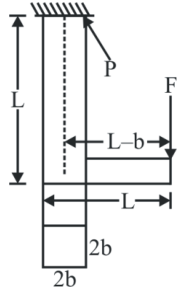
- A. $\frac{F(3L-b)}{4b^{3}}$
- B. $\frac{F(3L+b)}{4b^{3}}$
- C. $\frac{F(3L+4b)}{4b^{3}}$
- D. $\frac{F(3L-2b)}{4b^{3}}$
Answer: D. $\frac{F(3L-2b)}{4b^{3}}$
Explanation: The total axial stress $\sigma$ at the corner point P is the sum of the direct axial stress $\sigma_{a}$ and the bending stress $\sigma_{b}$. The direct axial stress is $\sigma_{a} = \frac{F}{Area} = \frac{F}{2b \times 2b} = \frac{F}{4b^{2}}$. The bending moment is $M = F(L-b)$. The section modulus is $Z = \frac{I}{Y} = \frac{(1/12)(2b)(2b)^{3}}{b} = \frac{4}{3}b^{3}$. The bending stress is $\sigma_{b} = \frac{M}{Z} = \frac{F(L-b)}{(4/3)b^{3}} = \frac{3F(L-b)}{4b^{3}}$. Adding both gives $\sigma = \frac{F}{4b^{2}} + \frac{3F(L-b)}{4b^{3}} = \frac{Fb + 3FL - 3Fb}{4b^{3}} = \frac{F(3L-2b)}{4b^{3}}$.