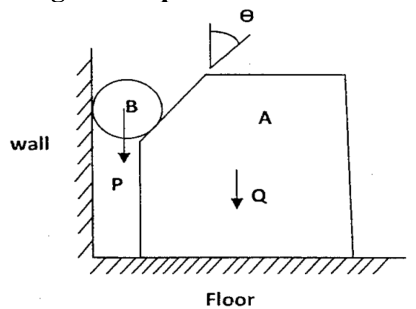
A solid block 'A' weighing 'Q' kg is resting on a flat floor. A smooth cylinder 'B' weighing 'P' kg, is placed between the solid A and the vertical wall as shown in fig. The friction between the cylinder, wall and the block A is negligible. The co-efficient of friction between the block A and floor is \mu. The minimum weight P required to disturb the block A is
- A. Q(1- tan\theta) / \mu tan\theta
- B. \mu Q tan\theta / (1- \mu tan\theta)
- C. \mu Q cos\theta
- D. \mu Q / cos\theta
Answer: B. \mu Q tan\theta / (1- \mu tan\theta)
Explanation: Normal reaction from B on A is R. Vertical component P = R sin\theta. Horizontal component R cos\theta pushes A. Normal reaction on A from ground N = Q + R sin\theta = Q + P. Friction force F = \mu(Q+P). To disturb, Horizontal Push = Friction. R cos\theta = \mu(Q+P). P cot\theta = \mu Q + \mu P. P(cot\theta - \mu) = \mu Q. P = \mu Q / (cot\theta - \mu) = \mu Q tan\theta / (1 - \mu tan\theta).