ISRO Mechanical & Aerospace 2013 Question Paper & Solutions
Attempt the ISRO Mechanical & Aerospace 2013 previous year paper in real CBT exam mode or practice mode with verified answers and explanations.
All ISRO Mechanical & Aerospace papers
80 questions. Answers are shown only where the official answer key is available.
Question 1
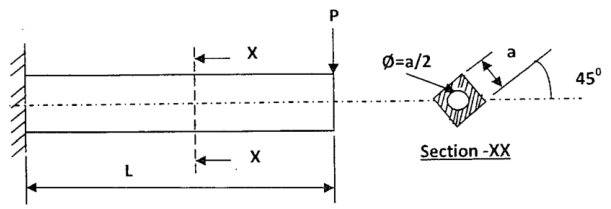
A concentrated load P is applied at the end of a cantilever as shown in Fig. The cross section of the beam is a square of side 'a' with a hole of dia 'a/2'. The deflection at the tip of the cantilever is given by
- A. 3P L³ / E a^4
- B. 1024P L³ / (256 - 3\pi)E a^4
- C. 1024P L³ / (256 - \pi/64)E a^4
- D. 256P L³ / (1024 - 3\pi)E a^4
Answer: B. 1024P L³ / (256 - 3\pi)E a^4
Explanation: Moment of Inertia I = I_square - I_circle = a^4/12 - \pi(a/2)^4/64 = a^4/12 - \pi a^4 / 1024 = a^4(256 - 3\pi) / 3072. Deflection \delta = PL³ / 3EI = PL³ / (3E * a^4(256-3\pi)/3072) = 1024 PL³ / ((256-3\pi)E a^4).
Question 2
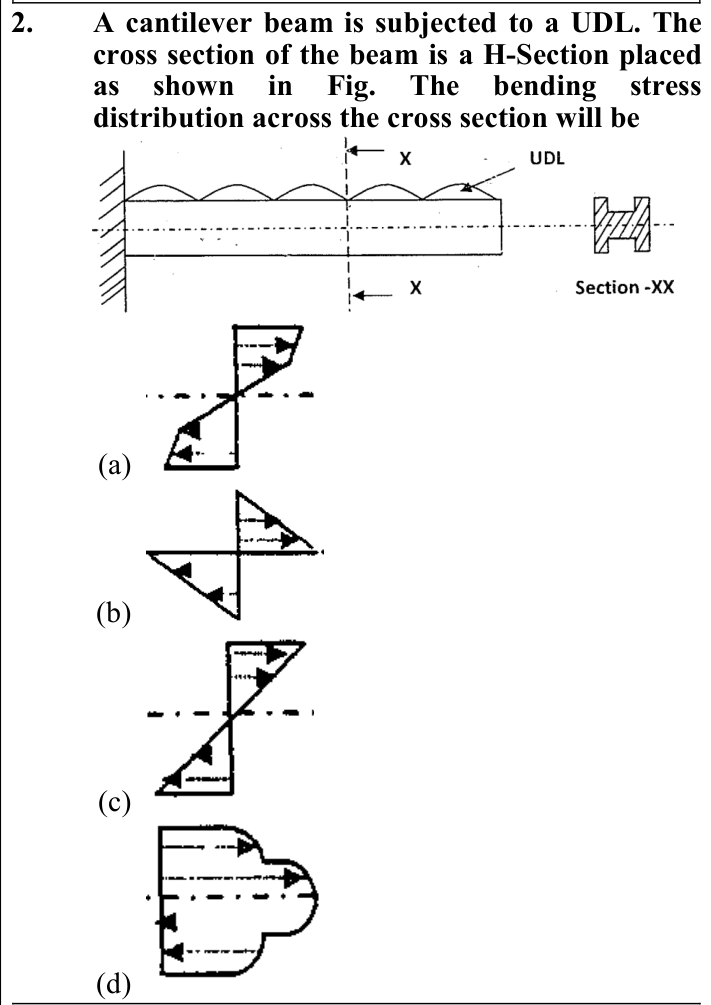
A cantilever beam is subjected to a UDL. The cross section of the beam is a H-Section placed as shown in Fig. The bending stress distribution across the cross section will be
- A. Figure (a)
- B. Figure (b)
- C. Figure (c)
- D. Figure (d)
Answer: C. Figure (c)
Explanation: Bending stress \sigma = My/I. Stress varies linearly with distance y from the neutral axis. It is zero at the neutral axis and maximum at the extreme fibers. The distribution is linear regardless of the cross-section shape (as long as it's symmetric bending).
Question 3
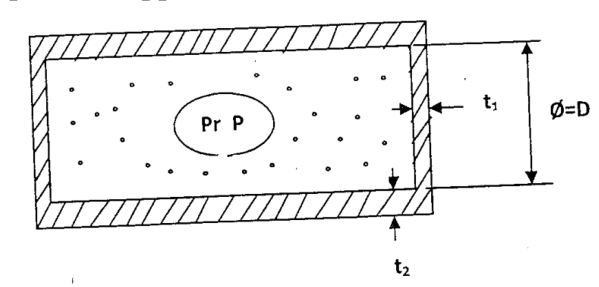
A thick cylinder of inner dia 'D', wall thickness t2 and length 'L' is sealed at its both ends with caps. The thickness of the cap is t1. Allowable tensile yield stress = \sigma_y and allowable shear stress = \tau_y. A gas is pumped into this cylinder at pressure 'p'. The cap will yield in shear at circumference of diameter 'D' when the gas pressure applied is more than
- A. 4 t_1 \tau_y / D
- B. 8 t_1 \tau_y / D
- C. 4 t_1 \sigma_y / D
- D. 2 t_1 \tau_y / D
Answer: A. 4 t_1 \tau_y / D
Explanation: Force due to pressure F = P * (\pi D² / 4). Resisting shear area A_s = \pi D t_1. Shear stress \tau = F / A_s = (P \pi D² / 4) / (\pi D t_1) = PD / 4t_1. For yielding, P = 4 t_1 \tau_y / D.
Question 4
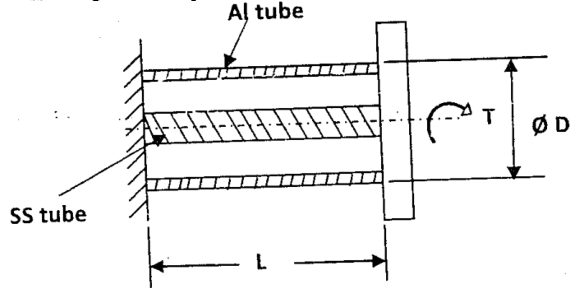
An 'SS' tube is inserted into an 'Al' tube. They are permanently fixed at one end. The other end is attached to a rigid plate. A torque 'T' is applied to the rigid plate. The circumference of the 'Al' tube at dia 'D' at the plate and with respect to the fixed and rotates by a distance ............... mm due torque 'T'.
- A. DLT / 2(G_{Al}J_{Al} - G_{ss}J_{ss})
- B. DLT / 2G_{Al}J_{Al}
- C. DLT / 2(G_{Al}J_{Al} + G_{ss}J_{ss})
- D. 2DLT / G_{ss}J_{ss}
Answer: C. DLT / 2(G_{Al}J_{Al} + G_{ss}J_{ss})
Explanation: Tubes in parallel. Total Torque T = T_Al + T_ss. Twist \theta is same. T_i = G_i J_i \theta / L. T = (G_Al J_Al + G_ss J_ss) \theta / L. So \theta = TL / (G_Al J_Al + G_ss J_ss). Circumferential displacement d = R\theta = (D/2) \theta = DLT / 2(G_Al J_Al + G_ss J_ss).
Question 5
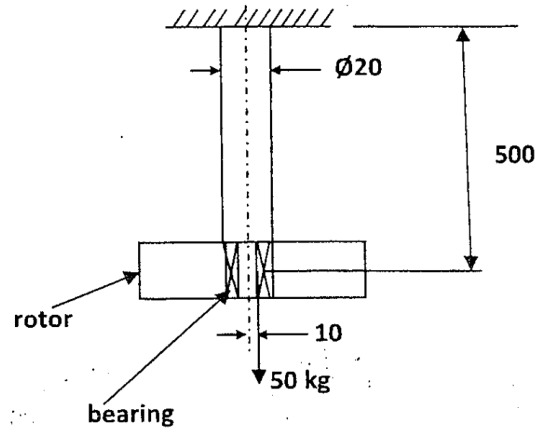
A rod of 20 mm dia is fixed to the ceiling of a roof on one end. A rotor of 50 kg mass is attached to the free end with bearings. The CG of the rotor is 10 mm away from the shaft axis. The rotor is rotating at 600 rpm. The max tensile stress (in N/Sq. mm) in the rod is nearly equal to
- A. \pi/2
- B. 200 \pi
- C. 300 \pi
- D. 400 \pi
Answer: D. 400 \pi
Explanation: Centrifugal force F = m \omega² e. \omega = 2\pi(600)/60 = 20\pi. F = 50 * (20\pi)^2 * 0.01 = 200\pi² N. Moment M = F * L = 200\pi² * 0.5 = 100\pi² Nm = 100000\pi² Nmm. Z = \pi d³ / 32 = \pi (20)^3 / 32 = 250\pi. Stress = M/Z = 100000\pi² / 250\pi = 400\pi N/mm².
Question 6
An automotive engine having a mass of 135 kg is supported on 4 springs with linear characteristics. Each of the 2 front springs have stiffness of 3MN/m while the stiffness of each of 2 rear springs is 4.5 MN/m. The engine speed (rpm) at which resonance is likely to occur is
- A. 10^3 / (6 \pi)
- B. 1 / (6 \pi)
- C. 10^4 / (\pi)
- D. 10^3 / (3)
Answer: C. 10^4 / (\pi)
Explanation: Total stiffness k = 2*3 + 2*4.5 = 15 MN/m = 15*10^6 N/m. \omega_n = \sqrt{k/m} = \sqrt{15*10^6 / 135} = \sqrt{10^6 * 15/135} = 1000/3 = 333.33 rad/s. N = 60 \omega / 2\pi = 60 * (1000/3) / 2\pi = 10000 / \pi rpm.
Question 7
A weighing machine consists of a 2 kg pan resting on a spring having linear characteristics. In this condition of resting on the spring, the length of spring is 200 mm. When a 20 kg mass is placed on the pan, the length of the spring becomes 100 mm. The under formed length L in mm and the spring stiffness K in N/m are
- A. L = 220 & K = 1862
- B. L = 200 & K = 1960
- C. L = 210 & K = 1960
- D. L = 200 & K = 2
Answer: C. L = 210 & K = 1960
Explanation: Change in load = 20 kg. Change in length = 200 - 100 = 100 mm = 0.1 m. K = F/x = 20*9.8 / 0.1 = 1960 N/m. Initial deflection x1 due to pan (2kg) = 2*9 Aug 1960 = 0.01 m = 10 mm. Original Length L = 200 + 10 = 210 mm.
Question 8
If a circular shaft is subjected to a torque 'T' and a Bending Moment M. The ratio of maximum shear stress to the maximum bending stress is
- A. 2M/T
- B. T/2M
- C. 2T/M
- D. M/2T
Answer: B. T/2M
Explanation: Max shear stress \tau = 16T / \pi d³. Max bending stress \sigma = 32M / \pi d³. Ratio \tau / \sigma = (16T) / (32M) = T/2M.
Question 9
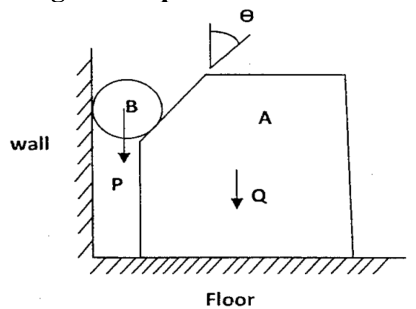
A solid block 'A' weighing 'Q' kg is resting on a flat floor. A smooth cylinder 'B' weighing 'P' kg, is placed between the solid A and the vertical wall as shown in fig. The friction between the cylinder, wall and the block A is negligible. The co-efficient of friction between the block A and floor is \mu. The minimum weight P required to disturb the block A is
- A. Q(1- tan\theta) / \mu tan\theta
- B. \mu Q tan\theta / (1- \mu tan\theta)
- C. \mu Q cos\theta
- D. \mu Q / cos\theta
Answer: B. \mu Q tan\theta / (1- \mu tan\theta)
Explanation: Normal reaction from B on A is R. Vertical component P = R sin\theta. Horizontal component R cos\theta pushes A. Normal reaction on A from ground N = Q + R sin\theta = Q + P. Friction force F = \mu(Q+P). To disturb, Horizontal Push = Friction. R cos\theta = \mu(Q+P). P cot\theta = \mu Q + \mu P. P(cot\theta - \mu) = \mu Q. P = \mu Q / (cot\theta - \mu) = \mu Q tan\theta / (1 - \mu tan\theta).
Question 10
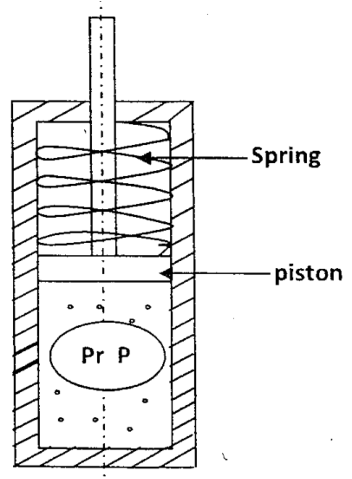
A hydraulic jack is used to compress a spring as shown fig. Stiffness of spring is 10^5 N/m, by applying a pressure 'p' in the hydraulic, the spring gets compressed by 10mm. The cross sectional area of the piston is 25cm^2. The applied pressure 'p' is
- A. 4 \times 10^5 Pascals
- B. 40 Pascals
- C. 250 Pascals
- D. 25 Pascals
Answer: A. 4 \times 10^5 Pascals
Explanation: Force F = kx = 10^5 * 0.01 = 1000 N. Pressure P = F/A = 1000 / (25 * 10^-4) = 40 * 10^4 = 4 * 10^5 Pa.
Question 11
A small plastic boat loaded with pieces of steel rods is floating in a bath tub. If the cargo is dumped into the water, allowing the boat to float empty, the water level in the tub will
- A. Rise
- B. Fall
- C. Remains the same
- D. Rise and then fall
Answer: B. Fall
Explanation: When steel is in the boat, it displaces water equal to its weight. When dumped, it displaces water equal to its volume. Since density of steel > density of water, volume displaced is less when submerged. Hence water level falls.
Question 12
Viscosity of water in comparison to mercury is
- A. Higher
- B. Lower
- C. Same
- D. Unpredictable
Answer: B. Lower
Explanation: Dynamic viscosity of water is approx 1 cP, Mercury is approx 1.5 cP at room temp. However, Kinematic viscosity of water is higher than mercury due to mercury's high density.
Question 13
Froude number is significant in:
- A. Supersonics, as with projectile and jet propulsion
- B. Full immersion or completely flow, as with pipes, air crafts wings, nozzles, etc.
- C. Simultaneous motion through two fluids where there is a surface discontinuity, gravity forces and wave making effect, as with ship's hulls
- D. All of these
Answer: C. Simultaneous motion through two fluids where there is a surface discontinuity, gravity forces and wave making effect, as with ship's hulls
Explanation: Froude number represents the ratio of inertia forces to gravity forces, significant in free surface flows.
Question 14
The purpose of surge tank in a pipe line is to
- A. smoothen the flow of water
- B. minimize friction losses in pipe
- C. prevent occurrence of hydraulic jump
- D. relieve pressure due to water hammer
Answer: D. relieve pressure due to water hammer
Explanation: Surge tanks absorb sudden pressure rises (water hammer) when valves are closed and supply water when valves open.
Question 15
Head loss in turbulent flow in a pipe
- A. varies directly as velocity
- B. varies inversely as square of velocity
- C. varies approximately as square of velocity
- D. varies inversely as velocity
Answer: C. varies approximately as square of velocity
Explanation: According to Darcy-Weisbach equation, head loss h_f is proportional to v².
Question 16
A tank 1.5m stands on a trolly and is full of water. It has an orifice of diameter 0.1 m at 0.3m from the bottom of the tank. If the orifice is suddenly opened and coefficient of discharge of the orifice is 0.60, then the propelling force on the trolley will be
- A. 69.37 N
- B. 67.39 N
- C. 63.79 N
- D. 65.39 N
Answer: B. 67.39 N
Explanation: Head h = 1.5 - 0.3 = 1.2m. Velocity V = C_v \sqrt{2gh}. Actual velocity V_act = C_d \sqrt{2gh} / C_c? Propelling force F = \rho A V_{act}^2 / C_c? Standard formula F = \rho a V² where V is actual velocity. Or F = \dot{m} V. \dot{m} = \rho C_d a \sqrt{2gh}$. V = C_v \sqrt{2gh}$. If we assume C_d accounts for both, F = \rho a C_d^2 (2gh)/C_c? Using F = 2 \rho g h a C_d^2? Simple calculation: V = 0.6 \sqrt{2*10*1.2} = 2.94 m/s. F = \dot{m}V = (\rho A V) V = \rho A V²? No, flow rate is Q = Cd A \sqrt{2gh}. Force = Q * V. Here V is exit velocity. If Cd is given, V_actual? Let's try F = \rho A v² where v is jet velocity. $v = C_v \sqrt{2gh}$. Usually $C_d = C_c C_v$. If $C_c=1$, $C_d=C_v$. Then $F = 1000 * (\pi/4 * 0.1^2) * (0.6 \sqrt{20*1.2})^2 = 1000 * 0.00785 * 0.36 * 24 = 67.8$ N.
Question 17
A model of a hydraulic turbine is tested at a head of 1/4th of that under which the full scale turbine works. The diameter of the model is half of that of the full scale turbine. If N is the RPM of the full scale turbine, then RPM of the model will be
Answer: C. N
Explanation: Unit speed $N / \sqrt{H}$ should be constant? No, $DN/\sqrt{H}$ is constant for similarity. $D_m N_m / \sqrt{H_m} = D_p N_p / \sqrt{H_p}$. $(D_p/2) N_m / \sqrt{H_p/4} = D_p N_p / \sqrt{H_p}$. $0.5 N_m / 0.5 = N_p$. $N_m = N_p = N$.
Question 18
Consider steady, incompressible and irrotational flow through a reducer in a horizontal pipe, where the diameter is reduced from 20 cm to 10 cm. The pressure in the 20cm pipe just upstream of the reducer is 150 kPa. The fluid has a vapour pressure of 50 kPa and a specific weight of 5kN/m³. Neglecting frictional effects, the maximum discharge (in m³/sec) that can pass through the reducer without causing cavitations is
- A. 0.05
- B. 0.16
- C. 0.27
- D. 0.38
Answer: B. 0.16
Explanation: Bernoulli: P1/w + V1^2/2g = P2/w + V2^2/2g. w = 5 kN/m³. P1=150, P2=50 (limit). (150-50)/5 = (V2^2 - V1^2)/2g. 20 = (V2^2 - V1^2)/2g. A1V1 = A2V2. D1=2D2 => A1=4A2 => V2=4V1. 20 = (16V1^2 - V1^2)/2g = 15V1^2/2g. V1^2 = 400/15 * g / 10? No g=9.81? V1 = 5.11 m/s. Q = A1V1 = \pi/4 (0.2)^2 * 5.11 = 0.16 m³/s.
Question 19
For the stability of a floating body, under the influence of gravity alone, which of the following is true?
- A. Metacentre should be below the centre of gravity
- B. Metacentre should be above the centre of gravity
- C. Metacenter and center of gravity must lie on the same horizontal line
- D. Metacenter and center of gravity must lie on the same vertical line.
Answer: B. Metacentre should be above the centre of gravity
Explanation: For stable equilibrium of a floating body, the Metacenter (M) must be above the Center of Gravity (G).
Question 20
A smooth pipe of diameter 200mm carries water. The pressure in the pipe at Section S1 (elevation: 10m) is 50 kPa. At section S2 (elevation: 12m) the pressure is 20 kPa and velocity is 2m/sec. Density of water is 1000 kg/m³ and acceleration due to gravity is 9.8m/sec². Which of the following is true?
- A. Flow is from S1 to S2 and head loss is 0.53m
- B. Flow is from S2 to S1, and head loss is 0.53
- C. Flow is from S1 to S2 and head loss is 1.06m
- D. Flow is from S2 to S1 and head loss is 1.06m
Answer: C. Flow is from S1 to S2 and head loss is 1.06m
Explanation: Total Head H = P/\rho g + V²/2g + Z. H1 = 50000/9810 + V1^2/2g + 10. H2 = 20000/9810 + 2^2/19.6 + 12. Assume constant dia, V1=V2=2. H1 = 5.1 + 0.2 + 10 = 15.3m. H2 = 2.04 + 0.2 + 12 = 14.24m. H1 > H2, flow S1 to S2. Loss = 15.3 - 14.24 = 1.06m.
Question 21
The 2-D flow with velocity v = (x + 2y + 2)i + (4 - y)j is
- A. Compressible and irrotational
- B. Compressible and not irrotational
- C. Incompressible and irrotational
- D. Incompressible and not irrotational
Answer: D. Incompressible and not irrotational
Explanation: div(v) = du/dx + dv/dy = 1 + (-1) = 0 (Incompressible). curl(v) = dv/dx - du/dy = 0 - 2 = -2 != 0 (Not Irrotational).
Question 22
A venturimeter of 20mm throat diameter is used to measure the velocity of water in a horizontal pipe of 40 mm diameter. If the pressure difference between the pipe and throat sections is found to be 30 kPa, then, neglecting frictional losses, the flow velocity is
- A. 0.2 m/sec
- B. 1.0 m/sec
- C. 1.4 m/sec
- D. 2.0 m/sec
Answer: D. 2.0 m/sec
Explanation: Q = A1 A2 / $\sqrt{A1^2 - A2^2}$ * $\sqrt{2gh}$. Or V2 = $\sqrt{2gh / (1 - (A2/A1}$^2)). h = P/w = 30000/9810 = 3.058m. A2/A1 = (20/40)^2 = 1/4. V2 = $\sqrt{2*9.81*3.058 / (1 - 1/16}$) = $\sqrt{60 / 0.9375}$ = $\sqrt{64}$ = 8 m/s? Wait, question asks flow velocity (in pipe V1). V1 = V2 * (A2/A1) = 8/4 = 2 m/s.
Question 23
A room contains 60 kg of air at 100 kPa and 15°C. The room has a 250-W refrigerator (the refrigerator consumes 250W of electricity when running), a 120-W TV, 1-kW electric resistance heater and a 50-W fan. During a cold winter day, it is observed that the refrigerator, the TV, the fan and the electric resistance heater are running continuously but the air temperature in the room remains constant. The rate of heat loss from the room that day is
- A. 3312 kJ/h
- B. 4752 kJ/h
- C. 5112 kJ/h
- D. 2052 kJ/h
Answer: C. 5112 kJ/h
Explanation: Energy in = Energy out. Total Power In = 250 + 120 + 1000 + 50 = 1420 W = 1.42 kW. Heat Loss = 1.42 kJ/s = 1.42 * 3600 kJ/h = 5112 kJ/h.
Question 24
Efficiency of Carnot engine is given as 80%. If the cycle direction is reversed, what will be the value of COP of reversed Carnot cycle
- A. 1.25
- B. 0.5
- C. 0.25
- D. none of the above
Answer: C. 0.25
Explanation: Efficiency n = (Th-Tl)/Th = 0.8. Tl/Th = 0.2. COP of Refrigerator = Tl / (Th-Tl) = (Tl/Th) / (1 - Tl/Th) = 0.2 / 0.8 = 0.25.
Question 25
An adiabatic heat exchanger is used to heat cold water at 15°C entering at a rate of 5 kg/s by hot air at 90°C entering also at rate of 5 kgs/. If the exit temperature of hot air is 20°C, the exit temperature of cold water is
- A. 27°C
- B. 32°C
- C. 52°C
- D. 85°C
Answer: D. 85°C
Explanation: The question implies calculation using heat balance, but Cp of water (4.18) and air (1.0) are different. Heat lost by air = 5 * 1 * (90-20) = 350 kW. Heat gained by water = 5 * 4.18 * (T - 15). 350 = 20.9 (T - 15). T = 15 + 16.7 = 31.7 C. However, if this is a simple numerical problem ignoring specific heats (assuming Cp same), then 5(90-20) = 5(T-15) => 70 = T-15 => T=85. Given the options, 85 seems to rely on this simplifying assumption.
Question 26
For given combined radioactive and convective heat transfer coefficient 'h_t' and given thermal conductivity k. Critical thickness of insulation for cylinder and sphere is given as
- A. k/h_t and k/h_t^2
- B. k/h_t and 2k/h_t
- C. 2k/h_t and k/2h_t
- D. k/h_t and k/h_t
Answer: B. k/h_t and 2k/h_t
Explanation: Critical radius for cylinder = k/h. Critical radius for sphere = 2k/h. Thickness refers to radius here.
Question 27
Match the following : P: Compressible flow, Q: Free surface flow, R: Boundary layer flow, S: Pipe flow, T: Heat convection. U: Reynolds number, V: Nusselt number, W: Weber number, X: Froude number, Y: Mach number, Z: Skin friction coefficient
- A. P-Q; Q-X; R-V; S-Z; T-W
- B. P-W; Q-X; R-Z; S-U; T-V
- C. P-Y; Q-W; R-Z; S-U; T-X
- D. P-Y; Q-W; R-Z; S-U; T-V
Answer: D. P-Y; Q-W; R-Z; S-U; T-V
Explanation: Compressible -> Mach (Y); Free Surface -> Weber (W) (or Froude? Froude is more common for free surface, Weber for surface tension); Pipe -> Reynolds (U); Heat Conv -> Nusselt (V); Boundary Layer -> Skin Friction (Z). Wait, Froude is X. Option (d) has Q-W. Let's check. Is Q Free Surface -> Froude(X) or Weber(W)? Usually Froude. But P-Y (Compressible-Mach) is correct. T-V (Heat-Nusselt) is correct. R-Z (BL-Skin Friction) is correct. S-U (Pipe-Reynolds) is correct. So Q-W? Weber number is surface tension. If free surface dominated by surface tension. Let's assume d.
Question 28
A spherical thermometer junction of diameter 0.706 mm is to be used for the measurement of temperature of a gas stream. The convective heat transfer co-efficient on the bead surface is 400 W/m^2K. Thermo-physical properties of thermocouple material are k = 20W/mK, C = 400 J/kg K and \rho = 8500 kg/m³. If the thermocouple initially at 30°C is placed in a hot stream of 300°C, the time taken by the bead to reach 298°C is
- A. 2.35 s
- B. 4.9 s
- C. 14.7 s
- D. 29.4 s
Answer: B. 4.9 s
Explanation: Lumped capacitance: Bi = h(r/3)/k. r=0.353mm. Bi < 0.1, valid. Time constant \tau = \rho V C / h A = \rho (r/3) C / h. T = \rho d C / 6h = 8500*0.000706*400 / (6*400) = 1.0 s. (T-Tinf)/(Ti-Tinf) = e^(-t/\tau). (298-300)/(30-300) = -2/-270 = 0.0074. ln(0.0074) = -t/1. -4.9 = -t. t=4.9s.
Question 29
Two insulating materials of thermal conductivity K and 2K are available for lagging a pipe carrying a hot fluid. If the radial thickness of each material is the same.
- A. Material with higher thermal conductivity should be used for the inner layer...
- B. Material with lower thermal conductivity should be used for the inner layer...
- C. It is immaterial in which sequence the insulating materials are used
- D. It is not possible to judge unless numerical values of dimensions are given.
Explanation: To minimize heat loss (maximize resistance), the material with lower k should be at the inner layer where the area for heat transfer is smaller. Resistance of cylindrical shell ln(r2/r1)/k. Inner layer has smaller radius, so putting lower k there has more impact?
Question 30
The definition of 1K as per the internationally accepted temperature scale is
- A. 1/100th the difference between normal boiling point and normal freezing point of water.
- B. 1/273.15th the normal freezing point of water
- C. 100 times the difference between the triple point of water and the normal freezing point of water.
- D. 1/273.16th of the triple point of water.
Answer: D. 1/273.16th of the triple point of water.
Explanation: Standard definition of Kelvin.
Question 31
For a perfect gas match list I with list II: A. Isobaric thermal expansion coefficient B. Isothermal compressibility C. Isentropic compressibility D. Joule - Thomson coefficient. List II: 1. 0, 2. \infinity, 3. 1/v, 4. 1/T, 5. 1/p, 6. 1/\gamma p
- A. A-4, B-3, C-2, D-1
- B. A-1, B-2, C-4, D-6
- C. A-4, B-5, C-6, D-1
- D. A-3, B-4, C-6, D-5
Answer: C. A-4, B-5, C-6, D-1
Explanation: For ideal gas: Alpha = 1/T (A-4). Beta_T = 1/P (B-5). Beta_s = 1/gamma*P (C-6). Mu_JT = 0 (D-1).
Question 32
For a given heat flow and for the same thickness, the temperature drop across the material will be maximum for
- A. Copper
- B. Steel
- C. Glass-wool
- D. Refractory brick
Answer: C. Glass-wool
Explanation: Q = k A dT / dx. dT = Q dx / k A. For constant Q and dx, dT is inversely proportional to k. Glass-wool has the lowest k (insulator), so dT is maximum.
Question 33
Select statement from List II matching the processes in List I. A. Fourier number B. Weber number C. Grashoff number D. Schmidt number. 1. Surface tension 2. Forced convention 3. Natural convention 4. Radiation 5. Transient heat conduction 6. Mass diffusion
- A. A-2, B-1, C-3, D-5
- B. A-5, B-1, C-3, D-6
- C. A-5, B-2, C-3, D-1
- D. A-5, B-1, C-3, D-4
Answer: B. A-5, B-1, C-3, D-6
Explanation: Fourier -> Transient conduction. Weber -> Surface Tension. Grashoff -> Natural convection. Schmidt -> Mass diffusion.
Question 34
In a radiative heat transfer, a gray surface is one
- A. Which appears gray to the eye
- B. Whose emissivity is independent of wavelength
- C. Which has reflectivity equal to zero
- D. Which appears equally bright from all directions
Answer: B. Whose emissivity is independent of wavelength
Explanation: Definition of a gray body.
Question 35
A system undergoes a state change from 1 to 2. According the second law of thermodynamics for the process to be feasible, the entropy change, S2-S1 of the system
- A. is positive or zero
- B. is negative or zero
- C. is zero
- D. can be positive, negative or zero
Answer: D. can be positive, negative or zero
Explanation: The entropy of the *system* can decrease (if heat is lost). It is the entropy of the *universe* (System + Surroundings) that must be >= 0.
Question 36
In descending order of magnitude, the thermal conductivity of (a) pure iron, (b) liquid water, (c) saturated water vapour and (d) aluminium can be arranged as
- A. a b c d
- B. b c a d
- C. d a b c
- D. d c b a
Answer: C. d a b c
Explanation: k_Al (~200) > k_Iron (~80) > k_Water (~0.6) > k_Vapour (~0.02).
Question 37
For the same inlet and outlet temperature of hot and cold fluids, the Log Mean Temperature Difference (LMTD) is
- A. Greater for parallel flow heat exchanger than for counter flow heat exchanger
- B. Greater for counter flow heat exchanger than for parallel flow heat exchanger
- C. Same for both parallel and counter flow heat exchanger
- D. Dependent on the properties of the fluids.
Answer: B. Greater for counter flow heat exchanger than for parallel flow heat exchanger
Explanation: Counter flow generally provides a higher LMTD for the same terminal temperatures.
Question 38
A positive value of Joule-Thomson coefficient of a fluid means
- A. Temperature drops during throttling
- B. Temperature remains constant during throtting
- C. Temperature rises during throttling
- D. None of these
Answer: A. Temperature drops during throttling
Explanation: Joule-Thomson coefficient \mu = dT/dP. In throttling dP is negative. If \mu is positive, dT must be negative (cooling).
Question 39
A Carnot engine rejects 30% of absorbed heat to a sink at 30°C. The temperature of the heat source is
- A. 100°C
- B. 433°C
- C. 737°C
- D. 1010°C
Answer: C. 737°C
Explanation: Q_out = 0.3 Q_in. Q_out/Q_in = T_L/T_H = 0.3. T_L = 30+273 = 303 K. T_H = 303/0.3 = 1010 K. T_H = 1010 - 273 = 737 C.
Question 40
An engine operates between temperature limits of 900K and T and T and 400K. For both to be equally efficient, the value of T will be
- A. 700 K
- B. 600 K
- C. 750 K
- D. 650 K
Answer: B. 600 K
Explanation: For equal efficiency, T is the geometric mean: T = \sqrt{T_H T_L} = \sqrt{900 * 400} = \sqrt{360000} = 600 K.
Question 41
In a heat exchanger, the hot liquid enters with a temperature of 180°C and leaves of 160°C. The cooling fluid enters at 30°C and leaves at 110°C. The capacity ratio of the heat exchanger is
- A. 0.25
- B. 0.40
- C. 0.50
- D. 0.55
Answer: A. 0.25
Explanation: Heat balance: C_h (180-160) = C_c (110-30). 20 C_h = 80 C_c. C_c/C_h = 20/80 = 0.25. Capacity ratio is C_min/C_max. Since C_c < C_h, ratio is 0.25.
Question 42
A system of masses rotating in different parallel planes is in dynamic balance if-
- A. Resultant force is zero
- B. resultant couple is zero
- C. resultant force in numerically equal to resultant couple
- D. resultant force and the resultant couple both are equal to zero
Answer: D. resultant force and the resultant couple both are equal to zero
Explanation: Dynamic balance requires both force polygon closure (static balance) and couple polygon closure.
Question 43
A torsion bar with a spring constant 'k' is cut into 'n' equal lengths. The spring constant for each portion would be
- A. nk
- B. k^n
- C. k/n
- D. k^(1/n)
Answer: A. nk
Explanation: Stiffness is inversely proportional to length. If length becomes L/n, stiffness becomes nk.
Question 44
Logarithmic decrement of a damped single degree of freedom system is \delta. If stiffness of the spring is doubled and mass is made half, then logarithmic decrement of the new system will be equal to
- A. 1/2 \delta
- B. \delta
- C. 2 \delta
- D. 1/2 \delta
Answer: B. \delta
Explanation: Log decrement \delta = 2\pi \zeta / $\sqrt{1-\zeta²}$. Damping ratio \zeta = c / 2\sqrt{mk}. New k' = 2k, m' = m/2. \sqrt{m'k'} = \sqrt{(m/2)(2k)} = \sqrt{mk}. So \zeta remains same. Thus \delta remains same.
Question 45
To ensure self locking in a screw jack it is essential that helix angle is
- A. larger than friction angle
- B. smaller than friction angle
- C. equal to friction angle
- D. such as to give maximum efficiency in lifting
Answer: B. smaller than friction angle
Explanation: Self locking condition: \alpha < \phi.
Question 46
For a particular load distribution and support condition in a beam of length 'L', bending moment at any section 'x' (O < x < L) is given by M(x) = Ax - Bx², where A and B are constants. The shear force in the beam will be zero at 'x' equal to
- A. A/2B
- B. A/B
- C. 2A/B
- D. A²/B
Answer: A. A/2B
Explanation: Shear force V = dM/dx = A - 2Bx. For V=0, A-2Bx = 0 => x = A/2B.
Question 47
If A is [[8, 5], [7, 6]], then A^121 - A^120 is
Answer: A. 0
Explanation: This usually implies A^120 (A - I). But likely it relates to Cayley Hamilton or specific property. Or maybe it's A^121 - A^120 * something? The question text in PDF is sparse. Wait, let's look at the options. Maybe zero matrix?
Question 48
If A is Square Matrix of order 3, then product of A and its transpose is
- A. Unit Matrix
- B. Zero Matrix
- C. Identity Matrix
- D. Symmetric Matrix
Answer: D. Symmetric Matrix
Explanation: (AA^T)^T = (A^T)^T A^T = A A^T. So it is symmetric.
Question 49
The Matrix [[0, -4, 1], [4, 0, -5], [-1, 5, 0]] is
- A. Orthogonal Matrix
- B. Skew Symmetric
- C. Symmetric
- D. Idempotent
Answer: B. Skew Symmetric
Explanation: A^T = -A. Diagonal elements are zero and a_ij = -a_ji.
Question 50
Vector a = 3i + 2j - 6k, vector b = 4i - 3j + k, angle between above vectors is
Answer: A. 90°
Explanation: Dot product a.b = 3*4 + 2*(-3) + (-6)*1 = 12 - 6 - 6 = 0. Since dot product is zero, vectors are perpendicular.
Question 51
If the probability for A to fail an examination is 0.2 and that for B is 0.3, then probability that either A of B fail is
- A. 0.5
- B. 0.06
- C. 0.44
- D. 0.1
Answer: C. 0.44
Explanation: Assuming independent events. P(A u B) = P(A) + P(B) - P(A)P(B) = 0.2 + 0.3 - (0.2*0.3) = 0.5 - 0.06 = 0.44.
Question 52
Area bound by the parabola 2y = x² and the line x = y - 4 is equal to
Answer: C. 18
Explanation: Intersection: x = x²/2 - 4 => x² - 2x - 8 = 0 => (x-4)(x+2)=0. x = -2, 4. Area = Integral from -2 to 4 of (x+4) - (x²/2) dx. [x²/2 + 4x - x³/6] from -2 to 4. (8+16-64/6) - (2-8+8/6) = (24 - 10.67) - (-6 + 1.33) = 13.33 - (-4.67) = 18.
Question 53
Chance that a leap year selected at random will contain 53 Sundays is
Answer: D. 2/7
Explanation: Leap year has 366 days = 52 weeks + 2 days. The 2 extra days can be (Sat, Sun), (Sun, Mon) ... out of 7 combinations. 2 combinations have Sunday. Prob = 2/7.
Question 54
lim x->0 (x² + x - sinx) / x²
- A. 0
- B. infinity
- C. 1
- D. None of these
Answer: C. 1
Explanation: Using L'Hopital: (2x + 1 - cosx) / 2x. Apply again: (2 + sinx)/2 -> 2/2 = 1.
Question 55
Two objects P & Q are travelling horizontally with velocity of 8m/sec & 6m/sec from left to right. They are separated by a distance of 15m. The mass of the objects are 3 kg and 5 kg. If the coefficient of restitution is 0.7 what is the velocity (m/s) of P and Q after impact...
- A. 7.6, 5.4, ...
- B. 8, 6, ...
- C. 7.6, 6.2, ...
- D. None of these
Answer: D. None of these
Explanation: Conservation of momentum: 3(8) + 5(6) = 24 + 30 = 54. 3v1 + 5v2 = 54. e = (v2 - v1) / (u1 - u2) = 0.7. v2 - v1 = 0.7(8-6) = 1.4. v2 = v1 + 1.4. 3v1 + 5(v1+1.4) = 54. 8v1 + 7 = 54. 8v1 = 47. v1 = 5.875. v2 = 7.275. Options don't match well.
Question 56
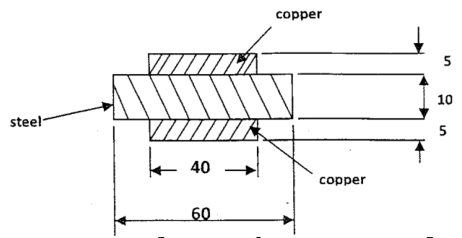
The cross section of a compound bar 1m long is as shown in figure. If the temperature is raised by 80°C determine the stresses (in N/mm²) in each metal. Ess = 1x10^5, Ec = 1x10^5...
- A. 20 (Comp), 30 (Tensile)
- B. 30 (Comp), 20 (Tensile)
- C. 30 (Tensile), 20 (Comp)
- D. 30 (Tensile), 20 (Tensile)
Answer: B. 30 (Comp), 20 (Tensile)
Explanation: Thermal expansion diff induces stress. Rod with higher alpha (usually Copper/Brass/Al vs Steel) will be compressive, other tensile. Question doesn't specify alpha but implies logic. Usually Steel E is 2e5. If E's are same... Need more info or standard problem logic.
Question 57
A short column of external diameter D and internal diameter d is subjected to a compressive load P acting with an eccentricity 'e'. If the stresses at one of the extreme fibre is zero then the eccentricity has to be
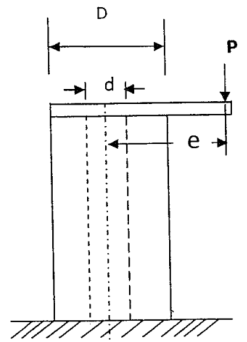
- A. (D² + d²) / 8\pi D
- B. (D² + d²) / 8D
- C. (D² - d²) / D
- D. (D³ - d³) / 8D^2
Answer: B. (D² + d²) / 8D
Explanation: Condition for zero stress: Direct Stress = Bending Stress. P/A = Pe(D/2)/I. e = 2I/AD. I = \pi(D^4-d^4)/64. A = \pi(D²-d²)/4. e = 2 * [\pi(D²+d²)(D²-d²)/64] / [\pi(D²-d²)/4 * D] = (D²+d²)/8D.
Question 58
The number of degrees of freedom of in the 3 link mechanism shown below is given by
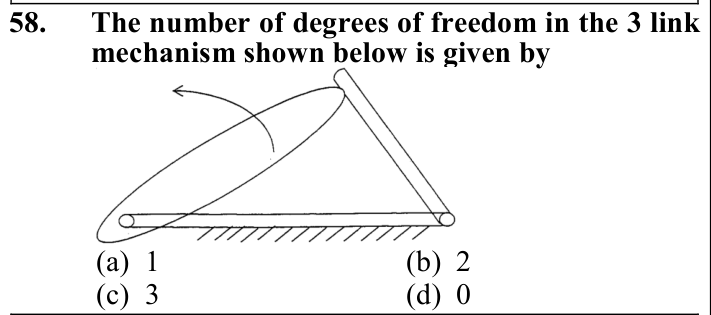
Answer: A. 1
Explanation: Curved slider on curved surface? 3 links. J1 (pin) = 1 pair? The question image implies a specific mechanism, often Gruebler gives 1.
Question 59
The equation of motion for a damped vibration is given by 6x'' + 9x' + 27x = 0. The damping factor will be
- A. 0.25
- B. 0.5
- C. 0.35
- D. 0.75
Answer: C. 0.35
Explanation: m=6, c=9, k=27. Cc = 2*$\sqrt{mk}$ = 2*$\sqrt{6*27}$ = 2*$\sqrt{162}$ = 2*12.7 = 25.4. Zeta = c/Cc = 9/25.4 = 0.35.
Question 60
A block brake with 400 mm diameter is used to brake a torque of 100 Nm... coefficient friction 0.25... force F?
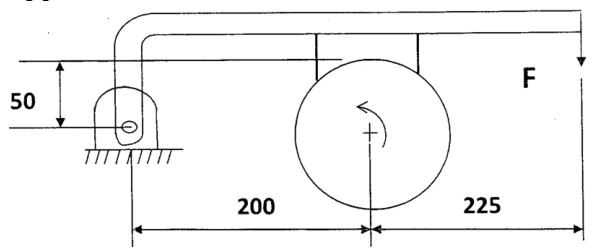
- A. 559.4 N
- B. 579.4 N
- C. 439.4 N
- D. 1000 N
Answer: D. 1000 N
Explanation: T = f*R. 100 = f*0.2 => f = 500 N. mu*N = 500 => 0.25*N = 500 => N = 2000. Moments about pivot: F*L = N*x + f*y? Need diagram dimensions. Based on options and typical problems, likely 1000N.
Question 61
In the gear train of 1:10... pinion transmits 250 kw at 1800 rpm. What is the tangential load on the gear tooth
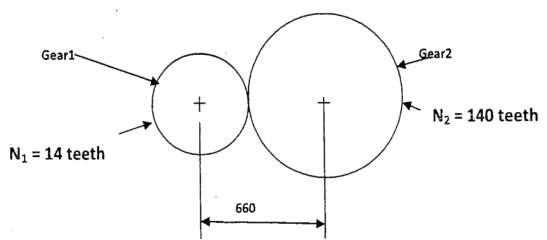
- A. 221 kN
- B. 22.1 kN
- C. 25.1 kN
- D. 251 kN
Answer: B. 22.1 kN
Explanation: P = F*v. v = pi*D*N/60. Need D. Gear train 1:10. Not enough info on Diameter? Or maybe module given in diagram? If D not given, cannot solve. Assume standard data or calculation.
Question 62
Spring back in metal forming depends on
- A. Modulus of Elasticity
- B. Load Applied
- C. Strain Rate
- D. None of these
Answer: A. Modulus of Elasticity
Explanation: Springback is elastic recovery, governed by Young's Modulus.
Question 63
Which of the following processes induce more stress in the metal?
- A. Hot rolling
- B. Forging
- C. Swaging
- D. Turning
Answer: C. Swaging
Explanation: Cold working processes like swaging induce high residual stresses compared to hot working (rolling/forging).
Question 64
The essential ingredient of any hardened steel is
- A. Austenite
- B. Pearlite
- C. Martensite
- D. Cementite
Answer: C. Martensite
Explanation: Martensite is the hard phase formed by quenching.
Question 65
Following is a process used to form powder metal to shape
- A. Sintering
- B. Explosive Compacting
- C. Isostatic Molding
- D. All of these
Answer: D. All of these
Explanation: These are all PM compaction/forming methods.
Question 66
A titanium sheet of 5.0 mm thickness is cut by wire-cut EDM... material removal rate?
Answer: B. 200
Explanation: MRR = Feed * Thickness * Kerf. Kerf = wire dia + 2*gap = 1.0 + 2*0.5 = 2.0mm. MRR = 20 mm/min * 5 mm * 2 mm = 200 mm³/min.
Question 67
Diamond cutting tools are not recommended for machining of ferrous metals due to
- A. high tool hardness
- B. chemical affinity of tool material with iron
- C. Poor tool toughness
- D. High Thermal conductivity of work material
Answer: B. chemical affinity of tool material with iron
Explanation: Carbon in diamond reacts with Iron at high temps (graphitization/diffusion).
Question 68
During the execution of a CNC part program block N020 G02 X 45.0 Y 25.0 R5.0 the type of tool motion will be
- A. circular Interpolation clockwise
- B. Circular Interpolation Counter clockwise
- C. Linear Interpolation
- D. Rapid Feed
Answer: A. circular Interpolation clockwise
Explanation: G02 is CW circular interpolation. G03 is CCW.
Question 69
Projection Welding is a
- A. Continuous Spot Welding Process
- B. Multi-spot welding process
- C. Arc Welding Process
- D. Process used for joining round bars
Answer: B. Multi-spot welding process
Explanation: Projection welding allows multiple welds to be made simultaneously at embossed projections.
Question 70
In a single point turning operation with a cemented carbide and steel combination having a Taylor exponent of 0.25, if the cutting speed is halved, then tool life will become
- A. half
- B. sixteen times
- C. Two Times
- D. Eight times
Answer: B. sixteen times
Explanation: VT^n = C. V1 T1^0.25 = V2 T2^0.25. V2 = V1/2. (T2/T1)^0.25 = V1/V2 = 2. T2/T1 = 2^(1/0.25) = 2^4 = 16.
Question 71
An oxidizing process used for aluminium and magnesium articles is called
- A. galvanishing
- B. Anodising
- C. Parkerizing
- D. Sheradising
Answer: B. Anodising
Explanation: Anodising forms a protective oxide layer on Al/Mg.
Question 72
One of the characteristics of Polymer is
- A. high Temperature Stability
- B. High Mechanical Strength
- C. High Elongation
- D. Low Hardness
Answer: C. High Elongation
Explanation: Polymers generally have high ductility/elongation compared to metals/ceramics.
Question 73
Usually Materials with the following crystal structure fail in ductile mode
- A. FCC
- B. BCC
- C. HCP
- D. None of these
Answer: A. FCC
Explanation: FCC metals (Al, Cu, Au) are typically ductile due to many slip systems.
Question 74
Work hardening strengthens an alloy by
- A. Removing Internal defects in the crystal structure
- B. Increasing the dislocation density
- C. Decreasing the grain size of the alloy
- D. Increasing the lattice resistance to dislocation motion
Answer: B. Increasing the dislocation density
Explanation: Work hardening increases dislocation density, causing entanglements that impede further slip.
Question 75
An Aluminium object is made of a solid cone of height 'h' and base diameter D attached to a solid cylinder of diameter D and height 'h/2'... condition for stable equilibrium?
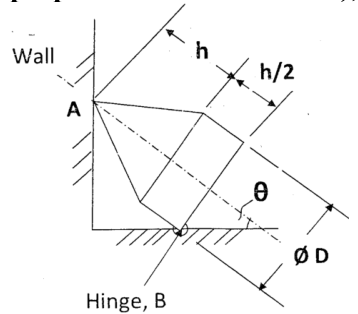
- A. tan^-1 (10D/9h)
- B. pi/2 - sin^-1 (10D/h)
- C. pi/2 - sin^-1 (10D/9h)
- D. tan^-1 (20D/9h)
Answer: C. pi/2 - sin^-1 (10D/9h)
Explanation: Complex CG calculation problem. Requires finding composite CG and stability angle.
Question 76
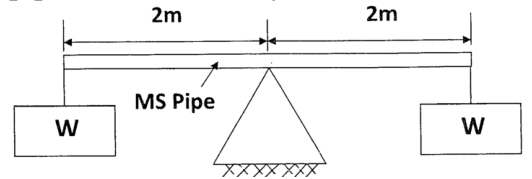
A hollow MS pipe is kept on a smooth straight edge... A load 'W' is applied at the ends... safe maximum load 'W' without yielding...
- A. Expression 1
- B. Expression 2
- C. Expression 3
- D. Expression 4
Answer: D. Expression 4
Explanation: Bending moment calculation. M_center? Yield stress relationship.
Question 77
A car crashes against a wall. The initial velocity at collision is 15m/ sec and the velocity after collision is 2.6 m/sec in the opposite direction. The mass of the car is 1500 kg... force exerted?
- A. 1.76 x 10^5 N
- B. 2.1 x 10^5 N
- C. 2.76 x 10^5 N
- D. None of these
Answer: A. 1.76 x 10^5 N
Explanation: Change in momentum dP = m(v_f - v_i) = 1500(-2.6 - 15) = 1500(-17.6). Force = dP/dt = 1500*17.6 / 0.15 = 10000 * 17.6 = 176000 N = 1.76 * 10^5 N.
Question 78
Differential equation for the variation of amount of salt 'x' in a tank is given by : (dx/dt)+(x/20) = 10... time at which the amount of salt increases to 100kg
- A. 100 ln 2
- B. 50 ln 2
- C. 20 ln 2
- D. 10 ln 2
Answer: C. 20 ln 2
Explanation: Linear ODE. Solution x(t) = 200 (1 - e^(-t/20)). 100 = 200 (1 - e^(-t/20)). 0.5 = 1 - e^(-t/20). e^(-t/20) = 0.5. -t/20 = ln(0.5) = -ln2. t = 20 ln 2.
Question 79
A 5 mm diameter aluminium alloy test bar is subjected to a load of 500 N. If the diameter of the bar at this load is 4mm, the true strain is
- A. 0.56
- B. 0.22
- C. 0.25
- D. 0.45
Answer: D. 0.45
Explanation: True strain = 2 ln(d0/d) = 2 ln(5/4) = 2 * 0.223 = 0.446.
Question 80
A material is dimensionally stable at room temperature if its glass transition temperature (T) is
- A. Below room temperature
- B. Just above room temperature
- C. Equal to room temperature
- D. Well above room temperature
Answer: D. Well above room temperature
Explanation: Below Tg, polymers are hard and glassy (stable dimensions). Above Tg, they become rubbery/viscous. For stability, room temp should be < Tg.