A particle starts from rest with a constant acceleration $\alpha$ m/sec$^2$ and after some time it decelerates at a uniform rate of $\beta$ m/sec$^2$ till it comes to rest. If the total time taken between two rests positions is t, the maximum velocity acquired by the particle would be
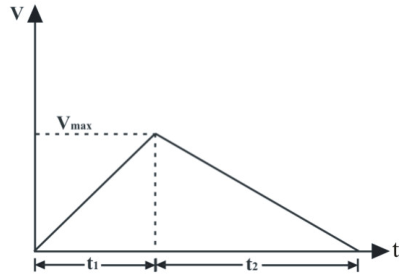
- A. $\frac{\alpha + \beta}{2}t$
- B. $\frac{\alpha - \beta}{2}t$
- C. $\left(\frac{\alpha\beta}{\alpha+\beta}\right)t$
- D. $\left(\frac{\alpha+\beta}{\alpha\beta}\right)t$
Answer: C. $\left(\frac{\alpha\beta}{\alpha+\beta}\right)t$
Explanation: $V_{max} = t_1 \alpha = t_2 \beta$. $t = t_1 + t_2 = V_{max}/\alpha + V_{max}/\beta$. $V_{max} = t / (1/\alpha + 1/\beta) = t \alpha \beta / (\alpha + \beta)$.