ISRO Mechanical & Aerospace 2010 Question Paper & Solutions
Attempt the ISRO Mechanical & Aerospace 2010 previous year paper in real CBT exam mode or practice mode with verified answers and explanations.
All ISRO Mechanical & Aerospace papers
80 questions.
Question 1
If thermal conductivity of a material of wall varies as $k_0 (1 - \alpha T)$, the temperature at the center of the wall will be ($\alpha$ is +ve)
- A. Depends on other factors
- B. More than that in case of constant thermal conductivity
- C. Less than that in case of constant thermal conductivity
- D. None of the above
Answer: C. Less than that in case of constant thermal conductivity
Explanation: With positive $\alpha$, k decreases as T increases. This non-linearity results in a temperature profile that bows downwards compared to the linear profile of constant k.
Question 2
The spectral emissive power $E_\lambda$ for a diffusely emitting surface is $E_\lambda = 0$ for $\lambda > 3 \mu m$; $E_\lambda = 150 W/m²\mu m$ for $3 < \lambda < 12 \mu m$; $E_\lambda = 300 W/m²\mu m$ for $12 < \lambda < 25 \mu m$; $E_\lambda = 0$ for $\lambda > 25 \mu m$. The total emissive power of the surface over the entire spectrum is
- A. 1250 W/m²
- B. 2500 W/m²
- C. 4000 W/m²
- D. 5250 W/m²
Answer: D. 5250 W/m²
Explanation: Total power = $\int E_\lambda d\lambda = 150(12-3) + 300(25-12) = 150(9) + 300(13) = 1350 + 3900 = 5250$.
Question 3
A wire is plastically deformed bent by supplying a force of 40 N over a distance of 0.8m. (The force moves in the direction in which the distance is measured). If the wire has a mass of 0.2 kg and a specific heat of 0.5 kJ/kg°C estimate the maximum increase in the average temperature of the wire
- A. 0.03°C
- B. 0.3°C
- C. 3°C
- D. 30°C
Answer: B. 0.3°C
Explanation: Work Done $W = 40 \times 0.8 = 32$ J. Heat $Q = mc\Delta T = 0.2 \times 500 \times \Delta T = 100 \Delta T$. $32 = 100 \Delta T \Rightarrow \Delta T = 0.32$.
Question 4
Two rods one of length L and the other of length 2L are made of the same material and have the same diameter. The two ends of the longer rod are maintained at 100°C. One end of the shorter rod is maintained at 100°C while the other end is insulated. Both the rods are exposed to the same environment at 40°C. The temperature at the insulated end of the shorter rod is measured to be 55°C. The temperature at the midpoint of the longer rod would be
- A. 40°C
- B. 50°C
- C. 55°C
- D. 100°C
Answer: C. 55°C
Explanation: By symmetry, the midpoint of the 2L rod with both ends at 100°C is equivalent to the insulated end of a length L rod with one end at 100°C (adiabatic boundary condition at symmetry plane).
Question 5
A sphere, a cube and a disc all of the same material, quality and volume are heated to 900 K and left in air. Which of these will have the lowest rate of cooling
- A. Cube
- B. Disc
- C. Sphere
- D. All will have the same rate of cooling
Answer: C. Sphere
Explanation: Cooling rate is proportional to Surface Area / Volume. For a given volume, a sphere has the minimum surface area, thus the slowest cooling rate.
Question 6
Air with initial condition of $P_1, V_1$ expands to final condition of $P_1/2, 3V_1$. The process is
- A. Hyperbolic
- B. Adiabatic
- C. Polytropic with n > 1
- D. Polytropic with n < 1
Answer: D. Polytropic with n < 1
Explanation: $P_1 V_1^n = P_2 V_2^n \Rightarrow P_1 V_1^n = (P_1/2) (3V_1)^n \Rightarrow 2 = 3^n$. $\ln 2 = n \ln 3 \Rightarrow n = \ln 2 / \ln 3 \approx 0.63 < 1$.
Question 7
Sun's surface at 5800 K emits radiation at a wavelength of 0.5$\mu$. A furnace at 300°C will emit through a small opening, radiation at a wavelength of
- A. 5$\mu$
- B. 0.5$\mu$
- C. 2.5$\mu$
- D. 0.25$\mu$
Answer: A. 5$\mu$
Explanation: Wien's Law: $\lambda_1 T_1 = \lambda_2 T_2$. $0.5 \times 5800 = \lambda_2 \times (300+273)$. $2900 = \lambda_2 \times 573 \Rightarrow \lambda_2 \approx 5.06 \mu m$.
Question 8
Polytropic index n is given by
- A. $\log(p_2/p_1) / \log(v_1/v_2)$
- B. $\log(p_1/p_2) / \log(v_1/v_2)$
- C. $\log(v_1/v_2) / \log(p_2/p_1)$
- D. $\log(v_2/v_1) / \log(p_2/p_1)$
Answer: A. $\log(p_2/p_1) / \log(v_1/v_2)$
Explanation: $P_1 V_1^n = P_2 V_2^n \Rightarrow (V_1/V_2)^n = P_2/P_1 \Rightarrow n \log(V_1/V_2) = \log(P_2/P_1)$.
Question 9
The heat flow rate through parallel walls of thickness $L_1, L_2$ and $L_3$ and having surface areas $A_1, A_2$ and $A_3$, thermal conductivities $k_1, k_2$ and $k_3$, respectively and first and last walls maintained at temperature $t_1$ and $t_2$ will be
- A. $\frac{t_1-t_2}{\frac{L_1}{A_1 k_1} + \frac{L_2}{A_2 k_2} + \frac{L_3}{A_3 k_3}}$
- B. $\frac{t_1-t_2}{\frac{k_1}{A_1 L_1} + \frac{k_2}{A_2 L_2} + \frac{k_3}{A_3 L_3}}$
- C. $\frac{t_1-t_2}{\frac{L_1 L_2 L_3}{k_1 A_1 + k_2 A_2 + k_3 A_3}}$
- D. None of these
Answer: A. $\frac{t_1-t_2}{\frac{L_1}{A_1 k_1} + \frac{L_2}{A_2 k_2} + \frac{L_3}{A_3 k_3}}$
Explanation: For composite walls in series, the total thermal resistance is the sum of individual resistances ($R = L/kA$). $Q = \Delta T / \sum R$.
Question 10
Which of the following property of air does not increase with rise in temperature?
- A. Specific gravity
- B. Kinematic viscosity
- C. Thermal conductivity
- D. Thermal diffusivity
Answer: A. Specific gravity
Explanation: Specific gravity is proportional to density. For a gas, density decreases as temperature increases (at constant pressure).
Question 11
Choose the correct figure representing gas heat transfer in parallel flow heat exchanger?
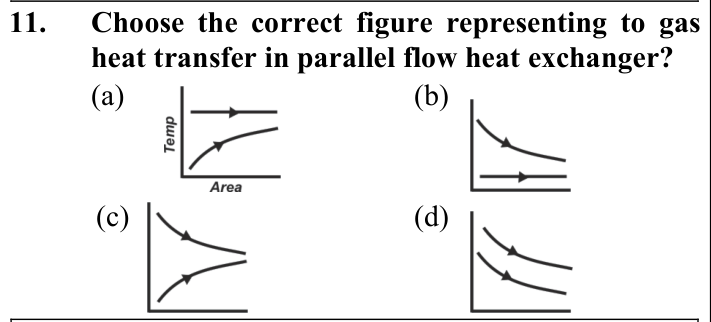
- A. Figure (a)
- B. Figure (b)
- C. Figure (c)
- D. Figure (d)
Answer: C. Figure (c)
Explanation: In parallel flow, both fluids enter at the same end. The hot fluid cools down and cold fluid heats up, moving in the same direction, so the temperature difference decreases along the length.
Question 12
The value of Prandtl number for air is about
- A. 0.1
- B. 0.3
- C. 0.7
- D. 10.5
Answer: C. 0.7
Explanation: For air and many gases, the Prandtl number is approximately 0.7.
Question 13
A body cools from 90°C to 80°C in 5 minutes. Under the same external conditions to cool from 80°C to 70°C the body will take
- A. 5 minutes
- B. 4 minutes
- C. 2.5 minutes
- D. More than 5 minutes
Answer: D. More than 5 minutes
Explanation: According to Newton's Law of Cooling, rate of cooling is proportional to temp difference. As temp drops, rate decreases, so time taken increases.
Question 14
When the temperature of a solid surface changes from 227°C to 1227°C, its total emissive power changes from E1 to E2. The ratio $E_2/E_1$ will be
- A. 3
- B. 9
- C. 81
- D. Cannot be determined
Answer: C. 81
Explanation: $E \propto T^4$. $T_1 = 227+273=500 K$. $T_2 = 1227+273=1500 K$. $E_2/E_1 = (1500/500)^4 = 3^4 = 81$.
Question 15
Characteristic gas constant of gas is equal to
- A. $C_p / C_v$
- B. $C_v / C_p$
- C. $C_p - C_v$
- D. $C_p + C_v$
Answer: C. $C_p - C_v$
Explanation: Mayer's relation: $R = C_p - C_v$.
Question 16
The matrix $A = \begin{bmatrix} -4 & -3 & -3 \\ 1 & 0 & 1 \\ 4 & 4 & x \end{bmatrix}$ is its own adjoint. The value of x will be
Answer: B. 3
Explanation: If $A = adj(A)$, then $A_{11} = C_{11}$, etc. $C_{33} = (-4)(0) - (-3)(1) = 3$. Since $A_{33} = x$, then $x=3$.
Question 17
The temperature of sun can be measured using a
- A. Standard thermometer
- B. Radiation pyrometer
- C. Platinum resistance thermometer
- D. Mercury thermometer
Answer: B. Radiation pyrometer
Explanation: Pyrometers measure temperature from a distance using thermal radiation, suitable for very high temperatures like the Sun.
Question 18
A car moving with uniform acceleration covers 450m in a 5 second interval, and covers 700 m in the next 5 second interval. The acceleration of the car is
- A. 7 m/s²
- B. 50 m/s²
- C. 25 m/s²
- D. 10 m/s²
Answer: D. 10 m/s²
Explanation: Distance in T seconds $S_T = uT + 0.5aT^2$. Let interval start at $u_1$. $450 = 5u_1 + 12.5a$. For next 5s, $S_{10} - S_5 = 700$. Total 10s distance = 1150. $1150 = 10u_1 + 50a$. Solving system gives $a = 10$.
Question 19
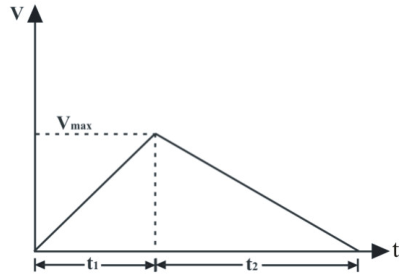
A particle starts from rest with a constant acceleration $\alpha$ m/sec$^2$ and after some time it decelerates at a uniform rate of $\beta$ m/sec$^2$ till it comes to rest. If the total time taken between two rests positions is t, the maximum velocity acquired by the particle would be
- A. $\frac{\alpha + \beta}{2}t$
- B. $\frac{\alpha - \beta}{2}t$
- C. $\left(\frac{\alpha\beta}{\alpha+\beta}\right)t$
- D. $\left(\frac{\alpha+\beta}{\alpha\beta}\right)t$
Answer: C. $\left(\frac{\alpha\beta}{\alpha+\beta}\right)t$
Explanation: $V_{max} = t_1 \alpha = t_2 \beta$. $t = t_1 + t_2 = V_{max}/\alpha + V_{max}/\beta$. $V_{max} = t / (1/\alpha + 1/\beta) = t \alpha \beta / (\alpha + \beta)$.
Question 20
Two metallic blocks having masses in the ratio 2:3 are made to slide down a friction less inclined plane starting initially from rest position. When these blocks reach the bottom of the inclined plane, they will have their kinetic energies in the ratio
Answer: A. 2:3
Explanation: Kinetic Energy gained = Potential Energy lost = mgh. Since h is same, ratio of KE is ratio of masses m1:m2 = 2:3.
Question 21
A particle is projected at an angle $\theta$ to the horizontal and it attains a maximum height H. The time taken by the projectile to reach the highest point, of its path is
- A. $\sqrt{H/g}$
- B. $\sqrt{2H/g}$
- C. $\frac{\sqrt{2H \sin \theta}}{g}$
- D. $\frac{\sqrt{2H}}{\sin \theta}$
Answer: B. $\sqrt{2H/g}$
Explanation: Max height $H = (u \sin \theta)^2 / 2g$. Vertical component $u_y = u \sin \theta = \sqrt{2gH}$. Time to max height $t = u_y / g = \sqrt{2gH}/g = \sqrt{2H/g}$.
Question 22
The tension in the cable supporting a lift moving upwards is twice the tension when the lift moves downwards. What is the acceleration of the lift?
Answer: B. g/3
Explanation: $T_{up} = m(g+a)$, $T_{down} = m(g-a)$. $m(g+a) = 2m(g-a) \Rightarrow g+a = 2g-2a \Rightarrow 3a = g \Rightarrow a = g/3$.
Question 23
For the apparent weight of a body at equator to become zero, the earth should rotate with an angular velocity of
- A. $\sqrt{2g/r}$
- B. $\sqrt{g/r}$
- C. $\sqrt{g/2r}$
- D. $g/r$
Answer: B. $\sqrt{g/r}$
Explanation: Apparent weight $W = m(g - r\omega²)$. For zero weight, $g = r\omega² \Rightarrow \omega = \sqrt{g/r}$.
Question 24
A cantilever beam AB of length L and uniform flexural rigidity EI has a bracket AC attached to its free end shown in Fig. Vertical load is applied to the free end C of the bracket. In order that the deflection of point A to be zero the ratio a/L should be
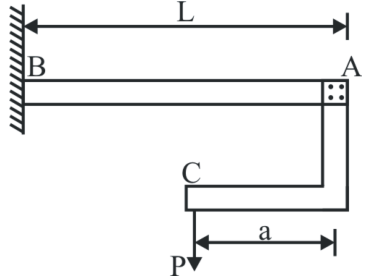
Answer: D. 2/3
Explanation: Load P at C causes force P and moment $M=Pa$ at A. Downward deflection due to P: $PL³/3EI$. Upward deflection due to M: $ML²/2EI$. Equating: $PL³/3EI = (Pa)L²/2EI \Rightarrow L/3 = a/2 \Rightarrow a/L = 2/3$.
Question 25
Given that $P_E$ = the crippling load given by Euler, $P_C$ = the load at failure due to direct compression, $P_R$ = the load in accordance with the Rankine's criterion of failure. Then $P_R$ is given by
- A. $(P_E + P_C)/2$
- B. $\sqrt{P_E \times P_C}$
- C. $\frac{P_E P_C}{P_C + P_E}$
- D. None of the above
Answer: C. $\frac{P_E P_C}{P_C + P_E}$
Explanation: Rankine's formula: $1/P_R = 1/P_C + 1/P_E$.
Question 26
Bending moment M and torque T is applied on a solid circular shaft. If the maximum bending stress equals to maximum shear stress developed, them M is equal to
Answer: A. T/2
Explanation: Max bending stress $\sigma_b = 32M/\pi d³$. Max shear stress $\tau = 16T/\pi d³$. $\sigma_b = \tau \Rightarrow 32M = 16T \Rightarrow M = T/2$.
Question 27
For solid shaft subjected to a torque of 18000 Nm having a permissible shear stress of 60N/mm$^2$, the diameter of shaft is
- A. 115 mm
- B. 121 mm
- C. 149 mm
- D. 108 mm
Answer: A. 115 mm
Explanation: $T = \frac{\pi}{16} \tau d³$. $18\times 10^6 = \frac{\pi}{16} (60) d³$. $d³ \approx 1527887$. $d \approx 115$ mm.
Question 28
Shear force is
- A. Rate of change of loading
- B. Sum of bending moments
- C. Rate of change of bending moment
- D. None of the above
Answer: C. Rate of change of bending moment
Explanation: $V = dM/dx$.
Question 29
Maximum deflection in cantilever due to pure bending moment M at its end is
- A. $ML²/2EI$
- B. $ML²/3EI$
- C. $ML²/4EI$
- D. $ML²/6EI$
Answer: A. $ML²/2EI$
Explanation: For cantilever with moment M at free end, curvature is constant $M/EI$. Deviation from tangent $\delta = Area \times \bar{x} = (ML/EI) \times L/2 = ML²/2EI$.
Question 30
Maximum shear stress in Mohr's circle is equal to
- A. Radius of circle
- B. Diameter of circle
- C. Center of circle from y-axis
- D. Chord of circle
Answer: A. Radius of circle
Explanation: Max shear stress is the radius of Mohr's circle, $(\sigma_1 - \sigma_2)/2$.
Question 31
Hardness of steel depends on
- A. Amount of carbon it contains
- B. The shape and distribution of the carbides in iron
- C. Method of fabrication
- D. Contents of alloying elements
Answer: A. Amount of carbon it contains
Explanation: Carbon content is the primary factor determining the maximum attainable hardness in steel.
Question 32
The modulus of $1 + \cos \alpha + i \sin \alpha$ is
- A. $2 \sin \frac{\alpha}{2}$
- B. $2 \cos \frac{\alpha}{2}$
- C. $\sin² \frac{\alpha}{2} - 1$
- D. $\cos² \frac{\alpha}{2} - 1$
Answer: B. $2 \cos \frac{\alpha}{2}$
Explanation: $|z| = \sqrt{(1+\cos\alpha)^2 + \sin²\alpha} = \sqrt{2+2\cos\alpha} = \sqrt{2(1+\cos\alpha)} = \sqrt{2(2\cos²(\alpha/2))} = 2\cos(\alpha/2)$.
Question 33
Hardness of martensite is about
- A. RC 65
- B. RC 48
- C. RC 57
- D. RC 80
Answer: A. RC 65
Explanation: Martensite is very hard, typically around Rockwell C 65.
Question 34
Materials after cold working are subjected to following process to relieve stresses
- A. Hot working
- B. Tempering
- C. Normalizing
- D. Annealing
Answer: D. Annealing
Explanation: Annealing (specifically process annealing or stress-relief annealing) is used to restore ductility and relieve internal stresses after cold work.
Question 35
In drop forging the forging is done by
- A. Dropping the workpiece at high velocity
- B. Dropping the hammer at high velocity
- C. Dropping the die with hammer at high velocity
- D. Dropping a weight on hammer to produce requisite impact
Answer: C. Dropping the die with hammer at high velocity
Explanation: In drop forging, a hammer (ram) carrying the upper die drops onto the workpiece placed on the lower die.
Question 36
Which of the machine tools can be used for boring? 1. Lathe 2. Drilling machine 3. Vertical milling machine 4. Horizontal milling machine
- A. 1, 2, 3
- B. 1, 3, 4
- C. 2 and 4
- D. 1 and 2
Answer: B. 1, 3, 4
Explanation: Boring can be done on Lathes, Milling machines, and Boring machines. Drilling machines are primarily for creating holes, though light boring is possible, standard practice lists the others.
Question 37
The vernier reading should not be taken at its face value before an actual check has been taken for
- A. Zero error
- B. Its calibration
- C. Flatness of measuring jaws
- D. Temperature equalization
Answer: A. Zero error
Explanation: Checking for zero error (reading when jaws are closed) is the first step to ensure accurate measurement.
Question 38
High carbon steel carries carbon percentage of
- A. 0.1 to 0.3%
- B. 0.3 to 0.6%
- C. 0.6 to 0.8%
- D. 0.8 to 1.5%
Answer: D. 0.8 to 1.5%
Explanation: High carbon steel typically contains 0.60% to 1.5% carbon.
Question 39
In order to measure/detect materials by non-destructive testing the method generally used is
- A. Acoustic emission
- B. Infrared radiometer
- C. Liquid crystallography
- D. Thermochemic point
Answer: A. Acoustic emission
Explanation: Acoustic emission is a standard NDT technique.
Question 40
Shock resisting steel should have
- A. Low wear resistance
- B. High wear resistance
- C. High toughness
- D. Poor hardenability
Answer: C. High toughness
Explanation: Toughness is the ability to absorb energy before fracture, essential for resisting shock/impact.
Question 41
A screw having coefficient of friction equal to or greater than the tangent of the load angle is known as
- A. Machine screw
- B. Self locking screw
- C. Set-screw
- D. Ball-bearing type screws
Answer: B. Self locking screw
Explanation: Condition for self-locking: $\phi \ge \alpha$ or $\tan \phi \ge \tan \alpha$, where $\mu = \tan \phi$.
Question 42
A bolt is designed with a large factor of safety, on the basis of
- A. Direct tensile stress
- B. Direct compressive stress
- C. Direct bending stress
- D. Direct shear stress
Answer: A. Direct tensile stress
Explanation: Bolts are primarily subjected to tensile loads during tightening and service.
Question 43
For two springs having same stiffness (k) are in series, the equivalent stiffness would be
Answer: B. k/2
Explanation: $1/k_{eq} = 1/k + 1/k = 2/k \Rightarrow k_{eq} = k/2$.
Question 44
A material is classified as brittle, if the elongation in a gauge length of 59mm, is less than
Answer: D. 5%
Explanation: Materials with less than 5% elongation at fracture are typically classified as brittle.
Question 45
In an extra humid atmosphere which one of the following motor would you select?
- A. Open type
- B. Semi-protected
- C. Drip proof
- D. Totally enclosed fan cooled
Answer: D. Totally enclosed fan cooled
Explanation: TEFC motors prevent moisture and contaminants from entering the motor windings.
Question 46
In fillet weld throat is
- A. Perpendicular distance from the root to the hypotenuse
- B. The smaller size of triangle of the fillet
- C. The larger size of triangle of the fillet
- D. None of the above
Answer: A. Perpendicular distance from the root to the hypotenuse
Explanation: The throat is the shortest distance from the root to the face of the weld (perpendicular to hypotenuse of the inscribed triangle).
Question 47
Sensitiveness of a governor is
- A. The ratio of the difference between the maximum and minimum equilibrium speed to the mean equilibrium speed
- B. The ratio of the maximum speed to minimum speed within the operating range
- C. The ratio of the difference between the maximum and mean speed to that of minimum to mean speed
- D. The range of variation of engine speed
Answer: A. The ratio of the difference between the maximum and minimum equilibrium speed to the mean equilibrium speed
Explanation: Sensitivity = $(N_2 - N_1) / N_{mean}$.
Question 48
The value of c which makes the angle 45° between $\vec{a} = \hat{i} + c\hat{j}$ and $\vec{b} = \hat{i} + \hat{j}$ is
- A. 1
- B. $1/\sqrt{2}$
- C. $-1/\sqrt{2}$
- D. 0
Answer: D. 0
Explanation: $\cos 45 = \frac{\vec{a}\cdot\vec{b}}{|a||b|} = \frac{1+c}{\sqrt{1+c²}\sqrt{2}} = \frac{1}{\sqrt{2}}$. $1+c = \sqrt{1+c²}$. Square both sides: $1+2c+c² = 1+c² \Rightarrow 2c=0 \Rightarrow c=0$.
Question 49
For traction applications, the type of motor best suited is
- A. Induction motor
- B. Synchronous motor
- C. DC shunt motor
- D. DC series motor
Answer: D. DC series motor
Explanation: DC series motors have high starting torque, ideal for traction.
Question 50
In simple harmonic motion the acceleration is proportional to
- A. Displacement
- B. Linear velocity
- C. Angular velocity
- D. Rate of change of angular velocity
Answer: A. Displacement
Explanation: $a = -\omega² x$. Acceleration is proportional to displacement x.
Question 51
A vibro meter
- A. Indicates vibration amplitude
- B. Indicates vibration frequency
- C. Indicates nature of vibrations
- D. only indicates second and above harmonics
Answer: A. Indicates vibration amplitude
Explanation: Vibrometers (seismic instruments with low natural frequency) measure displacement (amplitude) of the vibrating body.
Question 52
At node of the shaft
- A. The vibrations are minimum
- B. The vibrations are maximum
- C. The vibrations are average
- D. The vibrations are zero
Answer: D. The vibrations are zero
Explanation: A node is a point of zero amplitude in a standing wave pattern.
Question 53
Match List-I (Match property) with List-II (Related to): (A) Malleability (B) Hardness (C) Resilience (D) Isotropy vs 1. Wire drawing 2. Impact loads 3. Cold rolling 4. Indentation 5. Direction
- A. A-4, B-2, C-1, D-3
- B. A-3, B-4, C-2, D-5
- C. A-5, B-4, C-2, D-3
- D. A-3, B-2, C-1, D-5
Answer: B. A-3, B-4, C-2, D-5
Explanation: Malleability -> Cold rolling (sheets). Hardness -> Indentation. Resilience -> Impact loads. Isotropy -> Direction (properties independent of direction).
Question 54
The cutting speed of the tool in a mechanical shaper is
- A. Maximum at the beginning of the cutting stroke
- B. Maximum at the end of the cutting stroke
- C. Maximum at the middle of the cutting stroke
- D. Minimum at the middle of the cutting stroke
Answer: C. Maximum at the middle of the cutting stroke
Explanation: The velocity diagram of a shaper mechanism shows max velocity at the mid-stroke.
Question 55
Which is not correct statement about the function of flux in brazing
- A. To avoid thermal distortion and cracking
- B. To dissolve surface oxide coatings which have formed prior to brazing
- C. To prevent oxides from forming during the brazing operation
- D. To facilitate the wetting process
Answer: A. To avoid thermal distortion and cracking
Explanation: Flux cleans oxides and promotes wetting. Thermal distortion is controlled by heating methods, not flux.
Question 56
Investment casting is used for
- A. Shapes which are made by difficulty using complex patterns in sand casting
- B. Mass production
- C. Shapes which are very complex and intricate and can't be cast by any other method
- D. There is nothing like investment casting
Answer: C. Shapes which are very complex and intricate and can't be cast by any other method
Explanation: Investment casting produces intricate shapes with high accuracy.
Question 57
Internal and external threads can be produced on tapered surfaces conveniently by
- A. Universal milling machine
- B. Plano miller
- C. Planetary milling machine
- D. Lathe
Answer: D. Lathe
Explanation: A lathe with a taper turning attachment can cut threads on tapered surfaces.
Question 58
Optical square is
- A. Engineer's square having stock and blade set at 90°
- B. A constant deviation prism having the angle of deviation... equal to 90°
- C. A constant deviation prism having the angle of deviation... equal to 45°
- D. Used to produce interference fringes
Answer: C. A constant deviation prism having the angle of deviation... equal to 45°
Explanation: Note: Standard optical squares deviate light by 90°. The source PDF selected option (c) which says 45°. This might be referring to the angle between the reflecting surfaces (which is 45°) causing a 90° deviation.
Question 59
A master gauge is
- A. A new gauge
- B. An international reference standard
- C. A standard gauge for checking accuracy of gauges used on shop floors
- D. A gauge used by experienced technicians
Answer: C. A standard gauge for checking accuracy of gauges used on shop floors
Explanation: Master gauges are reference standards used to calibrate inspection gauges.
Question 60
Dimension of the hole is $50^{+0.02}_{-0.00}$ and shaft is $50^{+0.02}_{+0.00}$ mm. The minimum clearance is
- A. 0.02mm
- B. 0.00mm
- C. -0.02mm
- D. 0.01mm
Answer: C. -0.02mm
Explanation: Min Hole = 50.00. Max Shaft = 50.02. Min Clearance = 50.00 - 50.02 = -0.02 mm (Interference).
Question 61
Two cutters are mounted on the arbor so that two faces are machined simultaneously in
- A. Gang milling
- B. Straddle milling
- C. Pendulum milling
- D. Profile milling
Answer: B. Straddle milling
Explanation: Straddle milling uses two side cutters to machine parallel vertical surfaces.
Question 62
The main alloying elements in high speed steel in order of increasing proportion are
- A. Vanadium, Chromium, tungsten
- B. Tungsten, titanium, vanadium
- C. Chromium, titanium, vanadium
- D. Tungsten, chromium, titanium
Answer: A. Vanadium, Chromium, tungsten
Explanation: Typical 18-4-1 HSS contains 18% Tungsten, 4% Chromium, 1% Vanadium.
Question 63
Surface roughness on a drawing is represented by
- A. Triangles
- B. Circles
- C. Squares
- D. Rectangles
Answer: A. Triangles
Explanation: In engineering drawings, triangles (specifically inverted triangles) are used to indicate surface roughness.
Question 64
A husband and wife appear in an interview for two vacancies for same post. The probability of husband getting selected is 1/5 while the probability of wife getting selected is 1/7. Then the probability that anyone of them getting selected is
- A. 11/35
- B. 12/35
- C. 1/35
- D. 34/35
Answer: A. 11/35
Explanation: P(A or B) = P(A) + P(B) - P(A)P(B) = 1/5 + 1/7 - 1/35 = (7+5-1)/35 = 11/35.
Question 65
Cylindrical parts are held on planer by
- A. V-blocks and arrestors
- B. Angle plates
- C. V-block, T-bolts and clamps
- D. T-bolt and clamps
Answer: C. V-block, T-bolts and clamps
Explanation: V-blocks are used to hold cylindrical workpieces.
Question 66
Expressing a dimension as 25.3 ± 0.05 mm is the case of
- A. Unilateral tolerance
- B. Bilateral tolerance
- C. Limiting dimensions
- D. All of the above
Answer: B. Bilateral tolerance
Explanation: Tolerance is allowed on both sides of the nominal size.
Question 67
In comparison to an open-loop system a closed loop system is
- A. More stable
- B. More accurate
- C. More complex
- D. All of the above
Answer: D. All of the above
Explanation: Closed loop systems offer better accuracy and disturbance rejection but are more complex and stability is a key design concern (though they can stabilize unstable plants).
Question 68
[Image Question - Moody Diagram] The Moody diagram is shown in Fig. The friction factor for turbulent flow in a smooth pipe is given by curve
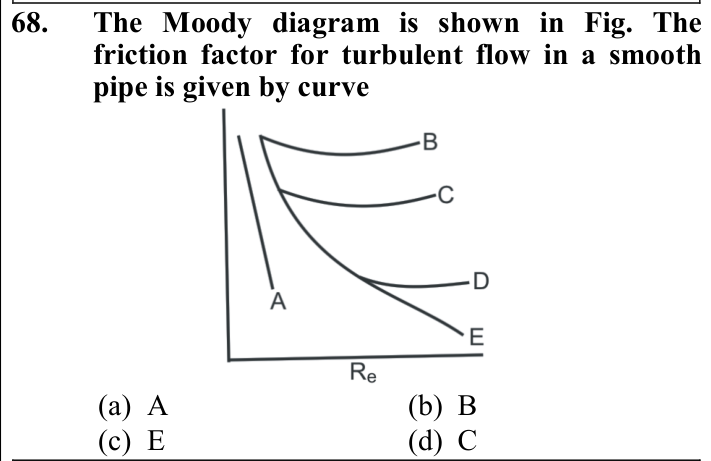
Answer: C. E
Explanation: For smooth pipes, friction factor depends only on Reynolds number and follows the lowest curve in the turbulent region.
Question 69
A piping system consists of three pipes arranged in series, the lengths of the pipes are 1200 m, 750 m and 600 m and diameter 750mm, 600 mm, 450 mm respectively. Transform the system to an equivalent 450 mm diameter pipe
- A. 671.3 m
- B. 771.3m
- C. 871.3m
- D. 971.3m
Answer: C. 871.3m
Explanation: Dupuit's equation: $L_e/D_e^5 = L_1/D_1^5 + L_2/D_2^5 + L_3/D_3^5$. With $D_e=450$, $L_e \approx 871.3$m.
Question 70
Friction drag is generally larger than the pressure drag in
- A. Flow past a sphere
- B. Flow past a thin sheet
- C. Flow past an airfoil
- D. Flow past a cylinder
Answer: C. Flow past an airfoil
Explanation: Streamlined bodies like airfoils have low pressure drag (form drag), so friction drag dominates.
Question 71
If D is the diameter of impeller at inlet, w is the width of impeller at inlet and $V_f$ is the velocity of flow at inlet, then discharge through a centrifugal pump is equal to
- A. $\pi D V_f$
- B. $D V_f w$
- C. $\pi D V_f w$
- D. $\pi D w$
Answer: C. $\pi D V_f w$
Explanation: Discharge area is circumference times width ($\pi D w$). $Q = Area \times Velocity = \pi D w V_f$.
Question 72
Cavitation parameter is defined by
- A. $(P - P_v) / (\rho V² / 2)$
- B. $(P_{atm} - P_v) / (\rho V² / 2)$
- C. $(P - P_{atm}) / (\rho V² / 2)$
- D. $(P - P_v) / (\rho V² / 2)$
Answer: A. $(P - P_v) / (\rho V² / 2)$
Explanation: The cavitation number $\sigma$ relates the pressure difference from vapor pressure to dynamic pressure.
Question 73
The maximum thickness of boundary layer in a pipe of radius R is
- A. 0.1R
- B. 0.22R
- C. 0.5R
- D. R
Answer: D. R
Explanation: In fully developed pipe flow, the boundary layers from the walls merge at the centerline, so thickness is the radius R.
Question 74
At a point A in a pipe line carrying water, the diameter is 1m, the pressure 98 kPa and the velocity 1m/s. At a point B, 2 m higher than A, the diameter is 0.5m and the pressure 20 kPa. The direction of flow would be
- A. A to B
- B. B to A
- C. Cannot be ascertained from data
- D. None of these
Answer: A. A to B
Explanation: Total Energy at A: $P/\gamma + v²/2g + z = 10 + 0.05 + 0 = 10.05$. At B: $V_B=4V_A=4$. $E_B = 2.04 + 0.81 + 2 = 4.85$. Fluid flows from high energy (A) to low energy (B).
Question 75
[Image Question - Manometer] In the given figure pressure p, in kPa, is
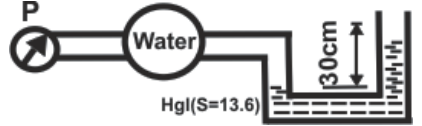
- A. 37
- B. 48.0
- C. 45.2
- D. 51.3
Answer: A. 37
Explanation: Manometer calculation: $P_{gauge} + \rho_{w} g h - \rho_{Hg} g H = 0$. $P = 13.6(9.81)(0.3) - 1(9.81)(0.3) \approx 37$ kPa.
Question 76
A small plastic boat loaded with pieces of steels rods is floating in a bath tub. If the cargo is dumped into the water allowing the boat to float empty, the water level in the tub will
- A. Rise
- B. Fall
- C. Not change
- D. Rise than fall
Answer: B. Fall
Explanation: When steel is in the boat, it displaces water equal to its weight. When submerged, it displaces water equal to its volume. Since steel density > water, volume displaced is less when submerged, so water level falls.
Question 77
Four cars, with a mass of 1500 kg each, are loaded on a 6 m wide, 12 m long small car ferry. How far, in cm will it sink in the water?
- A. 15.2
- B. 11.5
- C. 10.2
- D. 8.3
Answer: D. 8.3
Explanation: Extra weight = $4 \times 1500 \times g$. Extra Buoyancy = $\rho g (Area \times h)$. $6000 = 1000 (6 \times 12) h$. $h = 6000/72000 = 1/12$ m = 8.33 cm.
Question 78
Water enters a turbine at 900 kPa with negligible velocity. What maximum speed, in m/s, can it reach before it enters the turbine rotor?
Answer: A. 42
Explanation: Converting pressure head to kinetic head: $P/\rho = V²/2$. $V = \sqrt{2P/\rho} = \sqrt{2 \times 900000 / 1000} = \sqrt{1800} \approx 42.4$.
Question 79
Given that: Specific gravity of mercury = 13.6; Intensity of pressure = 40 kPa. Express the intensity of pressure (gauge) in various units (S.I.)
- A. 0.3 bar, 3.077 m of water, 0.15 m of mercury
- B. 0.4 bar, 4.077 m of water, 0.299 m of mercury
- C. 0.5 bar, 5.077 m of water, 0.339 m of mercury
- D. None of the above
Answer: B. 0.4 bar, 4.077 m of water, 0.299 m of mercury
Explanation: 40 kPa = 0.4 bar. Head water = 40/9.81 = 4.077m. Head Hg = 4.077/13.6 = 0.299m.
Question 80
The differential equation satisfying $y = Ae^{3x} + Be^{2x}$ is
- A. $d^2y/dx² + 5dy/dx - 6y = 0$
- B. $d^2y/dx² - 5dy/dx + 6y = 0$
- C. $d^2y/dx² + 5dy/dx + 6y = 0$
- D. $d^2y/dx² - 5dy/dx - 6y = 0$
Answer: B. $d^2y/dx² - 5dy/dx + 6y = 0$
Explanation: Roots are 3 and 2. Equation is $(D-3)(D-2)y = (D² - 5D + 6)y = 0$.