Topic: Control Systems
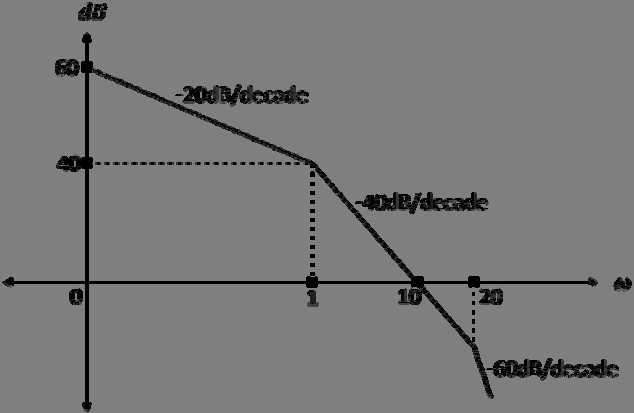
The voltage V in the circuit given below is :
- A. $\frac{2000}{s(s-1)(s+20)}$
- B. $\frac{2000}{s(s-1)(s-20)}$
- C. $\frac{1000}{s(s+1)(s-20)}$
- D. $\frac{2000}{s(s+1)(s+20)}$
Answer: D. $\frac{2000}{s(s+1)(s+20)}$
Explanation: The initial slope is -20 dB/dec, indicating a pole at the origin ($1/s$).
At $\omega=1$, the slope changes from -20 dB/dec to -40 dB/dec, meaning there is a simple pole at $s=1$.
At $\omega=20$, the slope changes from -40 dB/dec to -60 dB/dec, meaning another simple pole at $s=20$.
The general form is $H(s) = \frac{K_0}{s(s/1 + 1)(s/20 + 1)}$.
At $\omega=1$, the magnitude of the $K_0/s$ term dictates the graph before corner frequencies. So $20 \log_{10}(K_0 / 1) = 40$ dB $\implies K_0 = 100$.
$H(s) = \frac{100}{s(s+1)(s/20 + 1)} = \frac{2000}{s(s+1)(s+20)}$.