Topic: Engineering Mechanics
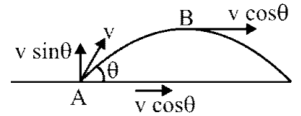
A shell is fired from cannon with a speed 'v' at an angle $\theta$ with the horizontal direction as shown in the figure. At the highest point in its path, it explodes into two pieces of equal mass. One of the pieces retraces its path to the cannon. The speed of other piece immediately after the explosion is
- A. $3v\cos\theta$
- B. $2v\cos\theta$
- C. $\frac{3}{2}v\cos\theta$
- D. $\sqrt{\frac{3}{2}}v\cos\theta$
Answer: A. $3v\cos\theta$
Explanation: At the highest point in projectile motion, the vertical velocity component is zero ($v_{y}=0$). The initial momentum of the shell of mass m is $P_{initial} = m(v\cos\theta\hat{i} + v\sin\theta\hat{j})$. Upon explosion, it splits into two masses of $m/2$. One piece retraces its path, meaning its velocity is opposite to the initial velocity, giving it a momentum of $-\frac{m}{2}v\cos\theta\hat{i}$. Applying the conservation of momentum: $m(v\cos\theta\hat{i}) = -\frac{m}{2}v\cos\theta\hat{i} + \frac{m}{2}v'\hat{i}$. Solving for $v'$ gives $\frac{3m}{2}v\cos\theta = \frac{m}{2}v'$, resulting in $v' = 3v\cos\theta$.