Topic: Theory of Machines and Vibrations
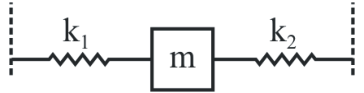
A block of mass 'm' is connected to two springs of stiffness $K_{1}$ and $K_{2}$ as shown in the figure $f_{1}$ and $f_{2}$ are the frequencies of the block when connected to $K_{1}$ and $K_{2}$ independently. Then the frequency of 'm' when connected to $K_{1}$ and $K_{2}$ as in the figure is
- A. $f=f_{1}+f_{2}$
- B. $f=f_{1}^{2}+f_{2}^{2}$
- C. $f=\sqrt{f_{1}^{2}+f_{2}^{2}}$
- D. $f=\sqrt{f_{1}^{2}-f_{2}^{2}}$
Answer: C. $f=\sqrt{f_{1}^{2}+f_{2}^{2}}$
Explanation: $f_{1}=\frac{1}{2\pi}\sqrt{\frac{k_{1}}{m}}$ and $f_{2}=\frac{1}{2\pi}\sqrt{\frac{k_{2}}{m}}$. When springs are in parallel, the equivalent stiffness is $k_{eq}=k_{1}+k_{2}$. Therefore, $f_{eq}=\frac{1}{2\pi}\sqrt{\frac{k_{1}+k_{2}}{m}} = \sqrt{(\frac{1}{2\pi}\sqrt{\frac{k_{1}}{m}})^2 + (\frac{1}{2\pi}\sqrt{\frac{k_{2}}{m}})^2} = \sqrt{f_{1}^{2}+f_{2}^{2}}$.