ISRO Mechanical & Aerospace 2007 Question Paper & Solutions
Attempt the ISRO Mechanical & Aerospace 2007 previous year paper in real CBT exam mode or practice mode with verified answers and explanations.
All ISRO Mechanical & Aerospace papers
80 questions. Answers are shown only where the official answer key is available.
Question 1
Topic: Thermodynamics
Only rocket engines can be propelled to space because
- A. They can generate very high thrust
- B. They have high propulsion efficiency
- C. These engines can work on several fuels
- D. They are not air-breathing engines
Answer: D. They are not air-breathing engines
Explanation: On earth, air tends to inhibit the exhaust gases from the engine (rocket), it reduce the thrust. However in space there is no atmosphere, the exhaust gases can exit much easier and faster, thus increasing the thrust. Thrust depends upon the speed of the exhaust gases and the mass of gas being expelled each second. Therefore the rocket engine actually works better in space than here on earth.
Question 2
Topic: Thermodynamics
The universal gas constant of a gas is the product of molecular weight of the gas and
- A. Gas constant
- B. Specific heat at constant pressure
- C. Specific heat at constant volume
- D. None of the above
Answer: A. Gas constant
Explanation: We know that, $PV=mRT$ and No. of mole (n) $=\frac{m}{M}$ so, $m=nM$. Therefore, $PV=nMRT$. Here $R=$ gas characteristic constant, $n=$ No of mole, $m=$ molecular mass, $M=$ molecular weight, $\overline{R}=$ universal gas constant. Thus, $MR=\overline{R}$.
Question 3
Topic: Thermodynamics
Vander Waal's equation of state of a gas is
- A. $PV=nRT$
- B. $(p+\frac{a}{V^{2}})(v+b)=RT$
- C. $(p+\frac{a}{V^{2}})(v-b)=RT$
- D. $(p-\frac{a}{V^{2}})(v-b)=RT$
Answer: C. $(p+\frac{a}{V^{2}})(v-b)=RT$
Explanation: $(p+\frac{a}{V^{2}})(v-b)=RT$ where $\frac{a}{V^{2}}=$ Account for intermolecular force (force of cohesion), $a=$ account for existence of mutual attraction between the molecules, $b=$ Account of co-volume (volume of molecules), $R=$ Gas characteristic constant.
Question 4
Topic: Heat Transfer
The radioactive heat transfer rate per unit area $(W/m^{2})$ between two plane parallel grey surfaces (emissivity $=0.9$ maintained at 400 K and 300 K is (Stefan Boltzmann constant $\sigma= 5.67\times10^{-8}W/m^{2}K^{4})$
Answer: B. 812
Explanation: Given, $\epsilon=0.9$, $T_{1}=400K$, $T_{2}=300~K$, $\sigma=5.67\times10^{-8}W/m^{2}K^{4}$. Heat transfer per unit area between parallel grey surface is given by $(\epsilon_{1}=\epsilon_{2}=\epsilon)$: $Q=\frac{\sigma(T_{1}^{4}-T_{2}^{4})}{(\frac{1}{\epsilon_{1}}+\frac{1}{\epsilon_{2}}-1)} = \frac{5.67\times10^{-8}\{(400)^{4}-(300)^{4}\}}{(\frac{1}{0.9}+\frac{1}{0.9}-1)} = 811.84~W/m^{2} \approx 812~W/m^{2}$.
Question 5
Topic: Thermodynamics
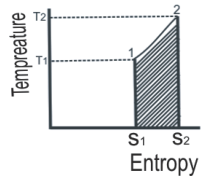
The efficiency $\eta$ of any heat engine and efficiency $\eta_{R}$ of a reversible heat engine operating between common heat source and heat sink are related as
- A. $\eta>\eta_{R}$
- B. $\eta<\eta_{R}$
- C. $\eta\ge\eta_{R}$
- D. $\eta\le\eta_{R}$
Answer: D. $\eta\le\eta_{R}$
Explanation: Let $\eta$ = efficiency of any heat engine and $\eta_{R} =$ efficiency of Reversible heat engine. According to Carnot's principle, no engine can be more efficient than a reversible engine operating between the same two thermal reservoirs. So, $\eta\le\eta_{R}$.
Question 6
Topic: Heat Transfer
A spherical shaped vessel of 1.4 m outer diameter is 90 mm thick. Find the rate of heat leakage, if the temperature difference between the inner and outer surfaces is $220^{\circ}C$. Thermal conductivity of the material of the sphere is 0.083 W/m K.
- A. 0.2 kW
- B. 0.5 kW
- C. 1.088 kW
- D. 1.6 kW
Answer: C. 1.088 kW
Explanation: Given, Outer diameter $(d_{2})=1.4m$, $r_{2}=0.7m$. $r_{1}=(0.7-0.09)m=0.61~m$. $dT=220^{\circ}C$, $k=0.083~W/mK$. Rate of heat leakage $Q=\frac{dT}{R_{th}}$. For a spherical shell, $R_{th}=\frac{r_{2}-r_{1}}{4\pi k r_{1}r_{2}} = \frac{0.09}{4\times3.14\times0.083\times0.7\times0.61} = 0.20218$. $Q=\frac{220}{0.20218} = 1.088~kW$.
Question 7
Topic: Fluid Mechanics
The velocity components in the x and y directions are given by $u=\lambda xy^{3}-x^{2}y$; $v=xy^{2}-\frac{3}{4}y^{4}$. The value of $\lambda$ for a possible flow field involving an incompressible fluid is
- A. $-\frac{3}{4}$
- B. 3
- C. $\frac{4}{3}$
- D. $-\frac{4}{3}$
Answer: B. 3
Explanation: For a possible incompressible flow, continuity equation must be satisfied: $\frac{\partial u}{\partial x}+\frac{\partial v}{\partial y}=0$. Given $u=\lambda xy^{3}-x^{2}y$, $\frac{\partial u}{\partial x}=\lambda y^{3}-2xy$. Given $v=xy^{2}-\frac{3}{4}y^{4}$, $\frac{\partial v}{\partial y}=2xy-3y^{3}$. Substituting into the continuity equation: $\lambda y^{3}-2xy+2xy-3y^{3}=0 \implies y^{3}(\lambda-3)=0$. Since $y\ne0$, $\lambda=3$.
Question 8
Topic: Heat Transfer
The temperature field in a body varies according to the equation $T(x,y)=x^{3}+4xy$. The direction of fastest variation in temperature at the point (1,0) is given by
- A. $3\hat{i}+8\hat{j}$
- B. $\hat{i}$
- C. $0.6\hat{i}+0.8\hat{j}$
- D. $0.5\hat{i}+0.866\hat{j}$
Answer: C. $0.6\hat{i}+0.8\hat{j}$
Explanation: For fastest variation, we calculate the gradient: $\nabla T = \frac{\partial T}{\partial x}\hat{i}+\frac{\partial T}{\partial y}\hat{j}$. $T=x^{3}+4xy$. $\frac{\partial T}{\partial x}=3x^{2}+4y$ and $\frac{\partial T}{\partial y}=4x$. At point (1,0): $(\frac{\partial T}{\partial x})_{(1,0)}=3$, $(\frac{\partial T}{\partial y})_{(1,0)}=4$. Gradient $=3\hat{i}+4\hat{j}$. For directional unit vector: $\hat{n}=\frac{3\hat{i}+4\hat{j}}{\sqrt{3^{2}+4^{2}}}=0.6\hat{i}+0.8\hat{j}$.
Question 9
Topic: Heat Transfer
The temperature distribution at a certain input of time in concrete slab during occurring is given by $T=3x^{2}+3x+16$ where x is in cm and T is in K. The rate of change of temperature with time is given $(\alpha=0.0003~cm^{2}/sec)$
- A. 0.009 K/sec
- B. 0.0048 K/sec
- C. $-0.0012~K/sec$
- D. -0.0018 K/sec
Answer: D. -0.0018 K/sec
Explanation: From the general heat conduction equation: $\frac{d^{2}T}{dx^{2}}=\frac{1}{\alpha}\frac{dT}{dt}$. Given $T=3x^{2}+3x+16$, differentiating twice with respect to x gives $\frac{dT}{dx}=6x+3$ and $\frac{d^{2}T}{dx^{2}}=6$. Substitute into the equation: $6=\frac{1}{0.0003}\frac{dT}{dt} \implies \frac{dT}{dt}=6 \times 0.0003 = 0.0018 K/s$. (Note: Option (d) in the paper has a negative sign, possibly due to a typo in the original text's options).
Question 10
Topic: Thermodynamics
300 kJ/sec of heat is applied at a constant fixed temperature of $290^{\circ}C$ to a heat engine. The heat rejection takes place at $8.5^{\circ}C.$ Then match the following:
Cycle
(A) 215kJ/sec are rejected
(B) 150kJ/sec are rejected
(C) 75kJ/sec are rejected
Results obtained
(1) reversible
(2) irreversible
(3) impossible
- A. A-1, B-2, C-3
- B. A-2, B-1, C-3
- C. A-3, B-2, C-1
- D. A-1, B-3, C-2
Answer: B. A-2, B-1, C-3
Explanation: Given, $Q_{1}=300~kJ/sec$, $T_{1}=290+273=563~K$, $T_{2}=8.5+273=281.5~K$. Using Clausius Inequality: $\oint\frac{dQ}{T}=0$ for reversible, $<0$ for irreversible, $>0$ for impossible. (A) When $Q_{2}=215$: $\frac{300}{563}-\frac{215}{281.5}=-0.23$ (irreversible). (B) When $Q_{2}=150$: $\frac{300}{563}-\frac{150}{281.5}=0$ (reversible). (C) When $Q_{2}=75$: $\frac{300}{563}-\frac{75}{281.5}=0.27>0$ (impossible).
Question 11
Topic: Fluid Mechanics
If the governing equation for a flow field is given by $\nabla^{2}\phi=0$ and the velocity is given by $\vec{V}=\nabla\phi$, then
- A. $\nabla\times \vec{V}=0$
- B. $\nabla\times \vec{V}=1$
- C. $\nabla^{2}\times \vec{V}=1$
- D. $(\vec{V}.\nabla)\vec{V}=\frac{\partial \vec{V}}{\partial t}$
Answer: A. $\nabla\times \vec{V}=0$
Explanation: Velocity is the gradient of the potential function $\phi$. The curl of any gradient field is always zero. Div (curl $\vec{F})=0$, i.e. $\nabla \times (\nabla\phi)=0$, thus $\nabla\times \vec{V}=0$.
Question 12
Topic: Heat Transfer
With rise in temperature thermal conductivity of air
- A. Increases
- B. Decreases
- C. Remains constant
- D. May increase or decrease depending on temperature
Answer: A. Increases
Explanation: Thermal conductivity of air and gases increases with a rise in temperature. This is because air molecules move faster, allowing them to transfer heat more efficiently. By contrast, the thermal conductivity of liquids and most solids generally decreases with an increase in temperature.
Question 13
Topic: Thermodynamics
In a reversible adiabatic process, the ratio of $T_{1}/T_{2}$ is equal to
- A. $(\frac{p_{1}}{p_{2}})^{\frac{\gamma-1}{\gamma}}$
- B. $(\frac{p_{2}}{p_{1}})^{\frac{\gamma-1}{\gamma}}$
- C. $(\frac{v_{1}}{v_{2}})^{\frac{\gamma-1}{\gamma}}$
- D. $(\frac{v_{2}}{v_{1}})^{\frac{\gamma-1}{\gamma}}$
Answer: A. $(\frac{p_{1}}{p_{2}})^{\frac{\gamma-1}{\gamma}}$
Explanation: A reversible adiabatic process is known as an isentropic process. In an adiabatic process, the change in heat energy is zero $(Q=0)$. For a reversible adiabatic process, the temperature and pressure are related by the expression $\frac{T_{1}}{T_{2}}=(\frac{p_{1}}{p_{2}})^{\frac{\gamma-1}{\gamma}}$ where $\gamma = \frac{C_p}{C_v}$.
Question 14
Topic: Fluid Mechanics
Chances of occurrence of cavitation are high if the
- A. Local pressure becomes very high
- B. Local pressure falls below the vapour pressure
- C. Thoma cavitation parameter exceeds a certain limit
- D. Local temperature becomes low
Answer: B. Local pressure falls below the vapour pressure
Explanation: Cavitation means a process in which the liquid's static pressure falls below its vapour pressure. That creates small vapour filled cavities in the liquid, known as 'bubbles' or 'voids'.
Question 15
Topic: Fluid Mechanics
The general equation of continuity for three-dimensional flow of a incompressible fluid for steady flow is
- A. $\frac{\partial u}{\partial x}+\frac{\partial v}{\partial y}+\frac{\partial w}{\partial z}=0$
- B. $\frac{\partial u}{\partial x}=\frac{\partial v}{\partial y}=\frac{\partial w}{\partial z}=0$
- C. $\frac{\partial u}{\partial x}+\frac{\partial v}{\partial y}+\frac{\partial w}{\partial z}=1$
- D. $\frac{\partial u}{\partial x}+\frac{\partial v}{\partial y}+\frac{\partial w}{\partial z}=u.v.w$
Answer: A. $\frac{\partial u}{\partial x}+\frac{\partial v}{\partial y}+\frac{\partial w}{\partial z}=0$
Explanation: Continuity equation is based on the principle of conservation of mass. General equation of continuity for 3-D flow of a incompressible fluid for steady flow is $\frac{\partial u}{\partial x}+\frac{\partial v}{\partial y}+\frac{\partial w}{\partial z}=0$.
Question 16
Topic: Fluid Mechanics
A liquid compressed in cylinder has a volume of $0.04~m^{3}$ at $50~kg/cm^{2}$ and a volume of $0.039~m^{3}$ at $150~kg/cm^{2}.$ The bulk modulus of liquid is
- A. $400~kg/cm^{2}$
- B. $4000~kg/cm^{2}$
- C. $40\times10^{5}kg/cm^{2}$
- D. $40\times10^{6}kg/cm^{2}$
Answer: B. $4000~kg/cm^{2}$
Explanation: Given, $P_{1}=50~kg/cm^{2}$, $P_{2}=150~kg/cm^{2}$, $V_{1}=0.04~m^{3}$, $V_{2}=0.039m^{3}$. Bulk modulus $K=-\frac{Vdp}{dV} = -\frac{0.04(150-50)}{(0.039-0.04)} = \frac{0.04\times100}{0.001} = 4000kg/cm^{2}$.
Question 17
Topic: Fluid Mechanics
The buoyancy depends on
- A. Mass of liquid displaced
- B. Viscosity of the liquid
- C. Pressure of the liquid displaced
- D. Depth of immersion
Answer: A. Mass of liquid displaced
Explanation: Buoyancy is the ability of an object to float when submerged in a fluid. An object completely or partially submerged in a fluid will experience an upward buoyancy force that is equal to the weight of the fluid that is displaced. Thus, it depends on the mass of the liquid displaced.
Question 18
Topic: Fluid Mechanics
A fluid jet discharging from a 100 mm diameter orifice has a diameter of 80 mm at its vena contracta. The coefficient of contraction is
- A. 0.8
- B. 1.25
- C. 0.2
- D. 0.64
Answer: D. 0.64
Explanation: Given, $d_{orifice}=100~mm$, $d_{vena~contracta}=80~mm$. Coefficient of contraction $C_{c}=\frac{\text{Area of vena contracta}}{\text{Area of orifice}} = \frac{\pi(80)^{2}/4}{\pi(100)^{2}/4} = 0.64$.
Question 19
Topic: Fluid Mechanics
If a jet of water of area 'A' strikes with velocity 'V' a series of flat plates mounted on a wheel of mean diameter D rotating at N rpm, then force exerted will be equal to
- A. $\frac{\rho AV^{2}}{g}$
- B. $\frac{\rho AV}{g}(V-\frac{\pi DN}{60})$
- C. $\frac{\rho A}{g}\times\frac{\pi DN}{60}$
- D. $\frac{\rho A}{g}(V-\frac{\pi DN}{60})$
Answer: B. $\frac{\rho AV}{g}(V-\frac{\pi DN}{60})$
Explanation: Force Exerted $= \frac{\rho AV(V-u)}{g}$ [Force per unit weight] where $u=\frac{\pi DN}{60}$. Therefore, Force $= \frac{\rho AV}{g}[V-\frac{\pi DN}{60}]$.
Question 20
Topic: Fluid Mechanics
The maximum height of a siphon for a fluid of specific gravity $\rho$ under atmospheric conditions is
- A. $\rho/10$ meters
- B. $\frac{10(1+\rho)}{\rho}meters$
- C. $10/(1-\rho)$ meters
- D. $10/\rho$ meters
Answer: D. $10/\rho$ meters
Explanation: Assuming initially the tank has water in it ($V_{1}=0$, $Z_{1}=0$). Applying Bernoulli's equation: $\frac{P_{0}}{\rho g}+\frac{0^{2}}{2g}+0=\frac{P_{2}}{\rho g}+\frac{V_{2}^{2}}{2g}+Z_{2}$. For maximum height, pressure at the highest point is zero and velocity is assumed zero. So $P_{0}=P_{atm}$. $\frac{P_{0}}{\rho g}=Z_{2}=y$. For water, $y=\frac{100000}{1000\times10}=10~m$. For another fluid, $\rho_{f}gh=\rho_{w}\times g\times y \implies h=\frac{10}{(\rho_{f}/\rho_{w})} = \frac{10}{\rho}$ m where $\rho$ is specific gravity.
Question 21
Topic: Fluid Machinery
A centrifugal pump with peripheral speed 'V' was selected for a total lift of 100 m. Actually pump was to be operated for a total lift of 400m. The peripheral speed should actually be (other conditions remaining same)
Answer: A. 2V
Explanation: Given $V_{1}=V$, $H_{1}=100m$, $H_{2}=400m$. We know $\frac{H_{1}}{N_{1}^{2}}=\frac{H_{2}}{N_{2}^{2}}$ and peripheral speed $V \propto N$. Therefore, $\frac{H_1}{V_1^2} = \frac{H_2}{V_2^2} \implies \frac{100}{V^{2}}=\frac{400}{V_{2}^{2}} \implies V_{2}^{2}=4V^{2} \implies V_{2}=2V$.
Question 22
Topic: Fluid Machinery
The specific speed of pump and turbine respectively are given as
- A. $\frac{N\sqrt{P}}{H^{5/4}},\frac{N\sqrt{Q}}{H^{3/4}}$
- B. $\frac{N\sqrt{Q}}{H^{3/4}},\frac{N\sqrt{P}}{H^{5/4}}$
- C. $\frac{N\sqrt{P}}{H^{3/4}},\frac{N\sqrt{Q}}{H^{5/4}}$
- D. $\frac{N\sqrt{Q}}{H^{5/4}},\frac{N\sqrt{P}}{H^{3/4}}$
Answer: B. $\frac{N\sqrt{Q}}{H^{3/4}},\frac{N\sqrt{P}}{H^{5/4}}$
Explanation: Specific speed for pump $=\frac{N\sqrt{Q}}{H^{3/4}}$. Specific speed for turbine $=\frac{N\sqrt{P}}{H^{5/4}}$.
Question 23
Topic: Fluid Mechanics
Match List I with List II and select the correct answer
List I (Forces)
1. Reynolds number
2. Froude number
3. Weber number
4. Mach number
List II (Dimensionless groups)
A. Viscous Force
B. Elastic force
C. Surface tension
D. Gravity
- A. 1-A, 2-B, 3-C, 4-D
- B. 1-A, 2-D, 3-C, 4-B
- C. 1-A, 4-B, 3-C, 2-D (Matches formatted as C in text)
- D. 2-A, 1-B, 3-C, 4-D
Explanation: The correct matches are: Reynolds number is ratio of inertia to Viscous Force (1-A). Mach number relates to Elastic force (4-B). Weber number relates to Surface tension (3-C). Froude number relates to Gravity (2-D).
Question 24
Topic: Fluid Machinery
Given that $\alpha_{1}=$ nozzle angle, $n=$ number of rows of moving blades, in a velocity compounded impulse turbine, the optimum blade speed ratio is
- A. $2~cos~\alpha_{1}.n$
- B. $\frac{n~cos~\alpha_{1}}{2}$
- C. $\frac{cos~\alpha_{1}}{2(n+1)}$
- D. $\frac{cos~\alpha_{1}}{2n}$
Answer: D. $\frac{cos~\alpha_{1}}{2n}$
Explanation: For a velocity compounded impulse turbine with $n$ rows of moving blades and nozzle angle $\alpha_1$, the optimum blade speed ratio is given by $\frac{cos~\alpha_{1}}{2n}$.
Question 25
Topic: Fluid Mechanics
The following terms relate to floating bodies: Centre of gravity - G, Metacentre - M, Weight of floating body - W, Buoyant Force $F_{B}$. Match List I and List II and select the correct answer.
List I (Condition)
A. G is above M
B. G and M coincide
C. G is below M
D. $FB\ge W$
List II (Result)
1. Stable equilibrium
2. Unstable equilibrium
3. Floating body
4. Neutral equilibrium
- A. A-2, B-4, C-1, D-3
- B. A-1, B-4, C-2, D-3
- C. A-4, B-1, C-3, D-2
- D. A-2, B-1, C-3, D-4
Answer: A. A-2, B-4, C-1, D-3
Explanation: The correct matches are: A. G is above M -> 2. Unstable equilibrium. B. G and M coincide -> 4. Neutral equilibrium. C. G is below M -> 1. Stable equilibrium. D. $FB\ge W$ -> 3. Floating body.
Question 26
Topic: Fluid Mechanics
A pipeline connecting two reservoirs has its diameter reduced by 20% due to deposition of chemicals. For a given head difference in the reservoirs with unaltered friction factor, this would cause a reduction in discharge of
- A. 42.8%
- B. 20%
- C. 17.8%
- D. 10.6%
Answer: A. 42.8%
Explanation: Head loss for pipe: $h=\frac{8fLQ^{2}}{\pi^{2}gD^{5}}$. For same head difference and friction factor: $\frac{Q_{1}^{2}}{D_{1}^{5}}=\frac{Q_{2}^{2}}{D_{2}^{5}} \implies \frac{Q_{2}}{Q_{1}}={(\frac{D_{2}}{D_{1}})}^{\frac{5}{2}}$. With $D_2 = 0.8 D_1$, $\frac{Q_{2}}{Q_{1}}=(0.8)^{\frac{5}{2}} \approx 0.572$. So $Q_{2}=57.2\%$ of $Q_{1}$. Reduction in discharge $= 100 - 57.2 = 42.8\%$.
Question 27
Topic: Fluid Mechanics
An open rectangular box of base $2m\times2m$ contains a liquid of specific gravity 0.80 up to a height of 2.5 m. If the box is imparted vertically upward acceleration of $4.9~m/s^{2}$, what will be the pressure on the base of the tank?
- A. 9.81 kPa
- B. 19.62 kPa
- C. 36.80 kPa
- D. 29.40 kPa
Answer: D. 29.40 kPa
Explanation: Given, $h=2.5m$, $a=4.9~m/s^{2}$, specific gravity = 0.8. Pressure exerted on the base of the tank is $P = \rho gh(1+\frac{a}{g}) = 1000\times0.8\times9.81\times2.5(1+\frac{4.9}{9.81}) \approx 1000 \times 0.8 \times 9.8 \times 2.5(1 + 0.5) = 29.4~kPa$.
Question 28
Topic: Fluid Mechanics
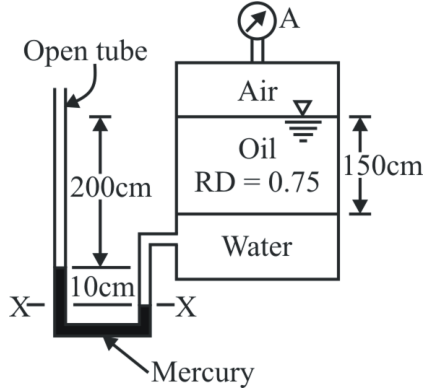
The tank shown in the figure is closed at top and contains air at a pressure of $P_{A}.$ The value of $P_{A}$ for the manometer readings shown will be (Oil RD=0.75, 150cm; Water 60cm; Mercury 10cm open to atmosphere)
- A. -3.573 kPa
- B. -4.573 kPa
- C. -6.573 kPa
- D. -7.573 kPa
Answer: A. -3.573 kPa
Explanation: Using jumping of fluid technique (hydrostatic equation): $P_{A} + (0.75\times1000\times9.81\times1.5) + (1000\times9.81\times0.60) - (13.6\times1000\times9.81\times0.10) = 0$. Solving this gives $P_{A}=-3.577~kPa$.
Question 29
Topic: Engineering Mechanics
$P=2\hat{i}-3\hat{j}$, $Q=-3\hat{i}+4\hat{j}-2\hat{k}$, and $\vec{R}$ are in equilibrium, if $\vec{R}$ is
- A. -\hat{i}-\hat{j}+2\hat{k}
- B. \hat{i}-\hat{j}+2\hat{k}
- C. \hat{i}+\hat{j}+2\hat{k}
- D. \hat{i}-\hat{j}-2\hat{k}
Answer: B. \hat{i}-\hat{j}+2\hat{k}
Explanation: For equilibrium of three vectors, $\vec{P}+\vec{Q}+\vec{R}=0$. Given $\vec{P}=2\hat{i}-3\hat{j}$ and $\vec{Q}=-3\hat{i}+4\hat{j}-2\hat{k}$. Let $\vec{R}=x\hat{i}+y\hat{j}+z\hat{k}$. Then $(2-3+x)\hat{i}+(-3+4+y)\hat{j}+(0-2+z)\hat{k}=0 \implies (x-1)\hat{i}+(y+1)\hat{j}+(z-2)\hat{k}=0$. So $x=1, y=-1, z=2$. Therefore, $\vec{R}=\hat{i}-\hat{j}+2\hat{k}$.
Question 30
Topic: Engineering Mechanics
A rigid body is rotating with constant angular velocity $\omega$ about a fixed axis, if V is the velocity of a point of the body, then curl $V=$
- A. $\omega$
- B. $\omega^{2}$
- C. $2\omega$
- D. $2\omega^{2}$
Answer: C. $2\omega$
Explanation: We know that angular velocity $\omega = \frac{1}{2}|\nabla\times V|$. Therefore, $2\omega = |\nabla\times V|$. Since curl $V = \nabla\times V$, the curl of the velocity field for a rotating rigid body is $2\omega$.
Question 31
Topic: Engineering Mathematics
Laplace transform of $sin^{3}2t$ is
- A. $\frac{24}{(s^{2}+4)(s^{2}+36)}$
- B. $\frac{1}{(s^{2}+4)(s^{2}+64)}$
- C. $\frac{48}{(s^{2}+4)(s^{2}+36)}$
- D. $\frac{64}{(s^{2}+4)(s^{2}+36)}$
Answer: C. $\frac{48}{(s^{2}+4)(s^{2}+36)}$
Explanation: We know that, $sin~3x=3~sin~x-4~sin^{3}x \implies sin^{3}x=\frac{3~sin~x-sin~3x}{4}$. Substituting $x=2t$, we get $sin^{3}2t=\frac{3~sin~2t-sin~6t}{4}$. The Laplace transform for the above is $\frac{1}{4}[\frac{3\times2}{s^{2}+2^{2}}-\frac{6}{s^{2}+6^{2}}] = \frac{1}{4}(\frac{6}{s^{2}+4}-\frac{6}{s^{2}+36}) = \frac{48}{(s^{2}+4)(s^{2}+36)}$.
Question 32
Topic: Engineering Mathematics
The value of the determinant $\begin{vmatrix}cos~\theta & 0 & sin~\theta \\ 0 & 1 & 0 \\ -sin~\theta & 0 & cos~\theta\end{vmatrix}$ is
Answer: C. 1
Explanation: Expanding the determinant along the first row: $cos~\theta[1\cdot cos~\theta - 0] - 0 + sin~\theta[0 - 1(-sin~\theta)] = cos^{2}\theta + sin^{2}\theta = 1$.
Question 33
Topic: Engineering Mathematics
Solution of $(D^{2}+4)y=sin^{2}x,$ is
- A. $y=A~cos~2x+B~sin~2x-\frac{1}{8}-\frac{x}{8}sin~2x$
- B. $y=A~cos~2x+B~sin~2x+\frac{1}{8}+\frac{x}{8}sin~2x$
- C. $y=A~cos~2x+B~sin~2x-\frac{1}{8}+\frac{x}{8}sin~2x$
- D. $y=A~cos~2x+B~sin~2x+\frac{1}{8}-\frac{x}{8}sin~2x$
Answer: D. $y=A~cos~2x+B~sin~2x+\frac{1}{8}-\frac{x}{8}sin~2x$
Explanation: Auxiliary equation is $D^{2}+4=0 \implies D=\pm2i$. So Complementary Function (CF) is $A~cos~2x+B~sin~2x$. Particular Integral (PI) $= \frac{1}{D^{2}+4}sin^{2}x = \frac{1}{D^{2}+4}(\frac{1-cos~2x}{2}) = \frac{1}{2(D^{2}+4)}(e^{0x}) - \frac{1}{2(D^{2}+4)}cos~2x = \frac{1}{2(4)} - \frac{x}{2(2\cdot 2)}sin~2x = \frac{1}{8} - \frac{x}{8}sin~2x$. Complete solution is $y = CF + PI = A~cos~2x+B~sin~2x+\frac{1}{8}-\frac{x}{8}sin~2x$.
Question 34
Topic: Engineering Mathematics
The value of k for which the lines $2x+y-1=0$, $4x+3y-3=0$ and $3x+ky-2=0$ are concurrent is
Answer: C. 2
Explanation: For lines to be concurrent, the determinant of their coefficients must be zero. $\begin{vmatrix}2 & 1 & -1 \\ 4 & 3 & -3 \\ 3 & k & -2\end{vmatrix} = 0$. Expanding: $2(-6 + 3k) - 1(-8 + 9) - 1(4k - 9) = 0 \implies -12 + 6k - 1 - 4k + 9 = 0 \implies 2k - 4 = 0 \implies k = 2$.
Question 35
Topic: Engineering Mathematics
A box contains 5 black and 5 red balls. Two balls are randomly picked one after another from the box, without replacement. The probability for both balls being red is
- A. $\frac{1}{90}$
- B. $\frac{1}{5}$
- C. $\frac{19}{90}$
- D. $\frac{2}{9}$
Answer: D. $\frac{2}{9}$
Explanation: Probability of first ball being red is $\frac{5}{10} = \frac{1}{2}$. Since there is no replacement, 9 balls are left (4 red). Probability of the second ball being red is $\frac{4}{9}$. Total probability $= \frac{1}{2} \times \frac{4}{9} = \frac{2}{9}$.
Question 36
Topic: Engineering Mathematics
$x^{3}+x \sin x$ is a ... function
- A. Constant function
- B. Odd function
- C. Even function
- D. Periodic function
Explanation: Let $F(x) = x^{3}+x \sin x$. $F(-x) = (-x)^{3}+(-x)\sin(-x) = -x^{3}+x \sin x$. It does not equal $F(x)$ (not even) and does not equal $-F(x)$ (not odd). It is not constant, nor is it periodic due to the $x^{3}$ term. Hence, none of the options given are correct.
Question 37
Topic: Engineering Mathematics
$\int\frac{dx}{x\sqrt{x^{2}-a^{2}}}$ is
- A. $\frac{1}{a}cosec^{-1}(\frac{x}{a})$
- B. $\frac{1}{a}sin^{-1}(\frac{x}{a})$
- C. $\frac{1}{a}cos^{-1}(\frac{x}{a})$
- D. $\frac{1}{a}sec^{-1}(\frac{x}{a})$
Answer: D. $\frac{1}{a}sec^{-1}(\frac{x}{a})$
Explanation: Let $x = a \sec \theta$. Then $dx = a \sec \theta \tan \theta d\theta$. Substituting these into the integral gives $\int\frac{a \sec \theta \tan \theta d\theta}{a \sec \theta \sqrt{a^{2} \sec^{2} \theta - a^{2}}} = \int\frac{\tan \theta d\theta}{a \tan \theta} = \int\frac{1}{a}d\theta = \frac{\theta}{a}$. Since $x = a \sec \theta$, $\theta = \sec^{-1}(\frac{x}{a})$. The integral evaluates to $\frac{1}{a}\sec^{-1}(\frac{x}{a})$.
Question 38
Topic: Engineering Mathematics
Eigen values of $\begin{bmatrix}-5 & 2 \\ 2 & -2\end{bmatrix}$ are
- A. -6, -1
- B. 6, -1
- C. -6, 1
- D. 6, 1
Answer: A. -6, -1
Explanation: For eigenvalues, $|A-\lambda I|=0$. $\begin{vmatrix}-5-\lambda & 2 \\ 2 & -2-\lambda\end{vmatrix}=0 \implies (-5-\lambda)(-2-\lambda) - 4 = 0 \implies 10 + 5\lambda + 2\lambda + \lambda^{2} - 4 = 0 \implies \lambda^{2} + 7\lambda + 6 = 0$. Factoring gives $(\lambda+6)(\lambda+1)=0$, so $\lambda=-6$ and $\lambda=-1$.
Question 39
Topic: Material Science
Hardness of martensite is about
- A. RC 65
- B. RC 48
- C. RC 57
- D. RC 80
Answer: A. RC 65
Explanation: Martensite is a very hard metastable structure with a body centered tetragonal (BCT) crystal structure. The highest hardness of a pearlitic steel is 400 Brinell whereas martensite can achieve 700 Brinell. In terms of Rockwell hardness it is about RC65.
Question 40
Topic: Material Science
Which is false statement about annealing. Annealing is done to
- A. Relieve stresses
- B. Harden steel slightly
- C. Improve machining characteristic
- D. Soften material
Answer: B. Harden steel slightly
Explanation: Annealing is a heat treatment process used mostly to increase the ductility and reduce the hardness of a material. Therefore, stating that it hardens steel slightly is a false statement.
Question 41
Topic: Material Science
Materials exhibiting time bound behavior are known as
- A. Visco elastic
- B. Anelastic
- C. Isentropic
- D. Resilient
Answer: A. Visco elastic
Explanation: Viscoelastic materials can behave predominantly as viscous or predominantly as elastic depending on the magnitude and the time scale of the applied shear stress. They exhibit time-dependent behavior, like creep and relaxation.
Question 42
Topic: Manufacturing Engineering
Shrinkage allowance is made by
- A. Adding to external and internal dimensions
- B. Subtracting from external and internal dimensions
- C. Subtracting from external dimension and adding to internal dimensions
- D. Adding to external dimensions and subtracting from internal dimensions
Answer: D. Adding to external dimensions and subtracting from internal dimensions
Explanation: Shrinkage allowance can be defined as allowance given to the pattern to compensate for the contraction or shrinkage in the casting during the solidification process. It is applied by adding to external dimensions and subtracting from internal dimensions.
Question 43
Topic: Manufacturing Engineering
Machinability depends on
- A. Microstructure, physical and mechanical properties and composition
- B. Cutting forces
- C. Type of chip
- D. Tool life
Answer: A. Microstructure, physical and mechanical properties and composition
Explanation: Machinability is defined as the ease with which a material can be machined. It depends on several factors intrinsic to the workpiece material, including its microstructure, heat treatment, chemical composition, hardness, tensile strength, and ductility.
Question 44
Topic: Manufacturing Engineering
Spinning operation is carried out on
- A. Hydraulic press
- B. Mechanical press
- C. Lathe
- D. Milling machine
Answer: C. Lathe
Explanation: Metal spinning is a metal working process by which a disc or tube of metal is rotated at high speed and formed into an axially symmetric part. Any heavy duty lathe with adequate speed range can be used for the spinning process.
Question 45
Topic: Industrial Engineering
Acceptance sampling is widely used in a
- A. Batch production
- B. Job production
- C. Mass production
- D. All of the above
Answer: C. Mass production
Explanation: Acceptance sampling is widely used in mass production. It is the process of evaluating the quality of a large number of items in a batch or lot based upon the quality of a smaller sample of those items.
Question 46
Topic: Metrology and Inspection
Gratings are used in connection with
- A. Flatness measurement
- B. Roundness measurement
- C. Surface texture measurement
- D. Linear displacement measurements
Answer: D. Linear displacement measurements
Explanation: Gratings are used in connection with linear displacement measurements.
Question 47
Topic: Metrology and Inspection
Which of the following errors are inevitable in the measuring system and it would be vainful exercise to avoid them
- A. Systematic errors
- B. Random errors
- C. Calibration errors
- D. Environmental errors
Answer: B. Random errors
Explanation: Random errors are caused by chance of variation in the measurement process that lead to deviation from the true value. These errors can occur due to environmental conditions, simple human error, or variation in the testing procedure. Therefore, random errors are inevitable in the measuring system and it would be vainful exercise to avoid them.
Question 48
Topic: Theory of Machines and Vibrations
A block whose mass is 650 gm is fastened to a spring of spring constant K equals 65 $N/m$ whose other end is fixed. The block is pulled a distance $x=11cm$ from its equilibrium position at $x=0$ on a smooth surface, and released from rest at $t=0$ The maximum speed 'S' of the oscillating block is
- A. $11~cm/sec$
- B. $11~m/sec$
- C. $11~mm/sec$
- D. $1.1~m/sec$
Answer: D. $1.1~m/sec$
Explanation: Given that, mass $(m)=650g=0.65~kg$, $k=65~N/m$, $x=0.11m$. Maximum speed of the spring will be at $x=0$ when the total spring energy is converted into kinetic energy of mass. $\frac{1}{2}kx^{2}=\frac{1}{2}mV^{2} \implies \frac{1}{2}\times65\times(0.11)^{2}=\frac{1}{2}\times(0.650)V^{2} \implies V=1.1~m/sec.$
Question 49
Topic: Theory of Machines and Vibrations
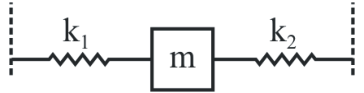
A block of mass 'm' is connected to two springs of stiffness $K_{1}$ and $K_{2}$ as shown in the figure $f_{1}$ and $f_{2}$ are the frequencies of the block when connected to $K_{1}$ and $K_{2}$ independently. Then the frequency of 'm' when connected to $K_{1}$ and $K_{2}$ as in the figure is
- A. $f=f_{1}+f_{2}$
- B. $f=f_{1}^{2}+f_{2}^{2}$
- C. $f=\sqrt{f_{1}^{2}+f_{2}^{2}}$
- D. $f=\sqrt{f_{1}^{2}-f_{2}^{2}}$
Answer: C. $f=\sqrt{f_{1}^{2}+f_{2}^{2}}$
Explanation: $f_{1}=\frac{1}{2\pi}\sqrt{\frac{k_{1}}{m}}$ and $f_{2}=\frac{1}{2\pi}\sqrt{\frac{k_{2}}{m}}$. When springs are in parallel, the equivalent stiffness is $k_{eq}=k_{1}+k_{2}$. Therefore, $f_{eq}=\frac{1}{2\pi}\sqrt{\frac{k_{1}+k_{2}}{m}} = \sqrt{(\frac{1}{2\pi}\sqrt{\frac{k_{1}}{m}})^2 + (\frac{1}{2\pi}\sqrt{\frac{k_{2}}{m}})^2} = \sqrt{f_{1}^{2}+f_{2}^{2}}$.
Question 50
Topic: Theory of Machines and Vibrations
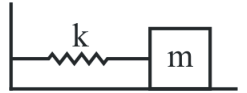
The block has a kinetic energy of 3J and the spring connecting the block has an elastic energy of 2J (shown in figure). When the block is at $x=+2.0$ cm. What is the kinetic energy when the block is at $x=0$.
Answer: D. 5J
Explanation: From energy conservation: Total energy at ($x=2~cm$) = Total energy at ($x=0$). At $x=2~cm$, total energy $E = KE + PE = 3J + 2J = 5J$. At $x=0$, the potential energy of the spring is zero, so all the energy is converted into kinetic energy. Therefore, the kinetic energy at $x=0$ is 5J.
Question 51
Topic: Strength of Materials
For a body subjected to direct stresses $\sigma_x, \sigma_y$ and $\sigma_z$ the direct strain $\epsilon_x$, in x direction is (where E and $\gamma$ are Young's Modulus and Poisson's ratio respectively)
- A. $\epsilon_{x}=\frac{1}{E}\{\sigma_{x}+\gamma(\sigma_{y}-\sigma_{z})\}$
- B. $\epsilon_{x}=\frac{1}{E}\{\sigma_{x}-\gamma(\sigma_{y}+\sigma_{z})\}$
- C. $\epsilon_{x}=\frac{1}{E}\{\sigma_{x}-\gamma(\sigma_{y}-\sigma_{z})\}$
- D. $\epsilon_{x}=\frac{1}{E}\{\sigma_{x}+\gamma(\sigma_{y}+\sigma_{z})\}$
Answer: B. $\epsilon_{x}=\frac{1}{E}\{\sigma_{x}-\gamma(\sigma_{y}+\sigma_{z})\}$
Explanation: Let E and $\gamma$ be Young's modulus and Poisson's ratio. The strain in the x-direction in a 3D body is derived using generalized Hooke's Law: $\epsilon_{x}=\frac{1}{E}[\sigma_{x}-\gamma(\sigma_{y}+\sigma_{z})]$.
Question 52
Topic: Strength of Materials
A circular shaft subjected to torsion undergoes a twist of $1^{\circ}$ in a length of 120 cm. If the maximum shear stress induced is limited to $1000kg/cm^{2}$ and if modulus of rigidity $G=0.8\times 10^{6}kg/cm^{2},$ then the radius of the shaft should be
- A. $\pi/18$ cm
- B. $\pi/27$ cm
- C. $18/\pi$ cm
- D. $27/\pi$ cm
Answer: D. $27/\pi$ cm
Explanation: Given: $l=120~cm$, $\tau=1000~kg/cm^{2}$, $G=0.8\times10^{6}kg/cm^{2}$, $\theta=1^{\circ}=1\times\frac{\pi}{180}rad$. Using the Torsion Equation: $\frac{\tau}{r} = \frac{G\theta}{l}$. Substituting the values: $\frac{1000}{r} = \frac{0.8\times10^{6}\times\pi}{180\times120}$. Solving for $r$, $r=\frac{27}{\pi} cm$.
Question 53
Topic: Strength of Materials
A hollow shaft of same cross-section area as solid shaft transmits
- A. Same torque
- B. Less torque
- C. More torque
- D. Unpredictable
Answer: C. More torque
Explanation: A hollow shaft of the same cross-sectional area as a solid shaft has a higher polar moment of inertia because its material is distributed further away from the neutral axis. Since Torque $T$ is proportional to the polar modulus, it can transmit more torque for the same allowable maximum shear stress.
Question 54
Topic: Strength of Materials
The extension of a mild steel bar 4m long, 2000 $mm^{2}$ cross section under the action of an axial load of 20kN, if $E=2\times10^{5}N/mm^{2},$ is
- A. 2mm
- B. 0.2mm
- C. 0.5mm
- D. 0.05mm
Answer: B. 0.2mm
Explanation: Given data: $l=4m=4000~mm$, $A=2000~mm^{2}$, $P=20~kN = 20\times10^{3}N$, $E=2\times10^{5}N/mm^{2}$. Extension is given by $\delta = \frac{PL}{AE} = \frac{20\times10^{3}\times4000}{2000\times2\times10^{5}} = 0.2~mm$.
Question 55
Topic: Strength of Materials
In I-section shear load is resisted mainly by
- A. Flanges only
- B. Web only
- C. Both by flanges and web
- D. None
Answer: B. Web only
Explanation: In an I-section, the shear stress distribution is parabolic across the web and relatively small in the flanges. The maximum shear stress occurs at the neutral axis located in the web. Hence, the shear load is resisted mainly by the web.
Question 56
Topic: Strength of Materials
Shear force is
- A. Rate of change of loading
- B. Sum of bending moments
- C. Rate of change of bending moment
- D. None of the above
Answer: C. Rate of change of bending moment
Explanation: Shear force $F$ is mathematically equal to the rate of change of bending moment with respect to distance $x$, i.e., $F = \frac{dM}{dx}$.
Question 57
Topic: Strength of Materials
Maximum shear stress in Mohr's circle is equal to
- A. Radius of circle
- B. Diameter of circle
- C. Centre of circle from y-axis
- D. Chord of circle
Answer: A. Radius of circle
Explanation: The maximum shear stress in Mohr's circle corresponds to the top or bottom points of the circle, which is exactly equal to the radius of the Mohr's circle: $\tau_{max} = R = \frac{\sigma_{1}-\sigma_{2}}{2}$.
Question 58
Topic: Strength of Materials
If a material expands freely due to heating it will develop
- A. Thermal stresses
- B. Tensile stress
- C. No stress
- D. Bending
Answer: C. No stress
Explanation: If a material expands freely due to heating, there are no internal resisting forces created, hence it will develop zero stress. Thermal stresses only develop when the material's expansion or contraction is restricted.
Question 59
Topic: Strength of Materials
When a column is fixed at both ends, corresponding Euler's critical load is
- A. $\pi^{2}EI/L^{2}$
- B. $2\pi^{2}EI/L^{2}$
- C. $3\pi^{2}EI/L^{2}$
- D. $4\pi^{2}EI/L^{2}$
Answer: D. $4\pi^{2}EI/L^{2}$
Explanation: When a column is fixed at both ends, the equivalent effective length is $L_{e}=\frac{L}{2}$. Euler's Critical Load is $P_{c}=\frac{\pi^{2}EI}{(L_{e})^{2}}$. Substituting $L_{e}$, we get $P_{c}=\frac{\pi^{2}EI}{(\frac{L}{2})^{2}} = \frac{4\pi^{2}EI}{L^{2}}$.
Question 60
Topic: Strength of Materials
A metal pipe of 1 m diameter contains a fluid having a pressure of 10 $kgf/cm^{2}$. If the permissible tensile stress in the metal is 200 $kgf/cm^{2}$ then the thickness of the metal required for making the pipe would be
- A. 5 mm
- B. 10 mm
- C. 25 mm
- D. 20 mm
Answer: C. 25 mm
Explanation: Given: diameter $d=1m = 100cm$, pressure $P=10~kgf/cm^{2}$, permissible tensile (hoop) stress $\sigma_{h}=200~kgf/cm^{2}$. The formula for hoop stress in a thin cylinder is $\sigma_{h}=\frac{Pd}{2t}$. Substituting the values: $200 = \frac{10\times100}{2\times t} \implies 200 = \frac{500}{t} \implies t = 2.5~cm = 25~mm$.
Question 61
Topic: Strength of Materials
Circumferential and longitudinal strains in the cylindrical boiler under internal steam pressure are $\epsilon_{1}$ and $\epsilon_{2}$ respectively. Change in the volume of the boiler cylinder per unit volume will be
- A. $\epsilon_{1}+2\epsilon_{2}$
- B. $\epsilon_{1}\epsilon_{2}^{2}$
- C. $2\epsilon_{1}+\epsilon_{2}$
- D. $\epsilon_{1}^{2}\epsilon_{2}$
Answer: C. $2\epsilon_{1}+\epsilon_{2}$
Explanation: Volume of a cylinder is $V=\pi r^{2}L$. Taking natural log on both sides: $log_{e}V=2~log_{e}r+log_{e}L$. Differentiating, we get $\frac{dV}{V}=\frac{2dr}{r}+\frac{dL}{L}$. Thus, volumetric strain $e_{v}=2\epsilon_{1}+\epsilon_{2}$, where $\epsilon_{1}$ is circumferential (hoop) strain and $\epsilon_{2}$ is longitudinal strain.
Question 62
Topic: Strength of Materials
If water in closed pipe freezes, the pipe will
- A. Rupture along a plane perpendicular to the axis of pipe
- B. Rupture of zig-zag along the length
- C. Rupture along weakest circumferential section
- D. Rupture along a line running longitudinally along the pipe
Answer: D. Rupture along a line running longitudinally along the pipe
Explanation: When water freezes, it expands and exerts internal pressure on the pipe. In a cylindrical pipe subjected to internal pressure, the circumferential (hoop) stress is twice the longitudinal stress. Therefore, the failure will take place along the longitudinal joint (running longitudinally) because of the higher hoop stress.
Question 63
Topic: Material Science
The notch angle of Izod impact test specimen is
- A. $10^{\circ}$
- B. $20^{\circ}$
- C. $22\frac{1}{2}^{\circ}$
- D. $45^{\circ}$
Answer: D. $45^{\circ}$
Explanation: The IZOD impact test is used to determine the impact resistance (toughness) of material. The notch angle of the standard IZOD impact test specimen is $45^{\circ}$.
Question 64
Topic: Engineering Mechanics
Which of the following statements regarding governing the friction between dry surfaces are correct?
1. The friction force is dependent on the velocity sliding.
2. The friction force is directly proportional to the normal force.
3. The friction forced is dependent on the materials of the contact surfaces.
4. The friction force is independent of the area of contact.
Select the correct answer using the codes given below:
- A. 2, 3 and 4
- B. 1 and 3
- C. 2 and 4
- D. 1, 2, 3 and 4
Answer: A. 2, 3 and 4
Explanation: According to the laws of dry friction: (1) Force of friction is directly proportional to the normal load. (2) It is independent of the area of contact. (3) It depends on the nature of the materials in contact. (4) It is independent of the velocity of sliding. Therefore, statements 2, 3, and 4 are correct.
Question 65
Topic: Theory of Machines and Vibrations
A simple spring-mass vibrating system has a natural frequency of N. If the spring stiffness is halved and the mass is doubled, then the natural frequency will become
Answer: A. $N/2$
Explanation: Natural frequency $N = \frac{1}{2\pi}\sqrt{\frac{k}{m}}$. If mass is doubled ($2m$) and stiffness is halved ($k/2$), then $N_{2} = \frac{1}{2\pi}\sqrt{\frac{k/2}{2m}} = \frac{1}{2\pi}\sqrt{\frac{k}{4m}} = \frac{1}{2}\left(\frac{1}{2\pi}\sqrt{\frac{k}{m}}\right) = \frac{N}{2}$.
Question 66
Topic: Theory of Machines and Vibrations
Under logarithmic decrement, the amplitude of successive vibrations are
- A. Constant
- B. In arithmetic progression
- C. In geometric progression
- D. In logarithmic progression
Answer: C. In geometric progression
Explanation: The ratio of two successive oscillation amplitudes is constant in an underdamped system. The natural logarithm of this ratio is called logarithmic decrement $\delta = \ln\frac{x_{1}}{x_{2}} = \ln\frac{x_{2}}{x_{3}} \implies \frac{x_{1}}{x_{2}} = \frac{x_{2}}{x_{3}} \implies x_{2}^{2} = x_{1} \cdot x_{3}$. Hence, the amplitudes of successive vibrations are in a geometric progression.
Question 67
Topic: Theory of Machines and Vibrations
Periodic time of simple pendulum is given by
- A. $2\pi\sqrt{\frac{l}{g}}$
- B. $2\pi\sqrt{\frac{g}{l}}$
- C. $\frac{1}{2\pi}\sqrt{\frac{l}{g}}$
- D. $\frac{1}{2\pi}\sqrt{\frac{g}{l}}$
Answer: A. $2\pi\sqrt{\frac{l}{g}}$
Explanation: A simple pendulum executes periodic motion. The time period (T) of a simple pendulum is given by $T = \frac{2\pi}{\omega} = 2\pi\sqrt{\frac{l}{g}}$, where l is the length of the string and g is acceleration due to gravity.
Question 68
Topic: Theory of Machines and Vibrations
In a single reduction, a large velocity ratio is required. The best transmission is
- A. Spur gear drive
- B. Helical gear drive
- C. Worm gear drive
- D. Bevel gear drive
Answer: C. Worm gear drive
Explanation: Worm gears and worm wheels can achieve very large velocity ratios in a single reduction stage compared to spur, helical, or bevel gears. So a worm gear drive is best when a large velocity ratio is required.
Question 69
Topic: Theory of Machines and Vibrations
Idler pulley is used
- A. For changing the direction of motion of the belt
- B. For applying tension
- C. For increasing velocity ratio
- D. All of the above
Answer: B. For applying tension
Explanation: An idler pulley is a free-wheeling pulley used to take up slack and apply tension to a belt in a drive system.
Question 70
Topic: Engineering Mechanics
If two bodies one light and other heavy have equal kinetic energies, which one has a greater momentum
- A. Heavy body
- B. Light body
- C. Both have equal momentum
- D. It depends on the actual velocities
Answer: A. Heavy body
Explanation: Kinetic energy $KE = \frac{p^{2}}{2m}$, where p is momentum. Thus, $p = \sqrt{2m(KE)}$. If the kinetic energies are equal, $p \propto \sqrt{m}$. Therefore, the body with the greater mass (heavy body) will have the greater momentum.
Question 71
Topic: Engineering Mechanics
A heavy block of mass m is slowly placed on a conveyer belt moving with speed v. If coefficient of friction between block and the belts is $\mu$, the block will slide on the belt through distance
- A. $\frac{v}{\mu g}$
- B. $\frac{v^{2}}{\sqrt{\mu g}}$
- C. $(\frac{v}{\mu g})^{2}$
- D. $\frac{v^{2}}{2\mu g}$
Answer: D. $\frac{v^{2}}{2\mu g}$
Explanation: Relative to the belt, the initial velocity of the block is $v$ and final velocity is $0$. The retardation due to the friction force is $a = \mu g$. Using the equation of motion $v^{2} - u^{2} = 2as$, we get $0 - v^{2} = 2(-\mu g)s$. Therefore, $s = \frac{v^{2}}{2\mu g}$.
Question 72
Topic: Engineering Mechanics
A car moving with uniform acceleration covers 450 m in a 5 second interval, and covers 700 m in the next 5 second interval. The acceleration of the car is
- A. $7~m/s^{2}$
- B. $50~m/s^{2}$
- C. $25~m/s^{2}$
- D. $10~m/s^{2}$
Answer: D. $10~m/s^{2}$
Explanation: Using $s=ut+\frac{1}{2}at^{2}$. At $t=5~sec$, $s=450~m$, so $450 = 5u + 12.5a \implies 900 = 10u + 25a$ (Eq. 1). At $t=10~sec$, $s=450+700=1150~m$, so $1150 = 10u + 50a$ (Eq. 2). Subtracting Eq. 1 from Eq. 2 gives $250 = 25a \implies a = 10~m/s^{2}$.
Question 73
Topic: Engineering Mechanics
A particle starts with a velocity $2~m/sec$ and moves on a straight-line track with retardation 0.1 $m/sec^{2}$. The time at which the particle is 15m from the starting point would be
- A. 10 sec
- B. 20 sec
- C. 50 sec
- D. 40 sec
Answer: A. 10 sec
Explanation: Given initial velocity $u=2~m/s$, retardation $a=-0.1~m/s^{2}$, distance $s=15~m$. Using $s=ut+\frac{1}{2}at^{2}$, we have $15=2t-\frac{1}{2}(0.1)t^{2}$. Simplifying gives $15 = 2t - 0.05t^{2} \implies t^{2} - 40t + 300 = 0$. Factoring, $(t-10)(t-30)=0$. The time is 10 seconds.
Question 74
Topic: Engineering Mechanics
Two particles with masses in the ratio 1:4 are moving with equal kinetic energies. The magnitude of their linear momentums will conform to the ratio
- A. 1:8
- B. 1:2
- C. $\sqrt{2}:1$
- D. $\sqrt{2}$
Answer: B. 1:2
Explanation: Given $KE_{1} = KE_{2} \implies \frac{1}{2}m_{1}v_{1}^{2} = \frac{1}{2}m_{2}v_{2}^{2} \implies \frac{m_{1}}{m_{2}} = \left(\frac{v_{2}}{v_{1}}\right)^{2} \implies \frac{1}{4} = \left(\frac{v_{2}}{v_{1}}\right)^{2} \implies \frac{v_{1}}{v_{2}} = 2$. Ratio of momentum is $\frac{P_{1}}{P_{2}} = \frac{m_{1}v_{1}}{m_{2}v_{2}} = \left(\frac{1}{4}\right) \times 2 = \frac{1}{2}$.
Question 75
Topic: Engineering Mechanics
A stone is projected horizontally from a cliff at $10~m/sec$ and lands on the ground below at 20 m from the base of the cliff. Find the height of the cliff. Use $g=10~m/sec^{2}$
- A. 18 m
- B. 20 m
- C. 22 m
- D. 24 m
Answer: B. 20 m
Explanation: Horizontal distance $= velocity \times time \implies 20 = 10 \times t \implies t = 2~sec$. The initial vertical velocity is 0. Vertical distance (height) $h = ut + \frac{1}{2}at^{2} = 0 + \frac{1}{2}(10)(2)^{2} = 20~m$.
Question 76
Topic: Theory of Machines and Vibrations
Oscillation of a particle is prescribed by the equation $x=3~cos~0.25~\pi t$. Where t is the time in seconds. Then time taken by the particle to move from position of equilibrium to maximum displacement is
- A. 0.5 sec
- B. 1.0 sec
- C. 2.0 sec
- D. 3.0 sec
Answer: C. 2.0 sec
Explanation: Comparing with the standard SHM equation $x = A\cos(\omega t)$, we get $\omega = 0.25\pi$. Time period $T = \frac{2\pi}{\omega} = \frac{2\pi}{0.25\pi} = 8~sec$. The time taken to move from the position of equilibrium to maximum displacement is one quarter of the time period, $t = \frac{T}{4} = \frac{8}{4} = 2~sec$.
Question 77
Topic: Engineering Mechanics
Which of the following is not a scalar quantity
- A. Time
- B. Mass
- C. Volume
- D. acceleration
Answer: D. acceleration
Explanation: Acceleration has both magnitude and direction, making it a vector quantity, not a scalar quantity. Time, mass, and volume only have magnitude.
Question 78
Topic: Machine Design
Which of the following stresses are associated with the tightening of a nut on a stud?
1. Tensile stresses due to stretching of stud.
2. Bending stresses of stud.
3. Transverse shear stresses across threads.
4. Torsional shear stress in threads due to frictional resistance.
Select the correct answer using the codes given below:
- A. 1, 2 and 3
- B. 1, 3 and 4
- C. 2, 3 and 4
- D. 1, 2 and 4
Answer: B. 1, 3 and 4
Explanation: The tightening of a nut on a stud induces: 1. Tensile stresses due to stretching of the stud. 3. Transverse shear stresses across threads. 4. Torsional shear stresses in threads due to frictional resistance. It does not cause bending stresses.
Question 79
Topic: Heat Transfer
A thin copper wire at $300^{\circ}C$ is suddenly immersed in water at $30^{\circ}C$. It cools down to $150^{\circ}C$ in 70 seconds. It is then reheated to the initial temperature of $300^{\circ}C$ and suddenly exposed to air at $30^{\circ}C$ where it cools down to $150^{\circ}C$ in 200 seconds. This difference in cooling time is due to
- A. Larger specific heat of water
- B. Larger heat transfer coefficient in water
- C. Smaller heat transfer coefficient in water
- D. None of the above
Answer: B. Larger heat transfer coefficient in water
Explanation: Heat transfer coefficient is the proportionality constant between the heat flux and the temperature difference $\Delta T$. Water has a significantly larger convective heat transfer coefficient compared to air. So the larger the heat transfer coefficient, the lesser the time needed for the body to cover the temperature difference.
Question 80
Topic: Heat Transfer
The heat flow rate through parallel walls of thickness $L_{1},$ $L_{2}$ and $L_{3},$ having surface areas $A_{1},$ $A_{2}$ and $A_{3}$ thermal conductivities $k_{1},$ $k_{2}$ and $k_{3}$ respectively, with the first and last walls maintained at temperatures $t_{1}$ and $t_{2}$ will be
- A. $\frac{t_{1}-t_{2}}{\frac{L_{1}}{A_{1}k_{1}}+\frac{L_{2}}{A_{2}k_{2}}+\frac{L_{3}}{A_{3}k_{3}}}$
- B. $\frac{t_{1}-t_{2}}{\frac{k_{1}}{A_{1}L_{1}}+\frac{k_{2}}{A_{2}L_{2}}+\frac{k_{3}}{A_{3}L_{3}}}$
- C. $\frac{t_{1}-t_{2}}{\frac{k_{1}A_{1}}{L_{1}}+\frac{k_{2}A_{2}}{L_{2}}+\frac{k_{3}A_{3}}{L_{3}}}$
- D. $\frac{t_{1}-t_{2}}{\frac{L_{1}A_{1}}{k_{1}}+\frac{L_{2}}{k_{2}}+\frac{L_{3}}{k_{3}}}$
Answer: A. $\frac{t_{1}-t_{2}}{\frac{L_{1}}{A_{1}k_{1}}+\frac{L_{2}}{A_{2}k_{2}}+\frac{L_{3}}{A_{3}k_{3}}}$
Explanation: For a composite wall made of three parallel layers, the total thermal resistance is the sum of the individual resistances: $R_{th} = \frac{L_{1}}{k_{1}A_{1}} + \frac{L_{2}}{k_{2}A_{2}} + \frac{L_{3}}{k_{3}A_{3}}$. The heat transfer rate $Q = \frac{dT}{R_{th}} = \frac{t_{1}-t_{2}}{\frac{L_{1}}{k_{1}A_{1}}+\frac{L_{2}}{k_{2}A_{2}}+\frac{L_{3}}{k_{3}A_{3}}}$.