GATE XE (Engineering Sciences) 2012 Question Paper & Solutions
Attempt the GATE XE (Engineering Sciences) 2012 previous year paper in real CBT exam mode or practice mode with the official answer key. Step-by-step explanations are coming soon.
87 questions. Answers are shown only where the official answer key is available.
General Aptitude
Question 1
Marks: 1
One of the parts (A, B, C, D) in the sentence given below contains an ERROR. Which one of the following is INCORRECT? I requested that he should be given the driving test today instead of tomorrow.
A. requested that
B. should be given
C. the driving test
D. instead of tomorrow
Answer: B. should be given
Question 2
Marks: 1
Which one of the following options is the closest in meaning to the word given below? Latitude
A. Eligibility
B. Freedom
C. Coercion
D. Meticulousness
Answer: B. Freedom
Question 3
Marks: 1
Choose the most appropriate word from the options given below to complete the following sentence: Given the seriousness of the situation that he had to face, his ___ was impressive.
A. beggary
B. nomenclature
C. jealousy
D. nonchalance
Answer: D. nonchalance
Question 4
Marks: 1
Choose the most appropriate alternative from the options given below to complete the following sentence: If the tired soldier wanted to lie down, he ___ the mattress out on the balcony.
A. should take
B. shall take
C. should have taken
D. will have taken
Answer: A. should take
Question 5
Marks: 1
If (1.001)1259 = 3.52 and (1.001)2062 = 7.85, then (1.001)3321 =
A. 2.23
B. 4.33
C. 11.37
D. 27.64
Answer: D. 27.64
Question 6
Marks: 2
A and B are friends. They decide to meet between 1 PM and 2 PM on a given day. There is a condition that whoever arrives first will not wait for the other for more than 15 minutes. The probability that they will meet on that day is
A. 1/4
B. 1/16
C. 7/16
D. 9/16
Answer: C. 7/16
Question 7
Marks: 2
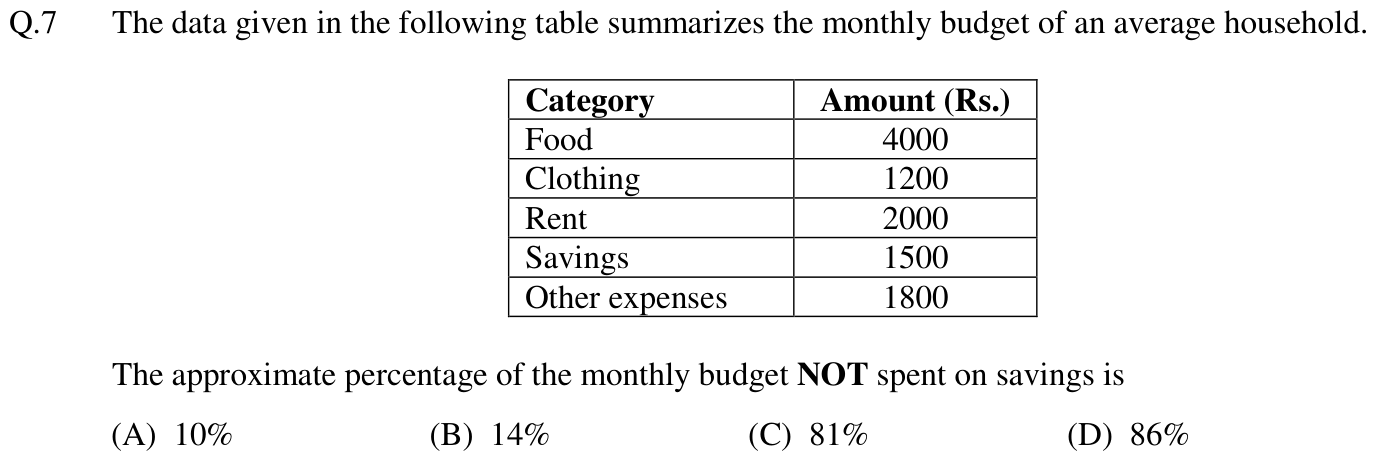
The data given in the following table summarizes the monthly budget of an average household. Category Amount (Rs.) Food 4000 Clothing 1200 Rent Savings 1500 Other expenses 1800 The approximate percentage of the monthly budget NOT spent on savings is
A. 10%
B. 14%
C. 81%
D. 86%
Answer: D. 86%
Question 8
Marks: 2
There are eight bags of rice looking alike, seven of which have equal weight and one is slightly heavier. The weighing balance is of unlimited capacity. Using this balance, the minimum number of weighings required to identify the heavier bag is
A. 2
B. 3
C. 4
D. 8
Answer: A. 2
Question 9
Marks: 2
Raju has 14 currency notes in his pocket consisting of only Rs. 20 notes and Rs. 10 notes. The total money value of the notes is Rs. 230. The number of Rs. 10 notes that Raju has is
A. 5
B. 6
C. 9
D. 10
Answer: A. 5
Question 10
Marks: 2
One of the legacies of the Roman legions was discipline. In the legions, military law prevailed and discipline was brutal. Discipline on the battlefield kept units obedient, intact and fighting, even when the odds and conditions were against them. Which one of the following statements best sums up the meaning of the above passage?
A. Thorough regimentation was the main reason for the efficiency of the Roman legions even in adverse circumstances.
B. The legions were treated inhumanly as if the men were animals.
C. Discipline was the armies’ inheritance from their seniors.
D. The harsh discipline to which the legions were subjected to led to the odds and conditions being against them.
Answer: A. Thorough regimentation was the main reason for the efficiency of the Roman legions even in adverse circumstances.
Engineering Mathematics
Question 1
Marks: 1
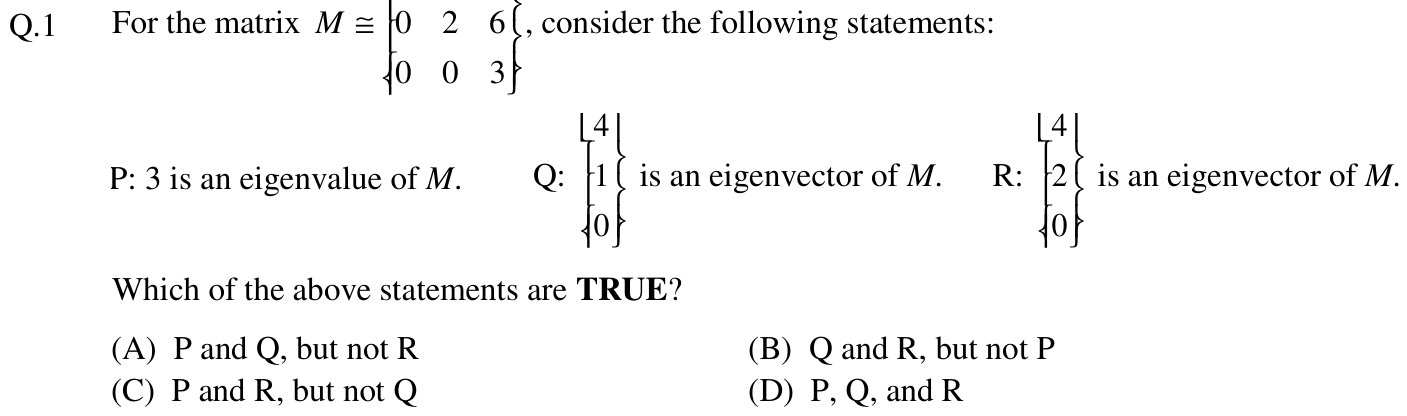
For the matrix = 3 0 0 6 2 0 5 4 1 M , consider the following statements: P: 3 is an eigenvalue of M. Q: 0 1 4 is an eigenvector of M. R: 0 2 4 is an eigenvector of M. Which of the above statements are TRUE?
A. P and Q, but not R
B. Q and R, but not P
C. P and R, but not Q
D. P, Q, and R
Answer: A. P and Q, but not R
Question 2
Marks: 1
Taylor series of x x f − =1 1 ) ( about 0 = x is given as Κ + + + + = 3 2 1 x x x TS f . This series can be used to evaluate ) (x f for
A. 1 ≠ x
B. 1 − < x
C. 1 < x
D. 1 1 < ≤ − x
Answer: C. 1 < x
Question 3
Marks: 1
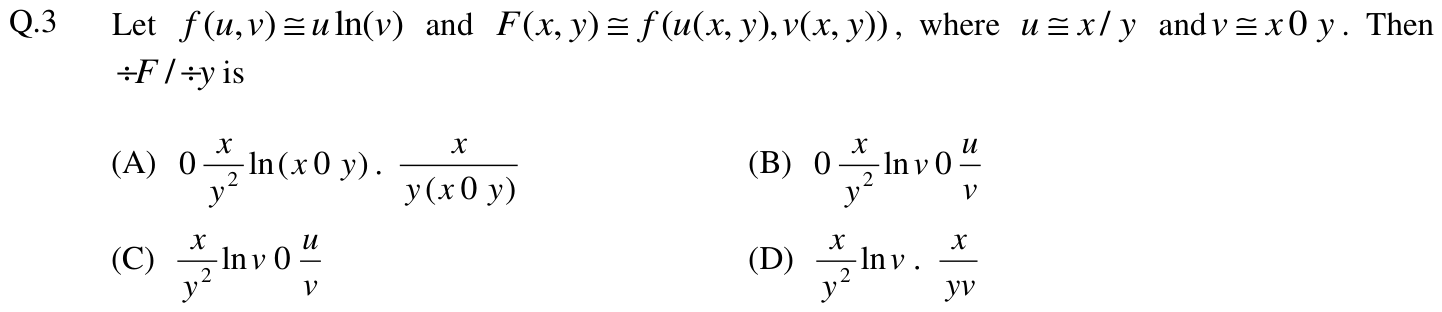
Let ( , ) ln( ) f u v u v = and ( , ) ( ( , ), ( , )) F x y f u x y v x y = , where / u x y = andv x y = − . Then / F y ∂ ∂is
A. ) ( ) ( ln 2 y x y x y x y x − + − −
B. v u v y x − − ln 2
C. v u v y x − ln 2
D. yv x v y x + ln 2
Answer: B. v u v y x − − ln 2
Question 4
Marks: 1
Consider two functions z z f = ) ( and z z g = ) ( (conjugate of z). Using Cauchy-Riemann conditions, choose the correct answer
A. Both f and g are analytic
B. f is analytic but g is not analytic
C. g is analytic but f is not analytic
D. Neither f nor g is analytic
Answer: D. Neither f nor g is analytic
Question 5
Marks: 1
For 4 2 5 f x xy = − , the direction of maximum increase of ( , ) f x y at the point (2, 2) is along
A. ˆ ˆ 3 10 i j +
B. ˆ ˆ 12 40 i j − −
C. ˆ ˆ 3 10 i j −
D. ˆ ˆ 12 40 i j − +
Answer: C. ˆ ˆ 3 10 i j −
Question 6
Marks: 1
Suppose 50% of the population of a village like oranges, 70% of the population like apples, and 40% like both. If a person is picked at random who likes at least one of these fruits, what is the probability that the person likes oranges?
A. 1/8
B. 5/12
C. 1/2
D. 5/8
Answer: D. 5/8
Question 7
Marks: 1
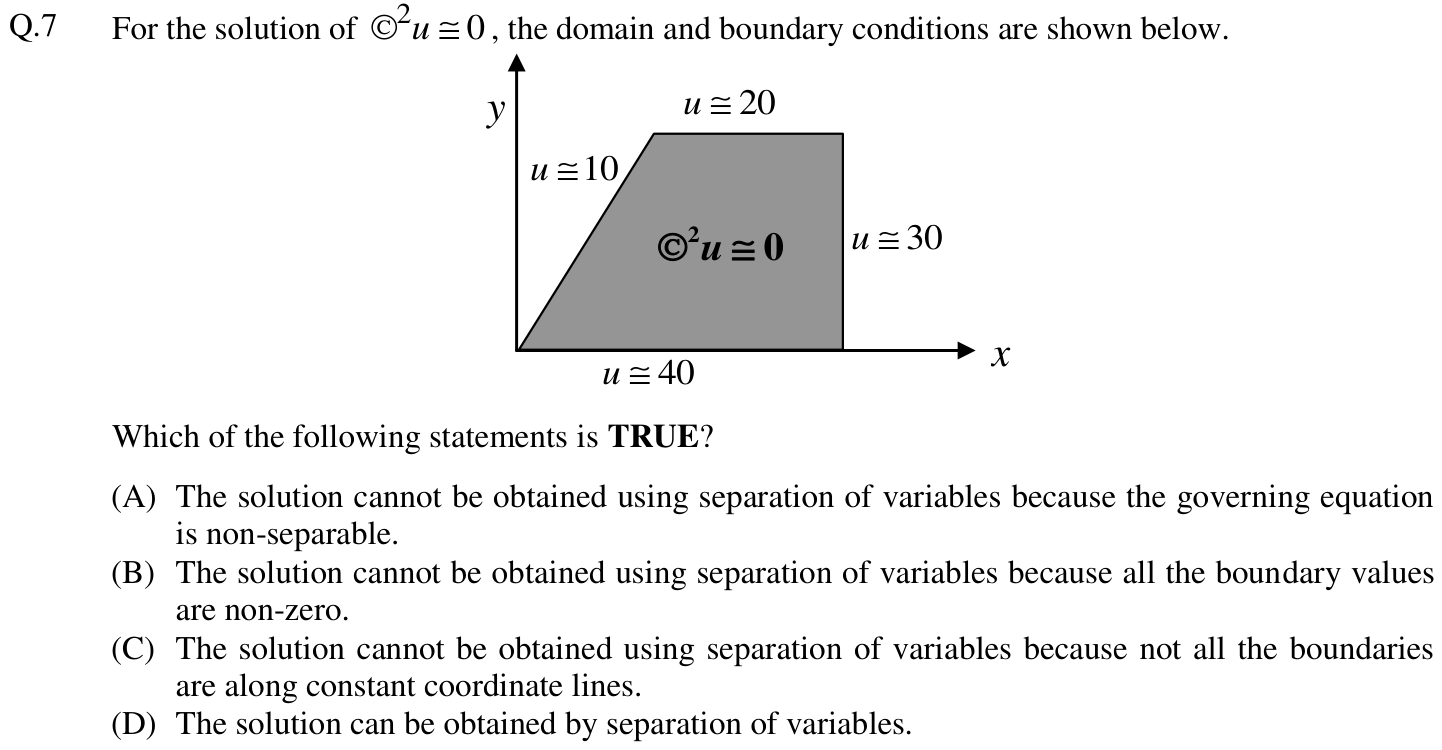
For the solution of 2 0 u ∇ = , the domain and boundary conditions are shown below. Which of the following statements is TRUE?
A. The solution cannot be obtained using separation of variables because the governing equation is non-separable.
B. The solution cannot be obtained using separation of variables because all the boundary values are non-zero.
C. The solution cannot be obtained using separation of variables because not all the boundaries are along constant coordinate lines.
D. The solution can be obtained by separation of variables.
Answer: C. The solution cannot be obtained using separation of variables because not all the boundaries are along constant coordinate lines.
Question 8
Marks: 2
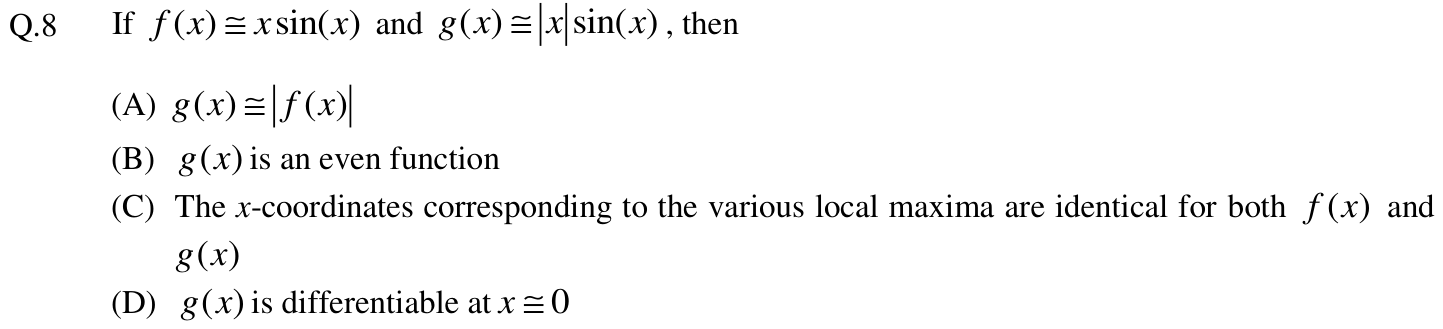
If ( ) sin( ) f x x x = and ( ) sin( ) g x x x = , then
A. ( ) ( ) g x f x =
B. ( ) g x is an even function
C. The x-coordinates corresponding to the various local maxima are identical for both ( ) f x and ( ) g x
D. ( ) g x is differentiable at 0 x =
Answer: D. ( ) g x is differentiable at 0 x =
Question 9
Marks: 2
The general solution of 4 3 2 4 3 2 2 2 2 0 d y d y d y dy y dx dx dx dx − + − + = is
A. 1 2 3 4 cosh( ) sinh( ) x x c e c xe c x c x + + +
B. 1 2 3 4 x x ix ix c e c e c e c e − − + + +
C. 1 2 3 4 cos( ) sin( ) x x c e c xe c x c x + + +
D. 1 2 3 4 x x ix ix c e c xe c e c e − − + + +
Answer: C. 1 2 3 4 cos( ) sin( ) x x c e c xe c x c x + + +
Question 10
Marks: 2
Evaluation of ( ) ∫∫ • − + S x x dA n k e z j y i e ˆ ˆ ˆ 3 ˆ over a surface S : 2 2 2 1 x y z + + =, using Gauss divergence theorem, gives
A. 0
B. 4π
C. 4π / 3
D. 12π
Answer: B. 4π
Question 11
Marks: 2
The exact solution of the integral 4 2 0 ( 4) x dx − ∫ is denoted by E I . The same integral evaluated numerically by the trapezoidal rule and the Simpson’s 1/3 rule are denoted by TI and SI , respectively. The subinterval used in the numerical methods is 2 h = . Then
A. E S T I I I = >
B. E S T I I I = <
C. E S T I I I < <
D. E S T I I I > > x y 2 0 u ∇ = 10 u = 20 u = 30 u = 40 u =
Answer: B. E S T I I I = <
Fluid Mechanics
Question 1
Marks: 1
In a two-dimensional flow field, the velocities in the x- and y- directions are u and v, respectively. The shear stress for a Newtonian fluid having dynamic viscosity µ is given by
A. ∂ ∂ − ∂ ∂ y u x v μ
B. y v ∂ ∂ μ 2
C. x u ∂ ∂ μ 2
D. ∂ ∂ + ∂ ∂ y u x v μ
Answer: D. ∂ ∂ + ∂ ∂ y u x v μ
Question 2
Marks: 1
In a potential flow, the superposition of the stream functions of a uniform flow and a line source gives rise to a dividing streamline representing
A. Rankine’s half-body
B. infinite circular cylinder
C. infinite rotating circular cylinder
D. infinite elliptical cylinder
Answer: A. Rankine’s half-body
Question 3
Marks: 1
Given that V, L and g are the characteristic velocity, characteristic length and acceleration due to gravity, respectively, the expression Lg V represents
A. Weber number
B. Euler number
C. Cavitation number (D) Froude number
D.
Answer: D.
Question 4
Marks: 1
Match the devices in Column I with the characteristics in Column II. Column I Column II P. orifice meter 1. high head loss and low cost Q. venturi meter 2. high head loss and high cost 3. low head loss and high cost 4. low head loss and low cost
A. P − 2; Q − 4
B. P − 1; Q − 2
C. P − 3; Q − 1
D. P − 1; Q − 3
Answer: D. P − 1; Q − 3
Question 5
Marks: 1
Identify the visualization method that shows a PATHLINE in an unsteady flow, assuming that the camera covers the required field of view.
A. A dye is continuously injected and a snap shot is taken
B. A dye is continuously injected and a long-exposure picture is taken
C. A blob (or drop) of dye is injected and a snap shot is taken
D. A blob (or drop) of dye is injected and a long-exposure picture is taken
Answer: D. A blob (or drop) of dye is injected and a long-exposure picture is taken
Question 6
Marks: 1
In the case of a fully developed flow through a pipe, the shear stress at the centerline is
A. a function of the axial distance
B. a function of the centerline velocity
C. zero
D. infinite
Answer: C. zero
Question 7
Marks: 1
The velocity in a one-dimensional unsteady flow is given by (x2 − t), where x is the position and t is the time. The total acceleration at any x and t is
A. −1 + x t + x3
B. −1 + x t + 2 x3
C. −1 − x t − x3
D. −1 − 2 x t + 2 x3
Answer: D. −1 − 2 x t + 2 x3
Question 8
Marks: 1
If ψ is the stream function, the Laplace’s equation 0 2 = ∇ψ is true when the flow is
A. incompressible
B. incompressible and irrotational
C. irrotational
D. compressible
Answer: B. incompressible and irrotational
Question 9
Marks: 1
A fully developed laminar flow is taking place through a pipe. If the flow velocity is doubled maintaining the flow laminar, the pressure loss would be
A. halved
B. unaltered
C. doubled
D. trebled
Answer: C. doubled
Question 10
Marks: 2
In the following equations, u and v are the velocities in the x- and y- directions, respectively and t is time. The flow field that CANNOT be termed as incompressible is
A. , 3 2 3 2 u = x + x y v = y + y x
B. 10 , 10 u = xt v = yt −
C. ( ) ( ) 1/7 / , 0 constant u = y v = δ δ=
D. 2 , 2 u = y v = x
Answer: A. , 3 2 3 2 u = x + x y v = y + y x
Question 11
Marks: 2
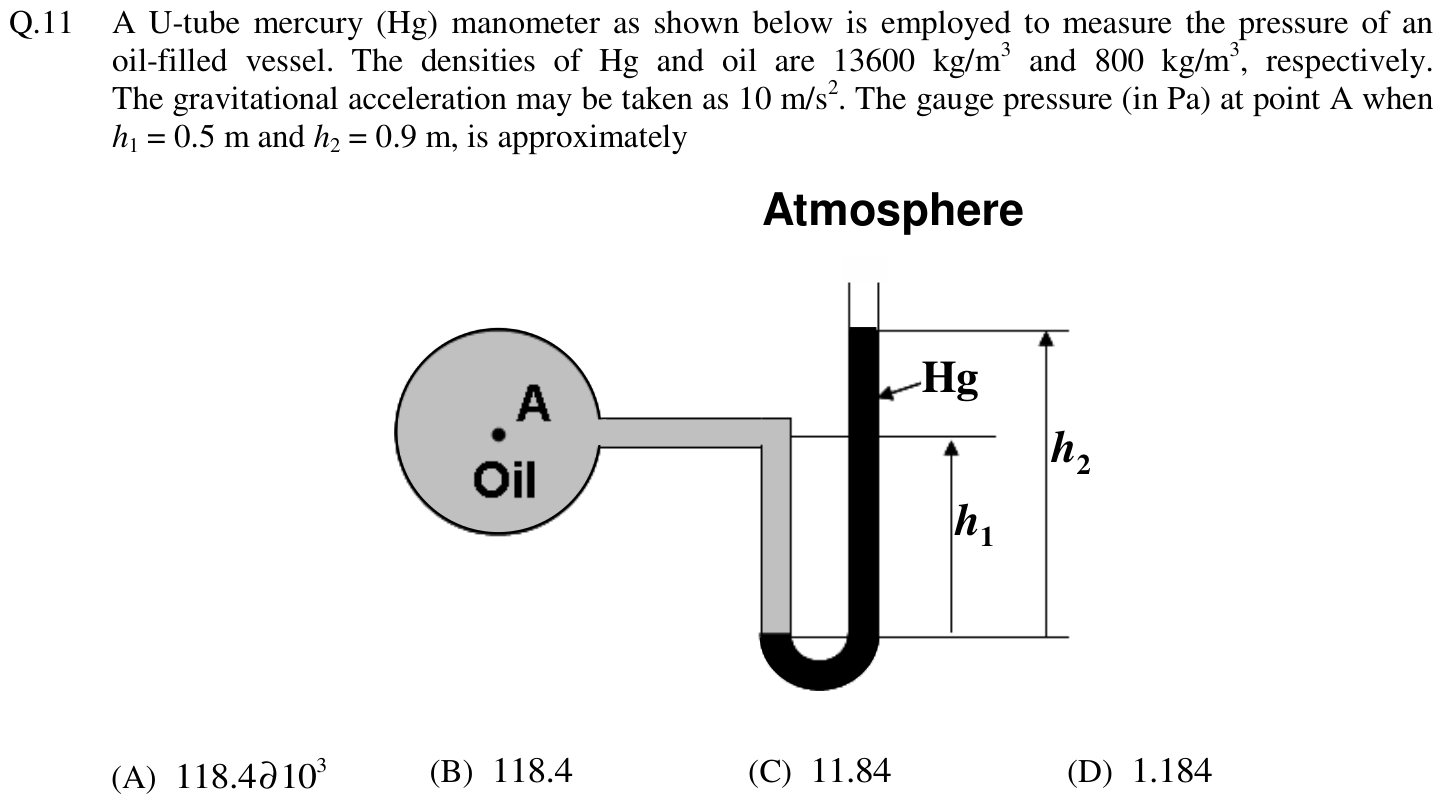
A U-tube mercury (Hg) manometer as shown below is employed to measure the pressure of an oil-filled vessel. The densities of Hg and oil are 13600 kg/m3 and 800 kg/m3, respectively. The gravitational acceleration may be taken as 10 m/s2. The gauge pressure (in Pa) at point A when h1 = 0.5 m and h2 = 0.9 m, is approximately
A. 3 118.4 10 ×
B. 118.4
C. 11.84
D. 1.184
Answer: A. 3 118.4 10 ×
Question 12
Marks: 2
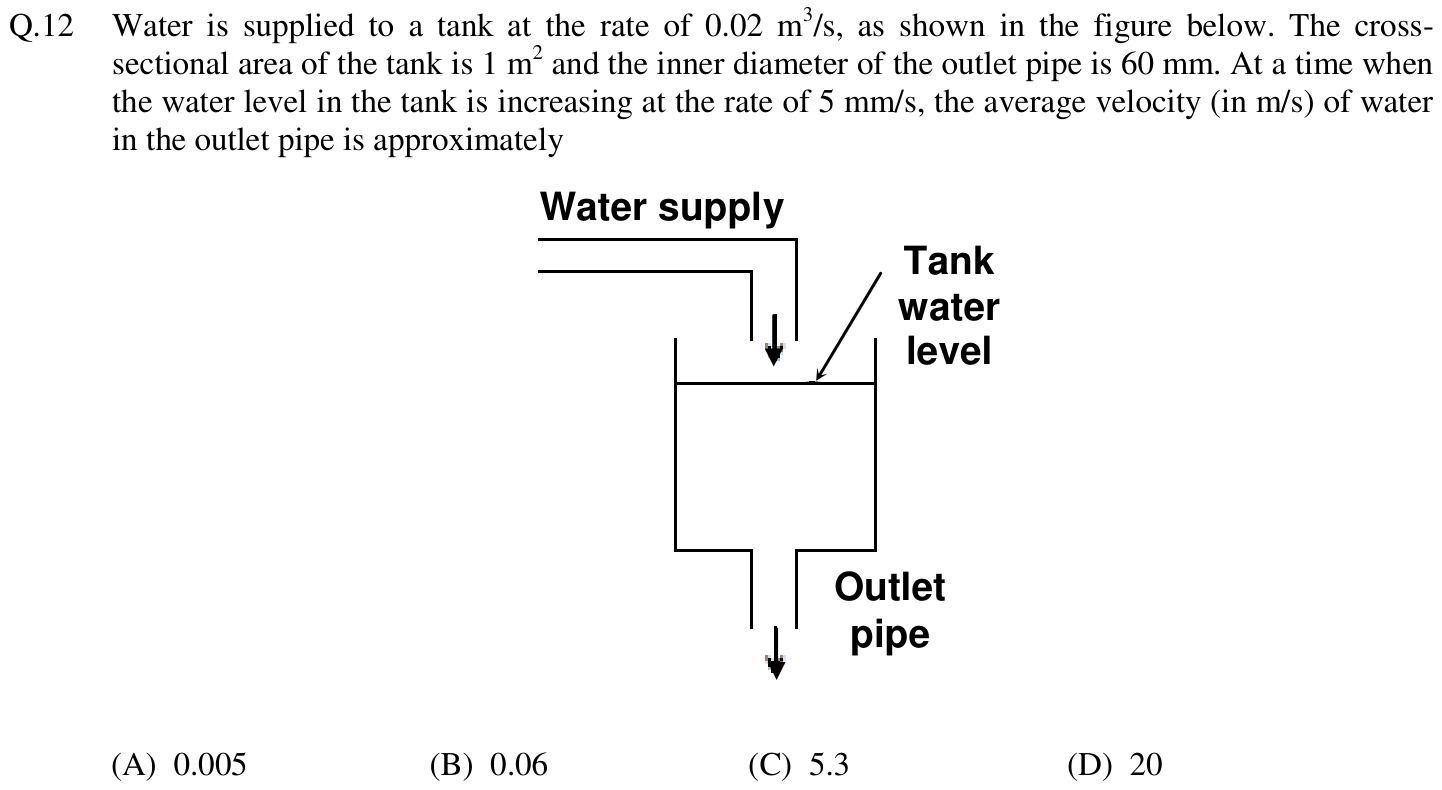
Water is supplied to a tank at the rate of 0.02 m3/s, as shown in the figure below. The cross- sectional area of the tank is 1 m2 and the inner diameter of the outlet pipe is 60 mm. At a time when the water level in the tank is increasing at the rate of 5 mm/s, the average velocity (in m/s) of water in the outlet pipe is approximately
A. 0.005
B. 0.06
C. 5.3
D. 20 Water supply Tank water level Outlet pipe h2 h1 Atmosphere Hg
Answer: C. 5.3
Question 13
Marks: 2
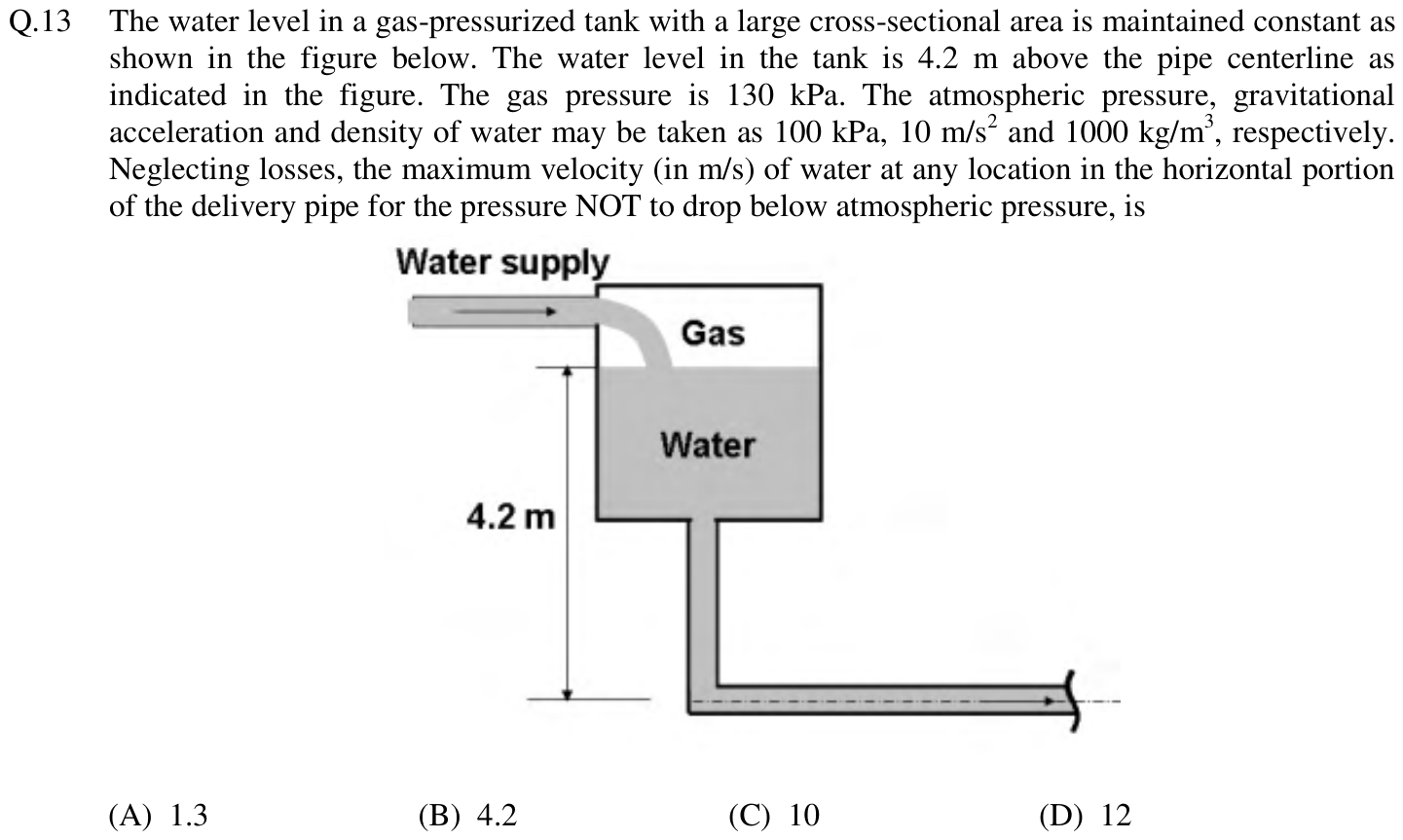
The water level in a gas-pressurized tank with a large cross-sectional area is maintained constant as shown in the figure below. The water level in the tank is 4.2 m above the pipe centerline as indicated in the figure. The gas pressure is 130 kPa. The atmospheric pressure, gravitational acceleration and density of water may be taken as 100 kPa, 10 m/s2 and 1000 kg/m3, respectively. Neglecting losses, the maximum velocity (in m/s) of water at any location in the horizontal portion of the delivery pipe for the pressure NOT to drop below atmospheric pressure, is
A. 1.3
B. 4.2
C. 10
D. 12
Answer: D. 12
Question 14
Marks: 2
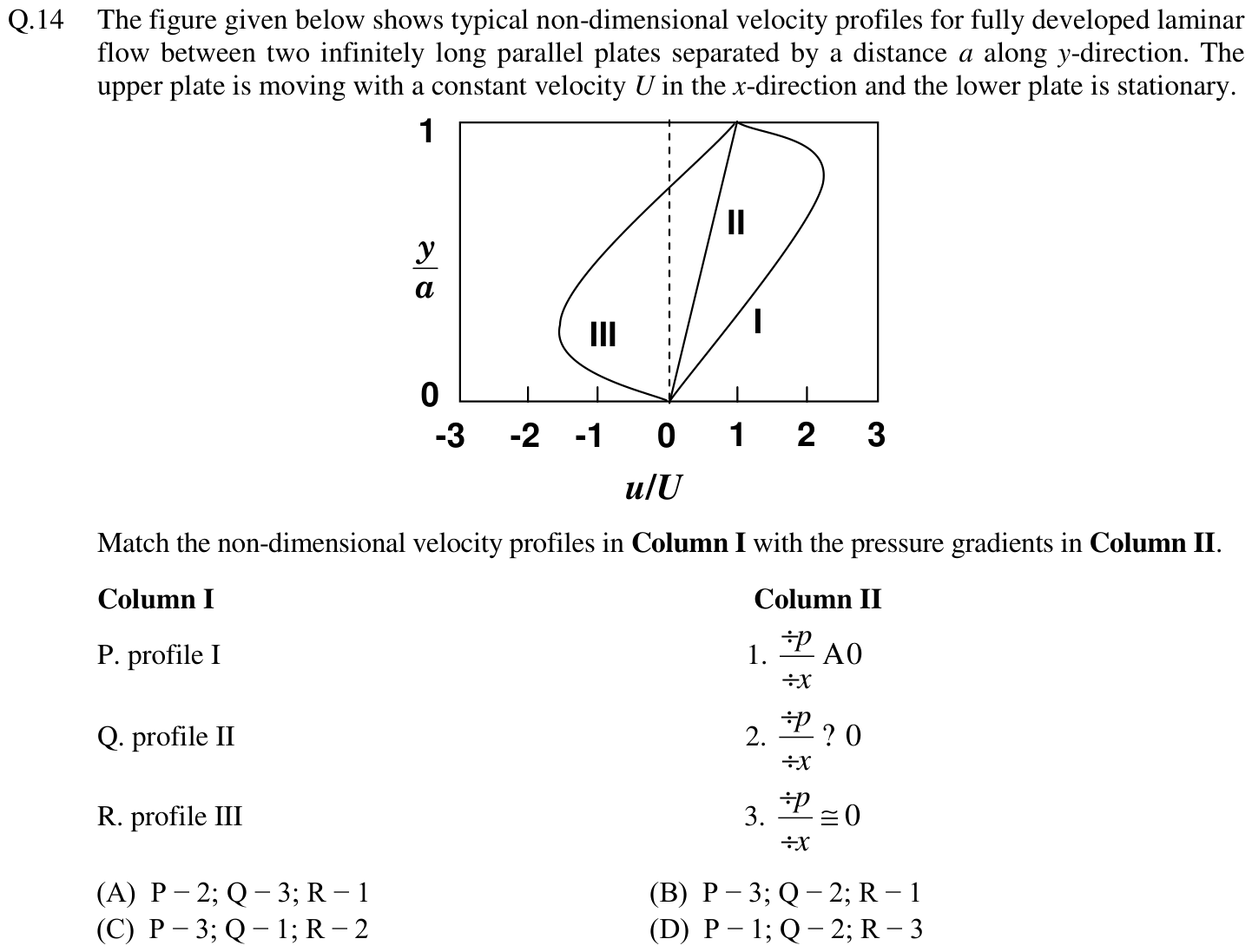
The figure given below shows typical non-dimensional velocity profiles for fully developed laminar flow between two infinitely long parallel plates separated by a distance a along y-direction. The upper plate is moving with a constant velocity U in the x-direction and the lower plate is stationary. Match the non-dimensional velocity profiles in Column I with the pressure gradients in Column II. Column I Column II P. profile I 1. 0 p x ∂ > ∂ Q. profile II 2. 0 p x ∂ < ∂ R. profile III 3. 0 p x ∂ = ∂
A. P − 2; Q − 3; R − 1
B. P − 3; Q − 2; R − 1
C. P − 3; Q − 1; R − 2
D. P − 1; Q − 2; R − 3 -3 -2 -1 0 1 2 3 0 1 u/U I II III a y
Answer: A. P − 2; Q − 3; R − 1
Question 15
Marks: 2
Air flows over a spherical storage vessel of diameter 4 m at a speed of 1 m/s. To find the drag force on the vessel, a test run is to be carried out in water using a sphere of diameter 100 mm. The density and dynamic viscosity of air are 1.2 kg/m3 and 1.8 ×10⁻⁵ Pa.s, respectively. The density and dynamic viscosity of water are 1000 kg/m3 and 10-3 Pa.s, respectively. The drag force on the model is 4 N under dynamically similar conditions. The drag force (in N) on the prototype is approximately
A. 0.25
B. 0.93
C. 1.08
D. 4
Answer: C. 1.08
Question 16
Marks: 2
The velocity of an air stream is 20 m/s. The densities of mercury and air are 13600 kg/m3 and 1.2 kg/m3, respectively. The gravitational acceleration may be taken as 10 m/s2. When a Pitot-static tube is placed in the stream, assuming the flow to be incompressible and frictionless, the difference between the stagnation and static pressure in the flow field (in mm Hg) would approximately be
A. 1760
B. 1.76
C. 0.57
D. 0.57 × 10⁻⁵
Answer: B. 1.76
Question 17
Marks: 2
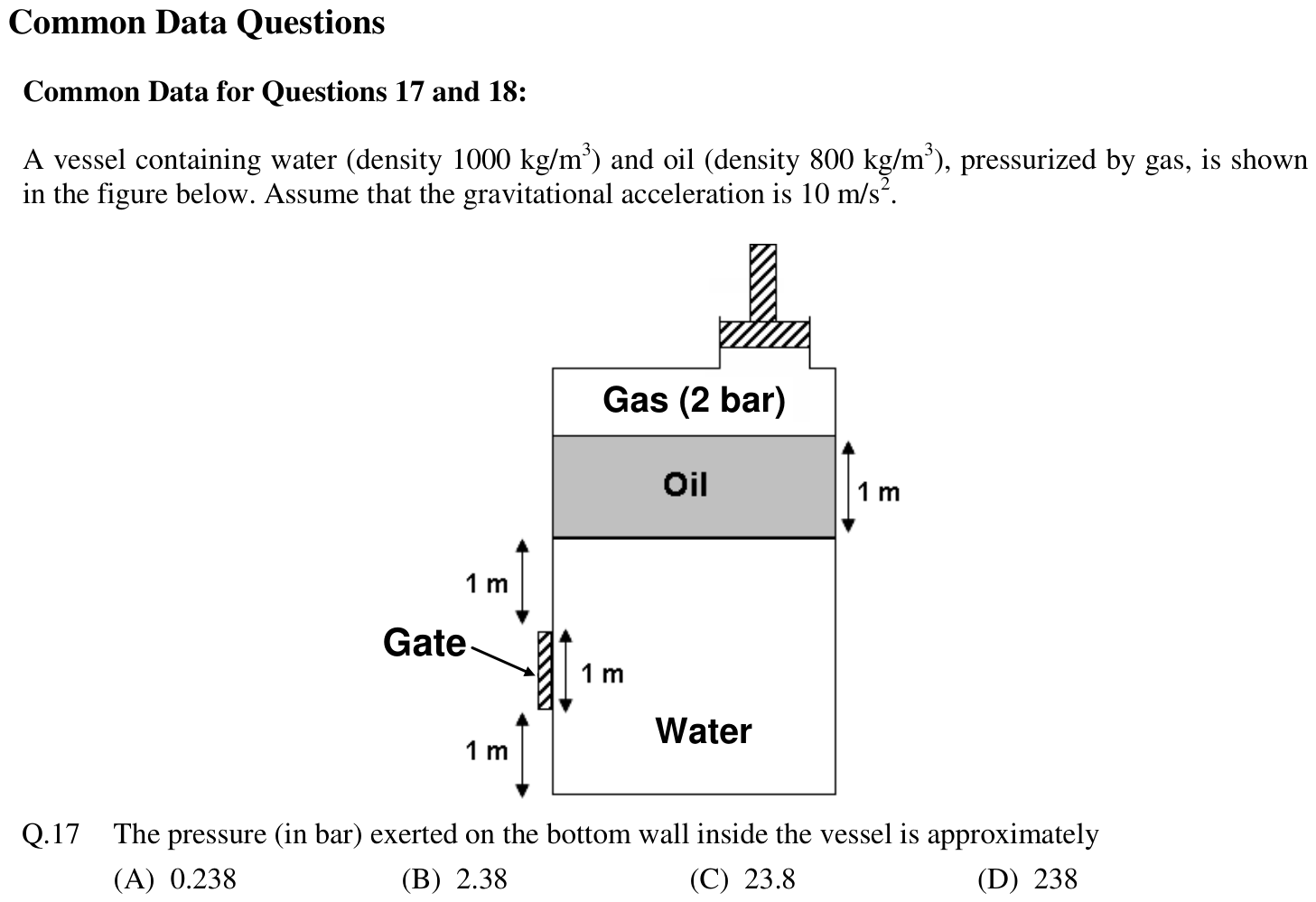
The pressure (in bar) exerted on the bottom wall inside the vessel is approximately
A. 0.238
B. 2.38
C. 23.8
D. 238
Answer: B. 2.38
Question 18
Marks: 2
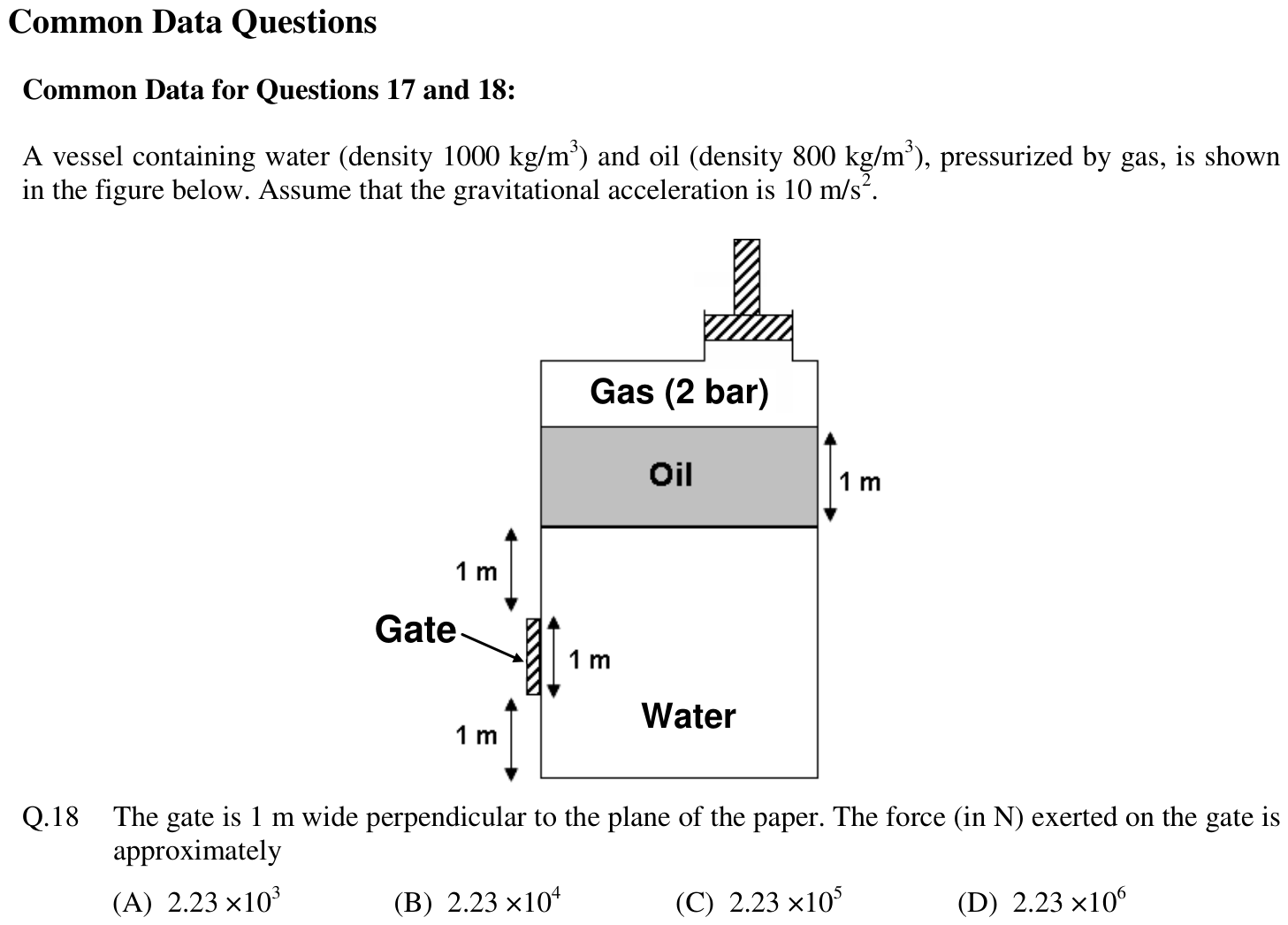
The gate is 1 m wide perpendicular to the plane of the paper. The force (in N) exerted on the gate is approximately
A. 2.23 ×10³
B. 2.23 ×10⁴
C. 2.23 ×10⁵
D. 2.23 ×10⁶ Gas (2 bar) Gate Water
Answer: C. 2.23 ×10⁵
Question 19
Marks: 2
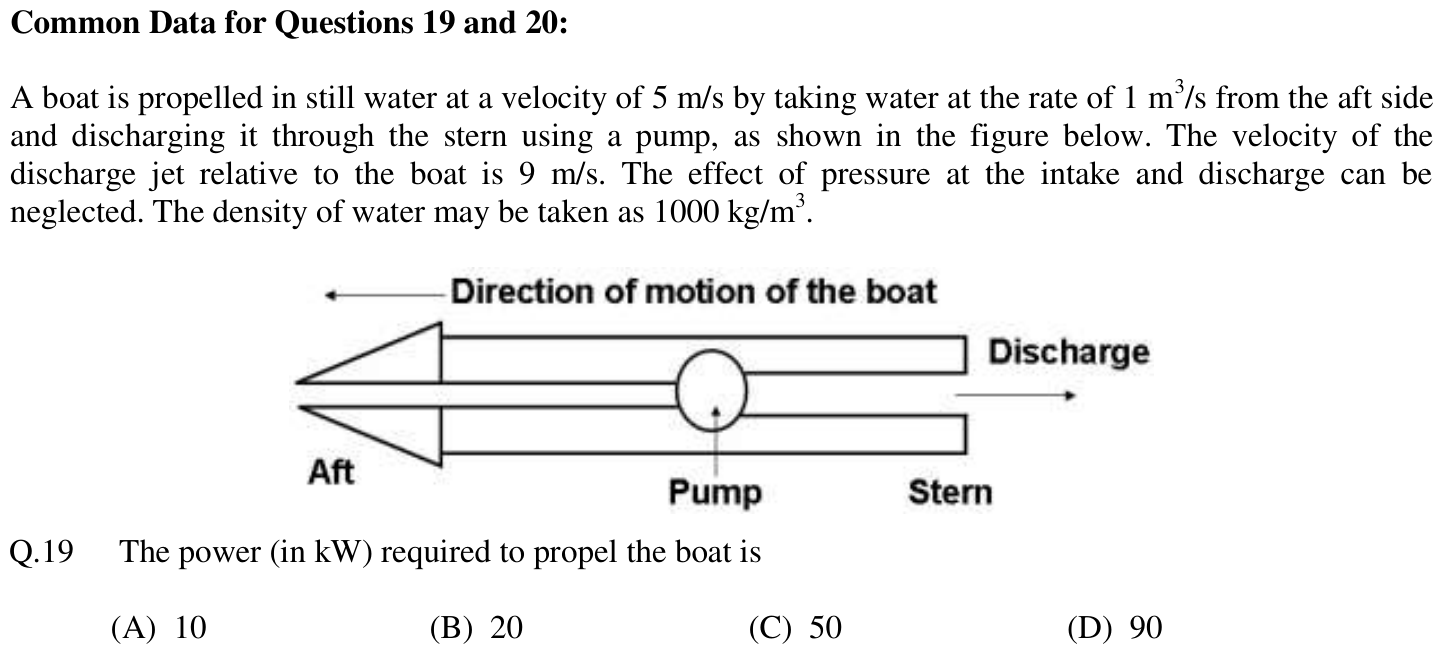
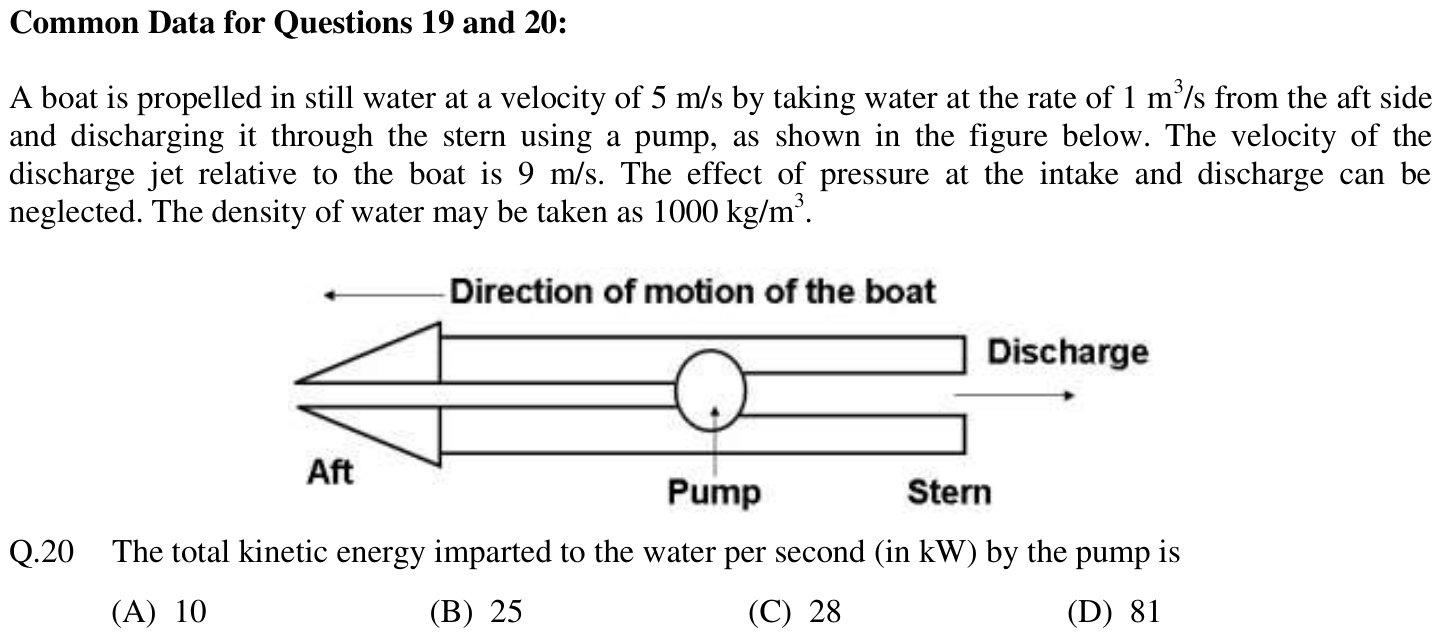
The power (in kW) required to propel the boat is
A. 10
B. 20
C. 50
D. 90
Answer: B. 20
Question 20
Marks: 2
The total kinetic energy imparted to the water per second (in kW) by the pump is
A. 10
B. 25
C. 28
D. 81
Answer: C. 28
Question 21
Marks: 2
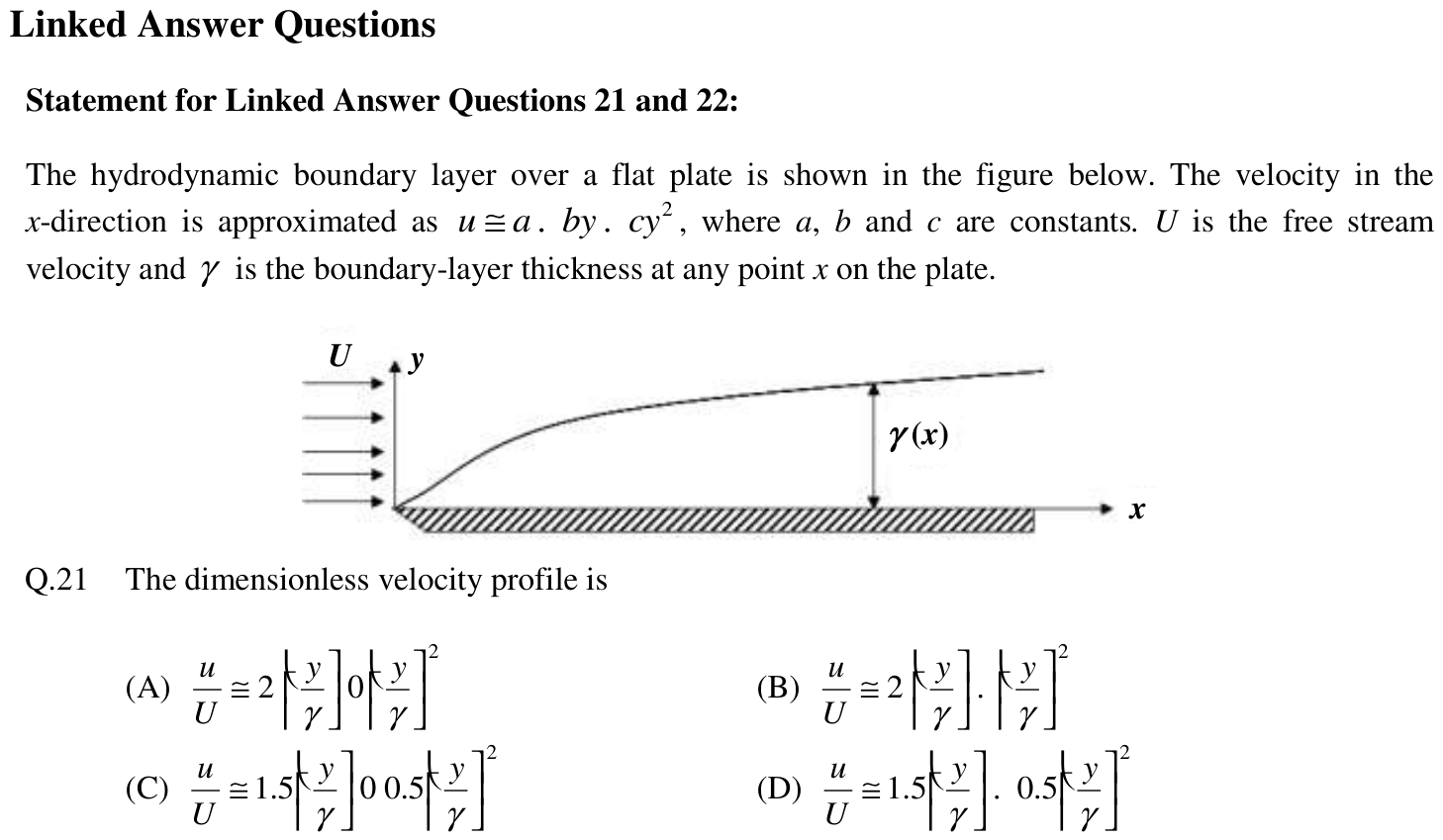
The dimensionless velocity profile is
A. 2 2 − = δ δ y y U u
B. 2 2 + = δ δ y y U u
C. 2 5.0 5.1 − = δ δ y y U u
D. 2 5.0 5.1 + = δ δ y y U u
Answer: A. 2 2 − = δ δ y y U u
Question 22
Marks: 2
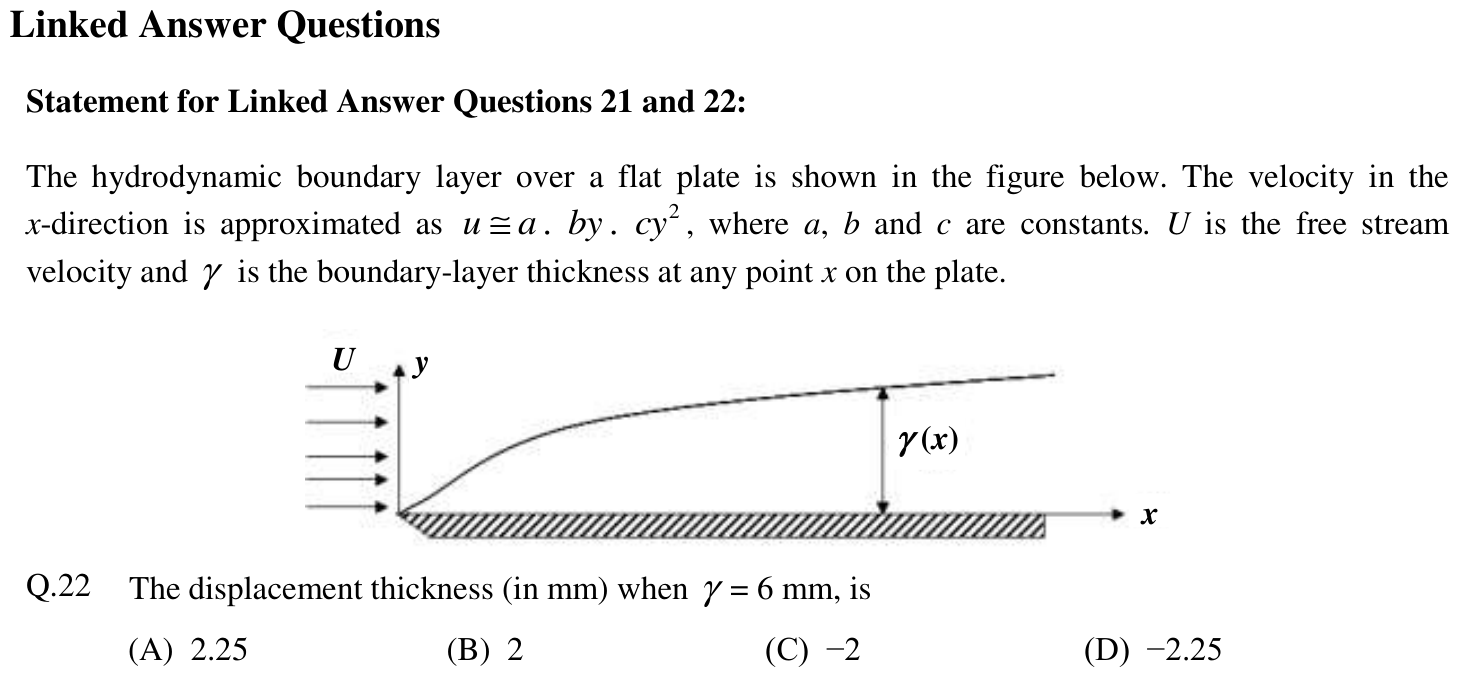
The displacement thickness (in mm) when δ= 6 mm, is
A. 2.25
B. 2
C. −2
D. −2.25 U y x δ (x)
Answer: B. 2
Solid Mechanics
Question 1
Marks: 1
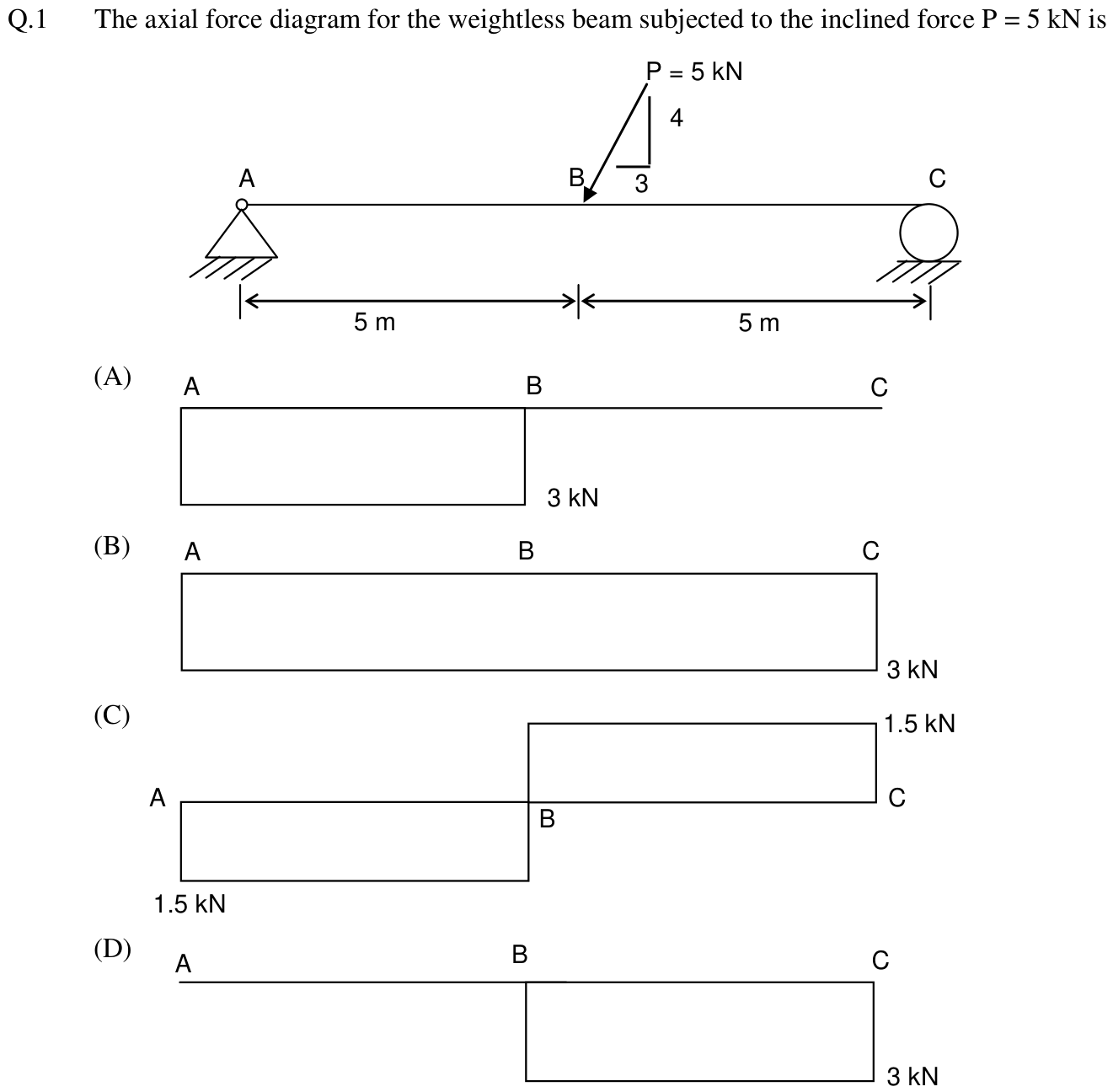
The axial force diagram for the weightless beam subjected to the inclined force P = 5 kN is
A.
B.
C.
D.
Answer: A.
Question 2
Marks: 1
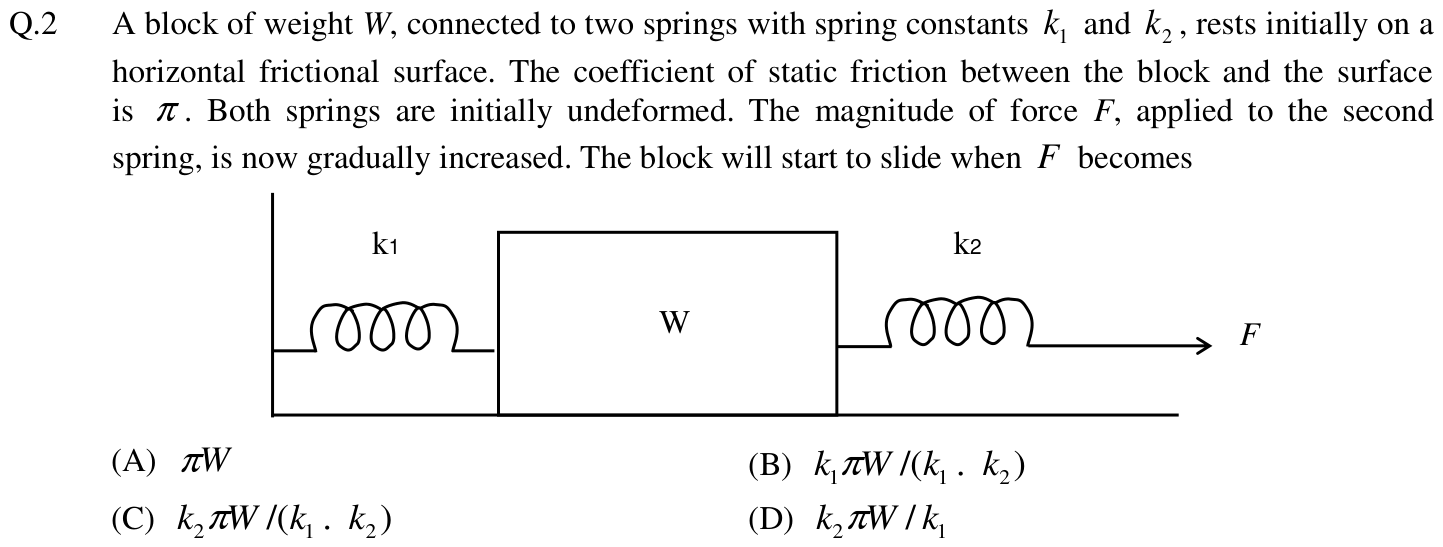
A block of weight W, connected to two springs with spring constants 1k and 2k , rests initially on a horizontal frictional surface. The coefficient of static friction between the block and the surface is μ. Both springs are initially undeformed. The magnitude of force F, applied to the second spring, is now gradually increased. The block will start to slide when F becomes
A. W μ
B. 1 1 2 /( ) k W k k μ +
C. 2 1 2 /( ) k W k k μ +
D. 2 1 / k W k μ P = 5 kN 4 5 m 5 m 3 B A C B A C 3 kN 3 kN B A C 1.5 kN C 1.5 kN B A C B A 3 kN F k2 k1 W
Answer: A. W μ
Question 3
Marks: 1
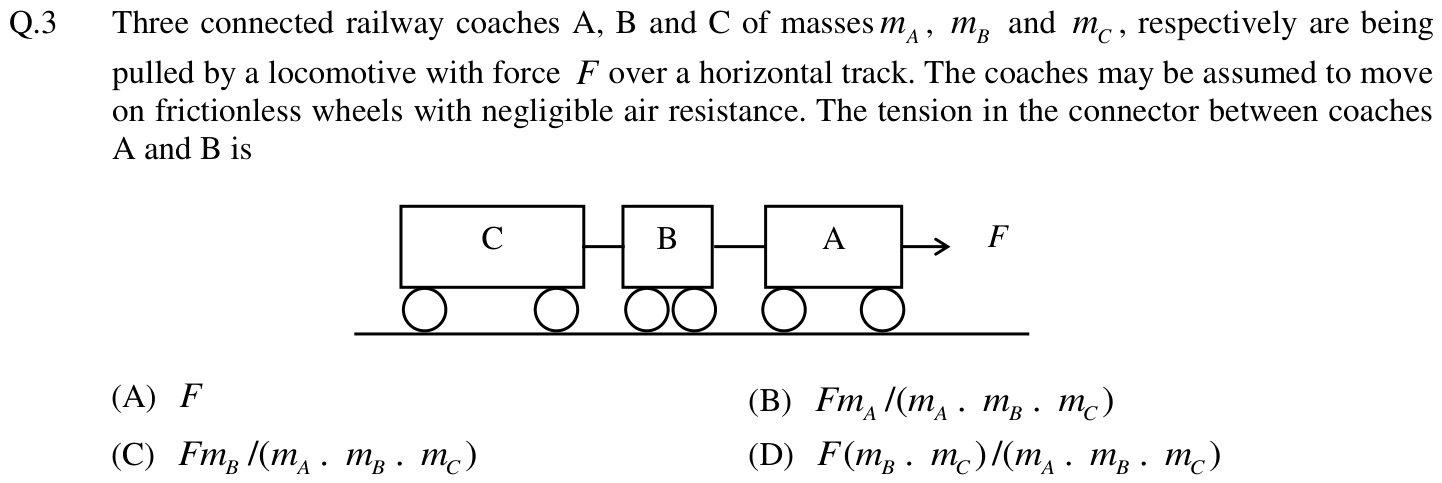
Three connected railway coaches A, B and C of masses A m , B m and C m , respectively are being pulled by a locomotive with force F over a horizontal track. The coaches may be assumed to move on frictionless wheels with negligible air resistance. The tension in the connector between coaches A and B is
A. F
B. /( ) A A B C Fm m m m + +
C. /( ) B A B C Fm m m m + +
D. ( )/( ) B C A B C F m m m m m + + +
Answer: D. ( )/( ) B C A B C F m m m m m + + +
Question 4
Marks: 1
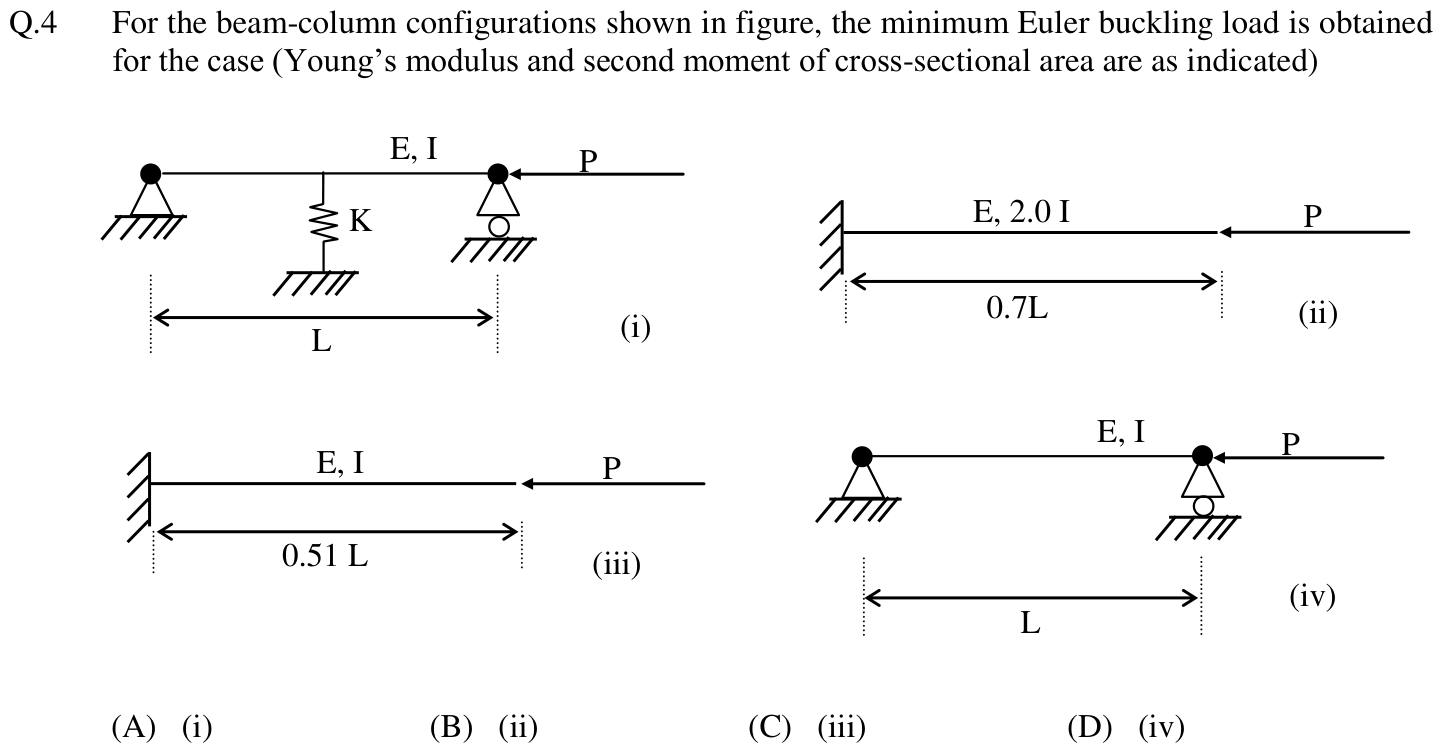
For the beam-column configurations shown in figure, the minimum Euler buckling load is obtained for the case (Young’s modulus and second moment of cross-sectional area are as indicated)
A. (i)
B. (ii)
C. (iii)
D. (iv)
Answer: C. (iii)
Question 5
Marks: 1
A disk of mass g 25 .0 = m and radius mm 10 = r is at rest relative to a mass-less horizontal turntable spinning about a vertical axis at an angular speed of s/ rad 2 = ω . The turntable is assumed to be mounted on frictionless bearings. Another identical, initially non-rotating disk is dropped onto the spinning disk. Friction causes both disks (and the turntable) to eventually rotate at the same angular speed. The eventual angular speed of the disks is
A. 0.15 rad/s
B. 1 rad/s
C. 2 rad/s
D. 4 rad/s
Answer: B. 1 rad/s
Question 6
Marks: 1
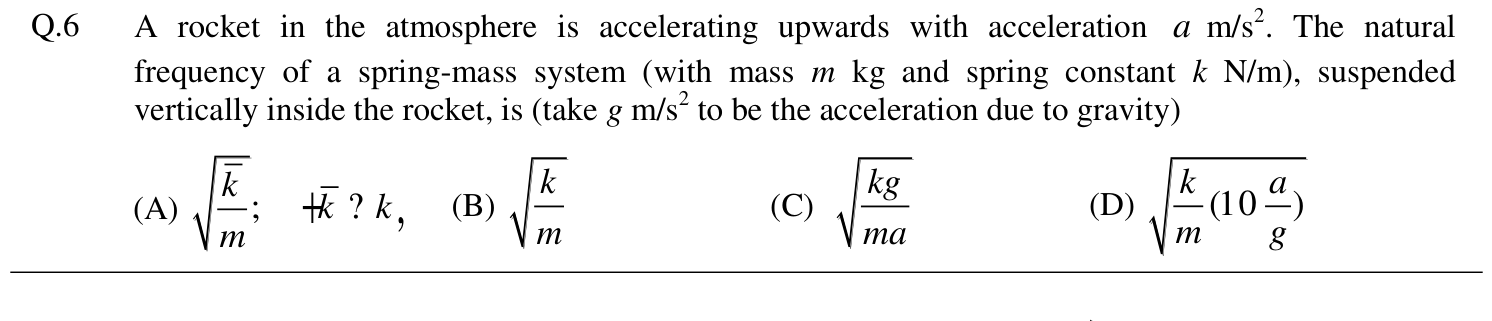
A rocket in the atmosphere is accelerating upwards with acceleration a m/s2. The natural frequency of a spring-mass system (with mass m kg and spring constant k N/m), suspended vertically inside the rocket, is (take g m/s2 to be the acceleration due to gravity)
A. ( ) ; k k k m <
B. k m
C. kg ma
D. (1 ) k a m g − C B A F P E, I K L (i) E, 2.0 I P (ii) 0.7L E, I P (iii) 0.51 L P E, I L (iv)
Answer: B. k m
Question 7
Marks: 1
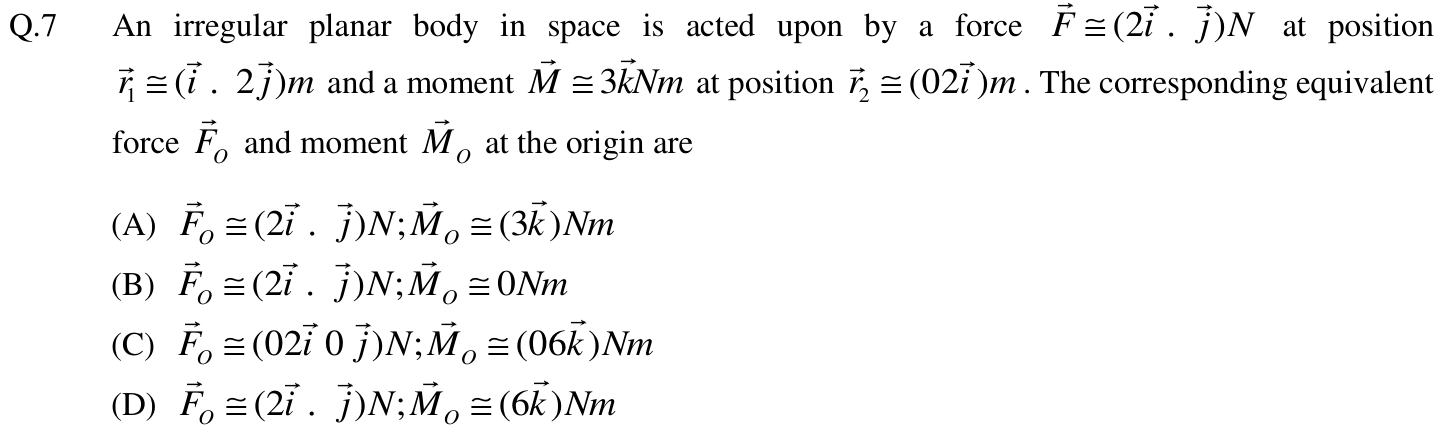
An irregular planar body in space is acted upon by a force (2 ) F i j N = + at position 1 ( 2 ) r i j m = + and a moment 3 M kNm = at position 2 ( 2 ) r i m =− . The corresponding equivalent force O F and moment O M at the origin are
A. (2 ) ; (3 ) O O F i j N M k Nm = + =
B. (2 ) ; 0 O O F i j N M Nm = + =
C. ( 2 ) ; ( 6 ) O O F i j N M k Nm =− − =−
D. (2 ) ; (6 ) O O F i j N M k Nm = + =
Answer: B. (2 ) ; 0 O O F i j N M Nm = + =
Question 8
Marks: 1
A hollow shaft and a solid shaft constructed of the same material have the same length and the same outer radius R. The inner radius of the hollow shaft is 0.6 R. Assuming that both shafts are subjected to the same torque, the ratio of the maximum shear stress in the hollow shaft to that in the solid shaft is
A. 1.1
B. 1.2
C. 1.15
D. 0.95
Answer: C. 1.15
Question 9
Marks: 1
A point in a beam experiences a tensile stress (due to bending) of 50 N/mm2 and a shear stress of 20 N/mm2. The principal stresses are
A. 17 N/mm2 tension, 67 N/mm2 compression
B. 0, 0
C. 57 N/mm2 tension, 7 N/mm2 compression
D. 52 N/mm2 compression, 15 N/mm2 tension
Answer: C. 57 N/mm2 tension, 7 N/mm2 compression
Question 10
Marks: 2
Consider a simply supported beam loaded either by a uniformly distributed transverse load or by a concentrated transverse load applied at the center such that the maximum bending stress in both cases is the same. The ratio of the strain energy for the two cases is
A. 4/5
B. 5/8
C. 8/5
D. 1
Answer: C. 8/5
Question 11
Marks: 2
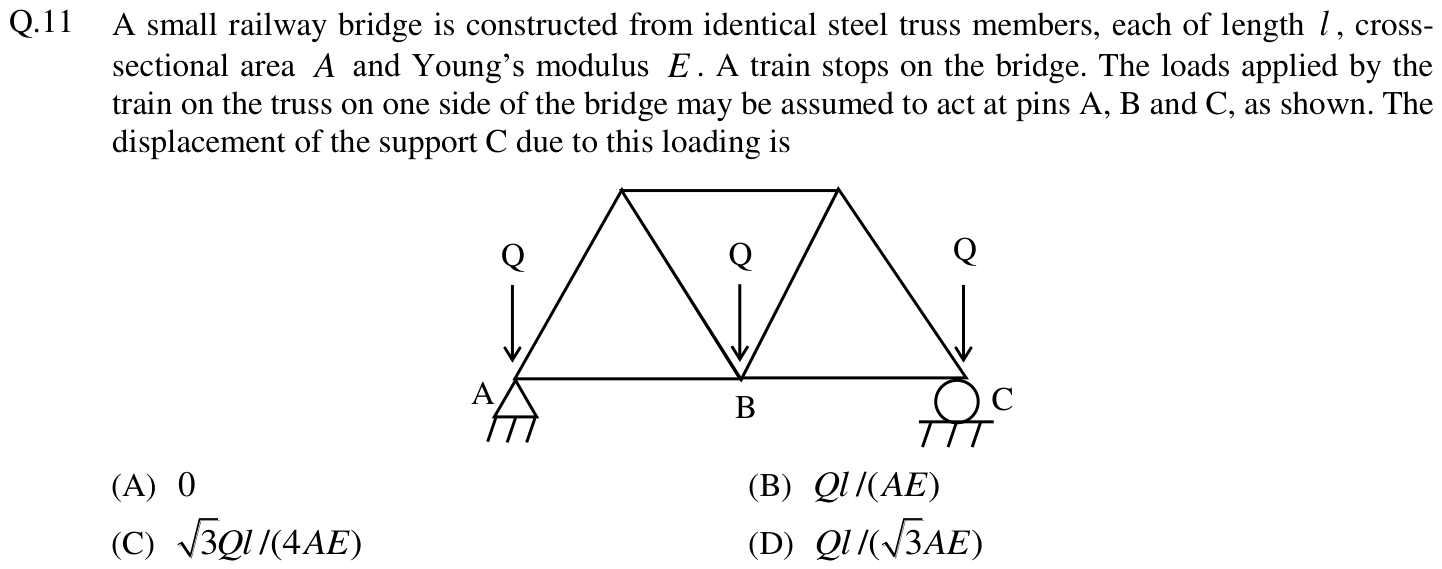
A small railway bridge is constructed from identical steel truss members, each of length l , cross- sectional area A and Young’s modulus E . A train stops on the bridge. The loads applied by the train on the truss on one side of the bridge may be assumed to act at pins A, B and C, as shown. The displacement of the support C due to this loading is
A. 0
B. /( ) Ql AE
C. 3 /(4 ) Ql AE
D. /( 3 ) Ql AE
Answer: D. /( 3 ) Ql AE
Question 12
Marks: 2
A vertical pole, cantilevered at the bottom, has a solid circular cross-section of diameter d = 49.21 mm. It is loaded by a horizontal force P = 6675 N at the top end. The maximum shear stress in the pole is
A. 4.25 N/mm2
B. 5.68 N/mm2
C. 4.68 N/mm2
D. 7.50 N/mm2 Q Q A B C Q
Answer: C. 4.68 N/mm2
Question 13
Marks: 2
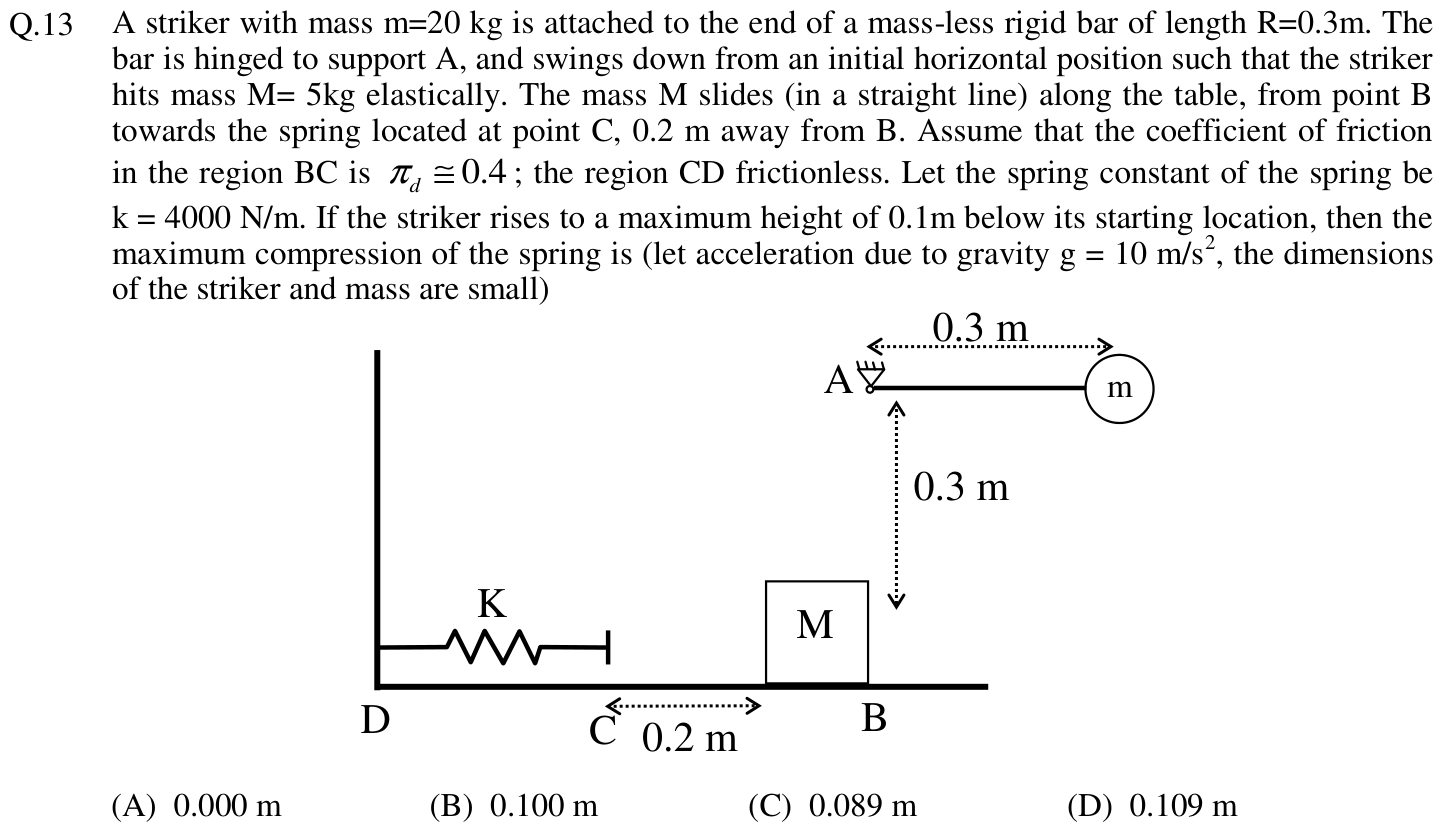
A striker with mass m=20 kg is attached to the end of a mass-less rigid bar of length R=0.3m. The bar is hinged to support A, and swings down from an initial horizontal position such that the striker hits mass M= 5kg elastically. The mass M slides (in a straight line) along the table, from point B towards the spring located at point C, 0.2 m away from B. Assume that the coefficient of friction in the region BC is 0.4 d μ= ; the region CD frictionless. Let the spring constant of the spring be k = 4000 N/m. If the striker rises to a maximum height of 0.1m below its starting location, then the maximum compression of the spring is (let acceleration due to gravity g = 10 m/s2, the dimensions of the striker and mass are small)
A. 0.000 m
B. 0.100 m
C. 0.089 m
D. 0.109 m
Question 14
Marks: 2
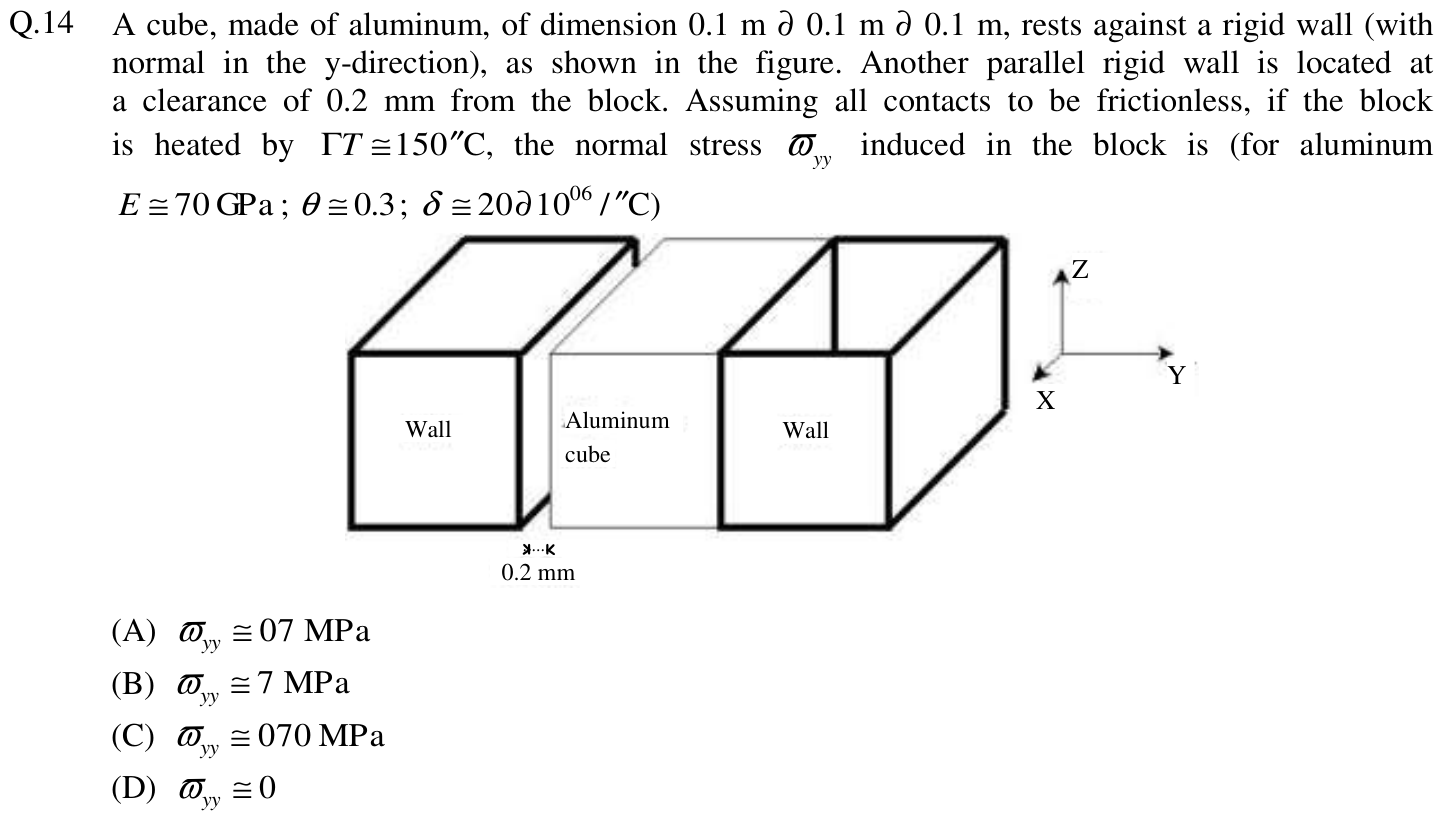
A cube, made of aluminum, of dimension 0.1 m × 0.1 m × 0.1 m, rests against a rigid wall (with normal in the y-direction), as shown in the figure. Another parallel rigid wall is located at a clearance of 0.2 mm from the block. Assuming all contacts to be frictionless, if the block is heated by 150 = ΔT °C, the normal stress yy σ induced in the block is (for aluminum GPa 70 = E ; 3.0 = ν ; / 10 20 6 − × = α °C)
A. MPa 7 − = yy σ
B. MPa 7 = yy σ
C. MPa 70 − = yy σ
D. 0 = yy σ
Answer: C. MPa 70 − = yy σ
Question 15
Marks: 2
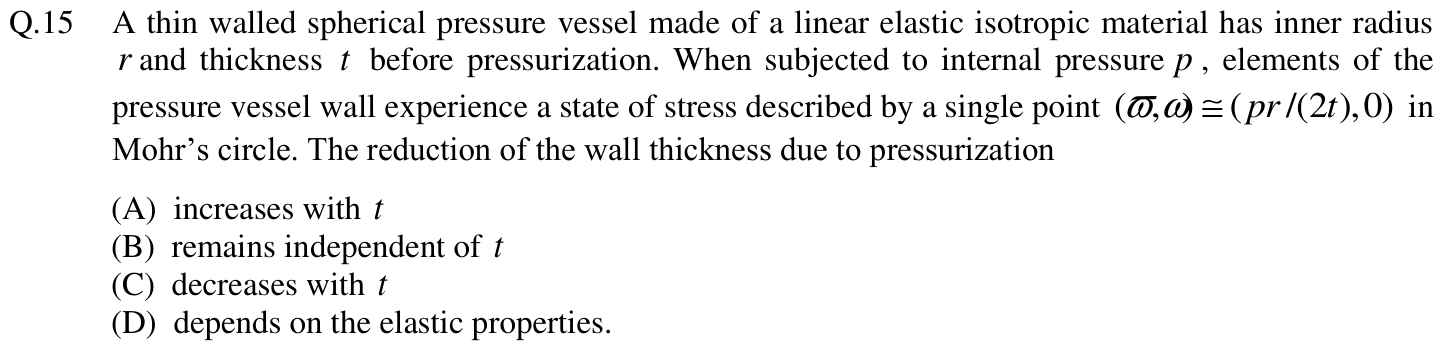
A thin walled spherical pressure vessel made of a linear elastic isotropic material has inner radius r and thickness t before pressurization. When subjected to internal pressure p , elements of the pressure vessel wall experience a state of stress described by a single point ( , ) ( /(2 ),0) pr t στ= in Mohr’s circle. The reduction of the wall thickness due to pressurization
A. increases with t
B. remains independent of t
C. decreases with t
D. depends on the elastic properties. Z Wall Aluminum cube Wall X Y 0.2 mm m C D B K M A 0.3 m 0.3 m 0.2 m
Question 16
Marks: 2
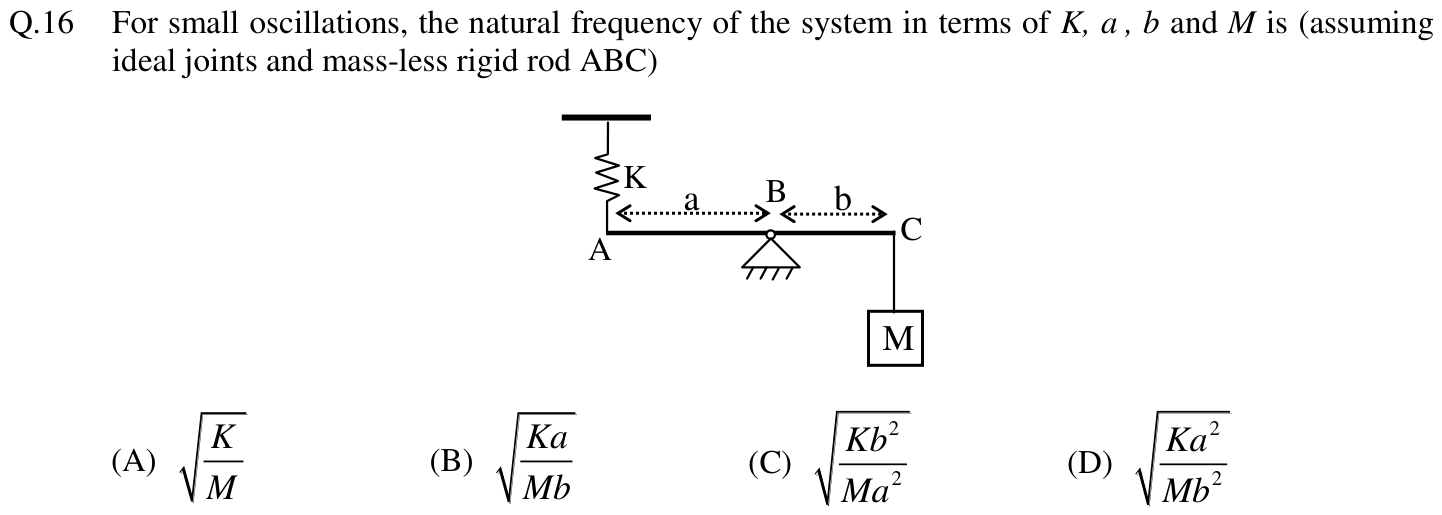
For small oscillations, the natural frequency of the system in terms of K, a , b and M is (assuming ideal joints and mass-less rigid rod ABC)
A. K M
B. Ka Mb
C. 2 2 Kb Ma
D. 2 2 Ka Mb
Answer: D. 2 2 Ka Mb
Question 17
Marks: 2
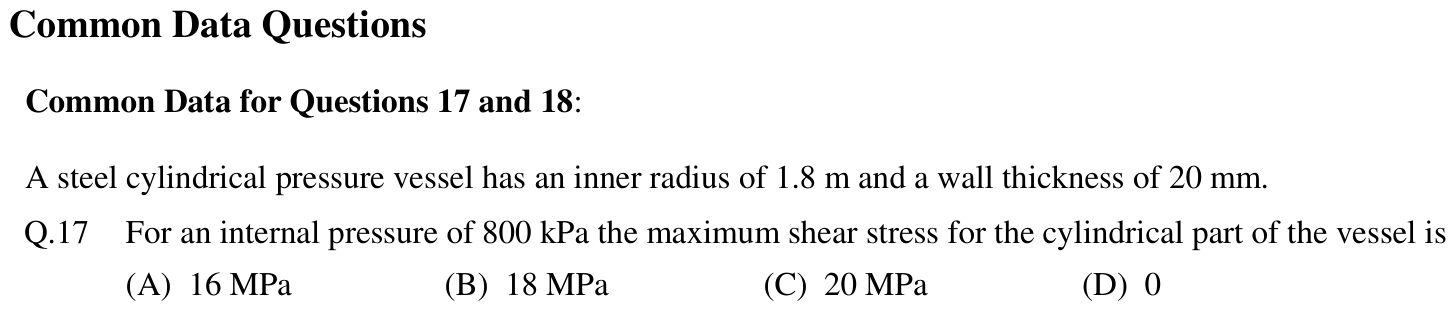
For an internal pressure of 800 kPa the maximum shear stress for the cylindrical part of the vessel is
A. 16 MPa
B. 18 MPa
C. 20 MPa
D. 0
Question 18
Marks: 2
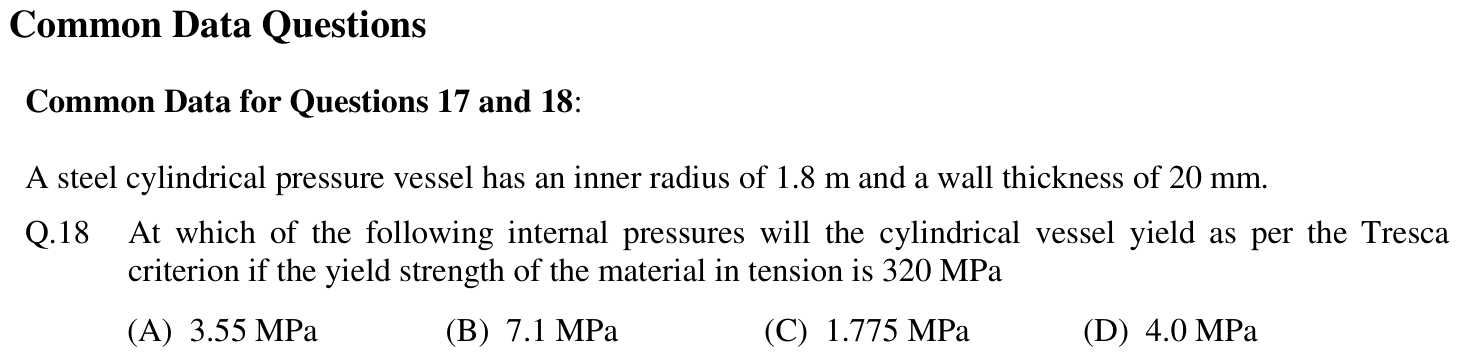
At which of the following internal pressures will the cylindrical vessel yield as per the Tresca criterion if the yield strength of the material in tension is 320 MPa
A. 3.55 MPa
B. 7.1 MPa
C. 1.775 MPa
D. 4.0 MPa
Answer: A. 3.55 MPa
Question 19
Marks: 2
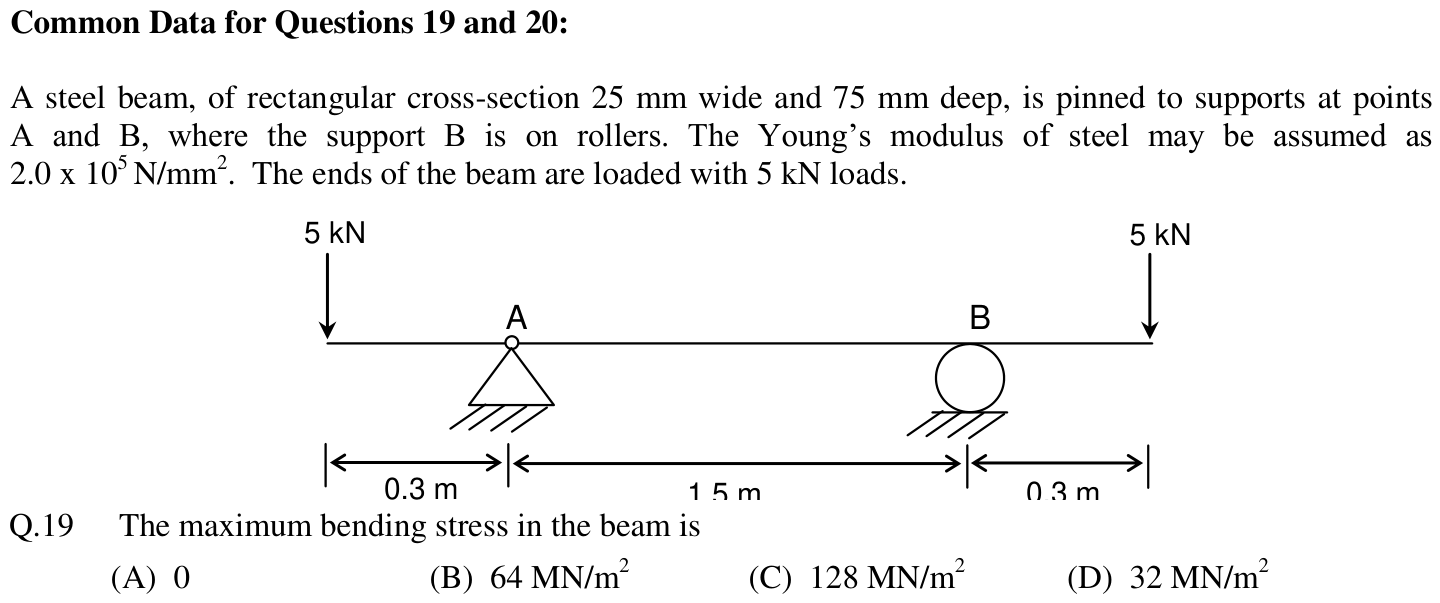
The maximum bending stress in the beam is
A. 0
B. 64 MN/m2
C. 128 MN/m2
D. 32 MN/m2
Answer: B. 64 MN/m2
Question 20
Marks: 2
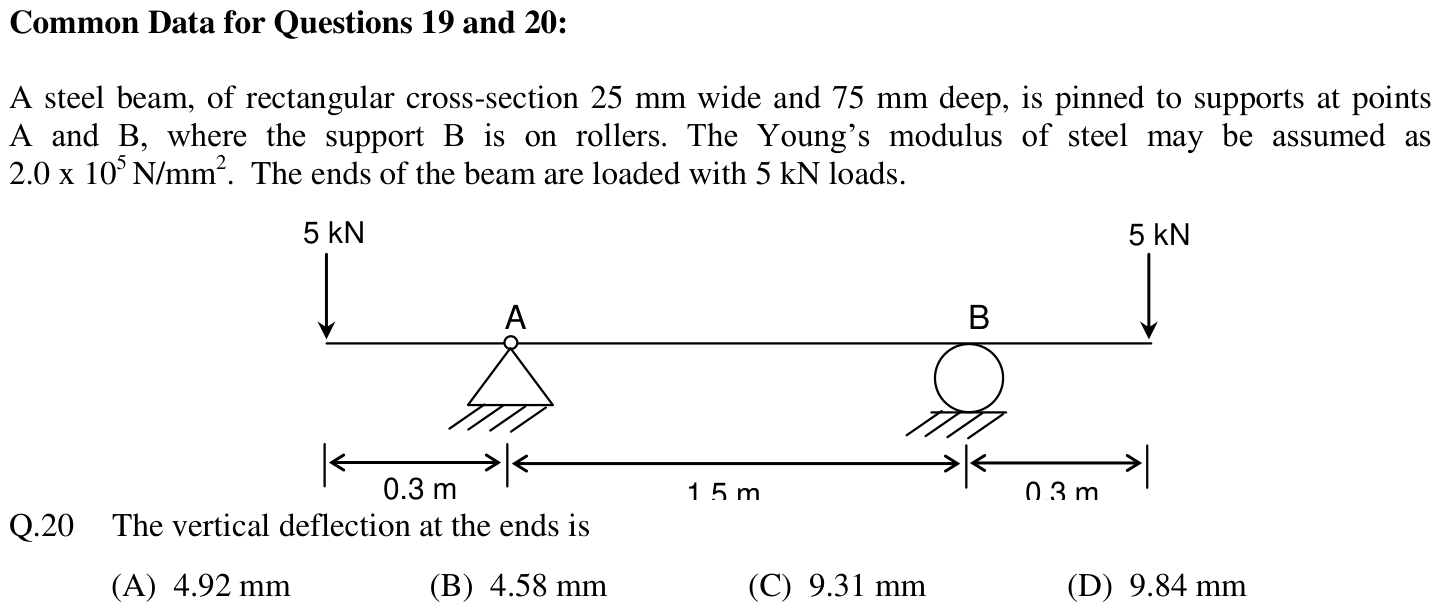
The vertical deflection at the ends is
A. 4.92 mm
B. 4.58 mm
C. 9.31 mm
D. 9.84 mm M C B K A a b B A 5 kN 5 kN 0.3 m 1.5 m 0.3 m
Question 21
Marks: 2
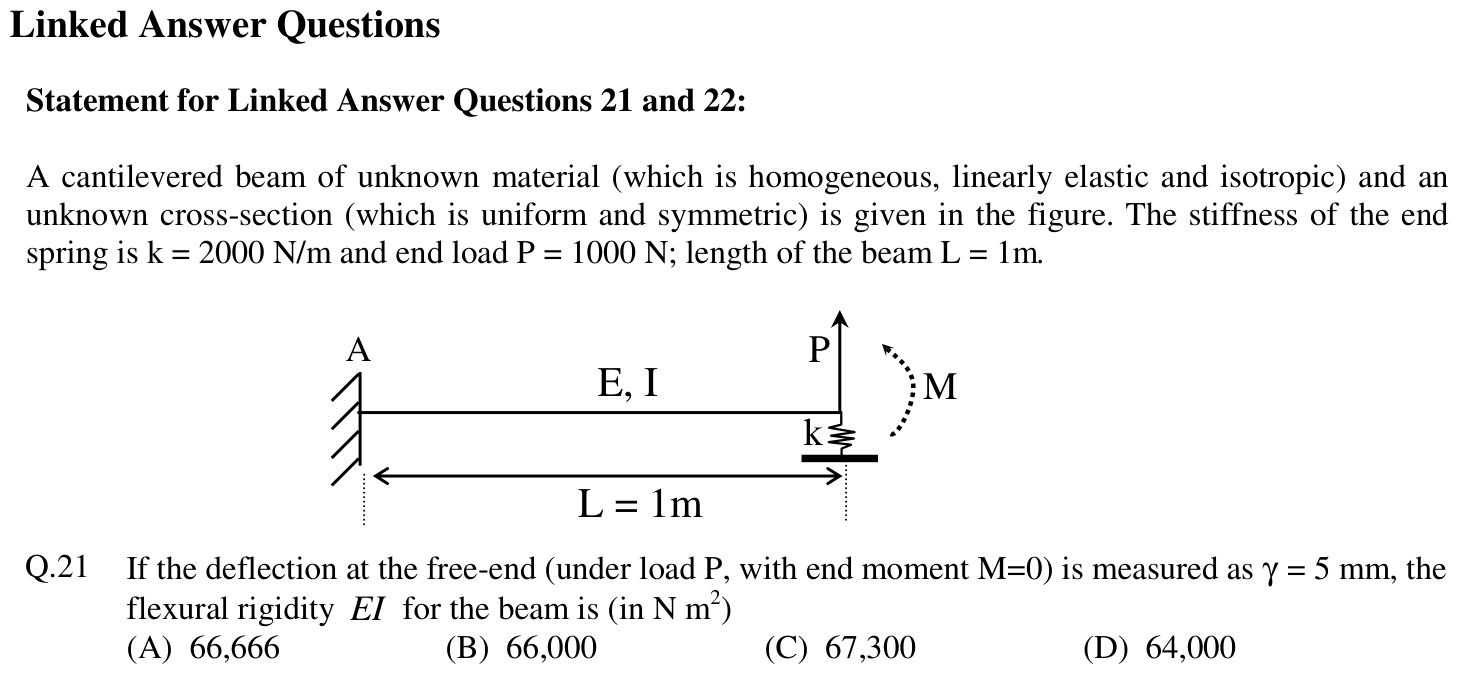
If the deflection at the free-end (under load P, with end moment M=0) is measured as δ = 5 mm, the flexural rigidity EI for the beam is (in N m2)
A. 66,666
B. 66,000
C. 67,300
D. 64,000
Answer: B. 66,000
Question 22
Marks: 2
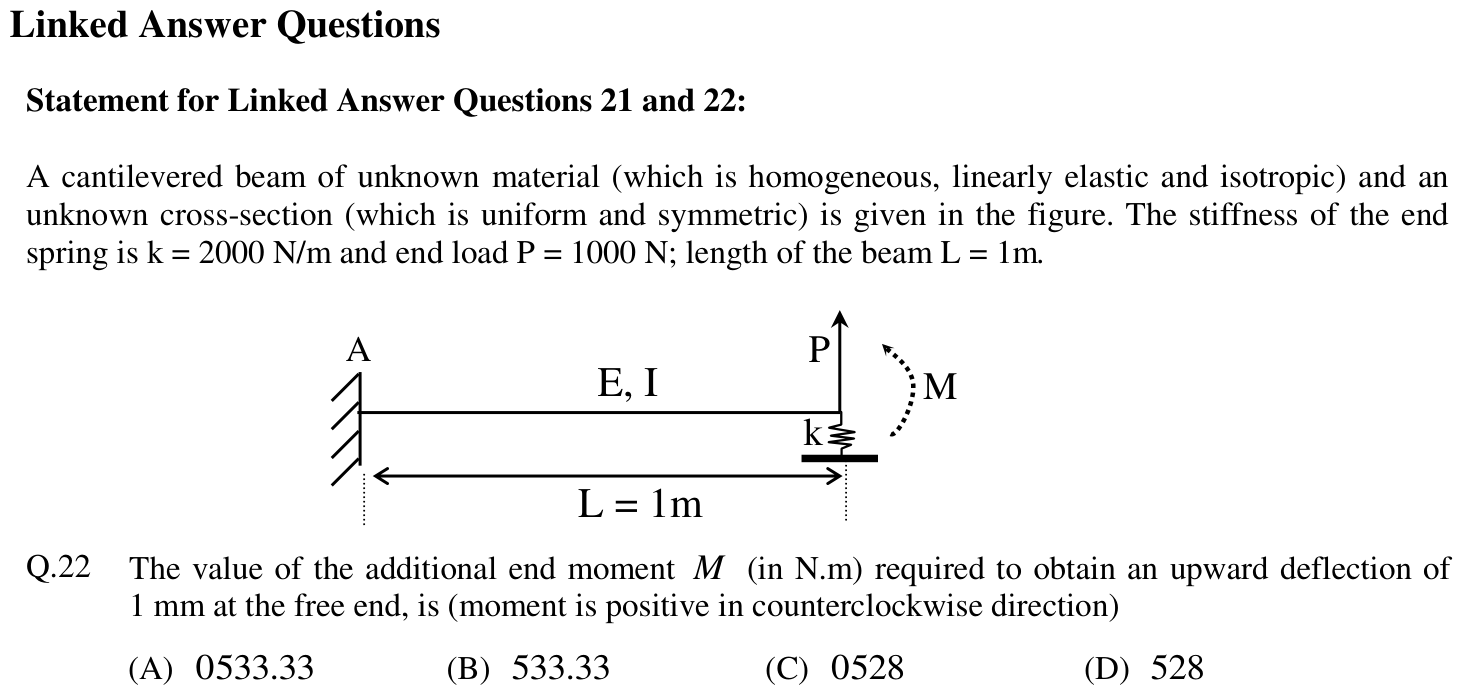
The value of the additional end moment M (in N.m) required to obtain an upward deflection of 1 mm at the free end, is (moment is positive in counterclockwise direction)
A. 533.33 −
B. 533.33
C. 528 −
D. 528 A P M L = 1m E, I k
Answer: A. 533.33 −
Thermodynamics
Question 1
Marks: 1
Consider a piston-cylinder arrangement containing a gas. This system is heated by placing it on the top of a burner. The system undergoes
A. a constant volume process
B. a constant pressure process
C. an adiabatic process
D. an isothermal process
Answer: B. a constant pressure process
Question 2
Marks: 1
For a pure substance, at the triple point
A. only solid and liquid phases co-exist in equilibrium
B. only liquid and vapour phases co-exist in equilibrium
C. only solid and vapour phases co-exist in equilibrium
D. solid, liquid and vapour phases co-exist in equilibrium
Answer: D. solid, liquid and vapour phases co-exist in equilibrium
Question 3
Marks: 1
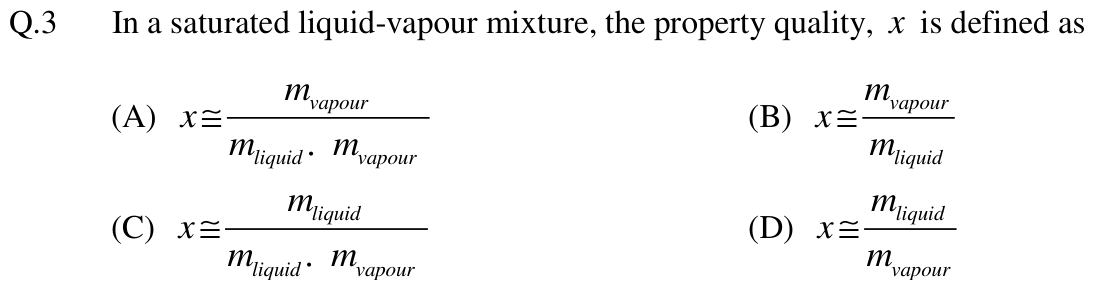
In a saturated liquid-vapour mixture, the property quality, x is defined as
A. vapour liquid vapour m x m m = +
B. vapour liquid m x m =
C. liquid liquid vapour m x m m = +
D. liquid vapour m x m =
Answer: A. vapour liquid vapour m x m m = +
Question 4
Marks: 1
The slope of a Mollier diagram at constant pressure indicates
A. enthalpy
B. entropy
C. internal energy
D. temperature
Answer: D. temperature
Question 5
Marks: 1
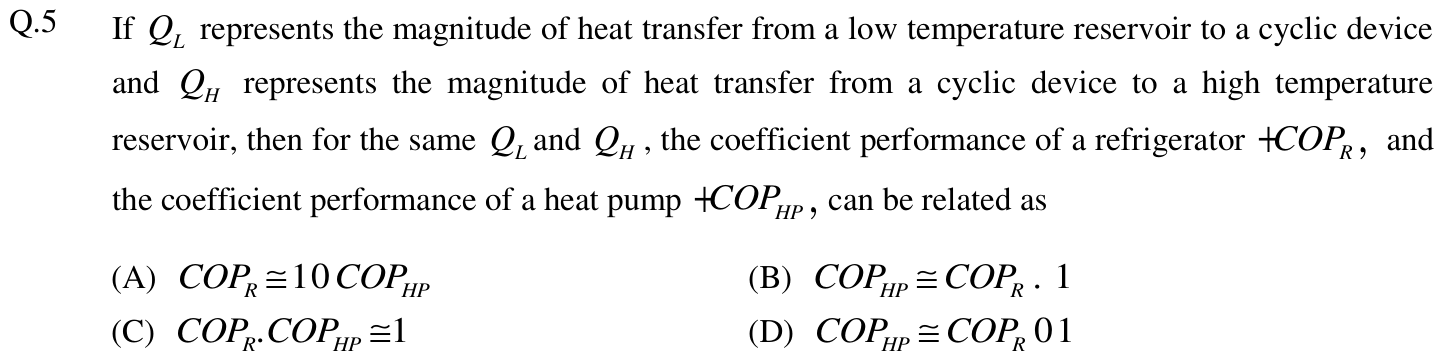
If L Q represents the magnitude of heat transfer from a low temperature reservoir to a cyclic device and H Q represents the magnitude of heat transfer from a cyclic device to a high temperature reservoir, then for the same L Q and H Q , the coefficient performance of a refrigerator ( ) R COP and the coefficient performance of a heat pump ( ) HP COP can be related as
A. 1 R HP COP COP =−
B. 1 HP R COP COP = +
C. . 1 R HP COP COP =
D. 1 HP R COP COP = −
Answer: B. 1 HP R COP COP = +
Question 6
Marks: 1
Clausius inequality is written as
A. ∫ >0 Q δ
B. ∫ <0 Q δ
C. ∫ ≤0 T Q δ
D. ∫ >0 T Q δ
Answer: C. ∫ ≤0 T Q δ
Question 7
Marks: 1
In a Diesel cycle, the ratio of cylinder volumes after and before combustion process is called
A. cut-off ratio
B. back work ratio
C. pressure ratio
D. compression ratio
Answer: A. cut-off ratio
Question 8
Marks: 1
The exergy (or availability) of a system at a specified state
A. depends on the conditions of the system alone
B. depends on the conditions of the environment alone
C. depends on the conditions of both the system and environment
D. depends neither on the conditions of the system nor the environment
Answer: C. depends on the conditions of both the system and environment
Question 9
Marks: 1
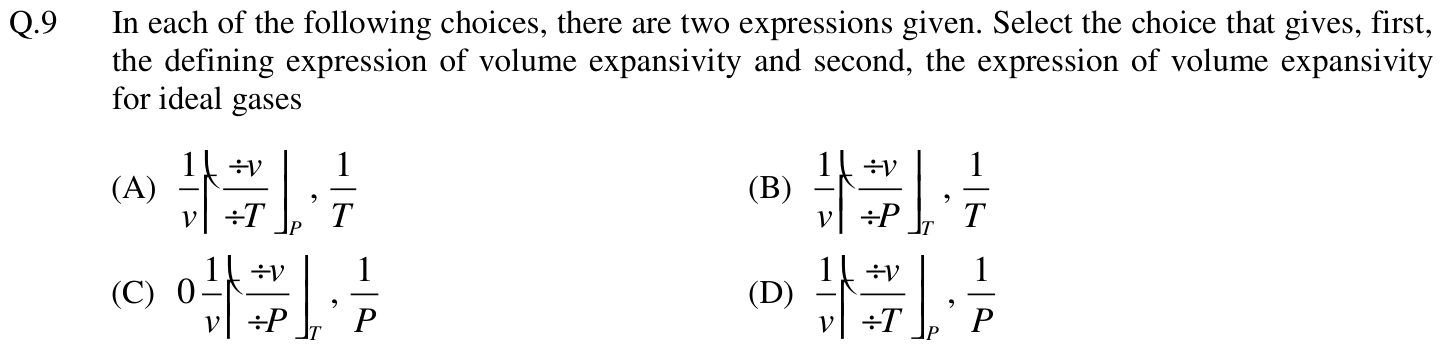
In each of the following choices, there are two expressions given. Select the choice that gives, first, the defining expression of volume expansivity and second, the expression of volume expansivity for ideal gases
A. 1 1 , P v v T T ∂ ∂
B. 1 1 , T v v P T ∂ ∂
C. 1 1 , T v v P P ∂ − ∂
D. 1 1 , P v v T P ∂ ∂
Answer: A. 1 1 , P v v T T ∂ ∂
Question 10
Marks: 2
A certain mass of gas at 0oC is expanded to 81 times its original volume under adiabatic conditions. If ratio of specific heats of the gas, 1.25 γ= , the final temperature of the gas is
A. – 235 oC
B. – 182 oC
C. – 91 oC
D. 0 oC
Answer: B. – 182 oC
Question 11
Marks: 2
A sample of gas with initial average kinetic energy, E is heated from 27 oC to 327 oC. The average kinetic energy after heating is
A. E
B. 2E
C. 27E
D. 327E
Answer: B. 2E
Question 12
Marks: 2
Helium in a piston/cylinder assembly at 20oC and 100 kPa is brought to 400 K in a reversible polytropic process with exponent n = 1.25. Assume helium to be an ideal gas. The molecular mass of helium is 4.003 kg/kmol. The specific work in the process is approximately
A. – 800 kJ/kg
B. – 788 kJ/kg
C. 788 kJ/kg
D. – 888 kJ/kg
Answer: D. – 888 kJ/kg
Question 13
Marks: 2
32 kg of oxygen is mixed with 28 kg of nitrogen at the same temperature. The gases are at the same pressure of 103 kPa before and after mixing. If R is the universal gas constant in kJ/kmol.K, the change in entropy of the mixture is
A. 1.38R
B. 0.69R
C. R
D. 0.34R
Answer: A. 1.38R
Question 14
Marks: 2
Consider two Carnot heat engines A and B operating in series. Engine A receives heat from a reservoir at 1750 K and rejects heat to another reservoir at temperature T. Engine B receives an amount of energy same as that rejected by Engine A from the reservoir at temperature T. Engine B then rejects heat to another reservoir at 320 K. In both cases, the engines produce some amount of work. If the thermal efficiencies of both the engines are the same, then the temperature T is approximately
A. 848 K
B. 748 K
C. 648 K
D. 548 K
Answer: B. 748 K
Question 15
Marks: 2
Joule-Thomson coefficient for a gas, j μ obeying the relation ( ) p v b RT − = is
A. p j c b μ=
B. j p b c μ=
C. j p b c μ=−
D. p j c b μ=−
Answer: C. j p b c μ=−
Question 16
Marks: 2
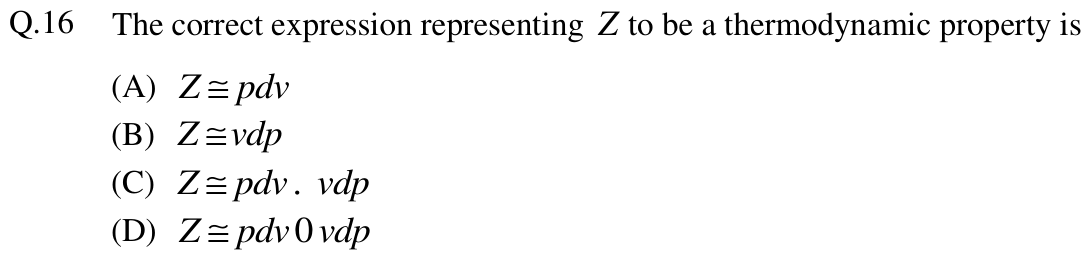
The correct expression representing Z to be a thermodynamic property is
A. Z pdv =
B. Z vdp =
C. Z pdv vdp = +
D. Z pdv vdp = −
Answer: C. Z pdv vdp = +
Question 17
Marks: 2
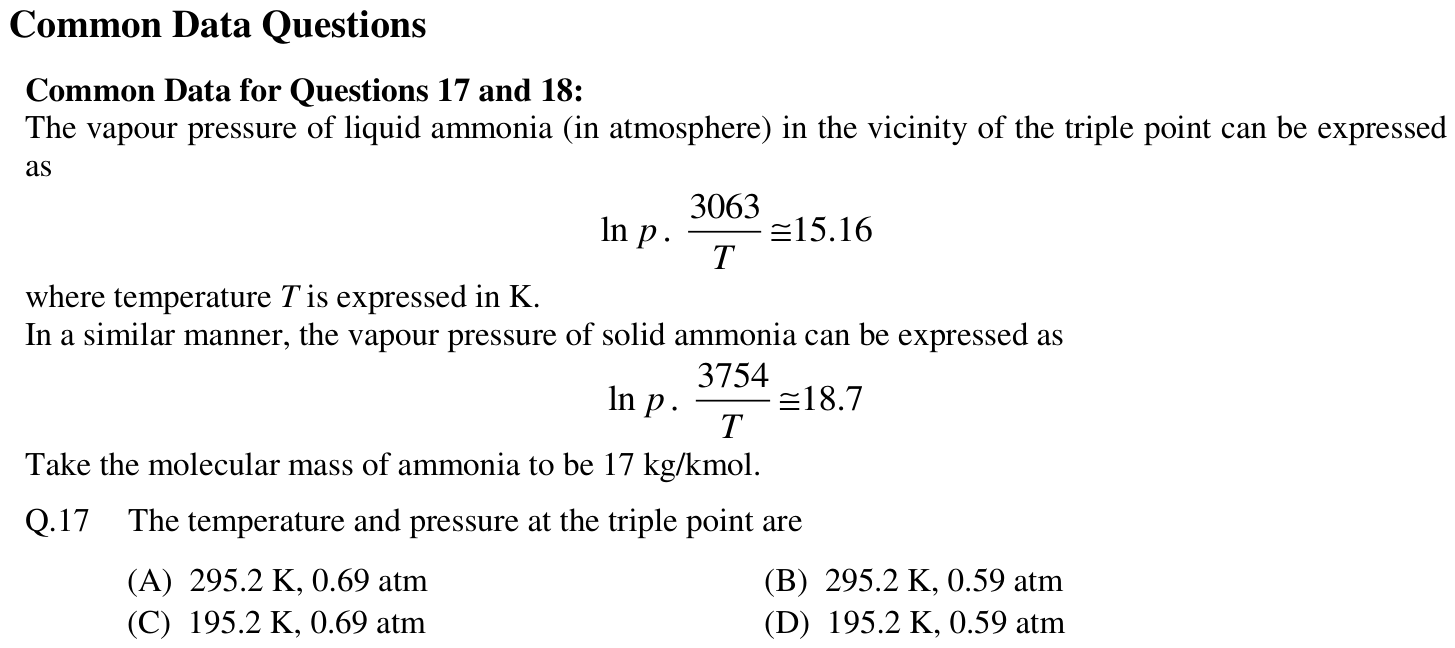
The temperature and pressure at the triple point are
A. 295.2 K, 0.69 atm
B. 295.2 K, 0.59 atm
C. 195.2 K, 0.69 atm
D. 195.2 K, 0.59 atm
Answer: D. 195.2 K, 0.59 atm
Question 18
Marks: 2
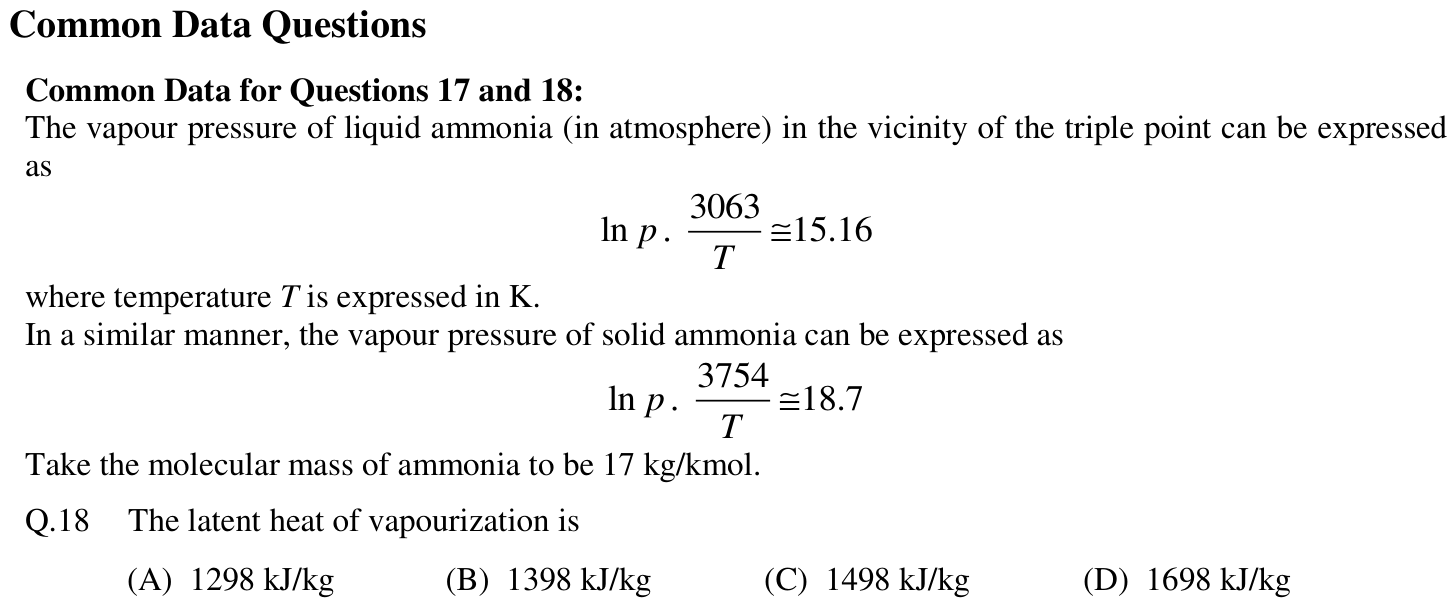
The latent heat of vapourization is
A. 1298 kJ/kg
B. 1398 kJ/kg
C. 1498 kJ/kg
D. 1698 kJ/kg
Answer: C. 1498 kJ/kg
Question 19
Marks: 2
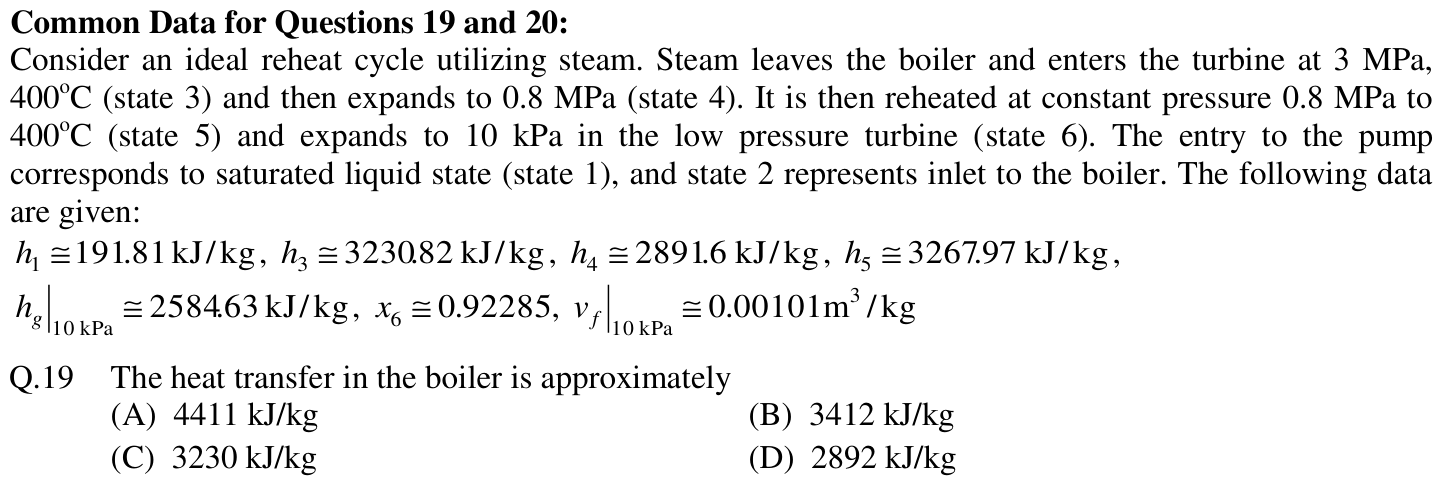
The heat transfer in the boiler is approximately
A. 4411 kJ/kg
B. 3412 kJ/kg
C. 3230 kJ/kg
D. 2892 kJ/kg
Answer: B. 3412 kJ/kg
Question 20
Marks: 2
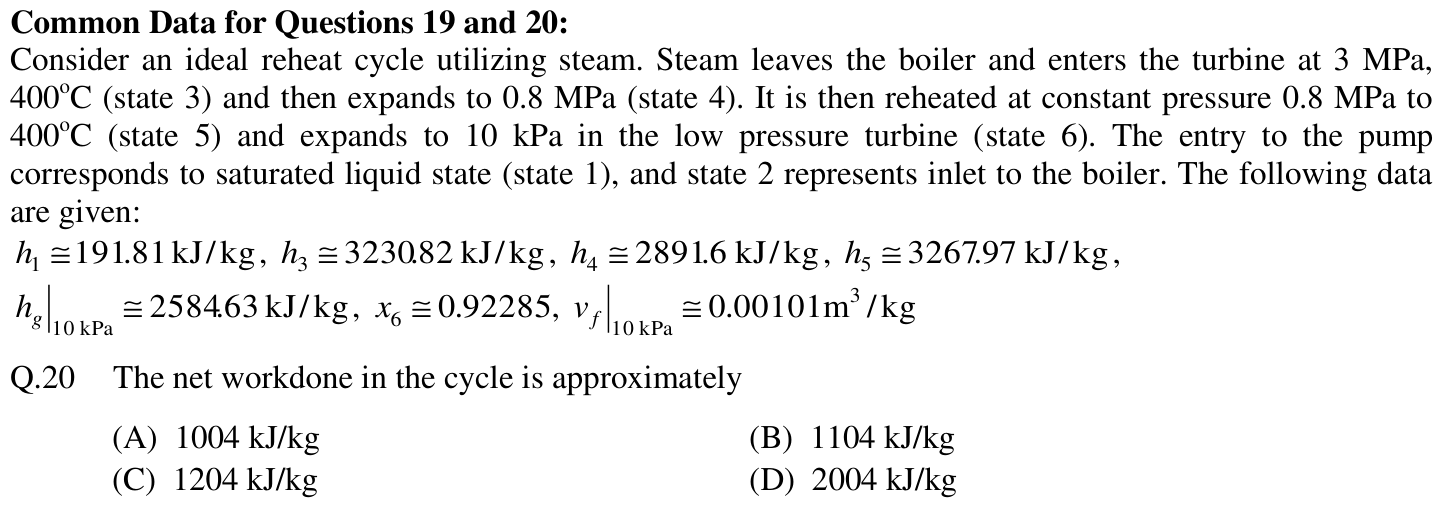
The net workdone in the cycle is approximately
A. 1004 kJ/kg
B. 1104 kJ/kg
C. 1204 kJ/kg
D. 2004 kJ/kg
Answer: C. 1204 kJ/kg
Question 21
Marks: 2
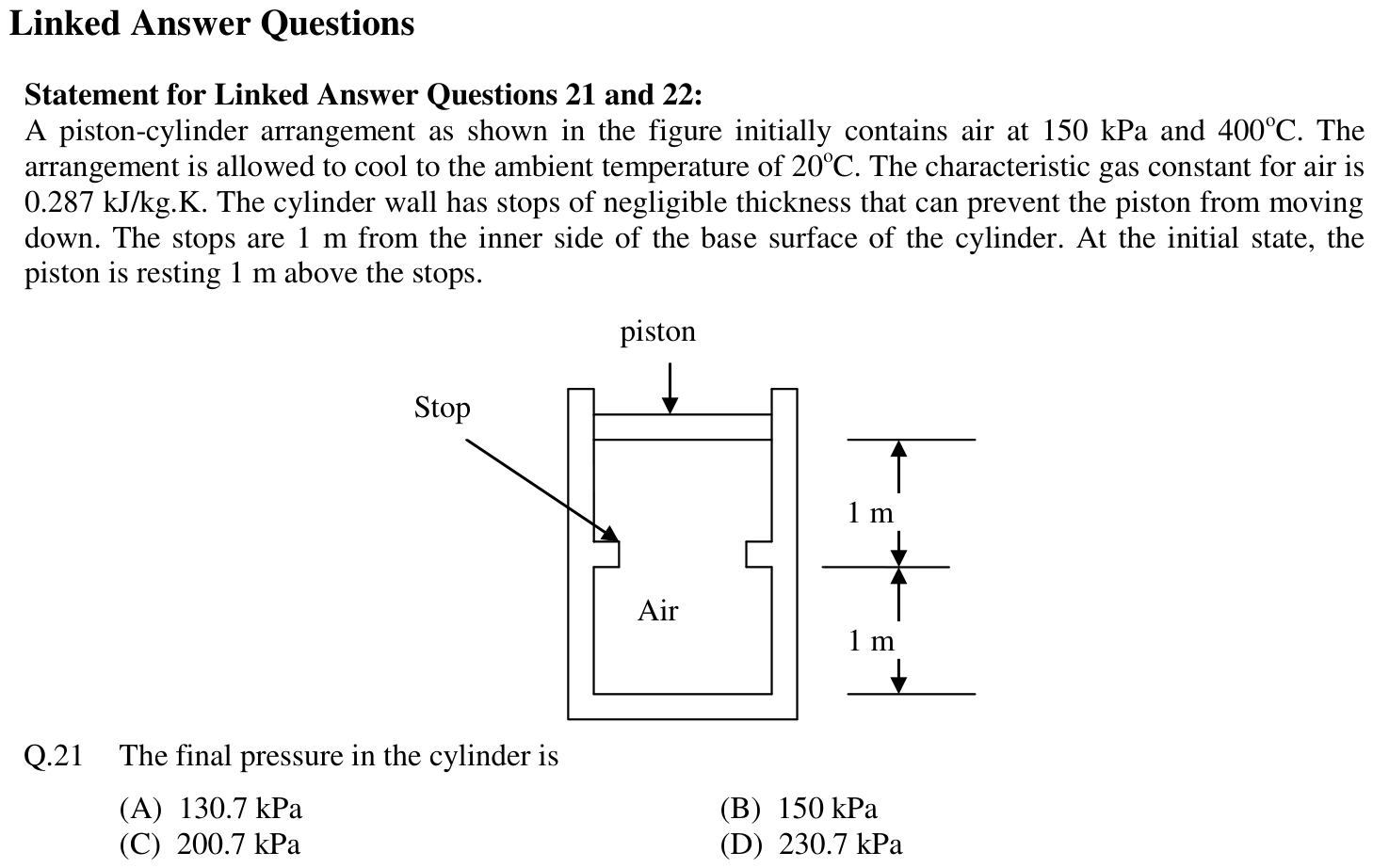
The final pressure in the cylinder is
A. 130.7 kPa
B. 150 kPa
C. 200.7 kPa
D. 230.7 kPa
Answer: A. 130.7 kPa
Question 22
Marks: 2
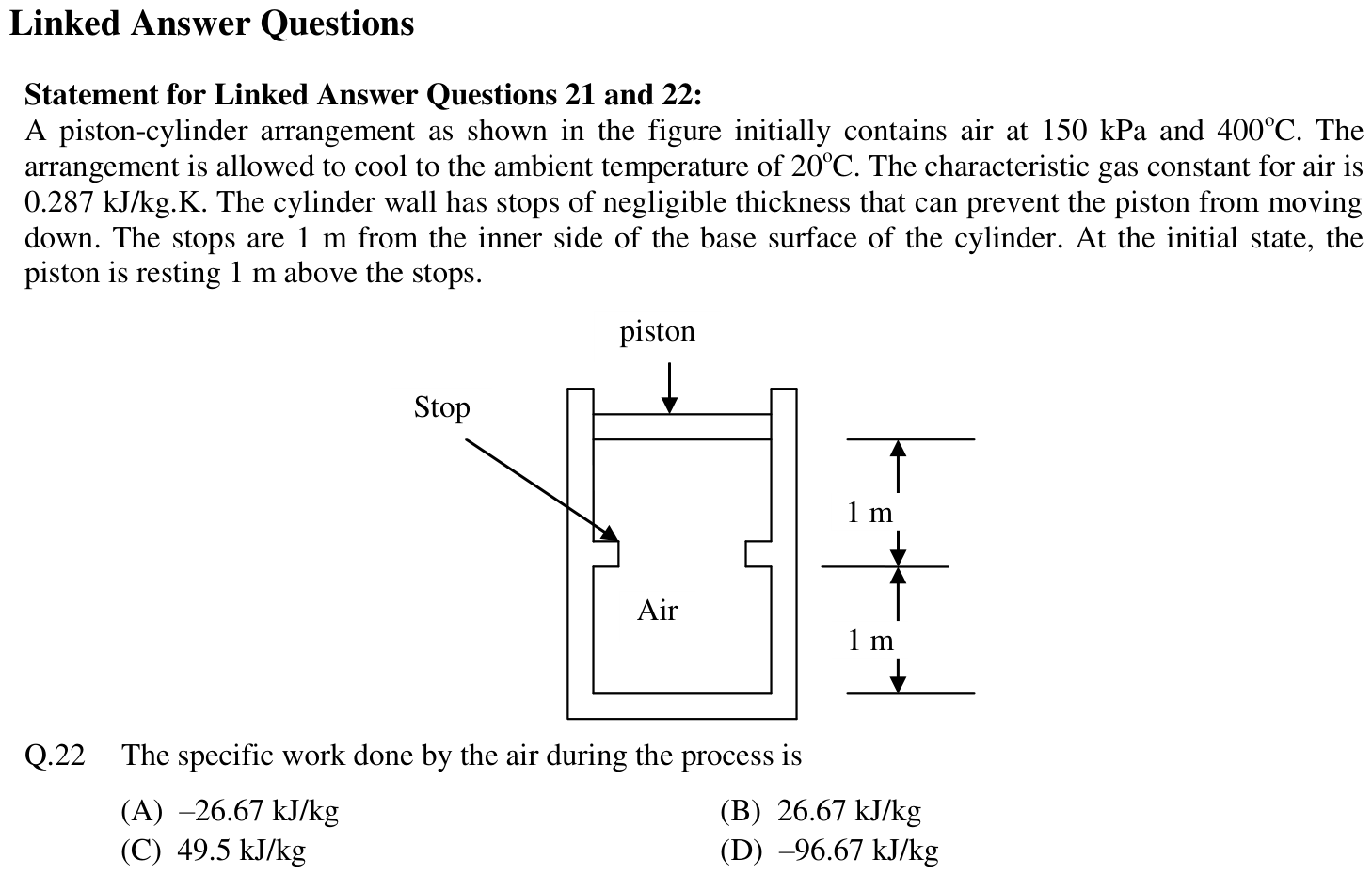
The specific work done by the air during the process is