Manufacturing Processes - ISRO Mechanical & Aerospace Subject-Wise PYQ Practice
Practice topic-wise Manufacturing Processes previous year questions for ISRO Mechanical & Aerospace with instant step-by-step solutions and formula breakdowns.
All ISRO Mechanical & Aerospace papers
113 questions. Answers are shown only where the official answer key is available.
Question 1
Year: 2008 | Topic: Material Science
The ultimate tensile strength and yield strength of most of the metals, when temperature falls from 0 to -150 °C will
- A. Increase
- B. Decrease
- C. Remain same
- D. First increase and then decrease
Answer: A. Increase
Explanation: Ultimate tensile stress is the maximum nominal stress attained by a test specimen during a simple tensile test. The ultimate strength of materials increases with a decrease in temperature. Therefore, as the temperature falls from 0 to -150 °C, both ultimate tensile strength and yield strength will increase.
Question 2
Year: 2008 | Topic: Material Science
"Troosite" is obtained when
- A. Quenching steel during transformation
- B. A fully hardened steel is finally drawn at about 677 °C
- C. Steel is rapidly quenched in oil
- D. When alloy steels are rapidly quenched in water
Answer: A. Quenching steel during transformation
Explanation: "Troosite" is obtained when quenching steel during transformation.
Question 3
Year: 2008 | Topic: Material Science
Induction hardening is the process of
- A. Hardening the core
- B. Uniform hardening
- C. Selective hardening
- D. Hardening surface for wear resistance
Answer: D. Hardening surface for wear resistance
Explanation: Induction hardening is a heat treatment process used to increase the hardness or wear resistance of a material's surface. In this method, metal parts are heated by electromagnetic induction and then quenched.
Question 4
Year: 2008 | Topic: Material Science
Which one is not the purpose of heat treatment of steels?
- A. Changing the composition of steel on the surface
- B. Changing the percentage of carbon and Si in the bulk.
- C. Increasing or decreasing the grain size
- D. Removing undesirable residual stresses
Answer: B. Changing the percentage of carbon and Si in the bulk.
Explanation: Changing the percentage of carbon and silicon in the bulk is not the purpose of heat treatment of steels.
Question 5
Year: 2008 | Topic: Manufacturing
A cold chisel is made of
- A. Mild steel
- B. Cast iron
- C. H.S.S.
- D. High carbon
Answer: D. High carbon
Explanation: A good cold chisel typically uses a combination of carbon and steel to forge its sharp edge. They are made of high carbon steel and designed to be irresistible to force, making them perfect for use with hard material.
Question 6
Year: 2008 | Topic: Material Science
The defect responsible for the phenomenon of slip, by which most metals deform plastically, is known as
- A. Fracture
- B. Twinning
- C. Dislocation
- D. Strain hardening
Answer: C. Dislocation
Explanation: The defect responsible for the phenomenon of slip, by which most metals deform plastically, is known as dislocation.
Question 7
Year: 2008 | Topic: Material Science
On loading a ductile material in excess of a certain value, gradual increase in elongation occurs with time. Such phenomenon is known as
- A. Creep
- B. Fatigue
- C. Stress concentration
- D. None of the above
Answer: A. Creep
Explanation: On loading a ductile material in excess of a certain value, a gradual increase in elongation occurs with time. Such a phenomenon is known as creep.
Question 8
Year: 2008 | Topic: Manufacturing
What is the correct sequence of the following parameters in order of their maximum to minimum influence on tool life? 1. Feed rate, 2. Depth of cut, 3. Cutting speed.
- A. 1, 2, 3
- B. 3, 2, 1
- C. 2, 3, 1
- D. 3, 1, 2
Answer: D. 3, 1, 2
Explanation: The order of influence from maximum to minimum on tool life is: Cutting speed > Feed rate > Depth of cut.
Question 9
Year: 2008 | Topic: Manufacturing
Given that cutting speed = 9m/min, the return time to cutting time ratio is = 1:2, the feed rate = 0.3 mm/stroke, the clearance at each of cut = 25 mm and that the plate is fixed 700 mm side along the direction of tool travel, the time required for finishing one flat surface of a plate of size 700 x 300 mm in a shaper, will be
- A. 10 min
- B. 12.5 min
- C. 15 min
- D. 20 min
Answer: B. 12.5 min
Explanation: L = 700 + 25 + 25 = 750 mm. B = 300 mm. R = 0.5. f = 0.3 mm/stroke. Tm = L(1+R)B / (1000 * V * f) = 750(1+0.5)300 / (1000 * 9 * 0.3) = 125 min. (Note: Solution calculates 125 min but the printed option provided is 12.5 min).
Question 10
Year: 2008 | Topic: Manufacturing
For achieving a specific surface finish in single point turning the most important factor to be controlled is
- A. Depth of cut
- B. Cutting speed
- C. Feed
- D. Tool rake angle
Answer: C. Feed
Explanation: Specific surface finish H = f² / (8*R), where f = feed rate and R = Nose radius of cutting tool. Hence, feed is the most important factor to be controlled.
Question 11
Year: 2008 | Topic: Manufacturing
Enlarging an existing circular hole with rotating single point tool is called
- A. Boring
- B. Drilling
- C. Reaming
- D. Internal turning
Answer: A. Boring
Explanation: Enlarging an existing circular hole with rotating single point tool is called boring.
Question 12
Year: 2014 | Topic: Material Science
Shock resisting steel should have higher?
- A. stiffness
- B. hardness
- C. toughness
- D. shear strength
Answer: C. toughness
Explanation: Shock resisting steels are a specialized class of tool steels designed to possess very high impact toughness and relatively low abrasion resistance, though they can still attain relatively high hardness.
Question 13
Year: 2014 | Topic: Material Science
Aluminium crystal structure is
- A. FCC
- B. BCC
- C. HCP
- D. None of these
Answer: A. FCC
Explanation: The crystal structure of Aluminium (Al) is Face-Centered Cubic (FCC). Other examples of metals with an FCC structure include Ag, Cu, Ni, Pb, and Pt.
Question 14
Year: 2014 | Topic: Material Science
The structure which has the highest packing of atoms
- A. Hexagonal close packed lattice
- B. Body centered cubic lattice
- C. Face centered cubic lattice
- D. Both (a) & (c)
Answer: D. Both (a) & (c)
Explanation: The Atomic Packing Factor (APF) is highest for both Hexagonal Close Packed (HCP) and Face Centered Cubic (FCC) lattices. For both HCP and FCC structures, the APF is 0.74, whereas for Body Centered Cubic (BCC) it is 0.68 and for Simple Cubic (SC) it is 0.52.
Question 15
Year: 2014 | Topic: Material Science
Match List I with List II and select the correct answer: List-I (Process): (P) Cold Rolling, (Q) Hardness, (R) Impact loads, (S) Wire drawing. List-II (Property): (1) Indentation, (2) Ductility, (3) Malleability, (4) Resilience.
- A. P-4, Q-2, R-3, S-1
- B. P-3, Q-1, R-4, S-2
- C. P-1, Q-3, R-4, S-2
- D. P-3, Q-1, R-2, S-4
Answer: B. P-3, Q-1, R-4, S-2
Explanation: Cold Rolling leverages malleability (P-3) to compress metals into sheets. Hardness represents resistance to indentation (Q-1). Impact loads are absorbed through the material's resilience (R-4). Wire drawing relies on the material's ductility to be stretched into wires (S-2).
Question 16
Year: 2014 | Topic: Material Science
Graphene is
- A. A two dimensional material consisting of a single layer of carbon atoms arranged in a honeycomb or chicken wire structure.
- B. A tube-shaped material made of carbon, having a diameter measuring on the nanometre scale.
- C. Completely non-transparent material.
- D. None of the above.
Answer: A. A two dimensional material consisting of a single layer of carbon atoms arranged in a honeycomb or chicken wire structure.
Explanation: Graphene is formally defined as a two-dimensional carbon allotrope. It consists of a single layer of carbon atoms arranged in a 2-D honeycomb lattice. Additionally, it is an extremely thin material that is both flexible and highly transparent.
Question 17
Year: 2014 | Topic: Manufacturing Processes
To drill holes of size 0.025 mm, which is the most appropriate process?
- A. Plasma drilling
- B. CNC drilling
- C. LASER drilling
- D. Electro discharge drilling
Answer: C. LASER drilling
Explanation: LASER (Light Amplification by Stimulated Emission of Radiation) drilling is the most appropriate and capable process for drilling extremely small micro-holes, such as those of 0.025 mm size, with high accuracy.
Question 18
Year: 2014 | Topic: Material Science
Perforation in Aluminum plate occurs when it is connected with the Mild steel plate and exposed to the same environment. This phenomenon is explained by
- A. Galvanic corrosion
- B. cold welding corrosion
- C. crevice corrosion
- D. high temperature corrosion
Answer: A. Galvanic corrosion
Explanation: When two dissimilar metals, such as an Aluminum plate and a Mild steel plate, are in contact with each other in the presence of an electrolyte (like an atmosphere containing moisture and oxygen), they form a potential galvanic cell. The more anodic metal (Aluminum) will preferentially corrode and can suffer perforation. This specific degradation phenomenon is known as galvanic corrosion.
Question 19
Year: 2014 | Topic: Material Science
A mixture of chemical compounds or elements that have a single chemical composition and solidifies at the lowest temperature than any other composition made up of the same ingredients.
- A. Phase balanced system
- B. Eutectic system
- C. Binary thermally balanced system
- D. intrinsic system
Answer: B. Eutectic system
Explanation: A eutectic system describes a specific mixture of chemical compounds or elements that has a single distinct chemical composition which solidifies at a lower temperature than any other possible composition of those same ingredients. This particular composition is known as the eutectic composition, and the specific lowest temperature at which it solidifies is called the eutectic temperature.
Question 20
Year: 2015 | Topic: Manufacturing Processes
In a butt welding process using arc welding, the arc power is found to be 2.5 KVA. The process is used to weld two steel plates each of 3 mm thickness as shown in the figure. Determine maximum possible welding speed. It is assumed that the metal transfer is a short circuit type and the arc is on for 85% of the total time. Take alpha_steel = 1.2 x 10^-5 m²/s, k_steel = 43.6 W/m C, melting point of steel = 1530 C and ambient temperature = 30 C
- A. 0.035 m/s
- B. 0.0146 m/s
- C. 0.02 m/s
- D. .0156 m/s
Answer: D. .0156 m/s
Explanation: Given the arc-on time efficiency is 0.85, the effective heat input rate is Q = 0.85 * 2500 W = 2125 W. The width of the weld pool for the given geometry is w = 2 * t * tan(30) = 2 * 3 * (1/$\sqrt{3}$) = 2 * $\sqrt{3}$ mm. Using the welding heat equation: Q = 8 * k * (Tm - Ta) * t * (1/5 + (v * w) / (4 * alpha)). Substituting values gives 2125 = 8 * 43.6 * (1500) * 0.003 * (0.2 + (v * 2 * $\sqrt{3}$ * 10^-3) / (4 * 1.2 * 10^-5)). Solving for the velocity v yields approximately 0.0156 m/s.
Question 21
Year: 2015 | Topic: Material Science
The effective number of lattice points in the unit cell of simple cubic, body centered cubic and face centered cubic space lattices, respectively are
- A. 1, 2, 2
- B. 1, 2, 4
- C. 2, 3, 4
- D. 2, 4, 4
Answer: B. 1, 2, 4
Explanation: For a Simple Cubic (SC) unit cell, there are 8 corner atoms, each contributing 1/8, resulting in 1 effective atom. For a Body-Centered Cubic (BCC) cell, there is 1 effective corner atom plus 1 full atom in the interior center, making 2 effective atoms. For a Face-Centered Cubic (FCC) cell, there is 1 effective corner atom plus 6 face-centered atoms each contributing 1/2 (totaling 3), resulting in 4 effective atoms.
Question 22
Year: 2015 | Topic: Material Science
Thermosetting plastics have in general
- A. Molecular chains that slip past one
- B. Be a ceramic since all ceramics are glass and glass is a kind of ceramic
- C. Have a monolithic crystal structure
- D. Have no long range crystalline lattice structure
Answer: D. Have no long range crystalline lattice structure
Explanation: Thermosetting plastics are characterized by high melting points and the inability to be recycled once cured. They form cross-linked chain networks rather than long independent chains, which means they fundamentally lack any long-range crystalline lattice structure.
Question 23
Year: 2015 | Topic: Material Science
Silicon steel is widely used in
- A. Cutting tools
- B. Dies and punches
- C. Electrical industry
- D. Chemical industry
Answer: C. Electrical industry
Explanation: Silicon steel, often referred to as electrical steel or transformer steel, is highly valued and widely used in the electrical industry. Its properties, such as low hysteresis loss and high magnetic permeability, make it the ideal material for manufacturing electrical transformer cores.
Question 24
Year: 2015 | Topic: Manufacturing Processes
Which bond gives the softest bond?
- A. Silicate bond
- B. Shellac bond
- C. Vitrified bond
- D. All of equal strength
Answer: A. Silicate bond
Explanation: Silicate bonds, made primarily of sodium silicate, are typically used for grinding operations that need to generate very minimal heat. This effectively makes them act as a softer bond compared to much harder options like vitrified or resinoid bonds.
Question 25
Year: 2015 | Topic: Material Science
An eutectoid steel consists of
- A. Wholly pearlite
- B. Wholly austenite
- C. Pearlite and ferrite
- D. Pearlite and cementite
Answer: A. Wholly pearlite
Explanation: At the exact eutectoid point (727 C and 0.8% Carbon content), austenite undergoes a complete solid-state decomposition reaction to form 100% pearlite. Pearlite itself is defined as an eutectoid microstructural mixture consisting of alternating layers of ferrite and cementite.
Question 26
Year: 2015 | Topic: Manufacturing Processes
Fifty flat pieces of 1 mm thick and initial dimensions as shown in the figure (a) to be milled in a single cut to the final dimensions shown in figure (b) using end milling. The cutter of diameter 25 mm has 10 teeth and rotates at 100 rpm. Horizontal feed of the table is 10 mm/min. Assuming single tooth in contact, the material removal rate will be
- A. 35.7 mm³/s
- B. 37.7 mm³/s
- C. 41.7 mm³/s
- D. 47.7 mm³/s
Answer: C. 41.7 mm³/s
Explanation: The width of the material removed from each piece is 30 mm - 25 mm = 5 mm. With a thickness of 1 mm, the volume removed per piece along the 205 mm length is 5 * 1 * 205 = 1025 mm³. Given the table feed is 10 mm/min, it takes 205 / 10 = 20.5 minutes to travel the entire length. The Material Removal Rate (MRR) per piece is 1025 / (20.5 * 60) = 0.833 mm³/s. For 50 pieces, the total MRR is 50 * 0.833 = 41.67 mm³/s, which rounds to 41.7 mm³/s.
Question 27
Year: 2015 | Topic: Material Science
German silver contains
- A. 12.5% silver
- B. 5% silver
- C. 1% silver
- D. None of the above
Answer: D. None of the above
Explanation: Despite its deceptive name, German silver contains no actual silver. It is a commercial alloy whose composition typically consists of Copper (50% to 61.6%), Zinc (19% to 17.2%), and Nickel (30% to 21.1%).
Question 28
Year: 2015 | Topic: Manufacturing Processes
Addition of coal dust to the green moulding sand is to improve
- A. Permeability
- B. Surface finish
- C. Mouldability
- D. Green strength
Answer: B. Surface finish
Explanation: Adding coal dust (sea coal) to green moulding sand creates a reducing atmosphere when heated by the molten metal. This prevents the metal from wetting and penetrating the sand grains, thereby substantially improving the surface finish of the final casting.
Question 29
Year: 2015 | Topic: Manufacturing Processes
Slush casting process is used to produce
- A. Hollow castings
- B. Intricate castings
- C. Large size castings
- D. Thin walled castings
Answer: A. Hollow castings
Explanation: Slush casting is a method based on partial solidification used specifically to produce hollow and thin-walled castings without requiring an internal core. It is highly suitable for decorative items, lamp shades, and toys, typically using non-ferrous materials with low melting points.
Question 30
Year: 2015 | Topic: Manufacturing Processes
Two castings of the same metal have the same surface area. One casting is in the form of a sphere and the other is a cube. What is the ratio of the solidification time for the sphere to that of the cube?
- A. 3/4
- B. 6/pi
- C. 3pi/8
- D. 5/4pi
Answer: B. 6/pi
Explanation: According to Chvorinov's rule, solidification time t = k * (V/A)^2. For a cube with side 'a', the volume is a³ and surface area is 6a^2, giving t_cube = k * (a² / 36). For a sphere with radius 'r', the volume is (4/3)*pi*r³ and surface area is 4*pi*r², giving t_sphere = k * (r² / 9). Setting the surface areas equal (6a^2 = 4*pi*r²) implies a² / r² = 4*pi / 6. The ratio t_sphere / t_cube evaluates to (r² / 9) / (a² / 36) = 4 * (r² / a²) = 4 * (6 / 4*pi) = 6 / pi.
Question 31
Year: 2015 | Topic: Manufacturing Processes
Resistance spot welding is performed on two plates of 1.5 mm thickness with 6 mm diameter electrode using 15000 A current for a time duration of 0.25 seconds. Assuming the interface resistance to be 0.0001 ohms, the heat generated to form the weld is
- A. 5625 W-sec
- B. 8437 W-sec
- C. 22500 W-sec
- D. 33750 W-sec
Answer: A. 5625 W-sec
Explanation: The total heat generated during the resistance spot welding process is determined by Joule's Law: Heat (H) = I² * R * t. Substituting the given parameters (I = 15000 A, R = 0.0001 ohms, t = 0.25 s) yields H = (15000)^2 * 0.0001 * 0.25 = 225,000,000 * 0.0001 * 0.25 = 22500 * 0.25 = 5625 Joules, which is equivalent to 5625 W-sec.
Question 32
Year: 2015 | Topic: Manufacturing Processes
Pre-heating before welding is done to
- A. Make the steel softer
- B. Burn away oil, grease, etc. from the plate surface
- C. Prevent cold cracks
- D. Prevent plate distortion
Answer: C. Prevent cold cracks
Explanation: Pre-heating the material prior to welding serves to slow down the cooling rate in both the weld metal and the heat-affected zone. This controlled cooling greatly minimizes thermal stresses and effectively prevents the formation of cold cracks and scratches in the joint.
Question 33
Year: 2015 | Topic: Machining and Machine Tool Operations
The velocity of tool along the tool face is known as
- A. Shear velocity
- B. Chip velocity
- C. Cutting velocity
- D. Mean velocity
Answer: B. Chip velocity
Explanation: In metal cutting, the velocity of the chip ($V_c$) relative to the tool is called the 'chip velocity', which essentially describes the velocity of the tool along the tool face.
Question 34
Year: 2015 | Topic: Machining and Machine Tool Operations
A milling cutter having 8 teeth is rotating at 150 RPM. If the feed per tooth is 0.1, the table speed in mm per minute is
Answer: A. 120
Explanation: The table speed (or feed rate) is given by the product of the feed per tooth ($f_t$), the number of teeth ($z$), and the rotational speed ($N$). Substituting the given values: Table speed = $0.1 \times 8 \times 150 = 120$ mm/min.
Question 35
Year: 2015 | Topic: Manufacturing Processes
In ultrasonic machining process, the material removal rate would
- A. Increase
- B. Decrease
- C. Increase and then decrease
- D. Decrease and then increase
Answer: A. Increase
Explanation: In the Ultrasonic Machining (USM) process, the rate of work material removal is proportional to both the frequency and the amplitude of vibration. As the frequency or amplitude of vibration is increased, the material removal rate (MRR) increases linearly.
Question 36
Year: 2015 | Topic: Machining and Machine Tool Operations
Tool life of 10 hrs is obtained when cutting with single point tool at 63 m/min. If Taylor's constant C = 257.35, tool life on doubling the velocity will be
- A. 5 hrs
- B. 25.7 min
- C. 38.3 min
- D. No change
Answer: B. 25.7 min
Explanation: Given $T_1 = 10 \text{ hrs} = 600 \text{ min}$ and $V_1 = 63 \text{ m/min}$. Using Taylor's tool life equation $V_1 T_1^n = C$, we have $63 \times (600)^n = 257.35$. This gives $600^n = 4.085$, resulting in $n \approx 0.22$. When the velocity is doubled, $V_2 = 126 \text{ m/min}$. Then, $126 \times T_2^{0.22} = 257.35$, giving $T_2^{0.22} = 2.042$. Solving for $T_2$ yields approximately 25.7 minutes.
Question 37
Year: 2015 | Topic: Machining and Machine Tool Operations
During orthogonal machining with a HSS tool, the rake angle is $5^{\circ}$ un-deformed chip thickness is 0.25 mm and width of cut is 4 mm. Assuming shear strength of work material to be 350 $N/mm²$ and coefficient of friction as 0.5, determine cutting and thrust force.
- A. 1029.4 N, 406.8 N
- B. 1000 N, 500 N
- C. 1110.5 N, 425.8 N
- D. 1025.4 N, 410.8 N
Answer: A. 1029.4 N, 406.8 N
Explanation: Rake angle $\alpha = 5^{\circ}$, $\mu = 0.5$. Friction angle $\beta = \tan^{-1}(0.5) = 26.57^{\circ}$. Using Merchant's theory, the shear angle is $\phi = 45^{\circ} + \frac{\alpha}{2} - \frac{\beta}{2} = 45^{\circ} + 2.5^{\circ} - 13.285^{\circ} = 34.22^{\circ}$. The shear force $F_s = \tau_s \times \frac{b t_c}{\sin\phi} = 350 \times \frac{4 \times 0.25}{\sin(34.22^{\circ})} = 622.37$ N. The cutting force is $F_c = \frac{F_s \cos(\beta-\alpha)}{\cos(\phi+\beta-\alpha)} = \frac{622.37 \cos(26.57^{\circ}-5^{\circ})}{\cos(34.22^{\circ}+26.57^{\circ}-5^{\circ})} = 1029.45$ N. The thrust force is $F_T = F_c \tan(\beta-\alpha) = 1029.45 \tan(26.57^{\circ}-5^{\circ}) = 406.96$ N. Hence, option (a) is correct.
Question 38
Year: 2015 | Topic: Manufacturing Processes
Which one of the following is a solid state joining process?
- A. Gas tungsten arc welding
- B. Resistance spot welding
- C. Friction welding
- D. Submerged arc welding
Answer: C. Friction welding
Explanation: Friction welding is classified as a solid-state joining process. In this specific type of joining, no molten or liquid state is involved. Instead, the metal joining occurs due to the application of intense high pressure in the solid state, which facilitates intermolecular diffusion directly at the interface surface.
Question 39
Year: 2016 | Topic: Material Science
The main objective of 'shot peening' is to improve which property of metal parts
- A. Surface finish
- B. Ductility
- C. Fatigue strength
- D. None of the above
Answer: C. Fatigue strength
Explanation: Shot peening is a mechanical cold working process where the surface of a metal part is impacted with small spherical media (shots). This process induces compressive residual stresses on the material's surface, which significantly improves its fatigue strength by delaying the initiation and propagation of surface cracks.
Question 40
Year: 2016 | Topic: Material Science
When a material is strain hardened?
- A. its yield strength reduces and ductility increases
- B. its yield strength increases and ductility reduces
- C. both yield strength and ductility increases
- D. both yield strength and ductility reduces
Answer: B. its yield strength increases and ductility reduces
Explanation: When a material undergoes strain hardening (also known as work hardening), its yield strength increases because of dislocation movements and dislocation generation within the crystal structure, which restrict further plastic deformation. As a result of this increased resistance to deformation, the material's ductility is reduced.
Question 41
Year: 2016 | Topic: Machining and Machine Tool Operations
In a cutting operation the cutting speed was reduced by 20%. Assuming n=0.5 and C=350 in Taylor's equation, the increase in tool life is
Answer: D. 56%
Explanation: According to Taylor's tool life equation, $V_1 T_1^n = V_2 T_2^n$. The new cutting speed is reduced by 20%, so $V_2 = 0.8 V_1$. Given $n = 0.5$, we have $V_1 T_1^{0.5} = 0.8 V_1 T_2^{0.5}$. Solving for $T_2$, we get $(T_2 / T_1)^{0.5} = 1 / 0.8 = 1.25$. Squaring both sides yields $T_2 / T_1 = (1.25)^2 = 1.5625$. The percentage increase in tool life is $(1.5625 - 1) \times 100 = 56.25\%$, which is approximately 56%.
Question 42
Year: 2016 | Topic: Production Engineering
Mass production of seamless tubes is by the process of
- A. Rolling
- B. Spinning
- C. Welding
- D. Extrusion
Answer: D. Extrusion
Explanation: Extrusion is the standard manufacturing process used for the mass production of seamless tubes. The process involves forcing a hot metal billet through a die with a mandrel placed in the center, producing a continuous, seamless hollow cross-section with good mechanical properties.
Question 43
Year: 2016 | Topic: Casting
Misrun is a casting defect which occurs due to
- A. Very high pouring temperature of metal
- B. Absorption of gases by liquid metal
- C. Insufficient fluidity of molten metal
- D. Improper alignment of mould flasks
Answer: C. Insufficient fluidity of molten metal
Explanation: A misrun is a defect wherein the molten liquid metal solidifies before completely filling the mould cavity. This is primarily caused by a lack of fluidity in the molten metal, which could be due to a low pouring temperature, slow pouring rate, or thin mold sections.
Question 44
Year: 2016 | Topic: Material Science
What is the common surface hardening treatment in steel?
- A. Carburizing
- B. Tempering
- C. Quenching
- D. None of the above
Answer: A. Carburizing
Explanation: Carburizing is the common surface hardening treatment used in steel. It is specifically used for low carbon steel to introduce carbon into the surface layer, making the exterior hard and wear-resistant while leaving the core tough and ductile.
Question 45
Year: 2016 | Topic: Material Science
Which of the following order of crystal structure will match with metals Iron - Copper - Zinc in that order?
- A. BCC-HCP-FCC
- B. FCC-BCC-HCP
- C. HCP-FCC-BCC
- D. BCC-FCC-HCP
Answer: D. BCC-FCC-HCP
Explanation: Iron (Fe) has a Body-Centered Cubic (BCC) structure at room temperature. Copper (Cu) has a Face-Centered Cubic (FCC) structure, known for its ductility. Zinc (Zn) possesses a Hexagonal Close-Packed (HCP) structure. Therefore, the order is BCC - FCC - HCP.
Question 46
Year: 2016 | Topic: Manufacturing Processes
A resistance spot-welding operation is performed on two pieces of 1.5 mm thick sheet steel using 12000 amps current for a duration of 0.20 second. The electrodes are 6 mm in diameter at the contacting surfaces. Resistance is assumed to be 0.0001 ohms and the resulting weld nugget is 6 mm in diameter and 2.5 mm thick. The unit melting energy for the metal is 12 J/mm³. What portion of heat generated was used to form the weld?
- A. 29.4%
- B. 70.6%
- C. 58.8%
- D. 41.2%
Answer: A. 29.4%
Explanation: Total heat generated H = I² * R * t = (12000)^2 * 0.0001 * 0.2 = 2880 J. The volume of the cylindrical weld nugget is V = (pi/4) * d² * h = (pi/4) * 6^2 * 2.5 ≈ 70.686 mm³. The heat required to melt this volume is Q = V * Unit energy = 70.686 * 12 = 848.23 J. The portion of heat utilized is (848.23 / 2880) * 100 ≈ 29.45%, which is closest to 29.4%.
Question 47
Year: 2016 | Topic: Material Science
Match the items in column-1 and column-2 and choose the correct combination
Column-1: A. Resilience, B. Fatigue, C. Stiffness, D. Elasticity
Column-2: 1. Ability of the material to return to the original shape when load is removed. 2. Capacity of a material to absorb energy elastically. 3. Ability of the material to absorb certain amount of energy without failure. 4. Resistance of the material to elastic deformation. 5. Failure of material at loads less than that at normal conditions
- A. A-2, B-5, C-3, D-1
- B. A-3, B-2, C-1, D-4
- C. A-3, B-5, C-4, D-2
- D. A-2, B-5, C-4, D-1
Answer: D. A-2, B-5, C-4, D-1
Explanation: Resilience defines the capacity of a material to absorb energy elastically without yielding (2). Fatigue refers to the failure of material at loads significantly lower than normal due to cyclic loading (5). Stiffness indicates a material's resistance to elastic deformation under a load (4). Elasticity describes the fundamental ability of a material to revert to its original shape upon removing an external load (1).
Question 48
Year: 2017 | Topic: Manufacturing
Which one of the following is FALSE?
- A. Number of Taps generally used for hand taping is 3
- B. Piispanen's model in machining is used to estimate shear strain
- C. Chip hammering during machining is due to improper chip control
- D. Cemented carbide tools are generally poor in compression
Answer: D. Cemented carbide tools are generally poor in compression
Explanation: Cemented carbide tools have very high compressive strength but are generally poor in shear. The statement that they are poor in compression is false.
Question 49
Year: 2017 | Topic: Manufacturing
Complex irregular three dimensional surfaces can be located using the following method
- A. Sighting
- B. Nesting
- C. Integral locators
- D. Buttons
Answer: B. Nesting
Explanation: Nesting locators position a part by enclosing it in a recess of the same shape, making it the most accurate method for complex irregular 3-D surfaces.
Question 50
Year: 2017 | Topic: Manufacturing
In tolerancing of a part, unless otherwise specified, individual features of size must
- A. not violate size limits of MMC at any cross section
- B. not violate an envelope of perfect form at LMC
- C. not violate an envelope of perfect form at MMC
- D. None of these
Answer: C. not violate an envelope of perfect form at MMC
Explanation: This is Taylor's principle of gauging. It ensures that a feature at its Maximum Material Condition (MMC) will have perfect form, which is critical for interchangeability.
Question 51
Year: 2017 | Topic: Manufacturing
The frictional shear stress (τ) in metal forming is expressed as (where m is friction shear factor and σ is flow stress)
- A. mσ/√3
- B. σ/(3m)
- C. σ/(m√3)
- D. √3σ/m
Answer: A. mσ/√3
Explanation: The relationship between flow stress in uniaxial tension and shear flow stress according to the Tresca friction model is given by τ = mσ/√3.
Question 52
Year: 2017 | Topic: Manufacturing
In CAD, if the transformation matrix T is diagonal, then the transformation is called
- A. translation
- B. reflection
- C. rotation
- D. scaling
Answer: D. scaling
Explanation: A diagonal transformation matrix in homogeneous coordinates represents scaling. The diagonal elements correspond to the scaling factors along each axis.
Question 53
Year: 2017 | Topic: Manufacturing
Which one of the following is the permanent mould casting process?
- A. Investment casting process
- B. Full mould process
- C. Vacuum casting process
- D. Die casting process
Answer: D. Die casting process
Explanation: Die casting is a process that uses a reusable mold (a die), making it a permanent mould casting process. The others listed use expendable molds.
Question 54
Year: 2017 | Topic: Manufacturing
Identify the geometric characteristic that describe the feature geometry and the inter-relationship of part features
- A. form tolerance
- B. form
- C. orientation tolerance
- D. dimension
Answer: B. form
Explanation: The four fundamental geometric characteristics are size, form, orientation, and location. Form describes the shape of a feature (e.g., flatness, straightness).
Question 55
Year: 2017 | Topic: Manufacturing
Datum features on the part are
- A. permanent
- B. temporary
- C. either permanent or temporary
- D. none of these
Answer: C. either permanent or temporary
Explanation: Datums can be permanent features of the final part or temporary features used during manufacturing that may be removed or altered later.
Question 56
Year: 2017 | Topic: Manufacturing
Root opening of a Single Vee groove weld joint of plate thickness 't' is
Answer: B. t/4
Explanation: As per standard welding code provisions, the root opening for a single Vee groove weld is typically around t/4 to allow for proper penetration.
Question 57
Year: 2017 | Topic: Manufacturing
A cubic B-spline curve requires a minimum of ______ control points.
Answer: B. 4
Explanation: A B-spline curve of degree 'n' (cubic is degree 3) requires at least n+1 control points. Therefore, a cubic B-spline requires a minimum of 4 control points.
Question 58
Year: 2017 | Topic: Material Science
The reaction in which a liquid phase transforms into two different solid phases is called
- A. Eutectoid reaction
- B. Peritectic reaction
- C. Eutectic reaction
- D. Peritectoid reaction
Answer: C. Eutectic reaction
Explanation: A eutectic reaction is an invariant reaction where a liquid phase transforms into two solid phases upon cooling (Liquid → Solid 1 + Solid 2).
Question 59
Year: 2017 | Topic: Manufacturing
Margin wear in a drill is due to
- A. abrasion
- B. vibration
- C. thermal softening
- D. diffusion
Answer: C. thermal softening
Explanation: Margin and crater wear are primarily caused by excessive heat leading to thermal softening of the tool material, while flank wear is due to abrasion.
Question 60
Year: 2017 | Topic: Manufacturing
Thumb rule between feed and nose radius in rough turning is
- A. f = 0.3r
- B. f = 0.5r
- C. f = 0.7r
- D. f = 0.9r
Answer: B. f = 0.5r
Explanation: A common rule of thumb for connecting feed (f) and nose radius (r) in rough turning operations is f (mm/rev) ≈ 0.5 × Nose radius.
Question 61
Year: 2017 | Topic: Manufacturing
The missing dimension in the following simple part is
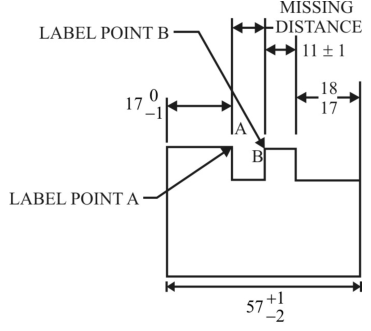
- A. 11.5 ± 1.5
- B. 11.5 ± 2.5
- C. 11.5 ± 3.5
- D. 11.5 ± 4.5
Answer: C. 11.5 ± 3.5
Explanation: This is a tolerance stack-up problem. AB_avg = 57 - 17 - 17.5 - 11 = 11.5. The tolerance is the sum of individual tolerances: 1.5(CD)+0.5(EA)+0.5(GF)+0.5(BG) = 3.5. So, AB = 11.5 ± 3.5.
Question 62
Year: 2017 | Topic: Manufacturing
Which one of the following is FALSE about Boronizing process?
- A. it is pack cementation process
- B. it can be done only on high carbon steels
- C. it is used to obtain extremely high wear resistant surfaces
- D. it leads to high distortion
Answer: B. it can be done only on high carbon steels
Explanation: Boronizing (or boriding) can be applied to a wide range of materials, including low-carbon steels, tool steels, and nickel-based alloys, not just high-carbon steels.
Question 63
Year: 2017 | Topic: Manufacturing
The type of locator used to prevent jamming during locating of a work piece is
- A. concentric locator
- B. integral locator
- C. equilateral locator
- D. spherical locator
Answer: D. spherical locator
Explanation: Spherical locators have a small contact area, which prevents jamming and binding, especially when locating from holes or internal features.
Question 64
Year: 2017 | Topic: Manufacturing
The maximum value of reduction in rolling process is (Where 'D' is roll diameter and 'α' is the angle of bite)
- A. D(1-cosα)/2
- B. D(1-cosα)/2
- C. D(1-sinα)
- D. D(1-sinα)/2
Explanation: The correct formula for draft or reduction (Δh) is Δh = 2R(1-cosα) or D(1-cosα). The options seem to be variations of this, but the question was excluded from evaluation by ISRO, likely due to ambiguity or errors in the options.
Question 65
Year: 2017 | Topic: Material Science
White iron structure consists of
- A. Pearlite
- B. Cementite
- C. Ferrite
- D. Pearlite and Cementite
Answer: D. Pearlite and Cementite
Explanation: The structure of white cast iron consists of pearlite and a large amount of cementite (iron carbide), often in a eutectic mixture called ledeburite. This high cementite content makes it very hard and brittle.
Question 66
Year: 2017 | Topic: Manufacturing
The Load Vs Displacement curve shown in the figure pertains to
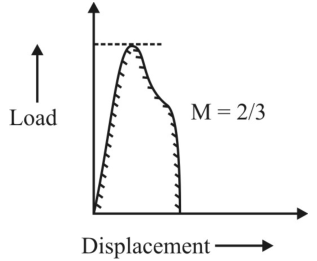
- A. Extrusion
- B. Bending
- C. Blanking
- D. Coining
Answer: C. Blanking
Explanation: The curve shows an initial increase in force, followed by a sharp drop after the material fractures. This characteristic shape is typical of a shearing operation like blanking.
Question 67
Year: 2017 | Topic: Manufacturing
Process in which lowest tolerances in cast products of ferrous and non ferrous metals can be achieved is
- A. Die casting
- B. Shell casting
- C. Investment casting
- D. Sand casting
Answer: C. Investment casting
Explanation: Investment casting (also known as lost-wax casting) is capable of producing parts with very high dimensional accuracy and tight tolerances, superior to other casting methods.
Question 68
Year: 2017 | Topic: Manufacturing
Pickling treatment is cleaning the casting with
- A. Soda ash
- B. Dilute acid
- C. Compressed air and sand particles
- D. Iron shots
Answer: B. Dilute acid
Explanation: Pickling is a metal surface treatment that uses a dilute acid solution (pickle liquor) to remove impurities like stains, rust, or scale.
Question 69
Year: 2017 | Topic: Material Science
Element which makes steel stainless
Answer: D. Cr
Explanation: Chromium (Cr) is the key alloying element that makes steel 'stainless' by forming a passive, corrosion-resistant chromium oxide layer on the surface. A minimum of 10.5% Cr is required.
Question 70
Year: 2017 | Topic: Manufacturing
Tolerances generally followed for tooling design are
- A. 5-10% of work piece tolerance
- B. 11-30% of work piece tolerance
- C. 31-50% of work piece tolerance
- D. none of these
Answer: C. 31-50% of work piece tolerance
Explanation: Tooling and gauge design often follows the 'rule of ten', where the gauge tolerance is 10% of the workpiece tolerance. However, for tooling design itself, a wider range such as 31-50% is often cited in textbooks.
Question 71
Year: 2018 | Topic: Manufacturing
The main objective of 'shot peening' is to improve which property of metal parts
- A. fatigue strength
- B. ductility
- C. surface finish
- D. none of these
Answer: A. fatigue strength
Explanation: Shot peening is a cold working process used to finish metal parts to prevent failure by improving fatigue strength.
Question 72
Year: 2018 | Topic: Manufacturing
Which of the following carbon steels is most weldable
- A. 1.0% carbon steel
- B. 0.3% carbon steel
- C. 0.5% carbon steel
- D. 0.15% carbon steel
Answer: D. 0.15% carbon steel
Explanation: Low carbon steel (0.15% carbon) is most weldable among them because they can be welded with low preheat and no post-treatment is required.
Question 73
Year: 2018 | Topic: Material Science
A small percentage of boron is added to steel in order to
- A. increase endurance strength
- B. reduce machinability
- C. increase water resistance
- D. increase hardenability
Answer: D. increase hardenability
Explanation: Boron gives hardness to steel. So, a small percentage of boron is added to steel in order to increase hardenability.
Question 74
Year: 2018 | Topic: Material Science
Number of atoms per unit cell of a face centered cubic (FCC) lattice is
Answer: C. 4
Explanation: Number of atoms per unit cell for crystal systems: SC is 1, BCC is 2, and FCC is 4.
Question 75
Year: 2018 | Topic: Material Science
The impact strength of a material is an index of its
- A. fatigue strength
- B. tensile strength
- C. hardness
- D. toughness
Answer: D. toughness
Explanation: The impact strength is the resistance of a material to fracture under a sudden impact or shock load, it is a measure of the toughness of the material.
Question 76
Year: 2018 | Topic: Material Science
Which of the following order of crystal structure will match with metals Iron - Nickel - Titanium in that order at room temperature?
- A. BCC-HCP-FCC
- B. FCC-BCC-HCP
- C. HCP-FCC-BCC
- D. BCC-FCC-HCP
Answer: D. BCC-FCC-HCP
Explanation: Iron is BCC, Nickel is FCC, and Titanium is HCP at room temperature.
Question 77
Year: 2018 | Topic: Manufacturing
In a machining operation cutting speed is reduced by 50%. Assuming n = 0.5, C = 300 in Taylor's equation, the increase in tool life is
Answer: B. 4
Explanation: Taylor's equation is VT^n = C. V1(T1)^0.5 = V2(T2)^0.5 => V(T1)^0.5 = (V/2)(T2)^0.5 => (T2/T1)^0.5 = 2 => T2 = 4*T1. The tool life increases by a factor of 4.
Question 78
Year: 2018 | Topic: Manufacturing
In a linear arc welding process, the heat input per unit length is inversely proportional to
- A. welding current
- B. welding speed
- C. welding voltage
- D. duty cycle of power source
Answer: B. welding speed
Explanation: In a linear arc welding process, the heat input per unit length is inversely proportional to welding speed. As we increase welding speed, heat input per unit length decreases due to less time available for heat transfer.
Question 79
Year: 2018 | Topic: Manufacturing
The welding process which uses a blanket of fusible granular flux is
- A. submerged arc welding
- B. tungsten inert gas welding
- C. electroslag welding
- D. thermit welding
Answer: A. submerged arc welding
Explanation: In submerged arc welding, a blanket of fusible granular flux is used to shield the weld zone.
Question 80
Year: 2018 | Topic: Manufacturing
In a metal sheet of 3 mm thickness, a hole of 7mm diameter needs to be punched. The yield strength in tension of the sheet material is 120 MPa and its ultimate shear strength is 100 MPa. The force required to punch the hole is
- A. 7.92 kN
- B. 11.6 kN
- C. 6.6 kN
- D. 13.9 kN
Answer: C. 6.6 kN
Explanation: Punching force F = pi * D * t * tau_s = 3.14 * 7 * 3 * 100 = 6594 N = 6.594 kN (approximately 6.6 kN).
Question 81
Year: 2018 | Topic: Material Science
Which of the following is an amorphous material
- A. mica
- B. lead
- C. rubber
- D. glass
Answer: D. glass
Explanation: Amorphous solids are non-crystalline solids in which the atoms and molecules are not organized in a definite lattice pattern. Such solids include glass, gel, etc.
Question 82
Year: 2021 | Topic: CAD/CAM
In CAD modeling, B-rep stands for:
- A. Boundary representation
- B. Binary representation
- C. Boolean representation
- D. Basic representation
Answer: A. Boundary representation
Explanation: B-rep (boundary representation) models solid geometry using faces, edges and vertices.
Question 83
Year: 2022 | Topic: Mechatronics
Which sensor is commonly used for precise angular position feedback in robotics?
- A. Rotary encoder
- B. Thermocouple
- C. Strain gauge
- D. LVDT
Answer: A. Rotary encoder
Explanation: Rotary encoders provide accurate angle measurements for servo systems and robotics.
Question 84
Year: 2024 | Topic: Manufacturing
A weld with a triangular cross section as shown below is to be produced on a steel work piece by shielded metal arc welding operation using steel electrode. If a 24 V power supply is used and the welding speed is 12 mm/s, what is the current needed? Assume the efficiency as 80% and the specific energy to melt steel as 8 J/mm³.
- A. 50 A
- B. 75 A
- C. 125 A
- D. 175 A
Answer: C. 125 A
Explanation: The figure shows a V-groove or double fillet weld cross-section. Assuming the total area is 25 mm² (base 10 mm and height 5 mm or similar), the volume melted per second = Area * velocity = 25 * 12 = 300 mm³/s. Heat required = 300 * 8 = 2400 J/s (W). Heat supplied = V * I * efficiency = 24 * I * 0.8 = 19.2 * I. Equating them: 19.2 * I = 2400 => I = 125 A.
Question 85
Year: 2024 | Topic: Material Science
The specific stiffness of a material is defined as the ratio of
- A. Mass to Young's modulus
- B. Density to Young's modulus
- C. Young's modulus to Density
- D. Young's modulus to Mass
Answer: C. Young's modulus to Density
Explanation: Specific stiffness, also known as specific modulus, is a materials property consisting of the elastic modulus (Young's modulus) divided by the mass density of the material.
Question 86
Year: 2024 | Topic: Manufacturing
A 20 mm diameter Aluminium rod is turned to 19 mm diameter in a single pass. If the axial speed of the tool is 200 mm/min and the spindle rotate at 600 rpm, the material removal rate is nearly
- A. 6100 mm³/min
- B. 12250 mm³/min
- C. 3050 mm³/min
- D. 9150 mm³/min
Answer: A. 6100 mm³/min
Explanation: Material Removal Rate (MRR) for turning = (pi/4) * (D_initial^2 - D_final^2) * feed_velocity. MRR = (pi/4) * (20^2 - 19^2) * 200 = 50 * pi * (400 - 361) = 1950 * pi = 6126.1 mm³/min, which is nearly 6100 mm³/min.
Question 87
Year: 2024 | Topic: Material Science
Stress strain curve of three types of material is given in the figure below. Please identify the correct combination.
- A. E- brittle, F - ductile, G - plastic
- B. E- plastic, F - brittle, G - ductile
- C. E- brittle, F - plastic, G - ductile
- D. E- ductile, F - plastic, G - brittle
Answer: A. E- brittle, F - ductile, G - plastic
Explanation: Curve E is steep and fractures without much plastic deformation, which is characteristic of a brittle material. Curve F shows significant strain before fracture, characteristic of a ductile material. Curve G is completely flat (horizontal), indicating continuous deformation at a constant stress, which is perfectly plastic.
Question 88
Year: 2024 | Topic: Manufacturing
In a casting process, a horizontal channel through which molten metal flows from pouring basin to reach mold cavity is called
- A. Runner
- B. Thinner
- C. Corridor
- D. Raiser
Answer: A. Runner
Explanation: In casting, the runner is the horizontal channel in the mold that distributes the molten metal from the sprue/pouring basin into the mold cavity.
Question 89
Year: 2024 | Topic: Manufacturing
3D Printing Techniques are
- A. Selective laser sintering
- B. Selective laser melting
- C. Electron beam melting
- D. All the Above
Answer: D. All the Above
Explanation: Selective Laser Sintering (SLS), Selective Laser Melting (SLM), and Electron Beam Melting (EBM) are all popular additive manufacturing (3D printing) techniques used particularly for metals and polymers.
Question 90
Year: 2024 | Topic: Material Science
What is the kind of deformation that occurs in shape memory alloys?
- A. Thermo Plastic
- B. Plastic
- C. Thermo Elastic
- D. None
Answer: C. Thermo Elastic
Explanation: Shape memory alloys return to their pre-deformed shape upon heating. This shape memory effect is the result of a solid-state, diffusionless phase transformation known as a thermo-elastic martensitic transformation.
Question 91
Year: 2024 | Topic: Manufacturing
A face milling operation is carried out with a 100 mm diameter milling cutter having 4 teeth and spindle speed of 300 rpm. If the feed per tooth is 0.125 mm, what is the table feed in mm/min?
- A. 90 mm/min
- B. 120 mm/min
- C. 150 mm/min
- D. 180 mm/min
Answer: C. 150 mm/min
Explanation: Table feed rate = Feed per tooth * Number of teeth * Spindle speed = 0.125 mm/tooth * 4 teeth/rev * 300 rev/min = 0.5 * 300 = 150 mm/min.
Question 92
Year: 2024 | Topic: Manufacturing
Which is the correct sequence of machining operations to be performed to finish a through hole of large diameter?
- A. Drilling, reaming, boring
- B. Drilling, boring, reaming
- C. Boring, drilling, reaming
- D. Boring, reaming, drilling
Answer: B. Drilling, boring, reaming
Explanation: The standard sequence to produce a large, precise hole is to first drill a pilot hole, then use a boring tool to enlarge it and align it accurately, and finally use a reamer to achieve the required dimensional accuracy and surface finish.
Question 93
Year: 2024 | Topic: Manufacturing
In abrasive jet machining process, the main mechanism of material removal takes place due to?
- A. Electrochemical action
- B. Ionic dissolution
- C. Mechanical impact
- D. Melting and evaporation
Answer: C. Mechanical impact
Explanation: In Abrasive Jet Machining (AJM), material removal occurs through the mechanical impact (erosion) of high-velocity abrasive particles directed at the workpiece.
Question 94
Year: 2024 | Topic: Material Science
The preferred choice of the steel material for Cryogenic application is
- A. Ferrite
- B. Austenitic
- C. Martensite
- D. All the Above
Answer: B. Austenitic
Explanation: Austenitic stainless steels (like 304 or 316) are the preferred choice for cryogenic applications because their FCC (Face-Centered Cubic) crystal structure retains excellent ductility and impact toughness at extremely low temperatures, preventing brittle fracture.
Question 95
Year: 2024 | Topic: Manufacturing
Which of the following is not a casting defect?
- A. Spatter
- B. Blow holes
- C. Cold shut
- D. Hot tear
Answer: A. Spatter
Explanation: Spatter consists of molten metal droplets that are expelled from the weld puddle and scatter around the weld area. Therefore, it is a welding defect, not a casting defect.
Question 96
Year: 2024 | Topic: Manufacturing
Which of the following improve weld ability of steel?
- A. Low carbon content and poor affinity to oxygen
- B. High carbon content and poor affinity to oxygen
- C. Low carbon content and good affinity to oxygen
- D. High carbon content and good affinity to oxygen
Answer: A. Low carbon content and poor affinity to oxygen
Explanation: Weldability of steel is primarily improved by maintaining a low carbon content (which prevents the formation of brittle martensite in the heat-affected zone) and having a poor affinity for oxygen to reduce oxidation and porosity issues during the welding process.
Question 97
Year: 2024 | Topic: Manufacturing
The commonly used flux for brazing is:
- A. Borax
- B. Epoxy
- C. NH4Cl
- D. Inert gas
Answer: A. Borax
Explanation: Borax (sodium borate) is the most commonly used flux in brazing operations. It dissolves oxides on the metal surfaces and protects them from further oxidation during the heating process.
Question 98
Year: 2024 | Topic: Material Science
The property of the material that represents maximum amount of strain energy that it can absorb before it fractures under load is called:
- A. Modulus of Resilience
- B. Modulus of Toughness
- C. Modulus of Elasticity
- D. None of the above
Answer: B. Modulus of Toughness
Explanation: The modulus of toughness is defined as the total area under the stress-strain curve up to the point of fracture. It represents the maximum amount of strain energy a material can absorb before breaking.
Question 99
Year: 2025 | Topic: Material Science
Which of the following properties of material that cannot be significantly changed by heat treatment?
- A. Ultimate tensile strength
- B. Yield strength
- C. Elastic Modulus
- D. Ductility
Answer: C. Elastic Modulus
Explanation: The Elastic Modulus (Young's Modulus) is an intrinsic property of a material determined by the strength of its interatomic bonds. Unlike yield strength, ultimate tensile strength, and ductility, it is virtually unaffected by microstructural changes induced by heat treatments.
Question 100
Year: 2025 | Topic: Material Science
A composite material consists of 60% by volume of fibre (modulus 200 GPa) and 40% by volume of matrix (modulus 5 GPa). What is the approximate modulus of the composite (using rule of mixtures)?
- A. 122 GPa
- B. 82 GPa
- C. 42 GPa
- D. 22 GPa
Answer: A. 122 GPa
Explanation: According to the rule of mixtures (Voigt upper bound) for an isostrain condition, the composite modulus $E_c = V_f E_f + V_m E_m$. Substituting the given values: $E_c = (0.60 \times 200) + (0.40 \times 5) = 120 + 2 = 122$ GPa.
Question 101
Year: 2025 | Topic: Material Science
A material has a yield strength of 300 MPa and a fracture strain of 0.2. What is the approximate toughness (assuming linear elastic behaviour)?
- A. 60 MPa
- B. 30 MPa
- C. 600 MPa
- D. 300 MPa
Answer: B. 30 MPa
Explanation: Toughness is defined as the area under the stress-strain curve up to fracture. Since linear elastic behaviour is assumed up to fracture, the curve forms a triangle. Area $= \frac{1}{2} \times \text{stress} \times \text{strain} = 0.5 \times 300 \text{ MPa} \times 0.2 = 30$ MPa (or $MJ/m³$).
Question 102
Year: 2025 | Topic: Material Science
What is the primary mechanism responsible for the increase in strength and hardness during cold working of metals?
- A. Formation of new grains through recrystallization
- B. Increase in dislocation density and entanglement, hindering dislocation movement
- C. Reduction of dislocations in the crystal structure
- D. Melting of metal surface layers due to deformation
Answer: B. Increase in dislocation density and entanglement, hindering dislocation movement
Explanation: Cold working (strain hardening) causes a massive multiplication of dislocations within the crystal lattice. These dislocations interact, entangle, and obstruct each other's movement, which increases the material's strength and hardness.
Question 103
Year: 2025 | Topic: Manufacturing
The power required for a turning operation is measured as 2.5 kW. If the cutting force is 800 N and the cutting speed is 90 m/min, calculate the mechanical efficiency.
- A. 86.4%
- B. 55.5%
- C. 40.8%
- D. 48%
Answer: D. 48%
Explanation: Power output (cutting power) = Cutting force × Cutting speed = 800 N × (90 / 60) m/s = 800 × 1.5 = 1200 W = 1.2 kW. The input power is 2.5 kW. Mechanical efficiency = (Power output / Power input) × 100 = (1.2 / 2.5) × 100 = 48%.
Question 104
Year: 2025 | Topic: Manufacturing
In face milling with a cutter of 100 mm diameter, if the cutting speed is 1 m/s, what should be the spindle speed (rpm)?
Answer: A. 190
Explanation: Cutting speed V = (π × D × N) / 60, where V is in m/s and D is in meters. Given V = 1 m/s and D = 100 mm = 0.1 m. Substituting the values: 1 = (π × 0.1 × N) / 60. Solving for N gives N = 60 / (0.1 × π) = 600 / π ≈ 190.98 rpm, which is closest to 190.
Question 105
Year: 2025 | Topic: Manufacturing
Brass is welded using oxidizing flame due to
- A. O2 is prevented entering from the atmosphere
- B. Zinc is evaporating
- C. Zinc is oxidised
- D. All of the above
Answer: B. Zinc is evaporating
Explanation: Brass contains a significant amount of zinc, which has a relatively low boiling point. During welding, zinc tends to vaporize (evaporate). Using an oxidizing flame creates a protective layer of zinc oxide on the weld pool surface, which effectively prevents further evaporation of the zinc. (Note: The Hindi translation in the source explicitly reads 'Zinc is prevented from evaporating', which aligns with option b).
Question 106
Year: 2025 | Topic: Manufacturing
The useful tool life of a HSS tool machining MS at 18 m/min is 3 hours. Calculate the tool life when the tool operates at 24 m/min. Assume n (exponent) which depends on cutting conditions as 0.125?
- A. 28 min
- B. 18 min
- C. 14 min
- D. 22 min
Answer: B. 18 min
Explanation: Using Taylor's tool life equation: V1 * (T1)^n = V2 * (T2)^n. Given V1 = 18 m/min, T1 = 3 hours = 180 min, V2 = 24 m/min, and n = 0.125. 18 * (180)^0.125 = 24 * (T2)^0.125. This gives (T2 / 180)^0.125 = 18 / 24 = 0.75. Therefore, T2 / 180 = (0.75)^(1/0.125) = (0.75)^8. Since 0.75^8 ≈ 0.1001, T2 = 180 * 0.1001 ≈ 18 minutes.
Question 107
Year: 2025 | Topic: Material Science
Weld decay in stainless steel is due to
- A. Depletion of Chromium at heat affected zone
- B. Depletion of Titanium in the weld
- C. Both (a) and (b)
- D. None of the above
Answer: A. Depletion of Chromium at heat affected zone
Explanation: Weld decay is a form of intergranular corrosion that occurs in the heat-affected zone (HAZ) of austenitic stainless steels. It is caused by the precipitation of chromium carbides at the grain boundaries, which leads to the localized depletion of chromium, reducing the material's corrosion resistance in that area.
Question 108
Year: 2025 | Topic: Material Science
Which of the following option is true for heat treatment of HSS 18:4:1?
- A. First specimen is heated to 1200° C
- B. First specimen is heated to 850° C
- C. First specimen is heated to 550° C
- D. None of the above
Answer: B. First specimen is heated to 850° C
Explanation: High-Speed Steel (HSS) has low thermal conductivity, so it must be heated slowly to prevent thermal shock and cracking. Standard heat treatment practice involves preheating the specimen to an intermediate temperature (typically around 800-850°C) before rapidly raising it to the final hardening temperature (around 1200-1250°C).
Question 109
Year: 2025 | Topic: Manufacturing
Salmon's hypothesis relates between
- A. Surface finish and cutting tool geometry
- B. Cutting forces and surface finish
- C. Surface finish and cutting temperature
- D. Cutting speed and cutting temperature
Answer: D. Cutting speed and cutting temperature
Explanation: Salomon's (referred to as Salmon's in the paper) hypothesis proposes a relationship between cutting speed and cutting temperature, theorizing that as cutting speed increases, cutting temperature rises to a peak and then begins to decrease at ultra-high cutting speeds.
Question 110
Year: 2025 | Topic: Manufacturing
Machinability index for SAE1112 steel is
- A. 50%
- B. 75%
- C. 100%
- D. None of the above
Answer: C. 100%
Explanation: SAE 1112 is a free-machining, resulfurized steel that is historically used as the standard benchmark base material for evaluating machinability. Its machinability index is arbitrarily defined as 100%.
Question 111
Year: 2025 | Topic: Manufacturing
In metal diffusion bonding, which are the process variables?
- A. Pressure and temperature
- B. Pressure and Time
- C. Pressure, temperature and time
- D. Temperature and time
Answer: C. Pressure, temperature and time
Explanation: Diffusion bonding is a solid-state welding process. It relies on the atomic diffusion of elements across the joint interface, which requires elevated temperature (to increase diffusion rates), applied pressure (to cause local plastic deformation and ensure intimate surface contact), and adequate time for the diffusion to occur.
Question 112
Year: 2025 | Topic: Manufacturing
In Selective Laser Sintering (SLS), what is typically used as the build material?
- A. Liquid photopolymer
- B. Thermoplastic filament
- C. UV-curable resin
- D. Powdered polymers or metals
Answer: D. Powdered polymers or metals
Explanation: Selective Laser Sintering (SLS) is a powder-bed fusion technology. It utilizes a high-power laser to fuse (sinter) small particles of polymer, metal, or ceramic powder into a solid 3D structure.
Question 113
Year: 2025 | Topic: Manufacturing
Which additive manufacturing process involves curing liquid resin using a UV laser?
- A. Fused Deposition Modeling (FDM)
- B. Selective Laser Sintering (SLS)
- C. Stereolithography (SLA)
- D. Electron Beam Melting (EBM)
Answer: C. Stereolithography (SLA)
Explanation: Stereolithography (SLA) is an additive manufacturing process that works by focusing an ultraviolet (UV) laser onto a vat of photopolymer resin, curing it layer by layer into a solid object.