Machine Design - ISRO Mechanical & Aerospace Subject-Wise PYQ Practice
Practice topic-wise Machine Design previous year questions for ISRO Mechanical & Aerospace with instant step-by-step solutions and formula breakdowns.
All ISRO Mechanical & Aerospace papers
40 questions. Answers are shown only where the official answer key is available.
Question 1
Year: 2008 | Topic: Machine Design
The failure occurs at a point in a member, when the maximum shear stress in a bi-axial stress system reaches the shear stress at elastic limit in simple tension test, this is according to
- A. Rankine's theory
- B. Guest's theory
- C. Lame's theory
- D. None of the above
Answer: B. Guest's theory
Explanation: Maximum shear stress theory (or Guest-Tresca's theory) states that the failure or yielding of a ductile material will occur when the maximum shear stress of a material equals or exceeds the shear value at the yield point in a uniaxial tensile test.
Question 2
Year: 2008 | Topic: Machine Design
The function of a washer is
- A. To fill the axial gap
- B. To provide cushioning effect
- C. To absorb shocks and vibrations
- D. To provide bearing area
Answer: D. To provide bearing area
Explanation: Washers mainly have two functions: 1. To ensure that the nut is pressed against a surface (providing bearing area), reducing the chance that it will contact an uneven surface. 2. To distribute the pressure of the nut evenly.
Question 3
Year: 2008 | Topic: Machine Design
Surface endurance limit of gear material depends on its
- A. Surface hardness
- B. Modulus of elasticity
- C. Elastic strength
- D. All of the above
Answer: A. Surface hardness
Explanation: Surface endurance limit of gear material depends upon its surface hardness.
Question 4
Year: 2008 | Topic: Machine Design
A double strap butt joint is always in
- A. Single shear
- B. Double shear
- C. Either single or double shear
- D. None of the above
Answer: B. Double shear
Explanation: In a double strap butt joint, the edge of the main plates butt against each other and two cover plates are placed on both sides of the main plate and then riveted together. Therefore, a double strap butt joint is always in double shear.
Question 5
Year: 2008 | Topic: Machine Design
Rivets are made of
- A. Soft material
- B. Hard material
- C. Ductile material
- D. Brittle material
Answer: C. Ductile material
Explanation: Rivets are made of ductile material like Aluminium, Copper, etc. so they can be deformed without fracturing during installation.
Question 6
Year: 2008 | Topic: Machine Design
The purpose of providing multiple collars on a flat collar pivot bearing is to
- A. Increase frictional resistance
- B. To establish self-sustaining bearing conditions
- C. Distribute the frictional load because of limiting friction
- D. Distribute the axial load because of limiting bearing pressure on a collar
Answer: D. Distribute the axial load because of limiting bearing pressure on a collar
Explanation: The purpose of providing multiple collars on a flat collar pivot bearing is to distribute the axial load because of limiting bearing pressure on a collar.
Question 7
Year: 2014 | Topic: Machine Design
A 4 meter long solid circular cylindrical shaft transmits 1600 kW at 500 rpm. The endurance limit of the material is 210 MPa and a factor of safety of 3 is to be used with respect to fatigue failure. Use G = 77.5 GPa. The design diameter 'D' of the shaft in meter is
- A. \sqrt[3]{\frac{69}{4375\pi^{2}}}
- B. \sqrt[3]{\frac{69}{4735\pi^{2}}}
- C. \sqrt[3]{\frac{4375}{96\pi^{2}}}
- D. \sqrt[3]{\frac{96}{4375\pi^{2}}}
Answer: D. \sqrt[3]{\frac{96}{4375\pi^{2}}}
Explanation: First, find the torque transmitted: T = (60 * P) / (2 * pi * N) = (60 * 1600 * 10^3) / (2 * pi * 500) = 96000/pi Nm. Using the Soderberg equation for fatigue failure in shear (as the load is purely torsional, mean stress is 0 and alternating stress is tau), the allowable shear stress tau_v = Endurance limit / FOS = 210 MPa / 3 = 70 MPa. Using the torsion equation tau = 16T / (pi * d³), we get 70 * 10^6 = (16 * (96000/pi)) / (pi * d³). Solving for d³ yields d³ = (16 * 96000) / (70 * 10^6 * pi²) = 96 / (4375 * pi²). Taking the cube root gives D = \sqrt[3]{\frac{96}{4375\pi^{2}}}.
Question 8
Year: 2014 | Topic: Machine Design
A solid steel shaft transmits 40kW of power at a speed of 75/pi Hz. The internal torque needed in the shaft is
- A. 812/3 Nm
- B. 800/3 Nm
- C. 541/2 Nm
- D. 400/3 Nm
Answer: B. 800/3 Nm
Explanation: Power transmitted by a shaft is given by P = T * omega, where omega is the angular velocity in rad/s. Given frequency f = 75/pi Hz, omega = 2 * pi * f = 2 * pi * (75/pi) = 150 rad/s. Given power P = 40 kW = 40,000 W. The torque T is calculated as T = P / omega = 40,000 / 150 = 4000 / 15 = 800/3 Nm.
Question 9
Year: 2015 | Topic: Machine Design
Which of the following is applied to brittle materials?
- A. Maximum principal stress theory
- B. Maximum principal strain theory
- C. Maximum strain energy theory
- D. Maximum shear stress theory
Answer: A. Maximum principal stress theory
Explanation: The Maximum Principal Stress Theory (Rankine Theory) assumes failure occurs when the maximum principal stress reaches the yield or ultimate strength. It neglects shear stress and the other principal stress. This theory is suitable for brittle materials under all loading conditions because brittle materials are characteristically weak in tension. It is not suitable for ductile materials because it ignores shear stress.
Question 10
Year: 2015 | Topic: Machine Design
Starting friction is low in
- A. Hydrostatic lubrication
- B. Hydrodynamic lubrication
- C. Mixed lubrication
- D. Boundary lubrication
Answer: A. Hydrostatic lubrication
Explanation: Hydrostatic lubrication involves supplying a pressurized fluid from an external pump to keep the mating surfaces completely separated, even before relative motion begins. This ensures that the starting friction is exceptionally low compared to hydrodynamic lubrication, which relies on motion to build up a fluid film.
Question 11
Year: 2015 | Topic: Machine Design
Which one of the following is trapezoidal thread?
- A. Acme
- B. Square
- C. Buttress
- D. All of the above
Answer: A. Acme
Explanation: Acme thread is heavily utilized for power transmission (e.g., lead screws). It is virtually identical to a standard trapezoidal thread in its characteristics and applications, with the primary difference being its thread angle of 29° instead of 30°.
Question 12
Year: 2015 | Topic: Machine Design
If the ratio of the diameter of rivet hole to the pitch of rivets is 0.25, then the tearing efficiency of the joint is
Answer: B. 75%
Explanation: The tearing efficiency of a riveted joint is calculated using the formula $\eta_t = 1 - \frac{d_h}{p}$, where $d_h/p$ represents the ratio of the rivet hole diameter to the pitch of the rivets. Substituting the given ratio yields $\eta_t = 1 - 0.25 = 0.75$, which corresponds to 75%.
Question 13
Year: 2015 | Topic: Machine Design
The life of a ball bearing at a load of 10 kN is 8000 hours. If the load is increased to 20 kN, keeping all other conditions the same, then its life in hours is
- A. 4000
- B. 2000
- C. 1000
- D. 500
Answer: C. 1000
Explanation: The expected life of a bearing is inversely proportional to the cube of the applied load for ball bearings, governed by the equation $L = (C/P)^3$. Therefore, the ratio of life spans is $\frac{L_1}{L_2} = \left(\frac{P_2}{P_1}\right)^3$. Given $P_1 = 10$ kN, $L_1 = 8000$ hrs, and the new load $P_2 = 20$ kN, we substitute to get $\frac{8000}{L_2} = \left(\frac{20}{10}\right)^3 = 8$. Solving for $L_2$ gives $8000 / 8 = 1000$ hours.
Question 14
Year: 2016 | Topic: Machine Design
Which thread is more suited in power screw to take load on both directions?
- A. Acme thread
- B. Square thread
- C. Buttress thread
- D. None of these
Explanation: Both Acme and Square threads are capable of transmitting power and taking loads in both directions. However, Acme threads are generally preferred and more suited for practical applications because their manufacturing is easier and more economical compared to Square threads, and they allow for the use of a split nut to compensate for wear.
Question 15
Year: 2016 | Topic: Machine Design
In a ball bearing, if the number of balls is reduced to half and diameter of the ball is increased to 4 times, then static load capacity of the ball bearing is
- A. reduced 4 times
- B. reduced 8 times
- C. increased 4 times
- D. increased 8 times
Answer: D. increased 8 times
Explanation: According to Stribeck's equation, the static load capacity of a bearing is $C = \frac{k d² Z}{5}$, indicating $C \propto d² Z$. With the new configuration, the number of balls is $Z_2 = Z_1 / 2$ and the ball diameter is $d_2 = 4d_1$. The ratio of the new capacity to the old is $C_2/C_1 = (d_2/d_1)^2 (Z_2/Z_1) = (4)^2 \times (1/2) = 16/2 = 8$. Therefore, $C_2 = 8C_1$.
Question 16
Year: 2017 | Topic: Machine Design
A 3 m long steel shaft has to transmit 7.5 kW at 3600 rpm. Required shaft diameter is given by (Take allowable shear stress = 100 N/mm², π² = 10)?
- A. 10 mm
- B. 7.5 mm
- C. 25 mm
- D. 12.5 mm
Answer: A. 10 mm
Explanation: Power P = 2πNT/60, so Torque T = (7500 * 60) / (2π * 3600) ≈ 375/(6π) N-m. From the torsion equation T/J = τ/r, and J = πd⁴/32, we get T = (τ * πd³)/16. Solving for d³, d³ = (16T)/(πτ) = (16 * 375*10³ / (6π)) / (π * 100). With π²=10, d³ ≈ 1000 mm³. So, d = 10 mm.
Question 17
Year: 2017 | Topic: Machine Design
For thin cylindrical shell structures loaded in compression, the design is based on
- A. Yield strength of material
- B. Ultimate strength of material
- C. Buckling strength of the structure
- D. Shear strength of the structure
Answer: C. Buckling strength of the structure
Explanation: Thin and long cylindrical structures under axial compression are prone to failure by buckling before they reach their yield strength. Therefore, buckling strength is the controlling design consideration.
Question 18
Year: 2017 | Topic: Machine Design
A 10 mm thick plate is welded to another plate using a 10 mm fillet weld on two sides. An end load of 1 kN acts on the plate. The primary shear stress produced in the throat is
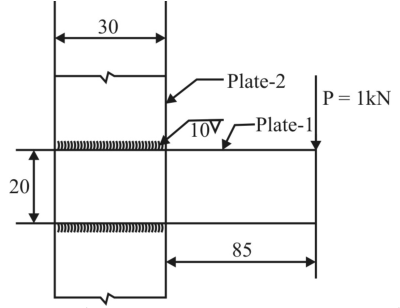
- A. 173 N/mm²
- B. 2.4 N/mm²
- C. 85 N/mm²
- D. None of these
Answer: B. 2.4 N/mm²
Explanation: The weld length is 30mm (from the diagram). Primary shear stress = Load / (2 * length * throat_thickness). Throat thickness 't' = size * cos(45). The formula given in the solution P√2 / (2bs) seems to simplify this calculation where s=size. Stress = 1000 / (2 * 30 * 0.707 * 10) = 2.35 N/mm², which is close to 2.4 N/mm².
Question 19
Year: 2017 | Topic: Machine Design
Which of the following is FALSE for bolted joints?
- A. Bolted joints are preloaded to avoid vibration loosening
- B. Threads made by thread rolling are preferred over machined threads
- C. When external load is applied, a bigger percentage relieves flange compression and the rest increases bolt tension
- D. Bolted joints are designed such that bolt stiffness is higher than flange stiffness
Answer: D. Bolted joints are designed such that bolt stiffness is higher than flange stiffness
Explanation: For a preloaded bolted joint, it is desirable for the flange stiffness to be much higher than the bolt stiffness to minimize the increase in bolt tension under external load.
Question 20
Year: 2017 | Topic: Machine Design
The specific metal cutting energy is expressed as (where α is rake angle, β is friction angle, φ is shear angle and τ is shear stress)
- A. τ cos(β-α) / [sinφ cos(φ+β-α)]
- B. τ sin(β-α) / [sinφ cos(φ-β+α)]
- C. τ cos(α-β) / [sinφ cos(φ-β+α)]
- D. τ sin(α-β) / [sinφ cos(φ+β-α)]
Answer: A. τ cos(β-α) / [sinφ cos(φ+β-α)]
Explanation: Specific cutting energy (Uc) is the cutting force (Fc) per unit material removal rate (MRR). The expression for Fc derived from Merchant's circle analysis leads to this formula for Uc.
Question 21
Year: 2018 | Topic: Machine Design
Life of a ball bearing at a load of 10 kN is 24000 hours. If the load is increased to 20 kN (all other conditions are same), its life in hour is
- A. 1000 h
- B. 3000 h
- C. 6000 h
- D. 12000 h
Answer: B. 3000 h
Explanation: Life L = (C/P)^n. For ball bearing n = 3, so L is proportional to 1/P³. L2/L1 = (P1/P2)^3. L2 = 24000 * (10/20)^3 = 24000 * (1/8) = 3000 hours.
Question 22
Year: 2018 | Topic: Machine Design
If an element is loaded as shown in figure below, the Von Mises stress will be close to (Principal stresses: 300 MPa, 150 MPa, -100 MPa)
- A. 180 MPa
- B. 350 MPa
- C. 255 MPa
- D. 495 MPa
Answer: B. 350 MPa
Explanation: Using Von Mises theory: (sigma1 - sigma2)^2 + (sigma2 - sigma3)^2 + (sigma3 - sigma1)^2 = 2 * sigma_y^2. Substituting the values gives (-100 - 300)^2 + (300 - 150)^2 + (150 - (-100))^2 = 160000 + 22500 + 62500 = 245000 = 2*sigma_y^2. Thus sigma_y^2 = 122500, making sigma_y = 350 MPa.
Question 23
Year: 2024 | Topic: Machine Design
The type of gear used to transmit rotary motion between non-parallel and non-intersecting shaft is
- A. Spur gear
- B. Helical gear
- C. Bevel gear
- D. Worm gear
Answer: D. Worm gear
Explanation: Worm gears, crossed helical gears, and hypoid gears are used to transmit power between non-parallel, non-intersecting shafts. Among the options given, the worm gear is the correct answer.
Question 24
Year: 2024 | Topic: Machine Design
Which of the bearings given below is not suitable for axial thrust load?
- A. Deep groove ball bearing
- B. Angular contact ball bearing
- C. Single row tapered bearing
- D. Straight Cylindrical roller bearing
Answer: D. Straight Cylindrical roller bearing
Explanation: Straight cylindrical roller bearings are designed to carry heavy radial loads and allow for axial displacement between the inner and outer rings, meaning they cannot support any axial thrust load.
Question 25
Year: 2024 | Topic: Machine Design
Two flanges are connected by a single bolt of nominal diameter 10 mm and is preloaded to a torque of 30 Nm. An external tensile load of 10,000 N is applied to the joint. The torque coefficient is 0.15 and joint stiffness constant is 0.2. The maximum tension in the bolt is
- A. 10,000 N
- B. 20,000 N
- C. 22,000 N
- D. 30,000 N
Answer: C. 22,000 N
Explanation: Preload force Fi = Torque / (K * d) = 30 / (0.15 * 0.010) = 20,000 N. The maximum tension in the bolt Fb = Fi + (C * P) = 20,000 + (0.2 * 10,000) = 20,000 + 2000 = 22,000 N.
Question 26
Year: 2024 | Topic: Machine Design
A 50 mm diameter solid shaft is welded to a flat plate all around by fillet weld of 4mm leg size as shown in Fig. If the allowable shear strength of the weld material is 100 MPa, the maximum approximate torque in Nm that the welded joint can sustain under pure torsion is
- A. 500*pi / $\sqrt{2}$
- B. 1000*pi / $\sqrt{2}$
- C. 500*pi*$\sqrt{2}$
- D. 1000*pi*$\sqrt{2}$
Answer: A. 500*pi / $\sqrt{2}$
Explanation: Throat thickness t = 0.707 * s = 4 / $\sqrt{2}$ mm. Polar moment of inertia of a circular weld J = pi * t * D³ / 4. Torsional shear stress tau = (T * r) / J. Therefore, T = tau * J / r = tau * (pi * t * D²) / 2. T = 100 * pi * (4 / $\sqrt{2}$) * (50^2) / 2 = 500,000 * pi / $\sqrt{2}$ N-mm = 500 * pi / $\sqrt{2}$ N-m.
Question 27
Year: 2024 | Topic: Machine Design
The diagram below is showing the various criteria of fatigue failure. Which option is the correct representation of these criteria? (Subscripts e, y and u represent endurance, yield and ultimate respectively.)
- A. 1 - Soderberg line, 2 - Goodman line, 3 - Gerber line
- B. 1 - Goodman line, 2 - Soderberg line, 3 - Gerber line
- C. 1 - Soderberg line, 2 - Gerber line, 3 - Goodman line
- D. 1 - Gerber line, 2 - Soderberg line, 3 - Goodman line
Answer: A. 1 - Soderberg line, 2 - Goodman line, 3 - Gerber line
Explanation: The Soderberg line (1) is the most conservative, connecting the endurance limit (Se) to the yield strength (Sy). The Goodman line (2) connects the endurance limit (Se) to the ultimate tensile strength (Su). The Gerber line (3) is a parabola connecting Se to Su.
Question 28
Year: 2024 | Topic: Machine Design
A flat belt run over a pulley and transmitting the power of 2.5 KW. The linear velocity of the belt is 2.5 m/s. The angle of lap is 165 deg and the coefficient of friction between the belt and pulley is 0.3. If the initial tension of the belt is increased by 10%, what is the effect on power transmission? (neglecting the slip and centrifugal effect of the belt)
- A. The power transmission is increased by 10%
- B. The power transmission is reduced by 10%
- C. The power transmission is doubled
- D. The power transmission is reduced to half
Answer: A. The power transmission is increased by 10%
Explanation: Power transmitted P = (T1 - T2) * V. The ratio T1/T2 = e^(mu*theta) remains constant. The initial tension T0 = (T1 + T2)/2. If T0 is increased by 10%, both T1 and T2 increase proportionally by 10%. Consequently, the difference (T1 - T2) increases by 10%, leading to a 10% increase in power transmission.
Question 29
Year: 2024 | Topic: Machine Design
A journal bearing of radius 'r1' and radial clearance 'c1' has a sommerfeld number 's1'. Another journal bearing of radius 'r2' and radial clearance 'c2' has a sommerfeld number 's2'. All the other parameters remain the same for both bearings. If r2 = 2 r1 and c2 = c1 / 2, then s2 / s1 is
Answer: C. 16
Explanation: The Sommerfeld number S = (r/c)^2 * (mu * N / P). Since only radius and clearance are changing, S2 / S1 = (r2/c2)^2 / (r1/c1)^2. Substituting the values gives ((2*r1) / (c1/2))^2 / (r1/c1)^2 = (4)^2 = 16.
Question 30
Year: 2024 | Topic: Machine Design
Match the following: Theories of failure with Shape of region of safety. (A) Rankine Theory, (B) Tresca Theory, (C) St. Venants theory, (D) Von mises Theory. (i) Hexagon, (ii) Ellipse, (iii) Square, (iv) Rhombus.
- A. (A)-(ii), (B)-(iv), (C)-(i), (D)-(iii)
- B. (A)-(iii), (B)-(iv), (C)-(ii), (D)-(i)
- C. (A)-(iii), (B)-(i), (C)-(iv), (D)-(ii)
- D. (A)-(iv), (B)-(i), (C)-(iii), (D)-(ii)
Answer: C. (A)-(iii), (B)-(i), (C)-(iv), (D)-(ii)
Explanation: Rankine theory (Maximum Normal Stress) boundary is a Square (iii). Tresca theory (Maximum Shear Stress) boundary is a Hexagon (i). St. Venants theory (Maximum Principal Strain) boundary is a Rhombus (iv). Von Mises (Maximum Distortion Energy) boundary is an Ellipse (ii).
Question 31
Year: 2024 | Topic: Machine Design
A machine member is subjected to fluctuating stress, $sigma = sigma_0 cos(5pi t)$. The endurance limit of the material is 350 MPa and the yield strength is 500 MPa. If the factor of safety used in the design is 3.5, then the maximum allowable stress $sigma_0$ in MPa according to soderberg fatigue criteria is
Answer: C. 100
Explanation: The stress varies sinusoidally from $+sigma_0$ to $-sigma_0$. Therefore, the mean stress $sigma_m = 0$, and the variable (amplitude) stress $sigma_v = sigma_0$. Using the Soderberg criteria: $(sigma_m / S_y) + (sigma_v / S_e) = 1 / FOS$. Since $sigma_m = 0$, the equation becomes $sigma_0 / 350 = 1 / 3.5$. Solving for $sigma_0$ gives 100 MPa.
Question 32
Year: 2024 | Topic: Machine Design
A round wire helical spring is loaded by the axial force. The maximum shear stress in the wire cross section will be at
- A. Outer fibre
- B. Inner fibre
- C. Center of the cross section
- D. Both outer and inner fibres
Answer: B. Inner fibre
Explanation: In a helical spring, the direct shear stress and the torsional shear stress are additive on the inner edge of the coil. Additionally, the curvature effect (accounted for by the Wahl factor) further concentrates the stress at the innermost fiber.
Question 33
Year: 2024 | Topic: Machine Design
The power is transmitted through a spur gear with 20 deg pressure angle mounted at the mid span of shaft supported on bearings at the ends. The nature of stress induced in the shaft is
- A. Normal stress due to bending only.
- B. Normal stress due to bending and shear stress due to torsion.
- C. Normal stress due to bending, axial loading and shear stress due to torsion
- D. Normal stress due to axial loading and shear stress due to torsion
Answer: B. Normal stress due to bending and shear stress due to torsion.
Explanation: A spur gear transmits both a tangential force component (which causes torsional shear stress in the shaft) and a radial force component (which causes bending moment, hence normal bending stress). Unlike helical gears, spur gears do not produce axial/thrust forces.
Question 34
Year: 2024 | Topic: Machine Design
If the load acting on the ball bearing is increased 2 times its life will
- A. Reduce by 2 times
- B. Reduce by 4 times
- C. Reduce by 8 times
- D. Not change
Answer: C. Reduce by 8 times
Explanation: The life of a ball bearing $L_{10}$ in millions of revolutions is proportional to $(C/P)^3$, where $P$ is the equivalent load. If the load is doubled (becomes $2P$), the new life is proportional to $1/(2P)^3 = 1/(8P^3)$. Therefore, the life is reduced by a factor of 8.
Question 35
Year: 2024 | Topic: Machine Design
An old clutch is to transmit a torque of 100 N-m. The inner and outer diameter of the clutch plate is 100 mm and 200 mm respectively. The force required for engagement is (assume $mu = 1/3$ with uniform wear theory)
- A. 4 kN
- B. 10 kN
- C. 25 kN
- D. 50 kN
Answer: A. 4 kN
Explanation: For an old clutch, uniform wear theory is used. Torque $T = (1/2) * mu * F * (R_o + R_i)$. Given $T = 100$ N-m = $100,000$ N-mm. Inner radius $R_i = 50$ mm, Outer radius $R_o = 100$ mm. $100,000 = (1/2) * (1/3) * F * (100 + 50) = (1/6) * F * 150 = 25F$. Solving for $F$, $F = 100,000 / 25 = 4000$ N = 4 kN.
Question 36
Year: 2025 | Topic: Machine Design
A closed-coil helical compression spring with 20 active coils has a spring stiffness of K. It is cut into two parts having 8 and 12 active coils respectively. What is the stiffness of the spring with 8 active coils?
- A. 1.5 K
- B. 2.0 K
- C. 2.5 K
- D. 3.0 K
Answer: C. 2.5 K
Explanation: The stiffness of a helical spring is inversely proportional to the number of active coils ($K \propto 1/N$). Therefore, $K_{new} \times N_{new} = K_{old} \times N_{old}$. For the spring with 8 coils: $K_{new} = K \times (20 / 8) = 2.5 K$.
Question 37
Year: 2025 | Topic: Machine Design
A ball bearing has a dynamic load rating of 60,000 N and experiences a load of 20,000 N. The expected life in million revolutions is :
Answer: D. 27
Explanation: The expected life of a ball bearing in millions of revolutions is calculated using the formula $L_{10} = (C/P)^3$, where $C$ is the dynamic load rating and $P$ is the equivalent dynamic bearing load. $L_{10} = (60000 / 20000)^3 = 3^3 = 27$ million revolutions.
Question 38
Year: 2025 | Topic: Machine Design
A single plate clutch transmits 50 Nm torque with a coefficient of friction 0.3 and mean radius 0.1 m. What is the axial force required?
- A. 1000 N
- B. 1500 N
- C. 1670 N
- D. 2000 N
Answer: C. 1670 N
Explanation: The torque capacity of a clutch is given by $T = n \mu F R_m$, where $n$ is the number of active friction surfaces. Assuming a configuration effectively representing $n=1$ (one active pair of friction surfaces) to match the provided options: $50 = 1 \times 0.3 \times F \times 0.1$. Solving for $F$: $F = 50 / 0.03 = 1666.67$ N, which is approximately 1670 N.
Question 39
Year: 2025 | Topic: Machine Design
Two plates subjected to tensile force of 50 kN, are fixed together by means of three rivets. The plates and rivets are made of same material. If the permissible shear stress in the rivets is 50 N/mm², what is the diameter of the rivets? (Neglect stress concentration effects)
- A. 14.75 mm
- B. 20.60 mm
- C. 24.38 mm
- D. 29.52 mm
Answer: B. 20.60 mm
Explanation: The total shear force $F = 50$ kN $= 50,000$ N is resisted by 3 rivets in single shear. The shear stress is $\tau = F / (n \times A) \Rightarrow 50 = 50000 / (3 \times (\pi/4) \times d²)$. Solving for $d$: $1 = 1000 / (0.75 \pi d²) \Rightarrow d² = 4000 / (3\pi) \approx 424.41$. Taking the square root gives $d \approx 20.60$ mm.
Question 40
Year: 2025 | Topic: Machine Design
For a gear pair, the center distance is 200 mm, and the module is 5 mm. The sum of teeth in the gear pair is
Answer: B. 80
Explanation: The center distance ($C$) of a gear pair is half the sum of their pitch circle diameters: $C = (d_1 + d_2) / 2$. Since pitch circle diameter $d = m \times Z$ (where $m$ is the module and $Z$ is the number of teeth), we have $C = m(Z_1 + Z_2) / 2$. Therefore, $Z_1 + Z_2 = 2C / m = (2 \times 200) / 5 = 400 / 5 = 80$.