Fluid Mechanics - ISRO Mechanical & Aerospace Subject-Wise PYQ Practice
Practice topic-wise Fluid Mechanics previous year questions for ISRO Mechanical & Aerospace with instant step-by-step solutions and formula breakdowns.
All ISRO Mechanical & Aerospace papers
95 questions. Answers are shown only where the official answer key is available.
Question 1
Year: 2007 | Topic: Fluid Mechanics
In laminar flow through a circular pipe, the velocity profile is:
- A. Parabolic
- B. Logarithmic
- C. Uniform
- D. Quadratic
Answer: A. Parabolic
Explanation: For fully developed laminar flow (Hagen–Poiseuille), the velocity profile is parabolic across the pipe cross-section.
Question 2
Year: 2008 | Topic: Fluid Mechanics
Match List I (Measuring Devices) with List II (Measuring parameter): A. Pitot tube, B. Micro-manometer, C. Pipe bend meter, D. Wall pressure tap. 1. Flow static pressure, 2. Rate of flow (indirect), 3. Differential pressure, 4. Flow stagnation pressure.
- A. A-1, B-3, C-2, D-4
- B. A-4, B-3, C-2, D-1
- C. A-4, B-3, C-2, D-1
- D. A-3, B-4, C-2, D-1
Answer: B. A-4, B-3, C-2, D-1
Explanation: A. Pitot tube measures Flow stagnation pressure (4). B. Micro-manometer measures Differential pressure (3). C. Pipe bend meter measures Rate of flow indirectly (2). D. Wall pressure tap measures Flow static pressure (1).
Question 3
Year: 2008 | Topic: Fluid Mechanics
The general equation of continuity for three-dimensional flow of a compressible fluid for steady flow is (where u, v, w are components of velocity in x, y and z directions respectively)
- A. du/dx + dv/dy + dw/dz = 0
- B. du/dx = dv/dy = dw/dz = 0
- C. du/dx + dv/dy + dw/dz = 1
- D. du/dx + dv/dy + dw/dz = u.v.w.
Answer: A. du/dx + dv/dy + dw/dz = 0
Explanation: For a steady incompressible flow, the continuity equation reduces to du/dx + dv/dy + dw/dz = 0. (Note: The question states compressible fluid but options are provided for incompressible flow, matching option A).
Question 4
Year: 2008 | Topic: Fluid Machinery
In centrifugal pumps, maximum efficiency is obtained when the blades are
- A. Straight
- B. Bent forward
- C. Bent backward
- D. radial
Answer: C. Bent backward
Explanation: In centrifugal pumps, maximum efficiency is obtained when the blades are bent backward.
Question 5
Year: 2008 | Topic: Fluid Machinery
If the characteristics of a pump are as shown in fig. What is represented by abscissa
- A. Head
- B. RPM
- C. Discharge
- D. Power
Answer: C. Discharge
Explanation: Characteristic curves of a pump are graphical representations of a pump's performance (Head, Efficiency, BHP) over a range of flow rates (Discharge). Therefore, the abscissa represents Discharge.
Question 6
Year: 2008 | Topic: Fluid Mechanics
A rocket exists exhaust gases with rho = 0.5 kg/m³ out a 50 cm diameter nozzle at a velocity of 1200 m/s. The thrust, is
- A. 420 kN
- B. 280 kN
- C. 140 kN
- D. 90 kN
Answer: C. 140 kN
Explanation: Area of Nozzle A = (pi/4) * (0.5)^2 = 0.196 m². Thrust = rho * A * V² = 0.5 * 0.196 * (1200)^2 = 141300 N = 141.3 kN, which is closest to 140 kN.
Question 7
Year: 2008 | Topic: Fluid Mechanics
The flow of a fluid in a pipe takes place from
- A. Higher level to lower level
- B. Small end to large end
- C. Higher pressure to lower pressure
- D. Higher energy to lower energy
Answer: D. Higher energy to lower energy
Explanation: Fluid flows from a region of higher energy to lower energy and not necessarily from higher pressure to lower pressure. Flow from a low-pressure region to a high-pressure region is possible if the sum of potential, pressure, and kinetic energy is favorable.
Question 8
Year: 2008 | Topic: Fluid Mechanics
An aero plane is flying at an height of 14km where temperature is -45 °C. The speed of the plane is corresponding to M=2. Find the speed of the plane if R=287J/kg K and gamma=1.4
- A. 2179 km/h
- B. 3010 km/h
- C. 3250 km/h
- D. 3379 km/h
Answer: A. 2179 km/h
Explanation: Speed v = M * $\sqrt{gamma * R * T}$. T = 273 - 45 = 228 K. v = 2 * $\sqrt{1.4 * 287 * 228}$ = 605.344 m/s. In km/h = 605.344 * 3.6 = 2179.24 km/h.
Question 9
Year: 2008 | Topic: Fluid Mechanics
Pipe 1, branches to three pipes as shown in the given figure. The areas and corresponding velocities are: Pipe 1 (V=50, A=20), Pipe 2 (V=V2, A=10), Pipe 3 (V=30, A=15), Pipe 4 (V=20, A=10). The value of V2 in cm per second will be
Answer: D. 35
Explanation: Using continuity equation: Q1 = Q2 + Q3 + Q4 => A1*V1 = A2*V2 + A3*V3 + A4*V4. 50*20 = V2*10 + 30*15 + 20*10. 1000 = 10*V2 + 450 + 200. 10*V2 = 350. V2 = 35 cm/sec.
Question 10
Year: 2008 | Topic: Fluid Mechanics
The pressure difference measured by a mercury oil differential manometer on the two sides of the orifice meter gives a reading of 50 cm of mercury. Determine the differential pressure head in orifice. Take the specific gravity of oil as 0.9.
- A. 7.05m of oil
- B. 5.05m of oil
- C. 4.75m of oil
- D. 3.35m of oil
Answer: A. 7.05m of oil
Explanation: h = x * ((S_m / S_oil) - 1) = 50 * ((13.6 / 0.9) - 1) cm. h = 50 * (15.11 - 1) = 705 cm = 7.05 m of oil.
Question 11
Year: 2008 | Topic: Fluid Mechanics
The transition Reynolds number for flow over a flat plate is 5x10^5. What is the distance from the leading edge at which transition will occur for flow of water with a uniform velocity of 1 m/s? (For water, the kinematic viscosity, v = 0.858x10^-6 m²/s)
- A. 1m
- B. 0.43m
- C. 43m
- D. 103m
Answer: B. 0.43m
Explanation: Re = (V * D) / v. Therefore, 5*10^5 = (1 * D) / (0.858*10^-6). D = 5*10^5 * 0.858*10^-6 = 0.429 m, which is approx 0.43 m.
Question 12
Year: 2008 | Topic: Fluid Mechanics
Pipes of lengths l1, l2 etc and diameters d1, d2, etc are connected in series. A single pipe of length l1+l2+l3+.... having same pressure loss as all pipes in series will have diameter equal to
- A. ((l1+l2+l3+...) / (l1/d1^4 + l2/d2^4 + ...))^(1/4)
- B. ((l1+l2+l3+...) / (l1/d1^5 + l2/d2^5 + ...))^(1/5)
- C. ((l1+l2+l3+...) / (l1/d1^3 + l2/d2^3 + ...))^(1/3)
- D. ((l1+l2+l3+...) / (l1/d1^2 + l2/d2^2 + ...))^(1/2)
Answer: B. ((l1+l2+l3+...) / (l1/d1^5 + l2/d2^5 + ...))^(1/5)
Explanation: When pipes are connected in series, the equivalent diameter equation is derived from the head loss formula: l/d^5 = l1/d1^5 + l2/d2^5 + l3/d3^5 + ... giving d = ((l1+l2+l3+...) / (l1/d1^5 + l2/d2^5 + ...))^(1/5).
Question 13
Year: 2014 | Topic: Fluid Mechanics
Which of the following is the correct definition of the Reynolds number? Where rho = fluid density, U = velocity, L = Length and mu = Kinematic viscosity
- A. rho * U * L / mu
- B. rho * U * L / mu²
- C. U * L / mu
- D. rho * U * L² / mu
Answer: C. U * L / mu
Explanation: Typically, Reynolds number is Re = (rho * U * L) / (dynamic viscosity). However, the question specifies that 'mu' represents 'Kinematic viscosity' (which is usually denoted by nu). Since kinematic viscosity is dynamic viscosity divided by density, the formula reduces to Re = (U * L) / mu.
Question 14
Year: 2014 | Topic: Fluid Mechanics
In case of steady incompressible laminar viscous flow between two stationary parallel plates, the velocity distribution is
- A. Linear
- B. Quadratic
- C. Parabolic
- D. Hyperbolic
Answer: C. Parabolic
Explanation: For a steady incompressible laminar viscous flow between two stationary parallel plates, the velocity profile depends on the pressure gradient and viscosity. The derived velocity equation is $u = -\frac{1}{2\mu}(\frac{\partial P}{\partial x})(ty - y²)$, which is clearly a parabolic distribution across the distance between the plates.
Question 15
Year: 2014 | Topic: Fluid Mechanics
Two pipe lines of equal length are connected in series. The diameter of second pipe is two times that of first pipe, the ratio of head loss between first and second pipe is
- A. 1:32
- B. 32:1
- C. 1:8
- D. 1:4
Answer: B. 32:1
Explanation: For pipes in series, the discharge $Q$ is constant. The head loss $h_f$ is proportional to $V²/d$. Using $V = Q/A$, $h_f \propto 1/d^5$. Therefore, the ratio of head loss between the first and second pipe is $\frac{h_{f1}}{h_{f2}} = (\frac{d_2}{d_1})^5$. Since $d_2 = 2d_1$, the ratio is $2^5 = 32$. The correct ratio is 32:1.
Question 16
Year: 2014 | Topic: Fluid Mechanics
The velocity potential function $\phi$ satisfy the Laplace equation: $\frac{\partial^{2}\phi}{\partial x^{2}}+\frac{\partial^{2}\phi}{\partial y^{2}}+\frac{\partial^{2}\phi}{\partial z^{2}}=0$. Then the flow is
- A. Unsteady, incompressible, rotational
- B. Steady, compressible, rotational
- C. Steady, incompressible, irrotational
- D. Unsteady, compressible, irrotational
Answer: C. Steady, incompressible, irrotational
Explanation: A velocity potential function $\phi$ automatically satisfies the condition for irrotational flow. When it also satisfies the Laplace equation, it meets the requirement of the 3-D continuity equation for an incompressible fluid: $\frac{\partial u}{\partial x}+\frac{\partial v}{\partial y}+\frac{\partial w}{\partial z}=0$. Therefore, the flow is steady, incompressible, and irrotational.
Question 17
Year: 2014 | Topic: Fluid Mechanics
For a two dimensional potential flow, the velocity potential is given by: $\phi=4x(3y-4)$. The numerical value of stream function at the point (2,3) is
- A. 10 Units
- B. 20 Units
- C. 18 Units
- D. 16 Units
Answer: C. 18 Units
Explanation: From the velocity potential $\phi$, the velocity components are $u = -\frac{\partial\phi}{\partial x} = -4(3y-4)$ and $v = -\frac{\partial\phi}{\partial y} = -12x$. Using the stream function relations, $\frac{\partial\psi}{\partial y} = u = -12y + 16$ and $\frac{\partial\psi}{\partial x} = -v = 12x$. Integrating with respect to x gives $\psi = 6x^2 + g(y)$. Differentiating with respect to y gives $g'(y) = -12y + 16$, which integrates to $g(y) = 16y - 6y^2$. Thus, $\psi = 6(x² - y²) + 16y$. At (2,3), $\psi = 6(4 - 9) + 16(3) = -30 + 48 = 18$ units.
Question 18
Year: 2014 | Topic: Fluid Mechanics
The velocity distribution in a turbulent boundary layer is given by $u/v=(y/\delta)^{1/7}$. What is the displacement thickness $\delta^{*}$
- A. $\delta$
- B. $\delta/7$
- C. $7\delta/8$
- D. $\delta/8$
Answer: D. $\delta/8$
Explanation: Displacement thickness is given by $\delta^{*} = \int_{0}^{\delta}(1 - \frac{u}{v})dy$. Substituting the given velocity profile $\frac{u}{v} = (\frac{y}{\delta})^{1/7}$ into the integral yields $\int_{0}^{\delta}(1 - (\frac{y}{\delta})^{1/7})dy$. Evaluating this integral gives $[y - \frac{7}{8}\frac{y^{8/7}}{\delta^{1/7}}]_{0}^{\delta} = \delta - \frac{7}{8}\delta = \frac{\delta}{8}$.
Question 19
Year: 2014 | Topic: Fluid Mechanics
The specific weight W of ocean water changes according to the equation $W=W_{0}+C\sqrt{h}$ $W_{0}$ = Specific weight of ocean water at free surface and C is a constant. The pressure as a function of depth h is given by
- A. $W_{0}h$
- B. $W_{0}h+(5/2)Ch$
- C. $W_{0}h+(2/3)Ch^{3/2}$
- D. $W_{0}h-(2/3)Ch^{2/3}$
Answer: C. $W_{0}h+(2/3)Ch^{3/2}$
Explanation: Pressure is defined as the integral of specific weight with respect to depth: $P = \int W dh$. Given the specific weight function $W = W_{0} + C\sqrt{h}$, we integrate it: $P = \int (W_{0} + C h^{1/2}) dh = W_{0}h + C \frac{h^{3/2}}{3/2}$. This simplifies to $P = W_{0}h + \frac{2}{3}C h^{3/2}$.
Question 20
Year: 2014 | Topic: Fluid Mechanics
The model of a propeller 3m diameter, cruising at 10 m/sec in air, is tested in a wind tunnel on a 1:10 scale model. If thrust of 50N is measured on the model at 5 m/sec wind speed, then thrust on prototype will be
- A. 20000 N
- B. 2000 N
- C. 5000 N
- D. 500 N
Answer: A. 20000 N
Explanation: Using aerodynamic scaling laws, the ratio of forces between the model and the prototype depends on velocity and diameter squared: $\frac{F_M}{F_P} = (\frac{v_M}{v_P})^2 (\frac{d_M}{d_P})^2$. Substituting $v_M = 5$, $v_P = 10$, and the scale ratio $\frac{d_M}{d_P} = \frac{1}{10}$, we get $\frac{F_M}{F_P} = (\frac{5}{10})^2 \times (\frac{1}{10})^2 = \frac{1}{4} \times \frac{1}{100} = \frac{1}{400}$. With $F_M = 50$ N, $F_P = 400 \times 50 = 20000$ N.
Question 21
Year: 2014 | Topic: Fluid Mechanics
Water having kinematic viscosity of 0.01 stoke flows at a velocity of 2m/sec in a pipe of 15 cm diameter. For dynamic similarity, the velocity of oil of kinematic viscosity of 0.03 stoke in a pipe of same diameter will be
- A. 0.33 m/sec
- B. 0.66 m/sec
- C. 2 m/sec
- D. 6 m/sec
Answer: D. 6 m/sec
Explanation: For dynamic similarity in pipe flow, the Reynolds numbers must be equal: $\left(\frac{VD}{\upsilon}\right)_{1} = \left(\frac{VD}{\upsilon}\right)_{2}$. Since the pipe diameter is the same ($D_1 = D_2 = 15$ cm), the equation simplifies to $\frac{V_1}{\upsilon_1} = \frac{V_2}{\upsilon_2}$. Solving for $V_2$ gives $V_2 = V_1 \times \frac{\upsilon_2}{\upsilon_1} = 2 \times \frac{0.03}{0.01} = 6$ m/s.
Question 22
Year: 2014 | Topic: Fluid Mechanics
An inclined plate 2 m long and 1 m wide lies with its length inclined at 45° to the surface of water and its nearest edge is 1m below it. If specific weight of water is $1000kg/m^{3}$, then total pressure force on the plate (in kg) is approximately
- A. 2150
- B. 2510
- C. 3220
- D. 3420
Answer: D. 3420
Explanation: The area of the plate is $A = 2 \times 1 = 2$ m². The depth of the center of gravity from the free surface is $\bar{h} = 1 + (L/2)\sin(45^{\circ}) = 1 + 1\cos(45^{\circ})$ (noting $\sin 45^{\circ} = \cos 45^{\circ}$). The total pressure force is $F = wA\bar{h} = 1000 \times 2 \times (1 + 1\cos 45^{\circ}) = 2000 \times (1 + 0.707) = 3414$ kg, which is approximately 3420 kg.
Question 23
Year: 2014 | Topic: Fluid Mechanics
A liquid of density $1200 kg/m^{3}$ is flowing steadily through a tube of varying cross section as shown below. The cross section at point A is $1 cm^{2}$ and at B is $20 mm^{2}$. The points A and B in the same horizontal plane. The speed of liquid at point A is 10cm/sec. The difference of pressure at A and B is
- A. 100 Pa
- B. 170 Pa
- C. 144 Pa
- D. 180 Pa
Answer: C. 144 Pa
Explanation: First, use the continuity equation $A_{1}v_{1} = A_{2}v_{2}$ to find $v_2$. $A_1 = 1\text{ cm}^2 = 10^{-4}\text{ m}^2$, $v_1 = 10\text{ cm/s} = 0.1\text{ m/s}$, $A_2 = 20\text{ mm}^2 = 20 \times 10^{-6}\text{ m}^2$. Thus, $v_2 = \frac{10^{-4}}{20 \times 10^{-6}} \times 0.1 = 0.5$ m/s. Using Bernoulli's equation for a horizontal pipe ($Z_1 = Z_2$), $\frac{P_{1}-P_{2}}{\rho g} = \frac{v_{2}^{2}-v_{1}^{2}}{2g}$. The pressure difference is $P_1 - P_2 = \frac{\rho(v_2^2 - v_1^2)}{2} = \frac{1200(0.5^2 - 0.1^2)}{2} = 600(0.24) = 144$ Pa.
Question 24
Year: 2014 | Topic: Fluid Mechanics
A wooden plank (sp. gravity = 0.5) of 1m x 1m x 0.5 m floats in water with 1.5 kN load on it with 1m x 1m surface horizontal. The depth of plank lying below water surface shall be
- A. 0.178 m
- B. 0.250 m
- C. 0.403 m
- D. 0.5 m
Answer: C. 0.403 m
Explanation: For equilibrium, the buoyant force equals the total weight (weight of the wooden plank + load). Buoyant force = $\rho_{w} g V_{submerged} = 1000 \times 9.81 \times (1 \times 1 \times x)$. Total weight = $(\rho_{plank} \times V \times g) + 1.5 \text{ kN} = (500 \times 1 \times 1 \times 0.5 \times 9.81) + 1500 = 2452.5 + 1500 = 3952.5$ N. Equating the two: $9810 \times x = 3952.5$, which yields $x = 0.4029$ m.
Question 25
Year: 2014 | Topic: Fluid Mechanics
Circulation is defined as the line integral of tangential component of velocity about a
- A. Centre
- B. close contour in a fluid flow
- C. velocity profile
- D. pressure profile
Answer: B. close contour in a fluid flow
Explanation: In fluid mechanics, circulation $\Gamma$ is strictly defined as the line integral of the tangential component of the velocity vector taken around a closed contour in the fluid flow.
Question 26
Year: 2014 | Topic: Fluid Mechanics
Unstable equilibrium of a floating body implies
- A. Metacentre M is above centre of gravity G
- B. Metacentre M is below centre of gravity G
- C. Metacentre M coincides with centre of gravity G
- D. None of these
Answer: B. Metacentre M is below centre of gravity G
Explanation: For a floating body, the stability states are governed by the relative positions of the Metacentre (M) and the center of gravity (G). Stable equilibrium occurs when M is above G. Unstable equilibrium occurs when M is below G, creating an overturning moment. Neutral equilibrium occurs when M coincides with G.
Question 27
Year: 2014 | Topic: Fluid Mechanics
Viscosity has the dimension of
- A. $(MT^{2})/L$
- B. $M^{2}/(LT)$
- C. $M/(LT^{2})$
- D. $M/(LT)$
Answer: D. $M/(LT)$
Explanation: Viscosity generally refers to dynamic viscosity $\mu$. The SI unit of dynamic viscosity is kg/(m·s) or Pa·s. Structurally, the dimensional formula for dynamic viscosity is $[M L^{-1} T^{-1}]$, which corresponds to $M/(LT)$.
Question 28
Year: 2014 | Topic: Fluid Mechanics
Which of the following flow is rotational (where u and v are velocity components in x and y directions respectively)
- A. $u=y; v=(\frac{3}{2}x)$
- B. $u=xy^{2} ; v=x^{2}y$
- C. Both (a) and (b)
- D. None of these
Answer: A. $u=y; v=(\frac{3}{2}x)$
Explanation: A flow is rotational if the angular velocity component $\omega_{z} = \frac{1}{2}\left(\frac{\partial v}{\partial x} - \frac{\partial u}{\partial y}\right)$ is non-zero. For option (a), $\omega_{z} = \frac{1}{2}\left(\frac{3}{2} - 1\right) = \frac{1}{4} \neq 0$, making it rotational. For option (b), $\omega_{z} = \frac{1}{2}(2xy - 2xy) = 0$, making it irrotational.
Question 29
Year: 2014 | Topic: Fluid Mechanics
A pump running at 1000 rpm consumes 1 kW and generates head of 10m of water. When it is operated at 2000rpm, its power consumption and head generated would be
- A. 4 kW, 50m of water
- B. 6 kW, 20m of water
- C. 3 kW, 30m of water
- D. 8 kW, 40m of water
Answer: D. 8 kW, 40m of water
Explanation: Using pump affinity laws, the head is proportional to the square of the speed ($H \propto N²$), and power is proportional to the cube of the speed ($P \propto N³$). The speed ratio is $N_2/N_1 = 2000/1000 = 2$. Therefore, the new head is $H_2 = 10 \times 2^2 = 40$ m. The new power consumption is $P_2 = 1 \times 2^3 = 8$ kW.
Question 30
Year: 2014 | Topic: Fluid Mechanics
For irrotational fluid flow curl of velocity vector is
- A. 0
- B. > 0
- C. < 0
- D. None of these
Answer: A. 0
Explanation: In an irrotational flow, the fluid elements move and deform but do not rotate. Mathematically, this condition is expressed by stating that the curl of the velocity vector is equal to zero ($\nabla \times \vec{V} = 0$) at every point in the flow field.
Question 31
Year: 2014 | Topic: Fluid Mechanics
An oil of kinematic viscosity of 0.5 stokes flow though a pipe of 20cm diameter. What is the velocity if the flow is critical?
- A. 0.5 m/s
- B. 0.9 m/s
- C. 1.5 m/s
- D. 2 m/s
Answer: A. 0.5 m/s
Explanation: For pipe flow, the critical Reynolds number ($Re_{critical}$) is 2000. The kinematic viscosity $\nu = 0.5$ stokes = $0.5 \times 10^{-4}$ m²/s. The pipe diameter $D = 20$ cm = $0.2$ m. Using the formula $Re = \frac{VD}{\nu}$, we substitute the values: $2000 = \frac{V \times 0.2}{0.5 \times 10^{-4}}$. Solving for $V$ yields $V = \frac{2000 \times 0.5 \times 10^{-4}}{0.2} = \frac{0.1}{0.2} = 0.5$ m/s.
Question 32
Year: 2014 | Topic: Fluid Mechanics
A vertical air stream flowing at a velocity of 100 m/s supports a ball of 60 mm in diameter. Taking the density of air as $1.2~kg/m^{3}$ and kinematic viscosity as 1.6 stokes, the weight of the ball that is supported is (if coefficient of drag $C_{D}=0.8$)
- A. 20.2 N
- B. 13.5 N
- C. 30.1 N
- D. 25.2 N
Answer: B. 13.5 N
Explanation: The ball is supported by the drag force of the air stream, meaning the drag force equals the weight of the ball. Drag Force $F_{D} = C_{D} \cdot A \cdot \frac{\rho V^{2}}{2}$. Given the diameter $d = 60\text{ mm} = 0.06\text{ m}$, the projected area is $A = \frac{\pi}{4}(0.06)^{2}$. Substituting the given values ($C_{D} = 0.8$, $\rho = 1.2\text{ kg/m}^3$, $V = 100\text{ m/s}$) into the equation yields $F_{D} = 0.8 \times \frac{\pi}{4} \times (0.06)^{2} \times \frac{1.2 \times 100^{2}}{2}$. Calculating this gives $F_{D} = 13.5648\text{ N}$, which closely matches 13.5 N.
Question 33
Year: 2014 | Topic: Fluid Mechanics
The velocity distribution flow over a flat plate is given by $U=(3/4)y-y^{2}$ in which u is the velocity in m/s at a distance y meter above the plate. If the dynamic viscosity of the fluid is 10 poise, then the shear stress at 0.2m is
- A. $0.45~N/m^{2}$
- B. $0.35~N/m^{2}$
- C. $0.55~N/m^{2}$
- D. $0.25~N/m^{2}$
Answer: B. $0.35~N/m^{2}$
Explanation: The velocity distribution is given by $U = \frac{3}{4}y - y²$. The velocity gradient is $\frac{dU}{dy} = \frac{3}{4} - 2y$. At a distance of $y = 0.2\text{ m}$, the gradient is $\frac{dU}{dy} = \frac{3}{4} - 2(0.2) = 0.75 - 0.4 = 0.35$. The dynamic viscosity is $\mu = 10\text{ Poise} = 1\text{ Pa.s}$. According to Newton's law of viscosity, the shear stress $\tau = \mu \frac{dU}{dy}$. Therefore, $\tau = 1 \times 0.35 = 0.35\text{ N/m}^2$.
Question 34
Year: 2015 | Topic: Fluid Mechanics
When a body floating in a liquid is given a small angular displacement, it starts oscillating about a point known as
- A. centre of gravity
- B. centre of pressure
- C. metacenter
- D. centre of buoyancy
Answer: C. metacenter
Explanation: When a body floating in a liquid is subjected to a small angular displacement, the center of buoyancy shifts. The body starts oscillating about a theoretical point of intersection between the new vertical line of buoyant force and the original vertical axis. This point is known as the metacenter (M).
Question 35
Year: 2015 | Topic: Fluid Mechanics
Bernoulli's equation is applied to
- A. venturimeter
- B. orifice meter
- C. pitot tube meter
- D. all of the above
Answer: D. all of the above
Explanation: The Bernoulli Theorem is based on the conservation of energy for a steady, non-viscous, incompressible fluid flow along a streamline, where the summation of kinetic energy, potential energy, and pressure energy is constant. Instruments such as the venturimeter, orifice meter, and pitot tube meter all operate by applying this fundamental Bernoulli equation.
Question 36
Year: 2015 | Topic: Fluid Mechanics
A jet of water discharging from a 40 mm diameter orifice has minimum area corresponding to dia of 24.4 mm at its vena contracta. The coefficient of contraction is
- A. 0.46
- B. 0.61
- C. 0.78
- D. 0.87
Answer: B. 0.61
Explanation: According to the provided solution, the ratio of the diameters is evaluated directly as $24.4 / 40 = 0.61$, which matches the typical acceptable range for the coefficient of contraction (0.61 to 0.69) for an orifice meter.
Question 37
Year: 2015 | Topic: Fluid Mechanics
A tank of uniform cross section, sectional cross area (A) containing liquid upto height ($H_1$) has an orifice of cross sectional area (a) at its bottom. The time required to empty the tank completely will be
- A. $\frac{2A\sqrt{H_{1}}}{C_{d}a\sqrt{2g}}$
- B. $\frac{2AH_{1}}{C_{d}a\sqrt{2g}}$
- C. $\frac{2AH_{1}^{3/2}}{C_{d}a\sqrt{2g}}$
- D. $\frac{2AH_{1}^{2}}{C_{d}a\sqrt{2g}}$
Answer: A. $\frac{2A\sqrt{H_{1}}}{C_{d}a\sqrt{2g}}$
Explanation: Let the height of water at any instant be $h$, and in time $dt$, the height changes by $dh$. The volume flow rate equates to $-A dh = C_{d}\sqrt{2gh} \cdot a \cdot dt$. Integrating both sides from the initial height $H_1$ to final height $H_2 = 0$ gives $t = \frac{2A\sqrt{H_1}}{aC_{d}\sqrt{2g}}$.
Question 38
Year: 2015 | Topic: Fluid Mechanics
The power transmitted through the nozzle is maximum when the head lost due to friction in the pipe is
- A. Equal to the total supply head
- B. One third of the total supply head
- C. One half of the total supply head
- D. Two third of the total supply head
Answer: B. One third of the total supply head
Explanation: Power transmitted at the outlet of the pipe is evaluated as $P = \rho g Q(H - h_f) = \rho g \frac{\pi}{4}d² V \left(H - \frac{4fLV^2}{d \times 2g}\right)$. For maximum power transmission, the derivative of power with respect to velocity is zero: $\frac{d}{dV}(P) = 0$. Differentiating and solving gives $H - 3 \left(\frac{4fLV^2}{d \times 2g}\right) = 0$, which simplifies to $H - 3h_f = 0$, meaning $h_f = H/3$.
Question 39
Year: 2015 | Topic: Fluid Mechanics
What is the type of flow when a cylindrical vessel containing some liquid is rotated about its vertical axis?
- A. steady flow
- B. turbulent flow
- C. vortex flow
- D. non-uniform flow
Answer: C. vortex flow
Explanation: When a cylindrical vessel containing a liquid is rotated about its vertical axis, the liquid revolves in concentric circles. This specific type of rotational motion is classified as a forced vortex flow.
Question 40
Year: 2015 | Topic: Fluid Mechanics
Water at $25^{\circ}C$ is flowing through a 1.0 km long GI pipe of 200 mm diameter at the rate of 0.07 $m³/s$. If value of Darcy friction factor for this pipe is 0.02 and density of water is 1000 $kg/m³$, the pumping power (in kW) required to maintain the flow is
- A. 1.8
- B. 17.4
- C. 20.5
- D. 41.0
Answer: B. 17.4
Explanation: The head loss due to friction is given by $h_f = \frac{f L Q²}{12 D^5} = \frac{0.02 \times 1000 \times (0.07)^2}{12 \times (0.2)^5} = 25.52$ m. The required pumping power is calculated as $P = \rho g Q h_f = 1000 \times 9.81 \times 0.07 \times 25.52 = 17524.58$ W, which is approximately 17.4 kW.
Question 41
Year: 2015 | Topic: Fluid Mechanics
The velocity at which the laminar flow stops is known as
- A. velocity of approach
- B. lower critical velocity
- C. higher critical velocity
- D. none of the above
Answer: B. lower critical velocity
Explanation: A laminar flow generally occurs at high fluid viscosity and low velocity. The exact velocity point at which the laminar flow characteristics stop and transition begins is known as the lower critical velocity.
Question 42
Year: 2016 | Topic: Fluid Mechanics
Air is accelerated isentropically from 100 m/s to 300 m/s in a nozzle. If the temperature at the inlet is 127°C, the inlet Mach number is (take R = 287 J/(kg K) and specific heat ratio = 1.4)
- A. 0.249
- B. 0.442
- C. 0.747
- D. 0.333
Answer: A. 0.249
Explanation: The actual inlet velocity is $V_1 = 100$ m/s. The inlet temperature in Kelvin is $T = 127 + 273 = 400$ K. The velocity of sound (acoustic velocity) for an ideal gas is $C = \sqrt{\gamma R T} = \sqrt{1.4 \times 287 \times 400} \approx 400.898$ m/s. The Mach number at the inlet is the ratio of actual velocity to the velocity of sound, $M = V_1 / C = 100 / 400.898 \approx 0.249$.
Question 43
Year: 2016 | Topic: Fluid Mechanics
A manometer is used to measure the pressure of a gas in a tank. The fluid used has a specific gravity of 0.85 and the manometer column height is 55 cm, as shown in figure. If the local atmospheric pressure is 96 kPa, what is the absolute pressure in the tank?
- A. 4.6 kPa
- B. 98.6 kPa
- C. 100.6 kPa
- D. 200 kPa
Answer: C. 100.6 kPa
Explanation: The density of the manometer fluid is 0.85 * 1000 = 850 kg/m³. The gauge pressure exerted by the fluid column is P_gauge = rho * g * h = 850 * 9.81 * 0.55 = 4586.175 Pa ≈ 4.6 kPa. The absolute pressure in the tank is P_atm + P_gauge = 96 kPa + 4.6 kPa = 100.6 kPa.
Question 44
Year: 2016 | Topic: Fluid Mechanics
A crane is used to lower weights into the sea (sea water density = 1025 kg/m³) for an underwater construction project. What is the percentage reduction in the tension in the rope of the crane due to a rectangular 0.4m × 0.4m × 3m concrete block (density = 2300 kg/m³) when it is completely immersed in water compared to the tension in the rope when it was suspended in air
Answer: A. 45%
Explanation: Tension in air T1 = weight of block = rho_block * V * g. Tension in water T2 = weight - buoyancy = (rho_block - rho_water) * V * g. The ratio of tension in water to air is T2/T1 = (2300 - 1025) / 2300 = 1275 / 2300 ≈ 0.554 (or 55.4%). The percentage reduction is (1 - 0.554) * 100 = 44.6%, which is approximately 45%.
Question 45
Year: 2016 | Topic: Fluid Mechanics
A steady, incompressible, two-dimensional velocity field is given by, V⃗ = (u,v) = (0.5 + 0.8x)î + (1.5 - 0.8y)ĵ. The number of stagnation points there in the flow field is
Answer: C. 1
Explanation: A stagnation point is where the local velocity is zero. Setting u = 0 gives 0.5 + 0.8x = 0, which means x = -0.625. Setting v = 0 gives 1.5 - 0.8y = 0, which means y = 1.875. Since there is exactly one solution for (x, y), there is only 1 stagnation point in the flow field.
Question 46
Year: 2016 | Topic: Fluid Mechanics
A piezometer and a Pitot tube are tapped into a horizontal water pipe, as shown in figure. The velocity of water at the center of the pipe is (given h1 = 3 cm, h2 = 7 cm, h3 = 12 cm)
- A. 2.4 m/s
- B. 1.53 m/s
- C. 2.07 m/s
- D. 1.93 m/s
Answer: B. 1.53 m/s
Explanation: The dynamic head (h_dynamic) is the difference between the stagnation head measured by the Pitot tube and the static head measured by the piezometer. According to the figure and data, h_dynamic = 12 cm = 0.12 m. Velocity v = $\sqrt{2 * g * h_dynamic}$ = $\sqrt{2 * 9.81 * 0.12}$ = 1.53 m/s.
Question 47
Year: 2016 | Topic: Fluid Mechanics
The pressure difference between the inside and outside of a liquid droplet of diameter 'd' due to surface tension (σ) is given by the relation
- A. ΔP = 4σ / d
- B. ΔP = 8σ / d
- C. ΔP = 2σ / d
- D. ΔP = 6σ / d
Answer: A. ΔP = 4σ / d
Explanation: For a liquid droplet, the surface tension force acts along the circumference, while the pressure force acts over the cross-sectional area. Equating these gives: P * (pi/4) * d² = σ * pi * d. Simplifying this yields the pressure difference ΔP = 4σ / d.
Question 48
Year: 2016 | Topic: Fluid Mechanics
A stream function is given by Ψ = 4x - 3y. The resultant velocity at any point is
- A. 7.81 units/s
- B. 7 units/s
- C. 3.5 units/s
- D. 5 units/s
Answer: D. 5 units/s
Explanation: The velocity components derived from the stream function are u = -(∂Ψ/∂y) = -(-3) = 3 and v = (∂Ψ/∂x) = 4. The resultant velocity V is the vector sum magnitude: V = $\sqrt{u² + v²}$ = $\sqrt{3^2 + 4^2}$ = $\sqrt{25}$ = 5 units/s.
Question 49
Year: 2016 | Topic: Fluid Mechanics
The coefficient of discharge for an orifice meter is in the range
- A. 0.97 to 0.99
- B. 0.93 to 0.98
- C. 0.62 to 0.65
- D. 0.51 to 0.55
Answer: C. 0.62 to 0.65
Explanation: The coefficient of discharge for an orifice meter is typically in the range of 0.62 to 0.65, which depends on the Reynolds number and the area ratio. By comparison, a venturimeter has a significantly higher coefficient of discharge, usually falling between 0.95 and 0.99.
Question 50
Year: 2016 | Topic: Fluid Mechanics
The hydraulic diameter, $D_h$ of a rectangular duct with sides 'a' and 'b' is
- A. $D_h = \frac{4ab}{2a+b}$
- B. $D_h = \frac{2ab}{a+b}$
- C. $D_h = \frac{2ab}{2a+b}$
- D. $D_h = \frac{4ab}{a+b}$
Answer: B. $D_h = \frac{2ab}{a+b}$
Explanation: Hydraulic diameter is defined as $D_h = \frac{4A}{P}$, where $A$ is the cross-sectional area and $P$ is the wetted perimeter. For a rectangular duct, the area is $A = a \times b$ and the perimeter is $P = 2(a+b)$. Substituting these gives $D_h = \frac{4ab}{2(a+b)} = \frac{2ab}{a+b}$.
Question 51
Year: 2016 | Topic: Fluid Mechanics
Multi stage centrifugal pumps are used for
- A. high discharge
- B. high head and high discharge
- C. high pressure
- D. high efficiency
Answer: C. high pressure
Explanation: In multi-stage centrifugal pumps, several impellers are usually arranged in series. The discharge fluid from one impeller is fed to the suction of the next, meaning the head (and therefore pressure) increases at each stage while maintaining the same discharge. Hence, they are designed to produce high pressure.
Question 52
Year: 2016 | Topic: Fluid Mechanics
Match the items in column-1 and column-2 and choose the correct combination
Column-1
K. Kaplan
P. Parsons
Fo. Fourneyron
Fr. Francis
Column-2
1. steam turbine
2. inward flow reaction
3. outward flow reaction
4. gas turbine
- A. K-1, P-4, Fo-3, Fr-3
- B. K-3, P-1, Fo-3, Fr-2
- C. K-2, P-1, Fo-3, Fr-2
- D. K-2, P-4, Fo-4, Fr-2
Explanation: Note: ISRO did not provide an answer key for this question due to unmatched pairs. Correctly, Francis is an inward flow radial turbine, Fourneyron is an outward flow radial turbine, Kaplan is an axial flow turbine, and Parsons is a steam turbine.
Question 53
Year: 2016 | Topic: Fluid Mechanics
The velocity of sound in winter compared to summer will be
- A. higher
- B. lower
- C. same
- D. cannot be predicted
Answer: B. lower
Explanation: The velocity of sound in a gas is given by the formula $C = \sqrt{\gamma R T}$, making it directly proportional to the square root of the absolute temperature ($T$). Since the ambient temperature is naturally lower in the winter compared to summer, the velocity of sound decreases correspondingly.
Question 54
Year: 2016 | Topic: Fluid Mechanics
Gaseous Nitrogen at 30°C is expanded through a converging nozzle from a total pressure of 0.5 MPa to a back pressure chamber. If the back pressure is increased from 0.1 MPa to 0.4 MPa in steps of 0.02 MPa, the trend in mass flow rate through the nozzle
- A. will gradually decrease
- B. will gradually increase
- C. will remain constant till a point and then gradually decrease
- D. will remain constant till a point and then gradually increase
Answer: C. will remain constant till a point and then gradually decrease
Explanation: For an ideal diatomic gas like Nitrogen, $\gamma = 1.4$. The critical pressure ratio is $P_c/P_0 = (2/(\gamma+1))^{\gamma/(\gamma-1)} \approx 0.528$. The critical pressure $P_c = 0.5 imes 0.528 = 0.264 \text{ MPa}$. When back pressure increases from 0.1 MPa up to 0.264 MPa, the flow is choked, and mass flow rate remains constant. Once the back pressure exceeds 0.264 MPa up to 0.4 MPa, the nozzle becomes unchoked, leading to a gradually decreasing mass flow rate.
Question 55
Year: 2016 | Topic: Fluid Mechanics
Critical to Stagnation Pressure ratio for an expansion process is
- A. $\frac{P^*}{P_0} = \left[\frac{2}{\gamma+1}\right]^{2\gamma/(\gamma-1)}$
- B. $\frac{P^*}{P_0} = \left[\frac{2}{\gamma+1}\right]^{(\gamma+1)(\gamma-1)}$
- C. $\frac{P^*}{P_0} = \left[\frac{2}{\gamma+1}\right]^{\gamma/(\gamma-1)}$
- D. $\frac{P^*}{P_0} = \left[\frac{2}{\gamma+1}\right]^{\gamma/(\gamma+1)}$
Answer: C. $\frac{P^*}{P_0} = \left[\frac{2}{\gamma+1}\right]^{\gamma/(\gamma-1)}$
Explanation: At the critical state where the Mach number is 1, the isentropic relation for the temperature ratio is $\frac{T^*}{T_0} = \frac{2}{\gamma+1}$. Combining this with the isentropic relationship between pressure and temperature, $\frac{P^*}{P_0} = \left(\frac{T^*}{T_0}\right)^{\frac{\gamma}{\gamma-1}}$, directly gives the pressure ratio as $\left[\frac{2}{\gamma+1}\right]^{\frac{\gamma}{\gamma-1}}$.
Question 56
Year: 2016 | Topic: Fluid Mechanics
A Pelton wheel turbine operates under a head of 125 m at a speed of 2000 rpm. To operate very close to the maximum efficiency, the mean diameter of the Pelton wheel is nearly
- A. 24 cm
- B. 48 cm
- C. 12.5 cm
- D. 36 cm
Answer: A. 24 cm
Explanation: Assuming a coefficient of velocity $C_v = 1$, the theoretical jet velocity is $V = \sqrt{2gH} = \sqrt{2 \times 9.81 \times 125} = 49.52 \text{ m/s}$. To achieve maximum efficiency, the blade (bucket) speed $u$ must be approximately half of the jet velocity, thus $u = 49.52 / 2 = 24.76 \text{ m/s}$. Using the formula for tangential velocity, $u = \frac{\pi D N}{60}$, we can write $24.76 = \frac{\pi \times D \times 2000}{60}$. Solving for diameter gives $D \approx 0.2365 \text{ m}$, which translates to 23.65 cm, nearly 24 cm.
Question 57
Year: 2017 | Topic: Fluid Mechanics
A water tank is located 3 m above ground and depth of water in tank is 2 m. Exit pipe is 50 mm in dia and 50 m long. Velocity of water at the exit at the ground level is
- A. 1.5 m/s
- B. 2 m/s
- C. 0.7 m/s
- D. This question is excluded for evaluation by the ISRO.
Answer: D. This question is excluded for evaluation by the ISRO.
Explanation: This question was officially excluded from evaluation, likely due to missing information (e.g., pipe friction factor) or ambiguity.
Question 58
Year: 2017 | Topic: Fluid Mechanics
Which one of the following is an impulse turbine?
- A. Francis turbine
- B. Kaplan turbine
- C. Pelton turbine
- D. none of these
Answer: C. Pelton turbine
Explanation: A Pelton turbine is an impulse turbine where the pressure of the fluid remains constant as it passes over the buckets. Francis and Kaplan turbines are reaction turbines.
Question 59
Year: 2017 | Topic: Fluid Mechanics
The specific speed of the Kaplan turbine is
- A. 2.0-5.0
- B. < 0.3
- C. 0.3-2.0
- D. 600-1000
Answer: D. 600-1000
Explanation: The Kaplan turbine has a very high specific speed, typically in the range of 600 to 1000, making it suitable for low head and high flow rate applications.
Question 60
Year: 2017 | Topic: Fluid Mechanics
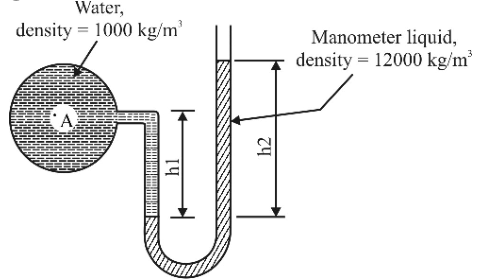
A U tube manometer is used to measure the gauge pressure of water (density = 1000 kg/m³). If the density of manometer liquid is 12000 kg/m³, h1 = 0.5m & h2 = 1.0m, gauge pressure at 'A' is
- A. 125 kPa
- B. 115 kPa
- C. 60 kPa
- D. 5 kPa
Answer: B. 115 kPa
Explanation: Balancing pressures at the interface: P_A + ρ₁gh₁ = P₀ + ρ₂gh₂. For gauge pressure, P₀=0. P_A = ρ₂gh₂ - ρ₁gh₁ = (12000*10*1.0) - (1000*10*0.5) = 120000 - 5000 = 115000 Pa = 115 kPa.
Question 61
Year: 2018 | Topic: Fluid Mechanics
Speed of an aeroplane is measured by
- A. pitot tube
- B. hot wire anemometer
- C. venturimeter
- D. rotameter
Answer: A. pitot tube
Explanation: Pitot tube is used to measure the velocity of airplanes and boats. Hot Wire Anemometer measures fluid velocity, Venturi meter measures flow rate, and Rotameter measures volumetric flow rate.
Question 62
Year: 2018 | Topic: Fluid Mechanics
Euler's dimensionless number relates the following
- A. inertial force and gravity
- B. viscous force and inertial force
- C. pressure force and inertial force
- D. viscous force and pressure force
Answer: C. pressure force and inertial force
Explanation: Euler Number (Eu) is defined as the ratio of Inertial Force to Pressure Force, i.e., $\sqrt{Fi / Fp}$.
Question 63
Year: 2018 | Topic: Fluid Mechanics
Speed of sound in water is equal to (K-bulk modulus, p-density)
- A. $\sqrt{K/p}$
- B. $\sqrt{K*p}$
- C. $\sqrt{p/K}$
- D. K/p
Answer: A. $\sqrt{K/p}$
Explanation: Speed of sound in water is C = $\sqrt{K/p}$, where K is Bulk modulus and p is Density.
Question 64
Year: 2018 | Topic: Fluid Mechanics
For an irrotational flow, d²(phi)/dx² + d²(phi)/dy² = 0 is the equation given by
- A. Cauchy-Riemann
- B. Reynolds
- C. Laplace
- D. Bernoulli
Answer: C. Laplace
Explanation: The expression d²(phi)/dx² + d²(phi)/dy² = 0 is known as the Laplace equation.
Question 65
Year: 2018 | Topic: Fluid Mechanics
The velocity of sound in a gaseous medium at a temperature of 400K is 400 ms^-1. If the temperature of the medium is increased to 600 K, the velocity of sound will be nearly
- A. 400 ms^-1
- B. 490 ms^-1
- C. 600 ms^-1
- D. None of there
Answer: B. 490 ms^-1
Explanation: Velocity of sound in a gaseous medium C = $\sqrt{gamma * R * T}$. Thus, C is proportional to $\sqrt{T}$. C2 = C1 * $\sqrt{T2/T1}$ = 400 * $\sqrt{600/400}$ = 489.89, which is approximately 490 m/s.
Question 66
Year: 2018 | Topic: Fluid Mechanics
Stress strain relation of the Newtonian fluid is
- A. parabolic
- B. linear
- C. hyperbolic
- D. inverse type
Answer: B. linear
Explanation: The stress-strain relation of a Newtonian fluid is linear, meaning the shear stress is directly proportional to the rate of shear strain.
Question 67
Year: 2018 | Topic: Fluid Machinery
In a centrifugal pump casing, the flow of water leaving the impeller is
- A. rectilinear flow
- B. free vortex motion
- C. radial flow
- D. forced vortex
Answer: B. free vortex motion
Explanation: Flow inside the impeller of centrifugal pump is forced vortex motion and the flow of water leaving the impeller is free vortex motion.
Question 68
Year: 2018 | Topic: Fluid Machinery
The degree of reaction in an axial flow compressor is defined as the ratio of static enthalpy rise in the
- A. rotor to static enthalpy rise in the stator
- B. stator to static enthalpy rise in the rotor
- C. rotor to static enthalpy rise in the stage
- D. stator to static enthalpy rise in the stage
Answer: C. rotor to static enthalpy rise in the stage
Explanation: The degree of reaction in an axial flow compressor is defined as the ratio of static enthalpy rise in the rotor to static enthalpy rise in the stage.
Question 69
Year: 2018 | Topic: Fluid Mechanics
If the stream function of two dimensional flow is psi = 5xy, then the velocity at a point (3, 4) is
- A. 25 m/s
- B. 20 m/s
- C. 7 m/s
- D. 5 m/s
Answer: A. 25 m/s
Explanation: Velocity in x-direction U = d(psi)/dy = 5x -> U(3,4) = 15 m/s. Velocity in y-direction V = -d(psi)/dx = -5y -> V(3,4) = -20 m/s. Resultant velocity V' = $\sqrt{U² + V²}$ = $\sqrt{15^2 + (-20}$^2) = 25 m/s.
Question 70
Year: 2018 | Topic: Fluid Mechanics
A glass tube of 8 mm diameter is immersed in water. Surface tension of water is 0.0075 kg m and rise of water in the tube due to capillary effect is
- A. 7.5 mm
- B. 3.75 mm
- C. 11.25 mm
- D. None of these
Answer: B. 3.75 mm
Explanation: Rise of water in the tube due to capillary effect h = (4 * sigma * cos(theta)) / (rho * g * d). For water in glass tube theta = 0, cos(0) = 1. h = (4 * 0.0075 * 1) / (1000 * 0.008) = 0.00375 m = 3.75 mm.
Question 71
Year: 2018 | Topic: Fluid Machinery
An impulse turbine produces 125 hp under a head of 25 meters. By what percentage should the speed be increased for a head of 100 metres
- A. 25%
- B. 50%
- C. 75%
- D. 100%
Answer: D. 100%
Explanation: Unit speed of turbine is N1/$\sqrt{H1}$ = N2/$\sqrt{H2}$. So, N1/$\sqrt{25}$ = N2/$\sqrt{100}$, meaning N2 = 2*N1. The speed should be increased by 100%.
Question 72
Year: 2018 | Topic: Fluid Machinery
The specific speed of a centrifugal pump, delivering 1000 litres of water per second against a head of 16 metre at 800 rpm
- A. 50 rpm
- B. 100 rpm
- C. 150 rpm
- D. 200 rpm
Answer: B. 100 rpm
Explanation: Specific speed of centrifugal pump Ns = N*$\sqrt{Q}$ / H^(3/4) = 800 * $\sqrt{1000 * 10^-3}$ / 16^(3/4) = 100 rpm.
Question 73
Year: 2018 | Topic: Fluid Mechanics
A pipe of 0.1 m² suddenly changes to 0.5 m² area. The quantity of water flowing in the pipe is 0.5 m³/s. Head loss due to sudden enlargement is nearly
- A. 0.025 m
- B. 0.05 m
- C. 0.8 m
- D. 1.2 m
Answer: C. 0.8 m
Explanation: V1 = Q/A1 = 0.5/0.1 = 5 m/s. V2 = Q/A2 = 0.5/0.5 = 1 m/s. Head loss due to sudden enlargement h = (V1 - V2)^2 / 2g = (5 - 1)^2 / 20 = 16 / 20 = 0.8 m.
Question 74
Year: 2018 | Topic: Fluid Machinery
Efficiency of a centrifugal pump is maximum when the blades are
- A. straight
- B. forward curved
- C. backward curved
- D. forward and backward curved
Answer: C. backward curved
Explanation: When the blades of a centrifugal pump are backward curved, the efficiency is maximum.
Question 75
Year: 2018 | Topic: Fluid Mechanics
The hydraulic diameter, Dh of a rectangular channel with sides 'a' and 'b' is,
- A. Dh = 2ab / (a+b)
- B. Dh = 4ab / (2a+b)
- C. Dh = 2ab / (2a+b)
- D. Dh = 4ab / (a+b)
Answer: A. Dh = 2ab / (a+b)
Explanation: Hydraulic diameter Dh = 4 * Area / Perimeter = 4(ab) / 2(a+b) = 2ab / (a+b).
Question 76
Year: 2024 | Topic: Fluid Mechanics
The velocity field of a certain two dimensional flow is given by V(x,y) = k(x i - y j) where k = 2/s and x and y are in meters. If the fluid density is 100 kg/m³ and pressure at origin is 10 kPa, what is the pressure at point (3,3)?
- A. 3.2 kPa
- B. 6.4 kPa
- C. 1.6 kPa
- D. None
Answer: B. 6.4 kPa
Explanation: The flow is steady and irrotational. By Bernoulli's equation, P1/rho + V1^2/2 = P2/rho + V2^2/2. At the origin (0,0), V1 = 0 and P1 = 10,000 Pa. At (3,3), velocity magnitude V2 = $\sqrt{(2*3}$^2 + (-2*3)^2) = $\sqrt{36 + 36}$ = $\sqrt{72}$ m/s. P2 / 100 + 72/2 = 10000 / 100. P2/100 + 36 = 100. P2 = 6400 Pa = 6.4 kPa.
Question 77
Year: 2024 | Topic: Fluid Mechanics
A spherical water drop of diameter 2 mm splits in to 8 small drops of equal size in air at temperature of 25 °C. The surface tension coefficient of water in air is 0.073 N/m and dynamic viscosity is 0.01 poise. The approximate work done in splitting up the drop is
- A. 0.29 x 10^-6 J
- B. 0.92 x 10^-6 J
- C. 0.86 x 10^-6 J
- D. 0.78 x 10^-6 J
Answer: B. 0.92 x 10^-6 J
Explanation: Initial volume = Final volume, so (4/3)*pi*R³ = 8 * (4/3)*pi*r³, which means r = R/2. The initial radius R = 1 mm. Change in surface area = Final Area - Initial Area = 8*(4*pi*r²) - 4*pi*R² = 8*4*pi*(R/2)^2 - 4*pi*R² = 4*pi*R². Work done = Surface tension * Change in area = 0.073 * 4 * pi * (10^-3)^2 = 0.917 x 10^-6 J, which is approximately 0.92 x 10^-6 J.
Question 78
Year: 2024 | Topic: Fluid Mechanics
Which is identified as the coefficient of momentum transport?
- A. Density
- B. Kinematic viscosity
- C. Dynamic viscosity
- D. Reynolds number
Answer: B. Kinematic viscosity
Explanation: Kinematic viscosity is also known as the momentum diffusivity or the coefficient of momentum transport, as it represents the ratio of dynamic viscosity to density.
Question 79
Year: 2024 | Topic: Fluid Mechanics
Which is the most economical depth of flow in an open rectangular channel?
- A. Depth of flow equals to the width of channel
- B. Depth of flow is double the width of channel
- C. Depth of flow is half of the width of channel
- D. Depth of flow is 1/3rd the width of channel
Answer: C. Depth of flow is half of the width of channel
Explanation: For a rectangular channel to be most economical (i.e., yielding maximum discharge for a given cross-sectional area), the hydraulic radius must be half the depth, which translates to the depth of flow being exactly half the width of the channel.
Question 80
Year: 2024 | Topic: Fluid Mechanics
Rapid and sharp changes in fluid properties in a very small region of gas flow is known as
- A. Cavitation
- B. Shock wave
- C. Sublimation
- D. Chocking
Answer: B. Shock wave
Explanation: A shock wave is a steep finite pressure wave where rapid and sharp changes in fluid properties (such as pressure, temperature, and density) occur in a supersonic gas flow.
Question 81
Year: 2024 | Topic: Fluid Mechanics
A cylindrical body of diameter 2 m and height 1.5 m having a mass of 2 tonnes and floats in sea water with its axis vertical. A lighting equipment is placed on the body such that the water level is at least 0.5 m below the top surface. What is the maximum mass of the electrical equipment that can be placed on the body. (The specific gravity of sea water may be taken as 1.02 and pi = 3.14)
- A. 252 kg
- B. 750 kg
- C. 1202 kg
- D. 275 kg
Answer: C. 1202 kg
Explanation: Maximum depth of immersion = 1.5 - 0.5 = 1.0 m. Maximum displaced volume V = (pi/4) * D² * depth = (3.14/4) * (2^2) * 1.0 = 3.14 m³. Maximum buoyant force = V * rho_water * g = 3.14 * 1020 * g = 3202.8 * g Newtons. This means the cylinder can support a total mass of 3202.8 kg. Subtracting the cylinder's own mass (2000 kg), the maximum mass of the equipment is 3202.8 - 2000 = 1202.8 kg.
Question 82
Year: 2024 | Topic: Fluid Mechanics
Examine the following statements: (i) Euler's equation is applicable to inviscid liquid (ii) Bernoulli's equation applicable to steady state (iii) Viscous forces are not considered in Navier Stokes equation (iv) Surface tension and compressibility forces are considered in Navier Stokes equation
- A. Statements (i) and (ii) are not correct
- B. Statements (iii) and (iv) are correct
- C. Statements (i), (ii) and (iii) are correct
- D. All the statements are correct
Explanation: Statement (i) is correct: Euler's equation assumes zero viscosity. Statement (ii) is correct: Bernoulli's equation is derived for steady flow. Statement (iii) is incorrect: Navier-Stokes equations explicitly consider viscous forces. Statement (iv) is generally incorrect as standard NS equations focus on gravity, pressure, and viscous forces, not surface tension. None of the provided options accurately reflect that ONLY (i) and (ii) are correct.
Question 83
Year: 2025 | Topic: Fluid Mechanics
A hydraulic press has a ram of 30 cm diameter and a plunger of 4.5 cm diameter. Find the weight lifted by hydraulic press when force applied at plunger is 500 N.
- A. 3.33 KN
- B. 22.22 N
- C. 3.33 N
- D. 22.22 KN
Answer: D. 22.22 KN
Explanation: According to Pascal's law, pressure is transmitted equally in all directions. P_plunger = P_ram, so F / d² = W / D². The weight lifted W = F * (D/d)^2 = 500 * (30 / 4.5)^2 = 500 * (20/3)^2 = 500 * (400 / 9) = 22222.22 N = 22.22 kN.
Question 84
Year: 2025 | Topic: Fluid Mechanics
90% of an iceberg volume is below the surface of sea water and only 10% is visible above surface. Find the density of iceberg, if density of sea-water is 1025 kg/m³.
- A. 1002.5 kg/m³
- B. 995.5 kg/m³
- C. 922.5 kg/m³
- D. 1025 kg/m³
Answer: C. 922.5 kg/m³
Explanation: For a floating body, the buoyancy force equals the weight of the body. Weight of iceberg = Weight of displaced fluid. rho_ice * V_total * g = rho_sea * V_submerged * g. Since 90% is submerged, V_submerged = 0.9 * V_total. Therefore, rho_ice = 0.9 * 1025 = 922.5 kg/m³.
Question 85
Year: 2025 | Topic: Fluid Mechanics
The equation of a velocity distribution over a plate is given by u = 2y - y² where u is the velocity in m/s at a point y meter from the plate measured perpendicularly. Assuming mu = 8.60 poise, the shear stress at a point 15 cm from the boundary is
- A. 14.6 Pa
- B. 0.24 Pa
- C. 2.4 Pa
- D. 1.46 Pa
Answer: D. 1.46 Pa
Explanation: Viscosity mu = 8.60 poise = 0.86 N.s/m² (Pa.s). The velocity gradient du/dy = d(2y - y²)/dy = 2 - 2y. At y = 15 cm = 0.15 m, du/dy = 2 - 2(0.15) = 1.7 s^-1. Newton's law of viscosity states tau = mu * (du/dy) = 0.86 * 1.7 = 1.462 Pa.
Question 86
Year: 2025 | Topic: Fluid Mechanics
A thin plane Lamina, of Area A and weight W, slides down a fixed plane Inclined at an angle alpha and maintains a uniform gap epsilon from the surface of the plane, the gap being filled with oil of constant viscosity mu. The terminal velocity of the plane is:
- A. W epsilon cos alpha / mu A
- B. W epsilon sin alpha / mu A
- C. mu epsilon cos alpha / AW
- D. mu epsilon sin alpha / AW
Answer: B. W epsilon sin alpha / mu A
Explanation: At terminal velocity, the downward component of weight equals the viscous drag force. Weight component = W * sin(alpha). Viscous force = tau * A = mu * (V / epsilon) * A. Equating them: W * sin(alpha) = mu * V * A / epsilon. Solving for V gives V = W * epsilon * sin(alpha) / (mu * A).
Question 87
Year: 2025 | Topic: Fluid Mechanics
A glass tube with a 90 deg bend is open at both the ends. It is inserted into a stream of oil, with specific gravity 0.9, so that one opening is directed upstream and the other is directed upward. Oil inside the tube is 50 mm higher than the surface of flowing oil. The velocity measured by the tube is, nearly:
- A. 1.99 m/s
- B. 0.99 m/s
- C. 2.99 m/s
- D. 3 m/s
Answer: B. 0.99 m/s
Explanation: This device acts as a Pitot tube. The 50 mm height difference represents the dynamic head (stagnation head minus static head). h = 50 mm = 0.05 m. Using Torricelli's theorem: V = $\sqrt{2 * g * h}$ = $\sqrt{2 * 9.81 * 0.05}$ = $\sqrt{0.981}$ = 0.9904 m/s.
Question 88
Year: 2025 | Topic: Fluid Mechanics
If the surface tension of water-air interface is 0.073 N/m, the gauge pressure inside a rain drop of 1.6 mm diameter is
- A. 182 Pa
- B. 0.182 Pa
- C. 91 Pa
- D. 0.091 Pa
Answer: A. 182 Pa
Explanation: The pressure difference inside a liquid drop is given by Delta P = 4 * sigma / d, where sigma is the surface tension and d is the diameter. Delta P = 4 * 0.073 / (1.6 * 10^-3) = 0.292 / 0.0016 = 182.5 Pa.
Question 89
Year: 2025 | Topic: Fluid Mechanics
An air flow with Mach number 2.0 passes through a normal shock wave. If the ratio of specific heats of air is 1.4, find the shock strength.
Answer: B. 3.5
Explanation: Shock strength is defined as (P_2 - P_1) / P_1 = (P_2 / P_1) - 1. The pressure ratio across a normal shock is P_2 / P_1 = 1 + [2*gamma / (gamma+1)] * (M_1^2 - 1). Substituting values: P_2 / P_1 = 1 + [2.8 / 2.4] * (2^2 - 1) = 1 + (7/6) * 3 = 1 + 3.5 = 4.5. Shock strength = 4.5 - 1 = 3.5.
Question 90
Year: 2025 | Topic: Fluid Mechanics
In an isentropic flow with a stagnation pressure of 6 MPa, find the static pressure, at the point where flow is sonic. (Assume gamma = 1.4; consider 1.2^3.5 ~ 1.892)
- A. 2.17 MPa
- B. 3.17 MPa
- C. 1.58 MPa
- D. 2.58 MPa
Answer: B. 3.17 MPa
Explanation: For an isentropic flow, the relationship between stagnation pressure P_0 and static pressure P is P_0 / P = (1 + ((gamma-1)/2)*M²)^(gamma / (gamma-1)). At the sonic point, M = 1. Therefore, P_0 / P* = (1 + (0.4/2))^(1.4/0.4) = (1.2)^3.5 = 1.892. Static pressure P* = P_0 / 1.892 = 6 / 1.892 = 3.171 MPa.
Question 91
Year: 2025 | Topic: Fluid Mechanics
A sphere is moving in water with a velocity of 1.6 m/s. Another sphere of twice the diameter is placed in a wind tunnel and tested with air which is 750 times less dense and 60 times less viscous than water. The velocity of air that will give dynamically similar condition is
- A. 5 m/s
- B. 10 m/s
- C. 20 m/s
- D. 40 m/s
Answer: B. 10 m/s
Explanation: Dynamic similarity for completely submerged flows requires equating the Reynolds numbers: $(\rho_w V_w D_w) / \mu_w = (\rho_a V_a D_a) / \mu_a$. Rearranging to solve for the velocity of air: $V_a = V_w \times (D_w / D_a) \times (\rho_w / \rho_a) \times (\mu_a / \mu_w)$. Substituting the given ratios: $V_a = 1.6 \times (1/2) \times (750) \times (1/60) = 0.8 \times 12.5 = 10$ m/s.
Question 92
Year: 2025 | Topic: Fluid Mechanics
For solid sphere falling vertically downwards under gravity in a viscous fluid, the terminal velocity V varies with diameter D of the sphere as:
- A. V ∝ D
- B. V ∝ D²
- C. V ∝ D³
- D. V ∝ 1/D
Answer: B. V ∝ D²
Explanation: According to Stokes' Law, the terminal velocity of a spherical particle falling through a viscous fluid is given by V = (D² * (ρ_s - ρ_f) * g) / (18 * μ). Therefore, the terminal velocity V is directly proportional to the square of the diameter (D²).
Question 93
Year: 2025 | Topic: Fluid Mechanics
For two-dimensional, steady, incompressible and irrotational flow, a stream function is given by (x² - y²). The potential function of the flow will be:
- A. 2xy + f(x)
- B. 2xy + constant
- C. 2(x² - y²)
- D. 2xy + f(y)
Answer: B. 2xy + constant
Explanation: Given stream function ψ = x² - y². The velocity components are u = ∂ψ/∂y = -2y and v = -∂ψ/∂x = -2x. The potential function φ must satisfy u = -∂φ/∂x and v = -∂φ/∂y (or vice versa depending on convention). Using u = ∂φ/∂x = -2y, integrating with respect to x gives φ = -2xy + f(y). Also, v = ∂φ/∂y = -2x. Differentiating φ with respect to y gives -2x + f'(y) = -2x, which means f'(y) = 0 and f(y) is a constant. So φ = -2xy + constant (or 2xy + constant depending on the exact sign convention). Option (b) represents the general correct form.
Question 94
Year: 2025 | Topic: Fluid Mechanics
Consider the following statement pertaining to boundary layer on a flat plate:
1. The thickness of laminar boundary layer at a distance x from the leading edge varies as x^(1/2).
2. The thickness of turbulent boundary layer at a distance x from the leading edge varies as x^(4/5).
3. The boundary layer is laminar when Reynolds number is less than 5 x 10^5.
Which of the above statements are correct?
- A. 1, 2 and 3
- B. 1 and 2 only
- C. 1 and 3 only
- D. 2 and 3 only
Answer: A. 1, 2 and 3
Explanation: All statements are correct. The laminar boundary layer thickness is proportional to the square root of x (x^(1/2)). The turbulent boundary layer thickness is proportional to x^(4/5). Furthermore, for flow over a flat plate, the critical Reynolds number for the transition from laminar to turbulent boundary layer flow is typically assumed to be around 5 × 10^5.
Question 95
Year: 2025 | Topic: Fluid Mechanics
A bourdon gauge connected to a closed tank indicates 40 kPa at a place where the atmospheric pressure is 95.48 kPa. If the tank is carried to a higher elevation where the atmospheric pressure is 90 kPa, the reading of the gauge will be
- A. 35 kPa
- B. 60.37 kPa
- C. 45.48 kPa
- D. 25.37 kPa
Answer: C. 45.48 kPa
Explanation: Because the tank is closed, the absolute pressure inside it remains constant regardless of elevation. Absolute pressure = Gauge pressure + Atmospheric pressure. Initially, P_abs = 40 kPa + 95.48 kPa = 135.48 kPa. At the new elevation, the absolute pressure remains 135.48 kPa, but atmospheric pressure drops to 90 kPa. The new gauge reading = P_abs - P_atm_new = 135.48 - 90 = 45.48 kPa.