Engineering Mechanics - ISRO Mechanical & Aerospace Subject-Wise PYQ Practice
Practice topic-wise Engineering Mechanics previous year questions for ISRO Mechanical & Aerospace with instant step-by-step solutions and formula breakdowns.
All ISRO Mechanical & Aerospace papers
47 questions.
Question 1
Year: 2008 | Topic: Basic Electrical Engineering
For traction applications, the type of motor best suited is
- A. Induction motor
- B. Synchronous motor
- C. DC shunt motor
- D. DC series motor
Answer: D. DC series motor
Explanation: DC series motors have a high initial torque, making them best suited for traction applications.
Question 2
Year: 2008 | Topic: Engineering Mechanics
A heavy block of mass m is slowly placed on a conveyer belt moving with speed v. If coefficient of friction between block and the belt is mu, the block will slide on the belt through distance
- A. v / (mu * g)
- B. v² / $\sqrt{mu * g}$
- C. (v / (mu * g))^2
- D. v² / (2 * mu * g)
Answer: D. v² / (2 * mu * g)
Explanation: Mass of block = m, speed = v. Retardation due to friction = -mu * g. Using v² - u² = 2as, we have v² - 0 = 2 * mu * g * s, which gives s = v² / (2 * mu * g).
Question 3
Year: 2008 | Topic: Engineering Mechanics
A car moving with speed u can be stopped in minimum distance x when brakes are applied. If the speed becomes n times, the minimum distance over which the car can be stopped would take the value
- A. x / n
- B. n * x
- C. x / n²
- D. n² * x
Answer: D. n² * x
Explanation: Using v² - u² = 2as, stopping distance x = u² / 2a. If speed becomes nu, the new distance s = (nu)^2 / 2a = n² * (u² / 2a) = n² * x.
Question 4
Year: 2008 | Topic: Engineering Mechanics
Speed of particle executing simple harmonic motion with amplitude 'a' is half of the maximum speed. At that instant, displacement of the particle is
- A. a/2
- B. ($\sqrt{3}$/2) * a
- C. (2a)/$\sqrt{3}$
- D. 3*$\sqrt{2}$ * a
Answer: B. ($\sqrt{3}$/2) * a
Explanation: Displacement x = a*sin(omega*t). Velocity v = dx/dt = a*omega*cos(omega*t). Given v = a*omega/2, we have a*omega*cos(omega*t) = a*omega/2, meaning cos(omega*t) = 1/2. Thus, omega*t = pi/3. At this instant, displacement x = a*sin(pi/3) = a*$\sqrt{3}$/2.
Question 5
Year: 2008 | Topic: Engineering Mechanics
Two blocks with masses M and m are in contact with each other and are resting on a horizontal frictionless floor. When horizontal force F is applied to the heavier, the blocks accelerate to the right. The force between the two blocks are
- A. (M+m)F / m
- B. MF / m
- C. mF / M
- D. mF / (M+m)
Answer: D. mF / (M+m)
Explanation: Acceleration of the system a = F / (M+m). From the FBD of block m, the force exerted by M on m is F_btw = m*a = m * F / (M+m).
Question 6
Year: 2008 | Topic: Engineering Mechanics
A stone of mass m at the end of a string of length l is whirled in a vertical circle at a constant speed. The tension in the string will be maximum when the stone is
- A. At the top of the circle
- B. Half-way down from the top
- C. Quarter-way down from the top
- D. At the bottom of the circle
Answer: D. At the bottom of the circle
Explanation: At the bottom, the tension in the string is maximum because the weight of the body and the centrifugal force both act in the downward (outward from center) direction. T = mg + mv²/r.
Question 7
Year: 2008 | Topic: Engineering Physics
Ratio of the radii of the planets P1 and P2 is k and ratio of the acceleration due to gravity on them is s. Ratio of escape velocities from them will be
- A. ks
- B. $\sqrt{ks}$
- C. $\sqrt{k/s}$
- D. $\sqrt{s/k}$
Answer: B. $\sqrt{ks}$
Explanation: Escape velocity V_esc = $\sqrt{2*g*R}$. The ratio of escape velocities V1/V2 = $\sqrt{(g1*R1}$ / (g2*R2)) = $\sqrt{s*k}$ or $\sqrt{ks}$.
Question 8
Year: 2014 | Topic: Engineering Mechanics
For two bodies having direct impact, co-efficient of restitution is given by
- A. Velocity of separation / Velocity of approach
- B. Velocity of separation / Velocity of approach
- C. Initial velocity of the body / Final velocity of the body
- D. None of the above
Answer: B. Velocity of separation / Velocity of approach
Explanation: The coefficient of restitution (e) is defined as the ratio of the relative velocity of separation after collision to the relative velocity of approach before collision. Mathematically, it is given by e = (v2 - v1) / (u1 - u2), where u1 and u2 are the initial velocities and v1 and v2 are the final velocities of the colliding bodies. Note: Options (a) and (b) appear identical in the source text, but the correct mathematical definition remains the ratio of separation velocity to approach velocity.
Question 9
Year: 2014 | Topic: Engineering Mechanics
A perfect frame is that which satisfies the equation (Assume n = No of members and j = No. of joints)
- A. n = 3j - 2
- B. n > 3(j - 1)
- C. n < 3(j - 1)
- D. n = (2j - 3)
Answer: D. n = (2j - 3)
Explanation: For a 2D pin-jointed truss or frame with 'j' joints and 'n' members, it is classified as a perfect frame if it exactly satisfies the condition n = 2j - 3. If n < 2j - 3, the frame is deficient (imperfect or unstable). If n > 2j - 3, the frame is redundant (statically indeterminate).
Question 10
Year: 2014 | Topic: Engineering Mechanics
Tension in the cable supporting a lift of weight 'W' and having an acceleration of 'a' while going upward is (g is acceleration due to gravity)
- A. W(1 + a/g)
- B. W(1 - a/g)
- C. W(2 + a/g)
- D. W(1 + 2a/g)
Answer: A. W(1 + a/g)
Explanation: Applying Newton's second law for a lift moving upwards with an acceleration 'a', the net upward force is equal to mass times acceleration. Therefore, T - W = ma. Since mass m = W/g, we can substitute this to get T = W + (W/g)a. Factoring out W gives the tension T = W(1 + a/g).
Question 11
Year: 2014 | Topic: Engineering Mechanics
The difference in the Potential energies between two arbitrary positions downward displacement $X_{1}$ and $X_{2}$ ($X_{2}>X_{1}$).
- A. $\frac{1}{2}k[x_{1}-x_{2}]^{2}$
- B. $\frac{1}{2}k[(x_{2})^{2}-(x_{1})^{2}]$
- C. $\frac{1}{2}k[(x_{1})-(x_{2})]$
- D. $\frac{1}{2}k[x_{1}-x_{2}]$
Answer: B. $\frac{1}{2}k[(x_{2})^{2}-(x_{1})^{2}]$
Explanation: The potential energy of a spring at a downward displacement $x_{1}$ is $P_{1} = \frac{1}{2}kx_{1}^{2}$. The potential energy at displacement $x_{2}$ is $P_{2} = \frac{1}{2}kx_{2}^{2}$. Since $x_{2} > x_{1}$, $P_{2} > P_{1}$. The difference in potential energies is $P_{2} - P_{1} = \frac{1}{2}kx_{2}^{2} - \frac{1}{2}kx_{1}^{2} = \frac{1}{2}k[(x_{2})^{2} - (x_{1})^{2}]$.
Question 12
Year: 2015 | Topic: Engineering Mechanics
A shell is fired from cannon with a speed 'v' at an angle $\theta$ with the horizontal direction as shown in the figure. At the highest point in its path, it explodes into two pieces of equal mass. One of the pieces retraces its path to the cannon. The speed of other piece immediately after the explosion is
- A. $3v\cos\theta$
- B. $2v\cos\theta$
- C. $\frac{3}{2}v\cos\theta$
- D. $\sqrt{\frac{3}{2}}v\cos\theta$
Answer: A. $3v\cos\theta$
Explanation: At the highest point in projectile motion, the vertical velocity component is zero ($v_{y}=0$). The initial momentum of the shell of mass m is $P_{initial} = m(v\cos\theta\hat{i} + v\sin\theta\hat{j})$. Upon explosion, it splits into two masses of $m/2$. One piece retraces its path, meaning its velocity is opposite to the initial velocity, giving it a momentum of $-\frac{m}{2}v\cos\theta\hat{i}$. Applying the conservation of momentum: $m(v\cos\theta\hat{i}) = -\frac{m}{2}v\cos\theta\hat{i} + \frac{m}{2}v'\hat{i}$. Solving for $v'$ gives $\frac{3m}{2}v\cos\theta = \frac{m}{2}v'$, resulting in $v' = 3v\cos\theta$.
Question 13
Year: 2015 | Topic: Engineering Mechanics
A mass of 35 kg is suspended from a weightless bar AB which is supported by a cable CB and a pin at A as shown in the figure. The pin reactions at A on the bar AB are
- A. $R_{x}=343.4\text{ N}, R_{y}=755.4\text{ N}$
- B. $R_{x}=343.4\text{ N}, R_{y}=0$
- C. $R_{x}=755.4\text{ N}, R_{y}=343.4\text{ N}$
- D. $R_{x}=755.4\text{ N}, R_{y}=0$
Answer: D. $R_{x}=755.4\text{ N}, R_{y}=0$
Explanation: To find the pin reactions at A, we consider the equilibrium conditions and take moments about point C. The distance from the pin A to C is 125 mm, and the horizontal distance to the suspended mass is 275 mm. Summing the moments about C to zero gives: $R_{x} \times 125 = mg \times 275$. Substituting $m = 35\text{ kg}$ and $g = 9.81\text{ m/s}^{2}$, we get $R_{x} = \frac{35 \times 9.81 \times 275}{125} = 755.4\text{ N}$. The vertical reaction $R_{y}$ at the pin is 0 N because the vertical tension component in the cable perfectly balances the downward weight.
Question 14
Year: 2015 | Topic: Engineering Mechanics
A simple structure ABCDE is supported on a hinge at A and on rollers at B while it carries a horizontal force of 1000 kN at E as shown in the figure. Determine the force in member AC using the method of joints.
- A. 1500 kN
- B. 1400 kN
- C. 1314 kN
- D. 1414 kN
Answer: D. 1414 kN
Explanation: First, determine the reactions at the supports. Taking moments about hinge A: $V_{B} \times 1 = 1000 \times 1.87$, which yields $V_{B} = 1870\text{ kN}$. Resolving vertical forces gives $V_{A} = -1870\text{ kN}$. For the roller support at B, the horizontal reaction is zero ($H_{B}=0$), so the force in member AB is $F_{AB} = 0$. Considering joint A and resolving forces vertically: $F_{AC}\sin45^{\circ} + F_{AD} = 1870$. Resolving forces horizontally at joint A: $F_{AB} + F_{AC}\cos45^{\circ} = 1000$. Since $F_{AB} = 0$, we have $F_{AC}\cos45^{\circ} = 1000$. Solving for $F_{AC}$ provides $F_{AC} = \frac{1000}{\cos45^{\circ}} = 1414\text{ kN}$.
Question 15
Year: 2015 | Topic: Engineering Mechanics
A moving fluid mass may be brought to a static equilibrium position by applying an imaginary inertia force of the same magnitude as that of the accelerating force but in the opposite direction. This is called
- A. Pascal's law
- B. Archimedes principle
- C. D-Alembert's principle
- D. None of the above
Answer: C. D-Alembert's principle
Explanation: D-Alembert's Principle states that a body is in dynamic equilibrium under the action of an effective force and an imaginary inertia force. The purpose of this principle is to convert a complex dynamic problem into an equivalent static problem. The inertia force always acts opposite to the direction of acceleration.
Question 16
Year: 2015 | Topic: Engineering Mechanics
A railway wagon A of mass 10000 kg collides with another identical wagon B as shown in the figure. If A is moving at 5 m/s and B is at rest at the time of collision, the maximum compression in the spring S with a spring constant of 2 MN/m will be
- A. 20 cm
- B. 30 cm
- C. 35 cm
- D. 45 cm
Answer: C. 35 cm
Explanation: For maximum compression, the calculation implies an inelastic collision where kinetic energy is converted into spring potential energy. Using the simplified energy equation provided: $\frac{1}{2} m_A v_A^2 = \frac{1}{2} kx²$. Substituting the values, we get $10000 \times 5^2 = 2 \times 10^6 \times x²$, which gives $x² = \frac{250000}{2000000} = 0.125$. Solving for $x$ yields $35.36$ cm, which is approximately 35 cm.
Question 17
Year: 2016 | Topic: Engineering Mechanics
An elevator has a mass of 5000 kg. When the tension in the supporting cable is 60 kN, the acceleration of the elevator is nearly
- A. 8 m/s²
- B. 12 m/s²
- C. -2 m/s²
- D. 2 m/s²
Answer: D. 2 m/s²
Explanation: Applying Newton's second law and drawing a free body diagram for the elevator: Net Force = mass * acceleration. The upward force is the cable tension (T = 60000 N) and the downward force is the weight (mg = 5000 kg * 9.81 m/s²). The equation is T - mg = ma. Substituting the values gives 60000 - 49050 = 5000 * a. Solving for acceleration yields 10950 = 5000 * a, resulting in a = 2.19 m/s², which is approximately 2 m/s².
Question 18
Year: 2016 | Topic: Engineering Mechanics
In the figure shown, the minimum ratio of mu1/mu2 so that the masses move together with the application of force F is (Assume block A has 5 kg on top of block B with 10 kg, pulling A with force F)
Answer: D. 3
Explanation: For the blocks to move together as a single unit, the friction force applied to the top block A by the applied force F must be sufficient to overcome the static friction between block B and the ground. The maximum friction force between block A (5 kg) and B is F_fA = mu1 * (5 * g). The friction force between block B (carrying A, total 15 kg) and the ground is F_fB = mu2 * (15 * g). Equating the two friction forces gives mu1 * 5 * g = mu2 * 15 * g. Solving for the ratio yields mu1 / mu2 = 15 / 5 = 3.
Question 19
Year: 2016 | Topic: Engineering Mechanics
A thin wire of length L and uniform linear mass density rho is bent into a circular loop with centre O as shown in figure. The moment of inertia of the loop about the axis XX' (tangential to the loop) is
- A. rho L³ / 16 pi²
- B. rho L³ / 8 pi²
- C. 5 rho L³ / 16 pi²
- D. 3 rho L³ / 8 pi²
Answer: D. 3 rho L³ / 8 pi²
Explanation: The length of the wire forms the circumference, so L = 2 * pi * R, giving the radius R = L / (2 * pi). The total mass is M = rho * L. The moment of inertia for a ring about a central diametrical axis is I_c = (M * R²) / 2. By applying the parallel axis theorem to find the moment of inertia about the tangential axis XX', we get I_XX = I_c + M * R² = (3/2) * M * R². Substituting M and R into this formula gives I_XX = (3/2) * (rho * L) * (L / (2 * pi))^2 = (3 * rho * L³) / (8 * pi²).
Question 20
Year: 2016 | Topic: Engineering Mechanics
A 10 kg mass is hung from 2 light, inextensible strings as shown. The tension in the horizontal string is nearly
- A. 49 N
- B. 57 N
- C. 100 N
- D. 0 N
Answer: B. 57 N
Explanation: Based on the free body diagram, the system is in static equilibrium. The angled string T1 has a vertical component that balances the weight, so T1 * sin(60°) = m * g. This evaluates to T1 * ($\sqrt{3}$/2) = 10 * 9.81, leading to T1 = 196.2 / $\sqrt{3}$. The horizontal string T2 balances the horizontal component of T1, yielding T2 = T1 * cos(60°). Substituting T1 into this equation provides T2 = (196.2 / $\sqrt{3}$) * 0.5 = 98.1 / $\sqrt{3}$, which calculates to approximately 56.63 N, closest to 57 N.
Question 21
Year: 2016 | Topic: Engineering Mechanics
A boat which has a speed of 5 km/h in still water crosses a river of width 1 km along the shortest path in 15 min. The velocity of the river in km/h is
- A. 3
- B. 1
- C. 4
- D. $\sqrt{41}$
Answer: A. 3
Explanation: To cross along the shortest path (straight across), the boat aims upstream at an angle $\theta$. The time taken is $15 \text{ min} = 0.25 \text{ hr}$. The effective velocity across the river is $V_{across} = \frac{\text{Distance}}{\text{Time}} = \frac{1}{0.25} = 4 \text{ km/h}$. This velocity is the component of the boat's speed perpendicular to the river flow, so $5 \cos\theta = 4$, yielding $\cos\theta = \frac{4}{5}$ and $\sin\theta = \frac{3}{5}$. The river velocity perfectly counteracts the horizontal component of the boat's velocity, so $V_{river} = 5 \sin\theta = 5 \times \frac{3}{5} = 3 \text{ km/h}$.
Question 22
Year: 2016 | Topic: Engineering Mechanics
In 1st, a particle goes from point A to point B, moving in a semicircle (as shown in figure). The magnitude of the average velocity is
- A. 3.14 m/s
- B. 1 m/s
- C. 2 m/s
- D. Zero
Answer: C. 2 m/s
Explanation: Average velocity is calculated as the total displacement divided by the total time. If the particle moves in a semicircle of radius 1 m, the total displacement is the straight-line distance from point A to point B, which corresponds to the diameter, $2 \times 1m = 2m$. Assuming a unit time interval of 1 second based on the problem's derived context, $V_{avg} = \frac{2}{1} = 2 \text{ m/s}$.
Question 23
Year: 2016 | Topic: Engineering Mechanics
A block is made to slide down an inclined plane ($30^{\circ}$ with horizontal) which is smooth. It starts sliding from rest and takes a time 't' to reach the bottom of the plane. An identical body is freely dropped from the same point. The time the body takes to reach the bottom is
Answer: B. t/2
Explanation: For a block sliding down a smooth incline from height $h$, the distance traveled along the incline is $S = \frac{h}{\sin 30^{\circ}} = 2h$. The acceleration is $a = g \sin 30^{\circ} = \frac{g}{2}$. Using the kinematic equation $S = \frac{1}{2} a t_1^2$, we have $2h = \frac{1}{2} \left(\frac{g}{2}\right) t_1^2$, which gives $t_1 = \sqrt{\frac{8h}{g}} = 2\sqrt{\frac{2h}{g}}$. For a freely falling body dropped from height $h$, $h = \frac{1}{2} g t_2^2$, meaning $t_2 = \sqrt{\frac{2h}{g}}$. Therefore, comparing the two, $t_2 = \frac{t_1}{2}$.
Question 24
Year: 2016 | Topic: Engineering Mechanics
Two equal forces are acting at a point with an angle of 60° between them. If the resultant force is equal to 60√3 what is the magnitude of each force?
Answer: D. 60
Explanation: Let the two equal forces be $F_1 = F_2 = F$. Using the parallelogram law of forces, the resultant $R = \sqrt{F_1^2 + F_2^2 + 2F_1F_2 \cos(\theta)}$. Given $R = 60\sqrt{3}$ and $\theta = 60^{\circ}$, we have $60\sqrt{3} = \sqrt{F² + F² + 2F^2 \cos(60^{\circ})}$. Since $\cos(60^{\circ}) = 0.5$, this simplifies to $60\sqrt{3} = \sqrt{2F^2 + F²} = \sqrt{3F^2} = F\sqrt{3}$. Thus, $F = 60$.
Question 25
Year: 2016 | Topic: Engineering Mechanics
A two member truss ABC is configured as shown in figure. The force in the member AB is
- A. 15 kN
- B. 30 kN
- C. 20 kN
- D. 5 kN
Answer: C. 20 kN
Explanation: From the truss geometry, member AB is horizontal (length 1m) and member AC acts as a diagonal. The height at support A and C is 0.5m. Let $\theta$ be the angle of member BC with the horizontal; $\tan(\theta) = 0.5 / 1 = 0.5$, which means $\theta = 26.56^{\circ}$. At joint B, balancing vertical forces gives $F_{BC} \sin(26.56^{\circ}) + 10 = 0$, so $F_{BC} = -10 / 0.447 = 22.37$ kN (Compression). Balancing horizontal forces gives $F_{AB} + F_{BC} \cos(26.56^{\circ}) = 0$. Substituting $F_{BC}$, $F_{AB} - 22.37 \times 0.894 = 0$, leading to $F_{AB} \approx 20$ kN (Tension).
Question 26
Year: 2016 | Topic: Engineering Mechanics
Four forces of magnitudes 20 N, 40N, 60 N and 80 N are acting respectively along the four sides of a square ABCD as shown in figure. The magnitude of resultant is
- A. 40√2 N
- B. 50√2 N
- C. 45√2 N
- D. 60√2 N
Answer: A. 40√2 N
Explanation: Summing the forces in the horizontal direction yields net horizontal force = -60 N + 20 N = -40 N. Summing the forces in the vertical direction yields net vertical force = 40 N - 80 N = -40 N. The magnitude of the resultant force 'F' is calculated using the Pythagorean theorem: F = $\sqrt{(-40}$^2 + (-40)^2) = 40√2 N.
Question 27
Year: 2017 | Topic: Engineering Mechanics
The force in member BC of steel truss structure shown in figure below is (Cross section of each member is A, Length of each member is 'l')
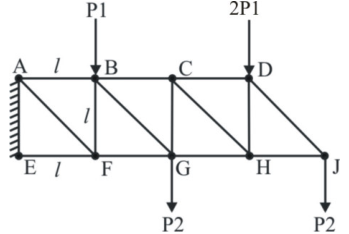
- A. P₁ + 2P₂
- B. 2P₁ + P₂
- C. 2×(P₁ + P₂)
- D. (P₁ + P₂)/2
Answer: C. 2×(P₁ + P₂)
Explanation: By taking moments about point G for the right-hand side of the section, F_BC × l = 2P₁ × l + P₂ × 2l, which simplifies to F_BC = 2P₁ + 2P₂ = 2(P₁ + P₂).
Question 28
Year: 2017 | Topic: Engineering Mechanics
The bar AB weighs 10 kg per meter and is supported by cable AC and a pin at B. Reaction at B is (take g = 10 m/s²)
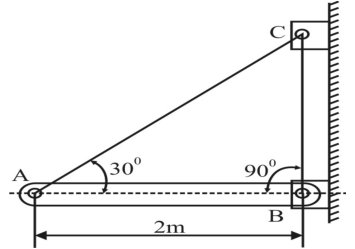
- A. 200 N, vertical
- B. 200 N, at 30° to horizontal
- C. 100 N vertical
- D. 100 N at 60° to horizontal
Answer: B. 200 N, at 30° to horizontal
Explanation: The total weight of the rod is 10 kg/m * 2m * 10 m/s² = 200 N acting at the center. Taking moments about B, Tsin(30) * 2 - 200 * 1 = 0, so T = 200 N. Summing forces, R_BV = 100 N and R_BH = 173.2 N. The resultant reaction is 200 N at 30° to the horizontal.
Question 29
Year: 2017 | Topic: Engineering Mechanics
A point moves according to the relation x = 8t² cos(ωt), y = -4t³ sin(ωt), where x and y are in meters, and t in seconds. If angular velocity ω = 8π rad/sec, the velocity vector of the point at t = 0.5 sec is given by
- A. 8 + j4π
- B. 6 + j20π
- C. 8 - j4π
- D. -20π – j6
Answer: C. 8 - j4π
Explanation: Differentiating x and y with respect to t gives velocity components u and v. At t=0.5s, ωt = 4π. Since sin(4π)=0 and cos(4π)=1, the velocity vector V = [16t cos(ωt) - 8t²ω sin(ωt)]i + [-12t² sin(ωt) - 4t³ω cos(ωt)]j simplifies to V = (16*0.5*1 - 0)i + (0 - 4*(0.5)³*8π*1)j = 8i - 4πj.
Question 30
Year: 2017 | Topic: Engineering Mechanics
Which of the following is NOT true?
- A. For direct impact of two bodies, coefficient of restitution is the ratio of relative velocity of approach to their relative velocity of separation
- B. Conservation of angular momentum implies that total angular momentum remains constant unless acted on by an external torque
- C. Conservation of linear momentum implies that the sum of external forces in that direction is zero
- D. The coefficient of friction is independent of area of contact
Answer: A. For direct impact of two bodies, coefficient of restitution is the ratio of relative velocity of approach to their relative velocity of separation
Explanation: The coefficient of restitution is the ratio of the relative velocity of separation to the relative velocity of approach, not the other way around.
Question 31
Year: 2017 | Topic: Engineering Mechanics
A block (4x3 m size) of 20 kg mass rests on a flat horizontal surface. If the coefficient of friction is 1/4, the force 'F' which will cause the block to move is approximately
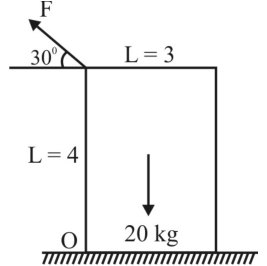
- A. 20 kgf
- B. 10 kgf
- C. 5 kgf
- D. 8.7 kgf
Answer: C. 5 kgf
Explanation: The normal force N = mg - Fsin(30). Friction force f = μN = 0.25(200 - 0.5F). For motion, Fcos(30) > f. So, 0.866F > 50 - 0.125F. This gives 0.991F > 50, so F > 50.45 N, which is approximately 5.04 kgf.
Question 32
Year: 2017 | Topic: Engineering Mechanics
The pulley system has a mass of 1.5 kg and radius of gyration of 0.2 m. The angular acceleration of the pulleys, when the suspended masses are released is
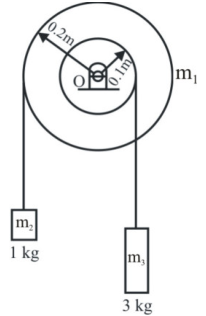
- A. 5 rad/sec²
- B. 10/1.3 rad/sec²
- C. 15/1.3 rad/sec²
- D. 10 rad/sec²
Answer: B. 10/1.3 rad/sec²
Explanation: The total moment of inertia I_total = I₁ + I₂ + I₃ = 0.06 + 0.04 + 0.03 = 0.13 kg-m². The net torque τ = m₃gr₃ - m₂gr₂ = 3*10*0.1 - 1*10*0.2 = 3 - 2 = 1 N-m. Angular acceleration α = τ / I_total = 1 / 0.13 = 100/13 ≈ 10/1.3 rad/sec².
Question 33
Year: 2017 | Topic: Engineering Mechanics
A carton carrying vessel of mass 10 tons floats on water. If the vessel tilts by 0.01 radians by moving a 50 kg carton from the centre by 2m, the metacentric height is
- A. 1 m
- B. 3 m
- C. 1.5 m
- D. 2 m
Answer: A. 1 m
Explanation: The tilting moment is w * x = 50kg * 10m/s² * 2m = 1000 N-m. The restoring moment is W * GM * sin(θ) ≈ W * GM * θ. Equating them, 1000 = (10,000kg * 10m/s²) * GM * 0.01. This gives GM = 1000 / 1000 = 1 m.
Question 34
Year: 2018 | Topic: Engineering Physics
The frequency of ultrasonic waves is
- A. less than 20 Hz
- B. between 20 to 10000 Hz
- C. between 20 to 20000 Hz
- D. above 20000 Hz
Answer: D. above 20000 Hz
Explanation: Range of frequency of waves: Infrasonic <= 20 Hz, Sonic 20 Hz to 20 kHz, Ultrasonic > 20 kHz.
Question 35
Year: 2018 | Topic: Engineering Physics
Loudness of the sound does not change with the change in
- A. frequency
- B. amplitude
- C. distance from the source of sound
- D. none of these
Answer: A. frequency
Explanation: Loudness refers to how loud or soft a sound feels to a listener. The loudness of sound is determined by the intensity of the sound waves and does not change with a change in frequency.
Question 36
Year: 2018 | Topic: Engineering Mechanics
Two blocks A and B of 1 kg each are kept on a flat surface, one above other. The coefficient of friction between each contacting pair is 0.2. If the lower block is pulled with a horizontal force F, the minimum value of F for which the slip occurs between the blocks is nearly
- A. 5.9 N
- B. 4.9 N
- C. 18.4 N
- D. 0
Answer: A. 5.9 N
Explanation: Friction occurs at both the top interface and the ground interface. Normal force at top R_A = 1g. Normal force at bottom R_B = (1+1)g. F = mu*R_A + mu*R_B = 0.2*(3*1*9.81) = 5.886 N, which is approx 5.9 N.
Question 37
Year: 2018 | Topic: Engineering Mechanics
A truck hauls a trailer at 60 km/hour when exerting a steady pull of 600N. If the work is done for 40 minutes, the power required is
- A. 6 kW
- B. 4 kW
- C. 2.4 kW
- D. 10 kW
Answer: D. 10 kW
Explanation: Velocity V = 60 * (5/18) = 50/3 m/s. Power P = F * V = 600 * (50/3) = 10000 W = 10 kW.
Question 38
Year: 2024 | Topic: Engineering Mechanics
In an accident site, tyre marks shows that a car was travelling along straight level street skidded for a total distance of 23 m, after the brakes applied. The coefficient of friction between the tyre and road estimated to be 0.5, what was the probable speed of car when break applied.
- A. 54 kmph
- B. 60.7 kmph
- C. 45.3 kmph
- D. 97 kmph
Answer: A. 54 kmph
Explanation: Deceleration a = -mu * g = -0.5 * 9.81 = -4.905 m/s². Using v² - u² = 2as, 0 - u² = 2 * (-4.905) * 23. u² = 225.63 => u = 15.02 m/s. In kmph, u = 15.02 * 3.6 = 54.07 kmph, which is approximately 54 kmph.
Question 39
Year: 2024 | Topic: Engineering Mechanics
If a solid cylinder, thin hollow cylinder and a sphere, all with same material and are having same outside diameter are allowed to roll down in same inclination without sliding. All surfaces are having same coefficient of friction. What is the order of the bodies reaching bottom
- A. All reach together
- B. Solid cylinder, sphere, thin hollow cylinder
- C. Sphere, solid cylinder, thin hollow cylinder
- D. Thin hollow cylinder, solid cylinder, sphere
Answer: C. Sphere, solid cylinder, thin hollow cylinder
Explanation: Acceleration of a rolling body down an incline is a = (g*sin(theta)) / (1 + (I/mr²)). The value of I/mr² is 0.4 for a sphere, 0.5 for a solid cylinder, and 1 for a thin hollow cylinder. A lower I/mr² means higher acceleration. Thus, the sphere reaches first, followed by the solid cylinder, and then the thin hollow cylinder.
Question 40
Year: 2024 | Topic: Engineering Mechanics
A small ring Z carries vertical load A of mass 27.3 kg by two strings ZX and ZY. String ZY carries a load B at its free end through a frictionless pulley. Find the value of B (rounded to nearest integer), if the string is stable at the configuration shown in fig. (Angle ZX makes 45 deg with horizontal/vertical, ZY makes 60 deg).
- A. 14 kg
- B. 20 kg
- C. 10 kg
- D. 5 kg
Answer: B. 20 kg
Explanation: Applying Lami's Theorem at node Z: Tension B / sin(180 - 45) = Load A / sin(45 + 60). Therefore, B / sin(135) = 27.3 / sin(105). B = 27.3 * sin(45) / sin(105) = 27.3 * 0.707 / 0.9659 = 19.98 kg, which rounds to 20 kg.
Question 41
Year: 2024 | Topic: Engineering Mechanics
A travelling crane as shown is used to carry a load of two tonnes at point D. A counter mass CW is to be added as shown to avoid toppling of the crane. Find the limiting value of counter mass and distance, X from F, such that it will not topple the crane even in the absence of load at D. The mass of the crane may be taken as 2 tonnes and is acting 2 meters away from E towards D.
- A. CW = 2 t at X = 8 m
- B. CW = 16 t at X = 10 m
- C. CW = 1.5 t at X = 6 m
- D. CW = 16.67 t at X = 12 m
Answer: A. CW = 2 t at X = 8 m
Explanation: To avoid toppling left (no load at D), overturning moment by CW about the left support must not exceed restoring moment by crane weight: CW * X <= 2 tonnes * 8 m = 16 t-m. To avoid toppling right (load at D), restoring moment by CW must exceed overturning moment: CW * (X + 6) >= 2 * 12 + 2 * 2 = 28 t-m. Testing Option (a): CW=2, X=8 yields CW * X = 16 and CW * (X+6) = 28, perfectly satisfying both limits.
Question 42
Year: 2024 | Topic: Engineering Mechanics
The moment of resultant of concurrent forces with respect to a center in their plane is equal to the algebraic sum of the moments of components with respect to same center. This theorem is known as
- A. Theorem of Varignon
- B. Method of moments
- C. Theorem of equilibrium of active forces
- D. Theorem of three forces
Answer: A. Theorem of Varignon
Explanation: Varignon's Theorem states that the moment of a resultant of two or more concurrent forces about any point is equal to the algebraic sum of the moments of the individual forces about that same point.
Question 43
Year: 2024 | Topic: Engineering Mechanics
As shown in the figure, the plane, having a mass of 8000 kg, is hoisted back until $theta = 60^circ$ and then the pull-back cable AC is released when the plane is at rest. Determine the speed of the plane just before it crashes into the ground at $theta = 30^circ$. (Neglect the size of the plane and effect of lift caused by the wings during the motion, assume $g=10 m/s²$)
- A. 23.98 m/s
- B. 12.1 m/s
- C. 9.56 m/s
- D. 6.76 m/s
Answer: B. 12.1 m/s
Explanation: By conservation of energy, the loss in potential energy equals the gain in kinetic energy. The vertical drop $Delta h = L cos(30^circ) - L cos(60^circ) = 20(sqrt{3}/2) - 20(1/2) = 17.32 - 10 = 7.32$ m. Equating energies: $mg Delta h = (1/2) m v²$. Thus, $v = sqrt{2g Delta h} = sqrt{2 * 10 * 7.32} = sqrt{146.4} = 12.1$ m/s.
Question 44
Year: 2024 | Topic: Engineering Mechanics
The uniform link shown in the following figure has a mass of 12 kg. If the spring is un-stretched at theta = 0 deg, determine the angle theta for stable equilibrium. Neglect the surface friction and assume g = 10 m/s² (k = 200 N/m, l = 0.6 m)
- A. 0 deg
- B. 60 deg
- C. 90 deg
- D. 30 deg
Answer: B. 60 deg
Explanation: Taking moments about the pivot or using the potential energy method: The restoring force of the spring balances the overturning moment of the link's weight. The equilibrium condition yields 1 - cos(theta) = (m*g) / (2*k*l). Substituting values: 1 - cos(theta) = (12 * 10) / (2 * 200 * 0.6) = 120 / 240 = 0.5. Thus, cos(theta) = 0.5, which gives theta = 60 deg.
Question 45
Year: 2024 | Topic: Engineering Mechanics
A satellite of mass 100 kg is attached centrally to the rocket stage of mass 900 kg using a separation system. In space the satellite is to be separated and ejected using 10 numbers of identical spring thrusters having same stroke 30 mm. Assume springs are fully transferring the energy and angular body rate of the bodies are negligible after separation. What is the stiffness of the spring required to get the satellite axial relative velocity of 1 m/s?
- A. 0.01 N/mm
- B. 10 N/mm
- C. 20 N/mm
- D. 100 N/mm
Answer: B. 10 N/mm
Explanation: By conservation of momentum: 100*v_s + 900*v_r = 0, so v_r = -v_s/9. Relative velocity v_s - v_r = v_s + v_s/9 = 10*v_s/9 = 1 m/s. Thus, v_s = 0.9 m/s and v_r = -0.1 m/s. Total Kinetic Energy = 0.5 * 100 * (0.9)^2 + 0.5 * 900 * (-0.1)^2 = 40.5 + 4.5 = 45 J. Energy of 10 springs = 10 * (0.5 * k * x²) = 5 * k * (0.03 m)^2 = 0.0045 * k. Equating energies: 0.0045 * k = 45 gives k = 10,000 N/m = 10 N/mm.
Question 46
Year: 2025 | Topic: Engineering Mechanics
A rocket is launched vertically up. It attains the velocity of 200 m/s at an altitude of 1.125 kms. At this point, its booster stage is separated without any relative velocity. Find the maximum altitude the booster stage attains and the time duration between separation and its impact on ground. Consider no drag effect on the separated booster stage and g = 10 m/s².
- A. Ymax = 1.125 km and t = 20s
- B. Ymax = 3.125 km and t = 25s
- C. Ymax = 2.0 km and t = 45s
- D. Ymax = 3.125 km and t = 45s
Answer: D. Ymax = 3.125 km and t = 45s
Explanation: Initial upward velocity of the separated booster $v_0 = 200$ m/s, initial altitude $h_0 = 1125$ m. The additional height gained by the booster is $h_{add} = v_0^2 / (2g) = 200^2 / (2 \times 10) = 40000 / 20 = 2000$ m. Total maximum altitude $Y_{max} = 1125 + 2000 = 3125$ m = 3.125 km. Time to reach max altitude $t_{up} = v_0 / g = 200 / 10 = 20$ s. Time to fall from max altitude to ground $t_{down}$ is found using $h = 0.5 g t_{down}^2 \Rightarrow 3125 = 0.5 \times 10 \times t_{down}^2 \Rightarrow t_{down} = \sqrt{625} = 25$ s. Total time from separation to impact $= 20 + 25 = 45$ s.
Question 47
Year: 2025 | Topic: Engineering Mechanics
A boat is travelling at a speed of 40 m/s due east as shown in the figure below. An observer is stationed 100 m south of the line of travel. Determine the angular velocity of the boat, relative to the observer, when in the position ($ heta = 30^\circ$) shown in the figure.
- A. 0.3 rad/sec
- B. 0.4 rad/sec
- C. 0.6 rad/sec
- D. 0.8 rad/sec
Answer: A. 0.3 rad/sec
Explanation: The observer is at a perpendicular distance $y = 100$ m from the line of travel. The angle $\theta = 30^\circ$ is measured from the north-south vertical line to the line of sight. The distance from the observer to the boat along the line of sight is $r = y / \cos\theta = 100 / \cos(30^\circ)$. The component of the boat's velocity perpendicular to the line of sight is $v_\perp = v \cos\theta = 40 \cos(30^\circ)$. The angular velocity is $\omega = v_\perp / r = (40 \cos(30^\circ)) / (100 / \cos(30^\circ)) = (40 \cos²(30^\circ)) / 100 = 0.4 \times (\sqrt{3}/2)^2 = 0.4 \times 0.75 = 0.3$ rad/sec.