ISRO Mechanical & Aerospace 2025 Question Paper & Solutions
Attempt the ISRO Mechanical & Aerospace 2025 previous year paper in real CBT exam mode or practice mode with verified answers and explanations.
All ISRO Mechanical & Aerospace papers
95 questions.
Question 1
Topic: Heat Transfer
A flat plate solar collector with no cover plate has a selective absorber of emissivity 0.2 and solar absorptivity 0.95. At a given time of day the absorber surface temperature is $125^{\circ}C$ when the solar irradiation is 1150 $W/m^{2}$, the effective sky temperature is $-10^{\circ}C$ and the ambient air temperature is $30^{\circ}C$. Assume the heat transfer convection coefficient to be $1~W/m^{2}K$. Calculate the useful heat removal rate from the collector. The sky radiation is in the same spectral region as that of surface emission.
- A. $561.3~W/m^{2}$
- B. $767.2~W/m^{2}$
- C. $913.8~W/m^{2}$
- D. None of the above
Answer: B. $767.2~W/m^{2}$
Explanation: Heat absorbed by the collector: $q_{abs} = \alpha G = 0.95 \times 1150 = 1092.5~W/m^{2}$.
Heat lost by convection: $q_{conv} = h(T_s - T_a) = 1 \times (125 - 30) = 95~W/m^{2}$.
Heat lost by radiation: The problem states sky radiation is in the same spectral region as surface emission, so absorptivity for sky radiation equals emissivity ($\epsilon = 0.2$).
$q_{rad} = \epsilon \sigma (T_s^4 - T_{sky}^4) = 0.2 \times 5.67 \times 10^{-8} \times ((125+273)^4 - (-10+273)^4) = 1.134 \times 10^{-8} \times (398^4 - 263^4) \approx 230.3~W/m^{2}$.
Useful heat removal rate: $q_{useful} = q_{abs} - q_{conv} - q_{rad} = 1092.5 - 95 - 230.3 = 767.2~W/m^{2}$.
Question 2
Topic: Fluid Mechanics
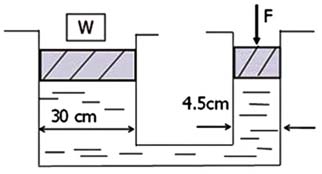
A hydraulic press has a ram of 30 cm diameter and a plunger of 4.5 cm diameter. Find the weight lifted by hydraulic press when force applied at plunger is 500 N.
- A. 3.33 KN
- B. 22.22 N
- C. 3.33 N
- D. 22.22 KN
Answer: D. 22.22 KN
Explanation: According to Pascal's law, pressure is transmitted equally. $P = \frac{F}{A_{plunger}} = \frac{W}{A_{ram}}$.
Therefore, $W = F \times \left(\frac{D_{ram}}{D_{plunger}}\right)^2 = 500 \times \left(\frac{30}{4.5}\right)^2 = 500 \times \left(\frac{20}{3}\right)^2 = 500 \times \frac{400}{9} = 22222.22~N = 22.22~KN$.
Question 3
Topic: Fluid Mechanics
90% of an iceberg volume is below the surface of sea water and only 10% is visible above surface. Find the density of iceberg, if density of sea-water is $1025~kg/m^{3}$.
- A. $1002.5~kg/m^{3}$
- B. $995.5~kg/m^{3}$
- C. $922.5~kg/m^{3}$
- D. $1025~kg/m^{3}$
Answer: C. $922.5~kg/m^{3}$
Explanation: By Archimedes' principle, Weight of iceberg = Buoyant force.
$\rho_{ice} \times V_{total} \times g = \rho_{sea} \times V_{submerged} \times g$.
$\rho_{ice} \times V = 1025 \times 0.90V \Rightarrow \rho_{ice} = 1025 \times 0.90 = 922.5~kg/m^{3}$.
Question 4
Topic: Fluid Mechanics
The equation of a velocity distribution over a plate is given by $u=2y-y^{2}$; where u is the velocity in $m/s$ at a point y meter from the plate measured perpendicularly. Assuming $\mu=8.60$ poise, the shear stress at a point 15 cm from the boundary is
- A. 14.6 Pa
- B. 0.24 Pa
- C. 2.4 Pa
- D. 1.46 Pa
Answer: D. 1.46 Pa
Explanation: Velocity gradient: $\frac{du}{dy} = 2 - 2y$.
At $y = 15~cm = 0.15~m$, $\frac{du}{dy} = 2 - 2(0.15) = 1.7~s^{-1}$.
Dynamic viscosity: $\mu = 8.60~poise = 0.86~Pa\cdot s$.
Shear stress: $\tau = \mu \frac{du}{dy} = 0.86 \times 1.7 = 1.462~Pa$.
Question 5
Topic: Fluid Mechanics
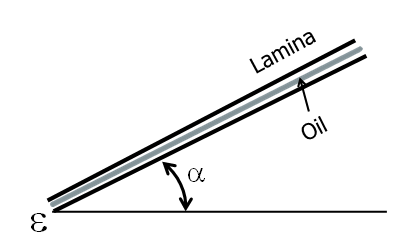
A thin plane Lamina, of Area A and weight W, slides down a fixed plane inclined at an angle $\alpha$ and maintains a uniform gap $\epsilon$ from the surface of the plane, the gap being filled with oil of constant viscosity $\mu$. The terminal velocity of the plane is:
- A. $W\epsilon \cos\alpha/\mu A$
- B. $W\epsilon \sin\alpha/\mu A$
- C. $\mu \epsilon \cos\alpha / AW$
- D. $\mu \epsilon \sin\alpha / AW$
Answer: B. $W\epsilon \sin\alpha/\mu A$
Explanation: The downward component of the weight of the lamina along the inclined plane is $W\sin\alpha$.
The viscous drag force resisting the motion is given by Newton's law of viscosity: $F_v = \tau A = \mu \left(\frac{V}{\epsilon}\right) A$, where V is the terminal velocity.
At steady terminal velocity, downward force = drag force:
$W\sin\alpha = \mu \left(\frac{V}{\epsilon}\right) A \Rightarrow V = \frac{W\epsilon \sin\alpha}{\mu A}$.
Question 6
Topic: Fluid Mechanics
A glass tube with a 90° bend is open at both the ends. It is inserted into a flowing stream of oil, with specific gravity 0.9, so that one opening is directed upstream and the other is directed upward. Oil inside the tube is 50 mm higher than the surface of flowing oil. The velocity measured by the tube is, nearly:
- A. $1.99~m/s$
- B. $0.99~m/s$
- C. $2.99~m/s$
- D. $3~m/s$
Answer: B. $0.99~m/s$
Explanation: This device acts as a Pitot tube. The rise of liquid in the tube corresponds to the dynamic pressure head.
$h = \frac{V^2}{2g}$. Here $h = 50~mm = 0.05~m$.
$V = \sqrt{2gh} = \sqrt{2 \times 9.81 \times 0.05} = \sqrt{0.981} \approx 0.99~m/s$.
Question 7
Topic: Fluid Mechanics
If the surface tension of water-air interface is 0.073 N/m, the gauge pressure inside a rain drop of 1.6 mm diameter is
- A. 182 Pa
- B. 0.182 Pa
- C. 91 Pa
- D. 0.091 Pa
Answer: A. 182 Pa
Explanation: Gauge pressure inside a spherical droplet is given by $\Delta P = \frac{4\sigma}{d}$.
Given $\sigma = 0.073~N/m$ and $d = 1.6~mm = 1.6 \times 10^{-3}~m$.
$\Delta P = \frac{4 \times 0.073}{1.6 \times 10^{-3}} = \frac{0.292}{0.0016} = 182.5~Pa \approx 182~Pa$.
Question 8
Topic: Thermodynamics
A Carnot engine receiving heat at 400 k has an efficiency of 25%. What is the COP of a Carnot refrigerator working between same temperature limits?
Answer: C. 3
Explanation: Efficiency of Carnot engine, $\eta = 1 - \frac{T_L}{T_H} = 0.25 \Rightarrow \frac{T_L}{T_H} = 0.75$.
COP of a Carnot refrigerator working between the same temperatures is $COP_R = \frac{T_L}{T_H - T_L} = \frac{\frac{T_L}{T_H}}{1 - \frac{T_L}{T_H}} = \frac{0.75}{1 - 0.75} = \frac{0.75}{0.25} = 3$.
Question 9
Topic: Heat Transfer
The temperature of a gas stream is to be measured by a thermocouple whose junction can be approximated as a 1-mm-diameter sphere. The properties of the junction material are $k=40~W/mK$ $\rho=8500~kg/m^{3}$, and specific $heat=320~J/kgK$ and the convective heat transfer coefficient between the junction and the gas is $h=200~W/m^{2}K$. Determine how long it will take for the thermocouple to read 99 percent of the initial temperature difference.
- A. 10.5 s
- B. 5.3 s
- C. 21 s
- D. 15 s
Answer: A. 10.5 s
Explanation: Using Lumped Capacitance method, $\frac{T - T_\infty}{T_i - T_\infty} = e^{-t/\tau}$, where time constant $\tau = \frac{\rho V c}{h A_s}$.
For a sphere, $\frac{V}{A_s} = \frac{\pi D^3 / 6}{\pi D^2} = \frac{D}{6}$.
$\tau = \frac{\rho c D}{6 h} = \frac{8500 \times 320 \times (1 \times 10^{-3})}{6 \times 200} = \frac{2720}{1200} \approx 2.267~s$.
To read 99% of the initial difference means 1% of the difference remains: $\frac{T - T_\infty}{T_i - T_\infty} = 0.01$.
$0.01 = e^{-t/2.267} \Rightarrow -4.605 = -t/2.267 \Rightarrow t = 4.605 \times 2.267 \approx 10.44~s \approx 10.5~s$.
Question 10
Topic: Thermodynamics
In a gas turbine cycle, the turbine output is 600 KJ/kg and the compressor work is $400~KJ/kg$. If the heat supplied is 1000 KJ/kg, what is the thermal efficiency of this cycle?
Answer: D. 20%
Explanation: Net work output, $W_{net} = W_T - W_C = 600 - 400 = 200~KJ/kg$.
Heat supplied, $Q_{in} = 1000~KJ/kg$.
Thermal efficiency, $\eta = \frac{W_{net}}{Q_{in}} = \frac{200}{1000} = 0.20 = 20\\%$.
Question 11
Topic: Thermodynamics
In a boiler, feed water supplied per hour is 205 kg while the coal fired per hour is 23 kg. Net enthalpy rise per kg of water is 115 KJ for conversion to steam. If the calorific valve of coal is $2050~KJ/kg.$ find the boiler efficiency.
Answer: C. 50%
Explanation: Heat utilized in steam generation = $m_{water} \times \Delta h = 205~kg \times 115~KJ/kg = 23575~KJ$.
Heat supplied by fuel = $m_{coal} \times CV = 23~kg \times 2050~KJ/kg = 47150~KJ$.
Boiler efficiency = $\frac{\text{Heat utilized}}{\text{Heat supplied}} = \frac{23575}{47150} = 0.50 = 50\\%$.
Question 12
Topic: Thermodynamics
Calculate the ideal air standard thermal efficiency based on Otto cycle for a petrol engine with a cylinder bore of 70 mm and stroke of 100 mm and clearance volume of 42.78 cm³? Consider ratio of specific heats, $\gamma=1.4$, $\pi=\frac{22}{7}$ and $log_{10}2.5\cong0.4$.
Answer: D. 60%
Explanation: Swept volume $V_s = \frac{\pi}{4} D^2 L = \frac{22}{7 \times 4} \times (7)^2 \times 10 = 385~cm^3$.
Clearance volume $V_c = 42.78~cm^3$.
Compression ratio $r = \frac{V_s + V_c}{V_c} = \frac{385 + 42.78}{42.78} = \frac{427.78}{42.78} \approx 10$.
Efficiency $\eta = 1 - \frac{1}{r^{\gamma-1}} = 1 - \frac{1}{10^{1.4-1}} = 1 - \frac{1}{10^{0.4}}$.
Given $\log_{10} 2.5 \cong 0.4$, so $10^{0.4} \cong 2.5$.
$\eta = 1 - \frac{1}{2.5} = 1 - 0.4 = 0.6 = 60\\%$.
Question 13
Topic: Thermodynamics
Calculate the volume of 3 kg of steam at a pressure of 1.3 bar. The dryness fraction of the sample of steam is 0.8. The specific volume of water at 1.3 bar is 0.001 $m^{3}/kg$ and specific volume of dry stream is $1.3~m^{3}/kg$ at 1.3 bar.
- A. $5.64~m^{3}$
- B. $3.12~m^{3}$
- C. $4.24~m^{3}$
- D. $2.64~m^{3}$
Answer: B. $3.12~m^{3}$
Explanation: Specific volume of wet steam $v = v_f + x(v_g - v_f)$. Since $v_f$ is very small compared to $v_g$, $v \approx x v_g$.
$v = 0.001 + 0.8(1.3 - 0.001) = 0.001 + 0.8(1.299) \approx 0.8 \times 1.3 = 1.04~m^3/kg$.
Total volume $V = m \times v = 3 \times 1.04 = 3.12~m^3$.
Question 14
Topic: Fluid Mechanics
An air flow with Mach number 2.0 passes through a normal shock wave. If the ratio of specific heats of air is 1.4, find the shock strength.
Answer: B. 3.5
Explanation: Shock strength is defined as $\frac{\Delta P}{P_1} = \frac{P_2 - P_1}{P_1} = \frac{P_2}{P_1} - 1$.
For a normal shock wave, the pressure ratio is $\frac{P_2}{P_1} = 1 + \frac{2\gamma}{\gamma+1}(M_1^2 - 1)$.
$\frac{P_2}{P_1} = 1 + \frac{2(1.4)}{1.4+1}(2^2 - 1) = 1 + \frac{2.8}{2.4}(3) = 1 + 3.5 = 4.5$.
Shock strength = $4.5 - 1 = 3.5$.
Question 15
Topic: Fluid Mechanics
In an isentropic flow with a stagnation pressure of 6 MPa, find the static pressure, at the point where flow is sonic. (Assume $\gamma=1.4$; consider $1.2^{7}\simeq1.89^{2})$
- A. 2.17 MPa
- B. 3.17 MPa
- C. 1.58 MPa
- D. 2.58 MPa
Answer: B. 3.17 MPa
Explanation: At sonic condition ($M = 1$), the critical pressure ratio is given by $\frac{P^*}{P_0} = \left(\frac{2}{\gamma+1}\right)^{\frac{\gamma}{\gamma-1}}$.
$\frac{P_0}{P^*} = \left(\frac{\gamma+1}{2}\right)^{\frac{\gamma}{\gamma-1}} = \left(\frac{1.4+1}{2}\right)^{\frac{1.4}{0.4}} = (1.2)^{3.5}$.
Given $1.2^7 \simeq 1.89^2$, taking square root on both sides yields $1.2^{3.5} \simeq 1.89$.
Therefore, $\frac{P_0}{P^*} = 1.89 \Rightarrow P^* = \frac{P_0}{1.89} = \frac{6~MPa}{1.89} = 3.174~MPa$.
Question 16
Topic: Propulsion / Aerospace
Why specific impulse of a rocket engine increases in vacuum compared to sea level?
- A. Combustion chamber pressure increases in vacuum
- B. Mass flow rate of propellant decreases in vacuum
- C. Exhaust velocity increases in vacuum
- D. Mass flow rate of propellant increases in vacuum
Answer: C. Exhaust velocity increases in vacuum
Explanation: Specific impulse is directly proportional to the effective exhaust velocity ($I_{sp} = V_e / g_0$). The effective exhaust velocity is given by $V_e = v_e + \frac{(P_e - P_a)A_e}{\dot{m}}$. In a vacuum, the ambient pressure $P_a$ becomes zero, which maximizes the thrust term and thereby increases the effective exhaust velocity. Thus, the specific impulse increases.
Question 17
Topic: Propulsion / Aerospace
A rocket with an initial mass of 10,000 kg ejects mass at a constant rate of 100 kg/s and at constant velocity through the nozzle. What should be the exit jet velocity, so as to increase the velocity of the rocket by 2 km/s in 50 seconds. [Assume no drag and optimal expansion in nozzle. Consider, $e^{0.693}\simeq 2$]
- A. $2886~m/s$
- B. $3286~m/s$
- C. $1000~m/s$
- D. $1985~m/s$
Answer: A. $2886~m/s$
Explanation: Using the ideal rocket equation (Tsiolkovsky equation): $\Delta V = v_e \ln\left(\frac{m_i}{m_f}\right)$.
Initial mass, $m_i = 10000$ kg.
Mass flow rate, $\dot{m} = 100$ kg/s.
Time, $t = 50$ s.
Mass ejected = $\dot{m} \times t = 100 \times 50 = 5000$ kg.
Final mass, $m_f = 10000 - 5000 = 5000$ kg.
Target $\Delta V = 2$ km/s = 2000 m/s.
$2000 = v_e \ln\left(\frac{10000}{5000}\right) = v_e \ln(2)$.
Given $e^{0.693} \simeq 2$, we have $\ln(2) = 0.693$.
$2000 = v_e \times 0.693 \implies v_e = \frac{2000}{0.693} = 2886.002~m/s$.
Question 18
Topic: Material Science
Which of the following properties of material that cannot be significantly changed by heat treatment?
- A. Ultimate tensile strength
- B. Yield strength
- C. Elastic Modulus
- D. Ductility
Answer: C. Elastic Modulus
Explanation: Elastic modulus (Young's modulus) is an intrinsic property determined by the interatomic bonding forces of the material. While heat treatment heavily alters the microstructure (dislocations, grain size, phases) affecting yield strength, UTS, and ductility, it has virtually no significant effect on the elastic modulus.
Question 19
Topic: Material Science
A composite material consists of 60% by volume of fibre (modulus 200 GPa) and 40% by volume of matrix (modulus 5 GPa). What is the approximate modulus of the composite (using rule of mixtures)?
- A. 122 GPa
- B. 82 GPa
- C. 42 GPa
- D. 22 GPa
Answer: A. 122 GPa
Explanation: According to the rule of mixtures for the longitudinal elastic modulus of a composite (Voigt bound): $E_c = V_f E_f + V_m E_m$, where $V_f$ and $V_m$ are volume fractions of the fibre and matrix respectively.
$E_c = (0.60 \times 200) + (0.40 \times 5) = 120 + 2 = 122$ GPa.
Question 20
Topic: Strength of Materials
A material has a yield strength of 300 MPa and a fracture strain of 0.2. What is the approximate toughness (assuming linear elastic behaviour)?
- A. 60 MPa
- B. 30 MPa
- C. 600 MPa
- D. 300 MPa
Answer: B. 30 MPa
Explanation: Toughness is represented by the total area under the stress-strain curve up to fracture. Assuming a simplified linear elastic behaviour (a triangular area) extending up to fracture point for approximation:
$Area = \frac{1}{2} \times stress \times strain = \frac{1}{2} \times 300~MPa \times 0.2 = 30~MPa$.
Question 21
Topic: Heat Transfer
The temperature profile for heat conduction through a wall of constant thermal conductivity in presence of a heat source is
- A. Linear
- B. Parabolic
- C. Logarithmic
- D. Hyperbolic
Answer: B. Parabolic
Explanation: The 1D steady-state heat conduction equation with uniform heat generation is $\frac{d^2T}{dx^2} + \frac{q_g}{k} = 0$. Integrating this twice with respect to $x$ yields a second-degree polynomial equation ($T(x) = C_1 x^2 + C_2 x + C_3$), which represents a parabolic temperature profile.
Question 22
Topic: Material Science
What is the primary mechanism responsible for the increase in strength and hardness during cold working of metals?
- A. Formation of new grains through recrystallization
- B. Increase in dislocation density and entanglement, hindering dislocation movement
- C. Reduction of dislocations in the crystal structure
- D. Melting of metal surface layers due to deformation
Answer: B. Increase in dislocation density and entanglement, hindering dislocation movement
Explanation: Cold working (strain hardening) plastically deforms a metal below its recrystallization temperature. This deformation drastically increases the dislocation density in the crystal lattice. These dislocations entangle and form obstacles to one another, requiring higher stress to cause further plastic flow, hence increasing strength and hardness.
Question 23
Topic: Strength of Materials
A material has a Young's modulus of 200 GPa and Poisson's ratio of 0.3. What is its bulk modulus?
- A. 100 GPa
- B. 153.8 GPa
- C. 76.9 GPa
- D. 166.7 GPa
Answer: D. 166.7 GPa
Explanation: The relationship between Young's Modulus ($E$), Bulk Modulus ($K$), and Poisson's ratio ($\nu$) is $E = 3K(1 - 2\nu)$.
$200 = 3K(1 - 2(0.3)) = 3K(1 - 0.6) = 3K(0.4) = 1.2K$.
$K = \frac{200}{1.2} = \frac{2000}{12} = 166.67$ GPa.
Question 24
Topic: Theory of Machines
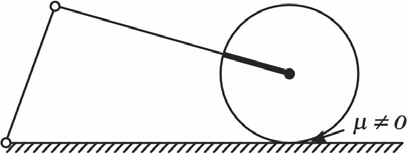
Find the total number of degrees of freedom for following system. Assume rolling without slipping.
- A. 0
- B. 1
- C. 2
- D. Cannot be determined
Answer: B. 1
Explanation: Applying Kutzbach's criterion: $F = 3(n-1) - 2j - h$.
Number of links $n = 4$ (Ground=1, oscillating left arm=2, connecting rod=3, wheel=4).
The joints ($j$) are 3 pin joints (ground-arm, arm-rod, rod-wheel) and 1 rolling contact without slipping. A rolling contact without slipping removes 2 degrees of freedom (constrains vertical movement and relates horizontal translation strictly to rotation), making it act as a lower pair ($j=1$).
$F = 3(4-1) - 2(4) = 9 - 8 = 1$.
Question 25
Topic: Machine Design
A closed-coil helical compression spring with 20 active coils has a spring stiffness of K. It is cut into two parts having 8 and 12 active coils respectively. What is the stiffness of the spring with 8 active coils?
- A. 1.5 K
- B. 2.0 K
- C. 2.5 K
- D. 3.0 K
Answer: C. 2.5 K
Explanation: The stiffness of a helical spring ($k$) is inversely proportional to the number of active coils ($n$), i.e., $k \propto \frac{1}{n}$. Thus, $k_1 n_1 = k_2 n_2$.
$K \times 20 = k_{new} \times 8 \implies k_{new} = K \times \frac{20}{8} = 2.5 K$.
Question 26
Topic: Machine Design
A ball bearing has a dynamic load rating of 60,000 N and experiences a load of 20,000 N. The expected life in million revolutions is:
Answer: C. 27
Explanation: For ball bearings, the expected rating life in millions of revolutions is given by $L_{10} = \left(\frac{C}{P}\right)^3$.
$L_{10} = \left(\frac{60000}{20000}\right)^3 = (3)^3 = 27$ million revolutions.
Question 27
Topic: Heat Transfer
In forced convection, which of the following is true for Stanton number?
- A. It is the ratio of heat transferred to thermal capacity of fluid
- B. It is the ratio of Nusselt number and Reynolds number
- C. It is the ratio of Nusselt number and Prandtl number
- D. Both (a) and (b)
Answer: A. It is the ratio of heat transferred to thermal capacity of fluid
Explanation: The Stanton number ($St$) measures the ratio of heat transferred into a fluid to the thermal capacity of the fluid. It is defined mathematically as $St = \frac{h}{\rho V c_p}$. Alternatively, it can be written as $St = \frac{Nu}{Re \cdot Pr}$. Thus, (a) is the accurate conceptual definition.
Question 28
Topic: Engineering Mechanics
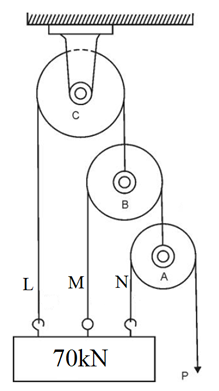
A load of 70 kN is lifted using a frictionless pulley system shown in the figure below. At each pulley, cables of square cross section with side of 10 mm are used. The stress in cable "L" will be:
- A. 100 MPa
- B. 200 MPa
- C. 400 MPa
- D. 700 MPa
Answer: C. 400 MPa
Explanation: From the block and tackle diagram: If pulling tension is $P$, the lowest hook (N) pulls with $P$. The pulley A has $2P$ acting upwards from B, so hook M holds $2P$. Pulley B has $4P$ acting upwards from C, so hook L holds $4P$.
Total upward force on the block = $P + 2P + 4P = 7P$.
$7P = 70$ kN $\implies P = 10$ kN.
Tension in cable L = $4P = 40$ kN = 40,000 N.
Cross-sectional area $A = 10 \times 10 = 100~mm^2$.
Stress = $Force / Area = \frac{40000}{100} = 400~N/mm^2 = 400$ MPa.
Question 29
Topic: Theory of Machines
How many instantaneous centres does the given mechanism possess?
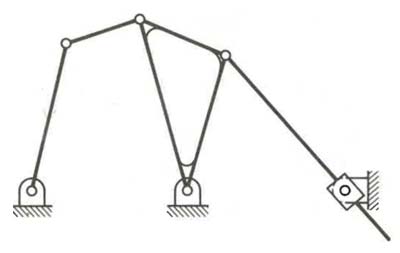
Answer: B. 15
Explanation: The diagram displays a mechanism with 6 links (n=6). These include: 1 fixed ground link, 1 left crank, 1 top coupler, 1 central V-shaped ternary link (lever), 1 connecting rod to the right, and 1 slider.
The number of instantaneous centres for a mechanism with $n$ links is given by $N = \frac{n(n-1)}{2}$.
$N = \frac{6(6-1)}{2} = \frac{30}{2} = 15$.
Question 30
Topic: Heat Transfer
Determine $F_{12}$ and $F_{21}$ for the following configuration having long inclined plates and point B is directly above the center of $A_1$
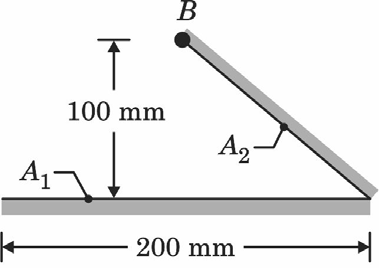
- A. $F_{12}=0.5, F_{21}=0.707$
- B. $F_{12}=0.707, F_{21}=0.5$
- C. $F_{12}=0.707, F_{21}=1$
- D. $F_{12}=0.5, F_{21}=1$
Answer: A. $F_{12}=0.5, F_{21}=0.707$
Explanation: Using Hottel's crossed-string method for adjacent surfaces: $F_{12} = \frac{L_1 + L_2 - L_3}{2L_1}$.
$A_1$ length ($L_1$) = 200 mm. B is directly above the center of $A_1$ at a height of 100 mm.
$L_2$ (length of $A_2$) = $\sqrt{100^2 + 100^2} = 100\sqrt{2}$ mm.
$L_3$ (imaginary string closing the triangle from left edge to B) = $\sqrt{100^2 + 100^2} = 100\sqrt{2}$ mm.
$F_{12} = \frac{200 + 100\sqrt{2} - 100\sqrt{2}}{2 \times 200} = \frac{200}{400} = 0.5$.
By reciprocity theorem: $A_1 F_{12} = A_2 F_{21}$.
$200 \times 0.5 = 100\sqrt{2} \times F_{21} \implies 100 = 100\sqrt{2} F_{21} \implies F_{21} = \frac{1}{\sqrt{2}} = 0.707$.
Question 31
Topic: Engineering Mechanics
A rocket is launched vertically up. It attains the velocity of $200~m/s$ at an altitude of 1.125 kms. At this point, its booster stage is separated without any relative velocity. Find the maximum altitude the booster stage attains and the time duration between separation and its impact on ground. Consider no drag effect on the separated booster stage and $g=10~m/s^{2}$.
- A. $Y_{max}=1.125~km$ and $t=20s$
- B. $Y_{max}=3.125~km$ and $t=25s$
- C. $Y_{max}=2.0~km$ and $t=45s$
- D. $Y_{max}=3.125~km$ and $t=45s$
Answer: D. $Y_{max}=3.125~km$ and $t=45s$
Explanation: Initial upward velocity of separated booster, $u = 200~m/s$.
Altitude at separation, $h_0 = 1125~m$.
Maximum additional height reached from separation point = $\frac{u^2}{2g} = \frac{200^2}{2 \times 10} = \frac{40000}{20} = 2000~m = 2.0~km$.
Total maximum altitude $Y_{max} = 1.125~km + 2.0~km = 3.125~km$.
Time taken to reach maximum altitude from separation, $t_1 = \frac{u}{g} = \frac{200}{10} = 20~s$.
Time taken to fall freely from $Y_{max}$ to ground, $t_2$: $Y_{max} = \frac{1}{2}gt_2^2 \Rightarrow 3125 = 5t_2^2 \Rightarrow t_2 = \sqrt{625} = 25~s$.
Total time duration $t = t_1 + t_2 = 20 + 25 = 45~s$.
Question 32
Topic: Engineering Mechanics
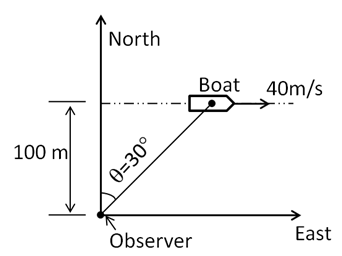
A boat is travelling at a speed of $40~m/s$ due east as shown in the figure below. An observer is stationed 100 m south of the line of travel. Determine the angular velocity of the boat, relative to the observer, when in the position $(\theta=30^{\circ})$ shown in the figure.
- A. $0.3~rad/sec$
- B. $0.4~rad/sec$
- C. $0.6~rad/sec$
- D. $0.8~rad/sec$
Answer: A. $0.3~rad/sec$
Explanation: Let the horizontal distance travelled by the boat be $x$. From the geometry of the figure, $x = 100 \tan\theta$.
Differentiating with respect to time $t$ gives the velocity of the boat: $v = \frac{dx}{dt} = 100 \sec^2\theta \cdot \frac{d\theta}{dt}$.
Here, angular velocity $\omega = \frac{d\theta}{dt}$.
Substituting the given values: $40 = 100 \sec^2(30^{\circ}) \cdot \omega$.
$\sec(30^{\circ}) = \frac{2}{\sqrt{3}}$, so $\sec^2(30^{\circ}) = \frac{4}{3}$.
$40 = 100 \times \frac{4}{3} \times \omega \Rightarrow 40 = \frac{400}{3} \omega$.
$\omega = \frac{40 \times 3}{400} = 0.3~rad/sec$.
Question 33
Topic: Heat Transfer
What is the name of the dimensionless number that characterizes the ratio of thermal to mass diffusivity?
- A. Lewis number
- B. Prandtl number
- C. Reynolds number
- D. Schmidt number
Answer: A. Lewis number
Explanation: The Lewis number ($Le$) is defined as the ratio of thermal diffusivity ($\alpha$) to mass diffusivity ($D_{AB}$). It is used to characterize fluid flows where there is simultaneous heat and mass transfer. $Le = \frac{\alpha}{D_{AB}}$.
Question 34
Topic: Machine Design
A single plate clutch transmits 50 Nm torque with a coefficient of friction 0.3 and mean radius 0.1 m. What is the axial force required?
- A. 1000 N
- B. 1500 N
- C. 1670 N
- D. 2000 N
Answer: C. 1670 N
Explanation: Torque transmitted by a clutch is given by $T = n \mu W R_{m}$. Usually, a single plate clutch has two active friction surfaces ($n=2$). However, checking the options reveals the question assumes a single friction face ($n=1$) for calculation.
$50 = 1 \times 0.3 \times W \times 0.1$.
$50 = 0.03 W \Rightarrow W = \frac{50}{0.03} = 1666.67~N \approx 1670~N$.
Question 35
Topic: Strength of Materials
Consider the following statements related to stress and strain :
1. Shear stress is always tangential to the face over which it acts.
2. Shear stresses on the transverse pair of faces are known as complimentary shear stresses.
3. Shear strain is defined as the change in the right angle of the element measured in radians.
Which of the above statements is correct?
- A. 1 and 2 only
- B. 1 and 3 only
- C. 2 and 3 only
- D. 1, 2 and 3
Answer: D. 1, 2 and 3
Explanation: 1. Shear stress is defined as the stress component parallel (tangential) to a given surface.
2. To maintain rotational equilibrium, a shear stress on one face must be accompanied by an equal shear stress on an adjacent transverse face, called complimentary shear stress.
3. Shear strain represents the distortion of the element and is measured by the change in the original right angle (in radians). All three statements are correct.
Question 36
Topic: Thermodynamics
A heat engine is supplied with 250 KJ/s of heat at a constant fixed temperature of $227^{\circ}C$. The heat is rejected at $27^{\circ}C$ and the cycle is reversible. What is the amount of heat rejected?
- A. 273 KJ/s
- B. 200 KJ/s
- C. 180 KJ/s
- D. 150 KJ/s
Answer: D. 150 KJ/s
Explanation: Convert temperatures to Kelvin: $T_H = 227 + 273 = 500~K$, $T_L = 27 + 273 = 300~K$.
For a reversible cycle (Carnot engine), $\frac{Q_H}{T_H} = \frac{Q_L}{T_L}$.
$\frac{250}{500} = \frac{Q_L}{300} \Rightarrow Q_L = 300 \times 0.5 = 150~KJ/s$.
Question 37
Topic: Machine Design
Two plates subjected to tensile force of 50 kN, are fixed together by means of three rivets. The plates and rivets are made of same material. If the permissible shear stress in the rivets is 50 $N/mm^{2}$, what is the diameter of the rivets? (Neglect stress concentration effects)
- A. 14.75 mm
- B. 20.60 mm
- C. 24.38 mm
- D. 29.52 mm
Answer: B. 20.60 mm
Explanation: Force $P = 50~kN = 50000~N$. Since there are 3 rivets in single shear, the total shear resistance is $n \times \frac{\pi}{4} d^2 \times \tau = P$.
$3 \times \frac{\pi}{4} d^2 \times 50 = 50000$.
$d^2 = \frac{50000 \times 4}{3 \times \pi \times 50} = \frac{4000}{3\pi} \approx 424.41~mm^2$.
$d = \sqrt{424.41} \approx 20.60~mm$.
Question 38
Topic: Strength of Materials
A cantilever beam carries a load W uniformly distributed over its entire length. If the same load is placed at the free end of the same cantilever, then the ratio of maximum deflection in the first case to that in the second case will be
- A. $3/8$
- B. $8/3$
- C. $5/8$
- D. $8/5$
Answer: A. $3/8$
Explanation: Case 1 (UDL): Total load is $W$. Max deflection $\delta_1 = \frac{wL^4}{8EI} = \frac{WL^3}{8EI}$.
Case 2 (Point Load): Load $W$ at the free end. Max deflection $\delta_2 = \frac{WL^3}{3EI}$.
Ratio = $\frac{\delta_1}{\delta_2} = \frac{\frac{1}{8}}{\frac{1}{3}} = \frac{3}{8}$.
Question 39
Topic: Strength of Materials
A solid shaft of diameter 'D' undergoes a twisting moment that develops maximum shear stress '$\tau$'. If the shaft is replaced by a hollow one of outside diameter 'D' and inside diameter D/2, then the maximum shear stress will be
- A. $1.067\tau$
- B. $1.143\tau$
- C. $1.33\tau$
- D. $2\tau$
Answer: A. $1.067\tau$
Explanation: For a solid shaft, $\tau = \frac{16T}{\pi D^3}$.
For a hollow shaft with $D_o = D$ and $D_i = D/2$, polar moment of inertia $J_h = \frac{\pi}{32}[D^4 - (D/2)^4] = \frac{\pi}{32}D^4(1 - 1/16) = \frac{15\pi D^4}{512}$.
Maximum shear stress in hollow shaft, $\tau_h = \frac{T (D/2)}{J_h} = \frac{T D / 2}{\frac{15\pi D^4}{512}} = \frac{256T}{15\pi D^3}$.
Ratio $\frac{\tau_h}{\tau} = \frac{\frac{256T}{15\pi D^3}}{\frac{16T}{\pi D^3}} = \frac{256}{15 \times 16} = \frac{16}{15} \approx 1.067$.
So, $\tau_h = 1.067\tau$.
Question 40
Topic: Heat Transfer
A hot metal sphere is suddenly immersed in a liquid bath at a much lower temperature than the hot metal sphere. Under which of the following conditions, the temperature gradients in the metal sphere can be assumed to be neglected during the cooling of the sphere?
- A. Nusselt number >> 1
- B. Biot number >> 1
- C. Biot number << 1
- D. Nusselt number << 1
Answer: C. Biot number << 1
Explanation: The assumption of negligible internal temperature gradients characterizes lumped system analysis. This is valid when the internal conductive resistance is much smaller than the external convective resistance, which implies that the Biot number ($Bi = \frac{hL_c}{k}$) is very small, typically $Bi < 0.1$ ($Bi \ll 1$).
Question 41
Topic: Strength of Materials
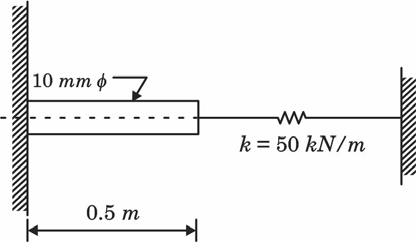
A rod has coefficient of thermal expansion $31.4\times10^{-6}/^{\circ}C$ and Young's modulus 200 GPa. It is fitted snugly between the supports as shown in the figure and heated. The stress induced in it due to $20^{\circ}C$ rise in temperature will be
- A. 0.1 MPa
- B. - 0.1 MPa
- C. 0.2 MPa
- D. 0.2 MPa
Answer: D. 0.2 MPa
Explanation: Rod length $L = 0.5~m$, dia $d = 10~mm$, spring stiffness $k = 50~kN/m = 50000~N/m$.
Free thermal expansion $\Delta L_{th} = L \alpha \Delta T = 0.5 \times 31.4 \times 10^{-6} \times 20 = 314 \times 10^{-6}~m$.
When the rod expands against the spring, it undergoes a net expansion $x$. The spring reaction force is $F = kx$.
The rod also shortens elastically due to this force $F$: $\Delta L_{el} = \frac{FL}{AE}$.
Compatibility equation: $\Delta L_{th} = x + \Delta L_{el} \Rightarrow L \alpha \Delta T = \frac{F}{k} + \frac{FL}{AE} = F \left( \frac{1}{k} + \frac{L}{AE} \right)$.
Area $A = \frac{\pi}{4} (0.01)^2 = 78.54 \times 10^{-6}~m^2$.
$\frac{1}{k} = \frac{1}{50000} = 2 \times 10^{-5}~m/N$.
$\frac{L}{AE} = \frac{0.5}{78.54 \times 10^{-6} \times 200 \times 10^9} = 3.18 \times 10^{-8}~m/N$.
Since $\frac{L}{AE}$ is very small compared to $\frac{1}{k}$, $F \approx \frac{L \alpha \Delta T}{1/k} = k L \alpha \Delta T = 50000 \times 314 \times 10^{-6} = 15.7~N$.
Stress $\sigma = \frac{F}{A} = \frac{15.7}{78.54 \times 10^{-6}} = 200,000~Pa = 0.2~MPa$ (Compressive).
Question 42
Topic: Theory of Machines
A cantilever beam of negligible mass has a mass m at its free end. If the length of the cantilever is halved, what is the factor by which its natural frequency is increased?
- A. $\frac{1}{2\sqrt{2}}$
- B. $\frac{1}{2}$
- C. 2
- D. $2\sqrt{2}$
Answer: D. $2\sqrt{2}$
Explanation: Equivalent stiffness of a cantilever beam with a mass at the free end is $k_{eq} = \frac{3EI}{L^3}$.
Natural frequency $\omega_n = \sqrt{\frac{k_{eq}}{m}} = \sqrt{\frac{3EI}{mL^3}}$, so $\omega_n \propto L^{-1.5}$.
When length is halved ($L' = L/2$), the new natural frequency is $\omega_n' \propto (L/2)^{-1.5} = L^{-1.5} \times 2^{1.5} = \omega_n \times \sqrt{8} = 2\sqrt{2} \omega_n$.
Question 43
Topic: Theory of Machines
Inversion of a mechanism is
- A. Changing of a higher pair to lower pair
- B. Obtained by fixing different links in a kinematic chain
- C. Turning it upside down
- D. Obtained by reversing the input and output motion
Answer: B. Obtained by fixing different links in a kinematic chain
Explanation: In kinematics, an inversion of a mechanism is produced by choosing different links to be the fixed frame. If a kinematic chain has $n$ links, it can theoretically yield $n$ different mechanisms by fixing each link one by one.
Question 44
Topic: Fluid Mechanics
A sphere is moving in water with a velocity of $1.6~m/s$. Another sphere of twice the diameter is placed in a wind tunnel and tested with air which is 750 times less dense and 60 times less viscous than water. The velocity of air that will give dynamically similar condition is
- A. $5~m/s$
- B. $10~m/s$
- C. $20~m/s$
- D. $40~m/s$
Answer: B. $10~m/s$
Explanation: For dynamic similarity in this scenario, Reynolds numbers must be equated: $Re_1 = Re_2$.
$\frac{\rho_1 V_1 D_1}{\mu_1} = \frac{\rho_2 V_2 D_2}{\mu_2}$.
$V_2 = V_1 \left(\frac{\rho_1}{\rho_2}\right) \left(\frac{D_1}{D_2}\right) \left(\frac{\mu_2}{\mu_1}\right)$.
Given: $V_1 = 1.6~m/s$, $D_2 = 2D_1$, $\rho_2 = \frac{\rho_1}{750}$, $\mu_2 = \frac{\mu_1}{60}$.
$V_2 = 1.6 \times 750 \times \frac{1}{2} \times \frac{1}{60} = 1.6 \times \frac{750}{120} = 1.6 \times 6.25 = 10~m/s$.
Question 45
Topic: Theory of Machines
In the statement, an eccentric mass rotating at 3000 rpm will create X times more unbalanced force than 50% of the same mass rotating at 300 rpm, X will be
Answer: D. 200
Explanation: Unbalanced centrifugal force is given by $F = mr\omega^2$.
Force case 1 ($F_1$): mass $m_1 = m$, speed $N_1 = 3000~rpm$.
Force case 2 ($F_2$): mass $m_2 = 0.5m$, speed $N_2 = 300~rpm$.
$X = \frac{F_1}{F_2} = \frac{m_1 N_1^2}{m_2 N_2^2} = \frac{m \times 3000^2}{0.5m \times 300^2} = 2 \times \left(\frac{3000}{300}\right)^2 = 2 \times 10^2 = 200$.
Question 46
Topic: Mechanical Vibrations
A mass of 10 kg is attached to the end of a spring with a stiffness $0.49~N/mm$. The critical damping coefficient of this system is
Answer: C. 140
Explanation: Mass $m = 10~kg$.
Stiffness $k = 0.49~N/mm = 0.49 \times 1000~N/m = 490~N/m$.
The critical damping coefficient is given by $c_c = 2\sqrt{km}$.
$c_c = 2\sqrt{490 \times 10} = 2\sqrt{4900} = 2 \times 70 = 140~Ns/m$.
Question 47
Topic: Mechanical Vibrations
In a vibration isolation system, the transmissibility will be less than unity for all values of damping factors, if the ratio of forcing frequency to natural frequency is
- A. equal to 1
- B. less than $\sqrt{2}$
- C. more than $\sqrt{2}$
- D. equal to 2
Answer: C. more than $\sqrt{2}$
Explanation: Transmissibility ratio ($T_r$) is the ratio of force transmitted to the foundation to the force applied. $T_r < 1$ ensures vibration isolation. By analyzing the transmissibility curve, $T_r$ is less than 1 for all values of the damping ratio $\zeta$ only when the frequency ratio $\frac{\omega}{\omega_n} > \sqrt{2}$.
Question 48
Topic: Mechanical Vibrations
In a multi-rotor system of torsional vibrations, maximum number of nodes that can occur is
- A. Two
- B. Equal to number of rotors plus one
- C. Equal to number of rotors
- D. Equal to number of rotors minus one
Answer: D. Equal to number of rotors minus one
Explanation: In a torsional vibration system with $n$ rotors mounted on a shaft, the maximum number of natural frequencies is $n-1$. Each natural frequency corresponds to a mode shape, and the highest mode shape will have a maximum of $n-1$ nodes.
Question 49
Topic: Theory of Machines
A planar mechanism has 8 links and 10 rotary joints. Using Grubler's criterion, the number of degrees of freedom of the mechanism is
Answer: B. 1
Explanation: According to Grubler's criterion (or Kutzbach criterion with no higher pairs), the degrees of freedom (DOF) is given by $F = 3(n-1) - 2j$.
Given links $n = 8$ and joints $j = 10$.
$F = 3(8-1) - 2(10) = 3(7) - 20 = 21 - 20 = 1$.
Question 50
Topic: Strength of Materials
A tapering bar (diameters of end sections being $d_1$ and $d_2$) and a bar of uniform cross-section d have the same length and are subjected to the same axial pull. Both the bars will have same extension if d is equal to
- A. $(d_1+d_2)/2$
- B. $\sqrt{d_1d_2}$
- C. $\sqrt{d_1d_2}/2$
- D. $\sqrt{d_1} + \frac{d_2}{2}$
Answer: B. $\sqrt{d_1d_2}$
Explanation: The extension of a uniformly tapering circular bar is $\Delta L = \frac{4PL}{\pi E d_1 d_2}$.
The extension of a uniform circular bar is $\Delta L = \frac{4PL}{\pi E d^2}$.
Equating both extensions: $\frac{4PL}{\pi E d_1 d_2} = \frac{4PL}{\pi E d^2} \Rightarrow d^2 = d_1 d_2 \Rightarrow d = \sqrt{d_1 d_2}$.
Question 51
Topic: Strength of Materials
A bar of copper and steel together forms a composite system are heated to a temperature of $40^{\circ}C$. What type of stress is induced in the copper bar?
- A. Tensile
- B. Compressive
- C. Shear
- D. Tensile as well as compressive
Answer: B. Compressive
Explanation: Copper has a higher coefficient of thermal expansion ($\alpha$) than steel. When heated, the copper bar attempts to expand more than the steel bar. The composite nature forces them to expand by the same amount, meaning steel restricts the free expansion of copper. As a result, the copper bar experiences compressive stress, and the steel bar experiences tensile stress.
Question 52
Topic: Fluid Mechanics
For solid sphere falling vertically downwards under gravity in a viscous fluid, the terminal velocity V varies with diameter D of the sphere as :
- A. $V \propto D^{\frac{1}{2}}$
- B. $V \propto D^2$
- C. $V \propto D$
- D. $V \propto \frac{1}{D}$
Answer: B. $V \propto D^2$
Explanation: According to Stokes' Law, the terminal velocity of a sphere falling in a viscous fluid is given by $V = \frac{(\rho_s - \rho_f) g D^2}{18\mu}$, where $\rho_s$ and $\rho_f$ are the densities of the sphere and fluid, respectively, and $\mu$ is the dynamic viscosity. Therefore, $V$ is directly proportional to the square of the diameter ($D^2$).
Question 53
Topic: Manufacturing Processes
The power required for a turning operation is measured as 2.5 kW. If the cutting force is 800 N and the cutting speed is 90 m/min, calculate the mechanical efficiency.
- A. 86.4%
- B. 55.5%
- C. 40.8%
- D. 48%
Answer: D. 48%
Explanation: The ideal power utilized at the cutting tool is $P_{ideal} = F_c \times V$.
Cutting force $F_c = 800~N$.
Cutting speed $V = 90~m/min = \frac{90}{60}~m/s = 1.5~m/s$.
$P_{ideal} = 800~N \times 1.5~m/s = 1200~W = 1.2~kW$.
The motor input power $P_{input} = 2.5~kW$.
Mechanical efficiency $\eta = \frac{P_{ideal}}{P_{input}} = \frac{1.2}{2.5} = 0.48 = 48\\%$.
Question 54
Topic: Thermodynamics / Fluid Mechanics
A weather balloon is rising vertically in the atmosphere. Temperature (T) at any point depends on both time (t) and altitude (h). The balloon rises with a vertical velocity of $10~m/s$. For a given time the change in temperature with respect to altitude is $-0.01^{\circ}C/m$. Similarly for a given altitude, the change in temperature with respect to time is $-0.1^{\circ}C/s$. The total change in temperature $(dT/dt)$ experienced by the balloon is:
- A. $-0.2^{\circ}C/s$
- B. $-0.11^{\circ}C/s$
- C. $-0.09^{\circ}C/s$
- D. $-0.1^{\circ}C/s$
Answer: A. $-0.2^{\circ}C/s$
Explanation: The total derivative of temperature with respect to time (material derivative) is $\frac{dT}{dt} = \frac{\partial T}{\partial t} + v \frac{\partial T}{\partial h}$.
Given: Local rate of change $\frac{\partial T}{\partial t} = -0.1^{\circ}C/s$.
Vertical velocity $v = \frac{dh}{dt} = 10~m/s$.
Temperature gradient $\frac{\partial T}{\partial h} = -0.01^{\circ}C/m$.
$\frac{dT}{dt} = -0.1 + (10 \times -0.01) = -0.1 - 0.1 = -0.2^{\circ}C/s$.
Question 55
Topic: Fluid Mechanics
For a two-dimensional, steady, incompressible and irrotational flow, a stream function is given by $(x^2-y^2)$. The potential function of the flow will be :
- A. $2xy+f(x)$
- B. 2xy + constant
- C. $Z(x^2-y^2)$
- D. $2xy+f(y)$
Answer: B. 2xy + constant
Explanation: Given stream function $\psi = x^2 - y^2$.
Velocity components: $u = \frac{\partial\psi}{\partial y} = -2y$ and $v = -\frac{\partial\psi}{\partial x} = -2x$.
Relating velocity components to the potential function $\phi$ using $u = -\frac{\partial\phi}{\partial x}$ and $v = -\frac{\partial\phi}{\partial y}$:
$-\frac{\partial\phi}{\partial x} = -2y \Rightarrow \frac{\partial\phi}{\partial x} = 2y$. Integrating w.r.t $x$: $\phi = 2xy + f(y)$.
$-\frac{\partial\phi}{\partial y} = -2x \Rightarrow \frac{\partial (2xy + f(y))}{\partial y} = 2x \Rightarrow 2x + f'(y) = 2x \Rightarrow f'(y) = 0$.
Therefore, $f(y) = \text{constant}$. The potential function is $\phi = 2xy + \text{constant}$.
Question 56
Topic: Manufacturing Processes
In face milling with a cutter of 100 mm diameter, if the cutting speed is $1~m/s$, what should be the spindle speed (rpm)?
Answer: A. 190
Explanation: Cutting speed $V = \frac{\pi D N}{60}$ where $V$ is in m/s, $D$ is in meters, and $N$ is in rpm.
$V = 1~m/s$, $D = 100~mm = 0.1~m$.
$1 = \frac{\pi \times 0.1 \times N}{60}$.
$N = \frac{60}{0.1\pi} = \frac{600}{\pi} \approx 190.98~rpm$. The closest option is 190.
Question 57
Topic: Manufacturing Processes
Brass is welded using oxidizing flame due to
- A. $O_2$ is prevented entering from the atmosphere
- B. Zinc is prevented from evaporating
- C. Zinc is oxidised
- D. All of the above
Answer: B. Zinc is prevented from evaporating
Explanation: Brass is an alloy of copper and zinc. During gas welding, the high heat causes the zinc to evaporate rapidly since its boiling point is relatively low. Using an oxidizing flame creates a protective scum/layer of zinc oxide on the molten pool, which suppresses the further evaporation of zinc.
Question 58
Topic: Thermodynamics
Which of the following equations describes the behaviour of a thermodynamic system undergoing a phase transition?
- A. Clausius-Clapeyron equation
- B. Van der Waals equation
- C. Maxwell-Boltzmann distribution
- D. Gibbs-Duhem equation
Answer: A. Clausius-Clapeyron equation
Explanation: The Clausius-Clapeyron equation ($\frac{dP}{dT} = \frac{L}{T\Delta v}$) characterizes a discontinuous phase transition between two phases of matter of a single constituent. It relates vapor pressure and temperature for phase changes.
Question 59
Topic: Manufacturing Processes
The useful tool life of a HSS tool machining MS at $18~m/min$ is 3 hours. Calculate the tool life when the tool operates at $24~m/min$ Assume 'n' (exponent) which depends on cutting conditions as 0.125?
- A. 28 min
- B. 18 min
- C. 14 min
- D. 22 min
Answer: B. 18 min
Explanation: According to Taylor's tool life equation: $V_1 T_1^n = V_2 T_2^n$.
$V_1 = 18~m/min$, $T_1 = 3~hours = 180~min$, $V_2 = 24~m/min$, $n = 0.125$.
$18 \times (180)^{0.125} = 24 \times (T_2)^{0.125}$.
$\left(\frac{T_2}{180}\right)^{0.125} = \frac{18}{24} = 0.75$.
$\frac{T_2}{180} = (0.75)^{\frac{1}{0.125}} = (0.75)^8 = 0.1001129$.
$T_2 = 180 \times 0.1001129 \approx 18.02~min$. So, 18 min is the correct answer.
Question 60
Topic: Manufacturing Processes
Weld decay in stainless steel is due to
- A. Depletion of Chromium at heat affected zone
- B. Depletion of Titanium in the weld
- C. Both (a) and (b)
- D. None of the above
Answer: A. Depletion of Chromium at heat affected zone
Explanation: Weld decay is a form of intergranular corrosion in austenitic stainless steels. During welding, the heat-affected zone (HAZ) reaches a sensitizing temperature range, causing chromium to combine with carbon to form chromium carbides at the grain boundaries. This depletes the adjacent areas of chromium, reducing corrosion resistance.
Question 61
Topic: Material Science / Manufacturing
Which of the following option is true for heat treatment of HSS 18:4:1?
- A. First specimen is heated to $1200^{\circ}C$
- B. First specimen is heated to $850^{\circ}C$
- C. First specimen is heated to $550^{\circ}C$
- D. None of the above
Answer: B. First specimen is heated to $850^{\circ}C$
Explanation: High-Speed Steel (HSS) 18:4:1 has high thermal expansion and low thermal conductivity. To prevent thermal shock and cracking, it is not heated directly to its austenitizing temperature ($1200^{\circ}C$). Instead, it is preheated slowly in stages, typically first around $550^{\circ}C$ and then to $850^{\circ}C$, before being rapidly heated to the final hardening temperature.
Question 62
Topic: Manufacturing Processes
Salmon's hypothesis relates between
- A. Surface finish and cutting tool geometry
- B. Cutting forces and surface finish
- C. Cutting speed and cutting temperature
- D. Surface finish and cutting temperature
Answer: C. Cutting speed and cutting temperature
Explanation: Salomon's (often referred to as Salmon's) hypothesis forms the theoretical basis for High-Speed Machining (HSM). It postulates a relationship between cutting speed and cutting temperature, suggesting that beyond a certain critical cutting speed, the cutting temperature at the tool-chip interface actually begins to decrease rather than increase.
Question 63
Topic: Manufacturing Processes
Machinability index for SAE1112 steel is
- A. 50%
- B. 75%
- C. 100%
- D. None of the above
Answer: C. 100%
Explanation: Free-machining steel SAE 1112 (or B1112) is universally used as the standard reference material for evaluating the machinability of other metals. Its machinability rating is arbitrarily established at an index of 100%.
Question 64
Topic: Fluid Mechanics
Consider the following statement pertaining to boundary layer on a flat plate.
1. The thickness of laminar boundary layer at a distance x from the leading edge varies as $x^{1/2}$
2. The thickness of turbulent boundary layer at a distance x from the leading edge varies as $x^{4/5}$
3. The boundary layer is laminar when Reynolds number is less than $5\times10^{5}$.
Which of the above statements are correct?
- A. 1, 2 and 3
- B. 1 and 2 only
- C. 1 and 3 only
- D. 2 and 3 only
Answer: A. 1, 2 and 3
Explanation: 1. For a laminar boundary layer, $\delta = \frac{5x}{\sqrt{Re_x}} \propto \frac{x}{\sqrt{x}} = x^{1/2}$.
2. For a turbulent boundary layer, $\delta = \frac{0.376x}{(Re_x)^{1/5}} \propto \frac{x}{x^{1/5}} = x^{4/5}$.
3. The critical Reynolds number for transition from laminar to turbulent flow over a flat plate is widely accepted as $5 \times 10^5$. All three statements are correct.
Question 65
Topic: Fluid Mechanics
A bourdon gauge connected to a closed tank indicates 40 kPa at a place where the atmospheric pressure is 95.48 kPa. If the tank is carried to a higher elevation where the atmospheric pressure is 90 kPa, the reading of the gauge will be
- A. 35 kPa
- B. 60.37 kPa
- C. 45.48 kPa
- D. 25.37 kPa
Answer: C. 45.48 kPa
Explanation: Absolute pressure inside the closed tank remains constant regardless of elevation.
$P_{abs} = P_{gauge1} + P_{atm1} = 40 + 95.48 = 135.48~kPa$.
At the new elevation, the new atmospheric pressure $P_{atm2} = 90~kPa$.
The new gauge reading $P_{gauge2} = P_{abs} - P_{atm2} = 135.48 - 90 = 45.48~kPa$.
Question 66
Topic: Manufacturing Processes
In metal diffusion bonding, which are the process variables?
- A. Pressure and temperature
- B. Pressure and Time
- C. Pressure, temperature and time
- D. Temperature and time
Answer: C. Pressure, temperature and time
Explanation: Diffusion bonding is a solid-state joining process that relies on the solid-state diffusion of atoms across the interface of the materials being joined. The primary process variables that govern this atom movement and interface coalescence are the applied Pressure, the elevated Temperature, and the holding Time.
Question 67
Topic: Metrology and Inspection
In the H7/g6 fit, the symbol H7 represents:
- A. Shaft with fundamental deviation below the zero line
- B. Hole with fundamental deviation above the zero line
- C. Hole with tolerance zone starting at the basic size
- D. Shaft with tight interference
Answer: C. Hole with tolerance zone starting at the basic size
Explanation: In limits and fits, uppercase letters signify hole tolerances. The letter 'H' represents the standard hole basis system where the lower deviation is exactly zero. This means the tolerance zone strictly starts at the basic size and extends positively.
Question 68
Topic: Metrology and Inspection
A linear measuring scale has a known systematic error of + 0.05 mm for every 100 mm of measurement. If this scale is used to measure a distance and the reading obtained is 5 meters, what is the actual length of the distance?
- A. 4995.00 mm
- B. 5002.50 mm
- C. 5000.00 mm
- D. 4997.50 mm
Answer: D. 4997.50 mm
Explanation: Measured reading = $5~m = 5000~mm$.
The scale has an error of $+0.05~mm$ per $100~mm$ measured. This means the scale overestimates the length.
Total Error = $\left(\frac{5000}{100}\right) \times 0.05 = 50 \times 0.05 = 2.50~mm$.
Actual Length = Measured Reading - Total Error = $5000 - 2.50 = 4997.50~mm$.
Question 69
Topic: Metrology and Inspection
What is the least count of a micrometre with a pitch of 0.5 mm and a thimble having 50 divisions?
- A. 0.01 mm
- B. 0.005 mm
- C. 0.02 mm
- D. 0.001 mm
Answer: A. 0.01 mm
Explanation: The least count (LC) of a micrometer is calculated by dividing the pitch of the screw by the total number of divisions on the circular scale (thimble).
$LC = \frac{Pitch}{Divisions} = \frac{0.5~mm}{50} = 0.01~mm$.
Question 70
Topic: Metrology and Inspection
A screw gauge moves 1 mm when two rotations were given. If the circular scale (near thimble) has 100 divisions marked circumferentially, what will be the least count?
- A. 0.001
- B. 0.020
- C. 0.010
- D. 0.005
Answer: D. 0.005
Explanation: Pitch is the distance advanced by the screw in one complete rotation.
Pitch = $\frac{1~mm}{2~rotations} = 0.5~mm$.
Least Count (LC) = $\frac{Pitch}{\text{Number of circular divisions}} = \frac{0.5~mm}{100} = 0.005~mm$.
Question 71
Topic: Heat Transfer
Which of the following is true for the scenario of a fluid flowing along a tube and a constant heat flux applied on the tube surface?
- A. The mean temperature of the fluid varies linearly along the tube length
- B. The surface temperature of the tube varies linearly along the tube length
- C. The difference between the tube surface temperature and mean fluid temperature remains constant throughout the tube length
- D. All of the above
Answer: D. All of the above
Explanation: Under constant heat flux boundary conditions in a fully developed pipe flow:
1. Heat added is constant, causing the fluid mean temperature $T_m$ to increase linearly with length $x$.
2. The convective heat transfer coefficient $h$ is constant. Since $q'' = h(T_s - T_m)$, the temperature difference $(T_s - T_m)$ must also remain constant.
3. Because $T_m$ is linear and $(T_s - T_m)$ is constant, the surface temperature $T_s$ must also increase linearly with $x$.
Question 72
Topic: Mechatronics and Robotics
Which of the following actuators is most suitable for simple binary (on-off) control applications such as door locks?
- A. Stepper motor
- B. Solenoid actuator
- C. Proportional hydraulic actuator
- D. Shape Memory Alloy (SMA) actuator
Answer: B. Solenoid actuator
Explanation: Solenoid actuators operate electromagnetically to provide quick, discrete two-position linear motion (push/pull or on/off). This makes them inherently perfectly suited for simple binary applications like engaging or disengaging a door lock.
Question 73
Topic: Mechatronics and Robotics
In multibody dynamics simulation, which of the following is typically not considered a rigid body parameter?
- A. Mass
- B. Inertia tensor
- C. Damping coefficient
- D. Center of gravity
Answer: C. Damping coefficient
Explanation: A rigid body in dynamics is fully characterized by its inertial properties: Mass, Center of Gravity (location), and Inertia tensor (mass distribution). The 'Damping coefficient' is a parameter related to joints, springs, or environmental resistance, not an intrinsic property of a singular rigid body.
Question 74
Topic: Manufacturing Processes
In Selective Laser Sintering (SLS), what is typically used as the build material?
- A. Liquid photopolymer
- B. Thermoplastic filament
- C. UV-curable resin
- D. Powdered polymers or metals
Answer: D. Powdered polymers or metals
Explanation: Selective Laser Sintering (SLS) is an additive manufacturing technique that uses a high power laser to sinter small particles of polymer powder (and sometimes metal/ceramic powders) into a solid 3D structure.
Question 75
Topic: Manufacturing Processes
Which additive manufacturing process involves curing liquid resin using a UV laser?
- A. Fused Deposition Modeling (FDM)
- B. Selective Laser Sintering (SLS)
- C. Stereolithography (SLA)
- D. Electron Beam Melting (EBM)
Answer: C. Stereolithography (SLA)
Explanation: Stereolithography (SLA) is a 3D printing technology that operates by focusing an ultraviolet (UV) laser on to a vat of photopolymer resin. The UV energy cures and solidifies the liquid resin layer by layer.
Question 76
Topic: Industrial Engineering
If the selling price is Rs. 300/unit, variable cost is Rs. 200/unit, and fixed cost is Rs. 50,000, what is the break-even quantity?
- A. 100 units
- B. 150 units
- C. 200 units
- D. 500 units
Answer: D. 500 units
Explanation: Break-even quantity is achieved when total revenue equals total costs.
Break-even Quantity = $\frac{\text{Fixed Cost}}{\text{Selling Price per unit} - \text{Variable Cost per unit}}$.
BEQ = $\frac{50000}{300 - 200} = \frac{50000}{100} = 500$ units.
Question 77
Topic: Industrial Engineering
A machine is purchased at a cost of Rs. 11,000. The assumed useful life is 9 years and the salvage value is Rs. 2,000. Based on sum of year digits method the depreciation for the fifth year would be Rs.
- A. 1,500
- B. 1,200
- C. 1,000
- D. 800
Answer: C. 1,000
Explanation: Sum of Year Digits (SYD) = $\frac{n(n+1)}{2} = \frac{9(10)}{2} = 45$.
Depreciable Base = Cost - Salvage Value = $11000 - 2000 = 9000$.
For the 5th year, the remaining life at the start of the year is $(9 - 5 + 1) = 5$ years.
Depreciation for year 5 = Depreciable Base $\times \frac{\text{Remaining Life}}{\text{SYD}} = 9000 \times \frac{5}{45} = 9000 \times \frac{1}{9} = 1000$.
Question 78
Topic: Industrial Engineering
In a small engineering project, three time estimates of a PERT activity are: Optimistic time = 8 min, Most likely time = 10 min, Pessimistic time = 14 min. The expected time of the activity would be :
- A. 12.13 min
- B. 10.33 min
- C. 10.76 min
- D. 11.25 min
Answer: B. 10.33 min
Explanation: The expected time ($t_e$) in a PERT analysis is calculated using the weighted average formula:
$t_e = \frac{t_o + 4t_m + t_p}{6}$
$t_e = \frac{8 + 4(10) + 14}{6} = \frac{8 + 40 + 14}{6} = \frac{62}{6} \approx 10.33$ minutes.
Question 79
Topic: Machine Design
For a gear pair, the center distance is 200 mm, and the module is 5 mm. The sum of teeth in the gear pair is:
Answer: B. 80
Explanation: Center distance $C$ for a gear pair is the sum of their pitch radii: $C = \frac{d_1 + d_2}{2}$.
Since pitch diameter $d = m \times T$ (where $m$ is module and $T$ is number of teeth):
$C = \frac{m T_1 + m T_2}{2} = \frac{m(T_1 + T_2)}{2}$.
$200 = \frac{5 \times (T_1 + T_2)}{2}$.
$400 = 5(T_1 + T_2) \Rightarrow T_1 + T_2 = \frac{400}{5} = 80$.
Question 80
Topic: Heat Transfer
A shell-and-tube heat exchanger (1 shell pass, 2 tube passes) is to be used to condense $2.73~kg/s$ of saturated steam at 340 K. Condensation occurs on the outer tube surfaces and the corresponding convection coefficient is $10,000~W/m^{2}K$. The temperature of the cooling water entering the tubes is $15^{\circ}C$ and the exit temperature is not to exceed $30^{\circ}C$. Thin-walled tubes of 19 mm diameter are to be used and the mean velocity of water flow through the tubes is to be maintained at $0.5~m/s$. Determine the minimum number of tubes that should be used? Water properties: $\rho=998~kg/m^{3}$, $\mu=0.000959~Pa.s$, $h_{fg}=2.34\times10^{6}J/kg$, $k=0.606~W/mK$, $C_{p}=4181~J/_{k}gK$
Answer: B. 720
Explanation: 1. Calculate heat transferred from steam: $Q = \dot{m}_s h_{fg} = 2.73 \times 2.34 \times 10^6 = 6.3882 \times 10^6~W$.
2. Determine mass flow rate of cooling water required: $Q = \dot{m}_w C_p \Delta T_w$.
$6388200 = \dot{m}_w \times 4181 \times (30 - 15) \Rightarrow \dot{m}_w = \frac{6388200}{4181 \times 15} = 101.86~kg/s$.
3. Calculate the mass flow rate through a single tube: $\dot{m}_{tube} = \rho \times A_{tube} \times V$.
$\dot{m}_{tube} = 998 \times \frac{\pi}{4}(0.019)^2 \times 0.5 = 998 \times 0.0002835 \times 0.5 = 0.1414~kg/s$.
4. The number of tubes per pass ($N_p$) is the total mass flow divided by the mass flow per tube:
$N_p = \frac{101.86}{0.1414} \approx 720.3$.
The minimum number of tubes per pass (effectively representing the tube bank size requirement to handle the flow rate at the specified velocity) is roughly 720.
Question 81
Topic: General Aptitude
What was the day of the week on 28th May, 2006?
- A. Thursday
- B. Friday
- C. Saturday
- D. Sunday
Answer: D. Sunday
Question 82
Topic: General Aptitude
Fact 1 : Jessica has four children.
Fact 2 : Two of the children have blue eyes and two of the children have brown eyes.
Fact 3 : Half of the children are girls.
If the first three statements are facts, which of the following statements must also be a fact?
I. At least one girl has blue eyes.
II. Two of the children are boys.
III. The boys have brown eyes.
- A. I only
- B. II only
- C. II and III only
- D. None of the statements is a known fact
Answer: B. II only
Question 83
Topic: General Aptitude
Many business offices are located in buildings having 2-8 floors. If a building has more than 3 floors, it has a lift. If the above statements are true, which of the following must be true?
- A. 2nd floors do not have lifts
- B. 7th floors have lifts
- C. Only floors above the 3rd floors have lifts
- D. All floors may be reached by lifts
Answer: B. 7th floors have lifts
Question 84
Topic: General Aptitude
A cube has a volume of 8 cubic metres. If each side is doubled in length what will its new volume be in cubic metres?
Answer: C. 64
Question 85
Topic: General Aptitude
In a mixture of 45 litres, the ratio of sugar solution to salt solution is 1 : 2. What is the amount of sugar solution to be added if the ratio has to be 2 : 1?
- A. 15 litres
- B. 45 litres
- C. 55 litres
- D. 65 litres
Answer: B. 45 litres
Question 86
Topic: General Aptitude
Which of the following mentioned standard probability density functions is applicable to discrete Random Variables?
- A. Gaussian Distribution
- B. Poisson Distribution
- C. Rayleigh Distribution
- D. Exponential Distribution
Answer: B. Poisson Distribution
Question 87
Topic: General Aptitude
Andre and Betty together weigh 150 pounds. Betty and Chris together 180 pounds. Andre, Chris and David together weigh 360 pounds. Altogether, the four of them weigh 450 pounds. How much does David weigh?
- A. 60 Pounds
- B. 90 Pounds
- C. 160 Pounds
- D. 210 Pounds
Answer: B. 90 Pounds
Question 88
Topic: General Aptitude
Statements : Some books are tables. Some tables are mirrors.
Conclusions :
I. Some mirrors are books.
II. No book is mirror.
- A. Only conclusion II follows
- B. Only conclusion I follows
- C. Either I or II follows
- D. Both I and II follow
Answer: C. Either I or II follows
Question 89
Topic: General Aptitude
Statements : No women teacher can play. Some women teachers are athletes.
Conclusions :
I. Male athletes can play.
II. Some athletes can play (Tough).
- A. Only conclusion I follows
- B. Only conclusion II follows
- C. Either I or II follows
- D. Neither I nor II follows
Answer: B. Only conclusion II follows
Question 90
Topic: General Aptitude
Which one will replace the question mark?
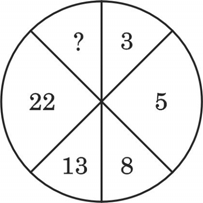
Answer: A. 45
Question 91
Topic: General Aptitude
In this, you are given a combination of alphabets and/or numbers followed by four alternatives (a), (b), (c) and (d). Choose the alternative which closely resembles the mirror image of the given combination.
Answer: B.
Question 92
Topic: General Aptitude
Observe the given figure and answer question below. If 50 play Football, 40 play Cricket and 30 play Basketball, then what is the number of players who play Football or Cricket but not Basketball?
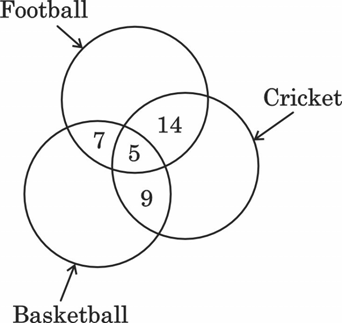
Answer: A. 45
Question 93
Topic: General Aptitude
Which of the following boxes should replace the question mark (?) to complete the pattern?
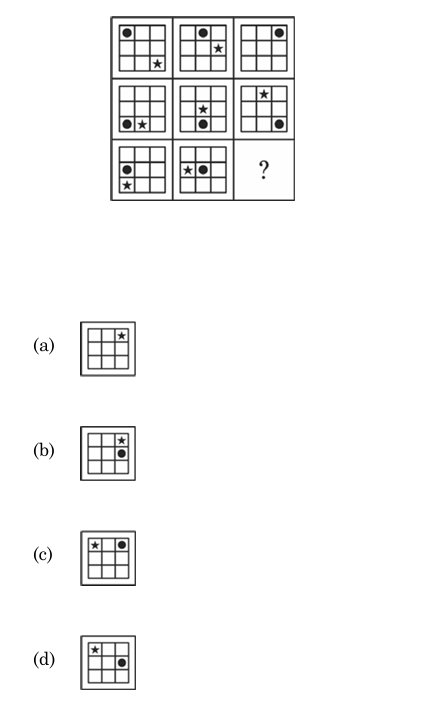
Answer: B.
Question 94
Topic: General Aptitude
Choose which one of the options best fits the missing symbol?
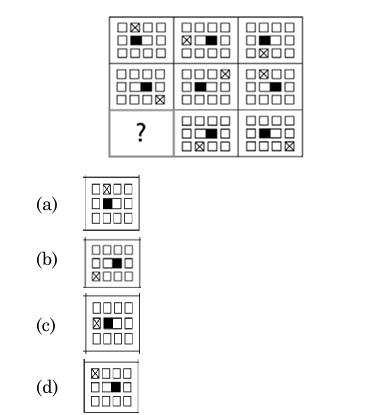
Answer: B.
Question 95
Topic: General Aptitude
Which figure completes the series?
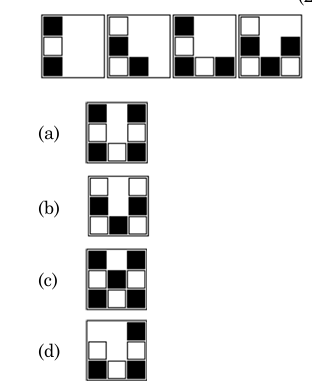
Answer: B.