ISRO Mechanical & Aerospace 2020 Question Paper & Solutions
Attempt the ISRO Mechanical & Aerospace 2020 previous year paper in real CBT exam mode or practice mode with verified answers and explanations.
All ISRO Mechanical & Aerospace papers
80 questions. Answers are shown only where the official answer key is available.
Question 1
A centrifugal pump having an impeller diameter of 127 mm, delivers a power of 12 hp. If the impeller diameter is changed to 254 mm, what is the power, if other parameters are kept constant?
- A. 48 hp
- B. 192 hp
- C. 24 hp
- D. 96 hp
Answer: D. 96 hp
Question 2
In a circular tube of diameter 100 mm and length 13 m with laminar flow, the friction factor is estimated to be 0.05. Calculate the Reynolds number?
- A. 950
- B. 2300
- C. 1280
- D. None of the above
Answer: C. 1280
Question 3
A hot fluid is flowing through a long pipe of 4 cm outer diameter and covered with 2 cm thick insulation. It is proposed to reduce the conduction heat loss to the surroundings to one third of the present rate by increasing the same insulation thickness. The additional thickness of insulation required will be
- A. 2 cm
- B. 6 cm
- C. 9 cm
- D. 12 cm
Answer: D. 12 cm
Explanation: For cylindrical surface $Q \propto 1 / \ln(r_{out}/r_{in})$. $Q_2/Q_1 = 1/3$. $r_1 = 2$cm, $r_2 = 4$cm. Solving logarithmic relation, $r_3 = 16$cm. Increment = $16 - 4 = 12$ cm.
Question 4
For a non-dimensional specific speed value of 1, for maximum efficiency, which of the following turbines is preferred?
- A. Pelton wheel
- B. Francis turbine
- C. Kaplan turbine
- D. Tyson wheel
Answer: B. Francis turbine
Question 5
An experiment is conducted with a fluid of density 1 kg/m³ at 10 m/s velocity. The free stream static pressure is 100 kPa and the local static pressure is 101 kPa. What is the pressure coefficient at the location?
Answer: C. 20
Question 6
An open tank is filled with water to a height of 20 m. What is the velocity of the water flow at the outlet, if the outlet is at the base of the tank?
- A. 40 m/s (approx.)
- B. 20 m/s (approx.)
- C. 10 m/s (approx.)
- D. 5 m/s (approx.)
Answer: B. 20 m/s (approx.)
Question 7
Which of the following is a non-Newtonian fluid?
- A. Air
- B. Water
- C. Gasoline
- D. None of the above
Answer: D. None of the above
Question 8
A hot body at 1000 K transfers 2000 kJ of heat to a body at 500 K. Determine the net entropy change?
- A. +4 kJ/kg
- B. -2 kJ/kg
- C. +2 kJ/kg
- D. -4 kJ/kg
Answer: C. +2 kJ/kg
Question 9
Highest ratio of specific heat is possible for?
- A. Argon
- B. Helium
- C. Hydrogen
- D. Air
Answer: A. Argon
Question 10
Which of the following can be used to determine the variation of saturation pressure with temperature along phase boundaries?
- A. Joule-Thomson relation
- B. Carnot equation
- C. Rankine- Hougoniot's relation
- D. Clausius- Clapeyron relation
Answer: D. Clausius- Clapeyron relation
Question 11
Air at 27 °C and 100 kPa enters in a steady flow nozzle at a velocity of 100 m/s. If the inlet area of the nozzle is 0.5 m², what is the mass flow rate through the system?
- A. 116 kg/s
- B. 232 kg/s
- C. 58 kg/s
- D. 143 kg/s
Answer: C. 58 kg/s
Question 12
Critical point of water is
- A. 22.06 kPa
- B. 22.06 MPa
- C. 22.06 atm
- D. 22.06 mbar
Answer: B. 22.06 MPa
Question 13
In a shower mixer, cold water at 27 °C, flowing at 5 kg/min is mixed with hot water at 77 °C flowing at 15 kg/min. The exit temperature of the mixture is
- A. 45.4 °C
- B. 64.5 °C
- C. 34.5 °C
- D. 68.4 °C
Answer: B. 64.5 °C
Question 14
Which of the following uses a regenerator?
- A. Brayton cycle
- B. Ericsson cycle
- C. Stirling cycle
- D. Both (b) and (c)
Answer: D. Both (b) and (c)
Question 15
Ratio of convective mass transfer to the mass diffusion rate is called?
- A. Sherwood number
- B. Schmidt number
- C. Rayleigh number
- D. Strouhal number
Answer: A. Sherwood number
Question 16
A gas is contained in a cylinder with a moveable piston of 100 kg mass. When 2500 J of heat flow into the gas, the internal energy of the gas increases by 1500 J. What is the distance through which the piston rises?
- A. 2 m
- B. 1 m
- C. 2.5 m
- D. 0.5 m
Answer: B. 1 m
Question 17
A refrigerator with COP of 5 is used in a room at 300 K. What will be the heat intake through a section of refrigerator wall of area 100 cm x 100 cm with a thickness of 10 cm, assuming only conduction? Value of thermal conductivity of the wall can be taken as 1 W/cm. K
- A. 5000 W
- B. 1000 W
- C. 7500 W
- D. 3000 W
Question 18
A mass of 1 kg of air at 27 °C and 0.98 atm is taken through a diesel cycle. If the compression ratio of the engine is 16, calculate the temperature of the air after compression? (for calculation, take the ratio of specific heats of air as 1.5)
- A. 1200 °C
- B. 1473 °C
- C. 927 °C
- D. 768 °C
Answer: C. 927 °C
Question 19
An aircraft is in its take off roll at sea level with ambient temperature of 18 °C. What is the approximate speed of the aircraft if the temperature measured by a probe at the exit of the engine diffuser is 36 °C? (Assuming air stagnation at diffuser outlet and Cp of air as 1.0 kJ/kg.K)
- A. 12 m/s
- B. 3 m/s
- C. 6 m/s
- D. 18 m/s
Question 20
The external surface of a wall of 3 m height, 5 m width and 0.5 m thickness is at a temperature of 2 °C. If a heat loss of 150 W from the room is measured across the wall, find the inner wall temperature? The thermal conductivity of wall material can be taken as 1 W/m.K
- A. 280 K
- B. 285 K
- C. 268 K
- D. 282 K
Answer: A. 280 K
Question 21
The typical range of Prandtl number for water is
- A. 0.004-0.300
- B. 1.7-13.7
- C. 50-500
- D. 2000-1000
Answer: B. 1.7-13.7
Question 22
Analogy between momentum and heat transfer is known as
- A. Stanton-Prandtl analogy
- B. Crassoff-Meyer analogy
- C. Chilton-Colburn analogy
- D. None of the above
Answer: C. Chilton-Colburn analogy
Question 23
Which of the following statement is true for a Rayleigh flow at M=1?
- A. Enthalpy is maximum
- B. Entropy is maximum
- C. Enthalpy is minimum
- D. Both (b) and (c)
Answer: B. Entropy is maximum
Question 24
A fluid passes through a well insulated tube of 4.7 cm² cross section area and 5 m length. If the pipe friction coefficient is 0.07 and the flow velocity is 3 m/s, then the flow can be represented using?
- A. Rayleigh flow model
- B. Isentropic flow model
- C. Gino flow model
- D. Fanno flow model
Answer: D. Fanno flow model
Question 25
A fluid having a density of 1 g/cc is in a state with Grashof number 2 x 10^6 and prandtl number 0.7. Assuming acceleration due to gravity as 10 m/s², calculate the Rayleigh number?
- A. 1.4 x 10^6
- B. 2.86 x 10^6
- C. 3.7 x 10^5
- D. 8.4 x 10^6
Answer: A. 1.4 x 10^6
Question 26
A cold liquid enters a counter flow heat exchanger at 15 °C at a rate of 8 kg/s. A hot stream of the same liquid enters the heat exchanger at 75 °C at 2 kg/s. Assuming the specific heat of the fluid as 4 kJ/kg °C. determine the maximum heat transfer rate.
- A. 960 kW
- B. 240 kW
- C. 1920 kW
- D. 480 kW
Answer: D. 480 kW
Question 27
The temperature of a surface with 0.2 m² area is 17 °C. Calculate the wavelength corresponding to maximum monochromatic emissive power
- A. 20 micrometers
- B. 30 micrometers
- C. 10 micrometers
- D. 40 micrometers
Answer: C. 10 micrometers
Question 28
For a surface, the direct and diffuse components of the solar radiation are 400 and 300 W/m² and the direct radiation makes 60 deg angle with the normal. If the surface temperature is 300 K and effective sky temperature is 200 K, calculate net rate of radiation heat transfer. (Assume solar absorptivity and emissivity as 0.1 each; For calculation take Stefan Boltzmanns constant as 6 x 10^-8 W/m².K^4)
- A. 11 W/m²
- B. 45 W/m²
- C. 33 W/m²
- D. 64 W/m²
Answer: A. 11 W/m²
Question 29
Which of the following element is added to high speed tool steels as a scavenger to remove slag impurities during melting and also for increasing cutting efficiency of tools.
- A. Chromium
- B. Vanadium
- C. Molybdenum
- D. Manganese
Answer: B. Vanadium
Question 30
Region of disorder created by movement of dislocations in super lattice is called:
- A. Twin
- B. Stacking fault
- C. Anti-phase boundary
- D. Orowon loop
Answer: C. Anti-phase boundary
Question 31
The state of stress during deep drawing forming operation of a cup is
- A. In the flange of blank, uni-axial compression and in wall of cup, bi-axial tension and compression
- B. In the flange of the blank, uni-axial tension and in wall of cup, bi-axial tension and compression
- C. In the flange of the blank, bi-axial tension and compression and in the wall of cup, simple uni-axial tension
- D. Both flange and wall of the cup will have bi-axial compression and tension
Answer: C. In the flange of the blank, bi-axial tension and compression and in the wall of cup, simple uni-axial tension
Question 32
During turning of a metallic rod at a given condition, the tool life was found to decrease from 100 min to 25 min. When cutting speed was increased from 50 m/min. to 100 m/min. How much will be life of tool if machined at 80 m/min.?
- A. 38.06 min.
- B. 39.06 min.
- C. 40.06 min.
- D. 41.06 min.
Answer: B. 39.06 min.
Question 33
In a single pass rolling operation, the thickness of a 100 mm wide plate is reduced from 20 mm to 15 mm. The roller radius is 125 mm and rotational speed is 8 rpm. The average flow stress for the plate material is 400 MPa. The power required for rolling operation in kW is?
- A. 12.5 pi/3
- B. 10 pi
- C. 40 pi/3
- D. 20 pi/3
Answer: D. 20 pi/3
Question 34
A dummy activity is used in PERT network to describe
- A. Precedence relationship
- B. Necessary time delay
- C. Resource restriction
- D. Resource idleness
Answer: A. Precedence relationship
Question 35
In small castings, which of the following allowances can be ignored.
- A. Shrinkage Allowance
- B. Rapping Allowance
- C. Draft Allowance
- D. Machining Allowance
Answer: B. Rapping Allowance
Question 36
In an arc welding process, two weld coupons were made using two different welding processes. For the first coupon, the voltage, current and welding speed used are 15V, 300 A and 30 mm/min respectively. Whereas the second coupon is welded with 60 kV, 200 mA and 25 mm/s. If the heat transfer efficiency for welding the first coupon is half of that of second coupon, the ratio of heat input per unit length is?
- A. 50:2
- B. 75:8
- C. 5:8
- D. 52
Answer: B. 75:8
Question 37
In Gas tungsten arc welding (GTAW) which of the following polarity is generally used for getting higher penetration
- A. Direct current straight polarity (DCSP)
- B. Direct current reverse polarity (DCRP)
- C. Alternating current high frequency (ACHF)
- D. All of the above
Answer: A. Direct current straight polarity (DCSP)
Question 38
The laws of adhesive wear, commonly referred to as Archard's law can be expressed as (If 'Q' is the total volume of wear debris produced, 'W' is the normal load, 'L' is the sliding distance, 'H' is the hardness of the softest contacting surfaces being worn away, and 'k' is a non-dimensional wear coefficient dependent on the materials in contact and their exact degree of cleanliness)
- A. Q = kWL/H
- B. Q = kW/LH
- C. Q = kHW/L
- D. Q = k/L WH
Answer: A. Q = kWL/H
Question 39
In a four-bar linkage if 'S' is the length of the shortest link, 'L' is the length of longest link and 'P' & 'Q' are length of other links, then the criteria for getting a triple rocker mechanism in which no links will fully rotate is
- A. S+Q > P+L
- B. S+L < P+Q
- C. S+L = P+Q
- D. S+L > P+Q
Answer: D. S+L > P+Q
Question 40
The piston of an engine moves with simple harmonic motion. The crank rotates at 120 r.p.m. with a stroke of 2 meters. The velocity of the piston, when it is at a distance of 0.8 metre from the center is
- A. 4.8 pi
- B. 2.4 pi
- C. 1.2 pi
- D. 0.6 pi
Answer: B. 2.4 pi
Question 41
If a block slides outward on a link at a uniform rate of 30 m/s, while the link is rotating at a constant angular velocity of 50 rad/s counter clockwise, the Coriolis component of acceleration is m/s².
- A. 1000
- B. 1500
- C. 3000
- D. 4500
Answer: C. 3000
Question 42
In a screw jack of lead angle alpha, the effort required to lift the load W is given by (phi = Friction Angle)
- A. P = W tan(alpha - phi)
- B. P = W tan(alpha + phi)
- C. P = W cos(alpha - phi)
- D. P = W cos(alpha + phi)
Answer: B. P = W tan(alpha + phi)
Question 43
When the axis of first and last gear are co-axial, then gear train is known as
- A. simple gear train
- B. compound gear train
- C. reverted gear train
- D. epicyclic gear train
Answer: C. reverted gear train
Question 44
A disc spinning on its axis at 20 rad/s will undergo precession when a torque 100 N-m is applied about an axis normal to it. If the mass moment of inertia is 1 kg-m², then the angular velocity of precession is?
- A. 0.2 rad/s
- B. 5 rad/s
- C. 10 rad/s
- D. 200 rad/s
Answer: B. 5 rad/s
Question 45
Which of the following is an absorption type dynamometer?
- A. Prony brake dynamometer
- B. Epicyclic- train dynamometer
- C. Torsion dynamometer
- D. Belt transmission dynamometer
Answer: A. Prony brake dynamometer
Question 46
Which of the following mechanism provides intermittent rotary motion?
- A. Chebyschev linkage
- B. Geneva Mechanism
- C. Peaucellier Mechanism
- D. Roberts Mechanism
Answer: B. Geneva Mechanism
Question 47
If m,n are integers and m+n is odd then value of integral from 0 to pi of sin(mx) * cos(nx) dx is
Question 48
1 + x + (x²)/2 - (x^4)/8 - (x^5)/15 + ........ =
- A. e^(tan x)
- B. e^(cos x)
- C. e^(sin x)
- D. e^x sin x
Answer: C. e^(sin x)
Question 49
The Laplace transform of $e^{at} \cos(\omega t)$
- A. (s-a) / ((s-a)^2 + w²)
- B. w / ((s-a)^2 + w²)
- C. a / ((s-a)^2 + w²)
- D. s / ((s-a)^2 + w²)
Answer: A. (s-a) / ((s-a)^2 + w²)
Question 50
if u = yzi + 3zxj + zk, then curl u is
- A. -3xi + yj + 2zk
- B. 3xi - yj + 2zk
- C. -3xi - yj - 2zk
- D. 3xi + yj - 2zk
Answer: A. -3xi + yj + 2zk
Question 51
cos(z) can be expressed as
- A. 1/2 (e^(iz) + e^(-iz))
- B. 1/2 (e^(iz) - e^(-iz))
- C. 1/(2i) (e^(iz) + e^(-iz))
- D. 1/(2i) (e^(iz) - e^(-iz))
Answer: A. 1/2 (e^(iz) + e^(-iz))
Question 52
In a vector field, Divergence of the gradient is
- A. curl
- B. unity
- C. zero
- D. Laplacian
Answer: D. Laplacian
Question 53
If a continuously differentiable vector function is the gradient of a scalar function, then its curl is
- A. infinite
- B. indeterminate
- C. unity
- D. zero
Answer: D. zero
Question 54
What does 'a' and 'e' indicate in the surface texture symbol shown below
- A. Roughness value, machining allowance
- B. Production method, roughness value
- C. Machining allowance, sampling length
- D. Heat treatment method, sample length
Answer: A. Roughness value, machining allowance
Question 55
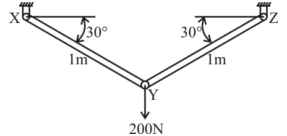
Two steel trusses, XY and YZ of identical size supports a load of 200 N as shown in fig. The length of the truss in 1m. The force in the truss xy in N is
- A. 100 N
- B. 200 N
- C. 150 N
- D. 50 N
Answer: B. 200 N
Question 56
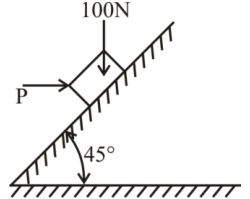
A block weighing 100 N is resting on a plane inclined with horizontal as shown in Fig. What horizontal force P is necessary to hold the body from sliding down the plane? (Coefficient of friction can be taken as 0.25)
- A. 30 N
- B. 120 N
- C. 60 N
- D. 15 N
Answer: C. 60 N
Question 57
The ratio of maximum shear stress to average shear stress in a beam of rectangular section is
Answer: C. 3/2
Question 58
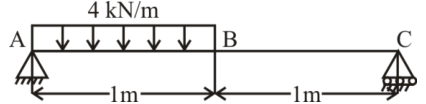
A mass less beam has a loading pattern shown in figure. Find the bending moment at mid span?
- A. 1 kN-m
- B. 3 kN-m
- C. 2 kN-m
- D. 0.0 kN-m
Answer: A. 1 kN-m
Question 59
Steel machine element at the critical section is in biaxial stress state with two principal stress being 300 N/mm² and 300 N/mm² (equal magnitude). Find the von Mises stress (in N/mm²) in the member
- A. 212.1
- B. 600
- C. 424.2
- D. 300
Answer: D. 300
Question 60
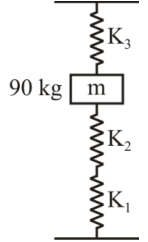
A machine component of 90 kg mass needs to be held in position using three springs as shown below. The spring constants K1, K2 and K3 are 4, 4 and 8 N/m respectively. Find the natural frequency of the system in rad/sec.
- A. 0.33
- B. 0.42
- C. 0.13
- D. 3.0
Answer: A. 0.33
Question 61
A cylindrical pressure vessel has diameter 200 mm and thickness 2 mm. Find the hoop and axial stress (N/mm²) in the cylindrical vessel, when it is subjected to an internal pressure of 5 MPa.
- A. 125, 125
- B. 125, 250
- C. 250, 250
- D. 250, 125
Answer: D. 250, 125
Question 62
For a long slender column of uniform cross section, the ratio of critical buckling load for the case with both ends hinged to the case with both ends clamped is
- A. 0.25
- B. 4.0
- C. 0.125
- D. 0.5
Answer: A. 0.25
Question 63
If the length of a column subjected to compressive load is increase by three times its original length, the critical buckling load becomes
- A. 1/3 of the original value
- B. 3 times the original value
- C. 1/9 of the original value
- D. 1/27 of the original value
Answer: C. 1/9 of the original value
Question 64
A square bar of size 10 mm x 10 mm and length 1000 mm is subjected to 200 N axial tensile force. The bar is made of mild steel having modulus of elasticity of 200 GPa. Find the strain energy density stored in the bar under this state of loading?
- A. 10 J/m³
- B. 20 J/m³
- C. 2 J/m³
- D. 5 J/m³
Answer: A. 10 J/m³
Question 65
A solid circular shaft needs to be designed to transmit a torque of 55 N m. If the allowable shear stress of the material is 280 N/mm², find the diameter (in mm) of the shaft required to transmit torque. (Assume, pi = 22/7)
- A. 5.62
- B. 10
- C. 31.62
- D. 25.0
Answer: B. 10
Question 66
If S is the applied stress, c is the width of the crack and r the radius of curvature at the tip of the crack, Griffith's crack theory gives the concentrated stress Sc as
- A. 2S(c/r)^(1/2)
- B. 2S(c/r)^(1/3)
- C. S(c/r)^(1/2)
- D. 2S(2c/r)^(1/2)
Answer: A. 2S(c/r)^(1/2)
Question 67
A metal alloy machine component is subjected to fluctuating tensile stress from 100 N/mm² to 200 N/mm². The material has yield and endurance strength of 450 and 200 N/mm² respectively. Find the factor of safety of the machine component.
- A. 5/6
- B. 12/7
- C. 1/3
- D. 6/5
Answer: B. 12/7
Question 68
A driver of mass 100 kg is standing at the tip of a spring board of negligible mass. The natural frequency of the spring board with the driver is 1.6 Hz. What is the static deflection at the tip of the spring board when the driver is standing at the tip?
- A. 0.1 mm
- B. 981 mm
- C. 98.1 mm
- D. 9.81 mm
Answer: C. 98.1 mm
Question 69
Which of the following is classified as a secondary bond in materials?
- A. Ionic bonding
- B. Covalent bonding
- C. Metallic bonding
- D. Hydrogen bonding
Answer: D. Hydrogen bonding
Question 70
The number of atoms per unit cell for an FCC crystal structure is
Answer: B. 4
Question 71
Which of the following hardness test uses diamond cone type indenter?
- A. Brinell
- B. Vickers
- C. Knoop
- D. Rockwell
Answer: D. Rockwell
Question 72
In a two component system, if the non-compositional variable is only temperature, the number of degrees of freedom in the case of a single phase field as per Gibbs Phase Rule is?
Answer: C. 2
Question 73
In an iron-carbon diagram, the percentage by weight of carbon at eutectoid composition is
- A. 1.12
- B. 0.76
- C. 0.24
- D. 0.03
Answer: B. 0.76
Question 74
Of the various microstructures that may be produced for a given steel alloy, which among the following is the hardest form
- A. Martensite
- B. Pearlite
- C. Bainite
- D. Spheroidite
Answer: A. Martensite
Question 75
Which spring steel is widely used for aircraft engine valves
- A. Oil tempered wire (0.6 C to 0.7 C)
- B. Chrome vanadium
- C. Hard drawn wire (0.6 C to 0.7 C)
- D. Phosphor bronze wire
Answer: B. Chrome vanadium
Question 76
If, Kf is the fatigue stress concentration factor and Kt is the theoretical stress concentration factor then, the notch sensitivity q is?
- A. (Kf+1)/(Kt+1)
- B. (Kf-1)/(Kt-1)
- C. (Kt-1)/(Kt-1)
- D. (Kf-1)/(Kt+1)
Answer: B. (Kf-1)/(Kt-1)
Question 77
Beach or clamshell marks on a failed metallic surface are typical of
- A. Ductile fracture
- B. Brittle fracture
- C. Creep failure
- D. Fatigue failure
Answer: D. Fatigue failure
Question 78
In vibration isolation if $\omega/\omega_n$ is less than $\sqrt{2}$ then the transmissibility will be
- A. Less than one
- B. Equal to one
- C. Greater than one
- D. Zero
Answer: C. Greater than one
Question 79
The natural frequency of a simply supported beam of length l with mass M at its centre, flexural rigidity EI and negligible beam mass is
- A. 1/(2*pi) * $\sqrt{48EI/Ml³}$
- B. 1/(2*pi) * $\sqrt{3EI/Ml³}$
- C. 1/(2*pi) * $\sqrt{EI/Ml³}$
- D. None of the above
Answer: A. 1/(2*pi) * $\sqrt{48EI/Ml³}$
Question 80
A machine component of natural frequency 20 rad/s is subjected to a base motion from the machine which is harmonic in natural with amplitude 3 m/s² at 10 rad/s. What is the peak amplitude of relative displacement of the components if the damping is negligible?
- A. 0.1 mm
- B. 1.0 mm
- C. 10.0 mm
- D. 100.0 mm
Answer: C. 10.0 mm