ISRO Mechanical & Aerospace 2017-2 Question Paper & Solutions
Attempt the ISRO Mechanical & Aerospace 2017-2 previous year paper in real CBT exam mode or practice mode with verified answers and explanations.
All ISRO Mechanical & Aerospace papers
80 questions. Answers are shown only where the official answer key is available.
Question 1
Topic: Strength of Materials
A beam is fixed at one end and is vertically supported at the other end. What is the degree of statical indeterminacy?
Answer: A. 1
Explanation: For a propped cantilever beam, there are four reactions: $R_{H}$, $R_{A}$, $M_{A}$ at the fixed end, and $R_{B}$ at the vertical support. There are three independent equations of static equilibrium ($\sum H=0$, $\sum V=0$, and $\sum M=0$). Therefore, the degree of static indeterminacy = No. of Reactions - No. of equilibrium equations = $4 - 3 = 1$.
Question 2
Topic: Power Plant Engineering
In a gas turbine power plant, reheating of gases between high pressure and low pressure turbine stages will
- A. Improve turbine output
- B. Decrease turbine output
- C. Increase compressor work
- D. Decrease compressor work
Answer: A. Improve turbine output
Explanation: Following are the effects of reheating in a gas turbine power plant: 1. No change in compressor work. 2. Turbine work output increases. 3. Net work output increases. 4. Both mean temperature of heat addition and heat rejection increases. 5. Both heat supplied and heat rejected increases. 6. Efficiency decreases. 7. Scope of regeneration increases.
Question 3
Topic: Engineering Mechanics
The resultant of two forces acting at $60^{\circ}$ is 7 N and when acting at right angles is $\sqrt{34}N$ The forces are
- A. 25 N and 9 N
- B. 3 N and $\sqrt{5}N$
- C. 3 N and 5 N
- D. $\sqrt{3}N$ and $\sqrt{5}N$
Answer: C. 3 N and 5 N
Explanation: By Parallelogram Method, $R=\sqrt{P^{2}+Q^{2}+2PQ~\cos~\theta}$. For $60^{\circ}$: $7=\sqrt{P^{2}+Q^{2}+2PQ\cos60^{\circ}} = \sqrt{P^{2}+Q^{2}+PQ} \Rightarrow 49=P^{2}+Q^{2}+PQ$ (Eq 1). When acting at right angles ($90^{\circ}$): $\sqrt{34}=\sqrt{P^{2}+Q^{2}} \Rightarrow 34=P^{2}+Q^{2}$ (Eq 2). Substituting (2) in (1): $49=34+PQ \Rightarrow PQ=15$. Solving $P^{2}+Q^{2}=34$ and $PQ=15$ yields $P=3N$ and $Q=5N$.
Question 4
Topic: Manufacturing Engineering
The metal removal rate in abrasive jet machining process is
- A. high
- B. very high
- C. low
- D. very low
Answer: C. low
Explanation: In Abrasive Jet Machining (AJM), the metal removal rate is very low (around $0.0001~cm^{3}/sec$). It is mostly used for finishing or cutting hard/brittle materials. Stray cutting cannot be avoided, tapering effects may occur, and soft materials cannot be machined effectively by this process.
Question 5
Topic: Refrigeration and Air Conditioning
The air inside a space capsule is maintained at the required condition by passing it through a set of heat exchangers. The heat exchangers are designed such that the humid air passing through them is cooled and partial condensation of the water vapour occurs. On a psychrometric chart, this process appears as a line which is
- A. Horizontal to the left
- B. Vertical downwards
- C. Diagonal downwards to the left
- D. Diagonal upwards to the right
Answer: C. Diagonal downwards to the left
Explanation: The process described is cooling (which reduces the dry bulb temperature) and dehumidification (which reduces the specific humidity due to partial condensation). On a psychrometric chart, cooling moves left horizontally, and dehumidification moves vertically downwards. Combined, this appears as a line which is diagonal downwards to the left.
Question 6
Topic: Strength of Materials
Two bolts A and B of same material and length are subjected to identical tensile load. If the elastic strain energy stored in bolt A is 16 times that of the bolt B and the mean diameter of bolt A is 13 mm, the mean diameter of bolt B (in mm) is
Answer: A. 52
Explanation: Strain energy $SE = \frac{P^{2}L}{2AE}$. Given $SE_{A} = 16 \cdot SE_{B}$. Since P, L, and E are the same for both bolts, $SE \propto \frac{1}{A}$. Therefore, $\frac{1}{A_{A}} = \frac{16}{A_{B}} \Rightarrow A_{B} = 16A_{A}$. Using area $A = \frac{\pi}{4}d^{2}$, we get $d_{B}^{2} = 16d_{A}^{2} \Rightarrow d_{B} = 4d_{A}$. Given $d_{A} = 13~mm$, $d_{B} = 4 \times 13 = 52~mm$.
Question 7
Topic: Manufacturing Engineering
The source of energy in ultrasonic machining process is
- A. Mechanical
- B. Electrical
- C. Electric spark
- D. None of these
Answer: A. Mechanical
Explanation: In Non-traditional Machining Processes, Ultrasonic Machining (USM) and Abrasive Jet Machining (AJM) use Mechanical energy. EDM and EBM use Thermal energy, while ECM uses Electrochemical energy.
Question 8
Topic: Fluid Mechanics and Machinery
A turbine develops 500 kW power under a head of 100 m at 200 rpm. What would be its normal speed under a head of 81 m?
- A. 100 rpm
- B. 180 rpm
- C. 1800 rpm
- D. 162 rpm
Answer: B. 180 rpm
Explanation: For a hydraulic turbine, the unit speed relation is $N \propto \sqrt{H}$. Therefore, $\frac{N_{1}}{\sqrt{H_{1}}} = \frac{N_{2}}{\sqrt{H_{2}}}$. Given $N_{1}=200~rpm$, $H_{1}=100~m$, and $H_{2}=81~m$. $\frac{200}{\sqrt{100}} = \frac{N_{2}}{\sqrt{81}} \Rightarrow \frac{200}{10} = \frac{N_{2}}{9} \Rightarrow N_{2} = 20 \times 9 = 180~rpm$.
Question 9
Topic: Strength of Materials
A solid rod of 12 mm diameter was tested for tensile strength with the gauge length of 50 mm. Final length = 80 mm; Final diameter = 4 mm; Yield load = 1130 N. What is the nearest yield stress and % reduction in area respectively?
- A. 10 MPa and 10%
- B. 90 MPa and 90%
- C. 10 MPa and 90%
- D. 90 MPa and 10%
Answer: C. 10 MPa and 90%
Explanation: Yield stress $\sigma_{y} = \frac{\text{Yield Load}}{\text{Original Area}} = \frac{1130}{\frac{\pi}{4} \times 12^{2}} = \frac{1130}{113.097} \approx 10~MPa$. Percentage reduction in area = $\frac{A_{i} - A_{f}}{A_{i}} \times 100 = \frac{d_{i}^{2} - d_{f}^{2}}{d_{i}^{2}} \times 100 = \frac{12^{2} - 4^{2}}{12^{2}} \times 100 = \frac{144 - 16}{144} \times 100 = \frac{128}{144} \times 100 \approx 88.88\% \approx 90\%$.
Question 10
Topic: Thermodynamics
When water at $0^{\circ}C$ is heated, its specific volume under standard atmosphere
- A. First increases then decreases
- B. First decreases then increases
- C. Increases steadily
- D. Decreases steadily
Answer: B. First decreases then increases
Explanation: When water is heated from $0^{\circ}C$, its density first increases until it reaches a maximum at $4^{\circ}C$, and then it decreases. Since specific volume is the reciprocal of density ($V \propto 1/\rho$), the specific volume will first decrease (up to $4^{\circ}C$) and then increase upon further heating.
Question 11
Topic: Theory of Machines
A spherical joint has _____ degree (s) of freedom.
- A. One
- B. Two
- C. Three
- D. Four
Answer: C. Three
Explanation: A spherical joint (or ball and socket joint) allows rotational movement about all three mutually perpendicular axes in space but restricts all three linear translations along the axes. Therefore, it has 3 degrees of freedom (all rotational).
Question 12
Topic: Machine Drawing
Isometric projection of a sphere is
- A. Circle
- B. Ellipse
- C. Hyperbola
- D. Parabola
Answer: A. Circle
Explanation: The isometric projection is a method for visually representing three-dimensional objects in two dimensions. For a perfect sphere, the isometric projection remains a circle from any viewing angle, though its diameter is typically drawn equal to the true diameter of the sphere.
Question 13
Topic: Industrial Engineering
ABC inventory control focuses on those
- A. Items not readily available
- B. Items which consume less money
- C. Items which have more demand
- D. Items which consume more money
Answer: D. Items which consume more money
Explanation: ABC analysis is an inventory categorization technique. 'A' items are very important for an organization because of their high value/capital investment (consuming more money), representing roughly 70-80% of total inventory value despite being only 10-20% of items. It primarily focuses control efforts on high-value items.
Question 14
Topic: Fluid Mechanics
How does the viscosity of fluids vary with increase in temperature?
- A. Increases for both liquids and gases
- B. Increases for liquids, decreases for gases
- C. Increases for gases, decreases for liquids
- D. Decreases for both liquids and gases
Answer: C. Increases for gases, decreases for liquids
Explanation: For liquids, viscosity is predominantly due to cohesive forces, which decrease as temperature increases, causing viscosity to drop. For gases, viscosity is due to molecular momentum exchange (collisions), which increases with temperature, causing gas viscosity to increase.
Question 15
Topic: Design of Machine Elements
It is required to connect two parallel shafts, the distance between whose axes is small and variable. They can be coupled by
- A. Universal joint
- B. Knuckle joint
- C. Sleeve coupling
- D. Oldham coupling
Answer: D. Oldham coupling
Explanation: Oldham Coupling is used to connect two parallel shafts where the distance between their axes is small and can be slightly variable. Universal joint connects inclined shafts. Knuckle joint connects shafts subject to axial loading. Sleeve coupling connects perfectly aligned parallel shafts.
Question 16
Topic: Fluid Mechanics
Under what condition does flow separation take place?
- A. When $dp/dx>0$
- B. When $dp/dx<0$
- C. When $dp/dx=0$
- D. Not a function of dp/dx
Answer: A. When $dp/dx>0$
Explanation: Flow separation takes place under an adverse pressure gradient, which occurs when $\frac{\partial p}{\partial x} > 0$. A favourable condition with attached flow occurs when $\frac{\partial p}{\partial x} < 0$.
Question 17
Topic: Material Science
The variety of cast iron which has maximum hardness is
- A. Gray iron
- B. Malleable iron
- C. Ductile iron
- D. White iron
Answer: D. White iron
Explanation: White cast iron has maximum hardness among various varieties of cast iron. The white cast iron structure is very hard, wear-resistant and brittle because of the presence of large amount of iron carbide instead of graphite.
Question 18
Topic: Theory of Machines
The Kutzback criterion for determining the number of degrees of freedom (n) of a mechanism with L as number of links, J as number of lower pairs and H as number of higher pairs is
- A. $3(J-1)-2L-H$
- B. $2(L-1)-2J-H$
- C. $3(L-1)-2J-H$
- D. $2(L-1)-3J-H$
Answer: C. $3(L-1)-2J-H$
Explanation: The Kutzback criterion is $n=3(L-1)-2J-H$, where $n$ = Degree of freedom, $L$ = No. of links, $J$ = No. of binary joints (lower pairs), $H$ = No. of higher pairs. Note: Kutzback criterion is valid only for 2-D mechanisms.
Question 19
Topic: Material Science
The crystal structure of cementite is
- A. FCC
- B. BCC
- C. Tetragonal
- D. Orthorhombic
Answer: D. Orthorhombic
Explanation: Cementite ($Fe_{3}C$) is a very hard and brittle inter-metallic compound and has a significant influence on the properties of steels. Its crystal structure is orthorhombic. In comparison, Austenite has an FCC structure and Ferrite has a BCC structure.
Question 20
Topic: Material Science
Hardness will be highest after which of the following heat treatment process?
- A. Furnace cooling
- B. Air cooling
- C. Oil quenching
- D. Water quenching
Answer: D. Water quenching
Explanation: Hardness will be highest after water quenching. The rate of cooling decides the hardness of the alloy and this is different for different fluids used because of the difference in the thermal conductivities, the specific heats and the heats of vaporization of these mediums.
Question 21
Topic: Theory of Machines
In which of the following type of gear train, the first gear and last gear are co-axial.
- A. Compound gear train
- B. Simple gear train
- C. Reverted gear train
- D. None of these
Answer: C. Reverted gear train
Explanation: Reverted Gear Train - If the axes of the first and the last wheels of a compound gear train coincide, it is called a reverted gear train.
Question 22
Topic: Heat Transfer
For heat transfer across a composite slab with materials having different thermal conductivity, study the following statements.
I. Temperature is continuous always.
II. Temperature gradient is not continuous.
III. Heat flow is not continuous.
- A. Statement I alone is correct
- B. Statement I and II are correct
- C. Statement II alone is correct
- D. All the statements are correct
Answer: B. Statement I and II are correct
Explanation: Temperature profile in any single slab is continuous. The temperature gradient $\frac{dT}{dx} \propto \frac{1}{k}$. Therefore, the temperature gradient is constant in a single slab having constant thermal conductivity. If there are two slabs having different thermal conductivities, they will have different temperature gradients and hence at the interface, the gradient will be non-continuous.
Question 23
Topic: Material Science
Which of the following treatment does not improve hardness?
- A. Quenching
- B. Cyaniding
- C. Normalizing
- D. Annealing
Answer: D. Annealing
Explanation: Annealing is a stress relieving process. It does not improve hardness; instead, it is used to increase ductility and reduce hardness and strength. Quenching is a hardening process. Cyaniding increases surface hardness, and normalizing increases hardness compared to the annealing process.
Question 24
Topic: Theory of Machines
The ratio of the height of a porter governor (when the length of arms and links are equal) to the height of watt governor is: (m: mass of the ball; M: mass of the sleeve)
- A. $\frac{m}{m+M}$
- B. $\frac{M}{m+M}$
- C. $\frac{m+M}{m}$
- D. $\frac{m+M}{M}$
Answer: C. $\frac{m+M}{m}$
Explanation: The height of a Porter governor is $h_{porter} = \frac{895}{N^{2}}(\frac{m+M}{m})$ and the height of a Watt governor is $h_{watt} = \frac{895}{N^{2}}$. Thus, the ratio $\frac{h_{porter}}{h_{watt}} = \frac{m+M}{m}$.
Question 25
Topic: Heat Transfer
For a specified inlet and outlet temperatures, for which kind of heat exchanger will the log mean temperature difference, $\Delta T_{lm}$ will be highest?
- A. Double pipe parallel flow heat exchanger
- B. Double pipe counter flow heat exchanger
- C. Cross flow heat exchanger
- D. Multi pass shell and tube heat exchanger
Answer: B. Double pipe counter flow heat exchanger
Explanation: For specified inlet and outlet temperatures of hot and cold fluids, the double pipe counter flow heat exchanger provides the highest Log Mean Temperature Difference (LMTD) among all flow arrangements.
Question 26
Topic: Machine Design
Fatigue strength for non-ferrous materials is usually defined at _________ stress cycles.
- A. $10^{4}$
- B. $10^{7}$
- C. $10^{9}$
- D. $10^{12}$
Answer: B. $10^{7}$
Explanation: For non-ferrous materials, there is no particular limiting stress (i.e. endurance limit). As stress reduces, the number of cycles to failure keeps increasing. Hence, the strength corresponding to $10^{7}$ or $5 \times 10^{8}$ cycles is considered as characteristic of the material and is known as fatigue strength.
Question 27
Topic: Engineering Mathematics
If $A=\begin{pmatrix}9&6\\ 8&7\end{pmatrix}$ then det $(A^{99}-A^{98})$ is
Answer: C. 0
Explanation: We know that $|AB|=|A||B|$. Thus, $|A^{99}-A^{98}| = |A^{98}(A-I)| = |A^{98}||A-I|$. Let's evaluate $|A-I| = \begin{vmatrix} 9-1 & 6 \\ 8 & 7-1 \end{vmatrix} = \begin{vmatrix} 8 & 6 \\ 8 & 6 \end{vmatrix} = (8 \times 6) - (6 \times 8) = 48 - 48 = 0$. Since $|A-I|=0$, $|A^{99}-A^{98}| = |A^{98}| \times 0 = 0$.
Question 28
Topic: Engineering Mathematics
$\lim_{\theta\rightarrow\pi/2}\frac{\log(\theta-\pi/2)}{\tan~\theta}$ is
- A. 1
- B. $\pi/2$
- C. $\pi/4$
- D. 0
Answer: D. 0
Explanation: The limit takes the form of $\frac{\infty}{\infty}$. Applying L'Hospital's rule: $\lim_{\theta\rightarrow\pi/2} \frac{\frac{1}{\theta-\pi/2}}{\sec^{2}\theta} = \lim_{\theta\rightarrow\pi/2} \frac{\cos^{2}\theta}{\theta-\pi/2}$. This takes the $\frac{0}{0}$ form. Applying L'Hospital's rule again: $\lim_{\theta\rightarrow\pi/2} \frac{2\cos\theta(-\sin\theta)}{1} = -\sin(2 \times \pi/2) = -\sin\pi = 0$.
Question 29
Topic: Engineering Mathematics
The solution of ODE $y~dx+x~dy=0$ is
- A. $y=\frac{k}{x}$
- B. $y=\frac{k}{y-x}$
- C. $y=\frac{x}{y}$
- D. $y=e^{kx}$
Answer: A. $y=\frac{k}{x}$
Explanation: Separating the variables: $\frac{dx}{x} = -\frac{dy}{y}$. Integrating both sides: $\ln x = -\ln y + \ln k \Rightarrow \ln x + \ln y = \ln k \Rightarrow \ln(xy) = \ln k \Rightarrow xy = k \Rightarrow y = \frac{k}{x}$.
Question 30
Topic: Engineering Mathematics
If $\phi$ is a scalar point function, the value of curl Grad $\phi$ is
Answer: A. 0
Explanation: The curl of the gradient of any scalar field $\phi$ is always zero vector. Mathematically, $\nabla \times (\nabla \phi) = 0$.
Question 31
Topic: Engineering Mathematics
The point where the plane $x+3y+2z-6=0$ meets the line joining P (2, 1, 1) and Q (1, 3, -2) is,
- A. (2, 1, 1)
- B. (1, 1, 1)
- C. (1, 3, -2)
- D. (-1, 3, 2)
Answer: C. (1, 3, -2)
Explanation: Equation of the line passing through P and Q is $\frac{x-2}{1-2}=\frac{y-1}{3-1}=\frac{z-1}{-2-1} \Rightarrow \frac{x-2}{-1}=\frac{y-1}{2}=\frac{z-1}{-3}=k$. (This can be rewritten as $\frac{x-2}{1}=\frac{y-1}{-2}=\frac{z-1}{3}=k$). Any point on this line is $x=2+k$, $y=1-2k$, $z=1+3k$. This point must lie on the plane $x+3y+2z-6=0$. Substituting the coordinates into the plane equation: $(2+k)+3(1-2k)+2(1+3k)-6=0 \Rightarrow 2+k+3-6k+2+6k-6=0 \Rightarrow k+1=0 \Rightarrow k=-1$. Substituting $k=-1$ into the point coordinates yields: $(2-1, 1-2(-1), 1+3(-1)) = (1, 3, -2)$.
Question 32
Topic: Engineering Mathematics
$\int_{0}^{\pi/2}\sin^{7}x~dx~is$
- A. $\frac{8}{35}$
- B. $\frac{16}{35}$
- C. 0
- D. 1
Answer: B. $\frac{16}{35}$
Explanation: Using Wallis' formula for definite integrals of the form $\int_{0}^{\pi/2}\sin^{n}x~dx$, when n is an odd integer: $\frac{n-1}{n} \times \frac{n-3}{n-2} \times \dots \times \frac{2}{3} \times 1$. For $n=7$, the integral is $\frac{6}{7} \times \frac{4}{5} \times \frac{2}{3} = \frac{48}{105} = \frac{16}{35}$.
Question 33
Topic: Engineering Mathematics
Laplace transform of $t \cos(at)$ is
- A. $\frac{s^{2}+a^{2}}{(s^{2}-a^{2})^{2}}$
- B. $\frac{s}{(s^{2}-a^{2})^{2}}$
- C. $\frac{s^{2}-a^{2}}{(s^{2}+a^{2})^{2}}$
- D. $\frac{s}{(s^{2}+a^{2})^{2}}$
Answer: C. $\frac{s^{2}-a^{2}}{(s^{2}+a^{2})^{2}}$
Explanation: By the property of Laplace transforms, $L[t^n f(t)] = (-1)^n \frac{d^n}{ds^n}[F(s)]$. Here, $f(t) = \cos(at)$ and $F(s) = \frac{s}{s^2+a^2}$. For $n=1$, $L[t \cos(at)] = -\frac{d}{ds}\left(\frac{s}{s^2+a^2}\right)$. Using the quotient rule: $-\left[\frac{(s^2+a^2)\cdot 1 - s \cdot (2s)}{(s^2+a^2)^2}\right] = -\left[\frac{a^2-s^2}{(s^2+a^2)^2}\right] = \frac{s^2-a^2}{(s^2+a^2)^2}$.
Question 34
Topic: Engineering Mathematics
If two vectors $\vec{a}=3\hat{i}+4\hat{j}-7\hat{k}$ and $\vec{b}=P\hat{i}-6\hat{j}+3\hat{k}$ are perpendicular, the value of P is
Answer: D. 15
Explanation: If two vectors are perpendicular, their dot product is zero. $\vec{a} \cdot \vec{b} = (3\hat{i}+4\hat{j}-7\hat{k}) \cdot (P\hat{i}-6\hat{j}+3\hat{k}) = 0$. $\Rightarrow 3P + 4(-6) + (-7)(3) = 0 \Rightarrow 3P - 24 - 21 = 0 \Rightarrow 3P = 45 \Rightarrow P = 15$.
Question 35
Topic: Engineering Mathematics
The arithmetic mean of 12 data point is 79. Later it was found that two data points were wrongly taken as 83 and 68 in place of 78 and 97. The actual mean is
Answer: C. 81
Explanation: Incorrect sum of the 12 data points $= 12 \times 79$. The difference between the correct values and incorrect values $= (78 + 97) - (83 + 68) = 175 - 151 = +24$. The correct sum is the incorrect sum plus 24. Thus, the new mean $= \frac{\text{Incorrect sum} + 24}{12} = 79 + \frac{24}{12} = 79 + 2 = 81$.
Question 36
Topic: IC Engines
How does cetane number varies with octane number in fuels in IC engines?
- A. No relation
- B. Directly proportional
- C. Inversely proportional
- D. Both are equal
Answer: C. Inversely proportional
Explanation: Cetane number is a measure of the ignition quality of diesel fuel (promotes auto-ignition), while octane number is a measure of the resistance of gasoline to auto-ignition (knocking). They are inversely proportional to each other. A fuel with a high octane number will have a low cetane number, and vice versa.
Question 37
Topic: Manufacturing Engineering
The relationship of the shear angle is as per ('$\alpha$' is rake angle and '$\beta$' is friction angle)
- A. Ernst-Merchant theory
- B. Merchant's theory
- C. Stabler theory
- D. Lee and Shaffer theory
Answer: A. Ernst-Merchant theory
Explanation: According to the Ernst-Merchant theory (minimum energy criterion), the relationship for the shear angle $\phi$ is given by $2\phi + \beta - \alpha = \frac{\pi}{2}$ (or $90^{\circ}$). Lee and Shaffer theory is $\phi + \beta - \alpha = \frac{\pi}{4}$ (or $45^{\circ}$).
Question 38
Topic: Machine Design
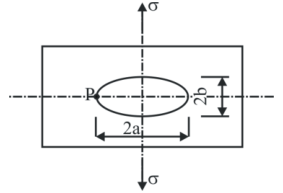
For a plate with an elliptical hole subjected to tensile stress, as shown in the figure, the maximum tensile stress at point P is
- A. $\sigma$
- B. $2\sigma$
- C. $3\sigma$
- D. more than $3\sigma$
Answer: D. more than $3\sigma$
Explanation: The theoretical stress concentration factor $k_{t}$ for an elliptical hole is given by $k_{t} = 1 + 2\left(\frac{a}{b}\right)$, where 'a' is the semi-axis perpendicular to the applied stress and 'b' is the semi-axis parallel to the applied stress. From the figure, the major axis is $2a$ and the minor axis is $2b$, so $a > b$. Therefore, $k_{t} = 1 + 2\left(\frac{a}{b}\right) > 1 + 2(1) = 3$. The maximum stress is $\sigma_{max} = k_{t} \times \sigma_{nominal}$, which will be more than $3\sigma$.
Question 39
Topic: Fluid Mechanics and Machinery
A centrifugal compressor is suitable for which of the following?
- A. High pressure ratio, low mass flow
- B. Low pressure ratio, low mass flow
- C. High pressure ratio, high mass flow
- D. Low pressure ratio, high mass flow
Answer: D. Low pressure ratio, high mass flow
Explanation: A centrifugal compressor is characterized by a high mass flow rate and a relatively low pressure ratio per stage. In contrast, reciprocating compressors are used for low mass flow rates and high pressure ratios.
Question 40
Topic: Manufacturing Engineering
The optimum cutting speed for maximum production is ('n' is tool constant and '$T_{c}$' is time required to change the tool)
- A. $\frac{k}{[\{\frac{1}{n}+1\}T_{c}]^{\frac{n}{2}}}$
- B. $\frac{k}{[\{\frac{1}{n}-1\}T_{c}]^{n}}$
- C. $\frac{k}{[\{1-\frac{1}{n}\}T_{c}]^{2n}}$
- D. $\frac{k}{[\{\frac{1}{n}-1\}\frac{T_{c}}{2}]^{n}}$
Answer: B. $\frac{k}{[\{\frac{1}{n}-1\}T_{c}]^{n}}$
Explanation: For maximum production rate, the optimum tool life is given by $T_{opt} = \left(\frac{1}{n}-1\right)T_{c}$. According to Taylor's tool life equation $V T^n = k$, the optimum cutting speed is $V_{opt} = \frac{k}{T_{opt}^n} = \frac{k}{[\{\frac{1}{n}-1\}T_{c}]^{n}}$.
Question 41
Topic: Strength of Materials
A rod of length L and area of cross section A has a modulus of elasticity E and coefficient of thermal expansion $\alpha$. One end of the rod is fixed and other end is free. If the temperature of the rod is increased by $\Delta T$, then
- A. Stress developed in the rod is $E\alpha\Delta T$ and strain developed in the rod is $\alpha\Delta T$
- B. Stress developed in the rod is zero and strain developed in the rod is $-\alpha\Delta T$
- C. Stress developed in the rod is zero and strain developed in the rod is $\alpha\Delta T$
- D. Stress developed in the rod is $E\alpha\Delta T$ and strain developed in the rod is zero
Answer: C. Stress developed in the rod is zero and strain developed in the rod is $\alpha\Delta T$
Explanation: Since one end of the rod is free, it can freely expand upon heating. Because the expansion is completely unconstrained, no internal resisting forces develop, so the thermal stress is zero. The rod will undergo a thermal strain given by $\epsilon_{T} = \alpha\Delta T$.
Question 42
Topic: Thermodynamics
The entropy of a hot baked potato decreases as it cools.
- A. The above statement is correct
- B. The above statement is incorrect as it violates the increase in entropy principle
- C. Too less information to comment
- D. The above statement is incorrect as it violates second law of thermodynamics
Answer: A. The above statement is correct
Explanation: The entropy of a hot baked potato decreases as it cools because heat is being transferred away from it. This does not violate the second law of thermodynamics; the heat transferred to the surrounding air increases the entropy of the surroundings by a greater amount, so the total entropy of the universe still increases.
Question 43
Topic: Thermodynamics
During January, at a location in Rohtang, winds at $-6^{\circ}C$ can be observed. Several meters below the ground, the temperature remains at $27^{\circ}C$ A scientist claims to have devised a power cycle exploiting this situation that has a thermal efficiency of 10%. Whether the claim is true?
- A. True
- B. False
- C. Can't say
- D. Insufficient data
Answer: A. True
Explanation: The maximum possible thermal efficiency is given by the Carnot cycle efficiency $\eta = \frac{T_{max}-T_{min}}{T_{max}}$. Converting temperatures to Kelvin: $T_{max} = 27 + 273 = 300~K$ and $T_{min} = -6 + 273 = 267~K$. $\eta = \frac{300-267}{300} = \frac{33}{300} = 0.11 = 11\%$. Since the scientist's claimed efficiency (10%) is less than the theoretical maximum limit (11%), the claim is possible and thus true.
Question 44
Topic: Manufacturing Engineering
The side relief angle in a cutting tool signature of 10, 20, 7, 6, 8, 15, 2 is
Answer: C. 6
Explanation: In the ASA (American Standards Association) tool signature system, the sequence is: Back Rake Angle, Side Rake Angle, End Relief Angle, Side Relief Angle, End Cutting Edge Angle, Side Cutting Edge Angle, and Nose Radius. The sequence given is 10, 20, 7, 6, 8, 15, 2. The fourth term is 6, which corresponds to the side relief angle.
Question 45
Topic: Metrology and Inspection
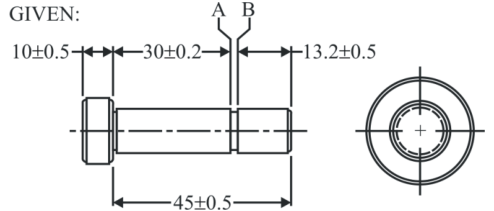
The missing distance between A and B in the pin figure shown below is (GIVEN: Total length = $45 \pm 0.5$, segments = $30 \pm 0.2$ and $13.2 \pm 0.5$)
- A. 1.8
- B. $1.8+1.1$
- C. 0.6
- D. $1.8\pm1.2$
Answer: D. $1.8\pm1.2$
Explanation: The basic size of the missing section AB is the total basic length minus the sum of the known internal segments: $45 - (30 + 13.2) = 1.8$. According to the worst-case method of tolerance accumulation, the total tolerance is the sum of the individual tolerances: $0.5 + 0.2 + 0.5 = 1.2$. Therefore, the dimension of AB is $1.8 \pm 1.2$.
Question 46
Topic: Thermodynamics
In an ideal gas turbine cycle with inter-cooling, reheating and regeneration as the number of compression and expansion states are increased, which of the following statements are correct?
I. The Brayton cycle reduces to Ericsson cycle.
II. The Brayton cycle reduces to Stirling cycle.
III. The cycle efficiency becomes equal to Carnot cycle efficiency.
- A. Statement I alone
- B. Statement III alone
- C. Statement I and II
- D. Statement II and III
Explanation: This question was excluded for evaluation by ISRO. However, theoretically, as the number of compression and expansion stages increases to infinity with ideal intercooling, reheating, and regeneration, the Brayton cycle approaches the Ericsson cycle, and its efficiency approaches the Carnot cycle efficiency (Statements I and III are correct).
Question 47
Topic: Fluid Mechanics
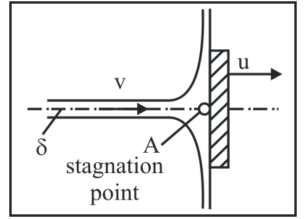
Calculate the dynamic head $(P_{A}-P_{static})$ when a jet of water with a velocity, v strikes a flat plate moving with a velocity, u in the same direction as jet. (Take $u=4~m/s,$ $v=10~m/s$ and $\rho=1000~kg/m^{3})$
- A. 8000 Pa
- B. 50000 Pa
- C. 18000 Pa
- D. 98000 Pa
Answer: C. 18000 Pa
Explanation: At the stagnation point, the relative velocity of the jet with respect to the moving plate is $V_{0}=V-u = 10-4 = 6~m/s$. The dynamic head is given by $(P_{A}-P_{static}) = \rho\left[\frac{(V-u)^{2}}{2}\right] = 1000 \times \frac{(6)^{2}}{2} = 1000 \times \frac{36}{2} = 18000~Pa$.
Question 48
Topic: Machine Drawing
The method of development of a right regular prism is
- A. Parallel line method
- B. Radial line method
- C. Triangulation method
- D. Approximate method
Answer: A. Parallel line method
Explanation: Parallel Line Method is used for developing prisms and single curved surfaces like cylinders, in which all the edges/generators of the lateral surface are parallel to each other. Radial Line Method is employed for pyramids and cones. Triangulation Method is used for developing transition pieces.
Question 49
Topic: Fluid Mechanics
A light plane flies at $720~km/hr$ in standard air at an altitude of 1000 m. Determine the stagnation pressure at the leading edge of the wing. Take, $P_{air}=9.0\times10^{4}N/m^{2}$ $\rho=1.1~kg/m^{3}.$
- A. 90 kPa
- B. 119 kPa
- C. 112 kPa
- D. 100 kPa
Answer: C. 112 kPa
Explanation: Velocity $V=720~km/hr = 720 \times \frac{5}{18} = 200~m/s$. Stagnation pressure $P_{s} = P_{0} + \rho\left(\frac{V^{2}}{2}\right) = 9.0\times10^{4} + 1.1 \times \frac{200^{2}}{2} = 90000 + 1.1 \times 20000 = 90000 + 22000 = 112000~Pa = 112~kPa$.
Question 50
Topic: Material Science
Below the ductile to brittle transition temperature, weld joints show
- A. High ductility
- B. High toughness
- C. Low toughness
- D. Ductile fracture
Answer: C. Low toughness
Explanation: Below the ductile to brittle transition temperature, materials undergo brittle fracture and weld joints show low toughness. Toughness is the area under the stress-strain curve, and for brittle materials, it is significantly lesser than for ductile materials.
Question 51
Topic: Heat Transfer
What is the Prandtl number for a gas at $27^{\circ}C$ and $1\times10^{5}Pa.$ with kinematic viscosity equal to $1.8\times10^{-5}m^{2}/s.$, specific heat capacity at constant pressure $=700~J/kg-K$ and thermal conductivity of 0.02 W/m-K? (Take Gas constant 300 J/kg-K)
- A. 0.52
- B. 0.62
- C. 0.70
- D. 0.78
Answer: C. 0.70
Explanation: Given $T=27^{\circ}C=300~K$, $P=1\times10^{5}~Pa$, $R=300~J/kg-K$. Density $\rho = \frac{P}{RT} = \frac{100000}{300 \times 300} = \frac{10}{9}~kg/m^{3}$. Prandtl number $Pr = \frac{\mu C_{p}}{k} = \frac{\rho v C_{p}}{k}$. Substituting the values: $Pr = \frac{(10/9) \times 1.8\times10^{-5} \times 700}{0.02} = \frac{2\times10^{-5} \times 700}{0.02} = \frac{0.014}{0.02} = 0.70$.
Question 52
Topic: Manufacturing Engineering
In continuous casting process, the mould is generally made of
- A. Cast iron
- B. Bronze
- C. Copper
- D. Tungsten carbide
Answer: C. Copper
Explanation: In the continuous casting process, the mould is generally made of copper because of its high thermal conductivity, which provides the necessary rapid heat extraction and solidification of the molten metal.
Question 53
Topic: Gas Dynamics
A re-entry module flies with Mach 10 at an ambient temperature of $-27^{\circ}C$ with $C_{P}=840$ $J/kg-K,$ gas constant $R=140~J/kg-K.$ What is the stagnation temperature at the tip of the nose of the re-entry module?
- A. $-23^{\circ}C$
- B. $1377^{\circ}C$
- C. $2477^{\circ}C$
- D. $-253^{\circ}C$
Explanation: This question was excluded for evaluation by ISRO. Theoretically, $\gamma = C_{p}/C_{v} = C_{p}/(C_{p}-R) = 840/(840-140) = 840/700 = 1.2$. Ambient temperature $T = -27^{\circ}C = 246~K$. Stagnation temperature $T_{0} = T(1 + \frac{\gamma-1}{2}M^{2}) = 246(1 + \frac{1.2-1}{2}10^{2}) = 246(1 + 0.1 \times 100) = 246 \times 11 = 2706~K$. In Celsius, $2706 - 273 = 2433^{\circ}C$, which does not perfectly match any option.
Question 54
Topic: Material Science
Which one of the following steels contains least percentage of carbon?
- A. Mild steel
- B. Stainless steel 304L
- C. Stainless steel 316L
- D. IF steel
Answer: D. IF steel
Explanation: Interstitial Free (IF) Steels are ultra-low carbon steels. Carbon is small enough to fit into the interstices of the primarily iron matrix making it an 'interstitial element'. In IF steel, carbon and nitrogen levels are kept extremely low, leaving these gaps empty.
Question 55
Topic: Heat Transfer
The Lewis number which is a measure of relative thermal and concentration boundary layer thicknesses is defined as, (Re: Reynold's number, Pr: Prandtl number, Sc: Schmidt number)
- A. $Re\times Pr$
- B. $Sc/Pr$
- C. $Re/Sc$
- D. $Sc\times Pr$
Answer: B. $Sc/Pr$
Explanation: Lewis number is defined as the ratio of thermal diffusivity to mass diffusivity, which is mathematically equivalent to the ratio of Schmidt number to Prandtl number ($Le = Sc/Pr$).
Question 56
Topic: Strength of Materials
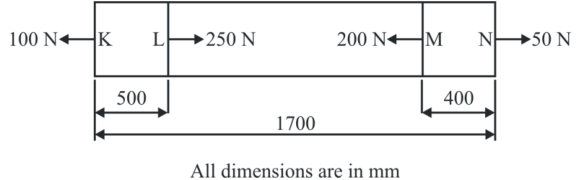
The figure shows an Aluminium rod of $25~mm^{2}$ cross sectional area. It is loaded at four points, K, L, M and N. Assume $E=67$ GPa for Aluminium. The total change in length of the rod due to loading as shown in close to
- A. $30~\mu m$
- B. $-10~\mu m$
- C. $-30~\mu m$
- D. $10~\mu m$
Answer: C. $-30~\mu m$
Explanation: Forces in sections: $P_{KL}=100~N$ (Tension), $P_{LM} = 100-250 = -150~N$ (Compression), $P_{MN} = 50~N$ (Tension). Total change in length $\Delta L = \frac{1}{AE}(P_{KL}L_{KL} + P_{LM}L_{LM} + P_{MN}L_{MN}) = \frac{1}{25\times10^{-6}\times67\times10^{9}}(100\times0.5 - 150\times0.8 + 50\times0.4) = \frac{1}{1675000}(50 - 120 + 20) = \frac{-50}{1675000} = -29.85\times10^{-6}~m \approx -30~\mu m$.
Question 57
Topic: Manufacturing Engineering
The basis of slip line field theory in metal cutting is
- A. Merchant theory
- B. Lee and Shaffer theory
- C. Ernst-Merchant theory
- D. None of these
Answer: B. Lee and Shaffer theory
Explanation: Slip line field theory in metal cutting is the basis of the 'Lee and Shaffer theory'. According to this theory, $\phi = \frac{\pi}{4} + \alpha - \beta$. It assumes that the material being cut behaves like an ideal plastic with no strain hardening and the shear plane represents a direction of maximum shear stress.
Question 58
Topic: Thermodynamics
A room contains 25 kg of air at 100 kPa and $14^{\circ}C$ The room has a 250 W refrigerator and 1 kW electric resistance heater. During a cold winter day, it is observed that both the refrigerator and the heater are running continuously, but the air temperature in the room remains constant. The rate of heat loss from the room during that day is
- A. $3600~kJ/hr.$
- B. $1250~kJ/hr.$
- C. $4500~kJ/hr.$
- D. $2700~kJ/hr.$
Answer: C. $4500~kJ/hr.$
Explanation: Since the air temperature in the room remains constant, the total heat added to the room must equal the heat loss to the surroundings. The power consumed by both the refrigerator (250 W) and the heater (1 kW = 1000 W) acts as heat input to the room. Total heat input $H_{in} = 250 + 1000 = 1250~W = 1250~J/s$. Rate of heat loss = $1250 \times 3600~J/hr = 4.5\times10^{6}~J/hr = 4500~kJ/hr$.
Question 59
Topic: Engineering Mechanics
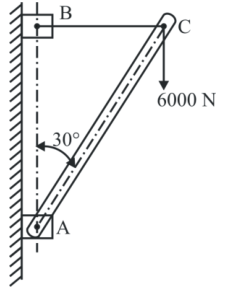
The bar AC, 10m long supports a load of 6000 N as shown in figure. The cable BC is horizontal and 5m long. Forces in the cable and the bar are
- A. 6928 N and 3464 N
- B. 3464 N and 6928 N
- C. 3464 N and 3464 N
- D. 6928 N and 6928 N
Answer: B. 3464 N and 6928 N
Explanation: From the geometry of right-angled triangle ABC, $\sin\theta = \frac{BC}{AC} = \frac{5}{10} = 0.5 \Rightarrow \theta = 30^{\circ}$ (angle with vertical). Balancing vertical forces at C: $F_{AC}\cos 30^{\circ} = 6000 \Rightarrow F_{AC} = \frac{6000}{\sqrt{3}/2} = 6928.2~N$ (Compression). Balancing horizontal forces: $F_{BC} = F_{AC}\sin 30^{\circ} = 6928.2 \times 0.5 = 3464.1~N$ (Tension). Hence, forces in the cable and bar are 3464 N and 6928 N respectively.
Question 60
Topic: Manufacturing Engineering
In a grinding wheel specification of 'wa36k8vbe', "wa" indicates
- A. Grain size
- B. Type of grade
- C. Type of abrasive
- D. Type of structure
Answer: C. Type of abrasive
Explanation: In standard grinding wheel specifications, the prefix or first part represents the abrasive type. Here 'wa' stands for white aluminium oxide. The rest stand for: 36 (Grain size), k (Grade), 8 (Structure), v (Bond type), and be (Manufacturer's record).
Question 61
Topic: Thermodynamics
Two Carnot heat engines are operating in series such that the heat sink of the first engine serves as the heat source of the second one. If the source temperature of the first engine is $1327^{\circ}C.$ the sink temperature of the second engine is $127^{\circ}C$, and the thermal efficiency of both the engines are the same, the temperature of the intermediate reservoir is:
- A. $627^{\circ}C$
- B. $410^{\circ}C$
- C. $577^{\circ}C$
- D. $527^{\circ}C$
Answer: D. $527^{\circ}C$
Explanation: Given, $T_{1}=1327^{\circ}C+273=1600~K$, $T_{3}=127^{\circ}C+273=400~K$. If two engines are connected in series and their thermal efficiencies are the same, the intermediate temperature is given by the geometric mean: $T_{2}=\sqrt{T_{1}\times T_{3}} = \sqrt{1600\times 400} = 40 \times 20 = 800~K$. Converting to Celsius: $T_{2} = 800 - 273 = 527^{\circ}C$.
Question 62
Topic: Engineering Mechanics
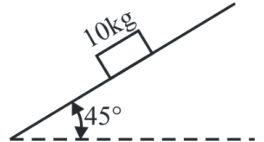
A body of mass 10 kg is initially stationary on a $45^{\circ}$ inclined plane as shown in figure. The coefficient of dynamic friction between the body and the plane is 0.3. The body slides down the plane and attains a velocity of $20~m/s.$ The distance travelled (in meter) by the body along the plane is close to
Answer: C. 41
Explanation: From the FBD for mass m, equating the net forces along the plane: $ma = mg\sin 45^{\circ} - \mu(mg\cos 45^{\circ})$. $a = 9.81 \times \frac{1}{\sqrt{2}} \times [1 - 0.3] = 9.81 \times \frac{1}{\sqrt{2}} \times 0.7 = 4.85~m/s^{2}$. Using equation of motion $v^{2} = u^{2} + 2as \Rightarrow 20^{2} = 0^{2} + 2 \times 4.85 \times s \Rightarrow s = \frac{400}{9.7} = 41.2~m$. The closest option is 41.
Question 63
Topic: Manufacturing Engineering
In metal forming, ring compression test is carried out to find out
- A. Compressive strength
- B. Interface friction
- C. Upset ratio
- D. None of these
Answer: B. Interface friction
Explanation: In metal forming, ring compression test is carried out to find out interface friction. We can determine the magnitude of the friction coefficient $\mu$, at the die (or) workpiece interface. If friction is present, the internal diameter of the ring is reduced with increasing deformation.
Question 64
Topic: Fluid Mechanics
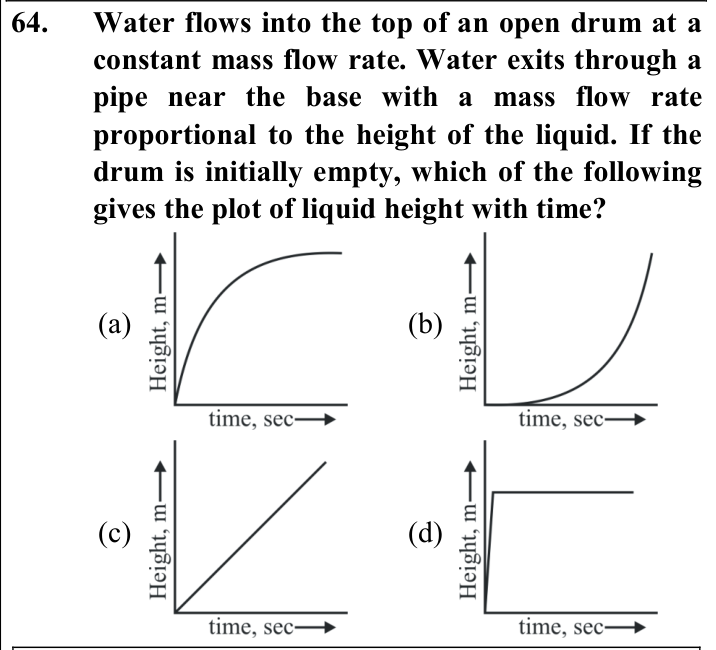
Water flows into the top of an open drum at a constant mass flow rate. Water exits through a pipe near the base with a mass flow rate proportional to the height of the liquid. If the drum is initially empty, which of the following gives the plot of liquid height with time?
- A. Graph (a)
- B. Graph (b)
- C. Graph (c)
- D. Graph (d)
Answer: A. Graph (a)
Explanation: Initially drum is empty with zero height so no discharge, but inlet has a constant mass flow rate. Hence height increases, along with which discharge along starts increasing and after attaining a certain height, discharge rate becomes equal to inlet rate, so after certain time, height becomes constant as depicted by option (a).
Question 65
Topic: Engineering Mechanics
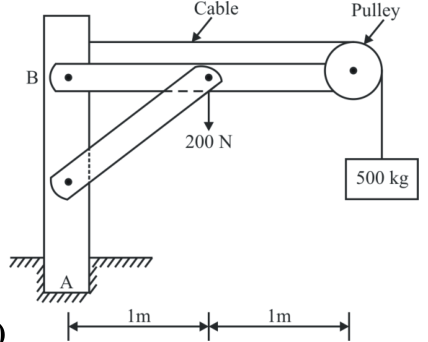
What is the approximate reaction moment at the fixed support A for the loaded frame shown below? (Take the diameter of the pulley as 250 mm)
- A. 10010 Nm
- B. 10624 Nm
- C. 9810 Nm
- D. 1263 Nm
Answer: B. 10624 Nm
Explanation: Moment due to 500 kg weight is given as $M_{1}=Mg(2+0.125) = 500 \times 9.81 \times 2.125 = 10423.125~Nm$. Additional moment due to the 200N force is $M_{2} = 200 \times 1 = 200~Nm$. Moment at fixed support A is $M_{A} = M_{1} + M_{2} = 10423.125 + 200 = 10623.125~Nm \approx 10624~Nm$.
Question 66
Topic: Heat Transfer
A radiator on a space capsule must dissipate heat generated inside the capsule, by radiating it into space. While on the bright side of earth, the capsule sees the earth's radiation and the solar radiation. The radiator surface has a solar absorptivity of 0.5 and an emissivity of 0.9. What is the maximum equilibrium surface temperature of the radiator, if the maximum heat generated in the capsule is $800~W/m^{2}?$ Assume earth's radiation $=100~W/m^{2}$ and solar irradiation $=524~W/m^{2}$ Take Stefan Boltzmann constant as $5\times10^{-8}W/m^{2}-K^{4}$
- A. $400^{\circ}C$
- B. $100^{\circ}C$
- C. $127^{\circ}C$
- D. $160^{\circ}C$
Answer: C. $127^{\circ}C$
Explanation: Heat generated $= 800~W/m^{2}$, Earth's radiation $= 100~W/m^{2}$, Solar irradiation $= 524~W/m^{2}$, Absorptivity $\alpha = 0.5$, Emissivity $\epsilon = 0.9$. Equating net heat transfer: $800 = \epsilon \sigma T^{4} - \alpha \times 524 - 100$. $800 = 0.9 \times 5.67 \times 10^{-8} \times T^{4} - 0.5 \times 524 - 100$. (Using standard value of $\sigma$ or specified, the calculation converges near $400~K$). $T^{4} = 2.58 \times 10^{10} \Rightarrow T = 400.86~K = 127.86^{\circ}C$.
Question 67
Topic: Metrology and Inspection
For profile controls, datum is
- A. Allowed but not required
- B. Not allowed
- C. Required
- D. None of these
Answer: A. Allowed but not required
Explanation: For profile controls (like profile of a line or profile of a surface in GD&T), a datum is allowed but not strictly required. When no datum is specified, the tolerance controls only the form of the profile. If datums are specified, it controls form, orientation, and/or location.
Question 68
Topic: Strength of Materials
A simply supported beam of length L is subjected to a varying distributed load $sin(\pi x/L)$ N/m, where distance x is measured from the left support. The magnitude of the vertical reaction in N at the left support is
- A. $3L/\pi$
- B. $2L/\pi$
- C. $L/2\pi$
- D. $L/\pi$
Answer: D. $L/\pi$
Explanation: Total load on the beam is $\int_{0}^{L}\sin\left(\frac{\pi x}{L}\right)dx = \left[-\frac{L}{\pi}\cos\left(\frac{\pi x}{L}\right)\right]_{0}^{L} = -\frac{L}{\pi}[-1 - 1] = \frac{2L}{\pi}$. Due to the symmetric nature of the sine wave load over the length $L$, the reactions at both supports will be equal. $R_{A} = R_{B} = \frac{1}{2} \times \text{Total Load} = \frac{1}{2} \times \frac{2L}{\pi} = \frac{L}{\pi}$.
Question 69
Topic: Heat Transfer
A packed bed of solid spheres acts as a thermal energy storage system. In a charging process, heat transfer from the hot gas increases thermal energy stored within the spheres. Consider two beds, one with aluminium spheres $(\rho=2700~kg/m^{3},$ $C=950~J/kg-K$, $k=240~W/m-K)$ and other with copper spheres ($\rho=8900~kg/m^{3},$ $C=400~J/kg-K,$ $k=380~W/m-K)$. Select the correct graph for the temperature rise of a sphere at the inlet of the bed
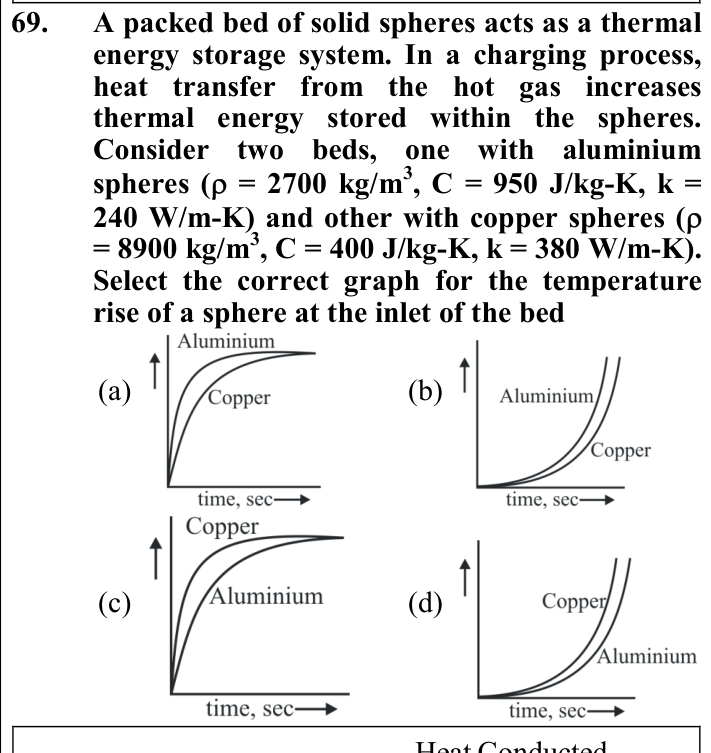
- A. Graph (a)
- B. Graph (b)
- C. Graph (c)
- D. Graph (d)
Answer: A. Graph (a)
Explanation: Thermal diffusivity $\alpha = \frac{k}{\rho C_{p}}$. For Aluminium, $\alpha_{Al} = \frac{240}{2700 \times 950} = 9.35 \times 10^{-5}$. For Copper, $\alpha_{Cu} = \frac{380}{8900 \times 400} = 10.67 \times 10^{-5}$. Since Copper has a higher thermal diffusivity, its temperature responds and rises faster to steady state initially compared to Aluminium, meaning the curve for Copper will be above Aluminium during the transient phase.
Question 70
Topic: Manufacturing Engineering
Compressive residual stresses in weld joints
- A. Decreases tensile strength
- B. Increases cracking tendency
- C. Increases fatigue strength
- D. Coarsen the grain structure
Answer: C. Increases fatigue strength
Explanation: Compressive residual stresses in weld joints increase fatigue strength. The improvement in fatigue performance is based on the concept of lowering the effective applied tensile stresses by inducing compressive residual stress, which suppresses crack growth.
Question 71
Topic: Strength of Materials
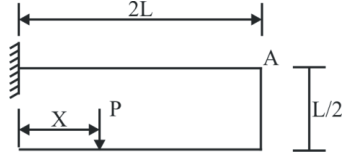
A force P is applied at a distance 'X' from the end of the beam as shown in the figure. What would be value of 'X' so that the displacement at 'A' is equal to zero?
- A. 0.5 L
- B. 0.25 L
- C. 0.33 L
- D. 0.66 L
Answer: D. 0.66 L
Explanation: The moment applied at the support due to the offset load is $M = P(2L - X)$. The upward deflection at point A due to this moment is $\delta_{M} = \frac{M(2L)^{2}}{2EI} = \frac{4P(2L-x)L^{2}}{2EI}$. The downward deflection at point A due to the point load P at the end is $\delta_{P} = \frac{P(2L)^{3}}{3EI} = \frac{8PL^{3}}{3EI}$. Equating them for zero net displacement: $\frac{4P(2L-x)L^{2}}{2EI} = \frac{8PL^{3}}{3EI} \Rightarrow 2L-x = \frac{4}{3}L \Rightarrow x = 2L - \frac{4}{3}L = \frac{2}{3}L = 0.66L$.
Question 72
Topic: Heat Transfer
An electric heater is sandwiched between two plates each 0.3 m long and 0.1 m wide with a thickness of 30 mm. At steady state condition the heater is maintained at a temperature of $100^{\circ}C.$ with a current of 0.25 A and voltage of 200 V. Assume the plates are perfectly insulated at the edges, and the heater is having perfect contact with the plates to given a temperature of $50^{\circ}C$ on the outside of the plate surface. What is the thermal conductivity of the plate material?
- A. $1.0~W/m-K$
- B. $0.5~W/m-K$
- C. $0.015~W/m-K$
- D. $0.3~W/m-K$
Answer: B. $0.5~W/m-K$
Explanation: Total heat generated $H_{gen} = V \times I = 200 \times 0.25 = 50~W$. Since heat flows equally through both plates, heat through one plate is $Q = 50/2 = 25~W$. From Fourier's law, $Q = kA\frac{\Delta T}{\Delta x}$. Substituting values: $25 = k \times (0.3 \times 0.1) \times \frac{100 - 50}{0.030}$. $25 = k \times 0.03 \times \frac{50}{0.03} \Rightarrow 25 = 50k \Rightarrow k = 0.5~W/m-K$.
Question 73
Topic: Manufacturing Engineering
Knife line or hairline cracking is observed in
- A. Ferritic stainless steel
- B. Martensitic stainless steel
- C. Austenitic stainless steel
- D. Stabilized stainless steel
Answer: D. Stabilized stainless steel
Explanation: Knife line (or) hairline cracking is typically observed in stabilized austenitic stainless steels (like those stabilized with Ti or Nb) due to intergranular corrosion in a very narrow band immediately adjacent to the weld fusion line.
Question 74
Topic: Manufacturing Engineering
Riser is designed so as to
- A. Freeze after the casting freezes
- B. Freeze before the casting freezes
- C. Freeze at the same time as the casting
- D. Minimize the time of pouring
Answer: A. Freeze after the casting freezes
Explanation: A riser is a reservoir of molten metal provided in the casting so that hot metal can flow back into the mould cavity when there is a reduction in volume (shrinkage) during solidification. Therefore, it must be designed to freeze after the main casting freezes.
Question 75
Topic: Strength of Materials
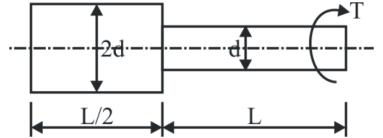
A torque T is applied at the free end of a stepped rod of circular cross-sections as shown in the figure. The shear modulus of the material of the rod is G. The expression for diameter 'd' to produce an angular twist $\theta$ at the free end is
- A. $(\frac{30TL}{\pi\theta G})^{1/4}$
- B. $(\frac{33TL}{\pi\theta G})^{1/4}$
- C. $(\frac{18TL}{\pi\theta G})^{1/4}$
- D. $(\frac{24TL}{\pi\theta G})^{1/4}$
Answer: B. $(\frac{33TL}{\pi\theta G})^{1/4}$
Explanation: Total angle of twist $\theta = \theta_{1} + \theta_{2} = \frac{TL_{1}}{GJ_{1}} + \frac{TL_{2}}{GJ_{2}}$. For part 1: length $L$, diameter $d$, so $J_{1} = \frac{\pi d^{4}}{32}$. For part 2: length $L/2$, diameter $2d$, so $J_{2} = \frac{\pi (2d)^{4}}{32} = \frac{16\pi d^{4}}{32}$. $\theta = \frac{T \times L}{G \times \frac{\pi d^{4}}{32}} + \frac{T \times (L/2)}{G \times \frac{16\pi d^{4}}{32}} = \frac{32TL}{\pi G d^{4}} + \frac{16TL}{16\pi G d^{4}} = \frac{32TL}{\pi G d^{4}} + \frac{TL}{\pi G d^{4}} = \frac{33TL}{\pi G d^{4}}$. Solving for $d$: $d = \left(\frac{33TL}{\pi \theta G}\right)^{1/4}$.
Question 76
Topic: Engineering Mechanics
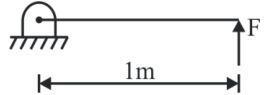
A pin jointed uniform rigid rod of weight 981 N and length 1 m is kept horizontally by an external force F as shown in the figure below. The force F is removed suddenly. At the instant of force removal, the magnitude of vertical reaction (in N) developed at the support is close to
- A. Zero
- B. 245
- C. 490
- D. 981
Answer: B. 245
Explanation: When force F is removed, the rod begins to rotate about the pin. Taking moments about the pin: $W \times \frac{L}{2} = I \alpha$. The moment of inertia of the rod about one end is $I = \frac{mL^{2}}{3}$. So, $W \times \frac{L}{2} = \frac{mL^{2}}{3} \alpha = \frac{W}{g}\frac{L^{2}}{3} \alpha$. Solving for $\alpha$, we get $\alpha = \frac{3g}{2L}$. The linear acceleration of the center of mass is $a = \frac{L}{2} \alpha = \frac{3g}{4}$. Using Newton's second law for vertical translation: $W - R = ma = \frac{W}{g} \left(\frac{3g}{4}\right) = \frac{3W}{4}$. Thus, the reaction $R = W - \frac{3W}{4} = \frac{W}{4} = \frac{981}{4} = 245.25~N$.
Question 77
Topic: Theory of Machines
The frictional torque transmitted in a conical pivot bearing considering uniform pressure is: (R: radius of shaft, a: semi angle of cone, $\mu$: Coefficient of friction, W: load on bearing)
- A. $(1/2)\mu WR \csc \alpha$
- B. $(3/4)\mu WR \cos \alpha$
- C. $(2/3)\mu WR \cos \alpha$
- D. $(2/3)\mu WR \csc \alpha$
Answer: D. $(2/3)\mu WR \csc \alpha$
Explanation: According to the uniform pressure theory, the frictional torque transmitted in a conical pivot bearing is given by $T = \frac{2}{3} \mu W R \csc \alpha$.
Question 78
Topic: Theory of Machines / Vibrations
A mass of 2 kg is attached to two identical springs each with stiffness k = 40 kN/m as shown in the figure. Under frictionless condition, the natural frequency of the system in Hz is close to
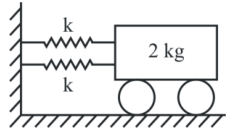
Answer: A. 32
Explanation: The two springs are in parallel, so equivalent stiffness $k_{eq} = k + k = 2k = 2 \times 40\times 10^{3} = 80\times 10^{3}~N/m$. The natural frequency in Hz is $f_{n} = \frac{1}{2\pi}\sqrt{\frac{k_{eq}}{m}} = \frac{1}{2\pi}\sqrt{\frac{80000}{2}} = \frac{1}{2\pi}\sqrt{40000} = \frac{200}{2\pi} = \frac{100}{\pi} \approx 31.83~Hz$, which is close to 32 Hz.
Question 79
Topic: Machine Design
A rectangular steel plate is joined to a vertical post using four identical rivets arranged as shown below in the figure. The shear load on the worst loaded rivet (in N) approximately is
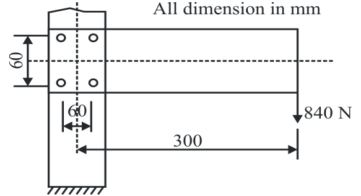
- A. 1700
- B. 1500
- C. 1650
- D. 1750
Answer: C. 1650
Explanation: The rivets form a $60\times60$ square. Eccentric load $P = 840~N$ at eccentricity $e = 300~mm$. Primary shear force per rivet $P_{p} = P/4 = 840/4 = 210~N$. Distance from CG to each rivet $r = \sqrt{30^{2}+30^{2}} = 30\sqrt{2}~mm$. Secondary shear force $P_{s} = \frac{P \cdot e \cdot r}{4r^{2}} = \frac{P \cdot e}{4r} = \frac{840 \times 300}{4 \times 30\sqrt{2}} = \frac{252000}{169.7} \approx 1485~N$. The worst loaded rivet (top right) has the angle between primary and secondary shear forces as $\theta = 45^{\circ}$. Resultant force $R = \sqrt{P_{p}^{2} + P_{s}^{2} + 2P_{p}P_{s}\cos 45^{\circ}} = \sqrt{210^{2} + 1485^{2} + 2(210)(1485)(\frac{1}{\sqrt{2}})} = \sqrt{44100 + 2205225 + 441021} \approx \sqrt{2690346} \approx 1640.2~N$. The closest option is 1650 N.
Question 80
Topic: Machine Design
Match the following criterion of material failure under biaxial stresses $\sigma_{1}$ and $\sigma_{2}$ and yield stress $\sigma_{y},$ with their corresponding graphic representations.
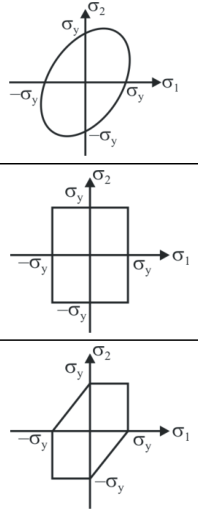
- A. A-L, B-N, C-M
- B. A-N, B-L, C-M
- C. A-M, B-N, C-L
- D. A-N, B-M, C-L
Answer: B. A-N, B-L, C-M
Explanation: A. Maximum shear stress criterion corresponds to the Tresca hexagon (Representation N). B. Maximum distortion energy criterion (von Mises) corresponds to the ellipse (Representation L). C. Maximum normal stress criterion (Rankine) corresponds to the square (Representation M). Thus, the correct match is A-N, B-L, C-M.