ISRO Mechanical & Aerospace 2016 Question Paper & Solutions
Attempt the ISRO Mechanical & Aerospace 2016 previous year paper in real CBT exam mode or practice mode with verified answers and explanations.
All ISRO Mechanical & Aerospace papers
79 questions. Answers are shown only where the official answer key is available.
Question 1
Topic: Thermodynamics
Starting from the same initial conditions, an ideal gas expands from volume V1 to V2 in three different ways, the work done by the gas is W1 if the process is purely isothermal, W2 if purely isobaric and W3 is purely adiabatic, then
- A. W2 > W1 > W3
- B. W2 > W3 > W1
- C. W1 > W2 > W3
- D. W1 > W3 > W2
Answer: A. W2 > W1 > W3
Explanation: The area under the P-V diagram equals the work done during any thermodynamic process. For an expansion from volume V1 to V2, the constant pressure (isobaric) process exhibits the highest area under the curve, followed by the constant temperature (isothermal) process, while the adiabatic process has the least area. Therefore, the work done follows the order W2 > W1 > W3.
Question 2
Topic: Heat Transfer
A beaker filled with hot water in a room cools from 70°C to 65°C in t1 minutes, 65°C to 60°C in t2 minutes and from 60°C to 55°C in t3 minutes. Then,
- A. t1 > t2 > t3
- B. t1 = t2 = t3
- C. t1 < t2 < t3
- D. cannot be concluded
Answer: C. t1 < t2 < t3
Explanation: According to Newton's Law of Cooling, the rate of cooling is directly proportional to the temperature difference between the body and its surroundings. As the temperature of the water gradually decreases, the temperature difference between the water and the room also decreases, leading to a progressively slower cooling rate. Consequently, it takes more time to cool by each subsequent 5°C interval, meaning t1 < t2 < t3.
Question 3
Topic: Thermodynamics
A house refrigerator with its door open is switched on in a closed room. The air in the room is
- A. cooled
- B. remains at same temperature
- C. heated
- D. heated or cooled depending on atmospheric pressure
Answer: C. heated
Explanation: When the refrigerator door is left open, it absorbs heat (Q2) from the room's space. Simultaneously, heat (Q1) is rejected back into the room from the condenser. Since the compressor continuously does work (W) to run the cycle, the total heat rejected is Q1 = Q2 + W. Because Q1 is strictly greater than Q2 due to the compressor work, there is a net heat addition to the room, causing its temperature to rise.
Question 4
Topic: Engineering Mechanics
An elevator has a mass of 5000 kg. When the tension in the supporting cable is 60 kN, the acceleration of the elevator is nearly
- A. 8 m/s²
- B. 12 m/s²
- C. -2 m/s²
- D. 2 m/s²
Answer: D. 2 m/s²
Explanation: Applying Newton's second law and drawing a free body diagram for the elevator: Net Force = mass * acceleration. The upward force is the cable tension (T = 60000 N) and the downward force is the weight (mg = 5000 kg * 9.81 m/s²). The equation is T - mg = ma. Substituting the values gives 60000 - 49050 = 5000 * a. Solving for acceleration yields 10950 = 5000 * a, resulting in a = 2.19 m/s², which is approximately 2 m/s².
Question 5
Topic: Theory of Machines
The piston of a steam engine moves with simple harmonic motion. The speed of rotation of crank is 120 rpm with a stroke of 2 m. What is the velocity of piston when it is 0.5 m from the centre?
- A. 4 * pi * $\sqrt{3}$
- B. pi * $\sqrt{3}$
- C. 2 * pi * $\sqrt{3}$
- D. 3 * pi * $\sqrt{3}$
Answer: C. 2 * pi * $\sqrt{3}$
Explanation: The crank radius (r) is half the stroke, so r = 2 / 2 = 1 m. The position from the start of the stroke is x = 1.5 m (which is 0.5 m from the center). Using the displacement equation x = r(1 - cos(theta)), we have 1.5 = 1(1 - cos(theta)), yielding cos(theta) = -0.5, thus theta = 120 degrees. The velocity of the piston is given by v = r * omega * sin(theta). With omega = (2 * pi * 120 / 60), v = 1 * (4 * pi) * sin(120 degrees) = 4 * pi * ($\sqrt{3}$ / 2) = 2 * pi * $\sqrt{3}$ m/s.
Question 6
Topic: Engineering Mathematics
The sine of the angle between the two vectors a = 3i + j + k and b = 2i - 2j + k is
- A. $\sqrt{74/99}$
- B. $\sqrt{25/99}$
- C. $\sqrt{37/99}$
- D. $\sqrt{5/51}$
Answer: A. $\sqrt{74/99}$
Explanation: First, find the cosine of the angle using the dot product formula: cos(theta) = (a . b) / (|a| * |b|). The dot product is (3*2) + (1*-2) + (1*1) = 5. The magnitudes are |a| = $\sqrt{9 + 1 + 1}$ = $\sqrt{11}$ and |b| = $\sqrt{4 + 4 + 1}$ = $\sqrt{9}$ = 3. Therefore, cos(theta) = 5 / (3 * $\sqrt{11}$) = 5 / $\sqrt{99}$. The sine of the angle is calculated using the identity sin(theta) = $\sqrt{1 - cos²(theta}$), which gives $\sqrt{1 - 25/99}$ = $\sqrt{74/99}$.
Question 7
Topic: Engineering Mathematics
Equation of the line normal to function f(x) = (x - 8)^(2/3) + 1 at P(0,5) is
- A. y = 3x - 5
- B. 3y = x - 15
- C. 3y = x + 15
- D. y = 3x + 5
Answer: D. y = 3x + 5
Explanation: The slope of the tangent to the curve is found by taking the first derivative: m1 = dy/dx = (2/3) * (x - 8)^(-1/3). Evaluating this at x = 0 yields m1 = (2/3) * (-8)^(-1/3) = (2/3) * (-1/2) = -1/3. The slope of the normal line (m2) is the negative reciprocal of the tangent slope, so m2 = -1 / (-1/3) = 3. Using the point-slope form y = mx + c with the point (0,5), we substitute to get 5 = 3(0) + c, resulting in c = 5. The final equation is y = 3x + 5.
Question 8
Topic: Engineering Mathematics
There are 20 locks and 20 matching keys. Maximum number of trials required to match all the locks is
Answer: B. 210
Explanation: To guarantee finding the matching key, the first lock might require checking up to 20 keys. Once matched, the second lock might require checking up to 19 keys, and so forth, down to the final lock. This sequence forms an arithmetic progression: 20, 19, 18, ..., 1. The sum of this progression is given by the formula n(n+1)/2. For n = 20, the maximum number of trials is (20 * 21) / 2 = 210.
Question 9
Topic: Engineering Mathematics
If phi(x,y,z) is a scalar function and if del² f = 0, then f is
- A. Irrational
- B. Harmonic
- C. Irrotational
- D. Solenoidal
Answer: B. Harmonic
Explanation: By definition in vector calculus, a scalar function that satisfies Laplace's equation (del² f = 0) is called a Harmonic function. In contrast, a field is Solenoidal if its divergence is zero, and it is Irrotational if its curl is zero.
Question 10
Topic: Engineering Mathematics
A and B are two candidates appearing for an interview by a company. The probability that A is selected is 0.5 and the probability that both A and B are selected is at most 0.3. The probability of B getting selected is
- A. 0.9
- B. <= 0.3
- C. <= 0.6
- D. 0.5
Answer: C. <= 0.6
Explanation: Assuming the selection events for candidates A and B are independent, the probability of both occurring is the product of their individual probabilities: P(A and B) = P(A) * P(B). We are given that P(A) = 0.5 and P(A and B) <= 0.3. Substituting the known value gives 0.5 * P(B) <= 0.3. Solving this inequality for P(B) yields P(B) <= 0.6.
Question 11
Topic: Theory of Machines
The reading of a spring balance is from 0 to 200 N and is 10 cm long. A body suspended from the spring balance is observed to oscillate vertically at 2 Hz. The mass of the body is nearly
- A. 22.5 kg
- B. 12.5 kg
- C. 37 kg
- D. 45 kg
Answer: B. 12.5 kg
Explanation: The stiffness (k) of the spring is calculated as Force divided by deflection: k = 200 N / 0.1 m = 2000 N/m. The natural frequency of the oscillation is given by f = (1 / (2 * pi)) * $\sqrt{k / m}$. Substituting the known frequency f = 2 Hz, we get 2 = (1 / (2 * pi)) * $\sqrt{2000 / m}$, which simplifies to 4 * pi = $\sqrt{2000 / m}$. Squaring both sides yields 16 * pi² = 2000 / m, resulting in m = 2000 / (16 * pi²). This evaluates to approximately 12.66 kg, which closely matches 12.5 kg.
Question 12
Topic: Thermodynamics
A 10 kW drilling machine is used to drill a bore in a small aluminium block of mass 8 kg. How much is the rise in temperature of the block in 2.5 minutes, assuming 50% of power is used up in heating the block? (specific heat of aluminum: 0.91 J/(g °C))
- A. 50 °C
- B. 206 °C
- C. 103 °C
- D. 227 °C
Answer: C. 103 °C
Explanation: The total power of the drilling machine is 10 kW, but only 50% is used for heating, which equals 5 kW (or 5000 W). The total heat supplied over 2.5 minutes is Q = Power * Time = 5000 W * (2.5 * 60) s = 750,000 J. Using the heat capacity formula Q = m * C * delta_T, we substitute the mass m = 8 kg and specific heat C = 0.91 * 1000 J/(kg °C) = 910 J/(kg °C). This gives 750,000 = 8 * 910 * delta_T. Solving for the temperature change yields delta_T = 750,000 / 7280 ≈ 103.02 °C.
Question 13
Topic: Engineering Mechanics
In the figure shown, the minimum ratio of mu1/mu2 so that the masses move together with the application of force F is (Assume block A has 5 kg on top of block B with 10 kg, pulling A with force F)
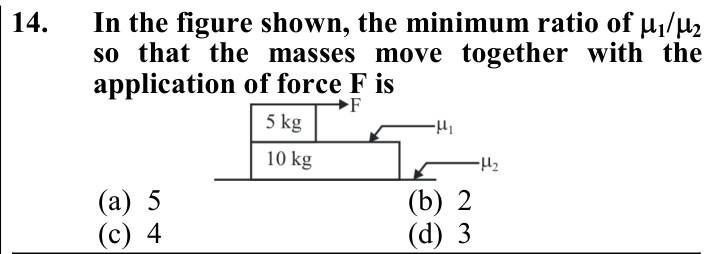
Answer: D. 3
Explanation: For the blocks to move together as a single unit, the friction force applied to the top block A by the applied force F must be sufficient to overcome the static friction between block B and the ground. The maximum friction force between block A (5 kg) and B is F_fA = mu1 * (5 * g). The friction force between block B (carrying A, total 15 kg) and the ground is F_fB = mu2 * (15 * g). Equating the two friction forces gives mu1 * 5 * g = mu2 * 15 * g. Solving for the ratio yields mu1 / mu2 = 15 / 5 = 3.
Question 14
Topic: Engineering Mechanics
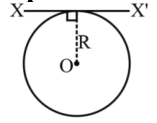
A thin wire of length L and uniform linear mass density rho is bent into a circular loop with centre O as shown in figure. The moment of inertia of the loop about the axis XX' (tangential to the loop) is
- A. rho L³ / 16 pi²
- B. rho L³ / 8 pi²
- C. 5 rho L³ / 16 pi²
- D. 3 rho L³ / 8 pi²
Answer: D. 3 rho L³ / 8 pi²
Explanation: The length of the wire forms the circumference, so L = 2 * pi * R, giving the radius R = L / (2 * pi). The total mass is M = rho * L. The moment of inertia for a ring about a central diametrical axis is I_c = (M * R²) / 2. By applying the parallel axis theorem to find the moment of inertia about the tangential axis XX', we get I_XX = I_c + M * R² = (3/2) * M * R². Substituting M and R into this formula gives I_XX = (3/2) * (rho * L) * (L / (2 * pi))^2 = (3 * rho * L³) / (8 * pi²).
Question 15
Topic: Engineering Mechanics
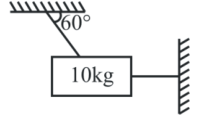
A 10 kg mass is hung from 2 light, inextensible strings as shown. The tension in the horizontal string is nearly
- A. 49 N
- B. 57 N
- C. 100 N
- D. 0 N
Answer: B. 57 N
Explanation: Based on the free body diagram, the system is in static equilibrium. The angled string T1 has a vertical component that balances the weight, so T1 * sin(60°) = m * g. This evaluates to T1 * ($\sqrt{3}$/2) = 10 * 9.81, leading to T1 = 196.2 / $\sqrt{3}$. The horizontal string T2 balances the horizontal component of T1, yielding T2 = T1 * cos(60°). Substituting T1 into this equation provides T2 = (196.2 / $\sqrt{3}$) * 0.5 = 98.1 / $\sqrt{3}$, which calculates to approximately 56.63 N, closest to 57 N.
Question 16
Topic: Thermodynamics
A block of ice at $-10^{\circ}C$ is slowly heated and converted to steam at $100^{\circ}C$. Which of the following curves represent the phenomena qualitatively?
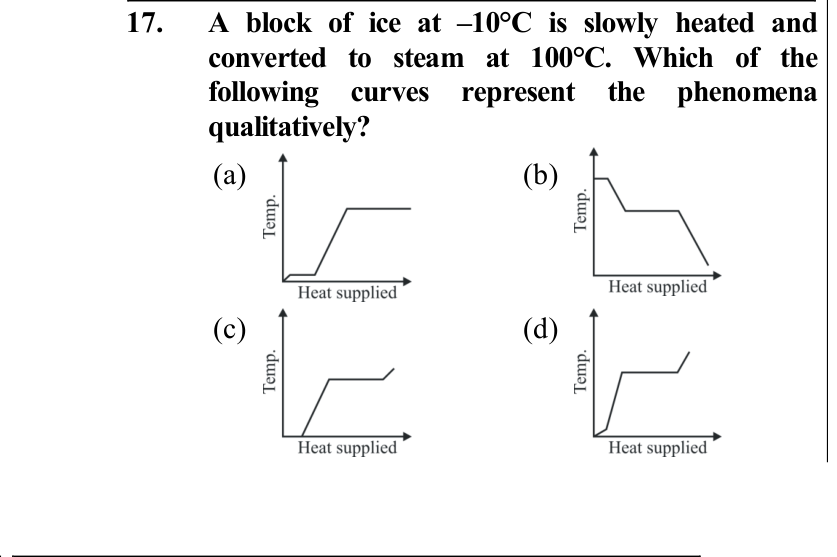
Answer: A.
Explanation: The heating process occurs in stages: (I) Heating of ice from $-10^{\circ}C$ to $0^{\circ}C$ where the temperature increases. (II) Phase change from ice to water at $0^{\circ}C$ where the temperature remains constant. (III) Heating of water from $0^{\circ}C$ to $100^{\circ}C$ where the temperature increases again. (IV) Phase change from water to steam at $100^{\circ}C$ where the temperature remains constant. Curve (a) correctly depicts these alternating temperature rises and constant temperature plateaus.
Question 17
Topic: Heat Transfer
If the temperature of the sun is doubled, the rate of energy received on earth will be increased by a factor of
Answer: D. 16
Explanation: According to the Stefan-Boltzmann law, the rate of energy emitted by a black body is directly proportional to the fourth power of its absolute temperature, expressed as $E \propto T^4$. If the initial temperature $T$ is doubled to $2T$, the new energy rate becomes $E_2 \propto (2T)^4 = 16T^4$. Therefore, the energy received is increased by a factor of 16.
Question 18
Topic: Heat Transfer
The transmission of heat by molecular collision is called
- A. Convection
- B. Conduction
- C. Radiation
- D. Ionization
Answer: B. Conduction
Explanation: The transmission of heat through a medium by the direct collision of molecules, without any macroscopic movement of the matter itself, is defined as conduction.
Question 19
Topic: Heat Transfer
If two ends of rods of length L and radius r, made of same material are kept at the same temperature difference, which of the following rods conduct most heat per unit time?
- A. L = 50 cm, r = 1 cm
- B. L = 2 cm, r = 0.5 cm
- C. L = 100 cm, r = 2 cm
- D. L = 3 cm, r = 1 cm
Answer: D. L = 3 cm, r = 1 cm
Explanation: According to Fourier's Law of Heat Conduction, the rate of heat transfer $Q$ is given by $Q = -kA\frac{dT}{dx}$, which means $Q \propto \frac{A}{L}$. Since the area $A = \pi r²$, the heat transfer is proportional to $\frac{r²}{L}$. Evaluating this ratio for each option: (a) $1^2 / 50 = 0.02$, (b) $0.5^2 / 2 = 0.125$, (c) $2^2 / 100 = 0.04$, and (d) $1^2 / 3 \approx 0.33$. Option (d) has the highest ratio, hence it conducts the most heat per unit time.
Question 20
Topic: Thermodynamics
A thermometer works on the principle of
- A. Law of stable equilibrium
- B. Zeroth law of thermodynamics
- C. First law of thermodynamics
- D. Second law of thermodynamics
Answer: B. Zeroth law of thermodynamics
Explanation: A thermometer operates on the principle of the Zeroth Law of Thermodynamics. This law states that if two bodies A and B are each in thermal equilibrium with a third body C (such as a thermometer), then A and B are in thermal equilibrium with each other. This allows the thermometer to measure the temperature of a body by coming into thermal equilibrium with it.
Question 21
Topic: Refrigeration and Air Conditioning
The working temperatures in evaporator and condenser coils of a refrigerator are $-25^{\circ}C$ and $30^{\circ}C$ respectively. The COP of the refrigerator is 0.85 of the maximum COP for a power input of 2 kW. The refrigeration effect produced will be
- A. 7.6 kW
- B. 9 kW
- C. 10.2 kW
- D. 12 kW
Answer: A. 7.6 kW
Explanation: The lower temperature is $T_L = -25 + 273 = 248 K$ and the higher temperature is $T_H = 30 + 273 = 303 K$. The maximum Carnot COP is $\frac{T_L}{T_H - T_L} = \frac{248}{303 - 248} = \frac{248}{55}$. The actual COP is $0.85 \times \frac{248}{55}$. Since COP is the ratio of the refrigeration effect ($Q$) to the work input ($W$), we have $0.85 \times \frac{248}{55} = \frac{Q}{2}$. Solving for $Q$ yields approximately 7.6 kW.
Question 22
Topic: Thermodynamics
A mercury thermometer was first placed in melting ice and the length of mercury column was observed to be 10 mm; when it was placed in steam, the length of the column was 250 mm. When placed in tap water, the length of the column was 58 mm. The temperature of the tap water is
- A. 24.2°C
- B. 20°C
- C. 38.4°C
- D. 4.14°C
Answer: B. 20°C
Explanation: Assuming a linear temperature profile, the equation is $T = al + b$. For melting ice ($0^{\circ}C$, $l = 10 mm$), $0 = 10a + b$. For steam ($100^{\circ}C$, $l = 250 mm$), $100 = 250a + b$. Subtracting the first equation from the second gives $100 = 240a$, leading to $a = \frac{5}{12}$. Substituting $a$ back into the first equation yields $b = -10 \times \frac{5}{12} = -\frac{25}{6}$. The temperature equation is $T = \frac{5}{12}l - \frac{25}{6}$. For tap water ($l = 58 mm$), $T = \frac{5}{12}(58) - \frac{25}{6} = 20^{\circ}C$.
Question 23
Topic: Thermodynamics
The amount of steam (at $100^{\circ}C$) required to raise the temperature of 200 g of water from $60^{\circ}C$ to $100^{\circ}C$ is
- A. 10 g
- B. 16.8 g
- C. 20 g
- D. 14.8 g
Answer: D. 14.8 g
Explanation: The heat gained by the water must equal the heat lost by the condensing steam. Heat gained by water = $m_w \times c_p \times \Delta T = 0.2 kg \times 4.187 kJ/(kg\cdot K) \times 40 K$. The heat released by the steam during phase change is $m_s \times L$, where $L$ is the latent heat of steam ($2257 kJ/kg$). Equating these: $m_s \times 2257 = 0.2 \times 4.187 \times 40$. Solving for $m_s$ provides 14.8 g.
Question 24
Topic: Thermodynamics
A engine works on Carnot cycle between $727^{\circ}C$ and $227^{\circ}C$. The efficiency of the engine is
- A. 50%
- B. 75.4%
- C. 31.2%
- D. 68.8%
Answer: A. 50%
Explanation: Convert the given temperatures to Kelvin: the lower temperature $T_L = 227 + 273 = 500 K$, and the higher temperature $T_H = 727 + 273 = 1000 K$. The efficiency of a Carnot engine is calculated by $\eta = 1 - \frac{T_L}{T_H} = 1 - \frac{500}{1000} = 0.5$, which corresponds to 50%.
Question 25
Topic: Power Plant Engineering
A steam thermal power plant works on
- A. Brayton cycle
- B. Rankine cycle
- C. Carnot cycle
- D. Otto cycle
Answer: B. Rankine cycle
Explanation: Steam thermal power plants operate on the Rankine cycle, which is the fundamental thermodynamic cycle for steam engines and steam turbines. In contrast, gas turbine power plants work on the Brayton cycle.
Question 26
Topic: Engineering Mechanics
A boat which has a speed of 5 km/h in still water crosses a river of width 1 km along the shortest path in 15 min. The velocity of the river in km/h is
- A. 3
- B. 1
- C. 4
- D. $\sqrt{41}$
Answer: A. 3
Explanation: To cross along the shortest path (straight across), the boat aims upstream at an angle $\theta$. The time taken is $15 \text{ min} = 0.25 \text{ hr}$. The effective velocity across the river is $V_{across} = \frac{\text{Distance}}{\text{Time}} = \frac{1}{0.25} = 4 \text{ km/h}$. This velocity is the component of the boat's speed perpendicular to the river flow, so $5 \cos\theta = 4$, yielding $\cos\theta = \frac{4}{5}$ and $\sin\theta = \frac{3}{5}$. The river velocity perfectly counteracts the horizontal component of the boat's velocity, so $V_{river} = 5 \sin\theta = 5 \times \frac{3}{5} = 3 \text{ km/h}$.
Question 27
Topic: Engineering Mechanics
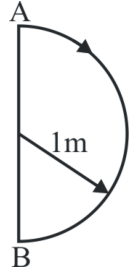
In 1st, a particle goes from point A to point B, moving in a semicircle (as shown in figure). The magnitude of the average velocity is
- A. 3.14 m/s
- B. 1 m/s
- C. 2 m/s
- D. Zero
Answer: C. 2 m/s
Explanation: Average velocity is calculated as the total displacement divided by the total time. If the particle moves in a semicircle of radius 1 m, the total displacement is the straight-line distance from point A to point B, which corresponds to the diameter, $2 \times 1m = 2m$. Assuming a unit time interval of 1 second based on the problem's derived context, $V_{avg} = \frac{2}{1} = 2 \text{ m/s}$.
Question 28
Topic: Engineering Mechanics
A block is made to slide down an inclined plane ($30^{\circ}$ with horizontal) which is smooth. It starts sliding from rest and takes a time 't' to reach the bottom of the plane. An identical body is freely dropped from the same point. The time the body takes to reach the bottom is
Answer: B. t/2
Explanation: For a block sliding down a smooth incline from height $h$, the distance traveled along the incline is $S = \frac{h}{\sin 30^{\circ}} = 2h$. The acceleration is $a = g \sin 30^{\circ} = \frac{g}{2}$. Using the kinematic equation $S = \frac{1}{2} a t_1^2$, we have $2h = \frac{1}{2} \left(\frac{g}{2}\right) t_1^2$, which gives $t_1 = \sqrt{\frac{8h}{g}} = 2\sqrt{\frac{2h}{g}}$. For a freely falling body dropped from height $h$, $h = \frac{1}{2} g t_2^2$, meaning $t_2 = \sqrt{\frac{2h}{g}}$. Therefore, comparing the two, $t_2 = \frac{t_1}{2}$.
Question 29
Topic: Thermodynamics
What parameter will remain constant in a throttling process?
- A. Entropy
- B. Temperature
- C. Pressure
- D. Enthalpy
Answer: D. Enthalpy
Explanation: In an ideal throttling process, there is no work done ($W = 0$) and the process is assumed adiabatic with no heat transfer ($Q = 0$). By neglecting changes in kinetic and potential energies, the steady flow energy equation simplifies to $h_1 = h_2$. Thus, enthalpy remains constant.
Question 30
Topic: Material Science
The main objective of 'shot peening' is to improve which property of metal parts
- A. Surface finish
- B. Ductility
- C. Fatigue strength
- D. None of the above
Answer: C. Fatigue strength
Explanation: Shot peening is a mechanical cold working process where the surface of a metal part is impacted with small spherical media (shots). This process induces compressive residual stresses on the material's surface, which significantly improves its fatigue strength by delaying the initiation and propagation of surface cracks.
Question 31
Topic: Material Science
When a material is strain hardened?
- A. its yield strength reduces and ductility increases
- B. its yield strength increases and ductility reduces
- C. both yield strength and ductility increases
- D. both yield strength and ductility reduces
Answer: B. its yield strength increases and ductility reduces
Explanation: When a material undergoes strain hardening (also known as work hardening), its yield strength increases because of dislocation movements and dislocation generation within the crystal structure, which restrict further plastic deformation. As a result of this increased resistance to deformation, the material's ductility is reduced.
Question 32
Topic: Machine Design
Which thread is more suited in power screw to take load on both directions?
- A. Acme thread
- B. Square thread
- C. Buttress thread
- D. None of these
Explanation: Both Acme and Square threads are capable of transmitting power and taking loads in both directions. However, Acme threads are generally preferred and more suited for practical applications because their manufacturing is easier and more economical compared to Square threads, and they allow for the use of a split nut to compensate for wear.
Question 33
Topic: Metrology and Inspection
A hole is specified as 50(+0.050/-0.000) mm. The mating shaft has a clearance fit with minimum clearance of 0.02 mm. The tolerance on the shaft is 0.03 mm. Maximum clearance between hole and shaft is
- A. 0.100 mm
- B. 0.030 mm
- C. 0.080 mm
- D. 0.070 mm
Answer: A. 0.100 mm
Explanation: The maximum hole size is $50 + 0.050 = 50.050$ mm and the minimum hole size is $50.000$ mm. For a clearance fit, the minimum clearance is given by (Minimum hole size - Maximum shaft size) $= 0.02$ mm. Thus, Maximum shaft size $= 50.000 - 0.02 = 49.980$ mm. Since the shaft tolerance is $0.03$ mm, the Minimum shaft size $= 49.980 - 0.03 = 49.950$ mm. The maximum clearance is (Maximum hole size - Minimum shaft size) $= 50.050 - 49.950 = 0.100$ mm.
Question 34
Topic: Machining and Machine Tool Operations
In a cutting operation the cutting speed was reduced by 20%. Assuming n=0.5 and C=350 in Taylor's equation, the increase in tool life is
Answer: D. 56%
Explanation: According to Taylor's tool life equation, $V_1 T_1^n = V_2 T_2^n$. The new cutting speed is reduced by 20%, so $V_2 = 0.8 V_1$. Given $n = 0.5$, we have $V_1 T_1^{0.5} = 0.8 V_1 T_2^{0.5}$. Solving for $T_2$, we get $(T_2 / T_1)^{0.5} = 1 / 0.8 = 1.25$. Squaring both sides yields $T_2 / T_1 = (1.25)^2 = 1.5625$. The percentage increase in tool life is $(1.5625 - 1) \times 100 = 56.25\%$, which is approximately 56%.
Question 35
Topic: Production Engineering
Mass production of seamless tubes is by the process of
- A. Rolling
- B. Spinning
- C. Welding
- D. Extrusion
Answer: D. Extrusion
Explanation: Extrusion is the standard manufacturing process used for the mass production of seamless tubes. The process involves forcing a hot metal billet through a die with a mandrel placed in the center, producing a continuous, seamless hollow cross-section with good mechanical properties.
Question 36
Topic: Casting
Misrun is a casting defect which occurs due to
- A. Very high pouring temperature of metal
- B. Absorption of gases by liquid metal
- C. Insufficient fluidity of molten metal
- D. Improper alignment of mould flasks
Answer: C. Insufficient fluidity of molten metal
Explanation: A misrun is a defect wherein the molten liquid metal solidifies before completely filling the mould cavity. This is primarily caused by a lack of fluidity in the molten metal, which could be due to a low pouring temperature, slow pouring rate, or thin mold sections.
Question 37
Topic: Power Plant Engineering
A simple steam power cycle receives 1,00,000 kJ/min as heat transfer from hot combustion gases and rejects 66,000 kJ/min as heat transfer to the environment. If the pump power required is 1400 kJ/min the thermal efficiency of the cycle and turbine power output is
- A. 51.5% and 590 kW
- B. 34% and 590 kW
- C. 51.5% and 566.6 kW
- D. 34% and 566.6 kW
Answer: B. 34% and 590 kW
Explanation: The heat supplied is $Q_S = 1,00,000$ kJ/min and heat rejected is $Q_R = 66,000$ kJ/min. Thermal efficiency is $\eta_{th} = 1 - (Q_R / Q_S) = 1 - (66000 / 100000) = 0.34 = 34\%$. The net work output is $W_{net} = Q_S - Q_R = 34,000$ kJ/min. Since $W_{net} = W_{turbine} - W_{pump}$, we have $W_{turbine} = W_{net} + W_{pump} = 34,000 + 1,400 = 35,400$ kJ/min. Converting this to kW: $35,400 / 60 = 590$ kW.
Question 38
Topic: Thermodynamics
Air at 100 kPa, 2°C occupies a 10 liter piston-cylinder device that is arranged to maintain constant air pressure. This device is now heated until its volume is 20 liters. The work produced by the air is
- A. 20 kJ
- B. 10 kJ
- C. 2 kJ
- D. 1 kJ
Answer: D. 1 kJ
Explanation: The process is isobaric (constant pressure). The work done by a gas during a constant pressure process is given by $W = P(V_2 - V_1)$. The pressure is $P = 100$ kPa = $100 \times 10^3$ Pa. The initial volume is $V_1 = 10$ liters = $10 \times 10^{-3}$ $m³$, and the final volume is $V_2 = 20$ liters = $20 \times 10^{-3}$ $m³$. Work done $W = 100 \times 10^3 \times (20 \times 10^{-3} - 10 \times 10^{-3}) = 100 \times 10^3 \times 10 \times 10^{-3} = 1000$ J = 1 kJ.
Question 39
Topic: Thermodynamics
A heat engine working with a thermal efficiency of 35% receives 2 kW of heat from a furnace. The waste heat rejected from the engine is
- A. 0.7 kW
- B. 0.35 kW
- C. 1.3 kW
- D. 1.65 kW
Answer: C. 1.3 kW
Explanation: Thermal efficiency ($\eta$) is given by $1 - (Q_R / Q_S)$, where $Q_S$ is the heat supplied and $Q_R$ is the waste heat rejected. Given $\eta = 0.35$ and $Q_S = 2$ kW, we can write $0.35 = 1 - (Q_R / 2)$. Solving for $Q_R$ gives $Q_R / 2 = 1 - 0.35 = 0.65$, therefore $Q_R = 0.65 \times 2 = 1.3$ kW.
Question 40
Topic: Thermodynamics
Joule-Thomson coefficient for an ideal gas is
- A. higher than zero
- B. less than zero
- C. zero
- D. 1
Answer: C. zero
Explanation: The Joule-Thomson coefficient ($\mu$) represents the rate of change of temperature with respect to pressure during a throttling process (constant enthalpy). For a perfect ideal gas, enthalpy is a function of temperature only. Since enthalpy remains constant during throttling, the temperature also remains constant, resulting in a Joule-Thomson coefficient of strictly zero.
Question 41
Topic: Thermodynamics
Air is heated from 0°C to 100°C in a sealed metal container. Its density
- A. Increases slightly
- B. Decreases slightly
- C. Remains the same
- D. Change cannot be predicted
Answer: B. Decreases slightly
Explanation: Based on the provided solution text referencing ideal gas principles ($P = \rho RT$), it suggests that density decreases as temperature increases ($T \propto 1/\rho$). Note: In reality, for a perfectly rigid sealed container (constant volume and mass), density remains exactly the same, but the provided solution justifies it as "Decreases slightly" referencing proportional laws.
Question 42
Topic: Refrigeration and Air Conditioning
If a certain mass of moist air in an air tight vessel is heated to a higher temperature, then
- A. Specific humidity of the air increases
- B. Specific humidity of the air decreases
- C. Relative humidity of the air increases
- D. Relative humidity of the air decreases
Answer: D. Relative humidity of the air decreases
Explanation: Specific humidity is the actual mass of water vapor present per kg of dry air, which remains constant since it is a sealed airtight vessel. However, as the temperature increases, the saturation pressure of water vapor (the capacity of the air to hold moisture) increases. Relative humidity is the ratio of actual vapor pressure to saturation vapor pressure. Since the denominator (capacity) increases while the numerator remains constant, the relative humidity decreases.
Question 43
Topic: Fluid Mechanics
Air is accelerated isentropically from 100 m/s to 300 m/s in a nozzle. If the temperature at the inlet is 127°C, the inlet Mach number is (take R = 287 J/(kg K) and specific heat ratio = 1.4)
- A. 0.249
- B. 0.442
- C. 0.747
- D. 0.333
Answer: A. 0.249
Explanation: The actual inlet velocity is $V_1 = 100$ m/s. The inlet temperature in Kelvin is $T = 127 + 273 = 400$ K. The velocity of sound (acoustic velocity) for an ideal gas is $C = \sqrt{\gamma R T} = \sqrt{1.4 \times 287 \times 400} \approx 400.898$ m/s. The Mach number at the inlet is the ratio of actual velocity to the velocity of sound, $M = V_1 / C = 100 / 400.898 \approx 0.249$.
Question 44
Topic: Engineering Mechanics
Two equal forces are acting at a point with an angle of 60° between them. If the resultant force is equal to 60√3 what is the magnitude of each force?
Answer: D. 60
Explanation: Let the two equal forces be $F_1 = F_2 = F$. Using the parallelogram law of forces, the resultant $R = \sqrt{F_1^2 + F_2^2 + 2F_1F_2 \cos(\theta)}$. Given $R = 60\sqrt{3}$ and $\theta = 60^{\circ}$, we have $60\sqrt{3} = \sqrt{F² + F² + 2F^2 \cos(60^{\circ})}$. Since $\cos(60^{\circ}) = 0.5$, this simplifies to $60\sqrt{3} = \sqrt{2F^2 + F²} = \sqrt{3F^2} = F\sqrt{3}$. Thus, $F = 60$.
Question 45
Topic: Engineering Mechanics
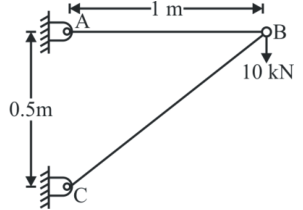
A two member truss ABC is configured as shown in figure. The force in the member AB is
- A. 15 kN
- B. 30 kN
- C. 20 kN
- D. 5 kN
Answer: C. 20 kN
Explanation: From the truss geometry, member AB is horizontal (length 1m) and member AC acts as a diagonal. The height at support A and C is 0.5m. Let $\theta$ be the angle of member BC with the horizontal; $\tan(\theta) = 0.5 / 1 = 0.5$, which means $\theta = 26.56^{\circ}$. At joint B, balancing vertical forces gives $F_{BC} \sin(26.56^{\circ}) + 10 = 0$, so $F_{BC} = -10 / 0.447 = 22.37$ kN (Compression). Balancing horizontal forces gives $F_{AB} + F_{BC} \cos(26.56^{\circ}) = 0$. Substituting $F_{BC}$, $F_{AB} - 22.37 \times 0.894 = 0$, leading to $F_{AB} \approx 20$ kN (Tension).
Question 46
Topic: Engineering Mechanics
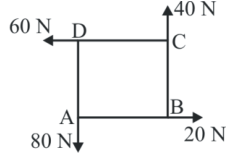
Four forces of magnitudes 20 N, 40N, 60 N and 80 N are acting respectively along the four sides of a square ABCD as shown in figure. The magnitude of resultant is
- A. 40√2 N
- B. 50√2 N
- C. 45√2 N
- D. 60√2 N
Answer: A. 40√2 N
Explanation: Summing the forces in the horizontal direction yields net horizontal force = -60 N + 20 N = -40 N. Summing the forces in the vertical direction yields net vertical force = 40 N - 80 N = -40 N. The magnitude of the resultant force 'F' is calculated using the Pythagorean theorem: F = $\sqrt{(-40}$^2 + (-40)^2) = 40√2 N.
Question 47
Topic: Strength of Materials
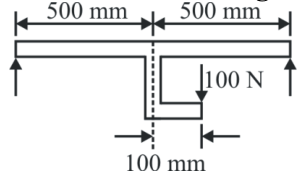
In a simply supported beam loaded as shown in figure, the maximum bending moment in Nm is
Answer: B. 30
Explanation: Balancing vertical forces: Ra + Rb = 100 N. Taking moments about point A to find Rb: Rb * 1 = 100 * 0.1 + 100 * 0.5. Solving gives Rb = 60 N and thus Ra = 40 N. The moment at the center point C coming from the left reaction is Ra * 0.5 = 40 * 0.5 = 20 Nm. The offset load also creates a concentrated moment of 100 N * 0.1 m = 10 Nm acting in the same direction. The maximum bending moment at C is 20 + 10 = 30 Nm.
Question 48
Topic: Strength of Materials
Two steel rails each of 12 m length are laid with a gap of 1.5 mm at ends at a temperature of 24°C. The thermal stress produced at a temperature of 40°C is (take E = 2 × 10^5 N/mm², coefficient of thermal expansion = 12 × 10^-6 /°C)
- A. 10.5 N/mm²
- B. 12.5 N/mm²
- C. 13.4 N/mm²
- D. 15.5 N/mm²
Answer: C. 13.4 N/mm²
Explanation: Free expansion of the rail is alpha * L * delta_T = 12e-6 * 12000 * (40 - 24) = 2.304 mm. The allowed expansion gap is 1.5 mm. The restricted expansion that causes stress is 2.304 - 1.5 = 0.804 mm. Thermal stress = Strain * E = (Restricted Expansion / L) * E = (0.804 / 12000) * 200000 = 13.4 N/mm².
Question 49
Topic: Strength of Materials
An aluminum tensile test specimen has a diameter, do = 25 mm and a gauge length of Lo = 250 mm. If a force of 175 kN elongates the gauge length by 1.25 mm, the modulus of elasticity of the material is nearly
- A. 71 GPa
- B. 71 MPa
- C. 142 GPa
- D. 142 MPa
Answer: A. 71 GPa
Explanation: The cross-sectional area A = (pi/4) * do² = (pi/4) * 25^2 = 490.87 mm². Using the elongation formula delta_L = (P * L) / (A * E), we can rearrange for Modulus of Elasticity E = (P * L) / (A * delta_L). Substituting values gives E = (175000 N * 250 mm) / (490.87 mm² * 1.25 mm) = 71301 N/mm² (or MPa). Converting to GPa gives approximately 71 GPa.
Question 50
Topic: Strength of Materials
A tubular shaft, having an inner diameter of 30 mm and an outer diameter of 40 mm, is to be used to transmit 80 kW of power. The speed of rotation of the shaft so that the shear stress will not exceed 50 MPa is
- A. 29.6 rpm
- B. 3557.4 rpm
- C. 1778.7 rpm
- D. 59.2 rpm
Answer: C. 1778.7 rpm
Explanation: Power P = (2 * pi * N * T) / 60, so Torque T = (P * 60) / (2 * pi * N). For a hollow shaft, maximum shear stress tau = 16 * T / (pi * do³ * (1 - k^4)), where k is the ratio di/do = 30/40 = 0.75. Rearranging to solve for N: N = (16 * 80000 * 60) / (50e6 * pi² * 0.04^3 * (1 - 0.75^4)). After computation, N calculates to roughly 1778.7 rpm.
Question 51
Topic: Strength of Materials
A cantilever beam of length L is subjected to a concentrated load P at a distance of L/3 from the free end. The deflection at the free end is
- A. 1/3 (PL³ / EI)
- B. 14/81 (PL³ / EI)
- C. 7/18 (PL³ / EI)
- D. 1/2 (PL³ / EI)
Answer: B. 14/81 (PL³ / EI)
Explanation: The load P is applied at a distance of 2L/3 from the fixed support. The deflection at the load application point is y1 = (P * (2L/3)^3) / (3EI) = 8PL^3 / 81EI. The slope at this point is theta = (P * (2L/3)^2) / (2EI) = 2PL^2 / 9EI. The deflection at the free end is y_total = y1 + theta * (L/3). Adding these gives (8PL^3 / 81EI) + (2PL^3 / 27EI) = (8PL^3 + 6PL^3) / 81EI = 14PL^3 / 81EI.
Question 52
Topic: Material Science
What is the common surface hardening treatment in steel?
- A. Carburizing
- B. Tempering
- C. Quenching
- D. None of the above
Answer: A. Carburizing
Explanation: Carburizing is the common surface hardening treatment used in steel. It is specifically used for low carbon steel to introduce carbon into the surface layer, making the exterior hard and wear-resistant while leaving the core tough and ductile.
Question 53
Topic: Material Science
Which of the following order of crystal structure will match with metals Iron - Copper - Zinc in that order?
- A. BCC-HCP-FCC
- B. FCC-BCC-HCP
- C. HCP-FCC-BCC
- D. BCC-FCC-HCP
Answer: D. BCC-FCC-HCP
Explanation: Iron (Fe) has a Body-Centered Cubic (BCC) structure at room temperature. Copper (Cu) has a Face-Centered Cubic (FCC) structure, known for its ductility. Zinc (Zn) possesses a Hexagonal Close-Packed (HCP) structure. Therefore, the order is BCC - FCC - HCP.
Question 54
Topic: Manufacturing Processes
A resistance spot-welding operation is performed on two pieces of 1.5 mm thick sheet steel using 12000 amps current for a duration of 0.20 second. The electrodes are 6 mm in diameter at the contacting surfaces. Resistance is assumed to be 0.0001 ohms and the resulting weld nugget is 6 mm in diameter and 2.5 mm thick. The unit melting energy for the metal is 12 J/mm³. What portion of heat generated was used to form the weld?
- A. 29.4%
- B. 70.6%
- C. 58.8%
- D. 41.2%
Answer: A. 29.4%
Explanation: Total heat generated H = I² * R * t = (12000)^2 * 0.0001 * 0.2 = 2880 J. The volume of the cylindrical weld nugget is V = (pi/4) * d² * h = (pi/4) * 6^2 * 2.5 ≈ 70.686 mm³. The heat required to melt this volume is Q = V * Unit energy = 70.686 * 12 = 848.23 J. The portion of heat utilized is (848.23 / 2880) * 100 ≈ 29.45%, which is closest to 29.4%.
Question 55
Topic: Fluid Mechanics
A manometer is used to measure the pressure of a gas in a tank. The fluid used has a specific gravity of 0.85 and the manometer column height is 55 cm, as shown in figure. If the local atmospheric pressure is 96 kPa, what is the absolute pressure in the tank?
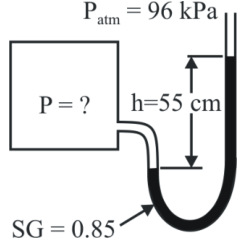
- A. 4.6 kPa
- B. 98.6 kPa
- C. 100.6 kPa
- D. 200 kPa
Answer: C. 100.6 kPa
Explanation: The density of the manometer fluid is 0.85 * 1000 = 850 kg/m³. The gauge pressure exerted by the fluid column is P_gauge = rho * g * h = 850 * 9.81 * 0.55 = 4586.175 Pa ≈ 4.6 kPa. The absolute pressure in the tank is P_atm + P_gauge = 96 kPa + 4.6 kPa = 100.6 kPa.
Question 56
Topic: Fluid Mechanics
A crane is used to lower weights into the sea (sea water density = 1025 kg/m³) for an underwater construction project. What is the percentage reduction in the tension in the rope of the crane due to a rectangular 0.4m × 0.4m × 3m concrete block (density = 2300 kg/m³) when it is completely immersed in water compared to the tension in the rope when it was suspended in air
Answer: A. 45%
Explanation: Tension in air T1 = weight of block = rho_block * V * g. Tension in water T2 = weight - buoyancy = (rho_block - rho_water) * V * g. The ratio of tension in water to air is T2/T1 = (2300 - 1025) / 2300 = 1275 / 2300 ≈ 0.554 (or 55.4%). The percentage reduction is (1 - 0.554) * 100 = 44.6%, which is approximately 45%.
Question 57
Topic: Fluid Mechanics
A steady, incompressible, two-dimensional velocity field is given by, V⃗ = (u,v) = (0.5 + 0.8x)î + (1.5 - 0.8y)ĵ. The number of stagnation points there in the flow field is
Answer: C. 1
Explanation: A stagnation point is where the local velocity is zero. Setting u = 0 gives 0.5 + 0.8x = 0, which means x = -0.625. Setting v = 0 gives 1.5 - 0.8y = 0, which means y = 1.875. Since there is exactly one solution for (x, y), there is only 1 stagnation point in the flow field.
Question 58
Topic: Fluid Mechanics
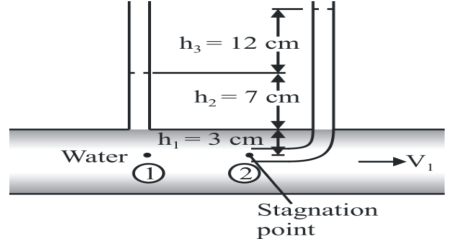
A piezometer and a Pitot tube are tapped into a horizontal water pipe, as shown in figure. The velocity of water at the center of the pipe is (given h1 = 3 cm, h2 = 7 cm, h3 = 12 cm)
- A. 2.4 m/s
- B. 1.53 m/s
- C. 2.07 m/s
- D. 1.93 m/s
Answer: B. 1.53 m/s
Explanation: The dynamic head (h_dynamic) is the difference between the stagnation head measured by the Pitot tube and the static head measured by the piezometer. According to the figure and data, h_dynamic = 12 cm = 0.12 m. Velocity v = $\sqrt{2 * g * h_dynamic}$ = $\sqrt{2 * 9.81 * 0.12}$ = 1.53 m/s.
Question 59
Topic: Fluid Mechanics
The pressure difference between the inside and outside of a liquid droplet of diameter 'd' due to surface tension (σ) is given by the relation
- A. ΔP = 4σ / d
- B. ΔP = 8σ / d
- C. ΔP = 2σ / d
- D. ΔP = 6σ / d
Answer: A. ΔP = 4σ / d
Explanation: For a liquid droplet, the surface tension force acts along the circumference, while the pressure force acts over the cross-sectional area. Equating these gives: P * (pi/4) * d² = σ * pi * d. Simplifying this yields the pressure difference ΔP = 4σ / d.
Question 60
Topic: Fluid Mechanics
A stream function is given by Ψ = 4x - 3y. The resultant velocity at any point is
- A. 7.81 units/s
- B. 7 units/s
- C. 3.5 units/s
- D. 5 units/s
Answer: D. 5 units/s
Explanation: The velocity components derived from the stream function are u = -(∂Ψ/∂y) = -(-3) = 3 and v = (∂Ψ/∂x) = 4. The resultant velocity V is the vector sum magnitude: V = $\sqrt{u² + v²}$ = $\sqrt{3^2 + 4^2}$ = $\sqrt{25}$ = 5 units/s.
Question 61
Topic: Fluid Mechanics
The coefficient of discharge for an orifice meter is in the range
- A. 0.97 to 0.99
- B. 0.93 to 0.98
- C. 0.62 to 0.65
- D. 0.51 to 0.55
Answer: C. 0.62 to 0.65
Explanation: The coefficient of discharge for an orifice meter is typically in the range of 0.62 to 0.65, which depends on the Reynolds number and the area ratio. By comparison, a venturimeter has a significantly higher coefficient of discharge, usually falling between 0.95 and 0.99.
Question 62
Topic: Fluid Mechanics
The hydraulic diameter, $D_h$ of a rectangular duct with sides 'a' and 'b' is
- A. $D_h = \frac{4ab}{2a+b}$
- B. $D_h = \frac{2ab}{a+b}$
- C. $D_h = \frac{2ab}{2a+b}$
- D. $D_h = \frac{4ab}{a+b}$
Answer: B. $D_h = \frac{2ab}{a+b}$
Explanation: Hydraulic diameter is defined as $D_h = \frac{4A}{P}$, where $A$ is the cross-sectional area and $P$ is the wetted perimeter. For a rectangular duct, the area is $A = a \times b$ and the perimeter is $P = 2(a+b)$. Substituting these gives $D_h = \frac{4ab}{2(a+b)} = \frac{2ab}{a+b}$.
Question 63
Topic: Heat Transfer
A flat plate of length 1 m and width 50 cm is placed in an air stream at 30°C blowing parallel to it. The convective heat transfer co-efficient is 30 W/(m²K). The heat transfer if the plate is maintained at a temperature of 400°C is
- A. 5.55 kW
- B. 4.05 kW
- C. 55.5 kW
- D. 6 kW
Answer: A. 5.55 kW
Explanation: The surface area of the plate is $A = L \times w = 1 \text{ m} \times 0.50 \text{ m} = 0.50 \text{ m}^2$. The convective heat transfer is determined using Newton's law of cooling: $Q = hA\Delta T$. Substituting the given values provides $Q = 30 \times 0.50 \times (400 - 30) = 15 \times 370 = 5550 \text{ W}$, which equals 5.55 kW.
Question 64
Topic: Heat Transfer
It is required to insulate a kitchen oven with cork board (K=0.043 W/(m K)) so that the heat losses from the oven does not exceed 400 W/m² when the inner surface of the oven is at 225°C and the outer surface of the oven is at 40°C. The thickness of insulation required is nearly
- A. 1 cm
- B. 2 cm
- C. 3 cm
- D. 4 cm
Answer: B. 2 cm
Explanation: Applying Fourier's Law for heat conduction, the heat flux is given by $Q/A = k \frac{\Delta T}{\delta}$. The heat flux is 400 W/m², thermal conductivity $k = 0.043 \text{ W/m-K}$, and the temperature difference $\Delta T = 225 - 40 = 185°\text{C}$. Rearranging for thickness $\delta$ gives $\delta = \frac{0.043 \times 185}{400} = 0.01988 \text{ m}$. This is approximately 2 cm.
Question 65
Topic: Heat Transfer
A radiator in a domestic heating system operates at a surface temperature of 55°C. Assuming the radiator behaves as a black body, the rate at which it emits the radiant heat per unit area is (assume $\sigma = 5.67 \times 10^{-8} \text{ W}/(\text{m}^2\text{K}^4)$)
- A. 0.66 kW/m²
- B. 0.0005 kW/m²
- C. 0.5 kW/m²
- D. 66 kW/m²
Answer: A. 0.66 kW/m²
Explanation: For a black body, the emissivity $\epsilon$ is 1. The rate of radiant heat emission per unit area is defined by the Stefan-Boltzmann law: $Q/A = \sigma T^4$. First, convert the temperature to Kelvin: $T = 55 + 273 = 328 \text{ K}$. Substituting the values yields $Q/A = 1 \times 5.67 \times 10^{-8} \times (328)^4 = 656.26 \text{ W/m}^2$, which is approximately 0.66 kW/m².
Question 66
Topic: Heat Transfer
A grey body is defined such that
- A. Monochromatic emissivity of the body is independent of temperature
- B. Monochromatic emissivity of the body is dependent of temperature
- C. Monochromatic emissivity of the body is independent of wave length
- D. Monochromatic emissivity of the body is dependent of wave length
Answer: C. Monochromatic emissivity of the body is independent of wave length
Explanation: A grey body is defined as a non-ideal radiator whose monochromatic emissivity is constant and independent of the wavelength ($\lambda$). This means it emits a constant fraction of the black body emission at all wavelengths.
Question 67
Topic: Heat Transfer
Critical thickness rate from a yields
- A. No heat transfer rate from a pipe
- B. Minimum heat transfer rate from a pipe
- C. Maximum heat transfer rate from a pipe
- D. None of the above
Answer: C. Maximum heat transfer rate from a pipe
Explanation: Critical thickness of insulation is the specific radius up to which adding insulation actually increases the heat transfer rate. This happens because the decrease in convective resistance (due to increased outer surface area) outweighs the increase in conductive resistance. At exactly the critical thickness, the heat transfer rate from a pipe reaches its maximum.
Question 68
Topic: Thermodynamics
A system is undergoing a cycle that consists of three processes. During the first process, the work is 5 kJ and the heat is 23 kJ. In the second process no work takes place and the heat interaction is -50 kJ. The third process is adiabatic. The work in the third process is
- A. -32 kJ
- B. -23 kJ
- C. -22 kJ
- D. zero
Answer: A. -32 kJ
Explanation: According to the First Law of Thermodynamics for a complete cycle, the net heat transfer is equal to the net work transfer ($\Sigma Q = \Sigma W$). The total heat transfer is $Q_{net} = 23 - 50 + 0 = -27 \text{ kJ}$. The total work transfer is $W_{net} = 5 + 0 + W$. Equating the two gives $-27 = 5 + W$, solving for $W$ yields $W = -32 \text{ kJ}$.
Question 69
Topic: Fluid Mechanics
Multi stage centrifugal pumps are used for
- A. high discharge
- B. high head and high discharge
- C. high pressure
- D. high efficiency
Answer: C. high pressure
Explanation: In multi-stage centrifugal pumps, several impellers are usually arranged in series. The discharge fluid from one impeller is fed to the suction of the next, meaning the head (and therefore pressure) increases at each stage while maintaining the same discharge. Hence, they are designed to produce high pressure.
Question 70
Topic: Metrology and Inspection
A wire has a mass (0.3 ± 0.003) g, radius (0.5 ± 0.005) mm and length (6 ± 0.06) cm. The maximum percentage error in the measurement of density is
Answer: D. 4
Explanation: Density $\rho$ is given by the formula $\rho = \frac{m}{V} = \frac{m}{\pi r² L}$. Using error propagation rules, the maximum relative percentage error is given by adding the individual relative errors: $\frac{\Delta \rho}{\rho} \% = \frac{\Delta m}{m} \% + 2\frac{\Delta r}{r} \% + \frac{\Delta L}{L} \%$. Plugging in the values gives: $(0.003/0.3) \times 100 + 2(0.005/0.5) \times 100 + (0.06/6) \times 100 = 1\% + 2(1\%) + 1\% = 4\%$.
Question 71
Topic: Fluid Mechanics
Match the items in column-1 and column-2 and choose the correct combination
Column-1
K. Kaplan
P. Parsons
Fo. Fourneyron
Fr. Francis
Column-2
1. steam turbine
2. inward flow reaction
3. outward flow reaction
4. gas turbine
- A. K-1, P-4, Fo-3, Fr-3
- B. K-3, P-1, Fo-3, Fr-2
- C. K-2, P-1, Fo-3, Fr-2
- D. K-2, P-4, Fo-4, Fr-2
Explanation: Note: ISRO did not provide an answer key for this question due to unmatched pairs. Correctly, Francis is an inward flow radial turbine, Fourneyron is an outward flow radial turbine, Kaplan is an axial flow turbine, and Parsons is a steam turbine.
Question 72
Topic: Metrology and Inspection
Which of the following pressure gauge is generally used for the calibration of other pressure measuring gauges
- A. Bourdon's tube pressure gauge
- B. Diaphragm pressure gauge
- C. Dead weight pressure gauge
- D. Manometer gauge
Answer: C. Dead weight pressure gauge
Explanation: A dead weight pressure gauge (dead weight tester) serves as a primary standard for pressure measurement. Since it uses known weights subjected to a known area to verify fluid pressure, it is widely utilized for the precise calibration of other pressure measuring gauges.
Question 73
Topic: Machine Design
In a ball bearing, if the number of balls is reduced to half and diameter of the ball is increased to 4 times, then static load capacity of the ball bearing is
- A. reduced 4 times
- B. reduced 8 times
- C. increased 4 times
- D. increased 8 times
Answer: D. increased 8 times
Explanation: According to Stribeck's equation, the static load capacity of a bearing is $C = \frac{k d² Z}{5}$, indicating $C \propto d² Z$. With the new configuration, the number of balls is $Z_2 = Z_1 / 2$ and the ball diameter is $d_2 = 4d_1$. The ratio of the new capacity to the old is $C_2/C_1 = (d_2/d_1)^2 (Z_2/Z_1) = (4)^2 \times (1/2) = 16/2 = 8$. Therefore, $C_2 = 8C_1$.
Question 74
Topic: Fluid Mechanics
The velocity of sound in winter compared to summer will be
- A. higher
- B. lower
- C. same
- D. cannot be predicted
Answer: B. lower
Explanation: The velocity of sound in a gas is given by the formula $C = \sqrt{\gamma R T}$, making it directly proportional to the square root of the absolute temperature ($T$). Since the ambient temperature is naturally lower in the winter compared to summer, the velocity of sound decreases correspondingly.
Question 75
Topic: Fluid Mechanics
Gaseous Nitrogen at 30°C is expanded through a converging nozzle from a total pressure of 0.5 MPa to a back pressure chamber. If the back pressure is increased from 0.1 MPa to 0.4 MPa in steps of 0.02 MPa, the trend in mass flow rate through the nozzle
- A. will gradually decrease
- B. will gradually increase
- C. will remain constant till a point and then gradually decrease
- D. will remain constant till a point and then gradually increase
Answer: C. will remain constant till a point and then gradually decrease
Explanation: For an ideal diatomic gas like Nitrogen, $\gamma = 1.4$. The critical pressure ratio is $P_c/P_0 = (2/(\gamma+1))^{\gamma/(\gamma-1)} \approx 0.528$. The critical pressure $P_c = 0.5 imes 0.528 = 0.264 \text{ MPa}$. When back pressure increases from 0.1 MPa up to 0.264 MPa, the flow is choked, and mass flow rate remains constant. Once the back pressure exceeds 0.264 MPa up to 0.4 MPa, the nozzle becomes unchoked, leading to a gradually decreasing mass flow rate.
Question 76
Topic: Engineering Mathematics
What is the value of the determinant consisting of rows (b²+c², ab, ac), (ba, c²+a², bc), and (ca, cb, a²+b²)?
- A. $4a^2b^2c^2$
- B. $8a^2b^2c^2$
- C. $2a^2b^2c^2$
- D. zero
Answer: A. $4a^2b^2c^2$
Explanation: Expanding the given $3 \times 3$ determinant algebraically leads to terms canceling out. The final simplified polynomial evaluates precisely to $4a^2b^2c^2$.
Question 77
Topic: Fluid Mechanics
Critical to Stagnation Pressure ratio for an expansion process is
- A. $\frac{P^*}{P_0} = \left[\frac{2}{\gamma+1}\right]^{2\gamma/(\gamma-1)}$
- B. $\frac{P^*}{P_0} = \left[\frac{2}{\gamma+1}\right]^{(\gamma+1)(\gamma-1)}$
- C. $\frac{P^*}{P_0} = \left[\frac{2}{\gamma+1}\right]^{\gamma/(\gamma-1)}$
- D. $\frac{P^*}{P_0} = \left[\frac{2}{\gamma+1}\right]^{\gamma/(\gamma+1)}$
Answer: C. $\frac{P^*}{P_0} = \left[\frac{2}{\gamma+1}\right]^{\gamma/(\gamma-1)}$
Explanation: At the critical state where the Mach number is 1, the isentropic relation for the temperature ratio is $\frac{T^*}{T_0} = \frac{2}{\gamma+1}$. Combining this with the isentropic relationship between pressure and temperature, $\frac{P^*}{P_0} = \left(\frac{T^*}{T_0}\right)^{\frac{\gamma}{\gamma-1}}$, directly gives the pressure ratio as $\left[\frac{2}{\gamma+1}\right]^{\frac{\gamma}{\gamma-1}}$.
Question 78
Topic: Material Science
Match the items in column-1 and column-2 and choose the correct combination
Column-1: A. Resilience, B. Fatigue, C. Stiffness, D. Elasticity
Column-2: 1. Ability of the material to return to the original shape when load is removed. 2. Capacity of a material to absorb energy elastically. 3. Ability of the material to absorb certain amount of energy without failure. 4. Resistance of the material to elastic deformation. 5. Failure of material at loads less than that at normal conditions
- A. A-2, B-5, C-3, D-1
- B. A-3, B-2, C-1, D-4
- C. A-3, B-5, C-4, D-2
- D. A-2, B-5, C-4, D-1
Answer: D. A-2, B-5, C-4, D-1
Explanation: Resilience defines the capacity of a material to absorb energy elastically without yielding (2). Fatigue refers to the failure of material at loads significantly lower than normal due to cyclic loading (5). Stiffness indicates a material's resistance to elastic deformation under a load (4). Elasticity describes the fundamental ability of a material to revert to its original shape upon removing an external load (1).
Question 79
Topic: Fluid Mechanics
A Pelton wheel turbine operates under a head of 125 m at a speed of 2000 rpm. To operate very close to the maximum efficiency, the mean diameter of the Pelton wheel is nearly
- A. 24 cm
- B. 48 cm
- C. 12.5 cm
- D. 36 cm
Answer: A. 24 cm
Explanation: Assuming a coefficient of velocity $C_v = 1$, the theoretical jet velocity is $V = \sqrt{2gH} = \sqrt{2 \times 9.81 \times 125} = 49.52 \text{ m/s}$. To achieve maximum efficiency, the blade (bucket) speed $u$ must be approximately half of the jet velocity, thus $u = 49.52 / 2 = 24.76 \text{ m/s}$. Using the formula for tangential velocity, $u = \frac{\pi D N}{60}$, we can write $24.76 = \frac{\pi \times D \times 2000}{60}$. Solving for diameter gives $D \approx 0.2365 \text{ m}$, which translates to 23.65 cm, nearly 24 cm.