Topic: Theory of Machines
Determine $m_{eq}$ and $k_{eq}$ for the system in below Fig., when X, the downward displacement of a block, measured from the system's equilibrium position, is used as the generalized coordinate. Take I as the M.I. of the wheel.
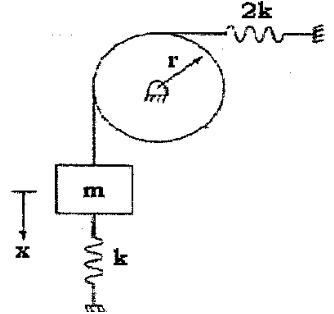
- A. $K_{eq}=3k, m_{eq}=m+\frac{I}{r^{2}}$
- B. $K_{eq}=3k, m_{eq}=mr^{2}+I$
- C. $K_{eq}=3k, m_{eq}=m-\frac{I}{r^{2}}$
- D. $K_{eq}=k/3, m_{eq}=m+\frac{I}{r^{2}}$
Answer: A. $K_{eq}=3k, m_{eq}=m+\frac{I}{r^{2}}$
Explanation: The springs with stiffness $k$ and $2k$ are connected in parallel, so the equivalent stiffness is $k_{eq} = k + 2k = 3k$. The total kinetic energy of the system is the sum of the translational kinetic energy of the mass $m$ and the rotational kinetic energy of the wheel: $E = \frac{1}{2}m\dot{x}^2 + \frac{1}{2}I\omega²$. Since $x = r\omega$, we can substitute $\omega = \dot{x}/r$ into the equation: $E = \frac{1}{2}m\dot{x}^2 + \frac{1}{2}I(\frac{\dot{x}}{r})^2 = \frac{1}{2}\dot{x}^2(m + \frac{I}{r²})$. Therefore, the equivalent mass is $m_{eq} = m + \frac{I}{r²}$.