Topic: Strength of Materials
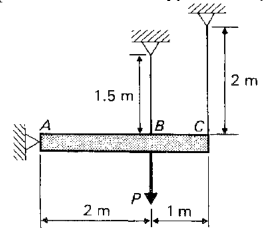
A rigid bar with wires at B & C is shown in the figure below. The cross sectional area of the wire at B is $3\times10^{-4}m^{2}$ at C is $2\times10^{-4}m^{2}$. The wires are elasto-plastic with strength 250 MPa and E value 200 GPa. The ultimate load P that can be applied to the rigid bar, as shown is
- A. 50 kN
- B. 75 kN
- C. 100 kN
- D. 150 kN
Answer: D. 150 kN
Explanation: Based on the geometry of the similar triangles, the deflections relate by $3\delta_1 = 2\delta_2$. Taking moments about point A gives $P \times 2 = P_1 \times 2 + P_2 \times 3$. The ultimate load carrying capacity of wire 1 (at B) is $P_1 = \sigma_{ultimate} \times A_1 = 250\times10^{6} \times 3\times10^{-4} = 75$ kN. For wire 2 (at C), it is $P_2 = \sigma_{ultimate} \times A_2 = 250\times10^{6} \times 2\times10^{-4} = 50$ kN. From the elastic relation, $P_1 = \frac{4}{3}P_2$. If $P_2$ reaches 50 kN, $P_1 = 66.67$ kN, which is safe. Substituting these into the moment equation gives $2P = 2(66.67) + 3(50) = 283.34$ kN, leading to $P = 141.67$ kN, which is approximately 150 kN.