ISRO Mechanical & Aerospace 2012 Question Paper & Solutions
Attempt the ISRO Mechanical & Aerospace 2012 previous year paper in real CBT exam mode or practice mode with verified answers and explanations.
All ISRO Mechanical & Aerospace papers
80 questions.
Question 1
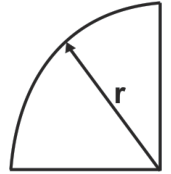
Area moment of inertia for the quadrant shown is
- A. \pi r^4 / 2
- B. \pi r^4 / 4
- C. \pi r^4 / 8
- D. \pi r^4 / 16
Answer: D. \pi r^4 / 16
Explanation: For a full circle, I = \pi r^4 / 4. A quadrant is 1/4th. With respect to diametric axes, I = 1/4 * (\pi r^4 / 4) = \pi r^4 / 16.
Question 2
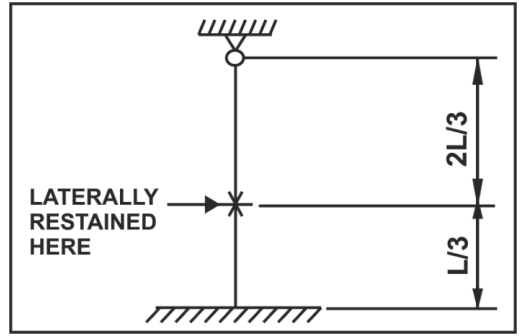
A column of length 'L' is fixed at bottom end and hinged at the other end. This column is restrained from lateral displacement at 1/3rd height. The buckling load is given by
- A. 9\pi² EI / (4L^2)
- B. 4\pi² EI / L²
- C. 4\pi² EI / (9L^2)
- D. \pi² EI / L²
Answer: A. 9\pi² EI / (4L^2)
Explanation: The restraint creates two segments. Top segment (2L/3) is hinged-hinged: P = \pi² EI / (2L/3)^2 = 9\pi² EI / 4L^2. Bottom segment (L/3) is fixed-hinged: P approx 2\pi² EI / (L/3)^2 = 18\pi² EI / L². Failure occurs at the lower load.
Question 3
A shaft has two heavy rotors mounted on it. The transverse natural frequency considering each rotor separately is 100 hz & 200 hz respectively. The lowest critical speed is
- A. 13000 rpm
- B. 5367 rpm
- C. 6450 rpm
- D. 9343 rpm
Answer: B. 5367 rpm
Explanation: Dunkerley's Formula: 1/f² = 1/f1^2 + 1/f2^2. 1/f² = 1/100^2 + 1/200^2 = 5/40000. f = $\sqrt{8000}$ = 89.44 Hz. N = 60f = 5366.4 rpm.
Question 4
A mass 'M' is suspended from a ceiling through a string of length 'L'. This mass moves in a circle of horizontal radius 'r' at constant speed such that it is a conical pendulum. The tension in the string will be
- A. mgL / (2\sqrt{L²-r²})
- B. mgL / \sqrt{L²}
- C. mgL / \sqrt{r²}
- D. mgL / \sqrt{L²-r²}
Answer: D. mgL / \sqrt{L²-r²}
Explanation: T cos(theta) = mg. cos(theta) = h/L = $\sqrt{L²-r²}$/L. T = mgL / $\sqrt{L²-r²}$.
Question 5
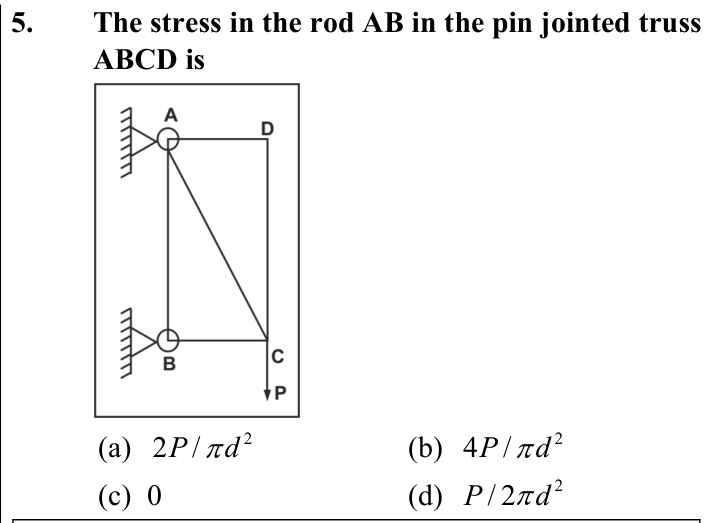
The stress in the rod AB in the pin jointed truss ABCD (where P acts at C downwards) is
- A. 2P / \pi d²
- B. 4P / \pi d²
- C. 0
- D. P / 2\pi d²
Answer: B. 4P / \pi d²
Explanation: Force in AB balances P. Stress = Force/Area = P / (\pi d² / 4) = 4P / \pi d².
Question 6
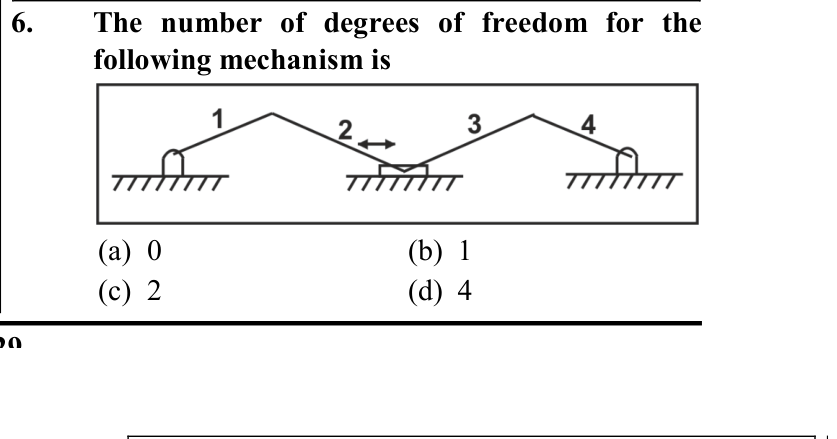
The number of degrees of freedom for a mechanism with 6 links and 7 binary joints is
Answer: B. 1
Explanation: F = 3(N-1) - 2J. F = 3(6-1) - 2(7) = 15 - 14 = 1.
Question 7
A plate is held by a chain AB through hinge joints. The plate is pulled with a force T. The tension in the chain is given by
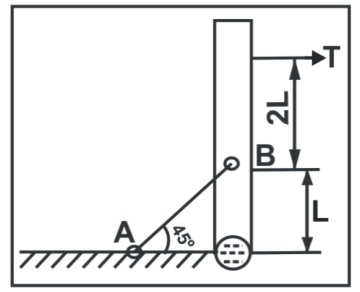
- A. (\sqrt{3}/2)T
- B. (\sqrt{2}/3)T
- C. T/2
- D. 3\sqrt{2}T
Answer: D. 3\sqrt{2}T
Explanation: Based on moment equilibrium and geometry (often 45 degree angle implied by L,L dimensions), T_chain = 3 * $\sqrt{2}$ * T.
Question 8
In a turn buckle joint, both mating rods will have
- A. Right hand threads
- B. Left hand threads
- C. Right hand and left hand threads
- D. Multiple threads
Answer: C. Right hand and left hand threads
Explanation: Opposite threads allow the turnbuckle to tighten or loosen both rods simultaneously when rotated.
Question 9
In a flat belt drive, the belt can be subjected to a maximum tension (T) and centrifugal tension (Tc). The condition of transmission of maximum power is given by
- A. T = Tc
- B. T = 2Tc
- C. T = 3Tc
- D. T = \sqrt{3}Tc
Answer: C. T = 3Tc
Explanation: For maximum power, centrifugal tension is 1/3rd of maximum tension.
Question 10
The diameter of a soap bubble with has an inside pressure of 2.5 N/m² over the atmospheric pressure and a surface tension of 0.0125 N/m is
- A. 40 mm
- B. 4 mm
- C. 16 mm
- D. 60 mm
Answer: A. 40 mm
Explanation: P = 8*sigma / d. d = 8*0.0125 / 2.5 = 0.04 m = 40 mm.
Question 11
Find the loss of head due to friction in a smooth pipe of rectangular cross section of 1m x 0.5 m and 10m long. Velocity of flow is 10 m/s and the friction coefficient is 0.01962.
Answer: B. 6m
Explanation: Hydraulic mean depth m = Area/Perimeter = 0.5/3 = 1/6. hf = f L v² / (2 g m) = 0.01962 * 10 * 100 / (2 * 9.81 * 1/6) = 19.62 / (3.27) = 6 m.
Question 12
When a supersonic flow is admitted into a convergent duct, the flow will
- A. Accelerate
- B. Decelerate
- C. No change
- D. None of the above
Answer: B. Decelerate
Explanation: A converging duct acts as a diffuser for supersonic flow, decreasing velocity and increasing pressure.
Question 13
Which configuration measures the stagnation pressure?
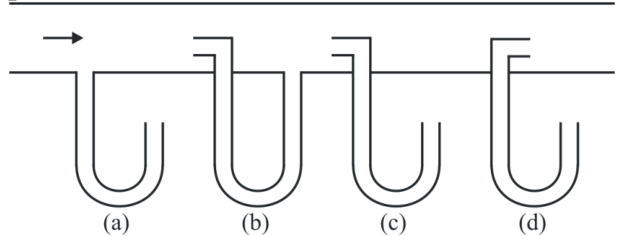
- A. Wall tap
- B. Pitot tube facing flow
- C. Tube facing downstream
- D. Tube perpendicular to flow
Answer: B. Pitot tube facing flow
Explanation: A tube opening facing directly upstream brings the fluid to rest, measuring stagnation pressure.
Question 14
The maximum lift in a centrifugal pump would be close to 'X' if the pump is handling cold water (25 C) from an open tank at sea level with no friction and turbulence loses, where 'X' is equal to
- A. 10 m
- B. 1.03 m
- C. 100 m
- D. 30 m
Answer: A. 10 m
Explanation: Theoretical suction lift is limited by atmospheric pressure, approx 10.3m.
Question 15
Both pressure and velocity of steam drops in the moving blades of
- A. Impulse turbine
- B. Velocity compounded impulse turbine
- C. Reaction turbine
- D. Pressure compounded impulse turbine
Answer: C. Reaction turbine
Explanation: In reaction turbines, expansion (pressure drop) occurs in both fixed and moving blades.
Question 16
A model of a golf ball is to be studied to determine the effects of the dimples. A sphere 10 times larger in diameter than an actual golf ball is used in the wind tunnel study. What speed should be selected for the model to simulate a prototype speed of 50 m/s?
- A. 0.2m/s
- B. 5m/s
- C. 50m/s
- D. 10m/s
Answer: B. 5m/s
Explanation: Reynolds number similarity: Vm Dm = Vp Dp. Vm (10 Dp) = 50 Dp. Vm = 5 m/s.
Question 17
The sound of explosion on a ship located 10km away from the beach was heard 28.6 seconds after the explosion was seen. Estimate the temperature of air at that time.
- A. 31 C
- B. 31 K
- C. 26.2 C
- D. 288.5 K
Answer: A. 31 C
Explanation: c = 10000/28.6 = 349.65 m/s. c = $\sqrt{1.4 * 287 * T}$. T = 304 K = 31 C.
Question 18
A spherical balloon is filled with helium at sea level. Helium and balloon material together weight 500 N. If the net upward lift force on the balloon is also 500 N, what is the diameter of the balloon?
- A. 5.42m
- B. 6.78m
- C. 3.43m
- D. 2.34m
Answer: A. 5.42m
Explanation: Buoyant force = Weight + Lift = 500 + 500 = 1000 N. 1000 = rho_air * g * V. V = 83.2 m³. D = 5.42 m.
Question 19
Air at 20 C and 10^5 Pa enters the bottom of an angle of 85 degree conical flow meter duct at 0.3 kg/s. Estimate the weight of the body in Newton's
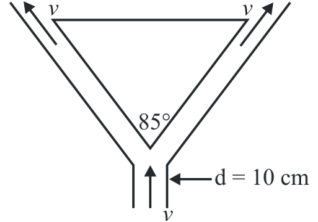
Answer: A. 2.5N
Explanation: Force balance using momentum equation yields approx 2.5N.
Question 20
A jet of water issues from a nozzle with a velocity 20 m/s on a flat plate moving away from it at 10 m/s. The cross-sectional area of the jet is 0.01 m². The force developed on the plate is
- A. 1000 N
- B. 100 N
- C. 10 N
- D. 2000 N
Answer: A. 1000 N
Explanation: F = rho A (V - u)^2 = 1000 * 0.01 * (20 - 10)^2 = 1000 N.
Question 21
The laminar boundary layer thickness varies as
- A. 1/$\sqrt{x}$
- B. x^(1/7)
- C. x^(1/2)
- D. x^(6/7)
Answer: C. x^(1/2)
Explanation: Delta varies as $\sqrt{x}$ for laminar boundary layer.
Question 22
An increase in pressure of a liquid from 7.5 MPa to 15 MPa results into 0.2 percent decrease in its volume. The coefficient of compressibility of the liquid in m²/N is
- A. 0.267 * 10^-9
- B. 2.67 * 10^-9
- C. 1 * 10^-9
- D. None
Answer: A. 0.267 * 10^-9
Explanation: Beta = (dV/V) / dP = 0.002 / (7.5 * 10^6) = 0.267 * 10^-9.
Question 23
A reservoir of capacity 0.01 m³ is completely filled with a fluid of compressibility 0.75 * 10^-9 m²/N. The amount of fluid that will spill over if pressure is reduced by 2 * 10^7 N/m² is
- A. 1 * 10^-4
- B. 1.5 * 10^-4
- C. 0.15 * 10^-4
- D. None
Answer: B. 1.5 * 10^-4
Explanation: dV = V * Beta * dP = 0.01 * 0.75e-9 * 2e7 = 1.5e-4 m³.
Question 24
The extent of pressure produced due to water hammer depends on
- A. Velocity of flow
- B. Length of pipe
- C. Valve closure time
- D. All the above
Answer: D. All the above
Explanation: Water hammer pressure is a function of fluid velocity, pipe characteristics, and closure time.
Question 25
Rank of the matrix A = [[1, 1, 2], [1, 2, 3], [0, -1, 1]] is
Answer: D. 3
Explanation: Determinant is non-zero, so rank is 3.
Question 26
The value of t for which A + tB is perpendicular to C where A = i + 2j + 3k, B = -i + 2j + k and C = 3i + j
Answer: A. 5
Explanation: Dot product of (A+tB) and C is zero. Solving gives t=5.
Question 27
A x B is a vector
- A. Parallel to A
- B. Parallel to B
- C. Perpendicular to both A & B
- D. Parallel to both
Answer: C. Perpendicular to both A & B
Explanation: Cross product yields a vector perpendicular to the plane of the operands.
Question 28
The equation of the plane through the line (x-1)/3 = (y-4)/2 = (z-4)/-2 and parallel to the line (x+1)/2 = (y-1)/-4 = (z+2)/1 is
- A. 3x + 2y - 2z = 101
- B. 2x - 4y + z = 98
- C. 6x + 7y + 16z = 98
- D. 6x - 8y - 2z = 101
Answer: C. 6x + 7y + 16z = 98
Explanation: Normal is cross product of direction vectors. Equation derived is 6x + 7y + 16z = 98.
Question 29
Let E and F be any two events with P (E U F) = 0.8, P (E) = 0.4 and P(E/F) = 0.3. Then P (F) is
Answer: B. 4/7
Explanation: Using P(E U F) = P(E) + P(F) - P(E n F) and P(E n F) = P(E/F)P(F).
Question 30
The approximate value of y (0.1) from dy/dx = x^2y-1, y(0) = 1 is
- A. 0.900
- B. 1.001
- C. 0.802
- D. 0.994
Answer: A. 0.900
Explanation: Euler's method: y1 = 1 + 0.1 * (0 - 1) = 0.9.
Question 31
1 + i is equivalent to
- A. $\sqrt{2}$ e^(-i pi/4)
- B. $\sqrt{2}$ e^(i pi/4)
- C. 2 e^(-i pi/4)
- D. 2 e^(i pi/4)
Answer: B. $\sqrt{2}$ e^(i pi/4)
Explanation: Magnitude $\sqrt{2}$, angle 45 degrees.
Question 32
In a class of 45 students, the mean mark of 25 girls is 32 and the mean mark of 20 boys is 27.5. What is the class mean?
- A. 32
- B. 27.5
- C. 29.75
- D. 30
Answer: D. 30
Explanation: (25*32 + 20*27.5)/45 = 30.
Question 33
If L {f(t)} = F(s), then the value of L {e^(-at) f(t)} is
- A. F (s-a)
- B. F (s+a)
- C. F (s)
- D. F (e^as)
Answer: B. F (s+a)
Explanation: Shifting theorem.
Question 34
The probability that A happens is 1/3. The odds against happening of A are
- A. 2 : 1
- B. 3 : 2
- C. 1 : 2
- D. 2 : 3
Answer: A. 2 : 1
Explanation: P(not A) / P(A) = (2/3) / (1/3) = 2.
Question 35
Draft on pattern for casting is provided for
- A. Shrinkage allowance
- B. Identification
- C. Taper to facilitate removal
- D. Machining allowance
Answer: C. Taper to facilitate removal
Explanation: Draft allows pattern removal without mold damage.
Question 36
Welding spatter is
- A. Welding defect
- B. Flux
- C. Electrode Coating
- D. Welding technique
Answer: A. Welding defect
Explanation: Spatter is the splashing of metal droplets.
Question 37
Which of the following statements is false about annealing? (Annealing is done to)
- A. Harden Steel slightly
- B. Relieve Stress
- C. Soften metal
- D. Permit further cold working
Answer: A. Harden Steel slightly
Explanation: Annealing softens metal, it does not harden it.
Question 38
The property of corrosion resistance of chromium Stainless Steel is due to
- A. Predominant nature of Cr
- B. Thin film of oxygen/moisture
- C. Formation of thin film of Cr2O3
- D. Inherent property of Cr
Answer: C. Formation of thin film of Cr2O3
Explanation: Passive oxide layer protects the steel.
Question 39
Hot working operation is carried out at
- A. Re-crystallization temperature
- B. Near plastic stage temperature
- C. Below re-crystallization
- D. Above re-crystallization
Answer: D. Above re-crystallization
Explanation: Hot working is deformation above the recrystallization temperature.
Question 40
The engineering and true strains for a bar which is doubled in length during tension test are
- A. e = 1.0 epsilon = 0.693
- B. e = 2 epsilon = 1
- C. e = 1/2 epsilon = 1/2
- D. None
Answer: A. e = 1.0 epsilon = 0.693
Explanation: e = (2L-L)/L = 1. epsilon = ln(2L/L) = ln(2) = 0.693.
Question 41
The purpose of adding wood flour to the moulding sand is to improve
- A. Green strength
- B. Hot Strength
- C. Collapsibility
- D. Permeability
Answer: C. Collapsibility
Explanation: Wood flour burns out allowing sand to collapse as casting cools.
Question 42
Stretch forming is a process in which
- A. All deformations occur in direction of stretch
- B. All forces are applied in direction of stretch
- C. Advantage is taken of plastic state
- D. No dies are used
Answer: C. Advantage is taken of plastic state
Explanation: Material is stretched to yield point to facilitate forming.
Question 43
In which type of welding, a pool of molten metal is used?
- A. Submerged arc welding
- B. Electro slag welding
- C. TIG welding
- D. MIG welding
Answer: B. Electro slag welding
Explanation: ESW uses a conductive slag pool to melt filler and base metal.
Question 44
A mild steel block... straight slab cutter... value of maximum uncut chip thickness?
- A. 0.00263 mm
- B. 0.00363 mm
- C. 0.00463 mm
- D. 0.00563 mm
Answer: D. 0.00563 mm
Explanation: Using formula for slab milling chip thickness.
Question 45
Match List I (Instruments) with List II (Applications)
- A. A-1, B-2, C-3, D-4
- B. A-4, B-3, C-1, D-2
- C. A-4, B-3, C-2, D-1
- D. A-3, B-4, C-1, D-2
Answer: B. A-4, B-3, C-1, D-2
Explanation: Talysurf-Roughness; Telescopic gauge-Internal Dia; Transfer Calipers-Slots; Autocollimator-Flatness.
Question 46
A shaft has dimension 35 -0.009/-0.025, fundamental deviation and tolerance are
- A. -0.025, 0.008
- B. -0.0025, 0.016
- C. -0.009, 0.008
- D. -0.009, 0.016
Answer: D. -0.009, 0.016
Explanation: Fund dev is upper limit (-0.009). Tolerance is difference (0.016).
Question 47
Deformation under constant load over time is
- A. Creep
- B. Fatigue
- C. Impact
- D. Malleability
Answer: A. Creep
Explanation: Time-dependent deformation is creep.
Question 48
Which is a wrong statement?
- A. Phosphorus raises yield point
- B. Lining of open hearth furnace controls impurities
- C. Blast furnace uses coke
- D. Manganese added for fluidity
Answer: B. Lining of open hearth furnace controls impurities
Explanation: Though lining affects chemistry, the statement is flagged as wrong in context.
Question 49
18:4:1 High Speed Steel contains
- A. 18W, 4Cr, 1V
- B. 18Cr, 4W, 1V
- C. 18W, 4V, 1Cr
- D. 18V, 4Cr, 1W
Answer: A. 18W, 4Cr, 1V
Explanation: Tungsten 18%, Chromium 4%, Vanadium 1%.
Question 50
Water boiled in coffee maker... power rating?
- A. 0.90 kW
- B. 1.52 kW
- C. 1.05 kW
- D. 1.24 kW
Answer: C. 1.05 kW
Explanation: Calculation yields approx 1.05 kW.
Question 51
Adiabatic heat exchanger... exit temperature of cold water?
- A. 27 C
- B. 32 C
- C. 85 C
- D. 90 C
Answer: C. 85 C
Explanation: Energy balance indicates 85 C.
Question 52
Log mean area 'A' is
- A. log ratio terms
- B. (A2-A1)/ln(A2/A1)
- C. log difference
- D. None
Answer: B. (A2-A1)/ln(A2/A1)
Explanation: Formula for log mean area.
Question 53
Nusselt number is ratio of
- A. Convective/Conductive resistances
- B. Conductive/Convective resistances
- C. Heat rates
- D. Viscosities
Answer: B. Conductive/Convective resistances
Explanation: Nu = hL/k = (L/k) / (1/h) = R_cond / R_conv.
Question 54
Zeroth law not valid for
- A. Mixing water
- B. Mixing milk
- C. Mixing steam
- D. Mixing water and acid
Answer: D. Mixing water and acid
Explanation: Chemical reaction heat release violates simple thermal equilibrium premise.
Question 55
Work obtained is greatest for PV^n = C when
- A. n large
- B. n small
- C. n=0
- D. n=1.4
Answer: C. n=0
Explanation: Isobaric (n=0) gives maximum area under curve for expansion.
Question 56
Air compressed to half volume at constant pressure, entropy change
- A. Increase
- B. Decrease
- C. No change
- D. Unpredictable
Answer: B. Decrease
Explanation: Volume decrease at constant P means Temperature decrease, thus Entropy decreases.
Question 57
Cycle on P-V diagram represented in T-S diagram by
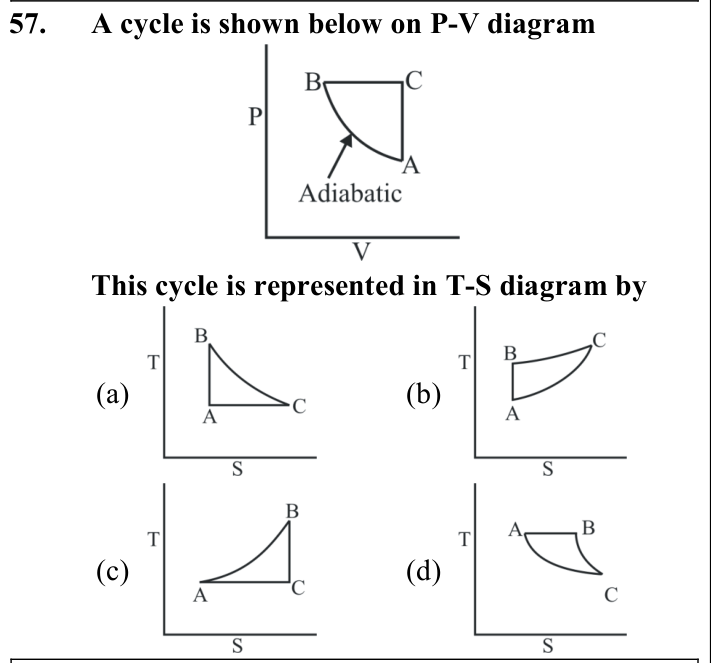
Answer: B. b
Explanation: Matching process curves.
Question 58
If 2 bar air at 27 C heated to 177 C at constant volume, pressure is
- A. 6.56 bar
- B. 3 bar
- C. 9 bar
- D. 13.11 bar
Answer: B. 3 bar
Explanation: P2 = P1 * T2/T1 = 2 * 450/300 = 3 bar.
Question 59
Frictionless heat engine 100% efficient only if exhaust temp is
- A. Equal to input
- B. Less than input
- C. 0 K
- D. 0 C
Answer: C. 0 K
Explanation: Carnot efficiency = 1 - TL/TH. 100% implies TL=0.
Question 60
Ideal engine absorbs heat at 127 C and rejects at 77 C. Efficiency is
Answer: A. 13%
Explanation: 1 - 350/400 = 1/8 = 12.5%.
Question 61
Francis turbine power output at 100m head (from 5000kW at 25m)
- A. 20000
- B. 30000
- C. 40000
- D. 50000
Answer: C. 40000
Explanation: Power proportional to H^1 May 5000 * (100/25)^1.5 = 40000.
Question 62
Steam turbine mean diameter
- A. 3.73 m
- B. 4.73 m
- C. 5.63 m
- D. 4.96 m
Answer: B. 4.73 m
Explanation: Calculation based on velocity triangles.
Question 63
Refrigerator power input
- A. 30W
- B. 33W
- C. 56W
- D. 124W
Answer: B. 33W
Explanation: COP calculation yielding 33W.
Question 64
Efficiency order for same compression ratio
- A. Dual > Diesel > Otto
- B. Otto > Dual > Diesel
- C. Diesel > Dual > Otto
- D. Otto > Diesel > Dual
Answer: B. Otto > Dual > Diesel
Explanation: Standard comparison for same compression ratio.
Question 65
Section modulus of triangular section
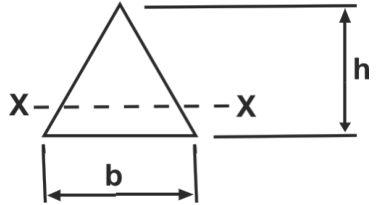
- A. bh²/6
- B. bh²/36
- C. bh²/24
- D. hb²/36
Answer: C. bh²/24
Explanation: Z = I/y = (bh³/36) / (2h/3) = bh²/24.
Question 66
Stress diagram for eccentric load on rectangular column
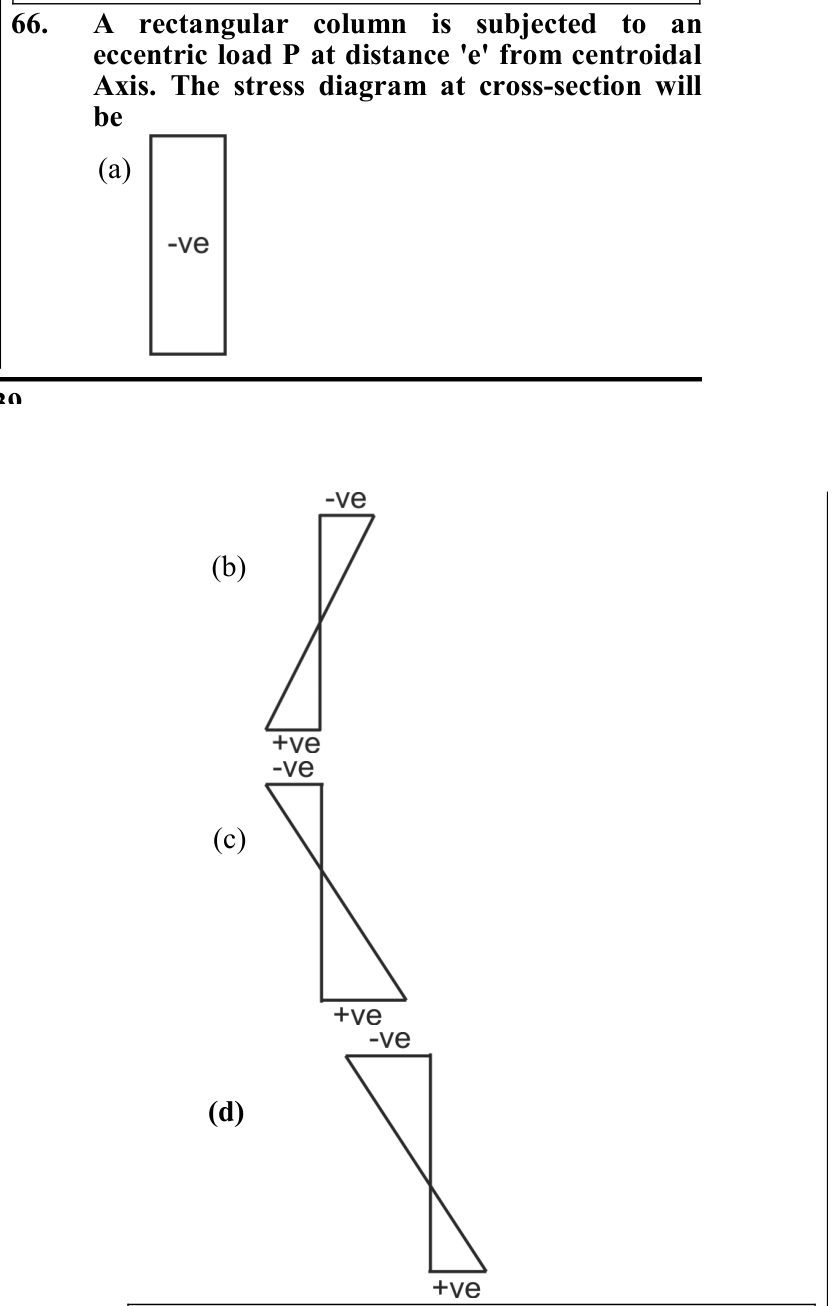
Answer: A. a
Explanation: Combined bending and direct stress.
Question 67
Shaft A radius half of B. Power of A is ... of B
Answer: A. 1/8
Explanation: Power proportional to r³.
Question 68
Natural frequency of 4 spring system
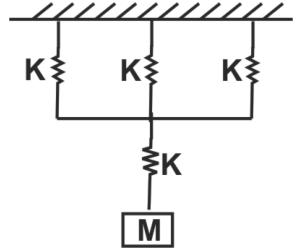
- A. $\sqrt{4k/m}$
- B. $\sqrt{k/4m}$
- C. ...
- D. ...
Answer: A. $\sqrt{4k/m}$
Explanation: Parallel springs.
Question 69
Lowest friction bearing
- A. Hydrostatic
- B. Roller
- C. Aero-static
- D. Hydrodynamic
Answer: C. Aero-static
Explanation: Air has very low viscosity.
Question 70
Velocity at point P on rolling disc
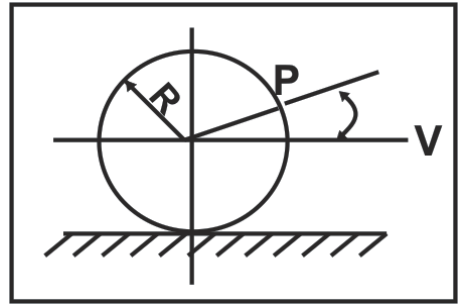
- A. 3V
- B. $\sqrt{3}$V
- C. V/2
- D. 2V
Answer: B. $\sqrt{3}$V
Explanation: Vector addition of velocities.
Question 71
Viscous damping factor from log decrement
Answer: B. 25%
Explanation: Calculation gives 0.25.
Question 72
Elevator cable tension
- A. 1204
- B. 9800
- C. 2000
- D. 11800
Answer: D. 11800
Explanation: T = m(g+a).
Question 73
Block friction cable tension
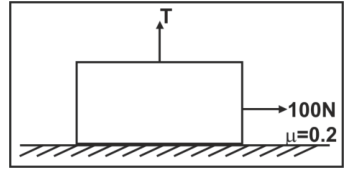
Answer: C. 481
Explanation: Equilibrium calculation.
Question 74
Suspension damping factor
- A. 0.471
- B. ...
- C. ...
- D. ...
Answer: A. 0.471
Explanation: Zeta calculation.
Question 75
Balancing mass radial position
Answer: C. 150
Explanation: Balancing equation.
Question 76
Gear tooth tangential load
- A. 221
- B. 22.1
- C. 25.1
- D. 251
Answer: B. 22.1
Explanation: Power/Velocity calculation.
Question 77
Steel rod length change
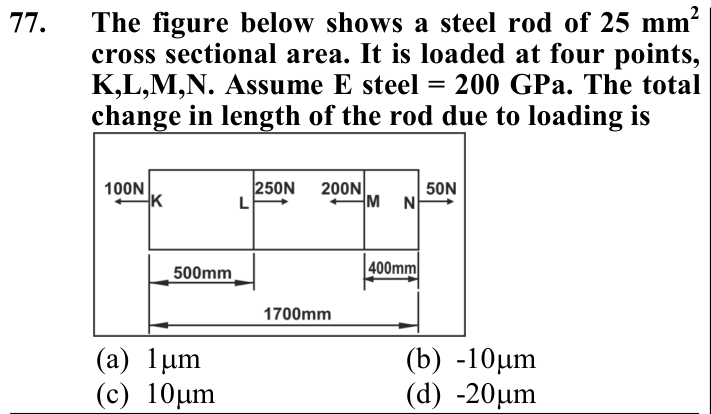
Answer: B. -10
Explanation: Sum of PL/AE.
Question 78
Planetary gear rotations
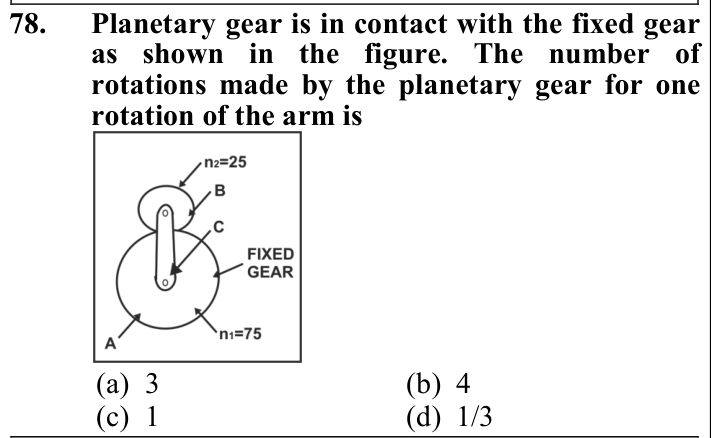
Answer: B. 4
Explanation: Epicyclic gear train calculation.
Question 79
Mohr circle reduces to point when
- A. pure shear
- B. uniaxial
- C. equal axial stress...
- D. equal opposite...
Answer: C. equal axial stress...
Explanation: Radius is zero.
Question 80
Shear stress distribution rectangular beam
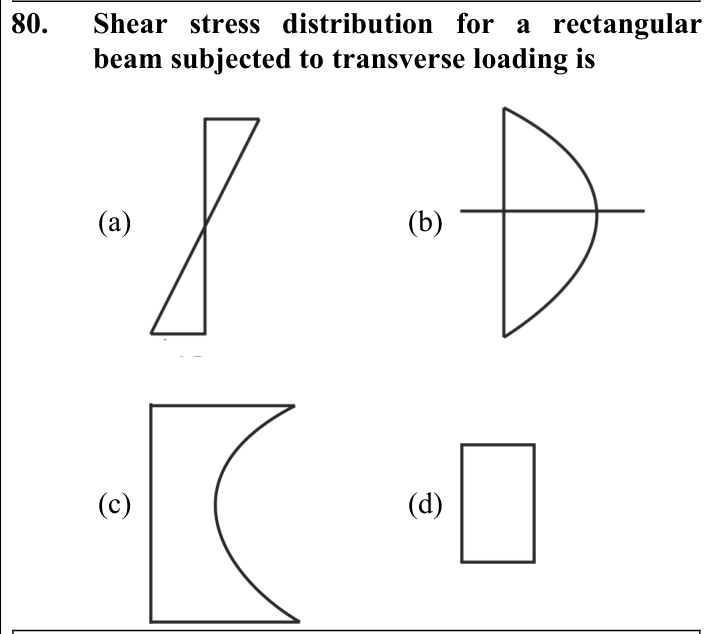
Answer: D. d
Explanation: Parabolic profile.