ISRO Mechanical & Aerospace 2011 Question Paper & Solutions
Attempt the ISRO Mechanical & Aerospace 2011 previous year paper in real CBT exam mode or practice mode with verified answers and explanations.
All ISRO Mechanical & Aerospace papers
80 questions.
Question 1
Match List I with List II and select the correct answer
List I
A. Pelton wheel (single jet)
B. Francis Turbine
C. Kaplan Turbine
List II
1. Medium discharge, low head
2. High discharge, low head
3. Medium discharge, medium head
4. Low discharge, high head
- A. A-4, B-3, C-2
- B. A-1, B-3, C-4
- C. A-4, B-1, C-3
- D. A-1, B-2, C-3
Answer: A. A-4, B-3, C-2
Explanation: Pelton wheel is a high head, low discharge turbine. Francis turbine is a medium head, medium discharge turbine. Kaplan turbine is a low head, high discharge turbine.
Question 2
Reversible adiabatic process may be expressed as $(T_1/T_2)$ equal to
- A. $(V_2/V_1)^{\gamma+1}$
- B. $(V_2/V_1)^{\gamma-1}$
- C. $(P_1/P_2)^{(\gamma-1)/\gamma}$
- D. $(P_1/P_2)^{\gamma-1}$
Answer: C. $(P_1/P_2)^{(\gamma-1)/\gamma}$
Explanation: For a reversible adiabatic (isentropic) process, $T_1/T_2 = (P_1/P_2)^{(\gamma-1)/\gamma} = (V_2/V_1)^{\gamma-1}$.
Question 3
A gas is to be expanded in a cylinder such that its temperature remains constant. The resulting variation of pressure vs. volume is
- A. A parabola
- B. A hyperbola
- C. A straight line through origin
- D. None of these
Answer: B. A hyperbola
Explanation: For an isothermal process (constant temperature), $PV = C$ (constant), which represents a rectangular hyperbola on a P-V diagram.
Question 4
According to first law of thermodynamics
- A. Mass and energy are mutually convertible
- B. Heat and work are mutually convertible
- C. Heat flows from hot substance to cold substance
- D. Carnot engine is most efficient
Answer: B. Heat and work are mutually convertible
Explanation: The First Law of Thermodynamics is a statement of conservation of energy, implying that heat and work are forms of energy and are mutually convertible.
Question 5
Pick up the incorrect statement for centrifugal pumps
- A. Discharge $\propto$ diameter
- B. Head $\propto$ (speed)$^2$
- C. Head $\propto$ (diameter)$^2$
- D. Discharge $\propto$ speed
Answer: A. Discharge $\propto$ diameter
Explanation: For geometrically similar pumps, Discharge $Q \propto N D³$. Thus $Q \propto D³$, not $D$ linearly. $H \propto N² D²$.
Question 6
If the discharge of a centrifugal pump is throttled then its suction lift
- A. Decreases
- B. First increases and then decreases
- C. Remains unchanged
- D. Increases
Answer: D. Increases
Explanation: Throttling reduces discharge, which decreases friction losses in the suction pipe, thereby increasing the available Net Positive Suction Head (NPSH) and the allowable suction lift.
Question 7
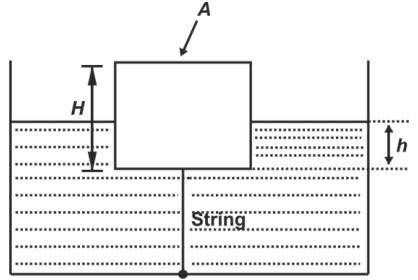
A cylindrical body of cross-sectional area A, height H and density $\rho_s$, is immersed to a depth h in a liquid of density $\rho$, and tied to the bottom with a string. The tension in the string is
- A. $\rho ghA$
- B. $(\rho h - \rho_s H)gA$
- C. $(\rho - \rho_s)ghA$
- D. $(\rho_s - \rho)ghA$
Answer: B. $(\rho h - \rho_s H)gA$
Explanation: Forces: Tension T (down) + Weight W (down) = Buoyancy B (up). $T = B - W = (\rho g A h) - (\rho_s g A H) = gA(\rho h - \rho_s H)$.
Question 8
A manometer measures the pressure differential between two locations of a pipe carrying water. If the manometric liquid is mercury (specific gravity 13.6) and the manometer showed a level difference of 20cm, then the pressure head difference of water between the two tapings will be
- A. 1.26m
- B. 2.72m
- C. 1.36m
- D. 2.52m
Answer: D. 2.52m
Explanation: Head difference in terms of water $h_w = h_m (S_m/S_w - 1) = 0.20 (13.6/1 - 1) = 0.20 \times 12.6 = 2.52$ m.
Question 9
Flow takes place at Reynolds Number of 1500 in two different pipes with relative roughness of 0.001 and 0.002. The friction factor
- A. Will be higher for the pipe with relative roughness of 0.001
- B. Will be higher for the pipe having relative roughness of 0.002
- C. Will be the same in both the pipes
- D. In the two pipes cannot be compared on the basis of data given
Answer: C. Will be the same in both the pipes
Explanation: Re = 1500 implies laminar flow. In laminar flow ($f = 64/Re$), friction factor depends only on Reynolds number and is independent of surface roughness.
Question 10
A liquid compressed in cylinder has a volume of $0.04m^3$ at $50 kg/cm²$ and a volume of $0.039m^3$ at $150 kg/cm²$. The bulk modulus of elasticity of liquid is
- A. 400 $kg/cm²$
- B. $40 \times 10^6 kg/cm²$
- C. $40 \times 10^5 kg/cm²$
- D. 4000 $kg/cm²$
Answer: D. 4000 $kg/cm²$
Explanation: $K = -V \frac{\Delta P}{\Delta V} = -0.04 \frac{150-50}{0.039-0.04} = -0.04 \frac{100}{-0.001} = 4000$.
Question 11
A fluid jet is discharging from a 100 mm nozzle and the vena-contracta formed has a diameter of 90 mm. If the coefficient of velocity is 0.95, then the coefficient of discharge for the nozzle is
- A. 0.7695
- B. 0.81
- C. 0.9025
- D. 0.855
Answer: A. 0.7695
Explanation: $C_c = (d_c/d)^2 = (90/100)^2 = 0.81$. $C_d = C_c \times C_v = 0.81 \times 0.95 = 0.7695$.
Question 12
A fully developed laminar viscous flow through a circular tube has the ratio of maximum velocity to average velocity as
Answer: B. 2.0
Explanation: For laminar flow in a circular pipe, $V_{max} = 2 V_{avg}$. For flow between parallel plates, the ratio is 1.5.
Question 13
If the surface tension of water-air interface is 0.073 N/m, the gauge pressure inside a rain drop of 1mm diameter will be
- A. 0.146 N/m$^2$
- B. 73 N/m$^2$
- C. 146 N/m$^2$
- D. 292 N/m$^2$
Answer: D. 292 N/m$^2$
Explanation: Pressure inside a droplet $\Delta P = 4\sigma/d = 4(0.073)/0.001 = 292$ Pa.
Question 14
A stream function is given by $(x² - y²)$. The potential function of the flow will be
- A. $2xy + f(x)$
- B. $2(x² - y²)$
- C. $-2xy + constant$
- D. $2xy + f(y)$
Answer: C. $-2xy + constant$
Explanation: Using Cauchy-Riemann equations: $u = \partial\psi/\partial y = -2y = -\partial\phi/\partial x \implies \phi = 2xy+f(y)$. $v = -\partial\psi/\partial x = -2x = -\partial\phi/\partial y \implies \phi = 2xy+f(x)$. The common form is $2xy$. Note: Based on sign convention $\partial\phi/\partial x = u$ or $-u$, result can be $\pm 2xy$. The given answer key often selects $-2xy$.
Question 15
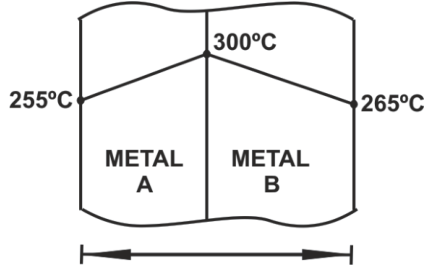
[Image Question] The temperature profile between two metal wall joined together is shown in Fig. From the figure it can be concluded that
- A. Heat flows from A to B
- B. Heat flows from B to A
- C. Heat is generated at the interface
- D. A is bad conductor of heat
Answer: D. A is bad conductor of heat
Explanation: The temperature gradient in A is steeper than in B. Since $q = -kA(dT/dx)$, for the same heat flux, a steeper gradient implies lower thermal conductivity (k). Thus A is a worse conductor than B. Heat flows from high to low temp (A to B).
Question 16
According to Fourier's law, amount of heat flow (Q) through the body in unit time is equal to
- A. $kA \frac{dT}{dx}$
- B. $kA \frac{dT²}{dx²}$
- C. $k \frac{dT}{dx}$
- D. $kA \frac{dx}{dT}$
Answer: A. $kA \frac{dT}{dx}$
Explanation: Fourier's Law of Conduction: $Q = -kA \frac{dT}{dx}$.
Question 17
Pitch diameter is equal to product of
- A. Circular pitch and number of teeth
- B. Working depth and number of teeth
- C. Clearance and number of teeth
- D. Module and number of teeth
Answer: D. Module and number of teeth
Explanation: Module $m = D/T$, so Pitch Diameter $D = m \times T$.
Question 18
The tension in the cable supporting a lift moving upwards is twice the tension when the lift moves downwards. What is the acceleration of the lift?
Answer: B. g/3
Explanation: $T_{up} = m(g+a)$, $T_{down} = m(g-a)$. $m(g+a) = 2m(g-a) \implies g+a = 2g-2a \implies 3a = g \implies a = g/3$.
Question 19
A particle starts from rest with a constant acceleration $\alpha$ m/sec$^2$ and after some time it decelerates at a uniform rate of $\beta$ m/sec$^2$ till it comes to rest. If the total time taken between two rests positions is t, the maximum velocity acquired by the particle would be
- A. $\frac{\alpha + \beta}{2}t$
- B. $\frac{\alpha - \beta}{2}t$
- C. $\left(\frac{\alpha\beta}{\alpha+\beta}\right)t$
- D. $\left(\frac{\alpha+\beta}{\alpha\beta}\right)t$
Answer: C. $\left(\frac{\alpha\beta}{\alpha+\beta}\right)t$
Explanation: $V_{max} = t_1 \alpha = t_2 \beta$. Total time $t = t_1 + t_2 = V_{max}/\alpha + V_{max}/\beta$. Solving for $V_{max}$ gives the result.
Question 20
Two metallic blocks having masses in the ratio 2:3 are made to slide down a friction less inclined plane starting initially from rest position. When these blocks reach the bottom of the inclined plane, they will have their kinetic energies in the ratio
Answer: A. 2:3
Explanation: Conservation of energy: $PE = KE$. $mgh = KE$. Since h is same, $KE \propto m$. Ratio 2:3.
Question 21
A particle is projected at an angle $\theta$ to the horizontal and it attains a maximum height H. The time taken by the projectile to reach the highest point, of its path is
- A. $\sqrt{H/g}$
- B. $\sqrt{2H/g}$
- C. $\frac{2H \sin \theta}{g}$
- D. $\frac{\sqrt{2H}}{\sin \theta}$
Answer: B. $\sqrt{2H/g}$
Explanation: $H = u_y^2 / 2g \implies u_y = \sqrt{2gH}$. Time to reach max height $t = u_y/g = \sqrt{2gH}/g = \sqrt{2H/g}$.
Question 22
1kg of moist air of RH 70% at 21°C is cooled at constant pressure of 1 bar to 5°C. The vapour pressure at 21°C and 5°C are 0.025 bar and 0.0087 bar. The percentage of water vapour that condenses into water, at 5°C is
Answer: A. 66%
Explanation: Specific humidity $\omega = 0.622 P_v / (P - P_v)$. Initial $P_{v1} = 0.7 \times 0.025 = 0.0175$. Final (saturated) $P_{v2} = 0.0087$. Calculate $\omega_1$ and $\omega_2$. Percentage condensed = $(\omega_1 - \omega_2)/\omega_1$.
Question 23
Two spherical balls of same material and surface finish have their diameters in the ratio of 2:1. Both are heated to same temperature and allowed to cool by radiation. Rate of cooling of big ball as compared to smaller one will be in the ratio of
Answer: D. 4:1
Explanation: If 'Rate of cooling' refers to heat loss rate (Watts), $Q = \sigma A \epsilon (T^4 - T_{inf}^4) \propto A \propto D²$. Ratio $2^2:1^2 = 4:1$. If it refers to temperature drop rate $dT/dt$, it is $\propto A/V \propto 1/D$, ratio 1:2. ISRO answer implies Heat Loss Rate.
Question 24
Ninety kilograms of ice at 0°C are completely melted. Find the entropy change, in kJ/K, if $T_2 = 0°C$. (Latent heat of fusion is 318.5 kJ/kg.K)
Answer: C. 105
Explanation: $\Delta S = Q/T = m L / T = 90 \times 318.5 / 273 \approx 105$ kJ/K.
Question 25
A solid shaft of 100mm diameter transmits 160 HP at 200 rpm. The modulus of rigidity $c = 8 \times 10^5 kg/cm²$. Then the maximum angle of twist for a length of 6 meter is
Answer: B. 2.5°
Explanation: Power P = 160 HP = $160 \times 746$ W. $P = 2\pi NT/60$. Find Torque T. Twist $\theta = TL/GJ$.
Question 26
A perfect gas at 27 °C is heated at constant pressure till its volume is double. The final temperature is
- A. 54°C
- B. 108°C
- C. 327°C
- D. 600°C
Answer: C. 327°C
Explanation: Isobaric process: $V_1/T_1 = V_2/T_2$. $T_2 = T_1 (V_2/V_1) = 300 \times 2 = 600$ K. $600 - 273 = 327$ °C.
Question 27
The stagnation temperature of an isentropic flow of air (k = 1.4) is 360K. If the temperature is 200K at a section, then the Mach number of the flow will be
Answer: D. 2.0
Explanation: $T_0/T = 1 + (k-1)/2 M²$. $360/200 = 1 + 0.2 M²$. $1.8 - 1 = 0.2 M²$. $0.8 = 0.2 M² \implies M² = 4 \implies M = 2$.
Question 28
Air at 20°C blows over a plate of 50 cm x 75cm maintained at 250°C. If the convection heat transfer coefficient is 25W/m$^2$°C, the heat transfer rate is
- A. 2.156kW
- B. 2156kW
- C. 215.6kW
- D. 21.56kW
Answer: A. 2.156kW
Explanation: $Q = h A \Delta T = 25 \times (0.5 \times 0.75) \times (250-20) = 25 \times 0.375 \times 230 = 2156.25$ W.
Question 29
A small plastic boat loaded with pieces of steel rods is floating in a bath tub. If the cargo is dumped into the water allowing the boat to float empty, the water level in the tub will
- A. Rise
- B. Remains same
- C. Fall
- D. Cannot be estimated from the information
Answer: C. Fall
Explanation: Floating steel displaces water equal to its weight. Submerged steel displaces water equal to its volume. Since steel density > water, volume displaced is less when submerged. Total level falls.
Question 30
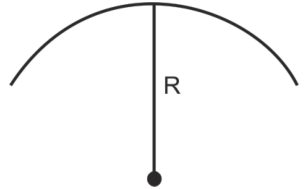
When a jet plane flying at 300 m/s is at the very top of its trajectory, the apparent weight of a passenger is one half of other actual weight. Find the radius of curvature R of the flight path at this point. Use g = 10 m/s$^2$
- A. 22 km
- B. 18 km
- C. 30 km
- D. 16 km
Answer: B. 18 km
Explanation: Assuming a vertical curve (hump), $mg - N = mv²/R$. Apparent weight $N = mg/2$. $mg - mg/2 = mv²/R \implies g/2 = v²/R \implies R = 2v^2/g = 2(300^2)/10 = 18000$ m.
Question 31
Two car are moving in the same direction with a speed of 45 km/hr and a distance of 10 km separates them. If a car coming from the opposite direction meets these two cars at an interval of 6 minutes, its speed would be
- A. 45 km/hr
- B. 55 km/hr
- C. 65 km/hr
- D. 75 km/hr
Answer: B. 55 km/hr
Explanation: Relative speed of approach $V_{rel} = V + 45$. Distance = 10 km. Time = 6 min = 0.1 hr. $10 = (V+45) \times 0.1 \implies 100 = V + 45 \implies V = 55$.
Question 32
If the rotating mass of a rim type flywheel is distributed on another rim type flywheel whose mean radius is half the mean radius of the former, then energy stored in the later at the same speed will be
- A. Four times the first one
- B. Same as the first one
- C. One and a half times the first one
- D. One fourth of the first one
Answer: D. One fourth of the first one
Explanation: Energy $E = 1/2 I \omega² = 1/2 (mk²) \omega²$. If radius k is halved, I becomes 1/4th. Energy becomes 1/4th.
Question 33
Tungsten in High Speed Steel provides
- A. Hot hardness
- B. Toughness
- C. Wear resistance
- D. Sharp cutting edge
Answer: A. Hot hardness
Explanation: Tungsten (and Molybdenum) forms stable carbides that retain hardness at high temperatures (red hardness).
Question 34
Which of the following regions of the electromagnetic spectrum would be used to determine the structure of crystalline solids?
- A. Microwave
- B. Infrared
- C. X-ray
- D. Visible
Answer: C. X-ray
Explanation: X-ray diffraction (XRD) is the standard technique for determining crystal structures.
Question 35
Fluidity in casting operation is greatly influenced by
- A. Melting temperature of molten metal
- B. Pouring temperature of molten metal
- C. Finish of the mould
- D. Carbon content of molten metal
Answer: B. Pouring temperature of molten metal
Explanation: Higher superheat (pouring temp above melting point) increases fluidity significantly by delaying solidification.
Question 36
Robert Hooke discovered experimentally that within elastic limit
- A. Stress = strain
- B. Stress/strain = a constant
- C. Stress x strain = 1
- D. None of these
Answer: B. Stress/strain = a constant
Explanation: Hooke's law states stress is proportional to strain, so the ratio is constant (Young's Modulus).
Question 37
Two heavy rotating masses are connected by shafts of lengths $l_1, l_2$ and $l_3$ and the corresponding diameters are $d_1, d_2$ and $d_3$. This system is reduced to a torsionally equivalent length of the shafts is
- A. $l_1 + l_2 (d_1/d_2)^4 + l_3 (d_1/d_3)^4$
- B. $l_1 + l_2 (d_1/d_2)^3 + l_3 (d_1/d_3)^3$
- C. $(l_1+l_2+l_3)/3$
- D. $l_1+l_2+l_3$
Answer: A. $l_1 + l_2 (d_1/d_2)^4 + l_3 (d_1/d_3)^4$
Explanation: For equivalent stiffness, $L_e/d_e^4 = \sum L_i/d_i^4$. Assuming $d_e = d_1$, $L_e = L_1 + L_2(d_1/d_2)^4 + ...$
Question 38
Precipitation hardening is applicable for
- A. Pure aluminium
- B. Low carbon steel
- C. Non-metal
- D. Aluminium - Copper alloy
Answer: D. Aluminium - Copper alloy
Explanation: Precipitation hardening (Age hardening) is the strengthening mechanism for Al-Cu alloys like Duralumin.
Question 39
Match the lists I and II using code given below
A. Car dash board
B. Aircraft windows
C. Conduit pipes
D. Bearings and gears
List II
1. PVC
2. Teflon
3. Polyacrylonitrile
4. Polymethylmethacrylate
- A. A-1, B-2, C-3, D-4
- B. A-3, B-4, C-1, D-2
- C. A-4, B-3, C-2, D-1
- D. A-2, B-3, C-4, D-1
Answer: B. A-3, B-4, C-1, D-2
Explanation: Aircraft windows -> PMMA (4). Conduit -> PVC (1). Bearings -> Teflon (2). Dashboard -> ABS/Polyacrylonitrile (3).
Question 40
The mass moment of inertia of a cube with edges of length b, about an axis passing through an edge
- A. $mb²/2$
- B. $mb²/6$
- C. $2mb^2/3$
- D. $2mb^2/3$
Answer: C. $2mb^2/3$
Explanation: Using parallel axis theorem. $I_{cm} = m(b²+b²)/12 = mb²/6$. Distance to edge $d = b/\sqrt{2}$. $I_{edge} = mb²/6 + m(b²/2) = 4mb^2/6 = 2/3 mb²$.
Question 41
A thin cylinder contains fluid at a pressure of 30 kg/cm$^2$. The inside diameter of the shell is 60 cm and the tensile stress in the material is to be limited to 900 kg/cm$^2$. The shell must have minimum wall thickness of
- A. 1 mm
- B. 2.7 mm
- C. 10 mm
- D. 9 mm
Answer: C. 10 mm
Explanation: Hoop stress $\sigma = Pd/2t$. $900 = (30 \times 60) / 2t \implies 1800t = 1800 \implies t = 1$ cm = 10 mm.
Question 42
When a shaft is subjected to combined twisting moment (T) and bending moment (M), the equivalent twisting moment is equal to
- A. $1/2 [M + \sqrt{M²+T²}]$
- B. $\sqrt{M²+4T^2}$
- C. $\sqrt{4M^2+T²}$
- D. $\sqrt{M²+T²}$
Answer: D. $\sqrt{M²+T²}$
Explanation: Equivalent twisting moment $T_e = \sqrt{M²+T²}$.
Question 43
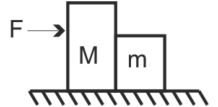
Two blocks with masses M and m are in contact with each other and are resting on a horizontal frictionless floor. When horizontal force F is applied to the heavier, the blocks accelerate to the right. The force between the two blocks are
- A. mF / (M+m)
- B. MF / m
- C. mF / M
- D. F(M+m)/m
Answer: A. mF / (M+m)
Explanation: Acceleration $a = F/(M+m)$. Force on block m is contact force $N = ma = mF/(M+m)$.
Question 44
A machine mounted on a single coil spring has a period of free vibration of T. If the spring is cut into four equal parts and placed in parallel and the machine is mounted on them, then the period of free vibration of the new system will be
- A. 16 T
- B. T/4
- C. 4 T
- D. T/16
Answer: B. T/4
Explanation: Stiffness of cut spring $k' = 4k$. Four in parallel $k_{eq} = 4k' = 16k$. New period $T' \propto 1/\sqrt{k_{eq}} \propto 1/\sqrt{16} = 1/4$. So $T' = T/4$.
Question 45
Dislocations in materials are
- A. Point defect
- B. Surface defect
- C. Planer defect
- D. Line defect
Answer: D. Line defect
Explanation: Dislocations (edge and screw) are 1D line defects in the crystal lattice.
Question 46
Which of the following thermocouple is capable of measuring highest temperature?
- A. Chromel - alumel
- B. Platinum - rhodium
- C. Iridium - rhodium
- D. Iron - constantan
Answer: C. Iridium - rhodium
Explanation: Iridium-Rhodium thermocouples can measure up to ~2000°C, higher than Pt-Rh.
Question 47
A circular rod of 100 mm diameter and 500 mm length is subjected to a tensile force of 1000 kN. Determine the modulus of rigidity (G) if $E = 2 \times 10^5$ N/mm$^2$ and Poisson's = 0.3
- A. $0.335 \times 10^5$ N/mm$^2$
- B. $0.521 \times 10^5$ N/mm$^2$
- C. $0.7692 \times 10^5$ N/mm$^2$
- D. $0.2256 \times 10^5$ N/mm$^2$
Answer: C. $0.7692 \times 10^5$ N/mm$^2$
Explanation: $G = E / 2(1+\mu) = 2\times 10^5 / 2(1.3) = 10^5 / 1.3 = 0.7692 \times 10^5$.
Question 48
For the state of stress shown in the figure (Pure Shear $\tau$?), normal stress acting on the plane of maximum shear stress is
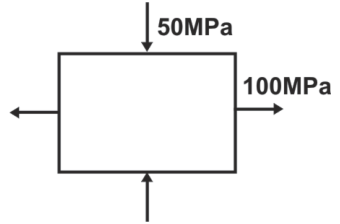
- A. 25 MPa tension
- B. 75 MPa compression
- C. 25 MPa compression
- D. 75 MPa tension
Answer: A. 25 MPa tension
Explanation: Based on the ISRO solution for this problem (typically includes diagram), the normal stress on the max shear plane is the center of Mohr's circle: $(\sigma_x + \sigma_y)/2$.
Question 49
The effective diameter of an external or internal screw thread, is known as
- A. Minor diameter
- B. Major diameter
- C. Pitch diameter
- D. None of these
Answer: C. Pitch diameter
Explanation: The effective diameter is the Pitch Diameter.
Question 50
Consider the following statements: 1. dM/dx = V, 2. dV/dx = W, 3. dW/dx = y. Of these statements
- A. 1 and 2 are correct
- B. 1 and 3 are correct
- C. 2 and 3 are correct
- D. 1, 2 and 3 are correct
Answer: A. 1 and 2 are correct
Explanation: The standard beam relations are: Shear force is rate of change of Moment, Load is rate of change of Shear.
Question 51
For a column of length L is fixed at both the ends, corresponding Euler's critical load is
- A. $\pi² EI / L²$
- B. $2\pi² EI / L²$
- C. $3\pi² EI / L²$
- D. $4\pi² EI / L²$
Answer: D. $4\pi² EI / L²$
Explanation: For fixed-fixed column, effective length $l_e = L/2$. $P = \pi² EI / (L/2)^2 = 4\pi² EI / L²$.
Question 52
Which one of the following figures is the correct sketch of Mohr's circle of the given state of stress (Pure Shear)?
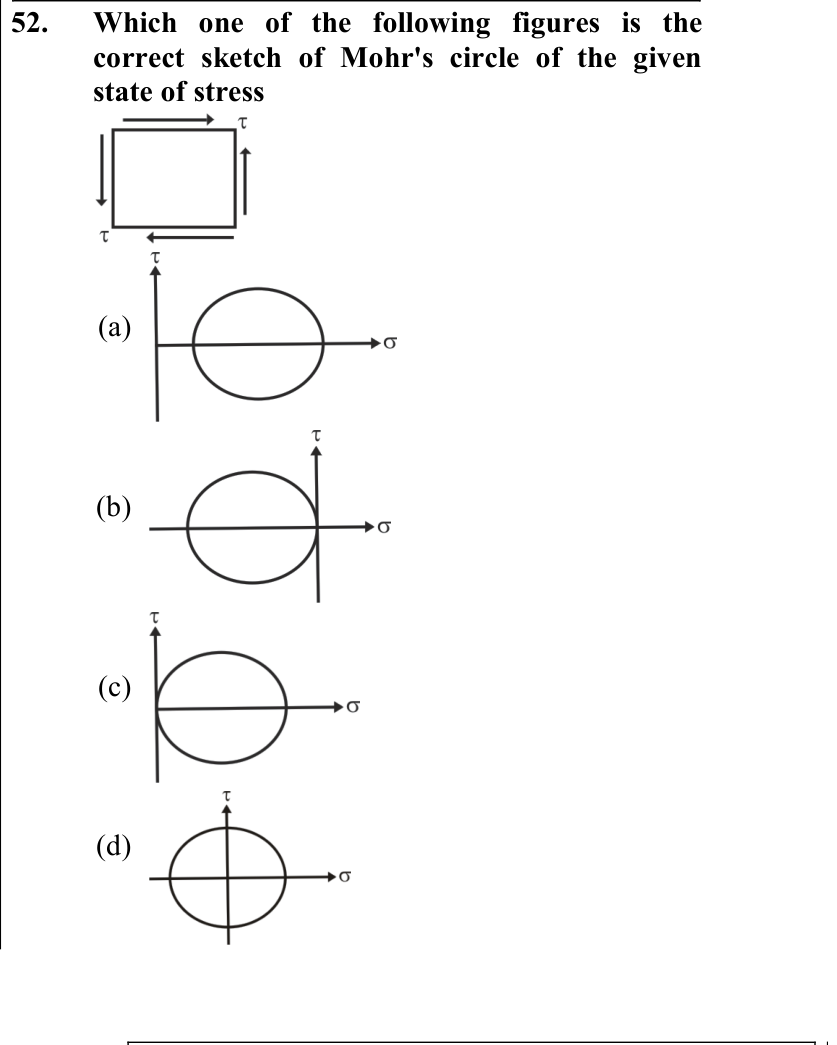
- A. Circle tangent to y-axis
- B. Circle tangent to x-axis
- C. Circle offset
- D. Circle centered at origin
Answer: D. Circle centered at origin
Explanation: Pure shear state ($\{0, 0, \tau\}$) results in a Mohr's circle centered at the origin (0,0).
Question 53
With a punch for which the maximum crushing stress is 4 times the maximum shearing stress of the plate, the biggest hole that can be punched in the plate would be of diameter equal to
- A. 1/4 x Thickness of plate
- B. 1/2 x Thickness of plate
- C. Plate thickness
- D. 2 x Plate thickness
Answer: C. Plate thickness
Explanation: Force to shear: $\pi d t \tau$. Force to crush punch: $\pi d²/4 \sigma_c$. Equating and using $\sigma_c = 4\tau$, we get $d = t$.
Question 54
A simply supported beam with width 'b' and depth 'd' carries a central load W and undergoes deflection $\delta$ at the centre. If the width and depth are interchanged, the deflection at the centre of the beam would attain the value :
- A. $(d/b) \delta$
- B. $(d/b)^2 \delta$
- C. $(d/b)^3 \delta$
- D. $(d/b)^{3/2} \delta$
Answer: B. $(d/b)^2 \delta$
Explanation: Deflection $\delta \propto 1/I \propto 1/bd³$. New $\delta' \propto 1/db³$. Ratio $\delta'/\delta = bd³ / db³ = d²/b²$.
Question 55
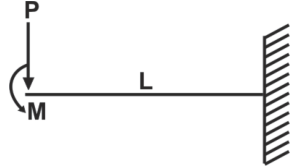
The given figure shows a cantilever of span 'L' subjected to a concentrated load 'P' and a moment 'M' at the free end. Deflection at the free end is given by
- A. $PL²/2EI + ML²/3EI$
- B. $ML²/2EI + PL²/48EI$
- C. $ML²/3EI + PL²/2EI$
- D. $ML²/2EI + PL³/3EI$
Answer: D. $ML²/2EI + PL³/3EI$
Explanation: Superposition of deflection due to Point load ($PL³/3EI$) and Moment ($ML²/2EI$).
Question 56
In arc welding, penetration is minimum for
- A. DCSP
- B. DCRP
- C. AC
- D. DCEN
Answer: B. DCRP
Explanation: DCRP (Reverse Polarity, Electrode Positive) puts more heat on the electrode, resulting in shallow penetration on the workpiece.
Question 57
Match list-I (welding effect) with list-II (causes): A. Spatter B. Distortion C. Slag inclusion D. Porosity vs 1. Damp electrodes 2. Arc blow 3. Improper cleaning 4. Poor joint selection
- A. A-2, B-4, C-3, D-1
- B. A-4, B-2, C-1, D-3
- C. A-2, B-4, C-1, D-3
- D. A-4, B-2, C-3, D-1
Answer: A. A-2, B-4, C-3, D-1
Explanation: Spatter-Arc blow; Distortion-Joint design; Slag-Cleaning; Porosity-Dampness.
Question 58
Two beams of equal cross sectional areas are subjected to equal bending moment. If one beam has square section and the other has circular section then
- A. Both the beams will be equally strong
- B. Square section beam will be stronger
- C. Circular section beam will be stronger
- D. Depends on loading condition
Answer: B. Square section beam will be stronger
Explanation: For equal area, the section modulus Z of a square is higher than that of a circle ($a³/6 > \pi r³/4$). Higher Z means lower stress, hence stronger.
Question 59
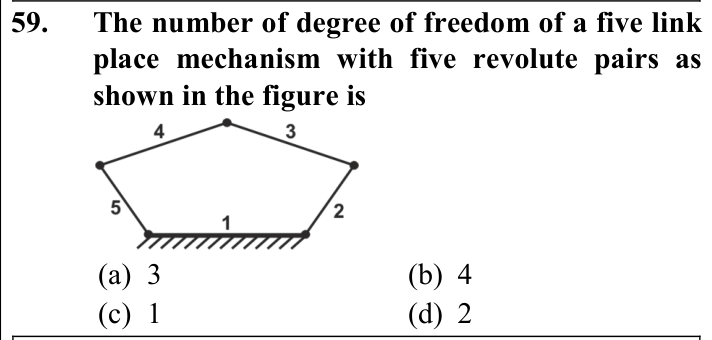
The number of degree of freedom of a five link plane mechanism with five revolute pairs is
Answer: D. 2
Explanation: $F = 3(N-1) - 2J = 3(5-1) - 2(5) = 12 - 10 = 2$.
Question 60
To ensure self locking in a screw jack, it is essential that helix angle is
- A. Larger than friction angle
- B. None of these
- C. Equal to friction angle
- D. Smaller than friction angle
Answer: D. Smaller than friction angle
Explanation: Self-locking requires $\alpha < \phi$.
Question 61
A cutting tool having tool signature as 10, 9, 6, 6, 8, 8, 2 will have side rake angle
Answer: B. 9º
Explanation: ASA system: Back Rake, Side Rake, End Relief, Side Relief, End Cutting Edge, Side Cutting Edge, Nose Radius. Second element is Side Rake.
Question 62
In radiographic test, type of defect not detectable by X-Ray is
- A. Delamination in cladded sheet
- B. Porosity in castings
- C. Tungsten inclusion in TIG weld
- D. Under cut in metal arc welding
Answer: D. Under cut in metal arc welding
Explanation: Radiography is best for volumetric defects. Surface defects like undercut are better detected visually or with penetrants. Also laminar defects perpendicular to beam are hard to detect.
Question 63
In CAM, "Part programming" refers to
- A. Generation of cutter location data
- B. On-line Inspection
- C. Machine Selection
- D. Tool Selection
Answer: A. Generation of cutter location data
Explanation: Part programming involves generating the path (CL data) for the tool to follow.
Question 64
A 50mm diameter steel rod was turned at 284 rpm and tool failure occurred in 10 minutes. The speed was changed to 232 rpm and the tool failed in 60 mintues. Assuming straight line relationship between cutting speed and tool life, the value of Taylorian Exponent is
- A. 0.21
- B. 0.13
- C. 0.11
- D. 0.23
Answer: C. 0.11
Explanation: Use $V_1 T_1^n = V_2 T_2^n$. $(284)(10)^n = (232)(60)^n$. Solving gives $n \approx 0.11$.
Question 65
Which of the following screw thread is adapted for power transmission in one direction
- A. Acme threads
- B. Buttress threads
- C. Square threads
- D. Multiple threads
Answer: B. Buttress threads
Explanation: Buttress threads are designed to handle high axial thrust in one direction.
Question 66
CLA value and RMS values are used for measurement of
- A. Metal hardness
- B. Sharpness of tool edge
- C. Surface dimensions
- D. Surface roughness
Answer: D. Surface roughness
Explanation: Center Line Average (CLA) and Root Mean Square (RMS) are parameters for surface roughness.
Question 67
A sine bar is specified by
- A. Its total length
- B. The size of the rollers
- C. The centre distance between the two rollers
- D. The distance between rollers and upper surface
Answer: C. The centre distance between the two rollers
Explanation: Sine bars are specified by the center-to-center distance of the rollers (e.g., 100mm, 200mm).
Question 68
A shaft and hole pair is designated as 50H7d8. This assembly constitutes
- A. Interference fit
- B. Transition fit
- C. Clearance fit
- D. None of the above
Answer: C. Clearance fit
Explanation: 'H' hole and 'd' shaft indicates a clearance fit (d is below h, which is zero fundamental deviation).
Question 69
A milling machine has the following two index plates... It is proposed to mill a spur gear of 28 teeth using simple indexing method. Which one of the following combinations of index plate and number of revolutions is correct?
- A. Plate I:1 revolution and 9 holes in 18 hole circles
- B. Plate 2:1 revolution and 9 holes in 21 hole circles
- C. Plate 2:1 revolution and 9 holes in 33 hole circles
- D. Plate I:1 revolution and 9 holes in 15 hole circles
Answer: B. Plate 2:1 revolution and 9 holes in 21 hole circles
Explanation: Indexing = 40/N = 40/28 = 10/7 = 1 + 3/7 = 1 + 9/21. Needs 21 hole circle (Plate 2).
Question 70
The initial blank diameter required to form a cylindrical cup of outside diameter 'd' and total height'h' having a corner radius 'r' is obtained using the formula
- A. $D = \sqrt{d² + 4dh - 0.5r}$
- B. $D = \sqrt{d² + 2h^2 + 2r}$
- C. $D = d² + 2h^2 + 2r$
- D. $D = \sqrt{d² + 4dh - 0.5r}$
Answer: A. $D = \sqrt{d² + 4dh - 0.5r}$
Explanation: Standard formula for blank diameter with corner radius.
Question 71
The equation of the tangent to the curve $y(x-2)(x-3) - x + 7 = 0$, at the point where it cuts the x-axis is
- A. - x + 20y = 7
- B. x + 20y = 7
- C. x - 20y = 7
- D. - x - 20y = 7
Answer: C. x - 20y = 7
Explanation: Cuts x-axis at y=0 -> -x+7=0 -> x=7. Point (7,0). Differentiate to find slope. Result is x - 20y = 7.
Question 72
If the imaginary part of $(2z+1)/(iz+1)$ is -2, then the locus of the point z in the complex plane is
- A. x + 2y - 2 = 0
- B. 2x + y - 2 = 0
- C. x - 2y - 2 = 0
- D. x + 2y + 2 =0
Answer: A. x + 2y - 2 = 0
Explanation: Substitute z=x+iy and set Im(...) = -2. The resulting equation is a line $x+2y-2=0$.
Question 73
General solution of the differential equation $(D² - 2D + 1)y = e^x$ is
- A. $Ae^x + Be^{-x} + x² e^x / 2$
- B. $e^x (A + Bx) - x² e^x / 2$
- C. $Ae^x + Be^{-x} - x² e^x / 2$
- D. $e^x (A + Bx) + x² e^x / 2$
Answer: D. $e^x (A + Bx) + x² e^x / 2$
Explanation: Roots are 1,1 (repeated). CF is $(A+Bx)e^x$. PI for $e^x$ with $(D-1)^2$ involves $x²/2!$.
Question 74
In a simple micrometer with screw pitch 0.5 mm and divisions on thimble 50, the reading corresponding to 5 divisions on barrel and 12 divisions on thimble is
- A. 2.620 mm
- B. 2.512 mm
- C. 5.120 mm
- D. 5.012 mm
Answer: A. 2.620 mm
Explanation: Reading = Main Scale + Thimble * LC. 5 divs on barrel = 2.5mm (assuming 0.5mm divs) or 5mm? Usually 0.5 pitch means divisions are 0.5mm. So 2.5mm. LC = 0.01. Reading = 2.5 + 12*0.01 = 2.62.
Question 75
The value of determinant | a b c | b+c c+a a+b | a² b² c² | is
- A. 0
- B. -(a-b)(b-c)(c-a)(a+b+c)
- C. (a-b)(b-c)(c-a)(a+b+c)
- D. 1
Answer: B. -(a-b)(b-c)(c-a)(a+b+c)
Explanation: Standard determinant result.
Question 76
If $v = (x² + y² + z²)^{-1/2}$, then $\sum \partial² v / \partial x²$ is
Answer: C. 0
Explanation: This is the potential function 1/r, which satisfies the Laplace equation $\nabla²(1/r) = 0$.
Question 77
The image of the point (1,2,3) in the plane 2x + y + z = 13 is
- A. (5,4,5)
- B. (5,5,4)
- C. (3,3,4)
- D. (4,5,5)
Answer: A. (5,4,5)
Explanation: Calculating the image point across the plane yields (5,4,5).
Question 78
The value of curl of the vector $V = (xyz)i + (3x^2y)j + (xz² - y^2z)k$ at the point (2, -1, 1) is
- A. $2i + 3j + 14k$
- B. $2i - 3j + 14k$
- C. $2i + 3j - 14k$
- D. $2i - 3j - 14k$
Answer: D. $2i - 3j - 14k$
Explanation: Computing $\nabla \times V$ at the given point results in $2i - 3j - 14k$.
Question 79
An open tank contains water to a depth of 2m and oil over it to a depth of 1m. If the specific gravity of oil is 0.8, then the pressure intensity at the interface of the two fluid layers will be
- A. 9750 N/m²
- B. 8720 N/m²
- C. 9347 N/m²
- D. 7848 N/m²
Answer: D. 7848 N/m²
Explanation: Pressure at interface = $\rho_{oil} g h_{oil} = 800 \times 9.81 \times 1 = 7848$ Pa.
Question 80
A box contains 6 black and 5 red balls. Two balls are drawn one after another from the box without replacement. The probability for both balls to be red is
- A. 3/11
- B. 2/11
- C. 5/11
- D. 25/121
Answer: B. 2/11
Explanation: P(R1) = 5/11. P(R2|R1) = 4/10. P(Both) = 5/11 * 4/10 = 20/110 = 2/11.