ISRO Mechanical & Aerospace 2009 Question Paper & Solutions
Attempt the ISRO Mechanical & Aerospace 2009 previous year paper in real CBT exam mode or practice mode with verified answers and explanations.
All ISRO Mechanical & Aerospace papers
80 questions.
Question 1
A hydraulic press has a ram of 15 cm diameter and plunger of 1.5 cm. It is required to lift a mass of 1000 kg. The force required on plunger is nearly equal to
- A. 100N
- B. 1000N
- C. 10000N
- D. 10N
Answer: A. 100N
Explanation: By Archimedes principle $F_1/A_1 = F_2/A_2$. Force $F_1 = F_2(A_1/A_2) = (1000 \times 9.81) \times (1.5^2/15^2) \approx 10000 \times (1/100) = 100$ N.
Question 2
If the stream function is given by $\Psi = 3xy$, then the velocity at a point (2, 3) will be
- A. 7.21 unit
- B. 18 unit
- C. 10.82 unit
- D. 54 unit
Answer: C. 10.82 unit
Explanation: $v = \partial\psi/\partial x = 3y$, $u = -\partial\psi/\partial y = -3x$. At (2,3), $v = 9, u = -6$. Resultant = $\sqrt{(-6)^2 + 9^2} = \sqrt{36+81} = \sqrt{117} \approx 10.82$.
Question 3
The correct sequence of the centrifugal pump components through which the fluid flows is
- A. Impeller, Suction pipe, Foot valve and strainer, Deliver pipe
- B. Foot valve and strainer, Suction pipe, Impeller, Deliver pipe
- C. Impeller, Suction pipe, Deliver pipe, Foot valve and strainer
- D. Suction pipe, Deliver pipe, Impeller, Foot valve and strainer
Answer: B. Foot valve and strainer, Suction pipe, Impeller, Deliver pipe
Explanation: The flow sequence starts from the sump: Foot valve & strainer $\rightarrow$ Suction pipe $\rightarrow$ Impeller $\rightarrow$ Delivery pipe.
Question 4
The relation $PV^\gamma = \text{constant}$, where $\gamma$ is the ratio of the specific heats of ideal gas, is applicable to
- A. Any adiabatic process
- B. Only reversible adiabatic process
- C. Only irreversible adiabatic process
- D. Only isothermal process
Answer: B. Only reversible adiabatic process
Explanation: The equation $PV^\gamma = C$ is derived assuming the process is both adiabatic and reversible (isentropic) for an ideal gas.
Question 5
Across a normal shock
- A. static pressure and the static temperature rise
- B. entropy remains constant
- C. velocity and static pressure decrease
- D. density and temperature decrease
Answer: A. static pressure and the static temperature rise
Explanation: Across a normal shock wave, flow goes from supersonic to subsonic. Static pressure, density, and temperature increase, while velocity decreases. Entropy increases.
Question 6
A necessary precaution in selection of pumps for parallel operations is that:
- A. H-Q characteristics of both should be identical
- B. Both pumps should be centrifugal type
- C. Both pumps should be identical
- D. There should not be change from positive to negative slope in H-Q curve
Answer: A. H-Q characteristics of both should be identical
Explanation: For stable parallel operation, pumps should have matching Head-Discharge (H-Q) characteristics to ensure load sharing and prevent one pump from overpowering the other.
Question 7
A metallic cube of side 10 cm, density 6.98 gm/cc is floating in liquid mercury (density 13.6 gm/cc), with 5 cm height of cube exposed above the mercury level. Water (density 1 gm/cc) is filled over this to submerge the cube fully. The new height of cube exposed above mercury level is
- A. 4.6 cm
- B. 5.4 cm
- C. 5.0 cm
- D. 5.8 cm
Answer: B. 5.4 cm
Explanation: Let x be depth in mercury. Buoyancy balance: $6.8(10^3) = 13.6(100x) + 1(100(10-x))$. Solving gives $x \approx 4.6$ cm. Height exposed above mercury (in water) is $10 - 4.6 = 5.4$ cm.
Question 8
The pressure drop for a relatively low Reynolds number flow in a 600 mm diameter, 30 m long pipeline is 70 kPa. What is the wall shear stress?
- A. 0 Pa
- B. 1400 Pa
- C. 700 Pa
- D. 350 Pa
Answer: D. 350 Pa
Explanation: Wall shear stress $\tau_w = \frac{D}{4} \frac{\Delta P}{L} = \frac{0.6}{4} \times \frac{70000}{30} = 350$ Pa.
Question 9
The radiative heat transfer rate per unit area ($W/m²$) between two plane parallel grey surfaces (emissivity 0.9) maintained at 400 K and 300 K is (Stefan Boltzmann constant $\sigma = 5.67 \times 10^{-8} W/m^2K^4$)
- A. 1020
- B. 464
- C. 812
- D. 567
Answer: C. 812
Explanation: $q = \frac{\sigma(T_1^4 - T_2^4)}{1/\epsilon_1 + 1/\epsilon_2 - 1}$. Substituting values gives $q \approx 812 W/m²$.
Question 10
At the eye tip of a centrifugal impeller, blade velocity is 200 m/s while the uniform axial velocity at the inlet is 150 m/s. If the sonic velocity is 300 m/s, then the inlet Mach number of the flow will be
- A. 0.75
- B. 0.66
- C. 0.90
- D. 0.83
Answer: D. 0.83
Explanation: Absolute velocity $V = \sqrt{200^2 + 150^2} = 250$ m/s. Mach number $M = V/c = 250/300 = 0.83$.
Question 11
The transition Reynolds number for flow over a flat plate is $5 \times 10^5$. What is the distance from the leading edge at which transition will occur for flow of water with a uniform velocity of 1 m/s? (For water, the kinematic viscosity, $\nu = 0.86 \times 10^{-6} m²/s$)
- A. 0.43m
- B. 1m
- C. 43m
- D. 103m
Answer: A. 0.43m
Explanation: $Re = \frac{Vx}{\nu}$. $x = \frac{5 \times 10^5 \times 0.86 \times 10^{-6}}{1} = 0.43$ m.
Question 12
For a reciprocating water pump having cylinder diameter d and crank radius r, if W is the weight of water lifted, the coefficient of discharge is
- A. $\frac{W}{\pi d² r}$
- B. $\frac{2W}{\gamma \pi d² r}$
- C. $\frac{W}{\gamma d² r}$
- D. $\frac{W}{\gamma \pi d²}$
Answer: B. $\frac{2W}{\gamma \pi d² r}$
Explanation: $C_d = \frac{Q_{act}}{Q_{th}}$. Theoretical volume $V = Area \times Stroke = \frac{\pi d²}{4} \times 2r$. Weight $W_{th} = \gamma \frac{\pi d² r}{2}$. So $C_d = \frac{W}{W_{th}} = \frac{2W}{\gamma \pi d² r}$.
Question 13
Both free vortex and forced vortex can be expressed mathematically in terms of tangential velocity V at the corresponding radius r. Choose the correct combination
- A. Free: V = r $\times$ const, Forced: V $\times$ r = const
- B. Free: $V² \times r$ = const, Forced: V = r $\times$ const
- C. Free: V $\times$ r = const, Forced: $V²$ = r $\times$ const
- D. Free: V $\times$ r = const, Forced: V = r $\times$ const
Answer: D. Free: V $\times$ r = const, Forced: V = r $\times$ const
Explanation: Free vortex: Angular momentum is constant ($vr = C$). Forced vortex: Rigid body rotation ($v = r\omega \rightarrow v = r \times C$).
Question 14
A bucket of water is hanging from a spring balance. An iron piece is suspended into water without touching sides of bucket from another support. The spring balance reading will
- A. Remain same
- B. Decrease
- C. Increase
- D. Increase/decrease depending on depth of immersion
Answer: C. Increase
Explanation: Due to Newton's 3rd law, the water exerts an upward buoyancy force on the iron, and the iron exerts an equal downward reaction force on the water, increasing the reading.
Question 15
A single-stage impulse turbine with a diameter of 120 cm runs at 3000 rpm. If the blade speed ratio is 0.42, then, the inlet velocity of steam will be
- A. 79 m/s
- B. 188 m/s
- C. 450 m/s
- D. 900 m/s
Answer: C. 450 m/s
Explanation: Blade speed $u = \frac{\pi D N}{60} \approx 188.5$ m/s. Inlet velocity $V = u / 0.42 \approx 448.8$ m/s.
Question 16
The critical point and triple point data for water are, $T_c = 374^\circ C, P_c = 22.1$ MPa, $T_T = 0.01^\circ C, P_T = 0.6$ kPa. Indicate the phase change that will occur in following cases: (i) Ice at 0.5 kPa is heated isobarically (ii) Water vapour at $400^\circ C$ is compressed isothermally
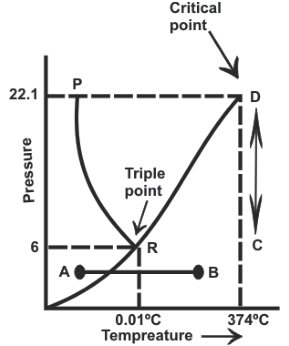
- A. (i) along AB, (ii) along CD
- B. (i) along CD, (ii) along AB
- C. (i) along OD, (ii) along PR
- D. (i) along RD, (ii) along OR
Answer: A. (i) along AB, (ii) along CD
Explanation: (i) 0.5 kPa < Triple Point Pressure, so heating ice leads to sublimation (Solid to Vapor). (ii) 400°C > Critical Temp, so compression involves no phase transition boundary (Supercritical fluid).
Question 17
The ratio of specific heats of a gas is 1.4 and the value of specific heat at constant pressure is 7.0 cal/mole°C. The difference between specific heat at constant pressure and specific heat at constant volume will be (in cal/mole°C)
Answer: D. 2.0
Explanation: $\gamma = C_p/C_v = 1.4$. Given $C_p = 7.0$. $C_v = 7.0/1.4 = 5.0$. Difference $C_p - C_v = 2.0$.
Question 18
The coefficient of linear expansion of a solid is L. The volume V of a cube of this solid on being heated by 1°C will change by
Answer: B. 3VL
Explanation: Volume expansion coefficient $\beta \approx 3\alpha$. Change in volume $\Delta V = V \beta \Delta T = V (3L) (1) = 3VL$.
Question 19
Two springs of equal length but having stiffness of 10 N/mm and 15 N/mm support a mass of 2 ton in series. Find the frequency of vibration
- A. $\frac{1}{2\pi}\sqrt{3}$ Hz
- B. $\frac{1}{2\pi}\sqrt{10}$ Hz
- C. $\frac{1}{2\pi}\sqrt{15}$ Hz
- D. $\frac{1}{2\pi}\sqrt{2}$ Hz
Answer: A. $\frac{1}{2\pi}\sqrt{3}$ Hz
Explanation: Series stiffness: $1/k_{eq} = 1/10 + 1/15 \Rightarrow k_{eq} = 6$ N/mm = 6000 N/m. Mass = 2000 kg. $\omega_n = \sqrt{k/m} = \sqrt{6000/2000} = \sqrt{3}$ rad/s.
Question 20
Ratio of pitch circle diameter in millimeters to the number of teeth, is known as
- A. Module
- B. Circular pitch
- C. Diametric pitch
- D. Clearance
Answer: A. Module
Explanation: Module $m = D/T$.
Question 21
Two particles with masses in the ratio 1:4 are moving with equal kinetic energies. The magnitude of their linear momentums will confirm to the ratio
- A. 1:8
- B. 1:$\sqrt{2}$
- C. $\sqrt{2}$:1
- D. 1:2
Answer: D. 1:2
Explanation: $p = \sqrt{2mK}$. Ratio $p_1/p_2 = \sqrt{m_1/m_2} = \sqrt{1/4} = 1/2$.
Question 22
Which of the following stresses are associated with the tightening of a nut on a stud? 1. Tensile stresses due to stretching of stud 2. Bending stresses of stud 3. Transverse shear stress across threads 4. Torsional shear stresses in threads due to frictional resistance
- A. 1, 2 and 3
- B. 1, 2 and 4
- C. 1, 3 and 4
- D. 2, 3 and 4
Answer: C. 1, 3 and 4
Explanation: Tightening causes axial tension, torsion due to friction, and shear across threads.
Question 23
A flywheel weight $\frac{981}{\pi}$ kg and has a radius of gyration of 100 cm. It is given a spin of 100 rpm about its horizontal axis. The whole assembly is rotating about a vertical axis at 6 rad/sec. The gyroscopic couple experienced will be
- A. 2,000 kgm
- B. 19,620 kgm
- C. 20,000 kgm
- D. 1,962 kgm
Answer: A. 2,000 kgm
Explanation: Couple $C = I \omega \omega_p = (mk²) \omega \omega_p$. $m = 981/\pi$. $\omega = 10\pi/3$. $\omega_p = 6$. $C = 19620$ Nm. In kg-m (force units), divide by 9.81 $\approx$ 2000.
Question 24
Determine the diameter of solid shaft which will transmit 90 kW at 160 rpm, if the shear stress in the shaft is limited to 60 N/mm$^2$
- A. 50 mm
- B. 60 mm
- C. 77 mm
- D. 70 mm
Answer: C. 77 mm
Explanation: $P = 2\pi NT/60$. Find T. Then $T = \frac{\pi}{16} \tau d³$. Solving gives $d \approx 77$ mm.
Question 25
[Image Question - Placeholder] A roller of weight W is rolled over the wooden block shown in the given figure. The pull required just to cause the said motion is
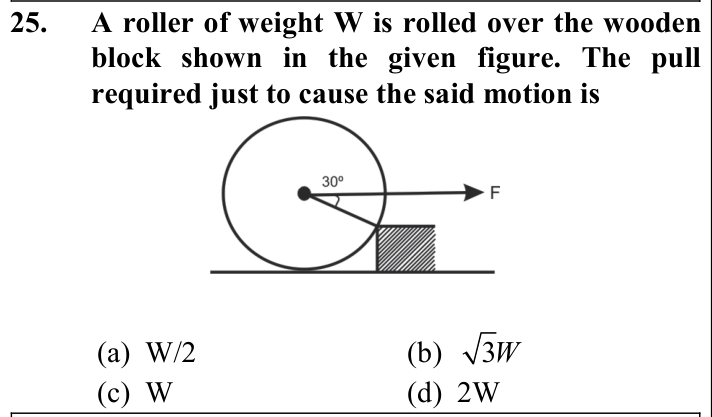
- A. W/2
- B. $\sqrt{3}W$
- C. W
- D. 2W
Answer: B. $\sqrt{3}W$
Explanation: From moment equilibrium about the corner of the block, assuming the force is horizontal and angle is 60 degrees from vertical, $F = W \tan 60 = \sqrt{3}W$.
Question 26
For one-dimensional isentropic flow in a diverging passage, if the initial static pressure is P1, and the initial Mach number is M1 (M1 < 1), then for the downstream flow
- A. M2 < M1 ; P2 < p1
- B. M2 > M1 ; P2 > p1
- C. M2 < M1 ; P2 > p1
- D. M2 > M1 ; P2 < p1
Answer: C. M2 < M1 ; P2 > p1
Explanation: Subsonic flow (M < 1) in a diverging duct (diffuser) results in decreased velocity (and Mach number) and increased pressure.
Question 27
In a furnace made of bricks, Inside heat transfer coefficient = 35 W/m$^2$K, Outside heat transfer coefficient = 25 W/m$^2$K, Thermal conductivity of bricks (15 cm thick) = 0.15 W/mK. The overall heat transfer coefficient (in W/m$^2$K) will be closer to the
- A. Inside heat transfer coefficient
- B. Outside heat transfer coefficient
- C. Thermal conductivity of bricks
- D. Heat transfer coefficient based on the thermal conductivity of the bricks alone
Answer: D. Heat transfer coefficient based on the thermal conductivity of the bricks alone
Explanation: Resistance $R = 1/h_i + L/k + 1/h_o$. $L/k = 0.15/0.15 = 1$. Convection resistances are small ($<0.04$). The dominant resistance is conduction, so U depends mostly on $k/L$.
Question 28
Two systems have the same wet bulb temperature at 20°C. System 'A' has Dry bulb temperature of 25°C since it has a relative humidity of 65%. System 'B' has a relative humidity of 30%. What will be its dry bulb temperature
- A. 33°C
- B. 25°C
- C. 27°C
- D. 22°C
Answer: A. 33°C
Explanation: For the same WBT, a lower relative humidity implies a larger wet bulb depression, thus a higher Dry Bulb Temperature.
Question 29
Four rods with different radii r and length l are connected to two reservoirs at different temperature. Which one of them will conduct most heat?
- A. r = 2 cm & l = 2 m
- B. r = 1 cm & l = 1 m
- C. r = 2 cm & l = 1/2 m
- D. r = 1/2 cm & l = 1/2 m
Answer: C. r = 2 cm & l = 1/2 m
Explanation: Heat rate $Q \propto Area/Length \propto r²/l$. Maximizing this ratio gives the answer.
Question 30
A 1000 kg vehicle travelling at 80 m/s impacts a plunger attached to a piston-cylinder arrangement. If all of the energy of the vehicle is absorbed by the 20 kg of liquid contained in the cylinder, what is the maximum temperature rise of the liquid? (The specific heat of the liquid is 4.0 kJ/kg.°C)
- A. 55°C
- B. 40°C
- C. 45°C
- D. 50°C
Answer: B. 40°C
Explanation: Kinetic Energy $KE = 0.5 m v² = 0.5(1000)(80^2) = 3.2$ MJ. Heat $Q = mc\Delta T = 20(4.0)\Delta T = 80 \Delta T$ kJ. $3200 = 80 \Delta T \Rightarrow \Delta T = 40$.
Question 31
In the Vander Waal's gas equation $(P + a/V²)(v-b) = RT$ the constant 'a' is introduced to compensate for
- A. Reduction in specific volume
- B. Inter-molecular forces
- C. Reduction in specific heat
- D. All of the above
Answer: B. Inter-molecular forces
Explanation: The term $a/V²$ accounts for the cohesive forces (inter-molecular attraction) between gas molecules.
Question 32
The centrifugal tension in belts
- A. Increase power transmission upto certain speed and then decreases
- B. Increase power transmission
- C. Does not affect power transmission
- D. Reduces power transmission
Answer: C. Does not affect power transmission
Explanation: Centrifugal tension increases the total tension in the belt but does not affect the power transmission capacity directly, assuming the belt does not slip or fail.
Question 33
In nodular iron, graphite is in the form of
- A. Spheroids
- B. Nodular carbide
- C. Flakes
- D. Cementite
Answer: A. Spheroids
Explanation: Nodular (Ductile) iron contains graphite in the form of nodules or spheroids.
Question 34
Corrosion resistance of steel increases by addition of
- A. Vanadium, aluminium
- B. Sulphur, phosphorus, lead
- C. Chromium and nickel
- D. Tungsten, molybdenum, vanadium, chromium
Answer: C. Chromium and nickel
Explanation: Chromium and Nickel are the primary alloying elements in stainless steel to improve corrosion resistance.
Question 35
Phenomenon of progressive extension of material with time at constant load is called
- A. Plasticity
- B. Creep
- C. Yield
- D. Breaking
Answer: B. Creep
Explanation: Creep is the time-dependent deformation under constant load, usually at elevated temperatures.
Question 36
Rivets are made of
- A. Soft material
- B. Ductile material
- C. Hard material
- D. Brittle material
Answer: B. Ductile material
Explanation: Rivets must be ductile to deform and form heads without cracking.
Question 37
Addition of copper to aluminium results in
- A. Precipitation hardening system
- B. Corrosion resistance
- C. Grain refinement
- D. High machinability
Answer: A. Precipitation hardening system
Explanation: Al-Cu alloys (like Duralumin) are heat treatable via precipitation hardening.
Question 38
A Hooke's joint is used to connect two
- A. Coplanar and Nonparallel shafts
- B. Non coplanar and Nonparallel shafts
- C. Coplanar and Parallel shafts
- D. All the above option
Answer: A. Coplanar and Nonparallel shafts
Explanation: Hooke's joint (Universal joint) connects intersecting shafts (coplanar, non-parallel).
Question 39
In a hardness test, L is load in kg, D is diameter of ball in mm and d is diameter of indentation in mm. Brinell Harness Number is expressed by the equation
- A. $BHN = \frac{L}{\pi D (D - \sqrt{D² - d²})}$
- B. $BHN = \frac{2L}{\pi D (D - \sqrt{D² - d²})}$
- C. $BHN = \frac{L}{\pi d (D - \sqrt{D² - d²})}$
- D. $BHN = \frac{2L}{\pi d (D - \sqrt{D² - d²})}$
Answer: B. $BHN = \frac{2L}{\pi D (D - \sqrt{D² - d²})}$
Explanation: Standard formula for BHN.
Question 40
Circumferential and longitudinal strains in the cylindrical boiler under internal steam pressure are $\epsilon_1$ and $\epsilon_2$ respectively. Change in the volume of the boiler cylinder per unit volume will be
- A. $\epsilon_1^2 \epsilon_2$
- B. $\epsilon_1 \epsilon_2^2$
- C. $2\epsilon_1 + \epsilon_2$
- D. $\epsilon_1 + 2\epsilon_2$
Answer: C. $2\epsilon_1 + \epsilon_2$
Explanation: Volumetric strain $\epsilon_v = \epsilon_l + 2\epsilon_c = \epsilon_2 + 2\epsilon_1$.
Question 41
An overhang beam ABC of length 4m is supported at A and B 3m apart. It is loaded with UDL of 5kN/m along its entire length. Find the value of load 'P' at C such that the reactions A and B are equal and opposite.
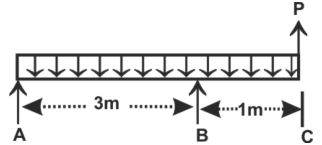
- A. P = 10 kN
- B. P = 30 kN
- C. P = 20 kN
- D. P = 25 kN
Answer: C. P = 20 kN
Explanation: For reactions to be equal and opposite ($R_A = -R_B$), the net vertical reaction force is zero, which implies the net external vertical load is zero if P acts upwards. With UDL 20kN down, P must be 20kN up.
Question 42
If two gears have moment of inertias as $I_1$ and $I_2$ respectively and mesh with a speed ratio $\omega_2/\omega_1 = n$, then equivalent moment of inertia of both gears referred to first one is
- A. $n² I_1 + I_2$
- B. $I_1 + n I_2$
- C. $n I_1 + I_2$
- D. $I_1 + n² I_2$
Answer: D. $I_1 + n² I_2$
Explanation: Kinetic energy equivalence: $\frac{1}{2} I_{eq} \omega_1^2 = \frac{1}{2} I_1 \omega_1^2 + \frac{1}{2} I_2 \omega_2^2$. Since $\omega_2 = n \omega_1$, $I_{eq} = I_1 + n² I_2$.
Question 43
A uniform circular ring of mass M and radius r is rotating with an angular speed $\omega$ about an axis passing through its center and perpendicular to the plane of the ring. Two identical beads, each of mass m, some how get attached at two diametrically opposite points. The rotational speed of the ring will become
- A. $\frac{M \omega}{M+2m}$
- B. $\frac{M \omega}{M+m}$
- C. $\frac{2M \omega}{M+2m}$
- D. $\omega$
Answer: A. $\frac{M \omega}{M+2m}$
Explanation: Conservation of angular momentum: $I_1 \omega_1 = I_2 \omega_2$. $I_1 = Mr²$, $I_2 = (M+2m)r²$. $\omega_2 = \frac{M}{M+2m}\omega$.
Question 44
An electric lift is moving downward with an acceleration of g/3, the vertical force between a passenger in the lift and its floor is equal to
- A. 3/4 of the passenger's weight
- B. 2/3 of the passenger's weight
- C. Passenger's weight
- D. 4/3 of the passenger's weight
Answer: B. 2/3 of the passenger's weight
Explanation: Apparent weight $W_{app} = m(g-a) = m(g - g/3) = 2/3 mg$.
Question 45
A body of mass 10 kg moving with a velocity of 1 m/s is acted upon by a force of 50 N for two seconds. The final velocity of the body is
- A. 22 m/sec
- B. 1 m/sec
- C. 21 m/sec
- D. 11 m/sec
Answer: D. 11 m/sec
Explanation: $v = u + at$. $a = F/m = 50/10 = 5$. $v = 1 + 5(2) = 11$ m/s.
Question 46
Proof resilience may be defined as
- A. Work done in straining the material
- B. Max. strain energy that can be stored in a material per unit volume
- C. Max. strain energy that can be stored in a material under elastic condition
- D. Max. load which can be applied to a member
Answer: C. Max. strain energy that can be stored in a material under elastic condition
Explanation: Proof resilience is the maximum strain energy stored up to the elastic limit.
Question 47
A plane intersects the co-ordinate axes at x = 2/3, y = 1/3, z = 1/2. What is the Miller index of this plane?
- A. (9 3 2)
- B. (4 3 2)
- C. (3 6 4)
- D. (4 2 3)
Answer: C. (3 6 4)
Explanation: Intercepts: 2/3, 1/3, 1/2. Reciprocals: 3/2, 3, 2. Normalize to integers: Multiply by 2 $\rightarrow$ (3 6 4).
Question 48
Relationship between modulus of elasticity E, modulus of rigidity G and Poisson's ratio $\mu$ is
- A. $G = E/2(1+\mu)$
- B. $G = E(2-\mu)$
- C. $E = G(1+\mu)$
- D. $G = E/1+\mu$
Answer: A. $G = E/2(1+\mu)$
Explanation: $E = 2G(1+\mu)$.
Question 49
A bar of length L, area A and Young's modulus E is subjected to a pulling force P. The strain energy stored in the bar is
- A. $PL²/AE$
- B. $PL²/2EI$
- C. $P^2L/2AE$
- D. $P^2L/AE$
Answer: C. $P^2L/2AE$
Explanation: Strain Energy $U = \frac{1}{2} P \delta = \frac{1}{2} P (PL/AE) = \frac{P^2L}{2AE}$.
Question 50
What is the expression for crippling load for a column of length L, with one end fixed and other end free?
- A. $P = \pi² EI / 4L^2$
- B. $P = \pi² EI / L²$
- C. $P = 2\pi² EI / L$
- D. $4\pi² EI / L²$
Answer: A. $P = \pi² EI / 4L^2$
Explanation: Effective length $Le = 2L$. $P = \pi² EI / (2L)^2$.
Question 51
A Mohr's circle reduces to a point when the body is subjected to
- A. Pure shear
- B. Uniaxial stress only
- C. Equal & opposite axial stresses on two mutually perpendicular planes
- D. Equal axis stresses are on two mutually perpendicular planes, the planes being free of shear.
Answer: D. Equal axis stresses are on two mutually perpendicular planes, the planes being free of shear.
Explanation: If $\sigma_x = \sigma_y$ and $\tau_{xy} = 0$, radius $R = \sqrt{\frac{(\sigma_x - \sigma_y)^2}{4} + \tau_{xy}^2} = 0$.
Question 52
Power screws are used to convert
- A. Linear motion to rotary motion
- B. Rotary motion into translatory motion
- C. Both (a) & (b)
- D. None of these
Answer: B. Rotary motion into translatory motion
Explanation: Power screws (lead screws) convert rotary motion (turning) into linear motion (translation).
Question 53
Following gases are used in tungsten inert gas welding
- A. CO2 and H2
- B. Argon and neon
- C. Argon and helium
- D. Helium and neon
Answer: C. Argon and helium
Explanation: Inert gases like Argon and Helium are used to shield the weld pool in TIG welding.
Question 54
The force required to punch a 25 mm hole in a mild steel plate 10 mm thick, when ultimate shear stress of the plate is 500 N/mm$^2$ will be nearly
- A. 78 kN
- B. 393 kN
- C. 98 kN
- D. 158 kN
Answer: B. 393 kN
Explanation: Force $F = \text{Perimeter} \times t \times \tau = \pi (25) \times 10 \times 500 \approx 393$ kN.
Question 55
One-half length of 50 mm diameter steel road is solid while the remaining half is hollow having a bore of 5 mm. The rod is subjected to equal and opposite torque at its ends. If the maximum shear stress in solid portion is $\tau$, the maximum shear stress in the hollow portion is :
- A. 15/16 $\tau$
- B. $\tau$
- C. 4/3 $\tau$
- D. 16/15 $\tau$
Answer: B. $\tau$
Explanation: The outer diameters are same (50mm). Since the bore (5mm) is very small ($d = 0.1D$), the polar moment of inertia $J$ is almost identical ($1 - 0.1^4 \approx 1$). Thus stress is approximately equal.
Question 56
[Image Question - Placeholder] Two metals plates of thickness 't' and width 'w' are joined by a fillet weld of 45° as shown in fig. When subjected to a pulling force 'F' the stress induced in the weld will be
- A. $F/wt$
- B. $F/wt \sin 45$
- C. $F \sin 45 / wt$
- D. $2F/wt$
Answer: B. $F/wt \sin 45$
Explanation: Stress = Force / Throat Area. Throat area = $w \times t \sin 45$.
Question 57
Ring rolling is used
- A. To decrease the thickness and increase diameter
- B. To increase the thickness of a ring
- C. For producing a seamless tube
- D. For producing large cylinder
Answer: A. To decrease the thickness and increase diameter
Explanation: Ring rolling expands a ring by reducing its radial thickness and increasing its diameter.
Question 58
A bar of 20 mm dia is tested in tension. It is observed that when a load of 38 kN is applied the extension measured over a gauge length of 200 mm is 0.12 mm and contraction in diameter is 0.0036 mm. Find the Poisson's ratio
- A. 0.2
- B. 0.3
- C. 0.25
- D. 0.33
Answer: B. 0.3
Explanation: $\mu = \frac{\epsilon_{lat}}{\epsilon_{long}} = \frac{0.0036/20}{0.12/200} = 0.3$.
Question 59
A perfect frame has N joints. The number of members should not be less than
- A. 2N-1
- B. 2N-2
- C. 2N-3
- D. 2N-5
Answer: C. 2N-3
Explanation: For a perfect plane truss, $m = 2j - 3$.
Question 60
A cantilever beam of rectangular cross section is subjected to load at free end. If the depth of the beam is double and load is halved, deflection of the free end as compared to original will be
Answer: D. 1/16
Explanation: Deflection $\delta \propto P/I \propto P/d³$. New deflection $\propto (P/2)/(2d)^3 = (P/2)/8d^3 = \frac{1}{16} (P/d³)$.
Question 61
[Image Question - Placeholder] The kinematic planar chain shown in the given figure is a
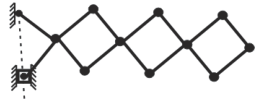
- A. Structure
- B. Mechanism with 2 degree of freedom
- C. Mechanism with 1 degree of freedom
- D. Mechanism with more than 2 degree of freedom
Answer: C. Mechanism with 1 degree of freedom
Explanation: Calculation of degrees of freedom using Gruebler's criterion yields F=1.
Question 62
The machining process in which the work piece is dissolved into an electrolyte solution is called
- A. Electro-chemical machining
- B. Ultrasonic machining
- C. Electro-discharge machining
- D. Laser machining
Answer: A. Electro-chemical machining
Explanation: ECM removes material via anodic dissolution in an electrolyte.
Question 63
In the metal forming process, the stresses encountered are
- A. Greater than yield strength but less than ultimate strength
- B. Less than yield strength of the material
- C. Greater than the ultimate strength of the material
- D. Less than the elastic limit
Answer: A. Greater than yield strength but less than ultimate strength
Explanation: To plastically deform the metal without fracturing, stress must be in the plastic region.
Question 64
A grinding wheel is specified as 49 A 36 M 7 V 24. The number 36 stands for
- A. Structure
- B. Grade
- C. Grit size
- D. Bond
Answer: C. Grit size
Explanation: The number 36 represents the grain size (Medium).
Question 65
In a fluid machinery, the relationship between saturation temperature and pressure decides the process of
- A. Flow separation
- B. Cavitation
- C. Turbulent mixing
- D. Water hammer
Answer: B. Cavitation
Explanation: Cavitation occurs when local pressure drops below vapor pressure at the prevailing temperature.
Question 66
Anodising is
- A. A process of coating of zinc by hot dipping
- B. A zinc diffusion process
- C. A process used for making thin phosphate coatings on steel...
- D. An oxidizing process used for aluminium and magnesium articles
Answer: D. An oxidizing process used for aluminium and magnesium articles
Explanation: Anodising increases the thickness of the natural oxide layer on metal parts.
Question 67
The process layout is best suited where
- A. Automation is employed
- B. Mass production is envisaged
- C. A few number of non-standardized units are to be produced
- D. Machines are arranged according to sequence of operation
Answer: C. A few number of non-standardized units are to be produced
Explanation: Process layout (functional layout) is flexible and suited for low-volume, high-variety production.
Question 68
The blank size of the gear of 3 mm module and 40 number of teeth is
- A. 120 mm
- B. 123 mm
- C. 126 mm
- D. 129 mm
Answer: C. 126 mm
Explanation: Blank diameter = Addendum Circle Diameter = $D + 2m = mZ + 2m = 3(40) + 6 = 126$ mm.
Question 69
A bag contains 7 white, 6 red and 9 black balls. Two balls are drawn at random. The probability that both the balls will be black is
- A. 1/11
- B. 12/77
- C. 5/77
- D. 9/77
Answer: B. 12/77
Explanation: Total = 22. P(2 Black) = $^{9}C_2 / ^{22}C_2 = 36 / 231 = 12/77$.
Question 70
Match List I (Machining Process) with List II (Medium): (A) Ultrasonic (B) EDM (C) ECM (D) EBM vs (1) Kerosene (2) Abrasive slurry (3) Vacuum (4) Salt solution.
- A. A-2, B-1, C-4, D-3
- B. A-2, B-3, C-4, D-1
- C. A-4, B-1, C-2, D-3
- D. A-4, B-3, C-2, D-1
Answer: A. A-2, B-1, C-4, D-3
Explanation: USM uses Abrasive slurry; EDM uses Dielectric (Kerosene); ECM uses Electrolyte; EBM uses Vacuum.
Question 71
The rake angle of a cutting tool is 15°, shear angle 45° and cutting velocity 35 m/min. What is the velocity of chip along the tool face?
- A. 25.3 m/min
- B. 27.3 m/min
- C. 28.5 m/min
- D. 23.5 m/min
Answer: C. 28.5 m/min
Explanation: $V_c = V \frac{\sin \phi}{\cos(\phi-\alpha)} = 35 \frac{\sin 45}{\cos 30} \approx 28.5$.
Question 72
The value of the determinant | 1 1 1 1 | 1 1+a 1 1 | 1 1 1+b 1 | 1 1 1 1+c | is
Answer: A. -abc
Explanation: Actually standard determinant for diagonal additions is abc.
Question 73
The locus of the point Z satisfying the condition arg (Z-1)/(Z+1) = pi/3 is
- A. $x² - y² - 2\sqrt{3}y = 0$
- B. $x² + y² = 1$
- C. $x² - y² - 2\sqrt{3}y - 1 = 0$
- D. $x² + y² - \frac{2}{\sqrt{3}}y - 1 = 0$
Answer: D. $x² + y² - \frac{2}{\sqrt{3}}y - 1 = 0$
Explanation: This represents a circle arc passing through 1 and -1.
Question 74
In a simple micrometer with screw pitch 0.5 mm and division on thimble 50, the reading corresponding to 5 divisions on barrel and 12 divisions on thimble is
- A. 2.620 mm
- B. 2.512 mm
- C. 5.120 mm
- D. 5.012 mm
Answer: A. 2.620 mm
Explanation: Least count = 0.5/50 = 0.01. Reading = 5(0.5) + 12(0.01) = 2.5 + 0.12 = 2.62 mm.
Question 75
It is required to cut screw threads of 2 mm pitch on a lathe. The lead screw has a pitch of 6 mm. If the spindle speed is 60 rpm, then the speed of the lead screw will be
- A. 10 rpm
- B. 20 rpm
- C. 120 rpm
- D. 180 rpm
Answer: B. 20 rpm
Explanation: $N_L / N_S = P_{thread} / P_{lead} \Rightarrow N_L / 60 = 2 / 6 \Rightarrow N_L = 20$.
Question 76
If u = log(tanx + tany), then sin2x du/dx + sin2y du/dy is
Answer: C. 2
Explanation: Using partial derivatives, the expression evaluates to 2.
Question 77
The value of $\lambda$ for which the equations $2x - 3y = 3$, $3x - 2y = 1$, $4x - \lambda y = 2$ are consistent is
- A. 3 or 6
- B. 1 or 3
- C. 2 or 6
- D. 2 or 3
Answer: A. 3 or 6
Explanation: Consistent implies determinant of augmented matrix is zero, or solving first two gives x,y then satisfy third.
Question 78
If a + b + c = 0 and |a|=3, |b|=5, |c|=7, then the angle between a and b is
Answer: D. 60°
Explanation: $c = -(a+b) \Rightarrow |c|^2 = |a|^2 + |b|^2 + 2|a||b|\cos\theta$. $49 = 9 + 25 + 30\cos\theta$. $\cos\theta = 1/2$.
Question 79
The image of the point P(1,3,4) in the plane 2x - y + z + 3 = 0 is
- A. (-3,5,-2)
- B. (-3,-5,2)
- C. (3,-5,-2)
- D. (-3,5,2)
Answer: A. (-3,5,-2)
Explanation: Formula for image of a point.
Question 80
Find a particular integral of the differential equation $(D² - 4D + 3)y = \sin 3x \cos 2x$
- A. Option A
- B. $\frac{1}{884}(10\cos 5x - 11\sin 5x) + \frac{1}{20}(\sin x + 2\cos x)$
- C. Option C
- D. Option D
Answer: B. $\frac{1}{884}(10\cos 5x - 11\sin 5x) + \frac{1}{20}(\sin x + 2\cos x)$
Explanation: Convert product to sum: $\frac{1}{2}(\sin 5x + \sin x)$, then solve for PI.