ISRO Mechanical & Aerospace 2008 Question Paper & Solutions
Attempt the ISRO Mechanical & Aerospace 2008 previous year paper in real CBT exam mode or practice mode with verified answers and explanations.
All ISRO Mechanical & Aerospace papers
77 questions.
Question 1
Topic: Material Science
The ultimate tensile strength and yield strength of most of the metals, when temperature falls from 0 to -150 °C will
- A. Increase
- B. Decrease
- C. Remain same
- D. First increase and then decrease
Answer: A. Increase
Explanation: Ultimate tensile stress is the maximum nominal stress attained by a test specimen during a simple tensile test. The ultimate strength of materials increases with a decrease in temperature. Therefore, as the temperature falls from 0 to -150 °C, both ultimate tensile strength and yield strength will increase.
Question 2
Topic: Material Science
"Troosite" is obtained when
- A. Quenching steel during transformation
- B. A fully hardened steel is finally drawn at about 677 °C
- C. Steel is rapidly quenched in oil
- D. When alloy steels are rapidly quenched in water
Answer: A. Quenching steel during transformation
Explanation: "Troosite" is obtained when quenching steel during transformation.
Question 3
Topic: Material Science
Induction hardening is the process of
- A. Hardening the core
- B. Uniform hardening
- C. Selective hardening
- D. Hardening surface for wear resistance
Answer: D. Hardening surface for wear resistance
Explanation: Induction hardening is a heat treatment process used to increase the hardness or wear resistance of a material's surface. In this method, metal parts are heated by electromagnetic induction and then quenched.
Question 4
Topic: Power Plant Engineering
Heavy water is used in atomic power plants as
- A. Fuel
- B. Source of energy
- C. Lubricant
- D. Moderator
Answer: D. Moderator
Explanation: Heavy water is used in atomic power plants as a moderator to slow down neutrons.
Question 5
Topic: Material Science
Which one is not the purpose of heat treatment of steels?
- A. Changing the composition of steel on the surface
- B. Changing the percentage of carbon and Si in the bulk.
- C. Increasing or decreasing the grain size
- D. Removing undesirable residual stresses
Answer: B. Changing the percentage of carbon and Si in the bulk.
Explanation: Changing the percentage of carbon and silicon in the bulk is not the purpose of heat treatment of steels.
Question 6
Topic: Manufacturing
A cold chisel is made of
- A. Mild steel
- B. Cast iron
- C. H.S.S.
- D. High carbon
Answer: D. High carbon
Explanation: A good cold chisel typically uses a combination of carbon and steel to forge its sharp edge. They are made of high carbon steel and designed to be irresistible to force, making them perfect for use with hard material.
Question 7
Topic: Strength of Materials
A body which is permanently deformed is said to have undergone
- A. Elastic deformation
- B. Limit of elastic deformation
- C. Plastic deformation
- D. Uniform deformation
Answer: C. Plastic deformation
Explanation: Plastic deformation is the process in which the object changes its size or shape that is not reversible because of the applied force. So, a body which is permanently deformed is said to have undergone plastic deformation.
Question 8
Topic: Material Science
The defect responsible for the phenomenon of slip, by which most metals deform plastically, is known as
- A. Fracture
- B. Twinning
- C. Dislocation
- D. Strain hardening
Answer: C. Dislocation
Explanation: The defect responsible for the phenomenon of slip, by which most metals deform plastically, is known as dislocation.
Question 9
Topic: Strength of Materials
With a punch for which the maximum crushing stress is 4 times the maximum shearing stress of the plate, the biggest hole that can be punched in the plate would be of diameter equal to
- A. 1/4 * Thickness of plate
- B. 1/2 * Thickness of plate
- C. Plate thickness
- D. 2 * plate thickness
Answer: C. Plate thickness
Explanation: Crushing stress = 4 * shearing stress. F / ((pi/4) * D²) = 4 * F / (pi * D * t). This simplifies to 4/D = 4/t, which means D = t (Diameter equals Plate thickness).
Question 10
Topic: Basic Electrical Engineering
For traction applications, the type of motor best suited is
- A. Induction motor
- B. Synchronous motor
- C. DC shunt motor
- D. DC series motor
Answer: D. DC series motor
Explanation: DC series motors have a high initial torque, making them best suited for traction applications.
Question 11
Topic: Material Science
On loading a ductile material in excess of a certain value, gradual increase in elongation occurs with time. Such phenomenon is known as
- A. Creep
- B. Fatigue
- C. Stress concentration
- D. None of the above
Answer: A. Creep
Explanation: On loading a ductile material in excess of a certain value, a gradual increase in elongation occurs with time. Such a phenomenon is known as creep.
Question 12
Topic: Machine Design
The failure occurs at a point in a member, when the maximum shear stress in a bi-axial stress system reaches the shear stress at elastic limit in simple tension test, this is according to
- A. Rankine's theory
- B. Guest's theory
- C. Lame's theory
- D. None of the above
Answer: B. Guest's theory
Explanation: Maximum shear stress theory (or Guest-Tresca's theory) states that the failure or yielding of a ductile material will occur when the maximum shear stress of a material equals or exceeds the shear value at the yield point in a uniaxial tensile test.
Question 13
Topic: Machine Design
The function of a washer is
- A. To fill the axial gap
- B. To provide cushioning effect
- C. To absorb shocks and vibrations
- D. To provide bearing area
Answer: D. To provide bearing area
Explanation: Washers mainly have two functions: 1. To ensure that the nut is pressed against a surface (providing bearing area), reducing the chance that it will contact an uneven surface. 2. To distribute the pressure of the nut evenly.
Question 14
Topic: Machine Design
Surface endurance limit of gear material depends on its
- A. Surface hardness
- B. Modulus of elasticity
- C. Elastic strength
- D. All of the above
Answer: A. Surface hardness
Explanation: Surface endurance limit of gear material depends upon its surface hardness.
Question 15
Topic: Machine Design
A double strap butt joint is always in
- A. Single shear
- B. Double shear
- C. Either single or double shear
- D. None of the above
Answer: B. Double shear
Explanation: In a double strap butt joint, the edge of the main plates butt against each other and two cover plates are placed on both sides of the main plate and then riveted together. Therefore, a double strap butt joint is always in double shear.
Question 16
Topic: Machine Design
Rivets are made of
- A. Soft material
- B. Hard material
- C. Ductile material
- D. Brittle material
Answer: C. Ductile material
Explanation: Rivets are made of ductile material like Aluminium, Copper, etc. so they can be deformed without fracturing during installation.
Question 17
Topic: Machine Design
The purpose of providing multiple collars on a flat collar pivot bearing is to
- A. Increase frictional resistance
- B. To establish self-sustaining bearing conditions
- C. Distribute the frictional load because of limiting friction
- D. Distribute the axial load because of limiting bearing pressure on a collar
Answer: D. Distribute the axial load because of limiting bearing pressure on a collar
Explanation: The purpose of providing multiple collars on a flat collar pivot bearing is to distribute the axial load because of limiting bearing pressure on a collar.
Question 18
Topic: Theory of Machines
Angle of dwell of cam is defined as the angle
- A. during which the follower returns to its initial position
- B. of rotation of the cam for definite displacement of the follower
- C. through which the cam rotates during the period in which the follower remains in the highest position
- D. moved by the cam from the instant the follower begins to rise, till it reaches its highest position
Answer: C. through which the cam rotates during the period in which the follower remains in the highest position
Explanation: Angle of dwell of cam is defined as the angle through which the cam rotates during the period in which the follower remains in the highest position.
Question 19
Topic: Theory of Machines
The supply of working fluid to the engine to suit the load condition is controlled by
- A. Meyer's expansion valve
- B. D-slide valve
- C. Governor
- D. Throttle valve.
Answer: C. Governor
Explanation: The supply of working fluid to the engine to suit the load condition is controlled by a governor.
Question 20
Topic: Theory of Machines
A pantograph is a device that reproduces a displacement
- A. On the same scale
- B. On any scale
- C. On reduced scale
- D. On enlarged scale
Answer: B. On any scale
Explanation: A Pantograph is a mechanical linkage connected in a manner based on parallelograms so that the movement of one pin produces identical movements in a second pin. It can trace an identical, enlarged, or miniaturized copy, meaning it reproduces on any scale.
Question 21
Topic: Theory of Machines
In the case of gyroscopic effect, the planes of spin, gyroscopic couple and precession are
- A. In same plane
- B. In different planes
- C. Any two in perpendicular planes and third in different plane
- D. Mutually perpendicular
Answer: D. Mutually perpendicular
Explanation: To achieve the effective gyroscopic effect, the planes of spin, gyroscopic couple and axis of precession are mutually perpendicular to each other.
Question 22
Topic: Theory of Machines
Which of the following is a lower pair?
- A. Piston and cylinder
- B. Cam and follower
- C. Belt drive
- D. Gear
Answer: A. Piston and cylinder
Explanation: When two elements of a pair are joined together with surface contact between them, the joint is called a lower pair. Prismatic pair (piston and cylinder), spherical pair (Ball and socket), screw pair etc. are examples of lower pairs.
Question 23
Topic: Fluid Mechanics
Match List I (Measuring Devices) with List II (Measuring parameter): A. Pitot tube, B. Micro-manometer, C. Pipe bend meter, D. Wall pressure tap. 1. Flow static pressure, 2. Rate of flow (indirect), 3. Differential pressure, 4. Flow stagnation pressure.
- A. A-1, B-3, C-2, D-4
- B. A-4, B-3, C-2, D-1
- C. A-4, B-3, C-2, D-1
- D. A-3, B-4, C-2, D-1
Answer: B. A-4, B-3, C-2, D-1
Explanation: A. Pitot tube measures Flow stagnation pressure (4). B. Micro-manometer measures Differential pressure (3). C. Pipe bend meter measures Rate of flow indirectly (2). D. Wall pressure tap measures Flow static pressure (1).
Question 24
Topic: Industrial Engineering
The following data pertain to a worker: base rate = Rs. 20 per hour, Time taken for completing the job = 2 hours, Standard time = 3 hours. Under Halsey plan the total earning of the worker is
- A. Rs. 36.67
- B. Rs. 40.67
- C. Rs. 46.67
- D. Rs. 56.57
Answer: C. Rs. 46.67
Explanation: Under the Halsey plan, E = R*Ta + (Time saved / Standard time) * R * (Ts - Ta). Here time saved = 3 - 2 = 1 hr. E = (20 * 2) + (1/3) * 20 * (3 - 2) = 40 + 6.67 = 46.67 Rs.
Question 25
Topic: Manufacturing
What is the correct sequence of the following parameters in order of their maximum to minimum influence on tool life? 1. Feed rate, 2. Depth of cut, 3. Cutting speed.
- A. 1, 2, 3
- B. 3, 2, 1
- C. 2, 3, 1
- D. 3, 1, 2
Answer: D. 3, 1, 2
Explanation: The order of influence from maximum to minimum on tool life is: Cutting speed > Feed rate > Depth of cut.
Question 26
Topic: Manufacturing
Given that cutting speed = 9m/min, the return time to cutting time ratio is = 1:2, the feed rate = 0.3 mm/stroke, the clearance at each of cut = 25 mm and that the plate is fixed 700 mm side along the direction of tool travel, the time required for finishing one flat surface of a plate of size 700 x 300 mm in a shaper, will be
- A. 10 min
- B. 12.5 min
- C. 15 min
- D. 20 min
Answer: B. 12.5 min
Explanation: L = 700 + 25 + 25 = 750 mm. B = 300 mm. R = 0.5. f = 0.3 mm/stroke. Tm = L(1+R)B / (1000 * V * f) = 750(1+0.5)300 / (1000 * 9 * 0.3) = 125 min. (Note: Solution calculates 125 min but the printed option provided is 12.5 min).
Question 27
Topic: Metrology
The least count of a metric Vernier caliper having 25 divisions on Vernier scale, matching with 24 divisions of main scale (1 main scale divisions = 0.5mm) is
- A. 0.005 mm
- B. 0.01 mm
- C. 0.02 mm
- D. 0.005 mm
Answer: C. 0.02 mm
Explanation: Least Count = length of smallest main scale division / Number of divisions on the vernier scale = 0.5 / 25 = 0.02 mm.
Question 28
Topic: Metrology
Standards to be used for reference purposes in laboratories and workshops are termed as
- A. Primary standards
- B. Secondary standards
- C. Tertiary standards
- D. Working standards
Answer: C. Tertiary standards
Explanation: Tertiary standards are the reference standards employed by NPL and are the first standards to be used for reference in laboratories and workshops.
Question 29
Topic: Manufacturing
For achieving a specific surface finish in single point turning the most important factor to be controlled is
- A. Depth of cut
- B. Cutting speed
- C. Feed
- D. Tool rake angle
Answer: C. Feed
Explanation: Specific surface finish H = f² / (8*R), where f = feed rate and R = Nose radius of cutting tool. Hence, feed is the most important factor to be controlled.
Question 30
Topic: Metrology
Interchangeability can be achieved by
- A. Standardization
- B. Better process planning
- C. Simplification
- D. Better product planning
Answer: A. Standardization
Explanation: Interchangeability in large scale production ensures that each male component fits with a corresponding female component without custom adjustments. This can be achieved by standardization.
Question 31
Topic: Manufacturing
Enlarging an existing circular hole with rotating single point tool is called
- A. Boring
- B. Drilling
- C. Reaming
- D. Internal turning
Answer: A. Boring
Explanation: Enlarging an existing circular hole with rotating single point tool is called boring.
Question 32
Topic: Metrology
Plug gauges are used to
- A. Measure the diameter of the workpieces
- B. Measure the diameter of the holes in the workpieces
- C. Check the diameter of the holes in the workpieces
- D. Check the length of the holes in the workpieces
Answer: C. Check the diameter of the holes in the workpieces
Explanation: Plug gauges are used to check the diameter of the holes in the workpieces (they check if the hole is within specified tolerance limits, not measure the exact dimension).
Question 33
Topic: Metrology
Basic shaft and basic hole are those whose upper deviations and lower deviations respectively are
- A. +ve, -ve
- B. -ve, +ve
- C. Zero, Zero
- D. None of the above
Answer: C. Zero, Zero
Explanation: Basic shaft and basic hole are those whose upper deviations and lower deviations respectively are zero, zero.
Question 34
Topic: Fluid Mechanics
The general equation of continuity for three-dimensional flow of a compressible fluid for steady flow is (where u, v, w are components of velocity in x, y and z directions respectively)
- A. du/dx + dv/dy + dw/dz = 0
- B. du/dx = dv/dy = dw/dz = 0
- C. du/dx + dv/dy + dw/dz = 1
- D. du/dx + dv/dy + dw/dz = u.v.w.
Answer: A. du/dx + dv/dy + dw/dz = 0
Explanation: For a steady incompressible flow, the continuity equation reduces to du/dx + dv/dy + dw/dz = 0. (Note: The question states compressible fluid but options are provided for incompressible flow, matching option A).
Question 35
Topic: Thermodynamics
The density of air at 10 °C and 1MPa abs, in SI units is
- A. 1.231
- B. 12.31
- C. 118.4
- D. 65.0
Answer: B. 12.31
Explanation: T = 10 °C = 283 K. P = 1 MPa = 10^6 Pa. Using ideal gas equation P = rho * R * T, rho = P / (RT) = 10^6 / (287 * 283) = 12.31 kg/m³.
Question 36
Topic: Fluid Machinery
In centrifugal pumps, maximum efficiency is obtained when the blades are
- A. Straight
- B. Bent forward
- C. Bent backward
- D. radial
Answer: C. Bent backward
Explanation: In centrifugal pumps, maximum efficiency is obtained when the blades are bent backward.
Question 37
Topic: Fluid Machinery
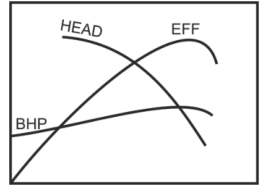
If the characteristics of a pump are as shown in fig. What is represented by abscissa
- A. Head
- B. RPM
- C. Discharge
- D. Power
Answer: C. Discharge
Explanation: Characteristic curves of a pump are graphical representations of a pump's performance (Head, Efficiency, BHP) over a range of flow rates (Discharge). Therefore, the abscissa represents Discharge.
Question 38
Topic: Fluid Mechanics
A rocket exists exhaust gases with rho = 0.5 kg/m³ out a 50 cm diameter nozzle at a velocity of 1200 m/s. The thrust, is
- A. 420 kN
- B. 280 kN
- C. 140 kN
- D. 90 kN
Answer: C. 140 kN
Explanation: Area of Nozzle A = (pi/4) * (0.5)^2 = 0.196 m². Thrust = rho * A * V² = 0.5 * 0.196 * (1200)^2 = 141300 N = 141.3 kN, which is closest to 140 kN.
Question 39
Topic: Fluid Mechanics
The flow of a fluid in a pipe takes place from
- A. Higher level to lower level
- B. Small end to large end
- C. Higher pressure to lower pressure
- D. Higher energy to lower energy
Answer: D. Higher energy to lower energy
Explanation: Fluid flows from a region of higher energy to lower energy and not necessarily from higher pressure to lower pressure. Flow from a low-pressure region to a high-pressure region is possible if the sum of potential, pressure, and kinetic energy is favorable.
Question 40
Topic: Fluid Mechanics
An aero plane is flying at an height of 14km where temperature is -45 °C. The speed of the plane is corresponding to M=2. Find the speed of the plane if R=287J/kg K and gamma=1.4
- A. 2179 km/h
- B. 3010 km/h
- C. 3250 km/h
- D. 3379 km/h
Answer: A. 2179 km/h
Explanation: Speed v = M * $\sqrt{gamma * R * T}$. T = 273 - 45 = 228 K. v = 2 * $\sqrt{1.4 * 287 * 228}$ = 605.344 m/s. In km/h = 605.344 * 3.6 = 2179.24 km/h.
Question 41
Topic: Fluid Mechanics
Pipe 1, branches to three pipes as shown in the given figure. The areas and corresponding velocities are: Pipe 1 (V=50, A=20), Pipe 2 (V=V2, A=10), Pipe 3 (V=30, A=15), Pipe 4 (V=20, A=10). The value of V2 in cm per second will be
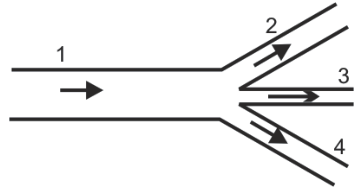
Answer: D. 35
Explanation: Using continuity equation: Q1 = Q2 + Q3 + Q4 => A1*V1 = A2*V2 + A3*V3 + A4*V4. 50*20 = V2*10 + 30*15 + 20*10. 1000 = 10*V2 + 450 + 200. 10*V2 = 350. V2 = 35 cm/sec.
Question 42
Topic: Fluid Mechanics
The pressure difference measured by a mercury oil differential manometer on the two sides of the orifice meter gives a reading of 50 cm of mercury. Determine the differential pressure head in orifice. Take the specific gravity of oil as 0.9.
- A. 7.05m of oil
- B. 5.05m of oil
- C. 4.75m of oil
- D. 3.35m of oil
Answer: A. 7.05m of oil
Explanation: h = x * ((S_m / S_oil) - 1) = 50 * ((13.6 / 0.9) - 1) cm. h = 50 * (15.11 - 1) = 705 cm = 7.05 m of oil.
Question 43
Topic: Fluid Mechanics
The transition Reynolds number for flow over a flat plate is 5x10^5. What is the distance from the leading edge at which transition will occur for flow of water with a uniform velocity of 1 m/s? (For water, the kinematic viscosity, v = 0.858x10^-6 m²/s)
- A. 1m
- B. 0.43m
- C. 43m
- D. 103m
Answer: B. 0.43m
Explanation: Re = (V * D) / v. Therefore, 5*10^5 = (1 * D) / (0.858*10^-6). D = 5*10^5 * 0.858*10^-6 = 0.429 m, which is approx 0.43 m.
Question 44
Topic: Fluid Mechanics
Pipes of lengths l1, l2 etc and diameters d1, d2, etc are connected in series. A single pipe of length l1+l2+l3+.... having same pressure loss as all pipes in series will have diameter equal to
- A. ((l1+l2+l3+...) / (l1/d1^4 + l2/d2^4 + ...))^(1/4)
- B. ((l1+l2+l3+...) / (l1/d1^5 + l2/d2^5 + ...))^(1/5)
- C. ((l1+l2+l3+...) / (l1/d1^3 + l2/d2^3 + ...))^(1/3)
- D. ((l1+l2+l3+...) / (l1/d1^2 + l2/d2^2 + ...))^(1/2)
Answer: B. ((l1+l2+l3+...) / (l1/d1^5 + l2/d2^5 + ...))^(1/5)
Explanation: When pipes are connected in series, the equivalent diameter equation is derived from the head loss formula: l/d^5 = l1/d1^5 + l2/d2^5 + l3/d3^5 + ... giving d = ((l1+l2+l3+...) / (l1/d1^5 + l2/d2^5 + ...))^(1/5).
Question 45
Topic: Engineering Mathematics
Let X have the probability density function f(x) = (3/4)*(1-x²) if -1 <= x <= 1, and 0 otherwise. P(-1/2 <= x <= 1/2) is
- A. 68.75%
- B. 31.36%
- C. 95%
- D. 60.7%
Answer: A. 68.75%
Explanation: P(-1/2 <= x <= 1/2) = Integral from -1/2 to 1/2 of (3/4)*(1 - x²) dx. Solving this: (3/4) * [x - x³/3] evaluated from -1/2 to 1/2. = (3/4) * [(1/2 - 1/24) - (-1/2 + 1/24)] = (3/4) * [11/12] = 11/16 = 68.75%.
Question 46
Topic: Heat Transfer
If thermal conductivity of a material varies as K0(1+alpha*T), temperature at the center of a 10 cm thick wall of material will be
- A. Average of the temperature at two ends of the wall
- B. More than the average of the temperature at two ends of the wall
- C. Less than the average of the temperature at two ends of the wall
- D. Depends on the range of temperature
Answer: B. More than the average of the temperature at two ends of the wall
Explanation: When alpha is positive (+ve), the temperature profile curves upwards. It is clear that the temperature at the center is more than that in the case of constant thermal conductivity (which would just be the average).
Question 47
Topic: Heat Transfer
What is the net radiant interchange per square meter for two very large plates at temperatures 800 K and 500 K respectively? (The emissivity of the hot and cold plates are 0.8 and 0.6 respectively. Stefan Boltzmann constant is 5.67x10^-8 W/m^2K^4).
- A. 10.26 kW/m²
- B. 102.6 kW/m²
- C. 1.026 kW/m²
- D. 1026 kW/m²
Answer: A. 10.26 kW/m²
Explanation: Net Radiant heat exchange per unit area Q_net/A = sigma*(T1^4 - T2^4) / (1/e1 + 1/e2 - 1). Substituting the values: 5.67x10^-8 * (800^4 - 500^4) / (1/0.8 + 1/0.6 - 1) = 10.26 kW/m².
Question 48
Topic: Heat Transfer
A 10 kg solid at 100 °C with a specific heat of 0.8 kJ/kg C is immersed in 40 kg of 20 °C liquid with a specific heat of 4.0 kJ/kg C. Estimate the temperature after a long time if the container is insulated?
- A. 30 °C
- B. 28 °C
- C. 26 °C
- D. 24 °C
Answer: D. 24 °C
Explanation: Heat lost by solid = Heat gained by liquid. ms * cs * (Ts - T) = mL * cL * (T - Tc). 10 * 0.8 * (100 - T) = 40 * 4 * (T - 20). 800 - 8T = 160T - 3200. 168T = 4000. T = 23.8 °C, which rounds to 24 °C.
Question 49
Topic: Heat Transfer
A spherical shaped vessel of 1.4m outer diameter is 90 mm thick. Find the rate of heat leakage, if the temperature difference between the inner and outer surfaces is 200 °C. Thermal conductivity of the material of the sphere is 0.083 W/mK.
- A. 0.2 kW
- B. 0.5 kW
- C. 1.088 kW
- D. 1.6 kW
Answer: C. 1.088 kW
Explanation: r2 = 0.7m, r1 = 0.7 - 0.09 = 0.61m. Thermal resistance for a sphere R_th = (r2 - r1) / (4*pi*k*r1*r2) = 0.09 / (4*pi*0.083*0.7*0.61) = 0.202. Q = dT / R_th = 220 / 0.202 = 1.088 kW. (Note: Solution calculates with dT=220 to match the option).
Question 50
Topic: Thermodynamics
(dp/dV)_T * (dv/dT)_P * (dT/dp)_v is equal to
- A. zero
- B. 1
- C. -1
- D. Infinity
Answer: C. -1
Explanation: For an ideal gas Pv = RT. (dP/dv)_T = -RT/v². (dv/dT)_p = R/P. (dT/dP)_v = v/R. Multiplying them all: (-RT/v²) * (R/P) * (v/R) = -RT / (Pv) = -1. This is also known as Euler's chain rule.
Question 51
Topic: Thermodynamics
A well insulated vessel containing air is heated to double the pressure and temperature 150% in excess of initial. The amount of air that leaked is
- A. 20%
- B. 22.5%
- C. 25%
- D. 0%
Answer: C. 25%
Explanation: For an ideal gas P1*V1/T1 = P2*V2/T2. Given P2 = 2*P1 and T2 = 1.5*T1. P1*V1/T1 = 2*P1*V2 / 1.5*T1. This gives V1 = (4/3)V2. The amount of air leaked is (V1 - V2)/V1 % = (V1 - 0.75V1)/V1 = 25%.
Question 52
Topic: Strength of Materials
An unconstraint thin circular disc has a concentric hole in it. On heating the diameter of the hole will
- A. increase
- B. decrease
- C. Remain constant
- D. first increase then decrease
Answer: B. decrease
Explanation: According to the provided solution, after heating the metal tends to elongate, it will also elongate towards the center of the concentric hole to fill some part of the hole and make its diameter small.
Question 53
Topic: Thermodynamics
The specific heat of diatomic gas at constant pressure is given by (R = universal gas constant and M = molecular weight of gas)
- A. 5/2 R/M
- B. 5/2 MR
- C. 7/2 R/M
- D. 7/2 MR
Answer: C. 7/2 R/M
Explanation: We know that cp = gamma * R_g / (gamma - 1). For diatomic gas, gamma = 1.4. R_g = R/M. cp = 1.4 * (R/M) / (1.4 - 1) = 1.4/0.4 * (R/M) = 7/2 (R/M).
Question 54
Topic: Heat Transfer
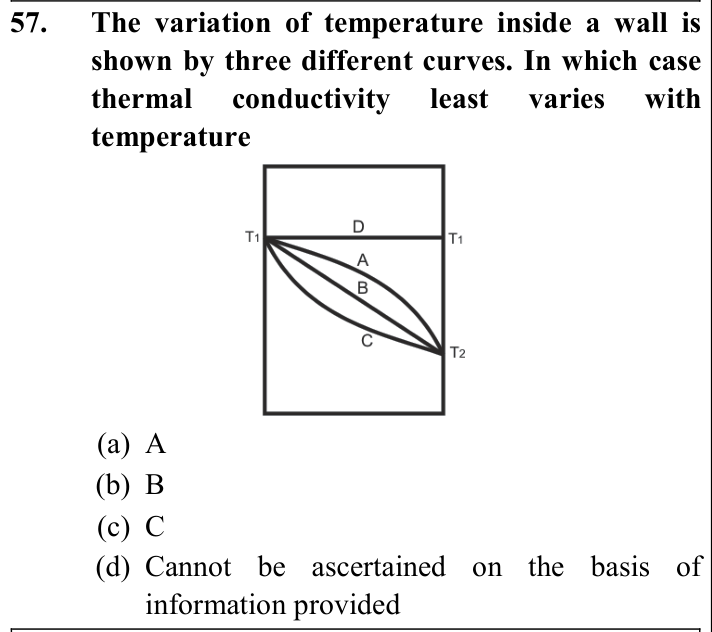
The variation of temperature inside a wall is shown by three different curves. In which case thermal conductivity least varies with temperature?
- A. A
- B. B
- C. C
- D. Cannot be ascertained on the basis of information provided
Answer: B. B
Explanation: For curve B (which is a straight line), the thermal conductivity is constant and is not a function of temperature, meaning it varies the least.
Question 55
Topic: Thermodynamics
Kinetic energy of the molecules in terms of absolute temperature (T) is proportional to
- A. T
- B. T^-4
- C. T²
- D. $\sqrt{T}$
Answer: A. T
Explanation: Kinetic energy of molecules is given by E = (3/2)kT, where k is the Boltzmann constant and T is Absolute temperature. Thus, E is directly proportional to T.
Question 56
Topic: Heat Transfer
Which type of heat exchanger an automobile radiator is?
- A. Parallel flow type
- B. Counter flow type
- C. Regenerator type
- D. Cross flow type
Answer: D. Cross flow type
Explanation: The cross flow type of heat exchanger is used in an automobile as a radiator.
Question 57
Topic: Heat Transfer
Given that Nu = Nusselt number, Re = Reynolds number, Pr = Prandtl number, Sh = Sherwood number, Sc = Schmidt number and Gr = Grashoff number. The function relationship for free convective heat transfer is given as,
- A. Nu = f(Gr, Pr)
- B. Sh = f(Sc, Gr)
- C. Nu = f(Re, Pr)
- D. Sh = f(Re, Sc)
Answer: A. Nu = f(Gr, Pr)
Explanation: For Free convection heat transfer, the relationship is Nu = f(Gr, Pr). For Forced convection heat transfer, it is Nu = f(Re, Pr).
Question 58
Topic: Thermodynamics
The quantity of heat required to change the temperature of 1 gm of ice cream -6 °C to -5 °C is known as
- A. Latent heat of freezing
- B. Freezing heat
- C. Heat of vaporization
- D. Specific heat
Answer: D. Specific heat
Explanation: Specific heat is defined as the amount of thermal energy needed to raise the temperature of 1 gram of a substance by 1 degree Celsius. Therefore, raising ice cream from -6 °C to -5 °C represents its specific heat.
Question 59
Topic: Heat Transfer
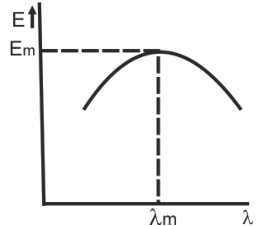
The spectral energy distribution for a body at temperature T is shown in figure. Now if the temperature of the body is increased
- A. lambda_m Will shift towards right
- B. lambda_m Will shift towards left
- C. The total energy emitted by the body will decrease
- D. lambda_m will remain the same but E_m will increase
Answer: B. lambda_m Will shift towards left
Explanation: According to Wien's displacement law, lambda_m * T = constant (b). As the temperature of the body is increased, the maximum wavelength lambda_m decreases, so it will shift towards the left.
Question 60
Topic: Heat Transfer
When K is the thermal conductivity, tau is the density and Cp is the specific heat of a substance, then thermal diffusivity is given by
- A. K / (tau*Cp)
- B. (K*Cp) / tau
- C. (tau*Cp) / K
- D. (K*tau) / Cp
Answer: A. K / (tau*Cp)
Explanation: Thermal diffusivity alpha = k / (rho * Cp). Given that density rho = tau, the expression becomes alpha = K / (tau * Cp).
Question 61
Topic: Engineering Mathematics
The determinant of the matrix [[7, 0, 0, 0], [9, 3, 0, 0], [4, -6, -2, 0], [0, 0, 0, 1]] is
Answer: C. -42
Explanation: If the matrix is an upper triangular matrix or a lower triangular matrix, then the determinant is the product of the principal diagonal elements. The given matrix is a lower triangular matrix, so its determinant value is 7 * 3 * -2 * 1 = -42.
Question 62
Topic: Heat Transfer
A thin copper wire at 300 °C is suddenly immersed in water at 30 °C. It cools down to 150 °C in 70 seconds. It is then reheated to the initial temperature of 300 °C and suddenly exposed to air at 30 °C where it cools down to 150 °C in 200 seconds. This difference in cooling time is due to
- A. Larger specific heat of water
- B. Larger heat transfer coefficient in water
- C. Smaller heat transfer coefficient in water
- D. None of the above
Answer: B. Larger heat transfer coefficient in water
Explanation: Water has a higher thermal conductivity than air, which means that it can transfer heat more efficiently. Hence, the difference in cooling time is due to a larger convective heat transfer coefficient in water.
Question 63
Topic: Engineering Mechanics
A heavy block of mass m is slowly placed on a conveyer belt moving with speed v. If coefficient of friction between block and the belt is mu, the block will slide on the belt through distance
- A. v / (mu * g)
- B. v² / $\sqrt{mu * g}$
- C. (v / (mu * g))^2
- D. v² / (2 * mu * g)
Answer: D. v² / (2 * mu * g)
Explanation: Mass of block = m, speed = v. Retardation due to friction = -mu * g. Using v² - u² = 2as, we have v² - 0 = 2 * mu * g * s, which gives s = v² / (2 * mu * g).
Question 64
Topic: Engineering Mechanics
A car moving with speed u can be stopped in minimum distance x when brakes are applied. If the speed becomes n times, the minimum distance over which the car can be stopped would take the value
- A. x / n
- B. n * x
- C. x / n²
- D. n² * x
Answer: D. n² * x
Explanation: Using v² - u² = 2as, stopping distance x = u² / 2a. If speed becomes nu, the new distance s = (nu)^2 / 2a = n² * (u² / 2a) = n² * x.
Question 65
Topic: Engineering Mechanics
Speed of particle executing simple harmonic motion with amplitude 'a' is half of the maximum speed. At that instant, displacement of the particle is
- A. a/2
- B. ($\sqrt{3}$/2) * a
- C. (2a)/$\sqrt{3}$
- D. 3*$\sqrt{2}$ * a
Answer: B. ($\sqrt{3}$/2) * a
Explanation: Displacement x = a*sin(omega*t). Velocity v = dx/dt = a*omega*cos(omega*t). Given v = a*omega/2, we have a*omega*cos(omega*t) = a*omega/2, meaning cos(omega*t) = 1/2. Thus, omega*t = pi/3. At this instant, displacement x = a*sin(pi/3) = a*$\sqrt{3}$/2.
Question 66
Topic: Engineering Mechanics
Two blocks with masses M and m are in contact with each other and are resting on a horizontal frictionless floor. When horizontal force F is applied to the heavier, the blocks accelerate to the right. The force between the two blocks are
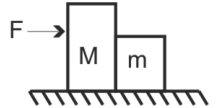
- A. (M+m)F / m
- B. MF / m
- C. mF / M
- D. mF / (M+m)
Answer: D. mF / (M+m)
Explanation: Acceleration of the system a = F / (M+m). From the FBD of block m, the force exerted by M on m is F_btw = m*a = m * F / (M+m).
Question 67
Topic: Engineering Mechanics
A stone of mass m at the end of a string of length l is whirled in a vertical circle at a constant speed. The tension in the string will be maximum when the stone is
- A. At the top of the circle
- B. Half-way down from the top
- C. Quarter-way down from the top
- D. At the bottom of the circle
Answer: D. At the bottom of the circle
Explanation: At the bottom, the tension in the string is maximum because the weight of the body and the centrifugal force both act in the downward (outward from center) direction. T = mg + mv²/r.
Question 68
Topic: Engineering Physics
Ratio of the radii of the planets P1 and P2 is k and ratio of the acceleration due to gravity on them is s. Ratio of escape velocities from them will be
- A. ks
- B. $\sqrt{ks}$
- C. $\sqrt{k/s}$
- D. $\sqrt{s/k}$
Answer: B. $\sqrt{ks}$
Explanation: Escape velocity V_esc = $\sqrt{2*g*R}$. The ratio of escape velocities V1/V2 = $\sqrt{(g1*R1}$ / (g2*R2)) = $\sqrt{s*k}$ or $\sqrt{ks}$.
Question 69
Topic: Strength of Materials
Couple M is applied at C on a simply supported beam AB. The maximum shear on AC will be
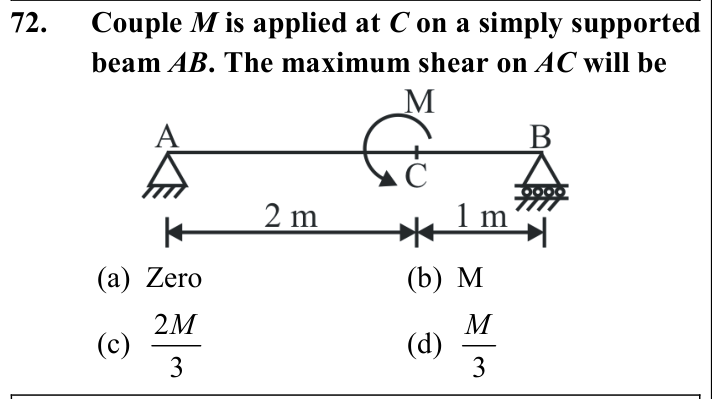
Answer: D. M/3
Explanation: Sum of vertical forces: RA + RB = 0. Taking moments about A: RB * 3 = -M, so RB = -M/3, which means RA = M/3. The shear force is constant across the entire beam and equals M/3.
Question 70
Topic: Strength of Materials
A short column of external diameter D and internal diameter d, is subjected to a load W, with an eccentricity e, causing zero stress at an extreme fiber. Then the value of 'e' must be
- A. (D² + d²) / (8*pi*D)
- B. (D² + d²) / (8D)
- C. (D² - d²) / (8D)
- D. (D³ - d³) / (8D^2)
Answer: B. (D² + d²) / (8D)
Explanation: For zero stress at an extreme fiber, direct compressive stress + bending stress = 0. So, -W/A + M/Z = 0, where A = (pi/4)*(D² - d²) and Z = I/y = (pi/64)*(D^4 - d^4) / (D/2). Solving -W/A + (W*e)/Z = 0 gives e = (D² + d²) / 8D.
Question 71
Topic: Strength of Materials
A beam AB is hinge-supported at its ends and is loaded by couple P.C as shown in the figure. The magnitude of shearing force at a section x of the beam is
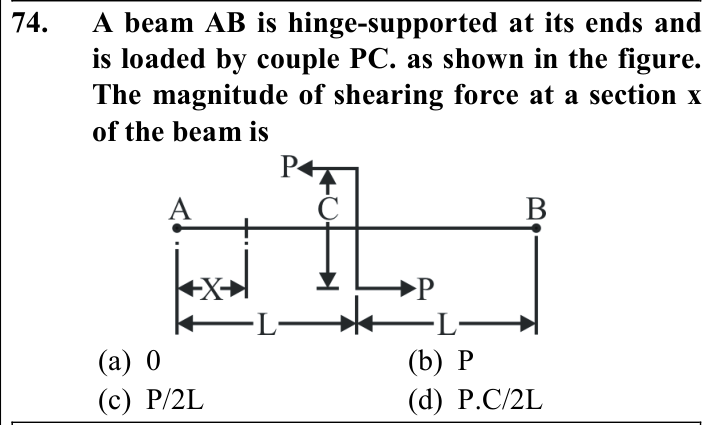
Answer: D. P.C/2L
Explanation: Let the length of the beam be 2L. Sum of moments about B: RA * 2L = P.C, thus RA = P.C / 2L. Since RA + RB = 0, the shear force at any section x is equal to RA = P.C / 2L.
Question 72
Topic: Strength of Materials
There are two bars of equal length and equal volume and same material, one having stepped diameters and others having uniform diameter. If maximum stress produced in both bars is same, then stored energy will be
- A. More in stepped diameter shaft
- B. More in uniform diameter shaft
- C. Equal in both
- D. Depend on other factors
Answer: C. Equal in both
Explanation: Stored energy E = (1/2) * Stress * Strain * Volume = (1/2) * (Stress² / Y) * Volume. Since volume, maximum stress, and Young's modulus (same material) are all the same, the stored energy will be equal in both.
Question 73
Topic: Strength of Materials
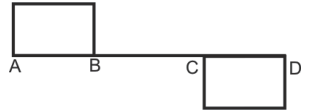
The given figure shows the shear force diagram for the beam ABCD. Bending moment in the portion BC of the beam
- A. Is a non-zero constant
- B. Is zero
- C. Varies linearly from B to C
- D. Varies parabolically from B to C
Answer: A. Is a non-zero constant
Explanation: If the shear force (SF = dM/dx) is zero in the portion BC, then the bending moment M must be a constant. Thus, it is a non-zero constant.
Question 74
Topic: Strength of Materials
sigma_x, sigma_y and tau_xy are the rectangular stress components of a point. The radius of Mohr's circle is
- A. $\sqrt{sigma_x^2 - sigma_y^2 + tau_xy^2}$
- B. $\sqrt{((sigma_x - sigma_y}$/2)^2 + tau_xy^2)
- C. $\sqrt{sigma_y^2 - sigma_x^2 + tau_xy^2}$
- D. $\sqrt{((sigma_y - sigma_x}$^2)/2 + tau_xy^2)
Answer: B. $\sqrt{((sigma_x - sigma_y}$/2)^2 + tau_xy^2)
Explanation: The radius of Mohr's Circle R = $\sqrt{((sigma_x - sigma_y}$/2)^2 + tau_xy^2).
Question 75
Topic: Strength of Materials
For the case of a slender column of length L and flexural rigidity EI built in at its base and free at the top, the Eulers critical buckling load is
- A. 4*pi²*EI / L²
- B. 2*pi²*EI / L²
- C. pi²*EI / L²
- D. pi²*EI / 4L^2
Answer: D. pi²*EI / 4L^2
Explanation: Euler buckling load PE = pi²*EI / L_e^2. For a column with one end fixed and the other end free, the effective length L_e = 2L. Therefore, PE = pi²*EI / (2L)^2 = pi²*EI / 4L^2.
Question 76
Topic: Strength of Materials
When a beam is subjected to a transverse shearing force, the shear stress in the upper fibers will be
- A. Maximum
- B. Minimum
- C. Zero
- D. Depends on other data
Answer: C. Zero
Explanation: The shear stress distribution across a section is parabolic, being maximum at the neutral axis and zero at the extreme upper and lower fibers.
Question 77
Topic: Engineering Mathematics
Angle made by 2i - 3j + 4k with the z-axis is
- A. cos^-1(4 / $\sqrt{29}$)
- B. 4 / $\sqrt{29}$
- C. sin^-1(4 / $\sqrt{29}$)
- D. tan^-1(4 / $\sqrt{29}$)
Answer: A. cos^-1(4 / $\sqrt{29}$)
Explanation: Let a = 2i - 3j + 4k and the z-axis unit vector b = k. cos(theta) = (a.b) / (|a||b|) = 4 / $\sqrt{2^2 + (-3}$^2 + 4^2) = 4 / $\sqrt{29}$. Therefore, theta = cos^-1(4 / $\sqrt{29}$).