ISRO Mechanical & Aerospace 2006 Question Paper & Solutions
Attempt the ISRO Mechanical & Aerospace 2006 previous year paper in real CBT exam mode or practice mode with verified answers and explanations.
All ISRO Mechanical & Aerospace papers
80 questions. Answers are shown only where the official answer key is available.
Question 1
Topic: Material Science
In nodular iron, graphite is in the form of-
- A. Cementite
- B. Free carbon
- C. Flakes
- D. Spheroids
Answer: D. Spheroids
Explanation: Nodular (or Ductile) Cast Iron- Nodular cast iron has also known as spheroidal or ductile cast iron. Alloying additions are of prime importance in producing these materials. Small additions of Mg/Ce to the gray cast iron melt before casting can result in graphite to form nodule or spheroids like particles. Matrix surrounding these particles can be either ferrite or pearlite depending on the heat treatment. These are stronger and ductile than gray cast iron.
Question 2
Topic: Material Science
Hardness of steel depends on
- A. Amount of carbon it contains
- B. The shape and distribution of the carbides in iron
- C. Method of fabrication
- D. Contents of alloying elements
Answer: A. Amount of carbon it contains
Explanation: The term hardened steel is often used for a medium or high carbon steel that has been given heat treatment and then quenching followed by tempering. Hardness of steel depends on the amount of carbon present in metal. Only steel that is high in carbon can be hardened and tempered. If a metal does not contain the necessary quantity of carbon, then its crystalline structure cannot be broken.
Question 3
Topic: Manufacturing Engineering
Too high welding current in arc welding would result in
- A. Excessive spatter, under cutting along edges, irregular deposits, wasted electrodes
- B. Excessive piling up of weld metal, poor penetration, wasted electrodes
- C. Too small bead, weak weld and wasted electrodes
- D. Excessive piling up of weld metal, overlapping without penetration of edges, wasted electrodes
Answer: A. Excessive spatter, under cutting along edges, irregular deposits, wasted electrodes
Explanation: Arc welding is a type of welding process using an electric arc to create heat to melt and joint metals. Very high welding current in arc welding would result in excessive spatter, under cutting along edges, irregular deposits, wasted electrodes.
Question 4
Topic: Manufacturing Engineering
Which of the following processes would produce strongest components?
- A. Hot rolling
- B. Extrusion
- C. Cold rolling
- D. Forging
Answer: C. Cold rolling
Explanation: Hot Rolling- Hot rolling is a mill process which involves rolling the steel at high temperature which is above the steel's recrystallization. Cold Rolling- Cold rolling is a metal working process in which metal is deformed by passing it through rollers at a temperature below its recrystallization. Cold Rolling increases the yield strength and hardness of metal by introducing defects into the metal's crystal structure. These defects prevent further slip and can reduce the grain size of the metal, resulting in Hall-Petch hardening. Since strength and hardness of a cold working component is always more than that of hot working due to strain hardening. Therefore cold working would be a better option as cold is specifically mentioned whereas in forging it could be hot or cold.
Question 5
Topic: Engineering Mathematics
If a quantity Q is dependent on three other quantities $q_{1}$, $q_{2}$ and $q_{3}$ related such that $Q=K\times(q_{1})^{n_{1}}\times(q_{2})^{n_{2}}\times(q_{3})^{n_{3}}$ then overall error $\frac{\delta Q}{Q}=$
- A. $n_{1}(\frac{\delta q_{1}}{q_{1}})+n_{2}(\frac{\delta q_{2}}{q_{2}})+n_{3}(\frac{\delta q_{3}}{q_{3}})$
- B. $\frac{1}{n_{1}}\frac{\delta q_{1}}{q_{1}}+\frac{1}{n_{2}}\frac{\delta q_{2}}{q_{2}}+\frac{1}{n_{3}}\frac{\delta q_{3}}{q_{3}}$
- C. $\frac{\delta q_{1}}{q_{1}}+\frac{\delta q_{2}}{q_{2}}+\frac{\delta q_{3}}{q_{3}}$
- D. $(\frac{\delta q_{1}}{q_{1}})^{n_{1}}+(\frac{\delta q_{2}}{q_{2}})^{n_{2}}+(\frac{\delta q_{3}}{q_{3}})^{n_{3}}$
Answer: A. $n_{1}(\frac{\delta q_{1}}{q_{1}})+n_{2}(\frac{\delta q_{2}}{q_{2}})+n_{3}(\frac{\delta q_{3}}{q_{3}})$
Explanation: $Q=K\times(q_{1})^{n_{1}}\times(q_{2})^{n_{2}}\times(q_{3})^{n_{3}}$. Taking log both side, $\ln Q=\ln k+n_{1} \ln q_{1}+n_{2} \ln q_{2}+n_{3} \ln q_{3}$. Differentiating both side: $\frac{\delta Q}{Q}=n_{1}(\frac{\delta q_{1}}{q_{1}})+n_{2}(\frac{\delta q_{2}}{q_{2}})+n_{3}(\frac{\delta q_{3}}{q_{3}})$. $\ln k=0$, because 'k' is constant.
Question 6
Topic: Material Science
Which of the following has maximum hardness-
- A. Austenite
- B. Pearlite
- C. Troostite
- D. Martensite
Answer: D. Martensite
Explanation: The highest hardness of martensite is 700 (BHN) brinell whereas hardness of a pearlite steel is 400 (BHN) brinell.
Question 7
Topic: Industrial Engineering
The main advantage of line organization is its-
- A. Effective command and control
- B. Defined responsibilities at all levels
- C. Rigid discipline in the organization
- D. All of the above
Answer: D. All of the above
Explanation: Line organization is the most oldest and simplest method of administrative organization. In this type of organization, the authority flows from top to bottom in concern. It means the line of command is carried out from top to bottom. Merits of line organization: Simplicity, Clear-cut division of authority and responsibility, Strong discipline, Unified control, Prompt decisions, Flexibility.
Question 8
Topic: Industrial Engineering
The mathematical technique for finding the best uses of limited resources in an optimum manner is known as-
- A. Operation research
- B. Linear programming
- C. Network analysis
- D. Queuing theory
Answer: B. Linear programming
Explanation: Linear Programming (L.P.) is used for optimization of our limited resources when there are number of alternate solution possible for the problem. It's the mathematical technique and the term linear is used for the variable and it simply means that the relationship between the different variable can be represented in the form of straight line.
Question 9
Topic: Metrology and Inspection
Which of the following errors are generally distributed in accordance with the Gaussian distribution-
- A. Controllable errors
- B. Calibration errors
- C. Avoidable errors
- D. Random errors
Answer: D. Random errors
Explanation: Random errors are those which are accidental and whose magnitude and sign cannot be predicted from knowledge of measuring system conditions. Random errors have positive and negative values and their magnitudes are generally distributed in accordance with Gaussian distribution of measurement. Systematic error/controllable error include calibration errors, error due to variation in the atmospheric condition, variation in contact pressure etc. These errors results from irregular procedure that are consistent in action.
Question 10
Topic: Strength of Materials
$\frac{PL^{3}}{3EI}$ is the deflection under the load P of a cantilever beam (length L, modulus of elasticity E, moment of inertia I). The strain energy due to bending is
- A. $\frac{P^{2}L^{3}}{3EI}$
- B. $\frac{P^{2}L^{3}}{6EI}$
- C. $\frac{P^{2}L^{3}}{4EI}$
- D. $\frac{P^{2}L^{3}}{48EI}$
Answer: B. $\frac{P^{2}L^{3}}{6EI}$
Explanation: Given Deflection ($\delta$) = $\frac{PL^{3}}{3EI}$. Strain energy = $\frac{1}{2} \times P \times \delta = \frac{1}{2} \times \text{load} \times \text{Deflection} = \frac{1}{2} \times P \times \frac{PL^{3}}{3EI} = \frac{P^{2}L^{3}}{6EI}$.
Question 11
Topic: Theory of Machines / Vibrations
A mass m attached to a light spring oscillates with a period of 2 sec. If the mass is increased by 2 kg, the period increases by 1 sec. The value of m is-
- A. 1 kg
- B. 1.6 kg
- C. 2 kg
- D. 2.4 kg
Answer: B. 1.6 kg
Explanation: Given Mass = m, Time period $T_{1}=2$ sec. Mass is increased by 2 kg $=m+2$, Time period increases $T_{2}=2+1=3$ sec. Time period, $T_{1}=2\pi\sqrt{\frac{m}{k}}=2$ ...(i). Mass increases by 2 kg, Time period, $T_{2}=2\pi\sqrt{\frac{m+2}{k}}=3$ ...(ii). From equation (i) and (ii): $\sqrt{\frac{m}{m+2}}=\frac{2}{3} \Rightarrow \frac{m}{m+2}=\frac{4}{9} \Rightarrow 9m=4m+8 \Rightarrow 5m=8 \Rightarrow m=1.6$ kg.
Question 12
Topic: Strength of Materials
A short column of external diameter D and internal diameter d carries an external load W. The greatest ecentricity which the load can have without producing tension on the cross section of the column is-
- A. $(D+d)/8$
- B. $(D^{2}+d^{2})/8$
- C. $(D^{2}+d^{2})/8D$
- D. $(D^{2}+d^{2})/8d$
Answer: C. $(D^{2}+d^{2})/8D$
Explanation: External diameter = D, Internal diameter = d, External load = W. For no tension, Stress due to bending moment ($\sigma_{b}$) = Stress due to axial load ($\sigma_{a}$). $\sigma_{b}=\sigma_{a} \Rightarrow \frac{M}{Z}=\frac{W}{A} \Rightarrow \frac{W \times e}{\frac{\pi}{32} \times \frac{(D^{4}-d^{4})}{D}} = \frac{4W}{\pi(D^{2}-d^{2})} \Rightarrow \frac{32 \times W \times e \times D}{\pi(D^{4}-d^{4})}=\frac{4W}{\pi(D^{2}-d^{2})} \Rightarrow e=\frac{D^{2}+d^{2}}{8D}$.
Question 13
Topic: Strength of Materials
If the radius of wire stretched by a load doubled, then its Young's modulus will-
- A. Be doubled
- B. Be halved
- C. Become for times
- D. None of the above
Answer: D. None of the above
Explanation: Young's modulus is also known as modulus of elasticity. It is the mechanical property of a material that allows it to withstand pressure and expand with respect to its length. It depends only on the material and not on the geometric dimensions like radius. Hence, it will remain unchanged.
Question 14
Topic: Strength of Materials
Longitudinal stress in a thin cylinder subjected to internal pressure is-
- A. Half of the hoop stress
- B. Twice the hoop stress
- C. Become four times
- D. None of the above
Answer: A. Half of the hoop stress
Explanation: For Thin Cylinder: Hoop/Circumferential stress $\sigma_{h}=\frac{Pd}{2t}$. Longitudinal stress $\sigma_{l}=\frac{Pd}{4t}$. Thus, $\sigma_{l}=\frac{1}{2}\sigma_{h}$.
Question 15
Topic: Strength of Materials
Maximum deflection in cantilever due to pure bending moment M at its ends is-
- A. $\frac{ML^{2}}{2EI}$
- B. $\frac{ML^{2}}{3EI}$
- C. $\frac{ML^{2}}{4EI}$
- D. $\frac{ML^{2}}{6EI}$
Answer: A. $\frac{ML^{2}}{2EI}$
Explanation: Using double integration method, at any distance x from A, we have $EI\frac{d^{2}y}{dx^{2}}=-M$. Integrating, $EI\frac{dy}{dx}=-Mx+C_{1}$. Integrating again, $EI(y)=-M\frac{x^{2}}{2}+C_{1}x+C_{2}$. At fixed end $x=0$, $\frac{dy}{dx}=0 \Rightarrow C_{1}=0$. At $x=0$, $y=0 \Rightarrow C_{2}=0$. The magnitude of deflection at free end ($x=L$) will be $y=\frac{ML^{2}}{2EI}$.
Question 16
Topic: Strength of Materials
If poisson's ratio for a material is 0.5, then the elastic modulus for the material is-
- A. 3 times its shear modulus
- B. 4 times its shear modulus
- C. Equal to its shear modulus
- D. Indeterminate
Answer: A. 3 times its shear modulus
Explanation: Given- Poisson's ratio ($\mu$) = 0.5. The relationship between Elastic modulus (E) and Shear modulus (G) is $E = 2G(1+\mu)$. Substituting the value, $E = 2G(1+0.5) = 2G(1.5) = 3G$. Hence, the elastic modulus is 3 times its shear modulus.
Question 17
Topic: Theory of Machines / Vibrations
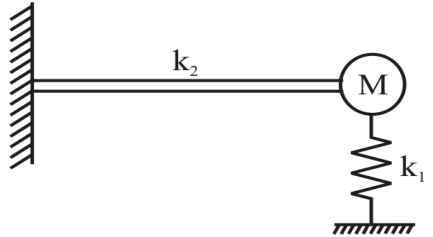
A cantilever beam of negligible weight is carrying a mass M at its free end, and is also resting on an elastic support of stiffness $k_{1}$ as shown in the figure below. If $k_{2}$ represents the bending stiffness of the beam, the natural frequency (rad/s) of the system is-
- A. $\sqrt{\frac{(k_{1}k_{2})}{M(k_{1}+k_{2})}}$
- B. $\sqrt{\frac{2(k_{1}+k_{2})}{M}}$
- C. $\sqrt{\frac{(k_{1}+k_{2})}{M}}$
- D. $\sqrt{\frac{(k_{1}-k_{2})}{M}}$
Answer: C. $\sqrt{\frac{(k_{1}+k_{2})}{M}}$
Explanation: From the equivalent system, the stiffness of the elastic support $k_{1}$ and the bending stiffness of the beam $k_{2}$ are in parallel. Therefore, equivalent stiffness $k_{eq} = k_{1} + k_{2}$. The natural frequency is given by $\omega_{n} = \sqrt{\frac{k_{eq}}{M}} = \sqrt{\frac{(k_{1}+k_{2})}{M}}$.
Question 18
Topic: Engineering Mechanics
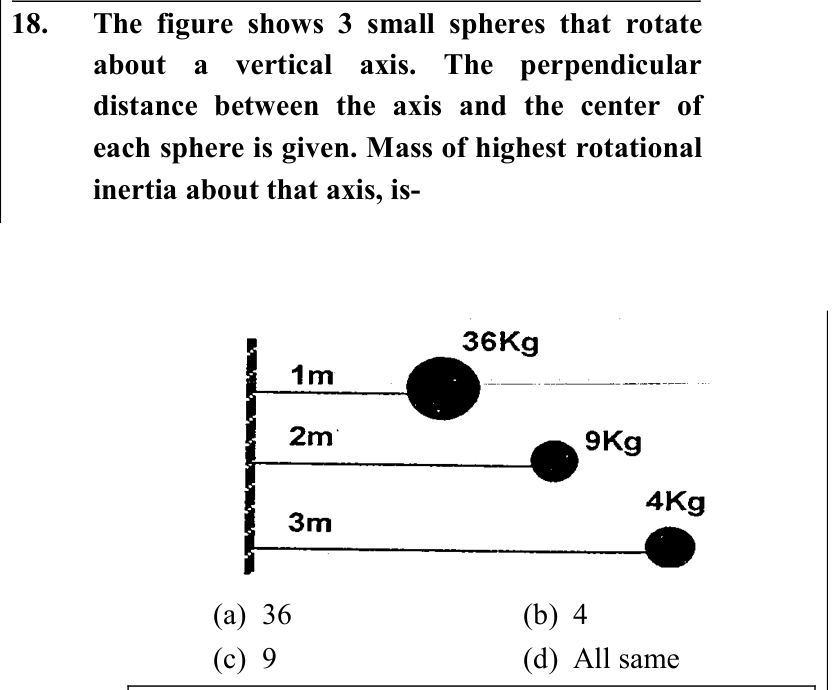
The figure shows 3 small spheres that rotate about a vertical axis. The perpendicular distance between the axis and the center of each sphere is given. Mass of highest rotational inertia about that axis, is-
Answer: D. All same
Explanation: Mass of rotational inertia, $I = \text{mass} \times (\text{radius})^{2}$. For the first sphere: $I_{1} = m_{1}r_{1}^{2} = 36 \times (1)^{2} = 36 \text{ kg-m}^{2}$. For the second sphere: $I_{2} = m_{2}r_{2}^{2} = 9 \times (2)^{2} = 36 \text{ kg-m}^{2}$. For the third sphere: $I_{3} = m_{3}r_{3}^{2} = 4 \times (3)^{2} = 36 \text{ kg-m}^{2}$. Since $I_{1} = I_{2} = I_{3}$, all spheres have the same rotational inertia.
Question 19
Topic: Theory of Machines / Vibrations
Which of the following relationships between the force F on a particle and the particles position x implies simple harmonic oscillation
- A. $F = -7x$
- B. $F = -200x^{2}$
- C. $F = 10x$
- D. $F = 5x^{2}$
Answer: A. $F = -7x$
Explanation: The fundamental condition for simple harmonic oscillation is that the restoring force (F) on a particle must be directly proportional to its displacement (x) from the mean position and directed towards the mean position. This is represented mathematically as $F = -kx$, where k is a positive spring constant. Only option (a) matches this linear relationship.
Question 20
Topic: Theory of Machines / Vibrations
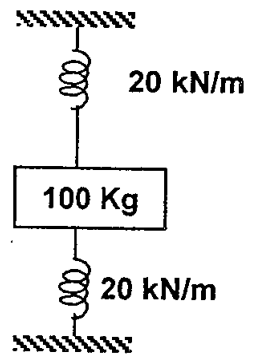
A mass of 100 kg is held between two springs as shown in figure. The natural frequency of vibration of the system of cycle/second is-
- A. $\frac{10}{\pi}$
- B. $\frac{5}{\pi}$
- C. $\frac{1}{2\pi}$
- D. $\frac{20}{\pi}$
Answer: A. $\frac{10}{\pi}$
Explanation: Both the springs are in parallel connection. Equivalent stiffness $k_{eff} = k_{1} + k_{2} = 20 + 20 = 40 \text{ kN/m} = 40 \times 10^{3} \text{ N/m}$. Natural frequency of vibration of the system in cycles/second ($f_{n}$) is given by $f_{n} = \frac{1}{2\pi}\sqrt{\frac{k_{eff}}{m}} = \frac{1}{2\pi}\sqrt{\frac{40 \times 10^{3}}{100}} = \frac{1}{2\pi}\sqrt{400} = \frac{20}{2\pi} = \frac{10}{\pi}$.
Question 21
Topic: Strength of Materials
The bending equation is written as-
- A. $\frac{I}{M}=\frac{f}{y}=\frac{E}{R}$
- B. $\frac{M}{I}=\frac{f^{2}}{y}=\frac{E^{2}}{R^{2}}$
- C. $\frac{M}{I}=\frac{f}{y}=\frac{E}{R}$
- D. $\frac{M^{2}}{I}=\frac{f^{2}}{y}=\frac{E^{2}}{R^{2}}$
Answer: C. $\frac{M}{I}=\frac{f}{y}=\frac{E}{R}$
Explanation: The standard bending equation for beams is $\frac{M}{I} = \frac{f}{y} = \frac{E}{R}$, where M is the bending moment, I is the moment of inertia about the neutral axis, f is the bending stress, y is the distance from the neutral axis, E is Young's modulus, and R is the radius of curvature.
Question 22
Topic: Power Plant Engineering
Hydraulic testing of boilers is done at pressures-
- A. Below and above atmosphere
- B. Slightly above atmospheric pressure
- C. At half the working pressures of boiler
- D. At 1.5 to 2 times the working pressure
Answer: D. At 1.5 to 2 times the working pressure
Explanation: Hydraulic test shall be carried out by raising the test pressure gradually. Hydraulic testing before assembly into the boiler is done by testing it hydraulically to 1.5 times the maximum permissible working pressure at site.
Question 23
Topic: Fluid Mechanics
100 m of water column is equal to
- A. $1000 \text{ kN/m}^{2}$
- B. $100 \text{ kN/m}^{2}$
- C. $10 \text{ kN/m}^{2}$
- D. $1 \text{ kN/m}^{2}$
Answer: A. $1000 \text{ kN/m}^{2}$
Explanation: Pressure (P) due to a water column of height h is given by $P = \rho g h$. Given $h = 100 \text{ m}$, density of water $\rho = 1000 \text{ kg/m}^{3}$, and taking $g \approx 10 \text{ m/s}^{2}$ (as per typical approximate calculations in these exams): $P = 1000 \times 10 \times 100 = 1000000 \text{ N/m}^{2} = 1000 \text{ kN/m}^{2}$.
Question 24
Topic: Design of Machine Elements
Gantry girders are invariably designed to resist-
- A. Transverse loads only
- B. Lateral loads only
- C. Transverse and lateral loads
- D. Transverse, lateral and axial load
Answer: C. Transverse and lateral loads
Explanation: Gantry girders are used to provide support for overhead travelling cranes. Movement of heavy loads exerts vertical (transverse) load applied by the crane itself. Horizontal (lateral) movements are exerted on the gantry girder by the surge, or acceleration and braking of the crane operation and the swinging of loads. Thus, they are designed to resist both transverse and lateral loads.
Question 25
Topic: Theory of Machines
If the rotating mass of a rim type flywheel is distributed on another rim type flywheel whose mean radius is half the mean radius of the former, then energy stored in the later at the same speed will be.
- A. Four times the first one
- B. Same as the first one
- C. One fourth of the first one
- D. One and a half times the first one
Answer: C. One fourth of the first one
Explanation: Energy stored in a flywheel is $E = \frac{1}{2}I\omega^{2}$. For a rim type flywheel, $I = mR^{2}$. Thus, $E_{1} = \frac{1}{2}mR_{1}^{2}\omega^{2}$. When the radius is half the mean radius ($R_{2} = R_{1}/2$), the energy is $E_{2} = \frac{1}{2}m(R_{1}/2)^{2}\omega^{2} = \frac{1}{4} \times \frac{1}{2}mR_{1}^{2}\omega^{2} = \frac{1}{4}E_{1}$.
Question 26
Topic: Engineering Mechanics
A thin circular disc is rolling with a uniform linear speed, along a straight path on a plane surface. Consider the following statements in this regard-
1. All points of the disc have the same velocity
2. The center of the disc has zero acceleration.
3. The center of the disc has centrifugal acceleration.
4. The point on the disc making contact with the plane surface has zero acceleration
Of these statements
- A. 1 and 4 are correct
- B. 3 and 4 are correct
- C. 3 alone is correct
- D. 2 alone is correct
Answer: D. 2 alone is correct
Explanation: In pure rolling with uniform linear speed: 1. Velocity varies at different points due to the combination of translation and rotation. 2. The center of the disc moves with uniform velocity, hence it has zero acceleration. 3. Since it has zero acceleration, there is no centrifugal acceleration at the center. 4. The point of contact has zero velocity, but it has a non-zero normal acceleration directed towards the center. Therefore, only statement 2 is correct.
Question 27
Topic: Engineering Mechanics
If a number of forces act on a rigid body, each force may be replaced by an equal and parallel force acting through a fixed point, together with a couple. For the rigid body to be in equilibrium.
- A. Both resultant force and couple must zero
- B. The resultant couple on the body must be zero
- C. The resultant force at the fixed point must be zero
- D. None of the above
Answer: A. Both resultant force and couple must zero
Explanation: If a number of forces act on a rigid body, each force may be replaced by an equal and parallel force acting through a fixed point, together with a couple. For the rigid body to be in static equilibrium, both the resultant force ($\Sigma F_{R} = 0$) and the resultant couple ($\Sigma C = 0$) must be zero.
Question 28
Topic: Theory of Machines / Vibrations
Whirling speed of a shaft coincides with the natural frequency of its-
- A. Longitudinal vibration
- B. Transverse vibration
- C. Torsional vibration
- D. Coupled bending torsional vibration
Answer: B. Transverse vibration
Explanation: The whirling speed or critical speed of a shaft is the rotational speed at which a spinning shaft will tend to vibrate violently in the transverse direction. This resonance occurs when the speed coincides with the natural frequency of its transverse vibration.
Question 29
Topic: Theory of Machines
A fixed gear having 200 teeth is in mesh with another gear having 50 teeth. The two gears are connected by arm. The number of turns made by the smaller gear for one revolution of arm about the center of the bigger gear is-
- A. 4
- B. 3
- C. $3\frac{2}{4}$
- D. 5
Answer: D. 5
Explanation: Using the tabular method: Let the arm rotate by +y and gear train by +x. Fixed gear ($T_{G}=200$) turns $N_{G} = y - x(T_{P}/T_{G}) = 0$. Given $y = 1$ rev, $1 - x(50/200) = 0 \Rightarrow 1 = x/4 \Rightarrow x = 4$. The speed of the smaller gear (pinion, $T_{P}=50$) is $N_{P} = y + x = 1 + 4 = 5$ revolutions.
Question 30
Topic: Theory of Machines / Vibrations
With symbols having the usual meanings, the single degree freedom of system, $m\ddot{x}+c\dot{x}+kx=F \sin\omega t$ represents
- A. Free vibrations with damping
- B. Free vibrations without damping
- C. Forced vibrations with damping
- D. Forced vibrations without damping
Answer: C. Forced vibrations with damping
Explanation: The given differential equation $m\ddot{x}+c\dot{x}+kx=F \sin\omega t$ contains a damping term '$c\dot{x}$' indicating it is a damped system, and an external harmonic excitation force term '$F \sin\omega t$' indicating it is a forced system. Thus, it represents forced vibrations with damping.
Question 31
Topic: Theory of Machines / Vibrations
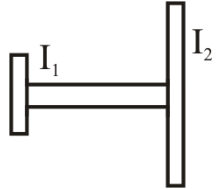
In the two-rotor system shown in the figure, $I_{1} < I_{2}$, a node of vibration situated.
- A. Between $I_{1}$ and $I_{2}$ but nearer to $I_{1}$
- B. Between $I_{1}$ and $I_{2}$ but nearer to $I_{2}$
- C. Exactly in the middle of the shaft
- D. Nearer to $I_{1}$ but outside
Answer: B. Between $I_{1}$ and $I_{2}$ but nearer to $I_{2}$
Explanation: From the torsional vibration of a two-rotor system, $L_{1} + L_{2} = L$. Equating the torsional natural frequencies of both segments: $\sqrt{\frac{S_{T_{1}}}{I_{1}}} = \sqrt{\frac{S_{T_{2}}}{I_{2}}}$, which simplifies to $\frac{L_{1}}{L_{2}} = \frac{I_{2}}{I_{1}}$. Given $I_{2} > I_{1}$, it implies $L_{2} < L_{1}$. So, the node of vibration is situated nearer to $I_{2}$.
Question 32
Topic: Design of Machine Elements
Which one of the following is not a friction clutch?
- A. Disc or plate clutch
- B. Cone clutch
- C. Centrifugal clutch
- D. Jaw clutch
Answer: D. Jaw clutch
Explanation: Jaw clutches are positive drive clutches (i.e., no slipping) and used in low speed machinery e.g. rolling milling. Friction clutches (like Disc or plate clutch, Cone clutch, Centrifugal clutch) depend on the frictional force between two bodies which are pressed together.
Question 33
Topic: Theory of Machines / Vibrations
Polar moment in inertia $(I_{p})$ of a circular disc is to be determined by suspending it by a wire and noting the frequency of oscillations (f).
- A. $I_{p} \propto \frac{1}{f^{2}}$
- B. $I_{p} \propto f^{2}$
- C. $I_{p} \propto f$
- D. $I_{p} \propto \frac{1}{f}$
Answer: A. $I_{p} \propto \frac{1}{f^{2}}$
Explanation: Radius of gyration $k \propto \frac{1}{f_{n}}$. Since polar moment of inertia $I = mk^{2}$, we have $I \propto \frac{1}{f_{n}^{2}}$.
Question 34
Topic: Theory of Machines
Pick up the wrong statement, A flywheel
- A. Is used to limit the invitable fluctuation speed during each cycle
- B. Controls the mean speed of rotation
- C. Stores up energy and gives up whenever required
- D. Regulates the speed during one cycle of prime mover
Answer: B. Controls the mean speed of rotation
Explanation: A Flywheel resists change in rotational speed by their moment of inertia and controls the speed variations caused by the fluctuation of the engine turning moment during each cycle of operation. "A flywheel controls the speed variation caused by the engine whereas governor maintains a constant speed during load variation on the engine." Hence, a flywheel does not control the mean speed of rotation.
Question 35
Topic: Automobile Engineering
Purpose of using differential gear in automobile is to.
- A. Help in turning
- B. Control speed
- C. Avoid jerks
- D. Obtain rear movement
Answer: A. Help in turning
Explanation: The purpose of differential gear on rear axle is to allow the back wheels to run at different speeds during turn and at same speed in straight motion. At a turn, the outer wheel moves faster than inner to cover more distance and inner wheel moves slow to cover less distance.
Question 36
Topic: Theory of Machines / Vibrations
The acceleration of Simple Harmonic Motion of a pendulum is proportional to
- A. Length of pendulum
- B. Time period
- C. Angular velocity
- D. Displacement
Answer: D. Displacement
Explanation: Equation for simple harmonic motion $x = A \sin \omega t$. Velocity $V = \frac{dx}{dt} = A \omega \cos \omega t$. Acceleration $a = \frac{dv}{dt} = -A \omega^{2} \sin \omega t = -\omega^{2}x$. Thus, acceleration is proportional to displacement ($a \propto x$).
Question 37
Topic: Engineering Mechanics
A person walks up a stalled escalator in 90 seconds. When standing on the same escalator, now moving, he is carried up in 60 seconds. how much time would it take him to walk up the moving escalator?
- A. 30 sec.
- B. 36 sec.
- C. 45 sec.
- D. 54 sec.
Answer: B. 36 sec.
Explanation: Let speed of person = u, speed of escalator = v, distance = s. Then $s/u = 90$ and $s/v = 60$. By relative velocity approach, time taken by person to walk up moving escalator = $s/(u+v)$. $\frac{u+v}{s} = \frac{1}{90} + \frac{1}{60} = \frac{5}{180}$. Therefore, $\frac{s}{u+v} = 36$ sec.
Question 38
Topic: Engineering Mechanics
A stone of mass m at the end of a string of length l is whirled in a vertical circle at a constant speed. The tension in the string will be maximum when the stone is-
- A. At the top of the circle
- B. Half-way down from the top
- C. Quarter-was down from the top
- D. At the bottom of the circle
Answer: D. At the bottom of the circle
Explanation: At the bottom, the tension in the string will be maximum because of both weight of stone and centrifugal force acting in downward direction. $T_{bottom} = mg + mr\omega^{2}$ (maximum). At the top, $T_{top} = mr\omega^{2} - mg$ (minimum).
Question 39
Topic: Theory of Machines / Vibrations
Speed of particle executing simple harmonic motion with amplitude a is half of the maximum speed. At the instant, displacement of the particle is-
- A. $\frac{a}{2}$
- B. $\frac{\sqrt{3}}{2}a$
- C. $\frac{2a}{\sqrt{3}}$
- D. $3\sqrt{2}a$
Answer: B. $\frac{\sqrt{3}}{2}a$
Explanation: Equation for simple harmonic motion is $x = a \sin \omega t$. Velocity $v = \frac{dx}{dt} = a \omega \cos \omega t$. For maximum speed, $\cos \omega t = 1$, then $V_{max} = a\omega$. When speed is half of maximum, $\frac{a\omega}{2} = a\omega \cos \omega t \implies \cos \omega t = 1/2 \implies \omega t = \pi/3$. At $\omega t = \pi/3$, displacement $x = a \sin(\pi/3) = \frac{\sqrt{3}}{2}a$.
Question 40
Topic: Engineering Mechanics
Two satellites, of masses m and 2m, are on the same circular orbit around earth. If the velocity of the lighter satellite is $v_{0}$, what is the velocity of the heavier satellite?
- A. $\frac{1}{2}v_{0}$
- B. $v_{0}$
- C. $2v_{0}$
- D. $\frac{1}{4}v_{0}$
Answer: B. $v_{0}$
Explanation: Centrifugal force and Gravitational force both are acting on satellites while orbiting. For equilibrium, $m\frac{V_{0}^{2}}{r} = \frac{G \cdot M \cdot m}{r^{2}} \implies V_{0} = \sqrt{\frac{GM}{r}}$. Radius of orbit is same for both satellites and there is no effect of change of mass of the satellite on speed. So speed will be same for both satellites ($v_{0}$).
Question 41
Topic: Heat Transfer
$Nu=C{R_{e}}^{m}{P_{r}}^{n}$ represents heat transfer under-
- A. Free convection
- B. Forced convection
- C. Combined convection
- D. None of the above
Answer: B. Forced convection
Explanation: Forced convection refers to the transfer of heat through a fluid when an external force is applied to increase flow rate. The relationship $N_{u}=C R_{e}^{m} \cdot P_{r}^{n}$ represents the forced convection heat transfer. For free convection, it is represented as $Nu=C(Gr \cdot Pr)^{m}$.
Question 42
Topic: Heat Transfer
If the inner and outer surfaces of a hollow cylinder (having radii $r_{1}$ and $r_{2}$ and length L) are at temperatures $t_{1}$ and $t_{2}$ then rate of radial heat flow will be
- A. $\frac{k}{2\pi L}\frac{t_{1}-t_{2}}{\log\frac{r_{2}}{r_{1}}}$
- B. $\frac{k}{2\pi L k}\frac{t_{1}-t_{2}}{\log\frac{r_{2}}{r_{1}}}$
- C. $\frac{2\pi L}{k}\frac{t_{1}-t_{2}}{\log\frac{r_{2}}{r_{1}}}$
- D. $2\pi Lk\frac{t_{1}-t_{2}}{\log\frac{r_{2}}{r_{1}}}$
Answer: D. $2\pi Lk\frac{t_{1}-t_{2}}{\log\frac{r_{2}}{r_{1}}}$
Explanation: For a hollow cylinder with inner and outer radii $r_{1}$ and $r_{2}$ and length L at temperatures $t_{1}$ and $t_{2}$, the thermal resistance is $R_{th} = \frac{\log(r_{2}/r_{1})}{2\pi kL}$. The heat transfer is $Q = \frac{\Delta T}{R_{th}} = \frac{(t_{1}-t_{2})2\pi kL}{\log(r_{2}/r_{1})} = 2\pi Lk\frac{t_{1}-t_{2}}{\log(r_{2}/r_{1})}$.
Question 43
Topic: Heat Transfer
For infinite parallel planes with emissivities $\epsilon_{1}$ and $\epsilon_{2}$, the interchange factor for radiation from surface 1 to surface 2 is given by-
- A. $\frac{\epsilon_{1}\epsilon_{2}}{\epsilon_{1}+\epsilon_{2}-\epsilon_{1}\epsilon_{2}}$
- B. $\frac{1}{\epsilon_{1}}+\frac{1}{\epsilon_{2}}$
- C. $\epsilon_{1}+\epsilon_{2}$
- D. $\epsilon_{1}\epsilon_{2}$
Answer: A. $\frac{\epsilon_{1}\epsilon_{2}}{\epsilon_{1}+\epsilon_{2}-\epsilon_{1}\epsilon_{2}}$
Explanation: For infinite parallel planes, the interchange factor for radiation is $f_{12} = \frac{1}{\frac{1}{\epsilon_{1}} + \frac{1}{\epsilon_{2}} - 1} = \frac{1}{\frac{\epsilon_{2}+\epsilon_{1}-\epsilon_{1}\epsilon_{2}}{\epsilon_{1}\epsilon_{2}}} = \frac{\epsilon_{1}\epsilon_{2}}{\epsilon_{2}+\epsilon_{1}-\epsilon_{1}\epsilon_{2}}$.
Question 44
Topic: Thermodynamics
For a closed system, difference between the heat added to the system and work done by the gas, is equal to the change in-
- A. Internal energy
- B. Entropy
- C. Enthalpy
- D. Temperature
Answer: A. Internal energy
Explanation: According to the first law of thermodynamics, for a closed system, difference between the heat added to the system and work done by the gas, is equal to the change in internal energy: $\Delta E = Q - W$.
Question 45
Topic: Thermodynamics
The condition for reversibility of a cycle is-
- A. Cyclic $\int\frac{dQ}{T}<0$
- B. Cyclic $\int\frac{dQ}{T}>0$
- C. Cyclic $\int\frac{dQ}{T}=0$
- D. None of these
Answer: C. Cyclic $\int\frac{dQ}{T}=0$
Explanation: According to Clausius inequality: $\oint\frac{dQ}{T}=0$ for Reversible cycle, $\oint\frac{dQ}{T}<0$ for Irreversible cycle, and $\oint\frac{dQ}{T}>0$ for Impossible cycle.
Question 46
Topic: Thermodynamics
The state of a real gas if changed from pressure $P_{1}$, temperature $T_{1}$ to pressure $P_{2}$ temperature $T_{2}.$ The change in enthalpy, $h_{2}-h_{1},$ is given by
- A. $\int_{T_{1}}^{T_{2}}C_{p}dT$
- B. $\int_{T_{1}}^{T_{2}}C_{p}dT+\int_{T_{1}}^{T_{2}}(\frac{\partial V}{\partial p})_{T}dp$
- C. $\int_{T_{1}}^{T_{2}}C_{v}dT+\oint_{P_{1}}^{P_{2}}[V-T(\frac{\partial V}{\partial p})_{p}]dp$
- D. $\int_{T_{1}}^{T_{2}}C_{p}dT+\oint_{P_{1}}^{P_{2}}[V-T(\frac{dV}{dT})_{p}]dp$
Answer: C. $\int_{T_{1}}^{T_{2}}C_{v}dT+\oint_{P_{1}}^{P_{2}}[V-T(\frac{\partial V}{\partial p})_{p}]dp$
Explanation: From fundamental thermodynamic potential equation, $dH=Tds+Vdp$. Expression of entropy as a function of P (Pressure) and T (Temperature), $Tds=T(\frac{\partial s}{\partial P})_{T}dp+T(\frac{\partial s}{\partial T})_{p}dT$. From a Maxwell relation, $(\frac{\partial s}{\partial P})_{T}=-(\frac{\partial v}{\partial T})_{P}$. Using $T(\frac{\partial s}{\partial T})_{p}=(\frac{\partial H}{\partial T})_{p}=C_{p}$, substituting yields the change in enthalpy. (Note: The provided solution in the text points to option (c) structurally as printed).
Question 47
Topic: Thermodynamics
One hundredth of a kilogram of air is compressed In a piston-cylinder device. At an instant of time when $T=400K.$ the rate at which work is being done on the air is 8.165 kW, and heat is being removed at a rate of 1.0 kW, the rate of temperature rise will be -
- A. $10~K/s$
- B. $100~K/s$
- C. $1000~K/s$
- D. $10000~K/s$
Answer: C. $1000~K/s$
Explanation: Given, $m_{air}=\frac{1}{100}kg$, $\delta\dot{W}=-8.165~kW$ (work done on air), $\delta\dot{Q}=-1~kW$ (heat removed). According to first law of thermodynamics: $\delta\dot{Q}=d\dot{U}+\delta\dot{W} \Rightarrow -1=\frac{mC_{v}dT}{dt}-8.165 \Rightarrow \frac{mC_{v}dT}{dt}=7.165$. For air $C_{v}=0.718~kJ/kg~K$. So, $\frac{dT}{dt}=\frac{7.165}{0.01 \times 0.718}=1000~K/s$.
Question 48
Topic: Thermodynamics
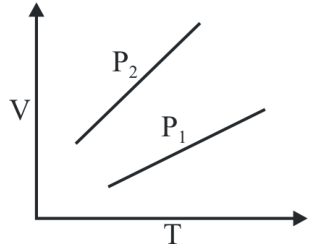
The volume versus temperature T graph for a certain amount of a perfect gas at two pressure $P_{1}$ and $P_{2}$ are as shown in the figure. It can be concluded that-
- A. The pressure $P_{1}$ is greater than the pressure $P_{2}$
- B. The adiabatic index for $P_{1}$ is higher than that for $P_{2}$
- C. $P_{1}$ represents monoatomic gas and $P_{2}$ represents diatomic gas
- D. None of the above
Answer: A. The pressure $P_{1}$ is greater than the pressure $P_{2}$
Explanation: From the Ideal gas equation, $PV=mRT \Rightarrow V = (\frac{mR}{P})T$. Thus, the slope of the V-T graph is $\frac{V}{T}=\frac{mR}{P}$. From the graph, $(Slope)_{2} > (Slope)_{1}$, which implies $\frac{R}{P_{2}} > \frac{R}{P_{1}}$. Therefore, $P_{1} > P_{2}$.
Question 49
Topic: Thermodynamics
In the polytropic process $PV^{n}=$ Constant, if $n=1$ the process will be at-
- A. Constant volume
- B. Constant pressure
- C. Constant temperature
- D. Adiabatic
Answer: C. Constant temperature
Explanation: Polytropic process $PV^{n}=$ Constant. If $n=1$, $PV^{1}=$ Constant. According to ideal gas law, $PV = mRT$, which means temperature is constant (Isothermal process).
Question 50
Topic: Thermodynamics
In case of ideal triatomic gas, the ratio of specific heat $C_{P}/C_{V}$ would be-
- A. 1
- B. 1.33
- C. 1.40
- D. 1.41
Answer: B. 1.33
Explanation: Specific heat ratio $\gamma=\frac{C_{P}}{C_{V}} = 1+\frac{2}{f}$, where f is degree of freedom. For a triatomic gas (non-linear), $f=6$. So $\gamma=1+\frac{2}{6}=1.33$.
Question 51
Topic: Refrigeration and Air Conditioning
The formation of frost on cooling coils in a refrigerator-
- A. Increases power consumption
- B. Improves C.O.P. of the system
- C. Increases heat transfer
- D. Reduces power consumption
Answer: A. Increases power consumption
Explanation: The addition of frost reduces the amount of cooling available over time because frost acts as an insulator (decreasing heat transfer), so that the machinery runs longer with the frost on it than without frost. This additional run time increases the overall power consumption.
Question 52
Topic: Heat Transfer
An air-conditioned room has one of the walls, which is $5m\times3m$ of 3.75 cm thick brick. The conditioned space is maintained at $27^{0}C$ when the outside temperature is $47^{0}C.$ Variation of thermal conductivity with temperature of the wall is given by $k=1+2\times10^{-4}T$ where T is in degree Kelvin, and k is in $W/m^{0}K.$ The heat gained by the conditioned space through this wall is
- A. 849.6W
- B. 84.96W
- C. 800W
- D. 0
Explanation: Given $T_{1}=27^{\circ}C=300~K$, $T_{2}=47^{\circ}C=320~K$. According to Fourier's law, heat transfer $Q=-kA\frac{dT}{dx}$. Area $A = 15~m^{2}$, thickness $dx = 0.0375~m$. Integrating $Q \int dx = -\int A k dT \Rightarrow Q \times 0.0375 = 15 \int_{300}^{320} (1+2\times10^{-4}T) dT$. Evaluating the integral gives $Q = 8496~W$. (Note: Not any suitable answer in given option).
Question 53
Topic: Heat Transfer
A mild steel tank of wall thickness 12 mm contains water at $100^{0}C.$ The atmospheric temperature is $20^{0}C$. The thermal conductivity of mild steel is $50~W/mK,$ and the heat transfer co-efficients for inside and outside the tank are 2850 and $10~W/m^{2}K,$ respectively. Calculate the rate of heat loss per $m^{2}$ of tank surface and the temperature of the outside surface of the tank.
- A. $300.5~W/m^{2}$ $45.5^{0}C$
- B. $495.2~W/m^{2}$ $67.6^{0}C$
- C. $602.6~W/m^{2},$ $80.6^{0}C$
- D. $795.2~W/m^{2}$ $99.52^{0}C$
Answer: D. $795.2~W/m^{2}$ $99.52^{0}C$
Explanation: Thermal Resistance $R_{th}=\frac{1}{h_{i}}+\frac{t}{k}+\frac{1}{h_{o}} = \frac{1}{2850} + \frac{0.012}{50} + \frac{1}{10} = 0.10059~K m^{2}/W$. Heat loss per unit area $q = \frac{\Delta T}{R_{th}} = \frac{100-20}{0.10059} = 795.2~W/m^{2}$. To find outside surface temperature T, $\frac{T-20}{1/10} = 795.2 \Rightarrow 10(T-20) = 795.2 \Rightarrow T-20 = 79.52 \Rightarrow T = 99.52^{\circ}C$.
Question 54
Topic: Thermodynamics
In order to burn 1 Kg of $CH_{4}$ completely the minimum under of kilograms of Oxygen needed is (take atomic weight of H,C,O as 1,12,16 respectively)
Answer: D. 4
Explanation: Chemical reaction: $CH_{4} + 2O_{2} \rightarrow CO_{2} + 2H_{2}O$. Molecular weight of $CH_{4} = 12 + 4(1) = 16$. Molecular weight of $2O_{2} = 2 \times (16 \times 2) = 64$. 16 kg of $CH_{4}$ needs 64 kg of oxygen. So, 1 kg of $CH_{4}$ requires $64/16 = 4$ kg of $O_{2}$.
Question 55
Topic: Engineering Mathematics
The vector field $\vec{F}=x\hat{i}-y\hat{j}$ (where i and $\hat{j}$ unit vectors) is-
- A. Divergence free, but not irrotational
- B. irrotational, but not divergence free
- C. Divergence free and irrotational
- D. Neither divergence free nor irrotational
Answer: C. Divergence free and irrotational
Explanation: Divergence of $\vec{F} = \nabla \cdot \vec{F} = \frac{\partial x}{\partial x} + \frac{\partial (-y)}{\partial y} = 1 - 1 = 0$ (so it is divergence free). Curl of $\vec{F} = \nabla \times \vec{F} = \hat{k}(\frac{\partial (-y)}{\partial x} - \frac{\partial x}{\partial y}) = \hat{k}(0 - 0) = 0$ (so it is irrotational).
Question 56
Topic: Fluid Mechanics
For flow through a horizontal pipe, the pressure gradient $\frac{dp}{dx}$ in the flow direction is-
Answer: D. -ve
Explanation: According to Bernoulli's equation with head loss, $\frac{p_{1}}{\rho g} + \frac{v_{1}^{2}}{2g} + z_{1} = \frac{p_{2}}{\rho g} + \frac{v_{2}^{2}}{2g} + z_{2} + h_{f}$. For horizontal uniform pipe, $v_{1}=v_{2}$ and $z_{1}=z_{2}$, so $\frac{p_{1}-p_{2}}{\rho g} = h_{f}$, meaning $p_{1} > p_{2}$. Pressure decreases in the direction of flow, hence the pressure gradient $\frac{dp}{dx}$ is negative.
Question 57
Topic: Fluid Mechanics
The transition Reynolds number for flow over a flat plate is $5\times10^{5}$. What is the distance from the leading edge at which transition will occur for flow of water with a uniform velocity for $1~m/s?$ (For water, the kinematic viscosity, $v=0.858\times10^{-6}m^{2}/s)$
- A. 1 m
- B. 0.43 m
- C. 43 m
- D. 103 m
Answer: B. 0.43 m
Explanation: Reynolds number $R_{e} = \frac{Vx}{v}$. Given $R_{e} = 5 \times 10^{5}$, $V = 1~m/s$, $v = 0.858 \times 10^{-6}~m^{2}/s$. $5 \times 10^{5} = \frac{1 \times x}{0.858 \times 10^{-6}} \Rightarrow x = 5 \times 10^{5} \times 0.858 \times 10^{-6} = 0.429~m \approx 0.43~m$.
Question 58
Topic: Fluid Mechanics
Between section 1 and 2 of a pipe a pump, a heater, a very rough pipe and an orifice plate are placed. The Bernoulli equation can be applied between 1 and 2 if-
- A. Orifice plate and heater are removed
- B. Heater pump and heater are removed
- C. Heater and pump are removed
- D. Heater, rough pipe and orifice plates are removed
Answer: A. Orifice plate and heater are removed
Explanation: Bernoulli's equation is strictly applicable for incompressible, frictionless, steady flow along a streamline without heat or work transfer. In the presence of a pump (work added), heater (heat added), very rough pipe (friction), and orifice plate (sudden energy loss), it cannot be applied. (Note: standard ISRO official key generally targets components causing discontinuous energy transfer; the provided solution text matches option (a), although technically all non-ideal elements violate simple Bernoulli).
Question 59
Topic: Fluid Mechanics
A one dimensional flow is one which-
- A. Is uniform flow
- B. is steady uniform flow
- C. Takes place in straight lines
- D. Involves zero transverse component of flow
Answer: D. Involves zero transverse component of flow
Explanation: One Dimensional Flow - It is that type of flow in which the flow parameter such as velocity is a function of time and one space coordinate only. Mathematically, $u=f(x)$, $v=0$ and $w=0$. Hence, one dimensional flow is one which involves zero transverse component of flow.
Question 60
Topic: Fluid Mechanics
A piece weighing 3 kg in air was found to weigh 2.5 kg when submerged in water. Its specific gravity is-
Answer: C. 6
Explanation: Weight of piece in air = 3 kg. Loss in weight of piece in water = $3 - 2.5 = 0.5~kg$. This loss equals the weight of water displaced. Specific gravity = (Weight in air) / (Loss of weight in water) = $3 / 0.5 = 6$.
Question 61
Topic: Fluid Mechanics
The actual velocity at vena contracta for flow through an orifice from a reservoir of height H=
- A. $\sqrt{2gH}$
- B. $C_{V}\sqrt{2gH}$
- C. $\sqrt{2gH/C_{v}}$
- D. $C_{d}\sqrt{2gH}$
Answer: B. $C_{V}\sqrt{2gH}$
Explanation: Actual velocity at vena contracta for flow through an orifice from a reservoir of height H is given by $V_{actual}=C_{v}\sqrt{2gH}$, where $C_{v}$ is the coefficient of velocity.
Question 62
Topic: Fluid Mechanics
The horizontal component of force on a curved surface is equal to the-
- A. Product of pressure at its centroid and area
- B. Weight of liquid retained by the curved area
- C. Force on a vertical projection of the curved surface
- D. Weight of liquid vertically above the curved surface
Answer: C. Force on a vertical projection of the curved surface
Explanation: The horizontal component of force on a curved surface is equal to the force on a vertical projection of the curved surface. Horizontal component $P_{H}$ = Total pressure force on the projected area of the curved surface on vertical plane. Vertical component $P_{V}$ = Weight of the liquid supported by the curved surface up to the free surface of the liquid.
Question 63
Topic: Fluid Mechanics and Machinery
The maximum depth from which a centrifugal pump can draw water is-
- A. Dependent on the speed N of the pump
- B. Dependent on the power of the pump
- C. Around 10 m
- D. Dependent on $N^{2}$
Answer: C. Around 10 m
Explanation: The maximum depth from which a centrifugal pump can draw water is theoretically equivalent to the atmospheric pressure head, which is around 10 m of water column. We know that $P_{atm} = \rho \times g \times h \Rightarrow 101.3 \times 10^{3} = 1000 \times 9.81 \times h \Rightarrow h \approx 10.33 m$. Practically, due to losses, it is around 10 m. This is the maximum height to which water can be raised by a suction pump.
Question 64
Topic: Fluid Mechanics
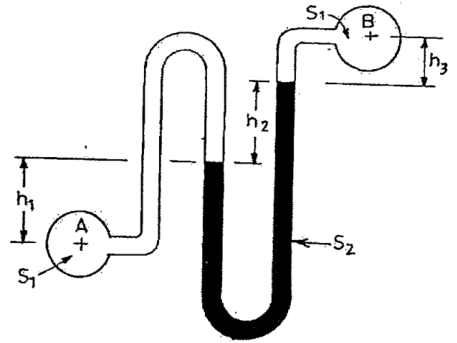
Two pipe lines at a different pressures, $p_{A}$ and $p_{B}$, each carrying the same liquid of specific gravity of $S_{1}$ are connected to a U tube with a liquid of specific gravity of $S_{2}$ resulting in the level differences $h_{1}$, $h_{2}$ and $h_{3}$ as shown in the figure. The difference is pressure head between points A and B in terms of head of water is.
- A. $h_{1}S_{2}+h_{2}S_{1}+h_{3}S_{1}$
- B. $h_{1}S_{1}+h_{2}S_{2}-h_{3}S_{1}$
- C. $h_{1}S_{1}-h_{2}S_{2}-h_{3}S_{1}$
- D. $h_{1}S_{1}+h_{2}S_{2}+h_{3}S_{1}$
Answer: D. $h_{1}S_{1}+h_{2}S_{2}+h_{3}S_{1}$
Explanation: Starting from point A and writing the manometric equation towards B: $P_{A} - h_{1}S_{1} - h_{2}S_{2} - h_{3}S_{1} = P_{B}$. Rearranging to find the pressure difference: $P_{A} - P_{B} = h_{1}S_{1} + h_{2}S_{2} + h_{3}S_{1}$.
Question 65
Topic: Fluid Mechanics
List-I gives 4 dimensionless numbers and List-II gives the types of forces, which are one of the constituents describing the numbers. Match List I with List II and select the correct answer using the codes given below the lists:
List I
A. Euler number
B. Froude number
C. Reynolds number
D. Weber number
List II
1. Pressure force
2. Gravity force
3. Elastic tension
4. Surface tension
5. Viscous force
- A. A-2, B-3, C-4, D-5
- B. A-3, B-2, C-4, D-5
- C. A-1, B-2, C-5, D-4
- D. A-2, B-1, C-5, D-4
Answer: C. A-1, B-2, C-5, D-4
Explanation: Reynolds number = Inertia Force / Viscous Force. Froude number = Inertia Force / Gravity Force. Euler number = Inertia Force / Pressure Force. Weber number = Inertia Force / Surface Tension. Mach number = Inertia Force / Elastic Tension.
Question 66
Topic: Power Plant Engineering
A single-stage impulse turbine with a diameter of 120 cm runs at 3000 rpm. If the blade speed ratio is 0.42, then, the inlet velocity of steam will be-
- A. $79~m/s$
- B. $188~m/s$
- C. $450~m/s$
- D. $900~m/s$
Answer: C. $450~m/s$
Explanation: In single stage impulse turbine, diameter $D=120~cm=1.2~m$, $N=3000~rpm$. Blade speed $U = \frac{\pi DN}{60} = \frac{\pi \times 1.2 \times 3000}{60} = 188.49~m/s$. Blade speed ratio = $\frac{U}{V} = 0.42$. Thus, Inlet velocity $V = \frac{188.49}{0.42} = 448.798 \approx 450~m/s$.
Question 67
Topic: Fluid Mechanics
For laminar flow over a flat plate, the thickness of the boundary layer at a distance from the leading edge is found to be 5 mm. The thickness of the boundary layer at a downstream section, which is at twice the distance of the previous section from the leading edge, will be-
- A. 10 mm
- B. $5\sqrt{2}mm$
- C. $5/\sqrt{2}mm$
- D. 2.5 mm
Answer: B. $5\sqrt{2}mm$
Explanation: For laminar flow over a flat plate, boundary layer thickness $\delta \propto \sqrt{x}$. Given $\delta_{1} = 5~mm$ at distance $x_{1}$. At $x_{2} = 2x_{1}$, $\frac{\delta_{1}}{\delta_{2}} = \sqrt{\frac{x_{1}}{x_{2}}} = \sqrt{\frac{x_{1}}{2x_{1}}} = \frac{1}{\sqrt{2}}$. Thus, $\delta_{2} = \delta_{1}\sqrt{2} = 5\sqrt{2}mm$.
Question 68
Topic: Fluid Mechanics
If $U_{\infty}=$ free stream velocity, $u=$ velocity at y, and $\delta=$ boundary layer thickness, then in a boundary layer flow, the momentum thickness $\theta$ is given by-
- A. $\theta=\int_{0}^{\delta}\frac{u}{U_{\infty}}(1-\frac{u}{U_{\infty}})dy$
- B. $\theta=\int_{0}^{\delta}\frac{u}{U_{\infty}}(1-\frac{u^{2}}{U_{\infty}^{2}})dy$
- C. $\theta=\int_{0}^{\delta}\frac{u^{2}}{U_{\infty}^{2}}(1-\frac{u}{U_{\infty}})dy$
- D. $\theta=\int_{0}^{\delta}(1-\frac{u}{U_{\infty}})dy$
Answer: A. $\theta=\int_{0}^{\delta}\frac{u}{U_{\infty}}(1-\frac{u}{U_{\infty}})dy$
Explanation: Momentum thickness ($\theta$) is defined as the distance by which the solid boundary should be displaced to compensate for the reduction in momentum of the flowing fluid due to boundary layer formation. It is mathematically given by $\theta=\int_{0}^{\delta}\frac{u}{U_{\infty}}(1-\frac{u}{U_{\infty}})dy$. Displacement Thickness $\delta^{*}=\int_{0}^{\delta}(1-\frac{u}{U_{\infty}})dy$. Energy Thickness $\delta^{**}=\int_{0}^{\delta}\frac{u}{U_{\infty}}(1-\frac{u^{2}}{U_{\infty}^{2}})dy$.
Question 69
Topic: Automobile Engineering
An automobile moving at a velocity of 40 $km/hr$ is experiencing a wind resistance of 2kN. If the automobile is moving at a velocity of 50 $km/hr$, the power required to overcome the wind resistance is-
- A. 43.4kW
- B. 3.125kW
- C. 2.5kW
- D. 27.776kW
Answer: A. 43.4kW
Explanation: Given $F_{1} = 2~kN$, $V_{1} = 40~km/hr$, $V_{2} = 50~km/hr$. Wind resistance force $F = \rho A V^{2}$ (thus $F \propto V^{2}$). $\frac{F_{1}}{V_{1}^{2}} = \frac{F_{2}}{V_{2}^{2}} \Rightarrow F_{2} = F_{1} \times (\frac{V_{2}}{V_{1}})^{2} = 2 \times (\frac{50}{40})^{2} = 2 \times \frac{25}{16} = 3.125~kN$. Power required to overcome is $P = F_{2} \times V_{2} = \frac{3.125 \times 1000 \times 50 \times (5/18)}{1000} kW \approx 43.4~kW$.
Question 70
Topic: Fluid Mechanics
A constant-heat water tank has, on one of its vertical sides two identical small orifices issuing two horizontal jets in the same vertical plane. The vertical distance between the centers of orifices is 1.5 m and the jet trajectories intersect at a point 0.5 m below the lower orifice. What is the approximate height of water level in the tank above the point of intersection trajectories?
- A. 1.0 m
- B. 2.5 m
- C. 0.5 m
- D. 2.0 m
Answer: B. 2.5 m
Explanation: Let the lower orifice be 2 and the upper orifice be 1. Vertical coordinates: $y_{2}=0.5m$, $y_{1}=1.5+0.5=2m$. Orifice 1 and 2 are identical, so their coefficient of velocity $C_{v}$ is the same. $C_{v} = \frac{x}{\sqrt{4yH}} \Rightarrow x^{2} = 4yH \cdot C_{v}^{2}$. At the intersection, x is same. So $y_{1}H_{1} = y_{2}H_{2}$. If H is head for orifice 2, $H_{2}=H$, and $H_{1}=H-1.5$. Thus, $2 \times (H-1.5) = 0.5 \times H \Rightarrow 1.5H = 3 \Rightarrow H = 2m$. The height of the water level above the intersection point is $H + y_{2} = 2 + 0.5 = 2.5~m$.
Question 71
Topic: Engineering Mathematics
A unit vector perpendicular to the vectors $\vec{a}=2i-3j+k$ and $\vec{b}=i+j-2k$, is
- A. $\frac{1}{\sqrt{3}}(-i+j+k)$
- B. $\frac{1}{\sqrt{3}}(i+j+k)$
- C. $\frac{1}{\sqrt{3}}(-i+j+k)$
- D. $(i+j+k)$
Answer: B. $\frac{1}{\sqrt{3}}(i+j+k)$
Explanation: A vector perpendicular to both $\vec{a}$ and $\vec{b}$ is their cross product $\vec{c} = \vec{a} \times \vec{b}$. $\vec{c} = \begin{vmatrix} \hat{i} & \hat{j} & \hat{k} \\ 2 & -3 & 1 \\ 1 & 1 & -2 \end{vmatrix} = \hat{i}(6-1) - \hat{j}(-4-1) + \hat{k}(2-(-3)) = 5\hat{i} + 5\hat{j} + 5\hat{k}$. Its magnitude is $|\vec{c}| = \sqrt{5^{2} + 5^{2} + 5^{2}} = \sqrt{75} = 5\sqrt{3}$. The unit vector is $\frac{\vec{c}}{|\vec{c}|} = \frac{5(\hat{i} + \hat{j} + \hat{k})}{5\sqrt{3}} = \frac{1}{\sqrt{3}}(\hat{i} + \hat{j} + \hat{k})$.
Question 72
Topic: Engineering Mathematics
The region of the z plane for which $|\frac{z-a}{z+a}|=1(Re,a\ne0)is-$
- A. x-axis
- B. y-axis
- C. The straight line $z=|a|$
- D. None of the above
Answer: B. y-axis
Explanation: Given $|\frac{z-a}{z+a}|=1 \Rightarrow |z-a| = |z+a| \Rightarrow |z-a|^{2} = |z+a|^{2}$. Let $z = x+iy$. Then $|x+iy-a|^{2} = |x+iy+a|^{2} \Rightarrow (x-a)^{2}+y^{2} = (x+a)^{2}+y^{2} \Rightarrow x^{2}+a^{2}-2ax = x^{2}+a^{2}+2ax \Rightarrow 4ax=0$. Since $a \neq 0$, it must be that $x=0$, which represents the y-axis.
Question 73
Topic: Engineering Mathematics
If $\alpha$, $\beta$, $\gamma$ are the roots of equations $x^{3}+px^{2}+qx+p=0$ Then the value of $tan^{-1}\alpha+tan^{-1}\beta+tan^{-1}\gamma~is$
- A. $n\pi/2$
- B. $n\pi$
- C. $2n\pi$
- D. $\frac{n\pi}{4}$
Answer: B. $n\pi$
Explanation: For the cubic equation $x^{3}+px^{2}+qx+p=0$, the roots $\alpha, \beta, \gamma$ satisfy: $\alpha+\beta+\gamma=-p$, $\alpha\beta+\beta\gamma+\gamma\alpha=q$, and $\alpha\beta\gamma=-p$. Using the tangent addition formula, $\tan^{-1}\alpha+\tan^{-1}\beta+\tan^{-1}\gamma = \tan^{-1}\left(\frac{\alpha+\beta+\gamma-\alpha\beta\gamma}{1-(\alpha\beta+\beta\gamma+\gamma\alpha)}\right)$. Substituting the values: $\tan^{-1}\left(\frac{-p - (-p)}{1-q}\right) = \tan^{-1}(0)$. The general value for $\tan^{-1}(0)$ is $n\pi$.
Question 74
Topic: Engineering Mathematics
The value of the determinant $|\begin{matrix}1&a&b+c\\ 1&b&c+a\\ 1&c&a+b\end{matrix}|$ is
Answer: A. 0
Explanation: Applying column operation $C_{3} \rightarrow C_{3} + C_{2}$, the third column becomes $(a+b+c)$ for all its elements. We can take out the common factor $(a+b+c)$ from the third column, making the third column identically $(1, 1, 1)^{T}$, which makes it identical to the first column. Since two columns are identical, the determinant's value is 0.
Question 75
Topic: Engineering Mathematics
The value of $\iint_{0}^{1}\frac{dxdy}{\sqrt{(1-x^{2})(1-y^{2})}}is=$
- A. $\frac{\pi^{2}}{2}$
- B. $\frac{\pi}{4}$
- C. $\frac{\pi^{2}}{4}$
- D. $\frac{\pi}{2}$
Answer: C. $\frac{\pi^{2}}{4}$
Explanation: $I=\int_{0}^{1}\int_{0}^{1}\frac{dxdy}{\sqrt{1-x^{2}}\sqrt{1-y^{2}}}$. Since the limits are independent, we can separate the integrals: $I = (\int_{0}^{1}\frac{dx}{\sqrt{1-x^{2}}}) \times (\int_{0}^{1}\frac{dy}{\sqrt{1-y^{2}}})$. The integral of $\frac{1}{\sqrt{1-x^{2}}}$ is $\sin^{-1}x$. Evaluating from 0 to 1, we get $\sin^{-1}(1) - \sin^{-1}(0) = \frac{\pi}{2} - 0 = \frac{\pi}{2}$. Thus, $I = \frac{\pi}{2} \times \frac{\pi}{2} = \frac{\pi^{2}}{4}$.
Question 76
Topic: Engineering Mathematics
Solution of $(D^{2}+16)y=cos~4x$ is-
- A. $y=Acos~4x+Bsin~4x+\frac{1}{8}cos~4x$
- B. $y=Acos~4x+B~sin~4x+\frac{1}{8}sin~4x$
- C. $y=Acos~4x+Bsin~4x+\frac{x}{8}cos~4x$
- D. $y=Acos~4x+B~sin~4x+\frac{x}{8}sin~4x$
Answer: D. $y=Acos~4x+B~sin~4x+\frac{x}{8}sin~4x$
Explanation: The Complementary Function (C.F.) is found by $(D^{2}+16) = 0 \Rightarrow D = \pm 4i$. So, $C.F. = A \cos 4x + B \sin 4x$. The Particular Integral (P.I.) is $\frac{1}{D^{2}+16}\cos 4x$. Since $-a^{2} = -4^{2} = -16$, substituting directly gives zero in the denominator. Using the rule $\frac{1}{D^{2}+a^{2}}\cos ax = \frac{x}{2a}\sin ax$, here $a=4$, so $P.I. = \frac{x}{8}\sin 4x$. Total solution $y = C.F. + P.I. = A \cos 4x + B \sin 4x + \frac{x}{8}\sin 4x$.
Question 77
Topic: Engineering Mathematics
Laplace transform of $t^{2}+2t+3$ is
- A. $\frac{-2}{s^{3}}-\frac{2}{s^{2}}-\frac{3}{s}$
- B. $\frac{2}{s^{3}}+\frac{2}{s^{2}}-\frac{3}{s}$
- C. $\frac{2}{s^{3}}+\frac{2}{s^{2}}+\frac{3}{s}$
- D. $\frac{-2}{s^{3}}+\frac{2}{s^{2}}-\frac{3}{s}$
Answer: C. $\frac{2}{s^{3}}+\frac{2}{s^{2}}+\frac{3}{s}$
Explanation: Using the formula $L(t^{n}) = \frac{n!}{s^{n+1}}$, Laplace transform $L(t^{2}) = \frac{2!}{s^{3}} = \frac{2}{s^{3}}$, $L(2t) = 2 \times \frac{1!}{s^{2}} = \frac{2}{s^{2}}$, and $L(3) = \frac{3}{s}$. Thus, $L(t^{2}+2t+3) = \frac{2}{s^{3}}+\frac{2}{s^{2}}+\frac{3}{s}$.
Question 78
Topic: Engineering Mathematics
Equation of a straight line passing through the point (-1, 2) and making equal intercepts on the axes is
- A. $x-y=1$
- B. $x-2y=1$
- C. $x+y=1$
- D. $x-y=2$
Answer: C. $x+y=1$
Explanation: Equation of a straight line in intercept form is $\frac{x}{a} + \frac{y}{b} = 1$. Since intercepts are equal, $a=b$, making the equation $x+y=a$. It passes through $(-1, 2)$, so substituting $x = -1$ and $y = 2$, we get $-1+2=a \Rightarrow a=1$. The equation is $x+y=1$.
Question 79
Topic: Engineering Mathematics
A bag contains eight white and six red marbles. The probability of drawing two marbles of same colour is-
- A. $\frac{^{8}C_{2}\cdot^{6}C_{2}}{^{14}C_{2}}$
- B. $\frac{^{8}C_{2}}{^{14}C_{2}}+\frac{^{6}C_{2}}{^{14}C_{2}}$
- C. $\frac{^{8}C_{2}\cdot^{6}C_{2}}{^{14}C_{2}\cdot^{14}C_{2}}$
- D. $\frac{^{8}C_{2}}{^{44}C_{2}}+\frac{^{6}C_{2}}{^{12}C_{2}}$
Answer: B. $\frac{^{8}C_{2}}{^{14}C_{2}}+\frac{^{6}C_{2}}{^{14}C_{2}}$
Explanation: Total marbles = 8W + 6R = 14. Probability of drawing two marbles of same colour = P(Both White) + P(Both Red) = $\frac{^{8}C_{2}}{^{14}C_{2}}+\frac{^{6}C_{2}}{^{14}C_{2}}$.
Question 80
Topic: Engineering Mathematics
The Algebraic multiplicity of the matrix $A=\begin{bmatrix}0&1&0\\ 0&0&1\\ 1&-3&3\end{bmatrix}is-$
Answer: C. 3
Explanation: Algebraic Multiplicity (AM) is the number of times an eigenvalue is repeated as a root of the characteristic equation $|A-\lambda I|=0$. Characteristic equation: $\begin{vmatrix}-\lambda&1&0\\ 0&-\lambda&1\\ 1&-3&3-\lambda\end{vmatrix}=0 \Rightarrow -\lambda[-\lambda(3-\lambda)-(-3)(1)] - 1(0 - 1) + 0 = -\lambda(\lambda^2 - 3\lambda + 3) + 1 = -\lambda^3 + 3\lambda^2 - 3\lambda + 1 = 0 \Rightarrow (\lambda-1)^{3} = 0$. Here, $\lambda=1$ is an eigenvalue repeated 3 times, hence algebraic multiplicity is 3.