Fluid Mechanics (XE-B) - GATE XE (Engineering Sciences) Subject-Wise PYQ Practice
Practice topic-wise Fluid Mechanics (XE-B) previous year questions for GATE XE (Engineering Sciences) with the official answer key. Step-by-step explanations are coming soon.
All GATE XE (Engineering Sciences) papers
182 questions. Answers are shown only where the official answer key is available.
Question 1
Year: 2025 | Marks: 1
Fluid at a constant flow rate passes through a long, straight, cylindrical pipe that has an axisymmetric convergent section at the end. Which one of the following options correctly represents the velocity field in the converging section in cylindrical (𝑟, 𝜃, 𝑧) coordinates?
- A. Two-dimensional function of 𝑟 and 𝑧
- B. One-dimensional function of 𝑟
- C. Two-dimensional function of 𝑟 and 𝜃
- D. One-dimensional function of 𝑧
Answer: A. Two-dimensional function of 𝑟 and 𝑧
Question 2
Year: 2025 | Marks: 1
A sharp flat plate of length L and infinite width is immersed parallel to a fluid stream having velocity 𝑢∞. At a point on the plate, far away from the leading edge and not near the trailing edge, the boundary layer thickness, the displacement thickness, and the momentum thickness are denoted as 𝛿, 𝛿∗, and 𝜃, respectively. Which one of the following options correctly represents the relation between these thicknesses?
- A. 𝛿> 𝛿∗> 𝜃
- B. 𝛿> 𝜃> 𝛿∗
- C. 𝛿∗> 𝛿> 𝜃
- D. 𝜃> 𝛿∗> 𝛿
Answer: A. 𝛿> 𝛿∗> 𝜃
Question 3
Year: 2025 | Marks: 1
Consider the following Statements [1] and [2]. Statement [1]: The Eulerian study focusses attention on individual particle and its motion is observed as a function of time. Statement [2]: The Lagrangian study focusses attention on the motion of the particles passing through an identified point. Which one of the following options identifies the correctness of the given statements?
- A. Both [1] and [2] are correct.
- B. Both [1] and [2] are NOT correct.
- C. [1] is correct, but [2] is NOT correct.
- D. [1] is NOT correct, but [2] is correct.
Answer: B. Both [1] and [2] are NOT correct.
Question 4
Year: 2025 | Marks: 1
Statement of Reynolds Transport Theorem is given below with three blanks. The rate of change of ________ extensive property can be calculated by summing the rate of change of the amount of same property in the ________ and the rate at which the property is ________ the surface of the control volume. Which one of the following options correctly fills the blanks by using its comma-separated phrases in sequence?
- A. system, control volume, exiting
- B. control volume, system, exiting
- C. system, control volume, entering
- D. control volume, control volume, entering
Answer: A. system, control volume, exiting
Question 5
Year: 2025 | Marks: 1
For a steady and incompressible flow, the velocity field (𝑉⃗ ) in Cartesian (𝑥, 𝑦, 𝑧) coordinate system is given as: 𝑉⃗ = 5𝑥𝑖−𝑃𝑦𝑗+ 3𝑘 Here, 𝑖, 𝑗, and 𝑘 are unit vectors along x, y, and z directions, respectively and 𝑃 is a constant. Which one of the following options is the correct value of 𝑃 that satisfies the conservation of mass for the given velocity field?
Answer: A. 5
Question 6
Year: 2025 | Marks: 1
Conservation of mass for a steady axisymmetric flow field in the cylindrical (r, z) coordinates is: 1 𝑟 𝜕(𝑟𝑉𝑟) 𝜕𝑟 + 𝜕𝑉𝑧 𝜕𝑧= 0 Here, 𝑉𝑟 and 𝑉𝑧 are radial and axial components of velocity, respectively. Which one of the following options is correct if 𝜓 is the stream function?
- A. 𝑉𝑟= 𝜕𝜓 𝜕𝑧 and 𝑉𝑧= − 1 𝑟 𝜕𝜓 𝜕𝑟
- B. 𝑉𝑟= 1 𝑟 𝜕𝜓 𝜕𝑧 and 𝑉𝑧= − 1 𝑟 𝜕𝜓 𝜕𝑟
- C. 𝑉𝑟= 1 𝑟 𝜕𝜓 𝜕𝑧 and 𝑉𝑧= 1 𝑟 𝜕𝜓 𝜕𝑟
- D. 𝑉𝑟= 1 𝑟 𝜕𝜓 𝜕𝑧 and 𝑉𝑧= − 𝜕𝜓 𝜕𝑟
Answer: B. 𝑉𝑟= 1 𝑟 𝜕𝜓 𝜕𝑧 and 𝑉𝑧= − 1 𝑟 𝜕𝜓 𝜕𝑟
Question 7
Year: 2025 | Marks: 1
Group-I indicates different properties of fluid and Group-II defines their basic dimensions in terms of Force (𝐹), Length (𝐿), and Time (𝑇). Group-I Group-II P Dynamic viscosity 1 𝐹𝐿−4𝑇2 Q Surface tension 2 𝐹𝐿−2𝑇 R Density 3 𝐹𝐿−1 Which one of the following options identifies the correct match between Group-I and Group-II?
- A. P−1, Q−3, R−2
- B. P−2, Q−1, R−3
- C. P−3, Q−2, R−1
- D. P−2, Q−3, R−1
Answer: D. P−2, Q−3, R−1
Question 8
Year: 2025 | Marks: 1
Consider the steady, incompressible, and fully developed laminar flow of a fluid through a circular pipe. Here, ∆𝑃 is the pressure drop in the direction of the flow and 𝑉 is the average axial velocity of the fluid at any cross-section. The relation between ∆𝑃 and 𝑉 is: ∆𝑃= 𝐾 𝑉𝑛 Here, 𝐾 and 𝑛 are constants. Which one of the following options is the correct value of 𝑛?
Answer: A. 1
Question 9
Year: 2025 | Marks: 1
A doublet is the resulting flow pattern when a sink and a source of equal strength are brought together. Which one of the following options correctly represents the nature of the product of the strength and the distance between them during approach?
- A. Remains always constant
- B. Continuously decreases
- C. Continuously increases
- D. First increases and then continuously decreases after reaching a maximum
Answer: A. Remains always constant
Question 10
Year: 2025 | Marks: 2
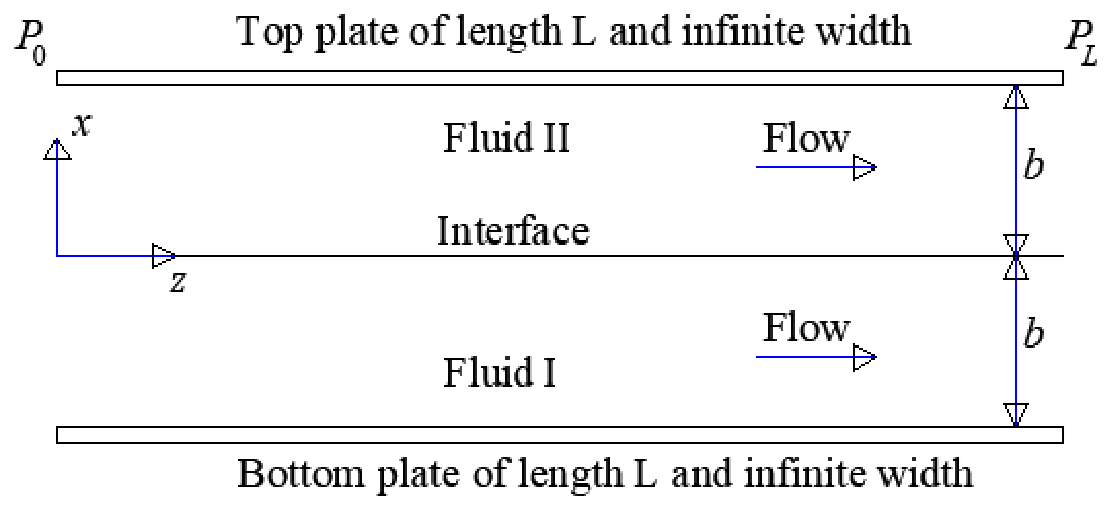
Figure shows two parallel plates (upper plate at 𝑥= 𝑏 and lower one at 𝑥= −𝑏) of length L (aligned in 𝑧 direction) and infinite width (in 𝑦 direction, normal to the plane of the figure). Two immiscible, incompressible liquids are flowing steadily in the 𝑧 direction through the thin passage between the plates under the influence of horizontal pressure gradient (𝑃0 −𝑃𝐿) L ⁄ . During the flow, the passage is always half-filled with denser fluid I (viscosity 𝜇𝐼) at the bottom and rest is occupied by lighter fluid II (viscosity 𝜇𝐼𝐼; 𝜇𝐼𝐼< 𝜇𝐼). Considering exactly planar interface between the fluids and no instabilities in the flow, the shear stress, 𝜏𝑥𝑧 is expressed as: 𝜏𝑥𝑧= (𝑃0 −𝑃𝐿)𝑏 L [(𝑥 𝑏) −1 2 (𝜇𝐼−𝜇𝐼𝐼 𝜇𝐼+ 𝜇𝐼𝐼)] Which one of the following options correctly identifies the location of the point having maximum velocity of the flow?
- A. Above the interface
- B. Below the interface
- C. At the interface
- D. At the top plate
Answer: A. Above the interface
Question 11
Year: 2025 | Marks: 2
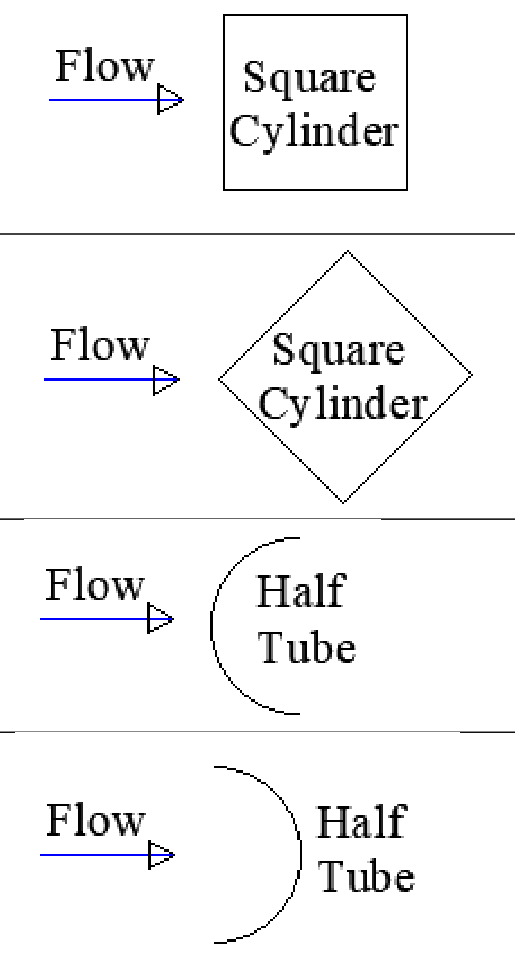
Group-I shows different two-dimensional bodies and Group-II mentions their total drag coefficient (𝐶𝐷) based on frontal area while facing parallel flow of fluid having Reynolds number 𝑅𝑒≥104 along the direction of arrow. The bodies are placed symmetrically with respect to the flow direction. Group-I Group-II P 1 1.2 Q 2 1.6 R 3 2.1 S 4 2.3 Which one of the following options identifies the correct match between Group-I and Group-II, as per the concept of degree of streamlining?
- A. P−3, Q−2, R−1, S−4
- B. P−3, Q−2, R−4, S−1
- C. P−2, Q−3, R−1, S−4
- D. P−3, Q−1, R−2, S−4
Answer: A. P−3, Q−2, R−1, S−4
Question 12
Year: 2025 | Marks: 2
A solid body of uniform specific gravity floats in a deep liquid pool. Take 𝐵, 𝐺, and 𝑀 as the centre of buoyancy, centre of gravity, and metacentre of the body, respectively. Which one of the following options is correct for the stable floatation of the body in the pool when the body is given a small tilt angle?
- A. 𝑀𝐺̅̅̅̅̅ is the metacentric height and 𝐺 should lie below 𝑀
- B. 𝑀𝐺̅̅̅̅̅ is the metacentric height and 𝐵 should lie above 𝑀
- C. 𝑀𝐵̅̅̅̅̅ is the metacentric height and 𝐵 should lie below 𝑀
- D. 𝑀𝐵̅̅̅̅̅ is the metacentric height and 𝐺 should lie above 𝑀
Answer: A. 𝑀𝐺̅̅̅̅̅ is the metacentric height and 𝐺 should lie below 𝑀
Question 13
Year: 2025 | Marks: 2
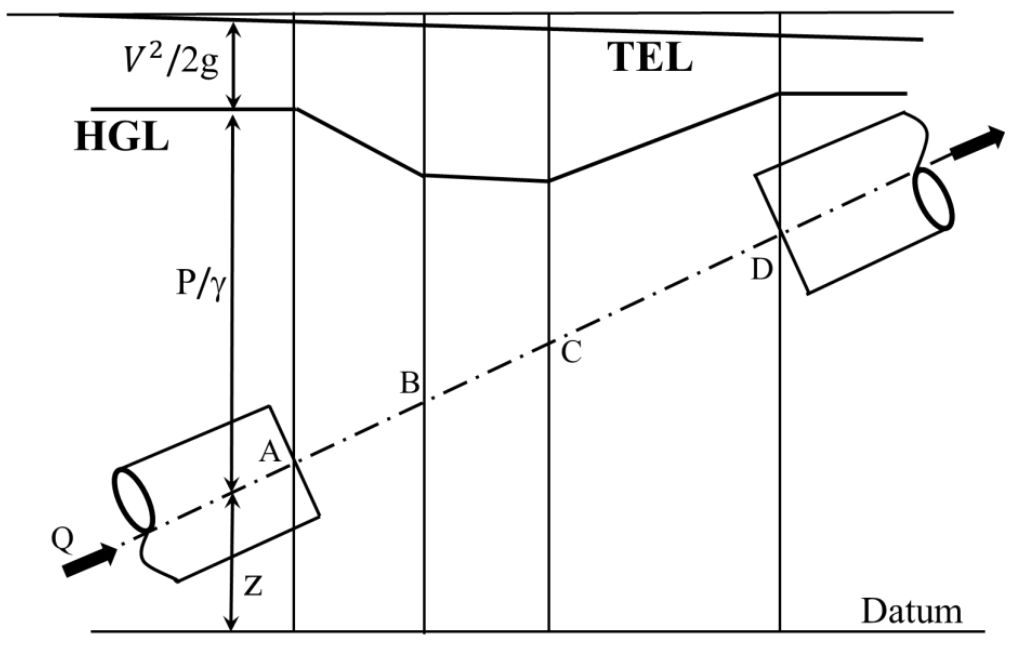
Figure shows the steady and incompressible flow of a fluid in the direction of arrow from section A to section D. Three pipe connectors are to be placed between sections at A and D having Total Energy Line (TEL) and Hydraulic Grade Line (HGL) as depicted in the figure. Consider, g, P, Q, V, γ, and Z denote gravitational acceleration, pressure, volume flow rate, velocity, specific weight, and elevation of centerline of the pipe connectors from the datum, respectively. Which one of the following options, in sequence, indicates the correct nature of connectors between sections A and B, B and C, and C and D in the direction of flow?
- A. Converging, Constant area, Diverging
- B. Diverging, Constant area, Converging
- C. Constant area, Constant area, Constant area
- D. Constant area, Converging, Diverging
Answer: A. Converging, Constant area, Diverging
Question 14
Year: 2025 | Marks: 2
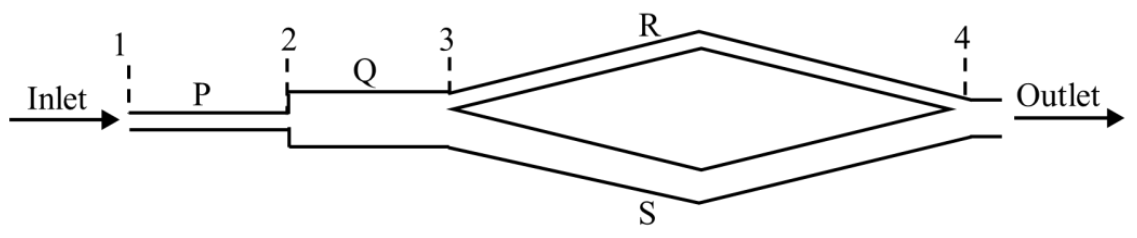
A liquid flows under steady and incompressible flow conditions from station 1 to station 4 through pipe sections P, Q, R, and S as shown in figure. Consider, 𝑑, 𝑉, and ℎ represent the diameter, velocity, and head loss, respectively, in each pipe section with subscripts ‘P’, ‘Q’, ‘R’, and ‘S’. ∆ℎ represents the head difference between the inlet (station 1) and outlet (station 4). All the pipe sections are placed on the same horizontal plane for which the figure shows the top view. Which one of the following options is correct for the given flow loop?
- A. ∆ℎ= ℎ𝑃+ ℎ𝑄+ ℎ𝑅+ ℎ𝑆 and 𝑉𝑃𝑑𝑃 2 = 𝑉𝑄𝑑𝑄 2 = 𝑉𝑅𝑑𝑅 2 = 𝑉𝑆𝑑𝑆 2
- B. ∆ℎ= ℎ𝑃+ ℎ𝑄+ ℎ𝑅 and 𝑉𝑃𝑑𝑃 2 = 𝑉𝑄𝑑𝑄 2 = 𝑉𝑅𝑑𝑅 2 = 𝑉𝑆𝑑𝑆 2
- C. ∆ℎ= ℎ𝑃+ ℎ𝑄+ ℎ𝑅 and 𝑉𝑃𝑑𝑃 2 = 𝑉𝑄𝑑𝑄 2 = 𝑉𝑅𝑑𝑅 2 + 𝑉𝑆𝑑𝑆 2
- D. ∆ℎ= ℎ𝑃+ ℎ𝑄+ ℎ𝑅+ ℎ𝑆 and 𝑉𝑃𝑑𝑃 2 = 𝑉𝑄𝑑𝑄 2 = 𝑉𝑅𝑑𝑅 2 + 𝑉𝑆𝑑𝑆 2
Answer: C. ∆ℎ= ℎ𝑃+ ℎ𝑄+ ℎ𝑅 and 𝑉𝑃𝑑𝑃 2 = 𝑉𝑄𝑑𝑄 2 = 𝑉𝑅𝑑𝑅 2 + 𝑉𝑆𝑑𝑆 2
Question 15
Year: 2025 | Type: NAT | Marks: 2
Consider, 𝑖 and 𝑗 are unit vectors along x and y directions of a Cartesian (𝑥, 𝑦) coordinate system, respectively and 𝑡 is time. Temperature (𝑇) and fluid velocity (𝑉⃗ ) are given for a flow field as: 𝑇= 𝑥2 + 𝑦𝑡+ 35 𝑉⃗ = (4𝑥𝑦)𝑖+ (𝑥𝑡−2𝑦2)𝑗 The total rate of change of temperature in the flow field (in integer) for time 𝑡= 2 at a point (2, 3) is ________
Answer: 71
Question 16
Year: 2025 | Type: NAT | Marks: 2
Driven by a pressure gradient of 100 kPa/m, a fluid of dynamic viscosity 0.1 Pa.s flows between two fixed infinitely large parallel plates under steady, incompressible, and fully developed laminar conditions. The average velocity of the flow is 2 m/s. The gap between the parallel plates in mm (rounded off to 2 decimal places) is ________
Answer: 4.80 to 5.00
Question 17
Year: 2025 | Type: NAT | Marks: 2
An incompressible fluid is flowing between two infinitely large parallel plates separated by 5 mm distance. The bottom plate is stationary and the top plate is moving at a constant velocity of 5 mm/s in the direction parallel to the bottom plate. The flow of the fluid between the plates is steady, two-dimensional, laminar, and the variation of fluid velocity is linear between the plates. A square fluid element of 1 mm side is considered at equal distance from both the plates in the flow field such that one of its sides is parallel to the plates. The magnitude of circulation in mm2/s (in integer) along the edges of the square fluid element is ________
Answer: 1
Question 18
Year: 2025 | Type: NAT | Marks: 2
Consider, a kite weighing 100 grams as essentially a rigid flat plate making an angle 8° with the horizontal and having a planform area of 0.045 m2 when exposed to horizontal parallel wind of 60 km/h. The thread string of the kite makes an angle 45° with the horizontal. A tension of 450 grams in the thread is necessary to float the kite steadily. Take air density as 1.2 kg/m3 and gravitational acceleration as 9.81 m/s2. The lift coefficient (𝐶𝐿) associated with the air flow around steadily floating kite (rounded off to 2 decimal places) is ________
Answer: 0.50 to 0.60
Question 19
Year: 2025 | Type: NAT | Marks: 2
A fixed control volume has four one-dimensional boundary sections (1, 2, 3, and 4). For a steady flow inside the control volume, the flow properties at each section are tabulated below: Boundary Section Type Density (kg/m3) Surface Normal Velocity (m/s) Cross-sectional Area (m2) Specific Energy (J/kg) 1 Inlet 1000 10 0.5 200 2 Inlet 1000 2 3.0 50 3 Outlet 1000 5 1.0 100 4 Outlet 1000 4 1.5 80 The rate of change of energy of the system which occupies the control volume at this instant is 𝐸× 106 J/s. The value of 𝐸 (rounded off to 2 decimal places) is ________
Answer: -0.32
Question 20
Year: 2025 | Type: NAT | Marks: 2
A ship is to be operated in a fluid medium with kinematic viscosity 0.032 × 10⁻³ m2/s. A one-tenth scale model of the ship is built for testing. Consider, inertia, viscous and gravity forces are dominant for the ship and its model during the operation. The required kinematic viscosity of the liquid for testing the model is 𝑃× 10−6 m2/s. The value of 𝑃 (rounded off to 2 decimal places) is ________
Answer: 0.95 to 1.05
Question 21
Year: 2025 | Type: NAT | Marks: 2
Water flows through a pipe of diameter 20 cm at a flow rate of 0.025 m3/s. A pitot- static tube is placed at the centre of the pipe and indicates the pressure difference of 5 cm of water column. Theoretical velocity measured through pitot-static tube when multiplied with velocity coefficient 𝐶𝑉 gives the actual velocity of the flow. If the mean velocity in the pipe is 90% of the actual velocity at the centre of the pipe and the gravitational acceleration is 10 m/s2, the value of 𝐶𝑉 (rounded off to 2 decimal places) is ________
Answer: 0.85 to 0.90
Question 22
Year: 2025 | Type: NAT | Marks: 2
An oil of density 870 kg/m3 and viscosity 0.036 Pa.s flows through a straight pipe of 10 cm diameter and 1.5 km length at the flow rate of 250 liters per minute under the steady and incompressible flow conditions. To control the flow rate of oil, a valve is fixed at the middle of the pipe causing no change in the total length of the pipe. The total head loss measured across the two ends of the pipe is 11.60 m. Using gravitational acceleration as 10 m/s2, the minor head loss contributed by the presence of the valve in m (rounded off to 2 decimal places) is ________
Answer: 0.85 to 1.28
Question 23
Year: 2024 | Marks: 1
Which one of the following figures shows the CORRECT dependence of apparent viscosity (η) on rate of shear strain (𝑑𝑢/𝑑𝑦) for pseudoplastic fluids?
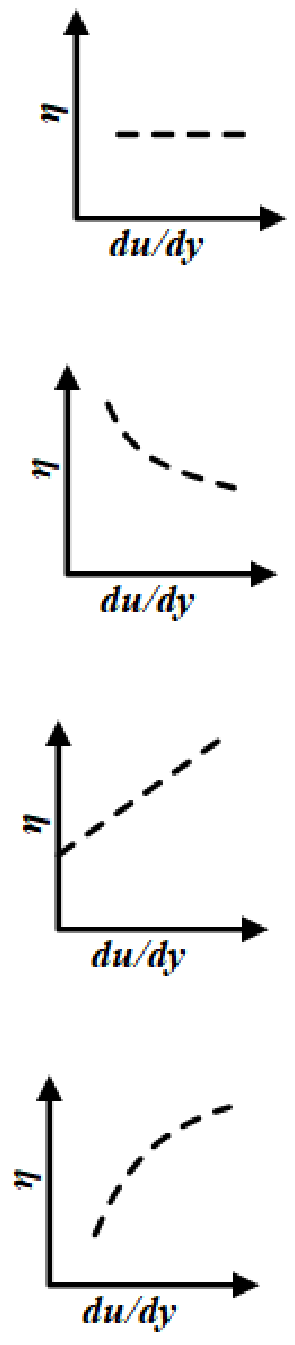
Answer: B.
Question 24
Year: 2024 | Marks: 1
The locus of temporary locations of all particles that have passed through a fixed point in the flow field at a particular instant is known as
- A. streamline.
- B. streakline.
- C. pathline.
- D. timeline.
Answer: B. streakline.
Question 25
Year: 2024 | Marks: 1
Consider the velocities 𝑢, 𝑣, and 𝑤 in x-, y-, and z-directions, respectively. The vorticity expression in the y-z plane is
- A. 𝜕𝑣 𝜕𝑥−𝜕𝑢 𝜕𝑦
- B. 𝜕𝑣 𝜕𝑦−𝜕𝑤 𝜕𝑧
- C. 𝜕𝑤 𝜕𝑦−𝜕𝑣 𝜕𝑧
- D. 𝜕𝑢 𝜕𝑧−𝜕𝑤 𝜕𝑥
Answer: C. 𝜕𝑤 𝜕𝑦−𝜕𝑣 𝜕𝑧
Question 26
Year: 2024 | Marks: 1
For the laminar, incompressible flow over a flat plate with uniform free stream velocity, the axial pressure gradient within the boundary layer is
- A. greater than zero.
- B. less than zero.
- C. equal to zero.
- D. equal to the axial velocity gradient.
Answer: C. equal to zero.
Question 27
Year: 2024 | Marks: 1
Let 𝑟 , 𝑉⃗ , and 𝑚 be position vector, velocity vector, and mass, respectively in a control mass system. Which one of the following properties is considered as conserved extensive property in Reynolds Transport Theorem to obtain the angular momentum equation?
- A. 𝑟 × 𝑚𝑉⃗
- B. 𝑟 × 𝑉⃗
- C. 𝑚𝑉⃗
- D. 𝑚
Answer: A. 𝑟 × 𝑚𝑉⃗
Question 28
Year: 2024 | Marks: 1
The hydraulic diameter for a circular pipe of radius 𝑅 is
Answer: C. 2R
Question 29
Year: 2024 | Marks: 1
For incompressible, laminar, fully-developed flow through a circular pipe, Darcy friction factor and Fanning friction factor are represented as 𝑓 and 𝐶𝑓, respectively. Which one of the following options is correct?
- A. 𝑓= 0.25𝐶𝑓
- B. 𝑓= 0.5𝐶𝑓
- C. 𝑓= 2𝐶𝑓
- D. 𝑓= 4𝐶𝑓
Answer: D. 𝑓= 4𝐶𝑓
Question 30
Year: 2024 | Marks: 1
For an immersed neutrally buoyant body to be in stable equilibrium, the center of gravity of the body is directly
- A. above the metacenter.
- B. below the metacenter.
- C. above the center of buoyancy.
- D. below the center of buoyancy.
Answer: D. below the center of buoyancy.
Question 31
Year: 2024 | Type: NAT | Marks: 1
The absolute pressure in a chamber is measured as 400 mm Hg at a location where the atmospheric pressure is 700 mm Hg. A vacuum gauge connected to the chamber reads ________ mm Hg (answer in integer).
Answer: 300
Question 32
Year: 2024 | Marks: 2
A thin film of an incompressible, Newtonian liquid (density 𝜌,viscosity 𝜇) with an uniform thickness (h) is flowing down on a vertical plate. The flow is driven by gravity (𝑔) alone. Assume zero shear stress condition at the free surface. The maximum velocity is given by
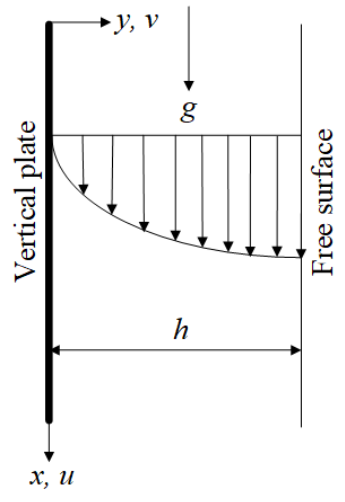
- A. 1 2𝜇𝜌𝑔ℎ2
- B. 1 4𝜇𝜌𝑔ℎ2
- C. 1 𝜇𝜌𝑔ℎ2
- D. 1 8𝜇𝜌𝑔ℎ2
Answer: A. 1 2𝜇𝜌𝑔ℎ2
Question 33
Year: 2024 | Marks: 2
A one-eighth scale model of a car is to be tested in a wind tunnel. If the air velocity over the car is 16 m/s, what should be the air velocity (in m/s) in the wind tunnel in order to achieve similarity between the model and the prototype?
Answer: D. 128
Question 34
Year: 2024 | Marks: 2
A set of basic dimensions, mass, length, and time are represented by M, L, and T, respectively. What will be the dimensions of pressure in M-L-T system?
- A. ML−1T −2
- B. MLT −2
- C. MLT −1
- D. ML−1T −1
Answer: A. ML−1T −2
Question 35
Year: 2024 | Marks: 2
Consider a fluid flow around an airfoil as shown in figure. The directions of drag force and lift force, respectively are along
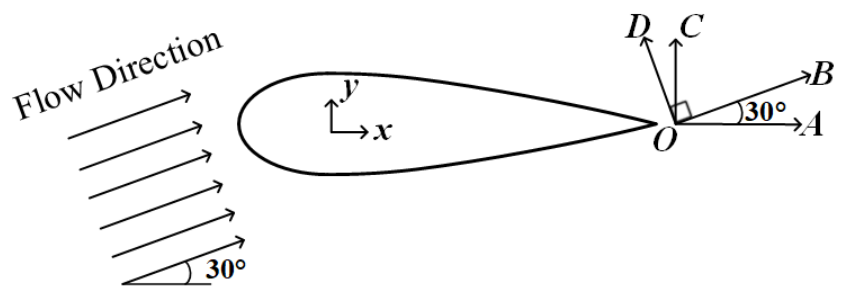
- A. OA and OC.
- B. OA and OD.
- C. OB and OC.
- D. OB and OD.
Answer: D. OB and OD.
Question 36
Year: 2024 | Type: NAT | Marks: 2
A vessel which contains a volatile liquid and its vapour is connected with a mercury manometer as shown in figure. Both the liquid and vapour phases are at equilibrium. The vapour pressure and density of the volatile liquid are 107.6 kPa and 700 kg/m3, respectively. The density of the mercury is 13600 kg/m3. Acceleration due to gravity (g) is 10 m/s2 and atmospheric pressure is 101 kPa. Hydrostatic pressure created by the weight of the vapour is neglected. The height, h (in m, rounded off to two decimal places) of the mercury column in figure is _________.
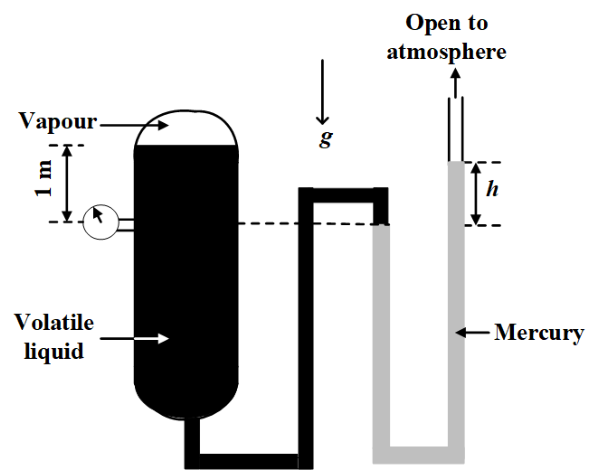
Answer: 0.09 to 0.11
Question 37
Year: 2024 | Type: NAT | Marks: 2
The velocity in a one-dimensional flow is given by 𝑢(𝑥) = 𝑎 (𝑏−𝑥)2 m/s, where 𝑎= 8 m3/s and 𝑏= 4 m. The acceleration (in m/s2, answer in integer) at 𝑥= 2 m is _____.
Answer: 4
Question 38
Year: 2024 | Type: NAT | Marks: 2
Consider two parallel plates separated by a distance of 1 cm filled with a Newtonian fluid of viscosity 10-3 Pa.s. The top plate is moving with a velocity of 1 m/s whereas the bottom plate is stationary. The shear stress (in Pa, rounded off to one decimal place) on the top plate is _____ .
Answer: 0.1
Question 39
Year: 2024 | Type: NAT | Marks: 2
A circular water jet of diameter 50 mm impinges with a velocity of 18 m/s normal to a plate. The density of water is 1000 kg/m3 and gravity force is neglected. The magnitude of net force (in N, rounded off to two decimal places) imparted by the jet on the stationary plate is _______________.
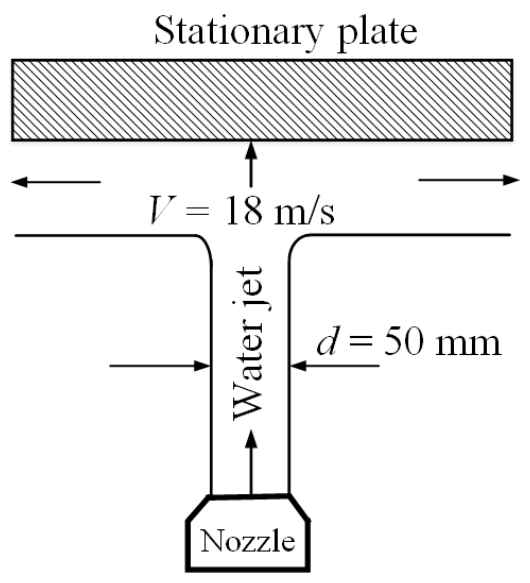
Answer: 635.00 to 637.00
Question 40
Year: 2024 | Type: NAT | Marks: 2
Consider the steady, incompressible flow of water in a horizontal pipe of constant diameter 1 m with an inlet velocity of 12 m/s. As shown in figure, water is lost through a circular hole of diameter 0.6 m at the rate of 4.53 m3/s. The outlet velocity (in m/s, rounded off to two decimal places) of water in the pipe is ______.
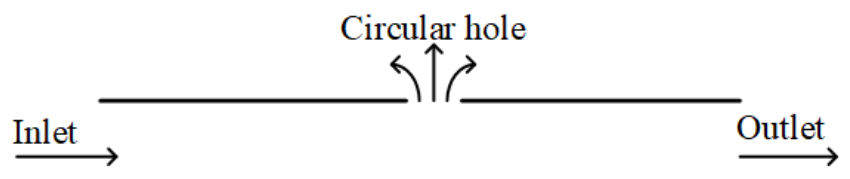
Answer: 6.00 to 6.50
Question 41
Year: 2024 | Type: NAT | Marks: 2
The axial velocity profile of a laminar, incompressible and fully-developed flow in a circular pipe of radius (R) is given as 𝑢𝑧= − 1 4𝜇 𝜕𝑝 𝜕𝑧𝑅2 (1 − 𝑟2 𝑅2), where r, 𝑧, 𝜇, and 𝑝 are radial direction, axial direction, fluid viscosity, and pressure, respectively. If the average velocity of the flow is given by 𝑢𝑧,𝑎𝑣𝑔= 1 𝐾(− 𝑅2 𝜇 𝜕𝑝 𝜕𝑧), then the value of K (answer in integer) is ______.
Answer: 8
Question 42
Year: 2024 | Type: NAT | Marks: 2
The velocity potential function in a two-dimensional flow field is given by 𝜙(𝑥, 𝑦) = −(𝑎𝑥𝑦+ 𝑏𝑥2 −𝑏𝑦2) m2/s where a = 2 per second and b = 0.5 per second. The magnitude of the velocity (in m/s, answer in integer) at 𝑥= 2 m, 𝑦= 1 m is _____.
Answer: 5
Question 43
Year: 2024 | Type: NAT | Marks: 2
Consider the incompressible, steady and irrotational flow through a concentric reducer in a horizontal pipeline. The pipe diameter reduces from d1 = 12 cm to d2 = 4 cm as shown in figure. The pressure at position 1 and position 2 of the reducer is p1 = 55 kPa and p2 = 27 kPa, respectively. The specific weight of fluid is 7 kN/m3. Acceleration due to gravity is 10 m/s2. Neglecting frictional effects, the mass flow rate (in kg/s, rounded off to two decimal places) of the fluid through the reducer is _____.
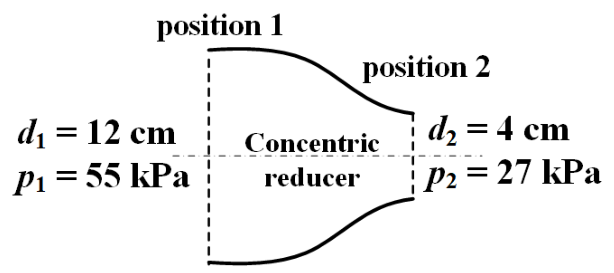
Answer: 7.85 to 8.11
Question 44
Year: 2024 | Type: NAT | Marks: 2
Consider the incompressible fluid flow over a flat plate with a free stream velocity, 𝑈∞= 1 m/s. The fluid kinematic viscosity is 10−6 m2/s and density is 1 kg/m3. The velocity profile within the boundary layer at any location 𝑥 is given by 𝑢(𝑦) = 𝑈∞( 3 2 𝑦 𝛿− 1 2 𝑦2 𝛿2), where boundary layer thickness, 𝛿= 4.64𝑥 √𝑅𝑒𝑥. The local wall shear stress at 𝑥= 1 m from the leading edge is _____ × 10 -3 N/m2 (rounded off to two decimal places).
Answer: 0.30 to 0.35
Question 45
Year: 2023 | Marks: 1
Match the following measuring instruments with the appropriate figures. I – Pitot probe II – Pitot-static probe III – Piezometer
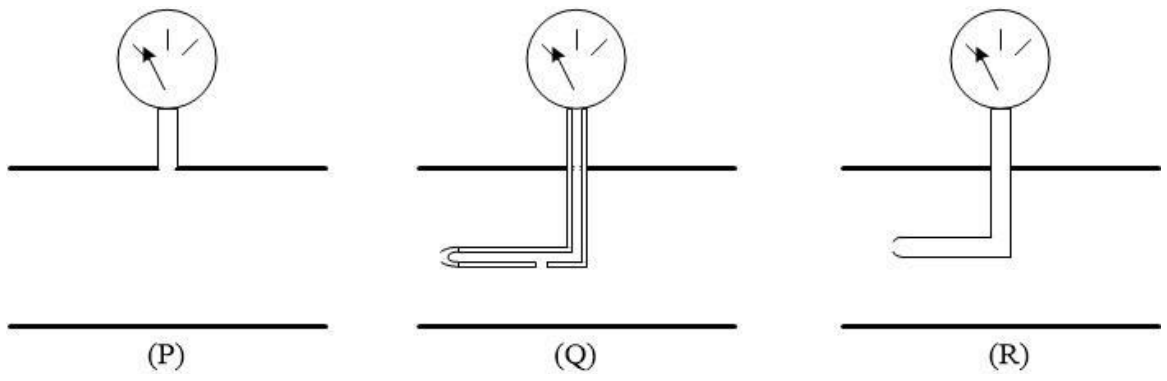
- A. I – P; II – Q; III – R
- B. I – R; II – Q; III – P
- C. I – R; II – P; III – Q
- D. I – Q; II – P; III – R
Answer: B. I – R; II – Q; III – P
Question 46
Year: 2023 | Marks: 1
Among the following non-dimensional numbers, which one characterizes periodicity present in a transient flow?
- A. Froude number
- B. Strouhal number
- C. Peclet number
- D. Lewis number
Answer: B. Strouhal number
Question 47
Year: 2023 | Marks: 1
For an incompressible boundary layer flow over a flat plate shown in the figure, the momentum thickness is expressed as
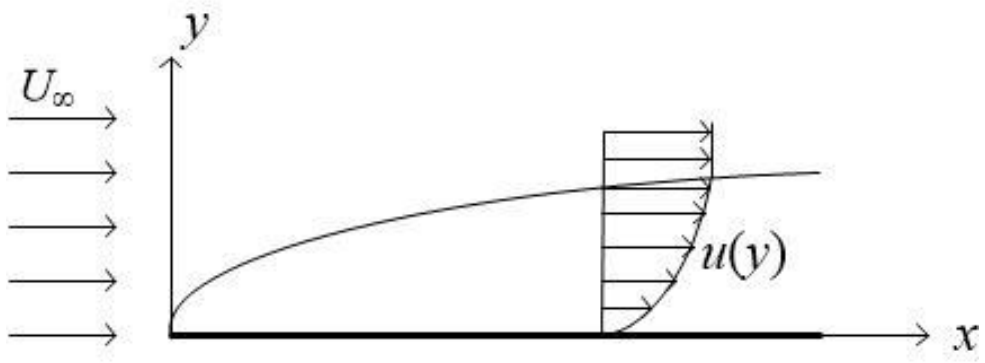
- A. ∫ 𝑢 𝑈∞ 𝑑𝑦 ∞ 0
- B. ∫ (1 −𝑢 𝑈∞ ) 𝑑𝑦 ∞ 0
- C. ∫ 𝑢 𝑈∞ (1 −𝑢 𝑈∞ ) 𝑑𝑦 ∞ 0
- D. ∫ (1 −𝑢2 𝑈∞2 ) 𝑑𝑦 ∞ 0
Answer: C. ∫ 𝑢 𝑈∞ (1 −𝑢 𝑈∞ ) 𝑑𝑦 ∞ 0
Question 48
Year: 2023 | Marks: 1
Among the shear stress versus shear strain rate curves shown in the figure, which one corresponds to a shear thinning fluid?
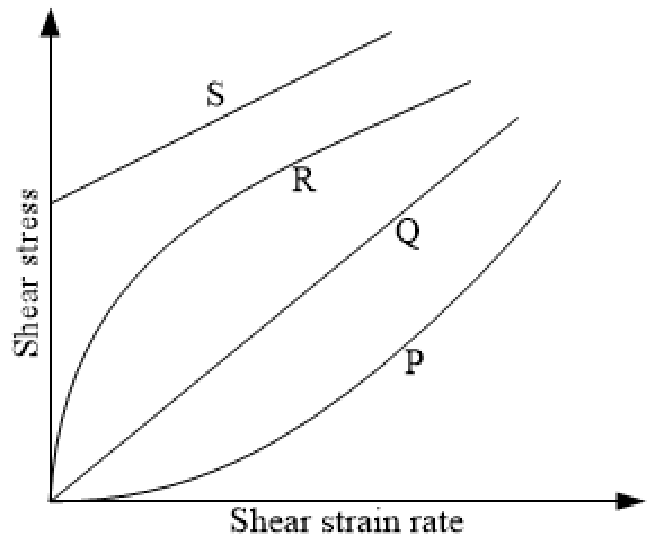
Answer: C. R
Question 49
Year: 2023 | Marks: 1
Consider steady incompressible flow over a flat plate, where the dashed line represents the edge of the boundary layer, as shown in the figure. Which one among the following statements is true?
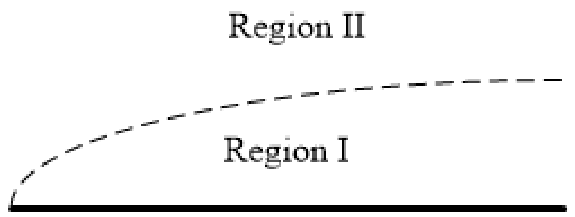
- A. Bernoulli’s equation can be applied in Region I between any two arbitrary points.
- B. Bernoulli’s equation can be applied in Region I only along a streamline.
- C. Bernoulli’s equation cannot be applied in Region II.
- D. Bernoulli’s equation cannot be applied in Region I.
Answer: D. Bernoulli’s equation cannot be applied in Region I.
Question 50
Year: 2023 | Marks: 1
An inviscid steady incompressible flow is formed by combining a uniform flow with velocity 𝑈∞ and a clockwise vortex of strength 𝐾 at the origin, as shown in the figure. Velocity potential (𝜙) for the combined flow in polar coordinate (𝑟, 𝜃) is
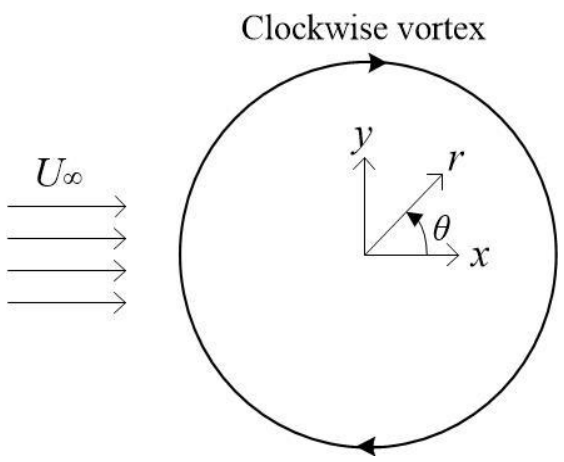
- A. 𝜙= 𝐾𝜃 2 𝜋−𝑈∞𝑟 cos 𝜃
- B. 𝜙= 𝐾𝜃 2 𝜋−𝑈∞𝑟 sin 𝜃
- C. 𝜙= 𝐾ln 𝑟+ 𝑈∞𝑟 cos 𝜃
- D. 𝜙= −𝐾ln 𝑟+ 𝑈∞𝑟 sin 𝜃
Answer: A. 𝜙= 𝐾𝜃 2 𝜋−𝑈∞𝑟 cos 𝜃
Question 51
Year: 2023 | Marks: 1
Which of the following statements are true? (i) Conservation of mass for an unsteady incompressible flow can be represented as ∇⋅𝑉⃗⃗= 0, where 𝑉⃗⃗ denotes velocity vector. (ii) Circulation is defined as the line integral of vorticity about a closed curve. (iii) For some fluids, shear stress can be a nonlinear function of the shear strain rate. (iv) Integration of the Bernoulli’s equation along a streamline under steady-state leads to the Euler’s equation.
- A. (i), (ii) and (iv) only
- B. (i), (ii) and (iii) only
- C. (i) and (iii) only
- D. (ii) and (iv) only
Answer: C. (i) and (iii) only
Question 52
Year: 2023 | Marks: 1
For a two-dimensional flow field given as 𝑉⃗⃗= −𝑥𝑖̂ + 𝑦𝑗̂, a streamline passes through points (2, 1) and (5, p). The value of p is
Answer: C. 2/5
Question 53
Year: 2023 | Type: MSQ | Marks: 1
A stationary object is fully submerged in a static fluid, as shown in the figure. Here, CG and CB stand for center of gravity and center of buoyancy, respectively. Which one(s) among the following statements is/are true?
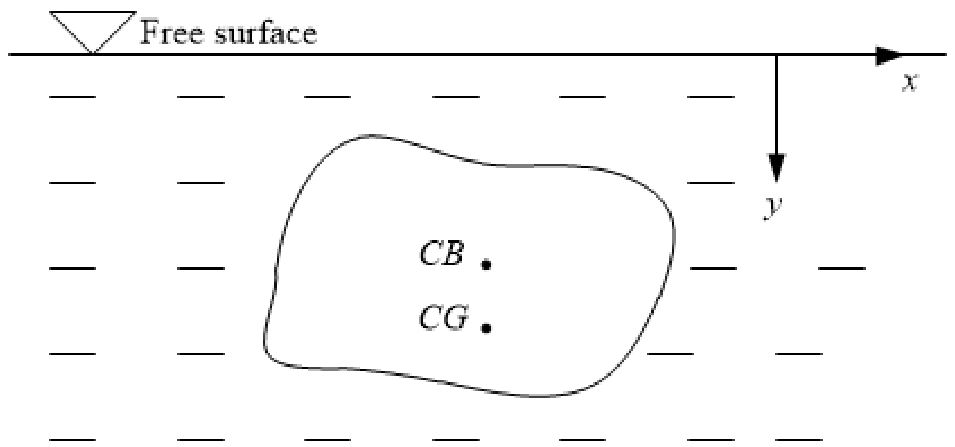
- A. The object is in stable equilibrium if 𝑦𝐶𝐺> 𝑦𝐶𝐵.
- B. The object is in stable equilibrium if 𝑦𝐶𝐺< 𝑦𝐶𝐵.
- C. The object is in neutral equilibrium if 𝑦𝐶𝐺= 𝑦𝐶𝐵.
- D. The object is in unstable equilibrium if 𝑦𝐶𝐺= 𝑦𝐶𝐵.
Answer: A. The object is in stable equilibrium if 𝑦𝐶𝐺> 𝑦𝐶𝐵.; C. The object is in neutral equilibrium if 𝑦𝐶𝐺= 𝑦𝐶𝐵.
Question 54
Year: 2023 | Marks: 2
Consider steady fully-developed incompressible flow of a Newtonian fluid between two infinite parallel flat plates. The plates move in the opposite directions, as shown in the figure. In the absence of body force and pressure gradient, the ratio of shear stress at the top surface (𝑦= 𝐻) to that at the bottom surface (𝑦= 0) is
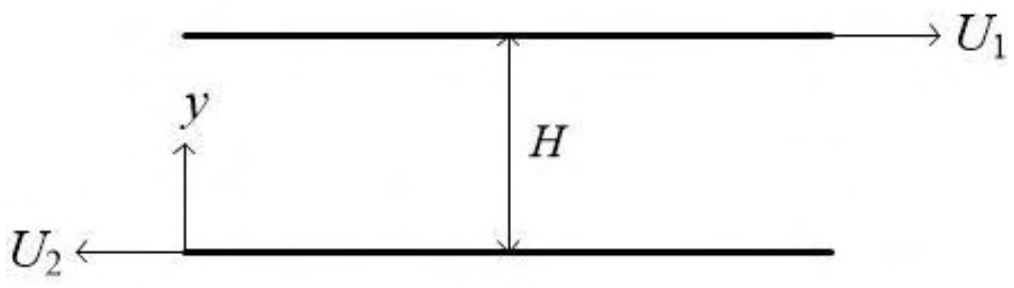
- A. 1
- B. 𝑈1 𝑈2
- C. 𝑈1 −𝑈2 𝑈2
- D. 𝑈1 + 𝑈2 𝑈2
Answer: A. 1
Question 55
Year: 2023 | Marks: 2
A two-dimensional incompressible flow field is defined as, 𝑉⃗⃗(𝑥, 𝑦) = (𝐴𝑥𝑦) 𝑖̂ + (𝐵𝑦2) 𝑗̂ where, 𝐴 and 𝐵 are constants. The dynamic viscosity of the Newtonian fluid is 𝜇. In the absence of body force, which among the following expressions represents the pressure gradient at the location (5, 0) in the concerned flow field?
- A. 𝜇𝐴(5 𝑖̂ + 𝑗̂)
- B. 𝜇(−5𝐵 𝑖̂ + 𝐴 𝑗̂)
- C. 𝜇𝐴(−𝑗̂)
- D. 𝜇𝐴(5 𝑖̂)
Answer: C. 𝜇𝐴(−𝑗̂)
Question 56
Year: 2023 | Marks: 2
For a potential flow, the fluid velocity is given by 𝑉⃗⃗(𝑥, 𝑦) = 𝑢𝑖̂ + 𝑣𝑗̂ . The slope of the potential line at (𝑥, 𝑦) is
- A. 𝑢 𝑣
- B. 𝑣 𝑢
- C. −𝑢 𝑣
- D. −𝑣 𝑢
Answer: C. −𝑢 𝑣
Question 57
Year: 2023 | Marks: 2
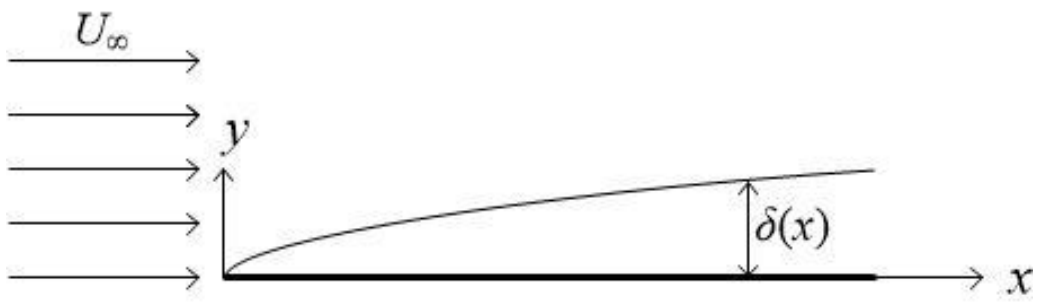
Consider steady incompressible flow of a Newtonian fluid over a horizontal flat plate, as shown in the figure. The boundary layer thickness is proportional to
- A. 𝑥1/4
- B. 𝑥1/2
- C. 𝑥−1/2
- D. 𝑥2
Answer: B. 𝑥1/2
Question 58
Year: 2023 | Type: MSQ | Marks: 2
In a steady two-dimensional compressible flow, 𝑢 and 𝑣 are the 𝑥- and 𝑦- components of flow velocity, respectively and 𝜌 is the fluid density. Among the following pairs of relations, which one(s) perfectly satisfies/satisfy the definition of stream function, 𝜓, for this flow?
- A. 𝑢= 𝜕𝜓 𝜕𝑦 and 𝑣= − 𝜕𝜓 𝜕𝑥
- B. 𝑢= − 𝜕𝜓 𝜕𝑥 and 𝑣= − 𝜕𝜓 𝜕𝑦
- C. 𝜌𝑢= 𝜕𝜓 𝜕𝑦 and 𝜌𝑣= − 𝜕𝜓 𝜕𝑥
- D. 𝜌𝑢= − 𝜕𝜓 𝜕𝑦 and 𝜌𝑣= 𝜕𝜓 𝜕𝑥
Answer: C. 𝜌𝑢= 𝜕𝜓 𝜕𝑦 and 𝜌𝑣= − 𝜕𝜓 𝜕𝑥; D. 𝜌𝑢= − 𝜕𝜓 𝜕𝑦 and 𝜌𝑣= 𝜕𝜓 𝜕𝑥
Question 59
Year: 2023 | Type: NAT | Marks: 2
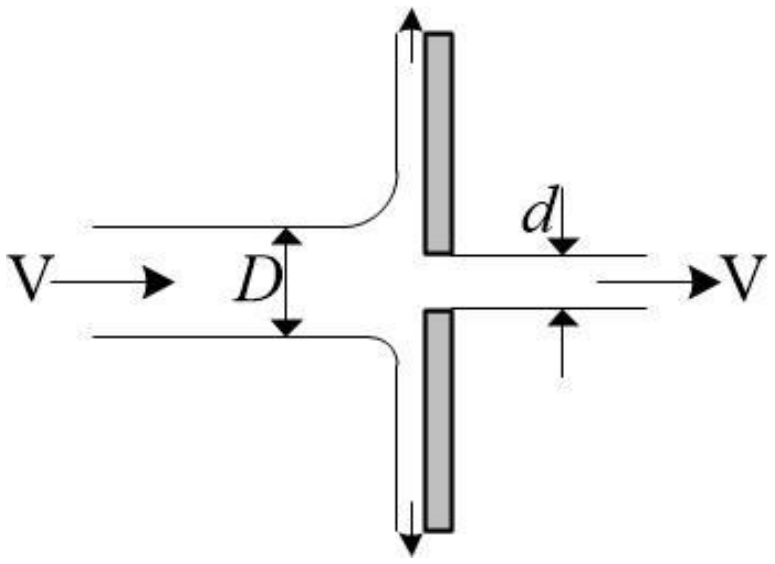
A water jet (density = 1000 kg/m3) is approaching a vertical plate, having an orifice at the center, as shown in the figure. While a part of the jet passes through the orifice, remainder flows along the plate. Neglect friction and assume both the inlet and exit jets to have circular cross-sections. If V = 5 m/s, 𝐷 = 100 mm and 𝑑 = 25 mm, magnitude of the horizontal force (in N, rounded off to one decimal place) required to hold the plate in its position is ___________.
Answer: 183.0 to 185.0
Question 60
Year: 2023 | Type: NAT | Marks: 2
Water (density = 1000 kg/m3) and alcohol (specific gravity = 0.7) enter a Y-shaped channel at flow rates of 0.2 m3/s and 0.3 m3/s, respectively. Their mixture leaves through the other end of the channel, as shown in the figure. The average density (in kg/m3) of the mixture is _______.
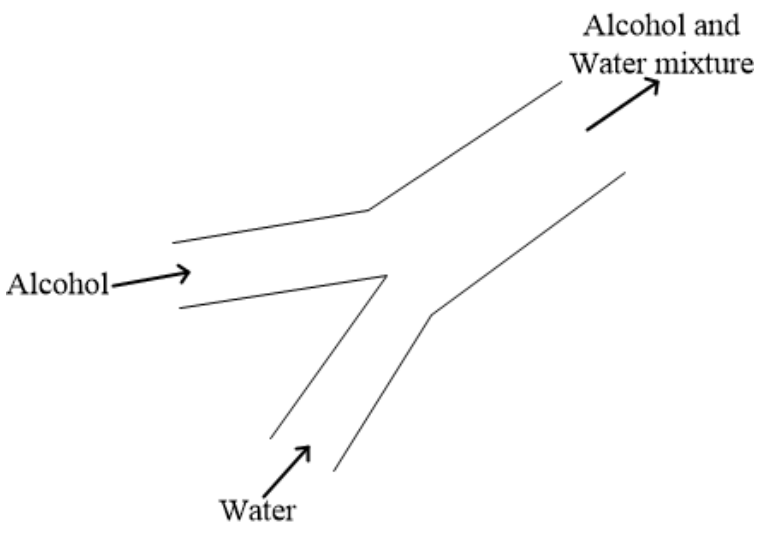
Answer: 820
Question 61
Year: 2023 | Type: NAT | Marks: 2
The velocity and acceleration of a fluid particle are given as 𝑉⃗⃗= (−𝑖̂ + 2𝑗̂) m/s and 𝑎⃗= (−2𝑖̂ −4𝑗̂) m/s2, respectively. The magnitude of the component of acceleration (in m/s2, rounded off to two decimal places) of the fluid particle along the streamline is _______.
Answer: 2.60 to 2.75
Question 62
Year: 2023 | Type: NAT | Marks: 2
A hydraulic turbine with rotor diameter of 100 mm produces 200 W of power while rotating at 300 rpm. Another dynamically-similar turbine rotates at a speed of 1500 rpm. Consider both turbines to operate with the same fluid (identical density and viscosity), and neglect any gravitational effect. Then the power (in W, rounded off to nearest integer) produced by the second turbine is _______________.
Answer: 430 to 460
Question 63
Year: 2023 | Type: NAT | Marks: 2
Water (density = 1000 kg/m3) flows steadily with a flow rate of 0.05 m3/s through a venturimeter having throat diameter of 100 mm. If the pipe diameter is 200 mm and losses are negligible, the pressure drop (in kPa, rounded off to one decimal place) between an upstream location in the pipe and the throat (both at the same elevation) is _______.
Answer: 18.5 to 19.5
Question 64
Year: 2023 | Type: NAT | Marks: 2
Water flows around a thin flat plate (0.25 m long, 2 m wide) with a free stream velocity (𝑈∞) of 1 m/s, as shown in the figure. Consider linear velocity profile ( 𝑢 𝑈∞= 𝑦 𝛿) for which the laminar boundary layer thickness is expressed as 𝛿= 3.5𝑥 √𝑅𝑒𝑥 . For water, density = 1000 kg/m3 and dynamic viscosity = 0.001 kg/m.s. Net drag force (in N, rounded off to two decimal places) acting on the plate, neglecting the end effects, is ________.
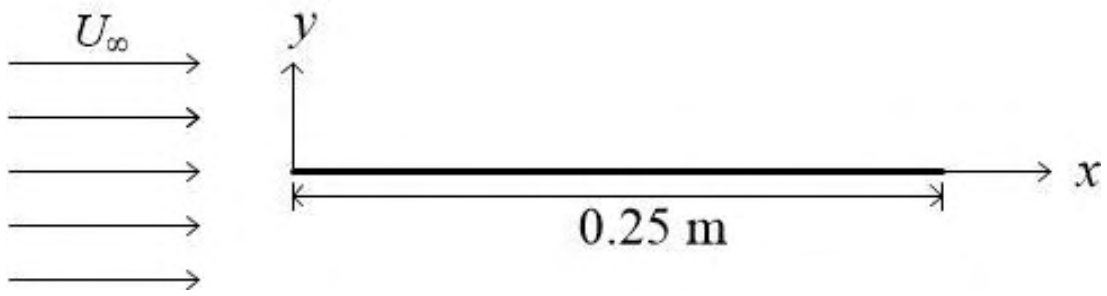
Answer: 1.10 to 1.20
Question 65
Year: 2023 | Type: NAT | Marks: 2
Axial velocity profile 𝑢(𝑟) for an axisymmetric flow through a circular tube of radius 𝑅 is given as, 𝑢(𝑟) 𝑈 = (1 −𝑟 𝑅) 1 𝑛 ⁄ where 𝑈 is the centerline velocity. If 𝑉 refers to the area-averaged velocity (volume flow rate per unit area), then the ratio 𝑉/𝑈 for 𝑛= 1 (rounded off to two decimal places) is ______________.
Answer: 0.32 to 0.34
Question 66
Year: 2023 | Type: NAT | Marks: 2
A stationary circular pipe of radius 𝑅= 0.5 m is half filled with water (density = 1000 kg/m3), whereas the upper half is filled with air at atmospheric pressure, as shown in the figure. Acceleration due to gravity is 𝑔= 9.81 m/s2. The magnitude of the force per unit length (in kN/m, rounded off to one decimal place) applied by water on the pipe section AB is _______. Material Science (XE-C)
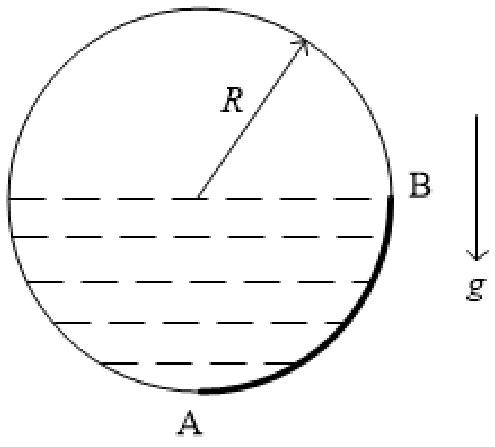
Answer: 2.2 to 2.4
Question 67
Year: 2022 | Marks: 1
A heavy horizontal cylinder of diameter D supports a mass of liquid having density 𝜌 as shown in the figure. Find out the vertical component of force exerted by the liquid per unit length of the cylinder if g is the acceleration due to gravity.
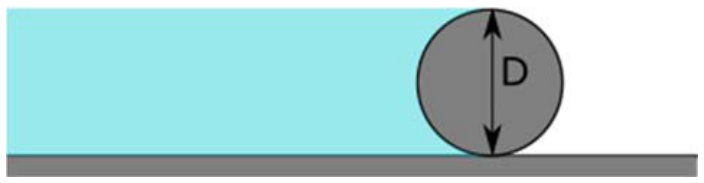
- A. 𝜋𝐷ଶ 4 𝜌𝑔
- B. 𝜋𝐷ଶ 8 𝜌𝑔
- C. 𝜋𝐷ଶ 2 𝜌𝑔
- D. 𝜋𝐷ଶ 3 𝜌𝑔
Answer: B. 𝜋𝐷ଶ 8 𝜌𝑔
Question 68
Year: 2022 | Marks: 1
The figure shows the developing zone and the fully developed region in a pipe flow where the steady flow takes place from left to right. The wall shear stress in the sections A, B, C, and D are given by 𝜏, 𝜏, 𝜏, and 𝜏, respectively. Select the correct statement.
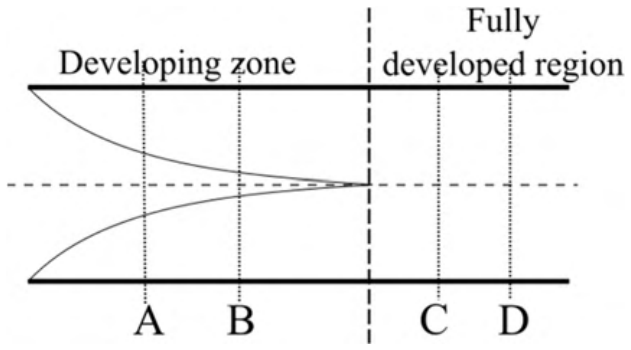
- A. 𝜏 𝜏
- B. 𝜏 𝜏
- C. 𝜏 𝜏
- D. 𝜏 𝜏
Answer: A. 𝜏 𝜏
Question 69
Year: 2022 | Marks: 1
The left hand column lists some non-dimensional numbers and the right hand column lists some physical phenomena. Indicate the correct combination 1. Reynolds number i. Wave drag 2. Froude number ii. Compressible flow 3. Mach number iii. Viscous drag 4. Weber number iv. Spray formation
- A. 1-iii, 2-i, 3-ii, 4-iv
- B. 1-i, 2-ii, 3-iv, 4-iii
- C. 1-iv, 2-iii, 3-iv, 4-iii
- D. 2-iv, 1-iii, 3-ii, 4-i
Answer: A. 1-iii, 2-i, 3-ii, 4-iv
Question 70
Year: 2022 | Type: MSQ | Marks: 1
As temperature increases
- A. the dynamic viscosity of a gas increases.
- B. the dynamic viscosity of a liquid decreases.
- C. the dynamic viscosity of a liquid does not change.
- D. the dynamic viscosity of a gas decreases.
Answer: A. the dynamic viscosity of a gas increases.; B. the dynamic viscosity of a liquid decreases.
Question 71
Year: 2022 | Type: MSQ | Marks: 1
Which of the following statement(s) regarding a venturimeter is/are correct?
- A. In the direction of flow, it consists of a converging section, a throat, and a diverging section.
- B. In the direction of flow, it consists of a diverging section, a throat, and a converging section.
- C. It is used for flow measurement at a very low Reynolds number.
- D. Pressure tappings are provided just upstream of the venturimeter and at the throat.
Answer: A. In the direction of flow, it consists of a converging section, a throat, and a diverging section.; D. Pressure tappings are provided just upstream of the venturimeter and at the throat.
Question 72
Year: 2022 | Type: MSQ | Marks: 1
Which of the following statement(s) is/are true for streamlines in a steady incompressible flow?
- A. Two streamlines cannot intersect each other.
- B. Flow rate increases between two diverging streamlines.
- C. Flow rate decreases between two diverging streamlines.
- D. Stream function has a constant value along a streamline.
Answer: A. Two streamlines cannot intersect each other.; D. Stream function has a constant value along a streamline.
Question 73
Year: 2022 | Type: MSQ | Marks: 1
A flow has a velocity potential given by 𝜙ൌ𝐴𝑥ଷ where ‘A’ is a non-zero constant. Which of the following statement(s) is/are true about the flow?
- A. The flow is incompressible.
- B. The flow is irrotational.
- C. The flow has local acceleration.
- D. The flow has convective acceleration.
Answer: B. The flow is irrotational.; D. The flow has convective acceleration.
Question 74
Year: 2022 | Type: MSQ | Marks: 1
A boundary layer develops due to a two-dimensional steady flow over a horizontal flat plate. Consider a vertical line away from the leading edge which extends from the wall to the edge of the boundary layer. Which of the following quantity/quantities is/are not constant along the vertical line? 𝑢 and 𝑣 represent the components of velocity in the direction along the plate and normal to it, respectively and x is taken along the length of the plate while p is the pressure. Neglect body forces.
Answer: A. 𝑢; B. 𝜕𝑢 𝜕𝑥; C. 𝑣
Question 75
Year: 2022 | Type: NAT | Marks: 1
A 10 kg mass placed on an infinitely long horizontal massless flat platform is to be supported by a steady vertical water jet as shown in the figure. The diameter of the jet is 5 cm. What minimum average velocity is required to hold the mass in place? Assume 𝜌௪௧ൌ1000 kg/mଷ, 𝑔ൌ10 ୫ ୱమ and 𝜋ൌ3.14 . Neglect friction. (Round off to two decimal places)
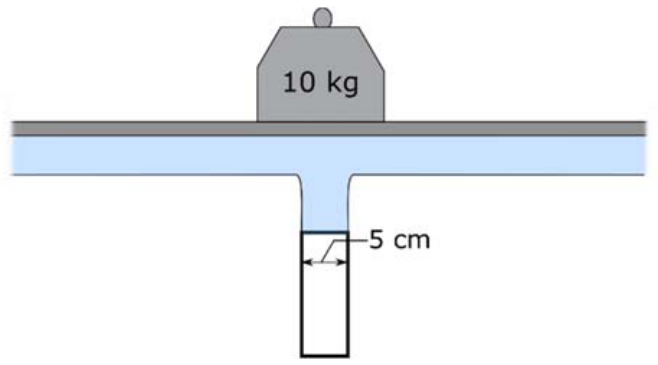
Answer: 6.95 to 7.20
Question 76
Year: 2022 | Marks: 2
Consider an inviscid flow through a smooth pipe which has a pitot-static tube arrangement as shown. Find the centre-line velocity in the pipe. Consider that the density of the fluid is 1000 kg/m3, acceleration due to gravity is 10 m/s2, and the specific gravity of the manometric fluid is 11.
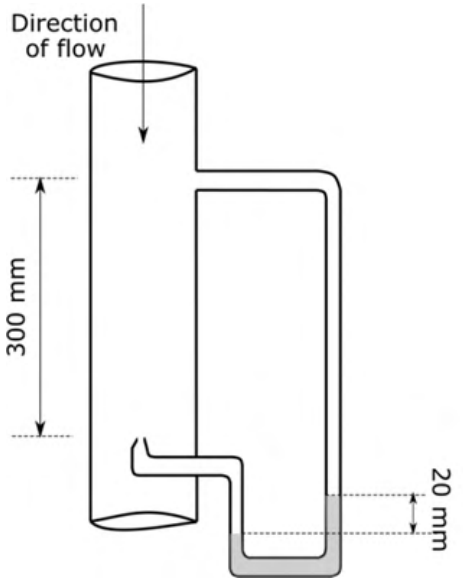
- A. 2 m/s
- B. 3 m/s
- C. 5 m/s
- D. 7 m/s
Answer: A. 2 m/s
Question 77
Year: 2022 | Marks: 2
The speed of propagation, c, of a capillary wave depends on the density of the fluid, ρ, the wavelength of the wave, λ, and the surface tension, σ. If the density and wavelength remain constant, halving the surface tension would lead to a new velocity, c', given by
- A. c' = 2c
- B. c' = √2c
- C. 𝑐ᇱൌ √ଶ
- D. c' = c
Answer: C. 𝑐ᇱൌ √ଶ
Question 78
Year: 2022 | Marks: 2
A two-dimensional flow field is described by a combination of a source of strength m at the origin and a uniform flow, U, in the positive x-direction such that the velocity potential is given by 2 2 ln 2 y x m Ux + + = π φ The stagnation streamline is shown in the figure. Find the distance a a ′.
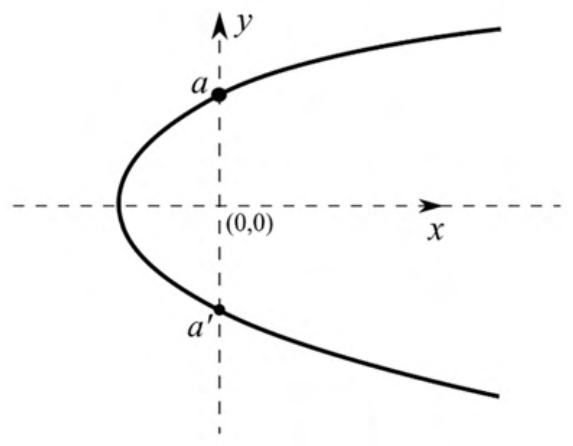
- A. U m
- B. U m 2
- C. U m 8
- D. U m 2
Answer: D. U m 2
Question 79
Year: 2022 | Marks: 2
A typical boundary layer over a flat plate has a linear velocity profile with zero velocity at the wall and freestream velocity, U∞, at the outer edge of the boundary layer. What is the ratio of the momentum thickness to the thickness of the boundary layer?
Answer: C. 6 1
Question 80
Year: 2022 | Type: MSQ | Marks: 2
Identify the configuration(s) in which steady two-dimensional internal flow may show boundary layer separation if the flow direction is left to right.
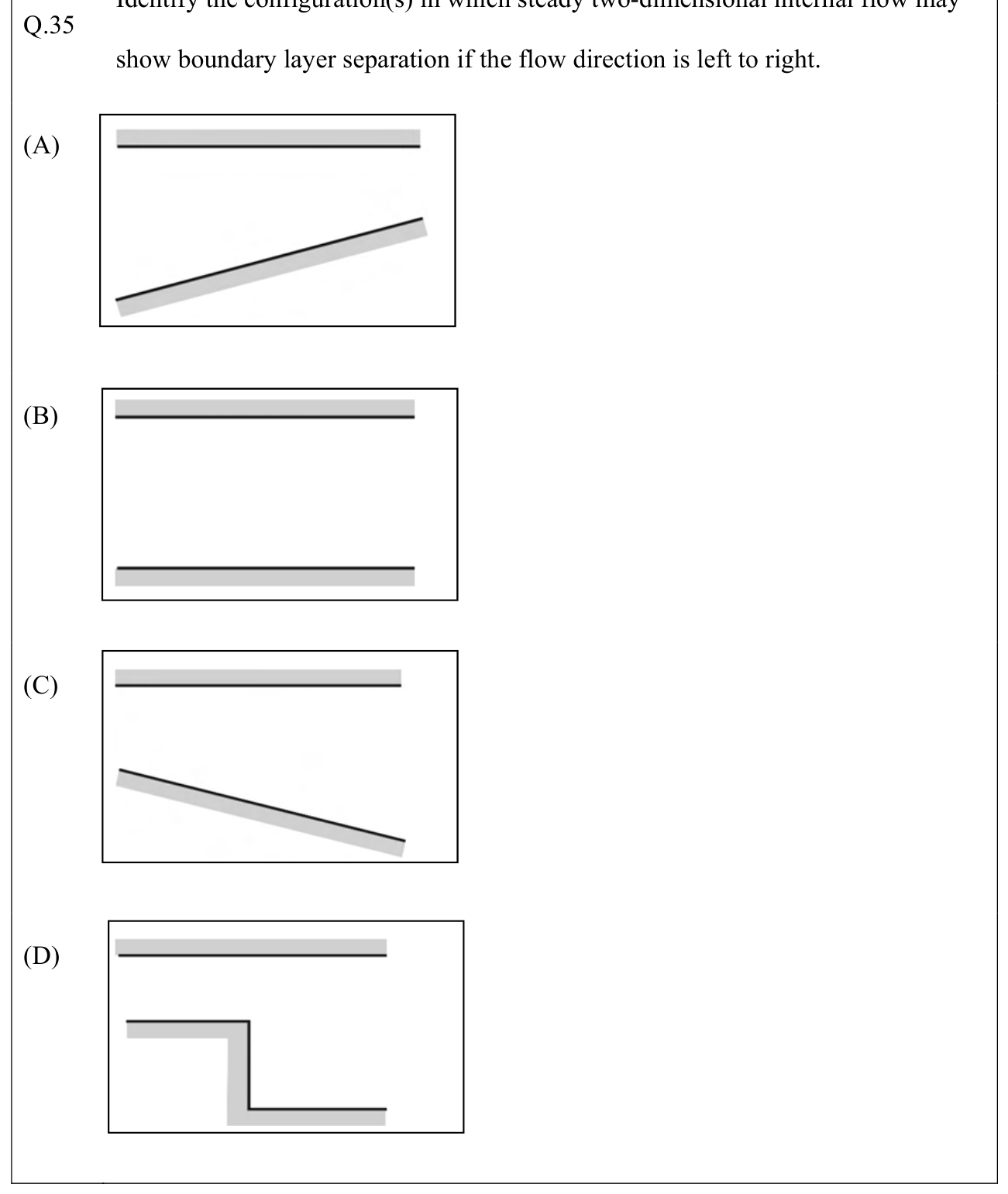
Answer: C. ; D.
Question 81
Year: 2022 | Type: NAT | Marks: 2
Consider steady fully developed flow of a liquid through two large horizontal flat parallel plates separated by a distance of 2 mm. One of the plate is fixed and the other plate moves at a speed of 0.5 m/s. What is the magnitude of the pressure gradient (in Pa/m) in the direction of the flow required to ensure that the net flow through the plates is zero? Dynamic viscosity of the liquid is 5x10⁻⁴ Ns/m2 (Round off to the nearest integer)
Answer: 374 to 376
Question 82
Year: 2022 | Type: NAT | Marks: 2
Consider two-dimensional turbulent flow of air over a horizontal flat plate of length 1 m. Skin friction coefficient at a length x from the leading edge of the plate is obtained as: ( ) 2.0 Re 06 .0 x fc = where, Rex is the local Reynolds number. Find out the drag force per unit width (in N/m2) on the plate if the free stream air velocity is 10 m/s. Density and dynamic viscosity of air are given as 1.2 kg/m3 and 1.83x10⁻⁵ N-s/m2, respectively. (Round off to three decimal places)
Question 83
Year: 2022 | Type: NAT | Marks: 2
For an inviscid fluid with density 1 kg/m3, the Cartesian velocity field is given as: 𝐮ൌሺെ2𝑥𝑦ሻ𝑡𝐢ሺ2𝑥𝑦ሻ𝑡𝐣 m/s Neglecting the body forces, find the magnitude of pressure gradient in (Pa/m) at (x, y) = (1 m, 1 m) at t = 1 s. (Round off to two decimal places)
Answer: 5.60 to 5.70
Question 84
Year: 2022 | Type: NAT | Marks: 2
Consider a lawn sprinkler with horizontal arms of radius, a = 10 cm which has water introduced vertically through the centre, as shown in the figure. The exit area of the jet is 25 cm2 and the jet velocity is 1 m/s. The water is ejected orthogonal to the sprinkler arm and the jet makes an angle of 60° with the horizontal plane. Find the torque (in N-m) required to hold the sprinkler stationary. Consider water density 1000 kg/m3. Neglect the effects of friction and gravity. (Round off to two decimal places)
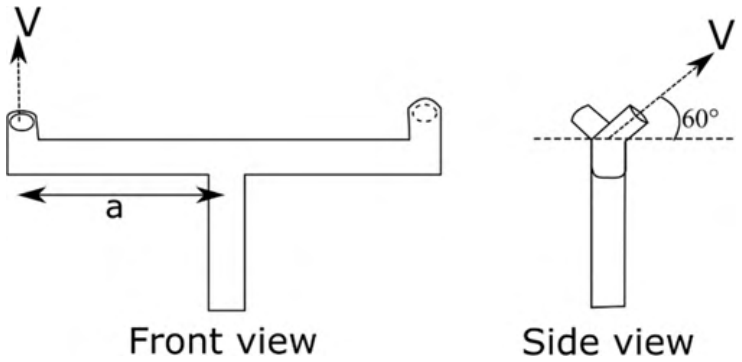
Answer: 0.24 to 0.26
Question 85
Year: 2022 | Type: NAT | Marks: 2
A wooden cylinder (specific gravity = 0.6) of length L and diameter D floats in water (density 1000 kg/m3). Find out the minimum value of D/L for which the cylinder floats with its axis vertical. (Round off to three decimal places)
Answer: 1.380 to 1.390
Question 86
Year: 2022 | Type: NAT | Marks: 2
Consider a cart of mass 10 kg placed on an inclined plane (angle of inclination 60° with horizontal) as shown in the figure. A turning vane of negligible weight is mounted on the cart. A horizontal steady water jet is issued from a stationary nozzle of area 0.1 m2 and strikes the turning vane as shown in the figure. The vane turns the jet downward parallel to the inclined plane. Find out the minimum jet velocity (in m/s) which will not allow the cart to come down. Neglect friction, consider density of water = 1000 kg/m3 and acceleration due to gravity = 10 m/s2. (Round off to two decimal places)
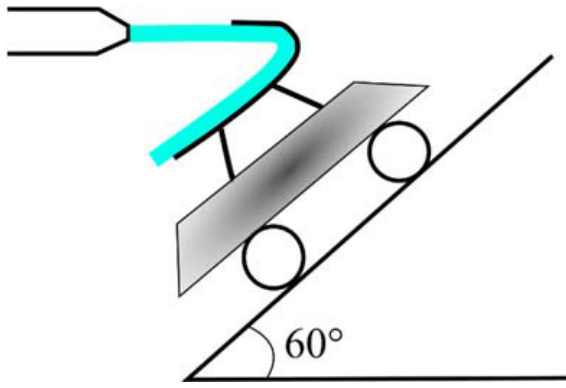
Answer: 0.74 to 0.78
Question 87
Year: 2022 | Type: NAT | Marks: 2
A siphon is used to drain out water (density 1000 kg/m3) from a tank as shown in the figure. What can be the maximum height z (in meter) of the point C? Consider acceleration due to gravity = 10 m/s2, pressure at point A = 101 kPa, vapour pressure of water = 29.5 kPa and neglect friction. (Round off to two decimal places)
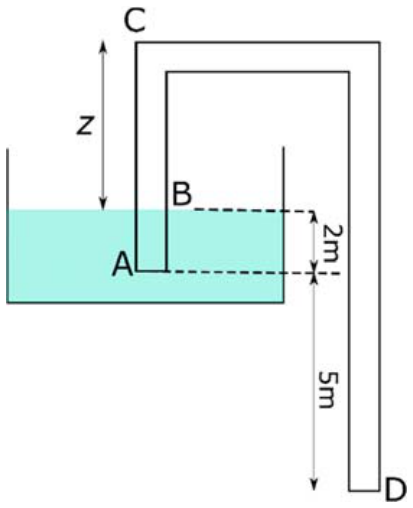
Answer: 5.1 to 5.2
Question 88
Year: 2022 | Type: NAT | Marks: 2
The horizontal belt of negligible weight shown in the figure moves with a steady velocity (V) of 2.5 m/s and skims over the top surface of an oil-film of depth h = 3 cm. The length (L) and width (b) of the belt are, respectively, 2 m and 60 cm. Find the viscosity of the oil (in Pa-s), given that the minimum power required to move the belt is 100 W. Neglect the end effects. (Round off to two decimal places)
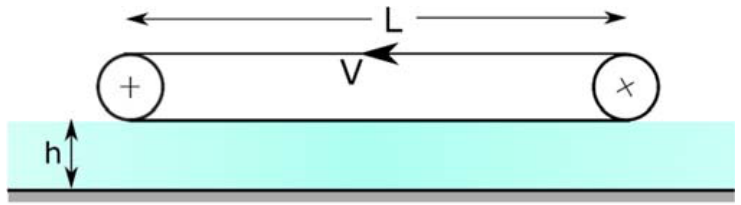
Answer: 0.39 to 0.41
Question 89
Year: 2018 | Marks: 1
Rheological diagram of different types of fluids is shown in figure. Column I represents the nature of the fluid and column II represents the curve showing the variation of shear stress against shear strain rate. Column I (i) Newtonian (ii) Shear thinning (iii) Shear thickening (iv) Bingham plastic Column II M N O P The most appropriate match between columns I and II is,
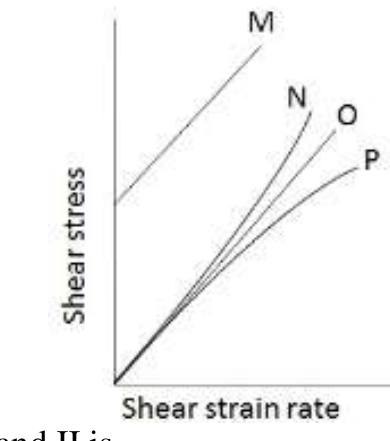
- A. (i) – O; (ii) – N ; (iii) – P; (iv) – M
- B. (i) – O; (ii) – P ; (iii) – N; (iv) – M
- C. (i) – P; (ii) – O ; (iii) – M; (iv) – N
- D. (i) – P; (ii) – O ; (iii) – N; (iv) – M
Answer: B. (i) – O; (ii) – P ; (iii) – N; (iv) – M
Question 90
Year: 2018 | Marks: 1
In a two-dimensional, incompressible and irrotational flow, stream function ( ( , ) x y ψ ψ = ) and velocity potential ( ( , ) x y φ φ = ) exist. The velocities in x and y directions are non-zero. The product of constant dy dx φ= and constant dy dx ψ= , is

Answer: A. −1
Question 91
Year: 2018 | Marks: 1
The inviscid flow past a rotating circular cylinder can be generated by the superposition of
- A. uniform flow, source and vortex
- B. uniform flow, doublet
- C. uniform flow, sink and vortex
- D. uniform flow, doublet and vortex
Answer: D. uniform flow, doublet and vortex
Question 92
Year: 2018 | Marks: 1
The velocity field and the surface normal vector are given by, ˆ ˆ ˆ V ui v j wk = + + and 1 2 3 ˆ ˆ ˆ n n i n j n k = + + , respectively. If Euler equations are to be solved, the boundary condition that must be satisfied at the wall is,

- A. 𝑉⃗ ∙𝑛⃗ = 0
- B. 𝑉⃗ = 0
- C. ∇∙𝑉⃗ = 0
- D. 𝑉⃗ × 𝑛⃗ = 0
Answer: A. 𝑉⃗ ∙𝑛⃗ = 0
Question 93
Year: 2018 | Marks: 1
The influence of Froude number is most significant in
- A. capillary flows
- B. creeping flows
- C. free surface flows
- D. compressible flows
Answer: C. free surface flows
Question 94
Year: 2018 | Marks: 1
If the stream function ( ( , ) x y ψ ) for a two-dimensional incompressible flow field is given as ( ) 2 2 2y x y − , the corresponding velocity field is
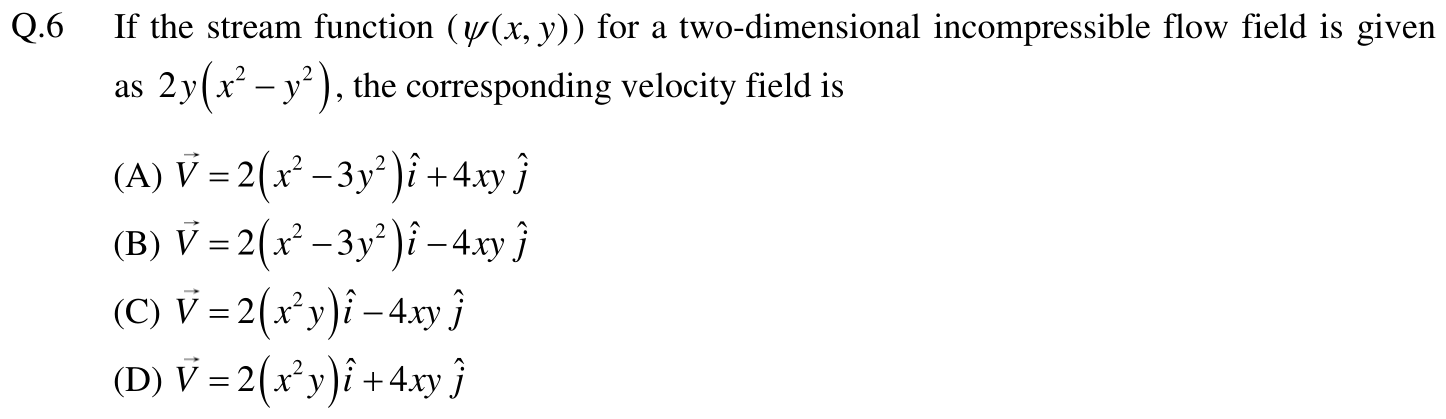
- A. ( ) 2 2 ˆ ˆ 2 3 4 V x y i xy j = − +
- B. ( ) 2 2 ˆ ˆ 2 3 4 V x y i xy j = − −
- C. ( ) 2 ˆ ˆ 2 4 V x y i xy j = −
- D. ( ) 2 ˆ ˆ 2 4 V x y i xy j = +
Answer: B. ( ) 2 2 ˆ ˆ 2 3 4 V x y i xy j = − −
Question 95
Year: 2018 | Marks: 1
Water is flowing in two different tubes of diameters D and 2D, with the same velocity. The ratio of laminar friction factors for the larger diameter tube to the smaller diameter tube is
Answer: A. 0.5
Question 96
Year: 2018 | Type: NAT | Marks: 1
If the velocity field is 2 ˆ ˆ 4 V xy i xy j = + m/s, vorticity of the fluid element in the field at (x=1, y=2) in s-1 is ____.

Answer: 4
Question 97
Year: 2018 | Type: NAT | Marks: 1
A pitot-static tube is used to measure air velocity in a duct by neglecting losses. The density of air is 1.2 kg/m3. If the difference between the total and static pressures is 1 kPa, the velocity of air at the measuring location, in m/s, is _______.
Answer: 39 to 42
Question 98
Year: 2018 | Marks: 2
A parallelepiped of (2 m × 2 m) square cross-section and 10 m in length, is partially floating in water upto a depth of 1.2 m, with its longest side being horizontal. The specific gravity of the block is
Answer: B. 0.6
Question 99
Year: 2018 | Marks: 2
The velocity field in a two-dimensional, unsteady flow is given by 2 ˆ ˆ ( , , ) 2 3 V x y t xy i xyt j = + m/s. The magnitude of acceleration of a fluid particle located at x = 1 m, y = 1 m at the time t = 1 s, in m/s2, is

- A. 16.0
- B. 18.1
- C. 24.1
- D. 34.1
Answer: C. 24.1
Question 100
Year: 2018 | Marks: 2
In a two-dimensional, incompressible and irrotational flow, fluid velocity (v) in the y- direction is given by 2 5 v x y = − . The velocity (u) in the x-direction is
- A. 2 5 u x y = −
- B. 2 5 u x y = +
- C. 5 2 u x y = +
- D. 5 2 u x y = −
Answer: C. 5 2 u x y = +
Question 101
Year: 2018 | Marks: 2
A two-dimensional laminar viscous liquid film of constant thickness (h) steadily flows down an incline as shown in figure. Acceleration due to gravity is g. If the velocity profile in the liquid film is given as, (2 ); 0 u ky h y v = − = , the value of constant k is
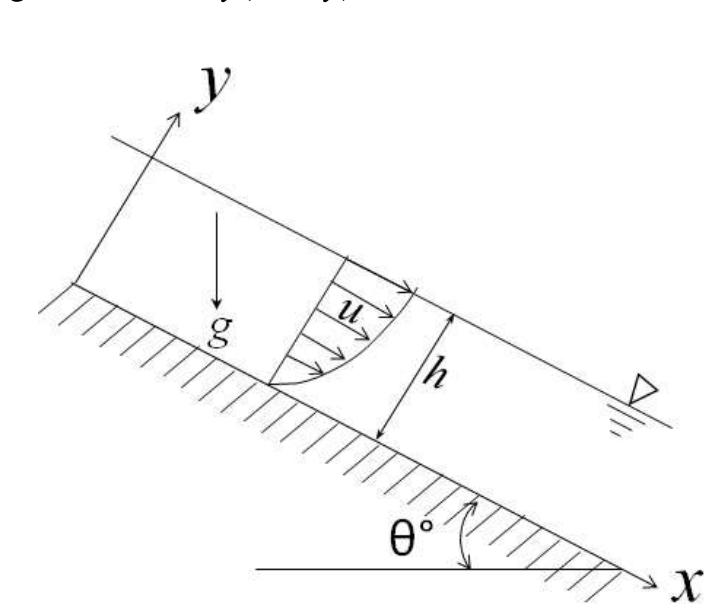
- A. sin 2 g ρ θ μ
- B. cos 2 g ρ θ μ
- C. sin g ρ θ
- D. cos g ρ θ
Answer: A. sin 2 g ρ θ μ
Question 102
Year: 2018 | Type: NAT | Marks: 2
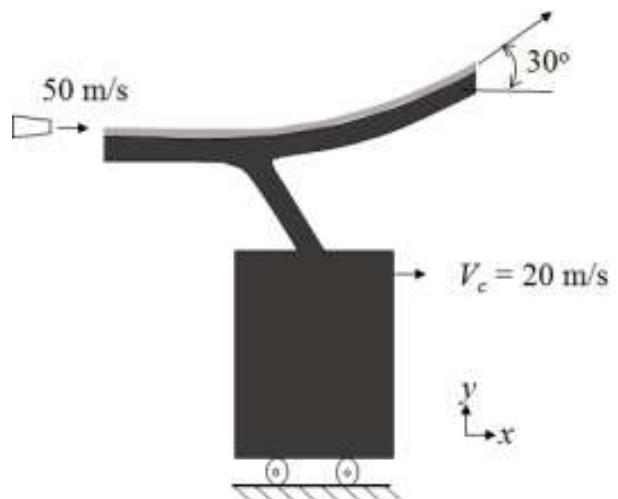
A water jet of 100 mm diameter issuing out of a nozzle at a speed of 50 m/s strikes a vane and flows along it as shown in figure. The vane is attached to a cart which is moving at a constant speed of 20 m/s on a frictionless track. The jet is deflected at an angle of 30o. Take the density of water as 1000 kg/m3. Neglecting the friction between the vane and the fluid, the magnitude of the force exerted by water on the cart in the x-direction, in N, is ______.
Answer: 900 to 990
Question 103
Year: 2018 | Type: NAT | Marks: 2
Capillary waves are generated in the sea. The speed of propagation (C) of these waves is known to be a function of density (ρ), wave length (λ), and surface tension (σ). Assume, ρ and λ to be constant. If the surface tension is doubled, in the functional form of the relevant non-dimensional group, the percentage increase in propagation speed (C) is _______ .
Answer: 40 to 42
Question 104
Year: 2018 | Type: NAT | Marks: 2
Consider a fully developed, two-dimensional and steady flow of a viscous fluid between two fixed parallel plates separated by a distance of 30 mm. The dynamic viscosity of the fluid is 0.01 kg/m-s and the pressure drop per unit length is 300 Pa/m. The fluid velocity at a distance of 10 mm from the bottom plate, in m/s, is ________.
Answer: 2.9 to 3.1
Question 105
Year: 2018 | Type: NAT | Marks: 2
A 2.6 gram smooth table-tennis (ping-pong) ball has a diameter of 38 mm. Density (ρ) of air is 1.2 kg/m3. Neglect the effect of gravity. Take coefficient of drag as 0.5. If the ball is struck with an initial velocity of 30 m/s, the initial deceleration, in m/s2, is _________.
Answer: 107 to 127
Question 106
Year: 2018 | Type: NAT | Marks: 2
On a flat plate, transition from laminar to turbulent boundary layer occurred at a critical Reynolds number (Recr). The empirical relations for the laminar and turbulent boundary layer thickness are given by 0.5 m 5.48Re la x x δ − = and 0.2 0.37Re turb x x δ − = , respectively. The ratio of laminar to turbulent boundary layer thickness, at the location of transition, is 0.3. The value of Recr is _______.
Answer: 440000 to 442000
Question 107
Year: 2018 | Type: NAT | Marks: 2
In a capillary tube of radius R = 0.25 mm, a fully developed laminar velocity profile is defined as, 2 2 2 1 4 R dp r u dx R μ = − − . In this expression, dp dx − =1 MPa/m, μ is the dynamic viscosity of the fluid, and r is the radial position from the centerline of the tube. If the flow rate through the tube is 1000 mm3/s, the viscosity of the fluid, in Pa-s, is ______________.
Answer: 0.001 to 0.002
Question 108
Year: 2018 | Type: NAT | Marks: 2
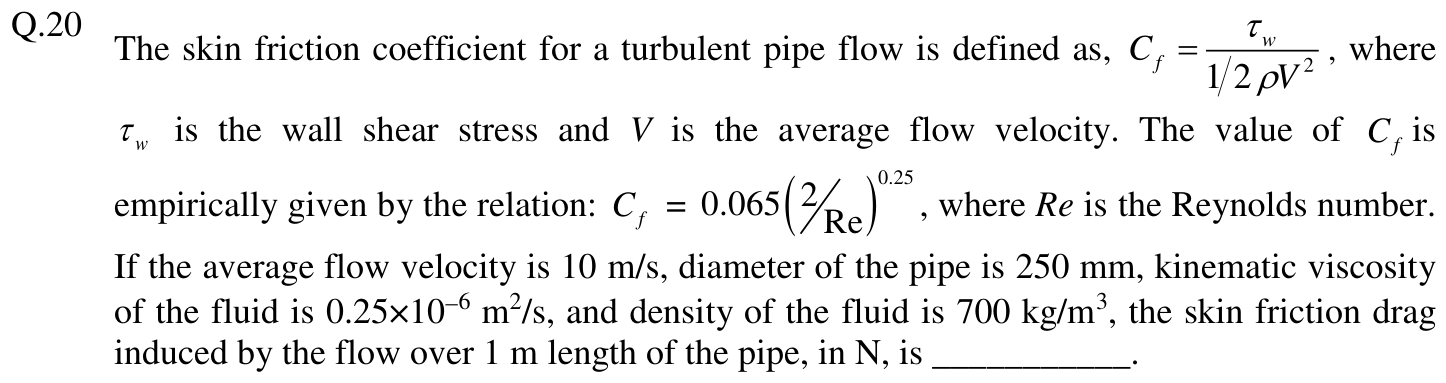
The skin friction coefficient for a turbulent pipe flow is defined as, 2 1 2 w f C V τ ρ = , where w τ is the wall shear stress and V is the average flow velocity. The value of f C is empirically given by the relation: f C = ( ) 0.25 2 0.065 Re , where Re is the Reynolds number. If the average flow velocity is 10 m/s, diameter of the pipe is 250 mm, kinematic viscosity of the fluid is 0.25×10⁻⁶ m2/s, and density of the fluid is 700 kg/m3, the skin friction drag induced by the flow over 1 m length of the pipe, in N, is ___________.
Answer: 30 to 45
Question 109
Year: 2018 | Type: NAT | Marks: 2
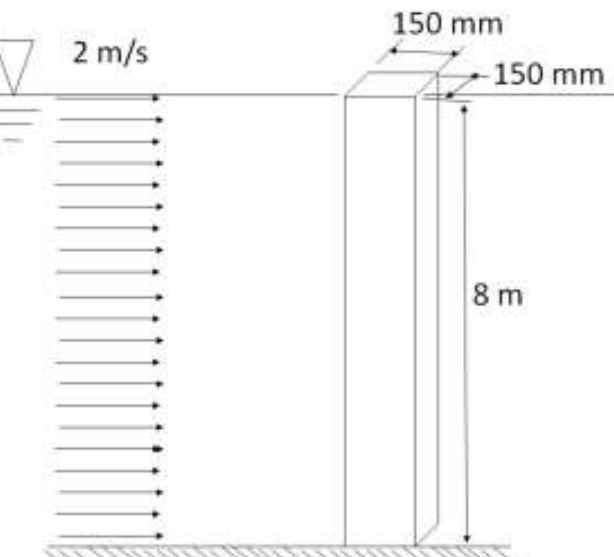
A (150 mm × 150 mm) square pillar is located in a river with water flowing at a velocity of 2 m/s, as shown in figure. The height of the pillar in water is 8 m. Take density of water as 1000 kg/m3 and kinematic viscosity as 1×10 −6 m/s2. The coefficient of drag of the pillar is 2.0. The drag force exerted by water on the pillar in N is _______.
Answer: 4800
Question 110
Year: 2018 | Type: NAT | Marks: 2
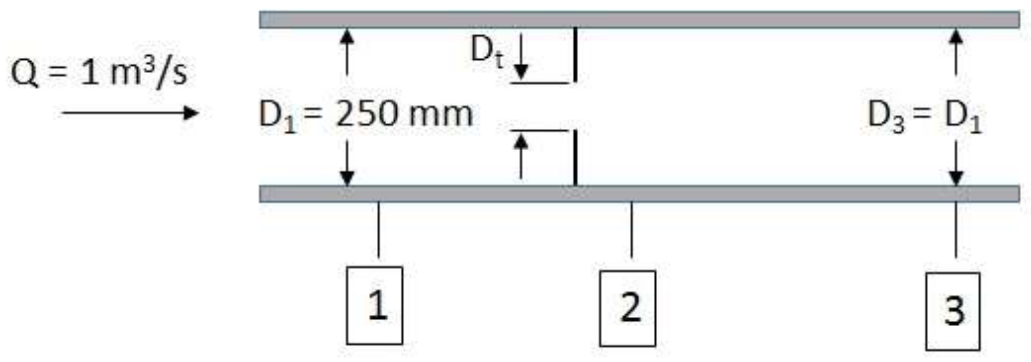
An orifice plate is used to measure flow rate of air (density = 1.23 kg/m3) in a duct of 250 mm diameter as shown in figure. The volume flow rate is 1 m3/s. Flow at sections 1 and 3 is uniform and section 2 is located at vena contracta. The diameter ratio, Dt/D1, is 0.66. The flow area at vena contracta, A2 = 0.65At, where At is area of the orifice. The pressure difference between locations 2 and 3 in N/m2 is ____________.
Answer: 1200 to 1350
Question 111
Year: 2016 | Type: NAT | Marks: 1
In the parallel-plate configuration shown, steady-flow of an incompressible Newtonian fluid is established by moving the top plate with a constant speed, U0 = 1m/s. If the force required on the top plate to support this motion is 0.5 N per unit area (in m2) of the plate then the viscosity of the fluid between the plates is __________ N-s/m2
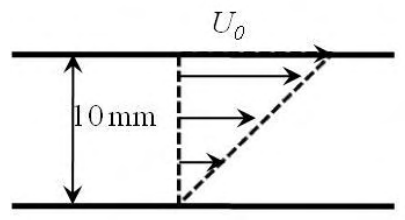
Answer: 0.0049 to 0.0051
Question 112
Year: 2016 | Marks: 1
For a newly designed vehicle by some students, volume of fuel consumed per unit distance travelled (qf in m3/m) depends upon the viscosity (μ) and density (ρ) of the fuel and, speed (U) and size (L) of the vehicle as where C is a constant. The dimensions of the constant C are
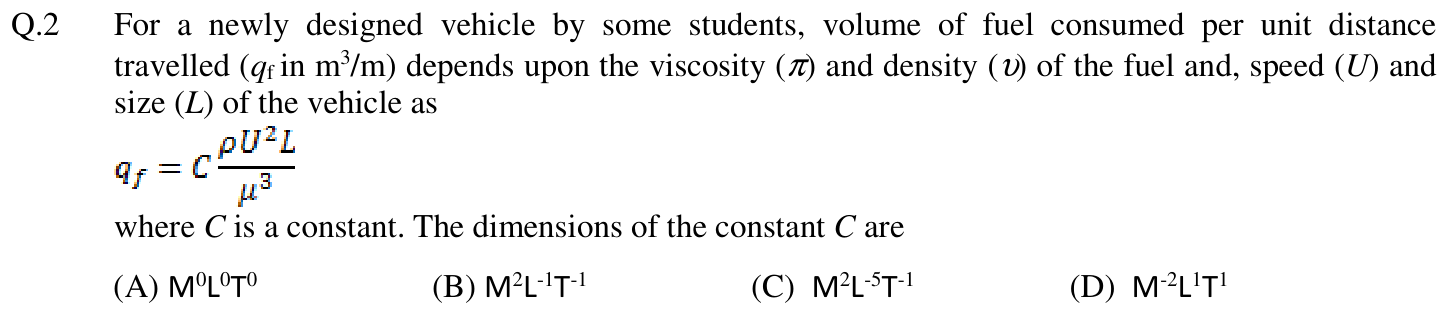
- A. M0L0T0
- B. M2L-1T-1
- C. M2L-5T-1
- D. M-2L1T1
Answer: B. M2L-1T-1
Question 113
Year: 2016 | Type: NAT | Marks: 1
A semi-circular gate of radius 1m is placed at the bottom of a water reservoir as shown in figure below. The hydrostatic force per unit width of the cylindrical gate in y-direction is _______ kN. The gravitational acceleration, g = 9.8 m/s2 and density of water = 1000 kg/m3.
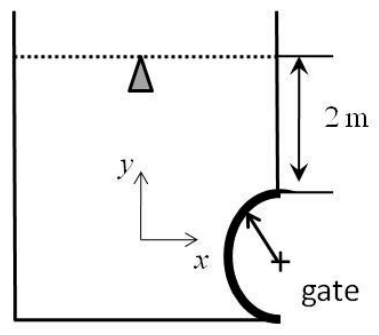
Answer: 15.3 to 15.5
Question 114
Year: 2016 | Type: NAT | Marks: 1
Velocity vector in m/s for a 2-D flow is given in Cartesian coordinate as Symbols bear usual meaning. At a point in the flow field, the - and -components of the acceleration vector are given as m/s2 and -0.5 m/s2, respectively. The velocity magnitude at that point is ________ m/s.

Answer: 1.4 to 1.42
Question 115
Year: 2016 | Marks: 1
If is velocity potential and is stream function for a 2-D, steady, incompressible and irrotational flow, which one of the followings is incorrect?
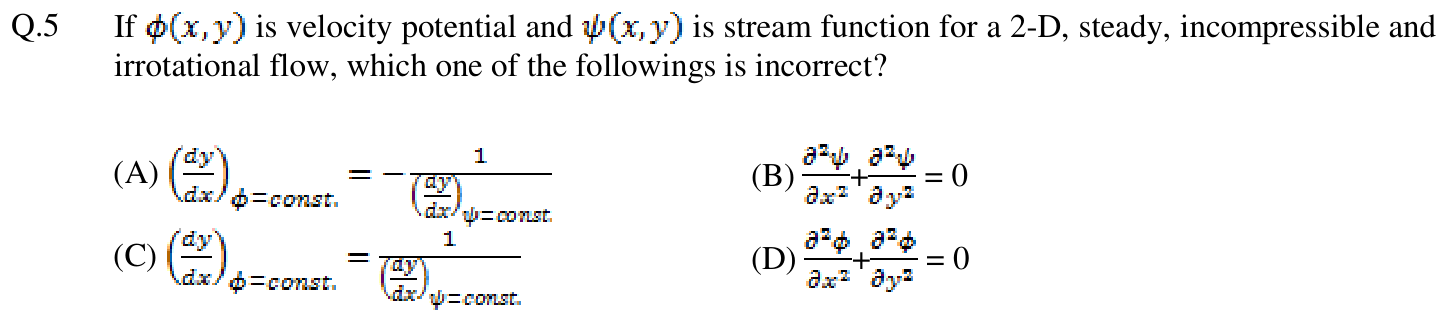
Answer: C.
Question 116
Year: 2016 | Marks: 1
The flow field shown over a bluff body has considerably curved streamlines. A student measures pressures at points A, B, C, and D and denotes them as PA, PB, PC, and PD respectively. State which one of the following statements is true. The arrow indicates the freestream flow direction.
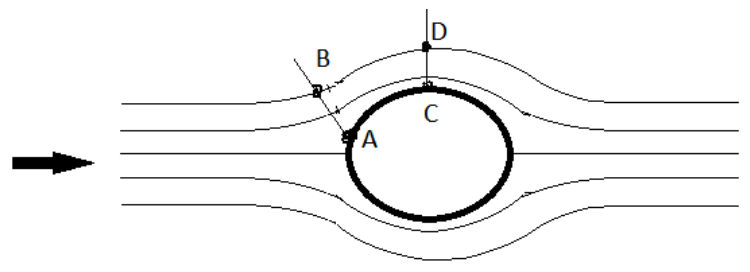
- A. PA = PB and PC > PD
- B. PA > PB and PC > PD
- C. PA = PB and PC < PD
- D. PA > PB and PC < PD
Answer: D. PA > PB and PC < PD
Question 117
Year: 2016 | Type: NAT | Marks: 1
A 2-D incompressible flow is defined by its velocity components in m/s as and . If the value of the constant is equal to 0.1 m2/s, the numerical value of vorticity at the point m and m is ________ s-1.

Answer: -0.00001 to 0.00001
Question 118
Year: 2016 | Marks: 1
Two flow configurations are shown below for flow of incompressible, viscous flow. The inlet velocity for the diverging nozzle (Fig (i)) and free-stream velocity for flow past the bluff body (Fig(ii)) is constant. Points A and B are separation points and flow is laminar. The relation regarding velocity gradients at point A and B is (y is the direction normal to the surface at the point of separation)
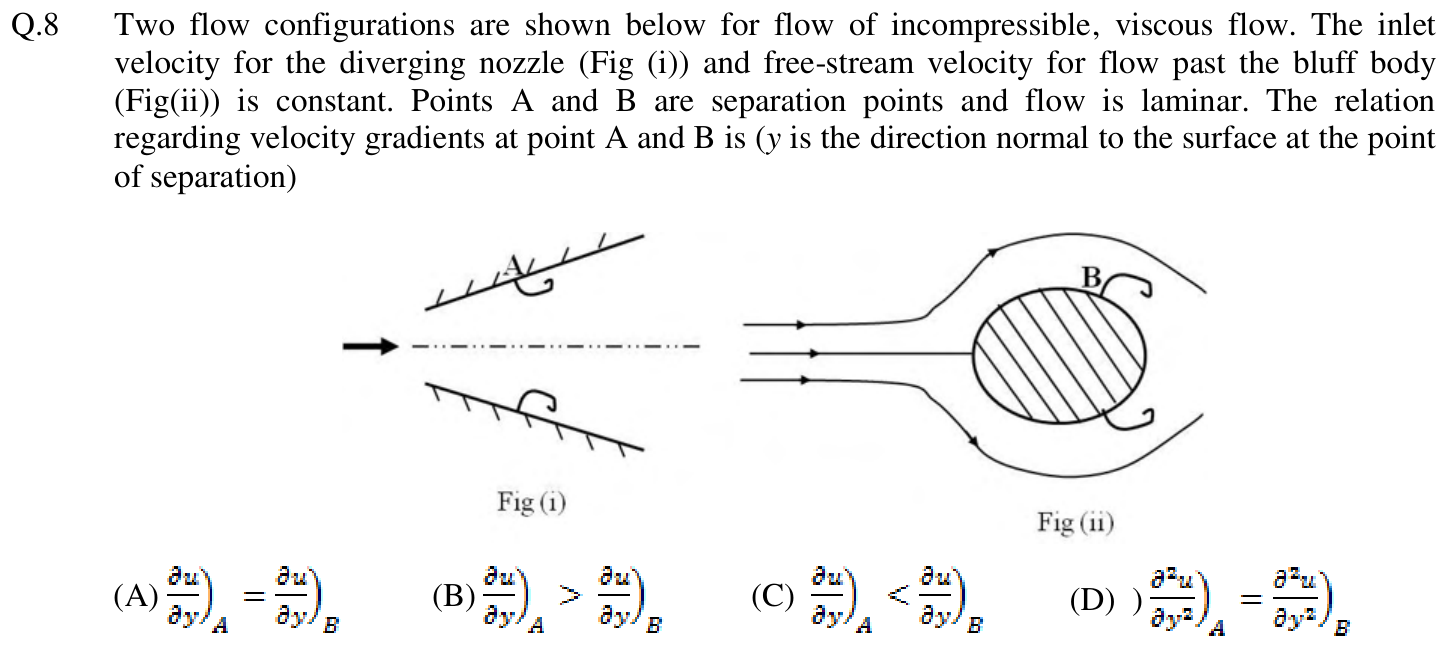
Answer: A.
Question 119
Year: 2016 | Type: NAT | Marks: 1
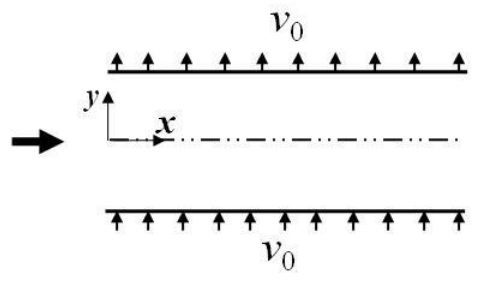
Consider a fully developed, steady, incompressible, 2-D, viscous channel flow with uniform suction and blowing velocity , as shown in the figure given below. The centerline velocity of the channel is 10 m/s along the x-direction. If the value of at both the walls is 1 m/s, the value of the y- component of velocity inside the flow field is __________ m/s.
Answer: 0.9 to 1.1
Question 120
Year: 2016 | Type: NAT | Marks: 2
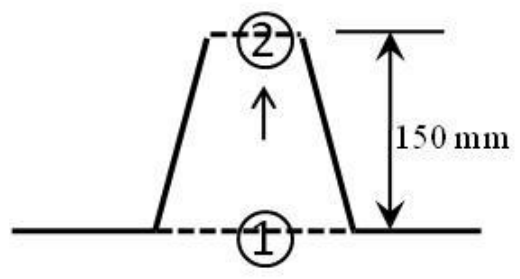
Exhaust from a kitchen goes into the atmosphere through a tapered chimney as shown. The area of cross-section of chimney at location-1 is twice of that at location-2. The flow can be assumed to be inviscid with constant exhaust density of 1 kg/m3 and acceleration due to gravity, g = 9.8 m/s2. If the steady, uniform exhaust velocity at location-1 is U = 1m/s, the pressure drop across the chimney is ________ Pa.
Answer: 2.95 to 3.05
Question 121
Year: 2016 | Type: NAT | Marks: 2
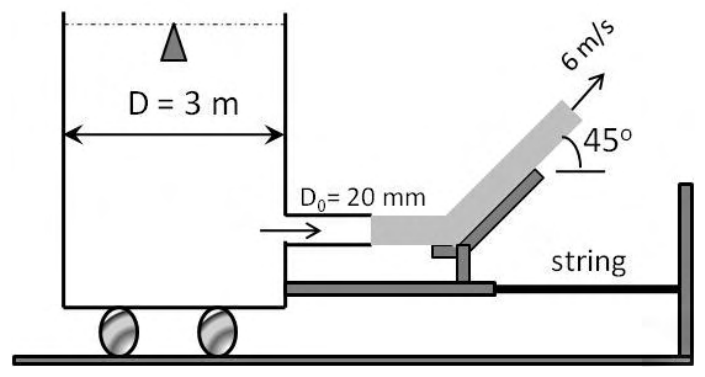
A jet of diameter 20 mm and velocity 6 m/s coming out of a water-tank standing on a frictionless cart hits a vane and gets deflected at an angle 45o as shown in the figure below. The density of water is 1000 kg/m3. Neglect all minor and viscous losses. If the cart remains stationary, the magnitude of tension in the supporting string connected to the wall is ________ N.
Answer: 7.9 to 8.1
Question 122
Year: 2016 | Type: NAT | Marks: 2
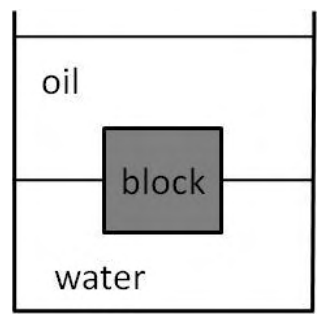
A block is floating at the oil-water interface as shown. The density of oil is two-thirds of that of water. Given that the density of the block is 800 kg/m3 and that of water is 1000 kg/m3, the fraction of the total height of block in oil is ________.
Answer: 0.59 to 0.61
Question 123
Year: 2016 | Type: NAT | Marks: 2
A horizontal pipe is feeding water into a reservoir from the top with a time-dependent volumetric flow-rate, Q (m3/h)= 1+0.1 where t is time in hours. The area of the base of the reservoir is 0.5 m2. Assuming that initially the reservoir was empty, the height of the water level in the reservoir after 60 minutes is __________ m.

Question 124
Year: 2016 | Marks: 2
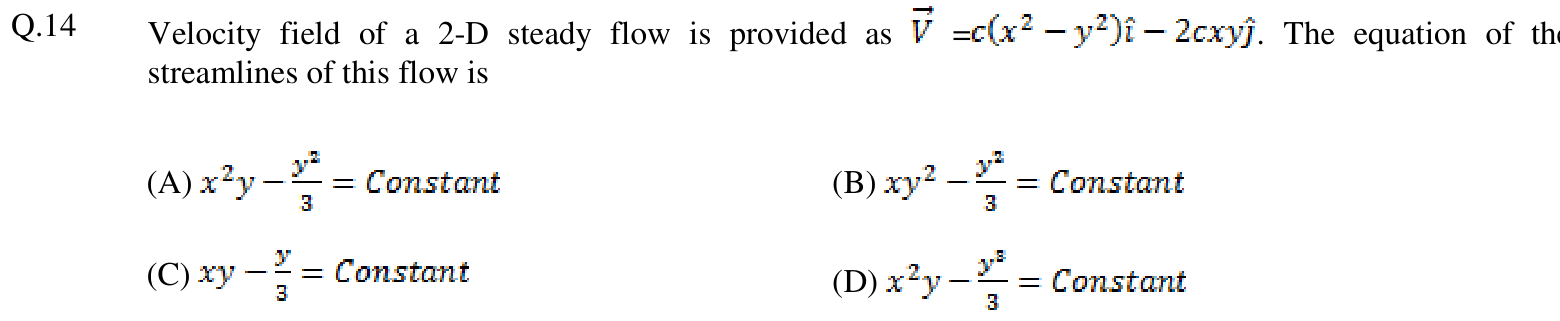
Velocity field of a 2-D steady flow is provided as = . The equation of the streamlines of this flow is
Answer: D.
Question 125
Year: 2016 | Marks: 2
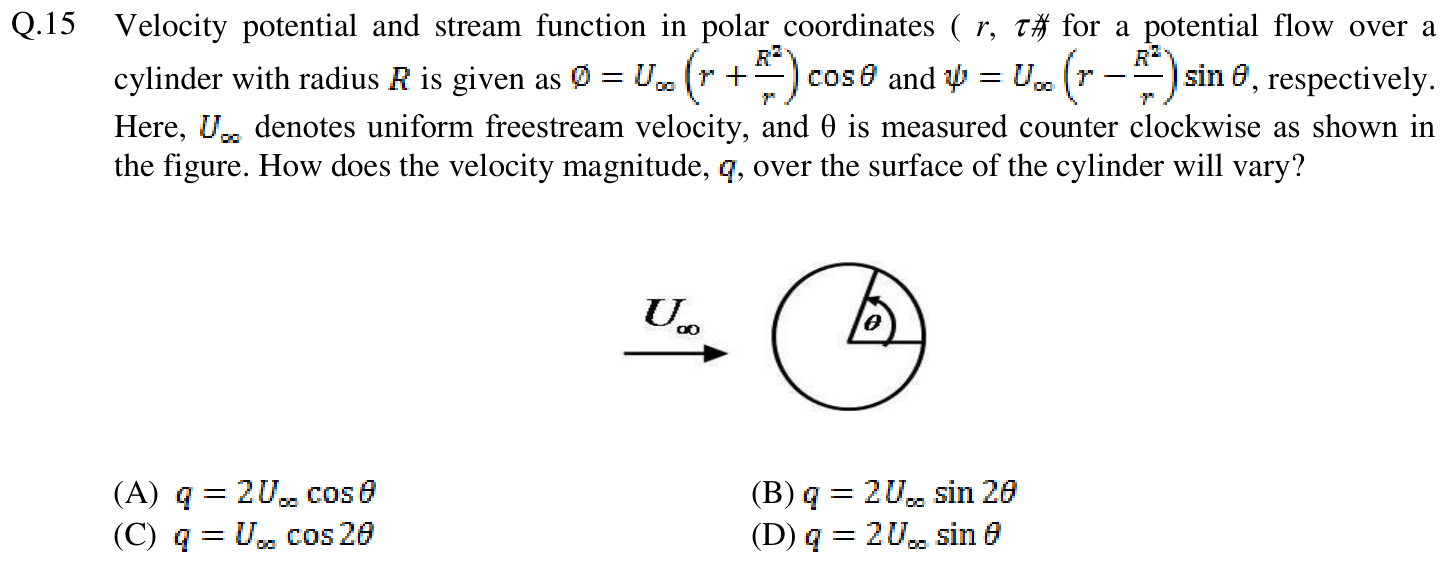
Velocity potential and stream function in polar coordinates ( r, θ ) for a potential flow over a cylinder with radius is given as and , respectively. Here, denotes uniform freestream velocity, and θ is measured counter clockwise as shown in the figure. How does the velocity magnitude, , over the surface of the cylinder will vary?
Answer: D.
Question 126
Year: 2016 | Type: NAT | Marks: 2
Consider a laminar flow over a flat plate of length = 1m. The boundary layer thickness at the end of the plate is for water, and for air for the same freestream velocity. If the kinematic viscosities of water and air are 1 and 1 , respectively, the numerical value of the ratio, is _________.

Question 127
Year: 2016 | Marks: 2
Prototype of a dam spillway ( a structure used for controlled release of water from the dam) has characteristic length of 20m and characteristic velocity of 2 m/s. A small model is constructed by keeping Froude number same for dynamic similarity between the prototype and the model. What is the minimum length-scale ratio between prototype and the model such that the minimum Reynolds' number for the model is 100? The density of water is 1000 kg/m3 and viscosity is 10-3 Pa-s.

- A. 1.8 10-4
- B. 1 10-4
- C. 1.8 10-3
- D. 9.1 10-4
Answer: A. 1.8 10-4
Question 128
Year: 2016 | Type: NAT | Marks: 2
An orifice meter, having orifice diameter of d is placed in a water pipeline having flow rate, . The ratio of orifice diameter to pipe diameter is 0.6. The contraction coefficient is also 0.6. The density of water is 1000 kg/m3. If the pressure drop across the orifice plate is 43.5kPa, the discharge co-efficient of the orifice meter at this flow Reynolds number is _________.

Answer: 0.29 to 0.33
Question 129
Year: 2016 | Marks: 2
Consider the following figures shown below. The objects are marked as A1, A2, B1, B2 and C1, C2 and the flow directions over these objects are shown by the respective arrow placed to the left of the object. Freestream velocities are same for all the cases. Amongst these objects, A1, A2, B1 and C1 are having smooth surfaces while B2 and C2 are having rough surfaces. Reynolds number is such that flow over rough surfaces become turbulent and flow over smooth surfaces can be considered laminar. All the airfoils can be considered as thin slender airfoil. Among the statements (i) to (vi) made about the drag of these objects which is/are correct? (i) Drag of object A1 is less than drag of object A2. (ii) Drag of Object A1 and A2 are same. (iii) Drag of Object B1 is more than drag of object B2. (iv) Drag of object B2 is more than drag of object B1. (v) Drag of Object C1 is more than drag of object C2. (vi) Drag of object C2 is more than drag of object C1.
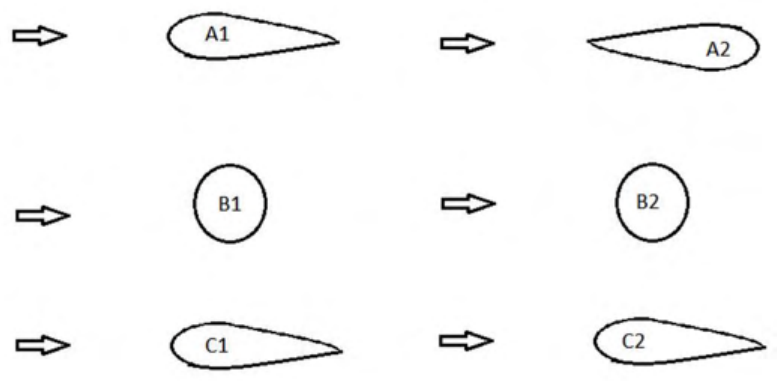
- A. (i),(iii) & (vi)
- B. (ii),(iii) & (vi)
- C. (i),(iii) & (v)
- D. (i),(iv) & (vi)
Answer: A. (i),(iii) & (vi)
Question 130
Year: 2016 | Type: NAT | Marks: 2
Consider 2-D, steady, incompressible, fully developed flow of viscous, Newtonian fluid through two stationary parallel plates, in Cartesian co-ordinate (x,y,z) system. Assume plates are very long in x-direction, wide in z-direction (also there is no variation of velocity in z direction) and distance between them is 2h. The velocity in such a channel is given as The origin y = 0 is located at the center between the plates. If h = 48 mm and , difference between values of stream functions passing through y = 0 and y = h/2 is __________ mm2/s.

Question 131
Year: 2016 | Type: NAT | Marks: 2
A pump is used to deliver water to an overhead tank at a flow rate of . The pump adds1.6 kW to water. If the density of water is 1000 kg/m3 and acceleration due to gravity is 10 m/s2, the pump head added to the flow is _________ m.

Answer: 39 to 41
Question 132
Year: 2016 | Type: NAT | Marks: 2
Water is discharged at atmospheric pressure from a large reservoir through a long pipe of diameter d and length L. The height of the free surface of the reservoir from the discharge point is h meters. The Darcy's friction factor of the pipe is 0.002. Neglect the velocity inside the reservoir as the reservoir is very large. Given, L = 20m, d = 40mm, density of water = 1000kg/m3 and flow rate is . Assume gravitational acceleration, g = 10 m/s2. The value of h is _______m.
Answer: 9.7 to 10.3
Question 133
Year: 2014 | Type: NAT | Marks: 1
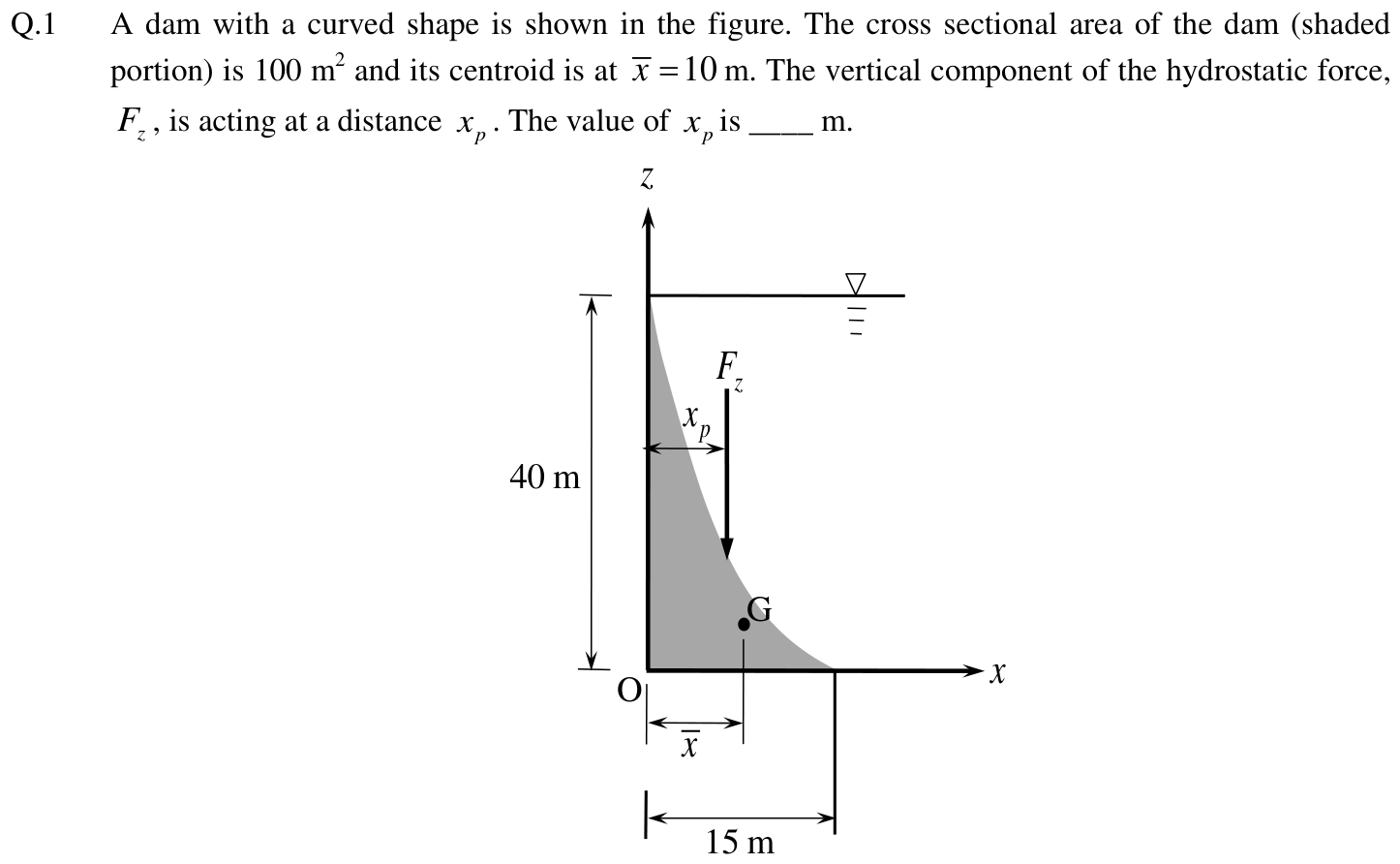
A dam with a curved shape is shown in the figure. The cross sectional area of the dam (shaded portion) is 100 m2 and its centroid is at 10 x = m. The vertical component of the hydrostatic force, zF , is acting at a distance p x . The value of p x is ____ m.
Answer: 7
Question 134
Year: 2014 | Marks: 1
For an unsteady incompressible fluid flow, the velocity field is ( ) 2 ˆ ˆ 3 3 6 V x t i xyt j = + − ρ , where x , y are in meters and t is in seconds. Acceleration in m/s2 at the point 10 x = m and 0 y = , as measured by a stationary observer is
Answer: A. 303
Question 135
Year: 2014 | Marks: 1
For an incompressible flow, the existence of components of acceleration for different types of flow is described in the table below. Type of Flow Components of Acceleration P: Steady and uniform 1: Local exists, convective does not exist Q: Steady and non-uniform 2: Both exist R: Unsteady and uniform 3: Both do not exist S: Unsteady and non-uniform 4: Local does not exist, convective exists Which one of the following options connecting the left column with the right column is correct?
- A. P – 1; Q – 4; R – 3; S – 2
- B. P – 4; Q – 1; R – 2; S – 3
- C. P – 3; Q – 2; R – 1; S – 4
- D. P – 3; Q – 4; R – 1; S – 2 15 m 40 m O G px x x z zF XE (GATE 2014)
Answer: D. P – 3; Q – 4; R – 1; S – 2 15 m 40 m O G px x x z zF XE (GATE 2014)
Question 136
Year: 2014 | Type: NAT | Marks: 1
Velocity in a two-dimensional flow field is specified as: 2 2 ; u x y v y x = = − . The magnitude of the rate of angular deformation at a location ( 2 x = m and 1 y = m) is ____ s-1.
Answer: 3
Question 137
Year: 2014 | Marks: 1
For a plane irrotational flow, equi-potential lines and streamlines are
- A. parallel to each other.
- B. at an angle of 90o to each other.
- C. at an angle of 45o to each other.
- D. at an angle of 60o to each other.
Answer: B. at an angle of 90o to each other.
Question 138
Year: 2014 | Marks: 1
Flow around a Rankine half-body is represented by the superposition of
- A. source and vortex flows.
- B. source and uniform flows.
- C. vortex and uniform flows.
- D. source, vortex and uniform flows.
Answer: B. source and uniform flows.
Question 139
Year: 2014 | Type: NAT | Marks: 1
It is required to carry out model studies on a boat having a characteristic length of 3.6 m and travelling at a speed of 3 m/s. Assume the acceleration due to gravity as 10 m/s2 and neglect the effects due to viscous and surface tension forces. The value of appropriate non-dimensional number is ____.
Answer: 0.48 to 0.52
Question 140
Year: 2014 | Marks: 1
Which one of the following velocity profiles typically represents a fully developed incompressible, turbulent flow in a pipe?
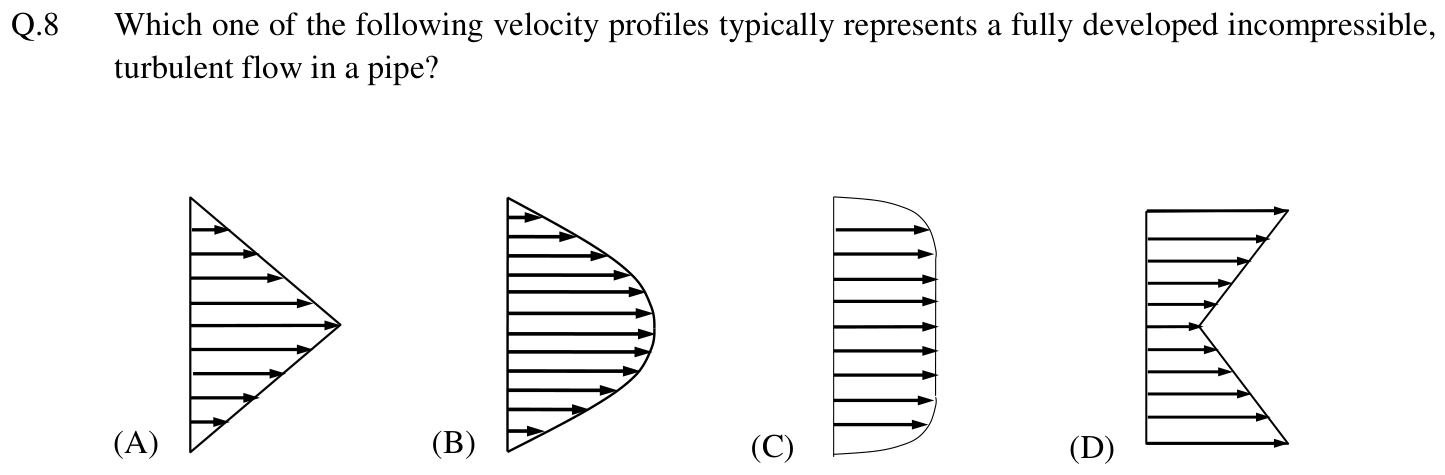
- A.
- B.
- C.
- D. XE (GATE 2014)
Answer: C.
Question 141
Year: 2014 | Marks: 1
Consider an incompressible, laminar flow past a circular cylinder of diameter d . The flow is uniform at the far upstream. Which one of the following figures typically represents the wake velocity profile just downstream of the cylinder?
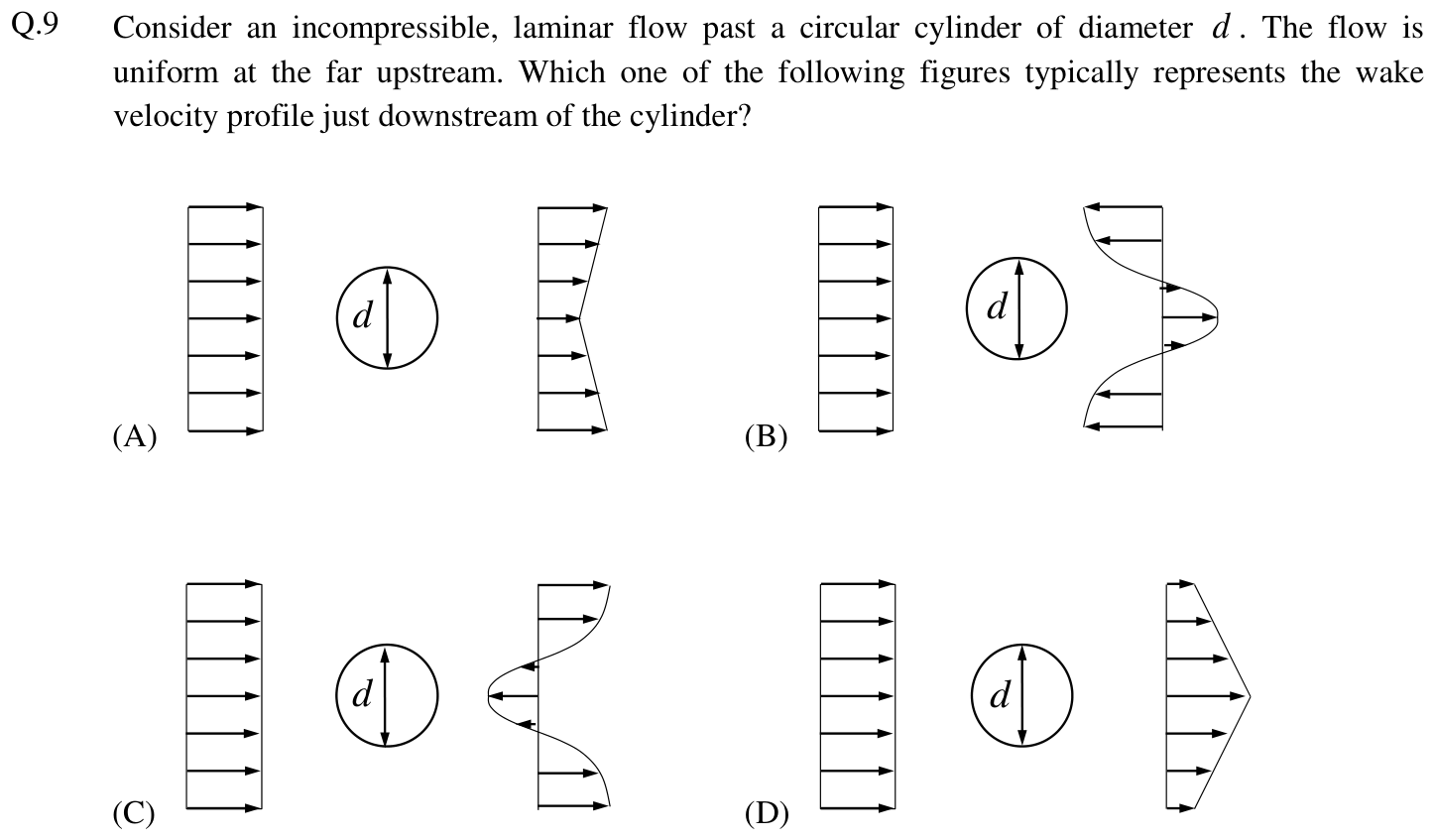
- A.
- B.
- C.
- D. d d d d XE (GATE 2014)
Answer: C.
Question 142
Year: 2014 | Marks: 2
A container of square cross-section is partially filled with a liquid of density 1 ρ . The cylinder is intended to float in another liquid of density 2 ρ as shown in the figure. The distance between metacentre and centre of buoyancy is sub I V , where I and sub V are area moment of inertia of the cross-section and submerged volume, respectively. Neglect the weight of the container. Which one of the following is the correct condition for stability?
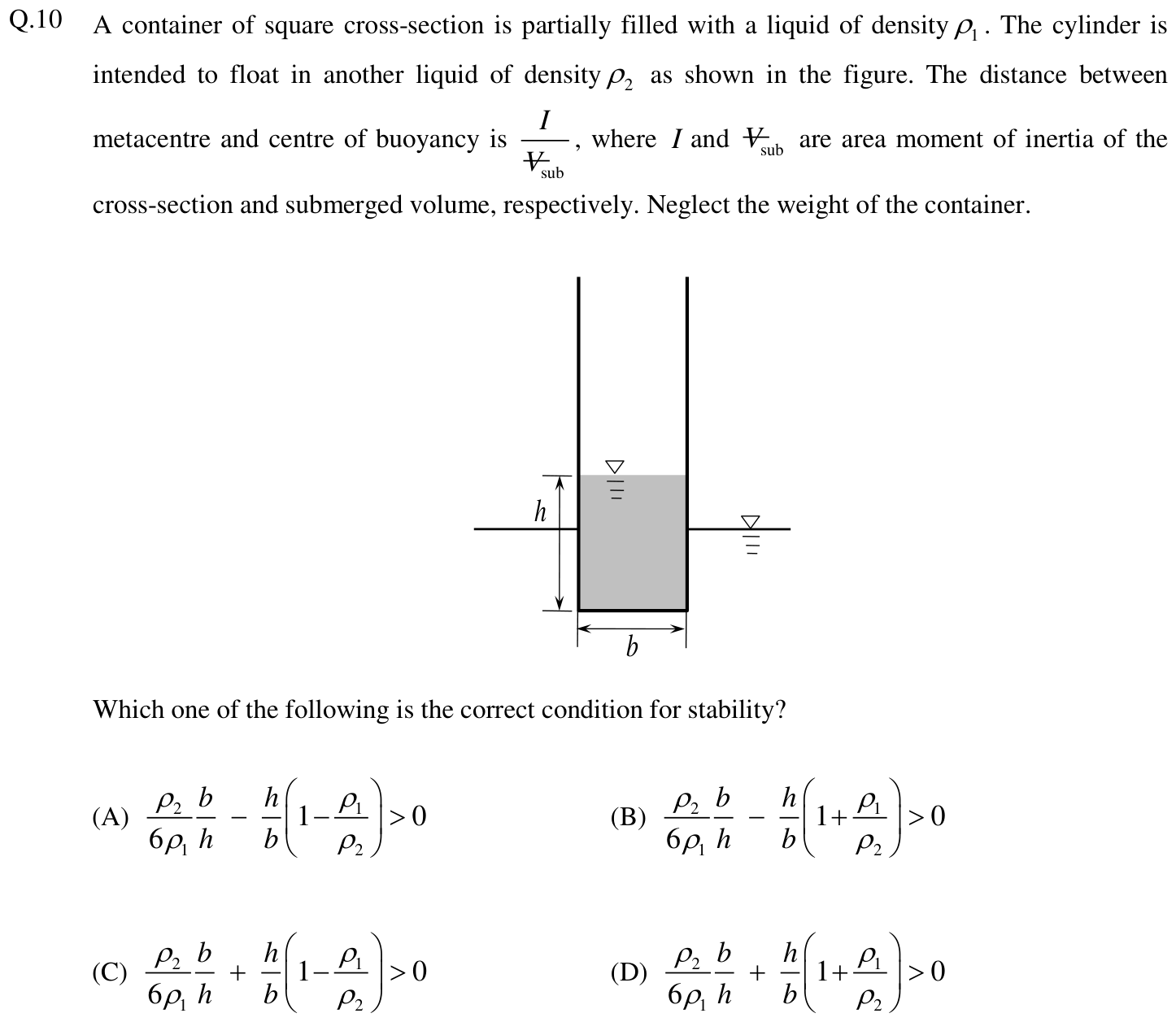
- A. 2 1 1 2 1 0 6 b h h b ρ ρ ρ ρ − − >
- B. 2 1 1 2 1 0 6 b h h b ρ ρ ρ ρ − + >
- C. 2 1 1 2 1 0 6 b h h b ρ ρ ρ ρ + − >
- D. 2 1 1 2 1 0 6 b h h b ρ ρ ρ ρ + + >
Answer: A. 2 1 1 2 1 0 6 b h h b ρ ρ ρ ρ − − >
Question 143
Year: 2014 | Marks: 2
In a steady state two-dimensional potential flow field due to a point source, the acceleration of a particle at a distance r from the point source is
- A. proportional to 1 r−.
- B. proportional to r .
- C. a constant.
- D. proportional to 3 r −.
Answer: D. proportional to 3 r −.
Question 144
Year: 2014 | Marks: 2
Velocity in a two-dimensional flow at time t and location ( ) ,x y is described as: ( ) 2 ˆ ˆ 3 1 V t i x j = + − ρ . The equation for the path line of a particle passing through the point (1,0) at 0 t = is
- A. 4 3 4 0 x y − =
- B. ( ) 3 4 1 2 0 x y − − =
- C. ( ) 4 3 1 64 0 x y − − =
- D. ( ) 4 3 1 16 0 x y + − = h b XE (GATE 2014)
Answer: C. ( ) 4 3 1 64 0 x y − − =
Question 145
Year: 2014 | Marks: 2
The gravity driven flow over a hump of height h in a canal is shown in the figure. The height of the free surface from the canal bed at upstream of the hump is H . The free surface height reduces to 1 H above the hump. Assuming the canal bed to be horizontal, the discharge per unit width is given by
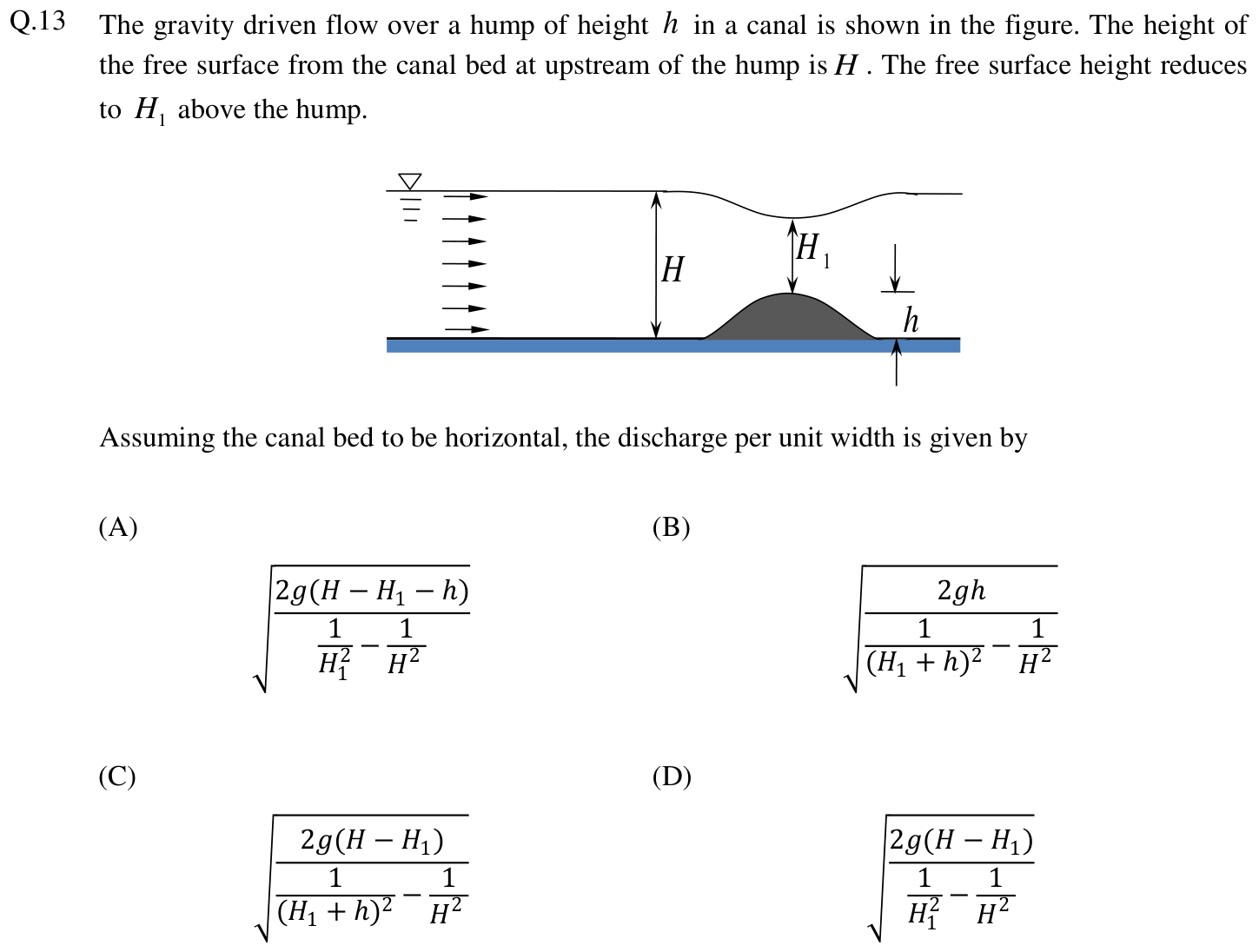
- A. ඩ 2𝑔𝑔(𝐻𝐻−𝐻𝐻1 −ℎ) 1 𝐻𝐻1 2 −1 𝐻𝐻2
- B. ඩ 2𝑔𝑔ℎ 1 (𝐻𝐻1 + ℎ)2 −1 𝐻𝐻2
- C. ඩ 2𝑔𝑔(𝐻𝐻−𝐻𝐻1) 1 (𝐻𝐻1 + ℎ)2 −1 𝐻𝐻2
- D. ඩ 2𝑔𝑔(𝐻𝐻−𝐻𝐻1) 1 𝐻𝐻1 2 −1 𝐻𝐻2
Answer: A. ඩ 2𝑔𝑔(𝐻𝐻−𝐻𝐻1 −ℎ) 1 𝐻𝐻1 2 −1 𝐻𝐻2
Question 146
Year: 2014 | Type: NAT | Marks: 2
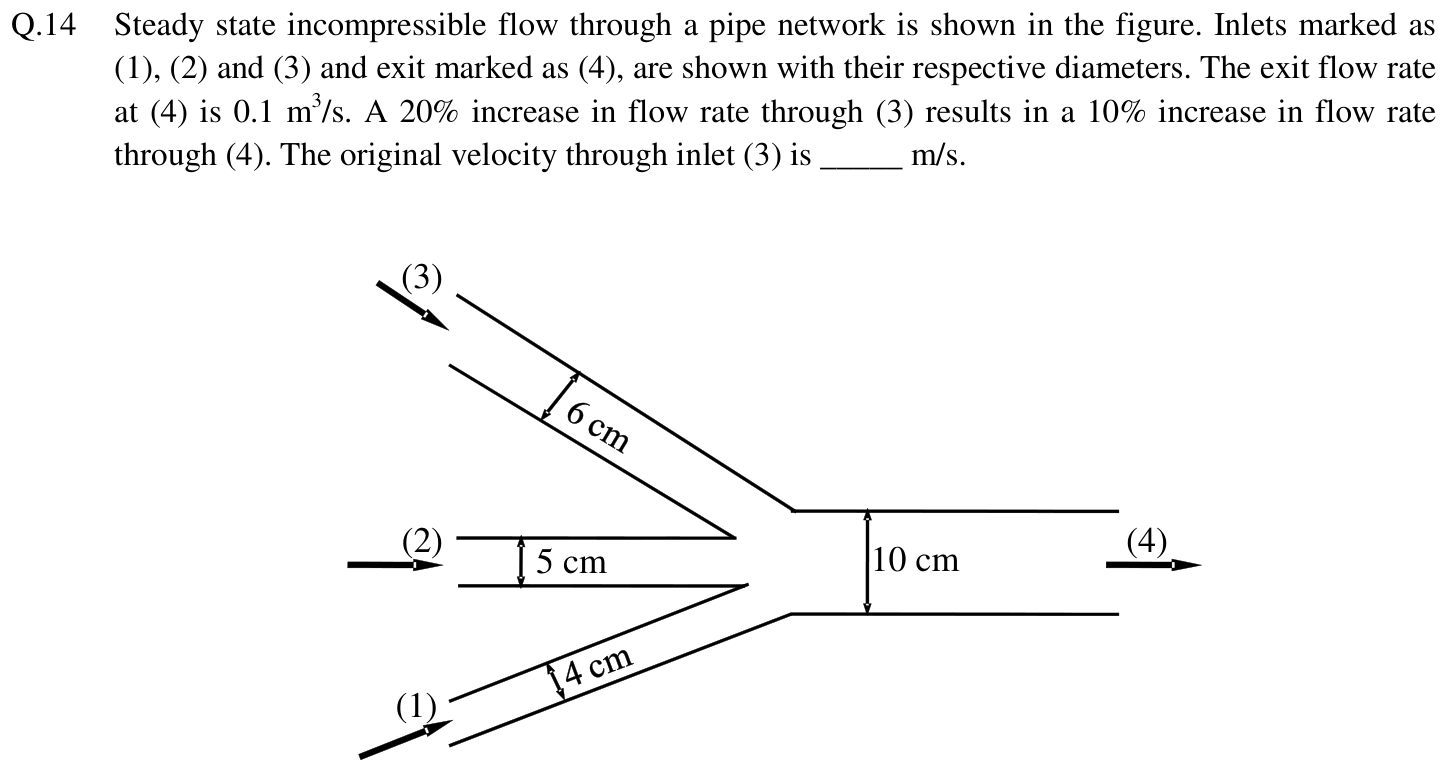
Steady state incompressible flow through a pipe network is shown in the figure. Inlets marked as (1), (2) and (3) and exit marked as (4), are shown with their respective diameters. The exit flow rate at (4) is 0.1 m3/s. A 20% increase in flow rate through (3) results in a 10% increase in flow rate through (4). The original velocity through inlet (3) is _____ m/s. H h 1 H 5 cm 10 cm (3) (2) (1) (4) XE (GATE 2014)
Answer: 17.55 to 17.75
Question 147
Year: 2014 | Type: NAT | Marks: 2
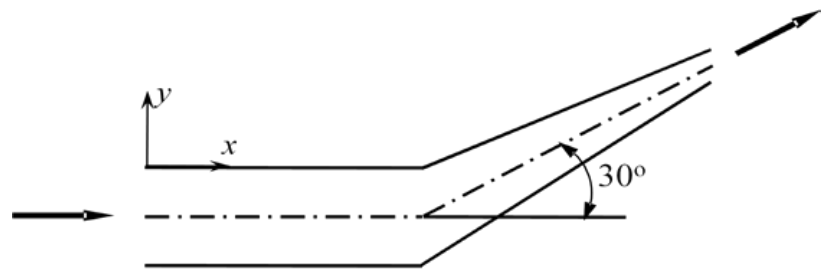
A reducing elbow is used to deflect water upward by 30o as shown in the figure. The mass flow rate at the inlet is 14 kg/s. Water is entering at a gauge pressure of 200 kPa and exits to the atmosphere. The cross-sectional area is 113 cm2 at the inlet and 7 cm2 at the exit. Density of water and acceleration due to gravity are 1000 kg/m3 and 10 m/s2, respectively. Magnitude of x - component of the water force on the elbow is ____ N.
Answer: 2033 to 2036
Question 148
Year: 2014 | Marks: 2
A source with a strength of 1k and a vortex with a strength of 2k are located at the origin. The resultant velocity at a radial distance r from the origin due to the superposition of the source and vortex is expressed as
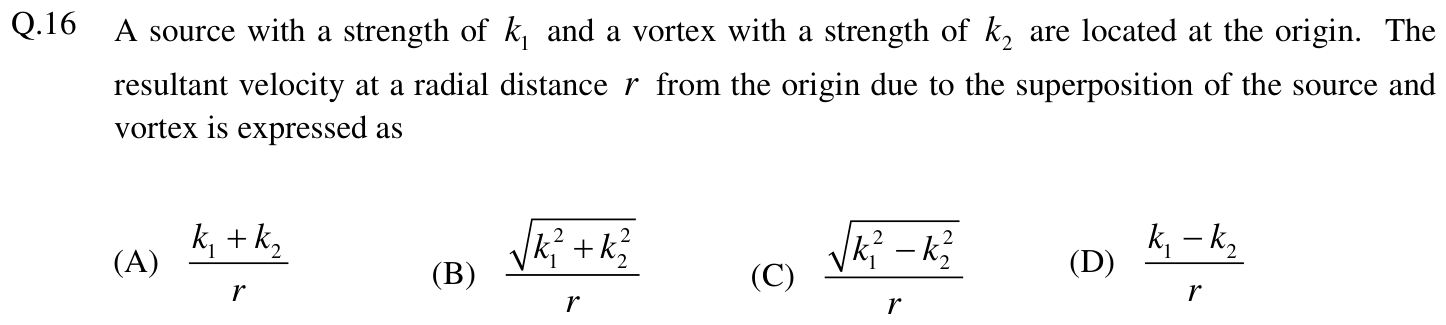
- A. 1 2 k k r +
- B. 2 2 1 2 k k r +
- C. 2 2 1 2 k k r −
- D. 1 2 k k r −
Answer: B. 2 2 1 2 k k r +
Question 149
Year: 2014 | Type: NAT | Marks: 2
Velocity potential for an incompressible fluid flow is given as: ( ) 2 2 2 2 x y y φ = + − . Assume the value of stream function at the origin to be zero. The value of stream function at [( ) ( ) , 2,2 x y ≡ ] is ____.
Answer: 8
Question 150
Year: 2014 | Type: NAT | Marks: 2
The model of a conduit is scaled to 1/100 of the actual size. Seawater is used in the prototype and fresh water is used in the model. Velocity in the prototype is 0.5 m/s. Density and dynamic viscosity of the seawater are 1025 kg/m3 and 1.07 × 10⁻³ kg/m-s, respectively. Density and dynamic viscosity of fresh water are 1000 kg/m3 and 1 × 10⁻³ kg/m-s, respectively. Assume the viscous forces to be dominant. The velocity to be maintained in the model to ensure dynamic similarity is____ m/s.
Answer: 47.52 to 48.50
Question 151
Year: 2014 | Type: NAT | Marks: 2
A fluid is flowing through a pipe of circular cross-section. Reynolds number of the flow is 1600. The head loss over a 45 m length of the pipe is 0.6 m. The average flow velocity of the fluid is 1 m/s and the acceleration due to gravity is 10 m/s2. The diameter of the pipe is ____ m. XE (GATE 2014)
Answer: 0.145 to 0.155
Question 152
Year: 2014 | Marks: 2
Consider a laminar flow over a flat plate of width w . At Section 1-1, the velocity profile is uniform as shown in the figure. The x -direction velocity profile at Section 2-2 is given by 2 2 , u y y U δ δ = − where δ is the boundary layer thickness. The volume flow rate through Section 2-2 is given by
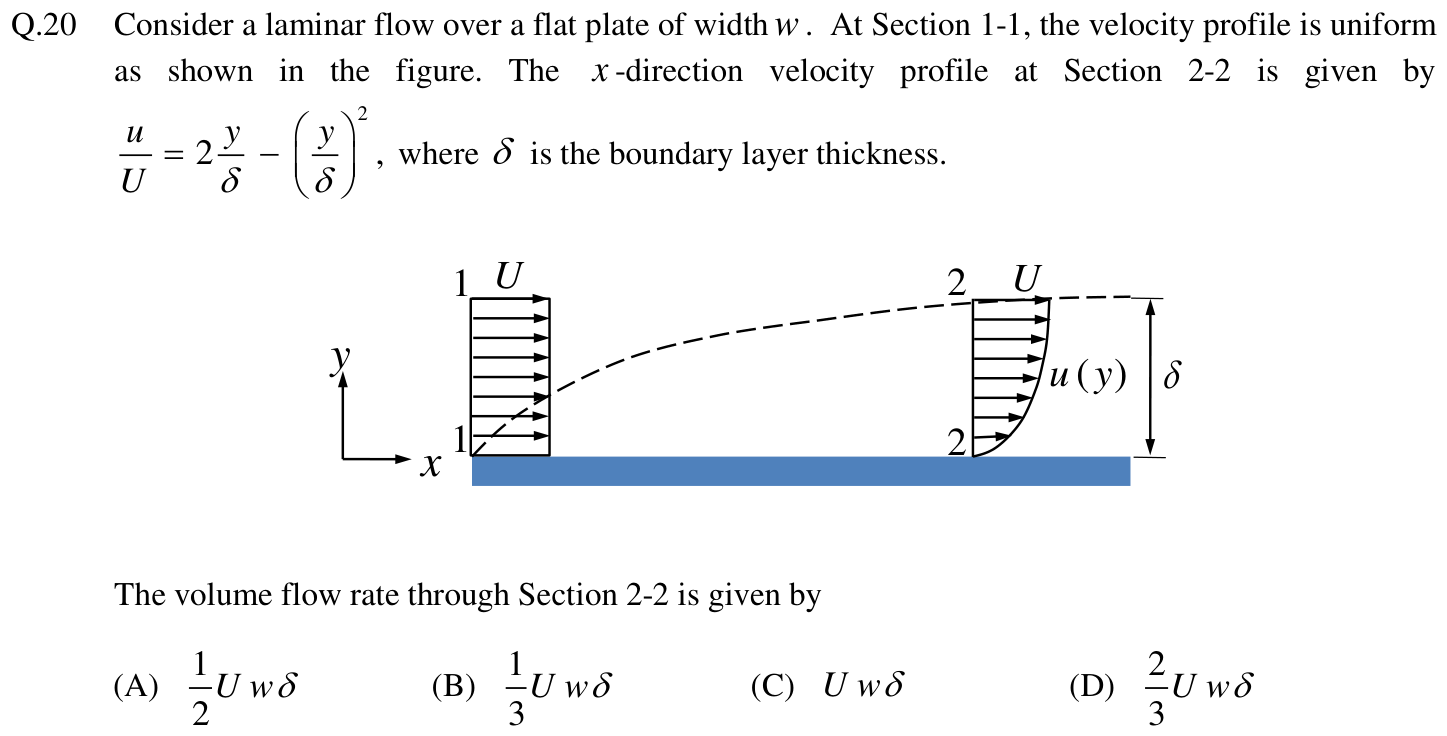
- A. 1 2U wδ
- B. 1 3U wδ
- C. U wδ
- D. 2 3U wδ
Answer: D. 2 3U wδ
Question 153
Year: 2014 | Marks: 2
A cube of weight W and side a falls at a constant speed in a medium as shown in the figure. If the medium is air (mass density =𝜌𝜌air ) let air U be the velocity of the cube. If the medium is water (mass density =𝜌𝜌water ) let water U be the velocity of the cube. Neglecting the buoyancy force and assuming drag coefficient to be same for both cases, the ratio of velocities, air water U U is given by
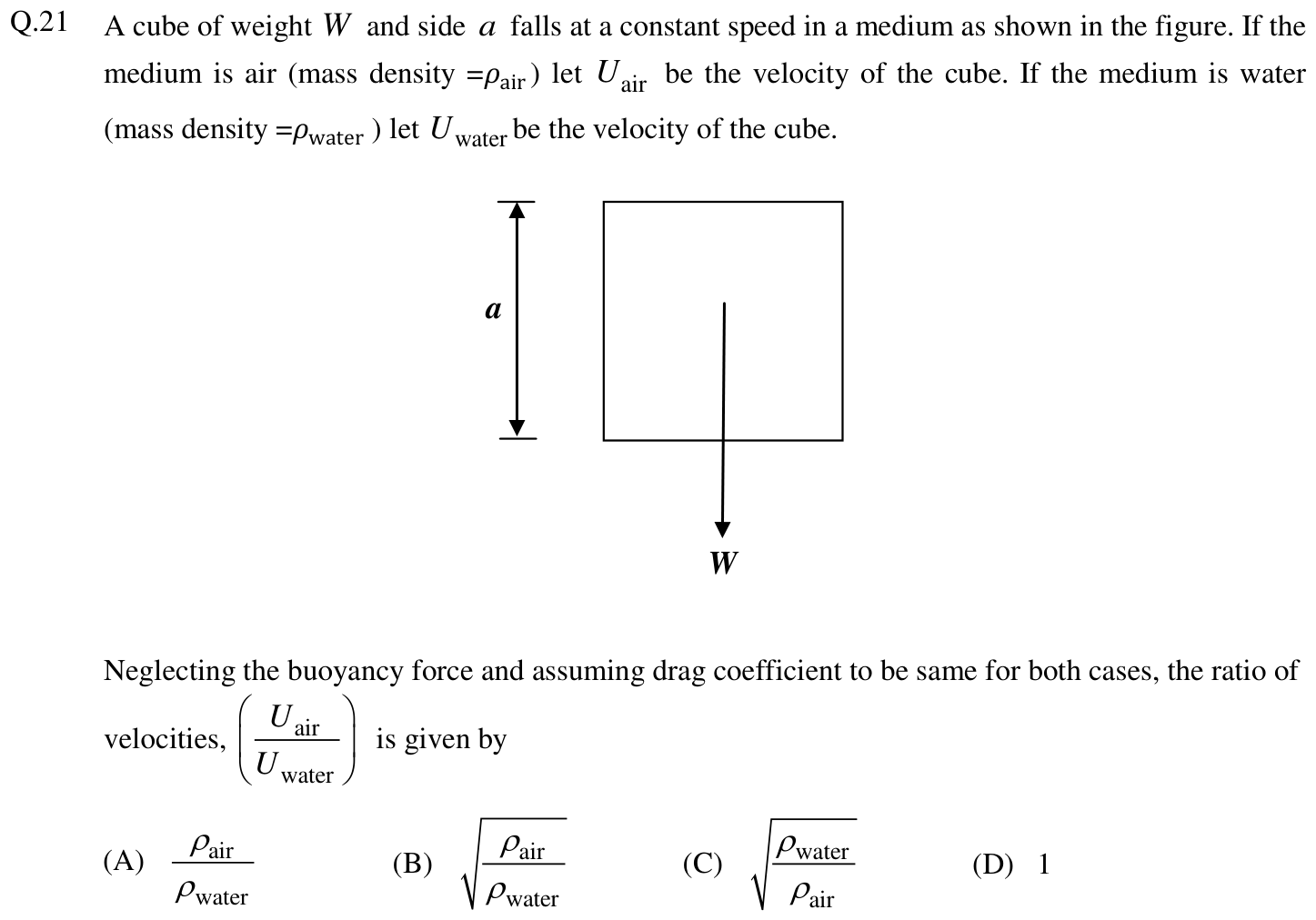
- A. air water ρ ρ
- B. air water ρ ρ
- C. water air ρ ρ
- D. 1 δ 1 1 2 2 U U ( ) u y x y a W XE (GATE 2014)
Answer: C. water air ρ ρ
Question 154
Year: 2014 | Type: NAT | Marks: 2
Water is flowing through a venturimeter having a diameter of 0.25 m at the entrance (Station 1) and 0.125 m at the throat (Station 2) as shown in the figure. A mercury manometer measures the piezometric head difference between Stations 1 and 2 as 1.3505 m. The loss of head between these two stations, is 1/7 times the velocity head at the Station 2. Assume the acceleration due to gravity to be 10 m/s2. The velocity of water at the throat is ____ m/s. • • 1 2 diameter 0.125 m diameter 0.25m Mercury Manometer XE (GATE 2014)
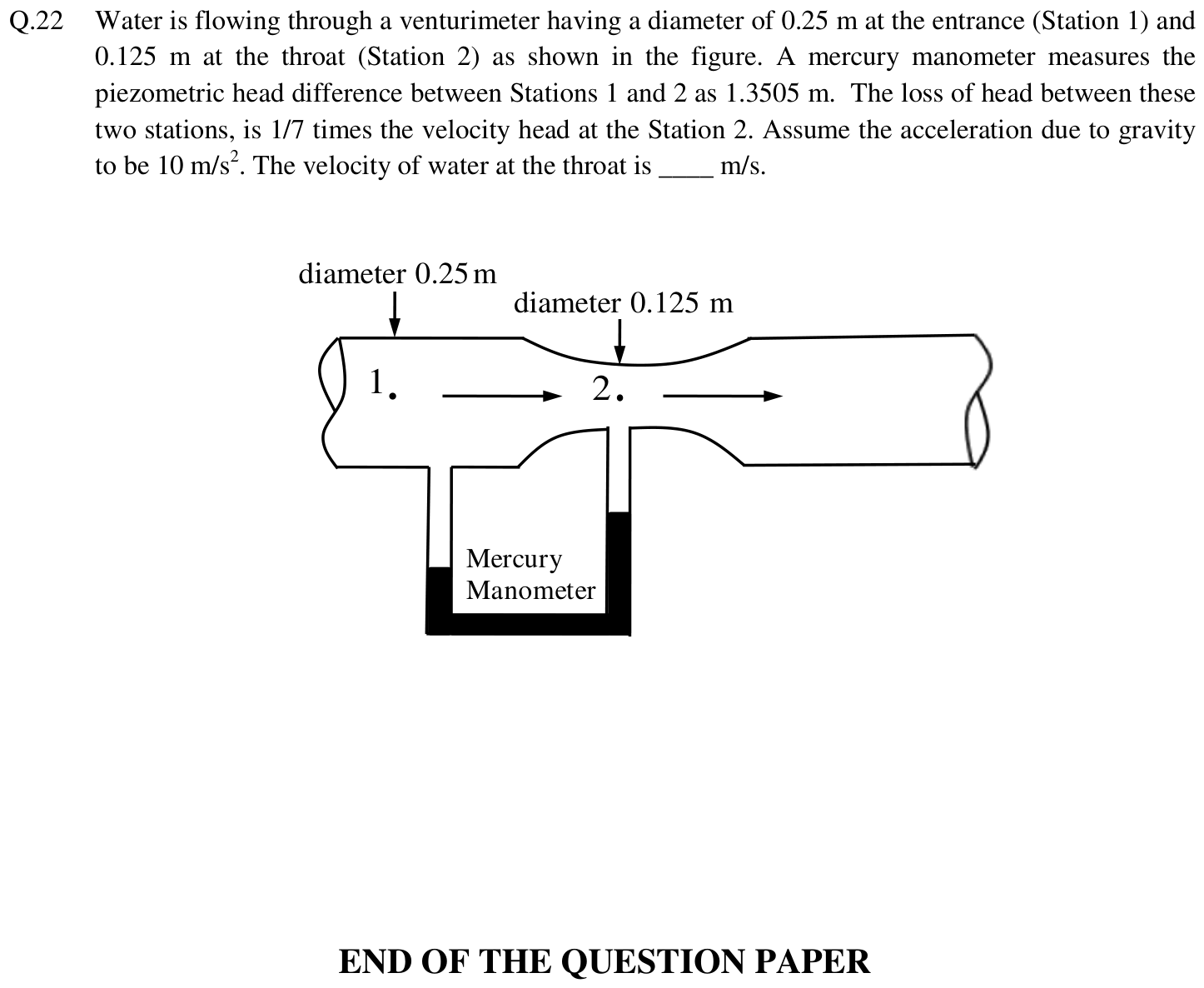
Answer: 4.8 to 5.2
Question 155
Year: 2007 | Marks: 1
A projection manometer is to be used for measuring the dynamic pressure of an airstream ($\rho = 1.2\text{ kg/m}^3$). The least count of the manometer scale is $0.1\text{ mm}$. The manometric liquid is alcohol of specific gravity $0.8$. The lowest velocity that can be measured is (Take $g = 10\text{ m/s}^2$, $\rho_w = 1000\text{ kg/m}^3$)
- A. $\sqrt{3}/2\text{ m/s}$
- B. $2/\sqrt{3}\text{ m/s}$
- C. $\sqrt{3}\text{ m/s}$
- D. $2\text{ m/s}$
Question 156
Year: 2007 | Marks: 1
The velocity of sound
- A. is a thermodynamic state variable
- B. is constant for a particular fluid
- C. depends on the velocity field for the flow
- D. depends on whether the flow is laminar or turbulent
Question 157
Year: 2007 | Marks: 1
Consider the mass balance equation $\frac{\partial u}{\partial x} + \frac{\partial v}{\partial y} = 0$. The most appropriate set of conditions for this equation to hold good is:
- A. steady or unsteady, and compressible or incompressible
- B. steady or unsteady, and compressible
- C. steady or unsteady, and incompressible
- D. steady, and compressible or incompressible
Question 158
Year: 2007 | Marks: 1
The non-dimensional number obtained from specific heat ($c_p$), thermal conductivity ($k$) and viscosity ($\mu$) is
- A. $\sqrt{k c_p}/\mu$
- B. $\sqrt{k \mu}/c_p$
- C. $k\mu/c_p$
- D. $\mu c_p/k$
Question 159
Year: 2007 | Marks: 1
For a two-dimensional turbulent boundary layer, the wall shear stress can be expressed as $\tau_w = \mu \frac{\partial u}{\partial y}\big|_{wall}$ where $u$ is the velocity parallel to the wall and $y$ is the coordinate perpendicular to the wall. In the above expression, $\mu$ denotes
- A. the molecular viscosity of the fluid
- B. the turbulent eddy viscosity
- C. an effective viscosity which is greater than the molecular viscosity
- D. an effective viscosity that is less than the molecular viscosity
Question 160
Year: 2007 | Marks: 1
Flow-separation from a solid surface may take place if the flow is
- A. viscous, in a positive streamwise pressure gradient
- B. viscous, in a negative streamwise pressure gradient
- C. inviscid, in a positive streamwise pressure gradient
- D. inviscid, in a negative streamwise pressure gradient
Question 161
Year: 2007 | Marks: 2
It is given that a solid sphere and a hollow cube have the same outer surface area. The ratio of buoyancy force on the sphere to that on the cube, when they are fully submerged in a liquid, is given by
- A. $\sqrt{\frac{2}{\pi}}$
- B. $\sqrt{\frac{4}{\pi}}$
- C. $\sqrt{\frac{6}{\pi}}$
- D. $\sqrt{\frac{8}{\pi}}$
Question 162
Year: 2007 | Marks: 2
Given that temperature $T(x,y)$ does not change along a streamline in a steady two-dimensional, incompressible flow, the equation of the streamline is obtained from
- A. $\frac{dy}{dx} = \frac{-(\frac{\partial T}{\partial x})}{(\frac{\partial T}{\partial y})}$
- B. $\frac{dy}{dx} = \frac{-(\frac{\partial T}{\partial y})}{(\frac{\partial T}{\partial x})}$
- C. $\frac{dy}{dx} = \frac{(\frac{\partial T}{\partial x})}{(\frac{\partial T}{\partial y})}$
- D. $\frac{dy}{dx} = \frac{(\frac{\partial T}{\partial y})}{(\frac{\partial T}{\partial x})}$
Question 163
Year: 2007 | Marks: 2
Consider a two-dimensional laminar boundary layer with a constant freestream velocity. For a fluid particle very close to the wall, the signs of the material acceleration components in directions parallel and perpendicular to the solid surface are, respectively
- A. + and -
- B. - and +
- C. + and +
- D. - and -
Question 164
Year: 2007 | Marks: 2
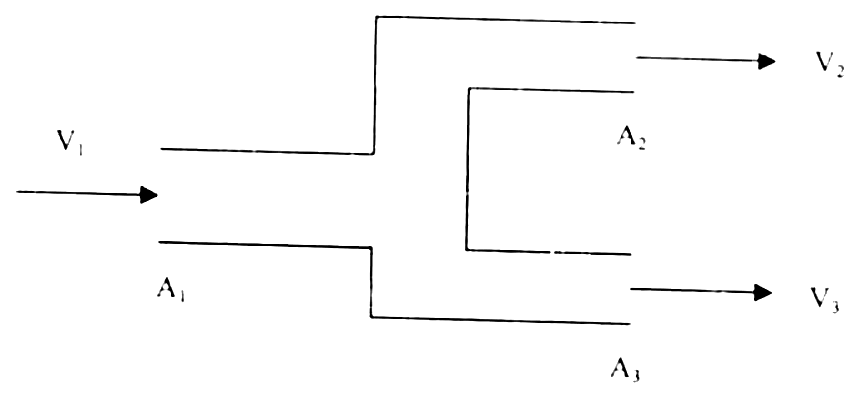
Water enters a pipe of cross-sectional area $A_1$ that branches out into sections of equal areas $A_2$ and $A_3$ as shown in the figure below. At one instant, the flow velocities are $V_1 = 2\text{ m/s}$, $V_2 = 3\text{ m/s}$ and $V_3 = 5\text{ m/s}$. At another instant, $V_1 = 3\text{ m/s}$ and $V_2 = 4\text{ m/s}$. What is the value of $V_3$ at this instant?
- A. $5\text{ m/s}$
- B. $6\text{ m/s}$
- C. $7\text{ m/s}$
- D. $8\text{ m/s}$
Question 165
Year: 2007 | Marks: 2
For a two-dimensional incompressible irrotational flow, the $x$-component of velocity $u = 2x + 3y$. The corresponding $y$-component of velocity is
- A. $2y - 3x$
- B. $2y + 3x$
- C. $-2y + 3x$
- D. $-2y - 3x$
Question 166
Year: 2007 | Marks: 2
For a certain two-dimensional steady incompressible flow, the horizontal and vertical velocity components are given by $u = 6y$, $v = 0$, where $y$ is the vertical distance. The angular velocity and rate of shear strain respectively are
- A. -3 and 3
- B. 3 and -3
- C. 3 and -6
- D. -6 and 3
Question 167
Year: 2007 | Marks: 2
In a steady two-dimensional incompressible flow, the stream function ($\psi$) obeys the equation $\frac{\partial^2 \psi}{\partial x^2} + \frac{\partial^2 \psi}{\partial y^2} = 4$. A solution of this equation is
- A. $\psi = x^2 + y^2$
- B. $\psi = y^2 - x^2$
- C. $\psi = xy$
- D. $\psi = x + y$
Question 168
Year: 2007 | Marks: 2
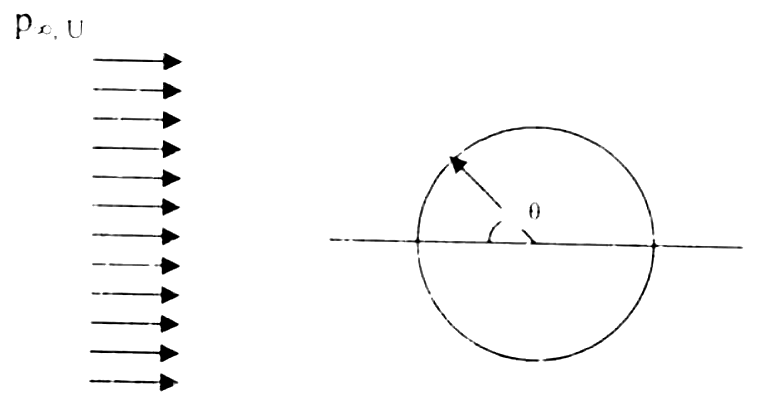
A uniform stream of an ideal fluid with velocity $U$ and pressure $p_\infty$ flows past a circular cylinder as shown in the figure below. The fluid velocity on the cylinder wall is given by $V_\theta = 2U \sin\theta$. The pressure coefficient is defined as $C_p = \frac{p - p_\infty}{0.5\rho U^2}$. The minimum value of $C_p$ on the surface of the cylinder is
Question 169
Year: 2007 | Marks: 2
A model of characteristic length $20\text{ cm}$ is built to study the flow of water ($\nu = 10^{-6}\text{ m}^2\text{/s}$) in an open channel of $5\text{ m}$ characteristic length. What should be the kinematic viscosity of the fluid used in the model?
- A. $4 \times 10^{-9}\text{ m}^2\text{/s}$
- B. $8 \times 10^{-9}\text{ m}^2\text{/s}$
- C. $4 \times 10^{-6}\text{ m}^2\text{/s}$
- D. $8 \times 10^{-6}\text{ m}^2\text{/s}$
Question 170
Year: 2007 | Marks: 2
Water flows steadily through a smooth circular tube of $5\text{ cm}$ diameter at a flow rate of $\pi\text{ kg/s}$. Take viscosity $\mu = 0.001\text{ Ns/m}^2$ and density $\rho = 1000\text{ kg/m}^3$. The Darcy friction factor is given as: $f_D = 64/Re_d$ for fully developed laminar flow and $f_D = 0.316 Re_d^{-0.25}$ for fully developed turbulent flow. The approximate pressure drop per unit length in the fully developed region of the tube is
- A. $20\text{ Pa/m}$
- B. $120\text{ Pa/m}$
- C. $480\text{ Pa/m}$
- D. $960\text{ Pa/m}$
Question 171
Year: 2007 | Marks: 2
Consider a constant pressure boundary layer over a flat plate of length $L = 3\text{ m}$. The freestream velocity is $U = 60\text{ m/s}$ and the density and viscosity of the fluid respectively are $\rho = 1.23\text{ kg/m}^3$ and $\mu = 1.79 \times 10^{-5}\text{ Ns/m}^2$. Transition occurs at a distance $x_{cr} = 0.1\text{ m}$ from the leading edge. If the freestream velocity is changed to $120\text{ m/s}$, $x_{cr}$ becomes
- A. $0.2\text{ m}$
- B. $0.1\text{ m}$
- C. $0.05\text{ m}$
- D. $0.005\text{ m}$
Question 172
Year: 2007 | Marks: 2
For a laminar boundary layer with constant freestream velocity (i.e. $dp/dx = 0$), the variation of $\partial u/\partial y$ with distance $y$ from the wall is given by
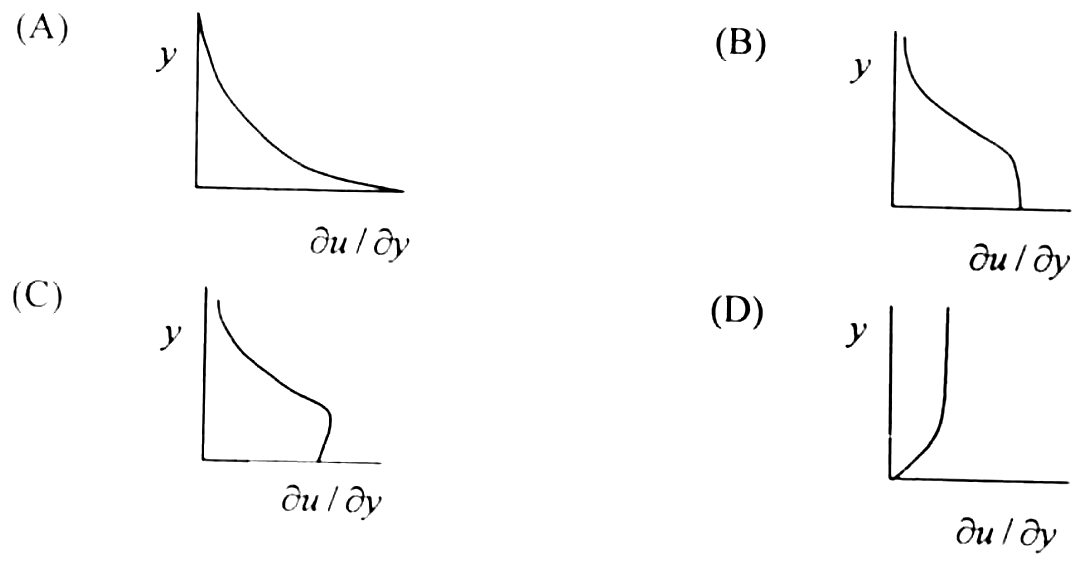
- A. Graph A
- B. Graph B
- C. Graph C
- D. Graph D
Question 173
Year: 2007 | Marks: 2
Consider the steady flow of a uniform stream past a circular cylinder, for a viscous fluid. The following two cases are compared: (I) cylinder is rotating at a slow rate about its axis (II) cylinder is not rotating. Consider the statements — P: The lift force in case I is zero; Q: The lift force in case II is zero; R: The drag force in case I is non-zero; S: The drag force in case II is zero. Which one of the following combinations is TRUE?
- A. P, Q, R
- B. P, R, S
- C. P, S
- D. Q, R
Question 174
Year: 2007 | Marks: 2
An orifice plate of $60\text{ mm}$ diameter and discharge coefficient $0.6$ is used for measuring the flow rate of air ($\rho = 1.2\text{ kg/m}^3$, $\mu = 1.8 \times 10^{-5}\text{ kg m}^{-1}\text{s}^{-1}$) through a pipe of $100\text{ mm}$ diameter. A manometer (with water as the working liquid) connected across the orifice plate reads $180\text{ mm}$. The air flow rate is approximately equal to
- A. $0.3\text{ m}^3\text{/s}$
- B. $0.1\text{ m}^3\text{/s}$
- C. $0.01\text{ m}^3\text{/s}$
- D. $0.003\text{ m}^3\text{/s}$
Question 175
Year: 2007 | Marks: 2
The velocity of an airstream ($\rho = 1.0\text{ kg/m}^3$) is to be measured using a pitot-static tube. The level difference between the two arms of the manometer is $2\text{ cm}$ of water. The velocity is
- A. $0.02\text{ m/s}$
- B. $2.0\text{ m/s}$
- C. $10\text{ m/s}$
- D. $20\text{ m/s}$
Question 176
Year: 2007 | Marks: 2
Match the items in the following columns using the most appropriate combinations: Column 1: (P) $\frac{dp}{dz} = \frac{-pg}{RT}$, (Q) Lift, (R) Stream function, (S) Compressibility. Column 2: (1) Volume flow rate, (2) Variable density atmosphere, (3) Mach Number, (4) Circulation, (5) Reynolds Number.
- A. P-3, Q-4, R-1, S-5
- B. P-1, Q-2, R-4, S-3
- C. P-4, Q-5, R-2, S-3
- D. P-2, Q-4, R-1, S-3
Question 177
Year: 2007 | Marks: 2
Common Data: A line source and a line sink, both of unit strength, are placed on the $x$-axis at $x = -1$ and $x = +1$ respectively. In terms of the Cartesian unit vectors $\mathbf{i}$ and $\mathbf{j}$, the velocity at the point $(0,1)$ is given as
- A. $0\mathbf{i} + 0\mathbf{j}$
- B. $\frac{1}{2\pi}\mathbf{i}$
- C. $\frac{1}{2\pi}\mathbf{j}$
- D. $\frac{1}{\pi}\mathbf{i}$
Question 178
Year: 2007 | Marks: 2
Common Data: A line source and a line sink, both of unit strength, are placed on the $x$-axis at $x = -1$ and $x = +1$ respectively. If the source and sink are placed in a uniform approach stream, the resulting external flow corresponds to that
- A. of a doublet
- B. over a circular cylinder
- C. over a Rankine half-body
- D. over a Rankine oval
Question 179
Year: 2007 | Marks: 2
Linked Answer Q.25 & Q.26: A motorboat is cruising in a lake (see figure below) at a uniform speed of $10\text{ m/s}$. A $180\text{ kW}$ pump sucks water at a rate $1\text{ m}^3\text{/s}$ through an inlet pipe in the front and pumps it out with a velocity of $10\text{ m/s}$ with respect to the lake, through an outlet pipe at the rear. The total drag on the boat is
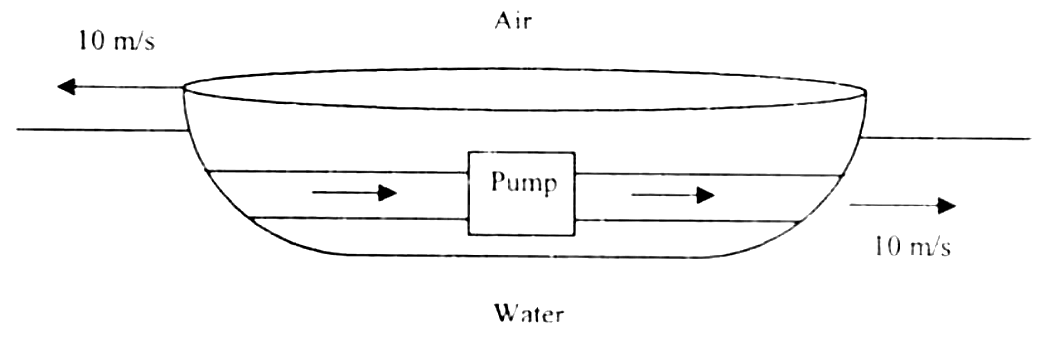
- A. 30 kN
- B. 20 kN
- C. 10 kN
- D. Zero
Question 180
Year: 2007 | Marks: 2
Linked Answer Q.25 & Q.26: A motorboat is cruising in a lake (see figure below) at a uniform speed of $10\text{ m/s}$. A $180\text{ kW}$ pump sucks water at a rate $1\text{ m}^3\text{/s}$ through an inlet pipe in the front and pumps it out with a velocity of $10\text{ m/s}$ with respect to the lake, through an outlet pipe at the rear. The power utilized for propelling the boat is
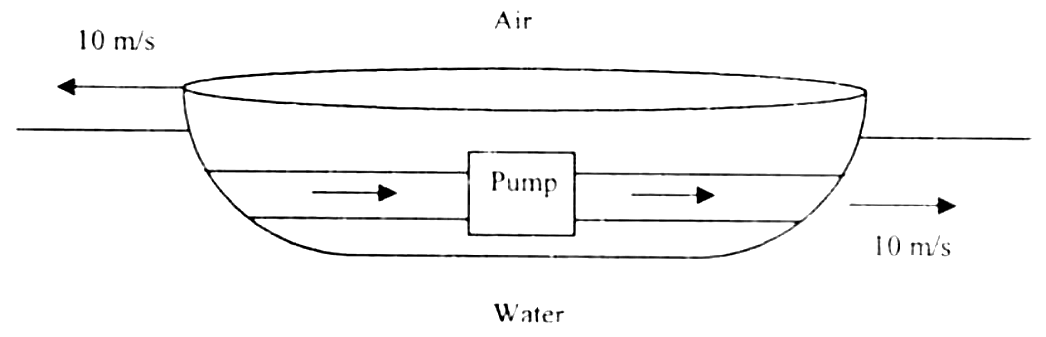
- A. 130 kW
- B. 100 kW
- C. 80 kW
- D. 30 kW
Question 181
Year: 2007 | Marks: 2
Linked Answer Q.27 & Q.28: Consider a fully developed laminar flow in a pipe of radius $R$ in which $r$ and $x$ represent the radial and axial co-ordinates respectively. The axial velocity distribution is $u(r) = \left(\frac{-R^2}{4\mu}\frac{dp}{dx}\right)\left(1 - \frac{r^2}{R^2}\right)$ and the average axial velocity is $u_m = \left(\frac{-R^2}{8\mu}\frac{dp}{dx}\right)$. The magnitude of shear stress on the wall ($\tau_{wall}$) is
- A. $\frac{32\mu}{\rho u_m R}$
- B. $\frac{4\mu u_m}{R}$
- C. $\frac{\mu u_m}{R}$
- D. $-\frac{R^2}{4}\frac{d^2p}{dx^2}$
Question 182
Year: 2007 | Marks: 2
Linked Answer Q.27 & Q.28: Consider a fully developed laminar flow in a pipe of radius $R$ in which $r$ and $x$ represent the radial and axial co-ordinates respectively. The axial velocity distribution is $u(r) = \left(\frac{-R^2}{4\mu}\frac{dp}{dx}\right)\left(1 - \frac{r^2}{R^2}\right)$ and the average axial velocity is $u_m = \left(\frac{-R^2}{8\mu}\frac{dp}{dx}\right)$. The local friction factor $C_f = \frac{\tau_{wall}}{0.5\rho u_m^2}$, with $\gamma = -\frac{dp}{dx}$ is given by
- A. $\frac{16\mu^2}{\rho R^3 \gamma}$
- B. $\frac{24\mu^2}{\rho R^3 \gamma}$
- C. $-\frac{R^2}{2\rho u_m^2}\frac{d^2p}{dx^2}$
- D. $\frac{64\mu^2}{\rho R^3 \gamma}$