GATE XE (Engineering Sciences) 2025 Question Paper & Solutions
Attempt the GATE XE (Engineering Sciences) 2025 previous year paper in real CBT exam mode or practice mode with the official answer key. Step-by-step explanations are coming soon.
All GATE XE (Engineering Sciences) papers
87 questions.
General Aptitude
Question 1
Marks: 1
Even though I had planned to go skiing with my friends, I had to __________ at the last moment because of an injury. Select the most appropriate option to complete the above sentence.
- A. back up
- B. back of
- C. back on
- D. back out
Answer: D. back out
Question 2
Marks: 1
The President, along with the Council of Ministers, ___________ to visit India next week. Select the most appropriate option to complete the above sentence.
- A. wish
- B. wishes
- C. will wish
- D. is wishing
Answer: B. wishes
Question 3
Marks: 1
An electricity utility company charges ₹ 7 per kWh (kilo watt-hour). If a 40-watt desk light is left on for 10 hours each night for 180 days, what would be the cost of energy consumption? If the desk light is on for 2 more hours each night for the 180 days, what would be the percentage-increase in the cost of energy consumption?
- A. ₹ 604.8; 10%
- B. ₹ 504; 20%
- C. ₹ 604.8; 12%
- D. ₹ 720; 15%
Answer: B. ₹ 504; 20%
Question 4
Marks: 1
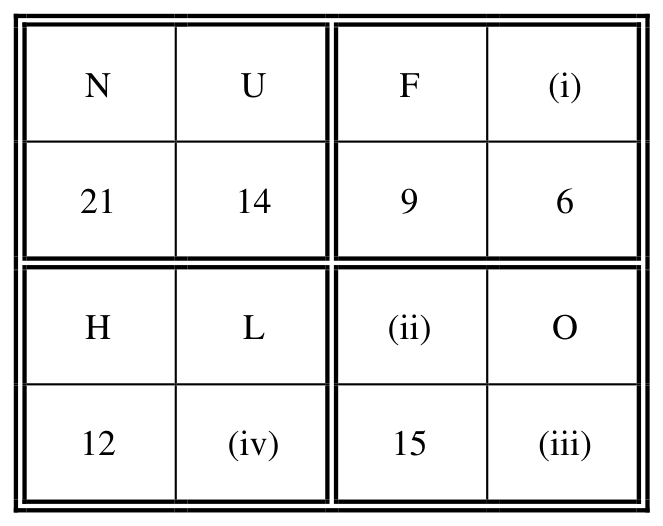
In the context of the given figure, which one of the following options correctly represents the entries in the blocks labelled (i), (ii), (iii), and (iv), respectively? N U F (i) 21 14 9 6 H L (ii) O 12 (iv) 15 (iii)
- A. Q, M, 12, and 8
- B. K, L, 10 and 14
- C. I, J, 10, and 8
- D. L, K, 12 and 8
Answer: C. I, J, 10, and 8
Question 5
Marks: 1
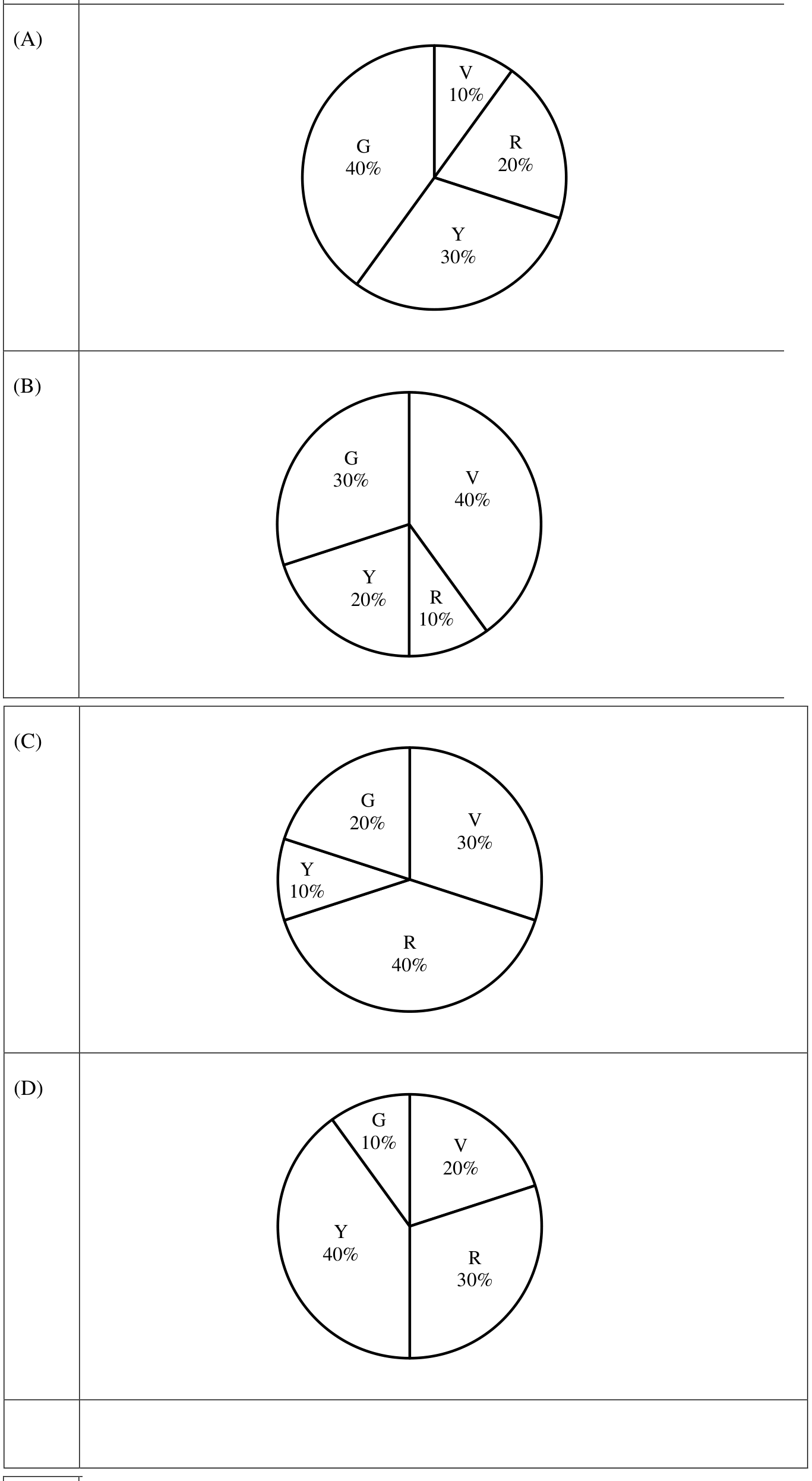
A bag contains Violet (V), Yellow (Y), Red (R), and Green (G) balls. On counting them, the following results are obtained: (i) The sum of Yellow balls and twice the number of Violet balls is 50. (ii) The sum of Violet and Green balls is 50. (iii) The sum of Yellow and Red balls is 50. (iv) The sum of Violet and twice the number of Red balls is 50. Which one of the following Pie charts correctly represents the balls in the bag?
- A.
- B. V 10% R 20% Y 30% G 40% V 40% R 10% Y 20% G 30%
- C.
- D. V 30% R 40% Y 10% G 20% V 20% R 30% Y 40% G 10%
Answer: A.
Question 6
Marks: 2
“His life was divided between the books, his friends, and long walks. A solitary man, he worked at all hours without much method, and probably courted his fatal illness in this way. To his own name there is not much to show; but such was his liberality that he was continually helping others, and fruits of his erudition are widely scattered, and have gone to increase many a comparative stranger’s reputation.” (From E.V. Lucas’s “A Funeral”) Based only on the information provided in the above passage, which one of the following statements is true?
- A. The solitary man described in the passage is dead.
- B. Strangers helped create a grand reputation for the solitary man described in the passage.
- C. The solitary man described in the passage found joy in scattering fruits.
- D. The solitary man worked in a court where he fell ill.
Answer: A. The solitary man described in the passage is dead.
Question 7
Marks: 2
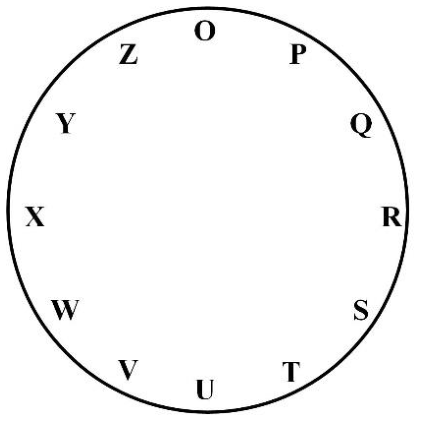
For the clock shown in the figure, if O* = O Q S Z P R T, and X* = X Z P W Y O Q , then which one among the given options is most appropriate for P* ?
- A. P U W R T V X
- B. P R T O Q S U
- C. P T V Q S U W
- D. P S U P R T V
Answer: B. P R T O Q S U
Question 8
Marks: 2
Consider a five-digit number 𝑃𝑄𝑅𝑆𝑇 that has distinct digits 𝑃, 𝑄, 𝑅, 𝑆, and 𝑇, and satisfies the following conditions: 𝑃< 𝑄 𝑆> 𝑃> 𝑇 𝑅< 𝑇 If integers 1 through 5 are used to construct such a number, the value of 𝑃 is:
Answer: C. 3
Question 9
Marks: 2
A business person buys potatoes of two different varieties P and Q, mixes them in a certain ratio and sells them at ₹ 192 per kg. The cost of the variety P is ₹ 800 for 5 kg. The cost of the variety Q is ₹ 800 for 4 kg. If the person gets 8% profit, what is the P:Q ratio (by weight)?
Answer: A. 5:4
Question 10
Marks: 2
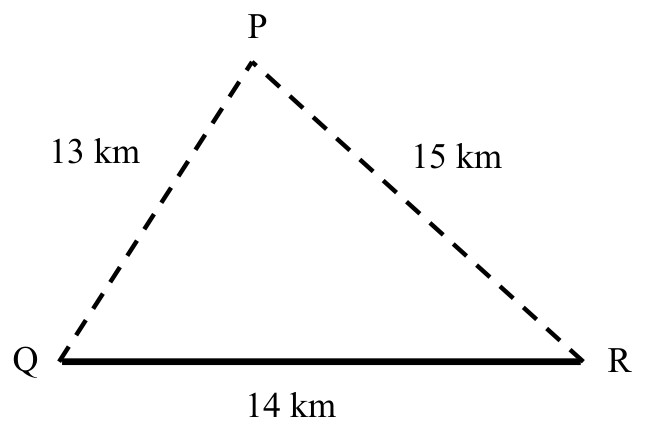
Three villages P, Q, and R are located in such a way that the distance PQ = 13 km, QR = 14 km, and RP = 15 km, as shown in the figure. A straight road joins Q and R. It is proposed to connect P to this road QR by constructing another road. What is the minimum possible length (in km) of this connecting road? Note: The figure shown is representative.
- A. 10.5
- B. 11.0
- C. 12.0
- D. 12.5 P Q R 14 km 13 km 15 km
Answer: C. 12.0
Engineering Mathematics
Question 11
Marks: 1
Let 𝑋 and 𝑌 be two random variables with mean 0, variance 1, and correlation coefficient 1 3 . Then the value of Var(𝑋+ 3𝑌) is equal to
Answer: D. 12
Question 12
Marks: 1
Consider the second order Partial Differential Equation (PDE) 4𝑥2 𝜕2𝑢 𝜕𝑥2 + 4(𝑥+ 𝑦) 𝜕2𝑢 𝜕𝑥𝜕𝑦+ (𝑥2 + 𝑦2) 𝜕2𝑢 𝜕𝑦2 − 𝑢= 0. Then which one of the following statements is correct ?
- A. The PDE is hyperbolic in the region {(𝑥, 𝑦) ∈ℝ2: −1 < 𝑥< 0, 𝑦< 0}
- B. The PDE is hyperbolic in the region {(𝑥, 𝑦) ∈ℝ2: 1 < 𝑥< ∞, 𝑦< 0}
- C. The PDE is elliptic in the region {(𝑥, 𝑦) ∈ℝ2: 0 < 𝑥< 1, 𝑦> 0}
- D. The PDE is parabolic in the region {(𝑥, 𝑦) ∈ℝ2: 1 < 𝑥< ∞, 𝑦< 0}
Answer: A. The PDE is hyperbolic in the region {(𝑥, 𝑦) ∈ℝ2: −1 < 𝑥< 0, 𝑦< 0}
Question 13
Marks: 1
Consider the infinite series (𝑃): ∑ 1 (𝑛log 𝑛)1/𝑛 ∞ 𝑛=2 (𝑄): ∑𝑛𝑛 (2𝑛)! ∞ 𝑛=1 Then which one of the following statements is correct ?
- A. Series (𝑃) and (𝑄) both converge
- B. Series (𝑃) converges and series (𝑄) diverges
- C. Series (𝑃) and (𝑄) both diverge
- D. Series (𝑃) diverges and series (𝑄) converges
Answer: D. Series (𝑃) diverges and series (𝑄) converges
Question 14
Marks: 1
Suppose the polynomial 𝑎+ 𝑏𝑥+ 𝑐𝑥2 + 𝑑𝑥3 interpolates the data, (−1, 1), (0, 3), (1, 2) and (2, 4). Then which one of the following statements is correct ?
- A. 𝑎= −2𝑐, 𝑑= −2𝑏
- B. 𝑎= 2𝑐, 𝑑= 2𝑏
- C. 𝑏= 3𝑐, 𝑎= 2𝑑
- D. 𝑏= 2𝑐, 𝑎= 3𝑑
Answer: A. 𝑎= −2𝑐, 𝑑= −2𝑏
Question 15
Marks: 1
Let 𝐶 be the positively oriented boundary of the domain bounded by the curves 𝑦= 2𝑥2 and 𝑦2 = 4𝑥. Then the value of the line integral ∮(2𝑦2 + 2𝑥𝑦+ 4𝑦)𝑑𝑥+ (𝑥2 + 4𝑥𝑦+ 8𝑥)𝑑𝑦 𝐶 is equal to
Answer: A. 8 3
Question 16
Type: NAT | Marks: 1
Let 𝑦(𝑥) be the solution of the initial value problem, 𝑥2𝑦′′ + 𝑥𝑦′ −𝑦= 0, 𝑥> 0, 𝑦(1) = 0, 𝑦′(1) = 2. Then the value of 𝑦′ ( 1 2) is equal to (Answer in integer) _______
Answer: 5
Question 17
Type: NAT | Marks: 1
Suppose that 2 is an eigenvalue of the matrix [ 0 3 −𝛼 0 1 0 1 −1 3 ] Then the value of 𝛼 is equal to (Answer in integer) __________
Answer: 2
Question 18
Marks: 2
Let 𝑓(𝑧) be an analytic function such that 𝑅𝑒(𝑓′(𝑧)) = 3𝑥2 −4𝑦−3𝑦2, 𝑓(𝑖) = 0, 𝑓′(0) = 0, where 𝑖= √−1. Then the value of 𝑓(1) is equal to
- A. 4 + 2𝑖
- B. 1 + 5𝑖
- C. 1 −𝑖
- D. 4 −2𝑖
Answer: B. 1 + 5𝑖
Question 19
Marks: 2
Consider the function 𝑓(𝑥, 𝑦) = 𝑥2𝑦+ 2𝑥𝑦2 −2𝑥2𝑦2. Then which one of the following statements is correct ?
- A. ( 3 2 , 0) is a point of local maxima of 𝑓.
- B. (0, 3 4) is a point of local minima of 𝑓.
- C. ( 3 2 , 3 4) is a point of local maxima of 𝑓.
- D. ( 3 2 , 3 4) is a saddle point of 𝑓.
Answer: D. ( 3 2 , 3 4) is a saddle point of 𝑓.
Question 20
Type: MSQ | Marks: 2
For 𝑎, 𝑏∈ℝ, consider the system of linear equations 𝑥+ 𝑦+ 𝑎𝑧= 2 2𝑦+ 2𝑧= 1 𝑎𝑥+ 2𝑧= 𝑏 If the system has infinitely many solutions, then which of the following statements is/are correct ?
- A. 𝑎= 2, 𝑏= 3
- B. 𝑎= 2, 𝑏= 5
- C. 𝑎= −1, 𝑏= − 3 2
- D. 𝑎= 3, 𝑏= 5
Answer: A. 𝑎= 2, 𝑏= 3; C. 𝑎= −1, 𝑏= − 3 2
Question 21
Type: NAT | Marks: 2
Let 𝑢(𝑥, 𝑡) be the solution of the initial boundary value problem 𝜕𝑢 𝜕𝑡−𝜕2𝑢 𝜕𝑥2 −𝑢= 0, 0 < 𝑥< 𝜋, 𝑡> 0, 𝑢(𝑥, 0) = 2 sin (3𝑥 2 ) cos (𝑥 2) , 0 < 𝑥< 𝜋, 𝑢(0, 𝑡) = 𝑢(𝜋, 𝑡) = 0, 𝑡> 0. Then the value of lim 𝑡→∞𝑢( 3𝜋 4 , 𝑡) is equal to (rounded off to two decimal places)___________
Answer: 0.68 to 0.73
Fluid Mechanics
Question 22
Marks: 1
Fluid at a constant flow rate passes through a long, straight, cylindrical pipe that has an axisymmetric convergent section at the end. Which one of the following options correctly represents the velocity field in the converging section in cylindrical (𝑟, 𝜃, 𝑧) coordinates?
- A. Two-dimensional function of 𝑟 and 𝑧
- B. One-dimensional function of 𝑟
- C. Two-dimensional function of 𝑟 and 𝜃
- D. One-dimensional function of 𝑧
Answer: A. Two-dimensional function of 𝑟 and 𝑧
Question 23
Marks: 1
A sharp flat plate of length L and infinite width is immersed parallel to a fluid stream having velocity 𝑢∞. At a point on the plate, far away from the leading edge and not near the trailing edge, the boundary layer thickness, the displacement thickness, and the momentum thickness are denoted as 𝛿, 𝛿∗, and 𝜃, respectively. Which one of the following options correctly represents the relation between these thicknesses?
- A. 𝛿> 𝛿∗> 𝜃
- B. 𝛿> 𝜃> 𝛿∗
- C. 𝛿∗> 𝛿> 𝜃
- D. 𝜃> 𝛿∗> 𝛿
Answer: A. 𝛿> 𝛿∗> 𝜃
Question 24
Marks: 1
Consider the following Statements [1] and [2]. Statement [1]: The Eulerian study focusses attention on individual particle and its motion is observed as a function of time. Statement [2]: The Lagrangian study focusses attention on the motion of the particles passing through an identified point. Which one of the following options identifies the correctness of the given statements?
- A. Both [1] and [2] are correct.
- B. Both [1] and [2] are NOT correct.
- C. [1] is correct, but [2] is NOT correct.
- D. [1] is NOT correct, but [2] is correct.
Answer: B. Both [1] and [2] are NOT correct.
Question 25
Marks: 1
Statement of Reynolds Transport Theorem is given below with three blanks. The rate of change of ________ extensive property can be calculated by summing the rate of change of the amount of same property in the ________ and the rate at which the property is ________ the surface of the control volume. Which one of the following options correctly fills the blanks by using its comma-separated phrases in sequence?
- A. system, control volume, exiting
- B. control volume, system, exiting
- C. system, control volume, entering
- D. control volume, control volume, entering
Answer: A. system, control volume, exiting
Question 26
Marks: 1
For a steady and incompressible flow, the velocity field (𝑉⃗ ) in Cartesian (𝑥, 𝑦, 𝑧) coordinate system is given as: 𝑉⃗ = 5𝑥𝑖−𝑃𝑦𝑗+ 3𝑘 Here, 𝑖, 𝑗, and 𝑘 are unit vectors along x, y, and z directions, respectively and 𝑃 is a constant. Which one of the following options is the correct value of 𝑃 that satisfies the conservation of mass for the given velocity field?
Answer: A. 5
Question 27
Marks: 1
Conservation of mass for a steady axisymmetric flow field in the cylindrical (r, z) coordinates is: 1 𝑟 𝜕(𝑟𝑉𝑟) 𝜕𝑟 + 𝜕𝑉𝑧 𝜕𝑧= 0 Here, 𝑉𝑟 and 𝑉𝑧 are radial and axial components of velocity, respectively. Which one of the following options is correct if 𝜓 is the stream function?
- A. 𝑉𝑟= 𝜕𝜓 𝜕𝑧 and 𝑉𝑧= − 1 𝑟 𝜕𝜓 𝜕𝑟
- B. 𝑉𝑟= 1 𝑟 𝜕𝜓 𝜕𝑧 and 𝑉𝑧= − 1 𝑟 𝜕𝜓 𝜕𝑟
- C. 𝑉𝑟= 1 𝑟 𝜕𝜓 𝜕𝑧 and 𝑉𝑧= 1 𝑟 𝜕𝜓 𝜕𝑟
- D. 𝑉𝑟= 1 𝑟 𝜕𝜓 𝜕𝑧 and 𝑉𝑧= − 𝜕𝜓 𝜕𝑟
Answer: B. 𝑉𝑟= 1 𝑟 𝜕𝜓 𝜕𝑧 and 𝑉𝑧= − 1 𝑟 𝜕𝜓 𝜕𝑟
Question 28
Marks: 1
Group-I indicates different properties of fluid and Group-II defines their basic dimensions in terms of Force (𝐹), Length (𝐿), and Time (𝑇). Group-I Group-II P Dynamic viscosity 1 𝐹𝐿−4𝑇2 Q Surface tension 2 𝐹𝐿−2𝑇 R Density 3 𝐹𝐿−1 Which one of the following options identifies the correct match between Group-I and Group-II?
- A. P−1, Q−3, R−2
- B. P−2, Q−1, R−3
- C. P−3, Q−2, R−1
- D. P−2, Q−3, R−1
Answer: D. P−2, Q−3, R−1
Question 29
Marks: 1
Consider the steady, incompressible, and fully developed laminar flow of a fluid through a circular pipe. Here, ∆𝑃 is the pressure drop in the direction of the flow and 𝑉 is the average axial velocity of the fluid at any cross-section. The relation between ∆𝑃 and 𝑉 is: ∆𝑃= 𝐾 𝑉𝑛 Here, 𝐾 and 𝑛 are constants. Which one of the following options is the correct value of 𝑛?
Answer: A. 1
Question 30
Marks: 1
A doublet is the resulting flow pattern when a sink and a source of equal strength are brought together. Which one of the following options correctly represents the nature of the product of the strength and the distance between them during approach?
- A. Remains always constant
- B. Continuously decreases
- C. Continuously increases
- D. First increases and then continuously decreases after reaching a maximum
Answer: A. Remains always constant
Question 31
Marks: 2
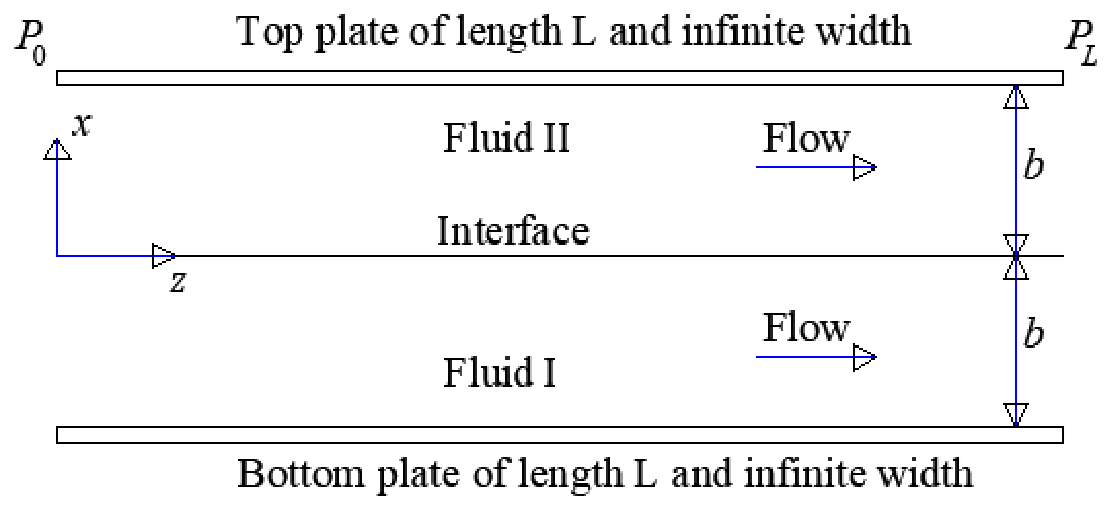
Figure shows two parallel plates (upper plate at 𝑥= 𝑏 and lower one at 𝑥= −𝑏) of length L (aligned in 𝑧 direction) and infinite width (in 𝑦 direction, normal to the plane of the figure). Two immiscible, incompressible liquids are flowing steadily in the 𝑧 direction through the thin passage between the plates under the influence of horizontal pressure gradient (𝑃0 −𝑃𝐿) L ⁄ . During the flow, the passage is always half-filled with denser fluid I (viscosity 𝜇𝐼) at the bottom and rest is occupied by lighter fluid II (viscosity 𝜇𝐼𝐼; 𝜇𝐼𝐼< 𝜇𝐼). Considering exactly planar interface between the fluids and no instabilities in the flow, the shear stress, 𝜏𝑥𝑧 is expressed as: 𝜏𝑥𝑧= (𝑃0 −𝑃𝐿)𝑏 L [(𝑥 𝑏) −1 2 (𝜇𝐼−𝜇𝐼𝐼 𝜇𝐼+ 𝜇𝐼𝐼)] Which one of the following options correctly identifies the location of the point having maximum velocity of the flow?
- A. Above the interface
- B. Below the interface
- C. At the interface
- D. At the top plate
Answer: A. Above the interface
Question 32
Marks: 2
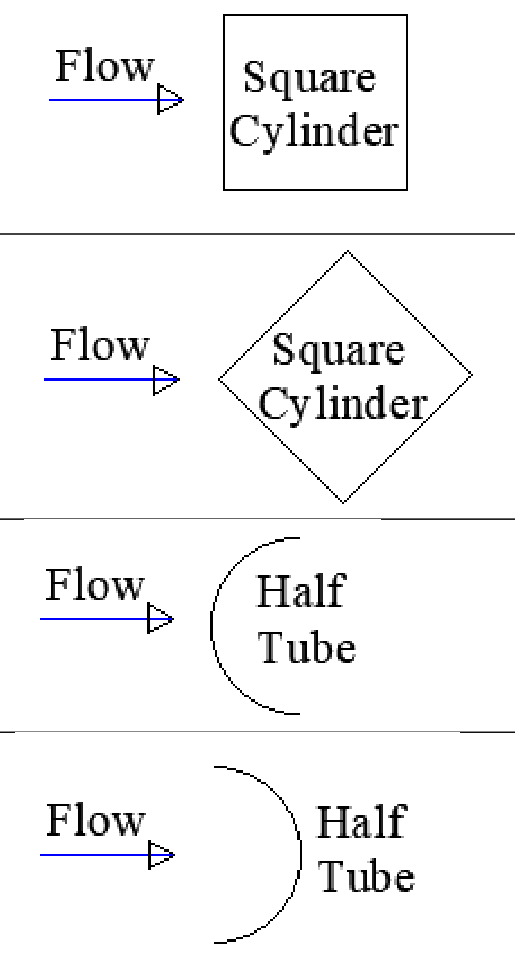
Group-I shows different two-dimensional bodies and Group-II mentions their total drag coefficient (𝐶𝐷) based on frontal area while facing parallel flow of fluid having Reynolds number 𝑅𝑒≥104 along the direction of arrow. The bodies are placed symmetrically with respect to the flow direction. Group-I Group-II P 1 1.2 Q 2 1.6 R 3 2.1 S 4 2.3 Which one of the following options identifies the correct match between Group-I and Group-II, as per the concept of degree of streamlining?
- A. P−3, Q−2, R−1, S−4
- B. P−3, Q−2, R−4, S−1
- C. P−2, Q−3, R−1, S−4
- D. P−3, Q−1, R−2, S−4
Answer: A. P−3, Q−2, R−1, S−4
Question 33
Marks: 2
A solid body of uniform specific gravity floats in a deep liquid pool. Take 𝐵, 𝐺, and 𝑀 as the centre of buoyancy, centre of gravity, and metacentre of the body, respectively. Which one of the following options is correct for the stable floatation of the body in the pool when the body is given a small tilt angle?
- A. 𝑀𝐺̅̅̅̅̅ is the metacentric height and 𝐺 should lie below 𝑀
- B. 𝑀𝐺̅̅̅̅̅ is the metacentric height and 𝐵 should lie above 𝑀
- C. 𝑀𝐵̅̅̅̅̅ is the metacentric height and 𝐵 should lie below 𝑀
- D. 𝑀𝐵̅̅̅̅̅ is the metacentric height and 𝐺 should lie above 𝑀
Answer: A. 𝑀𝐺̅̅̅̅̅ is the metacentric height and 𝐺 should lie below 𝑀
Question 34
Marks: 2
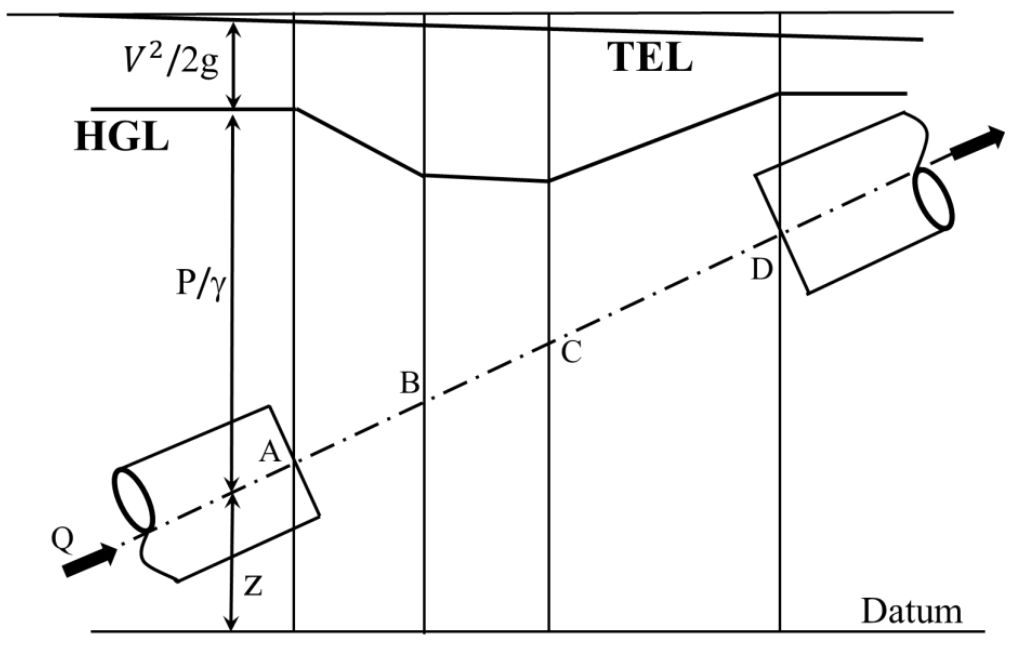
Figure shows the steady and incompressible flow of a fluid in the direction of arrow from section A to section D. Three pipe connectors are to be placed between sections at A and D having Total Energy Line (TEL) and Hydraulic Grade Line (HGL) as depicted in the figure. Consider, g, P, Q, V, γ, and Z denote gravitational acceleration, pressure, volume flow rate, velocity, specific weight, and elevation of centerline of the pipe connectors from the datum, respectively. Which one of the following options, in sequence, indicates the correct nature of connectors between sections A and B, B and C, and C and D in the direction of flow?
- A. Converging, Constant area, Diverging
- B. Diverging, Constant area, Converging
- C. Constant area, Constant area, Constant area
- D. Constant area, Converging, Diverging
Answer: A. Converging, Constant area, Diverging
Question 35
Marks: 2
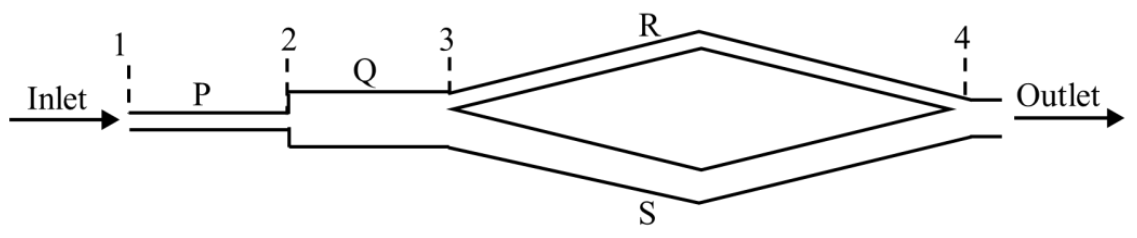
A liquid flows under steady and incompressible flow conditions from station 1 to station 4 through pipe sections P, Q, R, and S as shown in figure. Consider, 𝑑, 𝑉, and ℎ represent the diameter, velocity, and head loss, respectively, in each pipe section with subscripts ‘P’, ‘Q’, ‘R’, and ‘S’. ∆ℎ represents the head difference between the inlet (station 1) and outlet (station 4). All the pipe sections are placed on the same horizontal plane for which the figure shows the top view. Which one of the following options is correct for the given flow loop?
- A. ∆ℎ= ℎ𝑃+ ℎ𝑄+ ℎ𝑅+ ℎ𝑆 and 𝑉𝑃𝑑𝑃 2 = 𝑉𝑄𝑑𝑄 2 = 𝑉𝑅𝑑𝑅 2 = 𝑉𝑆𝑑𝑆 2
- B. ∆ℎ= ℎ𝑃+ ℎ𝑄+ ℎ𝑅 and 𝑉𝑃𝑑𝑃 2 = 𝑉𝑄𝑑𝑄 2 = 𝑉𝑅𝑑𝑅 2 = 𝑉𝑆𝑑𝑆 2
- C. ∆ℎ= ℎ𝑃+ ℎ𝑄+ ℎ𝑅 and 𝑉𝑃𝑑𝑃 2 = 𝑉𝑄𝑑𝑄 2 = 𝑉𝑅𝑑𝑅 2 + 𝑉𝑆𝑑𝑆 2
- D. ∆ℎ= ℎ𝑃+ ℎ𝑄+ ℎ𝑅+ ℎ𝑆 and 𝑉𝑃𝑑𝑃 2 = 𝑉𝑄𝑑𝑄 2 = 𝑉𝑅𝑑𝑅 2 + 𝑉𝑆𝑑𝑆 2
Answer: C. ∆ℎ= ℎ𝑃+ ℎ𝑄+ ℎ𝑅 and 𝑉𝑃𝑑𝑃 2 = 𝑉𝑄𝑑𝑄 2 = 𝑉𝑅𝑑𝑅 2 + 𝑉𝑆𝑑𝑆 2
Question 36
Type: NAT | Marks: 2
Consider, 𝑖 and 𝑗 are unit vectors along x and y directions of a Cartesian (𝑥, 𝑦) coordinate system, respectively and 𝑡 is time. Temperature (𝑇) and fluid velocity (𝑉⃗ ) are given for a flow field as: 𝑇= 𝑥2 + 𝑦𝑡+ 35 𝑉⃗ = (4𝑥𝑦)𝑖+ (𝑥𝑡−2𝑦2)𝑗 The total rate of change of temperature in the flow field (in integer) for time 𝑡= 2 at a point (2, 3) is ________
Answer: 71
Question 37
Type: NAT | Marks: 2
Driven by a pressure gradient of 100 kPa/m, a fluid of dynamic viscosity 0.1 Pa.s flows between two fixed infinitely large parallel plates under steady, incompressible, and fully developed laminar conditions. The average velocity of the flow is 2 m/s. The gap between the parallel plates in mm (rounded off to 2 decimal places) is ________
Answer: 4.80 to 5.00
Question 38
Type: NAT | Marks: 2
An incompressible fluid is flowing between two infinitely large parallel plates separated by 5 mm distance. The bottom plate is stationary and the top plate is moving at a constant velocity of 5 mm/s in the direction parallel to the bottom plate. The flow of the fluid between the plates is steady, two-dimensional, laminar, and the variation of fluid velocity is linear between the plates. A square fluid element of 1 mm side is considered at equal distance from both the plates in the flow field such that one of its sides is parallel to the plates. The magnitude of circulation in mm2/s (in integer) along the edges of the square fluid element is ________
Answer: 1
Question 39
Type: NAT | Marks: 2
Consider, a kite weighing 100 grams as essentially a rigid flat plate making an angle 8° with the horizontal and having a planform area of 0.045 m2 when exposed to horizontal parallel wind of 60 km/h. The thread string of the kite makes an angle 45° with the horizontal. A tension of 450 grams in the thread is necessary to float the kite steadily. Take air density as 1.2 kg/m3 and gravitational acceleration as 9.81 m/s2. The lift coefficient (𝐶𝐿) associated with the air flow around steadily floating kite (rounded off to 2 decimal places) is ________
Answer: 0.50 to 0.60
Question 40
Type: NAT | Marks: 2
A fixed control volume has four one-dimensional boundary sections (1, 2, 3, and 4). For a steady flow inside the control volume, the flow properties at each section are tabulated below: Boundary Section Type Density (kg/m3) Surface Normal Velocity (m/s) Cross-sectional Area (m2) Specific Energy (J/kg) 1 Inlet 1000 10 0.5 200 2 Inlet 1000 2 3.0 50 3 Outlet 1000 5 1.0 100 4 Outlet 1000 4 1.5 80 The rate of change of energy of the system which occupies the control volume at this instant is 𝐸× 106 J/s. The value of 𝐸 (rounded off to 2 decimal places) is ________
Answer: -0.32
Question 41
Type: NAT | Marks: 2
A ship is to be operated in a fluid medium with kinematic viscosity 0.032 × 10⁻³ m2/s. A one-tenth scale model of the ship is built for testing. Consider, inertia, viscous and gravity forces are dominant for the ship and its model during the operation. The required kinematic viscosity of the liquid for testing the model is 𝑃× 10−6 m2/s. The value of 𝑃 (rounded off to 2 decimal places) is ________
Answer: 0.95 to 1.05
Question 42
Type: NAT | Marks: 2
Water flows through a pipe of diameter 20 cm at a flow rate of 0.025 m3/s. A pitot- static tube is placed at the centre of the pipe and indicates the pressure difference of 5 cm of water column. Theoretical velocity measured through pitot-static tube when multiplied with velocity coefficient 𝐶𝑉 gives the actual velocity of the flow. If the mean velocity in the pipe is 90% of the actual velocity at the centre of the pipe and the gravitational acceleration is 10 m/s2, the value of 𝐶𝑉 (rounded off to 2 decimal places) is ________
Answer: 0.85 to 0.90
Question 43
Type: NAT | Marks: 2
An oil of density 870 kg/m3 and viscosity 0.036 Pa.s flows through a straight pipe of 10 cm diameter and 1.5 km length at the flow rate of 250 liters per minute under the steady and incompressible flow conditions. To control the flow rate of oil, a valve is fixed at the middle of the pipe causing no change in the total length of the pipe. The total head loss measured across the two ends of the pipe is 11.60 m. Using gravitational acceleration as 10 m/s2, the minor head loss contributed by the presence of the valve in m (rounded off to 2 decimal places) is ________
Answer: 0.85 to 1.28
Solid Mechanics
Question 66
Marks: 1
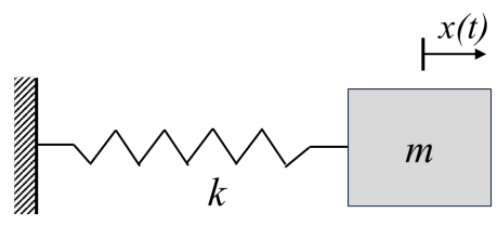
Consider a spring-mass system with mass m and spring stiffness k as shown in the illustration. At time t=0, the mass is displaced by P units and the velocity of the mass is zero. The displacement of the mass, x(t), is measured from the equilibrium position. Which one of the following functions represent x(t)?
- A. 𝑃 𝑐𝑜𝑠(√𝑘 𝑚𝑡)+ 𝑃 𝑠𝑖𝑛(√𝑘 𝑚𝑡)
- B. 𝑃 𝑠𝑖𝑛(√𝑘 𝑚𝑡)
- C. 𝑃 2 𝑐𝑜𝑠(√𝑘 𝑚𝑡)+ 𝑃 2 𝑠𝑖𝑛(√𝑘 𝑚𝑡)
- D. 𝑃𝑐𝑜𝑠(√𝑘 𝑚𝑡)
Answer: D. 𝑃𝑐𝑜𝑠(√𝑘 𝑚𝑡)
Question 67
Marks: 1
A ball of mass 5m approaches a stationary ball of mass m with a horizontal velocity of 2 m/s from left to right. After a perfectly elastic central collision, the horizontal velocity of the heavier ball is 1 m/s from left to right. Which one of the following statements, regarding the velocity (in m/s) of the lighter ball after impact, is TRUE?
- A. Comes to rest
- B. Moves from left to right at 5 m/s
- C. Moves from right to left at 5 m/s
- D. Moves from left to right at 1m/s
Answer: B. Moves from left to right at 5 m/s
Question 68
Marks: 1
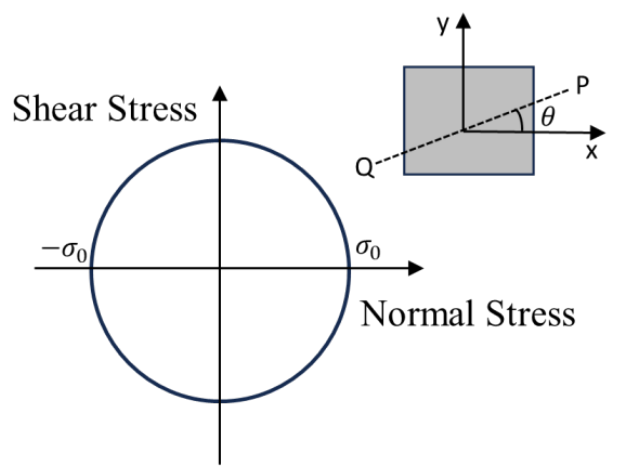
The Mohr’s circle corresponding to an infinitesimal element is shown in the figure. The plane PQ in the infinitesimal element, at an angle of 𝜃 from the x-axis, is in a state of pure shear. Which one of the following values of 𝜃 (in degrees) is CORRECT?
Answer: C. 45
Question 69
Marks: 1
The two-dimensional state of stress, in an infinitesimal element, is given by 𝜎𝑥𝑥= 800 MPa, 𝜎𝑥𝑦= 300 MPa and 𝜎𝑦𝑦= 0 MPa. Which one of the following options is the maximum shear stress (in MPa) in the element?
Answer: A. 500
Question 70
Marks: 1
Two cars P and Q are travelling on a straight path and are 60 m apart as shown in the figure; Car P is moving with a constant velocity of 36 kmph, while car Q is moving at a constant velocity of 18 kmph. At this instant, the driver in car P applies the brake and collision occurs with car Q after 30 seconds. Assuming uniform deceleration due to braking, which one of the following is the CORRECT velocity (in m/s) of the car P just before the collision?

Answer: D. 4
Question 71
Type: MSQ | Marks: 1
The natural frequency of a spring-mass system is 10 rad/s. Which of the following statements is/are CORRECT?
- A. The mass is 100 kg and the stiffness is 1 N/m.
- B. The mass is 1.25 kg and the stiffness is 125 N/m.
- C. The stiffness is 620 N/m and the mass is 6.2 kg.
- D. The stiffness is 62 N/m and the mass is 620 kg.
Answer: B. The mass is 1.25 kg and the stiffness is 125 N/m.; C. The stiffness is 620 N/m and the mass is 6.2 kg.
Question 72
Type: NAT | Marks: 1
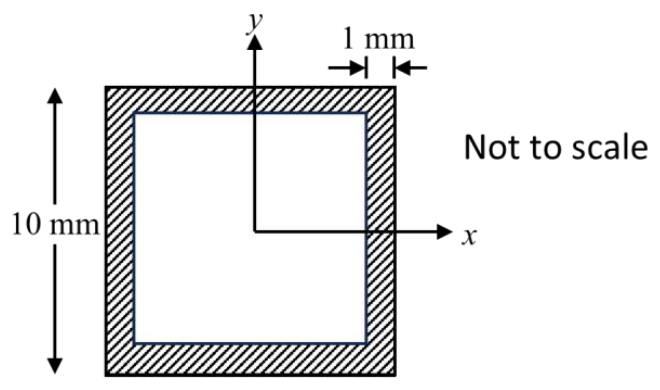
Consider a beam with a square box cross-section as shown in the figure. The outer square has a length of 10 mm. The thickness of the section is 1 mm. The area moment of inertia about the x-axis is _____ mm4 (in integer).
Answer: 490 to 494
Question 73
Type: NAT | Marks: 1
For a certain linear elastic isotropic material, the Young’s modulus is 140 GPa and the shear modulus is 50 GPa. The Poisson’s ratio for the material is _____ (rounded off up to two decimal places).
Answer: 0.40
Question 74
Type: NAT | Marks: 1
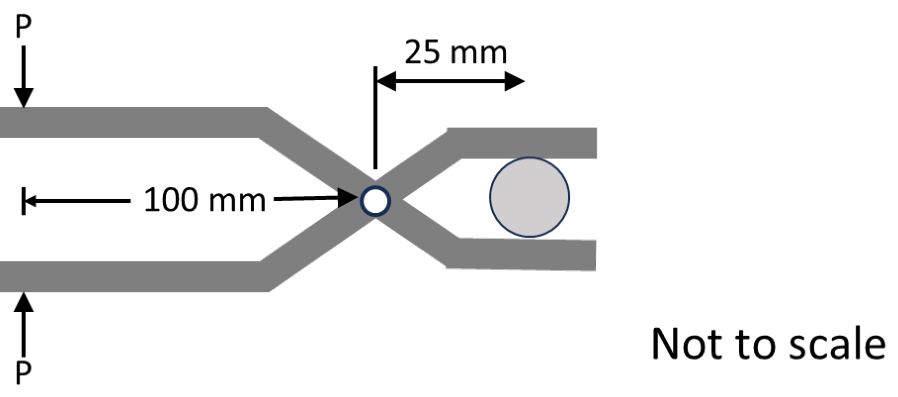
A force of P = 100 N is applied at the ends of the pliers as shown in the figure. Neglecting friction, the force exerted by the upper jaw on the workpiece is _____ N (in integer).
Answer: 400
Question 75
Marks: 2
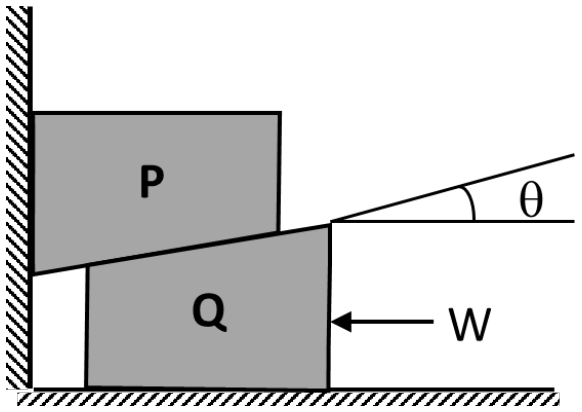
Consider two blocks, P of mass 100 kg and Q of mass 150 kg, resting as shown in the figure. The angle 𝜃= 30°. The coefficient of friction between the two blocks is 0.2. Assume no friction exists at all other interfaces. The minimum force required to move the block P upward is W. Which one of the following options is closest to the CORRECT magnitude of W (in N)?
- A. 862.2
- B. 1116.6
- C. 2900.0
- D. 406.2
Answer: A. 862.2
Question 76
Marks: 2
Which one of the following vertical columns, of circular cross-section, sustains the highest load without buckling?
- A. Cantilever column with a length L and cross-section diameter d
- B. Column with hinge at one end and roller at the other end with a length 2L and cross-section diameter d
- C. Cantilever column with a length L and cross-section diameter 2d
- D. Column with hinge at one end and roller at the other end with a length L and cross-section diameter d
Answer: C. Cantilever column with a length L and cross-section diameter 2d
Question 77
Marks: 2
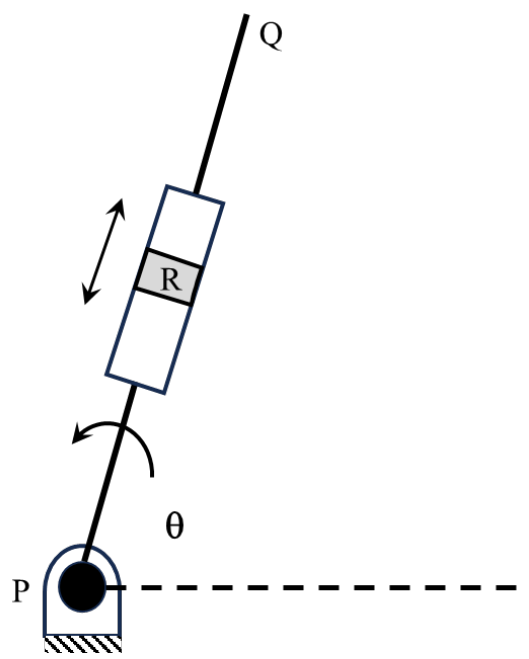
The figure shows a rod PQ, hinged at P, rotating counter-clockwise with a uniform angular speed of 15 rad/s. A block R translates along a slot cut out in rod PQ. At the instant shown the distance PR = 0.5 m and θ = 60o. The relative velocity of R with respect to the rod PQ is 5 m/s at the instant shown. The relative acceleration of R with respect to the rod PQ is zero at the instant shown. Which one of the following is the CORRECT magnitude of the absolute acceleration (in m/s2) of block R?
- A. 135.2
- B. 187.5
- C. 112.5
- D. 150.0
Answer: B. 187.5
Question 78
Marks: 2
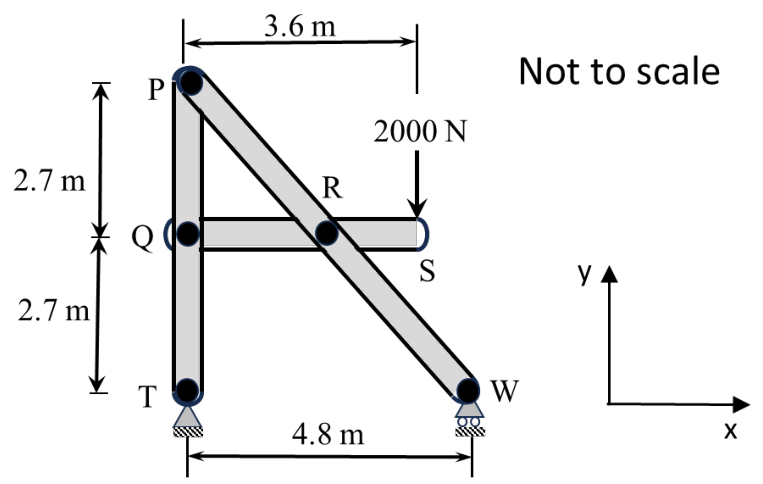
The frame shown in the figure is loaded at S with a force of 2000 N. The reactions at T are denoted by Tx and Ty, while the reaction at W is Wy. Neglect the weight of the members. Which one of the following options for the magnitudes of the forces (in N), Tx, Ty and Wy, is CORRECT?
- A. Tx = 0, Ty = 1000 and Wy = 1000
- B. Tx= 0, Ty =1500 and Wy = 500
- C. Tx = 0, Ty = 800 and Wy = 1200
- D. Tx = 0, Ty = 500 and Wy = 1500
Answer: D. Tx = 0, Ty = 500 and Wy = 1500
Question 79
Marks: 2
A closed thin cylindrical tank with a mean diameter d = 300 mm and thickness t = 2 mm, is subjected to a uniform internal gas pressure p. The allowable shear stress on the curved wall of the tank is 70 MPa. Based on the Tresca criteria, which one of the following options for the maximum safe value of p (in MPa) is CORRECT?
- A. 3.73
- B. 7.46
- C. 1.87
- D. 5.60
Answer: C. 1.87
Question 80
Type: MSQ | Marks: 2
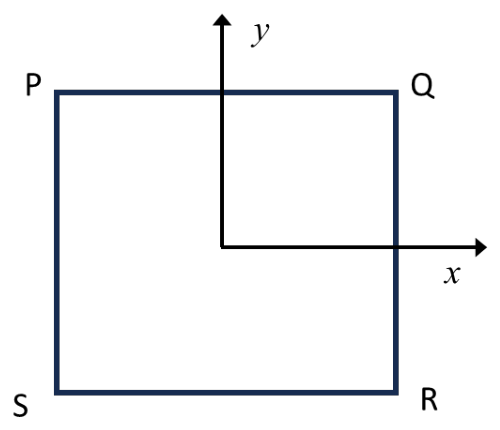
An infinitesimal square element PQRS is shown in the figure. The x and y axes are also marked in the figure. The strains on the element are given by 𝜀𝑥𝑥= 500 × 10−6, 𝜀𝑦𝑦= 100 × 10−6 and 𝜀𝑥𝑦= 0. Which of the following statements is/are CORRECT?
- A. Percentage change in length of the diagonal PR is 0.03.
- B. Change in angle between PR and QS is 4 × 10⁻⁴ rad.
- C. Change in angle between PR and QS is 2 × 10⁻⁴ rad.
- D. Percentage change in length of the diagonal QS is 0.03.
Answer: A. Percentage change in length of the diagonal PR is 0.03.; B. Change in angle between PR and QS is 4 × 10⁻⁴ rad.; D. Percentage change in length of the diagonal QS is 0.03.
Question 81
Type: MSQ | Marks: 2
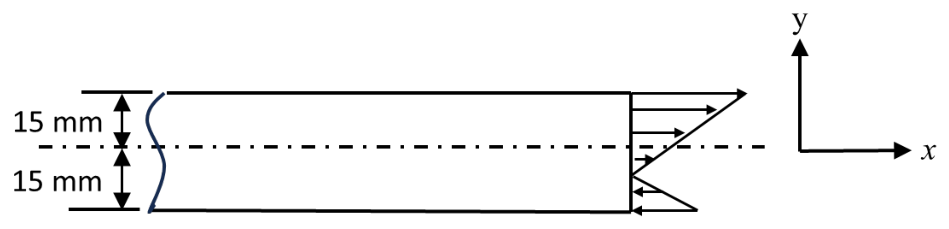
The figure shows the stress distribution across an internal surface of a rectangular beam of height 30 mm and depth 10 mm. The normal stress distribution is given by the expression 𝜎𝑥𝑥= 200𝑦+ 500 N/mm2; y is the distance in mm from the centroidal axis of the beam. Assume that there is no variation in the stress distribution along the z-direction. Which of the following statements is/are CORRECT?
- A. The net force in the x direction is 150 kN.
- B. The net force in the x direction is 75 kN.
- C. The net moment about the z axis is 4500 Nm.
- D. The net moment about the z axis is 2250 Nm.
Answer: A. The net force in the x direction is 150 kN.; C. The net moment about the z axis is 4500 Nm.
Question 82
Type: NAT | Marks: 2
A vertical column fixed at one end is subjected to a compressive axial load at the free end. The column’s section modulus, EI, is 9.82 × 10⁵ Nm2 and the cross-section area is 7.85 × 10⁻³ m2. The length of the column is 2 m. The yield stress of the material is 145 MPa. If the column can fail either in buckling or by Tresca’s criterion, the maximum load that the structure can safely sustain is _____ kN (rounded off to one decimal place).
Answer: 603.5 to 607.5
Question 83
Type: NAT | Marks: 2
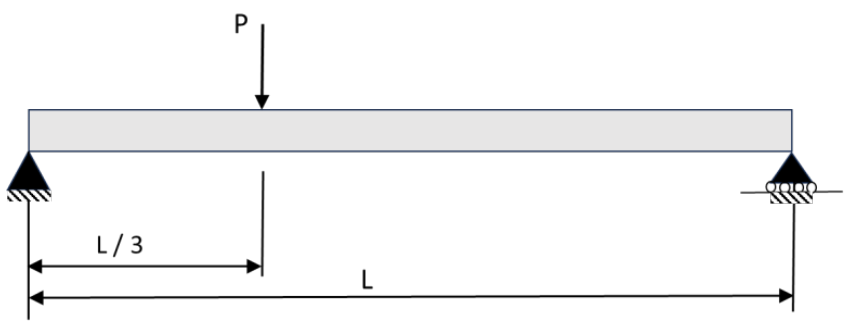
A simply-supported beam, with a point load P = 150 kN at a distance of L/3 from the left end, is shown in the figure. The elastic-strain energy (U) of the beam is given by the following expression: U = 2 243 P2L3 EI where the section modulus, EI, is 16.66 × 10⁵ Nm2 and the length of the beam L is 1 m. The deflection at the loading point is ____ mm (rounded off to two decimal places).
Answer: 1.46 to 1.50
Question 84
Type: NAT | Marks: 2
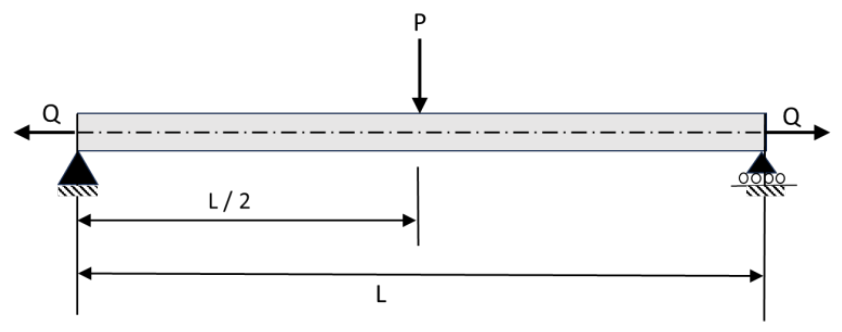
A simply-supported beam has a circular cross-section with a diameter of 20 mm, area of 314.2 mm2, area moment of inertia of 7854 mm4 and a length L of 4 m. A point load P =100 N acts at the center and an axial load Q = 20 kN acts through the centroidal axis as shown in the figure. The magnitude of the offset between the neutral axis and the centroidal axis, at L/2 from the left, is __________ mm (rounded off to one decimal place).
Answer: 4.9 to 5.1
Question 85
Type: NAT | Marks: 2
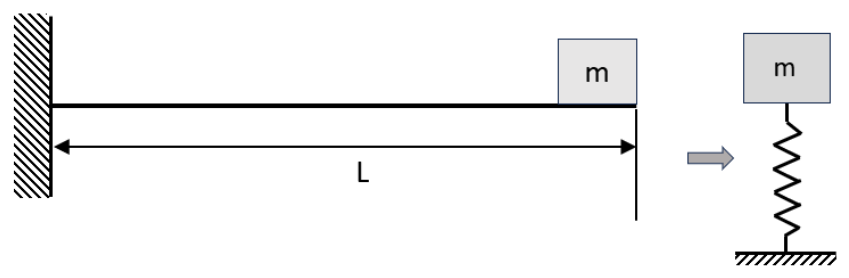
A massless cantilever beam, with a tip mass m of 10 kg, is modeled as an equivalent spring-mass system as shown in the figure. The beam is of length L = 1 m, with a circular cross-section of diameter d = 20 mm. The Young’s modulus of the beam material is 200 GPa. The natural frequency of the spring-mass system is _____ Hz (rounded off to two decimal places).
Answer: 3.43 to 3.47
Question 86
Type: NAT | Marks: 2
An electric motor’s rotor is spinning at 1500 rpm when its load and power are cut- off. The rotor which has a mass of 50 kg and a radius of gyration of 200 mm, then coasts down to rest. Due to kinetic friction, a constant torque of 10 Nm acts on the rotor as it coasts down. The number of revolutions executed by the rotor before it comes to rest is _____ (in integer).
Answer: 392 to 394
Question 87
Type: NAT | Marks: 2
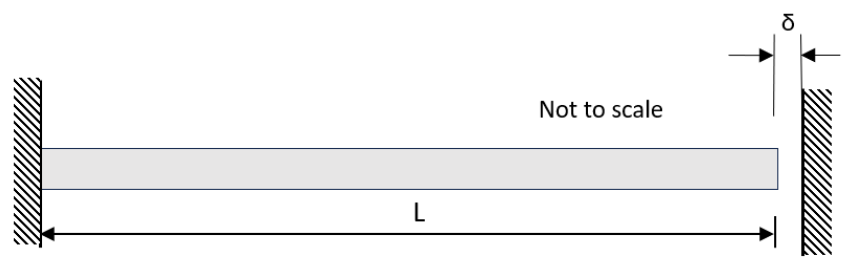
A bar of length L = 1 m is fixed at one end. Before heating its free end has a gap of δ = 0.1 mm from a rigid wall as shown in the figure. Now the bar is heated resulting in a uniform temperature rise of 10 ℃. The coefficient of linear thermal expansion of the material is 20 × 10−6/ ℃ and the Young’s modulus of elasticity is 100 GPa. Assume that the material properties do not change with temperature. The magnitude of the resulting axial stress on the bar is ______ MPa (in integer).
Answer: 10
Thermodynamics
Question 88
Marks: 1
A tank is divided into two compartments with one compartment containing a gas at a given pressure, while the second is completely evacuated. If the partition is removed, the gas occupies the entire compartment. Which one of the following statements is CORRECT?
- A. Work done is equal to the area under the curve of a p V − diagram
- B. Expansion of gas is not restrained by external force
- C. The entire process is reversible
- D. The overall change in volume is zero for the entire system
Answer: B. Expansion of gas is not restrained by external force
Question 89
Marks: 1
A cylinder of volume 0.1 m3 is filled with nitrogen at 10 MPa and 300 K. Consider nitrogen to be an ideal gas. The cylinder develops a leak and nitrogen escapes to atmosphere which is at 0.1 MPa. After sometime, the pressure in the cylinder reduces to 5 MPa. Assuming the cylinder and the leaked gas temperature remains constant at 300 K, the work done (in MJ) by nitrogen gas is
Answer: C. 0.5
Question 90
Marks: 1
A closed system undergoes a process 1–2 in which it absorbs 150 kJ of energy as heat and does 90 kJ of work. Then it follows another process 2–3 in which 80 kJ of work is done on it while it rejects 60 kJ as heat. If it is desired to restore the system to the initial state (state 1) by an adiabatic path, the work interaction (in kJ) in this process will be
Answer: A. 80
Question 91
Marks: 1
The inlet and outlet temperatures of the flowing fluid during a steady state flow process are the same as that of the surroundings. If the changes in kinetic and potential energies are neglected, the maximum power that can be obtained is equal to
- A. the rate of increase in enthalpy of the flowing fluid
- B. the rate of decrease in Helmholtz energy of the flowing fluid
- C. the rate of decrease in Gibbs free energy of the flowing fluid
- D. the rate of decrease in internal energy of the flowing fluid
Answer: C. the rate of decrease in Gibbs free energy of the flowing fluid
Question 92
Marks: 1
If 𝛾 refers to the ratio of specific heats, the air-standard efficiency of an Otto cycle is
- A. 1 − 1 (Compression ratio)𝛾
- B. 1 − 1 (Pressure ratio) (𝛾−1 𝛾)
- C. 1 − 1 (Compression ratio)(𝛾−1)
- D. 1 − 1 (Pressure ratio)(𝛾−1)
Answer: C. 1 − 1 (Compression ratio)(𝛾−1)
Question 93
Marks: 1
Let 𝑇𝐻 and 𝑇𝐿 denote the absolute temperatures of high and low temperature reservoirs, respectively. The coefficient of performance of a reversible refrigerator operating between these two reservoirs is
- A. 1 𝑇𝐻 𝑇𝐿−1
- B. 1 1 −𝑇𝐻 𝑇𝐿
- C. 1 𝑇𝐿 𝑇𝐻−1
- D. 1 𝑇𝐿 𝑇𝐻+ 1
Answer: A. 1 𝑇𝐻 𝑇𝐿−1
Question 94
Type: NAT | Marks: 1
A tank of 4 m3 contains an ideal gas mixture of 60% hydrogen and 40% nitrogen by volume at 100 kPa and 300 K. Nitrogen is added to the tank such that the composition changes to 50% nitrogen by volume, with a final temperature of 300 K. The amount of nitrogen (in kmol) to be added is ___________ (rounded off to three decimal places). Use: Universal gas constant (Ru) = 8.314 kJ/kmol-K
Answer: 0.030 to 0.034
Question 95
Type: NAT | Marks: 1
A heat engine having thermal efficiency of 40% receives heat from a source at 600 K and rejects heat to a sink at 300 K. The second-law efficiency (in %) of this engine is ___________ (answer in integer).
Answer: 80
Question 96
Type: NAT | Marks: 1
A rigid tank of 300 litre capacity contains 3 kg of oxygen (molar mass = 32 kg/kmol) at 25 °C. If oxygen behaves as an ideal gas, the pressure (in kPa) inside the tank is _______________ (rounded off to two decimal places). Use: Universal gas constant (Ru) = 8.314 kJ/kmol-K
Answer: 773 to 776
Question 97
Marks: 2
For an ideal gas turbine cycle, 𝑇1 and 𝑇3 are the compressor inlet temperature and turbine inlet temperature respectively. The ratio 𝑇3 𝑇1 is denoted by 𝑡 and the ratio of specific heats is denoted by 𝛾. For any given 𝑡, the optimum pressure ratio for the maximum specific work output is
- A. 𝑡 2 (𝛾−1)
- B. 𝑡 𝛾 2(𝛾−1)
- C. 𝑡 𝛾 (𝛾−1)
- D. 𝑡 𝛾−1 𝛾
Answer: B. 𝑡 𝛾 2(𝛾−1)
Question 98
Type: MSQ | Marks: 2
For a pure substance that expands on freezing, which of the following statement(s) is/are CORRECT?
- A. Temperature of the liquid phase can be lower than the temperature at the triple point
- B. Critical pressure is equal to the pressure at the triple point
- C. Highest pressure at which the vapour phase can exist is the pressure at the triple point
- D. Highest temperature at which solid-liquid phase change can happen is the temperature at the triple point
Answer: A. Temperature of the liquid phase can be lower than the temperature at the triple point; D. Highest temperature at which solid-liquid phase change can happen is the temperature at the triple point
Question 99
Type: MSQ | Marks: 2
Consider a gas obeying the relation ( ) P v b RT − = , where b and R are constants. Which of the following statement(s) is/are CORRECT about the specific heat capacity at constant pressure?
- A. It is independent of temperature
- B. It is a function of pressure
- C. It is a function of temperature
- D. It is independent of both specific volume and pressure
Answer: C. It is a function of temperature; D. It is independent of both specific volume and pressure
Question 100
Type: NAT | Marks: 2
A piston-cylinder arrangement contains an ideal gas mixture of 4 kg of hydrogen and 13 kg of nitrogen at 250 K and atmospheric pressure. On heat addition, the mixture expands at constant pressure until the temperature rises to 350 K. The average isobaric specific heats (𝑐𝑝) for hydrogen and nitrogen are 14.239 kJ/kg-K and 1.040 kJ/kg-K, respectively. The amount of heat (in MJ) added to the cylinder is _________________ (rounded off to three decimal places).
Answer: 6.9 to 7.2
Question 101
Type: NAT | Marks: 2
Air in an ideal Diesel cycle is compressed from 3 litre to 0.15 litre. It then expands during a constant pressure heat addition process to 0.3 litre. If the ratio of specific heats, γ = 1.4, the thermal efficiency (in %) of the cycle is ___________ (rounded to one decimal place).
Answer: 63 to 66
Question 102
Type: NAT | Marks: 2
Air at 101 kPa, 15 °C and 50% relative humidity is first heated to 20 °C in a heating coil, and then humidified by spraying water on it. In the final state, the air has temperature of 25 °C and relative humidity of 85%. The amount of water sprayed (in gm per kg of dry air) is _______________ (rounded off to two decimal places). Use the following data: The saturation pressure of water at 15 °C = 1.7057 kPa The saturation pressure of water at 25 °C = 3.1698 kPa
Answer: 11.5 to 12.0
Question 103
Type: NAT | Marks: 2
A stream of superheated steam (2 MPa, 300 °C) mixes with another stream of superheated steam (2 MPa, 400 °C) through a steady-state adiabatic process. The flow rates of the streams are 3 kg/min and 2 kg/min, respectively. This mixture then expands in an adiabatic nozzle to a saturated mixture with quality of 0.77 and 1 kPa. Neglect the velocity at the nozzle entrance and the change in potential energies. The velocity at the nozzle exit (in m/s) is ___________ (rounded off to two decimal places). Use the following data: At 2 MPa, 300 °C: Specific enthalpy of superheated steam = 3024.2 kJ/kg At 2 MPa, 400 °C: Specific enthalpy of superheated steam = 3248.4 kJ/kg At 1 kPa: Specific enthalpy of saturated water = 29.3 kJ/kg At 1 kPa: Specific enthalpy of saturated vapour = 2513.7 kJ/kg
Answer: 1515 to 1545
Question 104
Type: NAT | Marks: 2
A piston-cylinder assembly having 250 mm diameter contains 0.01 kg of water vapor at 1 MPa and 200 °C. The specific volume of the vapor is 0.20602 m3/kg. The system expands as per the relation 𝑝𝑉𝑛 = constant, where p is pressure and V is volume. The expansion of water vapour displaces the piston by 50 mm. If the final pressure is 0.35 MPa, the value of the exponent (𝑛) is __________ (rounded off to two decimal places).
Answer: 1.30 to 1.38
Question 105
Type: NAT | Marks: 2
Air enters a hair dryer at 22 °C and 100 kPa with a velocity of 3.7 m/s, and leaves the dryer at 83 °C and 100 kPa with a velocity of 9.1 m/s. The exit area of the dryer is 18.7 cm2, and the ambient temperature is 22 °C. The air is an ideal gas with gas constant 𝑅 = 0.287 kJ/kg-K and isobaric specific heat 𝑐𝑝 = 1.005 kJ/kg-K. If the change in potential energy is neglected, the second law efficiency (in %) of the dryer is __________ (rounded off to one decimal place).
Answer: 8.9 to 9.4
Question 106
Type: NAT | Marks: 2
A steam boiler contains saturated water vapour at 200 °C. After a certain period, the temperature of the boiler drops to 110 °C. Assume that all the valves of the boiler are closed and the energy is lost as heat to the surroundings. The ratio of mass of liquid to the mass of vapour is ___________ (rounded off to two decimal places). Saturated volume of vapour phase at 200 °C = 0.127 m3/kg Saturated volume of vapour phase at 110 °C = 1.210 m3/kg Saturated volume of liquid phase at 110 °C = 0.001 m3/kg
Answer: 8.1 to 8.9
Question 107
Type: NAT | Marks: 2
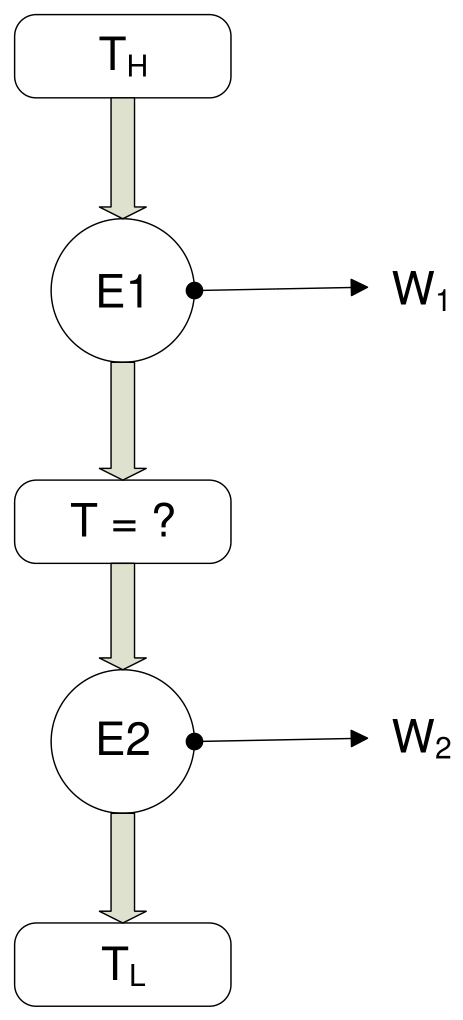
Two Carnot heat engines (E1 and E2) are operating in series as shown in figure. Engine E1 receives heat from a reservoir at 𝑇𝐻 = 1600 K and does work W1. Engine E2 receives heat from an intermediate reservoir at T, does work W2 and rejects the rest to a reservoir at 𝑇𝐿 = 400 K. Both the engines have identical thermal efficiencies. The temperature T (in K) of the intermediate reservoir is __________ (answer in integer). T = ? TH TL W1 W2 E1 E2
Answer: 800
Question 108
Type: NAT | Marks: 2
A particular temperature scale is obtained according to the relation: t ae b α = + where a and b are constants, and t is in °C. The thermometric property as measured by the thermometer is α. The values of α at ice point and steam point are 6 and 9, respectively. The temperature (in °C) which gives α = 7 is __________ (rounded off to two decimal places).
Answer: 8.9 to 9.1
Question 109
Type: NAT | Marks: 2
In a piston cylinder assembly, one kmol of an ideal gas is compressed from an initial state of 200 kPa and 400 K to a final state of 1 MPa and 400 K. If the surroundings are at 400 K, the minimum amount of work (in kJ/kmol) required for the compression process is ______________ (rounded off to two decimal places). Use: Universal gas constant (Ru) = 8.314 kJ/kmol-K
Answer: 5300 to 5400