GATE XE (Engineering Sciences) 2014 Question Paper & Solutions
Attempt the GATE XE (Engineering Sciences) 2014 previous year paper in real CBT exam mode or practice mode with the official answer key. Step-by-step explanations are coming soon.
All GATE XE (Engineering Sciences) papers
87 questions.
General Aptitude
Question 1
Marks: 1
A student is required to demonstrate a high level of comprehension of the subject, especially in the social sciences. The word closest in meaning to comprehension is
- A. understanding
- B. meaning
- C. concentration
- D. stability
Answer: A. understanding
Question 2
Marks: 1
Choose the most appropriate word from the options given below to complete the following sentence. One of his biggest ______ was his ability to forgive.
- A. vice
- B. virtues
- C. choices
- D. strength
Answer: B. virtues
Question 3
Marks: 1
Rajan was not happy that Sajan decided to do the project on his own. On observing his unhappiness, Sajan explained to Rajan that he preferred to work independently. Which one of the statements below is logically valid and can be inferred from the above sentences?
- A. Rajan has decided to work only in a group.
- B. Rajan and Sajan were formed into a group against their wishes.
- C. Sajan had decided to give in to Rajan’s request to work with him.
- D. Rajan had believed that Sajan and he would be working together.
Answer: D. Rajan had believed that Sajan and he would be working together.
Question 4
Marks: 1
If y = 5x2 + 3, then the tangent at x = 0, y = 3
- A. passes through x = 0, y = 0
- B. has a slope of +1
- C. is parallel to the x-axis
- D. has a slope of −1
Answer: C. is parallel to the x-axis
Question 5
Type: NAT | Marks: 1
A foundry has a fixed daily cost of Rs 50,000 whenever it operates and a variable cost of Rs 800Q, where Q is the daily production in tonnes. What is the cost of production in Rs per tonne for a daily production of 100 tonnes?
Answer: 1300
Question 6
Marks: 2
Find the odd one in the following group: ALRVX, EPVZB, ITZDF, OYEIK
- A. ALRVX
- B. EPVZB
- C. ITZDF
- D. OYEIK
Answer: D. OYEIK
Question 7
Marks: 2
Anuj, Bhola, Chandan, Dilip, Eswar and Faisal live on different floors in a six-storeyed building (the ground floor is numbered 1, the floor above it 2, and so on). Anuj lives on an even-numbered floor. Bhola does not live on an odd numbered floor. Chandan does not live on any of the floors below Faisal’s floor. Dilip does not live on floor number 2. Eswar does not live on a floor immediately above or immediately below Bhola. Faisal lives three floors above Dilip. Which of the following floor-person combinations is correct? Anuj Bhola Chandan Dilip Eswar Faisal
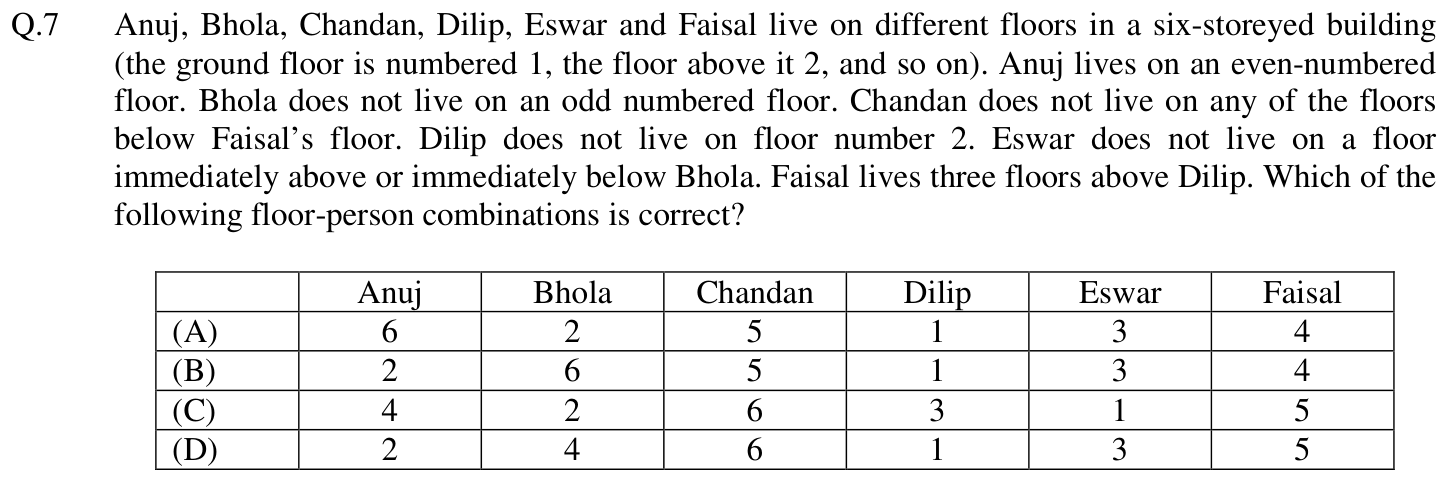
- A. 6 2 5 1 3 4
- B. 2 6 5 1 3 4
- C. 4 2 6 3 1 5
- D. 2 4 6 1 3 5 GA
Answer: B. 2 6 5 1 3 4
Question 8
Type: NAT | Marks: 2
The smallest angle of a triangle is equal to two thirds of the smallest angle of a quadrilateral. The ratio between the angles of the quadrilateral is 3:4:5:6. The largest angle of the triangle is twice its smallest angle. What is the sum, in degrees, of the second largest angle of the triangle and the largest angle of the quadrilateral?
Answer: 180
Question 9
Marks: 2
One percent of the people of country X are taller than 6 ft. Two percent of the people of country Y are taller than 6 ft. There are thrice as many people in country X as in country Y. Taking both countries together, what is the percentage of people taller than 6 ft?
- A. 3.0
- B. 2.5
- C. 1.5
- D. 1.25
Answer: D. 1.25
Question 10
Marks: 2
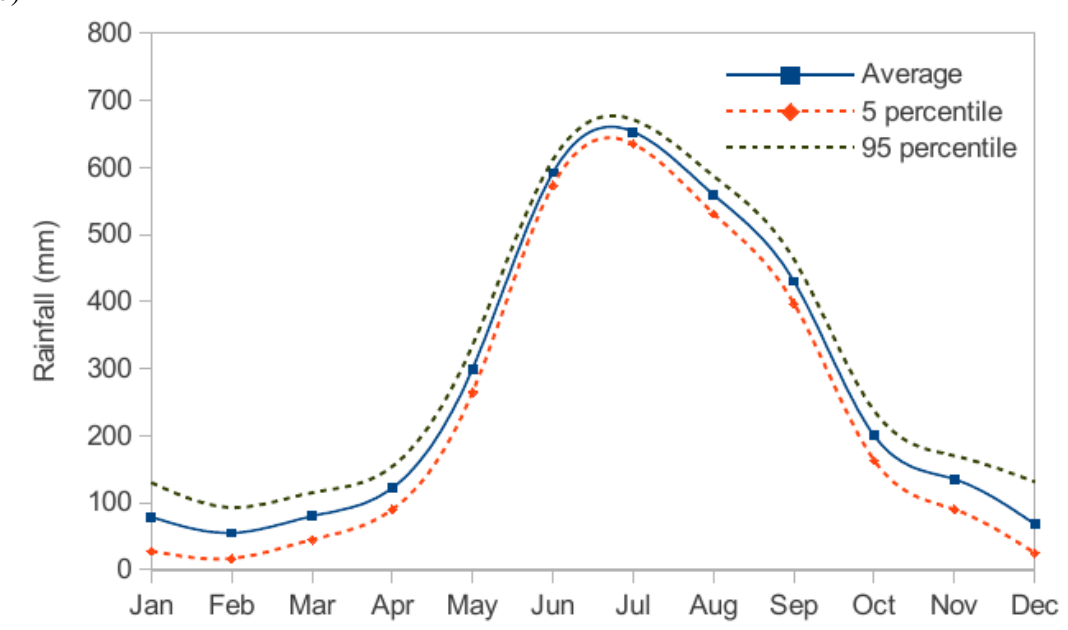
The monthly rainfall chart based on 50 years of rainfall in Agra is shown in the following figure. Which of the following are true? (k percentile is the value such that k percent of the data fall below that value) (i) On average, it rains more in July than in December (ii) Every year, the amount of rainfall in August is more than that in January (iii) July rainfall can be estimated with better confidence than February rainfall (iv) In August, there is at least 500 mm of rainfall
- A. (i) and (ii)
- B. (i) and (iii)
- C. (ii) and (iii)
- D. (iii) and (iv)
Answer: B. (i) and (iii)
Engineering Mathematics
Question 1
Type: NAT | Marks: 1
If 1, 0, and -1 are the eigenvalues of a 3 3× matrix A, then the trace of A A 5 2 + is equal to ______________.
Answer: 2
Question 2
Marks: 1
Which of the following is a solution of the differential equation ? 0 ), sin(ln 4 ' '' 2 > = + + x x y xy y x
- A. ) sin(ln 2 x x y =
- B. ) sin(ln 2 x x y − =
- C. ) cos(ln ln 2 x x y − =
- D. ) cos(ln ln 2 x x y =
Answer: C. ) cos(ln ln 2 x x y − =
Question 3
Marks: 1
At , 0 = z the complex function 2| | ) ( z z z f =
- A. satisfies the Cauchy-Riemann equations and is differentiable
- B. satisfies the Cauchy-Riemann equations but is not differentiable.
- C. does not satisfy the Cauchy-Riemann equations but is differentiable.
- D. does not satisfy the Cauchy-Riemann equations and is not differentiable.
Answer: A. satisfies the Cauchy-Riemann equations and is differentiable
Question 4
Marks: 1
Ten chocolates are distributed randomly among three children standing in a row. The probability that the first child receives exactly three chocolates is
- A. 9 11 3 2 5×
- B. 9 10 3 2 5×
- C. 9 3 1
- D. 3 1
Answer: B. 9 10 3 2 5×
Question 5
Type: NAT | Marks: 1
Let the function R f → ] 5 ,0 [: be defined by = ) (x f ≤ ≤ + < ≤ + < ≤ + .5 2 , 3 23 3 2 2 1 ,5 2 1 0 ,5 2 3 2 x x x x x x The number of points where f is not differentiable in (0, 5) , is ___________. XE (GATE 2014)
Answer: 1
Question 6
Marks: 1
An integrating factor of the differential equation 0 ) ( ) 3 ( 3 3 2 3 3 2 = − + + + dy xy e y x dx y y e y x y y is
- A. y 1
- B. 2 1 y
- C. 3 1 y
- D. y ln
Answer: C. 3 1 y
Question 7
Marks: 1
If a cubic polynomial passes through the points (0, 1), (1, 0), (2, 1) and (3, 10), then it also passes through the point
- A. ) 11 ,2 ( − −
- B. ) 2 ,1 ( − −
- C. ) 4 ,1 ( − −
- D. ) 23 ,2 ( − −
Answer: B. ) 2 ,1 ( − −
Question 8
Marks: 2
Let the function R f → ∞) ,0 [: be such that 4 3 8 ) ( 2 + + = ′ x x x f for 0 > x and .1 ) 0 ( = f Then )1( f lies in the interval
- A. [0, 1]
- B. [2, 3]
- C. [4, 5]
- D. [6, 7]
Answer: B. [2, 3]
Question 9
Type: NAT | Marks: 2
The perimeter of a rectangle having the largest area that can be inscribed in the ellipse 1 32 8 2 2 = +y x , is ________.
Answer: 24
Question 10
Type: NAT | Marks: 2
If the work done in moving a particle once around a circle 4 2 2 = +y x under the force field j ax y i ay x y x F ) ) ρ ) 2 ( ) 2 ( ) , ( + + − = is π 16 , then a is equal to _________. XE (GATE 2014)
Answer: 2
Question 11
Marks: 2
Let r and s be real numbers. If = 0 3 0 2 0 2 1 s r A and − = 1 1 1 s b , then the system of linear equations b AX = has
- A. no solutions for . 2r s ≠
- B. infinitely many solutions for . 2 2 ≠ =r s
- C. a unique solution for . 2 2 = =r s
- D. infinitely many solutions for . 2 2 = =r s XE (GATE 2014)
Answer: D. infinitely many solutions for . 2 2 = =r s XE (GATE 2014)
Fluid Mechanics
Question 1
Type: NAT | Marks: 1
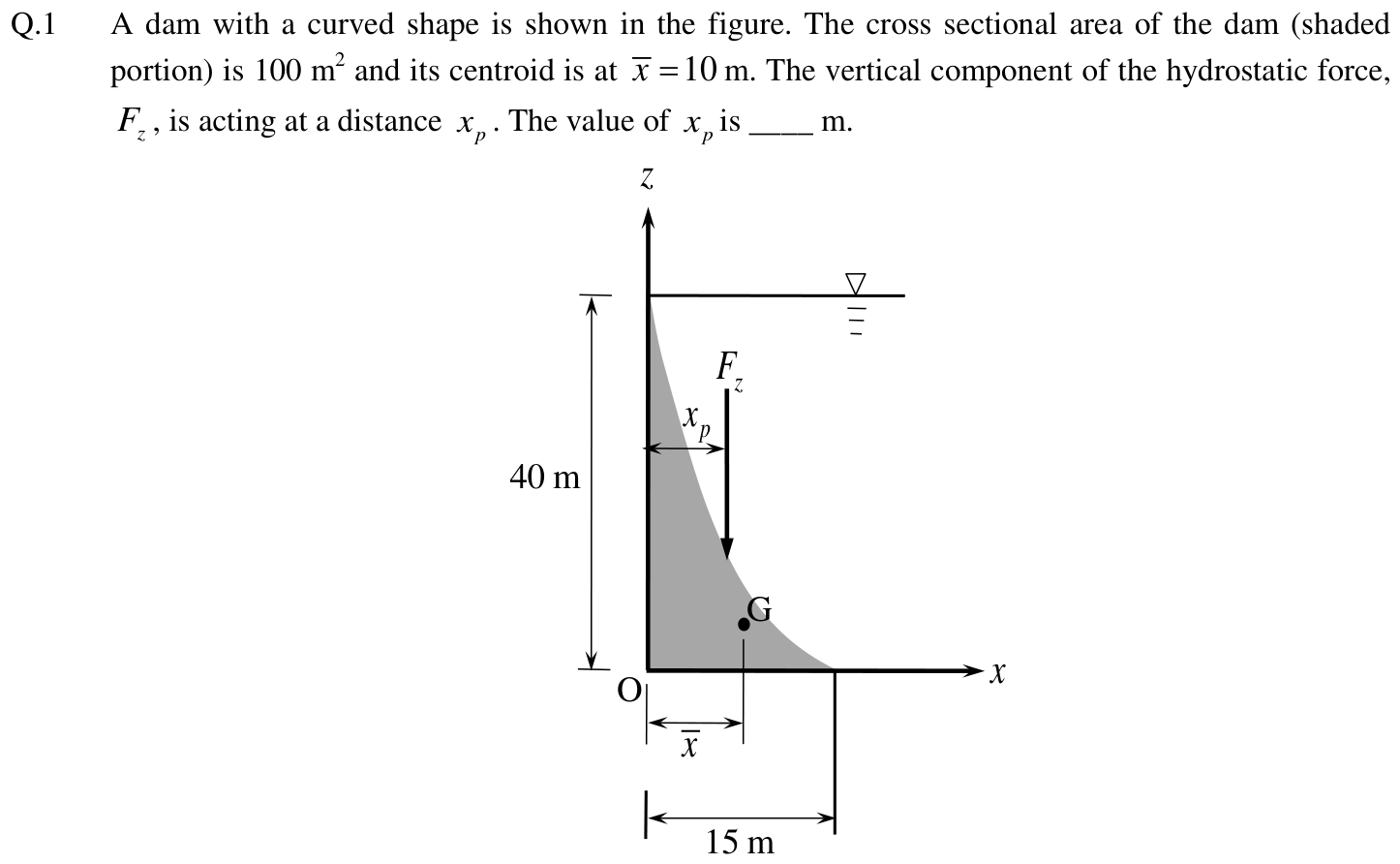
A dam with a curved shape is shown in the figure. The cross sectional area of the dam (shaded portion) is 100 m2 and its centroid is at 10 x = m. The vertical component of the hydrostatic force, zF , is acting at a distance p x . The value of p x is ____ m.
Answer: 7
Question 2
Marks: 1
For an unsteady incompressible fluid flow, the velocity field is ( ) 2 ˆ ˆ 3 3 6 V x t i xyt j = + − ρ , where x , y are in meters and t is in seconds. Acceleration in m/s2 at the point 10 x = m and 0 y = , as measured by a stationary observer is
Answer: A. 303
Question 3
Marks: 1
For an incompressible flow, the existence of components of acceleration for different types of flow is described in the table below. Type of Flow Components of Acceleration P: Steady and uniform 1: Local exists, convective does not exist Q: Steady and non-uniform 2: Both exist R: Unsteady and uniform 3: Both do not exist S: Unsteady and non-uniform 4: Local does not exist, convective exists Which one of the following options connecting the left column with the right column is correct?
- A. P – 1; Q – 4; R – 3; S – 2
- B. P – 4; Q – 1; R – 2; S – 3
- C. P – 3; Q – 2; R – 1; S – 4
- D. P – 3; Q – 4; R – 1; S – 2 15 m 40 m O G px x x z zF XE (GATE 2014)
Answer: D. P – 3; Q – 4; R – 1; S – 2 15 m 40 m O G px x x z zF XE (GATE 2014)
Question 4
Type: NAT | Marks: 1
Velocity in a two-dimensional flow field is specified as: 2 2 ; u x y v y x = = − . The magnitude of the rate of angular deformation at a location ( 2 x = m and 1 y = m) is ____ s-1.
Answer: 3
Question 5
Marks: 1
For a plane irrotational flow, equi-potential lines and streamlines are
- A. parallel to each other.
- B. at an angle of 90o to each other.
- C. at an angle of 45o to each other.
- D. at an angle of 60o to each other.
Answer: B. at an angle of 90o to each other.
Question 6
Marks: 1
Flow around a Rankine half-body is represented by the superposition of
- A. source and vortex flows.
- B. source and uniform flows.
- C. vortex and uniform flows.
- D. source, vortex and uniform flows.
Answer: B. source and uniform flows.
Question 7
Type: NAT | Marks: 1
It is required to carry out model studies on a boat having a characteristic length of 3.6 m and travelling at a speed of 3 m/s. Assume the acceleration due to gravity as 10 m/s2 and neglect the effects due to viscous and surface tension forces. The value of appropriate non-dimensional number is ____.
Answer: 0.48 to 0.52
Question 8
Marks: 1
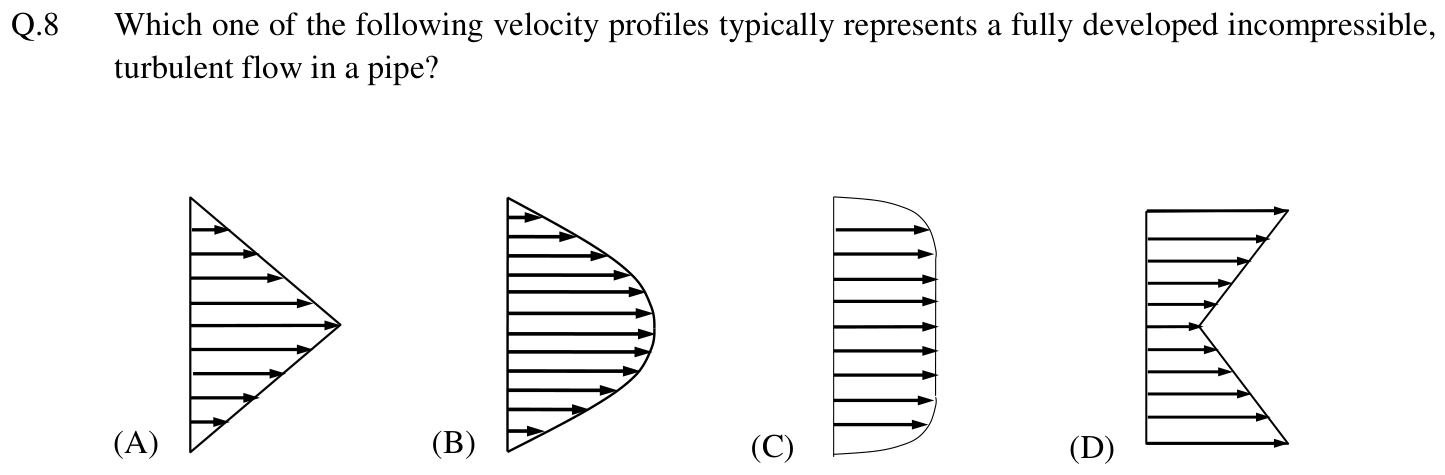
Which one of the following velocity profiles typically represents a fully developed incompressible, turbulent flow in a pipe?
- A.
- B.
- C.
- D. XE (GATE 2014)
Answer: C.
Question 9
Marks: 1
Consider an incompressible, laminar flow past a circular cylinder of diameter d . The flow is uniform at the far upstream. Which one of the following figures typically represents the wake velocity profile just downstream of the cylinder?
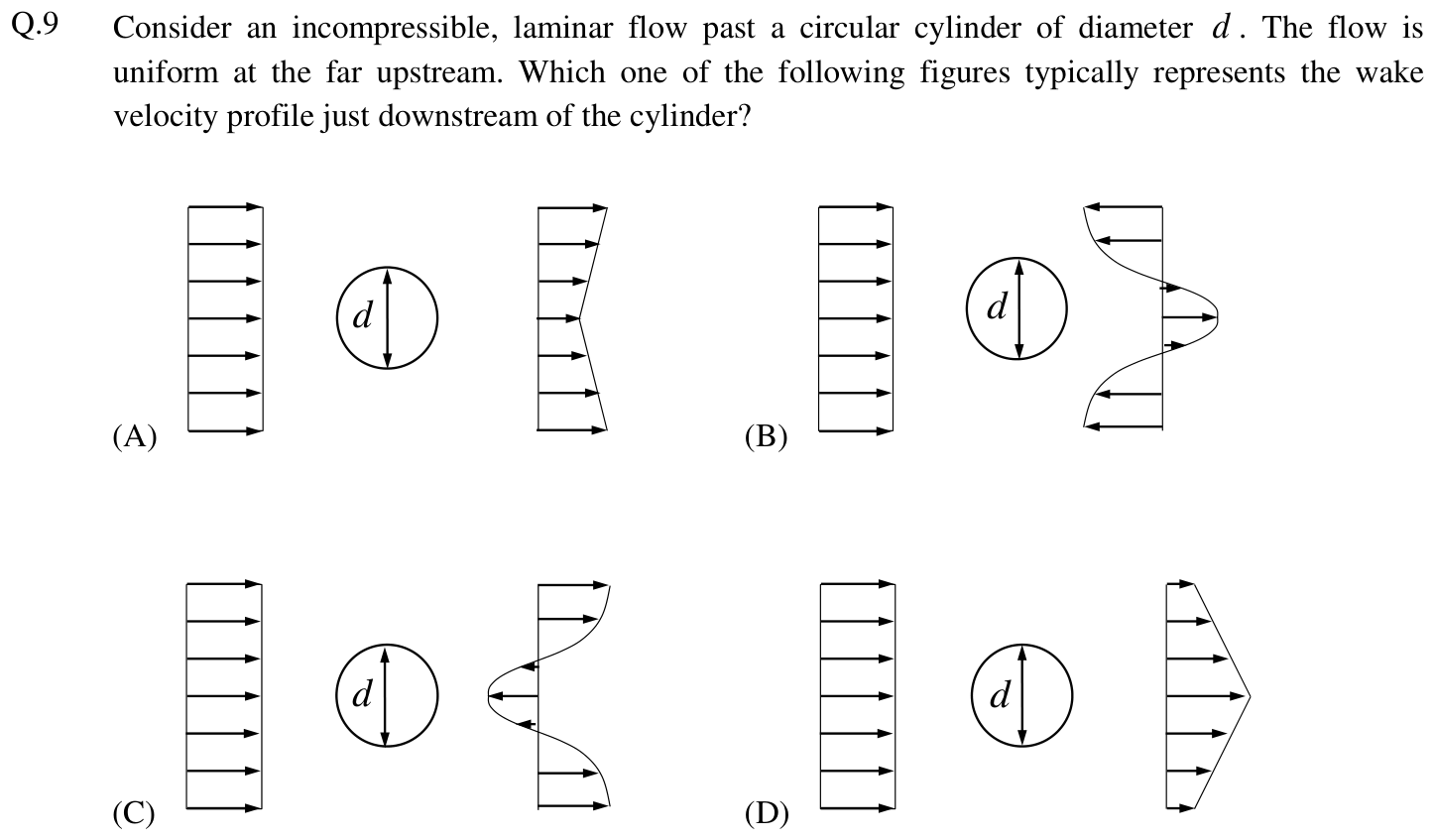
- A.
- B.
- C.
- D. d d d d XE (GATE 2014)
Answer: C.
Question 10
Marks: 2
A container of square cross-section is partially filled with a liquid of density 1 ρ . The cylinder is intended to float in another liquid of density 2 ρ as shown in the figure. The distance between metacentre and centre of buoyancy is sub I V , where I and sub V are area moment of inertia of the cross-section and submerged volume, respectively. Neglect the weight of the container. Which one of the following is the correct condition for stability?
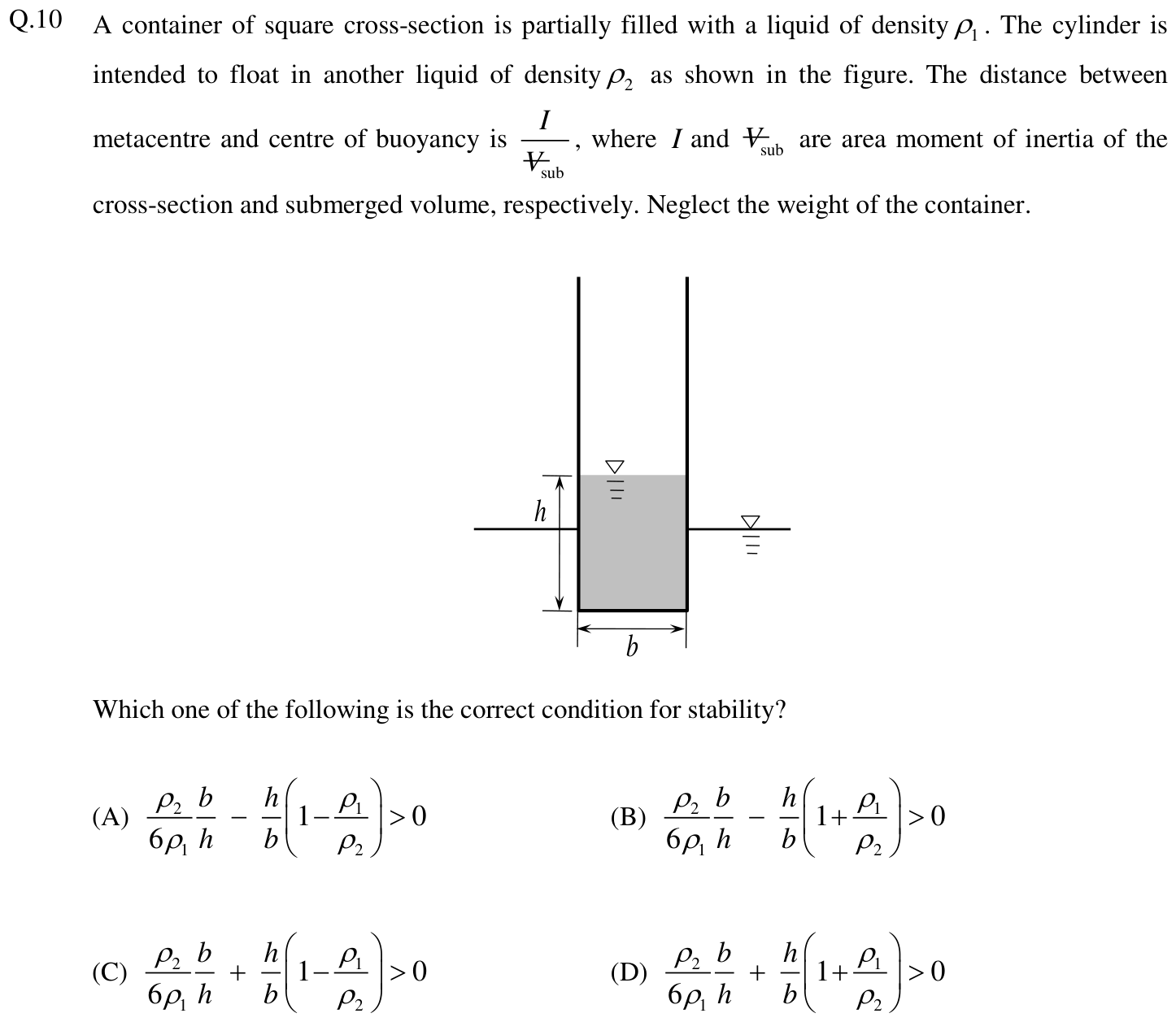
- A. 2 1 1 2 1 0 6 b h h b ρ ρ ρ ρ − − >
- B. 2 1 1 2 1 0 6 b h h b ρ ρ ρ ρ − + >
- C. 2 1 1 2 1 0 6 b h h b ρ ρ ρ ρ + − >
- D. 2 1 1 2 1 0 6 b h h b ρ ρ ρ ρ + + >
Answer: A. 2 1 1 2 1 0 6 b h h b ρ ρ ρ ρ − − >
Question 11
Marks: 2
In a steady state two-dimensional potential flow field due to a point source, the acceleration of a particle at a distance r from the point source is
- A. proportional to 1 r−.
- B. proportional to r .
- C. a constant.
- D. proportional to 3 r −.
Answer: D. proportional to 3 r −.
Question 12
Marks: 2
Velocity in a two-dimensional flow at time t and location ( ) ,x y is described as: ( ) 2 ˆ ˆ 3 1 V t i x j = + − ρ . The equation for the path line of a particle passing through the point (1,0) at 0 t = is
- A. 4 3 4 0 x y − =
- B. ( ) 3 4 1 2 0 x y − − =
- C. ( ) 4 3 1 64 0 x y − − =
- D. ( ) 4 3 1 16 0 x y + − = h b XE (GATE 2014)
Answer: C. ( ) 4 3 1 64 0 x y − − =
Question 13
Marks: 2
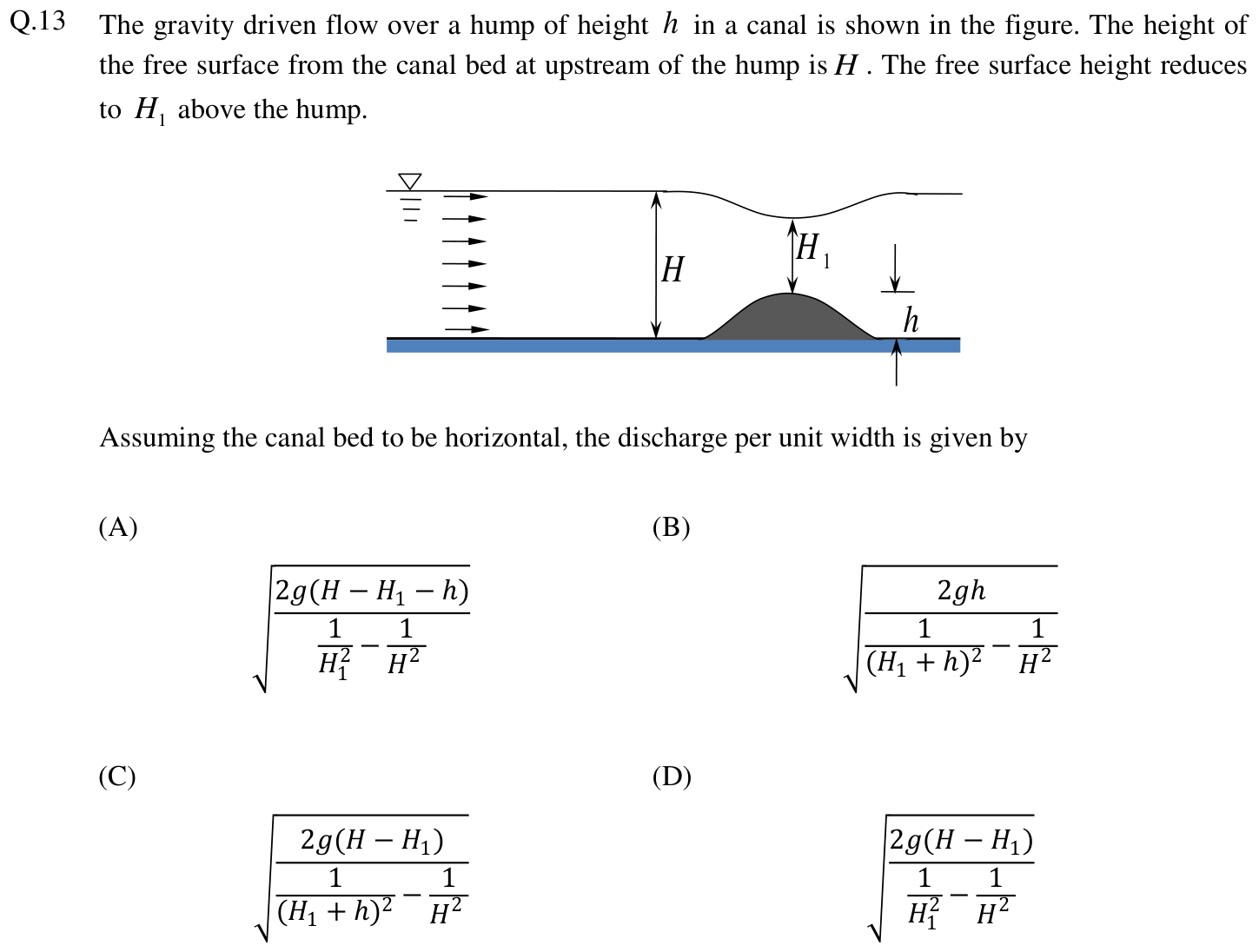
The gravity driven flow over a hump of height h in a canal is shown in the figure. The height of the free surface from the canal bed at upstream of the hump is H . The free surface height reduces to 1 H above the hump. Assuming the canal bed to be horizontal, the discharge per unit width is given by
- A. ඩ 2𝑔𝑔(𝐻𝐻−𝐻𝐻1 −ℎ) 1 𝐻𝐻1 2 −1 𝐻𝐻2
- B. ඩ 2𝑔𝑔ℎ 1 (𝐻𝐻1 + ℎ)2 −1 𝐻𝐻2
- C. ඩ 2𝑔𝑔(𝐻𝐻−𝐻𝐻1) 1 (𝐻𝐻1 + ℎ)2 −1 𝐻𝐻2
- D. ඩ 2𝑔𝑔(𝐻𝐻−𝐻𝐻1) 1 𝐻𝐻1 2 −1 𝐻𝐻2
Answer: A. ඩ 2𝑔𝑔(𝐻𝐻−𝐻𝐻1 −ℎ) 1 𝐻𝐻1 2 −1 𝐻𝐻2
Question 14
Type: NAT | Marks: 2
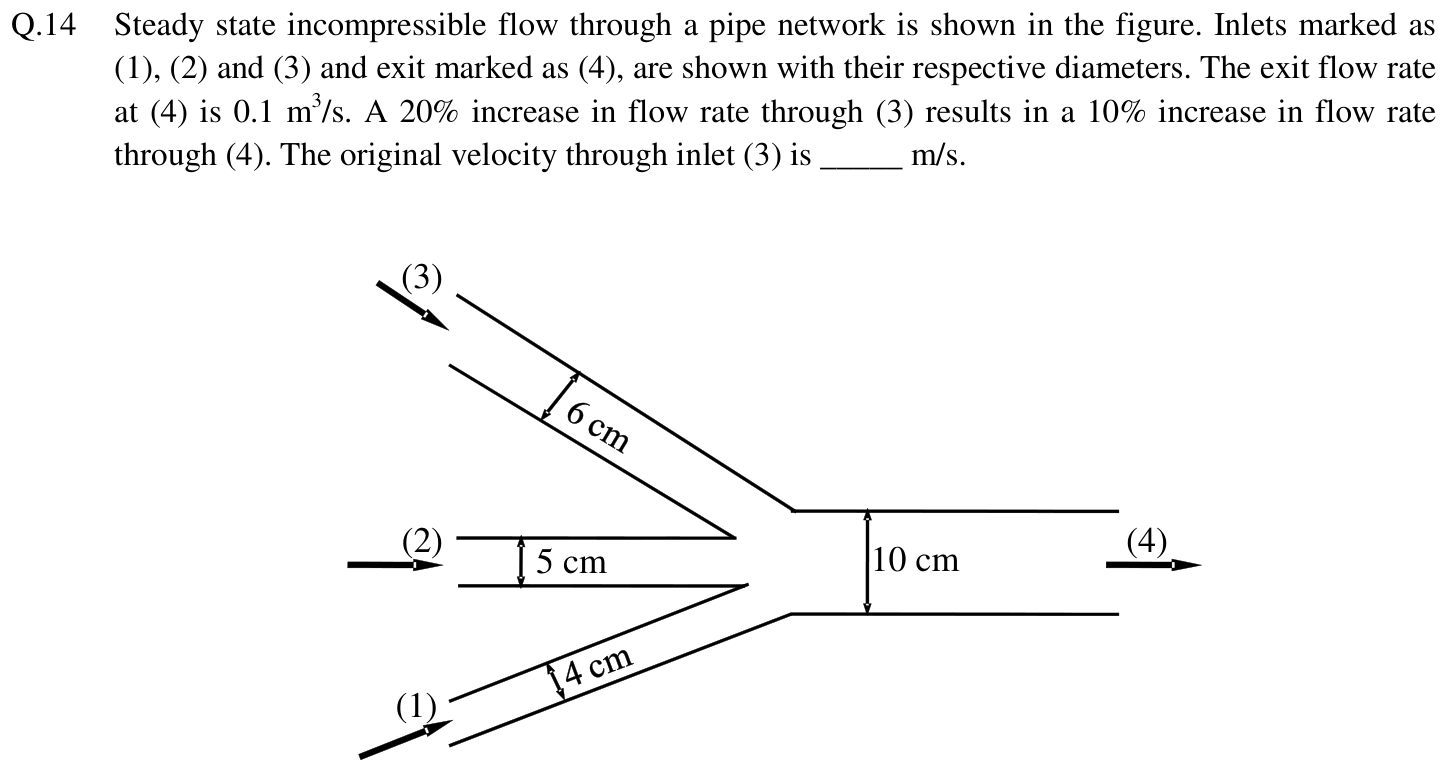
Steady state incompressible flow through a pipe network is shown in the figure. Inlets marked as (1), (2) and (3) and exit marked as (4), are shown with their respective diameters. The exit flow rate at (4) is 0.1 m3/s. A 20% increase in flow rate through (3) results in a 10% increase in flow rate through (4). The original velocity through inlet (3) is _____ m/s. H h 1 H 5 cm 10 cm (3) (2) (1) (4) XE (GATE 2014)
Answer: 17.55 to 17.75
Question 15
Type: NAT | Marks: 2
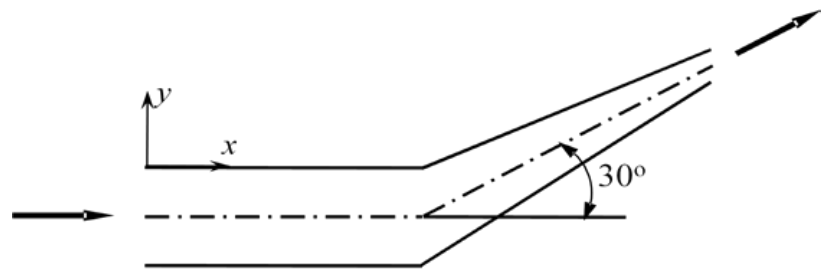
A reducing elbow is used to deflect water upward by 30o as shown in the figure. The mass flow rate at the inlet is 14 kg/s. Water is entering at a gauge pressure of 200 kPa and exits to the atmosphere. The cross-sectional area is 113 cm2 at the inlet and 7 cm2 at the exit. Density of water and acceleration due to gravity are 1000 kg/m3 and 10 m/s2, respectively. Magnitude of x - component of the water force on the elbow is ____ N.
Answer: 2033 to 2036
Question 16
Marks: 2
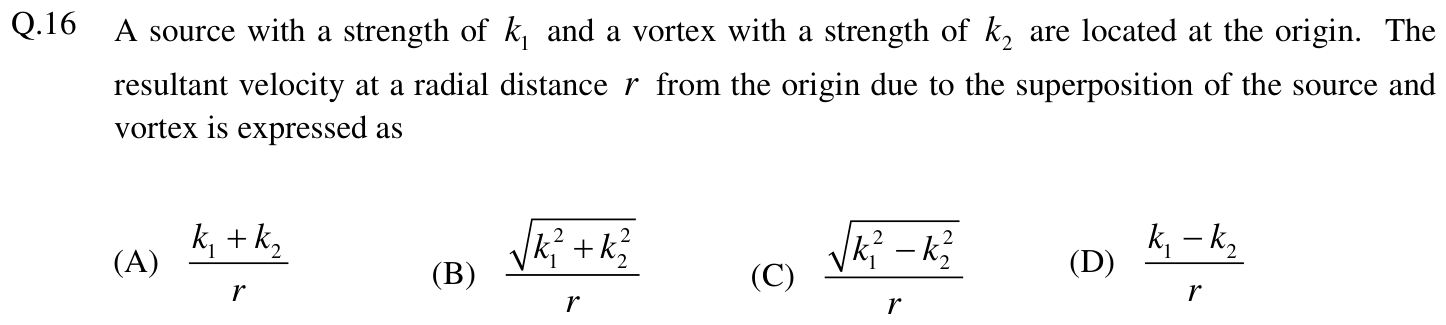
A source with a strength of 1k and a vortex with a strength of 2k are located at the origin. The resultant velocity at a radial distance r from the origin due to the superposition of the source and vortex is expressed as
- A. 1 2 k k r +
- B. 2 2 1 2 k k r +
- C. 2 2 1 2 k k r −
- D. 1 2 k k r −
Answer: B. 2 2 1 2 k k r +
Question 17
Type: NAT | Marks: 2
Velocity potential for an incompressible fluid flow is given as: ( ) 2 2 2 2 x y y φ = + − . Assume the value of stream function at the origin to be zero. The value of stream function at [( ) ( ) , 2,2 x y ≡ ] is ____.
Answer: 8
Question 18
Type: NAT | Marks: 2
The model of a conduit is scaled to 1/100 of the actual size. Seawater is used in the prototype and fresh water is used in the model. Velocity in the prototype is 0.5 m/s. Density and dynamic viscosity of the seawater are 1025 kg/m3 and 1.07 × 10⁻³ kg/m-s, respectively. Density and dynamic viscosity of fresh water are 1000 kg/m3 and 1 × 10⁻³ kg/m-s, respectively. Assume the viscous forces to be dominant. The velocity to be maintained in the model to ensure dynamic similarity is____ m/s.
Answer: 47.52 to 48.50
Question 19
Type: NAT | Marks: 2
A fluid is flowing through a pipe of circular cross-section. Reynolds number of the flow is 1600. The head loss over a 45 m length of the pipe is 0.6 m. The average flow velocity of the fluid is 1 m/s and the acceleration due to gravity is 10 m/s2. The diameter of the pipe is ____ m. XE (GATE 2014)
Answer: 0.145 to 0.155
Question 20
Marks: 2
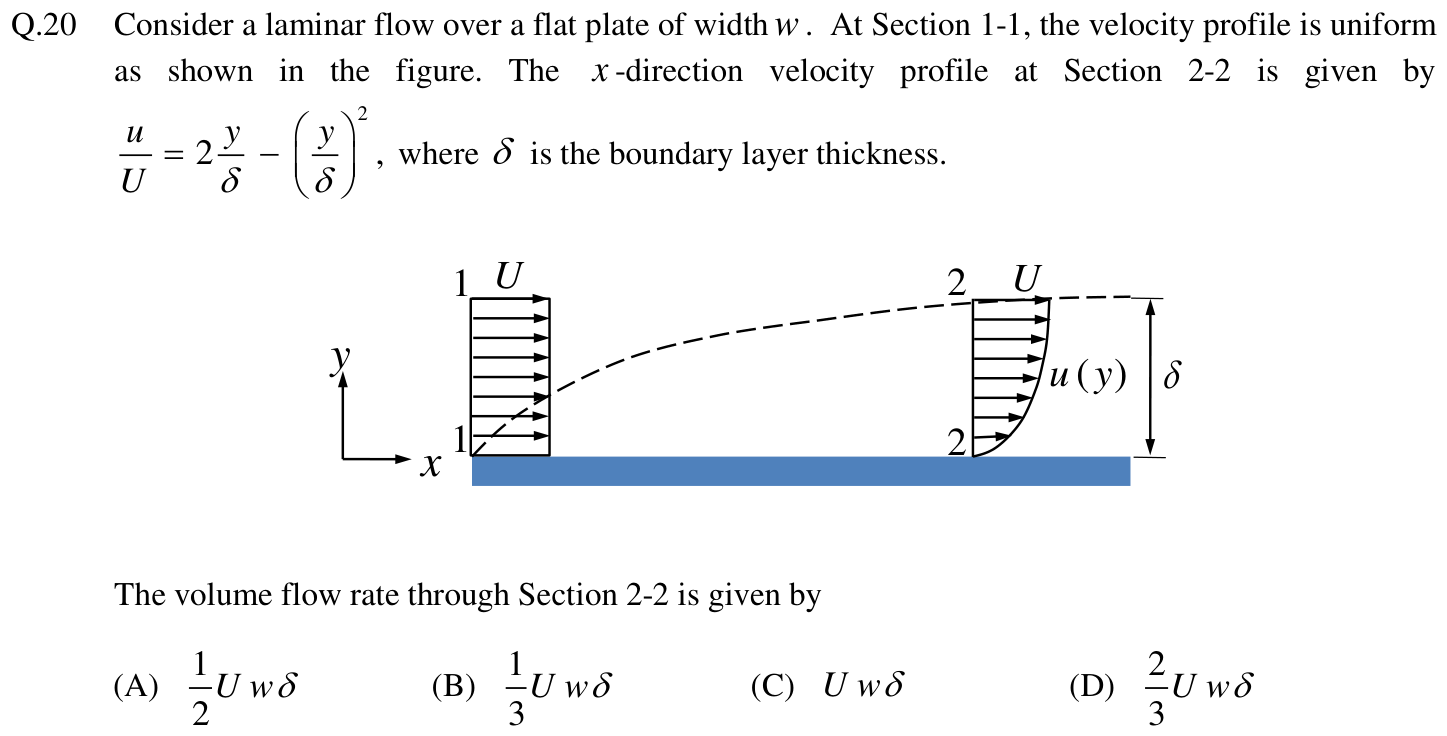
Consider a laminar flow over a flat plate of width w . At Section 1-1, the velocity profile is uniform as shown in the figure. The x -direction velocity profile at Section 2-2 is given by 2 2 , u y y U δ δ = − where δ is the boundary layer thickness. The volume flow rate through Section 2-2 is given by
- A. 1 2U wδ
- B. 1 3U wδ
- C. U wδ
- D. 2 3U wδ
Answer: D. 2 3U wδ
Question 21
Marks: 2
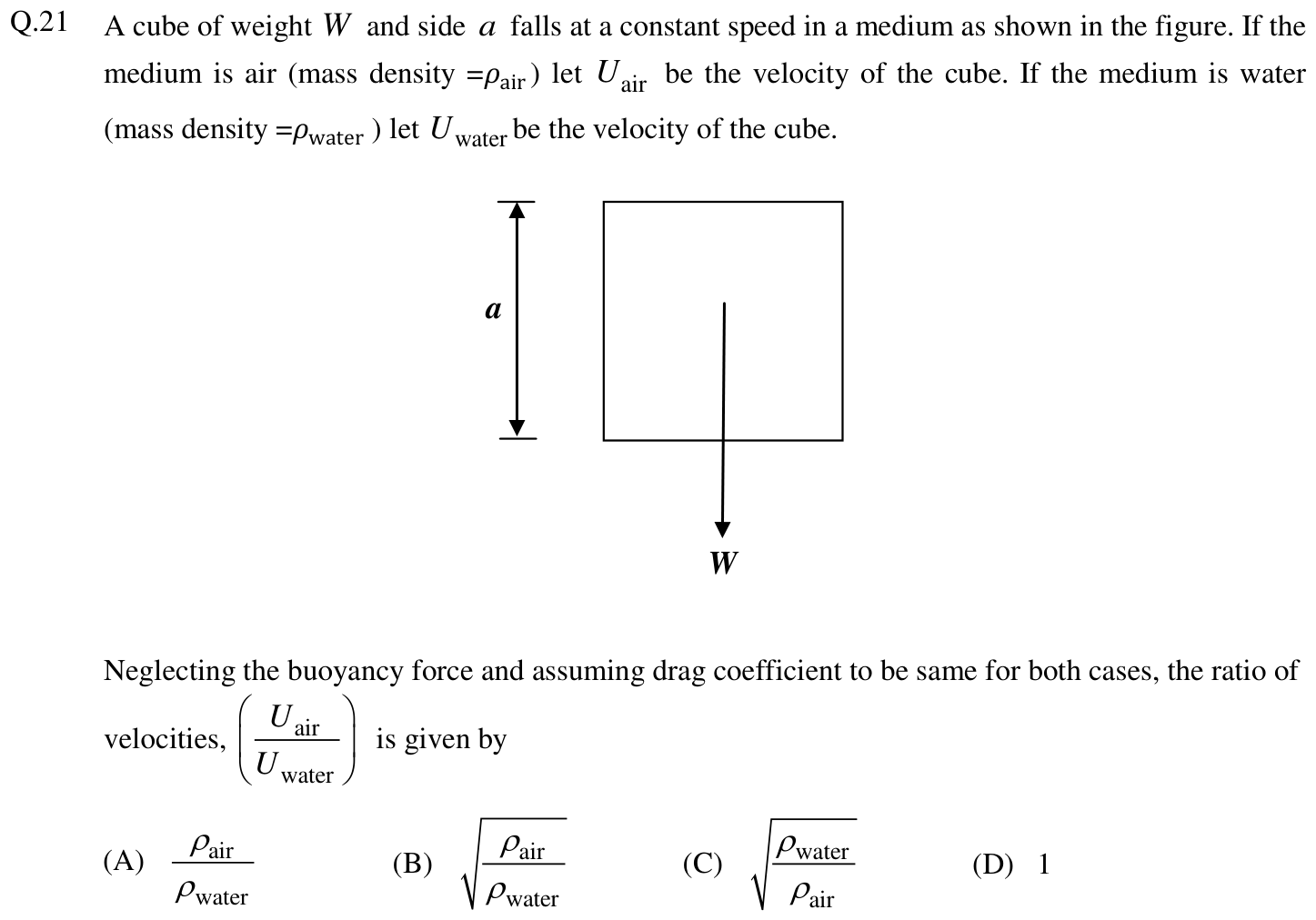
A cube of weight W and side a falls at a constant speed in a medium as shown in the figure. If the medium is air (mass density =𝜌𝜌air ) let air U be the velocity of the cube. If the medium is water (mass density =𝜌𝜌water ) let water U be the velocity of the cube. Neglecting the buoyancy force and assuming drag coefficient to be same for both cases, the ratio of velocities, air water U U is given by
- A. air water ρ ρ
- B. air water ρ ρ
- C. water air ρ ρ
- D. 1 δ 1 1 2 2 U U ( ) u y x y a W XE (GATE 2014)
Answer: C. water air ρ ρ
Question 22
Type: NAT | Marks: 2
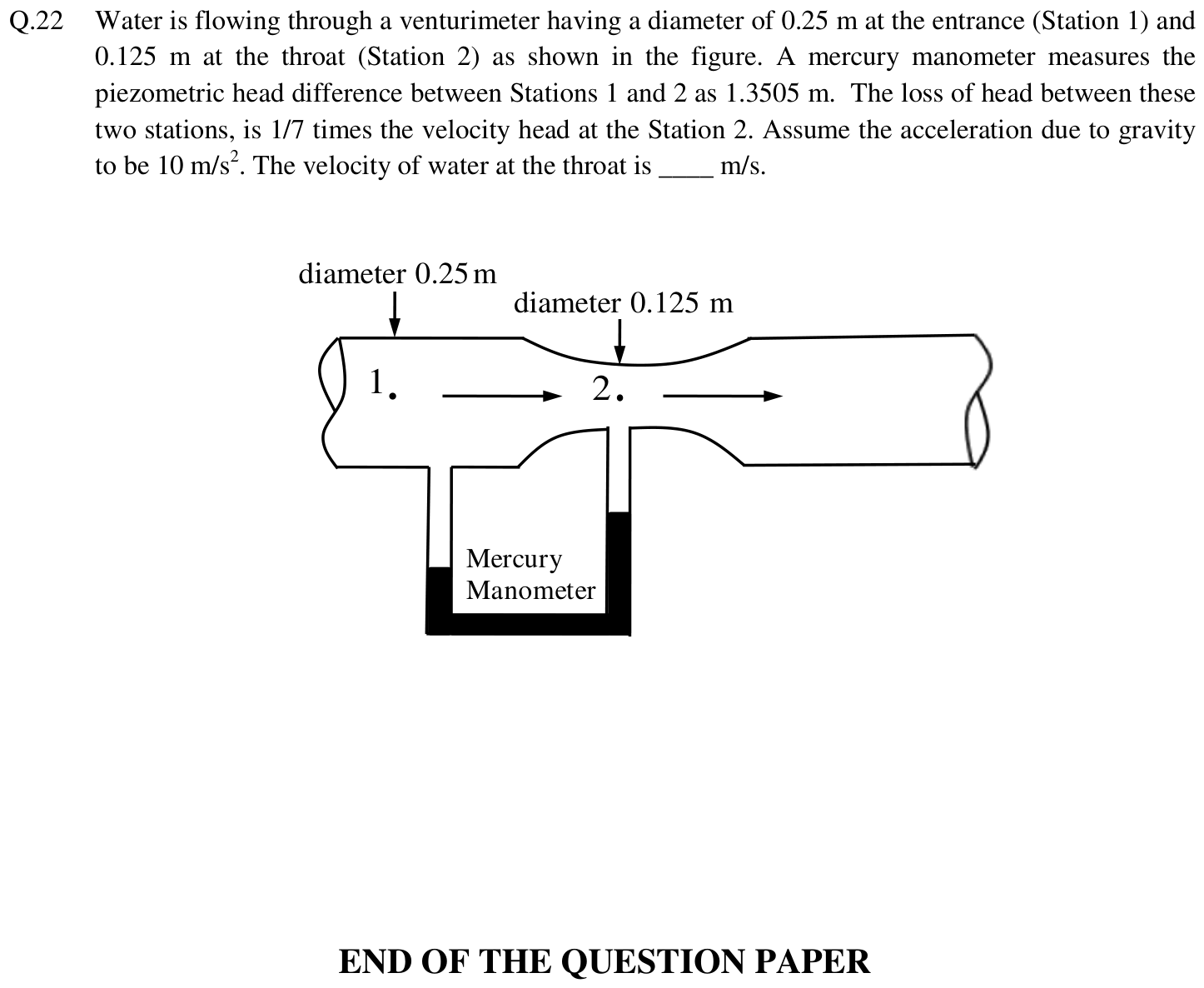
Water is flowing through a venturimeter having a diameter of 0.25 m at the entrance (Station 1) and 0.125 m at the throat (Station 2) as shown in the figure. A mercury manometer measures the piezometric head difference between Stations 1 and 2 as 1.3505 m. The loss of head between these two stations, is 1/7 times the velocity head at the Station 2. Assume the acceleration due to gravity to be 10 m/s2. The velocity of water at the throat is ____ m/s. • • 1 2 diameter 0.125 m diameter 0.25m Mercury Manometer XE (GATE 2014)
Answer: 4.8 to 5.2
Solid Mechanics
Question 1
Type: NAT | Marks: 1
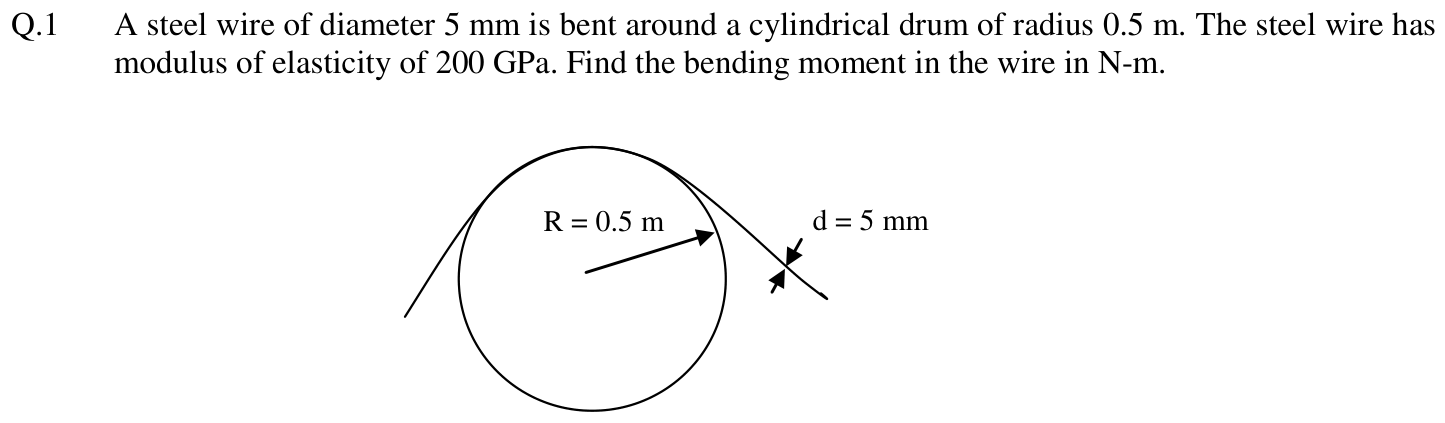
A steel wire of diameter 5 mm is bent around a cylindrical drum of radius 0.5 m. The steel wire has modulus of elasticity of 200 GPa. Find the bending moment in the wire in N-m.
Answer: 12.20 to 12.22
Question 2
Type: NAT | Marks: 1
A compressed air tank having an inner diameter of 480 mm and a wall thickness of 8 mm is formed by welding two steel hemispheres. If the allowable shear stress in the steel is 40 MPa, find the maximum permissible pressure (in MPa) inside the tank.
Answer: 5.3 to 5.4
Question 4
Marks: 1
A point in a body is subjected to a bi-axial state of stress, equal in magnitude but opposite in nature. On a plane inclined at an angle 45° with respect to x-axis (passing through the point), the
- A. shear and normal stresses are zero
- B. normal stress is maximum and shear stress is zero
- C. shear stress is maximum and normal stress is zero
- D. shear stress is maximum and normal stress is non-zero
Answer: C. shear stress is maximum and normal stress is zero
Question 3
Marks: 1
The Euler’s buckling load of a column fixed at both the ends is P. If one of the ends is made free, the buckling load shall change to
- A. P/16
- B. P/8
- C. P/4
- D. P/2 R = 0.5 m d = 5 mm XE (GATE 2014)
Answer: A. P/16
Question 6
Type: NAT | Marks: 1
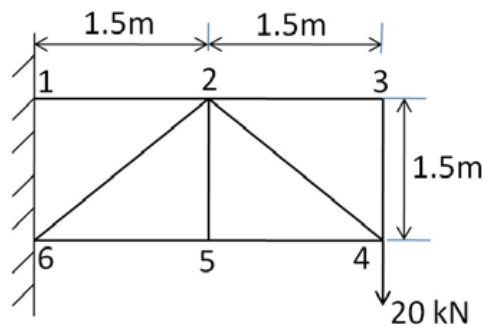
For the pin jointed truss, find the axial force (in kN) in the member 2-5.
Answer: 0
Question 5
Marks: 1
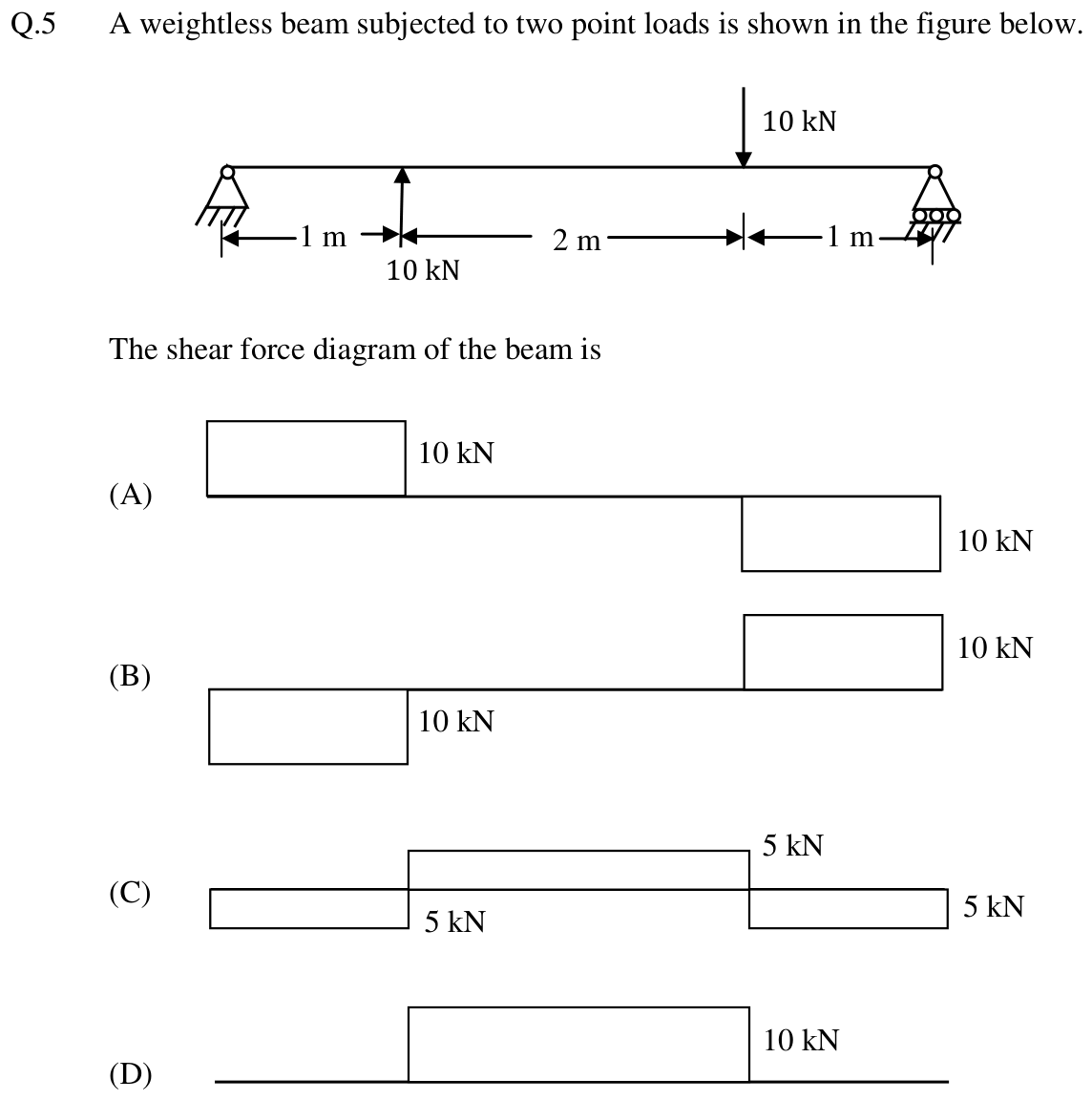
A weightless beam subjected to two point loads is shown in the figure below. The shear force diagram of the beam is
- A.
- B.
- C.
- D. 10 kN 10 kN 2 m 1 m 1 m 10 kN 10 kN 10 kN 10 kN 5 kN 5 kN 5 kN 10 kN XE (GATE 2014)
Answer: C.
Question 7
Marks: 1
The supporting structure of a water tank is made of reinforced concrete (RC) with a tubular cross section of inner diameter di, outer diameter do, height l, and Young’s modulus E. The mass of the tank is m. If mass of the supporting structure is neglected, then the natural frequency of the water tank in transverse direction is
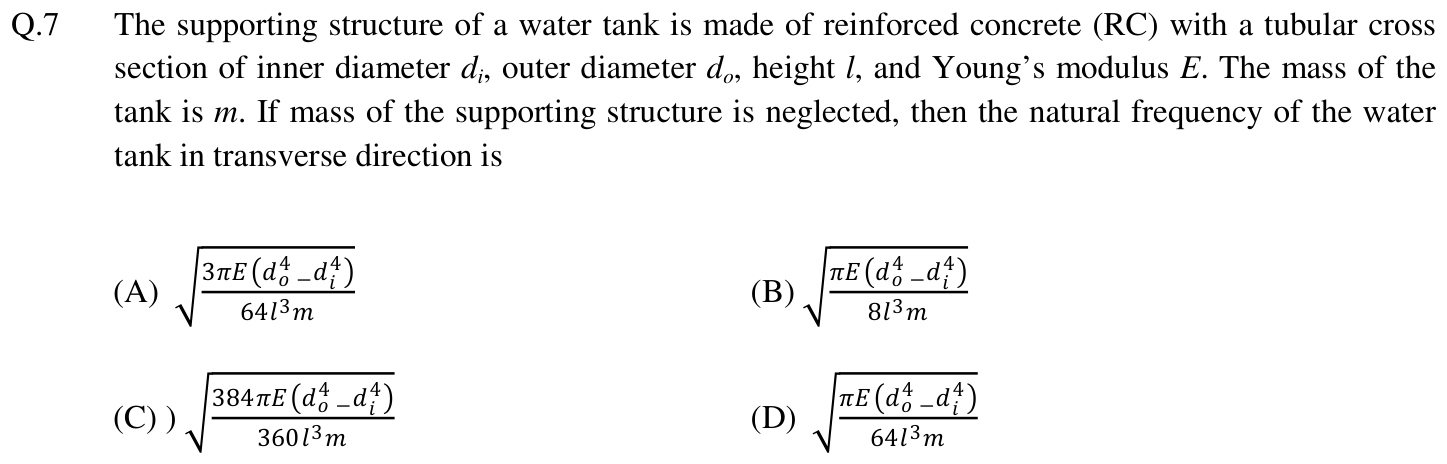
- A. ට3𝜋𝜋𝜋𝜋൫𝑑𝑑𝑜𝑜 − 4 𝑑𝑑𝑖𝑖 4൯ 64𝑙𝑙3𝑚𝑚
- B. ට𝜋𝜋𝜋𝜋൫𝑑𝑑𝑜𝑜 − 4 𝑑𝑑𝑖𝑖 4൯ 8𝑙𝑙3𝑚𝑚
- C. ) ට384𝜋𝜋𝜋𝜋൫𝑑𝑑𝑜𝑜 − 4 𝑑𝑑𝑖𝑖 4൯ 360𝑙𝑙3𝑚𝑚
- D. ට𝜋𝜋𝜋𝜋൫𝑑𝑑𝑜𝑜 − 4 𝑑𝑑𝑖𝑖 4൯ 64𝑙𝑙3𝑚𝑚
Answer: A. ට3𝜋𝜋𝜋𝜋൫𝑑𝑑𝑜𝑜 − 4 𝑑𝑑𝑖𝑖 4൯ 64𝑙𝑙3𝑚𝑚
Question 8
Marks: 1
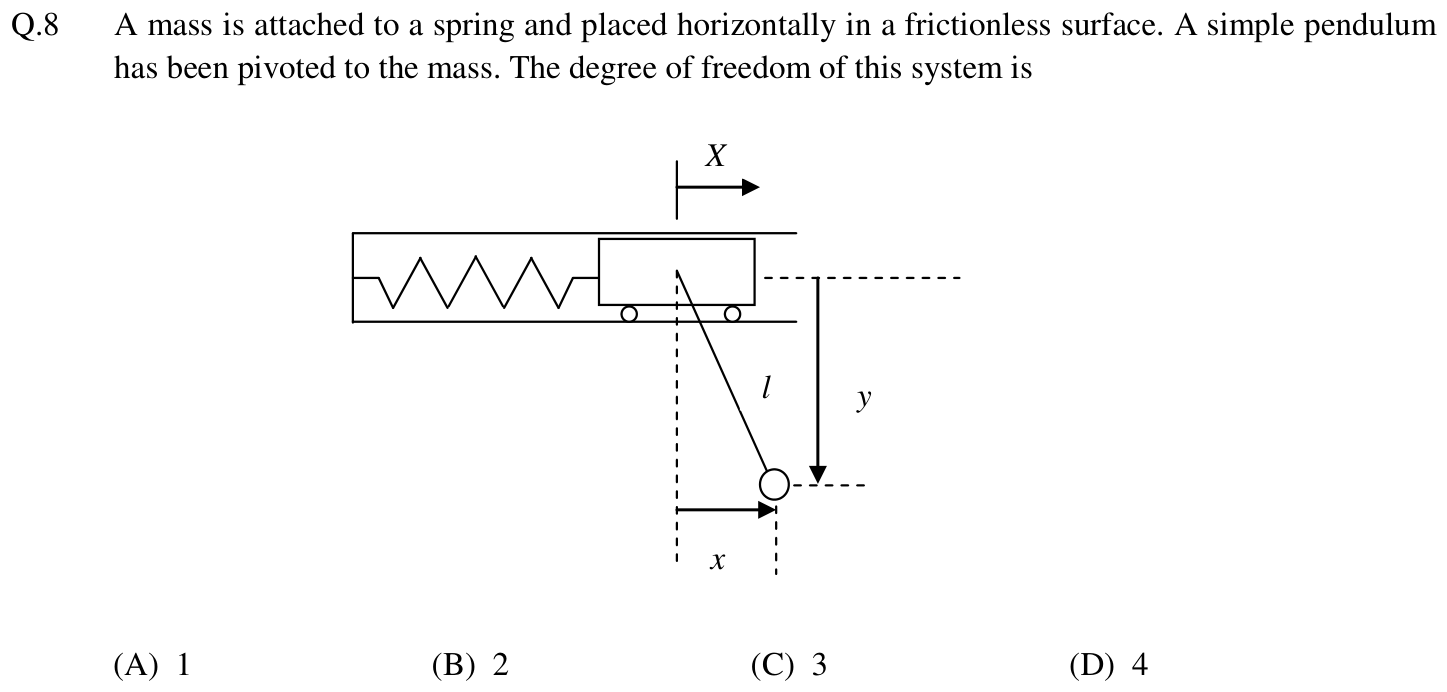
A mass is attached to a spring and placed horizontally in a frictionless surface. A simple pendulum has been pivoted to the mass. The degree of freedom of this system is
- A. 1
- B. 2
- C. 3
- D. 4 X y x l XE (GATE 2014)
Answer: B. 2
Question 9
Marks: 1
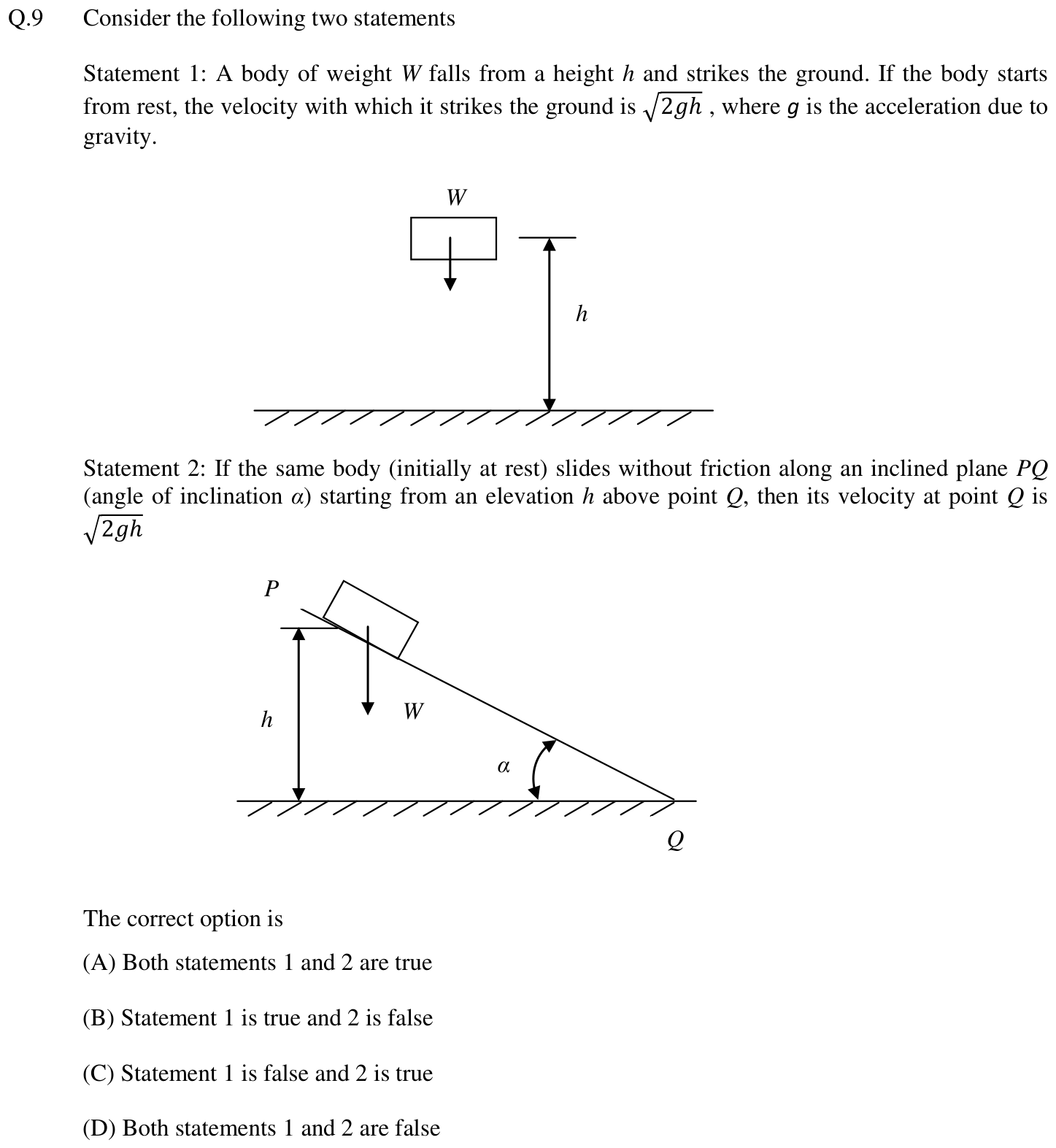
Consider the following two statements Statement 1: A body of weight W falls from a height h and strikes the ground. If the body starts from rest, the velocity with which it strikes the ground is ඥ2𝑔𝑔ℎ , where g is the acceleration due to gravity. Statement 2: If the same body (initially at rest) slides without friction along an inclined plane PQ (angle of inclination α) starting from an elevation h above point Q, then its velocity at point Q is ඥ2𝑔𝑔ℎ The correct option is
- A. Both statements 1 and 2 are true
- B. Statement 1 is true and 2 is false
- C. Statement 1 is false and 2 is true
- D. Both statements 1 and 2 are false W h h P Q W α XE (GATE 2014)
Answer: A. Both statements 1 and 2 are true
Question 10
Type: NAT | Marks: 2
A composite bar of length ‘L’ is made of a centrally placed steel plate (50 mm wide x 10 mm thick) with two copper plates (each 30 mm wide x 5 mm thick) connected rigidly on each side. If the temperature of the composite bar is raised by 50°C, find the stress developed in each copper plate in MPa. (For Steel: Es = 2x10⁵ MPa and αs= 12x10-6 /°C; For Copper: Ec = 1x10⁵ MPa and αc= 17x10-6 /°C)
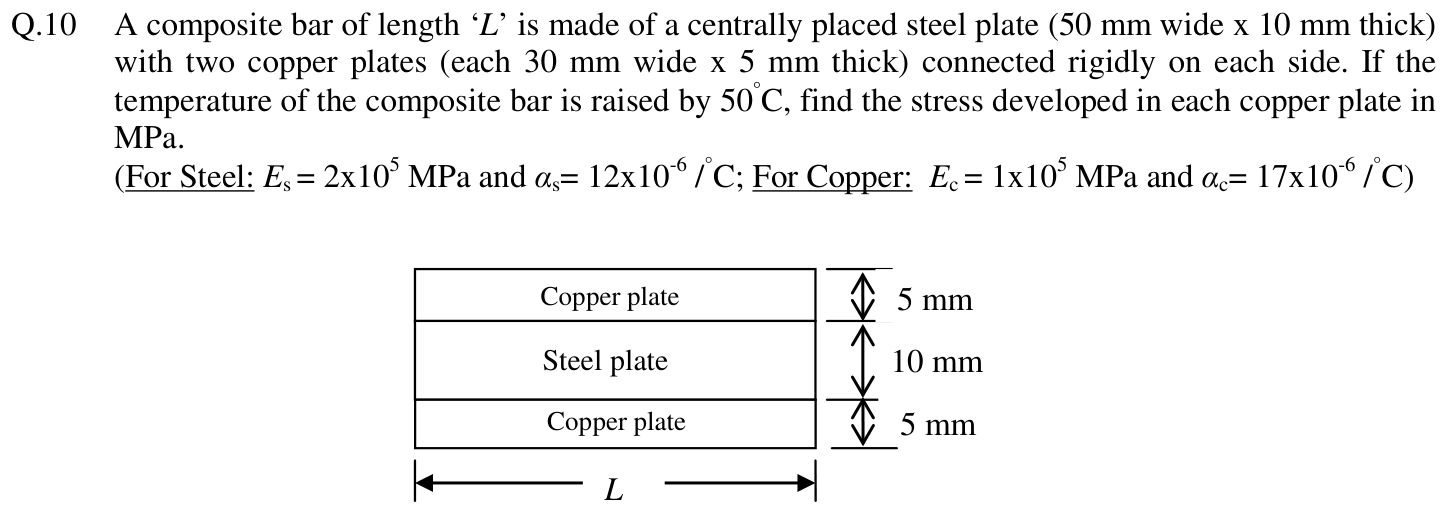
Answer: 19.1 to 19.3
Question 11
Marks: 2
The vertical deflection at the free end of the cantilever beam as shown in figure is
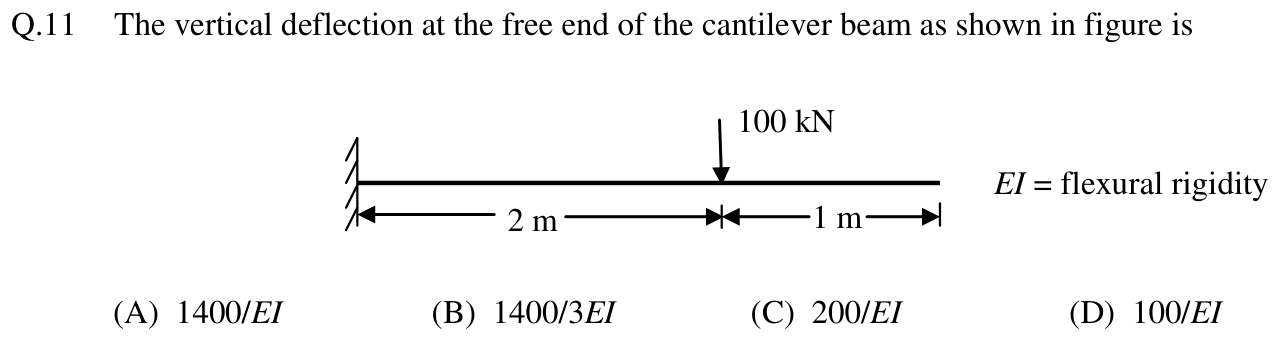
- A. 1400/EI
- B. 1400/3EI
- C. 200/EI
- D. 100/EI
Answer: B. 1400/3EI
Question 12
Type: NAT | Marks: 2
A hollow shaft and a solid shaft have the same length and the same outer radius R. The inner radius of the hollow shaft is 0.6 R. Assuming that both the shafts are made of same material and are subjected to the same torque, find the ratio of shear stress in hollow shaft to that in solid shaft.
Answer: 1.14 to 1.16
Question 13
Marks: 2
A beam with overhangs carries one point load acting downwards and the other upward. The clockwise moment Pb is applied at each support. The bending moment at the midpoint of the beam is
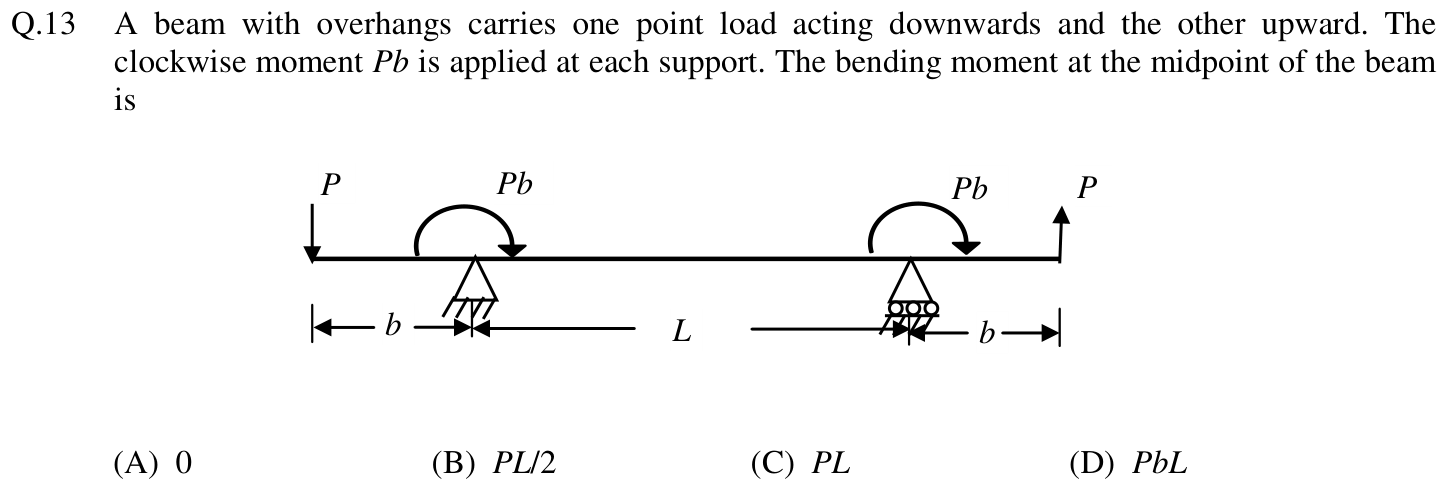
- A. 0
- B. PL/2
- C. PL
- D. PbL L Steel plate 5 mm 5 mm Copper plate Copper plate 10 mm 100 kN EI = flexural rigidity 1 m 2 m L P P b b Pb Pb XE (GATE 2014)
Answer: A. 0
Question 14
Marks: 2
A cantilever beam of length L supports a concentrated load P at the free end. The cross section of the beam is rectangular with constant width b and varying depth h. The depth h of this idealized cantilever beam varies in such a way that the maximum normal stress at every cross section remains equal to the allowable bending stress. Considering only the bending stresses, the depth hx of the fully stressed beam at any distance x from the free end shall vary
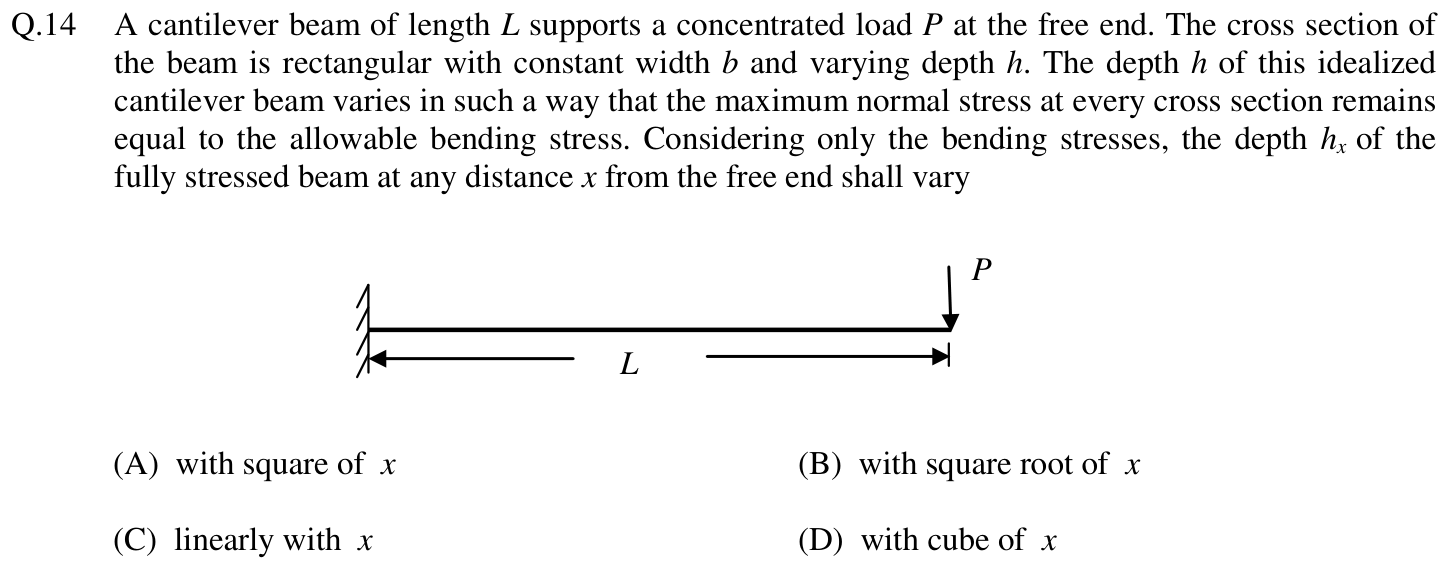
- A. with square of x
- B. with square root of x
- C. linearly with x
- D. with cube of x
Answer: B. with square root of x
Question 15
Marks: 2
A cantilever beam is subjected to following three different loading conditions: (a) a concentrated load P at its free end, (b) a couple Mo at its free end and (c) both loads acting simultaneously (a) (b) (c) The flexural rigidity of the beam may be assumed as EI. The strain energy due to bending when both loads act simultaneously
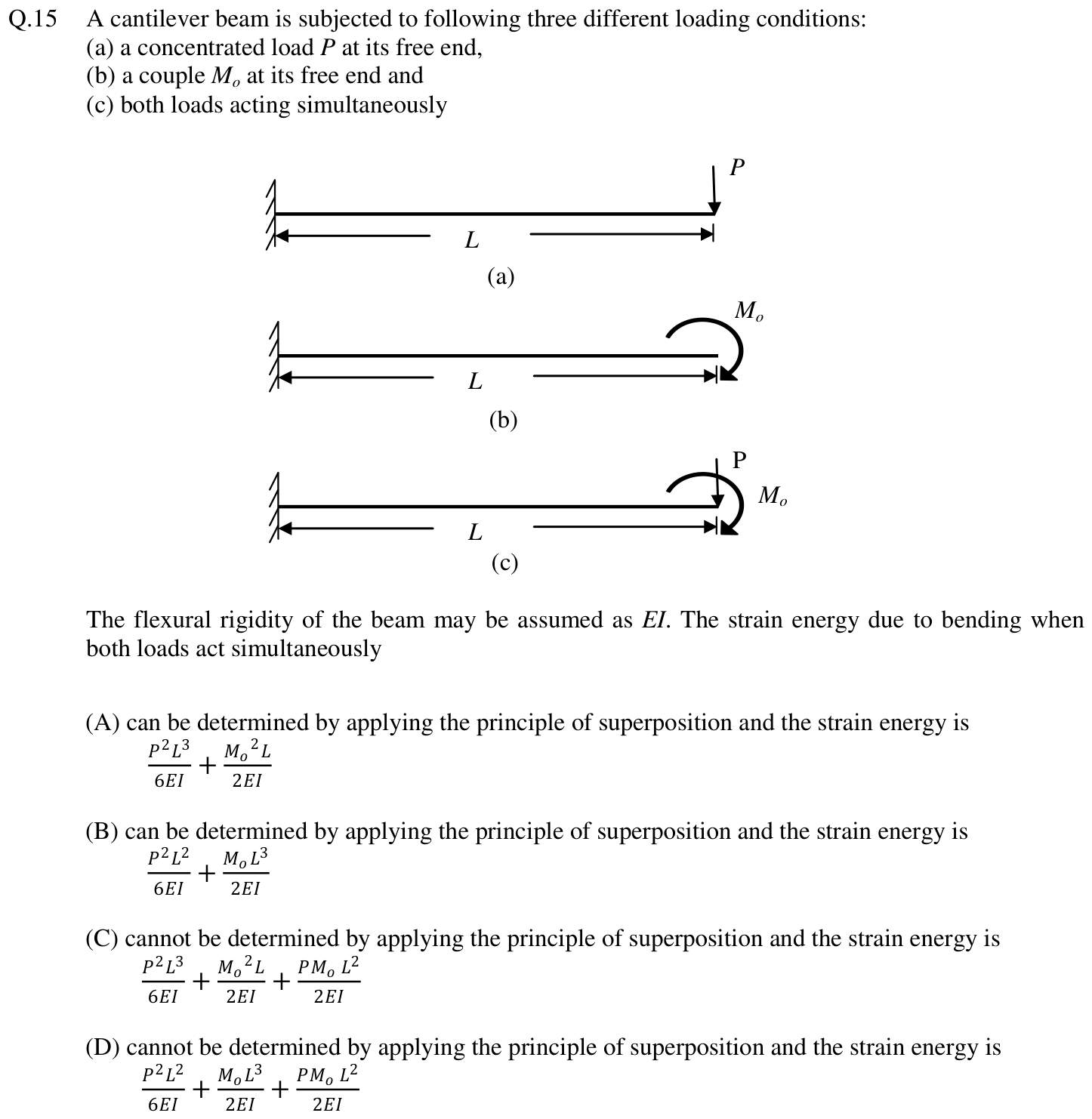
- A. can be determined by applying the principle of superposition and the strain energy is 𝑃𝑃2𝐿𝐿3 6𝐸𝐸𝐸𝐸+ 𝑀𝑀𝑜𝑜2𝐿𝐿 2𝐸𝐸𝐸𝐸
- B. can be determined by applying the principle of superposition and the strain energy is 𝑃𝑃2𝐿𝐿2 6𝐸𝐸𝐸𝐸+ 𝑀𝑀𝑜𝑜𝐿𝐿3 2𝐸𝐸𝐸𝐸
- C. cannot be determined by applying the principle of superposition and the strain energy is 𝑃𝑃2𝐿𝐿3 6𝐸𝐸𝐸𝐸+ 𝑀𝑀𝑜𝑜2𝐿𝐿 2𝐸𝐸𝐸𝐸+ 𝑃𝑃𝑀𝑀𝑜𝑜 𝐿𝐿2 2𝐸𝐸𝐸𝐸
- D. cannot be determined by applying the principle of superposition and the strain energy is 𝑃𝑃2𝐿𝐿2 6𝐸𝐸𝐸𝐸+ 𝑀𝑀𝑜𝑜𝐿𝐿3 2𝐸𝐸𝐸𝐸+ 𝑃𝑃𝑀𝑀𝑜𝑜 𝐿𝐿2 2𝐸𝐸𝐸𝐸 P L P L Mo L Mo L P XE (GATE 2014)
Answer: C. cannot be determined by applying the principle of superposition and the strain energy is 𝑃𝑃2𝐿𝐿3 6𝐸𝐸𝐸𝐸+ 𝑀𝑀𝑜𝑜2𝐿𝐿 2𝐸𝐸𝐸𝐸+ 𝑃𝑃𝑀𝑀𝑜𝑜 𝐿𝐿2 2𝐸𝐸𝐸𝐸
Question 16
Marks: 2
A tapered rod has diameter d1 at one end which reduces uniformly to a diameter d2 over the length (L). If the modulus of elasticity of the material is E, the change in the length of the rod due to the application of axial force (P) is
- A. 4𝑃𝑃𝑃𝑃 𝜋𝜋𝜋𝜋𝑑𝑑1𝑑𝑑2
- B. 4𝑃𝑃𝑃𝑃 𝜋𝜋𝜋𝜋൫𝑑𝑑12−𝑑𝑑22൯
- C. 𝑃𝑃𝑃𝑃 𝜋𝜋𝜋𝜋𝑑𝑑1𝑑𝑑2
- D. 2𝑃𝑃𝑃𝑃 𝜋𝜋𝜋𝜋൫𝑑𝑑12−𝑑𝑑22൯
Answer: A. 4𝑃𝑃𝑃𝑃 𝜋𝜋𝜋𝜋𝑑𝑑1𝑑𝑑2
Question 17
Type: NAT | Marks: 2
For a point in a body subjected to a plane stress condition (σx= 100 MPa, σy= 50 MPa and τxy = τyx = 25 MPa), the maximum principal stress in MPa is_____________
Answer: 110.3 to 110.5
Question 18
Marks: 2
An isotropic body is subjected to a state of stress given by: σx= 10 MPa and τxy = τyx = −20 MPa. Assuming G = 0.4E, the volumetric strain is
- A. 5/E
- B. 7.5/E
- C. 10/E
- D. 15/E
Answer: A. 5/E
Question 19
Marks: 2
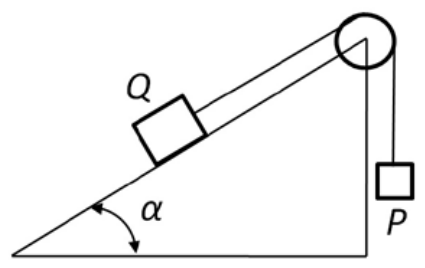
A block of weight Q rests on an inclined plane and it is attached to a string which runs over a frictionless pulley to carry a block of weight P at its other end. The coefficient of friction between the block of weight Q and the inclined plane is µ. Consider the following cases: Case I: weight Q starts moving down the inclined plane Case II: weight P starts falling down The limiting values of ratio P/Q for Case I and Case II respectively are
- A. (sin 𝛼𝛼−𝜇𝜇cos𝛼𝛼) and (sin𝛼𝛼+ 𝜇𝜇cos 𝛼𝛼)
- B. (𝜇𝜇sin 𝛼𝛼−cos 𝛼𝛼) and (𝜇𝜇sin 𝛼𝛼+ cos 𝛼𝛼)
- C. (sin 𝛼𝛼+ 𝜇𝜇cos𝛼𝛼) and (sin𝛼𝛼−𝜇𝜇cos 𝛼𝛼)
- D. (𝜇𝜇sin 𝛼𝛼+ cos 𝛼𝛼) and 𝜇𝜇(sin 𝛼𝛼−cos 𝛼𝛼) XE (GATE 2014)
Answer: A. (sin 𝛼𝛼−𝜇𝜇cos𝛼𝛼) and (sin𝛼𝛼+ 𝜇𝜇cos 𝛼𝛼)
Question 20
Marks: 2
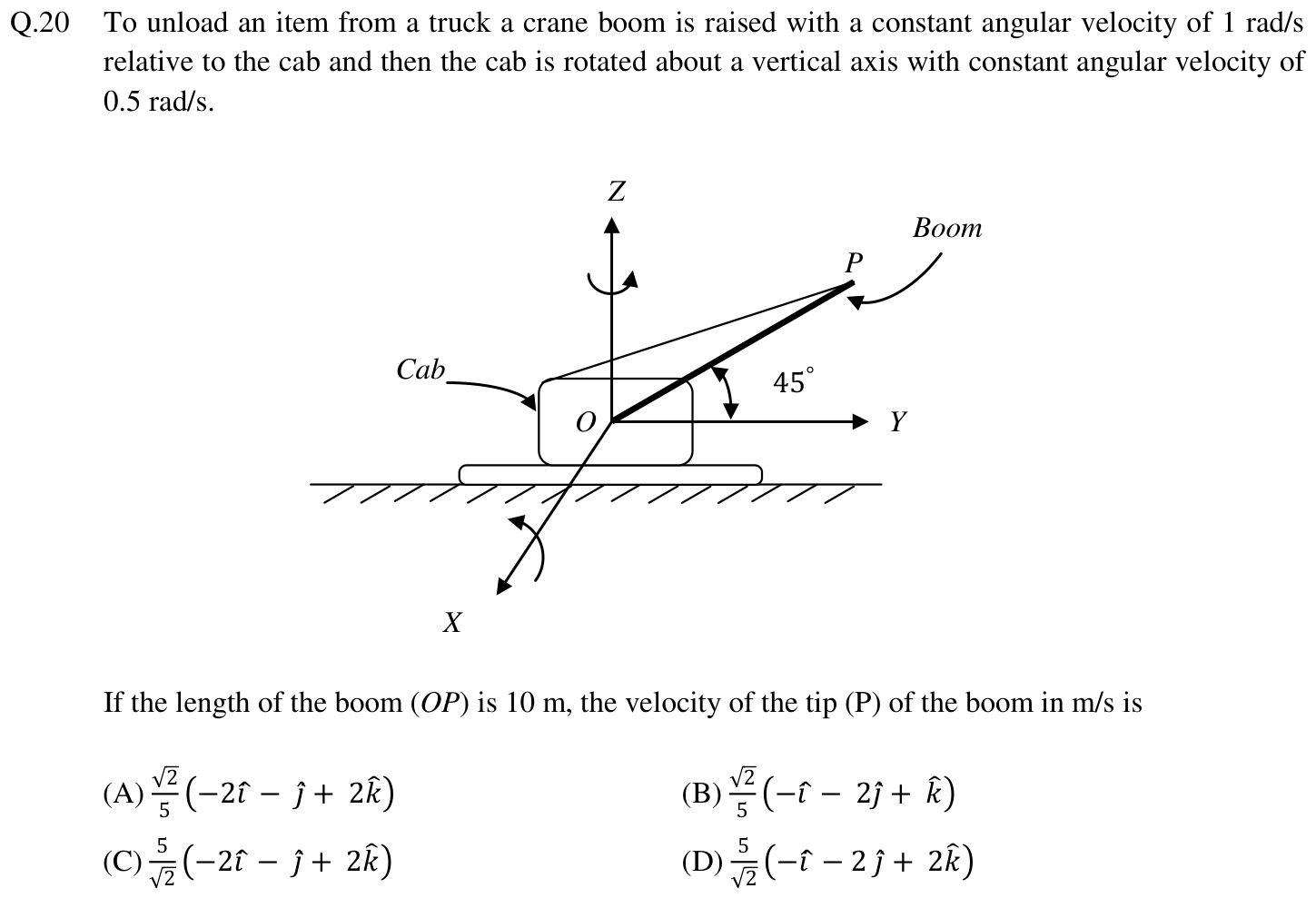
To unload an item from a truck a crane boom is raised with a constant angular velocity of 1 rad/s relative to the cab and then the cab is rotated about a vertical axis with constant angular velocity of 0.5 rad/s. If the length of the boom (OP) is 10 m, the velocity of the tip (P) of the boom in m/s is
- A. √2 5 ൫−2𝑖𝑖 ො− 𝑗𝑗̂ + 2𝑘𝑘൯
- B. √2 5 ൫−𝑖𝑖 ො− 2𝑗𝑗̂ + 𝑘𝑘൯
- C. 5 √2 ൫−2𝑖𝑖 ො− 𝑗𝑗̂ + 2𝑘𝑘൯
- D. 5 √2 ൫−𝑖𝑖 ො−2 𝑗𝑗̂ + 2𝑘𝑘൯
Answer: D. 5 √2 ൫−𝑖𝑖 ො−2 𝑗𝑗̂ + 2𝑘𝑘൯
Question 21
Marks: 2
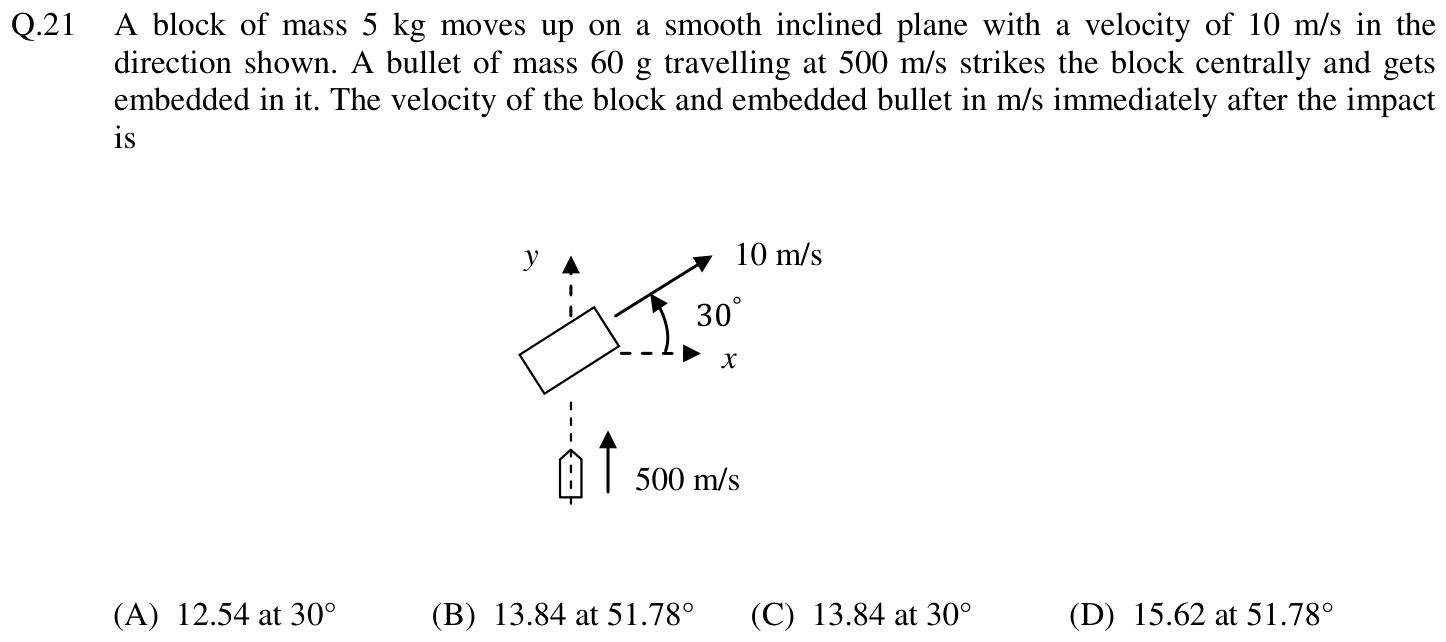
A block of mass 5 kg moves up on a smooth inclined plane with a velocity of 10 m/s in the direction shown. A bullet of mass 60 g travelling at 500 m/s strikes the block centrally and gets embedded in it. The velocity of the block and embedded bullet in m/s immediately after the impact is
- A. 12.54 at 30°
- B. 13.84 at 51.78°
- C. 13.84 at 30°
- D. 15.62 at 51.78° Z X Y Cab Boom 45° O P 30° x y 500 m/s 10 m/s XE (GATE 2014)
Answer: B. 13.84 at 51.78°
Question 22
Type: NAT | Marks: 2
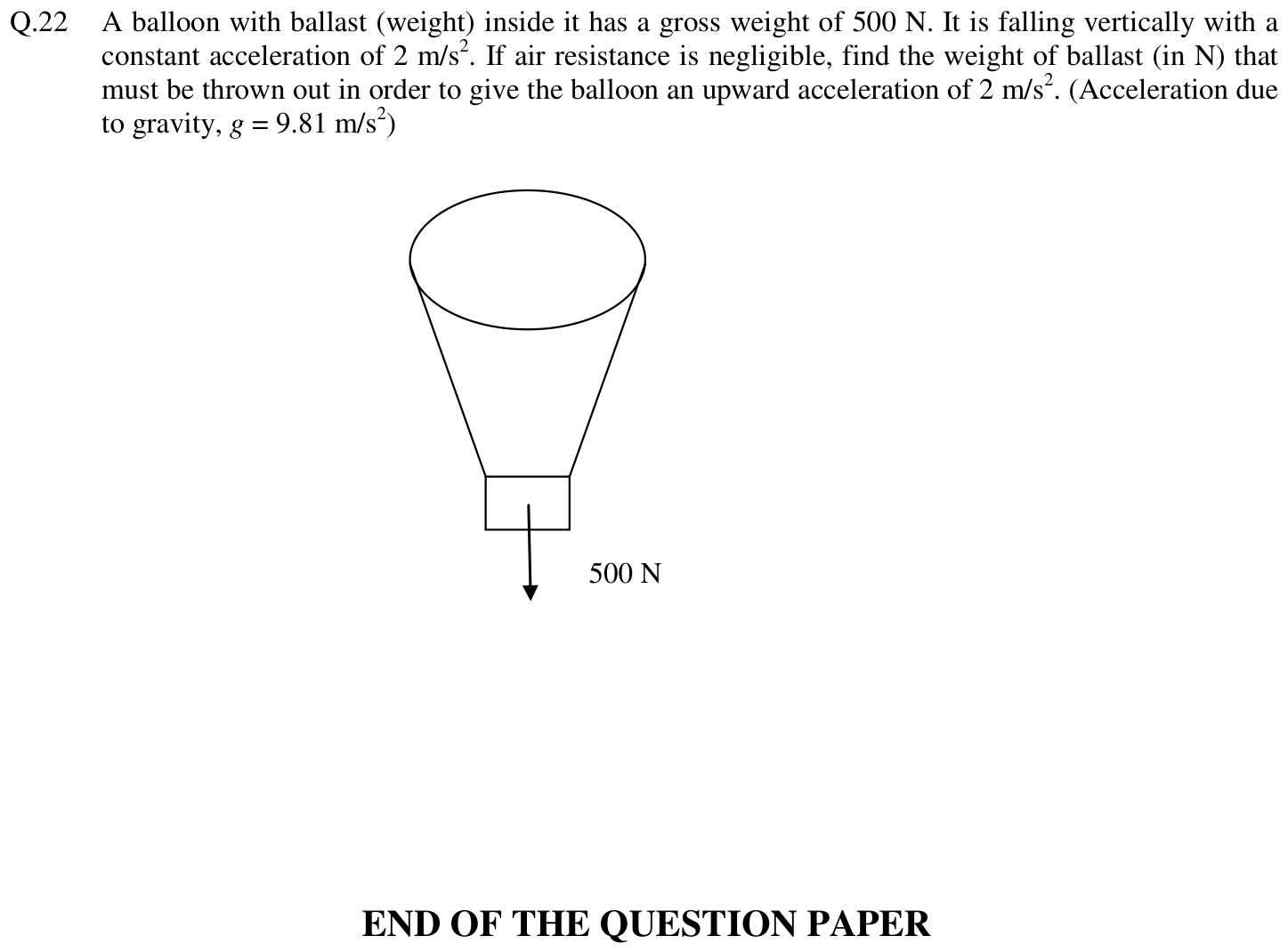
A balloon with ballast (weight) inside it has a gross weight of 500 N. It is falling vertically with a constant acceleration of 2 m/s2. If air resistance is negligible, find the weight of ballast (in N) that must be thrown out in order to give the balloon an upward acceleration of 2 m/s2. (Acceleration due to gravity, g = 9.81 m/s2) 500 N XE (GATE 2014)
Answer: 169.3 to 169.4
Thermodynamics
Question 1
Marks: 1
Entropy is a
- A. Path function
- B. Point function
- C. Property independent function
- D. Neither path nor point function
Answer: B. Point function
Question 2
Marks: 1
A small container has gas at high pressure. It is placed in an evacuated space. If the container is punctured, work done by the gas is
- A. Positive
- B. Negative
- C. Zero
- D. ∞
Answer: C. Zero
Question 3
Marks: 1
The molecular weight of a mixture is 38.4 gm/mol. The mixture is composed of methane and carbon-dioxide gases. The atomic weights of the elements C, H, and O are 12, 1, and 16 gm/mol, respectively. The mole fraction of methane (Xmethane) is ____________ and that of carbon-dioxide (X carbon-dioxide) is _______.
- A. Xmethane = 0.2; X carbon-dioxide = 0.8
- B. Xmethane = 0.8; X carbon-dioxide = 0.2
- C. Xmethane = 0.3; X carbon-dioxide = 0.7
- D. Xmethane= 0.7; X carbon-dioxide = 0.3
Answer: A. Xmethane = 0.2; X carbon-dioxide = 0.8
Question 4
Marks: 1
A system undergoes a change from state 1 to state 2. During this process, the change in the internal energy is ∆U. The change in internal energy of the system when executing the cycle 1-2-1 is equal to
- A. ∆U
- B. 2∆U
- C. Zero
- D. −2∆U XE (GATE 2014)
Answer: C. Zero
Question 5
Marks: 1
Which among the following plots represents a line joining two states with the same dew point temperature on a standard psychrometric chart, with the dry bulb temperature on the X-axis and the humidity ratio on the Y-axis?
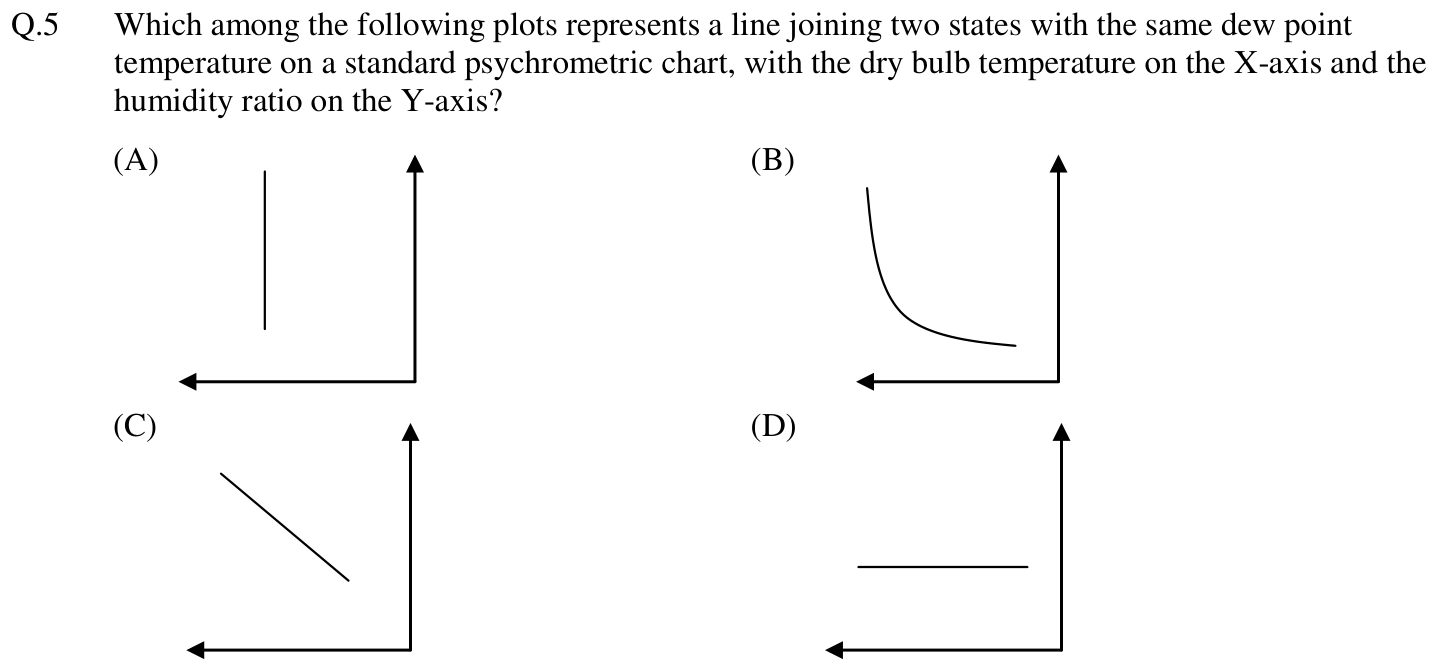
Answer: D.
Question 6
Marks: 1
The efficiency of a reversible engine operating between two temperatures is 40 % . The COP of a reversible refrigerator operating between the same temperatures is
Answer: A. 1.5
Question 7
Marks: 1
For a superheated vapor that cannot be approximated as an ideal gas, the expression determining a small change in the specific internal energy is
- A. dv v u dT c du T p ∂ ∂ + =
- B. dP P u dT c du T p ∂ ∂ + =
- C. dv v u dT c du T v ∂ ∂ + =
- D. dT c du v =
Answer: C. dv v u dT c du T v ∂ ∂ + =
Question 8
Marks: 1
The minimum and maximum volumes in an air standard Otto cycle are 100 and 800 cm3. Its thermal efficiency (%) is
- A. 56.47
- B. 94.55
- C. 54.08
- D. 87.50
Answer: A. 56.47
Question 9
Marks: 1
At a saturation temperature Tsat, the difference between the entropy of saturated vapor and entropy of saturated liquid can be expressed as
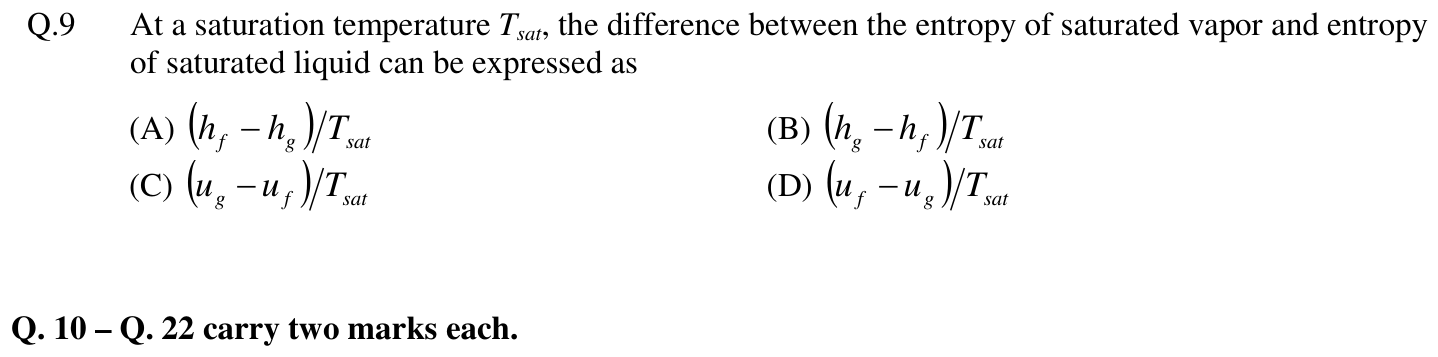
- A. ( ) sat g f T h h −
- B. ( ) sat f g T h h −
- C. ( ) sat f g T u u −
- D. ( ) sat g f T u u −
Answer: B. ( ) sat f g T h h −
Question 10
Marks: 2
A gas in a closed system is compressed reversibly from an initial volume of 0.2 m3 to 0.1 m3 at a constant pressure of 3 bar. During this process, there was a heat transfer of 50 kJ from the gas. The change in internal energy of the gas during this process in kJ is
- A. 20
- B. −80
- C. 80
- D. −20 XE (GATE 2014)
Answer: D. −20 XE (GATE 2014)
Question 11
Marks: 2
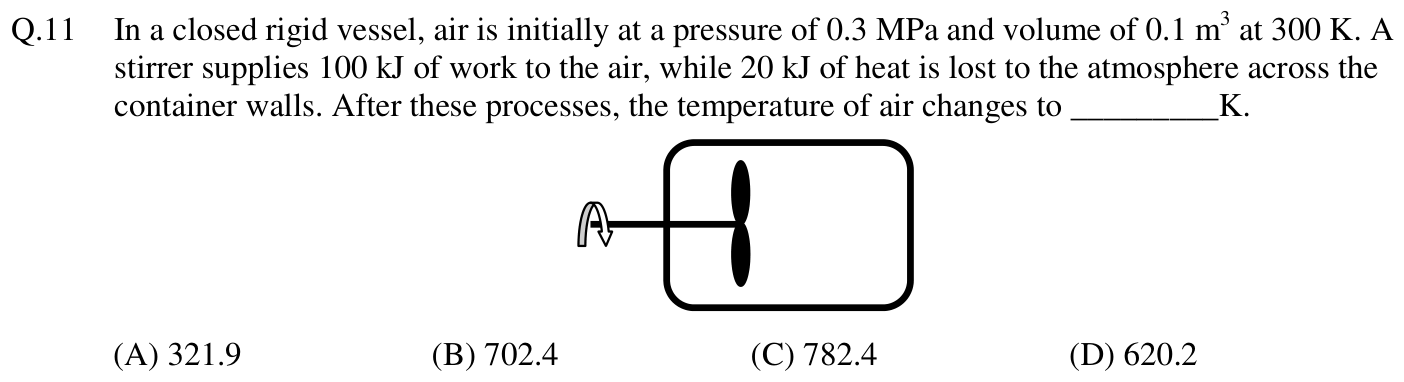
In a closed rigid vessel, air is initially at a pressure of 0.3 MPa and volume of 0.1 m3 at 300 K. A stirrer supplies 100 kJ of work to the air, while 20 kJ of heat is lost to the atmosphere across the container walls. After these processes, the temperature of air changes to _________K.
- A. 321.9
- B. 702.4
- C. 782.4
- D. 620.2
Answer: D. 620.2
Question 12
Marks: 2
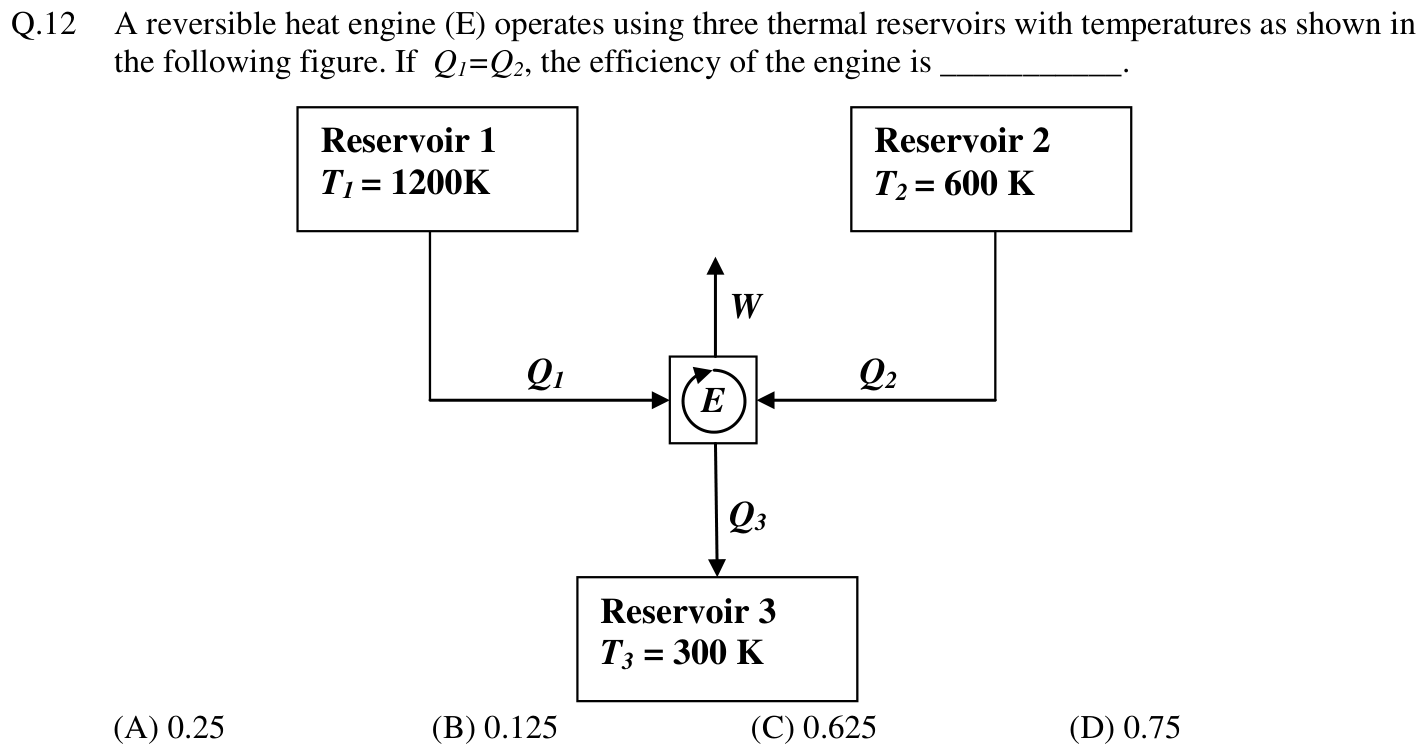
A reversible heat engine (E) operates using three thermal reservoirs with temperatures as shown in the following figure. If Q1=Q2, the efficiency of the engine is ___________.
- A. 0.25
- B. 0.125
- C. 0.625
- D. 0.75
Answer: C. 0.625
Question 13
Marks: 2
A metal block of mass 25 kg at 300 K is immersed in an infinitely large liquid nitrogen bath maintained at 77 K. The system comprising of the block and liquid nitrogen attains thermal equilibrium. The average specific heat of the metal is 0.45 kJ/(kg.K). The entropy generated during the process is ___________kJ/K.
- A. 17.28
- B. 32.5
- C. 47.8
- D. −47.8
Answer: A. 17.28
Question 14
Marks: 2
For a gas obeying the equation of state given by RT v v a P = + 2 , the values of the critical volume and the critical temperature are 0.004 m3/kg and 100 °C, respectively. If the value of the gas constant is 250 J/(kg.K), then the value of the constant ‘a’ is _____________ (N.m4/kg2). Note that the critical point is the point of inflection on the critical isotherm.
- A. 124.3
- B. 0.75
- C. 186.58
- D. 248.67 Reservoir 1 T1 = 1200K Reservoir 2 T2 = 600 K Reservoir 3 T3 = 300 K Q1 Q2 Q3 E W XE (GATE 2014)
Answer: C. 186.58
Question 15
Marks: 2
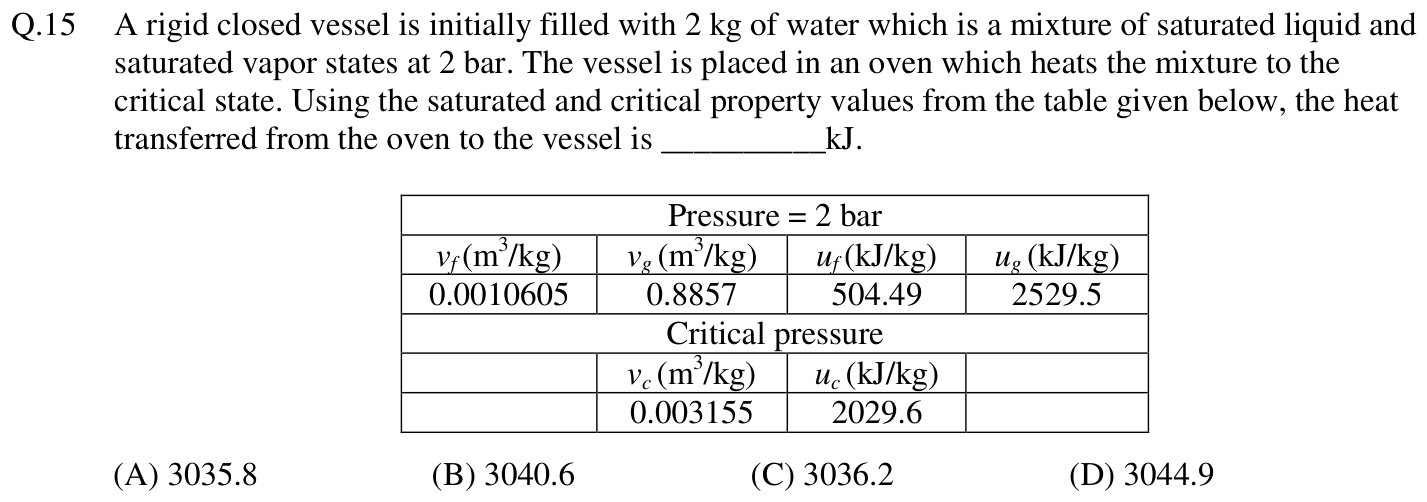
A rigid closed vessel is initially filled with 2 kg of water which is a mixture of saturated liquid and saturated vapor states at 2 bar. The vessel is placed in an oven which heats the mixture to the critical state. Using the saturated and critical property values from the table given below, the heat transferred from the oven to the vessel is __________kJ. Pressure = 2 bar vf (m3/kg) vg (m3/kg) uf (kJ/kg) ug (kJ/kg) 0.0010605 0.8857 504.49 2529.5 Critical pressure vc (m3/kg) uc (kJ/kg) 0.003155 2029.6
- A. 3035.8
- B. 3040.6
- C. 3036.2
- D. 3044.9
Answer: B. 3040.6
Question 16
Marks: 2
The equation of state for a certain gas is given by 2 2 1 / / C T C P RT v + − = , where C1 is 50,000 (K2.m3)/kg and C2 is 0.8 m3/kg. The relation P T T v T v P h ∂ ∂ − = ∂ ∂ is known for the gas. The inversion temperature, given by the condition, = ∂ ∂ 0 T P h is _________K.
- A. 500.0
- B. 433.0
- C. 353.6
- D. 250.0
Answer: B. 433.0
Question 17
Marks: 2
The maximum pressure and temperature in an air standard diesel cycle are 44 bar and 1600 K, respectively. If the minimum pressure and temperature are 1 bar and 300 K, respectively, then the cut-off ratio (the ratio of the volume at the end of the heat addition process to that at the beginning of the heat addition process) is
- A. 1.000
- B. 14.920
- C. 2.809
- D. 1.809
Answer: D. 1.809
Question 18
Marks: 2
The thermal efficiency of an air standard Brayton cycle 0.35. The pressure ratio across the turbine is
- A. 4.516
- B. 5.232
- C. 7.535
- D. 8.234
Answer: A. 4.516
Question 19
Marks: 2
Steam is isentropically expanded in a turbine from 80 bar to 7 bar. At the inlet of the turbine (state 1) h1 is 3246 kJ/kg and s1 is 6.52 kJ/(kg.K). Pressure = 7 bar hf (kJ/kg) hg (kJ/kg) sf [kJ/(kg.K)] sg [kJ/(kg.K)] 697 2763 2.0 6.7 The enthalpy of the steam exiting the turbine (state 2) in kJ/kg is
- A. 2683.87
- B. 2657.17
- C. 1986.87
- D. 3354.17 XE (GATE 2014)
Answer: A. 2683.87
Question 20
Marks: 2
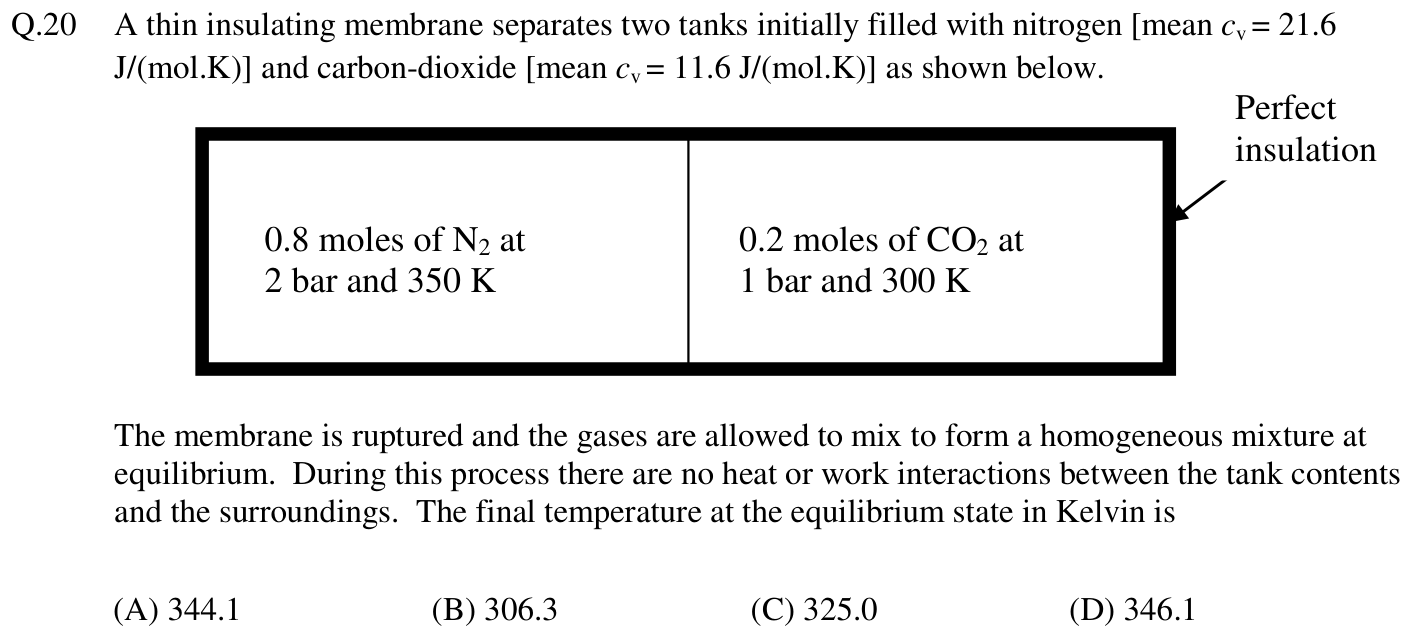
A thin insulating membrane separates two tanks initially filled with nitrogen [mean cv = 21.6 J/(mol.K)] and carbon-dioxide [mean cv = 11.6 J/(mol.K)] as shown below. The membrane is ruptured and the gases are allowed to mix to form a homogeneous mixture at equilibrium. During this process there are no heat or work interactions between the tank contents and the surroundings. The final temperature at the equilibrium state in Kelvin is
- A. 344.1
- B. 306.3
- C. 325.0
- D. 346.1
Answer: A. 344.1
Question 21
Marks: 2
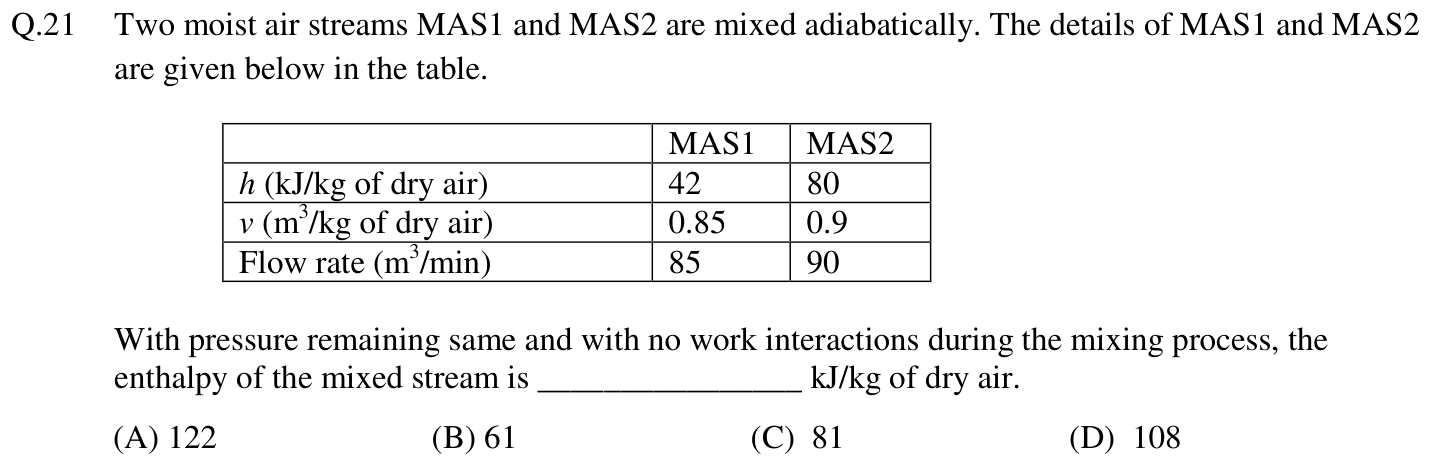
Two moist air streams MAS1 and MAS2 are mixed adiabatically. The details of MAS1 and MAS2 are given below in the table. MAS1 MAS2 h (kJ/kg of dry air) 42 80 v (m3/kg of dry air) 0.85 0.9 Flow rate (m3/min) 85 90 With pressure remaining same and with no work interactions during the mixing process, the enthalpy of the mixed stream is ________________ kJ/kg of dry air.
Answer: B. 61
Question 22
Marks: 2
Consider the steady flow of air through an insulated nozzle. The pressure and temperature at the inlet are 120 kPa and 320 K, respectively. The outlet pressure is 1 bar. The inlet velocity is very small and the air undergoes a reversible adiabatic process. The outlet velocity, in m/s, is
- A. 303.7
- B. 180.7
- C. 5.7
- D. 127.3 0.8 moles of N2 at 2 bar and 350 K 0.2 moles of CO2 at 1 bar and 300 K Perfect insulation XE (GATE 2014)
Answer: B. 180.7