Question 1
Marks: 1
Let $M = \begin{pmatrix} 1 & 1 & 1 \\ 0 & 1 & 1 \\ 0 & 0 & 1 \end{pmatrix}$. Then the maximum number of linearly independent eigenvectors of $M$ is
- A. 0
- B. 1
- C. 2
- D. 3
Attempt the GATE XE (Engineering Sciences) 2007 previous year paper in real CBT exam mode or practice mode. Answers will be added when the official answer key is published on CMB HUB.
All GATE XE (Engineering Sciences) papers
112 questions. The official answer key for this paper has not been published on CMB HUB yet, so the questions are shown without answers.
Marks: 1
Let $M = \begin{pmatrix} 1 & 1 & 1 \\ 0 & 1 & 1 \\ 0 & 0 & 1 \end{pmatrix}$. Then the maximum number of linearly independent eigenvectors of $M$ is
Marks: 1
Let $L = \lim_{x \to \frac{\pi}{2}} \frac{\sin^2 2x}{(x - \frac{\pi}{2})^2}$. Then $L$ is equal to
Marks: 1
Let $f(z) = \frac{1}{1 - z^2}$. The coefficient of $\frac{1}{z - 1}$ in the Laurent expansion of $f(z)$ about $z = 1$ is
Marks: 1
Let $u(x,t)$ be the solution of the initial value problem $\frac{\partial^2 u}{\partial t^2} = 9\frac{\partial^2 u}{\partial x^2}$, $t > 0$, $-\infty < x < \infty$, $u(x,0) = x + 5$, $\frac{\partial u}{\partial t}(x,0) = 0$. Then $u(2,2)$ is
Marks: 1
Two students take a test consisting of five TRUE/FALSE questions. To pass the test the students have to answer at least three questions correctly. Both of them know the correct answers to two questions and guess the answers to the remaining three. The probability that only one student passes the test is equal to
Marks: 1
The equation $g(x) = x$ is solved by Newton-Raphson iteration method, starting with an initial approximation $x_0$ near the simple root $\alpha$. If $x_{n+1}$ is the approximation to $\alpha$ at the $(n+1)^{th}$ iteration, then
Marks: 2
Let $Ax = b$ be a system of $m$ linear equations in $n$ unknowns with $m < n$ and $b \neq 0$. Then the system has
Marks: 2
Let $R$ be an $n \times n$ nonsingular matrix. Let $P$ and $Q$ be two $n \times n$ matrices such that $Q = R^{-1}PR$. If $x$ is an eigenvector of $P$ corresponding to a nonzero eigenvalue $\lambda$ of $P$, then
Marks: 2
Let $M$ be a $2 \times 2$ matrix with eigenvalues 1 and 2. Then $M^{-1}$ is
Marks: 2
The number of $n \times n$ matrices that are simultaneously Hermitian, unitary and diagonal is
Marks: 2
Let $M = \begin{pmatrix} 1 & b & a \\ 0 & 2 & c \\ 0 & 0 & 1 \end{pmatrix}$, where $a, b, c$ are real numbers. Then $M$ is diagonalizable
Marks: 2
The maximum value of the function $2x + 3y + 4z$ on the ellipsoid $2x^2 + 3y^2 + 4z^2 = 1$ is
Marks: 2
Let $f: \mathbb{R} \to \mathbb{R}$ be a twice differentiable real valued function such that $f(1/n) = 1$ for $n = 1, 2, 3, \dots$. Then
Marks: 2
Let $f(x) = \int_0^{x^2} \sin\sqrt{t} \, dt$ for $x \ge 0$. Then $f'(\pi/2)$ is equal to
Marks: 2
The value of the contour integral $\oint_{|z|=1} \frac{\cosh z}{4z^2 + 1} dz$ is equal to
Marks: 2
Let $f(x + iy) = u(x,y) + iv(x,y)$ be an analytic function defined on the complex plane satisfying $2u^2 + 3v^2 = 1$. Then
Marks: 2
The value of $\oint_C (xy^2 + 2x)dx + (x^2y + 4x)dy$ along the circle $C: x^2 + y^2 = 4$ in the anticlockwise direction is
Marks: 2
The volume of the prism whose base is the triangle in the $xy$-plane bounded by the $x$-axis and the lines $y = x$ and $x = 2$ and whose top lies in the plane $z = 5 - x - y$ is
Marks: 2
The general solution of $x(z^2 - y^2)\frac{\partial z}{\partial x} + y(x^2 - z^2)\frac{\partial z}{\partial y} = z(y^2 - x^2)$ is
Marks: 2
Choose a point uniformly distributed at random on the disc $x^2 + y^2 \le 1$. Let the random variable $X$ denote the distance of this point from the center of the disc. Then the variance of $X$ is
Marks: 2
If Runge-Kutta method of order 4 is used to solve the differential equation $\frac{dy}{dx} = f(x)$, $y(0) = 0$ in the interval $[0, h]$ with step size $h$, then
Marks: 2
If a polynomial of degree three interpolates a function $f(x)$ at the points $(0, 3)$, $(1, 13)$, $(3, 99)$ and $(4, 187)$, then $f(2)$ is
Marks: 2
Common Data: Let $f: \mathbb{R} \to \mathbb{R}$ be defined by $f(x) = x^2$ for $-\pi \le x \le \pi$ and $f(x + 2\pi) = f(x)$. The Fourier series of $f$ in $[-\pi, \pi]$ is
Marks: 2
Common Data: Let $f: \mathbb{R} \to \mathbb{R}$ be defined by $f(x) = x^2$ for $-\pi \le x \le \pi$ and $f(x + 2\pi) = f(x)$. The sum of the absolute values of the Fourier coefficients of $f$ is
Marks: 2
Linked Answer Q.25 & Q.26: Let $y(x) = \sum_{n=0}^\infty a_n x^n$ be a solution of the differential equation $\frac{d^2y}{dx^2} + xy = 0$. The value of $a_{11}$ is
Marks: 2
Linked Answer Q.25 & Q.26: Let $y(x) = \sum_{n=0}^\infty a_n x^n$ be a solution of the differential equation $\frac{d^2y}{dx^2} + xy = 0$. The solution of the differential equation given above satisfying $y(0) = 1$ and $y'(0) = 0$ is
Marks: 2
Linked Answer Q.27 & Q.28: The potential $u(x,y)$ satisfies the equation $\frac{\partial^2 u}{\partial x^2} + \frac{\partial^2 u}{\partial y^2} = 0$ in the square $0 \le x \le \pi$, $0 \le y \le \pi$. Three of the edges $x = 0$, $x = \pi$ and $y = 0$ of the square are kept at zero potential and the edge $y = \pi$ is kept at nonzero potential. The potential $u(x,y)$ is given by
Marks: 2
Linked Answer Q.27 & Q.28: The potential $u(x,y)$ satisfies the equation $\frac{\partial^2 u}{\partial x^2} + \frac{\partial^2 u}{\partial y^2} = 0$ in the square $0 \le x \le \pi$, $0 \le y \le \pi$. Three of the edges $x = 0$, $x = \pi$ and $y = 0$ of the square are kept at zero potential and the edge $y = \pi$ is kept at nonzero potential. If the edge $y = \pi$ is kept at the potential $\sin x$, then the potential $u(x,y)$ is given by
Marks: 1
A projection manometer is to be used for measuring the dynamic pressure of an airstream ($\rho = 1.2\text{ kg/m}^3$). The least count of the manometer scale is $0.1\text{ mm}$. The manometric liquid is alcohol of specific gravity $0.8$. The lowest velocity that can be measured is (Take $g = 10\text{ m/s}^2$, $\rho_w = 1000\text{ kg/m}^3$)
Marks: 1
The velocity of sound
Marks: 1
Consider the mass balance equation $\frac{\partial u}{\partial x} + \frac{\partial v}{\partial y} = 0$. The most appropriate set of conditions for this equation to hold good is:
Marks: 1
The non-dimensional number obtained from specific heat ($c_p$), thermal conductivity ($k$) and viscosity ($\mu$) is
Marks: 1
For a two-dimensional turbulent boundary layer, the wall shear stress can be expressed as $\tau_w = \mu \frac{\partial u}{\partial y}\big|_{wall}$ where $u$ is the velocity parallel to the wall and $y$ is the coordinate perpendicular to the wall. In the above expression, $\mu$ denotes
Marks: 1
Flow-separation from a solid surface may take place if the flow is
Marks: 2
It is given that a solid sphere and a hollow cube have the same outer surface area. The ratio of buoyancy force on the sphere to that on the cube, when they are fully submerged in a liquid, is given by
Marks: 2
Given that temperature $T(x,y)$ does not change along a streamline in a steady two-dimensional, incompressible flow, the equation of the streamline is obtained from
Marks: 2
Consider a two-dimensional laminar boundary layer with a constant freestream velocity. For a fluid particle very close to the wall, the signs of the material acceleration components in directions parallel and perpendicular to the solid surface are, respectively
Marks: 2
Water enters a pipe of cross-sectional area $A_1$ that branches out into sections of equal areas $A_2$ and $A_3$ as shown in the figure below. At one instant, the flow velocities are $V_1 = 2\text{ m/s}$, $V_2 = 3\text{ m/s}$ and $V_3 = 5\text{ m/s}$. At another instant, $V_1 = 3\text{ m/s}$ and $V_2 = 4\text{ m/s}$. What is the value of $V_3$ at this instant?
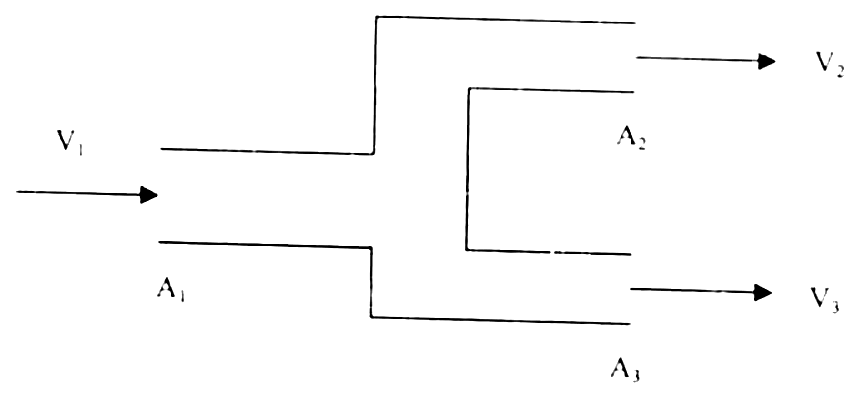
Marks: 2
For a two-dimensional incompressible irrotational flow, the $x$-component of velocity $u = 2x + 3y$. The corresponding $y$-component of velocity is
Marks: 2
For a certain two-dimensional steady incompressible flow, the horizontal and vertical velocity components are given by $u = 6y$, $v = 0$, where $y$ is the vertical distance. The angular velocity and rate of shear strain respectively are
Marks: 2
In a steady two-dimensional incompressible flow, the stream function ($\psi$) obeys the equation $\frac{\partial^2 \psi}{\partial x^2} + \frac{\partial^2 \psi}{\partial y^2} = 4$. A solution of this equation is
Marks: 2
A uniform stream of an ideal fluid with velocity $U$ and pressure $p_\infty$ flows past a circular cylinder as shown in the figure below. The fluid velocity on the cylinder wall is given by $V_\theta = 2U \sin\theta$. The pressure coefficient is defined as $C_p = \frac{p - p_\infty}{0.5\rho U^2}$. The minimum value of $C_p$ on the surface of the cylinder is
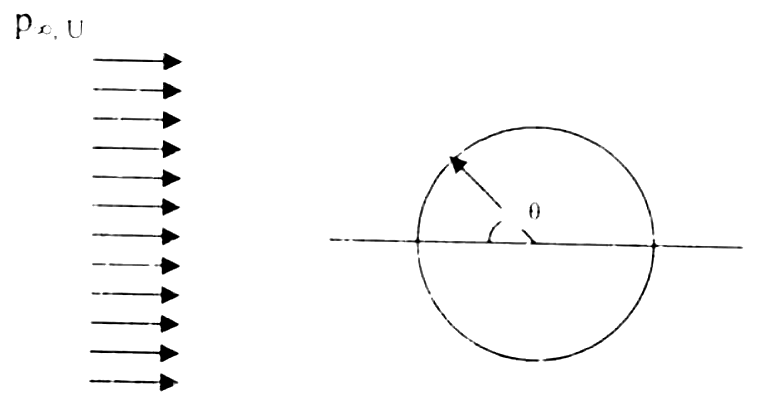
Marks: 2
A model of characteristic length $20\text{ cm}$ is built to study the flow of water ($\nu = 10^{-6}\text{ m}^2\text{/s}$) in an open channel of $5\text{ m}$ characteristic length. What should be the kinematic viscosity of the fluid used in the model?
Marks: 2
Water flows steadily through a smooth circular tube of $5\text{ cm}$ diameter at a flow rate of $\pi\text{ kg/s}$. Take viscosity $\mu = 0.001\text{ Ns/m}^2$ and density $\rho = 1000\text{ kg/m}^3$. The Darcy friction factor is given as: $f_D = 64/Re_d$ for fully developed laminar flow and $f_D = 0.316 Re_d^{-0.25}$ for fully developed turbulent flow. The approximate pressure drop per unit length in the fully developed region of the tube is
Marks: 2
Consider a constant pressure boundary layer over a flat plate of length $L = 3\text{ m}$. The freestream velocity is $U = 60\text{ m/s}$ and the density and viscosity of the fluid respectively are $\rho = 1.23\text{ kg/m}^3$ and $\mu = 1.79 \times 10^{-5}\text{ Ns/m}^2$. Transition occurs at a distance $x_{cr} = 0.1\text{ m}$ from the leading edge. If the freestream velocity is changed to $120\text{ m/s}$, $x_{cr}$ becomes
Marks: 2
For a laminar boundary layer with constant freestream velocity (i.e. $dp/dx = 0$), the variation of $\partial u/\partial y$ with distance $y$ from the wall is given by
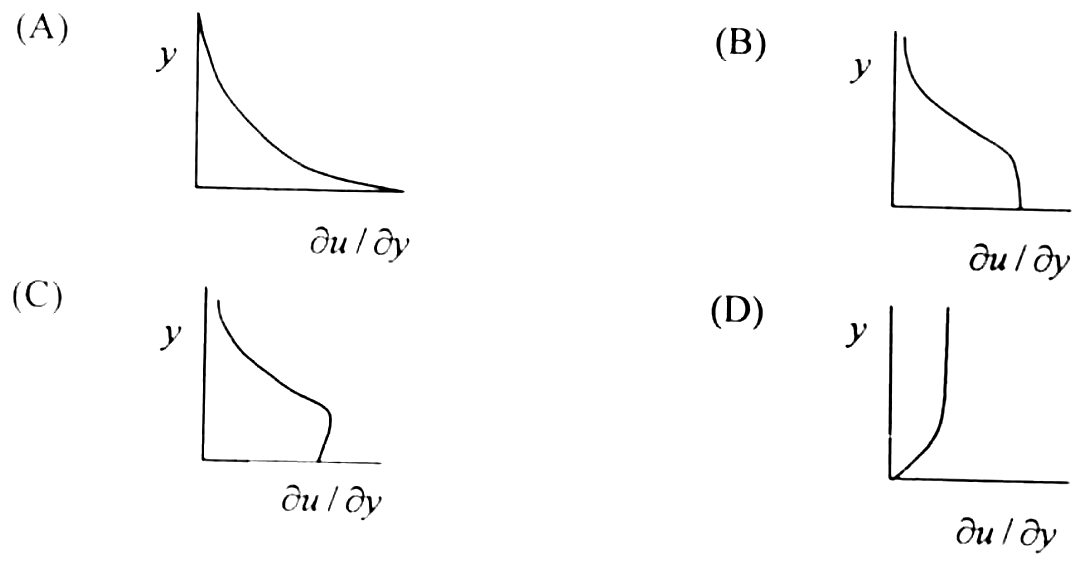
Marks: 2
Consider the steady flow of a uniform stream past a circular cylinder, for a viscous fluid. The following two cases are compared: (I) cylinder is rotating at a slow rate about its axis (II) cylinder is not rotating. Consider the statements — P: The lift force in case I is zero; Q: The lift force in case II is zero; R: The drag force in case I is non-zero; S: The drag force in case II is zero. Which one of the following combinations is TRUE?
Marks: 2
An orifice plate of $60\text{ mm}$ diameter and discharge coefficient $0.6$ is used for measuring the flow rate of air ($\rho = 1.2\text{ kg/m}^3$, $\mu = 1.8 \times 10^{-5}\text{ kg m}^{-1}\text{s}^{-1}$) through a pipe of $100\text{ mm}$ diameter. A manometer (with water as the working liquid) connected across the orifice plate reads $180\text{ mm}$. The air flow rate is approximately equal to
Marks: 2
The velocity of an airstream ($\rho = 1.0\text{ kg/m}^3$) is to be measured using a pitot-static tube. The level difference between the two arms of the manometer is $2\text{ cm}$ of water. The velocity is
Marks: 2
Match the items in the following columns using the most appropriate combinations: Column 1: (P) $\frac{dp}{dz} = \frac{-pg}{RT}$, (Q) Lift, (R) Stream function, (S) Compressibility. Column 2: (1) Volume flow rate, (2) Variable density atmosphere, (3) Mach Number, (4) Circulation, (5) Reynolds Number.
Marks: 2
Common Data: A line source and a line sink, both of unit strength, are placed on the $x$-axis at $x = -1$ and $x = +1$ respectively. In terms of the Cartesian unit vectors $\mathbf{i}$ and $\mathbf{j}$, the velocity at the point $(0,1)$ is given as
Marks: 2
Common Data: A line source and a line sink, both of unit strength, are placed on the $x$-axis at $x = -1$ and $x = +1$ respectively. If the source and sink are placed in a uniform approach stream, the resulting external flow corresponds to that
Marks: 2
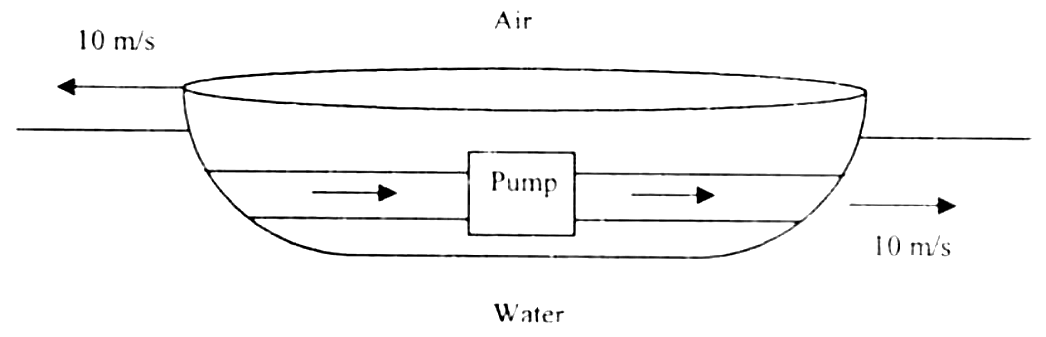
Linked Answer Q.25 & Q.26: A motorboat is cruising in a lake (see figure below) at a uniform speed of $10\text{ m/s}$. A $180\text{ kW}$ pump sucks water at a rate $1\text{ m}^3\text{/s}$ through an inlet pipe in the front and pumps it out with a velocity of $10\text{ m/s}$ with respect to the lake, through an outlet pipe at the rear. The total drag on the boat is
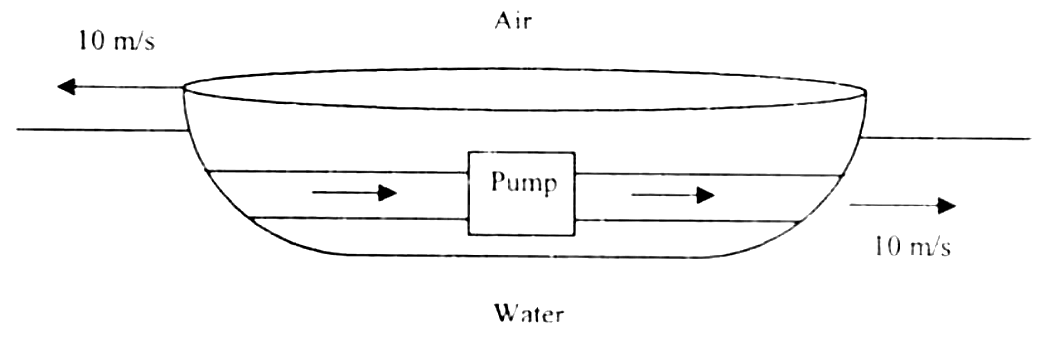
Marks: 2
Linked Answer Q.25 & Q.26: A motorboat is cruising in a lake (see figure below) at a uniform speed of $10\text{ m/s}$. A $180\text{ kW}$ pump sucks water at a rate $1\text{ m}^3\text{/s}$ through an inlet pipe in the front and pumps it out with a velocity of $10\text{ m/s}$ with respect to the lake, through an outlet pipe at the rear. The power utilized for propelling the boat is
Marks: 2
Linked Answer Q.27 & Q.28: Consider a fully developed laminar flow in a pipe of radius $R$ in which $r$ and $x$ represent the radial and axial co-ordinates respectively. The axial velocity distribution is $u(r) = \left(\frac{-R^2}{4\mu}\frac{dp}{dx}\right)\left(1 - \frac{r^2}{R^2}\right)$ and the average axial velocity is $u_m = \left(\frac{-R^2}{8\mu}\frac{dp}{dx}\right)$. The magnitude of shear stress on the wall ($\tau_{wall}$) is
Marks: 2
Linked Answer Q.27 & Q.28: Consider a fully developed laminar flow in a pipe of radius $R$ in which $r$ and $x$ represent the radial and axial co-ordinates respectively. The axial velocity distribution is $u(r) = \left(\frac{-R^2}{4\mu}\frac{dp}{dx}\right)\left(1 - \frac{r^2}{R^2}\right)$ and the average axial velocity is $u_m = \left(\frac{-R^2}{8\mu}\frac{dp}{dx}\right)$. The local friction factor $C_f = \frac{\tau_{wall}}{0.5\rho u_m^2}$, with $\gamma = -\frac{dp}{dx}$ is given by
Marks: 1
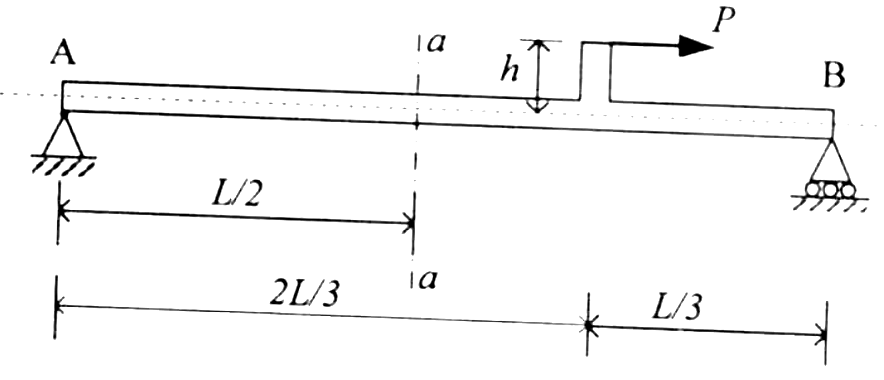
A simply supported beam AB is subjected to a horizontal force, $P$, as shown in the figure. Shear force at section $a$-$a$ is given by
Marks: 1
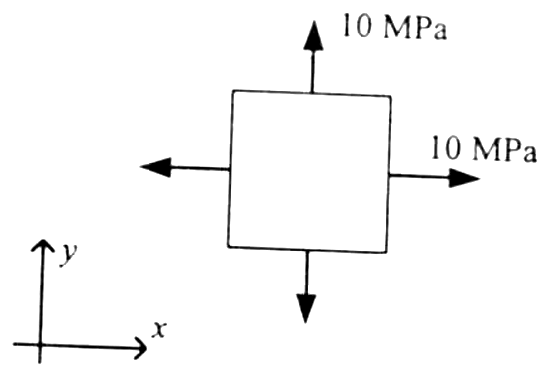
The two-dimensional state of stress at a point is given by the figure (10 MPa biaxial tension in $x$ and $y$). The corresponding Mohr's circle is
Marks: 1
The kind of fracture surface observed in a brittle specimen that fails under a uniaxial tensile test is
Marks: 1
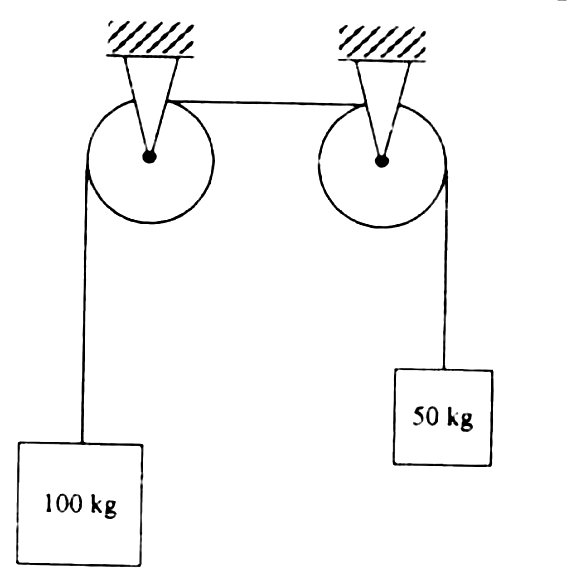
Two masses are attached to the two ends of a cable which passes over two frictionless pulleys as shown in the figure. (acceleration due to gravity $= g$). The acceleration of the $100\text{ kg}$ mass is
Marks: 1
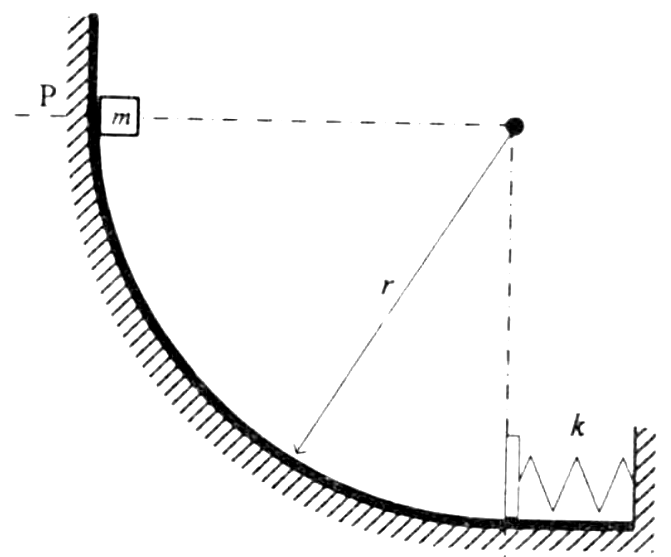
A block of mass $m$ is released at rest from a point P of a rough circular path of radius $r$ as shown in the figure. There is a spring of stiffness $k$ at the other end of the path. (acceleration due to gravity $= g$). The maximum spring deflection is
Marks: 1
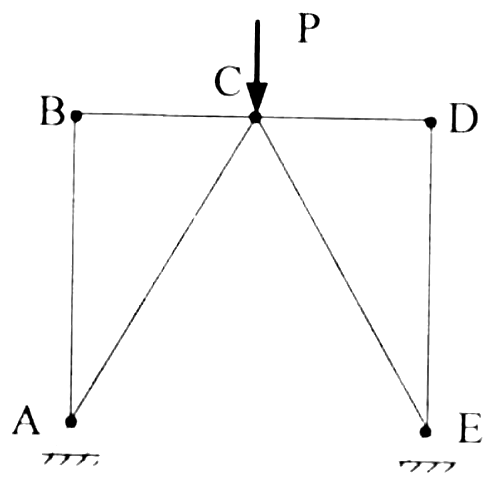
The truss shown in the figure is
Marks: 2
A mass $m_1$ with velocity $v_1$ impacts with a mass $m_2$ at rest. After the impact, the mass $m_1$ comes to rest. Then the coefficient of restitution $e$ should be
Marks: 2
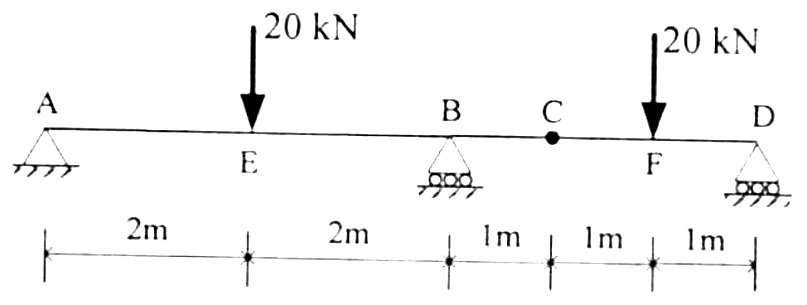
A beam ABCD with simple supports at A, B and D and an internal hinge at C is subjected to loads as shown in the figure. The reaction at middle support is given by
Marks: 2
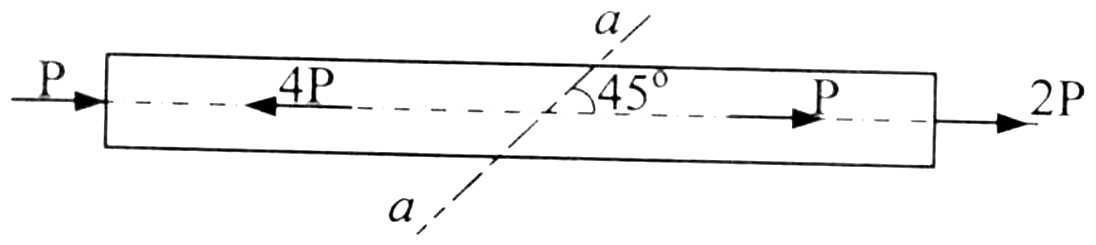
A bar of cross sectional area, $A$, is loaded as shown in the figure. The normal stress on a section $a$-$a$ inclined at $45^\circ$ to the axis of the bar is
Marks: 2
In a two-dimensional state of stress at a point, the maximum shear strain is found to be $\gamma_{\max} = 500\text{ }\mu\text{m/m}$. The sum of the normal stresses on two perpendicular planes at that point is $40\text{ MPa}$. (Young's Modulus $E = 200\text{ GPa}$; Modulus of rigidity $G = 80\text{ GPa}$; Poisson's ratio $\nu = 0.25$). The principal stresses at the point are
Marks: 2
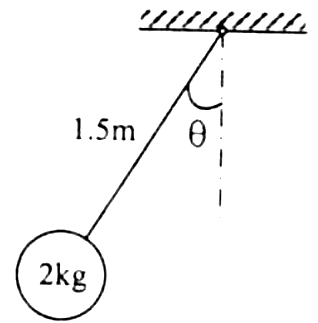
A mass of $2\text{ kg}$ is hung by a string of length $1.5\text{ m}$ as shown in the figure. The mass revolves in a horizontal circular path at $50$ revolutions per minute. The tension in the string in Newtons is
Marks: 2
A simply supported beam of span $L$ is subjected to a concentrated load $P$ at midspan. The cross-section of the beam is rectangular. The ratio of the shear stress at $1/4\text{th}$ the depth of the beam to the shear stress at the center of the cross-section is
Marks: 2
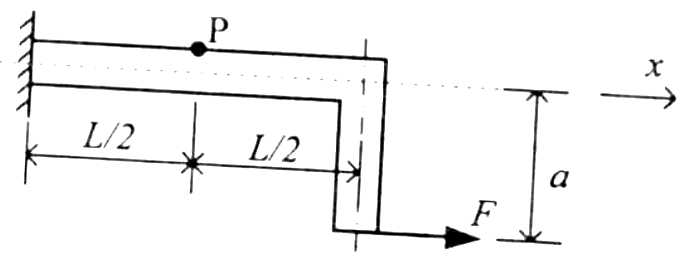
An L-shaped bar of square cross-section with sides, $b$, is loaded as shown in the figure. If the value of the stress component $\sigma_{xx}$ at point P is zero, the distance $a$ of the force $F$ from the $x$-axis should be
Marks: 2
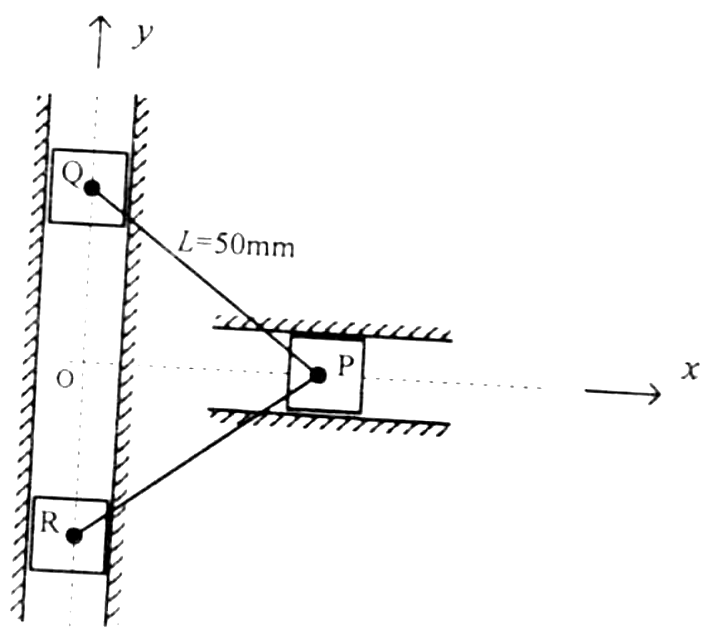
The rigid links PQ and PR of length $L$ each are connected to 3 sliders P, Q and R, by pin-joints as shown in the figure. The sliders, Q, and R, slide in the $y$-direction while the slider, P, slides in the $x$-direction. When the slider, P, is at the position $x = 40\text{ mm}$, its velocity is $30\text{ mm/s}$ along the positive $x$-direction. At that instant, the velocity of slider, Q, will be ($L = 50\text{ mm}$)
Marks: 2
An open ended thin-walled straight pipe is made of a material that can carry a maximum shear stress of $\tau_{\max}$. The pipe is of diameter, $d$, and thickness, $t$. The maximum internal pressure allowable is given by (neglecting the normal stress in the radial direction)
Marks: 2
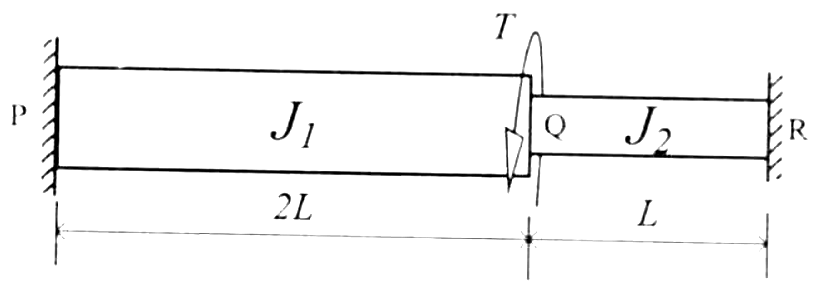
A stepped shaft PQR is fixed at both the ends as shown in the figure. A torque $T$ is applied at point Q. The polar moments of inertia of the shafts PQ and QR are $J_1$ and $J_2$ respectively. $G$ is the modulus of rigidity. The angle of twist at point Q due to torque, $T$, is given by (in radians)
Marks: 2
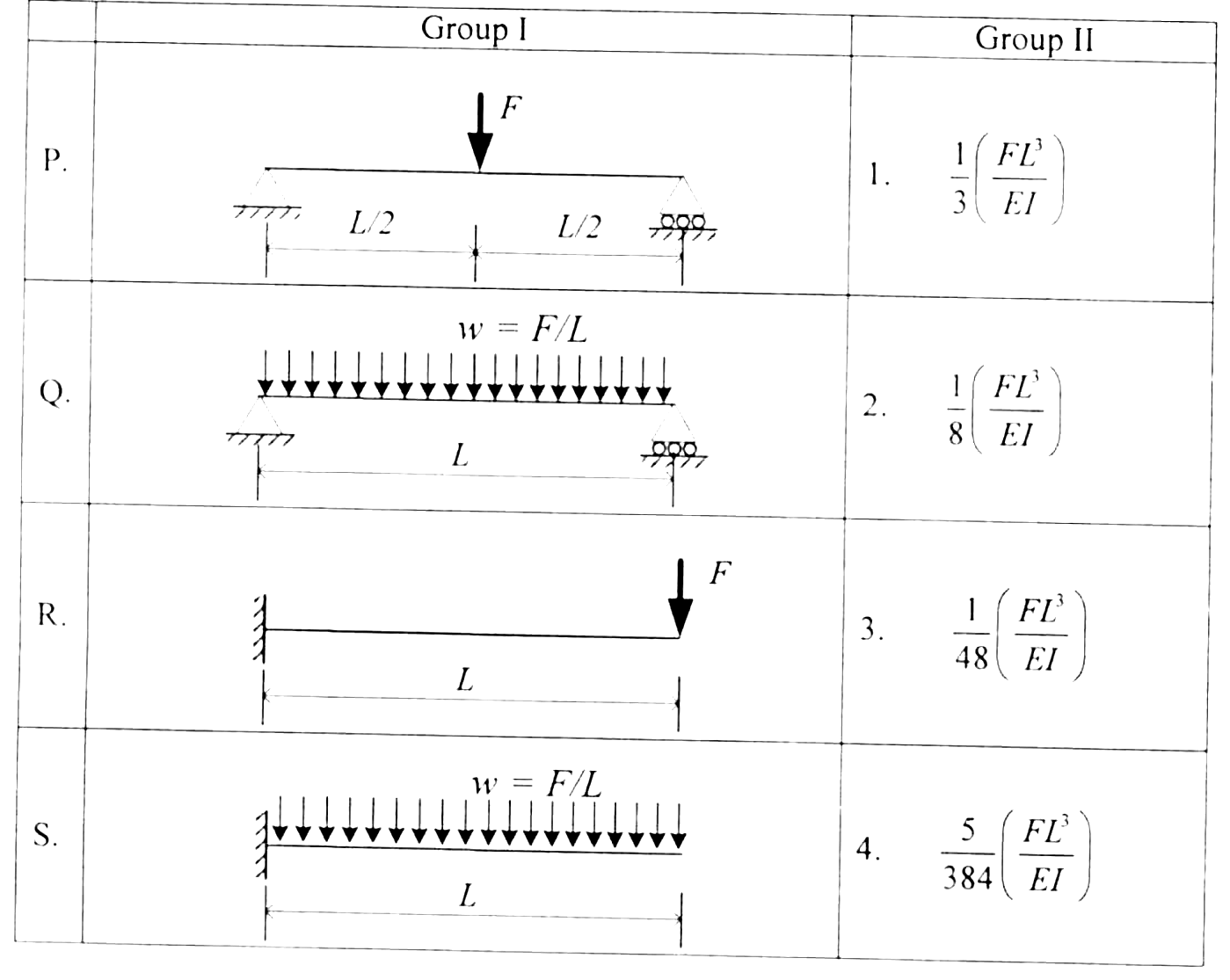
Group I contains beams with different types of supports and loading conditions (P: Simply supported beam with central point load $F$; Q: Simply supported beam with UDL $w=F/L$; R: Cantilever beam with tip point load $F$; S: Cantilever beam with UDL $w=F/L$). The beams have the same flexural rigidity $EI$ and span $L$. Group II contains the maximum deflections: (1) $\frac{1}{3}\left(\frac{FL^3}{EI}\right)$, (2) $\frac{1}{8}\left(\frac{FL^3}{EI}\right)$, (3) $\frac{1}{48}\left(\frac{FL^3}{EI}\right)$, (4) $\frac{5}{384}\left(\frac{FL^3}{EI}\right)$. Match the beam from Group I with the maximum deflection given in Group II.
Marks: 2
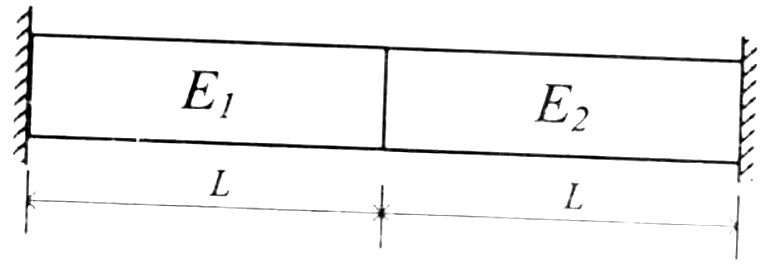
Two bars of different Young's moduli, $E_1$ and $E_2$, but with the same cross sectional area, $A$, and coefficient of thermal expansion, $\alpha$, are attached together at one end and fixed at the other as shown in the figure. The construction of this setup was carried out at an ambient temperature of $25^\circ\text{C}$. The stress in the bars when the temperature is uniformly increased by $10^\circ\text{C}$ is
Marks: 2
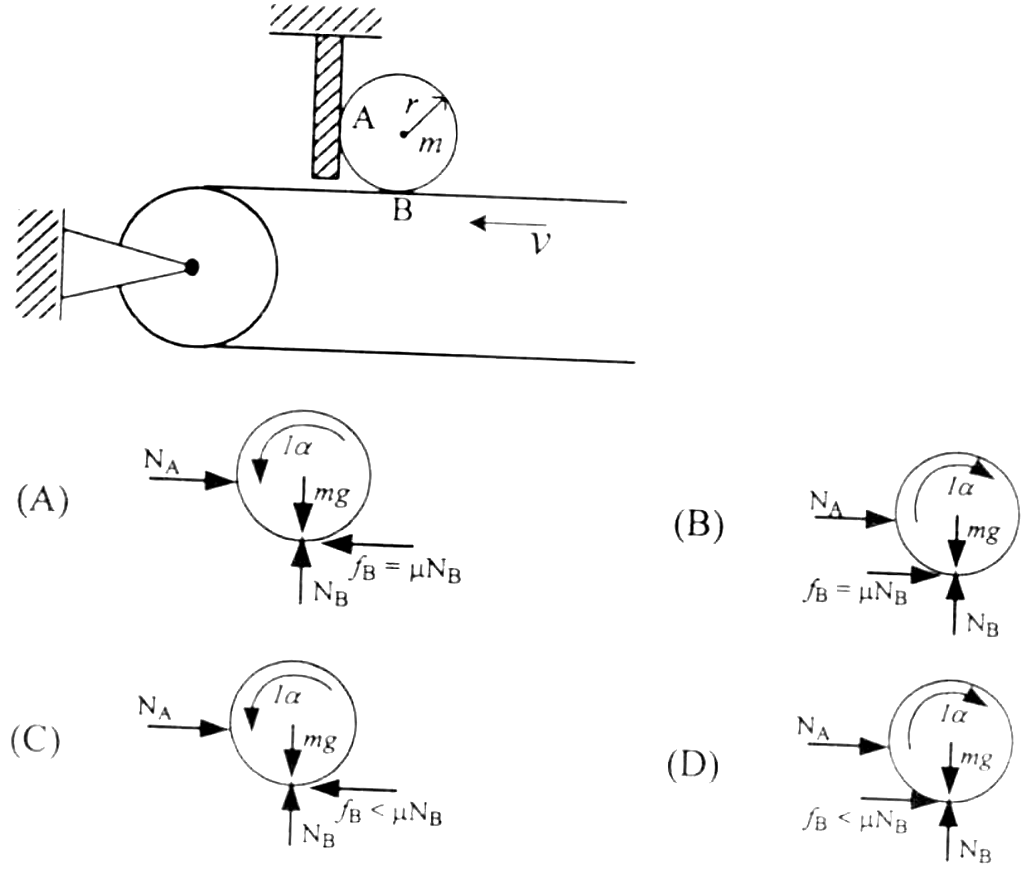
A cylinder of radius $r$ and mass $m$ is placed with no initial velocity on a conveyor belt as shown in the figure. There is a frictional contact between the cylinder and the belt at B. A vertical stopper with a smooth surface prevents the cylinder from rolling away. ($I$ is the moment of inertia of the cylinder; $\alpha$ is the angular acceleration of the cylinder; $\mu$ is the coefficient of friction between the cylinder and the belt and, $g$, is the acceleration due to gravity). The valid free-body diagram of the cylinder just after placing it on the belt (that shows inertial forces also) is
Marks: 2
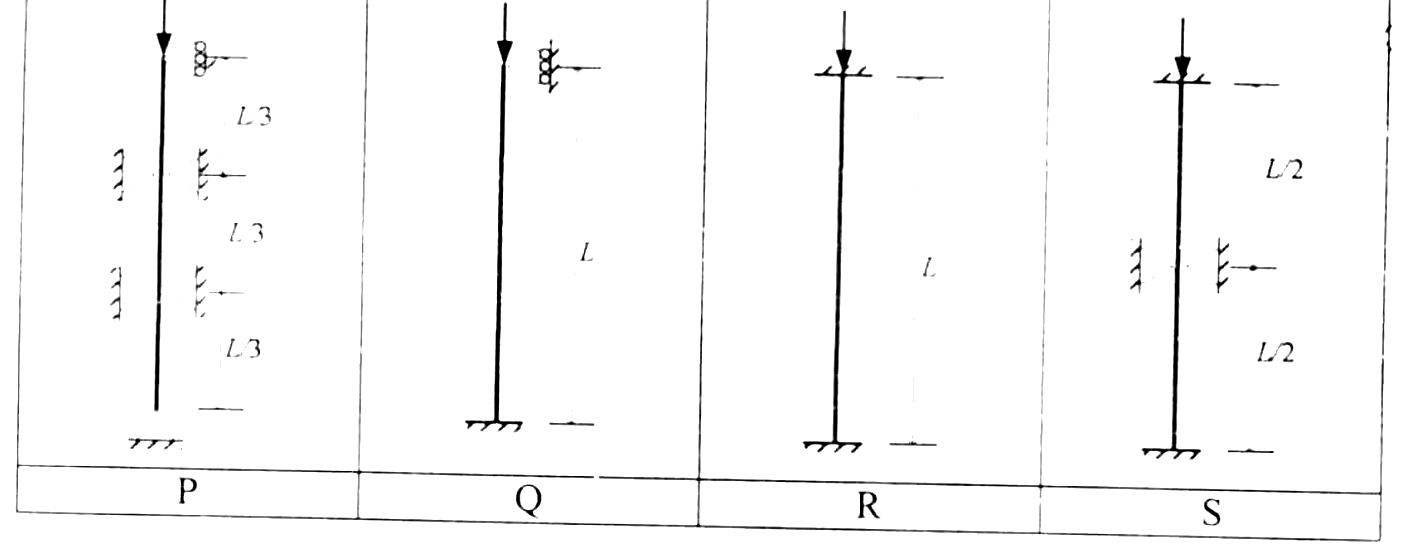
The figure below shows 4 long columns with different support conditions but the same flexural rigidity $EI$. Let P, Q, R, and S be the values of their critical buckling load as shown below the respective columns. P, Q, R and S can be arranged in increasing order as
Marks: 2
A circular shaft of diameter, $d$, is fixed at one end and subjected to an axial force, $P$, and a torque, $T$, at the other end. The torque, $T$, is equal to $Pd/8$. The tensile yield stress of the shaft material is $\sigma_y$. A point on the surface of the shaft will yield according to the Tresca yield criterion if $P$ is equal to
Marks: 2
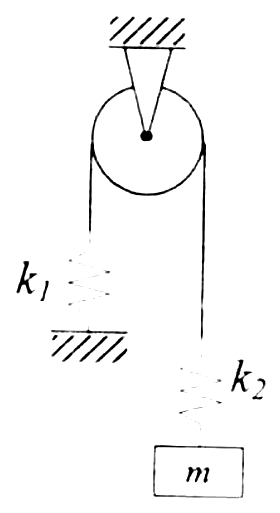
A single degree freedom system consisting of 2 springs and a mass is shown in the figure. The natural frequency of the system in radians/sec is given by
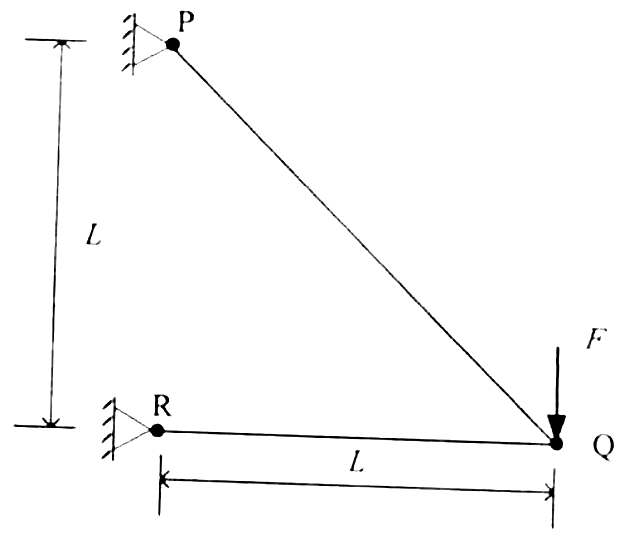
Marks: 2
Common Data: For the truss shown in the figure, both the members have a cross sectional area $A$ and Young's modulus $E$. The vertical deflection at point Q is
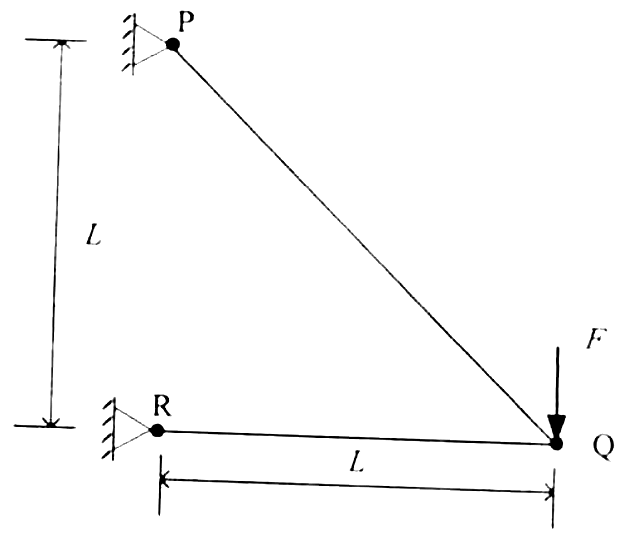
Marks: 2
Common Data: For the truss shown in the figure, both the members have a cross sectional area $A$ and Young's modulus $E$. The horizontal deflection at point Q is
Marks: 2
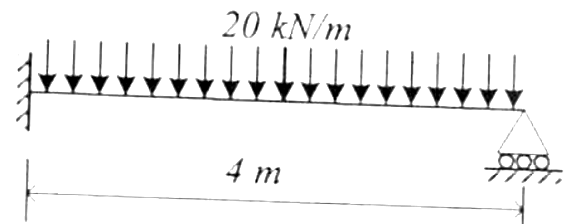
Linked Answer Q.25 & Q.26: A propped cantilever beam of span $4\text{ m}$ is subjected to a uniformly distributed load of $20\text{ kN/m}$ as shown in the figure. The reaction at the roller support is
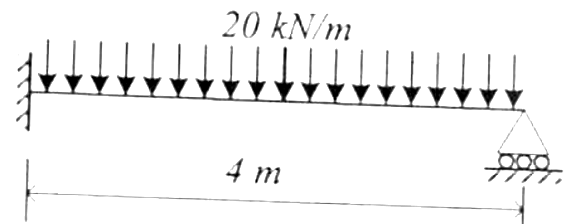
Marks: 2
Linked Answer Q.25 & Q.26: A propped cantilever beam of span $4\text{ m}$ is subjected to a uniformly distributed load of $20\text{ kN/m}$ as shown in the figure. The maximum bending moment in the beam is
Marks: 2
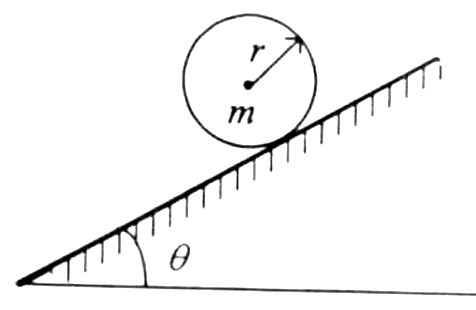
Linked Answer Q.27 & Q.28: A cylinder of mass, $m$, and radius, $r$, is rolling without slipping down an inclined plane that makes an angle, $\theta$, with the horizontal. The radius of gyration, $k$, of the cylinder is half the radius. (The coefficient of friction is, $\mu$; Acceleration due to gravity is, $g$). The frictional force acting on the cylinder is given by
Marks: 2
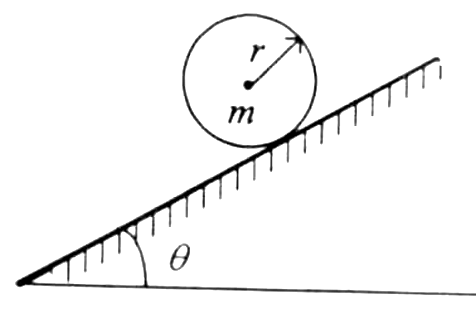
Linked Answer Q.27 & Q.28: A cylinder of mass, $m$, and radius, $r$, is rolling without slipping down an inclined plane that makes an angle, $\theta$, with the horizontal. The radius of gyration, $k$, of the cylinder is half the radius. (The coefficient of friction is, $\mu$; Acceleration due to gravity is, $g$). The angular acceleration of the cylinder is given by
Marks: 1
The specific gravity of ice at $0^\circ\text{C}$ is
Marks: 1
Which one of the following equations is correct?
Marks: 1
In an ideal vapour compression refrigeration system, the process in the condenser is
Marks: 1
One kilogram of a perfect gas at $15^\circ\text{C}$ and $100\text{ kPa}$ is heated to $45^\circ\text{C}$ by (i) a constant pressure process and (ii) a constant volume process. $c_p$ of the gas $= 1.042\text{ kJ/kg}\cdot\text{K}$ and $R = 0.2968\text{ kJ/kg}\cdot\text{K}$. Heat added in the constant pressure ($Q_p$) and constant volume ($Q_v$) processes are
Marks: 1
A system is capable of exchanging energy with its surroundings in the form of $n$ reversible work modes. The number of independent variables that completely specify the state of the system is
Marks: 1
A system is partitioned into two equal parts. An intensive property of each part will
Marks: 2
The polytropic index $n$ of an isochoric process is equal to
Marks: 2
Two systems A and B, possessing the same internal energy, contain saturated liquid-vapour mixture of water at $1\text{ MPa}$. The maximum value of the ratio of their masses is
Marks: 2
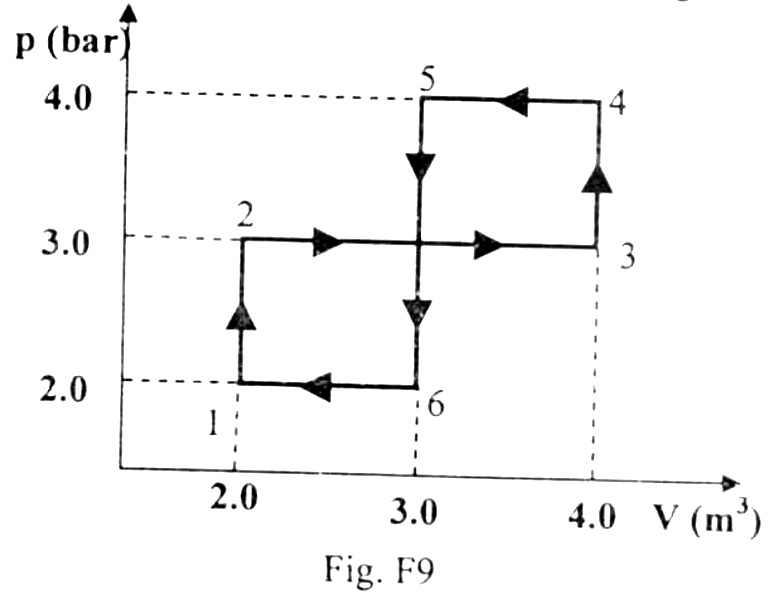
The net work output for the cycle 1-2-3-4-5-6-1 shown in Figure F9 is
Marks: 2
Steam enters an adiabatic turbine steadily at $450^\circ\text{C}$ and $4.0\text{ MPa}$ and leaves at $50\text{ kPa}$. The minimum possible dryness fraction of the steam at the turbine exit is approximately
Marks: 2
A rigid vessel contains saturated liquid-vapour mixture of water at $10\text{ MPa}$. On being heated, the mixture reaches the critical point. The initial quality of the mixture is approximately
Marks: 2
A Diesel engine has a compression ratio of $16$ and cut-off takes place at $8\%$ of stroke. Assuming an air-standard cycle, the cut-off ratio is
Marks: 2
In a Brayton cycle, if $\Delta T_e$ is the temperature change during the expansion process, and $\Delta T_c$ is the change in temperature during the compression process, then
Marks: 2
A rigid tank is connected through a valve to steam mains supplying steam at $1\text{ MPa}$, $400^\circ\text{C}$. Heat is transferred from the tank to the surroundings, and the valve is closed when the total amount of cooling is $2000\text{ kJ}$. The energy contained in the tank is the same before and after the process. Neglecting potential and kinetic energy changes, the mass of the steam that enters the tank is
Marks: 2
Steady heat transfer takes place through a plane wall in the outward direction at the rate of $1500\text{ W}$. The inner surface temperature of the wall is $27^\circ\text{C}$. The entropy generation is $0.25\text{ W/K}$. The outer-surface temperature of the wall is
Marks: 2
Consider an ideal gas in a frictionless piston cylinder assembly. The weightless piston is initially loaded with a large number of small weights. How would you carry out a reversible isothermal expansion process? Assume that a large number of very small weights, and an arrangement for reversible heat transfer are available.
Marks: 2
Consider an isentropic process undergone by an incompressible liquid. The change in temperature experienced by the liquid is $\Delta T = T_2 - T_1$. Which one of the following is correct?
Marks: 2
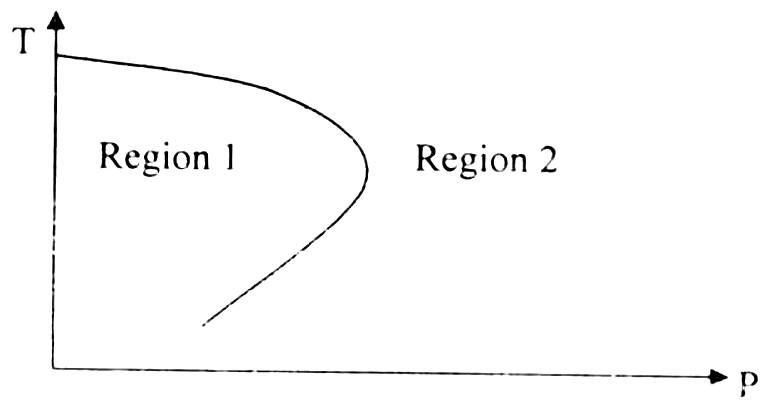
In the following $T$-$p$ diagram, an inversion curve is shown. Which one of the following is correct?
Marks: 2
A large furnace can supply heat at a temperature of $1200\text{ K}$ at a steady rate of $3200\text{ kW}$. The ambient temperature is $27^\circ\text{C}$. The availability of this energy is
Marks: 2
For a system containing an ideal gas, the difference between Gibbs function and Helmholtz function
Marks: 2
Match items in Group I with those in Group II: Group I: (P) Critical point, (Q) Dry saturated vapour, (R) Superheated vapour. Group II: (1) $\text{Quality} = 1.0$, (2) $v_f = v_g$, (3) $T > T_{sat}$, (4) $T < T_{sat}$.
Marks: 2
Consider steady flow of air ($c_p = 1005\text{ J/kg}\cdot\text{K}$) in an adiabatic passage. Air enters the passage at $100\text{ kPa}$, $500\text{ K}$ at a velocity of $150\text{ m/s}$ and exits the passage at $510\text{ K}$. Assume air to be an ideal gas and neglect gravitational effects. The passage is a
Marks: 2
Common Data: A reversible heat engine receives heat inputs of $300\text{ kJ}$ and $200\text{ kJ}$ from two thermal reservoirs at $1000\text{ K}$ and $800\text{ K}$, respectively. The engine rejects heat $Q$ to a reservoir at $300\text{ K}$. The value of $Q$ is
Marks: 2
Common Data: A reversible heat engine receives heat inputs of $300\text{ kJ}$ and $200\text{ kJ}$ from two thermal reservoirs at $1000\text{ K}$ and $800\text{ K}$, respectively. The engine rejects heat $Q$ to a reservoir at $300\text{ K}$. The work delivered by the engine is
Marks: 2
Linked Answer Q.25 & Q.26: A piston-cylinder arrangement contains an ideal gas mixture of $1\text{ kg}$ Nitrogen ($M = 28\text{ kg/kmol}$, $\gamma = 1.4$) and $2\text{ kg}$ of Argon ($M = 40\text{ kg/kmol}$, $\gamma = 1.667$), at $100\text{ kPa}$, $300\text{ K}$. The gas expands at constant pressure until the volume increases by $1\text{ m}^3$. The initial volume of the gas mixture is approximately
Marks: 2
Linked Answer Q.25 & Q.26: A piston-cylinder arrangement contains an ideal gas mixture of $1\text{ kg}$ Nitrogen ($M = 28\text{ kg/kmol}$, $\gamma = 1.4$) and $2\text{ kg}$ of Argon ($M = 40\text{ kg/kmol}$, $\gamma = 1.667$), at $100\text{ kPa}$, $300\text{ K}$. The gas expands at constant pressure until the volume increases by $1\text{ m}^3$. The heat added is approximately
Marks: 2
Linked Answer Q.27 & Q.28: A rigid tank contains a mixture of $0.2\text{ kg}$ of saturated water vapour and $2\text{ kg}$ of air ($M = 29\text{ kg/kmol}$) at a temperature of $50^\circ\text{C}$. The volume of the mixture is approximately
Marks: 2
Linked Answer Q.27 & Q.28: A rigid tank contains a mixture of $0.2\text{ kg}$ of saturated water vapour and $2\text{ kg}$ of air ($M = 29\text{ kg/kmol}$) at a temperature of $50^\circ\text{C}$. The pressure of the tank is approximately