ISRO Computer Science (CSE) 2025 Question Paper & Solutions
Attempt the ISRO Computer Science (CSE) 2025 previous year paper in real CBT exam mode or practice mode with verified answers and explanations.
All ISRO Computer Science (CSE) papers
95 questions.
Question 1
Topic: Data Structures
When a tree given in the diagram is traversed inorder, the order would be
[Diagram showing a binary tree with root 'a'.
Left child of 'a' is 'b'. Right child of 'a' is 'c'.
Left child of 'b' is 'd'. Right child of 'b' is 'e'.
Left child of 'd' is 'h'.
Left child of 'e' is 'i'. Right child of 'e' is 'j'.
Left child of 'c' is 'f'. Right child of 'c' is 'g'.
Left child of 'g' is 'k'.]
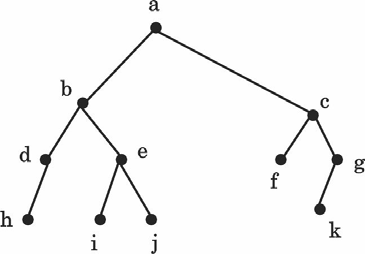
- A. a, b, d, h, e, i, j, c, f, g, k
- B. h, d, i, j, e, b, f, k, g, c, a
- C. h, d, b, i, e, j, a, f, c, k, g
- D. h, d, b, e, i, j, a, f, c, k, g
Answer: C. h, d, b, i, e, j, a, f, c, k, g
Explanation: Inorder traversal visits nodes in the order: Left Subtree, Root, Right Subtree.
Starting from root 'a':
1. Traverse left subtree of 'a' (rooted at 'b'):
- Traverse left subtree of 'b' (rooted at 'd'): left child 'h', then root 'd'. (h, d)
- Visit root 'b'.
- Traverse right subtree of 'b' (rooted at 'e'): left child 'i', then root 'e', then right child 'j'. (i, e, j)
Result for left subtree of 'a': h, d, b, i, e, j.
2. Visit root 'a'.
3. Traverse right subtree of 'a' (rooted at 'c'):
- Traverse left subtree of 'c': left child 'f'.
- Visit root 'c'.
- Traverse right subtree of 'c' (rooted at 'g'): left child 'k', then root 'g'. (k, g)
Result for right subtree of 'a': f, c, k, g.
Combining all parts: h, d, b, i, e, j, a, f, c, k, g.
Question 2
Topic: Algorithms
Huffman coding algorithm works on the principle of
- A. Randomization of symbols
- B. Key based portioning of symbols
- C. Hashing of symbols
- D. Frequencies of input symbols
Answer: D. Frequencies of input symbols
Explanation: Huffman coding is a lossless data compression algorithm. The idea is to assign variable-length codes to input characters, with lengths based on the frequencies of the corresponding characters. The most frequent character gets the smallest code and the least frequent character gets the largest code.
Question 3
Topic: Algorithms
Match the following table showing algorithm and its application.
(P) A person wants to visit from one place to another place in shortest period
(Q) A person wants to visit M places in shortest period
(R) All N persons wants to visit all M places in shortest period
(i) Floyd's algorithm
(ii) Multi-stage graph algorithm
(iii) Dijkstra's algorithm
- A. P-(ii), Q - (iii), R- (i)
- B. P-(i), Q - (iii), R - (ii)
- C. P-(ii), Q- (i), R - (iii)
- D. P-(i), Q- (ii), R- (iii)
Answer: A. P-(ii), Q - (iii), R- (i)
Explanation: Based on the types of shortest path problems:
- (P) 'From one place to another place' maps best to finding a path from a single source to a single destination through stages, which is effectively solved by a Multi-stage graph algorithm (ii).
- (Q) 'Visit M places from a source' represents finding shortest paths from a single source to all other nodes (M places), which maps to Dijkstra's algorithm (iii).
- (R) 'All N persons want to visit all M places' represents finding the shortest path between all pairs of vertices in a graph, which maps to Floyd-Warshall algorithm (i).
Question 4
Topic: Algorithms
Which of the following is true about Greedy algorithm?
- A. does not make any optimization
- B. makes local optimal decisions based on the selected criterion
- C. requires exhaustive search of all possible solutions
- D. is obvious in its correctness
Answer: B. makes local optimal decisions based on the selected criterion
Explanation: A greedy algorithm is an algorithmic paradigm that follows the problem-solving heuristic of making the locally optimal choice at each stage with the intent of finding a global optimum. Thus, it makes local optimal decisions based on a selected criterion.
Question 5
Topic: Discrete Mathematics / Graph Theory
There are 20 shopping malls in a city interconnected by roads. Each shopping mall can be reached through 3 different roads. It is assumed that
- only one park is planned to be constructed in a region
- roads do not cross each other
- road(s) do not pass through a park.
What is the maximum number of parks that can be constructed in the regions enclosed by roads?
Answer: D. 11
Explanation: This can be modeled as a planar graph where malls are vertices ($V$) and roads are edges ($E$).
Number of vertices, $V = 20$.
Degree of each vertex = 3.
Total number of edges, $E = \frac{V \times \text{degree}}{2} = \frac{20 \times 3}{2} = 30$.
Using Euler's formula for a connected planar graph: $V - E + F = 2$, where $F$ is the total number of faces (regions).
$20 - 30 + F = 2 \implies F = 12$.
This $F$ includes 1 unbounded (outer) region and 11 bounded regions. The parks are to be constructed in regions strictly "enclosed by roads" (the bounded faces), which is $F - 1 = 11$.
Question 6
Topic: Discrete Mathematics / Graph Theory
What is the chromatic number of the graph shown below?
[A planar graph with 8 vertices (a,b,c,d,e,f,g,h) and various interconnecting edges. Specifically, vertices e, f, and g form a $K_3$ (triangle), meaning at least 3 colors are needed.]
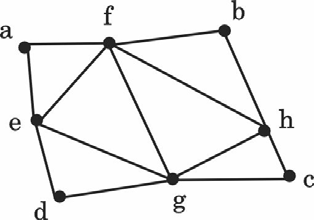
Answer: A. 3
Explanation: The chromatic number is the minimum number of colors needed to color the vertices such that no two adjacent vertices share the same color.
The graph contains triangles (e.g., e-f-g), so the chromatic number must be at least 3.
Let's try 3 colors (1, 2, 3): Assign f=1, e=2, g=3.
Since 'a' connects to f and e, a=3.
Since 'd' connects to e and g, d=1.
Since 'h' connects to f and g, h=2.
Since 'c' connects to g and h, c=1.
Since 'b' connects to f and h, b=3.
This assignment successfully colors the entire graph without any two adjacent nodes sharing a color. Therefore, the chromatic number is 3.
Question 7
Topic: Algorithms
Which of the following sorting technique was applied for an input array {10, 5, 16, 2, 8, 9} which gives array {2, 5, 10, 16, 8, 9} after three iterations?
- A. Bubble sort
- B. Selection sort
- C. Insertion sort
- D. All of the above
Answer: C. Insertion sort
Explanation: Let's trace Insertion Sort for the array {10, 5, 16, 2, 8, 9}:
- Initial: {10, 5, 16, 2, 8, 9}
- Iteration 1 (insert 5): 5 is compared with 10 and swapped. Array becomes {5, 10, 16, 2, 8, 9}.
- Iteration 2 (insert 16): 16 is compared with 10. No swap needed. Array remains {5, 10, 16, 2, 8, 9}.
- Iteration 3 (insert 2): 2 is smaller than 16, 10, and 5. It is inserted at the beginning. Array becomes {2, 5, 10, 16, 8, 9}.
This matches the given result exactly.
Question 8
Topic: Cryptography and Network Security
How many keys are needed for encrypted communication among 16 persons using AES encryption assuming unique key is used between any two persons:
- A. 120 keys
- B. 256 keys
- C. 32 keys
- D. 216 keys
Answer: A. 120 keys
Explanation: AES is a symmetric encryption algorithm. If a unique key is used between every possible pair of $N$ persons, the total number of keys required is the number of combinations of 2 chosen from $N$, which is given by $\frac{N(N - 1)}{2}$.
For $N = 16$: $\frac{16 \times 15}{2} = 8 \times 15 = 120$ keys.
Question 9
Topic: Cryptography and Network Security
Which of the following does not use key(s)?
- A. Symmetric Ciphers
- B. Generation of Message Digest
- C. Generation of Message Authentication Code
- D. Key exchange algorithms
Answer: B. Generation of Message Digest
Explanation: A Message Digest (like SHA-256 or MD5) is a one-way cryptographic hash function that takes an arbitrary amount of data and generates a fixed-size hash. It solely depends on the input data and operates without any secret keys. In contrast, symmetric ciphers, MACs, and key exchange algorithms explicitly require keys.
Question 10
Topic: Cryptography and Network Security
Match the following in the context of Information Security.
(i) Non-repudiation
(ii) Data Integrity
(iii) Data Confidentiality
(iv) Access Control
(P) Protection of data from unauthorised disclosure
(Q) Prevention of unauthorised use of a resource
(R) Protection against denial by one of the entities involved in a communication having participated in all or part of communication
(S) Assurance that data arrived are exactly as sent by authorised entity
- A. (i)-(R), (ii)-(P), (iii)-(Q), (iv)-(S)
- B. (i)-(R), (ii)-(S), (iii)-(P), (iv)-(Q)
- C. (i)-(P), (ii)-(R), (iii)-(S), (iv)-(Q)
- D. (i)-(R), (ii)-(Q), (iii)-(P), (iv)-(S)
Answer: B. (i)-(R), (ii)-(S), (iii)-(P), (iv)-(Q)
Explanation: The standard definitions in Information Security are:
(i) Non-repudiation -> (R) Protection against denial by an entity involved in a communication.
(ii) Data Integrity -> (S) Assurance that data arrived exactly as sent (no unauthorized modification).
(iii) Data Confidentiality -> (P) Protection of data from unauthorized disclosure.
(iv) Access Control -> (Q) Prevention of unauthorized use of a resource.
Question 11
Topic: Cryptography and Network Security
In which of the following cases, a user is persuaded to reveal personal data by hackers/cyber criminals?
- A. Eavesdropping attack
- B. SQL Injection attack
- C. Phishing
- D. Website Defacement
Answer: C. Phishing
Explanation: Phishing is a social engineering attack wherein cybercriminals impersonate a legitimate organization or trusted entity to trick (persuade) victims into revealing sensitive personal data, such as passwords or credit card numbers.
Question 12
Topic: Computer Networks
Which of the following protocols/applications does not facilitate data encryption when data is sent over computer network using that protocol/application
- A. HTTPS
- B. SNMPv3 (Version 3)
- C. DNS using DNSSEC
- D. SFTP
Answer: C. DNS using DNSSEC
Explanation: DNSSEC (Domain Name System Security Extensions) provides data integrity and origin authentication to DNS by digitally signing records. However, it does not provide confidentiality; the DNS requests and responses remain in plaintext (unencrypted). HTTPS, SNMPv3, and SFTP all support data encryption.
Question 13
Topic: Cryptography and Network Security
If an encryption key is n bits long, then how many distinct encryption keys are possible?
- A. $2^{n}$
- B. $2^{n}-1$
- C. $(n\times(n+1))/2$
- D. 2n
Answer: A. $2^{n}$
Explanation: In a binary system, each bit can independently take one of two values (0 or 1). For a key that is $n$ bits long, the total number of distinct possible combinations is $2 \times 2 \times \dots \times 2$ ($n$ times), which equals $2^n$.
Question 14
Topic: Cryptography and Network Security
Which of the following can be protected using a firewall?
- A. Dumpster Diving
- B. Physical Theft
- C. Shoulder Surfing
- D. Network Scanning
Answer: D. Network Scanning
Explanation: A firewall is a network security device designed to monitor and filter incoming and outgoing network traffic. It can be configured to detect, log, and block malicious network scanning (like port scanning). The other options (Dumpster Diving, Physical Theft, Shoulder Surfing) are physical or social engineering threats that a firewall cannot mitigate.
Question 15
Topic: Cryptography and Network Security
Which of the following defines format for Public Key Infrastructure?
- A. X.25
- B. X.509
- C. IEEE 802.11
- D. IEEE 802.3
Answer: B. X.509
Explanation: X.509 is an ITU-T standard that defines the format of public key certificates. These certificates are the foundational elements used in a Public Key Infrastructure (PKI) to securely associate a public key with an identity.
Question 16
Topic: Artificial Intelligence
Which of the following is not a type of Artificial Intelligence agent?
- A. Simple AI agent
- B. Unity based AI agent
- C. Learning AI agent
- D. Goal based AI agent
Answer: B. Unity based AI agent
Explanation: Standard classifications of AI agents (as defined by Russell and Norvig) include simple reflex agents, model-based reflex agents, goal-based agents, utility-based agents, and learning agents. 'Unity based AI agent' refers to agents built within the Unity game engine and is not a formal theoretical category of AI agents.
Question 17
Topic: Artificial Intelligence
Which of the following is advantage of Artificial Intelligence?
- A. Identifying a business trend to help in informed decision making
- B. Helps in analysis of cyber security incidents
- C. Based on learning capability, solves a pattern recognition problem
- D. All of the above
Answer: D. All of the above
Explanation: Artificial Intelligence offers numerous advantages across various domains, including predictive analytics for business trends, anomaly detection in cybersecurity, and advanced pattern recognition via machine learning.
Question 18
Topic: Artificial Intelligence
A decision tree in AI can be used for
- A. Only classification tasks
- B. Only regression tasks
- C. Both classification and regression tasks
- D. Neither classification nor regression tasks
Answer: C. Both classification and regression tasks
Explanation: Decision trees are versatile supervised machine learning algorithms utilized for both classification (predicting discrete class labels) and regression (predicting continuous values) tasks. The CART (Classification and Regression Trees) algorithm is a primary example.
Question 19
Topic: Artificial Intelligence
Which of the following algorithms is used for Reinforcement learning?
- A. Naive Bayes
- B. Principal Component Analysis
- C. Fast Forest Quantile
- D. Q-learning
Answer: D. Q-learning
Explanation: Q-learning is a prominent model-free reinforcement learning algorithm used to learn the value of an action in a particular state. Naive Bayes is for classification (supervised), and PCA is for dimensionality reduction (unsupervised).
Question 20
Topic: Artificial Intelligence
Which of the following algorithms is used for search/optimization in AI?
- A. Greedy Algorithm
- B. Recursive Algorithm
- C. Hill Climbing Algorithm
- D. Hot Potato Algorithm
Answer: C. Hill Climbing Algorithm
Explanation: Hill Climbing is a mathematical optimization algorithm belonging to the family of local search techniques. It is widely used in AI to find a local optimum for a given problem.
Question 21
Topic: Cloud Computing
What does "elasticity" in cloud computing refer to?
- A. Ability to scale up and scale down of compute resources
- B. Parallel execution of jobs
- C. High availability of systems
- D. Minimum response time
Answer: A. Ability to scale up and scale down of compute resources
Explanation: Elasticity in cloud computing refers to the system's ability to dynamically provision and de-provision computing resources (scale up/down or out/in) automatically in response to varying workload demands.
Question 22
Topic: Cloud Computing
With respect to hypervisors, following statements are given below:
(P) Runs on host machine physical hardware
(Q) Hosted hypervisor
(R) Runs on the operating system of physical host machine
(S) Bare metal hypervisor
Which of the following is correct match?
- A. Type-1 Hypervisor (P) and (Q), Type-2 Hypervisor: (R) and (S)
- B. Type-1 Hypervisor (P) and (S), Type-2 Hypervisor: (Q) and (R)
- C. Type-1 Hypervisor (R) and (S), Type-2 Hypervisor: (P) and (Q)
- D. Type-1 Hypervisor (R) and (Q), Type-2 Hypervisor: (P) and (S)
Answer: B. Type-1 Hypervisor (P) and (S), Type-2 Hypervisor: (Q) and (R)
Explanation: A Type-1 hypervisor (Bare metal) runs directly on the host machine's physical hardware (P and S). A Type-2 hypervisor (Hosted) runs on top of a conventional operating system (Q and R).
Question 23
Topic: Big Data
Which of the following is not a characteristic of Big Data?
- A. Velocity
- B. Visualisation
- C. Volume
- D. Variety
Answer: B. Visualisation
Explanation: The defining characteristics of Big Data are typically described by the 'V's: Volume, Velocity, Variety, Veracity, and Value. Visualisation is a technique used to present data, not an inherent characteristic of Big Data itself.
Question 24
Topic: Big Data
What is the primary purpose of Hadoop Distributed File System (HDFS) in Big Data storage?
- A. To compress files
- B. To store in-memory data
- C. To store relational data
- D. To store large files across multiple machines
Answer: D. To store large files across multiple machines
Explanation: HDFS (Hadoop Distributed File System) is designed to store massive datasets reliably and stream those datasets at high bandwidth to user applications by distributing the storage of large files across clusters of commodity hardware.
Question 25
Topic: Big Data
Which of the following is a Big Data tool employed for real-time stream processing?
- A. Hadoop
- B. Apache Flink
- C. Splunk
- D. ERDPlus
Answer: B. Apache Flink
Explanation: Apache Flink is an open-source, unified stream-processing and batch-processing framework specifically optimized for stateful computations over unbounded and bounded data streams (real-time processing).
Question 26
Topic: Big Data
Which of the following is used for storing unstructured data in Big Data environment?
- A. In-memory database
- B. Relational database
- C. NoSQL database
- D. SQL database
Answer: C. NoSQL database
Explanation: NoSQL (Not Only SQL) databases are non-tabular and support flexible schemas, making them ideal for storing unstructured and semi-structured data common in Big Data environments.
Question 27
Topic: Big Data
Match the following in the context of Big Data:
(i) Structured data (P) Text files, Images, Videos
(ii) Semi-structured data (Q) Fixed format data
(iii) Unstructured data (R) XML, JSON
- A. (i)-(Q), (ii)-(R), (iii)-(P)
- B. (i)-(Q), (ii)-(P), (iii)-(R)
- C. (i)-(P), (ii)-(R), (iii)-(Q)
- D. (i)-(R), (ii)-(Q), (iii)-(P)
Answer: A. (i)-(Q), (ii)-(R), (iii)-(P)
Explanation: Structured data adheres to a fixed format (Q). Semi-structured data does not have a strict tabular structure but contains tags/markers like XML and JSON (R). Unstructured data lacks any predefined data model, such as raw text, images, and videos (P).
Question 28
Topic: Theory of Computation
Which of the following hexadecimal constants match the regular expression given?
$(0x[0-9A-F]+)$
- A. $0x4C5$
- B. $0x50b$
- C. 04A
- D. 0x
Answer: A. $0x4C5$
Explanation: The regular expression specifies the string must start with '0x', followed by one or more (+) characters from the set 0-9 or uppercase A-F. Option (b) contains a lowercase 'b', violating the character class. Option (c) lacks the '0x' prefix. Option (d) lacks the trailing hexadecimal digits. Option (a) perfectly matches.
Question 29
Topic: Compiler Design
Which one of the following is true for Virtual Machine like JVM?
- A. Hardware dependent
- B. Hardware independent
- C. Bytecode is part of VM
- D. Links object code
Answer: B. Hardware independent
Explanation: The primary purpose of a Virtual Machine like the Java Virtual Machine (JVM) is to abstract the underlying physical hardware and operating system. This allows the compiled bytecode to be platform-agnostic, granting hardware independence.
Question 30
Topic: Compiler Design
Which compiler phase receives tokenized output?
- A. Lexical Analyser
- B. Parser
- C. Pre-processor
- D. Assembler
Answer: B. Parser
Explanation: The Lexical Analyzer (Scanner) breaks the source code into a stream of tokens. This tokenized output is then fed into the Parser (Syntax Analyzer), which constructs a parse tree to verify the grammatical structure of the program.
Question 31
Topic: Compiler Design
Which one of the following tools generates parser from BNF notation?
Answer: B. yacc
Explanation: YACC (Yet Another Compiler Compiler) is a tool used to generate an LALR(1) parser from a formal grammar specification written in BNF (Backus-Naur Form). In contrast, 'lex' is used for generating lexical analyzers.
Question 32
Topic: Compiler Design
For the same input string, which of the following options is true in the case of ambiguous grammar?
(i) two different parse trees
(ii) two leftmost derivations
(iii) two rightmost derivations
(iv) leftmost and rightmost derivations are different
Which one is correct?
- A. (i), (ii), (iii) are true; (iv) is false
- B. (i) is true; (ii), (iii), (iv) are false
- C. (i), (iv) are true; (ii), (iii) are false
- D. (i) is false; (ii), (iii), (iv) are true
Answer: A. (i), (ii), (iii) are true; (iv) is false
Explanation: An ambiguous grammar is defined as having more than one valid parse tree for the same input string. Having multiple parse trees automatically implies there are multiple leftmost derivations and multiple rightmost derivations for that string. However, statement (iv) 'leftmost and rightmost derivations are different' is naturally true for almost any string with multiple non-terminals even in unambiguous grammars, so it is not a defining characteristic of ambiguity (thus considered 'false' in distinguishing ambiguity).
Question 33
Topic: Theory of Computation
Which of the following strings will correctly match the Grammar G represented by production rules given?
$S\rightarrow A|B$
$A\rightarrow aAb | c$
$B\rightarrow bBd | e$
- A. accbb
- B. aacbb
- C. abaed
- D. aaebb
Answer: B. aacbb
Explanation: From the production rules:
$A \rightarrow aAb | c$ generates strings of the form $a^n c b^n$ where $n \ge 0$.
$B \rightarrow bBd | e$ generates strings of the form $b^m e d^m$ where $m \ge 0$.
The language generated by S is the union of these two sets: $\\{a^n c b^n\\} \cup \\{b^m e d^m\\}$.
Checking the options, 'aacbb' matches the pattern $a^n c b^n$ with $n=2$ ($a^2 c b^2$). The other options do not match either pattern.
Question 34
Topic: Programming Concepts
Consider following C++ snippet, which allocates memory.
int *ptr;
ptr = new int [4];
Which of the following statements may make the program crash when executed subsequently?
- A. ptr++;
- B. ptr+=3;
- C. ptr[4]=0x16;
- D. ptr=null;
Answer: C. ptr[4]=0x16;
Explanation: The array is allocated with a size of 4, meaning the valid indices are 0, 1, 2, and 3. Accessing and writing to `ptr[4]` is an out-of-bounds memory access (buffer overflow). This invokes undefined behavior and can corrupt adjacent memory, leading to an immediate or subsequent program crash.
Question 35
Topic: Computer Networks
While troubleshooting Internet access problem reported by a user, a computer technician finds that the default gateway setting is wrong. Which layer of OSI model is associated with the cause of the problem experienced by the user?
- A. Layer 2
- B. Layer 5
- C. Layer 3
- D. Layer 4
Answer: C. Layer 3
Explanation: The default gateway is an IP address used to route packets outside of the local subnet. IP addressing and routing are functions of the Network Layer, which is Layer 3 in the OSI model.
Question 36
Topic: Cryptography and Network Security
A company wants to transmit data between its two offices with full confidentiality and integrity. Private IP addresses used by system inside the company should also be confidential. Which of the following IPSec configuration will meet the requirements?
- A. IPSec using AH in Tunnel mode
- B. IPSec using ESP in Transport mode
- C. IPSec using ESP in Tunnel mode
- D. IPSec using AH in Transport mode
Answer: C. IPSec using ESP in Tunnel mode
Explanation: To ensure confidentiality, ESP (Encapsulating Security Payload) must be used, as AH (Authentication Header) only provides integrity and authentication without encryption. To keep the internal Private IP addresses confidential, Tunnel mode must be used because it encapsulates the entire original IP packet (including its headers) inside a new IP packet. Transport mode leaves the original IP header exposed.
Question 37
Topic: Information Theory and Coding
A communication system is designed using the following three 5 bit words as the only valid codewords and uses error correction using hamming distance.
Codeword A: 00000
Codeword B: 01110
Codeword C: 11000
During operation, receiver gets the word 01000. What would the system conclude?
- A. It will correct to codeword A
- B. It will correct to codeword B
- C. It will correct to codeword C
- D. It will be unable to correct the error
Answer: D. It will be unable to correct the error
Explanation: Let's calculate the Hamming distance from the received word (01000) to each valid codeword:
Distance to A (00000) = 1 bit (2nd bit).
Distance to B (01110) = 2 bits (3rd and 4th bits).
Distance to C (11000) = 1 bit (1st bit).
Since the received word is equidistant (distance 1) from both Codeword A and Codeword C, the system cannot unambiguously determine which of the two was originally transmitted. Therefore, it is unable to correct the error.
Question 38
Topic: Cryptography and Network Security
An RSA crypto system selects two primes $p=11$ and $q=13$. If the private key is $d=7$ which of the following can be the value of the public key 'e'?
Answer: A. 103
Explanation: In RSA, $n = p \times q = 11 \times 13 = 143$.
The totient $\phi(n) = (p-1)(q-1) = 10 \times 12 = 120$.
The public key $e$ and private key $d$ are related by $e \times d \equiv 1 \pmod{\phi(n)}$.
Given $d = 7$, we need to find $e$ such that $(e \times 7) \pmod{120} = 1$.
Testing the options:
(a) $103 \times 7 = 721$. $721 \pmod{120} = 1$ (since $120 \times 6 = 720$). This is correct.
(b) $143 \times 7 = 1001$. $1001 \pmod{120} \neq 1$.
(c) $21 \times 7 = 147$. $147 \pmod{120} = 27$.
(d) $19 \times 7 = 133$. $133 \pmod{120} = 13$.
Question 39
Topic: Computer Networks
Suppose the host firewall of a computer is configured to block all incoming ICMP packets. What could be its effect on function of TCP/IP protocol stack of the host?
- A. No effect
- B. Path MTU discovery fails
- C. Slow start fails
- D. Congestion control fails
Answer: B. Path MTU discovery fails
Explanation: Path MTU (Maximum Transmission Unit) Discovery relies on the host receiving ICMP 'Destination Unreachable - Fragmentation Needed' messages from routers along the path when a packet is too large. If all incoming ICMP packets are blocked by the firewall, the host will never receive these messages, causing Path MTU discovery to fail (potentially leading to 'black hole' connections).
Question 40
Topic: Computer Networks
What is the ideal TCP window size of a sender to fully utilize a link of bandwidth 8192000bps and latency of 32ms?
- A. 65536 bytes
- B. 8192 bytes
- C. 16384 bytes
- D. 32768 bytes
Answer: A. 65536 bytes
Explanation: To fully utilize a link, the TCP window size should be at least equal to the Bandwidth-Delay Product (BDP).
BDP = Bandwidth $\times$ Round Trip Time (RTT).
Given Bandwidth = $8,192,000$ bps.
Latency (one-way delay) = 32 ms. Therefore, RTT = $2 \times 32 = 64$ ms = $0.064$ seconds.
Window size in bits = $8,192,000 \times 0.064 = 524,288$ bits.
Window size in bytes = $524,288 / 8 = 65,536$ bytes.
Question 41
Topic: Computer Networks
Computer A is assigned with IP address 10.0.0.126 and computer B is assigned with IP address 10.0.0.131. Network mask is 255.255.255.192 in both cases. Which of the following statements is true?
- A. Computer A and B form part of a multicast group
- B. 10.0.0.x addresses have to be allocated by IANA and cannot be used by hosts
- C. The given network mask cannot be assigned to class A IP addresses
- D. A router will be required to communicate between A and B
Answer: D. A router will be required to communicate between A and B
Explanation: The subnet mask 255.255.255.192 translates to a /26 prefix, giving a block size of 64.
The subnets are 10.0.0.0, 10.0.0.64, 10.0.0.128, and 10.0.0.192.
Computer A (10.0.0.126) belongs to the 10.0.0.64/26 subnet (valid IP range 65-126).
Computer B (10.0.0.131) belongs to the 10.0.0.128/26 subnet (valid IP range 129-190).
Since A and B are in different subnets, they cannot communicate directly over the local network and require a router.
Question 42
Topic: Database Management Systems
Which of the following is a characteristic of NoSQL databases?
- A. They enforce a strict schema
- B. They support only relational data model
- C. They are queried using SQL
- D. They support flexible schema
Answer: D. They support flexible schema
Explanation: NoSQL (Not Only SQL) databases are designed to handle unstructured or semi-structured data. Unlike traditional relational databases that require a predefined, rigid schema, NoSQL databases support dynamic and flexible schemas, allowing fields to be added on the fly.
Question 43
Topic: Database Management Systems
Which of the following statement is true about database views?
- A. Views always store a duplicate copy of the data
- B. Views can be used to restrict access to sensitive columns
- C. Views cannot be queried like normal database tables
- D. Views cannot be updated under any condition
Answer: B. Views can be used to restrict access to sensitive columns
Explanation: A database view is a virtual table based on the result-set of a SQL statement. By creating a view that excludes sensitive columns (like passwords or salaries) and granting users access only to the view, an administrator can effectively restrict access to sensitive data.
Question 44
Topic: Database Management Systems
Assume a one-to-many relationship from table named "authors" to the table named "books". Where should the foreign key reside in an optimal design for this relationship?
- A. In the "books" table
- B. In the "authors" table
- C. In both the tables
- D. In a separate linking table
Answer: A. In the "books" table
Explanation: In a one-to-many relationship, the optimal and standard relational database design requires placing the foreign key on the "many" side of the relationship. Since one author can have many books, the "books" table (the "many" side) should contain a foreign key referencing the primary key of the "authors" table.
Question 45
Topic: Database Management Systems
Consider a table users(userid, country, city, street) with 50 million users. DBA creates the following index for the table
CREATE INDEX myindex ON users(country, city, street)
For which of the following queries will this index be least useful?
- A. SELECT userid FROM users WHERE country='IN'
- B. SELECT userid FROM users WHERE street='MG Road'
- C. SELECT userid FROM users WHERE country='IN' AND city='Pune' AND street='MG Road'
- D. SELECT userid FROM users WHERE country='IN' AND city='Pune'
Answer: B. SELECT userid FROM users WHERE street='MG Road'
Explanation: A composite index (e.g., on A, B, C) works effectively only if the query uses the leading columns of the index. It can resolve queries filtering by (A), by (A and B), or by (A, B, and C). Option (b) filters entirely by the third column (`street`) without referencing the leading column (`country`), rendering the composite B-tree index essentially useless for range scans or quick lookups, resulting in a full table scan.
Question 46
Topic: Database Management Systems
Let A and B be two entities in an E-R diagram with simple single value attributes. R1 and R2 are two relationships between M and N. R1 is one-to-many from A to B. R2 is many-to-many from A to B. What is the minimum number of tables required to represent A, B, R1 and R2 in the relational mode?
Answer: D. 3
Explanation: To represent the entities and relationships in a relational model:
1. Entity A requires 1 table.
2. Entity B requires 1 table.
3. Relationship R1 (1:N from A to B) can be mapped by adding the primary key of A as a foreign key in table B. It does not require a separate table.
4. Relationship R2 (M:N from A to B) requires a separate linking table containing the primary keys of both A and B as foreign keys.
Total minimum tables required = Table A + Table B + Table R2 = 3 tables.
Question 47
Topic: Database Management Systems
Consider table bank_accounts = (account_id, balance). Assume two accounts with account_id as A and B. Also assume that initially both accounts have a balance Rs. 5,000 each. Two transactions T1 and T2 are executed concurrently, both under REPEATABLE READ isolation level. Database uses standard locking mechanism.
T1: transfers Rs. 1,000 from A to B.
DB operation sequence is as follows:
BEGIN; READ(A); READ(B); WRITE(A); WRITE(B); END
T2: transfers Rs. 1,000 from B to A.
DB operation sequence is as follows:
BEGIN; READ(B); READ(A); WRITE(B); WRITE(A); END
Both transactions read the corresponding account balances, deducts Rs. 1,000 from one account, then adds Rs. 1,000 to the other account and results are written back.
Assuming that all interleaving of execution of T1 and T2 are possible and that there are no extraneous factors, which of the following will never occur?
- A. A's account balance shows Rs. 5,000 and B's account balance shows Rs. 5,000
- B. Deadlock is detected and T1 will be rolled back to recover
- C. Deadlock is detected and T2 will be rolled back to recover
- D. A's account balance shows Rs. 4,000 and that of B will have Rs. 6,000
Answer: D. A's account balance shows Rs. 4,000 and that of B will have Rs. 6,000
Explanation: In a standard 2PL (Two-Phase Locking) system under REPEATABLE READ, reads acquire shared (S) locks and writes acquire exclusive (X) locks held until the end of the transaction. If T1 and T2 execute concurrently, they may both acquire S-locks on A and B during their READ phases. When they attempt to WRITE, they will both need X-locks, leading to a circular wait (Deadlock). The DBMS will detect the deadlock and roll back one of the transactions (either T1 or T2), allowing the other to complete. The aborted transaction will automatically be retried or handled by the application, ensuring that eventually both transactions complete successfully. Therefore, a permanent state where only one transaction has succeeded (A=4000, B=6000) will never occur as the system guarantees atomicity and eventual consistency (both complete, leaving balances at 5000).
Question 48
Topic: Database Management Systems
Consider R (A, B, C, D, E, P, G) and the following Functional Dependencies in R:
AB -> CD, DE -> P, C -> E, P -> C, B -> G
Which one of the following is true?
- A. R is in BCNF
- B. R is in 3NF, but not in BCNF
- C. R is in 2NF, but not in 3NF
- D. R is not in 2NF
Answer: D. R is not in 2NF
Explanation: Let's find the candidate keys. The closure of AB is $\{A, B\}^+ = \{A, B, C, D, E, P, G\}$, covering all attributes. Since A and B do not appear on the right side of any functional dependency, they must be part of every candidate key. Thus, AB is the only candidate key. The prime attributes are A and B.
Checking the FDs for normal forms:
The FD B -> G has a proper subset of the candidate key (B) determining a non-prime attribute (G). This is a partial dependency.
Since a partial dependency exists, the relation R violates 2nd Normal Form (2NF). Therefore, R is not in 2NF.
Question 49
Topic: Digital Logic
If x and y are two decimal numbers such as $(0.11101)_{2}=(0.90xy5)_{10}$, what are the values of x and y?
- A. x=2, y=6
- B. x=6, y=2
- C. x=9, y=8
- D. none of the above
Answer: B. x=6, y=2
Explanation: Convert the binary fraction $(0.11101)_2$ to decimal:
$(0.11101)_2 = 1\times2^{-1} + 1\times2^{-2} + 1\times2^{-3} + 0\times2^{-4} + 1\times2^{-5}$
$= 0.5 + 0.25 + 0.125 + 0 + 0.03125 = 0.90625_{10}$.
Comparing $0.90625$ with $0.90xy5$, we get $x=6$ and $y=2$.
Question 50
Topic: Digital Logic
How many 3 to 8 line decoders are required for a 1 of 32 decoder?
Answer: C. 4
Explanation: A 1-of-32 (or 5-to-32) decoder has 32 output lines. A 3-to-8 line decoder has 8 output lines. To provide 32 outputs, we require exactly $32 / 8 = 4$ of these 3-to-8 line decoders in the final output stage. (Note: These 4 decoders are driven by the 2 most significant bits using their enable pins or an additional 2-to-4 decoder, but the primary question asks for the number of 3-to-8 decoders to generate the 32 lines).
Question 51
Topic: Computer Organization and Architecture
Let $A=(11111010)_{2}$ and $B=(00001010)_{2}$ represent numbers in 2's complement and stored as 1 byte. The product of A and B in 2's complement is
- A. (1001 1100)2
- B. (1010 0101)2
- C. (1100 0100)2
- D. (1101 0101)2
Answer: C. (1100 0100)2
Explanation: First, determine the decimal values of A and B:
$A = (11111010)_2$. Since the MSB is 1, it's negative. Taking 2's complement: $00000101 + 1 = 00000110_2 = 6_{10}$. So, $A = -6$.
$B = (00001010)_2$. The MSB is 0, so it's positive. $B = 10_{10}$.
The product is $-6 \times 10 = -60$.
To represent -60 in 8-bit 2's complement:
$+60_{10} = (00111100)_2$.
Invert the bits: $11000011$.
Add 1: $11000011 + 1 = (11000100)_2$.
Question 52
Topic: Digital Logic
The given Boolean expression is:
$X^{\prime}Y^{\prime}Z^{\prime}+X^{\prime}YZ^{\prime}$
Which of the following represents the Karnaugh map for the above expression?
- A. Option showing 1s at X'Y'Z' and X'YZ' in a 4-row (X'Y', X'Y, XY, XY'), 2-column (Z', Z) format
- B. Option showing 1s at X'Y'Z and X'YZ in a 4-row format
- C. Option showing 1s in a 2-row format that do not match the expression
- D. Option showing 1s in a 2-row format that do not match the expression
Answer: A. Option showing 1s at X'Y'Z' and X'YZ' in a 4-row (X'Y', X'Y, XY, XY'), 2-column (Z', Z) format
Explanation: The given expression has two minterms: $X'Y'Z'$ and $X'YZ'$. In a Karnaugh map with rows representing XY combinations and columns representing Z combinations, we need 1s located precisely at the cell for $X'Y'$ row under $Z'$ column, and the cell for $X'Y$ row under $Z'$ column. Option (a) accurately reflects this placement.
Question 53
Topic: Digital Logic
A MOD-16 ripple counter using J-K flip-flop has a current state 1001. How many clock pulses are required to get the state 0000?
Answer: C. 7
Explanation: A MOD-16 counter counts sequentially from 0000 (0) to 1111 (15) before overflowing back to 0000.
The current state is $1001_2 = 9_{10}$.
To reach $0000_2 = 16_{10}$ (overflow state), the counter needs to advance by $16 - 9 = 7$ states.
Therefore, 7 clock pulses are required.
Question 54
Topic: Digital Logic
Which of the following options is not true for a gated D-type flip-flop?
- A. when clock is high, allows the input data (D) to pass through to the output (Q)
- B. stores a single bit of data
- C. uses a clock signal to control when the input data (D) is transferred to the output (Q)
- D. when clock is low, allows the input data (D) to pass through to the output (Q)
Answer: D. when clock is low, allows the input data (D) to pass through to the output (Q)
Explanation: A gated D-latch (often casually referred to as a level-triggered D-type flip-flop) allows data to pass from input D to output Q when the enable/clock signal is HIGH (transparent state). When the clock signal is LOW, the latch is in the hold/opaque state, meaning it stores the previous value and ignores any changes at the D input. Therefore, option (d) is false.
Question 55
Topic: Digital Logic
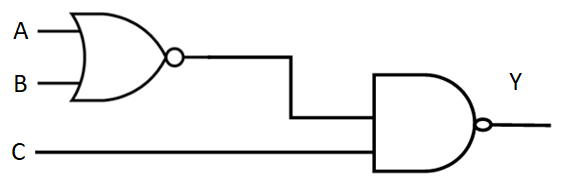
In order to get low output from the following logic circuit, the possible inputs are
[Logic circuit showing A and B as inputs to a NAND gate. The output of the NAND gate and C are inputs to an OR gate. The final output is Y]
- A. A-1, B-1, C-0
- B. A-1, B-1, C-1
- C. A-0, B-0, C-1
- D. A-0, B-0, C-0
Answer: A. A-1, B-1, C-0
Explanation: From the schematic, the boolean expression for the circuit is $Y = \overline{(A \cdot B)} + C$.
We want a low output, so $Y = 0$.
For an OR gate to output 0, both of its inputs must be 0. Thus, $\overline{(A \cdot B)} = 0$ AND $C = 0$.
$\overline{(A \cdot B)} = 0 \implies A \cdot B = 1 \implies A = 1$ AND $B = 1$.
Therefore, the required inputs are A=1, B=1, C=0.
Question 56
Topic: Engineering Mathematics
Let $C=\begin{pmatrix}\sin^2\theta & 1 & \cos^2\theta\\\cos^2\theta & 1 & \sin^2\theta\\-3 & 4 & 7\end{pmatrix}$
Then det (C) will be
- A. $7\cos^2\theta+3\sin^2\theta+1$
- B. $4\sin^2\theta+3\cos^2\theta$
- C. $7-4\sin^2\theta$
- D. 0
Answer: D. 0
Explanation: To evaluate the determinant of matrix C, apply the column operation: Replace Column 1 with (Column 1 + Column 3).
The new Column 1 becomes:
Row 1: $\sin^2\theta + \cos^2\theta = 1$
Row 2: $\cos^2\theta + \sin^2\theta = 1$
Row 3: $-3 + 7 = 4$
The matrix is now $\begin{pmatrix}1 & 1 & \cos^2\theta \\\ 1 & 1 & \sin^2\theta \\\ 4 & 4 & 7\end{pmatrix}$.
Because Column 1 and Column 2 are identical, the determinant of the matrix is 0.
Question 57
Topic: Engineering Mathematics
The smallest Eigen value of the matrix $A=\begin{pmatrix}4 & 3 & 1\\0 & 6 & 0\\0 & 4 & 7\end{pmatrix}$ is
Answer: C. 4
Explanation: The characteristic equation is given by $\det(A - \lambda I) = 0$.
$\begin{vmatrix} 4-\lambda & 3 & 1 \\\ 0 & 6-\lambda & 0 \\\ 0 & 4 & 7-\lambda \end{vmatrix} = 0$.
Expanding along the first column:
$(4-\lambda) \begin{vmatrix} 6-\lambda & 0 \\\ 4 & 7-\lambda \end{vmatrix} = (4-\lambda)(6-\lambda)(7-\lambda) = 0$.
The eigenvalues are $\lambda = 4, 6, 7$.
The smallest eigenvalue is 4.
Question 58
Topic: Engineering Mathematics
The value of the triple integral $\iint_{1}^{2}\int_{0}^{3}\int_{-3}^{3}2xy-x^3 dx dy dz$
- A. 9
- B. 18
- C. 0
- D. None of the above
Answer: C. 0
Explanation: Assuming the integrand is $2xy - x^3$ (based on symmetrical bounds logic common to such problems), the inner integral evaluates with respect to $x$ from $-3$ to $3$.
The function $f(x) = 2xy - x^3$ is an odd function with respect to $x$ because $f(-x) = 2(-x)y - (-x)^3 = - (2xy - x^3) = -f(x)$.
The integral of any odd function over a symmetric interval $[-a, a]$ is $0$.
Therefore, $\int_{-3}^{3} (2xy - x^3) dx = 0$. Since the innermost integral evaluates to 0, the entire triple integral evaluates to 0.
Question 59
Topic: Discrete Mathematics
Let the scenario 'If the vehicle is powered ON and if power is available to the avionics package, then communication to the vehicle will be established' be represented with statements
$p=$ power is available to avionics package;
$q=$ vehicle is powered ON;
$r=$ communication to the vehicle will be established
The logic form $(p\wedge q)\rightarrow r$ is equivalent to
- A. $\neg r\rightarrow(p\wedge q)$
- B. $p\rightarrow(q\wedge r)$
- C. $\neg p\vee\neg q\vee r$
- D. None of the above
Answer: C. $\neg p\vee\neg q\vee r$
Explanation: The material implication $A \rightarrow B$ is logically equivalent to $\neg A \vee B$.
Applying this to the given expression $(p \wedge q) \rightarrow r$:
$(p \wedge q) \rightarrow r \equiv \neg(p \wedge q) \vee r$.
Using De Morgan's Law on $\neg(p \wedge q)$ yields $\neg p \vee \neg q$.
Substituting this back gives the equivalent expression: $\neg p \vee \neg q \vee r$.
Question 60
Topic: Discrete Mathematics
How many subsets of {1, 2, 3, 4...12} can be formed such that no two elements in the subset are consecutive?
Answer: B. 377
Explanation: The number of subsets of the set $\{1, 2, \dots, n\}$ with no two consecutive elements follows the Fibonacci sequence. Let $S_n$ be the number of such subsets.
For $n=1$, subsets are $\\{\\}$ and $\\{1\\}$ $\implies S_1 = 2 = F_3$.
For $n=2$, subsets are $\\{\\}$, $\\{1\\}$, $\\{2\\}$ $\implies S_2 = 3 = F_4$.
In general, $S_n = F_{n+2}$, where $F_k$ is the $k^{th}$ Fibonacci number ($F_1=1, F_2=1, F_3=2, F_4=3, \dots$).
For $n=12$, we need $F_{14}$.
The sequence proceeds: $F_5=5, F_6=8, F_7=13, F_8=21, F_9=34, F_{10}=55, F_{11}=89, F_{12}=144, F_{13}=233, F_{14}=377$.
Thus, there are 377 such subsets.
Question 61
Topic: Discrete Mathematics
If A is a set with m elements and n is a positive integer, the number of different elements in $A^{n}$ is:
- A. $m\times n$
- B. $m\times m$
- C. $n^{m}$
- D. $m^{n}$
Answer: D. $m^{n}$
Explanation: The notation $A^n$ denotes the n-ary Cartesian product of the set A with itself, i.e., $A \times A \times \dots \times A$ ($n$ times). By the rule of product in combinatorics, the cardinality of the Cartesian product of sets is the product of their cardinalities. Thus, $|A^n| = |A| \times |A| \times \dots \times |A|$ ($n$ times) $= m^n$.
Question 62
Topic: Discrete Mathematics
How many four letter words can be formed using the letters of the word 'GAGANYAAN' with no repetition of letter?
Answer: D. 24
Explanation: The word 'GAGANYAAN' contains 9 letters in total, but only 4 distinct letters: {G, A, N, Y}. We need to form a 4-letter word with NO repetition. Since there are exactly 4 distinct letters available, we must use all 4 of them (G, A, N, Y) exactly once. The number of ways to arrange 4 distinct letters is $4! = 4 \times 3 \times 2 \times 1 = 24$.
Question 63
Topic: Operating Systems
A situation where several processes access and manipulate the same data concurrently and the outcome of the execution depends on the particular order in which access takes place is called
- A. Stack overflow
- B. Aging
- C. Race Condition
- D. Buffer overflow
Answer: C. Race Condition
Explanation: A race condition occurs when multiple threads or processes read and write to shared data concurrently, and the final result depends on the unpredictable timing or sequence of their execution (the "race"). It is a primary issue addressed by synchronization mechanisms.
Question 64
Topic: Operating Systems
Operating systems must provide a mechanism for parent processes to create new child processes. Which of the following statements is true when a parent process creates new process?
- A. The parent continues to execute concurrently with its children
- B. The parent waits until some or all of its children have terminated
- C. The parent waits for the child process by issuing a signal () system call
- D. Both (a) and (b)
Answer: D. Both (a) and (b)
Explanation: When a parent process creates a new child process, two primary execution possibilities exist in modern operating systems: the parent can either continue executing concurrently alongside the child, or it can block/wait (using a system call like `wait()`) until the child process finishes its execution. Both scenarios are standard and possible.
Question 65
Topic: Operating Systems
Which of the following transitions is not possible between the process states shown below?
States: Run, Ready, Waiting, Terminated
- A. Run $\rightarrow$ Ready
- B. Run $\rightarrow$ Terminated
- C. Run $\rightarrow$ Waiting
- D. Waiting $\rightarrow$ Run
Answer: D. Waiting $\rightarrow$ Run
Explanation: In standard process state models, a process in the 'Waiting' (or Blocked) state is waiting for an event like I/O completion. Once the event occurs, the process transitions to the 'Ready' state to be placed in the ready queue. It cannot transition directly from 'Waiting' to 'Run'; it must be selected by the CPU scheduler from the 'Ready' state.
Question 66
Topic: Operating Systems
Analyze the below resource allocation graph, Which of the following is the corresponding wait-for graph?
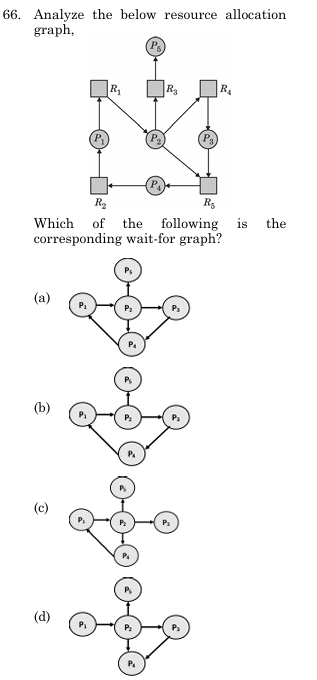
- A. Wait-for graph option A
- B. Wait-for graph option B
- C. Wait-for graph option C
- D. Wait-for graph option D
Answer: C. Wait-for graph option C
Explanation: A wait-for graph removes the resource nodes and adds a directed edge $P_i \rightarrow P_j$ if process $P_i$ is waiting for a resource held by $P_j$. From the resource allocation graph: P1 requests R1 (held by P2) $\Rightarrow P_1 \rightarrow P_2$. P2 requests R3 (held by P5) $\Rightarrow P_2 \rightarrow P_5$. P2 requests R4 (held by P3) $\Rightarrow P_2 \rightarrow P_3$. P2 requests R5 (held by P4) $\Rightarrow P_2 \rightarrow P_4$. P3 requests R5 (held by P4) $\Rightarrow P_3 \rightarrow P_4$. P4 requests R2 (held by P1) $\Rightarrow P_4 \rightarrow P_1$. Option (c) correctly displays exactly these edges.
Question 67
Topic: Operating Systems
For the following list of processes, the average turnaround time and average waiting time using FCFS algorithm is:
Process | Arrival Time (ms) | Execution Time (ms)
P1 | 6 | 24
P2 | 0 | 3
P3 | 3 | 3
- A. Average Turnaround time 30 ms and Average Waiting Time 4.5 ms
- B. Average Turnaround time 13 ms and Average Waiting Time 3 ms
- C. Average Turnaround time 10 ms and Average Waiting Time 0 ms
- D. Average Turnaround time 24 ms and Average Waiting Time 0 ms
Answer: C. Average Turnaround time 10 ms and Average Waiting Time 0 ms
Explanation: Using First-Come, First-Served (FCFS) scheduling:
- P2 arrives at 0, executes for 3ms, finishes at 3. (Wait = 0, Turnaround = 3-0=3)
- P3 arrives at 3, executes for 3ms, finishes at 6. (Wait = 3-3=0, Turnaround = 6-3=3)
- P1 arrives at 6, executes for 24ms, finishes at 30. (Wait = 6-6=0, Turnaround = 30-6=24)
Average Turnaround Time = (3 + 3 + 24) / 3 = 30 / 3 = 10 ms.
Average Waiting Time = (0 + 0 + 0) / 3 = 0 ms.
Question 68
Topic: Operating Systems
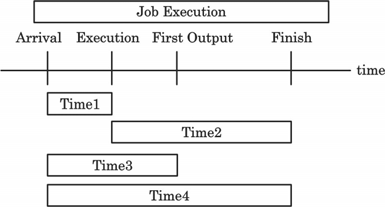
In the context of Operating system process scheduling, if W represents Wait Time, R represents Run Time, T represents Turnaround time, S represents Response time, then which of the following is correct option with respect to given diagram?
Diagram showing timeline: Arrival -> Execution (Time1), Execution -> Finish (Time2), Arrival -> First Output (Time3), Arrival -> Finish (Time4).
- A. Time1:W, Time2:R, Time3:T, Time4:S
- B. Time1:S, Time2:W, Time3:R, Time4:T
- C. Time1:W, Time2:R, Time3:S, Time4:T
- D. Time1:R, Time2:S, Time3:W, Time4:T
Answer: C. Time1:W, Time2:R, Time3:S, Time4:T
Explanation: Based on standard OS scheduling metrics:
- Time from 'Arrival' to 'Execution' start is the time spent waiting in the ready queue, which is Wait Time (W) (in non-preemptive systems, this equals response time, but W is specifically the queue wait).
- Time from 'Execution' start to 'Finish' is the total Run Time (R).
- Time from 'Arrival' to 'First Output' represents Response Time (S).
- Time from 'Arrival' to 'Finish' is the Turnaround Time (T).
Question 69
Topic: Operating Systems
Consider a system with 3 processes P0 to P2 and 3 resource types A, B, and C. Resource type A has 10 instances, resource type B has 5 instances and resource type C has 7 instances. The following snapshot of the system has been taken at a given time.
Allocation: P0(0,1,0), P1(2,0,0), P2(3,0,2)
Max: P0(7,5,3), P1(3,2,2), P2(9,0,2)
Which of the following is true?
- A. The system is not in safe state
- B. The system is blocked
- C. The system is in safe state
- D. The request cannot be granted to all the processes
Answer: C. The system is in safe state
Explanation: Total resources = (10, 5, 7). Total allocated = P0(0,1,0) + P1(2,0,0) + P2(3,0,2) = (5, 1, 2).
Available resources = Total - Allocated = (10, 5, 7) - (5, 1, 2) = (5, 4, 5).
Calculate Need matrix (Max - Alloc):
P0 Need: (7, 5, 3) - (0, 1, 0) = (7, 4, 3)
P1 Need: (3, 2, 2) - (2, 0, 0) = (1, 2, 2)
P2 Need: (9, 0, 2) - (3, 0, 2) = (6, 0, 0)
Starting with Available = (5, 4, 5):
- P1's Need (1, 2, 2) <= (5, 4, 5). P1 runs and releases (2, 0, 0). New Available = (7, 4, 5).
- P2's Need (6, 0, 0) <= (7, 4, 5). P2 runs and releases (3, 0, 2). New Available = (10, 4, 7).
- P0's Need (7, 4, 3) <= (10, 4, 7). P0 runs.
Since all processes can finish in the sequence <P1, P2, P0>, the system is in a safe state.
Question 70
Topic: Operating Systems
Consider the following reference strings and assume 3 frames are available, then the number of page faults that occur using Optimal page replacement algorithm is
6, 0, 5, 2, 0, 3, 0, 4, 2, 3, 0, 3, 2, 5, 2
- A. 15 Page Faults
- B. 9 Page Faults
- C. 12 Page Faults
- D. 8 Page Faults
Answer: D. 8 Page Faults
Explanation: Using Optimal replacement (replace page not used for the longest time in the future):
1. '6' -> Miss (Frames: 6)
2. '0' -> Miss (Frames: 6, 0)
3. '5' -> Miss (Frames: 6, 0, 5)
4. '2' -> Miss. Look ahead: 0 used next, 5 used at end, 6 never. Replace 6. (Frames: 2, 0, 5)
5. '0' -> Hit.
6. '3' -> Miss. Look ahead: 0, 4, 2, 3... 5 is furthest. Replace 5. (Frames: 2, 0, 3)
7. '0' -> Hit.
8. '4' -> Miss. Look ahead: 2, 3, 0. Replace 0 (used furthest away). (Frames: 2, 4, 3)
9. '2' -> Hit.
10. '3' -> Hit.
11. '0' -> Miss. Look ahead: 3, 2, 5. Replace 4. (Frames: 2, 0, 3)
12. '3' -> Hit.
13. '2' -> Hit.
14. '5' -> Miss. Replace 0 or 3. (Frames: 2, 5, 3)
15. '2' -> Hit.
Total Page Faults = 3 (initial) + 5 (replacements) = 8.
Question 71
Topic: Software Engineering
Cyclomatic complexity is associated with
- A. White Box Testing
- B. Black Box Testing
- C. Grey Box Testing
- D. None of the above
Answer: A. White Box Testing
Explanation: Cyclomatic complexity is a software metric used to measure the complexity of a program's internal control flow. Since it relies on the internal structure and logic of the code (paths, branches, loops), it is directly associated with White Box Testing.
Question 72
Topic: Software Engineering
Which of the following is related to Alpha Testing and Beta Testing?
- A. Unit Testing
- B. System Testing
- C. Acceptance Testing
- D. Integration Testing
Answer: C. Acceptance Testing
Explanation: Alpha Testing (conducted at the developer's site) and Beta Testing (conducted by end-users at their own sites) are the two primary phases of User Acceptance Testing (UAT). They evaluate whether the software meets the users' requirements and is ready for release.
Question 73
Topic: Software Engineering
As per the Capability Maturity Model (CMM), the process maturity levels are defined as
Level 1: Initial
Level 2: (A)
Level 3: (B)
Level 4: (C)
Level 5: Optimizing
Identify (A), (B) and (C).
- A. A: Defined, B: Repeatable, C: Managed
- B. A: Repeatable, B: Managed, C: Defined
- C. A: Repeatable, B: Defined, C: Managed
- D. A: Defined, B: Managed, C: Repeatable
Answer: C. A: Repeatable, B: Defined, C: Managed
Explanation: The 5 maturity levels of the Capability Maturity Model (CMM) are: 1 - Initial, 2 - Repeatable, 3 - Defined, 4 - Managed, 5 - Optimizing. Therefore, A = Repeatable, B = Defined, and C = Managed.
Question 74
Topic: Software Engineering
As per software engineering, which of the following order is correct for stages of Risk Management process of a software project?
- A. Risk identification $\rightarrow$ Risk planning $\rightarrow$ Risk analysis $\rightarrow$ Risk monitoring
- B. Risk planning $\rightarrow$ Risk identification $\rightarrow$ Risk analysis $\rightarrow$ Risk monitoring
- C. Risk analysis $\rightarrow$ Risk identification $\rightarrow$ Risk planning $\rightarrow$ Risk monitoring
- D. Risk identification $\rightarrow$ Risk analysis $\rightarrow$ Risk planning $\rightarrow$ Risk monitoring
Answer: D. Risk identification $\rightarrow$ Risk analysis $\rightarrow$ Risk planning $\rightarrow$ Risk monitoring
Explanation: The standard sequence of the Risk Management process involves first identifying the risks (Identification), then evaluating their likelihood and impact (Analysis), followed by creating strategies to mitigate them (Planning), and continuously tracking them throughout the project lifecycle (Monitoring).
Question 75
Topic: Software Engineering
Considering, X is a function defined in a software project, following statements are made
(i) Fan-in is a measure of the number of functions that call the function, X
(ii) Fan-out is the number of functions which are called by the function, X
(iii) High value of Fan-in means that X is tightly coupled to the rest of design of software
(iv) High value of Fan-out means that overall complexity of X may be high
Which of the following options is correct for the above-mentioned statements?
- A. Only (i) and (ii) are true
- B. Only (i) and (iii) are true
- C. Only (ii) and (iv) are true
- D. (i), (ii), (iii) and (iv) are true
Answer: D. (i), (ii), (iii) and (iv) are true
Explanation: All the statements accurately describe Fan-in and Fan-out. Fan-in is the number of modules calling a module (X), and high fan-in indicates high reuse and tight coupling. Fan-out is the number of modules called by module (X), and a high fan-out indicates that module X is orchestrating many other modules, resulting in high internal complexity.
Question 76
Topic: Software Engineering
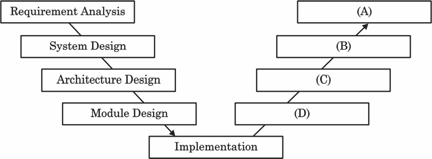
In the V Model of Software Testing shown below, please identify (A), (B), (C), (D)
Left side: Requirement Analysis, System Design, Architecture Design, Module Design
Right side (from top): (A), (B), (C), (D)
- A. (A): Acceptance Testing, (B): System Testing, (C): Integration Testing, (D): Unit Testing
- B. (A): Acceptance Testing, (B): Integration Testing, (C): System Testing, (D): Unit Testing
- C. (A): Unit Testing, (B): System Testing, (C): Integration Testing, (D): Acceptance Testing
- D. (A): Unit Testing, (B): Integration Testing, (C): System Testing, (D): Acceptance Testing
Answer: A. (A): Acceptance Testing, (B): System Testing, (C): Integration Testing, (D): Unit Testing
Explanation: In the V-Model, the testing phases on the right side correspond to the development phases on the left side, moving from bottom to top. Module Design is verified by Unit Testing (D); Architecture Design is verified by Integration Testing (C); System Design is verified by System Testing (B); and Requirement Analysis is verified by Acceptance Testing (A).
Question 77
Topic: Software Engineering
For a software project, following information about the domain characteristics are given :
Number of user inputs: Count 30, Average Weight 4
Number of user outputs: Count 60, Average Weight 5
Number of user enquiries: Count 20, Average Weight 4
Number of files: Count 5, Average Weight 10
Number of external interfaces: Count 4, Average Weight 7
Assume that all complexity adjustment values are average having scale = 3. The function point value for the project will be
- A. 681.46
- B. 186.46
- C. 816.46
- D. 618.46
Answer: D. 618.46
Explanation: First, calculate the Unadjusted Function Point (UFP): UFP = (30 * 4) + (60 * 5) + (20 * 4) + (5 * 10) + (4 * 7) = 120 + 300 + 80 + 50 + 28 = 578.
There are 14 complexity adjustment factors. If all are average (scale value = 3), the sum of complexity factors = $14 \times 3 = 42$.
The Value Adjustment Factor (VAF) is $0.65 + (0.01 \times 42) = 0.65 + 0.42 = 1.07$.
Function Point (FP) = $UFP \times VAF = 578 \times 1.07 = 618.46$.
Question 78
Topic: Theory of Computation
Consider the regular expression R over the alphabet {a,b}:
$R = (a^*b)^* + (b^*a)^*$
Which of the following regular expressions below describe the same language as R?
- A. $(a^*b^*) + (b^*a^*)$
- B. $a^*+b^*$
- C. $(a+b)^*$
- D. $a^*b+b^*a$
Answer: C. $(a+b)^*$
Explanation: The expression $(a^*b)^*$ generates all possible strings over {a,b} that end with 'b', as well as the empty string. The expression $(b^*a)^*$ generates all possible strings over {a,b} that end with 'a', as well as the empty string. The union of these two sets covers every possible string of 'a's and 'b's of any length. Therefore, $R$ is equivalent to the universal language $(a+b)^*$.
Question 79
Topic: Theory of Computation
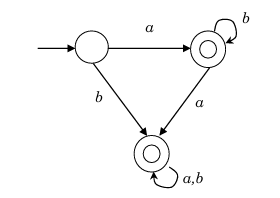
Consider the deterministic finite-state automaton (DFA) below over the alphabet {a,b}. The state with a small incoming arrow is the initial state, while a double circle state denotes a final state.
The number of states in the MINIMAL DFA for the language accepted by this DFA is:
Answer: B. 2
Explanation: The DFA has an initial non-final state $S_0$ and two final states $S_1$ and $S_2$. $S_2$ has self-loops on 'a' and 'b', making it a final sink state that accepts everything. $S_1$ loops to itself on 'b' and goes to $S_2$ on 'a', meaning from $S_1$, any sequence of 'a' and 'b' is also accepted. Because $S_1$ and $S_2$ are both final states from which any string leads to acceptance, they are equivalent and can be merged into a single final state $S_F$. The minimal DFA consists of 2 states: the initial non-final state $S_0$ and the merged final state $S_F$.
Question 80
Topic: Theory of Computation
Consider the context-free grammar G below. Here S is the starting non-terminal symbol, while a and b are terminal symbols.
$S \rightarrow a S b | T$
$T \rightarrow b T | b$
The language generated by G is:
- A. $\\{a^{m}b^{n}:0\le m<n\\}$
- B. $\\{a^{m}b^{n}:0<m<n\\}$
- C. $\\{a^{m}b^{n}:0<n\le m\\}$
- D. $\\{a^{n}b^{n}:0\le n\\}$
Answer: A. $\\{a^{m}b^{n}:0\le m<n\\}$
Explanation: The non-terminal $T$ generates strings of the form $b^k$ for $k \ge 1$ (i.e., one or more 'b's).
The non-terminal $S$ generates strings of the form $a^m T b^m$ for $m \ge 0$.
Substituting the strings generated by $T$, we get $a^m b^k b^m = a^m b^{m+k}$.
Let $n = m + k$. Since $k \ge 1$, it follows that $n > m$, or $m < n$.
Also, $m$ can be $0$ (if the first derivation uses $S \rightarrow T$). Therefore, the language is $\\{a^m b^n : 0 \le m < n\\}$.
Question 81
Topic: General Aptitude
What was the day of the week on 28th May, 2006?
- A. Thursday
- B. Friday
- C. Saturday
- D. Sunday
Answer: D. Sunday
Question 82
Topic: General Aptitude
Fact 1 : Jessica has four children.
Fact 2 : Two of the children have blue eyes and two of the children have brown eyes.
Fact 3 : Half of the children are girls.
If the first three statements are facts, which of the following statements must also be a fact?
I. At least one girl has blue eyes.
II. Two of the children are boys.
III. The boys have brown eyes.
- A. I only
- B. II only
- C. II and III only
- D. None of the statements is a known fact
Answer: B. II only
Question 83
Topic: General Aptitude
Many business offices are located in buildings having 2-8 floors. If a building has more than 3 floors, it has a lift. If the above statements are true, which of the following must be true?
- A. 2nd floors do not have lifts
- B. 7th floors have lifts
- C. Only floors above the 3rd floors have lifts
- D. All floors may be reached by lifts
Answer: B. 7th floors have lifts
Question 84
Topic: General Aptitude
A cube has a volume of 8 cubic metres. If each side is doubled in length what will its new volume be in cubic metres?
Answer: C. 64
Question 85
Topic: General Aptitude
In a mixture of 45 litres, the ratio of sugar solution to salt solution is 1 : 2. What is the amount of sugar solution to be added if the ratio has to be 2 : 1?
- A. 15 litres
- B. 45 litres
- C. 55 litres
- D. 65 litres
Answer: B. 45 litres
Question 86
Topic: General Aptitude
Which of the following mentioned standard probability density functions is applicable to discrete Random Variables?
- A. Gaussian Distribution
- B. Poisson Distribution
- C. Rayleigh Distribution
- D. Exponential Distribution
Answer: B. Poisson Distribution
Question 87
Topic: General Aptitude
Andre and Betty together weigh 150 pounds. Betty and Chris together 180 pounds. Andre, Chris and David together weigh 360 pounds. Altogether, the four of them weigh 450 pounds. How much does David weigh?
- A. 60 Pounds
- B. 90 Pounds
- C. 160 Pounds
- D. 210 Pounds
Answer: B. 90 Pounds
Question 88
Topic: General Aptitude
Statements : Some books are tables. Some tables are mirrors.
Conclusions :
I. Some mirrors are books.
II. No book is mirror.
- A. Only conclusion II follows
- B. Only conclusion I follows
- C. Either I or II follows
- D. Both I and II follow
Answer: C. Either I or II follows
Question 89
Topic: General Aptitude
Statements : No women teacher can play. Some women teachers are athletes.
Conclusions :
I. Male athletes can play.
II. Some athletes can play (Tough).
- A. Only conclusion I follows
- B. Only conclusion II follows
- C. Either I or II follows
- D. Neither I nor II follows
Answer: B. Only conclusion II follows
Question 90
Topic: General Aptitude
Which one will replace the question mark?
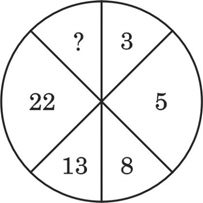
Answer: A. 45
Question 91
Topic: General Aptitude
In this, you are given a combination of alphabets and/or numbers followed by four alternatives (a), (b), (c) and (d). Choose the alternative which closely resembles the mirror image of the given combination.
Answer: B.
Question 92
Topic: General Aptitude
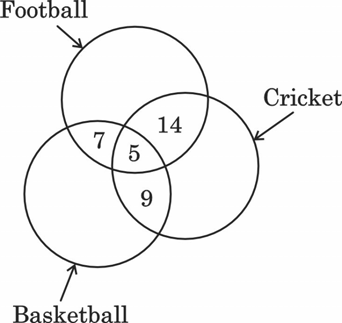
Observe the given figure and answer question below. If 50 play Football, 40 play Cricket and 30 play Basketball, then what is the number of players who play Football or Cricket but not Basketball?
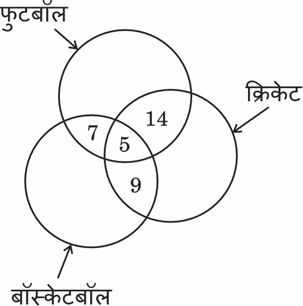
Answer: A. 45
Question 93
Topic: General Aptitude
Which of the following boxes should replace the question mark (?) to complete the pattern?
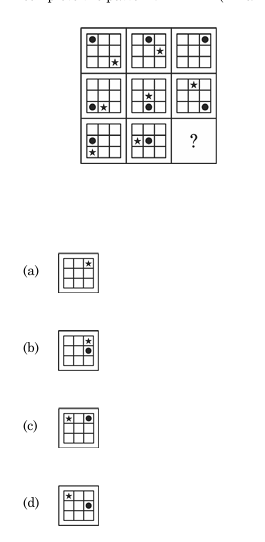
Answer: B.
Question 94
Topic: General Aptitude
Choose which one of the options best fits the missing symbol?
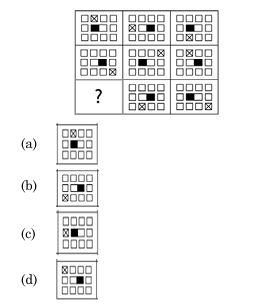
Answer: B.
Question 95
Topic: General Aptitude
Which figure completes the series?
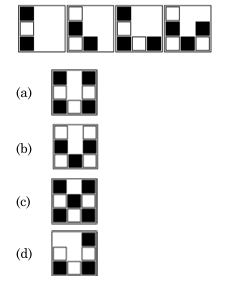
Answer: B.