ISRO Computer Science (CSE) 2020 Question Paper & Solutions

Attempt the ISRO Computer Science (CSE) 2020 previous year paper in real CBT exam mode or practice mode with the official answer key. Step-by-step explanations are coming soon.

All ISRO Computer Science (CSE) papers

80 questions. Answers are shown only where the official answer key is available.

Question 1

Regression testing is primarily related to

  • A. Functional testing
  • B. Development testing
  • C. Data flow testing
  • D. Maintenance testing

Answer: A. Functional testing

Question 2

ISRO Scientist/Engineer CS 2020, Question 2: see the question image.

Figure for question 2, ISRO Computer Science (CSE) 2020

  • A. Option A
  • B. Option B
  • C. Option C
  • D. Option D

Answer: C. Option C

Question 3

ISRO Scientist/Engineer CS 2020, Question 3: see the question image.
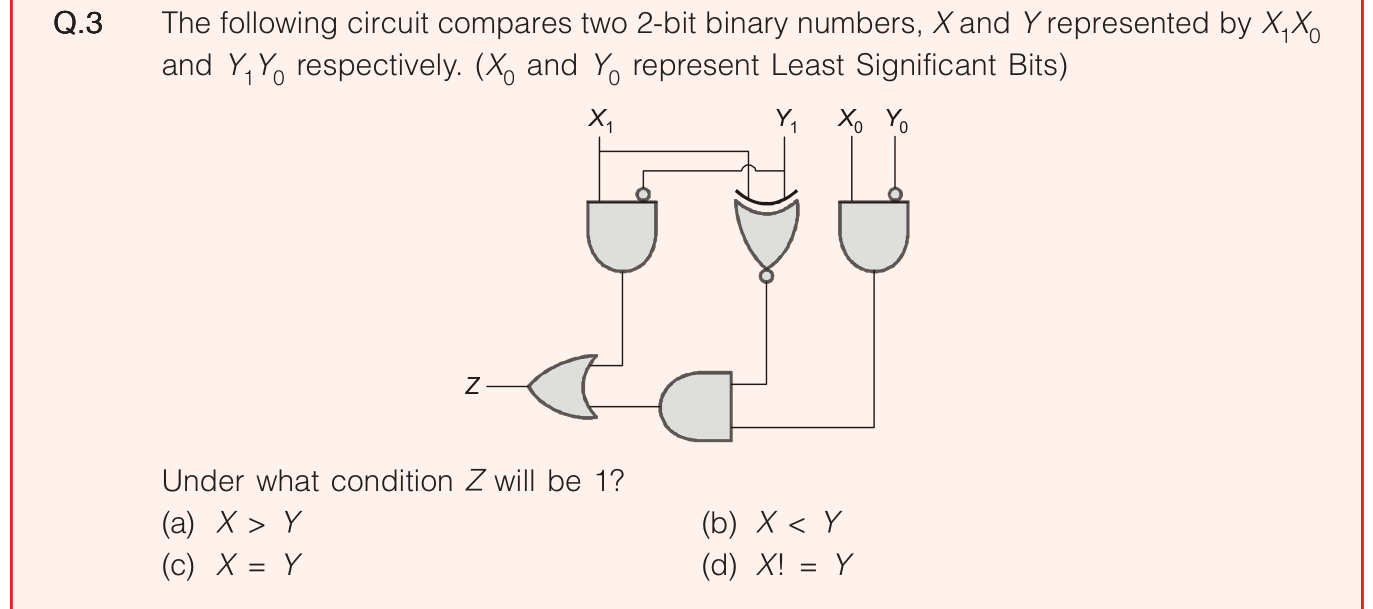
Figure for question 3, ISRO Computer Science (CSE) 2020

  • A. Option A
  • B. Option B
  • C. Option C
  • D. Option D

Answer: A. Option A

Question 4

What is the availability of the software with following reliability figures. Mean Time Between Failures (MTBF) is 20 days Mean Time To Repair (MTTR) is 20 hours.

  • A. 90%
  • B. 96%
  • C. 24%
  • D. 50%

Answer: D. 50%

Question 5

What is the defect rate for Six sigma?

  • A. 1.0 defect per million lines of code
  • B. 1.4 defects per million lines of code
  • C. 3.0 defects per million lines of code
  • D. 3.4 defects per million lines of code

Answer: D. 3.4 defects per million lines of code

Question 6

Consider a 5-segment pipeline with a clock cycle time 20 ns in each sub operation. Find out the approximate speed-up ratio between pipelined and non-pipelined system to execute 100 instructions. (If an average, every five cycles, a bubble due to data hazard has to be introduced in the pipeline)

  • A. 5
  • B. 4.03
  • C. 4.81
  • D. 4.17

Answer: B. 4.03

Question 7

ISRO Scientist/Engineer CS 2020, Question 7: see the question image.
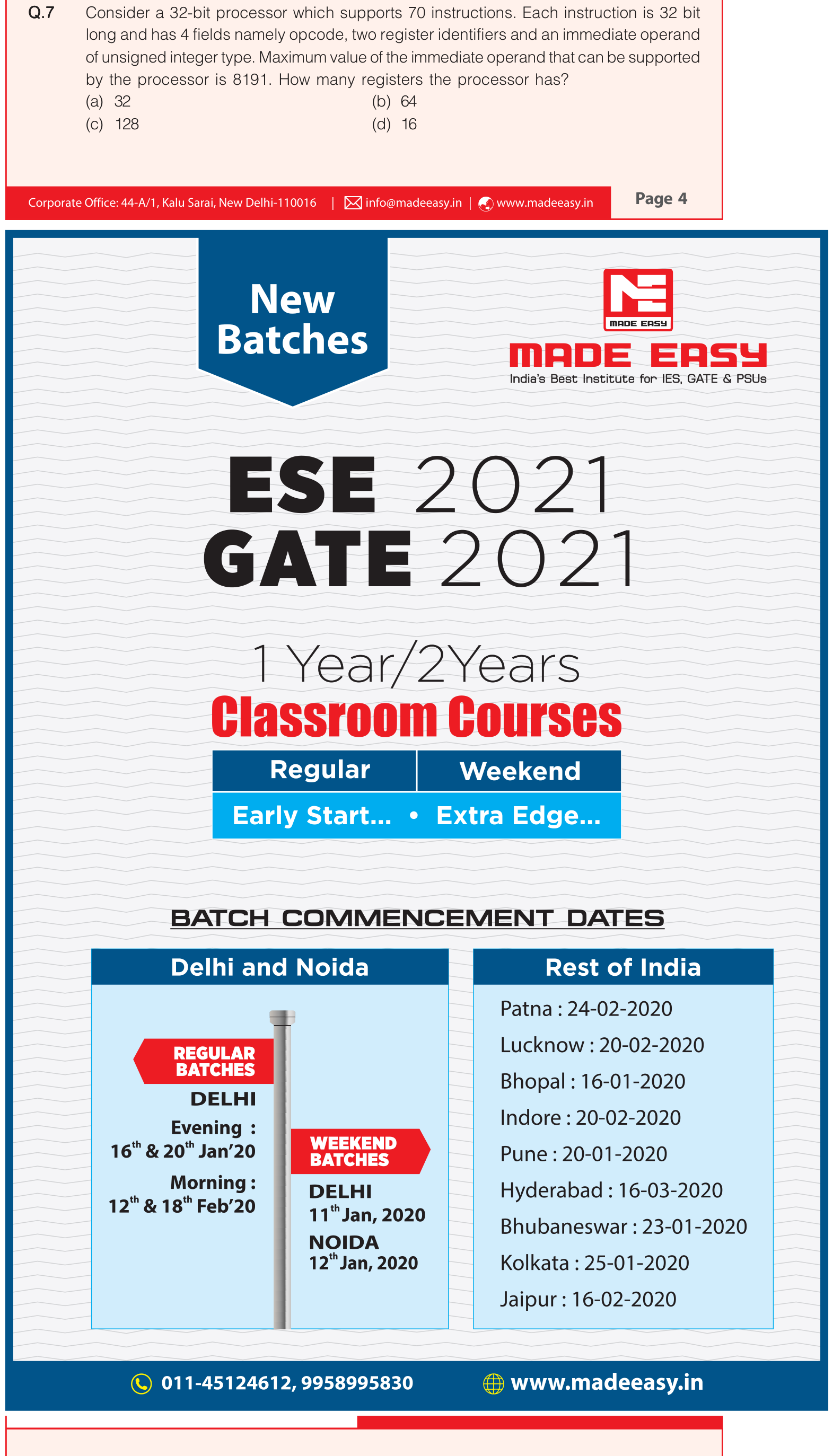
Figure for question 7, ISRO Computer Science (CSE) 2020

  • A. Option A
  • B. Option B
  • C. Option C
  • D. Option D

Answer: B. Option B

Question 8

In a 8-bit ripple carry adder using identical full adders, each full adder takes 34 ns for computing sum. If the time taken for 8-bit addition is 90 ns, find time taken by each full adder to find carry.

  • A. 6 ns
  • B. 7 ns
  • C. 10 ns
  • D. 8 ns

Answer: D. 8 ns

Question 9

ISRO Scientist/Engineer CS 2020, Question 9: see the question image.
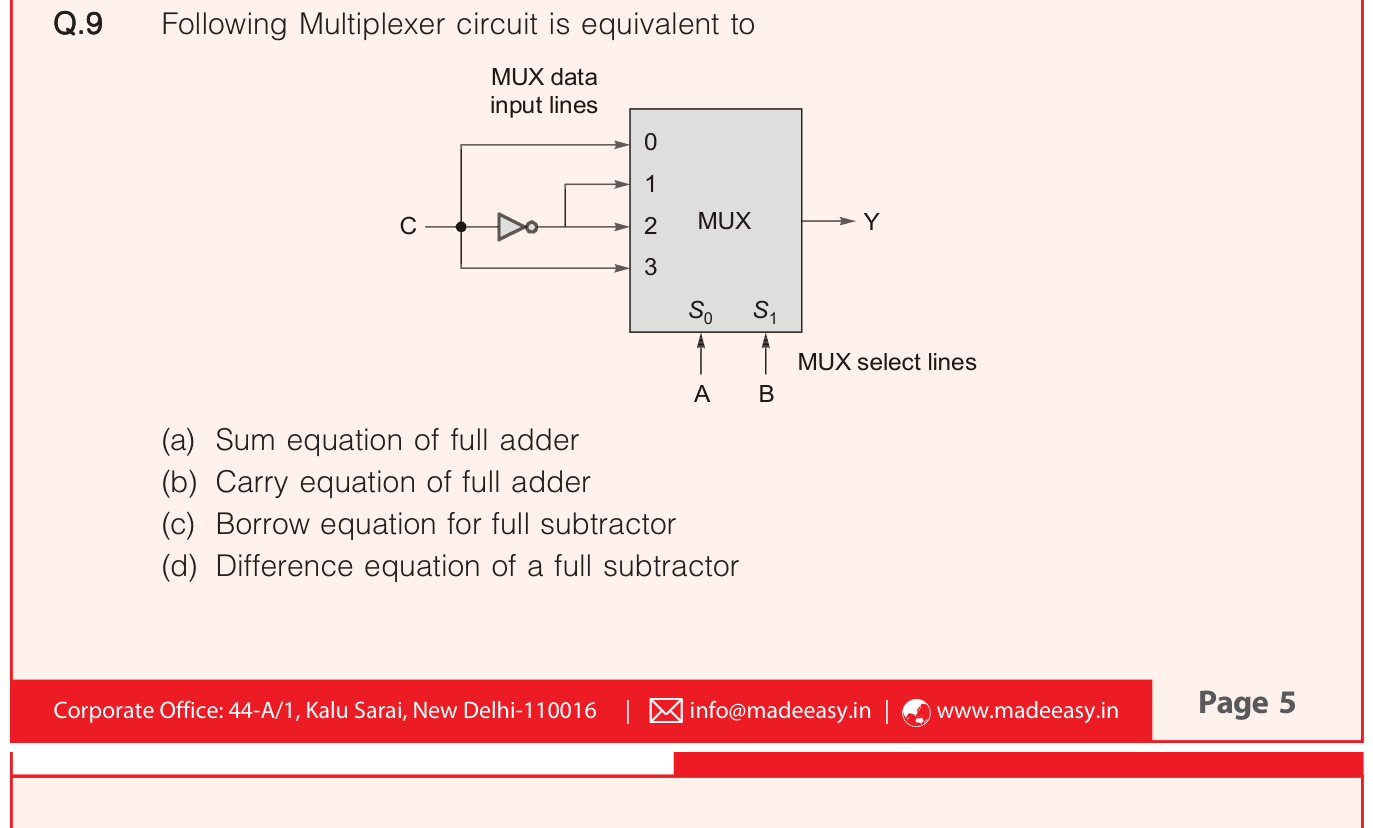
Figure for question 9, ISRO Computer Science (CSE) 2020

  • A. Option A
  • B. Option B
  • C. Option C
  • D. Option D

Question 10

ISRO Scientist/Engineer CS 2020, Question 10: see the question image.
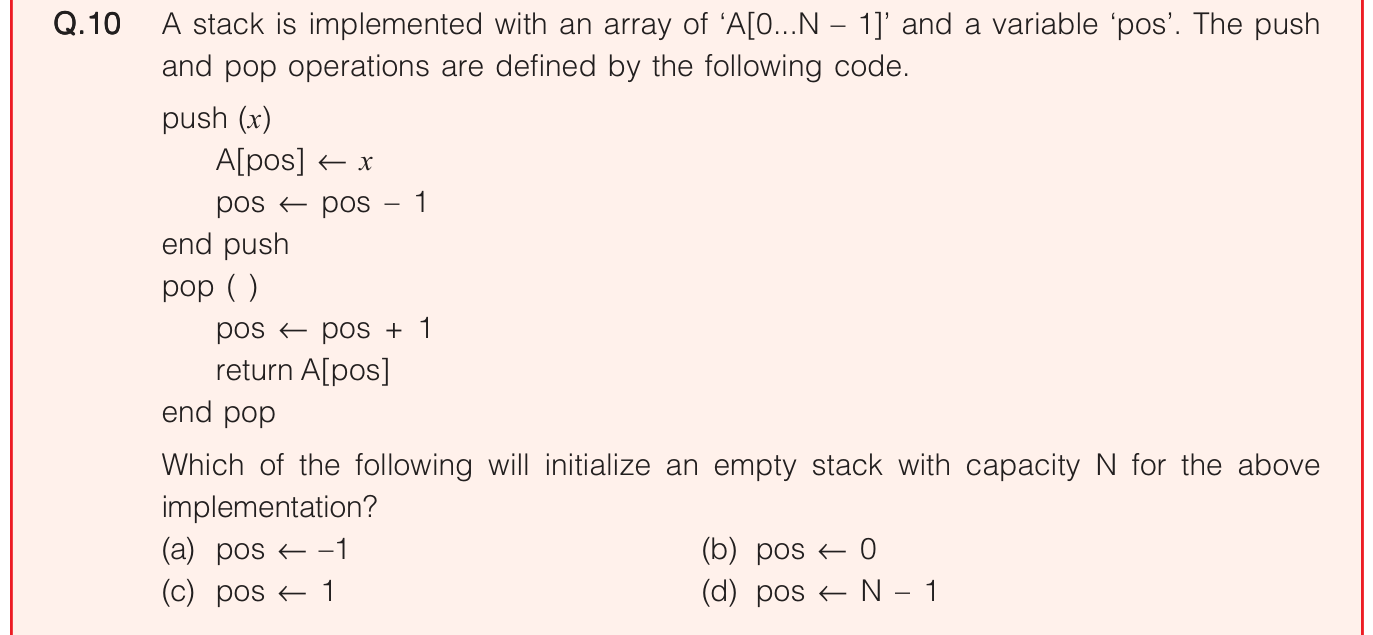
Figure for question 10, ISRO Computer Science (CSE) 2020

  • A. Option A
  • B. Option B
  • C. Option C
  • D. Option D

Answer: D. Option D

Question 11

ISRO Scientist/Engineer CS 2020, Question 11: see the question image.
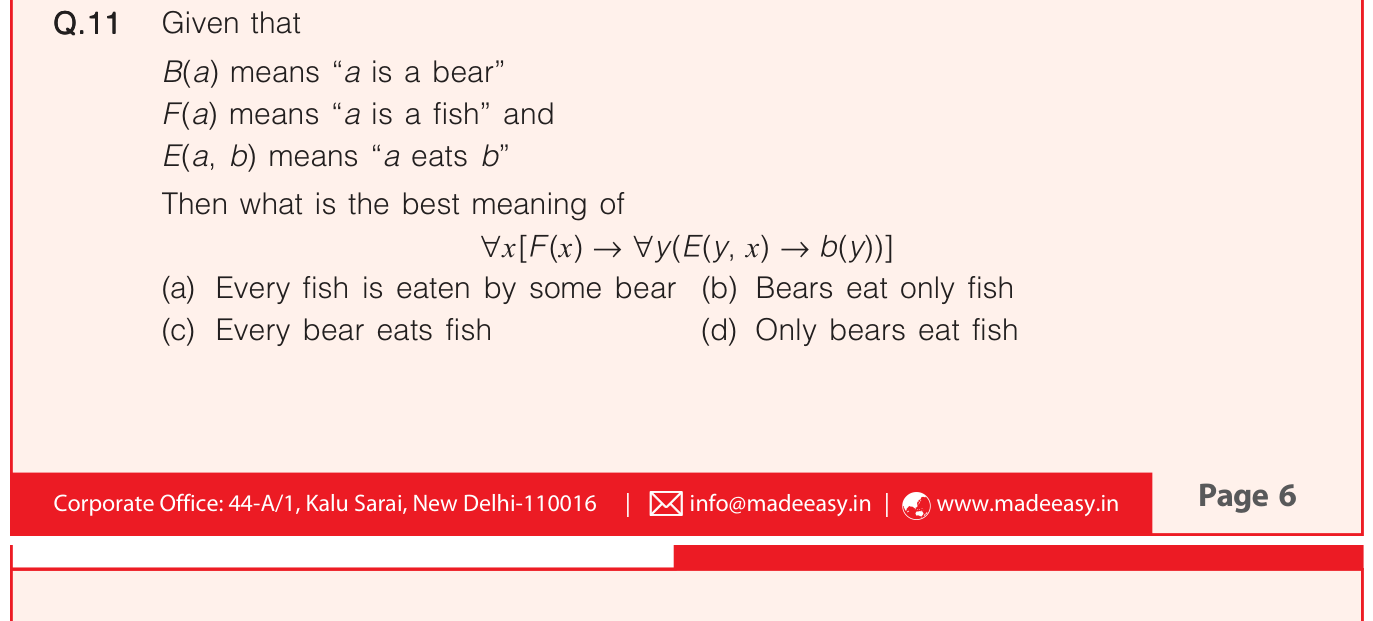
Figure for question 11, ISRO Computer Science (CSE) 2020

  • A. Option A
  • B. Option B
  • C. Option C
  • D. Option D

Answer: D. Option D

Question 12

ISRO Scientist/Engineer CS 2020, Question 12: see the question image.
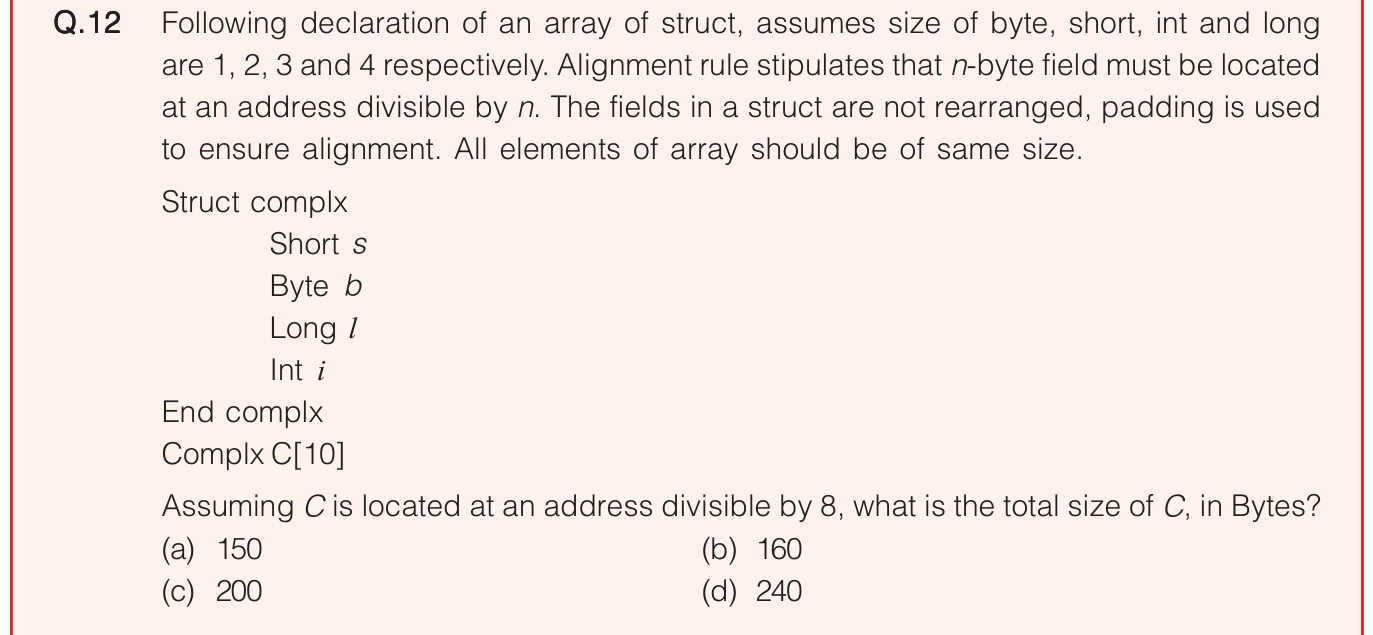
Figure for question 12, ISRO Computer Science (CSE) 2020

  • A. Option A
  • B. Option B
  • C. Option C
  • D. Option D

Answer: B. Option B

Question 13

The immediate addressing mode can be used for 1. Loading internal registers with initial values 2. Perform arithmetic or logical operation on data contained in instructions Which of the following is true?

  • A. Only 1
  • B. Only 2
  • C. Both 1 and 2
  • D. Immediate mode refers to data in cache

Answer: C. Both 1 and 2

Question 14

ISRO Scientist/Engineer CS 2020, Question 14: see the question image.
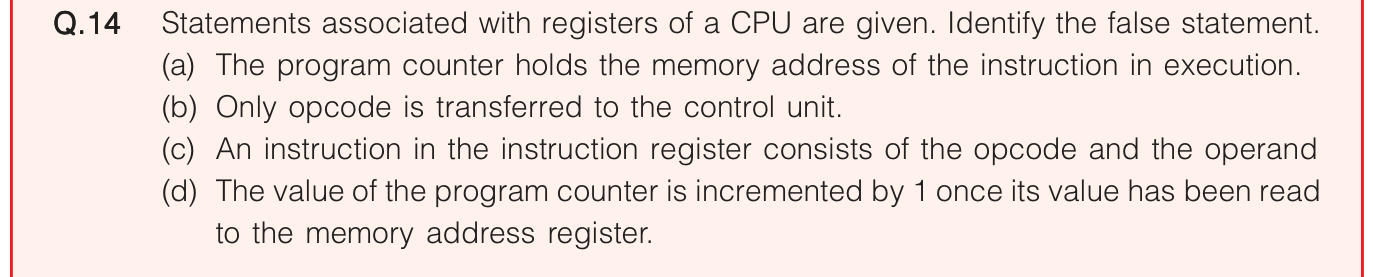
Figure for question 14, ISRO Computer Science (CSE) 2020

  • A. Option A
  • B. Option B
  • C. Option C
  • D. Option D

Answer: C. Option C

Question 15

Which of the following affects the processing power assuming they do not influence each other. 1. Data bus capability 2. Addressing scheme 3. Clock speed

  • A. 3 only
  • B. 1 and 3 only
  • C. 2 and 3 only
  • D. 1, 2 and 3

Answer: B. 1 and 3 only

Question 16

ISRO Scientist/Engineer CS 2020, Question 16: see the question image.

Figure for question 16, ISRO Computer Science (CSE) 2020

  • A. Option A
  • B. Option B
  • C. Option C
  • D. Option D

Question 17

G is an undirected graph with vertex set {v1, v2, v3, v4, v5, v6, v7} and edge set {v1v2, v1v3, v1v4, v2v4, v2v5, v3v4, v4v5, v4v6, v5v6, v6v7}. A breadth first search of the graph is performed with v1 as the root node. Which of the following is a tree edge?

  • A. v2v4
  • B. v1v4
  • C. v4v5
  • D. v3v4

Answer: B. v1v4

Question 18

If the array A contains the items 10, 4, 7, 23, 67, 12 and 5 in that order, what will be the resultant array A after third pass of insertion sort?

  • A. 67, 12, 10, 5, 4, 7, 23
  • B. 4, 7, 10, 23, 67, 12, 5
  • C. 4, 5, 7, 67, 10, 12, 23
  • D. 10, 7, 4, 67, 23, 12, 5

Answer: B. 4, 7, 10, 23, 67, 12, 5

Question 19

ISRO Scientist/Engineer CS 2020, Question 19: see the question image.

Figure for question 19, ISRO Computer Science (CSE) 2020

  • A. Option A
  • B. Option B
  • C. Option C
  • D. Option D

Answer: A. Option A

Question 20

ISRO Scientist/Engineer CS 2020, Question 20: see the question image.
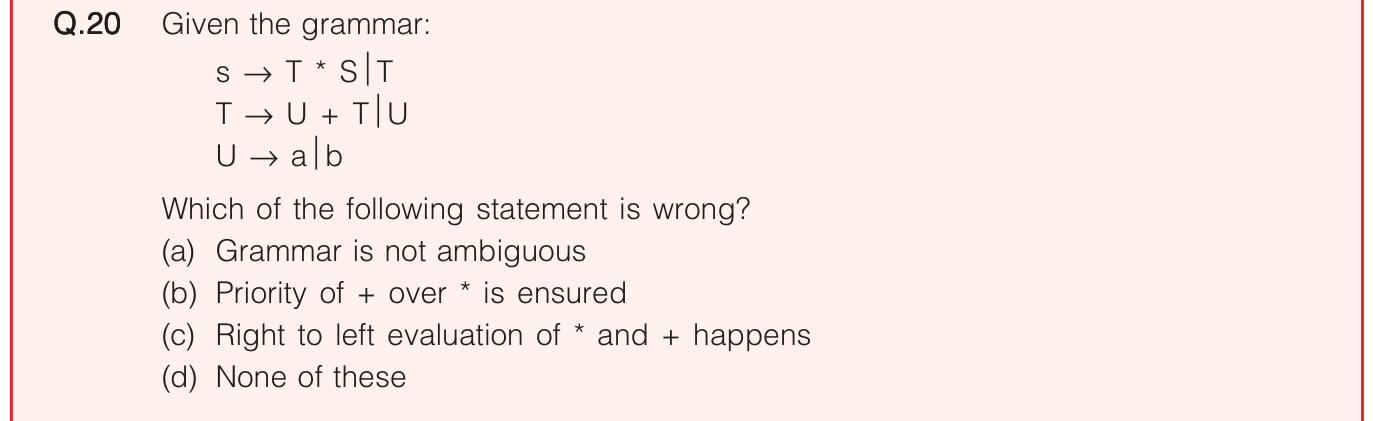
Figure for question 20, ISRO Computer Science (CSE) 2020

  • A. Option A
  • B. Option B
  • C. Option C
  • D. Option D

Answer: D. Option D

Question 21

ISRO Scientist/Engineer CS 2020, Question 21: see the question image.
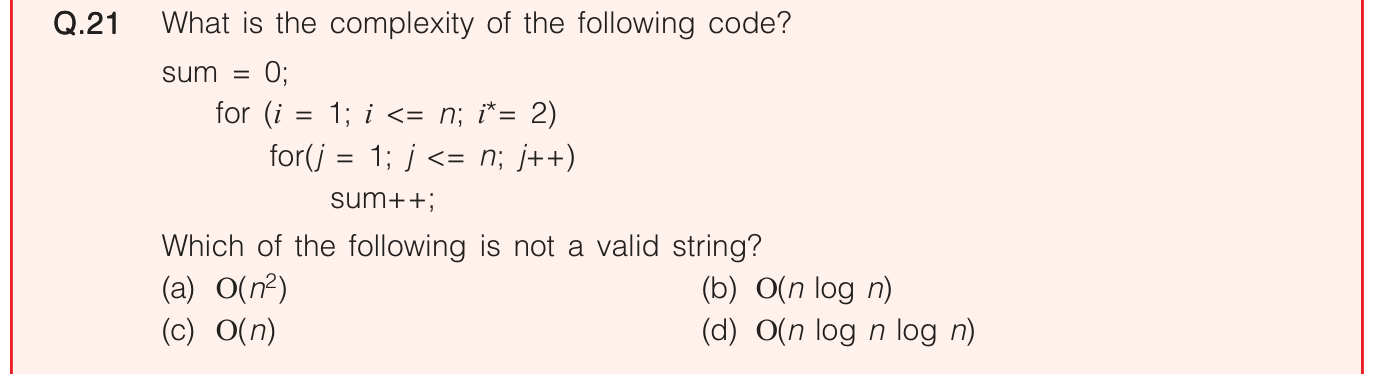
Figure for question 21, ISRO Computer Science (CSE) 2020

  • A. Option A
  • B. Option B
  • C. Option C
  • D. Option D

Answer: C. Option C

Question 22

In the following procedure Integer procedure P(X, Y); Integer X,Y: x; value begin K = 5; L = 8; P = x + y; end X is called by value and Y is called by name. If the procedure were invoked by the following program fragment K = 0; L = 0; Z = P(K, L); then the value Z would be set equal to

  • A. 5
  • B. 8
  • C. 13
  • D. 0

Answer: D. 0

Question 23

ISRO Scientist/Engineer CS 2020, Question 23: see the question image.
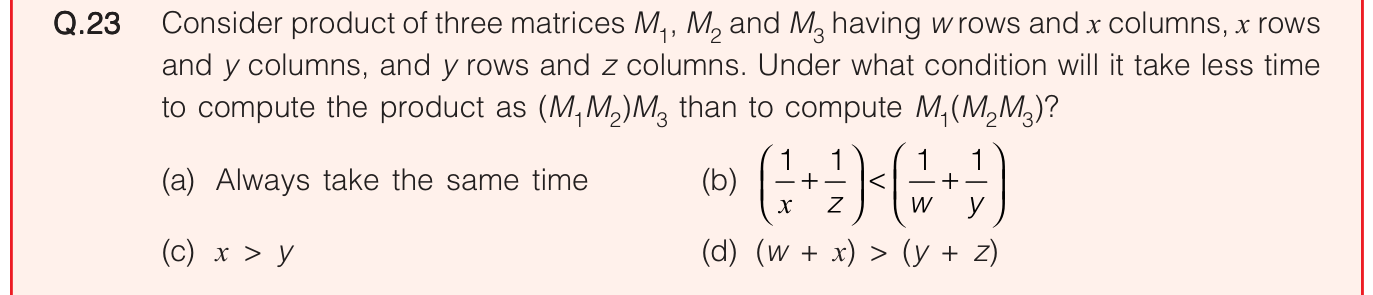
Figure for question 23, ISRO Computer Science (CSE) 2020

  • A. Option A
  • B. Option B
  • C. Option C
  • D. Option D

Answer: B. Option B

Question 24

ISRO Scientist/Engineer CS 2020, Question 24: see the question image.
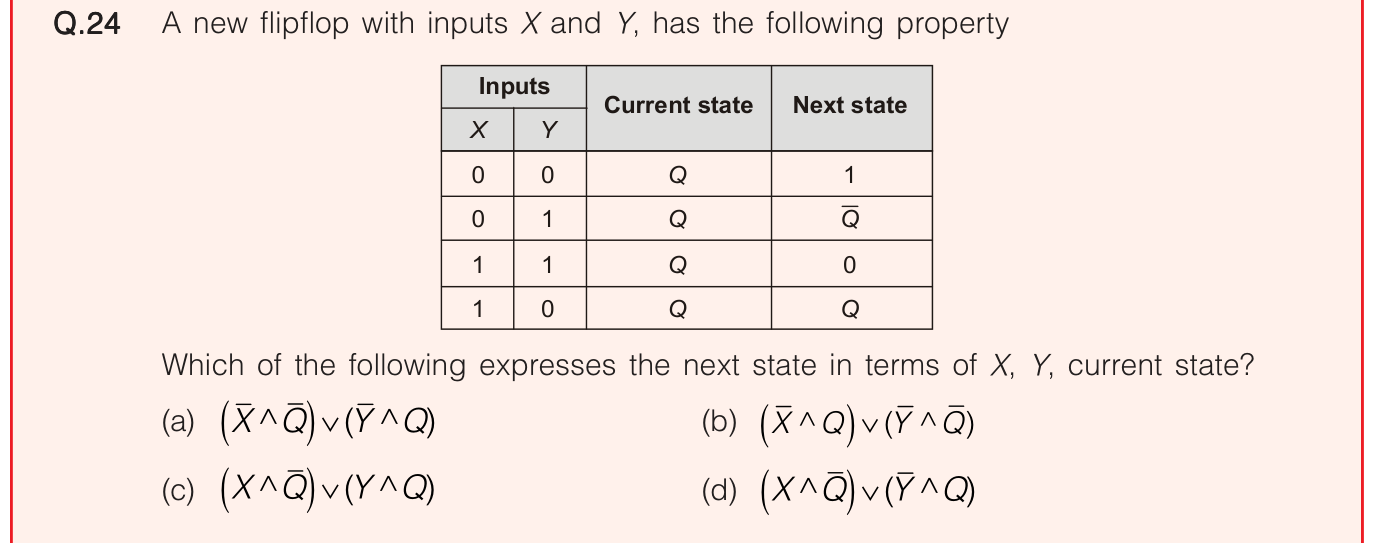
Figure for question 24, ISRO Computer Science (CSE) 2020

  • A. Option A
  • B. Option B
  • C. Option C
  • D. Option D

Answer: A. Option A

Question 25

ISRO Scientist/Engineer CS 2020, Question 25: see the question image.
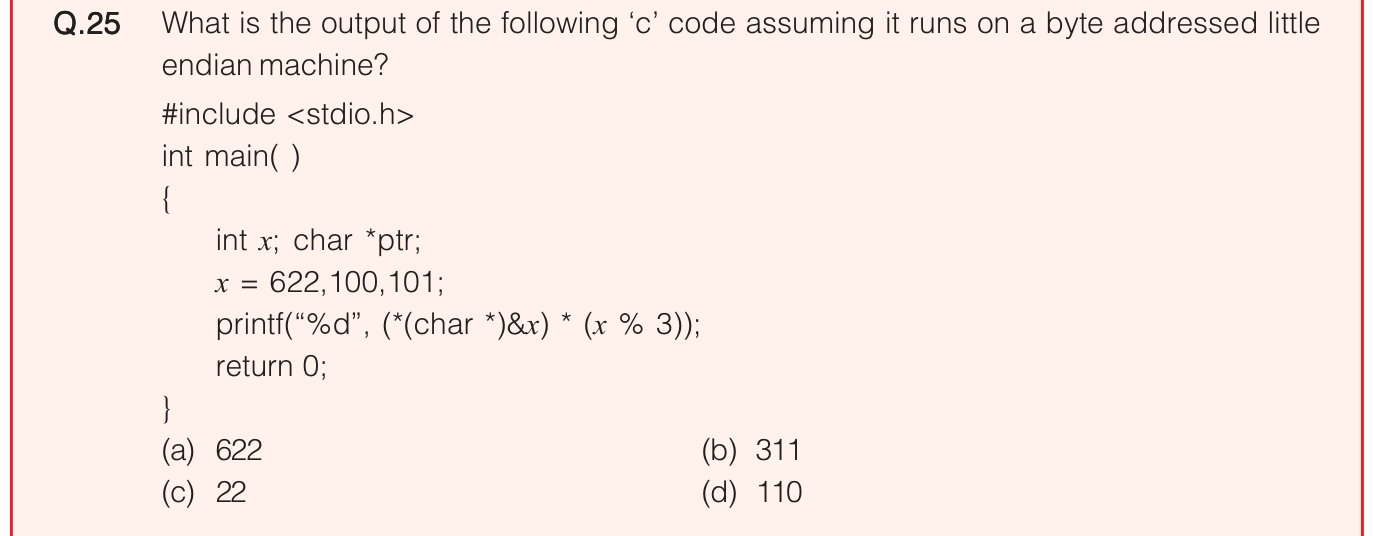
Figure for question 25, ISRO Computer Science (CSE) 2020

  • A. Option A
  • B. Option B
  • C. Option C
  • D. Option D

Answer: D. Option D

Question 26

ISRO Scientist/Engineer CS 2020, Question 26: see the question image.
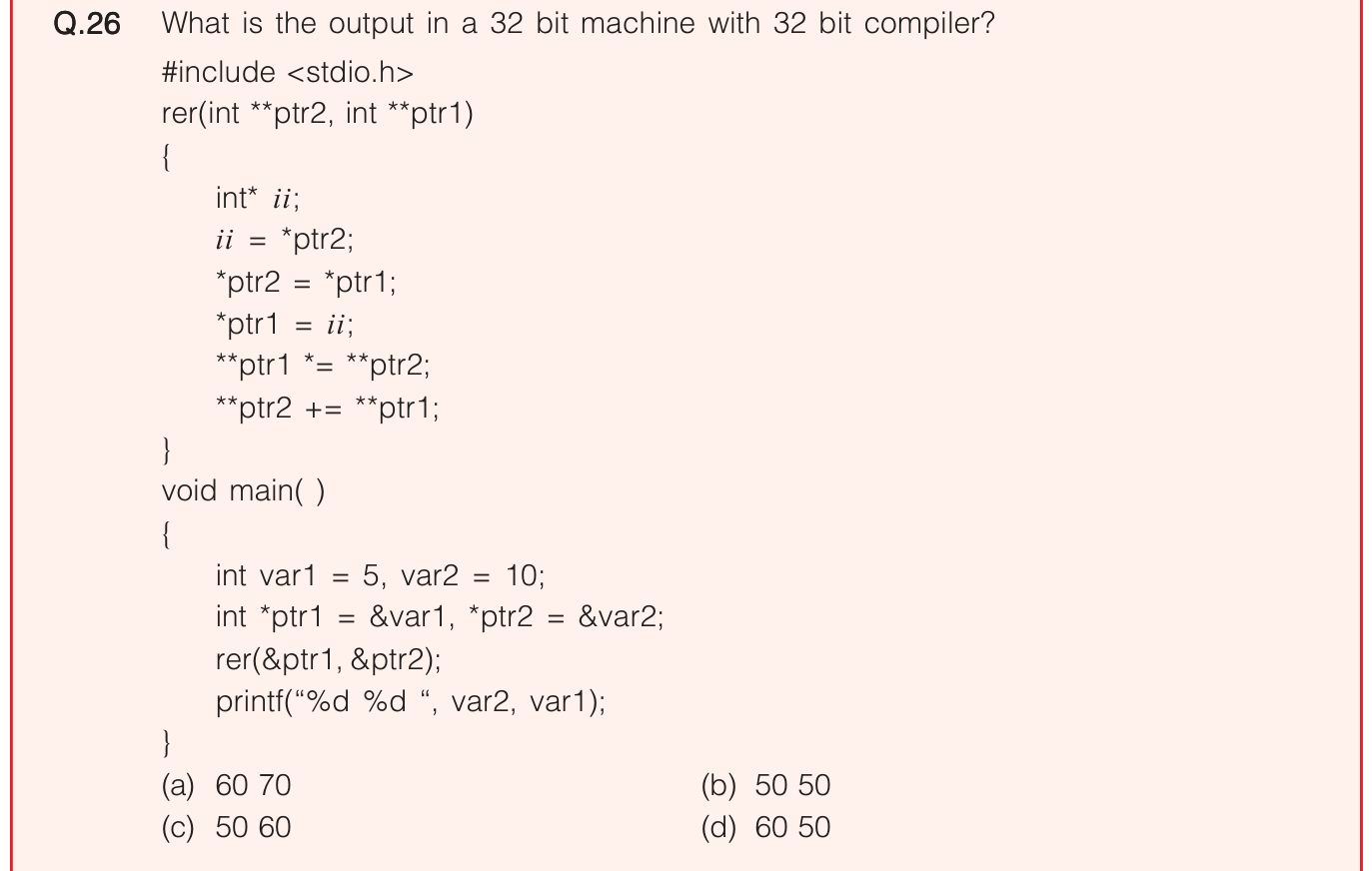
Figure for question 26, ISRO Computer Science (CSE) 2020

  • A. Option A
  • B. Option B
  • C. Option C
  • D. Option D

Answer: D. Option D

Question 27

ISRO Scientist/Engineer CS 2020, Question 27: see the question image.

Figure for question 27, ISRO Computer Science (CSE) 2020

  • A. Option A
  • B. Option B
  • C. Option C
  • D. Option D

Answer: C. Option C

Question 28

ISRO Scientist/Engineer CS 2020, Question 28: see the question image.
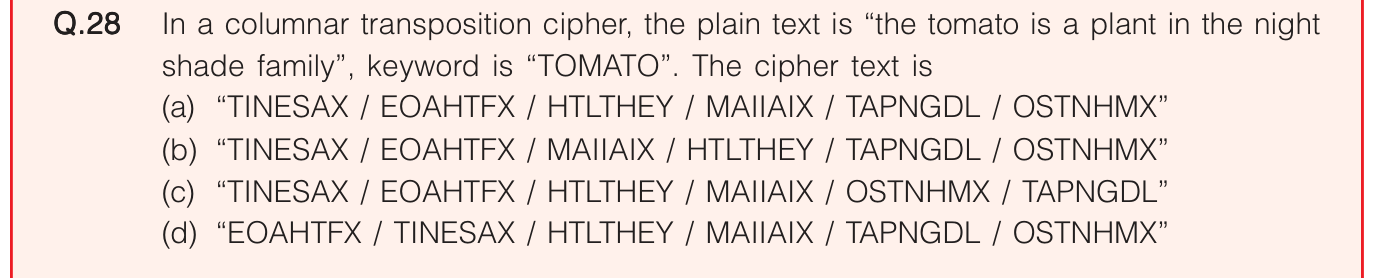
Figure for question 28, ISRO Computer Science (CSE) 2020

  • A. Option A
  • B. Option B
  • C. Option C
  • D. Option D

Answer: A. Option A

Question 29

ISRO Scientist/Engineer CS 2020, Question 29: see the question image.

Figure for question 29, ISRO Computer Science (CSE) 2020

  • A. Option A
  • B. Option B
  • C. Option C
  • D. Option D

Answer: B. Option B

Question 30

A magnetic disk has 100 cylinders, each with 10 tracks of 10 sectors. If each sector contains 128 Bytes, what is the maximum capacity of the disk in kilobytes?

  • A. 1,280,000
  • B. 1280
  • C. 1250
  • D. 128,000

Answer: B. 1280

Question 31

ISRO Scientist/Engineer CS 2020, Question 31: see the question image.

Figure for question 31, ISRO Computer Science (CSE) 2020

  • A. Option A
  • B. Option B
  • C. Option C
  • D. Option D

Answer: D. Option D

Question 32

ISRO Scientist/Engineer CS 2020, Question 32: see the question image.
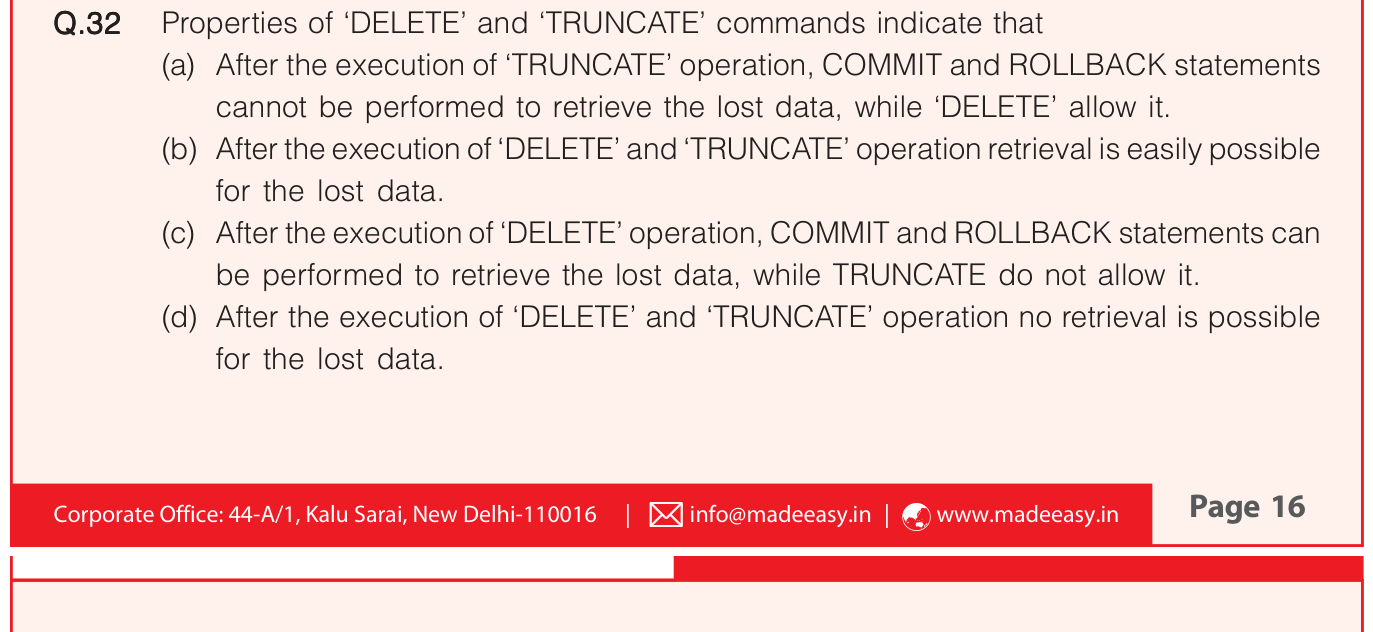
Figure for question 32, ISRO Computer Science (CSE) 2020

  • A. Option A
  • B. Option B
  • C. Option C
  • D. Option D

Answer: C. Option C

Question 33

ISRO Scientist/Engineer CS 2020, Question 33: see the question image.
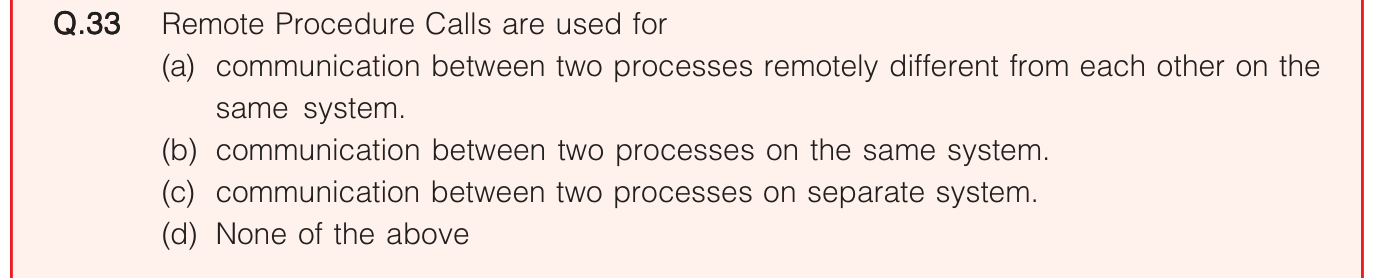
Figure for question 33, ISRO Computer Science (CSE) 2020

  • A. Option A
  • B. Option B
  • C. Option C
  • D. Option D

Answer: C. Option C

Question 34

Consider the following recursive C function that takes two arguments unsigned int rer (unsigned int n, unsigned int r) { if (n > 0) return (n% r + rer(n/r, r)); else return 0; } What is the return value of the function rer when it is called as rer (513, 2)?

  • A. 9
  • B. 8
  • C. 5
  • D. 2

Answer: D. 2

Question 35

ISRO Scientist/Engineer CS 2020, Question 35: see the question image.

Figure for question 35, ISRO Computer Science (CSE) 2020

  • A. Option A
  • B. Option B
  • C. Option C
  • D. Option D

Answer: C. Option C

Question 36

ISRO Scientist/Engineer CS 2020, Question 36: see the question image.
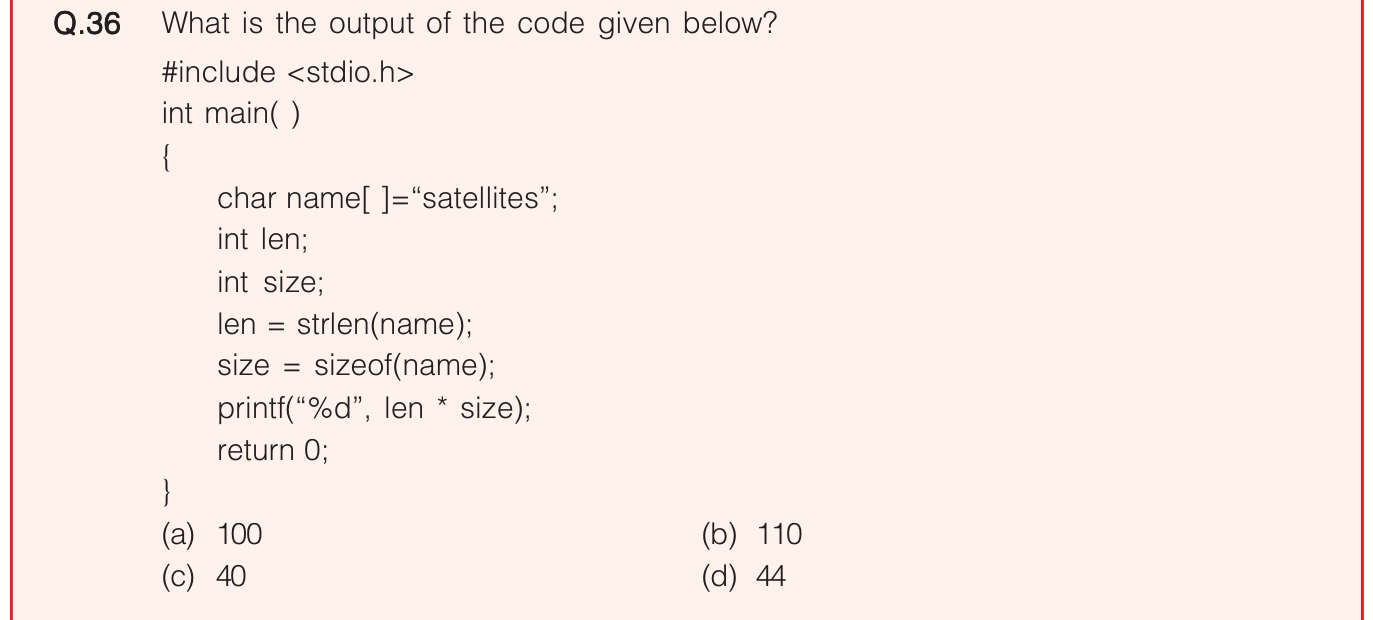
Figure for question 36, ISRO Computer Science (CSE) 2020

  • A. Option A
  • B. Option B
  • C. Option C
  • D. Option D

Answer: B. Option B

Question 37

ISRO Scientist/Engineer CS 2020, Question 37: see the question image.

Figure for question 37, ISRO Computer Science (CSE) 2020

  • A. Option A
  • B. Option B
  • C. Option C
  • D. Option D

Answer: B. Option B

Question 38

ISRO Scientist/Engineer CS 2020, Question 38: see the question image.

Figure for question 38, ISRO Computer Science (CSE) 2020

  • A. Option A
  • B. Option B
  • C. Option C
  • D. Option D

Answer: B. Option B

Question 39

ISRO Scientist/Engineer CS 2020, Question 39: see the question image.
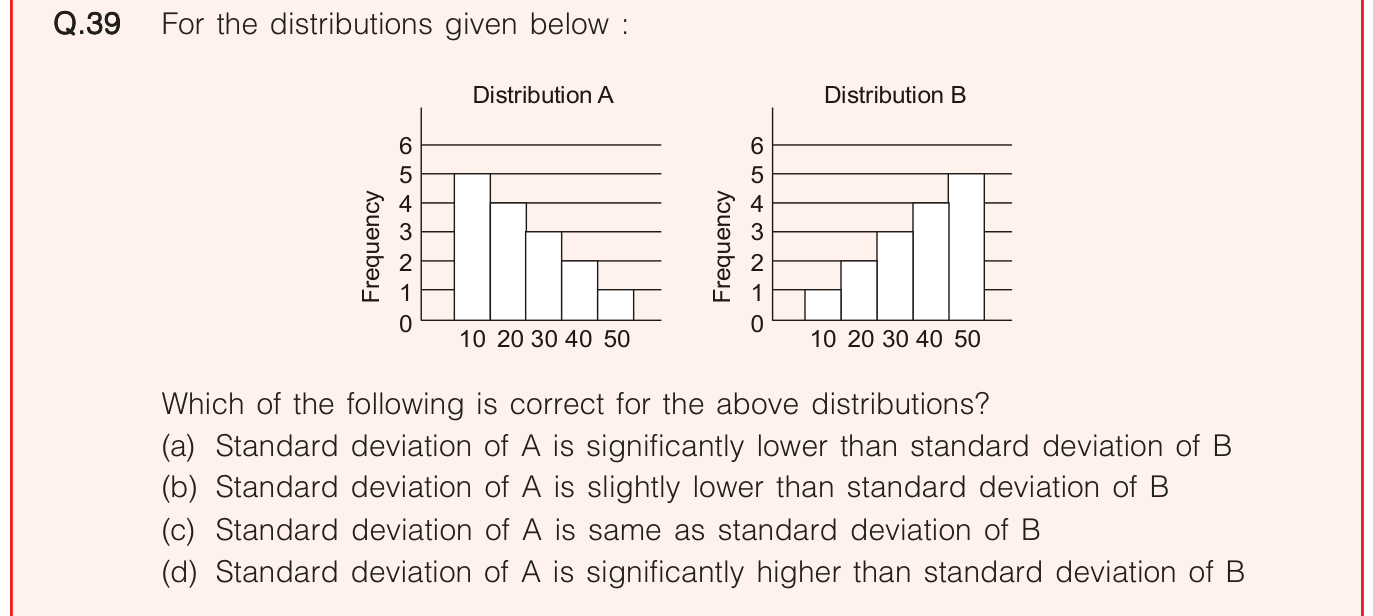
Figure for question 39, ISRO Computer Science (CSE) 2020

  • A. Option A
  • B. Option B
  • C. Option C
  • D. Option D

Answer: C. Option C

Question 40

The hardware implementation which provides mutual exclusion is

  • A. Semaphores
  • B. Test and set instruction
  • C. Both options
  • D. None of the options

Answer: C. Both options

Question 41

Which of the following algorithms defines time quantum?

  • A. shortest job scheduling algorithm
  • B. round robin scheduling algorithm
  • C. priority scheduling algorithm
  • D. multilevel queue scheduling algorithm

Answer: B. round robin scheduling algorithm

Question 42

ISRO Scientist/Engineer CS 2020, Question 42: see the question image.
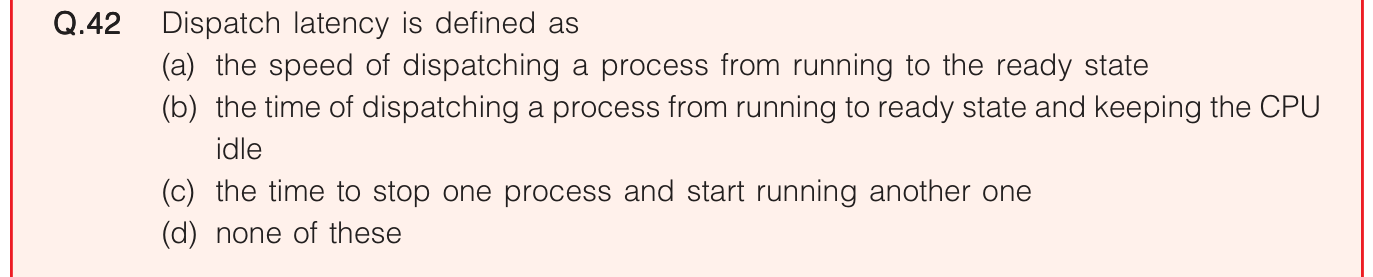
Figure for question 42, ISRO Computer Science (CSE) 2020

  • A. Option A
  • B. Option B
  • C. Option C
  • D. Option D

Answer: C. Option C

Question 43

An aid to determine the deadlock occurrence is

  • A. resource allocation graph
  • B. starvation graph
  • C. inversion graph
  • D. none of the above

Answer: A. resource allocation graph

Question 44

Consider the following page reference string. 1 2 3 4 2 1 5 6 2 1 2 3 7 6 3 2 1 2 3 6 What are the minimum number of frames required to get a single page fault for the above sequence assuming LRU replacement strategy?

  • A. 7
  • B. 4
  • C. 6
  • D. 5

Answer: C. 6

Question 45

ISRO Scientist/Engineer CS 2020, Question 45: see the question image.
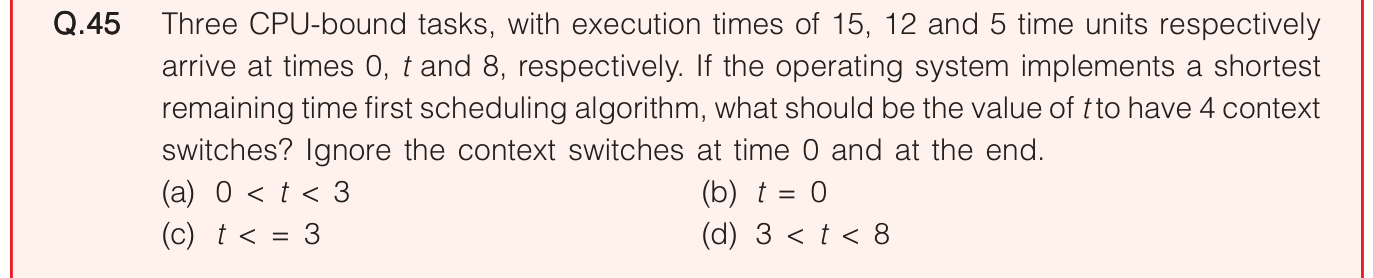
Figure for question 45, ISRO Computer Science (CSE) 2020

  • A. Option A
  • B. Option B
  • C. Option C
  • D. Option D

Answer: A. Option A

Question 46

The post-order traversal of a binary tree is ACEDBHIGF. The pre-order traversal is

  • A. ABCDEFGHI
  • B. FBADCEGIH
  • C. FABCDEGHI
  • D. ABDCEFGIH

Question 47

ISRO Scientist/Engineer CS 2020, Question 47: see the question image.

Figure for question 47, ISRO Computer Science (CSE) 2020

  • A. Option A
  • B. Option B
  • C. Option C
  • D. Option D

Answer: D. Option D

Question 48

ISRO Scientist/Engineer CS 2020, Question 48: see the question image.

Figure for question 48, ISRO Computer Science (CSE) 2020

  • A. Option A
  • B. Option B
  • C. Option C
  • D. Option D

Answer: C. Option C

Question 49

ISRO Scientist/Engineer CS 2020, Question 49: see the question image.
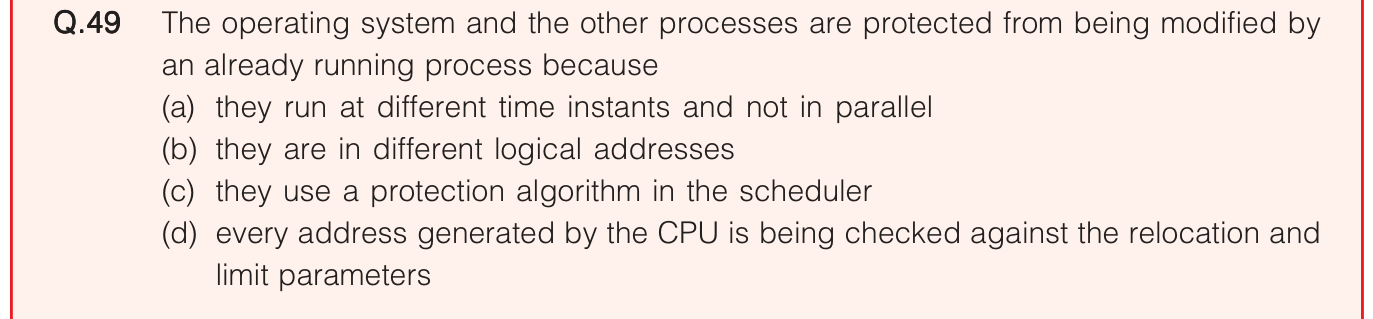
Figure for question 49, ISRO Computer Science (CSE) 2020

  • A. Option A
  • B. Option B
  • C. Option C
  • D. Option D

Answer: D. Option D

Question 50

ISRO Scientist/Engineer CS 2020, Question 50: see the question image.
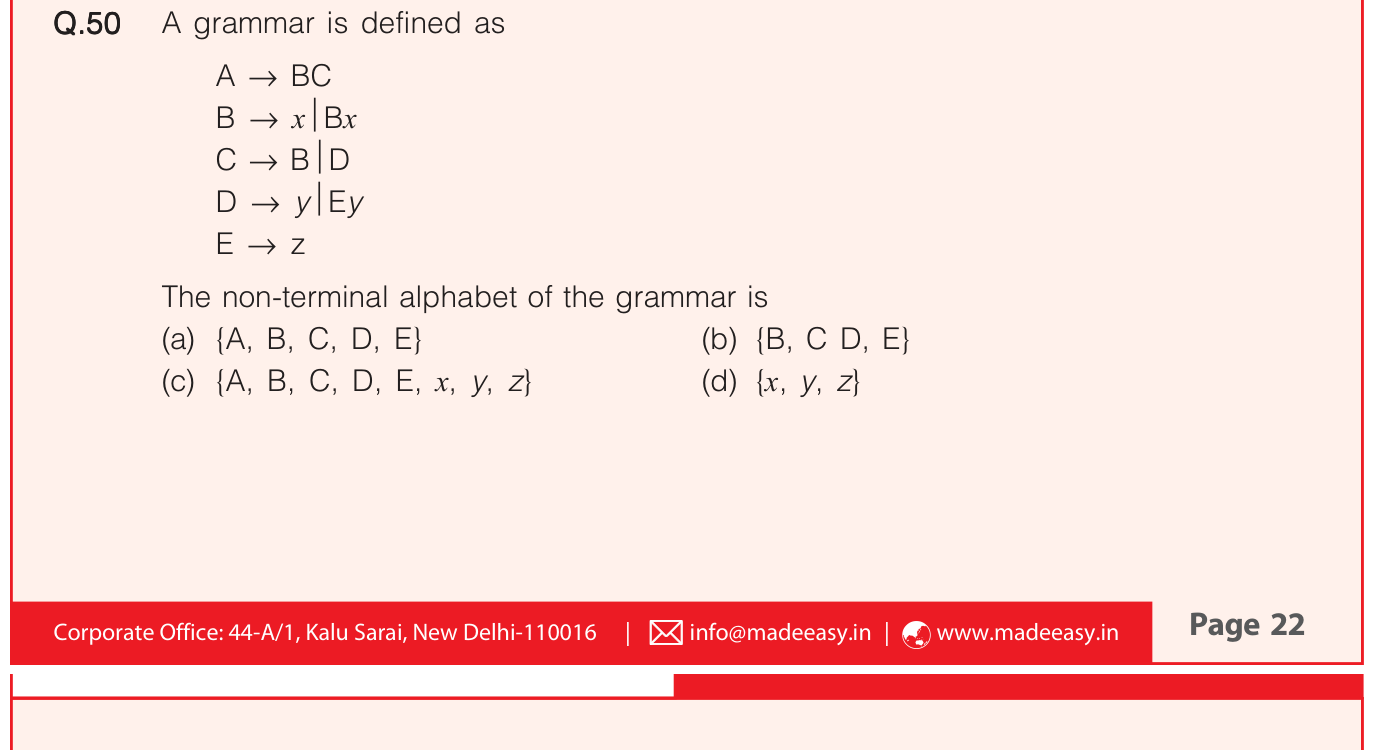
Figure for question 50, ISRO Computer Science (CSE) 2020

  • A. Option A
  • B. Option B
  • C. Option C
  • D. Option D

Answer: A. Option A

Question 51

ISRO Scientist/Engineer CS 2020, Question 51: see the question image.

Figure for question 51, ISRO Computer Science (CSE) 2020

  • A. Option A
  • B. Option B
  • C. Option C
  • D. Option D

Question 52

ISRO Scientist/Engineer CS 2020, Question 52: see the question image.
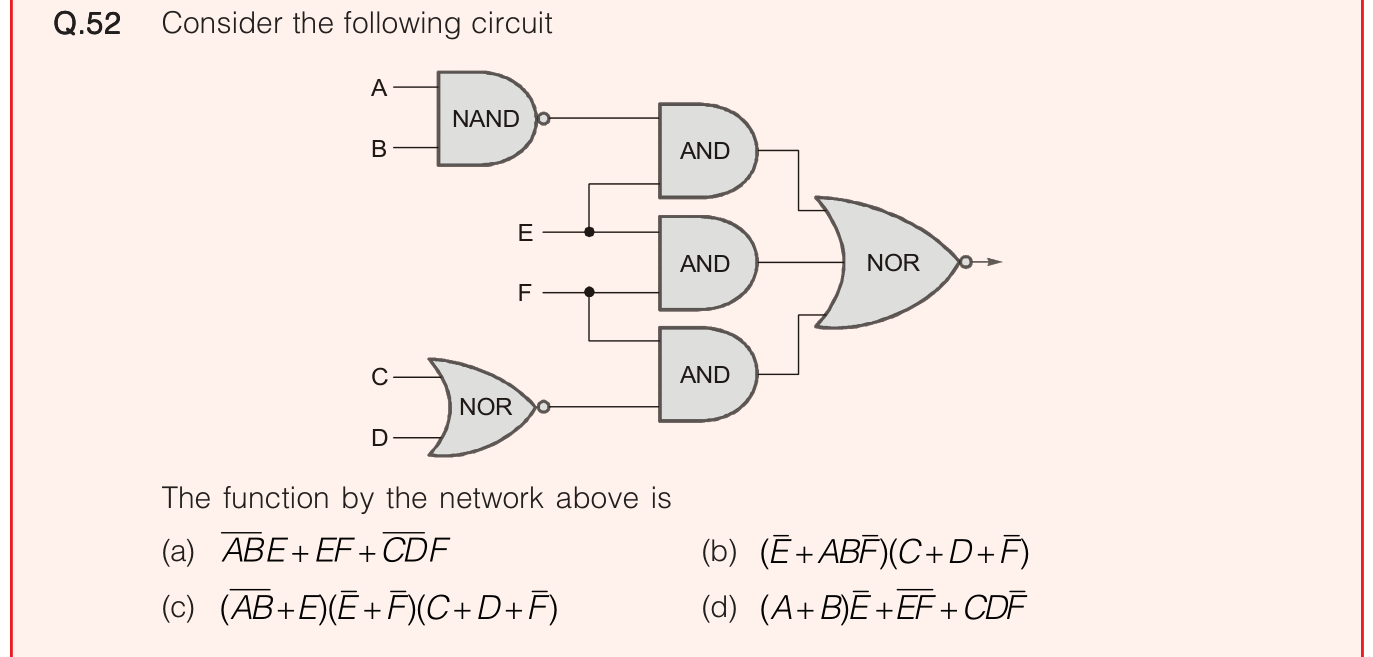
Figure for question 52, ISRO Computer Science (CSE) 2020

  • A. Option A
  • B. Option B
  • C. Option C
  • D. Option D

Answer: B. Option B

Question 53

ISRO Scientist/Engineer CS 2020, Question 53: see the question image.
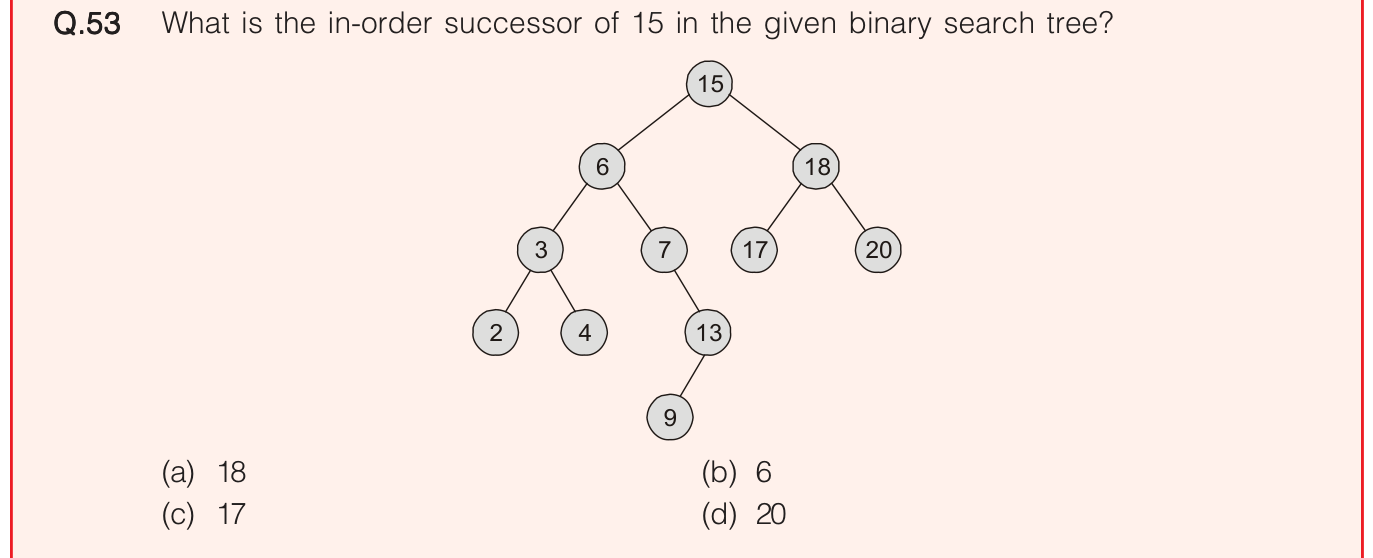
Figure for question 53, ISRO Computer Science (CSE) 2020

  • A. Option A
  • B. Option B
  • C. Option C
  • D. Option D

Answer: C. Option C

Question 54

ISRO Scientist/Engineer CS 2020, Question 54: see the question image.

Figure for question 54, ISRO Computer Science (CSE) 2020

  • A. Option A
  • B. Option B
  • C. Option C
  • D. Option D

Answer: C. Option C

Question 55

ISRO Scientist/Engineer CS 2020, Question 55: see the question image.

Figure for question 55, ISRO Computer Science (CSE) 2020

  • A. Option A
  • B. Option B
  • C. Option C
  • D. Option D

Answer: B. Option B

Question 56

ISRO Scientist/Engineer CS 2020, Question 56: see the question image.

Figure for question 56, ISRO Computer Science (CSE) 2020

  • A. Option A
  • B. Option B
  • C. Option C
  • D. Option D

Answer: B. Option B

Question 57

ISRO Scientist/Engineer CS 2020, Question 57: see the question image.
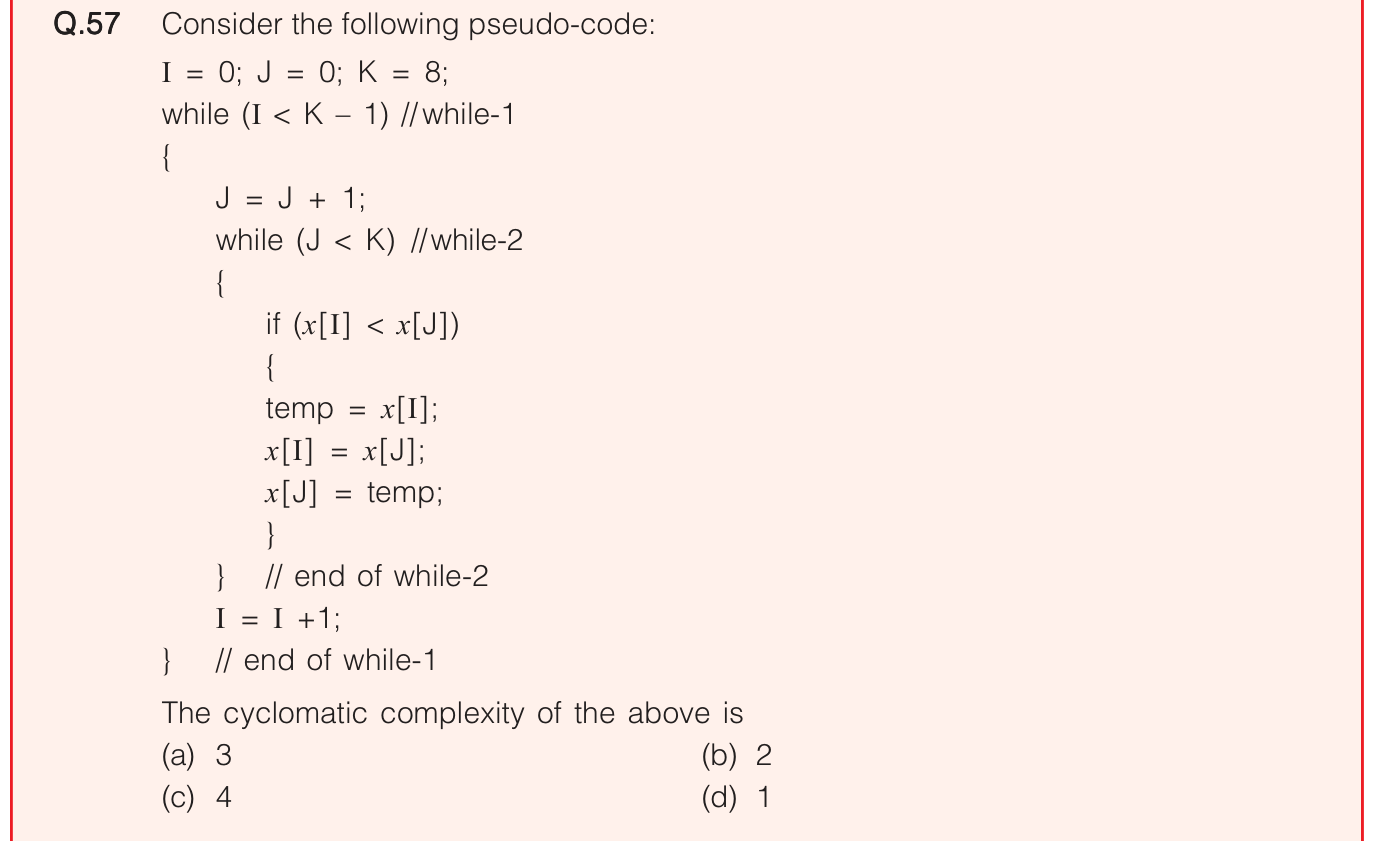
Figure for question 57, ISRO Computer Science (CSE) 2020

  • A. Option A
  • B. Option B
  • C. Option C
  • D. Option D

Answer: C. Option C

Question 58

ISRO Scientist/Engineer CS 2020, Question 58: see the question image.

Figure for question 58, ISRO Computer Science (CSE) 2020

  • A. Option A
  • B. Option B
  • C. Option C
  • D. Option D

Answer: B. Option B

Question 59

ISRO Scientist/Engineer CS 2020, Question 59: see the question image.
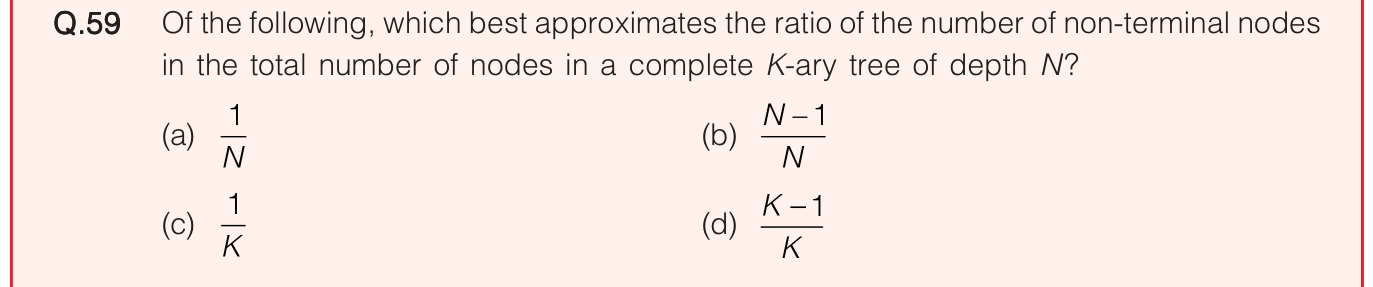
Figure for question 59, ISRO Computer Science (CSE) 2020

  • A. Option A
  • B. Option B
  • C. Option C
  • D. Option D

Answer: C. Option C

Question 60

ISRO Scientist/Engineer CS 2020, Question 60: see the question image.

Figure for question 60, ISRO Computer Science (CSE) 2020

  • A. Option A
  • B. Option B
  • C. Option C
  • D. Option D

Answer: A. Option A

Question 61

ISRO Scientist/Engineer CS 2020, Question 61: see the question image.
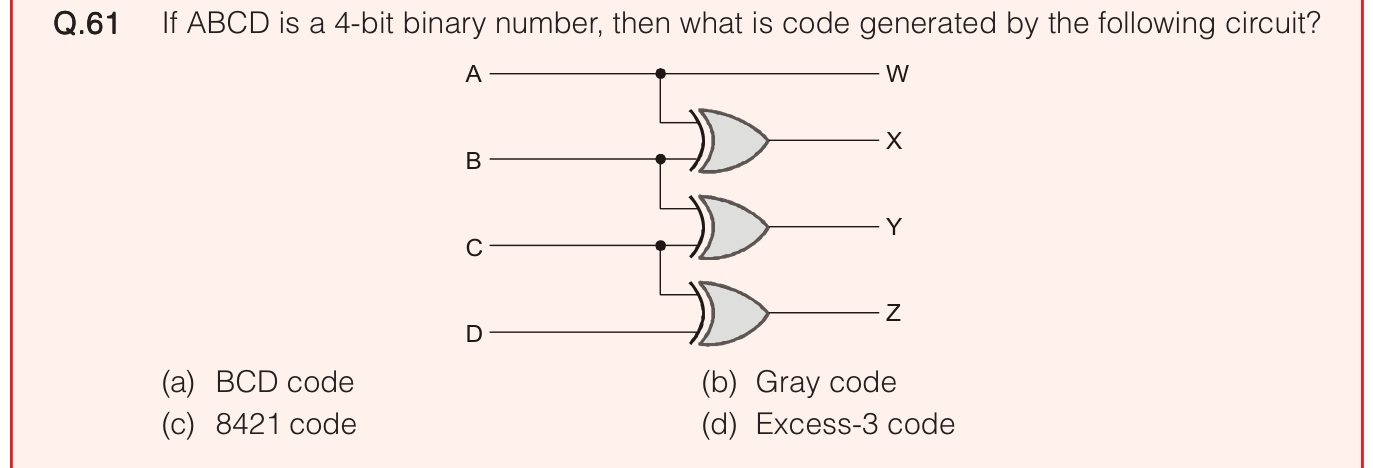
Figure for question 61, ISRO Computer Science (CSE) 2020

  • A. Option A
  • B. Option B
  • C. Option C
  • D. Option D

Answer: B. Option B

Question 62

ISRO Scientist/Engineer CS 2020, Question 62: see the question image.
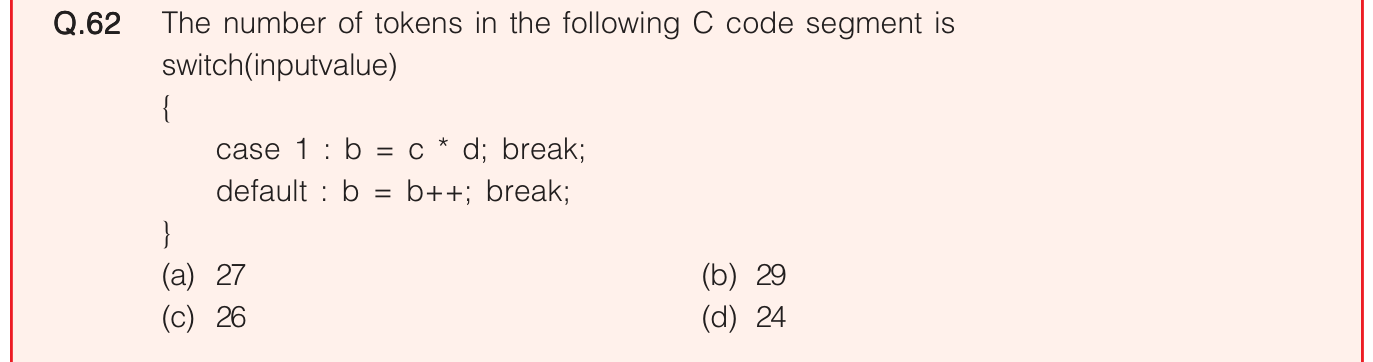
Figure for question 62, ISRO Computer Science (CSE) 2020

  • A. Option A
  • B. Option B
  • C. Option C
  • D. Option D

Answer: C. Option C

Question 63

ISRO Scientist/Engineer CS 2020, Question 63: see the question image.
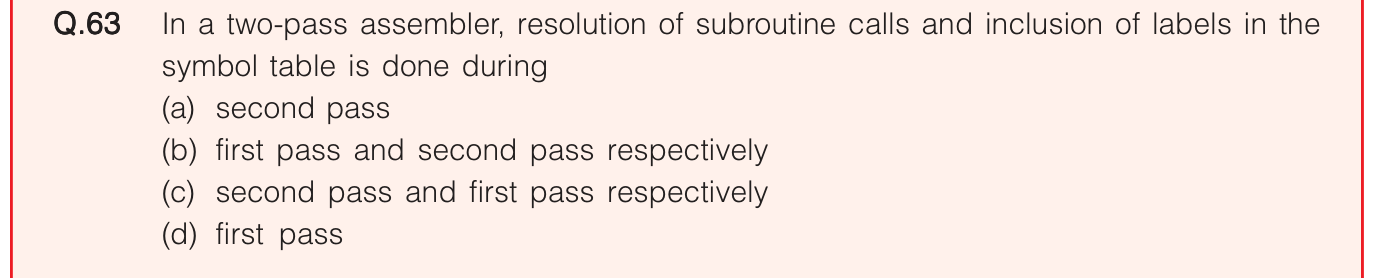
Figure for question 63, ISRO Computer Science (CSE) 2020

  • A. Option A
  • B. Option B
  • C. Option C
  • D. Option D

Answer: C. Option C

Question 64

One instruction tries to write an operand before it is written by previous instruction. This may lead to a dependency called

  • A. True dependency
  • B. Anti-dependency
  • C. Output dependency
  • D. Control hazard

Answer: C. Output dependency

Question 65

ISRO Scientist/Engineer CS 2020, Question 65: see the question image.

Figure for question 65, ISRO Computer Science (CSE) 2020

  • A. Option A
  • B. Option B
  • C. Option C
  • D. Option D

Answer: C. Option C

Question 66

ISRO Scientist/Engineer CS 2020, Question 66: see the question image.
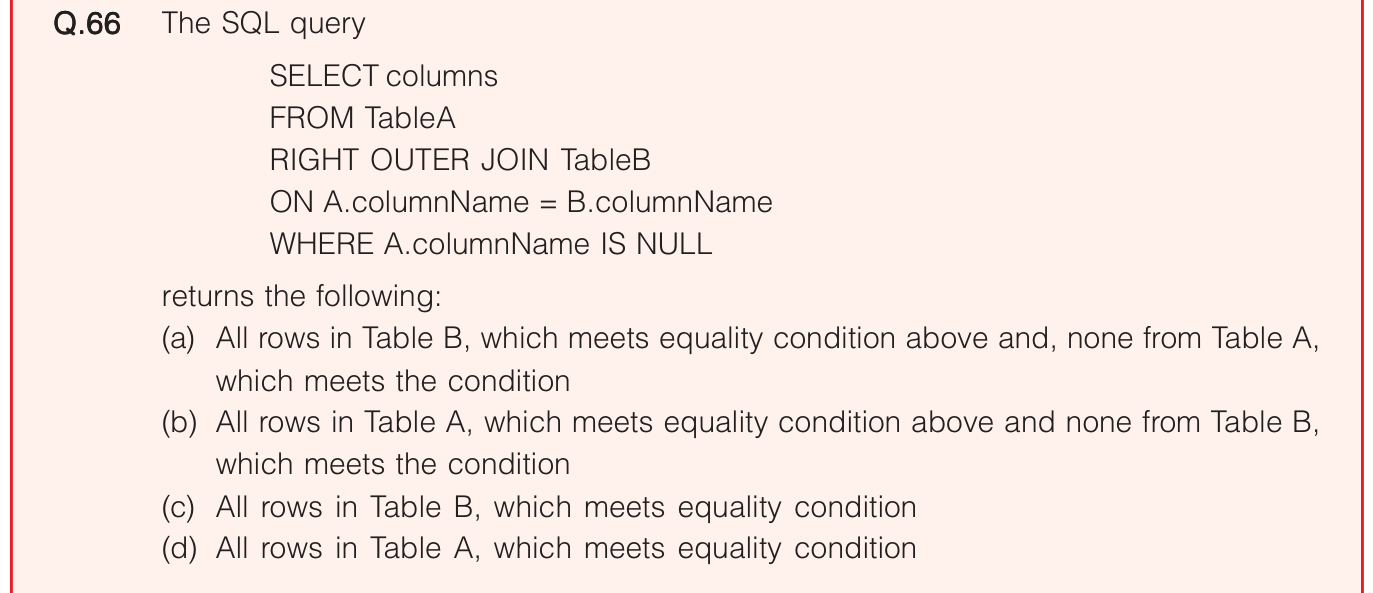
Figure for question 66, ISRO Computer Science (CSE) 2020

  • A. Option A
  • B. Option B
  • C. Option C
  • D. Option D

Question 67

To send same bit sequence, NRZ encoding require

  • A. Same clock frequency as Manchester encoding
  • B. Half the clock frequency as Manchester encoding
  • C. Twice the clock frequency as Manchester encoding
  • D. A clock frequency which depend on number of zeros and ones in the bit sequence

Answer: B. Half the clock frequency as Manchester encoding

Question 68

ISRO Scientist/Engineer CS 2020, Question 68: see the question image.

Figure for question 68, ISRO Computer Science (CSE) 2020

  • A. Option A
  • B. Option B
  • C. Option C
  • D. Option D

Answer: C. Option C

Question 69

ISRO Scientist/Engineer CS 2020, Question 69: see the question image.
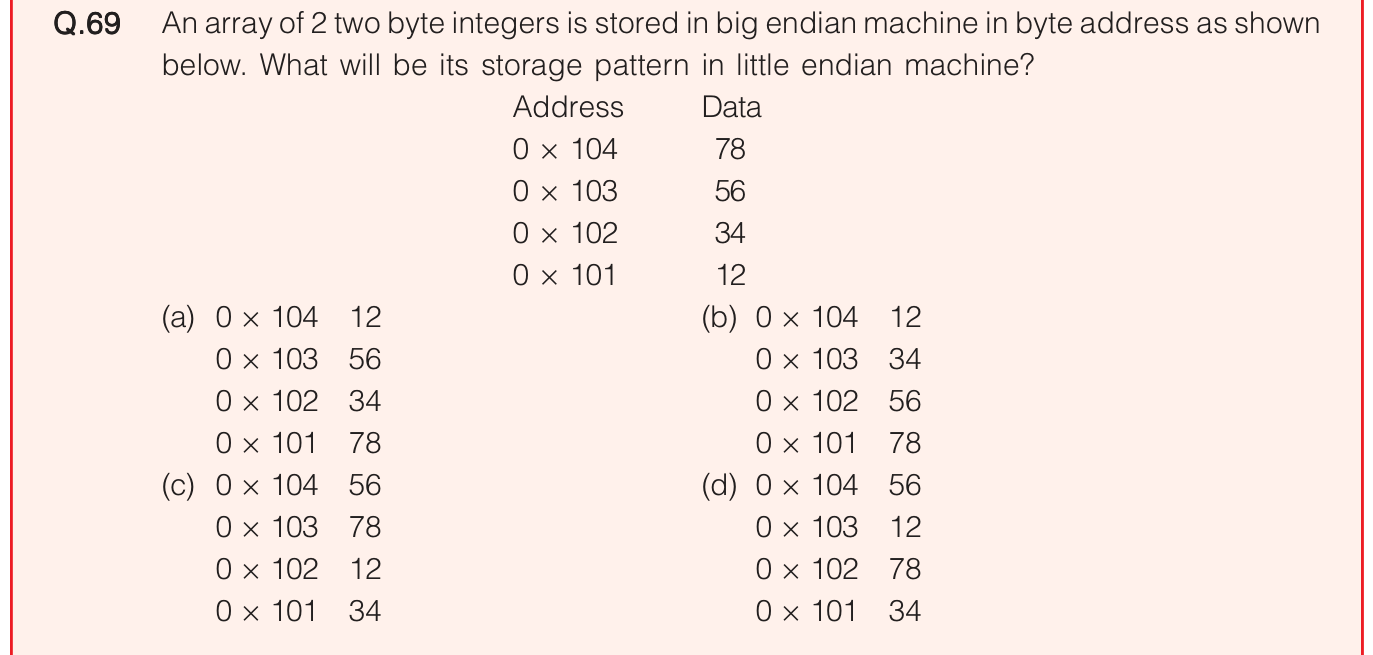
Figure for question 69, ISRO Computer Science (CSE) 2020

  • A. Option A
  • B. Option B
  • C. Option C
  • D. Option D

Answer: B. Option B

Question 70

A non-pipelined CPU has 12 general purpose registers (R0, R1, R2, ..... R12). Following operation are supported ADD Ra, Rb, Rr Add Ra to Rb and store the result in Rr MUL Ra, Rb, Rr Multiply Ra to Rb and store the result in Rr MUL operations takes two clock cycles, ADD takes one clock cycle. Calculate minimum number of clock cycles required to compute the value of the expression XY + XYZ + YZ. The variables X, Y, Z are initially available in registers R0, R1 and R2 and contents of these registers must not be modified.

  • A. 5
  • B. 6
  • C. 7
  • D. 8

Answer: B. 6

Question 71

ISRO Scientist/Engineer CS 2020, Question 71: see the question image.

Figure for question 71, ISRO Computer Science (CSE) 2020

  • A. Option A
  • B. Option B
  • C. Option C
  • D. Option D

Answer: B. Option B

Question 72

Which of the following is true?

  • A. Every subset of a regular set is regular
  • B. Every finite subset of non-regular set is regular
  • C. The union of two non-regular set is not regular
  • D. Infinite union of finite set is regular

Answer: B. Every finite subset of non-regular set is regular

Question 73

ISRO Scientist/Engineer CS 2020, Question 73: see the question image.
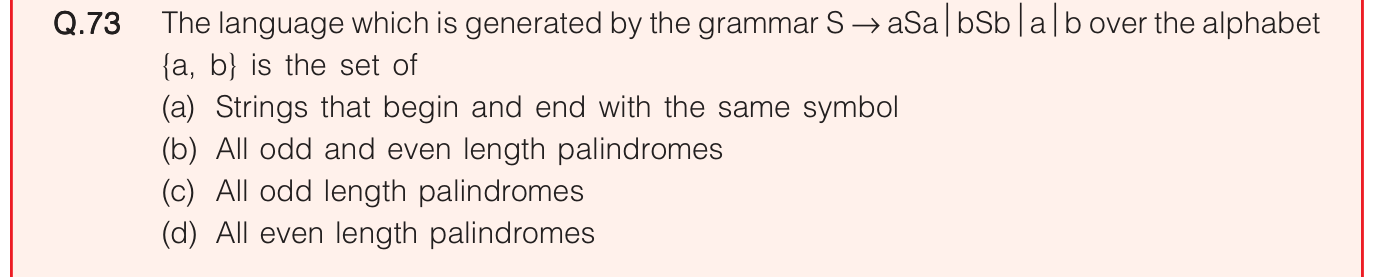
Figure for question 73, ISRO Computer Science (CSE) 2020

  • A. Option A
  • B. Option B
  • C. Option C
  • D. Option D

Answer: C. Option C

Question 74

ISRO Scientist/Engineer CS 2020, Question 74: see the question image.

Figure for question 74, ISRO Computer Science (CSE) 2020

  • A. Option A
  • B. Option B
  • C. Option C
  • D. Option D

Answer: A. Option A

Question 75

ISRO Scientist/Engineer CS 2020, Question 75: see the question image.

Figure for question 75, ISRO Computer Science (CSE) 2020

  • A. Option A
  • B. Option B
  • C. Option C
  • D. Option D

Answer: B. Option B

Question 76

ISRO Scientist/Engineer CS 2020, Question 76: see the question image.

Figure for question 76, ISRO Computer Science (CSE) 2020

  • A. Option A
  • B. Option B
  • C. Option C
  • D. Option D

Answer: A. Option A

Question 77

ISRO Scientist/Engineer CS 2020, Question 77: see the question image.

Figure for question 77, ISRO Computer Science (CSE) 2020

  • A. Option A
  • B. Option B
  • C. Option C
  • D. Option D

Answer: C. Option C

Question 78

ISRO Scientist/Engineer CS 2020, Question 78: see the question image.
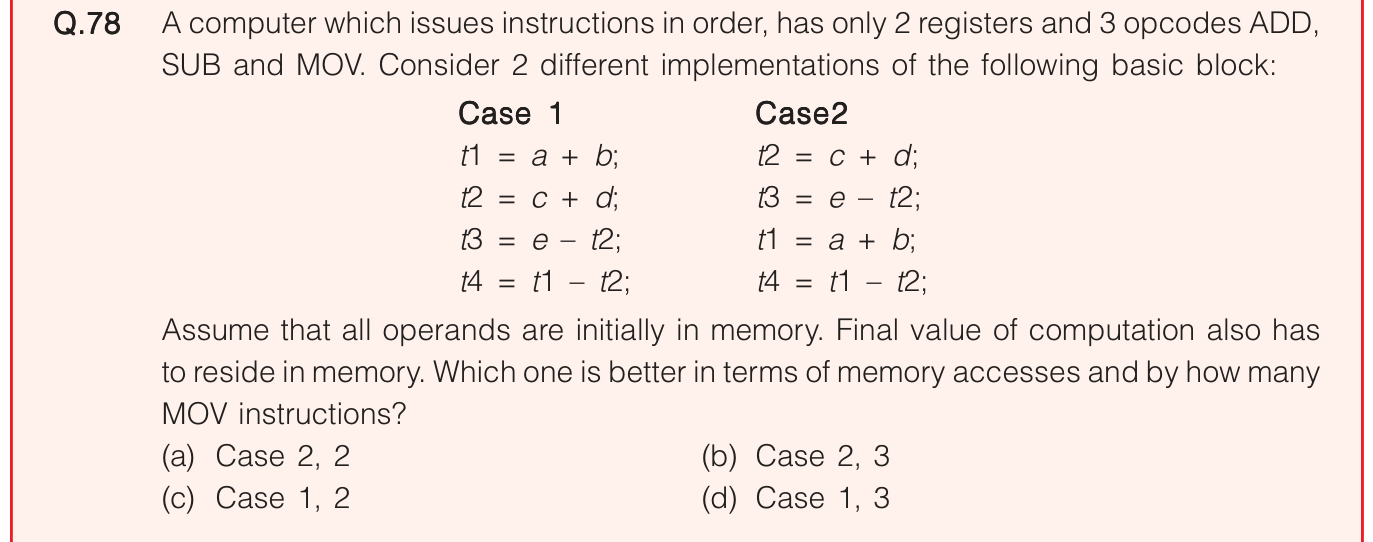
Figure for question 78, ISRO Computer Science (CSE) 2020

  • A. Option A
  • B. Option B
  • C. Option C
  • D. Option D

Answer: A. Option A

Question 79

ISRO Scientist/Engineer CS 2020, Question 79: see the question image.

Figure for question 79, ISRO Computer Science (CSE) 2020

  • A. Option A
  • B. Option B
  • C. Option C
  • D. Option D

Answer: B. Option B

Question 80

Consider a 2-dimensional array with 10 rows and 4 columns, with each element storing a value equivalent to the product of row number and column number. The array row- major format. If the first element x[0][0] occupies the memory location with address 1000 and each element occupies only one memory location, which all locations (in decimal) will be holding a value of 10?

  • A. 1018, 1019
  • B. 1022, 1041
  • C. 1013, 1014
  • D. 1000, 1399

Every question on its own page