Thermodynamics (XE-E) - GATE XE (Engineering Sciences) Subject-Wise PYQ Practice
Practice topic-wise Thermodynamics (XE-E) previous year questions for GATE XE (Engineering Sciences) with the official answer key. Step-by-step explanations are coming soon.
All GATE XE (Engineering Sciences) papers
292 questions. Answers are shown only where the official answer key is available.
Question 1
Year: 2025 | Marks: 1
A tank is divided into two compartments with one compartment containing a gas at a given pressure, while the second is completely evacuated. If the partition is removed, the gas occupies the entire compartment. Which one of the following statements is CORRECT?
- A. Work done is equal to the area under the curve of a p V − diagram
- B. Expansion of gas is not restrained by external force
- C. The entire process is reversible
- D. The overall change in volume is zero for the entire system
Answer: B. Expansion of gas is not restrained by external force
Question 2
Year: 2025 | Marks: 1
A cylinder of volume 0.1 m3 is filled with nitrogen at 10 MPa and 300 K. Consider nitrogen to be an ideal gas. The cylinder develops a leak and nitrogen escapes to atmosphere which is at 0.1 MPa. After sometime, the pressure in the cylinder reduces to 5 MPa. Assuming the cylinder and the leaked gas temperature remains constant at 300 K, the work done (in MJ) by nitrogen gas is
Answer: C. 0.5
Question 3
Year: 2025 | Marks: 1
A closed system undergoes a process 1–2 in which it absorbs 150 kJ of energy as heat and does 90 kJ of work. Then it follows another process 2–3 in which 80 kJ of work is done on it while it rejects 60 kJ as heat. If it is desired to restore the system to the initial state (state 1) by an adiabatic path, the work interaction (in kJ) in this process will be
Answer: A. 80
Question 4
Year: 2025 | Marks: 1
The inlet and outlet temperatures of the flowing fluid during a steady state flow process are the same as that of the surroundings. If the changes in kinetic and potential energies are neglected, the maximum power that can be obtained is equal to
- A. the rate of increase in enthalpy of the flowing fluid
- B. the rate of decrease in Helmholtz energy of the flowing fluid
- C. the rate of decrease in Gibbs free energy of the flowing fluid
- D. the rate of decrease in internal energy of the flowing fluid
Answer: C. the rate of decrease in Gibbs free energy of the flowing fluid
Question 5
Year: 2025 | Marks: 1
If 𝛾 refers to the ratio of specific heats, the air-standard efficiency of an Otto cycle is
- A. 1 − 1 (Compression ratio)𝛾
- B. 1 − 1 (Pressure ratio) (𝛾−1 𝛾)
- C. 1 − 1 (Compression ratio)(𝛾−1)
- D. 1 − 1 (Pressure ratio)(𝛾−1)
Answer: C. 1 − 1 (Compression ratio)(𝛾−1)
Question 6
Year: 2025 | Marks: 1
Let 𝑇𝐻 and 𝑇𝐿 denote the absolute temperatures of high and low temperature reservoirs, respectively. The coefficient of performance of a reversible refrigerator operating between these two reservoirs is
- A. 1 𝑇𝐻 𝑇𝐿−1
- B. 1 1 −𝑇𝐻 𝑇𝐿
- C. 1 𝑇𝐿 𝑇𝐻−1
- D. 1 𝑇𝐿 𝑇𝐻+ 1
Answer: A. 1 𝑇𝐻 𝑇𝐿−1
Question 7
Year: 2025 | Type: NAT | Marks: 1
A tank of 4 m3 contains an ideal gas mixture of 60% hydrogen and 40% nitrogen by volume at 100 kPa and 300 K. Nitrogen is added to the tank such that the composition changes to 50% nitrogen by volume, with a final temperature of 300 K. The amount of nitrogen (in kmol) to be added is ___________ (rounded off to three decimal places). Use: Universal gas constant (Ru) = 8.314 kJ/kmol-K
Answer: 0.030 to 0.034
Question 8
Year: 2025 | Type: NAT | Marks: 1
A heat engine having thermal efficiency of 40% receives heat from a source at 600 K and rejects heat to a sink at 300 K. The second-law efficiency (in %) of this engine is ___________ (answer in integer).
Answer: 80
Question 9
Year: 2025 | Type: NAT | Marks: 1
A rigid tank of 300 litre capacity contains 3 kg of oxygen (molar mass = 32 kg/kmol) at 25 °C. If oxygen behaves as an ideal gas, the pressure (in kPa) inside the tank is _______________ (rounded off to two decimal places). Use: Universal gas constant (Ru) = 8.314 kJ/kmol-K
Answer: 773 to 776
Question 10
Year: 2025 | Marks: 2
For an ideal gas turbine cycle, 𝑇1 and 𝑇3 are the compressor inlet temperature and turbine inlet temperature respectively. The ratio 𝑇3 𝑇1 is denoted by 𝑡 and the ratio of specific heats is denoted by 𝛾. For any given 𝑡, the optimum pressure ratio for the maximum specific work output is
- A. 𝑡 2 (𝛾−1)
- B. 𝑡 𝛾 2(𝛾−1)
- C. 𝑡 𝛾 (𝛾−1)
- D. 𝑡 𝛾−1 𝛾
Answer: B. 𝑡 𝛾 2(𝛾−1)
Question 11
Year: 2025 | Type: MSQ | Marks: 2
For a pure substance that expands on freezing, which of the following statement(s) is/are CORRECT?
- A. Temperature of the liquid phase can be lower than the temperature at the triple point
- B. Critical pressure is equal to the pressure at the triple point
- C. Highest pressure at which the vapour phase can exist is the pressure at the triple point
- D. Highest temperature at which solid-liquid phase change can happen is the temperature at the triple point
Answer: A. Temperature of the liquid phase can be lower than the temperature at the triple point; D. Highest temperature at which solid-liquid phase change can happen is the temperature at the triple point
Question 12
Year: 2025 | Type: MSQ | Marks: 2
Consider a gas obeying the relation ( ) P v b RT − = , where b and R are constants. Which of the following statement(s) is/are CORRECT about the specific heat capacity at constant pressure?
- A. It is independent of temperature
- B. It is a function of pressure
- C. It is a function of temperature
- D. It is independent of both specific volume and pressure
Answer: C. It is a function of temperature; D. It is independent of both specific volume and pressure
Question 13
Year: 2025 | Type: NAT | Marks: 2
A piston-cylinder arrangement contains an ideal gas mixture of 4 kg of hydrogen and 13 kg of nitrogen at 250 K and atmospheric pressure. On heat addition, the mixture expands at constant pressure until the temperature rises to 350 K. The average isobaric specific heats (𝑐𝑝) for hydrogen and nitrogen are 14.239 kJ/kg-K and 1.040 kJ/kg-K, respectively. The amount of heat (in MJ) added to the cylinder is _________________ (rounded off to three decimal places).
Answer: 6.9 to 7.2
Question 14
Year: 2025 | Type: NAT | Marks: 2
Air in an ideal Diesel cycle is compressed from 3 litre to 0.15 litre. It then expands during a constant pressure heat addition process to 0.3 litre. If the ratio of specific heats, γ = 1.4, the thermal efficiency (in %) of the cycle is ___________ (rounded to one decimal place).
Answer: 63 to 66
Question 15
Year: 2025 | Type: NAT | Marks: 2
Air at 101 kPa, 15 °C and 50% relative humidity is first heated to 20 °C in a heating coil, and then humidified by spraying water on it. In the final state, the air has temperature of 25 °C and relative humidity of 85%. The amount of water sprayed (in gm per kg of dry air) is _______________ (rounded off to two decimal places). Use the following data: The saturation pressure of water at 15 °C = 1.7057 kPa The saturation pressure of water at 25 °C = 3.1698 kPa
Answer: 11.5 to 12.0
Question 16
Year: 2025 | Type: NAT | Marks: 2
A stream of superheated steam (2 MPa, 300 °C) mixes with another stream of superheated steam (2 MPa, 400 °C) through a steady-state adiabatic process. The flow rates of the streams are 3 kg/min and 2 kg/min, respectively. This mixture then expands in an adiabatic nozzle to a saturated mixture with quality of 0.77 and 1 kPa. Neglect the velocity at the nozzle entrance and the change in potential energies. The velocity at the nozzle exit (in m/s) is ___________ (rounded off to two decimal places). Use the following data: At 2 MPa, 300 °C: Specific enthalpy of superheated steam = 3024.2 kJ/kg At 2 MPa, 400 °C: Specific enthalpy of superheated steam = 3248.4 kJ/kg At 1 kPa: Specific enthalpy of saturated water = 29.3 kJ/kg At 1 kPa: Specific enthalpy of saturated vapour = 2513.7 kJ/kg
Answer: 1515 to 1545
Question 17
Year: 2025 | Type: NAT | Marks: 2
A piston-cylinder assembly having 250 mm diameter contains 0.01 kg of water vapor at 1 MPa and 200 °C. The specific volume of the vapor is 0.20602 m3/kg. The system expands as per the relation 𝑝𝑉𝑛 = constant, where p is pressure and V is volume. The expansion of water vapour displaces the piston by 50 mm. If the final pressure is 0.35 MPa, the value of the exponent (𝑛) is __________ (rounded off to two decimal places).
Answer: 1.30 to 1.38
Question 18
Year: 2025 | Type: NAT | Marks: 2
Air enters a hair dryer at 22 °C and 100 kPa with a velocity of 3.7 m/s, and leaves the dryer at 83 °C and 100 kPa with a velocity of 9.1 m/s. The exit area of the dryer is 18.7 cm2, and the ambient temperature is 22 °C. The air is an ideal gas with gas constant 𝑅 = 0.287 kJ/kg-K and isobaric specific heat 𝑐𝑝 = 1.005 kJ/kg-K. If the change in potential energy is neglected, the second law efficiency (in %) of the dryer is __________ (rounded off to one decimal place).
Answer: 8.9 to 9.4
Question 19
Year: 2025 | Type: NAT | Marks: 2
A steam boiler contains saturated water vapour at 200 °C. After a certain period, the temperature of the boiler drops to 110 °C. Assume that all the valves of the boiler are closed and the energy is lost as heat to the surroundings. The ratio of mass of liquid to the mass of vapour is ___________ (rounded off to two decimal places). Saturated volume of vapour phase at 200 °C = 0.127 m3/kg Saturated volume of vapour phase at 110 °C = 1.210 m3/kg Saturated volume of liquid phase at 110 °C = 0.001 m3/kg
Answer: 8.1 to 8.9
Question 20
Year: 2025 | Type: NAT | Marks: 2
Two Carnot heat engines (E1 and E2) are operating in series as shown in figure. Engine E1 receives heat from a reservoir at 𝑇𝐻 = 1600 K and does work W1. Engine E2 receives heat from an intermediate reservoir at T, does work W2 and rejects the rest to a reservoir at 𝑇𝐿 = 400 K. Both the engines have identical thermal efficiencies. The temperature T (in K) of the intermediate reservoir is __________ (answer in integer). T = ? TH TL W1 W2 E1 E2
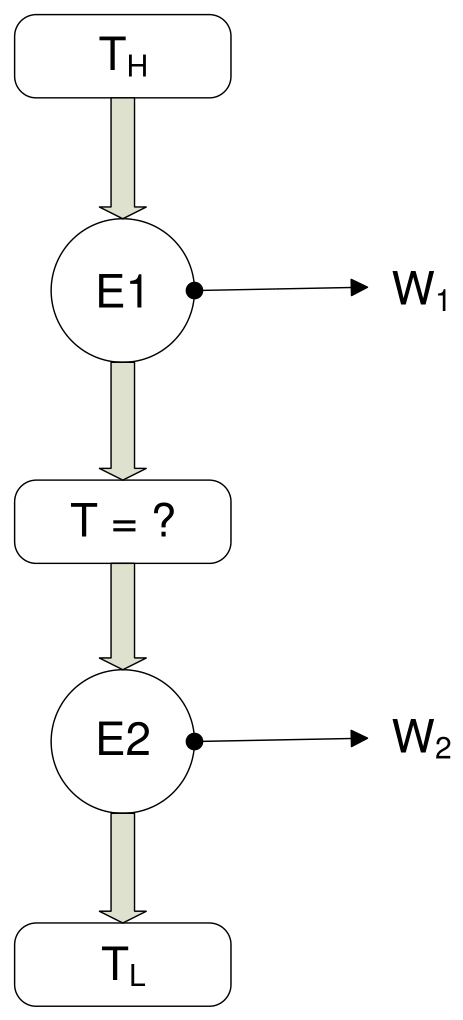
Answer: 800
Question 21
Year: 2025 | Type: NAT | Marks: 2
A particular temperature scale is obtained according to the relation: t ae b α = + where a and b are constants, and t is in °C. The thermometric property as measured by the thermometer is α. The values of α at ice point and steam point are 6 and 9, respectively. The temperature (in °C) which gives α = 7 is __________ (rounded off to two decimal places).
Answer: 8.9 to 9.1
Question 22
Year: 2025 | Type: NAT | Marks: 2
In a piston cylinder assembly, one kmol of an ideal gas is compressed from an initial state of 200 kPa and 400 K to a final state of 1 MPa and 400 K. If the surroundings are at 400 K, the minimum amount of work (in kJ/kmol) required for the compression process is ______________ (rounded off to two decimal places). Use: Universal gas constant (Ru) = 8.314 kJ/kmol-K
Answer: 5300 to 5400
Question 23
Year: 2024 | Marks: 1
A heat source at temperature 𝑇𝐻 transfers the same amount of heat to a sink under the following situations: Case A: Sink is at temperature 𝑇𝐿,1 Case B: Sink is at temperature 𝑇𝐿,2 If 𝑇𝐿,1 <𝑇𝐿,2, which one of the following statements is TRUE?
- A. The reversibility is the same, and the entropy generation is greater than zero for Cases A and B
- B. Case B is less reversible with the entropy generation greater than zero
- C. Case B is more reversible with the entropy generation greater than zero
- D. Case B is more reversible with the entropy generation equal to zero
Answer: C. Case B is more reversible with the entropy generation greater than zero
Question 24
Year: 2024 | Marks: 1
Given 𝑣 is the molar specific volume, 𝑃 is the pressure, 𝑇 is the temperature, 𝑅 is the Universal gas constant, and 𝑎, 𝑏 are van der Waal’s constants. The van der Waal’s equation of state is 𝑃= 𝑅𝑇 𝑣−𝑏−𝑎 𝑣2 The value of ( 𝜕𝑣 𝜕𝑇) 𝑃( 𝜕𝑃 𝜕𝑣) 𝑇( 𝜕𝑇 𝜕𝑃) 𝑣 is
Answer: B. −1
Question 25
Year: 2024 | Marks: 1
The temperature of 10g of liquid water (𝑐𝑝= 4.2J/g.K) in an insulated container is raised by 5K by stirring. The amount of heat transferred to the water (in J) is
Answer: C. 0
Question 26
Year: 2024 | Marks: 1
The figure shows four different processes labeled 1, 2, 3, and 4 for the same closed system containing an ideal gas. The curves labeled 𝑇1, 𝑇2, and 𝑇3 are isotherms. For which one of the these four processes, the magnitude of internal energy change is the highest?
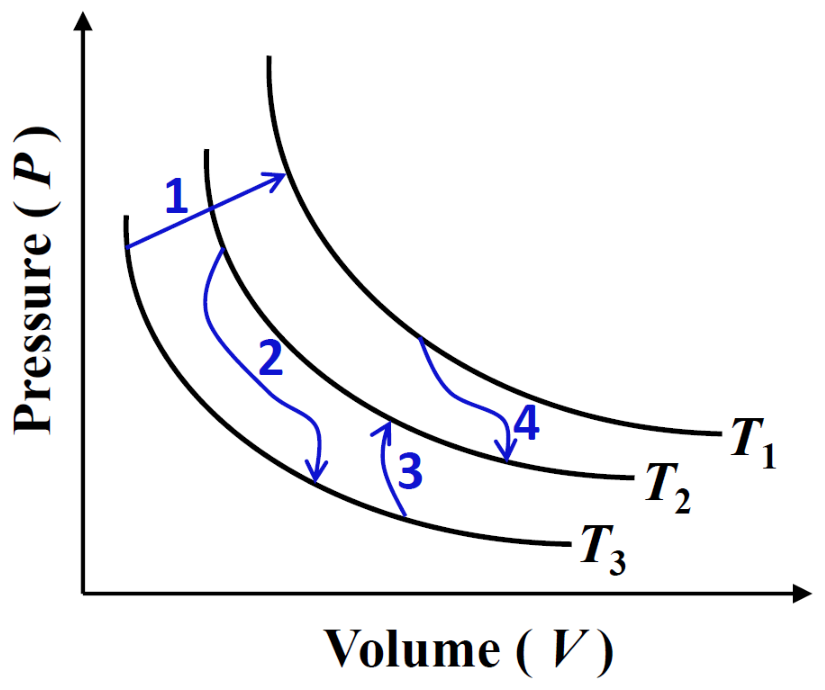
- A. Process 1
- B. Process 2
- C. Process 3
- D. Process 4
Answer: A. Process 1
Question 27
Year: 2024 | Marks: 1
A power plant operates on a simple ideal Rankine cycle. If superheating is added to this cycle, then which one of the following options is CORRECT ?
- A. Pump work increases, turbine work output increases, cycle efficiency increases, and moisture content at turbine exit increases
- B. Pump work remains same, turbine work output increases, cycle efficiency increases, and moisture content at turbine exit increases
- C. Pump work remains same, turbine work output increases, cycle efficiency increases, and moisture content at turbine exit decreases
- D. Pump work decreases, turbine work output increases, cycle efficiency increases, and moisture content at turbine exit decreases
Answer: C. Pump work remains same, turbine work output increases, cycle efficiency increases, and moisture content at turbine exit decreases
Question 28
Year: 2024 | Type: MSQ | Marks: 1
Consider a mixture of ideal gases with total pressure, volume, and temperature as 𝑃, 𝑉, and 𝑇, respectively. The partial pressure, number of moles, and temperature of each component “𝑖” of the mixture are 𝑃𝑖 , 𝑁𝑖 , and 𝑇𝑖 , respectively. Which of the following statements is/are TRUE ?
- A. 𝑇= ∑𝑇𝑖 𝑖
- B. 𝑃= ∑𝑃𝑖 𝑖
- C. 𝑉= ∑𝑁𝑖𝑅𝑇 𝑃 𝑖
- D. 𝑉= ∑𝑁𝑖𝑅𝑇 𝑃𝑖 𝑖
Answer: A. 𝑇= ∑𝑇𝑖 𝑖
Question 29
Year: 2024 | Type: MSQ | Marks: 1
Two rigid, impermeable containers 𝐴 and 𝐵 are filled with an ideal gas. They are allowed to exchange heat only with each other and not with the surroundings. 𝑃, 𝑉, 𝑁, and 𝑇 represent the pressure, total volume, number of moles, and temperature, respectively. At equilibrium, which of the following conditions is/are necessarily satisfied? (Subscripts 𝐴 and 𝐵 represent properties of the gas in the respective containers.)
- A. 𝑃𝐴= 𝑃𝐵
- B. 𝑇𝐴= 𝑇𝐵
- C. 𝑃𝐴𝑉𝐴 𝑁𝐴 = 𝑃𝐵𝑉𝐵 𝑁𝐵
- D. 𝑃𝐴 𝑉𝐴 = 𝑃𝐵 𝑉𝐵
Answer: B. 𝑇𝐴= 𝑇𝐵; C. 𝑃𝐴𝑉𝐴 𝑁𝐴 = 𝑃𝐵𝑉𝐵 𝑁𝐵
Question 30
Year: 2024 | Type: NAT | Marks: 1
Following data is for an actual vapour compression refrigeration cycle. Enthalpy at compressor inlet: 246kJ/kg Enthalpy at compressor exit: 286kJ/kg Heat load on the evaporator: 158kJ/kg The enthalpy at the exit of the condenser in kJ/kg is ________ (rounded off to the nearest integer).
Answer: 88
Question 31
Year: 2024 | Type: NAT | Marks: 1
A rigid tank, initially at 1bar and300K, contains 5moles of 𝑂2, 4moles of 𝑁2 , and 3moles of 𝐻2 . From this tank, 2moles of 𝑂2 are removed keeping the temperature constant. Assuming ideal gas behaviour, the final partial pressure of 𝑂2 (in bar) inside the tank is _______ (rounded off to three decimal places). Use 𝑅 = 8.314J/mol.K Molecular weights of 𝐻2, 𝑁2 and 𝑂2 are 2g/mol, 28g/mol, and 32g/mol respectively.
Answer: 0.249 to 0.251
Question 32
Year: 2024 | Marks: 2
A fixed mass of an ideal gas undergoes two different cycles M and N as shown in the Pressure (𝑃) – Volume (𝑉) diagrams. Based on the information provided, which one of the following statements is always TRUE ?
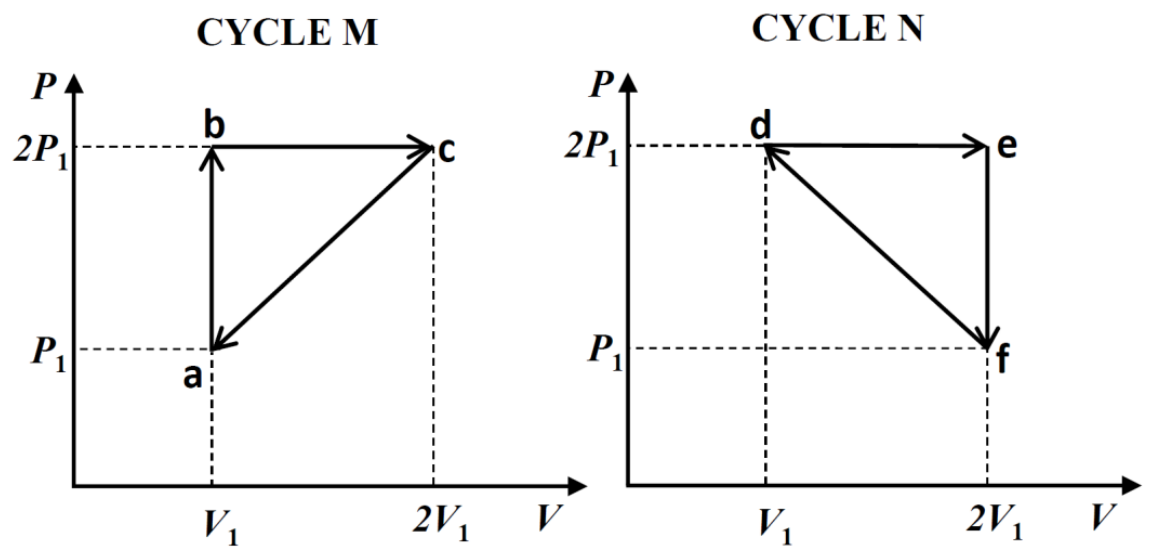
- A. Heat input in Cycle M is equal to heat input in Cycle N
- B. Heat rejected in Cycle M is equal to heat rejected in Cycle N
- C. Net heat transfer in Cycle M is equal to net heat transfer in Cycle N
- D. Thermal efficiency of Cycle M is equal to thermal efficiency of Cycle N
Answer: C. Net heat transfer in Cycle M is equal to net heat transfer in Cycle N
Question 33
Year: 2024 | Marks: 2
In a graph with Helmholtz function on the 𝑦–axis and volume on the 𝑥–axis, the slope of the isothermal curves for a finite volume system containing an ideal gas is
- A. always zero
- B. infinite
- C. finite, positive, and non-zero
- D. finite, negative, and non-zero
Answer: D. finite, negative, and non-zero
Question 34
Year: 2024 | Marks: 2
Match each quantity in Column M with the appropriate relation from Column N. Here, 𝜓 is Helmholtz function, 𝑃 is pressure, 𝑣 is specific volume, 𝑇 is temperature, ℎ is specific enthalpy, and 𝑠 is specific entropy. Column M Column N (M1)𝑣 (M2)𝑃 (M3)𝑠 (M4)𝑇 (N1)−𝜕𝜓 𝜕𝑣| 𝑇 (N2) 𝜕𝜓 𝜕𝑣| 𝑇 (N3) 𝜕𝜓 𝜕𝑇| 𝑣 (N4)− 𝜕𝜓 𝜕𝑇| 𝑣 (N5)𝜕ℎ 𝜕𝑃| 𝑠 (N6)− 𝜕ℎ 𝜕𝑠| 𝑃 (N7) − 𝜕ℎ 𝜕𝑃| 𝑠 (N8) 𝜕ℎ 𝜕𝑠| 𝑃
- A. M1-N5, M2-N1, M3-N4, M4-N7
- B. M1-N6, M2-N2, M3-N3, M4-N8
- C. M1-N5, M2-N1, M3-N4, M4-N8
- D. M1-N8, M2-N1, M3-N4, M4-N5
Answer: C. M1-N5, M2-N1, M3-N4, M4-N8
Question 35
Year: 2024 | Marks: 2
10kg of water at 300K is poured into a bucket containing 10kg of water at 350K. Heat capacity of water is 4.2kJ/kg.K . Neglecting any heat losses to the surroundings, the change in the entropy (in kJ/K) of the system during this process (rounded off to two decimal places) is
- A. 0.00
- B. 0.25
- C. 0.50
- D. 0.75
Answer: B. 0.25
Question 36
Year: 2024 | Marks: 2
A Carnot engine operates between two temperatures T1 and T2 such that T1 > T2. If the thermal efficiency of the engine is to be increased by changing one of the temperatures by a constant amount ∆T > 0, which one of the following cases will give the highest increase in efficiency?
- A. Increasing T1 by ∆T while keeping T2 constant
- B. Decreasing T1 by ∆T while keeping T2 constant
- C. Increasing T2 by ∆T while keeping T1 constant
- D. Decreasing T2 by ∆T while keeping T1 constant
Answer: D. Decreasing T2 by ∆T while keeping T1 constant
Question 37
Year: 2024 | Marks: 2
The equation of state for a non-ideal gas is 𝑃𝑣 𝑅𝑇= 1 + 𝐵𝑃 where 𝑃 is pressure, 𝑣 is specific volume, 𝑅 is the specific gas constant, 𝑇 is temperature, and 𝐵 is a temperature dependent parameter. For this gas, the partial derivative of enthalpy with respect to pressure at constant temperature is
- A. 𝐵𝑅𝑇
- B. −𝑅𝑇2 (𝑑𝐵 𝑑𝑇)
- C. 𝐵𝑅𝑇−𝑅𝑇2 (𝑑𝐵 𝑑𝑇)
- D. 0
Answer: B. −𝑅𝑇2 (𝑑𝐵 𝑑𝑇)
Question 38
Year: 2024 | Type: NAT | Marks: 2
Consider the following data from a Brayton cycle. Enthalpy at inlet to turbine: 1400kJ/kg Enthalpy at exit of turbine: 880kJ/kg Enthalpy at exit of compressor: 600kJ/kg On adding a regenerator of effectiveness equal to 0.8, the absolute value of percentage change in heat addition is __________ (rounded off to the nearest integer).
Answer: 28
Question 39
Year: 2024 | Type: NAT | Marks: 2
An ideal gas undergoes a series of reversible steady state, steady flow processes between states 1, 2, and 3. Process 1→2 satisfies the relation 𝑃+ 800𝑣= 900, where pressure, 𝑃 is in kPa and specific volume, 𝑣 is in m3/kg. Process 2→3 is isochoric. Given that 𝑣1 = 0.5m3/kg, 𝑣2 = 𝑣3 = 1m3/kg, 𝑃3 𝑃2 = 4, the total work done per unit mass (in kJ/kg) in the series of processes 1→2→3 is _________ (rounded off to the nearest integer).
Answer: 0
Question 40
Year: 2024 | Type: NAT | Marks: 2
Air (assumed as an ideal gas) with a mass flow rate of 2.5kg/s enters a horizontal nozzle at 350K, 350kPa with a velocity of 3m/s. The air exits the nozzle at a pressure of 101.5kPa and temperature 305K with a Mach number of 9 7 . Assuming steady state operation and constant properties given in the data, the ratio of inlet area to exit area required to satisfy the exit condition is ___________ (rounded off to one decimal place). Use the following data: 𝛾= 1.4, 𝑐𝑝= 1.011kJ/kg.K, 𝑅= 0.287kJ/kg.K
Answer: 49.0 to 51.0
Question 41
Year: 2024 | Type: NAT | Marks: 2
The melting point of a substance at 1bar is 273K. The following property data is available for this substance at 1bar. Density of the solid phase 900kg/m3 Density of the liquid phase 1000kg/m3 Latent heat for melting 300kJ/kg Assuming that the above properties are constant, the melting point (in K) of the substance at 101bar is ________ (rounded off to two decimal places).
Answer: 271.50 to 272.50
Question 42
Year: 2024 | Type: NAT | Marks: 2
100moles of moist air at 70% relative humidity is cooled from 70oC to 50oC at a constant pressure of 1bar. The vapour pressures of water are given in the table. The number of moles of water left in the moist air at the end of this process is _________(rounded off to two decimal places). 𝐓𝐞𝐦𝐩𝐞𝐫𝐚𝐭𝐮𝐫𝐞(𝐨𝐂) 𝐕𝐚𝐩𝐨𝐮𝐫𝐏𝐫𝐞𝐬𝐬𝐮𝐫𝐞(𝐤𝐏𝐚) 50 12.34 70 31.16
Answer: 10.50 to 11.50
Question 43
Year: 2024 | Type: NAT | Marks: 2
A rigid insulated tank containing an ideal gas at 300 K and 1bar is being filled from an external pressurized line supplying the same gas at 300 K and 10bar. When the mass of gas inside the tank has doubled, its temperature (in K) is _______ (rounded off to the nearest integer). Assume ratio of specific heats to be constant for this process and equal to 1.4.
Answer: 359 to 361
Question 44
Year: 2024 | Type: NAT | Marks: 2
A piston-cylinder system contains 2kg of wet steam at 90oC with quality of 0.1 . The piston is loaded with a linear spring. The steam expands to 800kPa and 250oC on heating. The work done (in kJ) in this process is ______ (rounded off to two decimal places). Use the following data: At 90oC: 𝑃𝑠𝑎𝑡= 70kPa, 𝑣𝑓= 0.001m3/kg, 𝑣𝑔= 2.4m3/kg At 250oC and 800kPa: 𝑣 = 0.29m3/kg
Answer: 40.000 to 44.500
Question 45
Year: 2023 | Marks: 1
A The number of properties required to fix the state of a system is given by ‘state postulate’. R The state of a simple compressible system is completely specified by two independent, intensive properties. About the statements A and R applied to a single-phase system,
- A. A is correct and R is incorrect.
- B. A is incorrect and R is correct.
- C. Both A and R are incorrect.
- D. Both A and R are correct.
Answer: D. Both A and R are correct.
Question 46
Year: 2023 | Marks: 1
Which of the following is an extensive property of a system?
- A. Density
- B. Pressure
- C. Temperature
- D. Total mass
Answer: D. Total mass
Question 47
Year: 2023 | Marks: 1
A tank of volume V contains homogeneous mixture of two ideal gases, A and B at a temperature T and a pressure P. The mixture contains nA moles of gas A and nB moles of gas B. If PA and PB are the partial pressures of gas A and gas B, respectively, then
- A. 𝑃𝐴= 𝑛𝐴 𝑛𝐴+ 𝑛𝐵 𝑃, 𝑃𝐵= 𝑛𝐵 𝑛𝐴+ 𝑛𝐵 𝑃
- B. 𝑃𝐴= 𝑛𝐵 𝑛𝐴 𝑃, 𝑃𝐵= 𝑛𝐴 𝑛𝐵 𝑃
- C. 𝑃𝐴= 𝑛𝐴 𝑛𝐵 𝑃, 𝑃𝐵= 𝑛𝐵 𝑛𝐴 𝑃
- D. 𝑃𝐴= 𝑛𝐵 𝑛𝐴+ 𝑛𝐵 𝑃, 𝑃𝐵= 𝑛𝐴 𝑛𝐴+ 𝑛𝐵 𝑃
Answer: A. 𝑃𝐴= 𝑛𝐴 𝑛𝐴+ 𝑛𝐵 𝑃, 𝑃𝐵= 𝑛𝐵 𝑛𝐴+ 𝑛𝐵 𝑃
Question 48
Year: 2023 | Marks: 1
If an ideal air-standard Otto cycle and an ideal air-standard Diesel cycle operate on the same compression ratio, then the relation between the thermal efficiencies (ηth) of the cycles is
- A. 𝜂𝑡ℎ,𝑂𝑡𝑡𝑜= 𝜂𝑡ℎ,𝐷𝑖𝑒𝑠𝑒𝑙 and 𝜂𝑡ℎ,𝑂𝑡𝑡𝑜< 1
- B. 𝜂𝑡ℎ,𝑂𝑡𝑡𝑜> 𝜂𝑡ℎ,𝐷𝑖𝑒𝑠𝑒𝑙
- C. 𝜂𝑡ℎ,𝑂𝑡𝑡𝑜< 𝜂𝑡ℎ,𝐷𝑖𝑒𝑠𝑒𝑙
- D. 𝜂𝑡ℎ,𝑂𝑡𝑡𝑜= 𝜂𝑡ℎ,𝐷𝑖𝑒𝑠𝑒𝑙= 1
Answer: B. 𝜂𝑡ℎ,𝑂𝑡𝑡𝑜> 𝜂𝑡ℎ,𝐷𝑖𝑒𝑠𝑒𝑙
Question 49
Year: 2023 | Marks: 1
The following statements are given: (i) The third law of thermodynamics deals with the entropy of a substance at the absolute zero temperature. (ii) Entropy of any non-crystalline structure is zero at absolute zero temperature. (iii) At the absolute zero temperature, the crystal structure has maximum degree of order. (iv) The thermal energy of the substance at absolute zero temperature is maximum. The correct option describing these statements is
- A. Only (i) is correct
- B. Only (ii) is correct
- C. Both (i) and (iii) are correct
- D. Both (i) and (iv) are correct
Answer: C. Both (i) and (iii) are correct
Question 50
Year: 2023 | Marks: 1
Adiabatic bulk modulus of a substance is defined as
- A. −1 𝑣(𝜕𝑣 𝜕𝑃) 𝑇
- B. −𝑣(𝜕𝑃 𝜕𝑣) 𝑇
- C. −1 𝑣(𝜕𝑣 𝜕𝑃) 𝑠
- D. −𝑣(𝜕𝑃 𝜕𝑣) 𝑠
Answer: D. −𝑣(𝜕𝑃 𝜕𝑣) 𝑠
Question 51
Year: 2023 | Type: NAT | Marks: 1
An insulated rigid closed tank of 2 m3 internal volume contains saturated liquid- vapor mixture of water at 200 ℃. The quality of the mixture is 0.75. The mass of the mixture in the tank is ____________ kg (rounded off to one decimal place). Use the following data for water: At 200 ℃: vf = 0.001156 m3/kg, vfg = 0.12620 m3/kg, vg = 0.12736 m3/kg
Answer: 20.5 to 21.5
Question 52
Year: 2023 | Type: NAT | Marks: 1
A rigid closed tank contains 2 kg of an ideal gas at 500 kPa and 350 K. A valve is opened, and half of the mass of the gas is allowed to escape. Then the valve is closed. If the final pressure in the tank is 300 kPa, the final temperature in the tank is ____________ K (in integer).
Answer: 420
Question 53
Year: 2023 | Type: NAT | Marks: 1
Air at 400 K and 200 kPa is heated at constant pressure to 600 K. Assuming that the internal energy is a function of temperature only, the magnitude of change in internal energy during this process is ____________ kJ/kmol (rounded off to one decimal place). Use the following data: Molar specific heat of air at constant volume: 𝑐̅𝑣 (kJ/kmol-K) = 𝑎+ 𝑏𝑇+ 𝑐𝑇2 where 𝑇 is temperature in K, 𝑎 = 19.686 kJ/kmol-K, 𝑏 = 0.002 kJ/kmol-K2 and 𝑐= 0.5 × 10⁻⁵ kJ/kmol-K3.
Answer: 4389 to 4392
Question 54
Year: 2023 | Marks: 2
A rigid closed tank having a volume of 2 m3 contains 0.1 m3 of saturated liquid water and 1.9 m3 of saturated water vapor at 100 kPa. Heat is transferred to the tank until the final tank pressure reaches 2 MPa. Following data for water is given: At 100 kPa: vf = 0.001043 m3/kg, vg = 1.694 m3/kg, uf = 417.33 kJ/kg, ug = 2506.06 kJ/kg At 2 MPa: vf = 0.001177 m3/kg, vg = 0.09963 m3/kg, uf = 906.42 kJ/kg, ug = 2600.26 kJ/kg The magnitude of heat transfer in this process is
- A. 34670 kJ
- B. 55842 kJ
- C. 67906 kJ
- D. 77470 kJ
Answer: D. 77470 kJ
Question 55
Year: 2023 | Marks: 2
An ideal Diesel cycle has a compression ratio of 20 and cut-off ratio of 1.5. At the beginning of the compression stroke, air is at 100 kPa, 300 K. Use the cold-air-standard assumptions with property value cp = 1.005 kJ/kg-K. Assume cp / cv = 1.4. For this cycle, the net work output per unit mass is
- A. 335 kJ/kg
- B. 395 kJ/kg
- C. 500 kJ/kg
- D. 165 kJ/kg
Answer: A. 335 kJ/kg
Question 56
Year: 2023 | Marks: 2
A 5 kg metal block (cp = 0.5 kJ/kg-K) at 373 K is submerged into 10 kg of water (cp = 4.2 kJ/kg-K) at 293 K in an insulated rigid container without spilling. Assuming thermal equilibrium is reached, the approximate entropy change of the universe is
- A. −0.565 kJ/K
- B. 0.073 kJ/K
- C. 0.642 kJ/K
- D. 0.963 kJ/K
Answer: B. 0.073 kJ/K
Question 57
Year: 2023 | Marks: 2
Match the following: Thermodynamic function/equation Expression A1 Helmholtz function (a) B1 ( d d𝑇(ln 𝑃)) 𝑠𝑎𝑡 = ℎ𝑔−ℎ𝑓 𝑅𝑇2 A2 Gibbs function (g) B2 𝑢−𝑇𝑠 A3 T-ds equation B3 d𝑢= 𝑇d𝑠−𝑃d𝑣 A4 Clapeyron-Clausius equation B4 ℎ−𝑇𝑠 .
- A. A1→B2, A2→B4, A3→B1, A4→B3
- B. A1→B4, A2→B2, A3→B1, A4→B3
- C. A1→B2, A2→B4, A3→B3, A4→B1
- D. A1→B4, A2→B2, A3→B3, A4→B1
Answer: C. A1→B2, A2→B4, A3→B3, A4→B1
Question 58
Year: 2023 | Type: NAT | Marks: 2
A piston-cylinder device initially contains 1 m3 of air at 200 kPa and 25 ℃. Air expands at constant pressure while a heater of 250 W is switched on for 10 minutes. There is a heat loss of 4 kJ during this process. Assuming air as an ideal gas, the final temperature of air is ____________ ℃ (rounded off to one decimal place). Use the following data for air: R = 0.287 kJ/kg-K, cp = 1.005 kJ/kg-K
Answer: 85.0 to 88.0
Question 59
Year: 2023 | Type: NAT | Marks: 2
Steam at 2 MPa and 300 ℃ steadily enters a nozzle of inlet diameter of 20 cm. Steam leaves the nozzle with a velocity of 300 m/s. The mass flow rate of steam through the nozzle is 10 kg/s. Assume no work interaction and no change in potential energy. If the heat loss from the nozzle per kg of steam is 3 kJ, the exit enthalpy per kg of steam is ____________ kJ (rounded off to nearest integer). Use the following data for steam: At 2 MPa and 300 ℃: v = 0.12551 m3/kg, h = 3024.2 kJ/kg
Answer: 2975 to 2980
Question 60
Year: 2023 | Type: NAT | Marks: 2
A rigid tank of 2 m3 internal volume contains 5 kg of water as a saturated liquid-vapor mixture at 400 kPa. Half of the mass of the saturated liquid in the tank is drained-off while maintaining constant pressure of 400 kPa in the tank. The final quality of the mixture remaining in the tank is ____________ (rounded off to two decimal places). Use the following data for water: At 400 kPa: vf = 0.001084 m3/kg, vfg = 0.46138 m3/kg, vg = 0.46246 m3/kg
Answer: 0.90 to 0.95
Question 61
Year: 2023 | Type: NAT | Marks: 2
Consider a spark ignition engine which operates on an ideal air-standard Otto cycle. It uses a fuel which produces 44 MJ/kg of heat in the engine. If the engine requires 40 mg of fuel to produce 1 kJ of work output, then the compression ratio of the Otto cycle is ____________ (rounded off to two decimal places). For the entire cycle, use cp / cv = 1.4
Answer: 8.00 to 8.30
Question 62
Year: 2023 | Type: NAT | Marks: 2
A refrigerator operates on an ideal vapor compression cycle between the pressure limits of 140 kPa and 800 kPa. The working fluid is the refrigerant R-134a. The refrigerant enters the compressor as saturated vapor at 140 kPa and exits at 800 kPa and 60 ℃. It leaves the condenser as a saturated liquid at 800 kPa. The coefficient of performance (COP) of the refrigerator is ____________ (rounded off to two decimal places). Use the following property data for R-134a: At 140 kPa: hf = 27.06 kJ/kg, hg = 239.19 kJ/kg At 800 kPa: hf = 95.48 kJ/kg, hg = 267.34 kJ/kg At 800 kPa and 60 ℃: h = 296.82 kJ/kg
Answer: 2.45 to 2.55
Question 63
Year: 2023 | Type: NAT | Marks: 2
A steam power plant operates on a simple ideal Rankine cycle. The condenser pressure is 10 kPa and the boiler pressure is 5 MPa. The steam enters the turbine at 600 ℃. Mass flow rate of the steam is 50 kg/s. Neglecting the pump work, the net power output of the plant is ____________ MW (rounded off to one decimal place). Use the following property data for water: At 10 kPa: hf = 191.81 kJ/kg, hfg = 2392.82 kJ/kg, hg = 2584.63 kJ/kg sf = 0.6492 kJ/kg-K, sfg = 7.5010 kJ/kg-K, sg = 8.1502 kJ/kg-K At 5 MPa and 600 ℃: h = 3666.47 kJ/kg, s = 7.2588 kJ/kg-K
Answer: 67.3 to 69.3
Question 64
Year: 2023 | Type: NAT | Marks: 2
In an air-conditioning system, air enters at 20 ℃ and 30% relative humidity at a steady rate of 30 m3/min in a humidifier and it is conditioned to 25 ℃ and 60% relative humidity. Assuming entire process takes place at pressure of 100 kPa, the mass flow rate of the steam added to air in the humidifier is ____________ kg/min (rounded off to three decimal places). Use the following property data: At 20 ℃ and 25 ℃, saturation pressures of water are 2.3392 kPa and 3.1698 kPa, respectively. For air, R = 0.287 kJ/kg-K
Answer: 0.262 to 0.290
Question 65
Year: 2023 | Type: NAT | Marks: 2
An office uses a heat pump to receive 500 kJ/day heat in winter to maintain its temperature at 300 K. The ambient temperature is 280 K. If the COP of the heat pump is 60% of its theoretical maximum value, the ratio of actual work input to the minimum theoretical work input to the heat pump is ____________ (rounded off to one decimal place).
Answer: 1.6 to 1.8
Question 66
Year: 2023 | Type: NAT | Marks: 2
In a liquid-vapour phase change process, ( d𝑃 d𝑇) 𝑠𝑎𝑡at 100 °C for saturated water is 3750 Pa/K. If the resulting change in specific volume (𝑣𝑔−𝑣𝑓) is 1.672 m3/kg, the enthalpy of vaporization (ℎ𝑓𝑔) will be ____________ kJ/kg (in integer).
Answer: 2337 to 2341
Question 67
Year: 2022 | Marks: 1
The energy equation for a reversible non-flow process can be expressed as d d q u p v δ = + , where q is the heat transfer per unit mass, u is the internal energy per unit mass, p is the pressure, and v is the mass specific volume. This energy equation is not in exact differential form. It can be made exact differential by multiplying with the following integrating factor: (T is the absolute temperature)
- A. 1 p
- B. 1 v
- C. 1 T
- D. 1 uT
Answer: C. 1 T
Question 68
Year: 2022 | Marks: 1
An air standard Diesel cycle consists of four processes: 1-2 (isentropic compression), 2-3 (constant pressure heat addition), 3-4 (isentropic expansion) and 4-1 (constant volume heat rejection). 4T is the temperature (in K) attained at the end of isentropic expansion (3-4) before constant volume heat rejection. The constant volume heat rejection process (4-1) is replaced by a constant pressure heat rejection process (4a-1) such that 4a T is the temperature (in K) reached at the end of isentropic expansion (3-4a), and the state point 1 remains the same. Then
- A. 4 4 a T T <
- B. 4 4 a T T >
- C. 4 4 a T T =
- D. 4 4 2 a T T =
Answer: A. 4 4 a T T <
Question 69
Year: 2022 | Marks: 1
Gas in a cylinder-piston device expands from state 1 1 1 1 ( , , ) p V T to state 2 2 2 2 ( , , ). p V T The expansion process is polytropic, i.e., constant, 1 n pV n = ≠. Assuming the ideal gas behaviour, the expression for the work done, W by the system is given by
- A. 2 1 1 1 ln T W pV T =
- B. 2 2 1 1 1 p V pV W n − = −
- C. 1 1 1 2 ln V W pV V =
- D. 2 2 2 1 ln p W p V p =
Answer: B. 2 2 1 1 1 p V pV W n − = −
Question 70
Year: 2022 | Marks: 1
The temperature of the working fluid in a real heat engine cycle changes during heat addition and heat rejection processes. The maximum and minimum temperatures of the cycle are max T and min, T respectively. If C ηis the thermal efficiency of a Carnot engine operating between these temperature limits, then the thermal efficiency, η of the real heat engine satisfies the relation
- A. C η η >
- B. C η η <
- C. C η η =
- D. 1 C η η =+
Answer: B. C η η <
Question 71
Year: 2022 | Type: NAT | Marks: 1
A 1.2 m3 rigid vessel contains 8 kg of saturated liquid-vapor mixture at 150 kPa. The specific enthalpy of this mixture is _______ kJ/kg (round off to 2 decimal places). 3 3 At 150 kPa: 0.001053 m /kg, 1.1594 m /kg 467.13 kJ/kg, 2693.1 kJ/kg f g f g v v h h = = = =
Answer: 750.00 to 756.00
Question 72
Year: 2022 | Type: NAT | Marks: 1
Air in a closed system undergoes a thermodynamic process from an initial temperature of 300 K to the final temperature of 400 K. The specific heat of air at constant volume, vc varies linearly with the temperature, T (in K) as 3 (0.7 0.27 10 ) vc T − = + × kJ/(kg K). Change in the specific internal energy of the air in the system is _______ kJ/kg (round off to 2 decimal places).
Answer: 79.00 to 80.00
Question 73
Year: 2022 | Type: NAT | Marks: 1
A vertical cylinder-piston device contains a fixed mass of gas in equilibrium. The cross-sectional area of the piston is 0.05 m2. For 150 kPa pressure of the gas in the cylinder, the mass of the piston is _______ kg (round off to 2 decimal places). Assume that the atmospheric pressure is 100 kPa and the acceleration due to gravity is 9.81 m/s2.
Answer: 254.00 to 255.00
Question 74
Year: 2022 | Type: NAT | Marks: 1
A steam power plant operates on Rankine cycle. At certain operating condition of the plant, there is a reduction of 20% net work output (kJ/kg) as compared to 100% capacity. This reduction will cause the specific steam consumption (kg/kJ) to increase by _______% (in integer).
Answer: 25
Question 75
Year: 2022 | Type: NAT | Marks: 1
A Carnot heat pump extracts heat from the environment at 250 K, and supplies 6 kW of heat to a room which is maintained at a constant temperature TH. The heat pump requires a power input of 1 kW for its operation. Then, the temperature of the room TH is _______ K (round off to nearest integer).
Answer: 300
Question 76
Year: 2022 | Marks: 2
One of the Maxwell equations is expressed as , T v s p v T ∂ ∂ = ∂ ∂ where s is the entropy per unit mass, v is the mass specific volume, p is the pressure, and T is the temperature. In this expression, s is a continuous function of T and v. The derivatives of s are also continuous. Let vc be specific heat capacity at constant volume for a gas. Then, v T c v ∂ ∂ can be written as
- A. 2 2 v p p T T ∂ ∂
- B. 2 2 T v p T v ∂ ∂
- C. 2 2 v p T T ∂ ∂
- D. 2 2 1 T p T v ∂ ∂
Answer: C. 2 2 v p T T ∂ ∂
Question 77
Year: 2022 | Marks: 2
The general relation among the properties x , y and z at any state point can be expressed as 1 x y z x y z y z x ∂ ∂ ∂ =− ∂ ∂ ∂ . If p , T and h are continuous functions and p p h c T ∂ = ∂ , μis the Joule-Thomson coefficient, then T h p ∂ ∂ is
- A. pc μ −
- B. pc T
- C. pc T −
- D. pc μ
Answer: A. pc μ −
Question 78
Year: 2022 | Marks: 2
An air-conditioning system consists of an insulated rigid mixing chamber designed to supply air at 24 ℃ to a building. The mixing chamber mixes two air streams: (i) a cold air stream at 10 ℃ and mass flow rate c m&(kg/s), and (ii) a stream of fresh ambient air at 30 ℃ and mass flow rate a m&(kg/s). Assume air to be an ideal gas with constant specific heat ( 1.005 kJ/(kg K), / 1.4 p p v c c c γ = = = ). Neglect change in kinetic and potential energies as compared to change in enthalpy. Under the steady state condition, the ratio of the mass flow rates of the two streams ( / c a m m & &) is
Answer: B. 3 7
Question 79
Year: 2022 | Marks: 2
An ideal gas mixture consists of 80% N2 and 20% O2 on mass basis. If the total pressure is 300 kPa, then the partial pressure of N2 (in kPa) is (Molecular weights of N2 = 28 kg/kmol and O2 = 32 kg/kmol)
- A. 246.15
- B. 230.34
- C. 254.78
- D. 213.54
Answer: A. 246.15
Question 80
Year: 2022 | Marks: 2
On the basis of the ideal gas equation and van der Waals equation, the temperatures of a gas at pressure 10 MPa and specific volume 0.005 m3/kg would be, respectively (Assume gas constant R = 0.3 kJ/(kg K), a = 0.18 m6 kPa/kg2 and b = 0.0014 m3/kg)
- A. 166.67 K and 235.89 K
- B. 166.67 K and 206.40 K
- C. 166.67 K and 267.21 K
- D. 166.67 K and 240.90 K
Answer: B. 166.67 K and 206.40 K
Question 81
Year: 2022 | Marks: 2
An ideal Brayton cycle operates between maximum and minimum temperatures of 3T and 1T , respectively. For constant values of 3T and 1T , the pressure ratio (rp) for maximum work output is (γis the specific heat ratio of air)
- A. ( )1 3 1 T T γ γ−
- B. ( ) 2 1 3 1 T T γ γ−
- C. ( ) 2 1 3 1 T T γ γ−
- D. ( ) 2 1 3 1 T T γ−
Answer: C. ( ) 2 1 3 1 T T γ γ−
Question 82
Year: 2022 | Type: NAT | Marks: 2
An insulated rigid tank of volume 10 m3 contains air initially at 1 MPa and 600 K. A valve connected to the tank is opened, and air is allowed to escape until the temperature inside the tank drops to 400 K. The temperature of the discharged air can be approximated as the average of the initial and final temperatures of the air in the tank. Neglect kinetic and potential energies of the discharged air. Assume that air behaves as an ideal gas with constant specific heat so that internal energy v u c T = and enthalpy . p h c T = Then, the final pressure of the air in the tank is _______ MPa (round off to 2 decimal places). Assume 1.005 kJ/(kg K), / 1.4 p p v c c c γ = = =
Answer: 0.20 to 0.24
Question 83
Year: 2022 | Type: NAT | Marks: 2
Steam enters a steam turbine at 5 MPa and 600 ℃, and exits as saturated vapor at 50 kPa. Under steady state condition, the turbine loses heat to the surroundings at the rate of 50 kJ per kilogram of steam flowing through the turbine. The ambient temperature is 300 K, and the heat transfer to the surroundings takes place at the outer surface of the turbine at a temperature of 450 K. The irreversibility per unit mass of steam flowing through the turbine is _______ kJ/kg (round off to 2 decimal places). Neglect the change in kinetic and potential energies of the steam, and use the following property values: Superheated steam at 5 MPa, 600 ℃ 3 0.07870 m /kg, 3273.3 kJ/kg, 3666.9 kJ/kg, 7.2605 kJ/(kg K) v u h s = = = = Saturated vapour at 50 kPa 3 3.2403 m /kg, 2483.2 kJ/kg, 2645.2 kJ/kg, 7.5931 kJ/(kg K) g g g g v u h s = = = =
Answer: 132.00 to 134.00
Question 84
Year: 2022 | Type: NAT | Marks: 2
A heat engine receives heat at 1000 K and rejects heat to the environment at 300 K. The efficiency of the heat engine is half of the efficiency of a Carnot engine operating between the above mentioned temperature limits. The work output from the heat engine is completely used to drive a refrigerator that steadily removes heat from a cold space at 260 K at a rate of 5.2 kW, and rejects the heat to the same environment at 300 K. The COP (coefficient of performance) of the refrigerator is half of the COP of the Carnot refrigerator operating between the same temperature limits as that of the refrigerator. Then, rate of heat supplied to the heat engine is _______ kW (round off to 2 decimal places).
Answer: 4.50 to 4.65
Question 85
Year: 2022 | Type: NAT | Marks: 2
A room contains air at 25 ℃, 100 kPa and 80% relative humidity. If the saturation pressure of water vapor at 25 ℃ is 3.1698 kPa, then the specific humidity of air is _______ kg of water vapor / kg of dry air (round off to 4 decimal places).
Answer: 0.0160 to 0.0165
Question 86
Year: 2022 | Type: NAT | Marks: 2
An insulated rigid container is divided into two parts by a thin partition. One part of the container contains 6 kg of saturated liquid-vapor mixture with a dryness fraction of 0.7 at 0.3 MPa. The other part contains 12 kg of saturated liquid at 0.6 MPa of the same substance. When the partition is removed and the system attains equilibrium, the final specific volume of the mixture is _______ 3 m /kg (round off to 2 decimal places). Use the following property values: 3 3 3 3 At 0.3 MPa : 0.001073 m /kg, 0.60582 m /kg At 0.6 MPa : 0.001101 m /kg, 0.31560 m /kg f g f g v v v v = = = =
Answer: 0.13 to 0.15
Question 87
Year: 2022 | Type: NAT | Marks: 2
During a steady state air-conditioning process, air enters a heating section at 15 ℃ with 40% relative humidity and leaves at 30 ℃. Assuming the heating process takes place at 100 kPa, the relative humidity of the air at exit is _______ % (round off to nearest integer). Saturation pressures of water vapor at 15 ℃ and 30 ℃ are 1.7057 kPa and 4.2469 kPa respectively.
Answer: 15 to 17
Question 88
Year: 2022 | Type: NAT | Marks: 2
Steam enters a steam turbine at 10 MPa and 600 ℃ with a mass flow rate of 16 kg/s. The steam exits the turbine as saturated vapor at 10 kPa. Under steady state condition, the turbine generates 16.2 MW power. If the ambient temperature is 25 ℃, the rate of entropy generation in the turbine is _______ kW/K (round off to 2 decimal places). Neglect the change in kinetic and potential energies of the steam, and use the following property values: Superheated steam at 10 MPa, 600 ℃ 3 0.03837 m /kg, 3241.68 kJ/kg, 3625.34 kJ/kg, 6.9028 kJ/(kg K) v u h s = = = = Saturated vapour at 10 kPa 3 14.67355 m /kg, 2437.89 kJ/kg, 2584.63 kJ/kg, 8.1501 kJ/(kg K) g g g g v u h s = = = =
Answer: 21.00 to 22.00
Question 89
Year: 2020 | Marks: 1
GATE XE 2020, Thermodynamics, Q.1: see the question image.
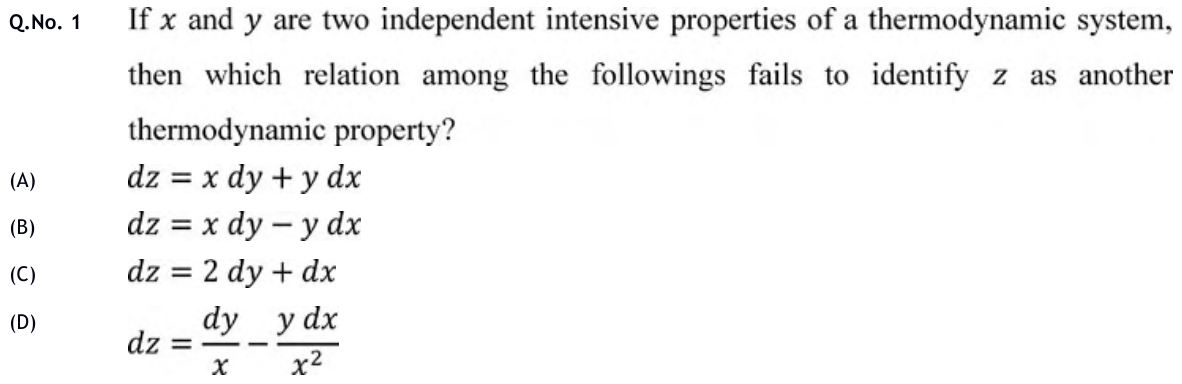
Answer: B.
Question 90
Year: 2020 | Marks: 1
GATE XE 2020, Thermodynamics, Q.2: see the question image.
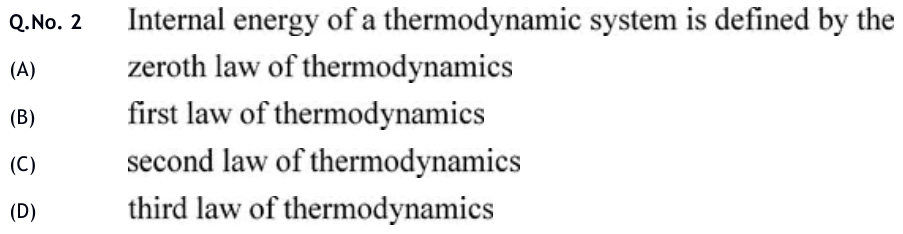
Answer: B.
Question 91
Year: 2020 | Marks: 1
GATE XE 2020, Thermodynamics, Q.3: see the question image.
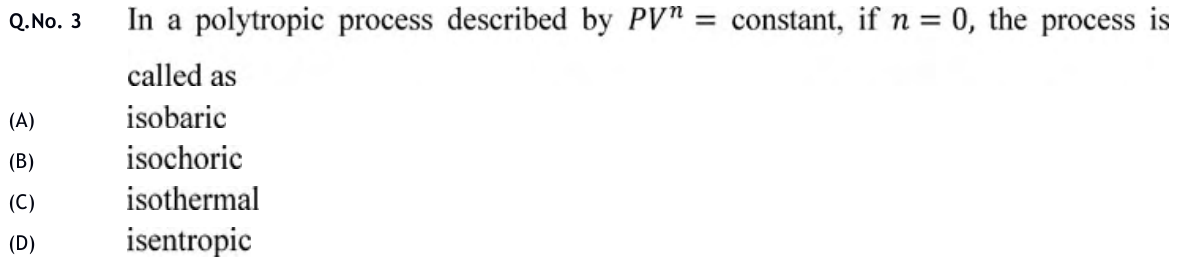
Answer: A.
Question 92
Year: 2020 | Marks: 1
GATE XE 2020, Thermodynamics, Q.4: see the question image.
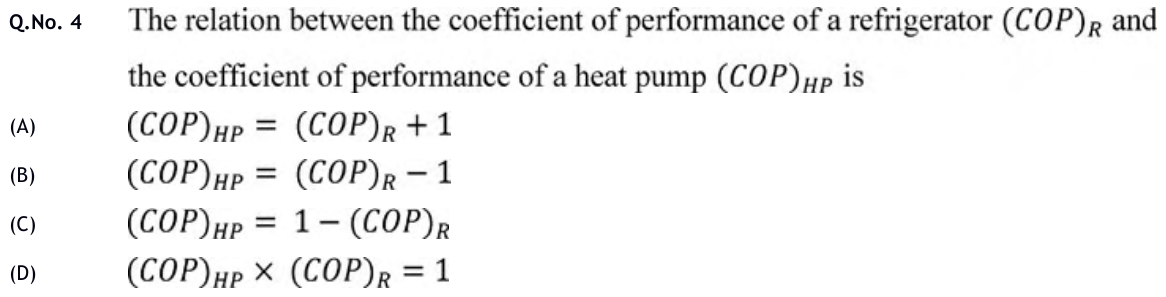
Answer: A.
Question 93
Year: 2020 | Marks: 1
GATE XE 2020, Thermodynamics, Q.5: see the question image.
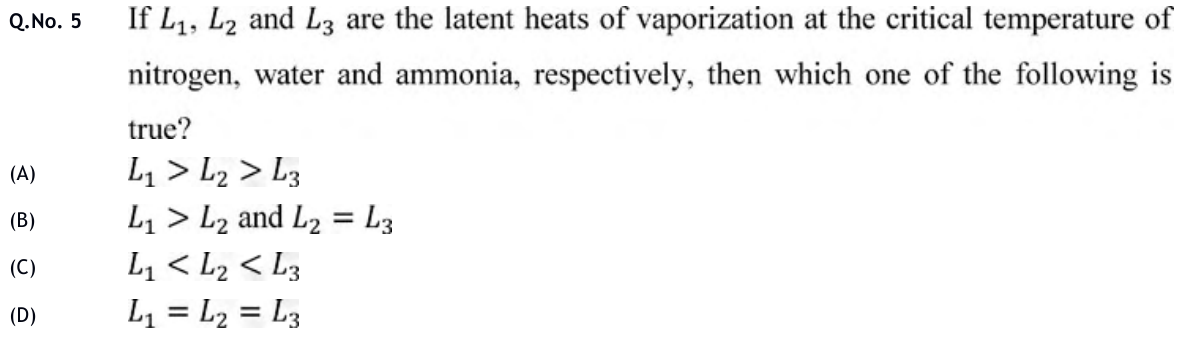
Answer: D.
Question 94
Year: 2020 | Type: NAT | Marks: 1
GATE XE 2020, Thermodynamics, Q.6: see the question image.

Answer: 125
Question 95
Year: 2020 | Type: NAT | Marks: 1
GATE XE 2020, Thermodynamics, Q.7: see the question image.

Answer: 1
Question 96
Year: 2020 | Type: NAT | Marks: 1
GATE XE 2020, Thermodynamics, Q.8: see the question image.

Answer: 198 to 202
Question 97
Year: 2020 | Type: NAT | Marks: 1
GATE XE 2020, Thermodynamics, Q.9: see the question image.

Answer: 63.5 to 65.5
Question 98
Year: 2020 | Marks: 2
GATE XE 2020, Thermodynamics, Q.10: see the question image.
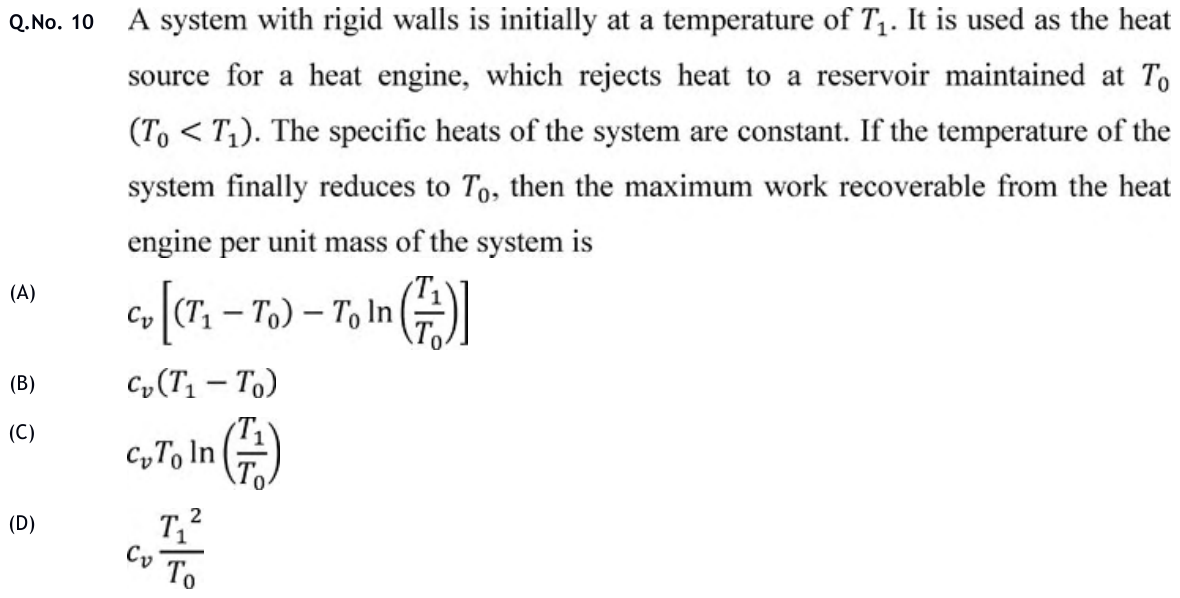
Answer: A.
Question 99
Year: 2020 | Marks: 2
GATE XE 2020, Thermodynamics, Q.11: see the question image.
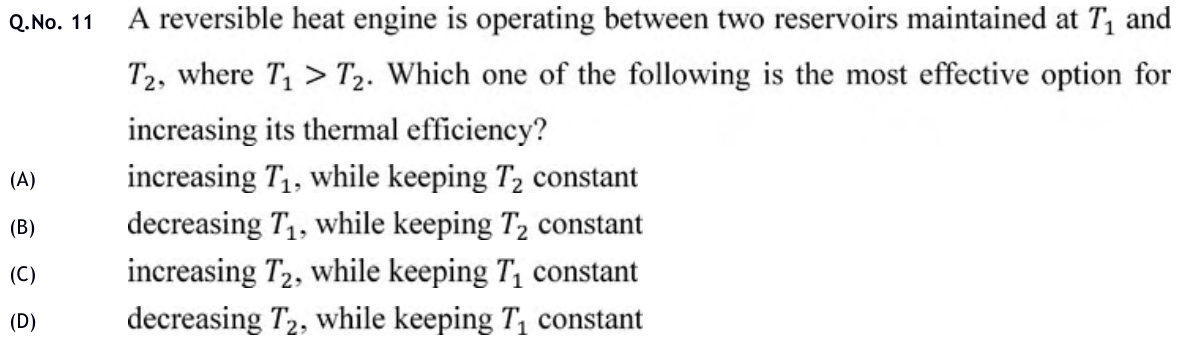
Answer: D.
Question 100
Year: 2020 | Marks: 2
GATE XE 2020, Thermodynamics, Q.12: see the question image.
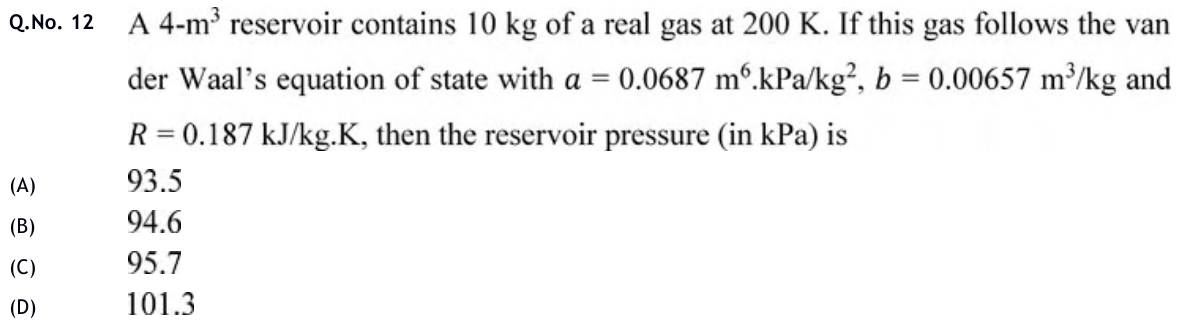
Answer: B.
Question 101
Year: 2020 | Marks: 2
GATE XE 2020, Thermodynamics, Q.13: see the question image.
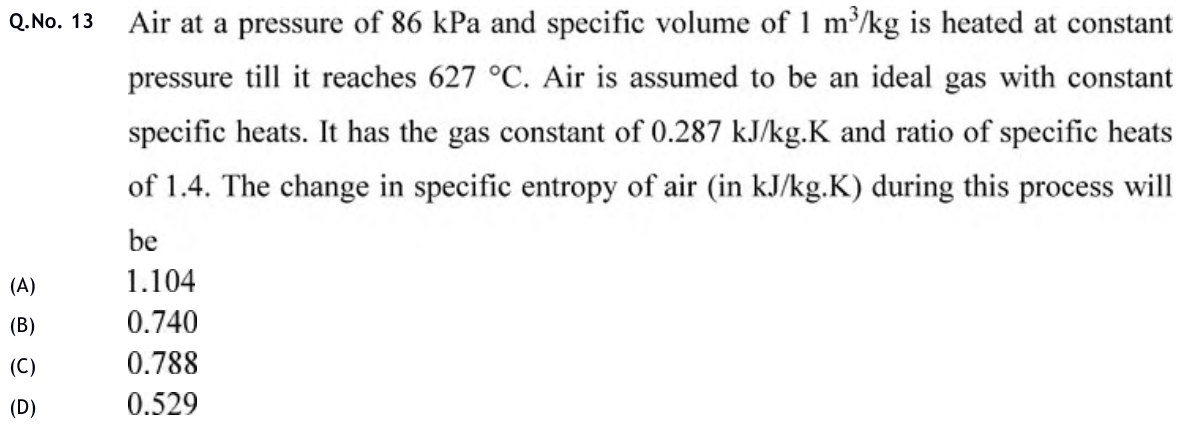
Answer: A.
Question 102
Year: 2020 | Marks: 2
GATE XE 2020, Thermodynamics, Q.14: see the question image.
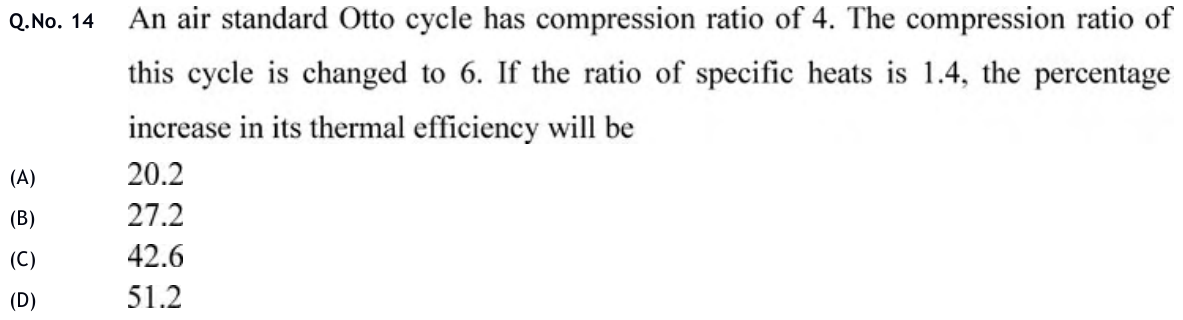
Answer: A.
Question 103
Year: 2020 | Marks: 2
GATE XE 2020, Thermodynamics, Q.15: see the question image.
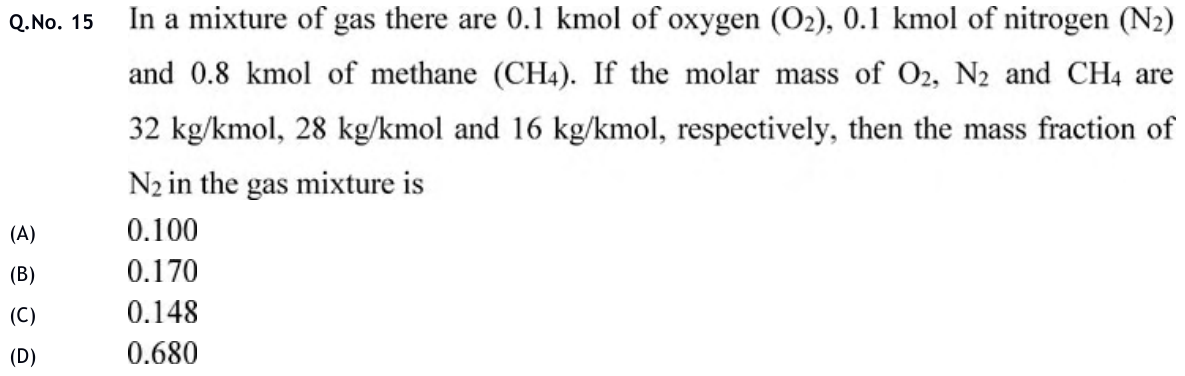
Answer: C.
Question 104
Year: 2020 | Type: NAT | Marks: 2
GATE XE 2020, Thermodynamics, Q.16: see the question image.
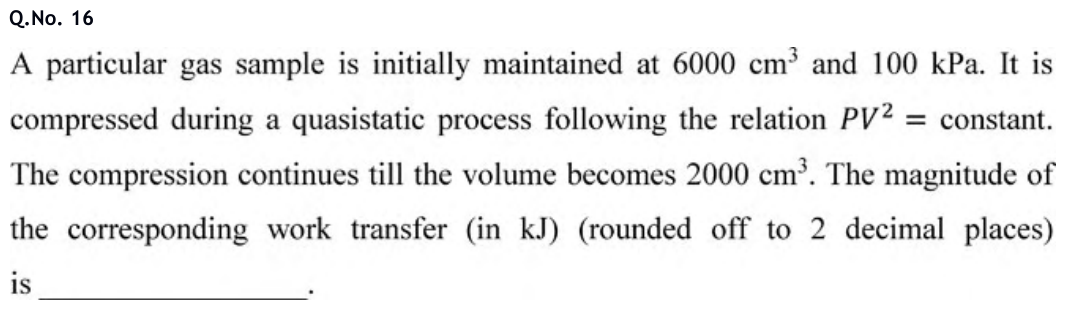
Answer: 1.15 to 1.25
Question 105
Year: 2020 | Type: NAT | Marks: 2
GATE XE 2020, Thermodynamics, Q.17: see the question image.
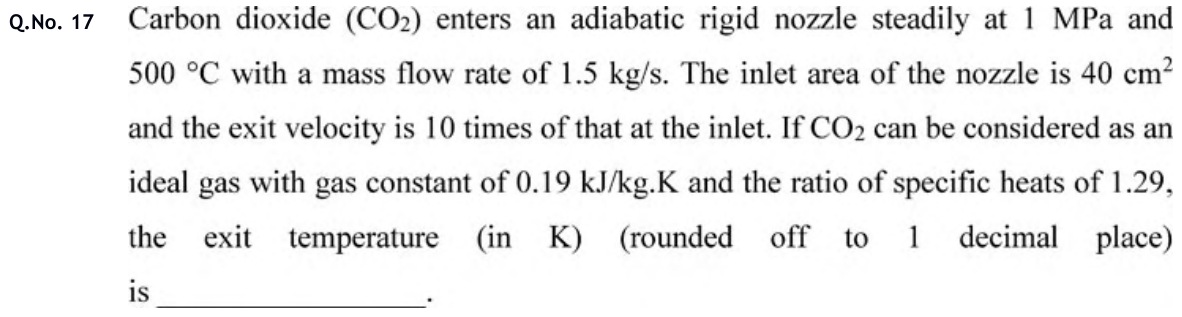
Answer: 590 to 600
Question 106
Year: 2020 | Type: NAT | Marks: 2
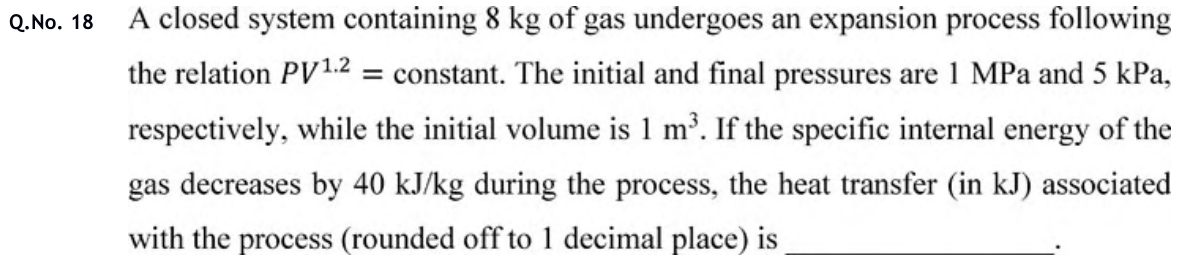
GATE XE 2020, Thermodynamics, Q.18: see the question image.
Answer: 2610 to 2614
Question 107
Year: 2020 | Type: NAT | Marks: 2
GATE XE 2020, Thermodynamics, Q.19: see the question image.

Answer: 1.20 to 1.26
Question 108
Year: 2020 | Type: NAT | Marks: 2
GATE XE 2020, Thermodynamics, Q.20: see the question image.
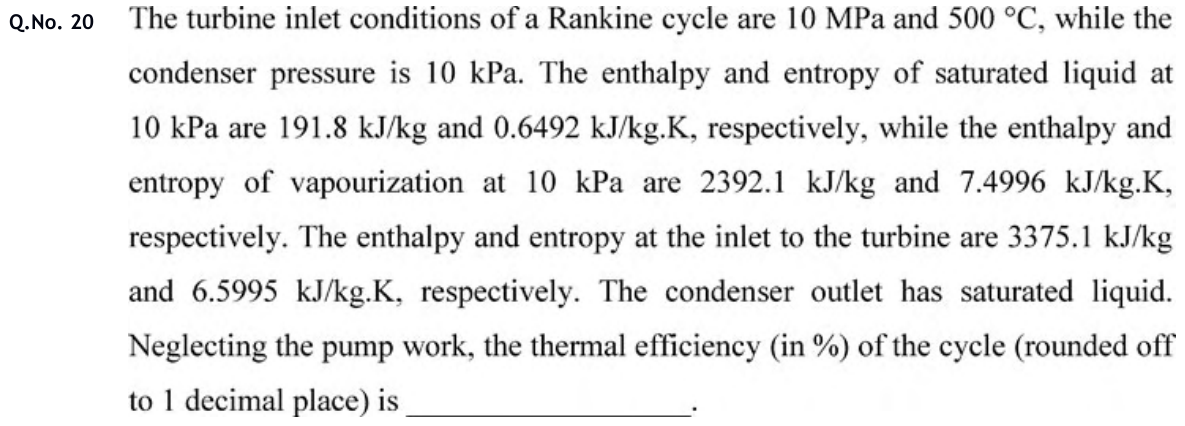
Answer: 39 to 42
Question 109
Year: 2020 | Type: NAT | Marks: 2
GATE XE 2020, Thermodynamics, Q.21: see the question image.
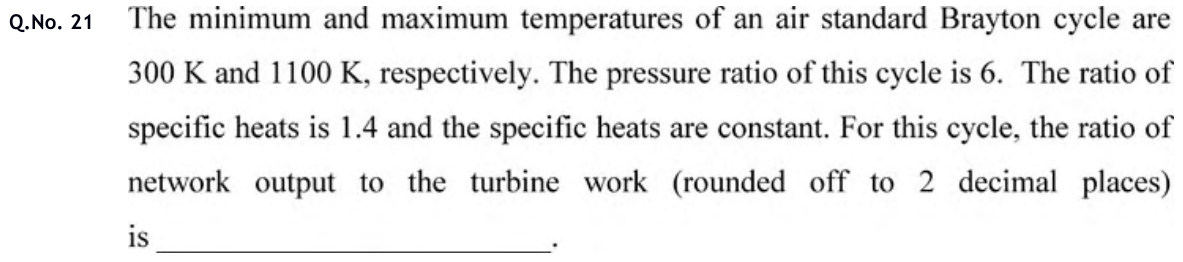
Answer: 0.52 to 0.57
Question 110
Year: 2020 | Type: NAT | Marks: 2
GATE XE 2020, Thermodynamics, Q.22: see the question image.

Answer: 2.30 to 2.40
Question 111
Year: 2018 | Marks: 1
When a fixed mass of air-water vapour mixture is heated at constant pressure,
- A. both relative and specific humidity decrease.
- B. relative humidity decreases, but specific humidity remains unchanged.
- C. specific humidity decreases, but relative humidity remains unchanged.
- D. both relative and specific humidity increase.
Answer: B. relative humidity decreases, but specific humidity remains unchanged.
Question 112
Year: 2018 | Marks: 1
For a reversible isothermal expansion of one mole of an ideal gas from state 1 to state 2, the magnitude of work done is
- A. 1 2 ln P RT P
- B. 2 2 1 1 PV PV −
- C. 1 2 ln V R V
- D. 0
Answer: A. 1 2 ln P RT P
Question 113
Year: 2018 | Marks: 1
The statement which is NOT a consequence of the first law of thermodynamics is
- A. Heat is a path function
- B. Energy is a property of a system
- C. Energy of an isolated system is not conserved
- D. A perpetual motion machine of the first kind is not possible
Answer: C. Energy of an isolated system is not conserved
Question 114
Year: 2018 | Marks: 1
For a refrigerator absorbing heat QL from a cold region and rejecting heat QH to a hot region, the coefficient of performance is written as
- A. L H L Q Q Q −
- B. H H L Q Q Q −
- C. H L L Q Q Q −
- D. L H Q Q
Answer: A. L H L Q Q Q −
Question 115
Year: 2018 | Marks: 1
The value of the compressibility factor at the critical point evaluated using the van der Waals equation of state is
Answer: C. 3 8
Question 116
Year: 2018 | Marks: 1
The vapour pressure of a liquid at 8 °C is 2.7 kPa. Its enthalpy of vaporization is constant and equal to 42700 kJ/kmol. Take R = 8.314 kJ/kmol.K. The temperature (in °C) at a vapour pressure of 13.5 kPa is
- A. 58.7
- B. 51.4
- C. 44.3
- D. 35.2
Answer: D. 35.2
Question 117
Year: 2018 | Type: NAT | Marks: 1
One kmol of an ideal gas (Cp = 21 kJ/kmol.K) undergoes a constant pressure process from 300 K to 500 K. The molar entropy of the gas at 300 K is 150 kJ/kmol.K. The molar entropy (in kJ/kmol.K) at 500 K (up to 1 decimal place) is ________.
Answer: 160.0 to 161.0
Question 118
Year: 2018 | Type: NAT | Marks: 1
A spring, having a spring constant of 350 kN/m, is initially compressed by 0.4 cm. The work required (in J) to compress it by another 0.6 cm (up to 1 decimal place) is ________.
Answer: 14.5 to 15.0
Question 119
Year: 2018 | Type: NAT | Marks: 1
An ideal gas has a molar mass of 40 kg/kmol. Take R = 8.314 kJ/kmol.K. At a pressure of 2 bar and a temperature of 300 K, the volume (in m3) of 1 kg of this gas (up to 2 decimal places) is ________.
Answer: 0.30 to 0.32
Question 120
Year: 2018 | Marks: 2
Consider the following statements for an ideal gas undergoing a reversible non-flow process: P. If the process is adiabatic, the change in enthalpy of the gas is necessarily zero. Q. If the process is adiabatic, the change in entropy of the gas is necessarily zero. R. If the process is isothermal, the change in enthalpy of the gas is necessarily zero. S. If the process is isothermal, the change in entropy of the gas is necessarily zero. Which one of the following options is valid?
- A. Only P is correct
- B. Only S is correct
- C. Only Q and R are correct
- D. Only P and S are correct
Answer: C. Only Q and R are correct
Question 121
Year: 2018 | Marks: 2
An ideal Otto cycle (O) and an ideal diesel cycle (D) have the same maximum temperature and reject equal amount of heat. Also, the working fluid enters at the same state before compression. One of the following statements always true about their efficiencies (𝜂) is
- A. 𝜂O > 𝜂D
- B. 𝜂O = 𝜂D
- C. 𝜂O < 𝜂D
- D. 𝜂O = 1 −𝜂D
Answer: C. 𝜂O < 𝜂D
Question 122
Year: 2018 | Marks: 2
A reversible engine receives 75 kJ/s of energy from a reservoir at 750 K and does 12 kJ/s of work. The heat is rejected to two reservoirs at 650 K and 550 K. The rate of heat rejection (in kJ/s) to the reservoir at 650 K is
Answer: D. 52
Question 123
Year: 2018 | Marks: 2
A gas obeys the following equation of state: 2 ( ) , aP P v b RT T − = + where v is molar volume, and a, b are constants with values 5 10 a − = J.K/Pa2.kmol and 2 8 10 b − =× m3/kmol. Take Cp = 30 kJ/kmol.K. At 10 bar and 500 K, the value of the Joule-Thomson coefficient (in K/Pa) is
- A. 6 2 10− −×
- B. 6 4 10− −×
- C. 6 2 10− ×
- D. 6 4 10− ×
Answer: B. 6 4 10− −×
Question 124
Year: 2018 | Marks: 2
In an ideal Rankine cycle, steam enters the turbine at 10 MPa and 500 °C (ℎ = 3375.1 kJ/kg, 𝑠 = 6.5995 kJ/kg.K). It is cooled in the condenser at a pressure of 10 kPa. At 10 kPa, ℎ𝑓 = 191.81 kJ/kg, 𝑠𝑓 = 0.6492 kJ/kg.K, ℎ𝑔 = 2583.9 kJ/kg and 𝑠𝑔 = 8.1488 kJ/kg.K. The heat rejected in the condenser (in kJ/kg) is
- A. 1898
- B. 3796
- C. 949
- D. 2847
Answer: A. 1898
Question 125
Year: 2018 | Marks: 2
Methane has compressibility factor value of 0.9 at reduced pressure of 1.0 and reduced temperature of 1.5. For propane, the critical temperature and pressure are 369.8 K and 42.48 bar, respectively. Take R = 8.314 kJ/kmol.K. Applying the principle of corresponding states, the molar volume of propane (in m3/kmol) at the same reduced pressure and temperature is
- A. 0.355
- B. 0.526
- C. 0.791
- D. 0.977
Answer: D. 0.977
Question 126
Year: 2018 | Type: NAT | Marks: 2
A rigid insulated vessel is divided into two compartments by a partition. One compartment contains 12 kg of oxygen at 200 kPa and 280 K. The other compartment contains 26 kg of carbon dioxide at 400 kPa and 360 K. The specific heats at constant volume in kJ/kg.K for oxygen and carbon dioxide are 0.662 and 0.653, respectively. The partition is removed and the gases are allowed to mix. Considering both gases are ideal, the final temperature (in K) of the mixture (up to 1 decimal place) is ________.
Answer: 332.5 to 336.5
Question 127
Year: 2018 | Type: NAT | Marks: 2
Moist air having 60% relative humidity, enters a steady-flow air-conditioning unit at 102 kPa and 30 °C. The volume flow rate of the moist air entering the unit is 0.1 m3/s. The moist air leaves the unit at 95 kPa and 15 °C with a relative humidity of 100%. Liquid condensate leaves the unit at 15 °C. For water: at 15 °C, ℎ𝑓 = 62.982 kJ/kg, ℎ𝑔 = 2528.3 kJ/kg, 𝑃𝑠𝑎𝑡 = 1.7057 kPa. at 30 °C, ℎ𝑓 = 125.74 kJ/kg, ℎ𝑔 = 2555.6 kJ/kg, 𝑃𝑠𝑎𝑡 = 4.2469 kPa. For air, specific heat at constant pressure is 1.004 kJ/kg.K and the specific gas constant is 0.287 kJ/kg.K. Neglecting heat leakage to the surrounding, the magnitude of heat extracted (in kW) from the air stream (up to 2 decimal places) is __________.
Answer: 3.01 to 3.07
Question 128
Year: 2018 | Type: NAT | Marks: 2
Air at 150 kPa and 323 K is filled in a rigid vessel of 0.05 m3 capacity. For air, assumed as an ideal gas, specific heat at constant volume is 0.7163 kJ/kg.K and the specific gas constant is 0.287 kJ/kg.K. Neglect kinetic and potential energy changes. If 30 kJ of heat is added, the final temperature (in K) of air (up to 1 decimal place) is __________.
Answer: 838.0 to 844.0
Question 129
Year: 2018 | Type: NAT | Marks: 2
Superheated steam at 2 bar and 300 °C, with an enthalpy of 3072.1 kJ/kg, enters a horizontal adiabatic nozzle with negligible velocity and leaves at 0.2 bar as saturated vapour with an enthalpy of 2609.9 kJ/kg. Assuming steady flow and neglecting the potential energy changes, the exit velocity (in m/s) of the steam (up to 1 decimal place) is __________.
Answer: 961.0 to 962.0
Question 130
Year: 2018 | Type: NAT | Marks: 2
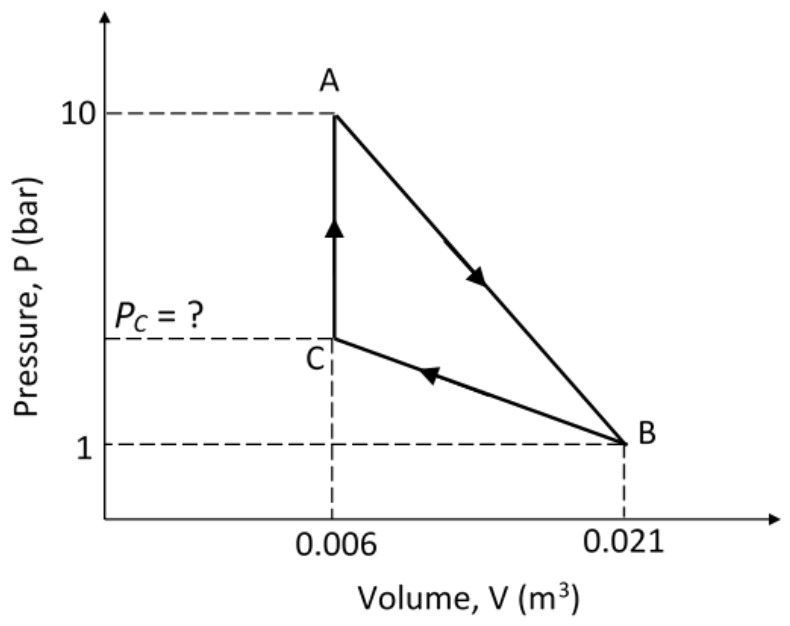
A given mass of a simple compressible substance undergoes a reversible cycle, as shown in the P-V diagram. The magnitude of the net work done during the cycle is 3 kJ. The pressure (in bar) at point C (up to 1 decimal place) is ________.
Answer: 5.7 to 6.1
Question 131
Year: 2018 | Type: NAT | Marks: 2
One kmol of an ideal gas at 300 K and 10 bar is reversibly heated in a constant volume process to 500 K. It is then reversibly and isothermally expanded to 2 bar. Take Cv = 20.8 kJ/kmol.K and R = 8.314 kJ/kmol.K. The total heat supplied (in kJ) to the gas (up to 1 decimal place) is ________.
Answer: 12950.0 to 13000.0
Question 132
Year: 2018 | Type: NAT | Marks: 2
A rigid container is completely filled with a liquid having a constant isothermal compressibility of 4 1 1.09 10 bar − − × and a constant coefficient of volume expansion of 3 1 1.12 10 K − − × . The liquid is initially at 300 K and 1 bar. Heat is supplied to the liquid to raise its temperature to 350 K. Assuming that no phase change occurs, the final pressure (in bar) of the liquid (up to 1 decimal place) is ________.
Answer: 513.0 to 517.0
Question 133
Year: 2017 | Marks: 1
GATE XE 2017, Thermodynamics, Q.1: see the question image.
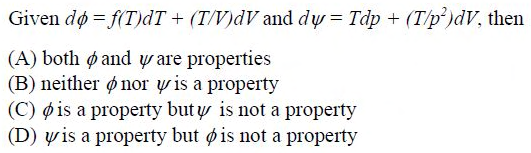
Answer: B.
Question 134
Year: 2017 | Marks: 1
GATE XE 2017, Thermodynamics, Q.2: see the question image.

Answer: C.
Question 135
Year: 2017 | Marks: 1
GATE XE 2017, Thermodynamics, Q.3: see the question image.

Answer: C.
Question 136
Year: 2017 | Type: NAT | Marks: 1
GATE XE 2017, Thermodynamics, Q.4: see the question image.

Answer: 0.17 to 0.18
Question 137
Year: 2017 | Marks: 1
GATE XE 2017, Thermodynamics, Q.5: see the question image.

Answer: B.
Question 138
Year: 2017 | Marks: 1
GATE XE 2017, Thermodynamics, Q.6: see the question image.

Answer: D.
Question 139
Year: 2017 | Marks: 1
GATE XE 2017, Thermodynamics, Q.7: see the question image.
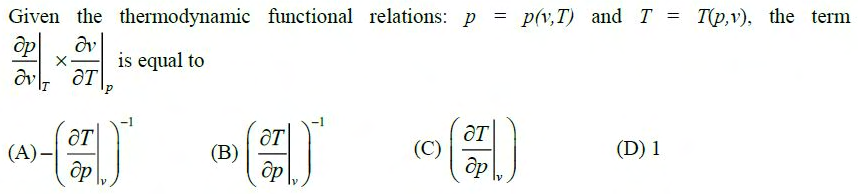
Answer: A.
Question 140
Year: 2017 | Marks: 1
GATE XE 2017, Thermodynamics, Q.8: see the question image.
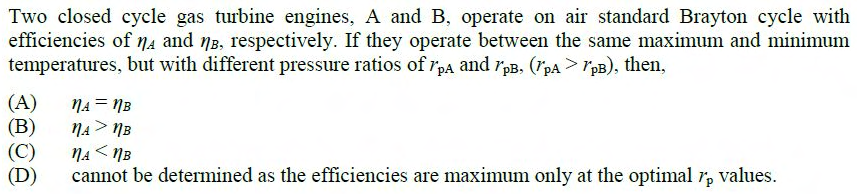
Answer: B.
Question 141
Year: 2017 | Type: NAT | Marks: 1
GATE XE 2017, Thermodynamics, Q.9: see the question image.

Answer: 499 to 501
Question 142
Year: 2017 | Type: NAT | Marks: 2
GATE XE 2017, Thermodynamics, Q.10: see the question image.

Answer: 53 to 55
Question 143
Year: 2017 | Marks: 2
GATE XE 2017, Thermodynamics, Q.11: see the question image.

Answer: D.
Question 144
Year: 2017 | Type: NAT | Marks: 2
GATE XE 2017, Thermodynamics, Q.12: see the question image.
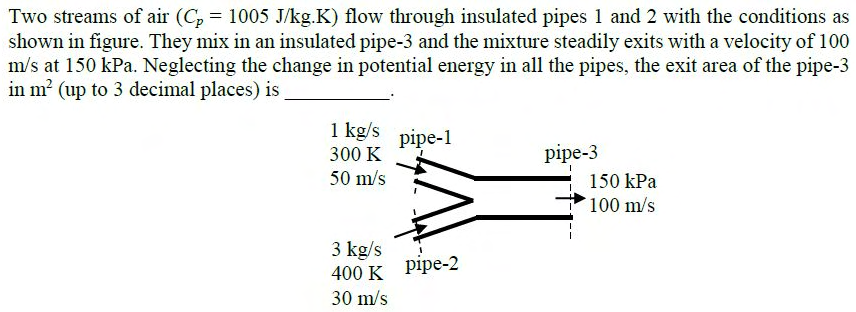
Answer: 0.026 to 0.030
Question 145
Year: 2017 | Type: NAT | Marks: 2
GATE XE 2017, Thermodynamics, Q.13: see the question image.

Answer: 73.5 to 73.8
Question 146
Year: 2017 | Type: NAT | Marks: 2
GATE XE 2017, Thermodynamics, Q.14: see the question image.

Answer: 2.2
Question 147
Year: 2017 | Type: NAT | Marks: 2
GATE XE 2017, Thermodynamics, Q.15: see the question image.

Answer: 0.140 to 0.150
Question 148
Year: 2017 | Marks: 2
GATE XE 2017, Thermodynamics, Q.16: see the question image.

Answer: C.
Question 149
Year: 2017 | Marks: 2
GATE XE 2017, Thermodynamics, Q.17: see the question image.

Answer: A.
Question 150
Year: 2017 | Marks: 2
GATE XE 2017, Thermodynamics, Q.18: see the question image.
Answer: A.
Question 151
Year: 2017 | Type: NAT | Marks: 2
GATE XE 2017, Thermodynamics, Q.19: see the question image.

Answer: 2225 to 2230
Question 152
Year: 2017 | Type: NAT | Marks: 2
GATE XE 2017, Thermodynamics, Q.20: see the question image.
Answer: 0.76 to 0.82
Question 153
Year: 2017 | Type: NAT | Marks: 2
GATE XE 2017, Thermodynamics, Q.21: see the question image.

Answer: 29.0 to 30.0
Question 154
Year: 2017 | Type: NAT | Marks: 2
GATE XE 2017, Thermodynamics, Q.22: see the question image.
Answer: 60.5 to 61.5
Question 155
Year: 2016 | Marks: 1
Which of the following thermodynamic properties is NOT an intensive property of a thermodynamic system:
- A. Pressure
- B. Temperature
- C. Density
- D. Volume
Answer: D. Volume
Question 156
Year: 2016 | Marks: 1
An U-tube manometer shows a height difference of z1 between the two columns for a known gauge pressure P1 (both z1 and P1 in appropriate units). If the height difference between the two columns is 2z1, then the corresponding gauge pressure will be:
Answer: B. 2P1
Question 157
Year: 2016 | Marks: 1
Water vapour can be treated as an ideal gas,
- A. for all temperature and pressure
- B. for sufficiently low pressure, regardless of its temperature
- C. for very high pressure only
- D. for sufficiently low temperature, regardless of its pressure
Answer: B. for sufficiently low pressure, regardless of its temperature
Question 158
Year: 2016 | Marks: 1
The thermal efficiency of a Carnot engine is 0.5. If the temperature of the cold reservoir is 300 K, then the temperature of the hot reservoir is:
- A. 600 K
- B. 1200 K
- C. 900 K
- D. 450 K
Answer: A. 600 K
Question 159
Year: 2016 | Marks: 1
In a reversible, constant-pressure, non-flow process, heat input is given by
- A. change in internal energy
- B. change in enthalpy
- C. change in entropy
- D. work output
Answer: B. change in enthalpy
Question 160
Year: 2016 | Marks: 1
Moist air undergoes an adiabatic saturation process such that the relative humidity of air increases. For this process,
- A. Dry bulb temperature increases, specific humidity increases
- B. Dry bulb temperature increases, specific humidity decreases
- C. Dry bulb temperature decreases, specific humidity increases
- D. Dry bulb temperature decreases, specific humidity decreases
Answer: C. Dry bulb temperature decreases, specific humidity increases
Question 161
Year: 2016 | Marks: 1
A steadily flowing ideal gas undergoes adiabatic throttling, where T1: temperature before throttling T2: temperature after throttling Assuming no change in kinetic and potential energy due to throttling, which of the following is correct:
- A. T1 = T2
- B. T1 > T2
- C. T1 < T2
- D. T1 = γ T2, γ: specific heat ratio
Answer: A. T1 = T2
Question 162
Year: 2016 | Marks: 1
For irreversible heat transfer from a hot body to a cold body, if Δ denotes the property change of both hot and cold bodies (i.e. difference between its final and initial values), then
- A. ΔS = 0
- B. ΔU > 0
- C. ΔS < 0
- D. ΔS > 0
Answer: D. ΔS > 0
Question 163
Year: 2016 | Marks: 1
A closed system undergoes a cyclic process. For the net work done by the system on the surroundings, which of the following statements is FALSE:
- A. Net work is always zero
- B. Net work is ∮𝑃𝑃 𝑑𝑑𝑑𝑑 if the process is reversible
- C. Net work can be negative
- D. Net work can be positive
Answer: A. Net work is always zero
Question 164
Year: 2016 | Marks: 2
Consider the following statements related to the second law of thermodynamics: P. A cyclic heat engine cannot produce net work by exchanging heat only with one reservoir. Q. The efficiency of a reversible heat engine is dependent on the nature and amount of working substance undergoing the cycle. R. It is impossible to have a cyclic device which will produce no effect other than the transfer of heat from a cold body to a hot body. S. It is impossible to have heat engines operating between a heat source and sink to have a lower efficiency than that of a reversible heat engine operating between the same source and sink. For which of the following options, BOTH the statements are inconsistent with the second law of thermodynamics:
- A. P and R
- B. P and Q
- C. R and S
- D. Q and S
Answer: D. Q and S
Question 165
Year: 2016 | Marks: 2
Consider the following statements related to air-standard Otto, Diesel, and Brayton cycles: P. Brayton cycle has at least one isentropic and one isobaric process. Q. Otto cycle has at least one isentropic and one isochoric process. R. Diesel cycle has at least one isentropic and one isothermal process. S. At least one of the cycles has an isothermal process. For which of the following options, BOTH the statements are consistent with the operation of the above cycles:
- A. P and R
- B. P and Q
- C. R and S
- D. P and S
Answer: B. P and Q
Question 166
Year: 2016 | Type: NAT | Marks: 2
Volumetric analysis of a hydrocarbon combustion product shows 8% CO2, 15% H2O (vapour), 5.5% O2 and 71.5% N2. The combustion product flows steadily through a heat exchanger at 200 kPa pressure. Assume each component in the mixture to be an ideal gas. In order to avoid the condensation of H2O in the heat exchanger, the minimum allowable temperature (in oC) is ______. Saturated H2O Table: P (kPa) 10 20 30 40 50 T (oC) 45.83 60.09 69.12 75.82 81.35
Question 167
Year: 2016 | Type: NAT | Marks: 2
An equimolar mixture of two ideal gases (A, B) expands isentropically in a nozzle. The gas mixture enters the nozzle at 300 kPa, 400 K and exits at 100 kPa. Assuming the mixture to be an ideal gas, the exit temperature of the gas mixture (in K) is _________. Molar mass (kg/kmol) Cp (kJ/kg-K) Gas A 28.013 1.04 Gas B 2.016 14.21
Answer: 286 to 297
Question 168
Year: 2016 | Type: NAT | Marks: 2
A rigid vessel of volume 10 m3 is filled with hydrogen at 25oC and 500 kPa. Due to leakage, some gas has escaped from the vessel until the pressure in the vessel drops down to 200 kPa, and the corresponding temperature of the gas inside the vessel is found to be 15oC. The amount of gas leaked (in kg) from the vessel is _________.
Answer: 2.30 to 2.40
Question 169
Year: 2016 | Type: NAT | Marks: 2
A hot ideal gas (Cp = 1.2 kJ/(kg.K)) steadily flows through a turbine with inlet and exit temperatures of 1500 K and 500 K respectively. The minimum mass flow rate (in kg/s) of the hot gas to achieve a power output of 12 MW is ____________.
Answer: 9.5 to 10.5
Question 170
Year: 2016 | Type: NAT | Marks: 2
Air pressure inside a spherical balloon is proportional to its diameter. The balloon undergoes a reversible, isothermal, non-flow process. During the process, the balloon maintains its spherical shape, and the air inside the balloon consumes 2 kJ of heat. Initial air pressure inside the balloon was 120 kPa, while the initial balloon diameter was 20 cm. Assuming air to be an ideal gas, the final diameter of the balloon (in cm) is _____________.
Answer: 28 to 36
Question 171
Year: 2016 | Type: NAT | Marks: 2
An air-standard diesel engine has a compression ratio of 18 (the ratio of the volume at the beginning of the compression process to that at the end of the compression process), and a cut-off ratio of 2 (the ratio of the volume at the end of the heat addition process to that at the beginning of the heat addition process). The thermal efficiency (in %) of the engine is ____________________.
Answer: 62.0 to 64.0
Question 172
Year: 2016 | Type: NAT | Marks: 2
Compressed air, at 1 MPa pressure, 400 K temperature flows through a large pipe. An evacuated, insulated rigid tank of 0.5 m3 volume is connected to the pipe through a valve. The valve is opened to fill the tank and the valve closes automatically when the tank pressure reaches 1 MPa. Assuming ideal gas behaviour, the final air temperature in the tank (in K) is __________.
Answer: 555 to 565
Question 173
Year: 2016 | Type: NAT | Marks: 2
A 40 kg metal block (Cp = 0.5 kJ/(kg.K)) at T = 450oC is quenched in 150 kg oil (Cp = 2.5 kJ/(kg. K)) at T = 25oC. If the combined (metal block and oil) system is fully isolated from its surroundings, then the net change in the entropy (in kJ/K) of the combined system is ________________.
Answer: 9.7 to 9.9
Question 174
Year: 2016 | Marks: 2
For phase change from solid (sol) to liquid (liq) state, if the slope of the solid-liquid coexistence line in the P-T diagram is negative, then:
- A. vliq < vsol
- B. vliq > vsol
- C. sliq < ssol
- D. hliq < hsol
Answer: A. vliq < vsol
Question 175
Year: 2016 | Type: NAT | Marks: 2
A house-hold refrigerator operates under steady state condition between an evaporator temperature of 263 K and a condenser temperature of 323 K. The heat load to the refrigerator is 3 kW. The actual COP of the refrigerator is half of that of a Carnot refrigerator operating between the same condenser and evaporator temperatures. The power required (in kW) to run the refrigerator is ___________.
Answer: 1.34 to 1.40
Question 176
Year: 2016 | Marks: 2
The Maxwell relation that results from the expression for the Helmholtz free energy 𝐴𝐴= 𝑈𝑈−𝑇𝑇𝑇𝑇, is:
- A. �𝜕𝜕𝜕𝜕 𝜕𝜕𝜕𝜕ቁ 𝑠𝑠= − �𝜕𝜕𝜕𝜕 𝜕𝜕𝜕𝜕ቁ 𝑣𝑣
- B. �𝜕𝜕𝜕𝜕 𝜕𝜕𝜕𝜕ቁ 𝑠𝑠= �𝜕𝜕𝜕𝜕 𝜕𝜕𝜕𝜕ቁ 𝑃𝑃
- C. �𝜕𝜕𝜕𝜕 𝜕𝜕𝜕𝜕ቁ 𝑣𝑣= �𝜕𝜕𝜕𝜕 𝜕𝜕𝜕𝜕ቁ 𝑇𝑇
- D. �𝜕𝜕𝜕𝜕 𝜕𝜕𝜕𝜕ቁ 𝑃𝑃= − �𝜕𝜕𝜕𝜕 𝜕𝜕𝜕𝜕ቁ 𝑇𝑇
Answer: C. �𝜕𝜕𝜕𝜕 𝜕𝜕𝜕𝜕ቁ 𝑣𝑣= �𝜕𝜕𝜕𝜕 𝜕𝜕𝜕𝜕ቁ 𝑇𝑇
Question 177
Year: 2015 | Marks: 1
GATE XE 2015, Thermodynamics, Q.1: see the question image.

Answer: A.
Question 178
Year: 2015 | Type: NAT | Marks: 1
GATE XE 2015, Thermodynamics, Q.2: see the question image.

Answer: 0.130 to 0.135
Question 179
Year: 2015 | Marks: 1
GATE XE 2015, Thermodynamics, Q.3: see the question image.
Answer: A.
Question 180
Year: 2015 | Marks: 1
GATE XE 2015, Thermodynamics, Q.4: see the question image.
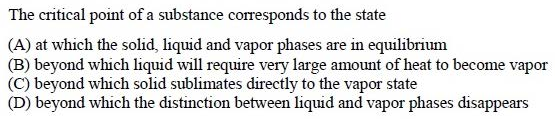
Answer: D.
Question 181
Year: 2015 | Marks: 1
GATE XE 2015, Thermodynamics, Q.5: see the question image.
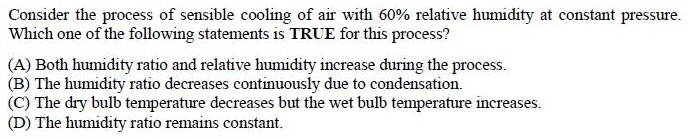
Answer: D.
Question 182
Year: 2015 | Type: NAT | Marks: 1
GATE XE 2015, Thermodynamics, Q.6: see the question image.

Answer: 19.5 to 20.5
Question 183
Year: 2015 | Marks: 1
GATE XE 2015, Thermodynamics, Q.7: see the question image.
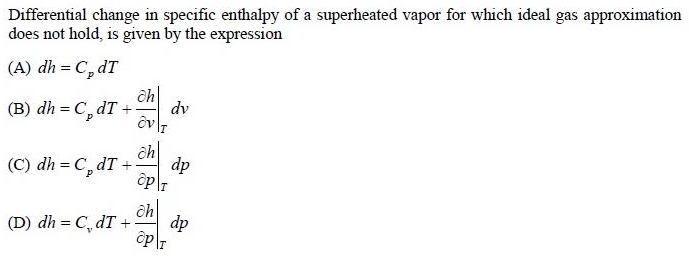
Answer: C.
Question 184
Year: 2015 | Type: NAT | Marks: 1
GATE XE 2015, Thermodynamics, Q.8: see the question image.

Answer: 92 to 100
Question 185
Year: 2015 | Marks: 1
GATE XE 2015, Thermodynamics, Q.9: see the question image.
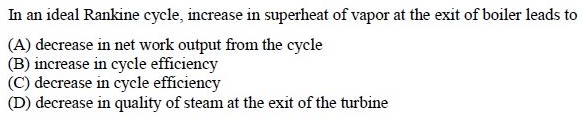
Answer: B.
Question 186
Year: 2015 | Marks: 2
GATE XE 2015, Thermodynamics, Q.10: see the question image.
Answer: C.
Question 187
Year: 2015 | Marks: 2
GATE XE 2015, Thermodynamics, Q.11: see the question image.

Answer: C.
Question 188
Year: 2015 | Type: NAT | Marks: 2
GATE XE 2015, Thermodynamics, Q.12: see the question image.

Answer: 95 to 97
Question 189
Year: 2015 | Type: NAT | Marks: 2
GATE XE 2015, Thermodynamics, Q.13: see the question image.

Answer: 2.9 to 3.0
Question 190
Year: 2015 | Marks: 2
GATE XE 2015, Thermodynamics, Q.14: see the question image.

Answer: D.
Question 191
Year: 2015 | Type: NAT | Marks: 2
GATE XE 2015, Thermodynamics, Q.15: see the question image.

Answer: 111.0 to 111.6
Question 192
Year: 2015 | Marks: 2
GATE XE 2015, Thermodynamics, Q.16: see the question image.

Answer: D.
Question 193
Year: 2015 | Marks: 2
GATE XE 2015, Thermodynamics, Q.17: see the question image.

Answer: D.
Question 194
Year: 2015 | Marks: 2
GATE XE 2015, Thermodynamics, Q.18: see the question image.
Answer: C.
Question 195
Year: 2015 | Type: NAT | Marks: 2
GATE XE 2015, Thermodynamics, Q.19: see the question image.

Answer: 617 to 619
Question 196
Year: 2015 | Type: NAT | Marks: 2
GATE XE 2015, Thermodynamics, Q.20: see the question image.

Answer: 6235 to 6245
Question 197
Year: 2015 | Type: NAT | Marks: 2
GATE XE 2015, Thermodynamics, Q.21: see the question image.

Answer: 2100 to 2200
Question 198
Year: 2015 | Type: NAT | Marks: 2
GATE XE 2015, Thermodynamics, Q.22: see the question image.

Answer: 8.20 to 8.25
Question 199
Year: 2014 | Marks: 1
Entropy is a
- A. Path function
- B. Point function
- C. Property independent function
- D. Neither path nor point function
Answer: B. Point function
Question 200
Year: 2014 | Marks: 1
A small container has gas at high pressure. It is placed in an evacuated space. If the container is punctured, work done by the gas is
- A. Positive
- B. Negative
- C. Zero
- D. ∞
Answer: C. Zero
Question 201
Year: 2014 | Marks: 1
The molecular weight of a mixture is 38.4 gm/mol. The mixture is composed of methane and carbon-dioxide gases. The atomic weights of the elements C, H, and O are 12, 1, and 16 gm/mol, respectively. The mole fraction of methane (Xmethane) is ____________ and that of carbon-dioxide (X carbon-dioxide) is _______.
- A. Xmethane = 0.2; X carbon-dioxide = 0.8
- B. Xmethane = 0.8; X carbon-dioxide = 0.2
- C. Xmethane = 0.3; X carbon-dioxide = 0.7
- D. Xmethane= 0.7; X carbon-dioxide = 0.3
Answer: A. Xmethane = 0.2; X carbon-dioxide = 0.8
Question 202
Year: 2014 | Marks: 1
A system undergoes a change from state 1 to state 2. During this process, the change in the internal energy is ∆U. The change in internal energy of the system when executing the cycle 1-2-1 is equal to
- A. ∆U
- B. 2∆U
- C. Zero
- D. −2∆U XE (GATE 2014)
Answer: C. Zero
Question 203
Year: 2014 | Marks: 1
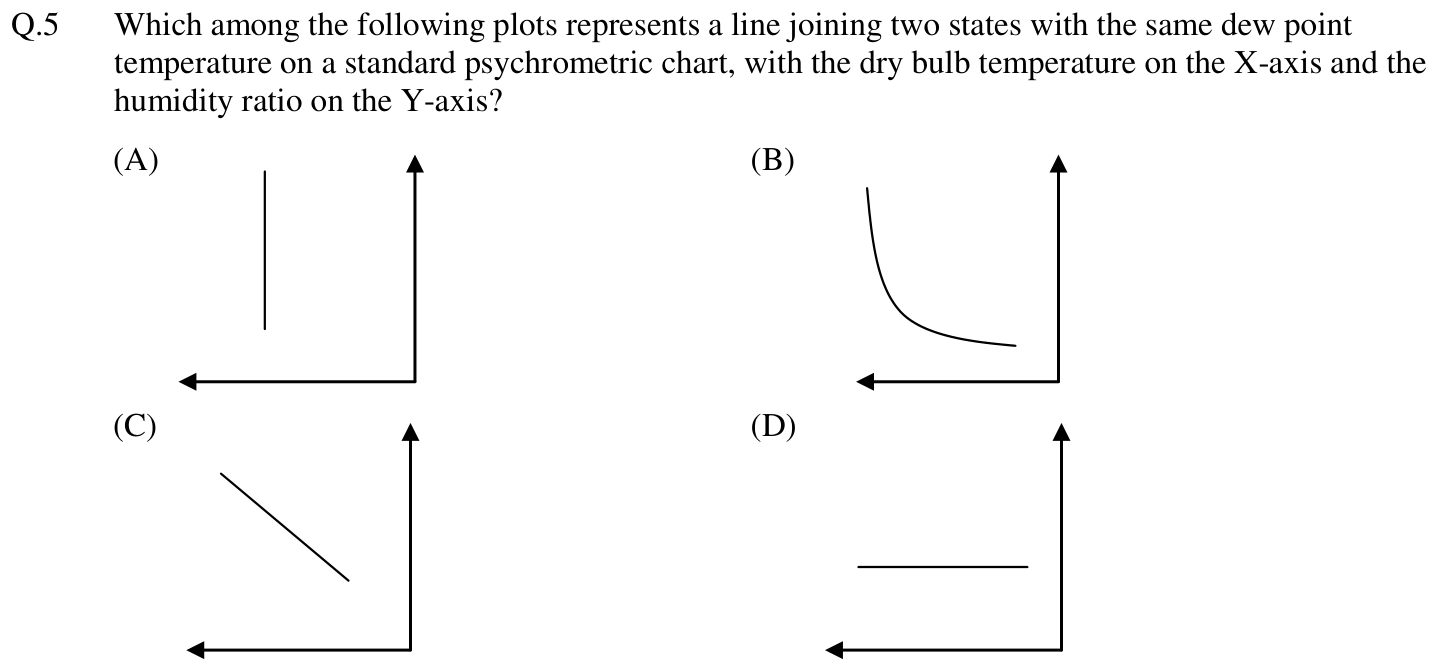
Which among the following plots represents a line joining two states with the same dew point temperature on a standard psychrometric chart, with the dry bulb temperature on the X-axis and the humidity ratio on the Y-axis?
Answer: D.
Question 204
Year: 2014 | Marks: 1
The efficiency of a reversible engine operating between two temperatures is 40 % . The COP of a reversible refrigerator operating between the same temperatures is
Answer: A. 1.5
Question 205
Year: 2014 | Marks: 1
For a superheated vapor that cannot be approximated as an ideal gas, the expression determining a small change in the specific internal energy is
- A. dv v u dT c du T p ∂ ∂ + =
- B. dP P u dT c du T p ∂ ∂ + =
- C. dv v u dT c du T v ∂ ∂ + =
- D. dT c du v =
Answer: C. dv v u dT c du T v ∂ ∂ + =
Question 206
Year: 2014 | Marks: 1
The minimum and maximum volumes in an air standard Otto cycle are 100 and 800 cm3. Its thermal efficiency (%) is
- A. 56.47
- B. 94.55
- C. 54.08
- D. 87.50
Answer: A. 56.47
Question 207
Year: 2014 | Marks: 1
At a saturation temperature Tsat, the difference between the entropy of saturated vapor and entropy of saturated liquid can be expressed as
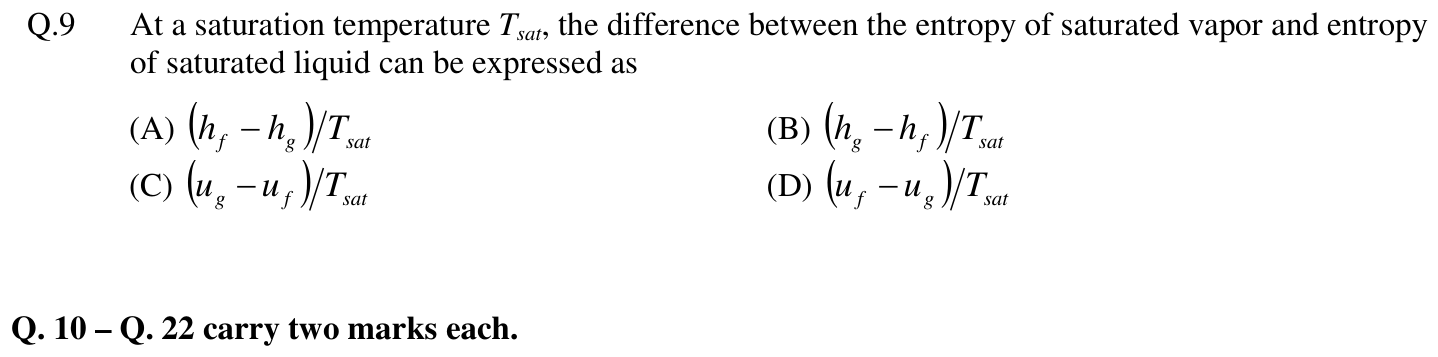
- A. ( ) sat g f T h h −
- B. ( ) sat f g T h h −
- C. ( ) sat f g T u u −
- D. ( ) sat g f T u u −
Answer: B. ( ) sat f g T h h −
Question 208
Year: 2014 | Marks: 2
A gas in a closed system is compressed reversibly from an initial volume of 0.2 m3 to 0.1 m3 at a constant pressure of 3 bar. During this process, there was a heat transfer of 50 kJ from the gas. The change in internal energy of the gas during this process in kJ is
- A. 20
- B. −80
- C. 80
- D. −20 XE (GATE 2014)
Answer: D. −20 XE (GATE 2014)
Question 209
Year: 2014 | Marks: 2
In a closed rigid vessel, air is initially at a pressure of 0.3 MPa and volume of 0.1 m3 at 300 K. A stirrer supplies 100 kJ of work to the air, while 20 kJ of heat is lost to the atmosphere across the container walls. After these processes, the temperature of air changes to _________K.
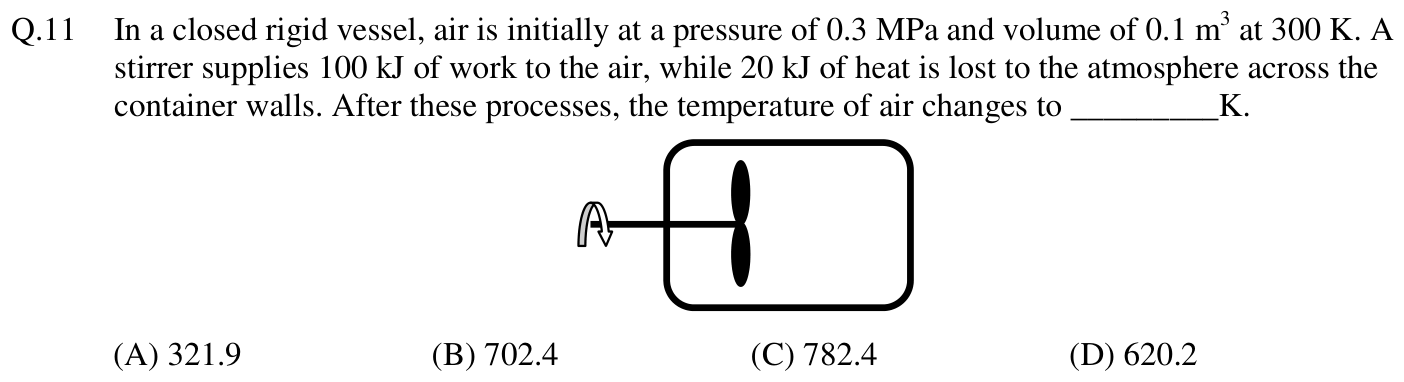
- A. 321.9
- B. 702.4
- C. 782.4
- D. 620.2
Answer: D. 620.2
Question 210
Year: 2014 | Marks: 2
A reversible heat engine (E) operates using three thermal reservoirs with temperatures as shown in the following figure. If Q1=Q2, the efficiency of the engine is ___________.
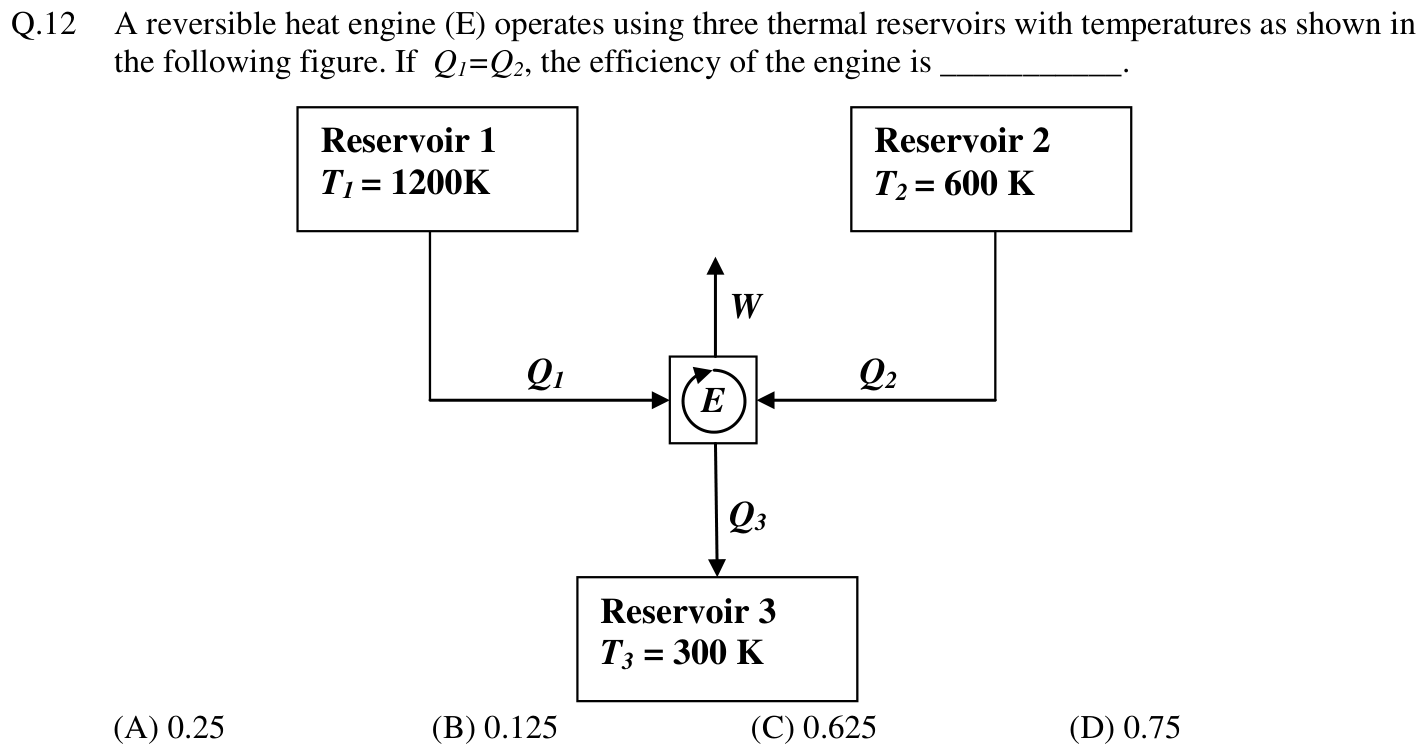
- A. 0.25
- B. 0.125
- C. 0.625
- D. 0.75
Answer: C. 0.625
Question 211
Year: 2014 | Marks: 2
A metal block of mass 25 kg at 300 K is immersed in an infinitely large liquid nitrogen bath maintained at 77 K. The system comprising of the block and liquid nitrogen attains thermal equilibrium. The average specific heat of the metal is 0.45 kJ/(kg.K). The entropy generated during the process is ___________kJ/K.
- A. 17.28
- B. 32.5
- C. 47.8
- D. −47.8
Answer: A. 17.28
Question 212
Year: 2014 | Marks: 2
For a gas obeying the equation of state given by RT v v a P = + 2 , the values of the critical volume and the critical temperature are 0.004 m3/kg and 100 °C, respectively. If the value of the gas constant is 250 J/(kg.K), then the value of the constant ‘a’ is _____________ (N.m4/kg2). Note that the critical point is the point of inflection on the critical isotherm.
- A. 124.3
- B. 0.75
- C. 186.58
- D. 248.67 Reservoir 1 T1 = 1200K Reservoir 2 T2 = 600 K Reservoir 3 T3 = 300 K Q1 Q2 Q3 E W XE (GATE 2014)
Answer: C. 186.58
Question 213
Year: 2014 | Marks: 2
A rigid closed vessel is initially filled with 2 kg of water which is a mixture of saturated liquid and saturated vapor states at 2 bar. The vessel is placed in an oven which heats the mixture to the critical state. Using the saturated and critical property values from the table given below, the heat transferred from the oven to the vessel is __________kJ. Pressure = 2 bar vf (m3/kg) vg (m3/kg) uf (kJ/kg) ug (kJ/kg) 0.0010605 0.8857 504.49 2529.5 Critical pressure vc (m3/kg) uc (kJ/kg) 0.003155 2029.6
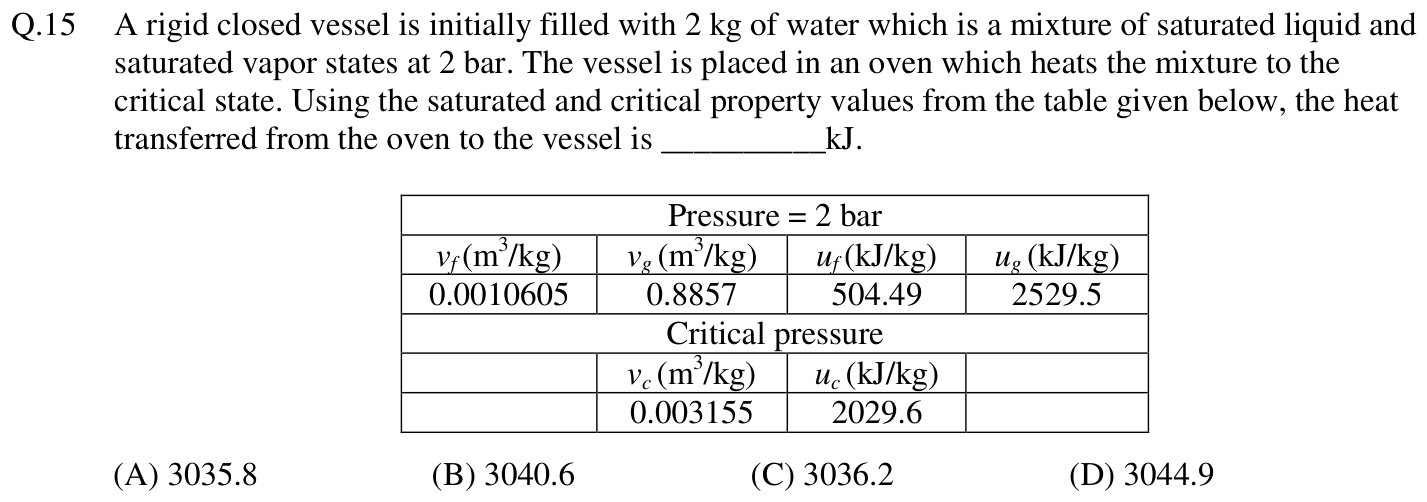
- A. 3035.8
- B. 3040.6
- C. 3036.2
- D. 3044.9
Answer: B. 3040.6
Question 214
Year: 2014 | Marks: 2
The equation of state for a certain gas is given by 2 2 1 / / C T C P RT v + − = , where C1 is 50,000 (K2.m3)/kg and C2 is 0.8 m3/kg. The relation P T T v T v P h ∂ ∂ − = ∂ ∂ is known for the gas. The inversion temperature, given by the condition, = ∂ ∂ 0 T P h is _________K.
- A. 500.0
- B. 433.0
- C. 353.6
- D. 250.0
Answer: B. 433.0
Question 215
Year: 2014 | Marks: 2
The maximum pressure and temperature in an air standard diesel cycle are 44 bar and 1600 K, respectively. If the minimum pressure and temperature are 1 bar and 300 K, respectively, then the cut-off ratio (the ratio of the volume at the end of the heat addition process to that at the beginning of the heat addition process) is
- A. 1.000
- B. 14.920
- C. 2.809
- D. 1.809
Answer: D. 1.809
Question 216
Year: 2014 | Marks: 2
The thermal efficiency of an air standard Brayton cycle 0.35. The pressure ratio across the turbine is
- A. 4.516
- B. 5.232
- C. 7.535
- D. 8.234
Answer: A. 4.516
Question 217
Year: 2014 | Marks: 2
Steam is isentropically expanded in a turbine from 80 bar to 7 bar. At the inlet of the turbine (state 1) h1 is 3246 kJ/kg and s1 is 6.52 kJ/(kg.K). Pressure = 7 bar hf (kJ/kg) hg (kJ/kg) sf [kJ/(kg.K)] sg [kJ/(kg.K)] 697 2763 2.0 6.7 The enthalpy of the steam exiting the turbine (state 2) in kJ/kg is
- A. 2683.87
- B. 2657.17
- C. 1986.87
- D. 3354.17 XE (GATE 2014)
Answer: A. 2683.87
Question 218
Year: 2014 | Marks: 2
A thin insulating membrane separates two tanks initially filled with nitrogen [mean cv = 21.6 J/(mol.K)] and carbon-dioxide [mean cv = 11.6 J/(mol.K)] as shown below. The membrane is ruptured and the gases are allowed to mix to form a homogeneous mixture at equilibrium. During this process there are no heat or work interactions between the tank contents and the surroundings. The final temperature at the equilibrium state in Kelvin is
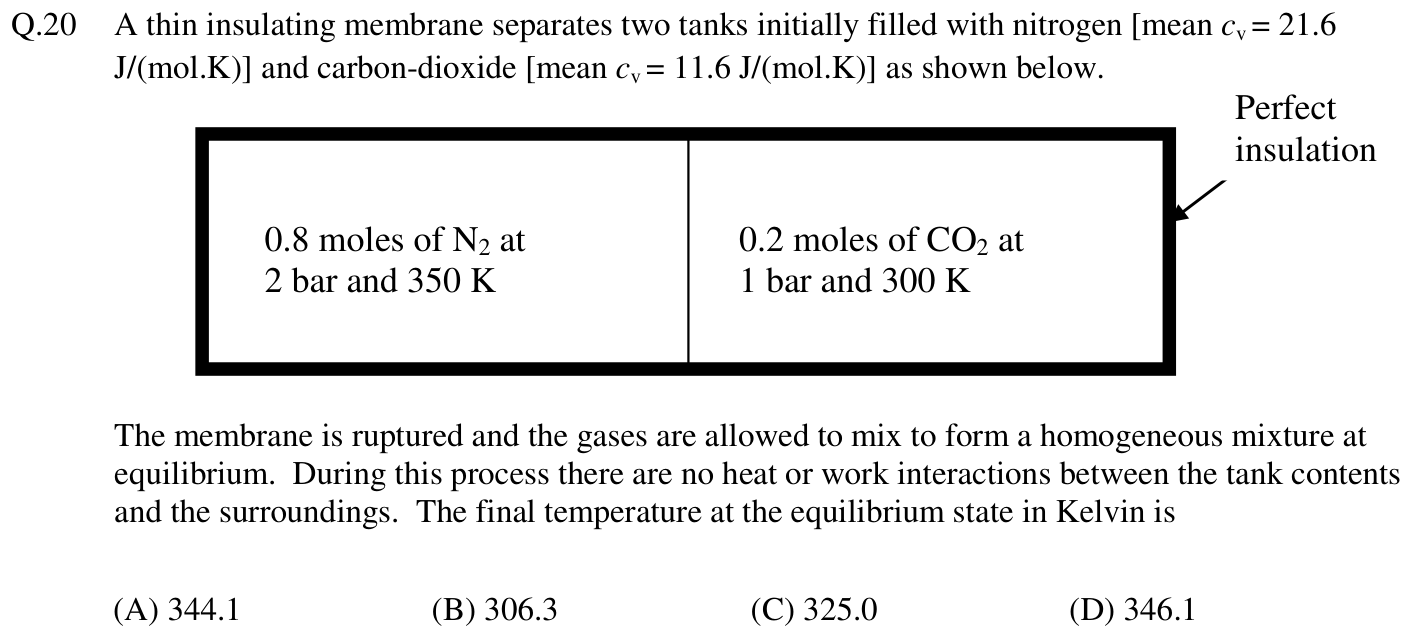
- A. 344.1
- B. 306.3
- C. 325.0
- D. 346.1
Answer: A. 344.1
Question 219
Year: 2014 | Marks: 2
Two moist air streams MAS1 and MAS2 are mixed adiabatically. The details of MAS1 and MAS2 are given below in the table. MAS1 MAS2 h (kJ/kg of dry air) 42 80 v (m3/kg of dry air) 0.85 0.9 Flow rate (m3/min) 85 90 With pressure remaining same and with no work interactions during the mixing process, the enthalpy of the mixed stream is ________________ kJ/kg of dry air.
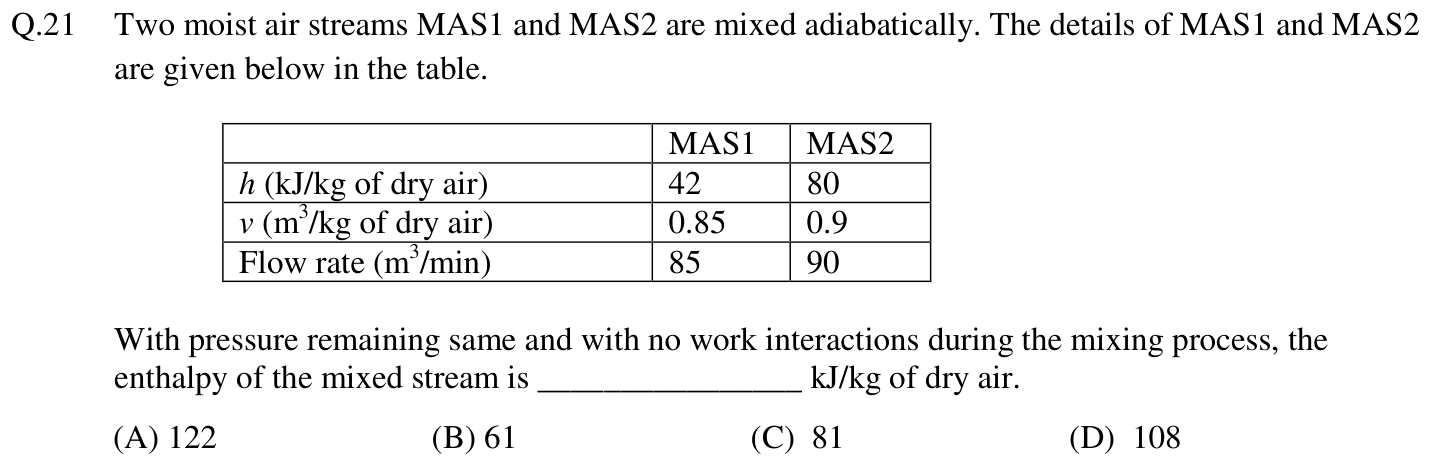
Answer: B. 61
Question 220
Year: 2014 | Marks: 2
Consider the steady flow of air through an insulated nozzle. The pressure and temperature at the inlet are 120 kPa and 320 K, respectively. The outlet pressure is 1 bar. The inlet velocity is very small and the air undergoes a reversible adiabatic process. The outlet velocity, in m/s, is
- A. 303.7
- B. 180.7
- C. 5.7
- D. 127.3 0.8 moles of N2 at 2 bar and 350 K 0.2 moles of CO2 at 1 bar and 300 K Perfect insulation XE (GATE 2014)
Answer: B. 180.7
Question 221
Year: 2013 | Marks: 1
The measured temperature of a system is 30oC.Its exact absolute temperature in K is
- A. 303.00
- B. 303.10
- C. 303.15
- D. 303.16
Question 222
Year: 2013 | Marks: 1
The fuel air mixture in a pertrol engine is ignited with a spark plug at the end of compression stroke. This process
- A. increases the entropy of the fuel air mixture but decreases the entropy of the spark plug
- B. decreases the entropy of the fuel air mixture but increases the entropy of the spark plug
- C. decreases the entropy of the fuel air mixture and of the spark plug
- D. increases the entropy of the fuel air mixture and of the spark plug
Question 223
Year: 2013 | Marks: 1
In the van der Waals equation of state given below: (+ܽݒଶ)(ݒ−ܾ) = The constant a represents the effect of
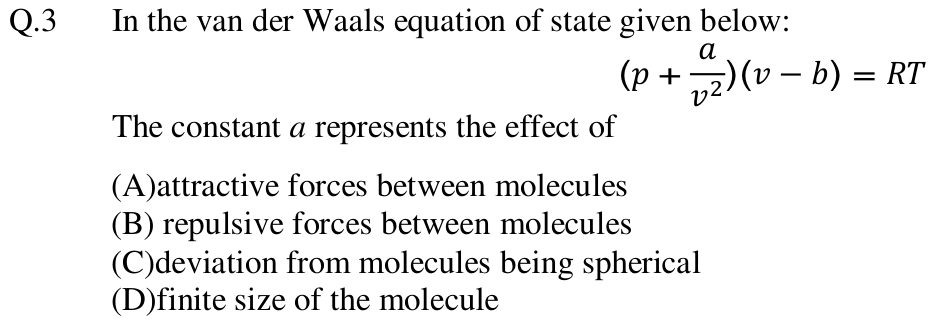
- A. attractive forces between molecules
- B. repulsive forces between molecules
- C. deviation from molecules being spherical
- D. finite size of the molecule
Question 224
Year: 2013 | Marks: 1
For a reversible isothermal expansion of an ideal gas from a state 1 to a state 2,
- A. s1=s2
- B. s1>s2
- C. s1<s2
- D. h1>h2
Question 225
Year: 2013 | Marks: 1
For a pure substance the critical isotherm on the p-v plane exhibits
- A. a maximum
- B. a minimum
- C. a point of inflection
- D. a discontinuity
Question 226
Year: 2013 | Marks: 1
For an ideal gas as a working fluid for a given heat input Q, the process that gives the maximum work among the following four processes is
- A. isothermal
- B. constant volume
- C. constant pressure
- D. isentropic
Question 227
Year: 2013 | Marks: 1
An air standard Otto cycle has the following shape on a thermodynamic property plane. The x and y coordinates, respectively, are
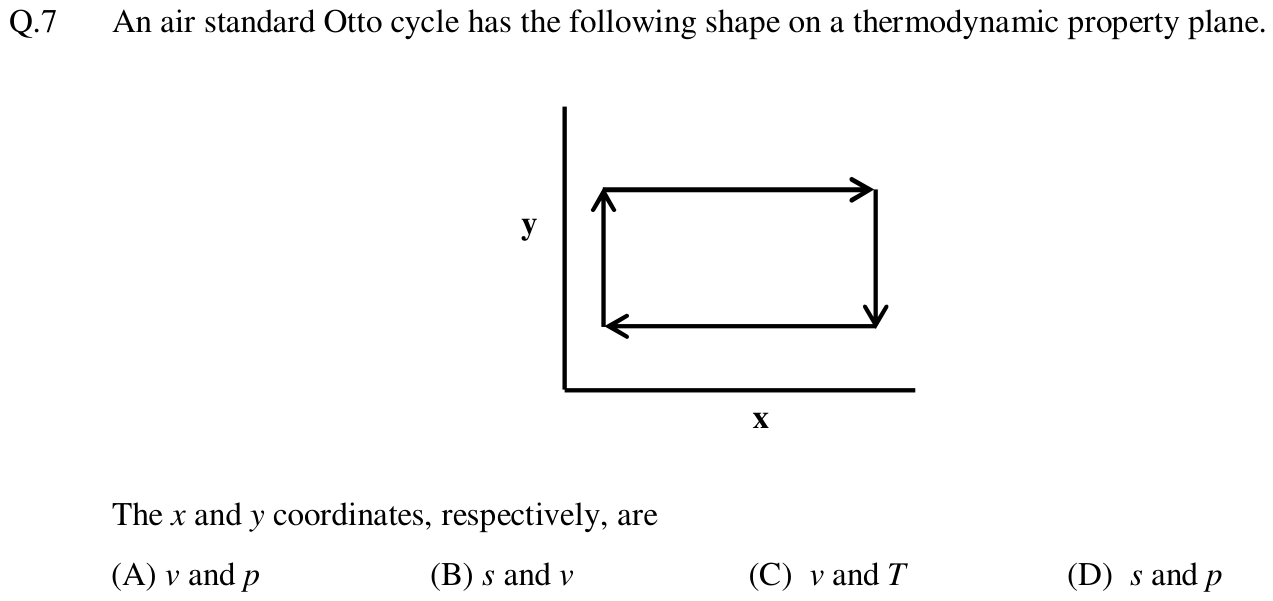
- A. v and p
- B. s and v
- C. v and T
- D. s and p
Question 228
Year: 2013 | Type: NAT | Marks: 1
The specific volume of steam after expansion in a turbine is 12 m3/kg. At this pressure the saturated liquid and saturated vapour specific volumes are 0.001 and 15.25 m3/kg respectively. What is the dryness fraction to second decimal place accuracy? _________
Question 229
Year: 2013 | Marks: 1
Which of the following processes, shown in the figure below, represents the throttling of an ideal gas?
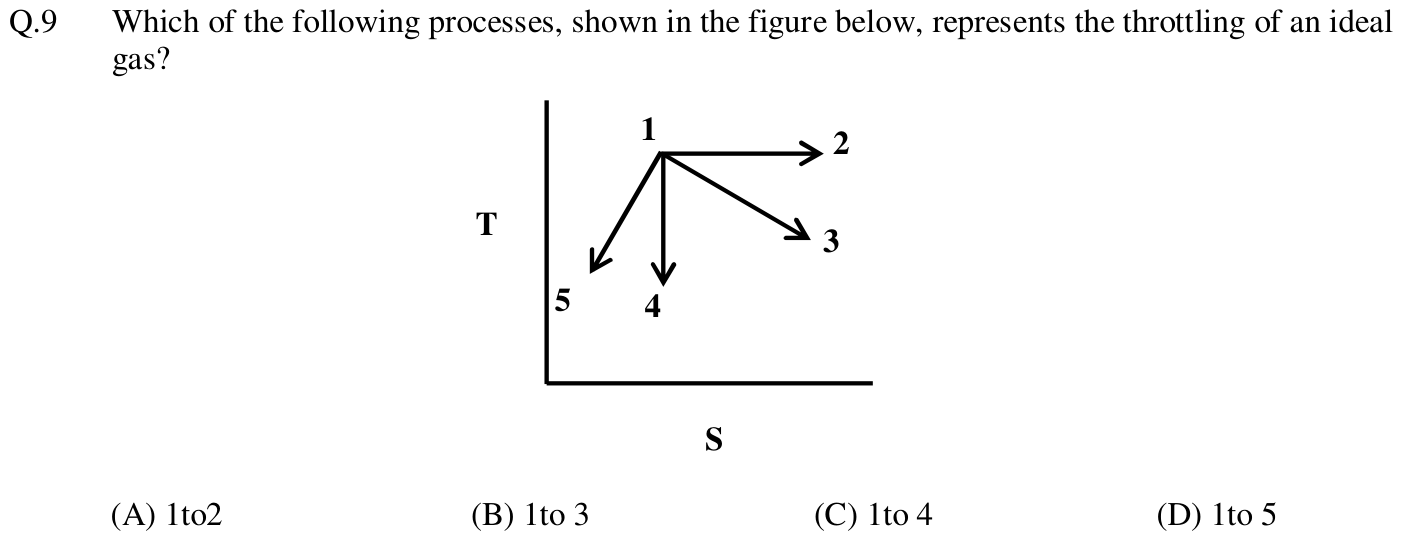
- A. 1to2
- B. 1to 3
- C. 1to 4
- D. 1to 5
Question 230
Year: 2013 | Marks: 2
On a ln pvsh coordinate system, where ln p is the y-coordinate and h is the x coordinate, the slope of a constant entropy line is
- A. 1/v
- B. v
- C. p/v
- D. 1/(pv)
Question 231
Year: 2013 | Marks: 2
Starting from the definition of Gibbs free energy function g=h-Ts, the Maxwell relation that can be derived is

- A. డ డ்ቚ ௦= ௩ ௦
- B. డ డ்ቚ ௦= ݒ
- C. డ௩ డ௦ቚ = − డ డ்ቚ ௦
- D. డ௩ డ்ቚ = − డ௦ డቚ் y x T S 1 2 3 4 5
Question 232
Year: 2013 | Type: NAT | Marks: 2
A thermodynamic cycle operates between one source at a temperature of 600 K, another source at a temperature of 300 K and a sink at a temperature T as shown in the figure below If the First and Second laws of thermodynamics are not violated, what should be the value of T in K? _____________
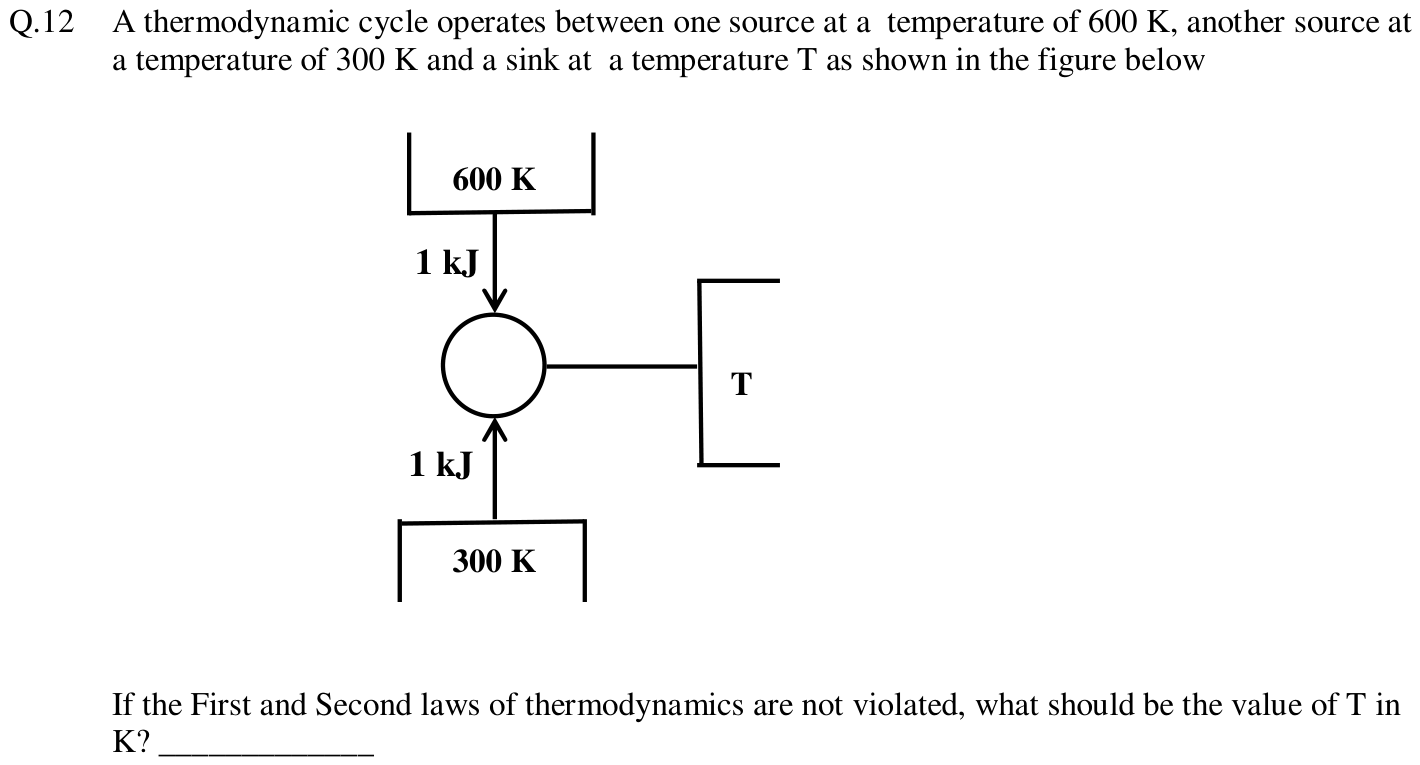
Question 233
Year: 2013 | Marks: 2
A closed system containing an ideal gas undergoes a cycle as shown in the figure shown below. For the process1-2, which one of the following statements is true?
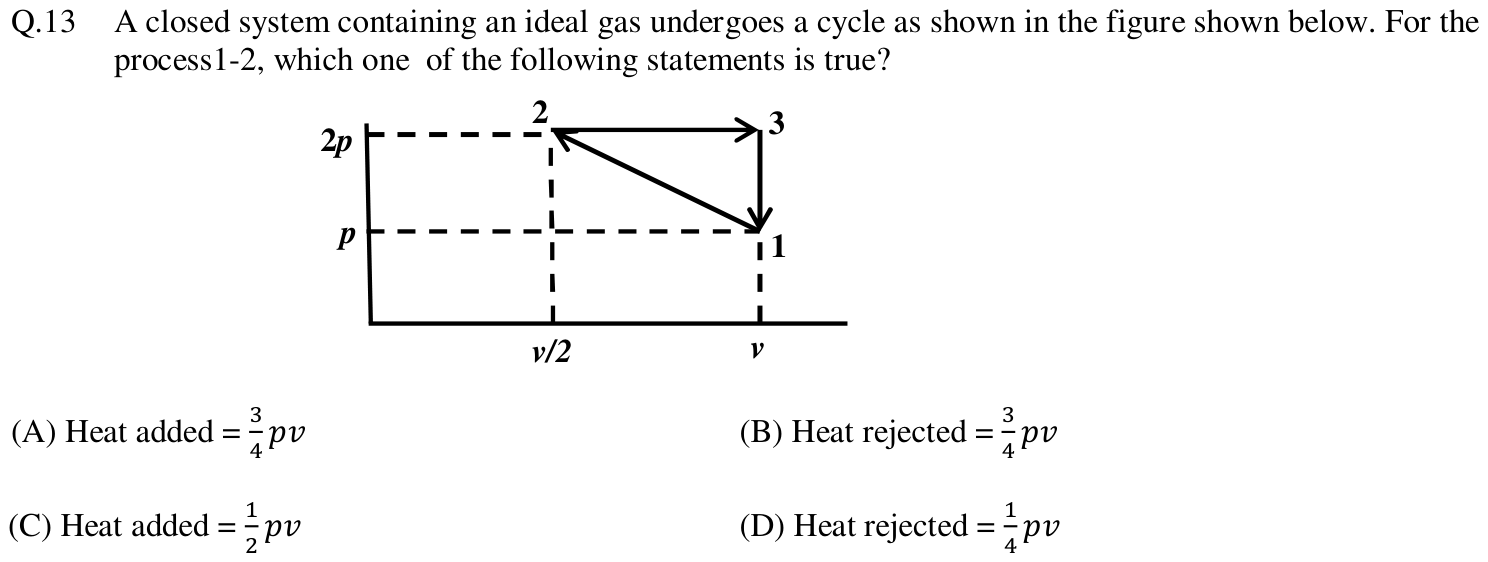
- A. Heat added = ଷ ସݒ
- B. Heat rejected = ଷ ସݒ
- C. Heat added = ଵ ଶݒ
- D. Heat rejected = ଵ ସݒ 600 K 300 K T 1 kJ 1 kJ p v v/2 2p 2 1 3
Question 234
Year: 2013 | Type: NAT | Marks: 2
A well-insulated rigid hot water tank receives steady flow of water from two sources as shown in the figure below There is no accumulation of water in the tank. A back-up heater is provided to ensure a constant outflow temperature of water at 60 oC from the tank under steady state. What is the required capacity of the back-up heater to the nearest kW? __________
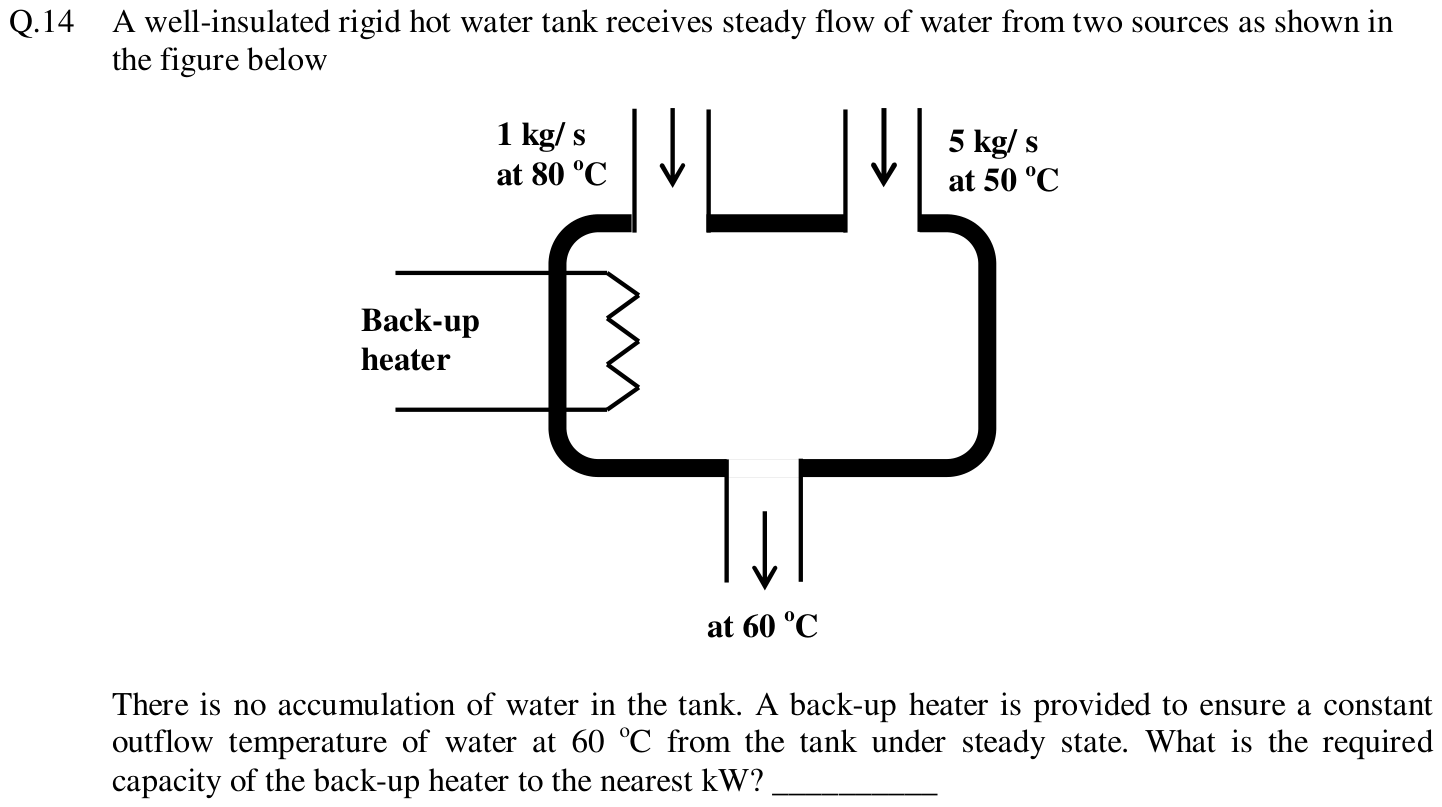
Question 235
Year: 2013 | Type: NAT | Marks: 2
1 kg of air in an insulated rigid tank of volume 1 m3is churned with a friction-less fan (see figure below) of 600 W capacity for 10 minutes. The fan efficiency is 100 %. Treating air as an ideal gas and neglecting kinetic and potential energy changes, what is the increase of pressure, to the nearest kPa? _________
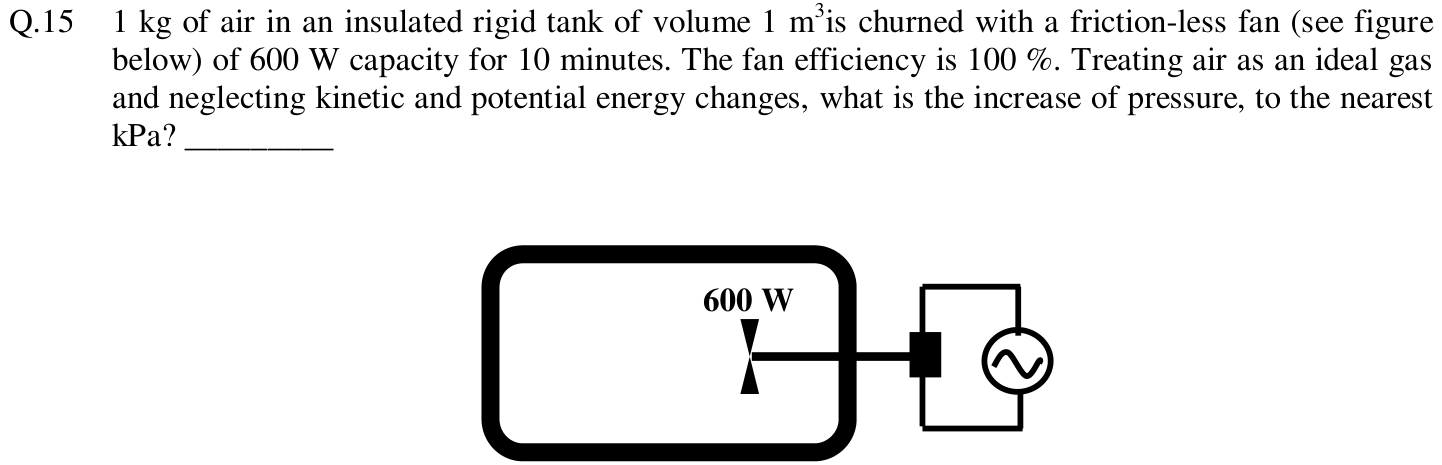
Question 236
Year: 2013 | Type: NAT | Marks: 2
The isothermal compressibility of a liquid is 5 × 10⁻⁶ /kPa. If it is compressed at constant temperature from 5000 to 10000kPa, what is the ratio of final volume to initial volume, to second decimal place accuracy? ____________
Question 237
Year: 2013 | Type: NAT | Marks: 2
What is the partial pressure of water vapour in kPa to the first decimal place accuracy before the high pressure front moves in? ____________
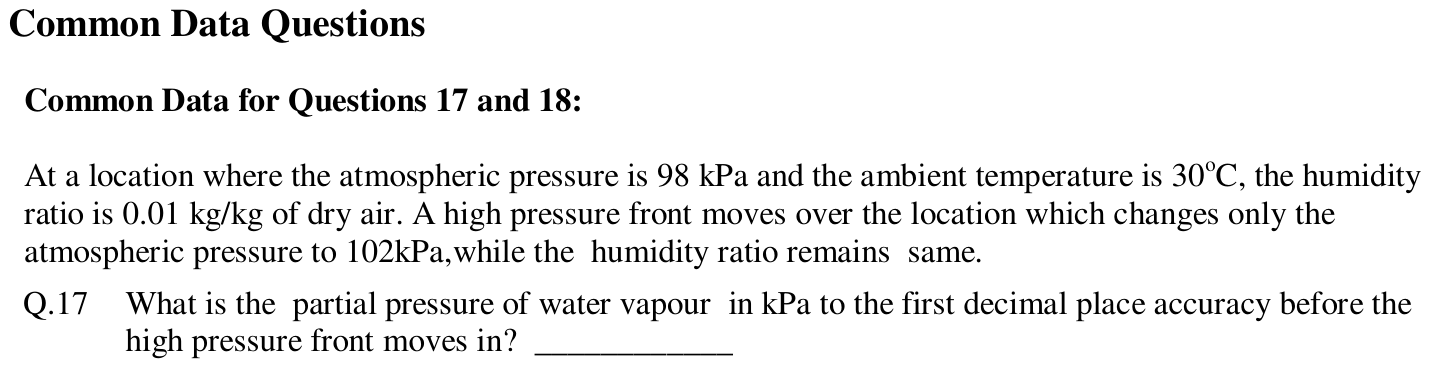
Question 238
Year: 2013 | Type: NAT | Marks: 2
What is the relative humidity of air under the influence of high pressure front to integer precision in %? _____ 1 kg/ s at 80 oC 5 kg/ s at 50 oC at 60 oC Back-up heater 600 W
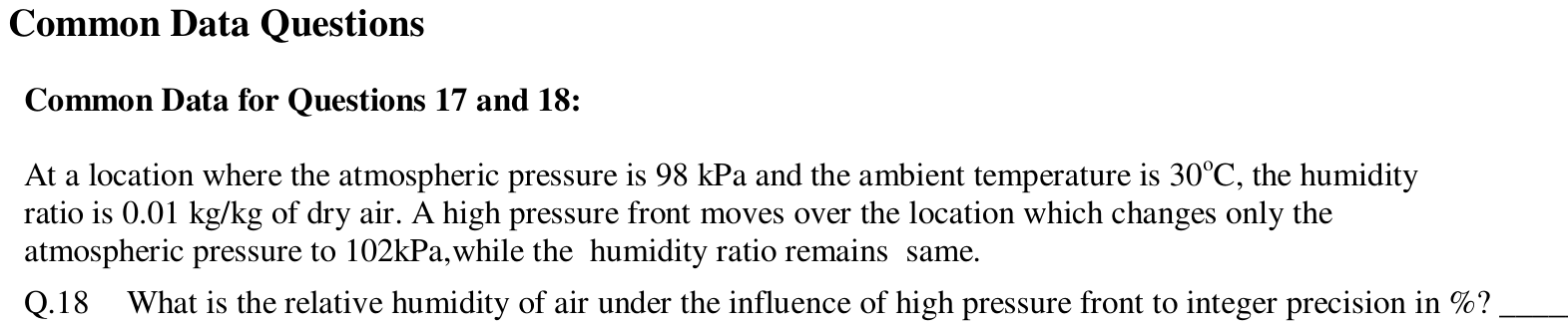
Question 239
Year: 2013 | Type: NAT | Marks: 2
What is the ratio of the volumes of chambers A and B, i.e. VA/VB, to first decimal place accuracy? ________
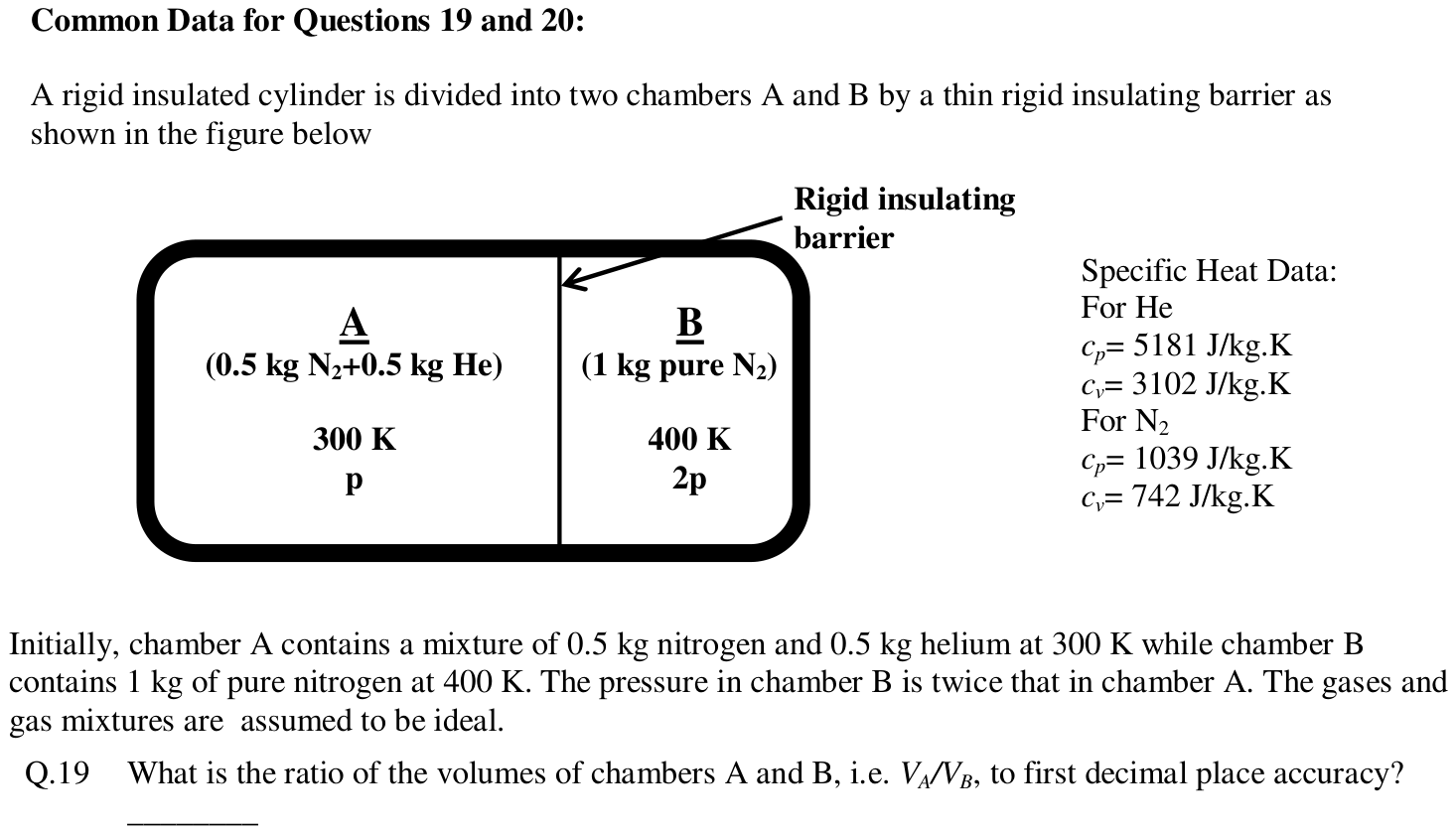
Question 240
Year: 2013 | Type: NAT | Marks: 2
If the barrier is removed and the gases are allowed to mix and reach thermodynamic equilibrium, what is the final temperature of the mixture, to the nearest K? ________
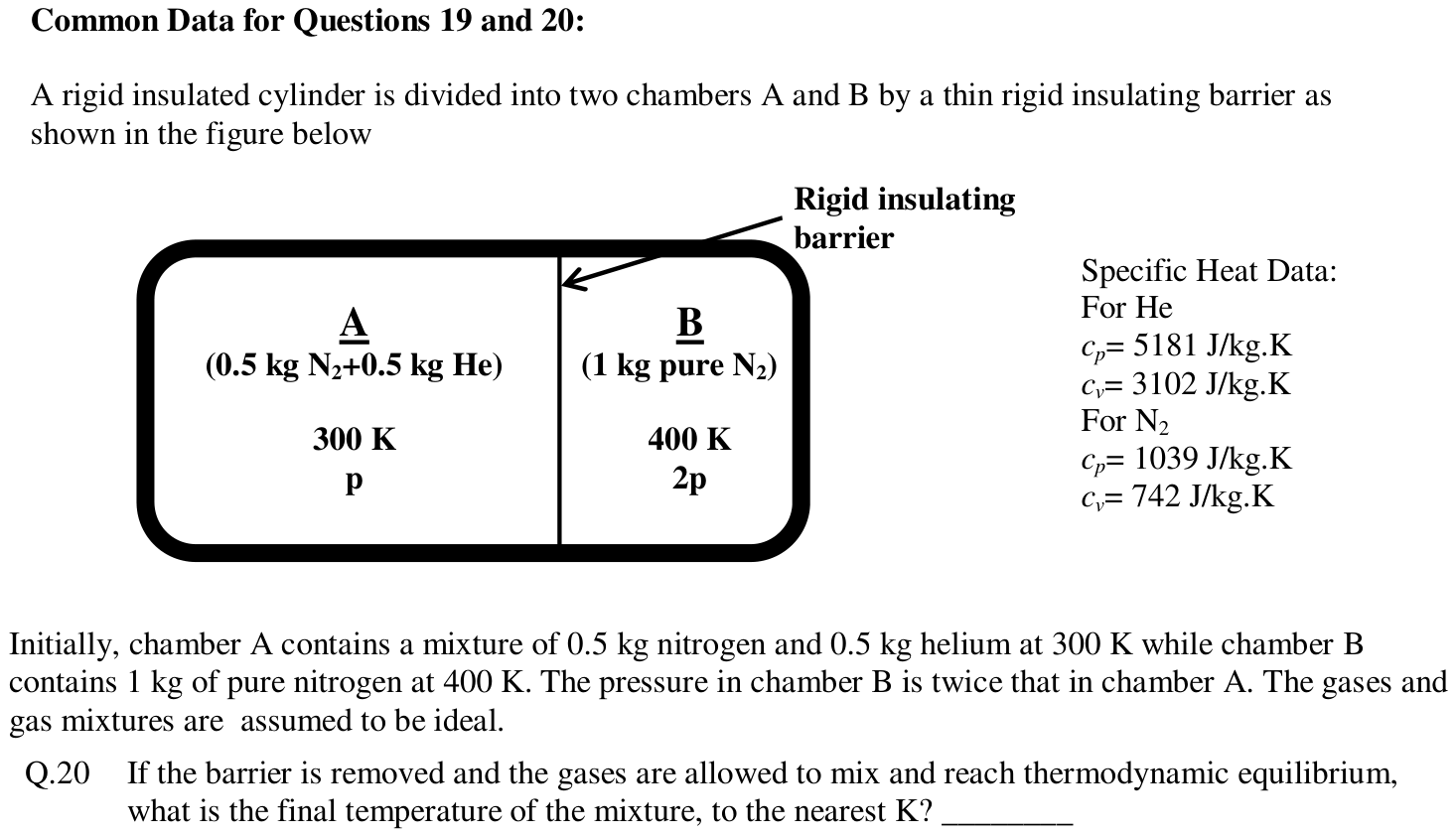
Question 241
Year: 2013 | Type: NAT | Marks: 2
What is the mass flow rate of the working fluid through the turbine, in kg/s, to first decimal place accuracy? __________
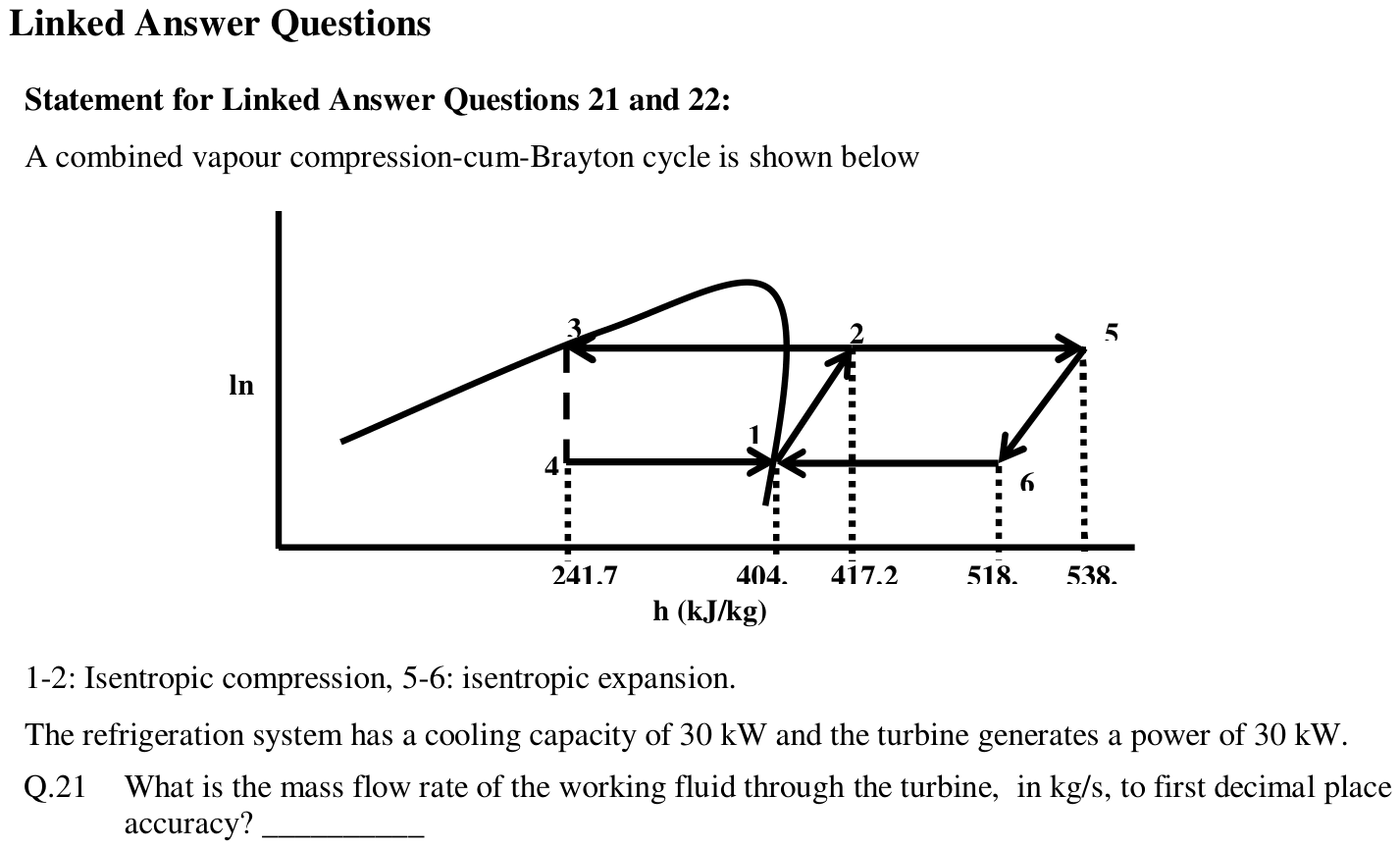
Question 242
Year: 2013 | Type: NAT | Marks: 2
What is the power required to drive the compressor, to the nearest kW? ________ ln h (kJ/kg) 538. 518. 417.2 404. 241.7 1 2 4 3 5 6 A (0.5 kg N2+0.5 kg He) 300 K p B (1 kg pure N2) 400 K 2p Rigid insulating barrier Specific Heat Data: For He cp= 5181 J/kg.K cv= 3102 J/kg.K For N2 cp= 1039 J/kg.K cv= 742 J/kg.K
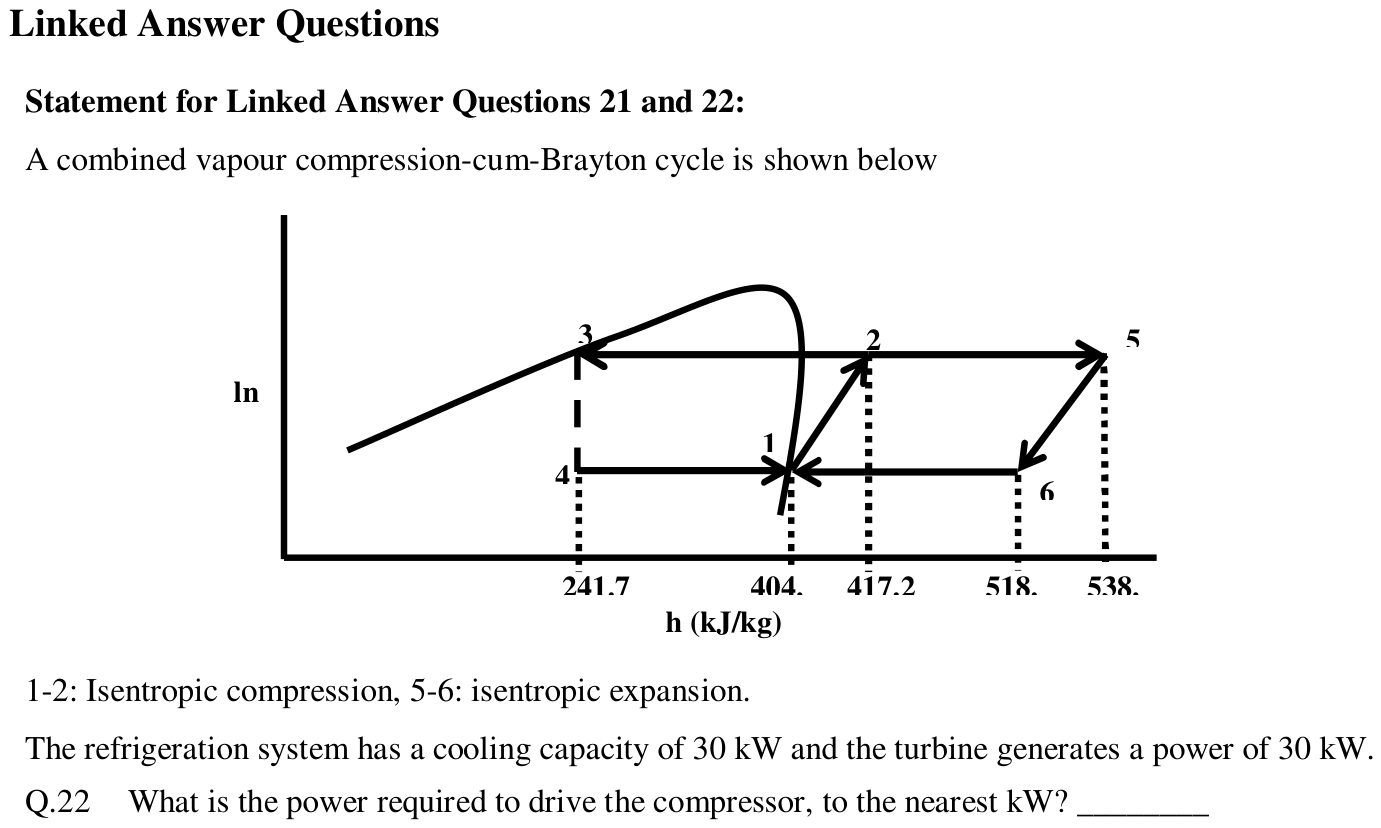
Question 243
Year: 2012 | Marks: 1
Consider a piston-cylinder arrangement containing a gas. This system is heated by placing it on the top of a burner. The system undergoes
- A. a constant volume process
- B. a constant pressure process
- C. an adiabatic process
- D. an isothermal process
Answer: B. a constant pressure process
Question 244
Year: 2012 | Marks: 1
For a pure substance, at the triple point
- A. only solid and liquid phases co-exist in equilibrium
- B. only liquid and vapour phases co-exist in equilibrium
- C. only solid and vapour phases co-exist in equilibrium
- D. solid, liquid and vapour phases co-exist in equilibrium
Answer: D. solid, liquid and vapour phases co-exist in equilibrium
Question 245
Year: 2012 | Marks: 1
In a saturated liquid-vapour mixture, the property quality, x is defined as
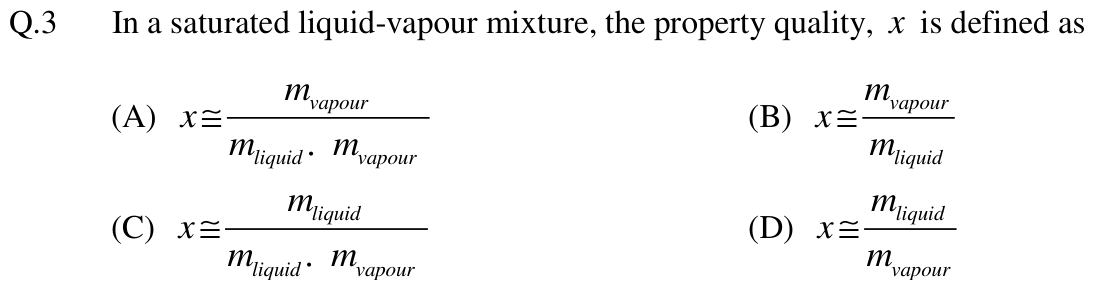
- A. vapour liquid vapour m x m m = +
- B. vapour liquid m x m =
- C. liquid liquid vapour m x m m = +
- D. liquid vapour m x m =
Answer: A. vapour liquid vapour m x m m = +
Question 246
Year: 2012 | Marks: 1
The slope of a Mollier diagram at constant pressure indicates
- A. enthalpy
- B. entropy
- C. internal energy
- D. temperature
Answer: D. temperature
Question 247
Year: 2012 | Marks: 1
If L Q represents the magnitude of heat transfer from a low temperature reservoir to a cyclic device and H Q represents the magnitude of heat transfer from a cyclic device to a high temperature reservoir, then for the same L Q and H Q , the coefficient performance of a refrigerator ( ) R COP and the coefficient performance of a heat pump ( ) HP COP can be related as
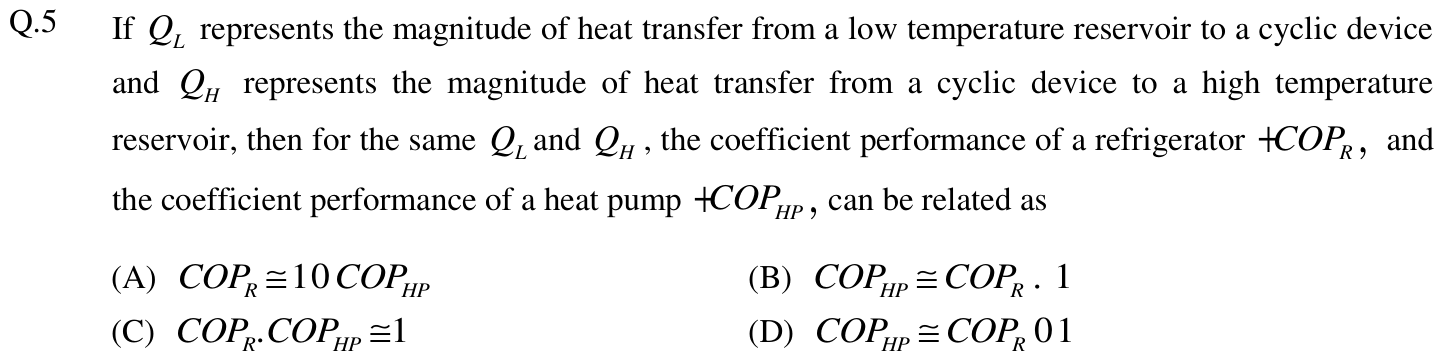
- A. 1 R HP COP COP =−
- B. 1 HP R COP COP = +
- C. . 1 R HP COP COP =
- D. 1 HP R COP COP = −
Answer: B. 1 HP R COP COP = +
Question 248
Year: 2012 | Marks: 1
Clausius inequality is written as

- A. ∫ >0 Q δ
- B. ∫ <0 Q δ
- C. ∫ ≤0 T Q δ
- D. ∫ >0 T Q δ
Answer: C. ∫ ≤0 T Q δ
Question 249
Year: 2012 | Marks: 1
In a Diesel cycle, the ratio of cylinder volumes after and before combustion process is called
- A. cut-off ratio
- B. back work ratio
- C. pressure ratio
- D. compression ratio
Answer: A. cut-off ratio
Question 250
Year: 2012 | Marks: 1
The exergy (or availability) of a system at a specified state
- A. depends on the conditions of the system alone
- B. depends on the conditions of the environment alone
- C. depends on the conditions of both the system and environment
- D. depends neither on the conditions of the system nor the environment
Answer: C. depends on the conditions of both the system and environment
Question 251
Year: 2012 | Marks: 1
In each of the following choices, there are two expressions given. Select the choice that gives, first, the defining expression of volume expansivity and second, the expression of volume expansivity for ideal gases
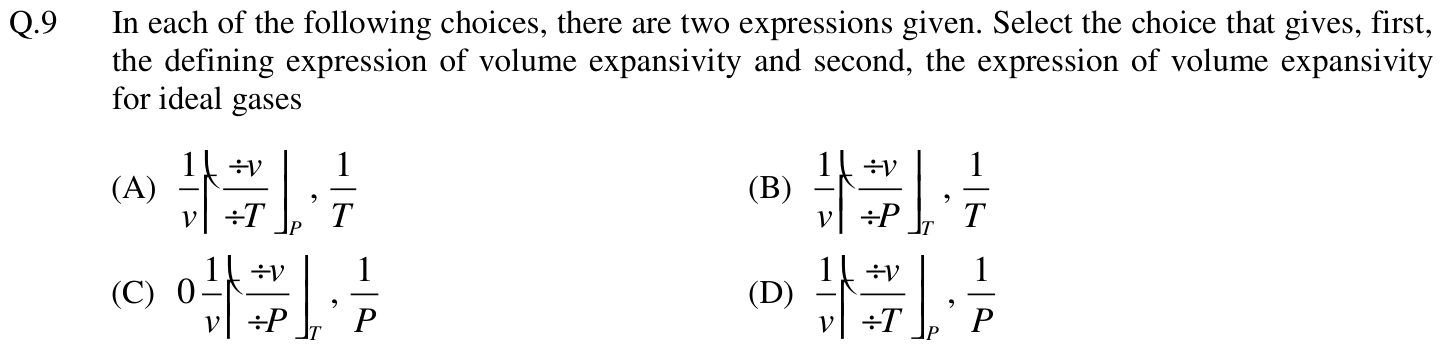
- A. 1 1 , P v v T T ∂ ∂
- B. 1 1 , T v v P T ∂ ∂
- C. 1 1 , T v v P P ∂ − ∂
- D. 1 1 , P v v T P ∂ ∂
Answer: A. 1 1 , P v v T T ∂ ∂
Question 252
Year: 2012 | Marks: 2
A certain mass of gas at 0oC is expanded to 81 times its original volume under adiabatic conditions. If ratio of specific heats of the gas, 1.25 γ= , the final temperature of the gas is

- A. – 235 oC
- B. – 182 oC
- C. – 91 oC
- D. 0 oC
Answer: B. – 182 oC
Question 253
Year: 2012 | Marks: 2
A sample of gas with initial average kinetic energy, E is heated from 27 oC to 327 oC. The average kinetic energy after heating is
Answer: B. 2E
Question 254
Year: 2012 | Marks: 2
Helium in a piston/cylinder assembly at 20oC and 100 kPa is brought to 400 K in a reversible polytropic process with exponent n = 1.25. Assume helium to be an ideal gas. The molecular mass of helium is 4.003 kg/kmol. The specific work in the process is approximately
- A. – 800 kJ/kg
- B. – 788 kJ/kg
- C. 788 kJ/kg
- D. – 888 kJ/kg
Answer: D. – 888 kJ/kg
Question 255
Year: 2012 | Marks: 2
32 kg of oxygen is mixed with 28 kg of nitrogen at the same temperature. The gases are at the same pressure of 103 kPa before and after mixing. If R is the universal gas constant in kJ/kmol.K, the change in entropy of the mixture is

- A. 1.38R
- B. 0.69R
- C. R
- D. 0.34R
Answer: A. 1.38R
Question 256
Year: 2012 | Marks: 2
Consider two Carnot heat engines A and B operating in series. Engine A receives heat from a reservoir at 1750 K and rejects heat to another reservoir at temperature T. Engine B receives an amount of energy same as that rejected by Engine A from the reservoir at temperature T. Engine B then rejects heat to another reservoir at 320 K. In both cases, the engines produce some amount of work. If the thermal efficiencies of both the engines are the same, then the temperature T is approximately
- A. 848 K
- B. 748 K
- C. 648 K
- D. 548 K
Answer: B. 748 K
Question 257
Year: 2012 | Marks: 2
Joule-Thomson coefficient for a gas, j μ obeying the relation ( ) p v b RT − = is

- A. p j c b μ=
- B. j p b c μ=
- C. j p b c μ=−
- D. p j c b μ=−
Answer: C. j p b c μ=−
Question 258
Year: 2012 | Marks: 2
The correct expression representing Z to be a thermodynamic property is
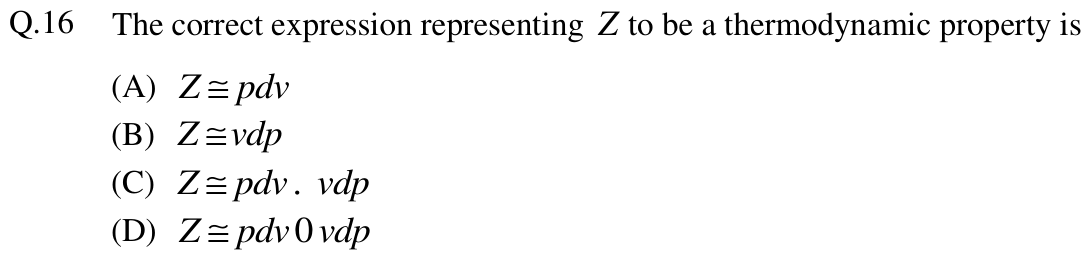
- A. Z pdv =
- B. Z vdp =
- C. Z pdv vdp = +
- D. Z pdv vdp = −
Answer: C. Z pdv vdp = +
Question 259
Year: 2012 | Marks: 2
The temperature and pressure at the triple point are
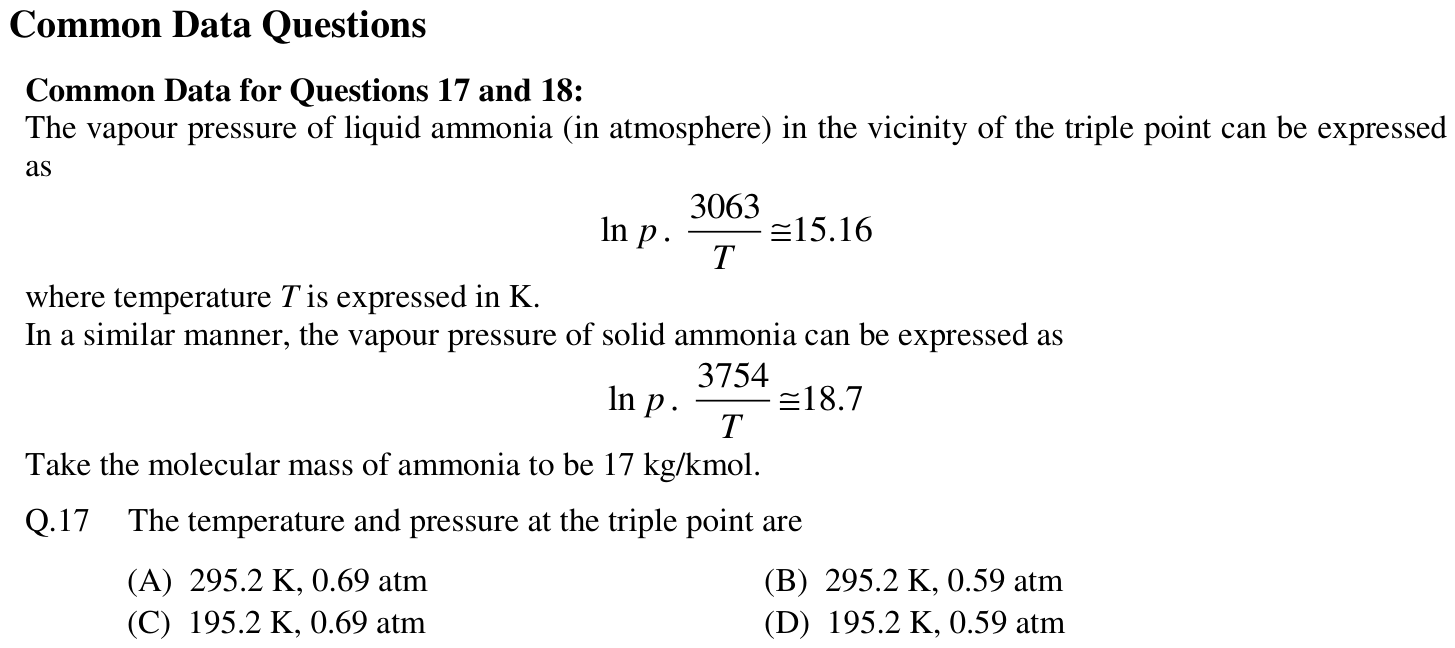
- A. 295.2 K, 0.69 atm
- B. 295.2 K, 0.59 atm
- C. 195.2 K, 0.69 atm
- D. 195.2 K, 0.59 atm
Answer: D. 195.2 K, 0.59 atm
Question 260
Year: 2012 | Marks: 2
The latent heat of vapourization is
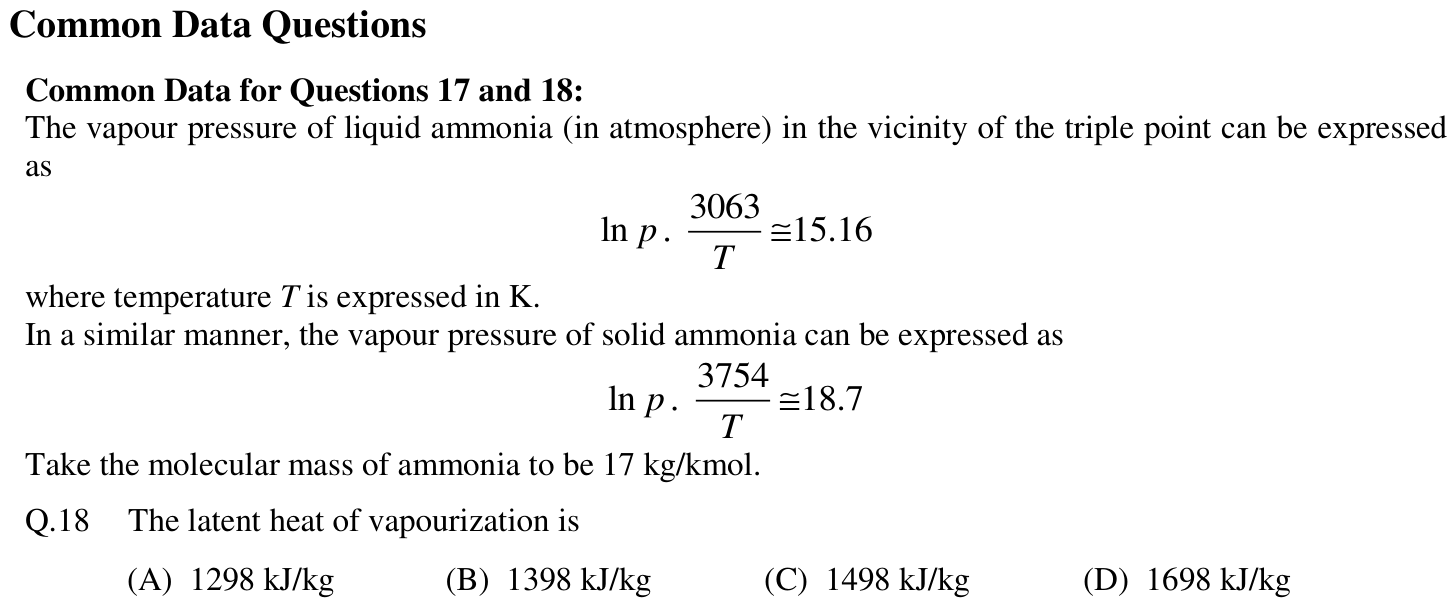
- A. 1298 kJ/kg
- B. 1398 kJ/kg
- C. 1498 kJ/kg
- D. 1698 kJ/kg
Answer: C. 1498 kJ/kg
Question 261
Year: 2012 | Marks: 2
The heat transfer in the boiler is approximately
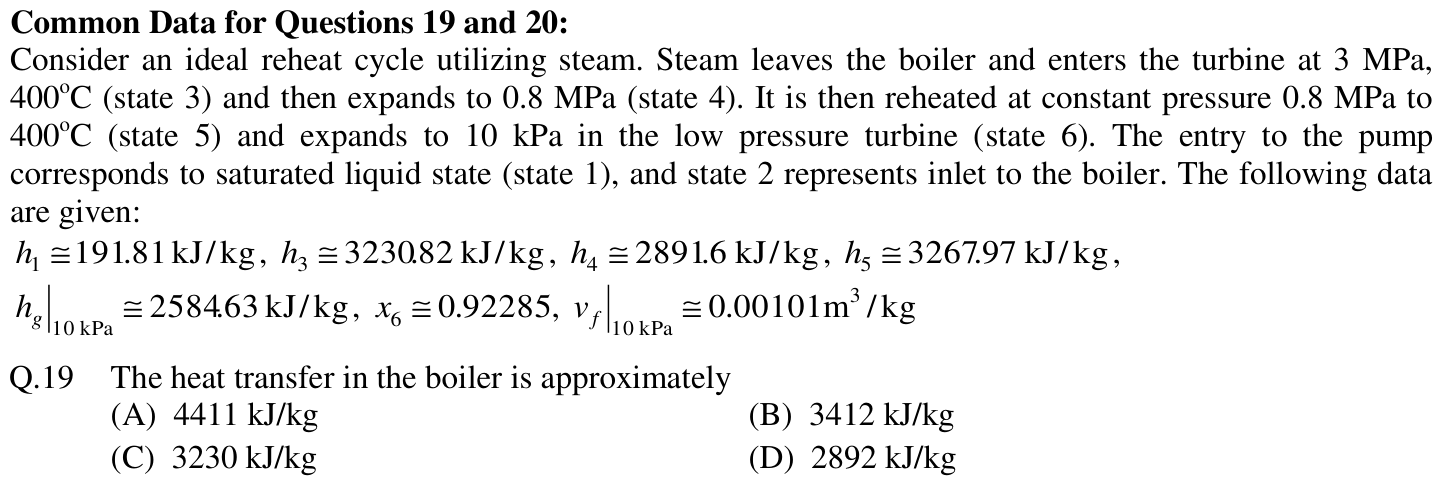
- A. 4411 kJ/kg
- B. 3412 kJ/kg
- C. 3230 kJ/kg
- D. 2892 kJ/kg
Answer: B. 3412 kJ/kg
Question 262
Year: 2012 | Marks: 2
The net workdone in the cycle is approximately
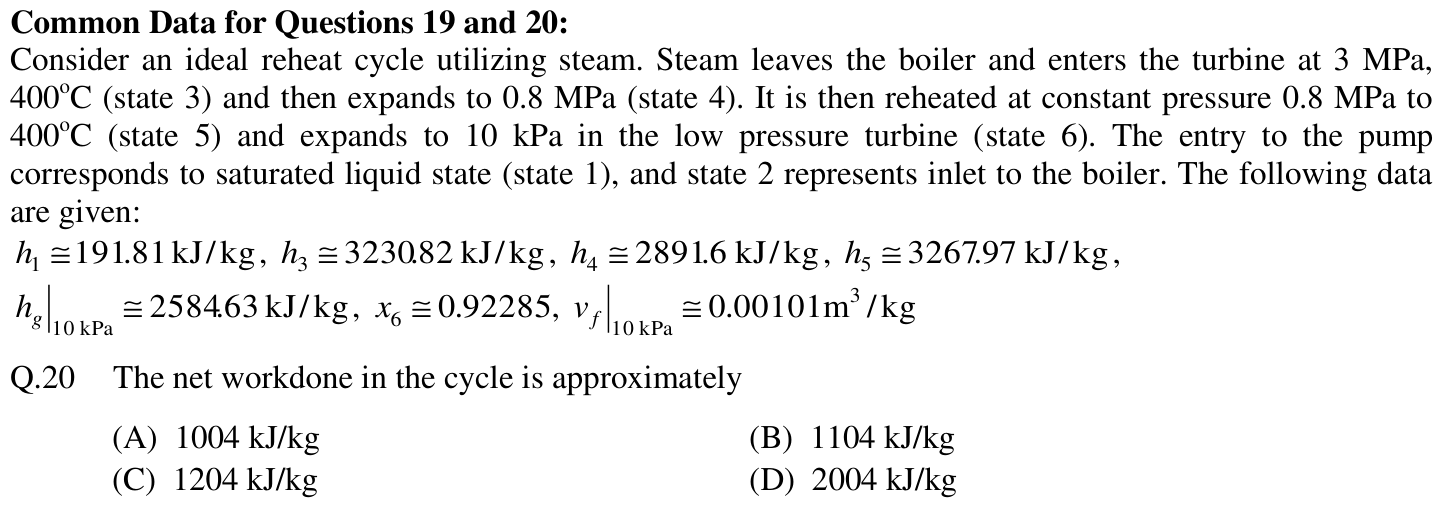
- A. 1004 kJ/kg
- B. 1104 kJ/kg
- C. 1204 kJ/kg
- D. 2004 kJ/kg
Answer: C. 1204 kJ/kg
Question 263
Year: 2012 | Marks: 2
The final pressure in the cylinder is
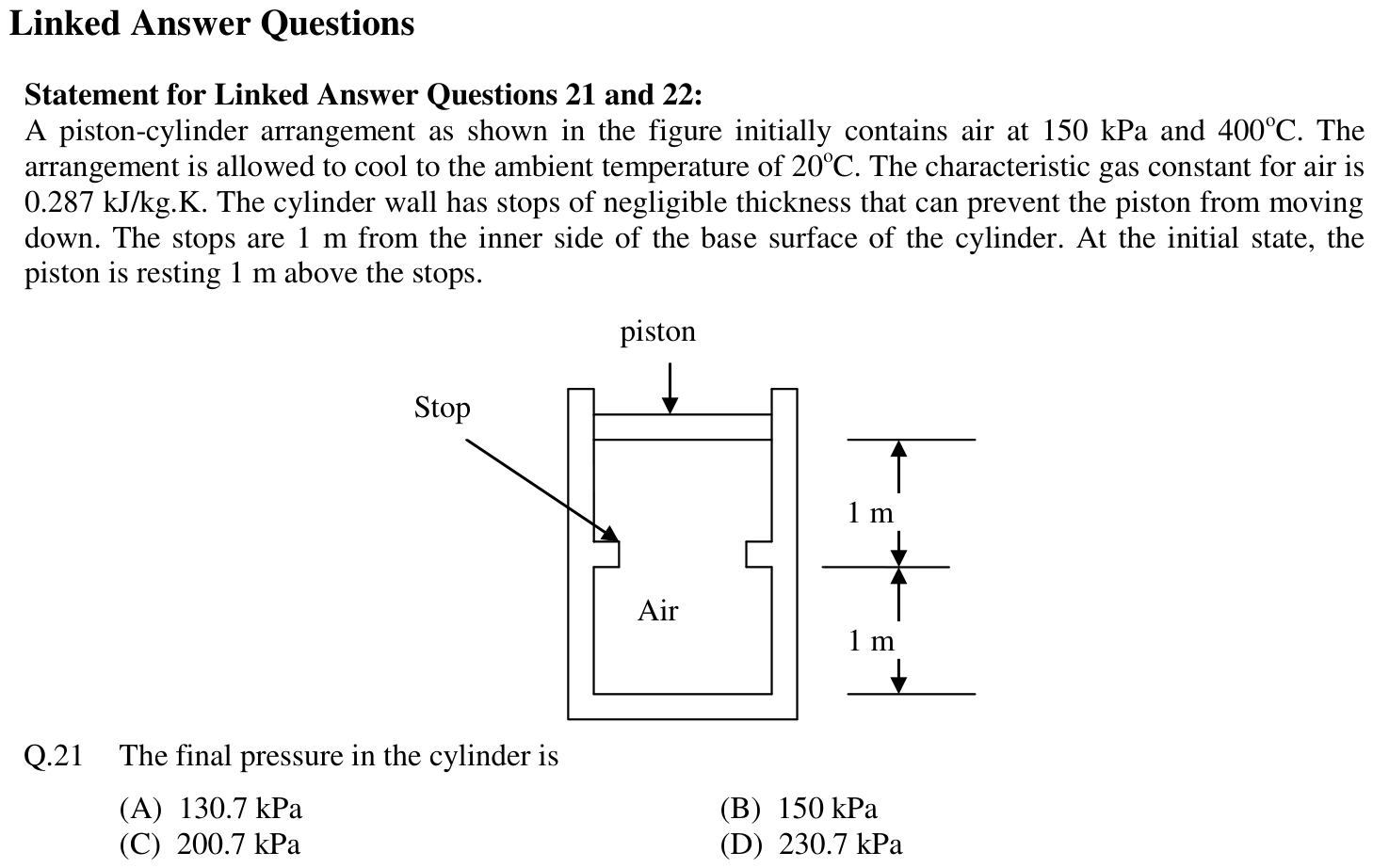
- A. 130.7 kPa
- B. 150 kPa
- C. 200.7 kPa
- D. 230.7 kPa
Answer: A. 130.7 kPa
Question 264
Year: 2012 | Marks: 2
The specific work done by the air during the process is
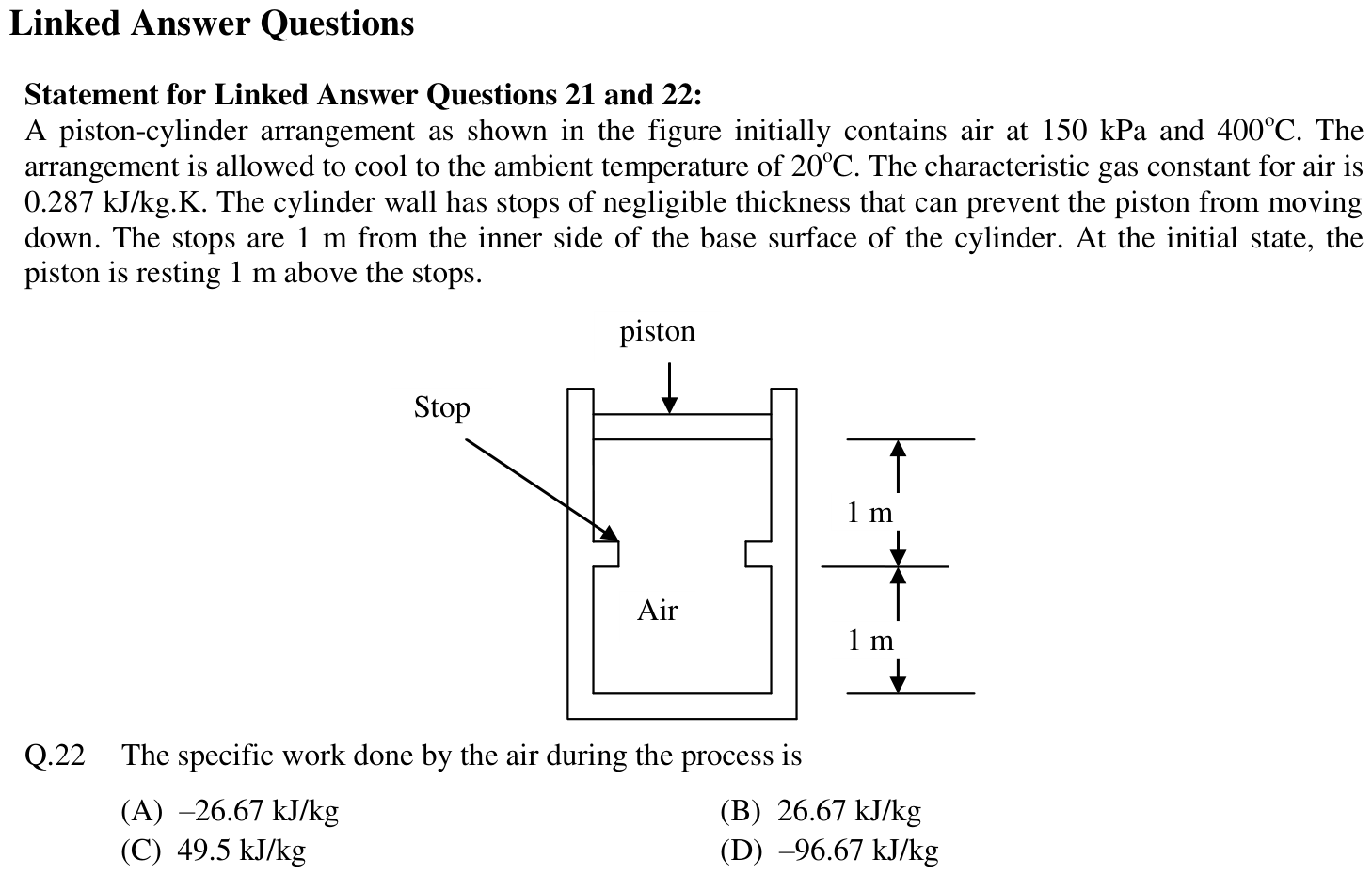
- A. –26.67 kJ/kg
- B. 26.67 kJ/kg
- C. 49.5 kJ/kg
- D. –96.67 kJ/kg Air Stop piston 1 m 1 m
Answer: D. –96.67 kJ/kg Air Stop piston 1 m 1 m
Question 265
Year: 2007 | Marks: 1
The specific gravity of ice at $0^\circ\text{C}$ is
- A. greater than unity
- B. less than unity
- C. equal to unity
- D. cannot say; insufficient information
Question 266
Year: 2007 | Marks: 1
Which one of the following equations is correct?
- A. $v = (1 - x)v_f + x v_g$
- B. $v = v_f + v_g$
- C. $v = x v_f + (1 - x)v_g$
- D. $v = x(v_f + v_g)$
Question 267
Year: 2007 | Marks: 1
In an ideal vapour compression refrigeration system, the process in the condenser is
- A. heat addition at constant pressure
- B. heat removal at constant volume
- C. heat removal at constant pressure
- D. heat addition at constant volume
Question 268
Year: 2007 | Marks: 1
One kilogram of a perfect gas at $15^\circ\text{C}$ and $100\text{ kPa}$ is heated to $45^\circ\text{C}$ by (i) a constant pressure process and (ii) a constant volume process. $c_p$ of the gas $= 1.042\text{ kJ/kg}\cdot\text{K}$ and $R = 0.2968\text{ kJ/kg}\cdot\text{K}$. Heat added in the constant pressure ($Q_p$) and constant volume ($Q_v$) processes are
- A. $Q_p = 31.26\text{ kJ}$, $Q_v = 22.35\text{ kJ}$
- B. $Q_p = 22.35\text{ kJ}$, $Q_v = 31.26\text{ kJ}$
- C. $Q_p = 31.26\text{ kJ}$, $Q_v = 31.26\text{ kJ}$
- D. $Q_p = 22.35\text{ kJ}$, $Q_v = 0\text{ kJ}$
Question 269
Year: 2007 | Marks: 1
A system is capable of exchanging energy with its surroundings in the form of $n$ reversible work modes. The number of independent variables that completely specify the state of the system is
- A. $n - 2$
- B. $n - 1$
- C. $n$
- D. $n + 1$
Question 270
Year: 2007 | Marks: 1
A system is partitioned into two equal parts. An intensive property of each part will
- A. become half
- B. remain unchanged
- C. double
- D. depend on the nature of the intensive property
Question 271
Year: 2007 | Marks: 2
The polytropic index $n$ of an isochoric process is equal to
- A. zero
- B. one
- C. minus one
- D. infinity
Question 272
Year: 2007 | Marks: 2
Two systems A and B, possessing the same internal energy, contain saturated liquid-vapour mixture of water at $1\text{ MPa}$. The maximum value of the ratio of their masses is
Question 273
Year: 2007 | Marks: 2
The net work output for the cycle 1-2-3-4-5-6-1 shown in Figure F9 is
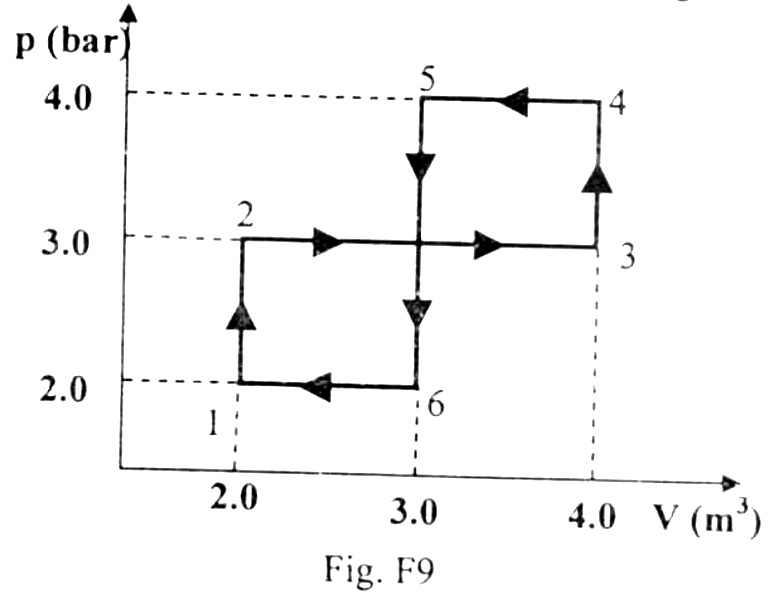
- A. 200 kJ
- B. 1200 kJ
- C. 0 kJ
- D. 1000 kJ
Question 274
Year: 2007 | Marks: 2
Steam enters an adiabatic turbine steadily at $450^\circ\text{C}$ and $4.0\text{ MPa}$ and leaves at $50\text{ kPa}$. The minimum possible dryness fraction of the steam at the turbine exit is approximately
Question 275
Year: 2007 | Marks: 2
A rigid vessel contains saturated liquid-vapour mixture of water at $10\text{ MPa}$. On being heated, the mixture reaches the critical point. The initial quality of the mixture is approximately
Question 276
Year: 2007 | Marks: 2
A Diesel engine has a compression ratio of $16$ and cut-off takes place at $8\%$ of stroke. Assuming an air-standard cycle, the cut-off ratio is
- A. 1.20
- B. 2.20
- C. 3.20
- D. 4.20
Question 277
Year: 2007 | Marks: 2
In a Brayton cycle, if $\Delta T_e$ is the temperature change during the expansion process, and $\Delta T_c$ is the change in temperature during the compression process, then
- A. $|\Delta T_e| - |\Delta T_c| > 0$
- B. $|\Delta T_e| - |\Delta T_c| < 0$
- C. $|\Delta T_e| - |\Delta T_c| = 0$
- D. $|\Delta T_e| - |\Delta T_c|$ solely depends on the compression ratio
Question 278
Year: 2007 | Marks: 2
A rigid tank is connected through a valve to steam mains supplying steam at $1\text{ MPa}$, $400^\circ\text{C}$. Heat is transferred from the tank to the surroundings, and the valve is closed when the total amount of cooling is $2000\text{ kJ}$. The energy contained in the tank is the same before and after the process. Neglecting potential and kinetic energy changes, the mass of the steam that enters the tank is
- A. 0.676 kg
- B. 6.76 kg
- C. 0.612 kg
- D. 6.12 kg
Question 279
Year: 2007 | Marks: 2
Steady heat transfer takes place through a plane wall in the outward direction at the rate of $1500\text{ W}$. The inner surface temperature of the wall is $27^\circ\text{C}$. The entropy generation is $0.25\text{ W/K}$. The outer-surface temperature of the wall is
- A. $2.7^\circ\text{C}$
- B. $5.1^\circ\text{C}$
- C. $7.2^\circ\text{C}$
- D. $12.7^\circ\text{C}$
Question 280
Year: 2007 | Marks: 2
Consider an ideal gas in a frictionless piston cylinder assembly. The weightless piston is initially loaded with a large number of small weights. How would you carry out a reversible isothermal expansion process? Assume that a large number of very small weights, and an arrangement for reversible heat transfer are available.
- A. without adding or removing weights on the piston, transfer heat to the system
- B. without adding or removing weights on the piston, transfer heat from the system
- C. adding weights on the piston, transfer heat to the system
- D. removing weights from the piston, transfer heat to the system
Question 281
Year: 2007 | Marks: 2
Consider an isentropic process undergone by an incompressible liquid. The change in temperature experienced by the liquid is $\Delta T = T_2 - T_1$. Which one of the following is correct?
- A. $\Delta T = 0$
- B. $\Delta T > 0$
- C. $\Delta T < 0$
- D. $\Delta T$ depends on the liquid under consideration
Question 282
Year: 2007 | Marks: 2
In the following $T$-$p$ diagram, an inversion curve is shown. Which one of the following is correct?
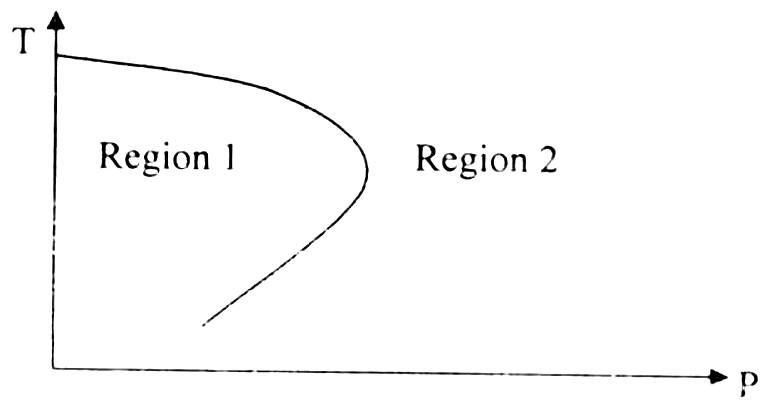
- A. Region 1: Cooling, Region 2: Cooling
- B. Region 1: Heating, Region 2: Cooling
- C. Region 1: Cooling, Region 2: Heating
- D. Region 1: Heating, Region 2: Heating
Question 283
Year: 2007 | Marks: 2
A large furnace can supply heat at a temperature of $1200\text{ K}$ at a steady rate of $3200\text{ kW}$. The ambient temperature is $27^\circ\text{C}$. The availability of this energy is
- A. 0 kW
- B. 800 kW
- C. 1200 kW
- D. 2400 kW
Question 284
Year: 2007 | Marks: 2
For a system containing an ideal gas, the difference between Gibbs function and Helmholtz function
- A. depends on pressure only
- B. depends on temperature only
- C. depends on both pressure and temperature
- D. is independent of both pressure and temperature
Question 285
Year: 2007 | Marks: 2
Match items in Group I with those in Group II: Group I: (P) Critical point, (Q) Dry saturated vapour, (R) Superheated vapour. Group II: (1) $\text{Quality} = 1.0$, (2) $v_f = v_g$, (3) $T > T_{sat}$, (4) $T < T_{sat}$.
- A. P-1, Q-2, R-3
- B. P-1, Q-3, R-2
- C. P-2, Q-1, R-3
- D. P-2, Q-1, R-4
Question 286
Year: 2007 | Marks: 2
Consider steady flow of air ($c_p = 1005\text{ J/kg}\cdot\text{K}$) in an adiabatic passage. Air enters the passage at $100\text{ kPa}$, $500\text{ K}$ at a velocity of $150\text{ m/s}$ and exits the passage at $510\text{ K}$. Assume air to be an ideal gas and neglect gravitational effects. The passage is a
- A. diffuser, and the velocity at the exit is approximately 49 m/s
- B. diffuser, and the velocity at the exit is approximately 79 m/s
- C. nozzle, and the velocity at the exit is approximately 179 m/s
- D. nozzle, and the velocity at the exit is approximately 249 m/s
Question 287
Year: 2007 | Marks: 2
Common Data: A reversible heat engine receives heat inputs of $300\text{ kJ}$ and $200\text{ kJ}$ from two thermal reservoirs at $1000\text{ K}$ and $800\text{ K}$, respectively. The engine rejects heat $Q$ to a reservoir at $300\text{ K}$. The value of $Q$ is
- A. 65 kJ
- B. 165 kJ
- C. 100 kJ
- D. 265 kJ
Question 288
Year: 2007 | Marks: 2
Common Data: A reversible heat engine receives heat inputs of $300\text{ kJ}$ and $200\text{ kJ}$ from two thermal reservoirs at $1000\text{ K}$ and $800\text{ K}$, respectively. The engine rejects heat $Q$ to a reservoir at $300\text{ K}$. The work delivered by the engine is
- A. 35 kJ
- B. 135 kJ
- C. 235 kJ
- D. 335 kJ
Question 289
Year: 2007 | Marks: 2
Linked Answer Q.25 & Q.26: A piston-cylinder arrangement contains an ideal gas mixture of $1\text{ kg}$ Nitrogen ($M = 28\text{ kg/kmol}$, $\gamma = 1.4$) and $2\text{ kg}$ of Argon ($M = 40\text{ kg/kmol}$, $\gamma = 1.667$), at $100\text{ kPa}$, $300\text{ K}$. The gas expands at constant pressure until the volume increases by $1\text{ m}^3$. The initial volume of the gas mixture is approximately
- A. $2.14\text{ m}^3$
- B. $1.07\text{ m}^3$
- C. $4.28\text{ m}^3$
- D. $3.21\text{ m}^3$
Question 290
Year: 2007 | Marks: 2
Linked Answer Q.25 & Q.26: A piston-cylinder arrangement contains an ideal gas mixture of $1\text{ kg}$ Nitrogen ($M = 28\text{ kg/kmol}$, $\gamma = 1.4$) and $2\text{ kg}$ of Argon ($M = 40\text{ kg/kmol}$, $\gamma = 1.667$), at $100\text{ kPa}$, $300\text{ K}$. The gas expands at constant pressure until the volume increases by $1\text{ m}^3$. The heat added is approximately
- A. 145.81 kJ
- B. 97.21 kJ
- C. 291.65 kJ
- D. 218.72 kJ
Question 291
Year: 2007 | Marks: 2
Linked Answer Q.27 & Q.28: A rigid tank contains a mixture of $0.2\text{ kg}$ of saturated water vapour and $2\text{ kg}$ of air ($M = 29\text{ kg/kmol}$) at a temperature of $50^\circ\text{C}$. The volume of the mixture is approximately
- A. $1.42\text{ m}^3$
- B. $2.41\text{ m}^3$
- C. $4.12\text{ m}^3$
- D. $0.412\text{ m}^3$
Question 292
Year: 2007 | Marks: 2
Linked Answer Q.27 & Q.28: A rigid tank contains a mixture of $0.2\text{ kg}$ of saturated water vapour and $2\text{ kg}$ of air ($M = 29\text{ kg/kmol}$) at a temperature of $50^\circ\text{C}$. The pressure of the tank is approximately
- A. 89.4 kPa
- B. 98.4 kPa
- C. 48.9 kPa
- D. 148.9 kPa