Question 1
Year: 2025 | Marks: 1
Let 𝑋 and 𝑌 be two random variables with mean 0, variance 1, and correlation coefficient 1 3 . Then the value of Var(𝑋+ 3𝑌) is equal to
- A. 9
- B. 10
- C. 11
- D. 12
Answer: D. 12
Practice topic-wise Engineering Mathematics (XE-A) previous year questions for GATE XE (Engineering Sciences) with the official answer key. Step-by-step explanations are coming soon.
All GATE XE (Engineering Sciences) papers
160 questions. Answers are shown only where the official answer key is available.
Year: 2025 | Marks: 1
Let 𝑋 and 𝑌 be two random variables with mean 0, variance 1, and correlation coefficient 1 3 . Then the value of Var(𝑋+ 3𝑌) is equal to
Answer: D. 12
Year: 2025 | Marks: 1
Consider the second order Partial Differential Equation (PDE) 4𝑥2 𝜕2𝑢 𝜕𝑥2 + 4(𝑥+ 𝑦) 𝜕2𝑢 𝜕𝑥𝜕𝑦+ (𝑥2 + 𝑦2) 𝜕2𝑢 𝜕𝑦2 − 𝑢= 0. Then which one of the following statements is correct ?
Answer: A. The PDE is hyperbolic in the region {(𝑥, 𝑦) ∈ℝ2: −1 < 𝑥< 0, 𝑦< 0}
Year: 2025 | Marks: 1
Consider the infinite series (𝑃): ∑ 1 (𝑛log 𝑛)1/𝑛 ∞ 𝑛=2 (𝑄): ∑𝑛𝑛 (2𝑛)! ∞ 𝑛=1 Then which one of the following statements is correct ?
Answer: D. Series (𝑃) diverges and series (𝑄) converges
Year: 2025 | Marks: 1
Suppose the polynomial 𝑎+ 𝑏𝑥+ 𝑐𝑥2 + 𝑑𝑥3 interpolates the data, (−1, 1), (0, 3), (1, 2) and (2, 4). Then which one of the following statements is correct ?
Answer: A. 𝑎= −2𝑐, 𝑑= −2𝑏
Year: 2025 | Marks: 1
Let 𝐶 be the positively oriented boundary of the domain bounded by the curves 𝑦= 2𝑥2 and 𝑦2 = 4𝑥. Then the value of the line integral ∮(2𝑦2 + 2𝑥𝑦+ 4𝑦)𝑑𝑥+ (𝑥2 + 4𝑥𝑦+ 8𝑥)𝑑𝑦 𝐶 is equal to
Answer: A. 8 3
Year: 2025 | Type: NAT | Marks: 1
Let 𝑦(𝑥) be the solution of the initial value problem, 𝑥2𝑦′′ + 𝑥𝑦′ −𝑦= 0, 𝑥> 0, 𝑦(1) = 0, 𝑦′(1) = 2. Then the value of 𝑦′ ( 1 2) is equal to (Answer in integer) _______
Answer: 5
Year: 2025 | Type: NAT | Marks: 1
Suppose that 2 is an eigenvalue of the matrix [ 0 3 −𝛼 0 1 0 1 −1 3 ] Then the value of 𝛼 is equal to (Answer in integer) __________
Answer: 2
Year: 2025 | Marks: 2
Let 𝑓(𝑧) be an analytic function such that 𝑅𝑒(𝑓′(𝑧)) = 3𝑥2 −4𝑦−3𝑦2, 𝑓(𝑖) = 0, 𝑓′(0) = 0, where 𝑖= √−1. Then the value of 𝑓(1) is equal to
Answer: B. 1 + 5𝑖
Year: 2025 | Marks: 2
Consider the function 𝑓(𝑥, 𝑦) = 𝑥2𝑦+ 2𝑥𝑦2 −2𝑥2𝑦2. Then which one of the following statements is correct ?
Answer: D. ( 3 2 , 3 4) is a saddle point of 𝑓.
Year: 2025 | Type: MSQ | Marks: 2
For 𝑎, 𝑏∈ℝ, consider the system of linear equations 𝑥+ 𝑦+ 𝑎𝑧= 2 2𝑦+ 2𝑧= 1 𝑎𝑥+ 2𝑧= 𝑏 If the system has infinitely many solutions, then which of the following statements is/are correct ?
Answer: A. 𝑎= 2, 𝑏= 3; C. 𝑎= −1, 𝑏= − 3 2
Year: 2025 | Type: NAT | Marks: 2
Let 𝑢(𝑥, 𝑡) be the solution of the initial boundary value problem 𝜕𝑢 𝜕𝑡−𝜕2𝑢 𝜕𝑥2 −𝑢= 0, 0 < 𝑥< 𝜋, 𝑡> 0, 𝑢(𝑥, 0) = 2 sin (3𝑥 2 ) cos (𝑥 2) , 0 < 𝑥< 𝜋, 𝑢(0, 𝑡) = 𝑢(𝜋, 𝑡) = 0, 𝑡> 0. Then the value of lim 𝑡→∞𝑢( 3𝜋 4 , 𝑡) is equal to (rounded off to two decimal places)___________
Answer: 0.68 to 0.73
Year: 2024 | Marks: 1
Let 𝑓(𝑥) = {𝜋+ 𝑥, −𝜋≤𝑥< 0, 0,0 ≤𝑥< 𝜋, with 𝑓(𝑥+ 2𝜋) = 𝑓(𝑥). If 𝐹(𝑥) represents the Fourier series of 𝑓(𝑥), then the value of 𝐹(− 𝜋 2) + 𝐹(0) is
Answer: C. 𝜋
Year: 2024 | Marks: 1
Let 𝑦 be a non-zero quadratic polynomial satisfying the differential equation (2 + 𝑥2) 𝑑2𝑦 𝑑𝑥2 + 𝑥𝑑𝑦 𝑑𝑥−𝑘𝑦= 0, where 𝑘 is a real constant. If 𝑦(1) = 1, then the value of the integral ∫2𝑦𝑑𝑥 1 0 is
Answer: D. 4 3
Year: 2024 | Marks: 1
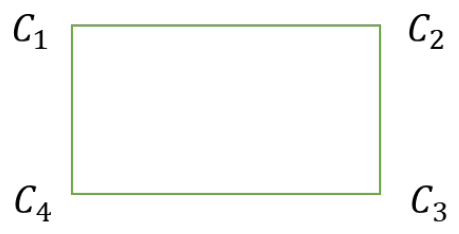
There are four cities, namely, 𝐶1, 𝐶2, 𝐶3 and 𝐶4. The cities are directly connected by four roads as shown in the picture given below, that is, 𝐶1 is connected with 𝐶2, 𝐶2 is connected with 𝐶3, 𝐶3 is connected with 𝐶4, and 𝐶4 is connected with 𝐶1. The probability of any road getting independently blocked is 1 3 . Let 𝐸1 be the event of travelling from 𝐶1 to 𝐶3 via 𝐶2 and 𝐸2 be the event of travelling from 𝐶1 to 𝐶3 via 𝐶4. Then, which of the following statements is correct ?
Answer: A. 𝑃(𝐸1 ∪𝐸2) = 56 81
Year: 2024 | Marks: 1
Assume that 𝑓: [0, 1] →ℝ is continuous on [0, 1] and differentiable on (0, 1) such that 𝑓(𝑥+ ℎ) = 𝑓(𝑥) + ℎ𝑓′(𝑥+ 𝜃ℎ) for some 0 < 𝜃< 1. If 𝑓(𝑥) = 𝑥2(1 + 𝑥), and 𝜃 is expressed in terms of 𝑥 and ℎ, then the value of lim ℎ→0 𝜃(𝑥, ℎ) is
Answer: B. 1 2
Year: 2024 | Type: NAT | Marks: 1
Let 𝐴 be a 3 × 3 matrix whose eigenvalues are 2, 3, 4 and let 𝐼 be the identity matrix of order 3. If 𝐴−1 = 1 2𝑘(𝐴2 −9𝐴) + 13 𝑘𝐼 for some integer 𝑘≠0, then the value of 𝑘 is ______
Answer: 12
Year: 2024 | Type: NAT | Marks: 1
For some integer 𝑘, the differential equation 𝑥2 𝑑2𝑦 𝑑𝑥2 −3𝑥𝑑𝑦 𝑑𝑥+ (𝑘+ 2)𝑦= 0 is transformed into (𝐷−2)2𝑦= 0, where 𝐷= 𝑑 𝑑𝑡 and 𝑡= log𝑒𝑥. Then, the value of 𝑘 is _____
Answer: 2
Year: 2024 | Type: NAT | Marks: 1
The approximate value (rounded off to two decimal places) of the integral ∫𝑒−𝑥2𝑑𝑥 1/2 0 , using the Trapezoidal rule with step-size ℎ= 1 8 , is ______
Answer: 0.42 to 0.55
Year: 2024 | Marks: 2
Consider 𝑓(𝑧) = 𝑒𝑧, where 𝑧= 𝑥+ 𝑖𝑦and 𝑖= √−1. Which of the following statements is correct ?
Answer: A. 𝑓 is periodic
Year: 2024 | Type: MSQ | Marks: 2
Let 𝑃 and 𝑄 be two square matrices of the same order. Then, which of the following matrices is/are necessarily equal to (𝑃+ 2𝑄)2 ?
Answer: B. 𝑃(𝑃+ 2𝑄) + 𝑄(2𝑃+ 4𝑄); C. (𝑃+ 2𝑄)(2𝑄+ 𝑃); D. 𝑃2 + 2𝑃𝑄+ 2𝑄𝑃+ 4𝑄2
Year: 2024 | Type: NAT | Marks: 2
If ∫ ∫𝑒𝑦3 1 √𝑥/𝛼 𝛼 0 𝑑𝑦𝑑𝑥= 𝑒−1, 𝛼> 0, then the value (in integer) of 𝛼 is _____
Answer: 3
Year: 2024 | Type: NAT | Marks: 2
Consider the vector field 𝐹⃗⃗⃗ = (2𝑥+ 𝑦2)𝑖̂ + (2𝑥𝑦+ 3𝑦)𝑗̂ and 𝛼𝑚= ∫ 𝐹⃗⃗⃗ 𝐶𝑚 ⋅𝑑𝑟 , 𝑚= 1, 2, where 𝐶1 is an arc of the unit circle connecting the points (1, 0) and (0, 1) and 𝐶2 is the straight line connecting the points (1, 0) and (0, 1). Then, the value (in integer) of 2(𝛼1 2 + 3𝛼2 2) is ______
Answer: 2
Year: 2023 | Marks: 1
Let 𝐴 be a 3 × 3 real matrix having eigenvalues 1, 2, and 3. If 𝐵= 𝐴2 + 2𝐴+ 𝐼, where 𝐼 is the 3 × 3 identity matrix, then the eigenvalues of 𝐵 are
Answer: A. 4, 9, 16
Year: 2023 | Marks: 1
Let 𝑓: ℝ2 →ℝ be a function defined by 𝑓(𝑥, 𝑦) = { 𝑥𝑦 |𝑥| + 𝑦 , 𝑦≠−|𝑥| 0 , otherwise. Then which one of the following statement is TRUE?
Answer: A. 𝑓 is NOT continuous at (0,0).
Year: 2023 | Marks: 1
If the quadrature formula ∫𝑓(𝑥)𝑑𝑥 1 −1 ≈1 9 (𝑐1𝑓(−1) + 𝑐2𝑓(1 2) + 𝑐3𝑓(1)) is exact for all polynomials of degree less than or equal to 2, then
Answer: A. 𝑐1 + 𝑐2 4 + 𝑐3 = 6
Year: 2023 | Marks: 1
The second smallest eigenvalue of the eigenvalue problem 𝑑2𝑦 𝑑𝑥2 + (𝜆−3)𝑦= 0, 𝑦(0) = 𝑦(𝜋) = 0, is
Answer: C. 7
Year: 2023 | Marks: 1
Which one of the following functions is differentiable at 𝑧= 0 but NOT differentiable at any other point in the complex plane ℂ?
Answer: A. 𝑓(𝑧) = 𝑧|𝑧|, 𝑧∈ℂ
Year: 2023 | Type: NAT | Marks: 1
If the polynomial 𝑃(𝑥) = 𝑎0 + 𝑎1𝑥+ 𝑎2𝑥(𝑥−1) + 𝑎3𝑥(𝑥−1)(𝑥−2) interpolates the points (0, 2), (1, 3), (2, 2), and (3, 5), then the value of 𝑃( 5 2) is _________ (round off to 2 decimal places).
Answer: 2.60 to 2.65
Year: 2023 | Type: NAT | Marks: 1
The value of 𝑚 for which the vector field 𝐹⃗(𝑥, 𝑦) = (4𝑥𝑚𝑦2 −2 𝑥 𝑦𝑚)𝑖̂ + (2𝑥4𝑦−3𝑥2𝑦2)𝑗̂ is a conservative vector field, is _________________ (in integer).
Answer: 3
Year: 2023 | Marks: 2
Let 𝑃= [ 4 −2 2 6 −3 4 3 −2 3 ], and 𝑄= [ 3 −2 2 4 −4 6 2 −3 5 ] . The eigenvalues of both 𝑃 and 𝑄 are 1, 1, and 2. Which one of the following statements is TRUE?
Answer: B. 𝑃 is diagonalizable but 𝑄 is NOT diagonalizable
Year: 2023 | Marks: 2
The surface area of the portion of the paraboloid 𝑧= 𝑥2 + 𝑦2 that lies between the planes 𝑧= 0 and 𝑧= 1 4 is
Answer: A. 𝜋 6 (2√2 −1)
Year: 2023 | Type: NAT | Marks: 2
The probability of a person telling the truth is 4 6 . An unbiased die is thrown by the same person twice and the person reports that the numbers appeared in both the throws are same. Then the probability that actually the numbers appeared in both the throws are same is __________ (round off to 2 decimal places).
Answer: 0.26 to 0.30
Year: 2023 | Type: NAT | Marks: 2
Let 𝑢(𝑥, 𝑡) be the solution of the initial boundary value problem 𝜕𝑢 𝜕𝑡− 𝜕2𝑢 𝜕𝑥2 = 0, 𝑥∈(0, 2), 𝑡> 0 𝑢(𝑥, 0) = sin(𝜋𝑥), 𝑥∈(0, 2) 𝑢(0, 𝑡) = 𝑢(2, 𝑡) = 0. Then the value of 𝑒𝜋2 (𝑢( 1 2 , 1) −𝑢( 3 2 , 1)) is __________ (in integer).
Answer: 2
Year: 2022 | Marks: 1
The value of lim ௫→ 1 𝑥 න ቀ𝑡 ඥ𝑡ଶ5 ቁ 𝑑𝑡 ଶା௫ ଶ is
Answer: C. 5
Year: 2022 | Marks: 1
Let Χ ൌ ൛𝑧ൌ𝑥𝑖𝑦∶𝑥and 𝑦are real numbers, 𝑖ൌ√െ1 ൟ be the set of complex numbers. Let the function 𝑓ሺ𝑧ሻൌ𝑢ሺ𝑥, 𝑦ሻ𝑖 𝑣ሺ𝑥, 𝑦ሻ for 𝑧ൌ𝑥𝑖𝑦 Î Χ be analytic in Χ, where 𝑢ሺ𝑥, 𝑦ሻൌ𝑥 𝑦ଷെ𝑦 𝑥ଷ and 𝑣ሺ𝑥, 𝑦ሻൌ 𝑥ସ 4 𝑦ସ 4 െ 3 2 𝑥ଶ𝑦ଶ. If 𝑓ᇱሺ𝑧ሻ denotes the derivative of 𝑓ሺ𝑧ሻ, then
Answer: C. |𝑓ᇱሺെ1 𝑖ሻ|ଶൌ8
Year: 2022 | Marks: 1
If the partial differential equation ሺ𝑥2ሻ𝜕ଶ𝑢 𝜕𝑥ଶ2ሺ𝑥𝑦ሻ𝜕ଶ𝑢 𝜕𝑥 𝜕𝑦2ሺ𝑦െ1ሻ𝜕ଶ𝑢 𝜕𝑦ଶെ3𝑦ଶ 𝜕𝑢 𝜕𝑦ൌ0 is parabolic on the circle ሺ𝑥െ𝑎ሻଶሺ𝑦െ𝑏ሻଶൌ𝑟ଶ, then the values of 𝑎, 𝑏 and 𝑟 are given by
Answer: B. 𝑎ൌെ1, 𝑏ൌ2, 𝑟ൌ1
Year: 2022 | Type: NAT | Marks: 1
Let G be the positively oriented circle 𝑥ଶ𝑦ଶൌ9 in the 𝑥𝑦-plane. If ර൫3𝑦𝑒௫ୱ୧୬௫൯ 𝑑𝑥 ൫7𝑥 √𝑒௬2 ൯ 𝑑𝑦 ൌ𝛼 𝜋 G , where 𝛼 is a real constant, then 𝛼 is equal to ________.
Answer: 36
Year: 2022 | Type: NAT | Marks: 1
Let 𝑦ଵሺ𝑥ሻ and 𝑦ଶሺ𝑥ሻ be two linearly independent solutions of 𝑥ଶ 𝑑ଶ𝑦 𝑑𝑥ଶെ 2𝑥 𝑑𝑦 𝑑𝑥2𝑦ൌ0, 𝑥 0. Let 𝑊ሺ𝑦ଵ, 𝑦ଶሻሺ𝑥ሻ denote the Wronskian of 𝑦ଵሺ𝑥ሻ and 𝑦ଶሺ𝑥ሻ at 𝑥. If 𝑊ሺ𝑦ଵ, 𝑦ଶሻሺ1ሻൌ1 then 𝑊ሺ𝑦ଵ, 𝑦ଶሻሺ2ሻ is equal to _______.
Answer: 4
Year: 2022 | Type: NAT | Marks: 1
Let 𝐴ൌ 2 0 1 2 1 1 5 െ5 0 0 0 0 3 0 1 3 . Then the sum of the geometric multiplicities of the distinct eigenvalues of 𝐴 is equal to ________.
Answer: 2
Year: 2022 | Type: NAT | Marks: 1
In a cosmopolitan city, the population comprises of 30% female and 70% male. Suppose that 5% of female and 30% of male in the population are foreigners. A person is selected at random from this population. Given that the selected person is a foreigner, the probability that the person is a female is ________ (round off to three decimal places).
Answer: 0.066 to 0.068
Year: 2022 | Marks: 2
Let 𝑓: ሺ0, ∞ሻ→ℝ be the continuous function such that 𝑓ሺ𝑥ሻൌ2 ሺ௫ሻ ௫ for all 𝑥0, where 𝑔ሺ𝑥ሻൌ 𝑓ሺ𝑡ሻ ௫ ଵ 𝑑𝑡 for all 𝑥0. Then 𝑓ሺ2ሻ is equal to
Answer: C. 2 log4
Year: 2022 | Marks: 2
Let 𝐴 and 𝐵 be 𝑛ൈ𝑛 matrices with real entries. Consider the following statements: P: If 𝐴 is symmetric then 𝑟𝑎𝑛𝑘ሺ𝐴ሻൌ Number of nonzero eigenvalues (counting multiplicity) of 𝐴. Q: If 𝐴𝐵ൌ𝟎 then 𝑟𝑎𝑛𝑘ሺ𝐴ሻ𝑟𝑎𝑛𝑘ሺ𝐵ሻ𝑛. Then
Answer: A. both P and Q are TRUE
Year: 2022 | Type: NAT | Marks: 2
Let 𝑓: ℝଶ→ℝ be given by 𝑓ሺ𝑥, 𝑦ሻൌ4𝑥𝑦െ2𝑥ଶെ𝑦ସ1. The number of critical points where 𝑓 has local maximum is equal to ________.
Answer: 2
Year: 2022 | Type: NAT | Marks: 2
If the quadrature rule න𝑓ሺ𝑥ሻ𝑑𝑥 ଵି ଵ ൎ𝑓ሺ𝛼ሻ 𝛾 𝑓ሺ𝛽ሻ, where 𝛼, 𝛽 and 𝛾 are real constants, is exact for all polynomials of degree 3, then 𝛾3 ሺ𝛼ଶ 𝛽ଶሻሺ𝛼ଷ𝛽ଷሻ is equal to _______.
Answer: 3
Year: 2020 | Marks: 1
GATE XE 2020, Engineering Mathematics, Q.1: see the question image.
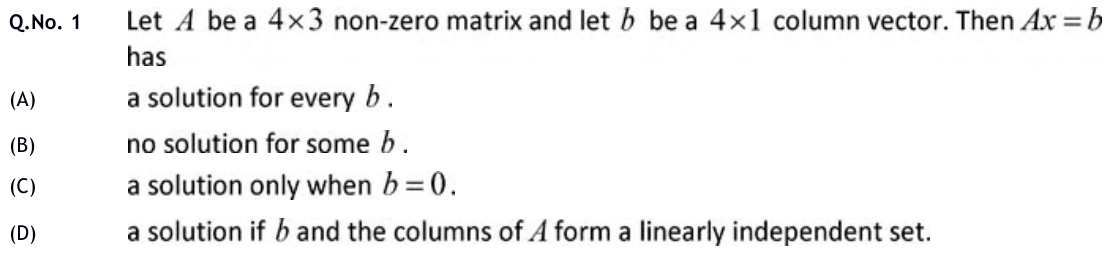
Answer: B.
Year: 2020 | Marks: 1
GATE XE 2020, Engineering Mathematics, Q.2: see the question image.
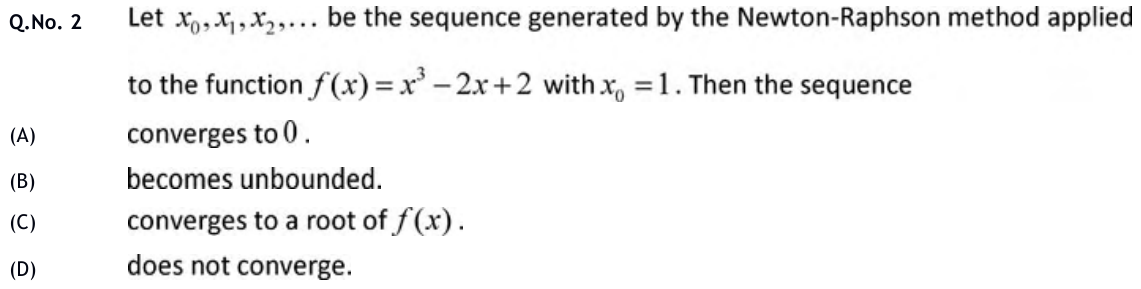
Answer: D.
Year: 2020 | Marks: 1
GATE XE 2020, Engineering Mathematics, Q.3: see the question image.
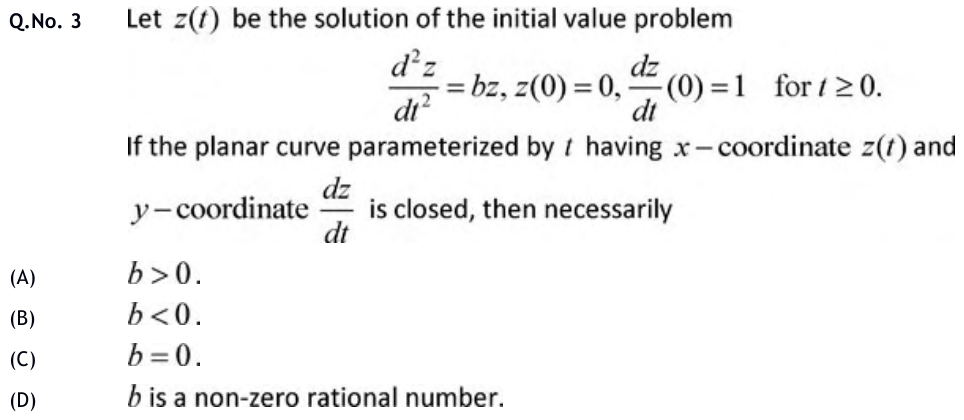
Answer: B.
Year: 2020 | Marks: 1
GATE XE 2020, Engineering Mathematics, Q.4: see the question image.
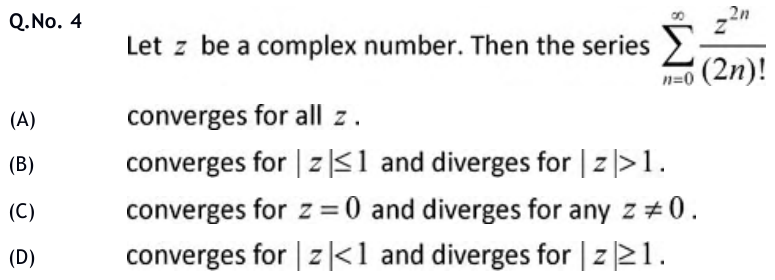
Answer: A.
Year: 2020 | Marks: 1
GATE XE 2020, Engineering Mathematics, Q.5: see the question image.
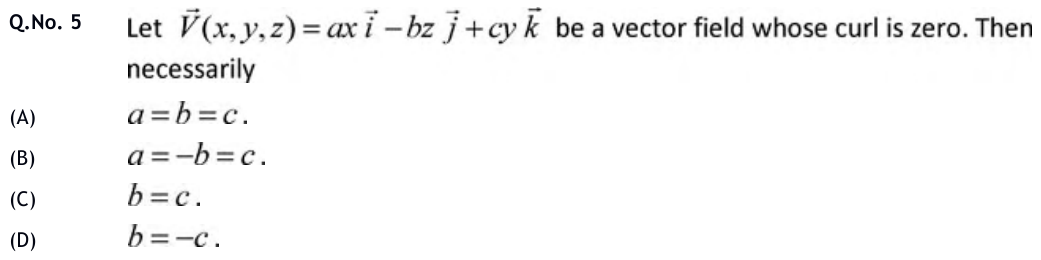
Answer: D.
Year: 2020 | Type: NAT | Marks: 1
GATE XE 2020, Engineering Mathematics, Q.6: see the question image.

Answer: 5
Year: 2020 | Type: NAT | Marks: 1
GATE XE 2020, Engineering Mathematics, Q.7: see the question image.

Answer: 2
Year: 2020 | Marks: 2
GATE XE 2020, Engineering Mathematics, Q.8: see the question image.
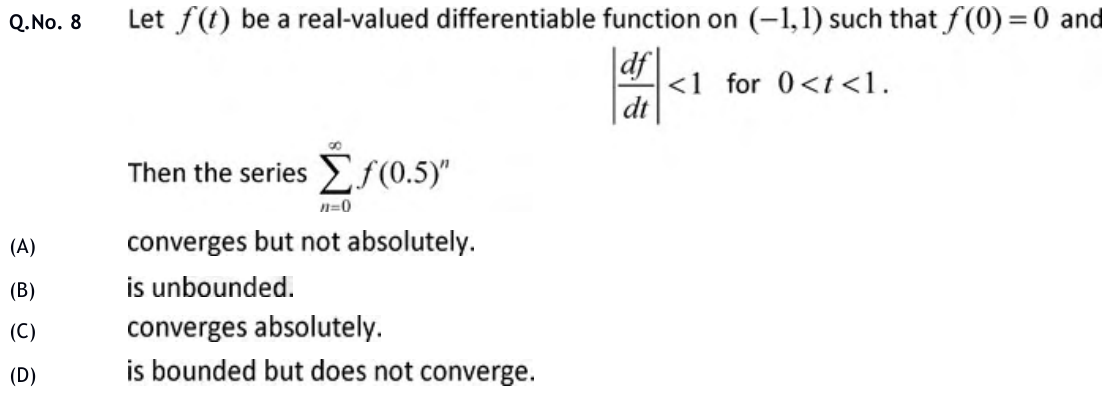
Answer: C.
Year: 2020 | Marks: 2
GATE XE 2020, Engineering Mathematics, Q.9: see the question image.
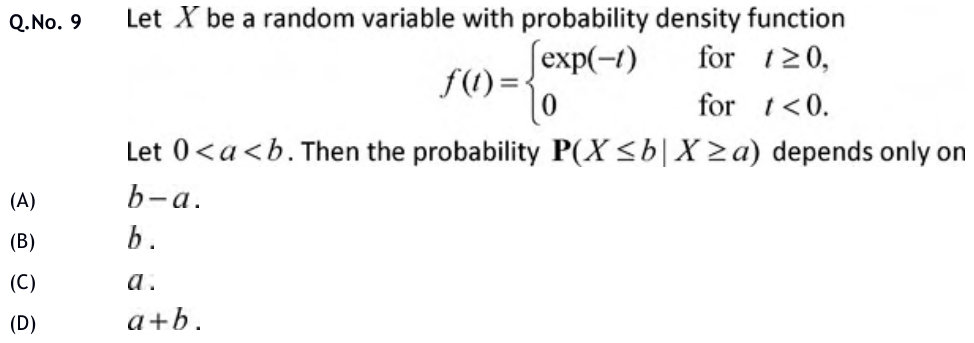
Answer: A.
Year: 2020 | Marks: 2
GATE XE 2020, Engineering Mathematics, Q.10: see the question image.
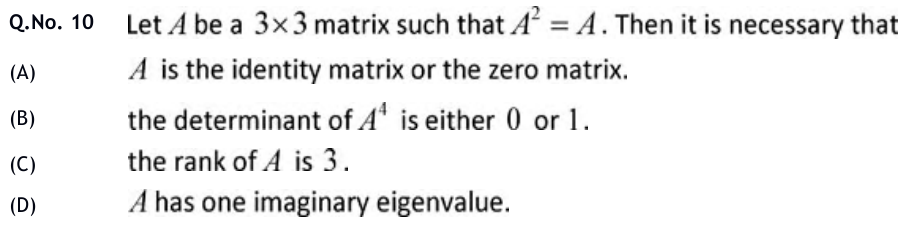
Answer: B.
Year: 2020 | Type: NAT | Marks: 2
GATE XE 2020, Engineering Mathematics, Q.11: see the question image.

Answer: 0.43 to 0.47
Year: 2018 | Marks: 1
The largest interval in which the initial value problem ( ) ( ) () () 2 2 1 ln , (1) = 0 and 1 1, 5 x d y dy dy e x y x y dx x dx dx + + = = − has a unique solution is
Answer: D. (0, 5)
Year: 2018 | Marks: 1
The sum of the roots of the indicial equation at 0 x = of the differential equation ( ) 2 3 2 sin (tan ) 0, 0, d y dy x x x x y x dx dx + − = > is
Answer: A. 0
Year: 2018 | Type: NAT | Marks: 1
Let f be a three times continuously differentiable real valued function on (0, 5) such that its third derivative 1 ( ) 100 f x ′′′ = for all (0,5). x∈ If ( ) P x is a polynomial of degree 2 ≤ such that (1) (1), P f = (2) (2) P f = and (3) (3) P f = then | (4) (4) | f P − equals _______________
Answer: 0.01
Year: 2018 | Type: NAT | Marks: 1
For real numbers 1 α and 2, α if the formula () () 1 1 1 1 2 2 2 1 ( ) f x dx f f α α − − = + ∫ is exact for all polynomials of degree 1 ≤ then 1 2 2 3 α α + equals _______________
Answer: 5
Year: 2018 | Type: NAT | Marks: 1
Raju has four fair coins and one fair dice. At first Raju tosses a coin. If the coin shows head then he rolls the dice and the number that dice shows is taken as his score. If the coin shows tail then he tosses three more coins and the total number of tails shown (including the first one) is taken as his score. If Raju tells that his score is 2 then the probability that he rolled the dice is (up to two decimal places) _______________
Answer: 0.29 to 0.32
Year: 2018 | Type: NAT | Marks: 1
Let f be a continuously differentiable real valued function defined by 2 1, ( ) 5 1. bx a if x f x x if x + < = ≥ Then the value of 2 a b is _______________
Answer: 250
Year: 2018 | Type: NAT | Marks: 1
A rectangular box without top cover having a square base is to be made from a sheet of 108 square meters. Then the largest possible volume of the box in cubic meters is ______________
Answer: 108
Year: 2018 | Marks: 2
Let 5 3 . 6 4 A − = − Then the trace of 1000 A equals
Answer: B. 1000 2 1 +
Year: 2018 | Marks: 2
Let denote the set of complex numbers and 2 1. i =− Let γ be the simple positively oriented circle | | 1 z = and { } 0 | | 2 S z z = ∈ < < . If : f S → is analytic in S and is given by 2 0 1 7 ( ) , 8 2 n n n f z a z z S z z ∞ = = + + ∈ ∑ then the value of the contour integral 1 ( ) cos ze f z dz i z γ π + ∫ is
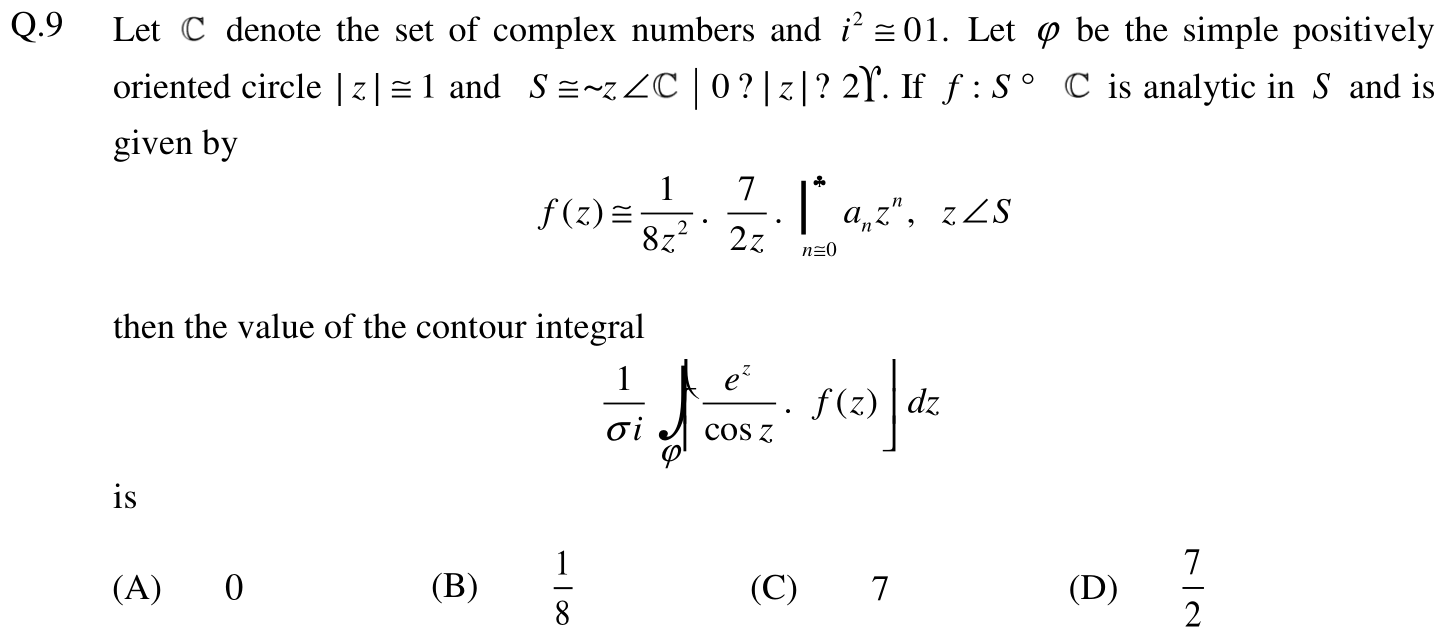
Answer: C. 7
Year: 2018 | Type: NAT | Marks: 2
Let 3 denote the three dimensional Euclidean space and ˆ ˆ ˆ ( , , ) x y z yi x j z k =− + + F for all 3 ( , , ) . x y z ∈ If C is the curve described by the parametric equation 2 ˆ ˆ ˆ ( ) cos sin 2 , 0 1, t t i t j t k t = + + ≤≤ r then the value of the line integral d C ⋅ ∫F r is_______________

Answer: 3
Year: 2018 | Type: NAT | Marks: 2
Let ( , ) u x t satisfy the initial and boundary value problem 2 2 2 , 0 , 0, u u x t t x π ∂ ∂ = < < > ∂ ∂ (0, ) 0 ( , ), 0, u t u t t π = = > ( ,0) sin 2sin 4 , 0 . u x x x x π = + < < Then the value of , ln(5) 2 u π is_______________
Answer: 0.04
Year: 2017 | Type: NAT | Marks: 1
GATE XE 2017, Engineering Mathematics, Q.1: see the question image.
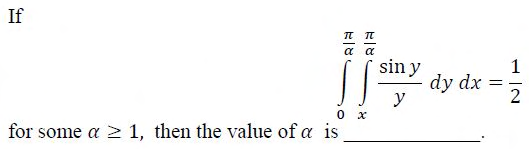
Answer: 2.98 to 3.02
Year: 2017 | Marks: 1
GATE XE 2017, Engineering Mathematics, Q.2: see the question image.

Answer: D.
Year: 2017 | Type: NAT | Marks: 1
GATE XE 2017, Engineering Mathematics, Q.3: see the question image.

Answer: 6.98 to 7.02
Year: 2017 | Type: NAT | Marks: 1
GATE XE 2017, Engineering Mathematics, Q.4: see the question image.

Answer: 2.98 to 3.02
Year: 2017 | Marks: 1
GATE XE 2017, Engineering Mathematics, Q.5: see the question image.
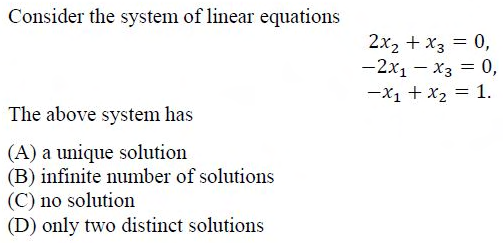
Answer: C.
Year: 2017 | Type: NAT | Marks: 1
GATE XE 2017, Engineering Mathematics, Q.6: see the question image.

Answer: 7.98 to 8.02
Year: 2017 | Marks: 1
GATE XE 2017, Engineering Mathematics, Q.7: see the question image.
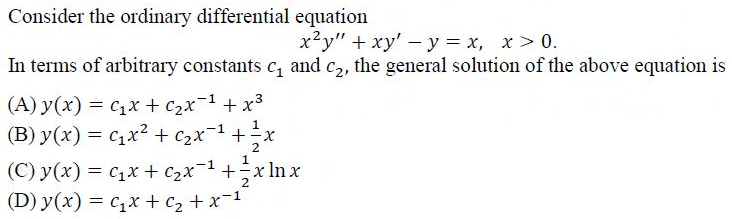
Answer: C.
Year: 2017 | Marks: 2
GATE XE 2017, Engineering Mathematics, Q.8: see the question image.
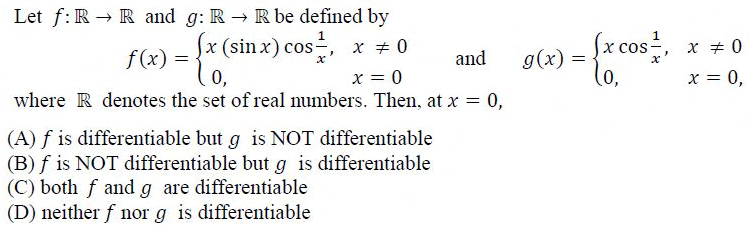
Answer: A.
Year: 2017 | Type: NAT | Marks: 2
GATE XE 2017, Engineering Mathematics, Q.9: see the question image.
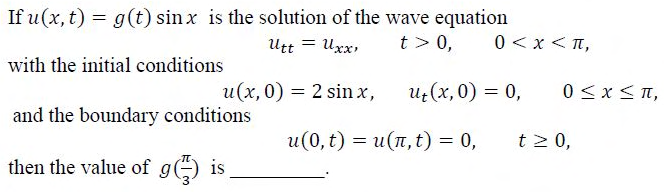
Answer: 0.98 to 1.02
Year: 2017 | Type: NAT | Marks: 2
GATE XE 2017, Engineering Mathematics, Q.10: see the question image.
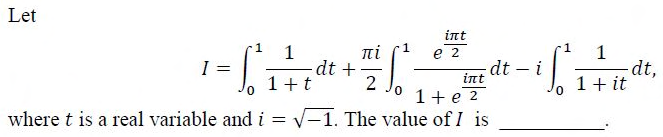
Answer: -0.02 to 0.02
Year: 2017 | Marks: 2
GATE XE 2017, Engineering Mathematics, Q.11: see the question image.
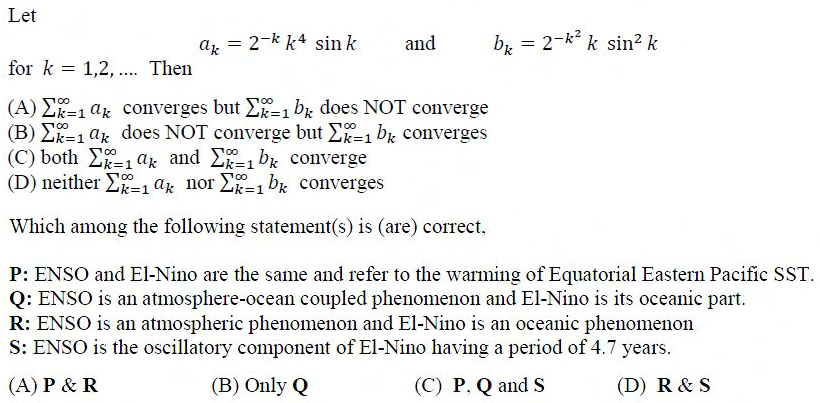
Answer: C.
Year: 2016 | Marks: 1
A company records heights of all employees. Let X and Y denote the errors in the average height of male and female employees respectively. Assume that 𝑋𝑋 ~ 𝑁𝑁(0, 4) and 𝑌𝑌 ~ 𝑁𝑁(0, 9) and they are independent. Then the distribution of 𝑍𝑍= (𝑋𝑋+ 𝑌𝑌)/2 is
Answer: B. 𝑁𝑁(0, 3.25)
Year: 2016 | Marks: 1
The volume of the solid obtained by revolving the curve 𝑦𝑦2 = 𝑥𝑥 , 0 ≤𝑥𝑥≤1 around 𝑦𝑦-axis is
Answer: D. 𝜋𝜋 5
Year: 2016 | Type: NAT | Marks: 1
Let 𝑦𝑦(𝑥𝑥) be the solution of the initial value problem 𝑑𝑑𝑑𝑑 𝑑𝑑𝑑𝑑+ 2𝑥𝑥𝑥𝑥= 𝑥𝑥; 𝑦𝑦(0) = 0. Find the value of lim𝑥𝑥 → ∞𝑦𝑦(𝑥𝑥).
Answer: 0.5
Year: 2016 | Marks: 1
Which of the following is a quasi-linear partial differential equation?
Answer: A. 𝜕𝜕2𝑢𝑢 𝜕𝜕 𝑡𝑡2 + 𝑢𝑢2 = 0
Year: 2016 | Marks: 1
Let 𝑃𝑃(𝑥𝑥) and 𝑄𝑄(𝑥𝑥) be the polynomials of degree 5, generated by Lagrange and Newton interpolation methods respectively, both passing through given six distinct points on the 𝑥𝑥𝑥𝑥-plane. Which of the following is correct?
Answer: A. 𝑃𝑃(𝑥𝑥) ≡𝑄𝑄(𝑥𝑥)
Year: 2016 | Marks: 1
The Laurent series of 𝑓𝑓(𝑧𝑧) = 1/(𝑧𝑧3 − 𝑧𝑧4) with center at 𝑧𝑧= 0 in the region |𝑧𝑧| > 1 is
Answer: B. −∑ 1 𝑧𝑧𝑛𝑛+4 ∞ 𝑛𝑛=0
Year: 2016 | Marks: 1
The value of the surface integral F dS Γ ⋅ ∫∫ n υρ over the sphere Γ given by 𝑥𝑥2 + 𝑦𝑦2 + 𝑧𝑧2 = 1, where ˆ ˆ = 4 F x i - z k ρ , and ndenotes the outward unit normal, is
Answer: D. 4 𝜋𝜋
Year: 2016 | Type: NAT | Marks: 2
A diagnostic test for a certain disease is 90% accurate. That is, the probability of a person having (respectively, not having) the disease tested positive (respectively, negative) is 0.9. Fifty percent of the population has the disease. What is the probability that a randomly chosen person has the disease given that the person tested negative?
Answer: 0.099 to 0.101
Year: 2016 | Marks: 2
Let 𝑀𝑀= ቀ1 1 0 1ቁ. Which of the following is correct?
Answer: C. 1 is the only eigenvalue and 𝑀𝑀 is not diagonalizable
Year: 2016 | Type: NAT | Marks: 2
Let 𝑓𝑓(𝑥𝑥) = 2 𝑥𝑥3 − 3𝑥𝑥2 + 69, −5 ≤𝑥𝑥≤5. Find the point at which 𝑓𝑓 attains the global maximum.
Answer: 5.0
Year: 2016 | Type: NAT | Marks: 2
Calculate 1 2 C C F dr F dr ⋅ − ⋅ ∫ ∫ ρ ρ ρ ρ, where 𝐶𝐶1:𝑟𝑟⃗(𝑡𝑡) = (𝑡𝑡, 𝑡𝑡2) and 𝐶𝐶2:𝑟𝑟⃗(𝑡𝑡) = ൫𝑡𝑡, √𝑡𝑡൯, 𝑡𝑡 varying from 0 to 1 and ˆ F = xy j ρ .
Answer: 0.149 to 0.151
Year: 2015 | Marks: 1
GATE XE 2015, Engineering Mathematics, Q.1: see the question image.
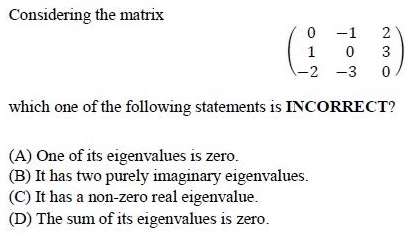
Answer: C.
Year: 2015 | Type: NAT | Marks: 1
GATE XE 2015, Engineering Mathematics, Q.2: see the question image.

Answer: 3.92 to 3.93
Year: 2015 | Marks: 1
GATE XE 2015, Engineering Mathematics, Q.3: see the question image.
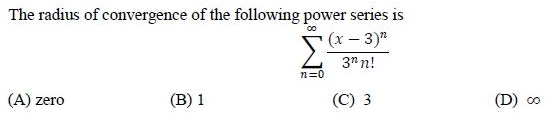
Answer: D.
Year: 2015 | Marks: 1
GATE XE 2015, Engineering Mathematics, Q.4: see the question image.

Answer: A.
Year: 2015 | Type: NAT | Marks: 1
GATE XE 2015, Engineering Mathematics, Q.5: see the question image.

Answer: 4.15 to 4.16
Year: 2015 | Marks: 1
GATE XE 2015, Engineering Mathematics, Q.6: see the question image.
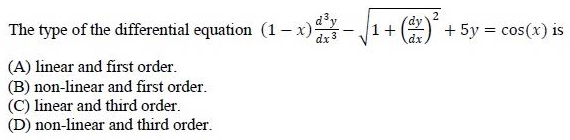
Answer: D.
Year: 2015 | Marks: 1
GATE XE 2015, Engineering Mathematics, Q.7: see the question image.

Answer: B.
Year: 2015 | Marks: 2
GATE XE 2015, Engineering Mathematics, Q.8: see the question image.

Answer: B.
Year: 2015 | Marks: 2
GATE XE 2015, Engineering Mathematics, Q.9: see the question image.

Answer: A.
Year: 2015 | Marks: 2
GATE XE 2015, Engineering Mathematics, Q.10: see the question image.
Answer: B.
Year: 2015 | Type: NAT | Marks: 2
GATE XE 2015, Engineering Mathematics, Q.11: see the question image.

Answer: 2
Year: 2014 | Type: NAT | Marks: 1
If 1, 0, and -1 are the eigenvalues of a 3 3× matrix A, then the trace of A A 5 2 + is equal to ______________.
Answer: 2
Year: 2014 | Marks: 1
Which of the following is a solution of the differential equation ? 0 ), sin(ln 4 ' '' 2 > = + + x x y xy y x
Answer: C. ) cos(ln ln 2 x x y − =
Year: 2014 | Marks: 1
At , 0 = z the complex function 2| | ) ( z z z f =
Answer: A. satisfies the Cauchy-Riemann equations and is differentiable
Year: 2014 | Marks: 1
Ten chocolates are distributed randomly among three children standing in a row. The probability that the first child receives exactly three chocolates is
Answer: B. 9 10 3 2 5×
Year: 2014 | Type: NAT | Marks: 1
Let the function R f → ] 5 ,0 [: be defined by = ) (x f ≤ ≤ + < ≤ + < ≤ + .5 2 , 3 23 3 2 2 1 ,5 2 1 0 ,5 2 3 2 x x x x x x The number of points where f is not differentiable in (0, 5) , is ___________. XE (GATE 2014)
Answer: 1
Year: 2014 | Marks: 1
An integrating factor of the differential equation 0 ) ( ) 3 ( 3 3 2 3 3 2 = − + + + dy xy e y x dx y y e y x y y is
Answer: C. 3 1 y
Year: 2014 | Marks: 1
If a cubic polynomial passes through the points (0, 1), (1, 0), (2, 1) and (3, 10), then it also passes through the point
Answer: B. ) 2 ,1 ( − −
Year: 2014 | Marks: 2
Let the function R f → ∞) ,0 [: be such that 4 3 8 ) ( 2 + + = ′ x x x f for 0 > x and .1 ) 0 ( = f Then )1( f lies in the interval
Answer: B. [2, 3]
Year: 2014 | Type: NAT | Marks: 2
The perimeter of a rectangle having the largest area that can be inscribed in the ellipse 1 32 8 2 2 = +y x , is ________.
Answer: 24
Year: 2014 | Type: NAT | Marks: 2
If the work done in moving a particle once around a circle 4 2 2 = +y x under the force field j ax y i ay x y x F ) ) ρ ) 2 ( ) 2 ( ) , ( + + − = is π 16 , then a is equal to _________. XE (GATE 2014)
Answer: 2
Year: 2014 | Marks: 2
Let r and s be real numbers. If = 0 3 0 2 0 2 1 s r A and − = 1 1 1 s b , then the system of linear equations b AX = has
Answer: D. infinitely many solutions for . 2 2 = =r s XE (GATE 2014)
Year: 2013 | Marks: 1
The value of the integral ∫ ௗ௧ ඥ(ି௧) ଵ is

Year: 2013 | Marks: 1
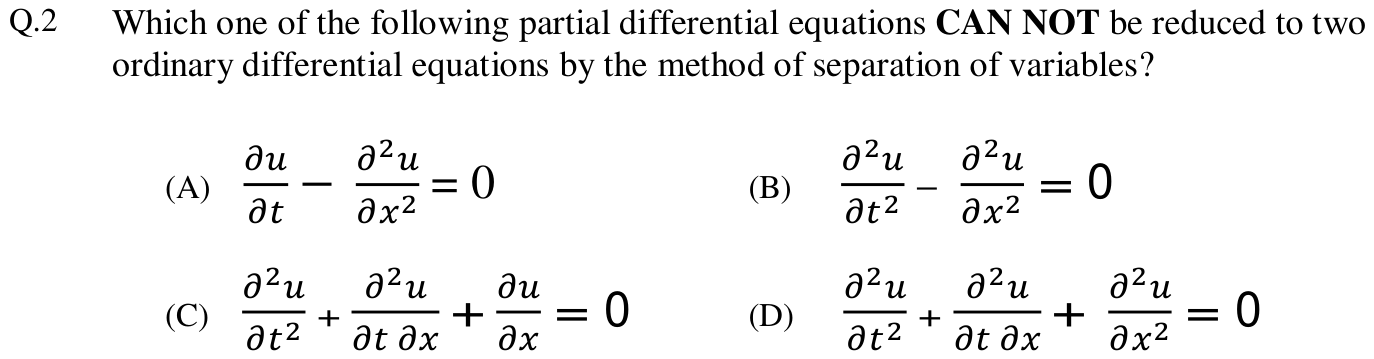
Which one of the following partial differential equations CAN NOT be reduced to two ordinary differential equations by the method of separation of variables?
Year: 2013 | Marks: 1
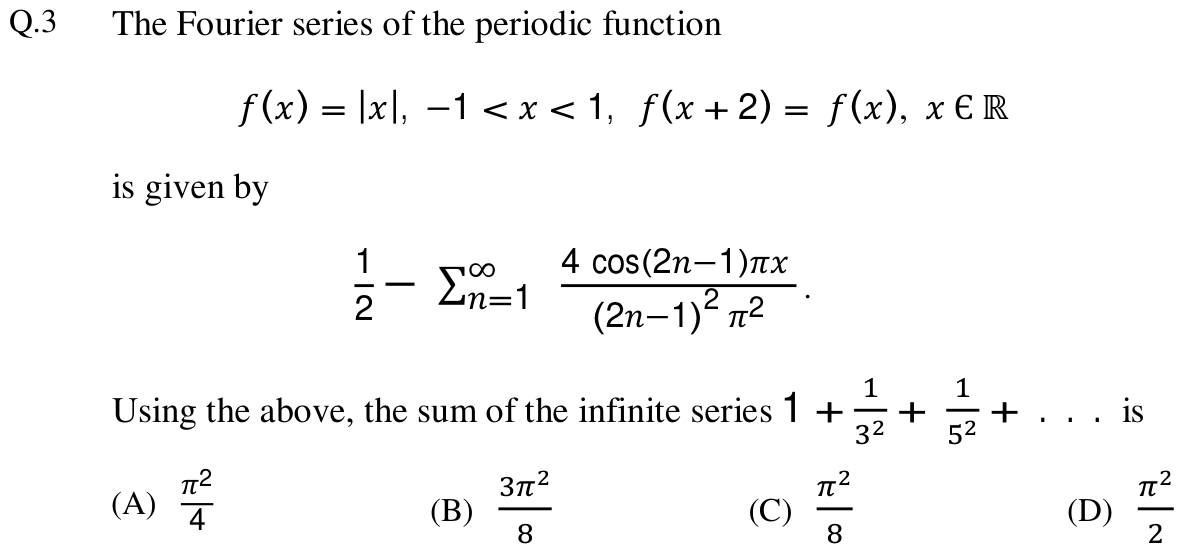
The Fourier series of the periodic function ݂(ݔ) = |ݔ|, −1 < ݔ< 1, ݂(ݔ+ 2) = ݂(ݔ), ݔ Є ℝ is given by 1 2 − ∑ 4 cos(2݊−1)ߨݔ (2݊−1)2 ߨ2 ∞ =1 . Using the above, the sum of the infinite series 1 + ଵ ଷమ+ ଵ ହమ+ . . . is
Year: 2013 | Marks: 1
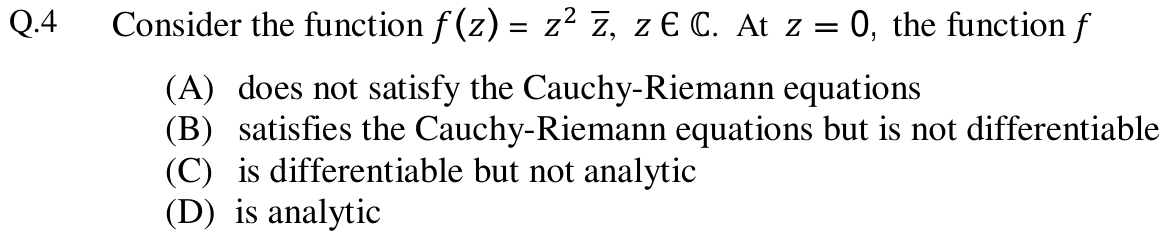
Consider the function ݂(ݖ) = ݖଶݖ, ݖЄ ℂ. At ݖ= 0, the function ݂
Year: 2013 | Marks: 1
The integral ∮ (௭ାସ) (௭ାଵ)(௭ିଶ)య ݀ݖalong the contour ܥ: |ݖ−(1 +݅)| = 2, oriented anti- clockwise, is equal to

Year: 2013 | Marks: 1
The integral ∫ ∫ ቀ ௫ ௬ቁ ௫ ௫మ ଵ ݁ ௫మ/௬ ݀ݕ݀ ݔ equals

Year: 2013 | Marks: 1
If the mean and variance of a binomial distribution are 6 and 2 respectively, then the probability of two failures is

Year: 2013 | Marks: 2
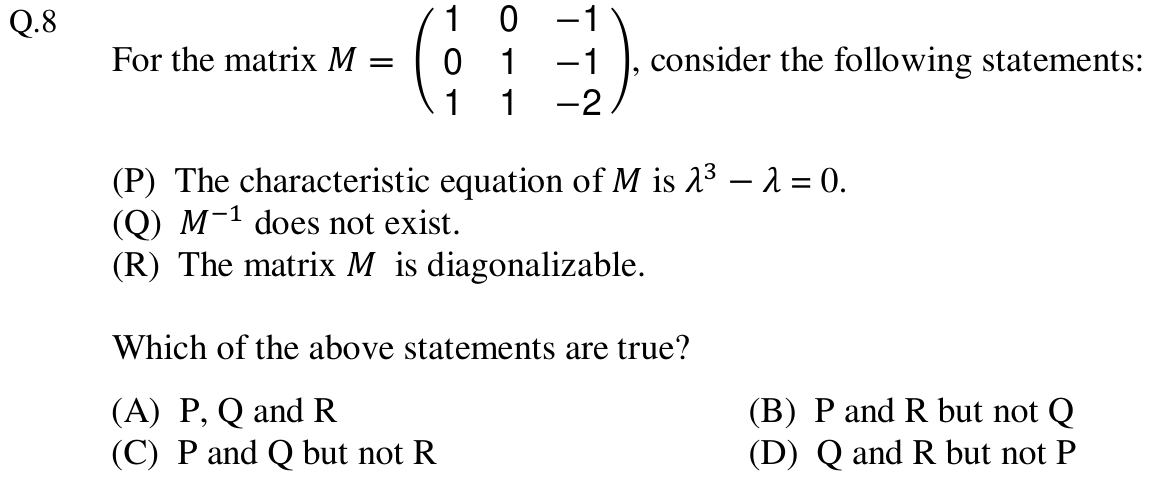
For the matrix ܯ= ൭ 1 0 −1 0 1 −1 1 1 −2 ൱, consider the following statements: (P) The characteristic equation of ܯ is ߣଷ−ߣ = 0. (Q) ܯିଵ does not exist. (R) The matrix ܯ is diagonalizable. Which of the above statements are true?
Year: 2013 | Marks: 2
The work done by the force ܨ⃗= (ݔ+ ݔଶ) ଓ̂ + (ݔଶ+ ݕଷ) ଔ̂ in moving a particle once along the triangle with vertices (0,0),(1,0) and (0,1) in the anti-clockwise direction is

Year: 2013 | Marks: 2
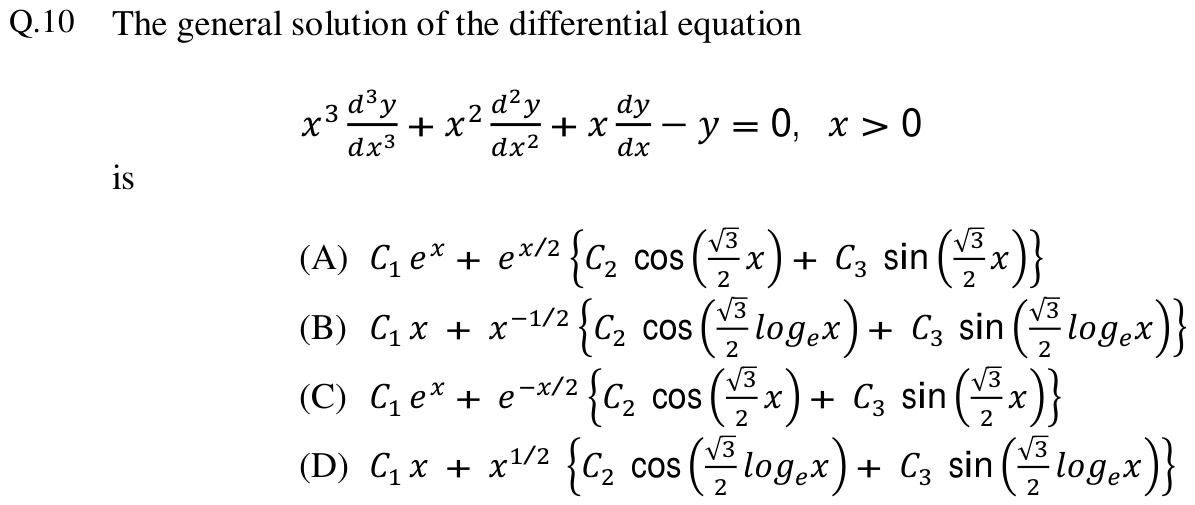
The general solution of the differential equation ݔଷௗయ௬ ௗ௫య+ ݔଶௗమ௬ ௗ௫మ+ ݔ ௗ௬ ௗ௫−ݕ= 0, ݔ> 0 is
Year: 2013 | Marks: 2
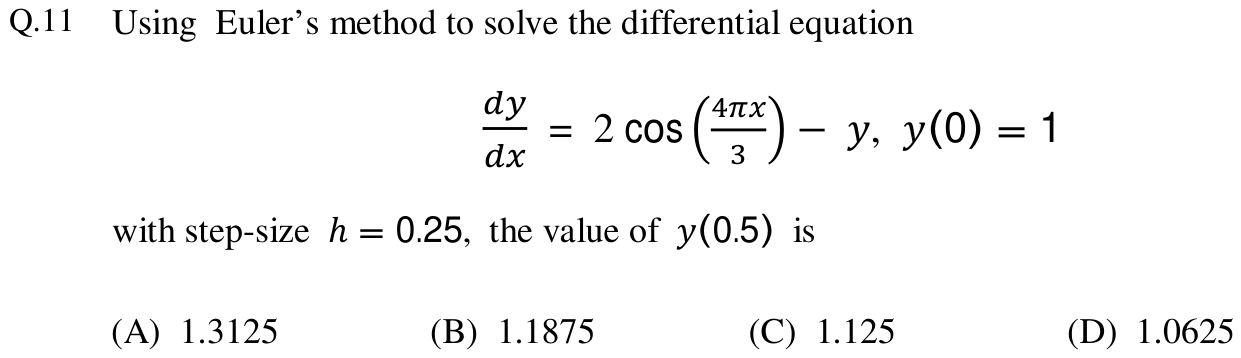
Using Euler’s method to solve the differential equation ௗ௬ ௗ௫ = 2 cos ቀ ସగ௫ ଷቁ− ݕ, ݕ(0) = 1 with step-size ℎ= 0.25, the value of ݕ(0.5) is
Year: 2012 | Marks: 1
For the matrix = 3 0 0 6 2 0 5 4 1 M , consider the following statements: P: 3 is an eigenvalue of M. Q: 0 1 4 is an eigenvector of M. R: 0 2 4 is an eigenvector of M. Which of the above statements are TRUE?
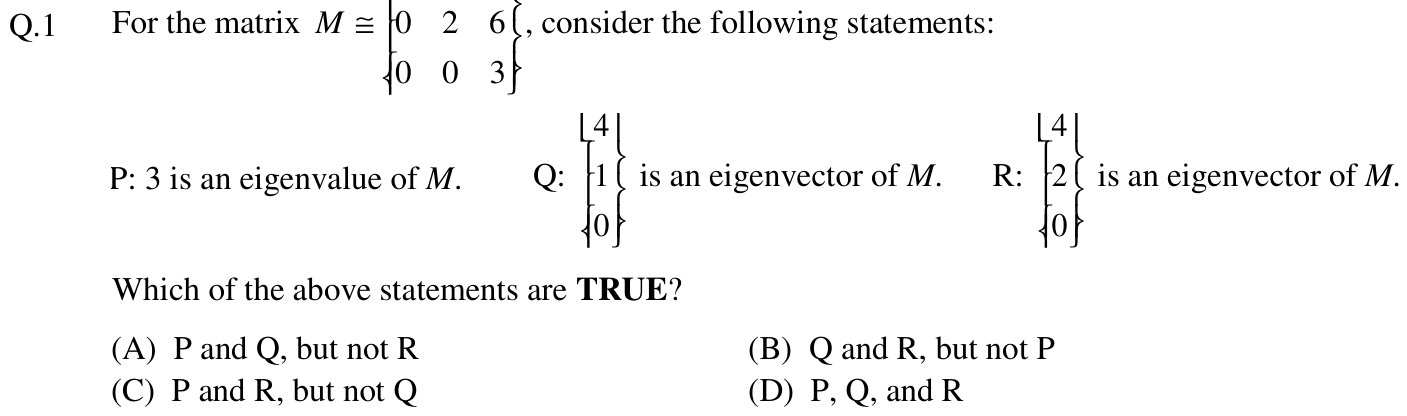
Answer: A. P and Q, but not R
Year: 2012 | Marks: 1
Taylor series of x x f − =1 1 ) ( about 0 = x is given as Κ + + + + = 3 2 1 x x x TS f . This series can be used to evaluate ) (x f for

Answer: C. 1 < x
Year: 2012 | Marks: 1
Let ( , ) ln( ) f u v u v = and ( , ) ( ( , ), ( , )) F x y f u x y v x y = , where / u x y = andv x y = − . Then / F y ∂ ∂is
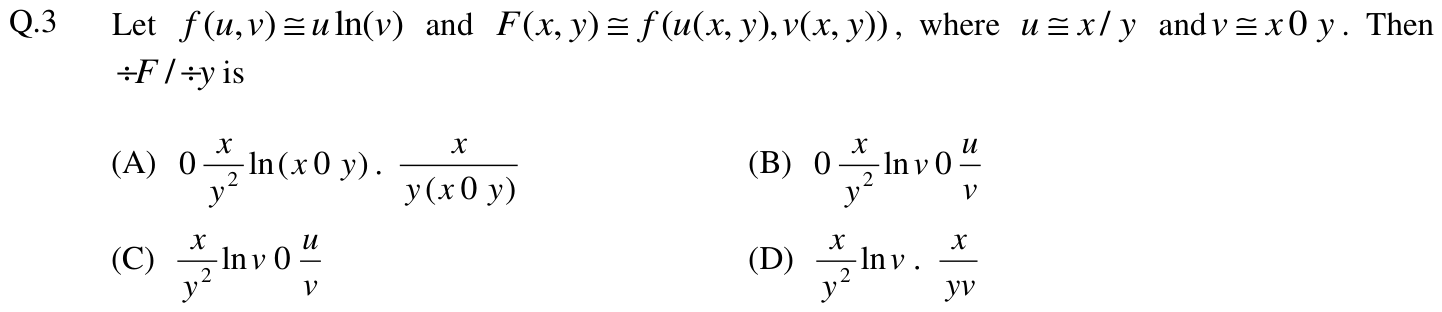
Answer: B. v u v y x − − ln 2
Year: 2012 | Marks: 1
Consider two functions z z f = ) ( and z z g = ) ( (conjugate of z). Using Cauchy-Riemann conditions, choose the correct answer

Answer: D. Neither f nor g is analytic
Year: 2012 | Marks: 1
For 4 2 5 f x xy = − , the direction of maximum increase of ( , ) f x y at the point (2, 2) is along

Answer: C. ˆ ˆ 3 10 i j −
Year: 2012 | Marks: 1
Suppose 50% of the population of a village like oranges, 70% of the population like apples, and 40% like both. If a person is picked at random who likes at least one of these fruits, what is the probability that the person likes oranges?
Answer: D. 5/8
Year: 2012 | Marks: 1
For the solution of 2 0 u ∇ = , the domain and boundary conditions are shown below. Which of the following statements is TRUE?
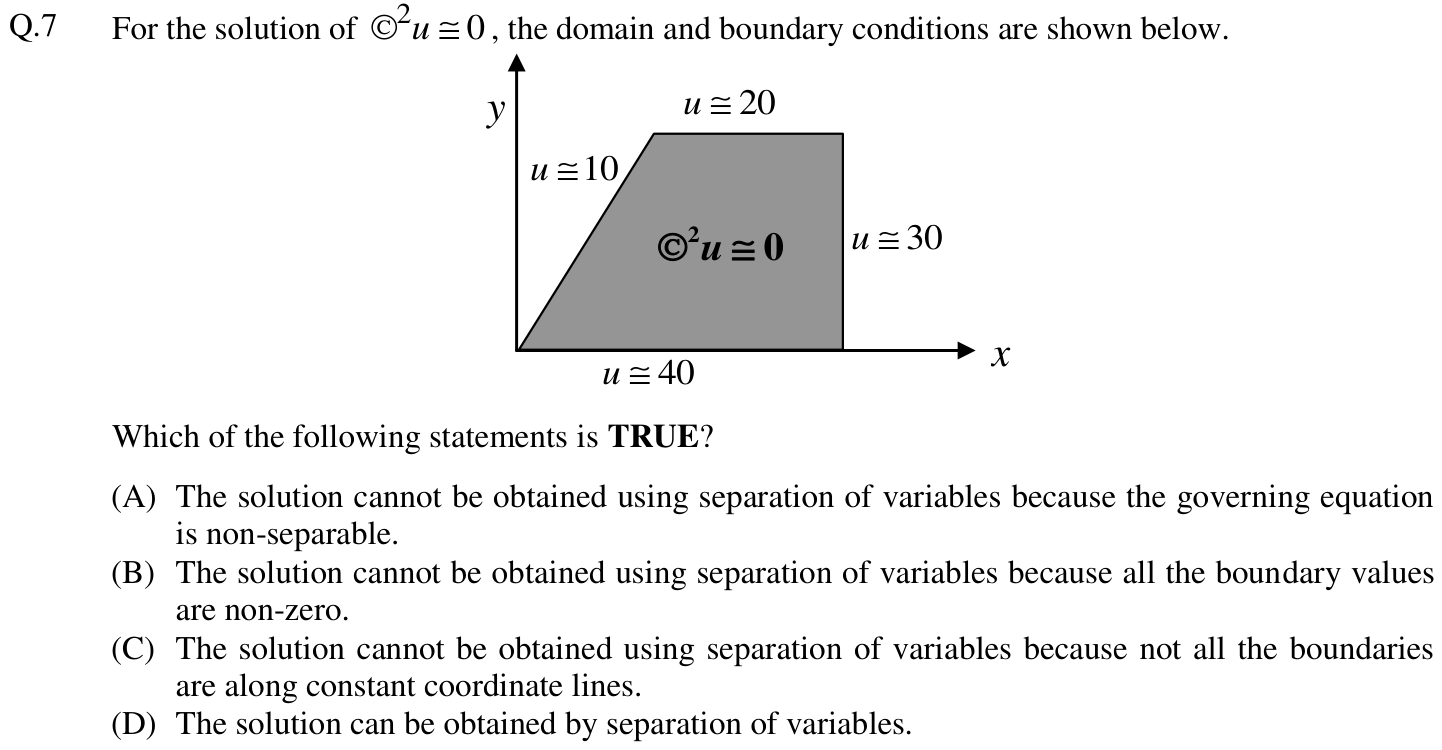
Answer: C. The solution cannot be obtained using separation of variables because not all the boundaries are along constant coordinate lines.
Year: 2012 | Marks: 2
If ( ) sin( ) f x x x = and ( ) sin( ) g x x x = , then
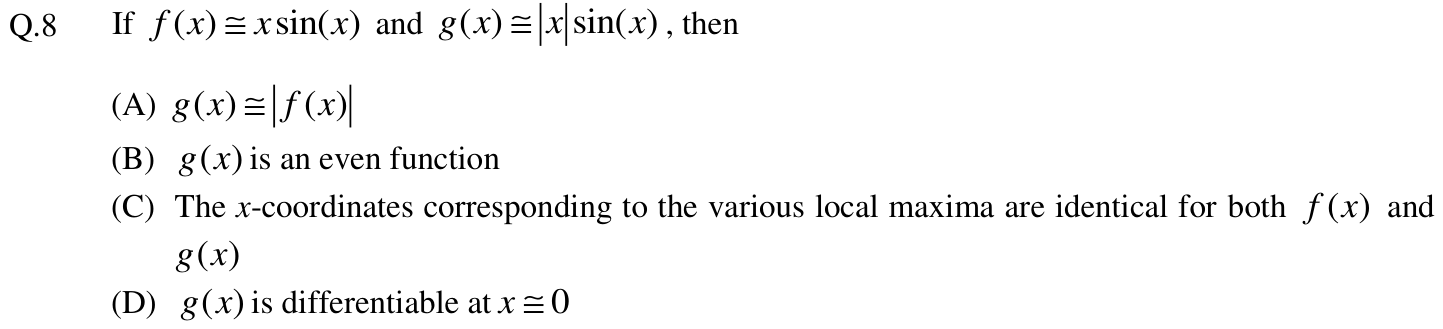
Answer: D. ( ) g x is differentiable at 0 x =
Year: 2012 | Marks: 2
The general solution of 4 3 2 4 3 2 2 2 2 0 d y d y d y dy y dx dx dx dx − + − + = is

Answer: C. 1 2 3 4 cos( ) sin( ) x x c e c xe c x c x + + +
Year: 2012 | Marks: 2
Evaluation of ( ) ∫∫ • − + S x x dA n k e z j y i e ˆ ˆ ˆ 3 ˆ over a surface S : 2 2 2 1 x y z + + =, using Gauss divergence theorem, gives

Answer: B. 4π
Year: 2012 | Marks: 2
The exact solution of the integral 4 2 0 ( 4) x dx − ∫ is denoted by E I . The same integral evaluated numerically by the trapezoidal rule and the Simpson’s 1/3 rule are denoted by TI and SI , respectively. The subinterval used in the numerical methods is 2 h = . Then

Answer: B. E S T I I I = <
Year: 2007 | Marks: 1
Let $M = \begin{pmatrix} 1 & 1 & 1 \\ 0 & 1 & 1 \\ 0 & 0 & 1 \end{pmatrix}$. Then the maximum number of linearly independent eigenvectors of $M$ is
Year: 2007 | Marks: 1
Let $L = \lim_{x \to \frac{\pi}{2}} \frac{\sin^2 2x}{(x - \frac{\pi}{2})^2}$. Then $L$ is equal to
Year: 2007 | Marks: 1
Let $f(z) = \frac{1}{1 - z^2}$. The coefficient of $\frac{1}{z - 1}$ in the Laurent expansion of $f(z)$ about $z = 1$ is
Year: 2007 | Marks: 1
Let $u(x,t)$ be the solution of the initial value problem $\frac{\partial^2 u}{\partial t^2} = 9\frac{\partial^2 u}{\partial x^2}$, $t > 0$, $-\infty < x < \infty$, $u(x,0) = x + 5$, $\frac{\partial u}{\partial t}(x,0) = 0$. Then $u(2,2)$ is
Year: 2007 | Marks: 1
Two students take a test consisting of five TRUE/FALSE questions. To pass the test the students have to answer at least three questions correctly. Both of them know the correct answers to two questions and guess the answers to the remaining three. The probability that only one student passes the test is equal to
Year: 2007 | Marks: 1
The equation $g(x) = x$ is solved by Newton-Raphson iteration method, starting with an initial approximation $x_0$ near the simple root $\alpha$. If $x_{n+1}$ is the approximation to $\alpha$ at the $(n+1)^{th}$ iteration, then
Year: 2007 | Marks: 2
Let $Ax = b$ be a system of $m$ linear equations in $n$ unknowns with $m < n$ and $b \neq 0$. Then the system has
Year: 2007 | Marks: 2
Let $R$ be an $n \times n$ nonsingular matrix. Let $P$ and $Q$ be two $n \times n$ matrices such that $Q = R^{-1}PR$. If $x$ is an eigenvector of $P$ corresponding to a nonzero eigenvalue $\lambda$ of $P$, then
Year: 2007 | Marks: 2
Let $M$ be a $2 \times 2$ matrix with eigenvalues 1 and 2. Then $M^{-1}$ is
Year: 2007 | Marks: 2
The number of $n \times n$ matrices that are simultaneously Hermitian, unitary and diagonal is
Year: 2007 | Marks: 2
Let $M = \begin{pmatrix} 1 & b & a \\ 0 & 2 & c \\ 0 & 0 & 1 \end{pmatrix}$, where $a, b, c$ are real numbers. Then $M$ is diagonalizable
Year: 2007 | Marks: 2
The maximum value of the function $2x + 3y + 4z$ on the ellipsoid $2x^2 + 3y^2 + 4z^2 = 1$ is
Year: 2007 | Marks: 2
Let $f: \mathbb{R} \to \mathbb{R}$ be a twice differentiable real valued function such that $f(1/n) = 1$ for $n = 1, 2, 3, \dots$. Then
Year: 2007 | Marks: 2
Let $f(x) = \int_0^{x^2} \sin\sqrt{t} \, dt$ for $x \ge 0$. Then $f'(\pi/2)$ is equal to
Year: 2007 | Marks: 2
The value of the contour integral $\oint_{|z|=1} \frac{\cosh z}{4z^2 + 1} dz$ is equal to
Year: 2007 | Marks: 2
Let $f(x + iy) = u(x,y) + iv(x,y)$ be an analytic function defined on the complex plane satisfying $2u^2 + 3v^2 = 1$. Then
Year: 2007 | Marks: 2
The value of $\oint_C (xy^2 + 2x)dx + (x^2y + 4x)dy$ along the circle $C: x^2 + y^2 = 4$ in the anticlockwise direction is
Year: 2007 | Marks: 2
The volume of the prism whose base is the triangle in the $xy$-plane bounded by the $x$-axis and the lines $y = x$ and $x = 2$ and whose top lies in the plane $z = 5 - x - y$ is
Year: 2007 | Marks: 2
The general solution of $x(z^2 - y^2)\frac{\partial z}{\partial x} + y(x^2 - z^2)\frac{\partial z}{\partial y} = z(y^2 - x^2)$ is
Year: 2007 | Marks: 2
Choose a point uniformly distributed at random on the disc $x^2 + y^2 \le 1$. Let the random variable $X$ denote the distance of this point from the center of the disc. Then the variance of $X$ is
Year: 2007 | Marks: 2
If Runge-Kutta method of order 4 is used to solve the differential equation $\frac{dy}{dx} = f(x)$, $y(0) = 0$ in the interval $[0, h]$ with step size $h$, then
Year: 2007 | Marks: 2
If a polynomial of degree three interpolates a function $f(x)$ at the points $(0, 3)$, $(1, 13)$, $(3, 99)$ and $(4, 187)$, then $f(2)$ is
Year: 2007 | Marks: 2
Common Data: Let $f: \mathbb{R} \to \mathbb{R}$ be defined by $f(x) = x^2$ for $-\pi \le x \le \pi$ and $f(x + 2\pi) = f(x)$. The Fourier series of $f$ in $[-\pi, \pi]$ is
Year: 2007 | Marks: 2
Common Data: Let $f: \mathbb{R} \to \mathbb{R}$ be defined by $f(x) = x^2$ for $-\pi \le x \le \pi$ and $f(x + 2\pi) = f(x)$. The sum of the absolute values of the Fourier coefficients of $f$ is
Year: 2007 | Marks: 2
Linked Answer Q.25 & Q.26: Let $y(x) = \sum_{n=0}^\infty a_n x^n$ be a solution of the differential equation $\frac{d^2y}{dx^2} + xy = 0$. The value of $a_{11}$ is
Year: 2007 | Marks: 2
Linked Answer Q.25 & Q.26: Let $y(x) = \sum_{n=0}^\infty a_n x^n$ be a solution of the differential equation $\frac{d^2y}{dx^2} + xy = 0$. The solution of the differential equation given above satisfying $y(0) = 1$ and $y'(0) = 0$ is
Year: 2007 | Marks: 2
Linked Answer Q.27 & Q.28: The potential $u(x,y)$ satisfies the equation $\frac{\partial^2 u}{\partial x^2} + \frac{\partial^2 u}{\partial y^2} = 0$ in the square $0 \le x \le \pi$, $0 \le y \le \pi$. Three of the edges $x = 0$, $x = \pi$ and $y = 0$ of the square are kept at zero potential and the edge $y = \pi$ is kept at nonzero potential. The potential $u(x,y)$ is given by
Year: 2007 | Marks: 2
Linked Answer Q.27 & Q.28: The potential $u(x,y)$ satisfies the equation $\frac{\partial^2 u}{\partial x^2} + \frac{\partial^2 u}{\partial y^2} = 0$ in the square $0 \le x \le \pi$, $0 \le y \le \pi$. Three of the edges $x = 0$, $x = \pi$ and $y = 0$ of the square are kept at zero potential and the edge $y = \pi$ is kept at nonzero potential. If the edge $y = \pi$ is kept at the potential $\sin x$, then the potential $u(x,y)$ is given by