GATE ME Vibrations: Previous Year Questions
GATE ME (Mechanical Engineering) Vibrations previous year questions from Theory of Machines, with figures and the answer key.
Theory of Machines | All GATE ME papers
GATE ME 2026, Question 56 (1 mark, MCQ)
Theory of Machines - Vibrations
In a single degree of freedom vibrating system with only viscous damping, the critical damping coefficient is and the damping coefficient is . The logarithmic decrement of the vibrating system is

- 0.32
- 1.89
- 1.26
- 0.63
Answer: D
GATE ME 2026, Question 58 (2 marks, MCQ)
Theory of Machines - Vibrations
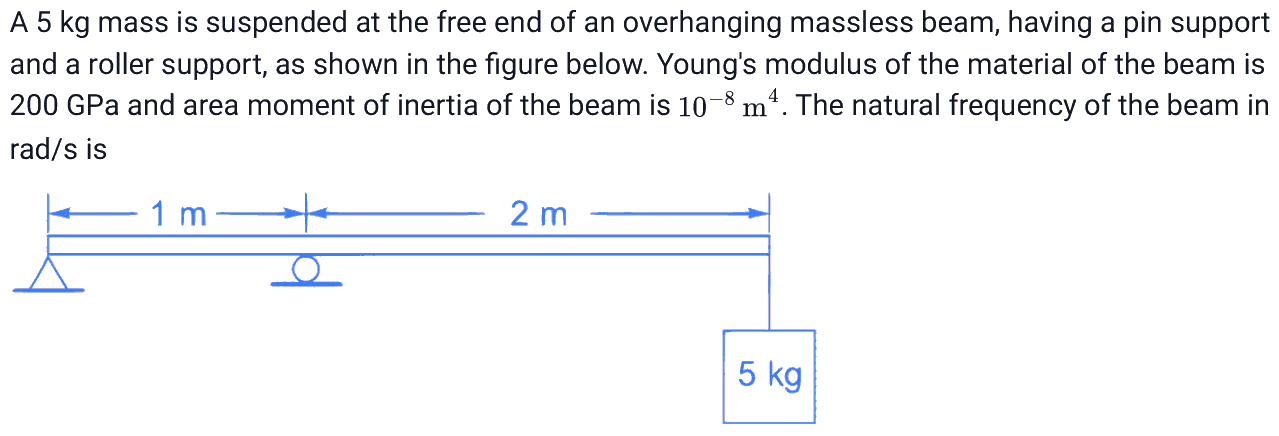
A 5 kg mass is suspended at the free end of an overhanging massless beam, having a pin support and a roller support, as shown in the figure below. Young's modulus of the material of the beam is 200 GPa and area moment of inertia of the beam is . The natural frequency of the beam in rad/s is
- 10
- 5
Answer: B
GATE ME 2025, Question 29 (1 mark, MCQ)
Theory of Machines - Vibrations
In the context of balancing of rotating and reciprocating masses, which one of the following options is true?
- An unbalanced rigid rotor can be completely balanced using a single balancing mass
- An unbalanced rigid rotor can be completely balanced using two balancing masses attached in two distinct planes
- A single-cylinder internal combustion engine can be completely balanced using a single balancing mass
- A single-cylinder internal combustion engine can be completely balanced using two balancing masses
Answer: B
GATE ME 2025, Question 35 (1 mark, NAT)
Theory of Machines - Vibrations
A block of mass 1 kg connected to a spring of stiffness is operating in a viscous medium such that the damping ratio (or damping factor) is equal to the ratio of the damped frequency to the natural frequency. The magnitude of the damping ratio for this system is ________ (rounded off to 2 decimal places).

Answer: 0.7 to 0.72
GATE ME 2025, Question 42 (2 marks, MCQ)
Theory of Machines - Vibrations
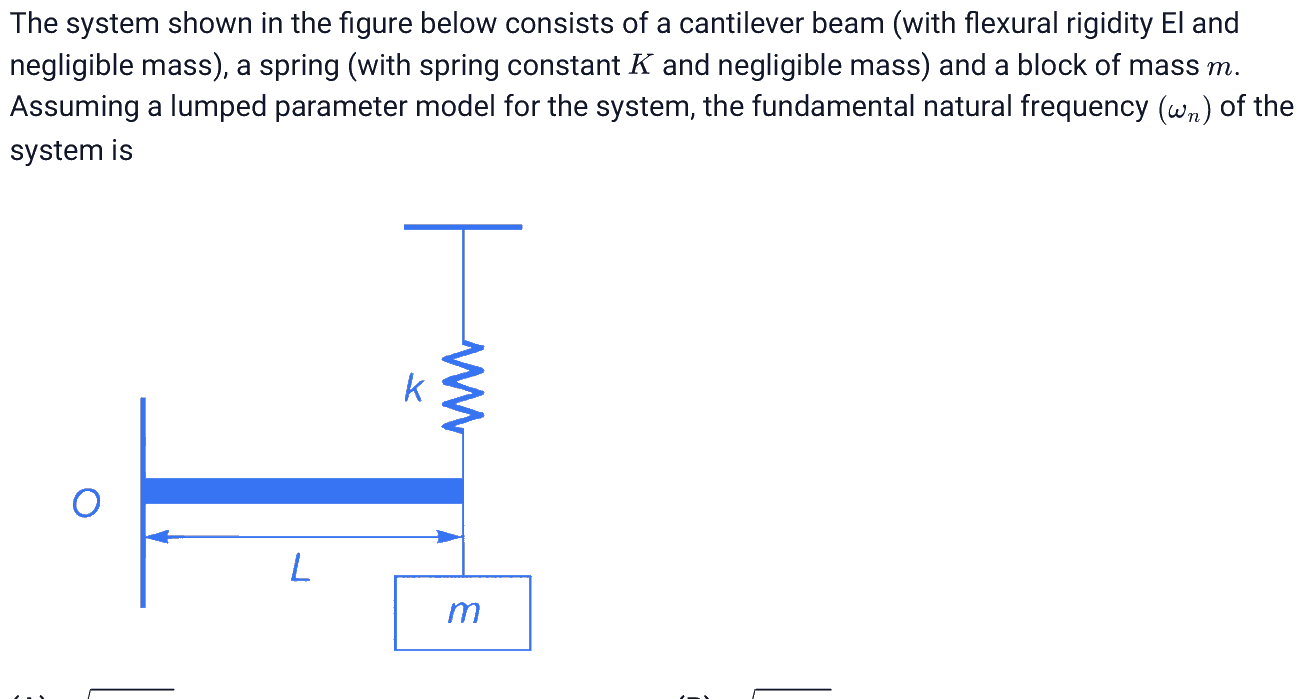
The system shown in the figure below consists of a cantilever beam (with flexural rigidity El and negligible mass), a spring (with spring constant and negligible mass) and a block of mass . Assuming a lumped parameter model for the system, the fundamental natural frequency of the system is
Answer: A
GATE ME 2024, Question 25 (1 mark, MCQ)
Theory of Machines - Vibrations
A linear spring-mass-dashpot system with a mass of 2 kg is set in motion with viscous damping. If the natural frequency is 15 Hz, and the amplitudes of two successive cycles measured are 7.75 mm and 7.20 mm, the coefficient of viscous damping (in N.s/m) is
- 4.41
- 7.51
- 2.52
- 6.11
Answer: A
GATE ME 2024, Question 55 (2 marks, NAT)
Theory of Machines - Vibrations
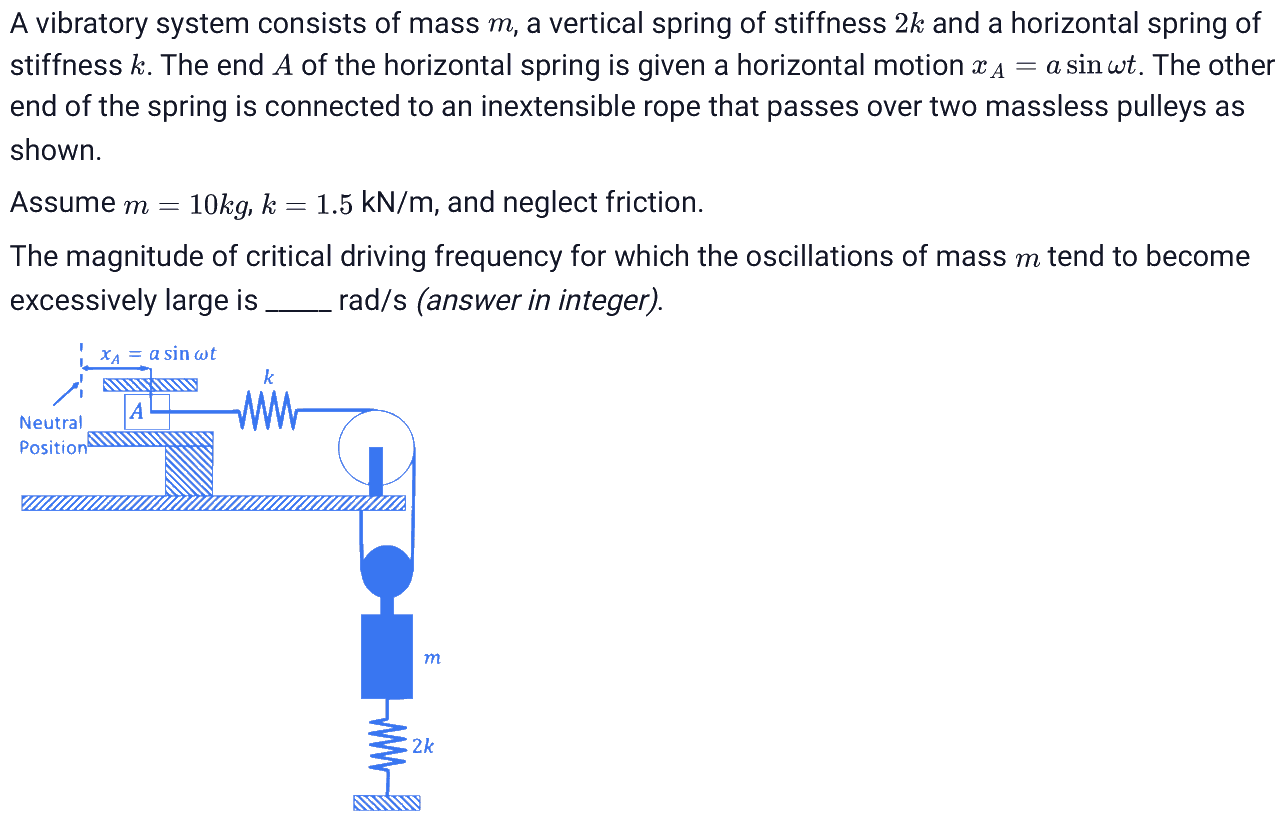
A vibratory system consists of mass , a vertical spring of stiffness and a horizontal spring of stiffness . The end of the horizontal spring is given a horizontal motion . The other end of the spring is connected to an inextensible rope that passes over two massless pulleys as shown. Assume , kN/m, and neglect friction. The magnitude of critical driving frequency for which the oscillations of mass tend to become excessively large is _____ rad/s (answer in integer).
Answer: 29 to 31
GATE ME 2023, Question 30 (1 mark, NAT)
Theory of Machines - Vibrations
The figure shows a block of mass m = 20 kg attached to a pair of identical linear springs, each having a spring constant k = 1000 N/m. The block oscillates on a frictionless horizontal surface. Assuming free vibrations, the time taken by the block to complete ten oscillations is _________ seconds. (Rounded off to two decimal places) Take π = 3.14.
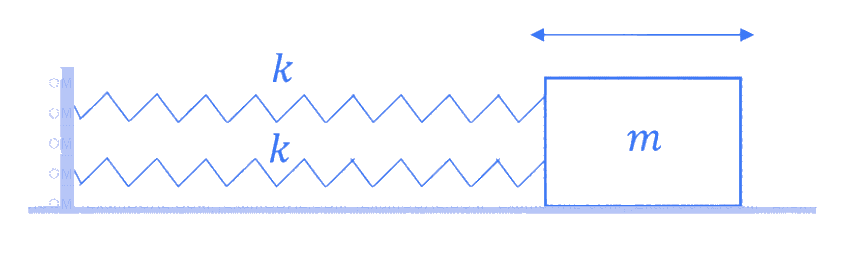
Answer: 6.27 to 6.29
GATE ME 2022 Set 1, Question 32 (1 mark, NAT)
Theory of Machines - Vibrations
A rigid uniform annular disc is pivoted on a knife edge A in a uniform gravitational field as shown, such that it can execute small amplitude simple harmonic motion in the plane of the figure without slip at the pivot point. The inner radius r and outer radius R are such that r$^{2}$ = R$^{2}$/2, and the acceleration due to gravity is g. If the time period of small amplitude simple harmonic motion is given by where π is the ratio of circumference to diameter of a circle, then β = ________ (round off to 2 decimal places).
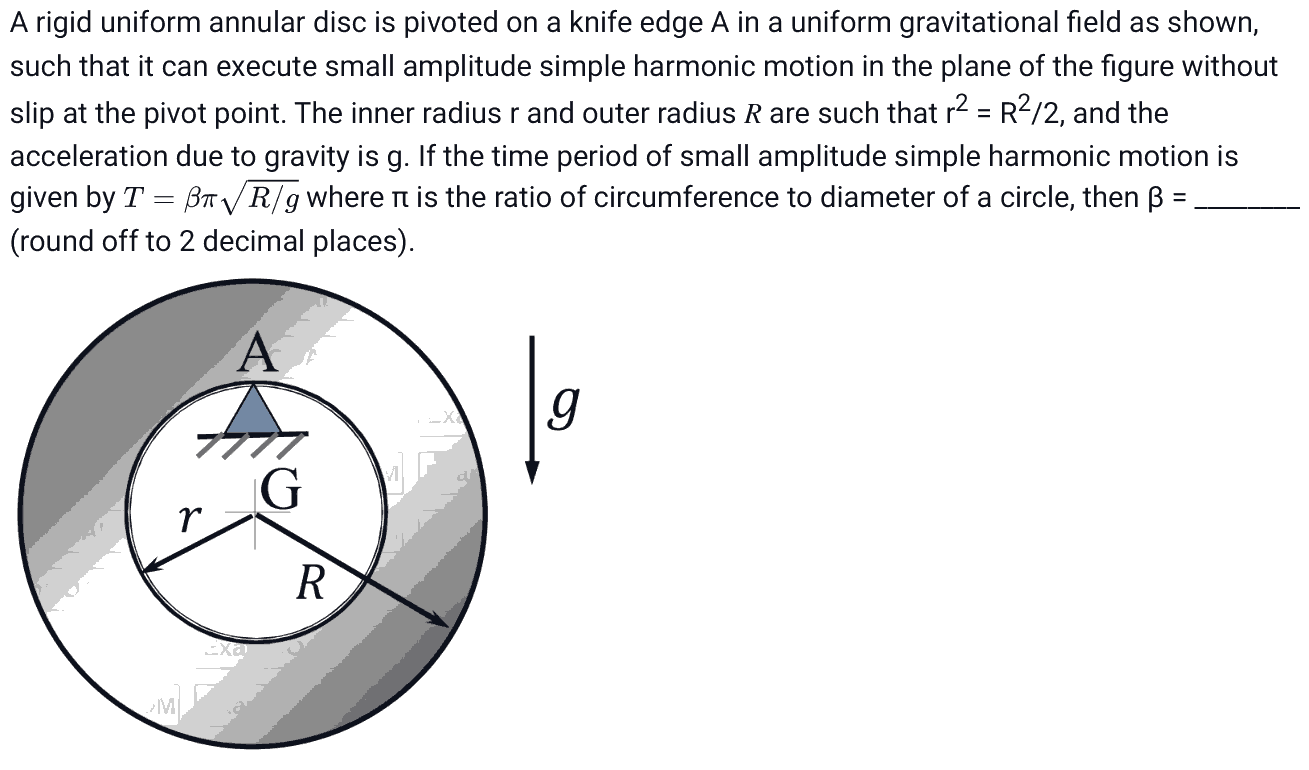
Answer: 2.62 to 2.7
GATE ME 2022 Set 1, Question 39 (2 marks, MCQ)
Theory of Machines - Vibrations
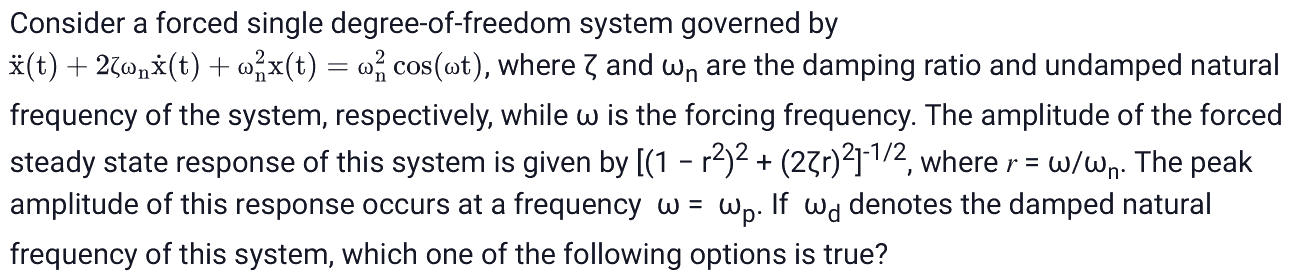
Consider a forced single degree-of-freedom system governed by $^{ζω}$$^{ω}$$^{ω}$$^{ω}$, where ζ and ω$_{n}$ are the damping ratio and undamped natural frequency of the system, respectively, while ω is the forcing frequency. The amplitude of the forced steady state response of this system is given by [(1 − r$^{2}$)$^{2}$ + (2ζr)$^{2}$]$^{-1/2}$, where r = ω/ω$_{n}$. The peak amplitude of this response occurs at a frequency ω = ω$_{p}$. If ω$_{d}$ denotes the damped natural frequency of this system, which one of the following options is true?
- ω$_{p}$ < ω$_{d}$ < ω$_{n}$
- ω$_{p}$ = ω$_{d}$ < ω$_{n}$
- ω$_{d}$ < ω$_{n}$ = ω$_{p}$
- ω$_{d}$ < ω$_{n}$ < ω$_{p}$
Answer: A
GATE ME 2022 Set 2, Question 31 (1 mark, NAT)
Theory of Machines - Vibrations
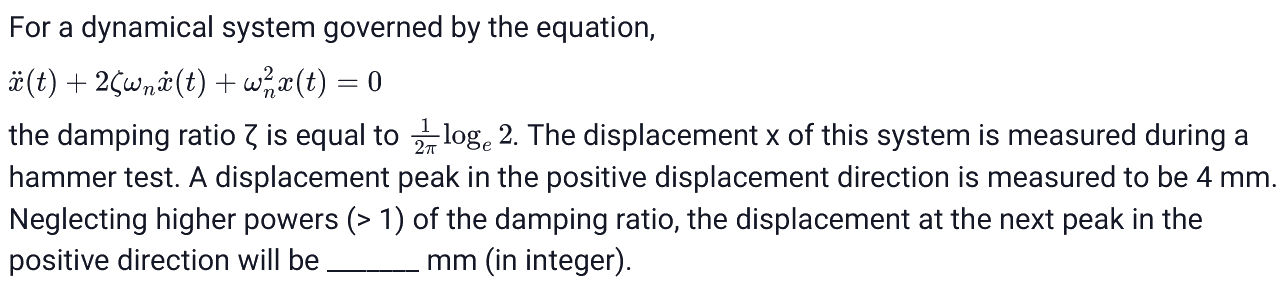
For a dynamical system governed by the equation, the damping ratio ζ is equal to . The displacement x of this system is measured during a hammer test. A displacement peak in the positive displacement direction is measured to be 4 mm. Neglecting higher powers (> 1) of the damping ratio, the displacement at the next peak in the positive direction will be _______ mm (in integer).
Answer: 1.95 to 2.05
GATE ME 2022 Set 2, Question 40 (2 marks, MCQ)
Theory of Machines - Vibrations
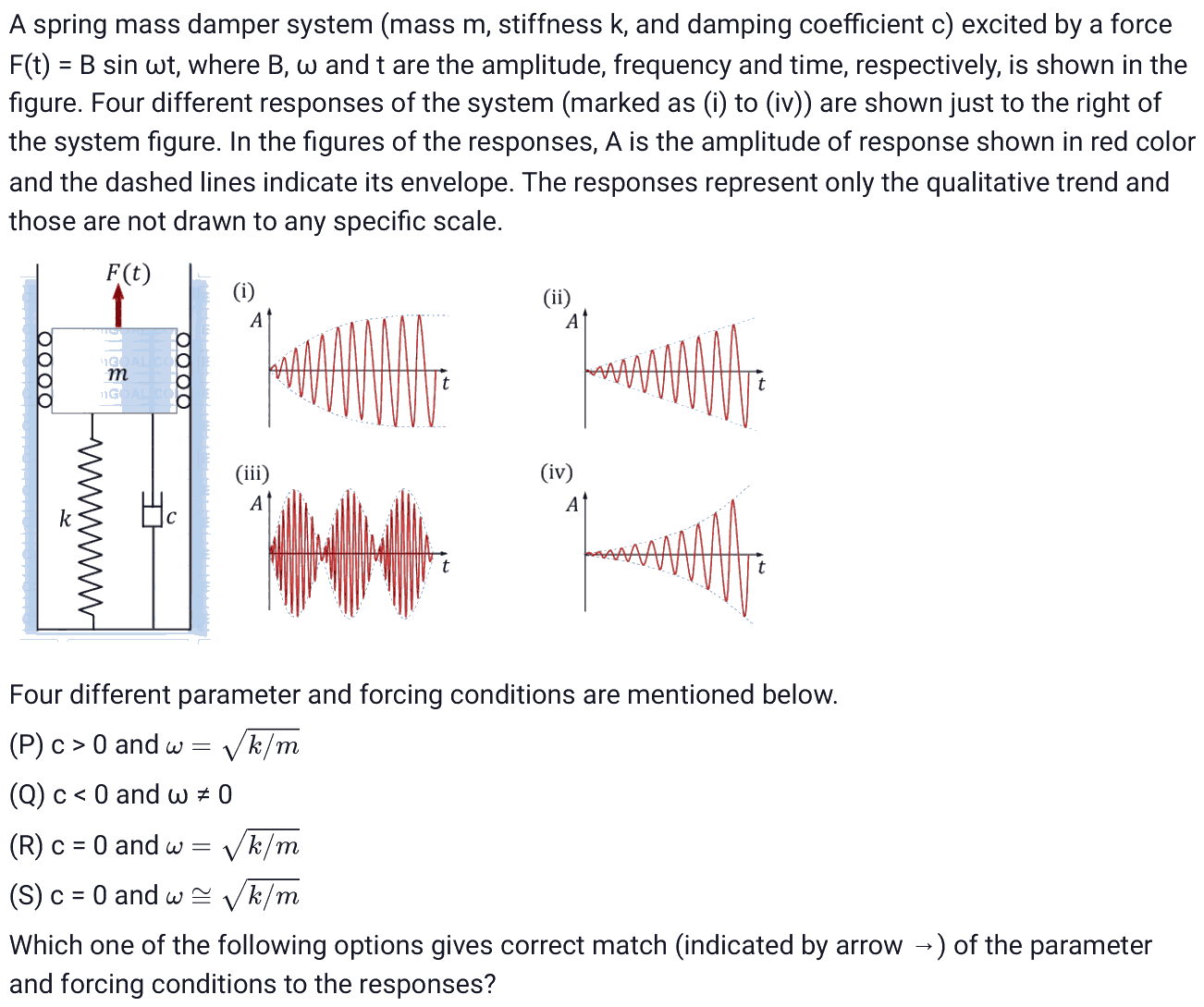
A spring mass damper system (mass m, stiffness k, and damping coefficient c) excited by a force F(t) = B sin ωt, where B, ω and t are the amplitude, frequency and time, respectively, is shown in the figure. Four different responses of the system (marked as (i) to (iv)) are shown just to the right of the system figure. In the figures of the responses, A is the amplitude of response shown in red color and the dashed lines indicate its envelope. The responses represent only the qualitative trend and those are not drawn to any specific scale. Four different parameter and forcing conditions are mentioned below. (P) c > 0 and (Q) c < 0 and ω≠ 0 (R) c = 0 and (S) c = 0 and Which one of the following options gives correct match (indicated by arrow →) of the parameter and forcing conditions to the responses?
- P - i, Q - iii, R - iv, S - ii
- P - ii, Q - iii, R - iv, S - i
- P - i, Q - iv, R - ii, S - iii
- P - iii, Q - iv, R - ii, S - i
Answer: C
GATE ME 2021 Set 1, Question 35 (1 mark, NAT)
Theory of Machines - Vibrations
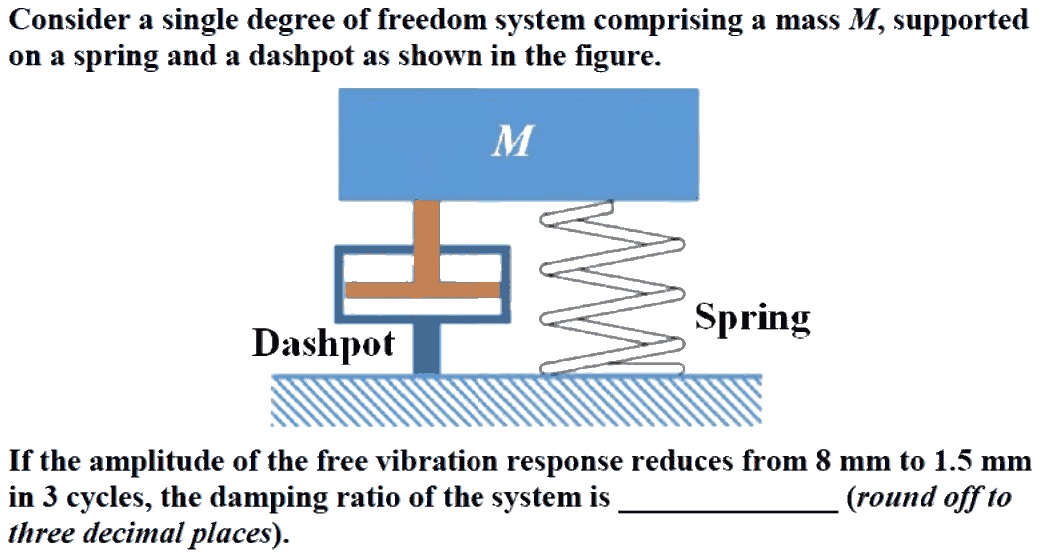
Q.25 Consider a single degree of freedom system comprising a mass M, supported on a spring and a dashpot as shown in the figure. W Spring Dashpot If the amplitude of the free vibration response reduces from 8 mm to 1.5 mm in 3 cycles, the damping ratio of the system is (round offto three decimal places).
Answer: 0.085 to 0.09
GATE ME 2021 Set 1, Question 40 (2 marks, MCQ)
Theory of Machines - Vibrations
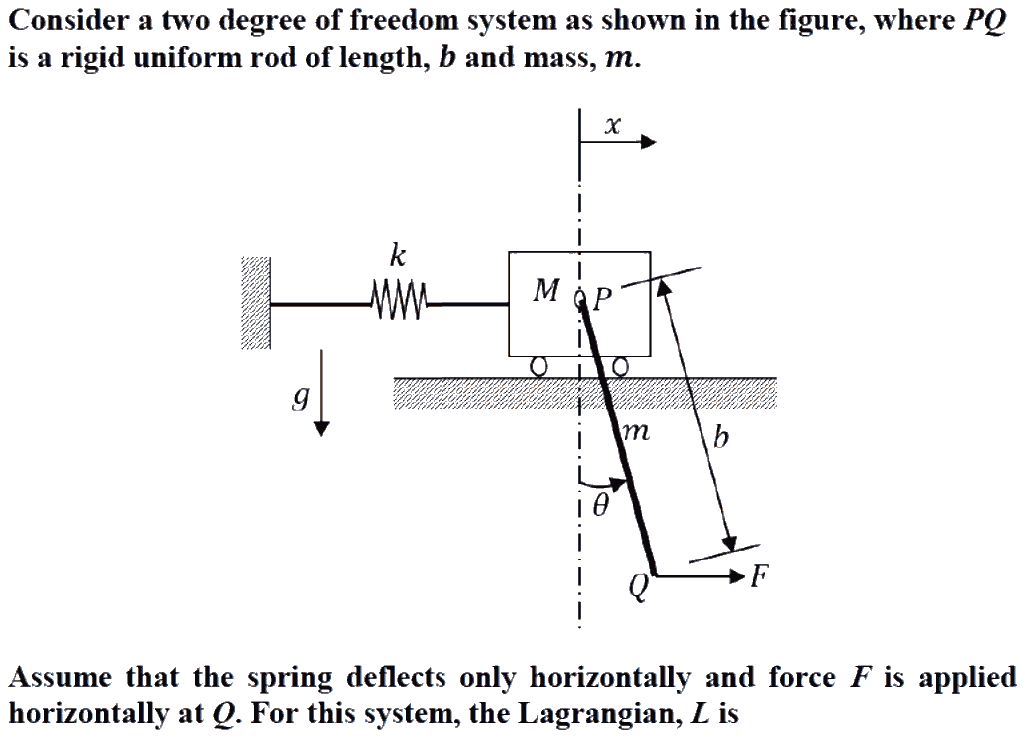
Q.30 Consider atwodegree offreedomsystem asshowninthefigure,wherePQ is a rigid uniform rod of length, b and mass, m. m Assume that the spring deflects only horizontally and force F is applied horizontally at Q. For this system, the Lagrangian, L is (A) 1 b 2 (B) (M + m)x² + 1 b kx2 + mg .cos θ -2 (C) 1 1 1 Mx2 + -2 (D) 1 b mb0x cos 0 +mb²θ2 kx2 + mg cos 0 + Fb sin θ
Answer: B
GATE ME 2021 Set 1, Question 42 (2 marks, MCQ)
Theory of Machines - Vibrations
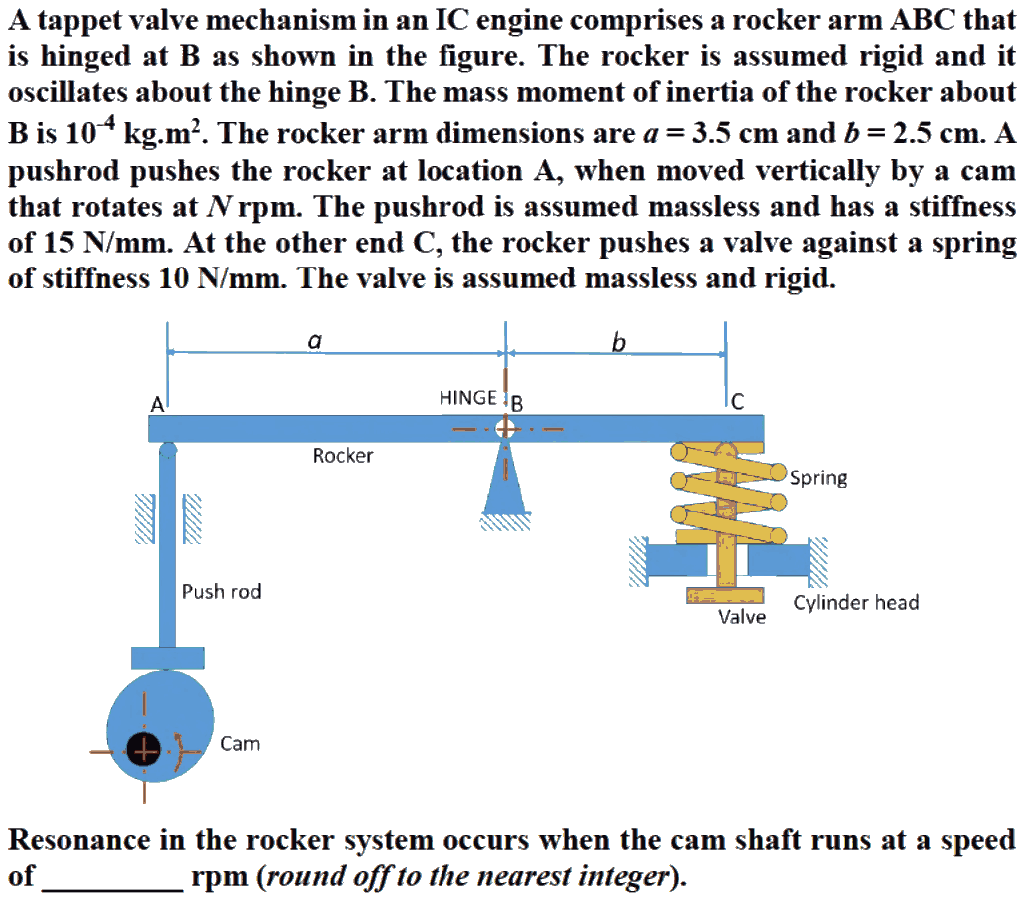
Q.32 A tappetvalvemechanisminanICenginecomprisesarockerarmABCthat is hinged at B as shown in the figure. The rocker is assumed rigid and it oscillatesabout thehingeB.Themassmomentof inertia oftherocker about B is 104kg.m². The rocker arm dimensions are a =3.5 cm and b = 2.5 cm. A pushrodpushestherocker atlocationA,whenmovedverticallybya cam thatrotatesatNrpm.Thepushrodisassumedmasslessandhasastiffness of15N/mm.Attheotherend C,therockerpushes a valveagainst a spring of stiffness 10 N/mm. The valve is assumed massless and rigid. HINGE! Rocker Spring Pushrod Cylinderhead Valve Cam Resonance in the rocker system occurs when the cam shaft runs at a speed of rpm (round off to the nearest integer). (A) 496 (B) 4739 (C) 790 (D) 2369
Answer: B
GATE ME 2021 Set 2, Question 43 (2 marks, MCQ)
Theory of Machines - Vibrations
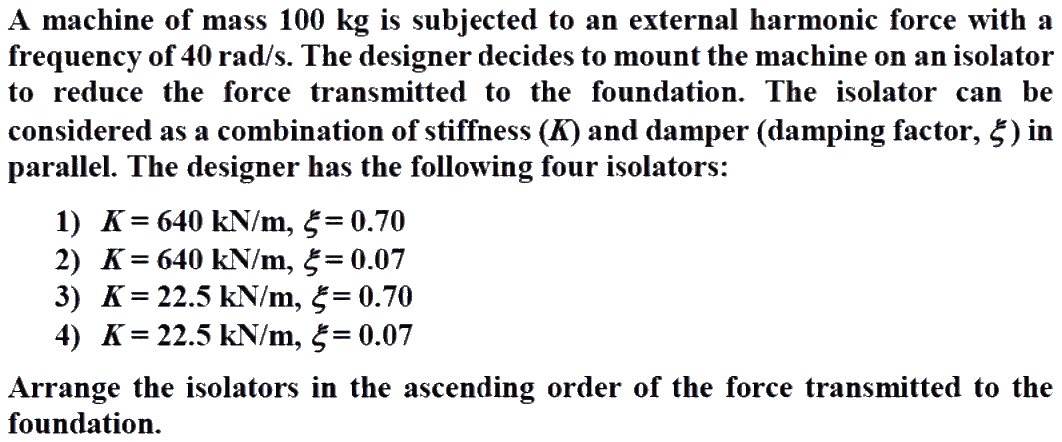
Q.33 Amachineofmass100kgissubjectedtoanexternalharmonicforcewitha frequency of 40 rad/s.The designer decides to mount the machine on an isolator toreducetheforcetransmittedtothefoundation.Theisolatorcanbe considered as a combination of stiffness(K)and damper(damping factor,) in parallel.The designerhas thefollowingfourisolators: 1)K=640 kN/m,§=0.70 2) K =640 kN/m,§= 0.07 3) K = 22.5 kN/m, §= 0.70 4) K = 22.5 kN/m, §= 0.07 Arrange the isolators in the ascending order of the force transmitted to the foundation. (A) 1-3-4-2 (B) 1-3-2-4 (C) 4-3-1-2 (D) 3-1-2-4
Answer: C
GATE ME 2021 Set 2, Question 44 (2 marks, MCQ)
Theory of Machines - Vibrations
Q.34 Consider the system shown in the figure. A rope goes over a pulley. A mass, m,

Answer: B
GATE ME 2020 Set 1, Question 16 (1 mark, MCQ)
Theory of Machines - Vibrations
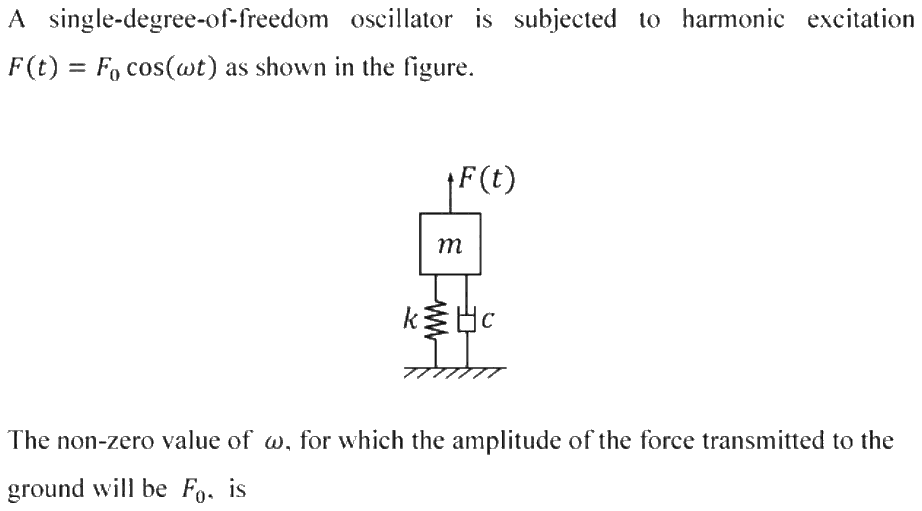
Q.No.6 Asingle-degree-of-freedom oscillatorissubjectedtoharmonic excitation F(t)=Focos(wt)as shown in thefigure. F(t) m kHc Thenon-zerovalueof,forwhichtheamplitudeoftheforcetransmittedtothe ground will be Fo,is (A) k 2m (B) k m (C) 2k m (D) m
Answer: C
GATE ME 2020 Set 1, Question 41 (2 marks, MCQ)
Theory of Machines - Vibrations
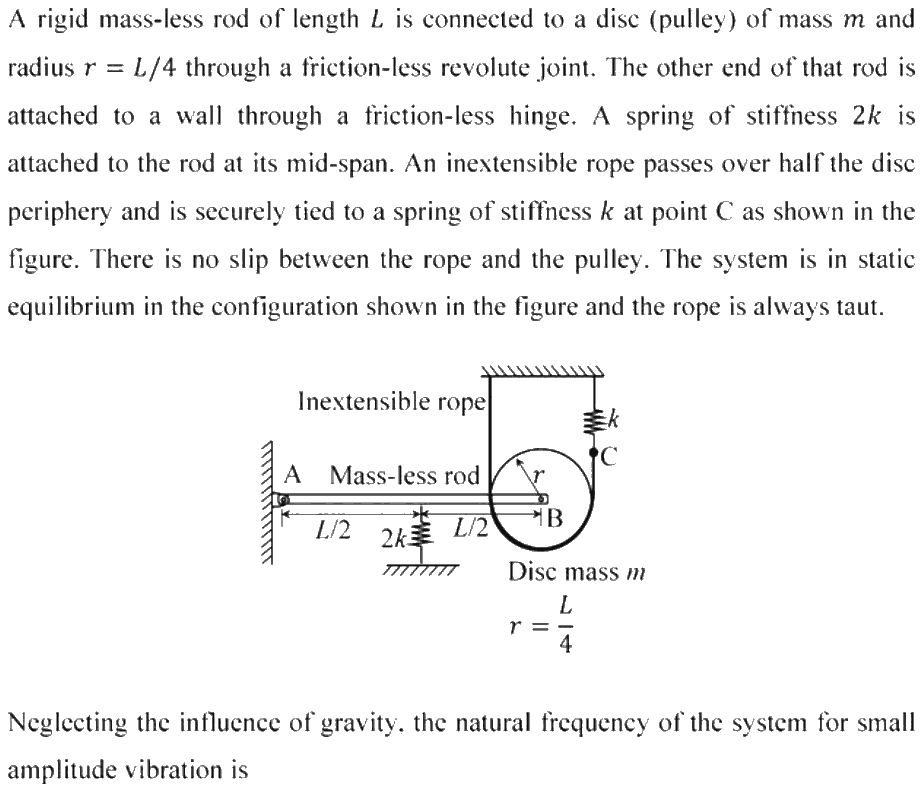
Q.No.31 Arigidmass-lessrodof lengthLis connected to a disc(pulley)ofmassm and radiusr=L/4throughafriction-lessrevolutejoint.Theotherendofthatrodis attached toawall throughafriction-lesshinge.A springofstiffness2kis attached to therod at itsmid-span.Aninextensiblerope passes over half the disc periphery and is securely tied to a spring of stiffness k at point C as shown in the figure.Thereisno slipbetween therope and the pulley.The system isin static equilibriumintheconfigurationshowninthefigureandtheropeisalwaystaut. Inextensiblerope k Mass-lessrod L/2 2k Discmassm L r=4 Neglecting theinfluenceofgravity,thenaturalfrequencyof thesystemforsmall amplitudevibrationis (A) (B) 3 √2 (C) (D)
Answer: C
GATE ME 2020 Set 2, Question 17 (1 mark, MCQ)
Theory of Machines - Vibrations
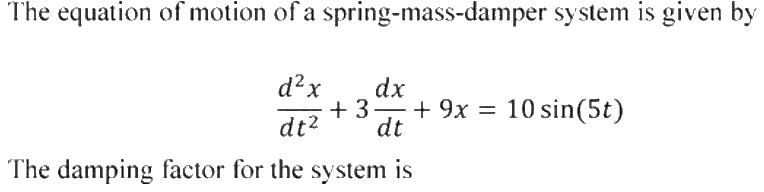
Q.No.7 d²x +9x=10sin(5t) dt2 dt Thedampingfactorforthesystemis (A) 0.25 (B) 0.5 (C) 2 (D) 3 ThenumberofqualitativelydistinctkinematicinversionspossibleforaGrashof
Answer: B
GATE ME 2019 Set 1, Question 16 (1 mark, MCQ)
Theory of Machines - Vibrations
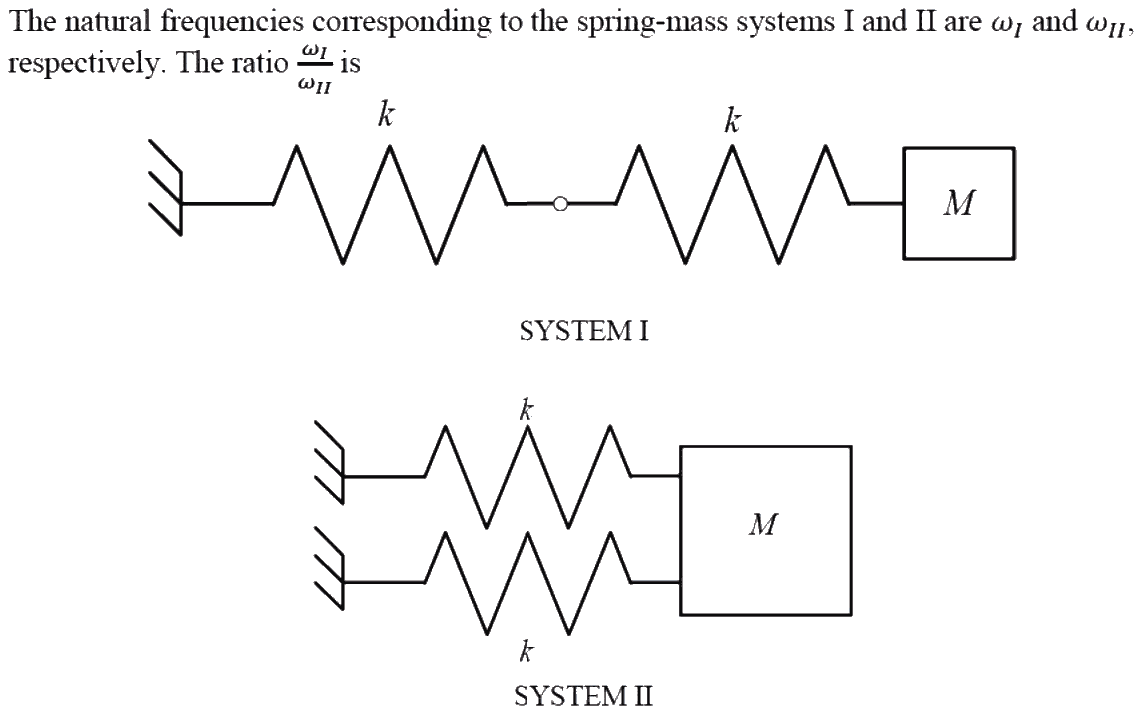
Q.6 The natural frequencies corresponding to the spring-mass systems I and II are w and @11, respectively. The ratio is k k W SYSTEMI M SYSTEMII 1 (A) (B) (C) 2 (D) 4 12
Answer: A
GATE ME 2019 Set 1, Question 53 (2 marks, NAT)
Theory of Machines - Vibrations
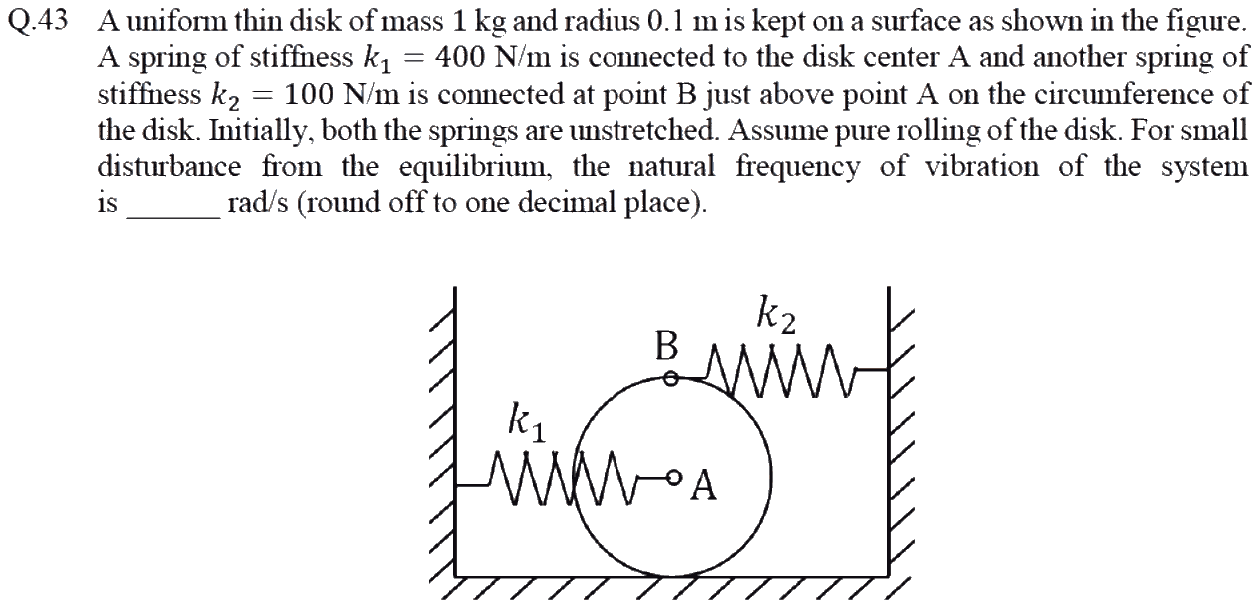
Q.43 A spring of stiffness k1 = 400 N/m is connected to the disk center A and another spring of stiffnessk2=100N/m is connectedatpoint Bjust abovepoint A onthe circumference of the disk.Initially,both the springs are unstretched.Assume purerollingofthe disk.Forsmall disturbance from the equilibrium, the natural frequency of vibration of the system is rad/s (round off to one decimal place). k2 B W k MM-·A
Answer: 23 to 24
GATE ME 2019 Set 2, Question 42 (2 marks, MCQ)
Theory of Machines - Vibrations
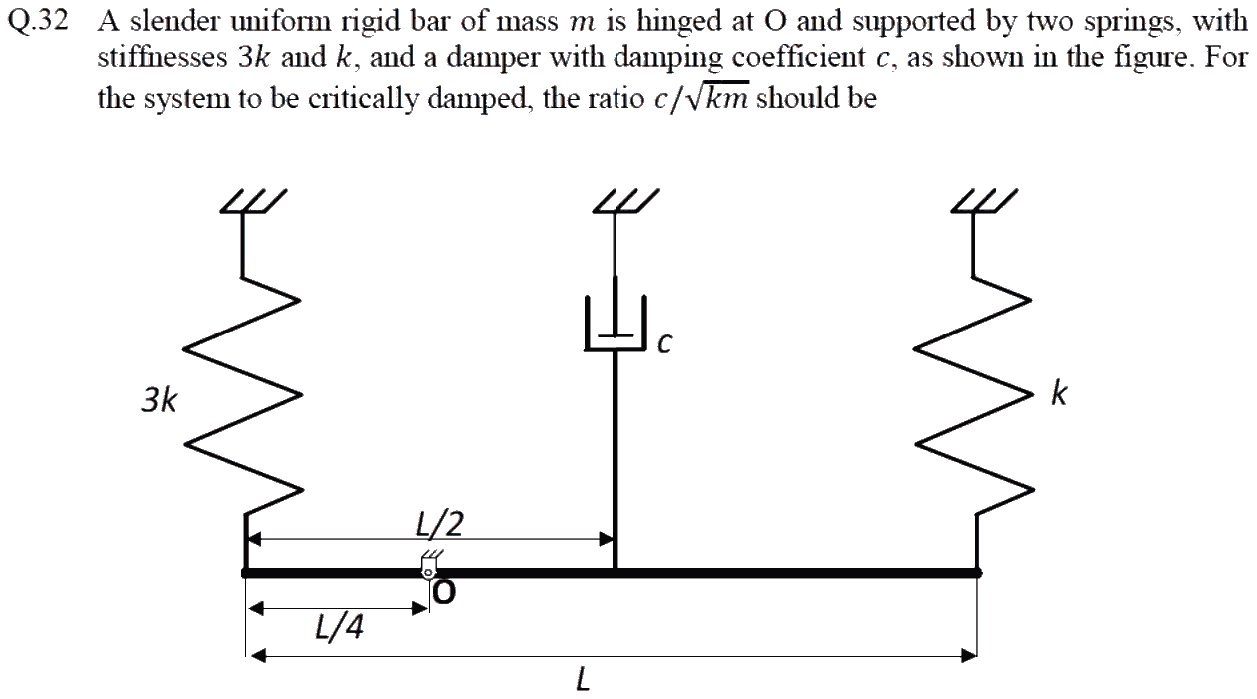
Q.32A slende stiffnesses 3k and k, and a damper with damping coefficient c, as shown in the figure. For thesystem tobecritically damped,theratioc/√kmshould be 3k L/2 L/4 (A) 2 (B) 4 (C) 2V7 (D) 4√7
Answer: D
GATE ME 2018 Set 1, Question 17 (1 mark, MCQ)
Theory of Machines - Vibrations
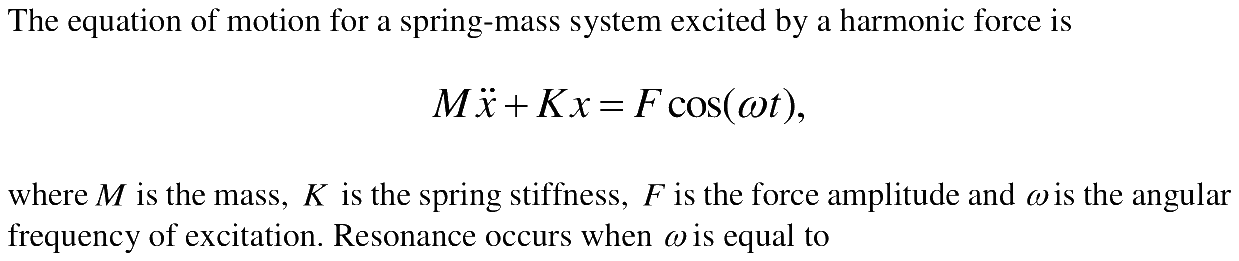
Q.7 The equation of motion for a spring-mass system excited by a harmonic force is M x Kx F cos( t ), where M is the mass, K is the spring stiffness, F is the force amplitude and is the angular frequency of excitation. Resonance occurs when is equal to M (B) 1 K K K (A) K (C) 2 (D) M 2 M M
Answer: D
GATE ME 2018 Set 1, Question 50 (2 marks, NAT)
Theory of Machines - Vibrations
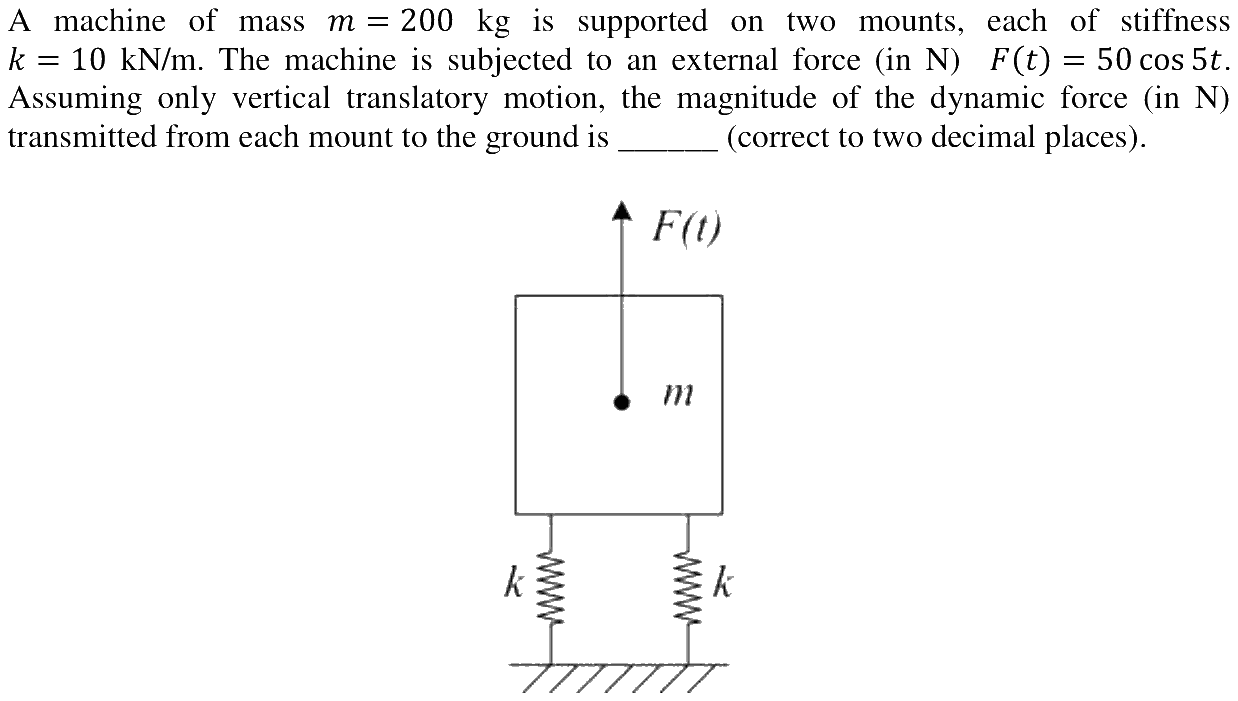
Q.40 A machine of mass 𝑚= 200 kg is supported on two mounts, each of stiffness 𝑘= 10 kN/m. The machine is subjected to an external force (in N) 𝐹(𝑡) = 50 cos 5𝑡. Assuming only vertical translatory motion, the magnitude of the dynamic force (in N) transmitted from each mount to the ground is ______ (correct to two decimal places).
Answer: 33 to 33.5
GATE ME 2018 Set 2, Question 17 (1 mark, MCQ)
Theory of Machines - Vibrations
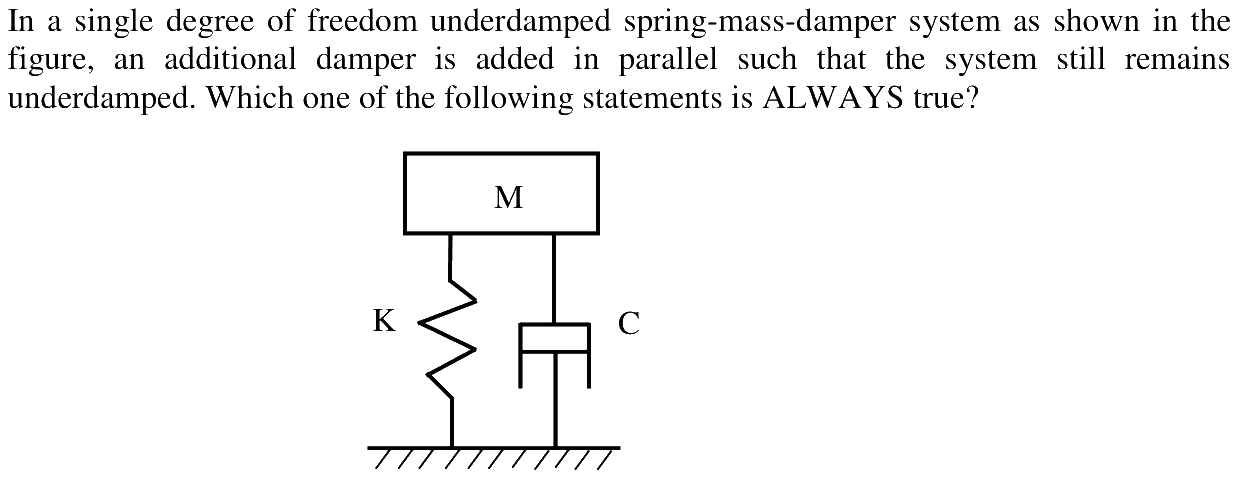
Q.7 In a single degree of freedom underdamped spring-mass-damper system as shown in the figure, an additional damper is added in parallel such that the system still remains underdamped. Which one of the following statements is ALWAYS true? M K C (A) Transmissibility will increase. (B) Transmissibility will decrease. (C) Time period of free oscillations will increase. (D) Time period of free oscillations will decrease.
Answer: C
GATE ME 2017 Set 1, Question 54 (1 mark, MCQ)
Theory of Machines - Vibrations
The damping ratio for a viscously damped spring mass system, governed by the relationship is given by

Answer: B
GATE ME 2017 Set 1, Question 55 (2 marks, MCQ)
Theory of Machines - Vibrations
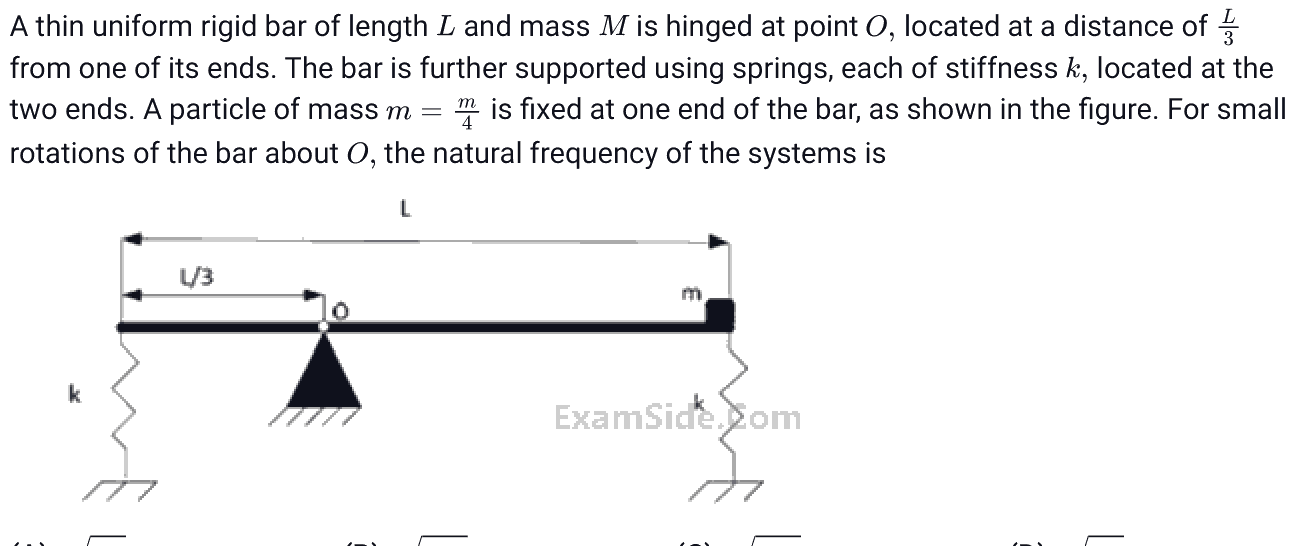
A thin uniform rigid bar of length and mass is hinged at point located at a distance of from one of its ends. The bar is further supported using springs, each of stiffness located at the two ends. A particle of mass is fixed at one end of the bar, as shown in the figure. For small rotations of the bar about the natural frequency of the systems is
Answer: B
GATE ME 2017 Set 2, Question 6 (1 mark, MCQ)
Theory of Machines - Vibrations
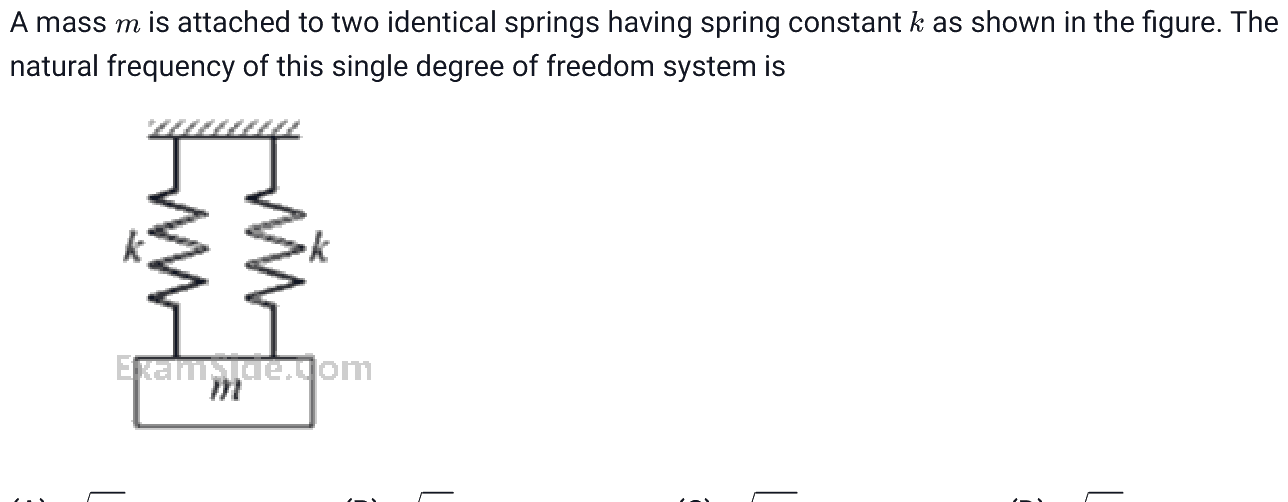
A mass is attached to two identical springs having spring constant as shown in the figure. The natural frequency of this single degree of freedom system is
Answer: A
GATE ME 2017 Set 2, Question 31 (2 marks, NAT)
Theory of Machines - Vibrations
The radius of gyration of a compound pendulum about the point of suspension is mm. The distance between the point of suspension and the centre of mass is mm. Considering the acceleration due to gravity as m/s$^{2}$, the natural frequency (in radian/s) of the compound pendulum is _________.

Answer: 15 to 16
GATE ME 2016 Set 1, Question 21 (1 mark, NAT)
Theory of Machines - Vibrations
A single degree of freedom spring mass system with viscous damping has a spring constant of 10 kN/m. The system is excited by a sinusoidal force of amplitude 100 N. If the damping factor (ratio) is 0.25, the amplitude of steady state oscillation at resonance is ________mm.
Answer: 19.9 to 20.1
GATE ME 2016 Set 1, Question 47 (2 marks, MCQ)
Theory of Machines - Vibrations
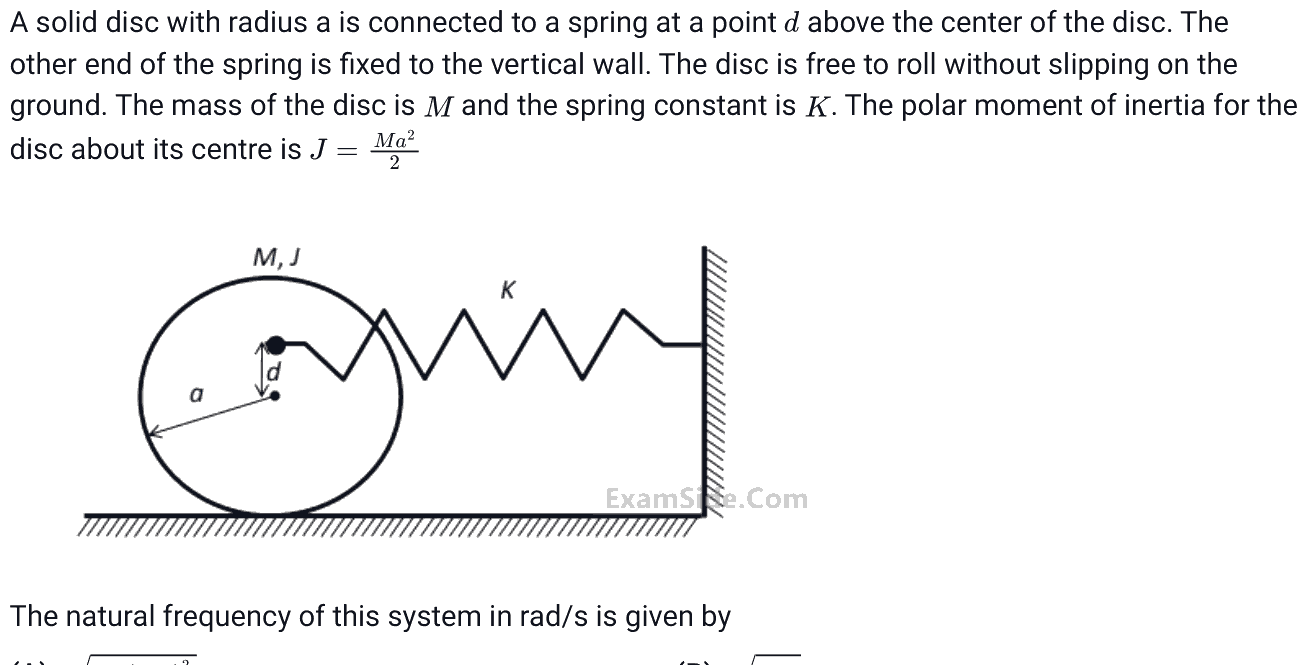
A solid disc with radius a is connected to a spring at a point above the center of the disc. The other end of the spring is fixed to the vertical wall. The disc is free to roll without slipping on the ground. The mass of the disc is and the spring constant is . The polar moment of inertia for the disc about its centre is The natural frequency of this system in rad/s is given by
Answer: A
GATE ME 2016 Set 2, Question 47 (2 marks, NAT)
Theory of Machines - Vibrations
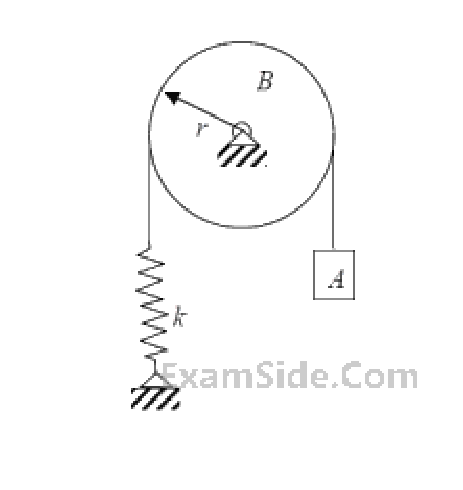
The system shown in the figure consists of block A of mass 5 kg connected to a spring through a massless rope passing over pulley B of radius r and mass 20 kg. The spring constant k is 1500 N/m. If there is no slipping of the rope over the pulley, the natural frequency of the system is_____________ rad/s.
Answer: 9.9 to 10.1
GATE ME 2016 Set 3, Question 21 (1 mark, NAT)
Theory of Machines - Vibrations
The static deflection of a spring under gravity, when a mass of 1 kg is suspended from it, is 1 mm. Assume the acceleration due to gravity g =10 m/s$^{2}$ . The natural frequency of this spring-mass system (in rad/s) is _____________
Answer: 99 to 101
GATE ME 2016 Set 3, Question 47 (2 marks, NAT)
Theory of Machines - Vibrations
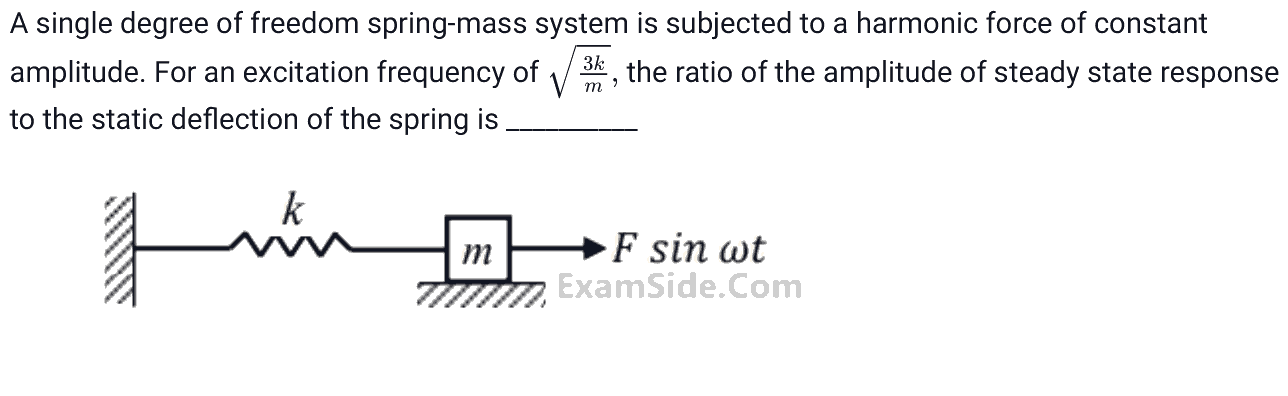
A single degree of freedom spring-mass system is subjected to a harmonic force of constant amplitude. For an excitation frequency of the ratio of the amplitude of steady state response to the static deflection of the spring is __________
Answer: 0.49 to 0.51
GATE ME 2015 Set 1, Question 48 (2 marks, MCQ)
Theory of Machines - Vibrations
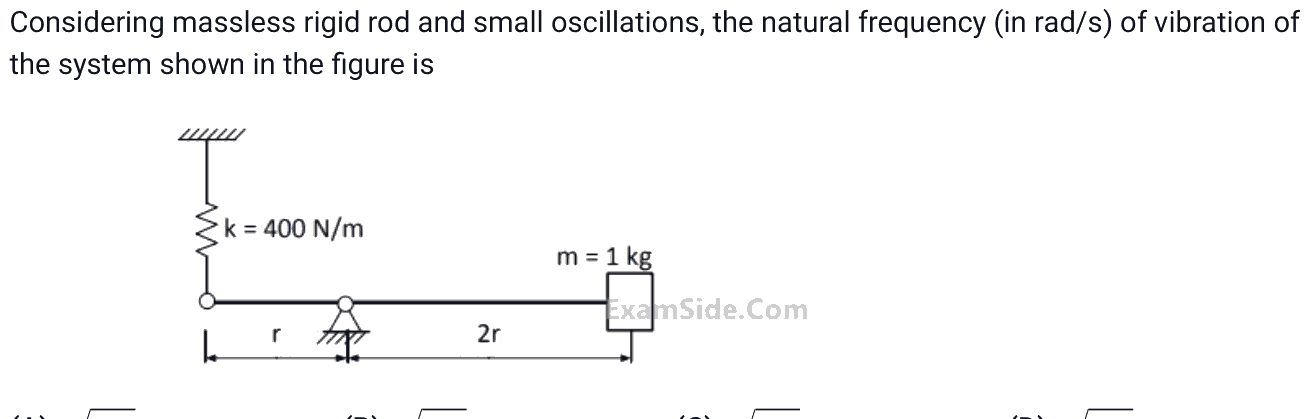
Considering massless rigid rod and small oscillations, the natural frequency (in rad/s) of vibration of the system shown in the figure is
Answer: D
GATE ME 2015 Set 1, Question 52 (2 marks, MCQ)
Theory of Machines - Vibrations
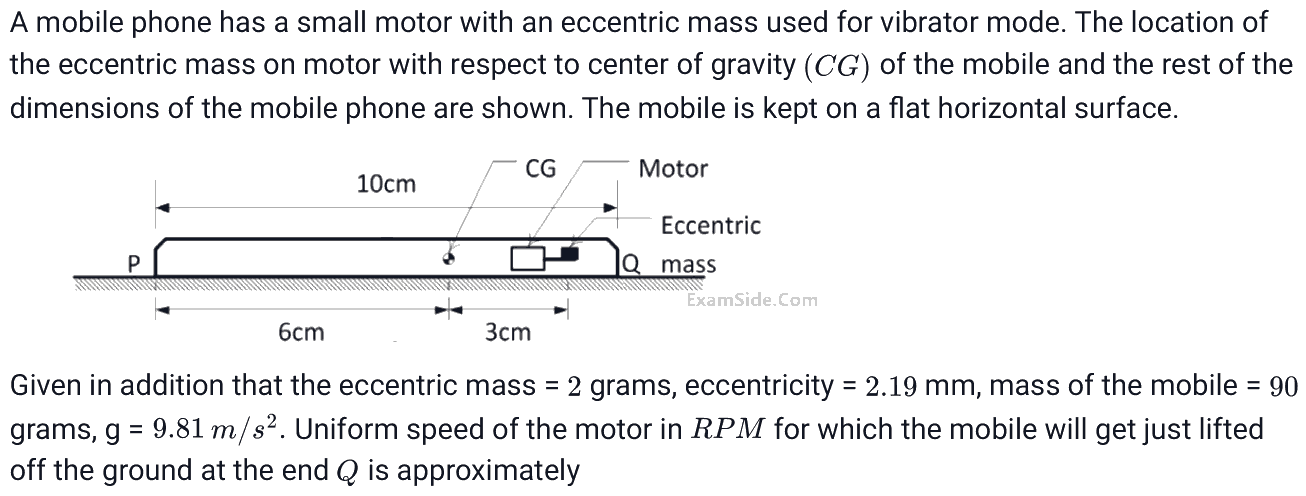
A mobile phone has a small motor with an eccentric mass used for vibrator mode. The location of the eccentric mass on motor with respect to center of gravity of the mobile and the rest of the dimensions of the mobile phone are shown. The mobile is kept on a flat horizontal surface. Given in addition that the eccentric mass = grams, eccentricity = mm, mass of the mobile = grams, g = Uniform speed of the motor in for which the mobile will get just lifted off the ground at the end is approximately
Answer: B
GATE ME 2015 Set 1, Question 55 (2 marks, NAT)
Theory of Machines - Vibrations
A precision instrument package (m = 1kg) needs to be mounted on a surface vibrating at 60 Hz. It is desired that only 5% of the base surface vibration amplitude be transmitted to the instrument. Assume that the isolation is designed with its natural frequency significantly lesser than 60Hz, so that the effect of damping may be ignored. The stiffness (in N/m) of the required mounting pad is _____________.
Answer: 6750 to 7150
GATE ME 2015 Set 2, Question 20 (1 mark, NAT)
Theory of Machines - Vibrations
In a spring-mass system the mass is m and the spring constant is . The critical damping coefficient of the system is kg/s. In another spring mass system, the mass is and the spring constant is . The critical damping coefficient (in kg/s) of this system is __________

Answer: 0.38 to 0.42
GATE ME 2015 Set 2, Question 46 (2 marks, MCQ)
Theory of Machines - Vibrations
A single-degree-freedom spring mass system is subjected to a sinusoidal force of N amplitude and frequency along the axis of the spring. The stiffness of the spring is N/m, damping factor is and the undamped natural frequency is . At steady state, the amplitude of vibration (in m) is approximately

Answer: B
GATE ME 2015 Set 3, Question 29 (1 mark, MCQ)
Theory of Machines - Vibrations
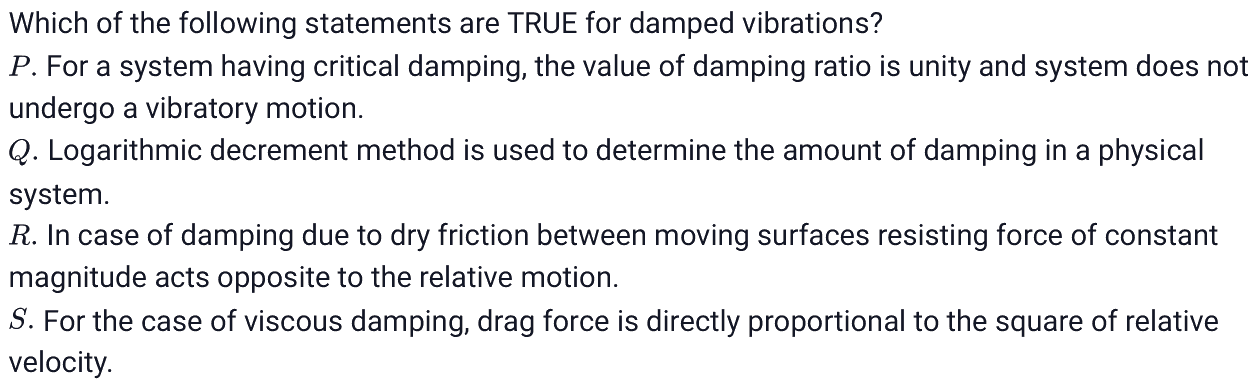
Which of the following statements are TRUE for damped vibrations? For a system having critical damping, the value of damping ratio is unity and system does not undergo a vibratory motion. Logarithmic decrement method is used to determine the amount of damping in a physical system. In case of damping due to dry friction between moving surfaces resisting force of constant magnitude acts opposite to the relative motion. For the case of viscous damping, drag force is directly proportional to the square of relative velocity.
- and only
- and only
- and only
- and only
Answer: C
GATE ME 2015 Set 3, Question 38 (2 marks, MCQ)
Theory of Machines - Vibrations
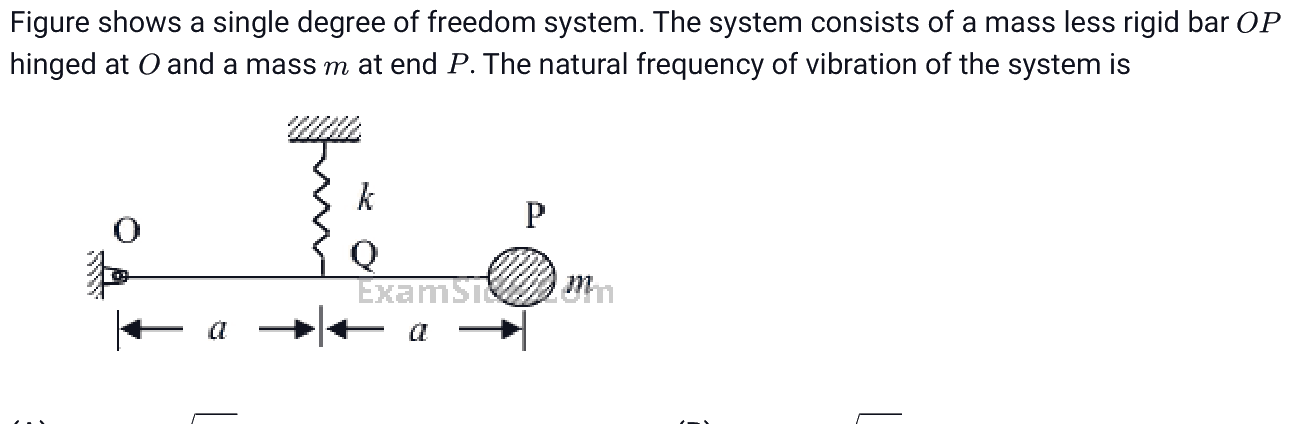
Figure shows a single degree of freedom system. The system consists of a mass less rigid bar hinged at and a mass at end The natural frequency of vibration of the system is
Answer: A
GATE ME 2014, Question 16 (1 mark, MCQ)
Theory of Machines - Vibrations
Critical damping is the
- largest amount of damping for which no oscillation occurs in free vibration
- smallest amount of damping for which no oscillation occurs in free vibration
- largest amount of damping for which the motion is simple harmonic in free vibration
- smallest amount of damping for which the motion is simple harmonic in free vibration
Answer: B
GATE ME 2014, Question 17 (1 mark, MCQ)
Theory of Machines - Vibrations
In vibration isolation, which one of the following statements is NOT correct regarding Transmissibility ()?

- is nearly unity at small excitation frequencies
- can be always reduced by using higher damping at any excitation frequency
- is unity at the frequency ratio of
- is infinity at resonance for undamped systems
Answer: B
GATE ME 2014 Set 1, Question 18 (1 mark, MCQ)
Theory of Machines - Vibrations
Q.8 Critical damping is the (A) largest amount of damping for which no oscillation occurs in free vibration (B) smallest amount of damping for which no oscillation occurs in free vibration (C) largest amount of damping for which the motion is simple harmonic in free vibration (D) smallest amount of damping for which the motion is simple harmonic in free vibration

Answer: B
GATE ME 2014 Set 1, Question 43 (2 marks, NAT)
Theory of Machines - Vibrations
Consider a cantilever beam, having negligible mass and uniform flexural rigidity, with length . The frequency of vibration of the beam, with a kg mass attached at the free tip, is . The flexural rigidity (in ) of the beam is _________.

Answer: 0.064 to 0.067
GATE ME 2014 Set 1, Question 48 (2 marks, MCQ)
Theory of Machines - Vibrations
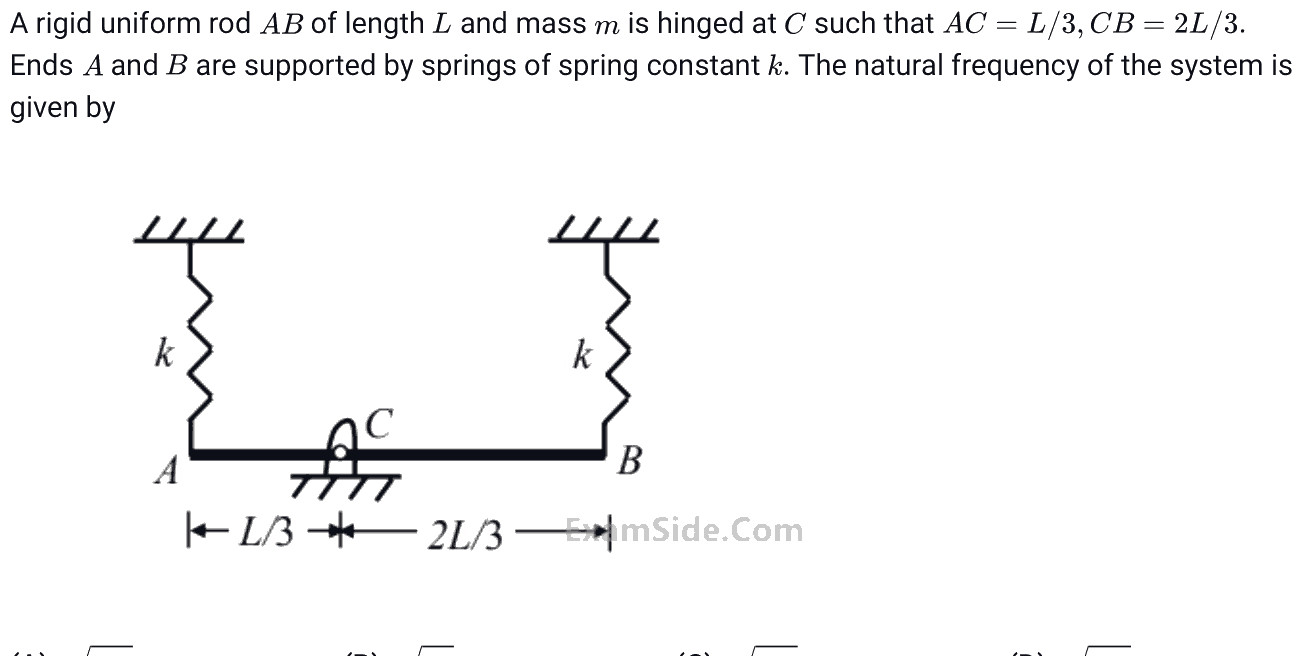
A rigid uniform rod of length and mass is hinged at such that Ends and are supported by springs of spring constant The natural frequency of the system is given by
Answer: D
GATE ME 2014 Set 2, Question 19 (1 mark, MCQ)
Theory of Machines - Vibrations
Q.9 In vibration isolation, which one of the following statements is NOT correct regarding Transmissibility (T)? (A) T is nearly unity at small excitation frequencies (B) T can be always reduced by using higher damping at any excitation frequency (C) T is unity at the frequency ratio of 2 (D) T is infinity at resonance for undamped systems

Answer: B
GATE ME 2014 Set 2, Question 44 (2 marks, MCQ)
Theory of Machines - Vibrations
What is the natural frequency of the spring mass system shown below? The contact between the block and the inclined plane is frictionless. The mass of the block is denoted by and the spring constants are denoted by and as shown below.
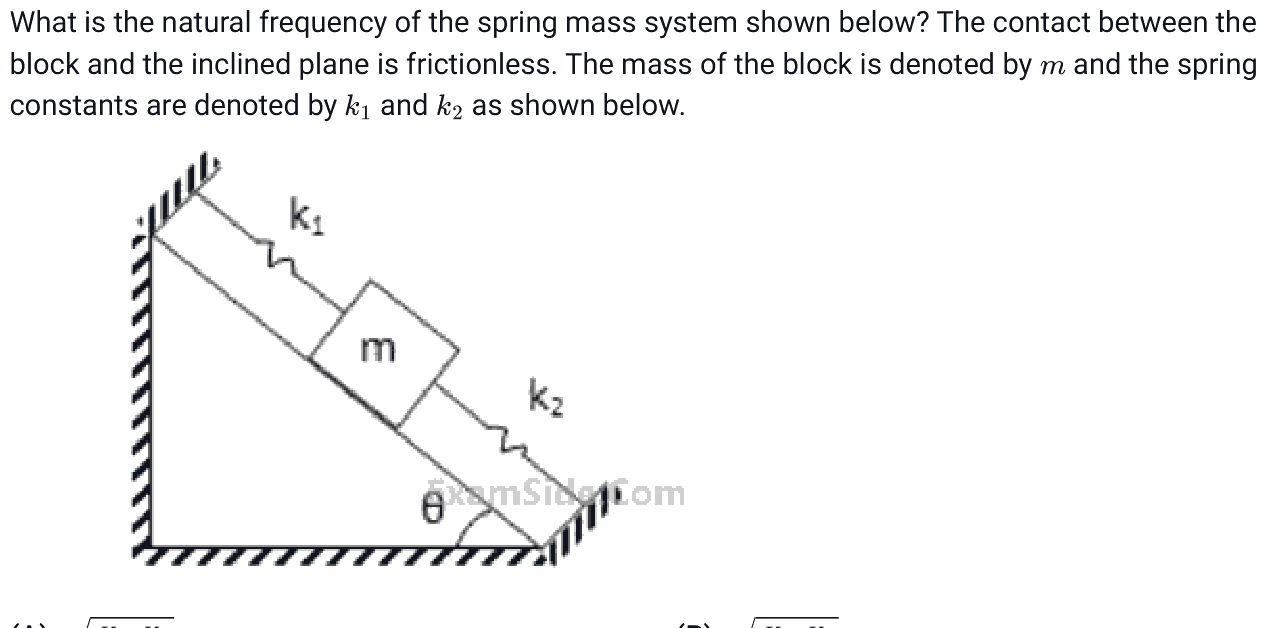
Answer: D
GATE ME 2014 Set 3, Question 18 (1 mark, MCQ)
Theory of Machines - Vibrations
Consider a single degree-of-freedom system with viscous damping excited by a harmonic force. At resonance, the phase angle (in degree) of the displacement with respect to the exciting force is
Answer: C
GATE ME 2014 Set 3, Question 43 (2 marks, NAT)
Theory of Machines - Vibrations
The damping ratio of a single degree of freedom spring-mass-damper system with mass of kg, stiffness and viscous damping coefficient of is _____________

Answer: 1.24 to 1.26
GATE ME 2014 Set 3, Question 50 (2 marks, NAT)
Theory of Machines - Vibrations
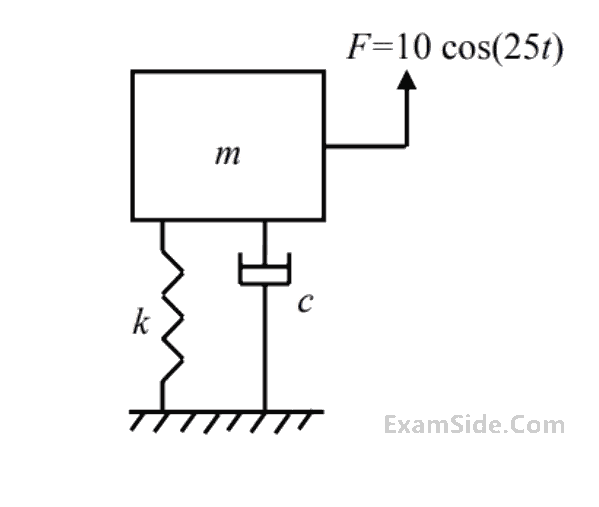
A mass-spring-dashpot system with mass m = 10 kg, spring constant k = 6250 N/m is excited by a harmonic excitation of 10 cos(25t) N. At the steady state, the vibration amplitude of the mass is 40mm. The damping coefficient (c, in N.s/m) of the dashpot is ______________
Answer: 9 to 11
GATE ME 2014 Set 4, Question 20 (1 mark, NAT)
Theory of Machines - Vibrations
A point mass is executing simple harmonic motion with an amplitude of mm and frequency of Hz. The maximum acceleration (m/s$^{2}$) of the mass is _________.

Answer: 6.3 to 6.4
GATE ME 2014 Set 4, Question 49 (2 marks, NAT)
Theory of Machines - Vibrations
A single degree of freedom system has a mass of 2kg, stiffness 8 N/m and viscous damping ratio 0.02. The dynamic magnification factor at an excitation frequency of 1.5 rad/s is ___________
Answer: 2 to 2.4
GATE ME 2013, Question 22 (1 mark, MCQ)
Theory of Machines - Vibrations
If two nodes are observed at a frequency of rpm during whirling of a simply supported long slender rotating shaft, the first critical speed of the shaft in rpm is

Answer: A
GATE ME 2013, Question 39 (2 marks, MCQ)
Theory of Machines - Vibrations
A single degree of freedom system having mass and stiffness initially at rest is subjected to an impulse force of magnitude for seconds. The amplitude in of the resulting free vibration is

Answer: C
GATE ME 2012, Question 48 (2 marks, MCQ)
Theory of Machines - Vibrations
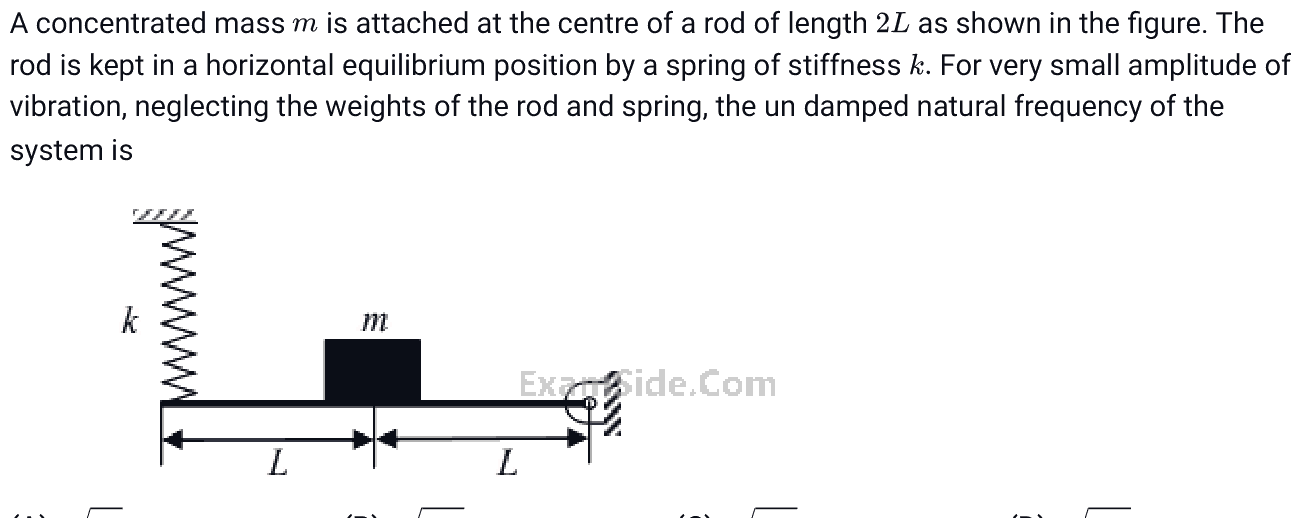
A concentrated mass is attached at the centre of a rod of length as shown in the figure. The rod is kept in a horizontal equilibrium position by a spring of stiffness For very small amplitude of vibration, neglecting the weights of the rod and spring, the un damped natural frequency of the system is
Answer: D
GATE ME 2011, Question 49 (2 marks, MCQ)
Theory of Machines - Vibrations
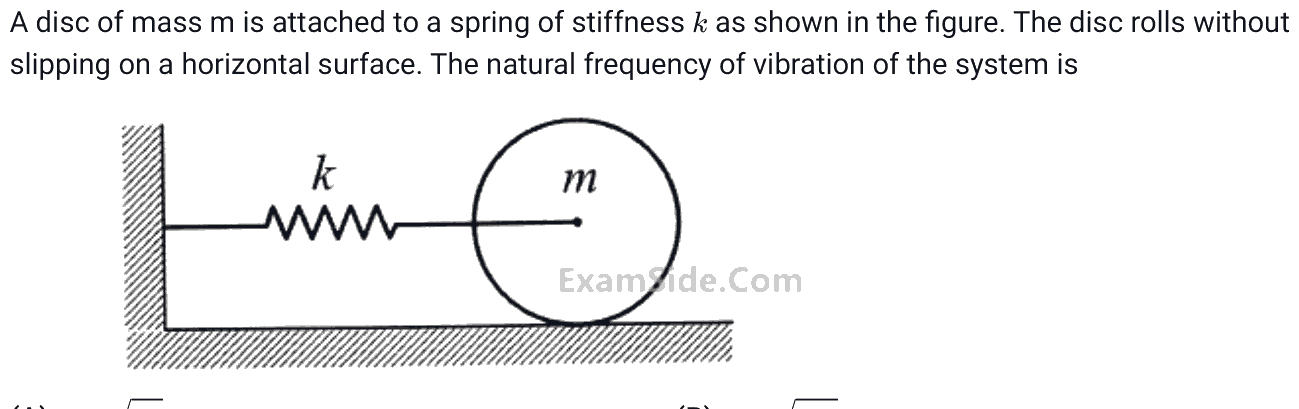
A disc of mass m is attached to a spring of stiffness as shown in the figure. The disc rolls without slipping on a horizontal surface. The natural frequency of vibration of the system is
Answer: C
GATE ME 2011, Question 50 (2 marks, MCQ)
Theory of Machines - Vibrations
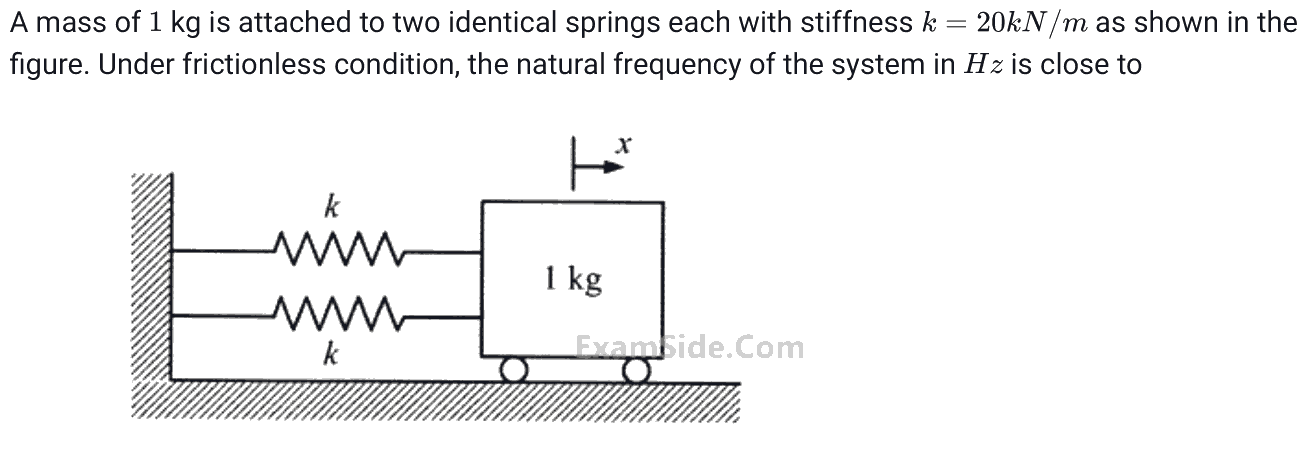
A mass of kg is attached to two identical springs each with stiffness as shown in the figure. Under frictionless condition, the natural frequency of the system in is close to
Answer: A
GATE ME 2010, Question 19 (1 mark, MCQ)
Theory of Machines - Vibrations
The natural frequency of a spring-mass system on earth is The natural frequency of this system on the moon (g$_{moon}$ = g$_{earth}$/6) is

Answer: A
GATE ME 2010, Question 51 (2 marks, MCQ)
Theory of Machines - Vibrations
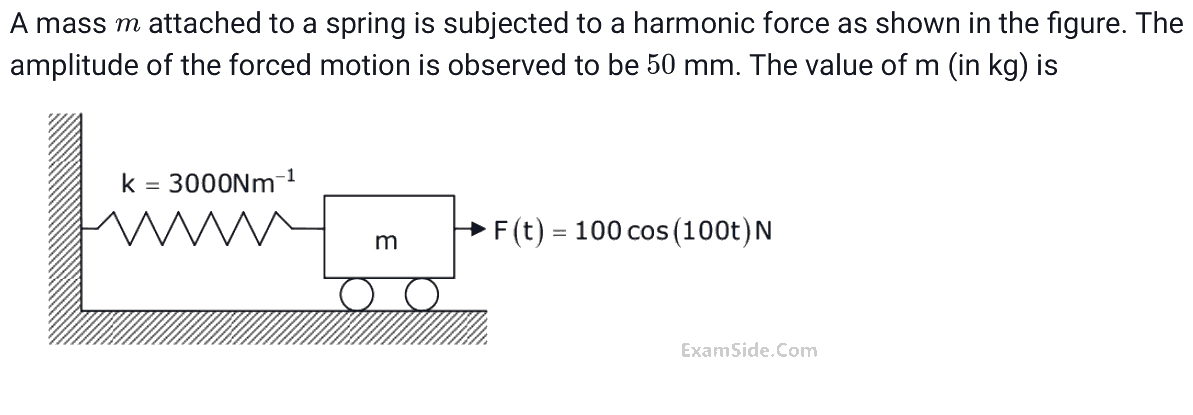
A mass attached to a spring is subjected to a harmonic force as shown in the figure. The amplitude of the forced motion is observed to be mm. The value of m (in kg) is
Answer: A
GATE ME 2009, Question 20 (1 mark, MCQ)
Theory of Machines - Vibrations
The rotor shaft of a large electric motor supported between short bearings at both the ends shows a deflection of mm in the middle of the rotor. Assuming the rotor to be perfectly balanced and supported at knife edges at both the ends, the likely critical speed (in rpm) of the shaft is

Answer: B
GATE ME 2009, Question 52 (2 marks, MCQ)
Theory of Machines - Vibrations
An automotive engine weighing kg is supported on four springs with linear characteristics. Each of the front two springs have a stiffness of MN/m while the stiffness of each rear spring is MN/m. The engine speed (in rpm), at which resonance is likely to occur, is

Answer: A
GATE ME 2009, Question 53 (2 marks, MCQ)
Theory of Machines - Vibrations
A vehicle suspension system consists of a spring and a damper. The stiffness of the spring is kN/m and the damping constant of the damper is Ns/m. If the mass is kg, then the damping factor () and damped natural frequency () respectively are

- and
- and
- and
- and
Answer: A
GATE ME 2008, Question 54 (2 marks, MCQ)
Theory of Machines - Vibrations
A uniform rigid rod of mass and length m is hinged at its centre & laterally supported at one end by a spring of spring constant The natural frequency in rad/s is

Answer: C
GATE ME 2008, Question 55 (2 marks, MCQ)
Theory of Machines - Vibrations
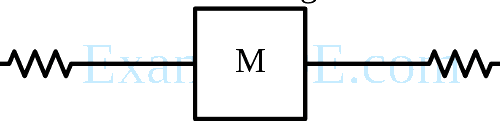
$^{The natural frequency of the spring mass system shown in the figure is closest to}$ M=1.4kg K$^{1}$=4000 N/mK$_{2}$=1600 N/m
Answer: B
GATE ME 2007, Question 21 (1 mark, MCQ)
Theory of Machines - Vibrations
For an under damped harmonic oscillator, resonance
- occurs when excitation frequency is greater than undamped natural frequency.
- occurs when excitation frequency is less than undamped natural frequency
- occurs when excitation frequency is equal to undamped natural frequency
- never occurs
Answer: C
GATE ME 2007, Question 56 (2 marks, MCQ)
Theory of Machines - Vibrations
The equation of motion of a harmonic oscillator is given by and the initial conditions at are The amplitude of after complete cycles is

Answer: A
GATE ME 2007, Question 57 (2 marks, MCQ)
Theory of Machines - Vibrations
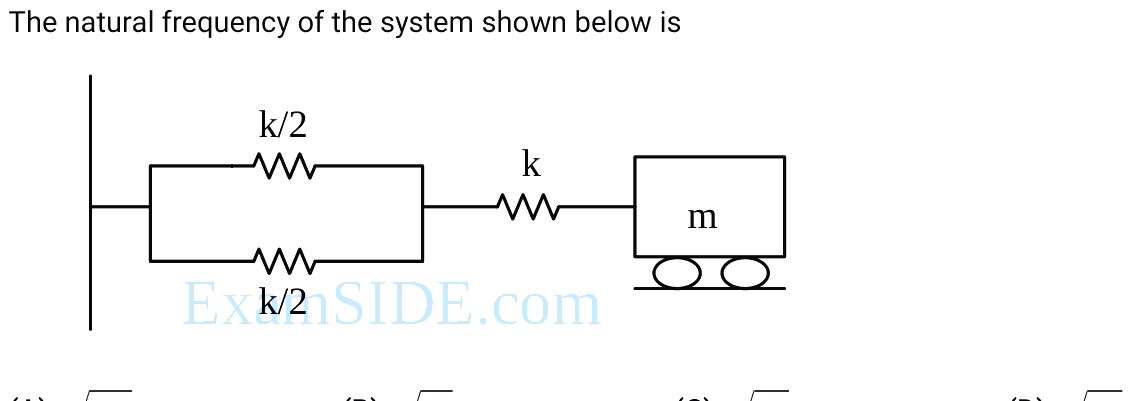
$^{The natural frequency of the system shown below is}$ k/2 ExamSIDE.comk/2
Answer: A
GATE ME 2006, Question 22 (1 mark, MCQ)
Theory of Machines - Vibrations
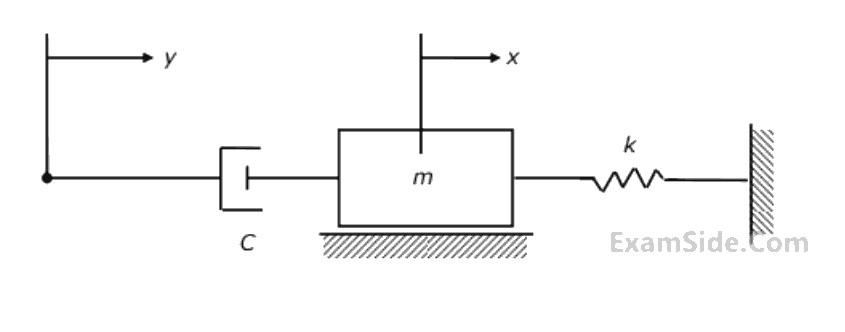
The differential equation governing the vibrating system is
Answer: C
GATE ME 2006, Question 58 (2 marks, MCQ)
Theory of Machines - Vibrations
A machine of kg mass is supported on springs of total stiffness kN/m. Machine has an unbalanced rotating force of N at speed of rpm. Assuming a damping factor of the value of transmissibility ratio is

Answer: C
GATE ME 2006, Question 59 (2 marks, MCQ)
Theory of Machines - Vibrations
A vibratory system consists of a mass kg, a spring of stiffness and a dashpot with damping coefficient of The value of critical damping of the system is:

Answer: D
GATE ME 2006, Question 60 (2 marks, MCQ)
Theory of Machines - Vibrations
A vibratory system consists of a mass kg, a spring of stiffness and a dashpot with damping coefficient of The value of logarithmic decrement is

Answer: B
GATE ME 2005, Question 23 (1 mark, MCQ)
Theory of Machines - Vibrations
There are four samples P, Q, R and S, with natural frequencies 64, 96, 128 and 256 Hz, respectively. There are mounted on test setups for conducting vibration experiments. If a loud pure not of frequency 144Hz is produced by some instrument, which of the samples will show the most perceptible induced vibration?
- P
- Q
- R
- S
Answer: C
GATE ME 2005, Question 61 (2 marks, MCQ)
Theory of Machines - Vibrations
In a spring-mass system, the mass is 0.1 kg and the stiffness of the spring is 1 kN/m. By introducing a damper, the frequency of oscillation is found to be 90% of the original value. What is the damping coefficient of the damper?
- 1.2 N.s/m
- 3.4 N.s/m
- 8.7 N.s/m
- 12.0 N.s/m
Answer: C
GATE ME 2004, Question 24 (1 mark, MCQ)
Theory of Machines - Vibrations
A vibrating machine is isolated from the floor using springs. If the ratio of excitation frequency of vibration of machine to the natural frequency of the isolation system is equal to 0.5, the transmissibility ratio of isolation is
Answer: C
GATE ME 2004, Question 62 (2 marks, MCQ)
Theory of Machines - Vibrations
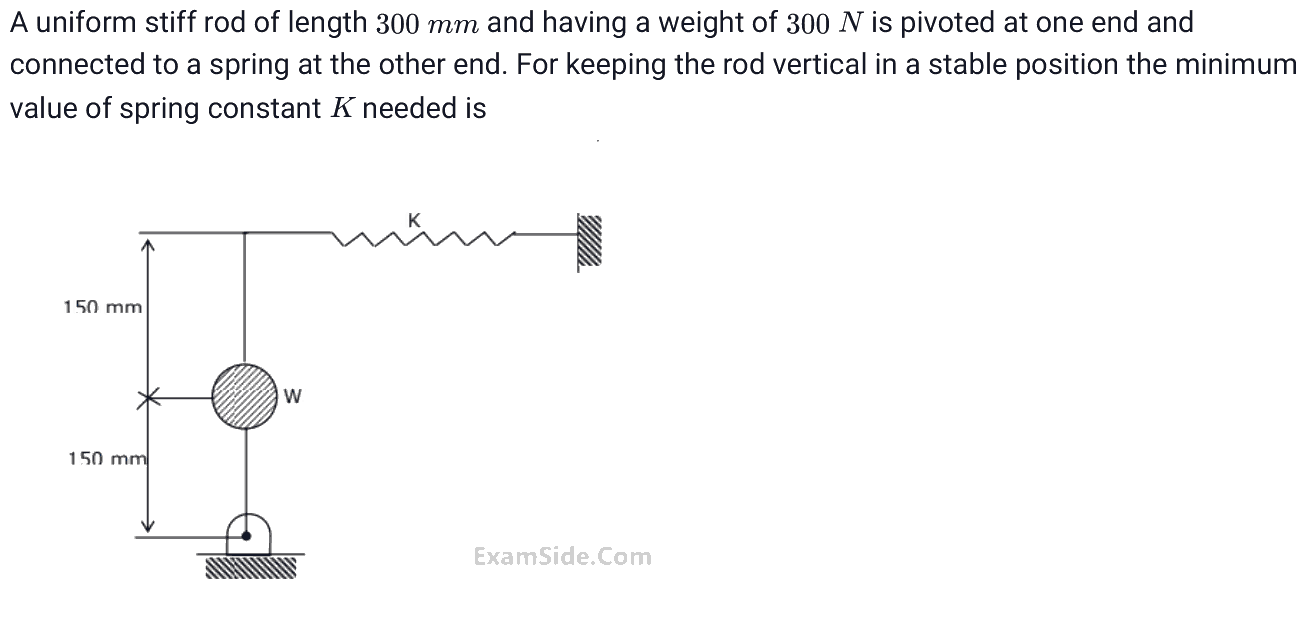
A uniform stiff rod of length and having a weight of is pivoted at one end and connected to a spring at the other end. For keeping the rod vertical in a stable position the minimum value of spring constant needed is
Answer: C
GATE ME 2004, Question 63 (2 marks, MCQ)
Theory of Machines - Vibrations
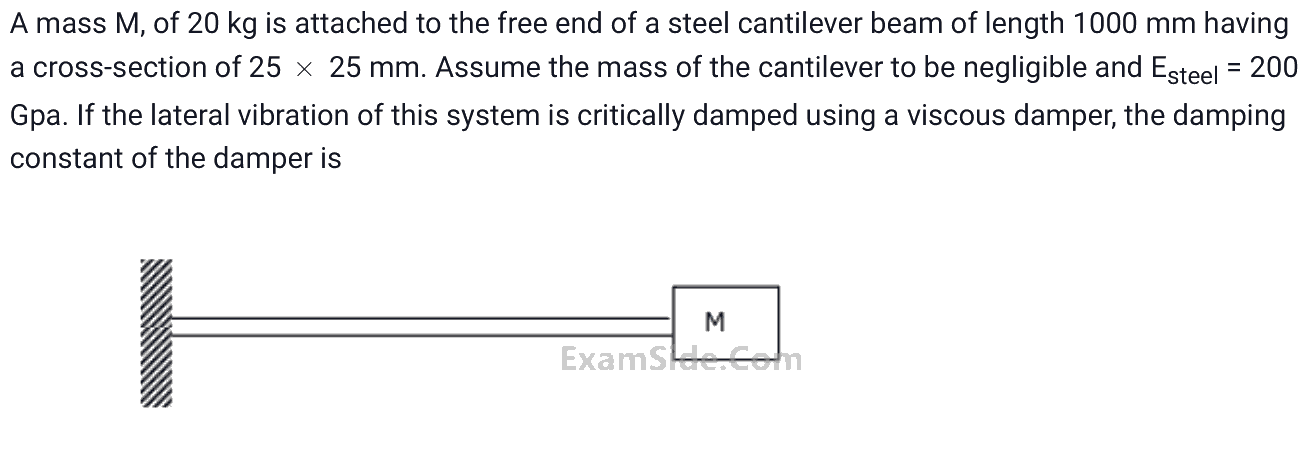
A mass M, of 20 kg is attached to the free end of a steel cantilever beam of length 1000 mm having a cross-section of 25 25 mm. Assume the mass of the cantilever to be negligible and E$_{steel}$ = 200 Gpa. If the lateral vibration of this system is critically damped using a viscous damper, the damping constant of the damper is
- 1250 Ns/m
- 625 Ns/m
- 312.50 Ns/m
- 156.25 Ns/m
Answer: A
GATE ME 2003, Question 64 (2 marks, MCQ)
Theory of Machines - Vibrations
A flexible rotor-shaft system comprises of a rotor disc placed in the middle of a mass-less shaft of diameter and length between bearings (shaft is being taken mass-less as the equivalent mass of the shaft is included in the rotor mass) mounted at the ends. The bearings are assumed to simulate simply supported boundary conditions. The shaft is made of steel for which the value of is . Pa. What is the critical speed of rotation of the shaft?

Answer: B
GATE ME 2003, Question 65 (2 marks, MCQ)
Theory of Machines - Vibrations
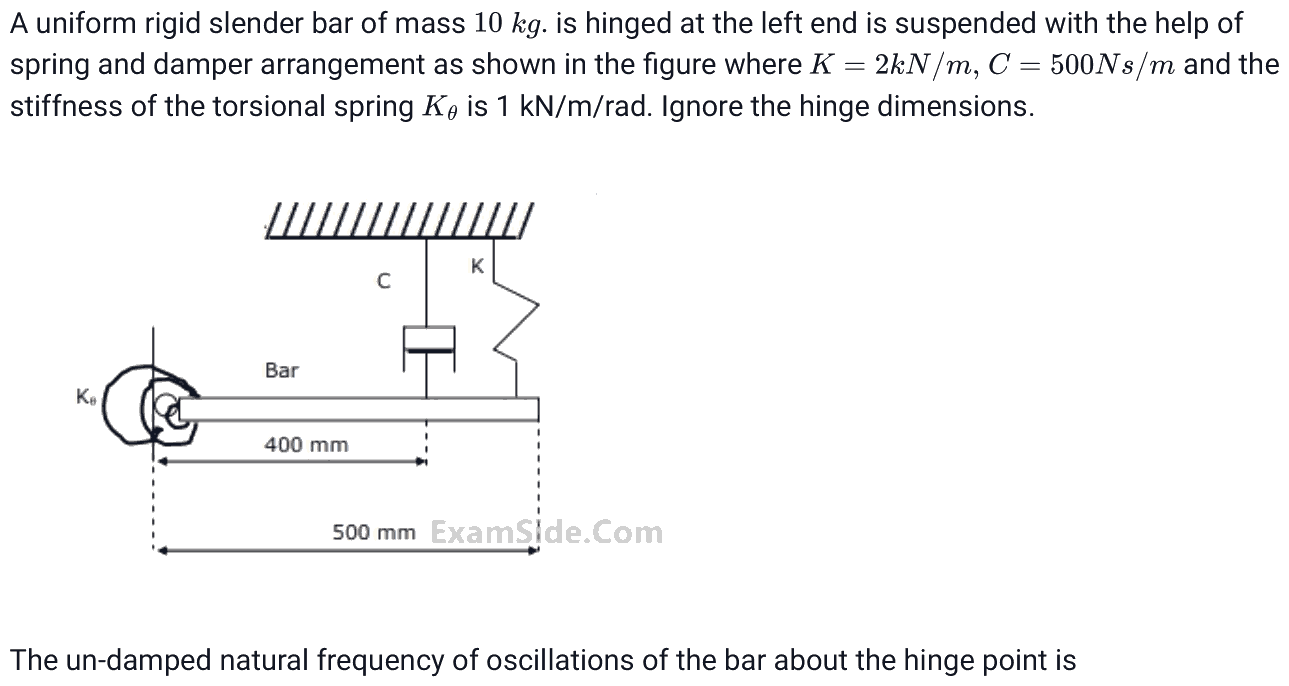
A uniform rigid slender bar of mass is hinged at the left end is suspended with the help of spring and damper arrangement as shown in the figure where and the stiffness of the torsional spring is 1 kN/m/rad. Ignore the hinge dimensions. The un-damped natural frequency of oscillations of the bar about the hinge point is
- rad/s
- rad/s
- rad/s
- rad/s
Answer: A
GATE ME 2003, Question 66 (2 marks, MCQ)
Theory of Machines - Vibrations
A uniform rigid slender bar of mass is hinged at the left end is suspended with the help of spring and damper arrangement as shown in the figure where and the stiffness of the torsional spring is 1 kN/m/rad. Ignore the hinge dimensions. The damping coefficient in the vibration equation is given by
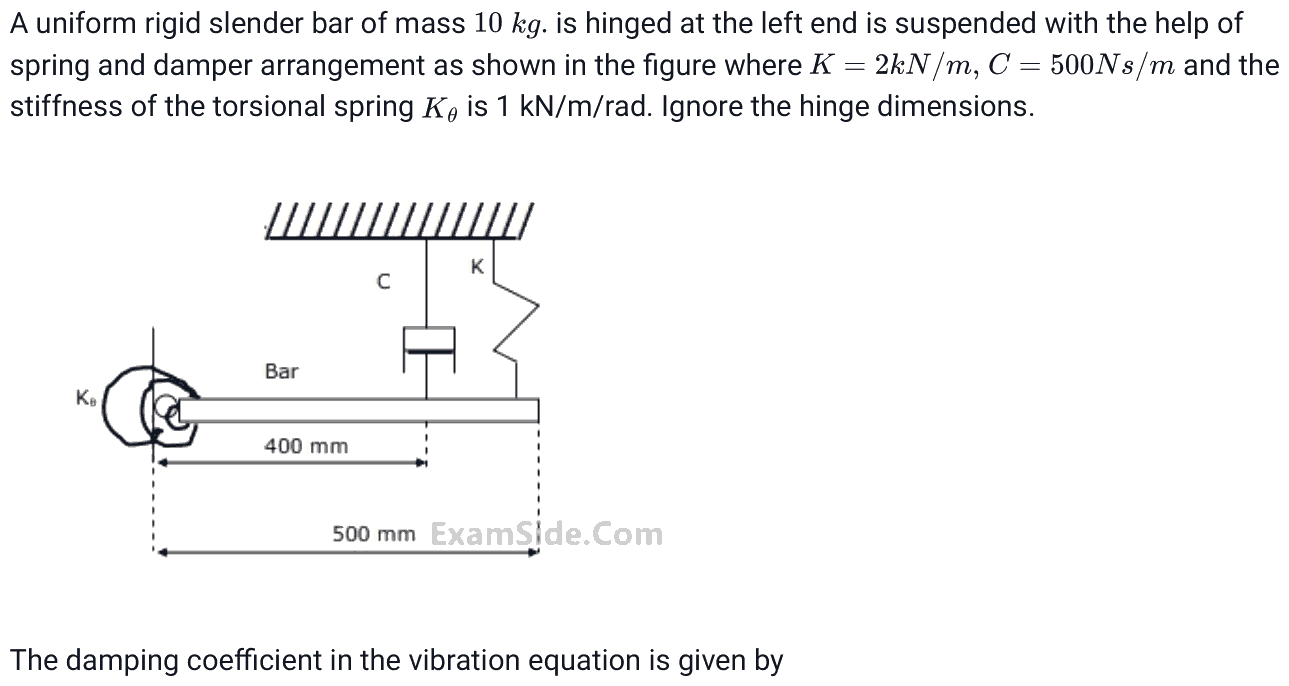
- Nms/rad
- N/(m/s)
- Nms/rad
- N/(m/s)
Answer: C
GATE ME 2001, Question 25 (1 mark, MCQ)
Theory of Machines - Vibrations
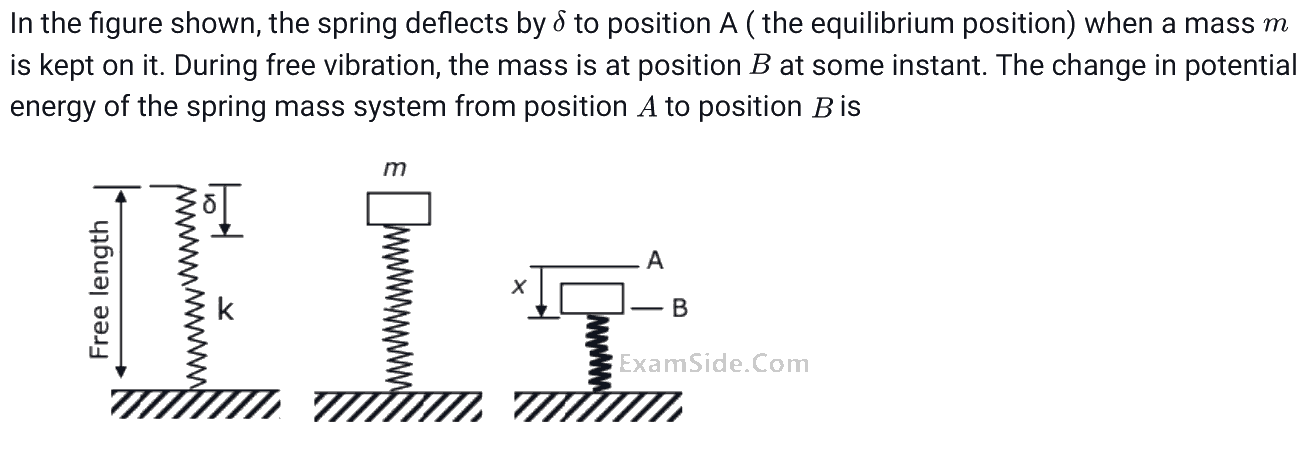
In the figure shown, the spring deflects by to position A ( the equilibrium position) when a mass is kept on it. During free vibration, the mass is at position at some instant. The change in potential energy of the spring mass system from position to position is
Answer: A
GATE ME 2001, Question 67 (2 marks, MCQ)
Theory of Machines - Vibrations
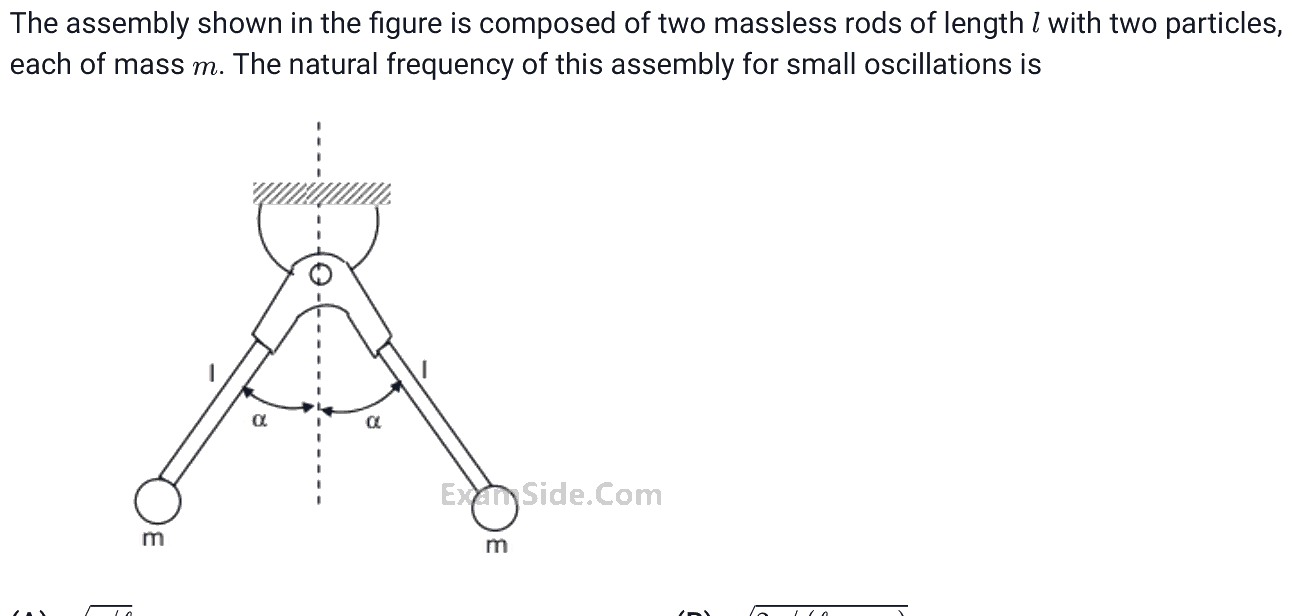
The assembly shown in the figure is composed of two massless rods of length with two particles, each of mass . The natural frequency of this assembly for small oscillations is
Answer: D
GATE ME 2001, Question 71 (5 marks, TEXT)
Theory of Machines - Vibrations
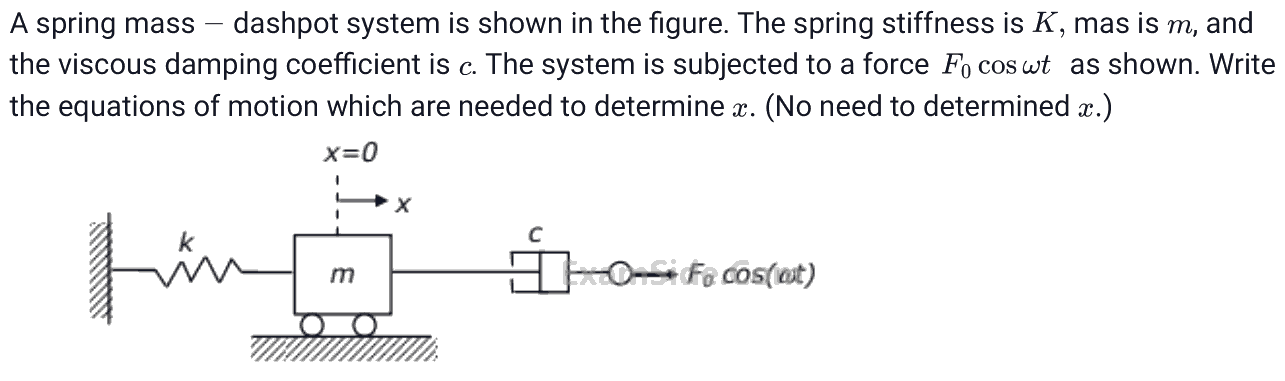
A spring mass dashpot system is shown in the figure. The spring stiffness is mas is , and the viscous damping coefficient is . The system is subjected to a force as shown. Write the equations of motion which are needed to determine (No need to determined )
GATE ME 2000, Question 68 (2 marks, MCQ)
Theory of Machines - Vibrations
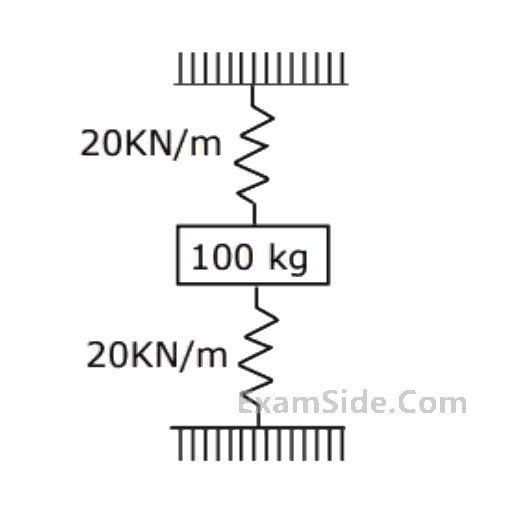
As shown in Figure, a mass of 100 kg is held between two springs. The natural frequency of vibration of the system, in cycles/s, is
Answer: C
GATE ME 1999, Question 69 (2 marks, MCQ)
Theory of Machines - Vibrations
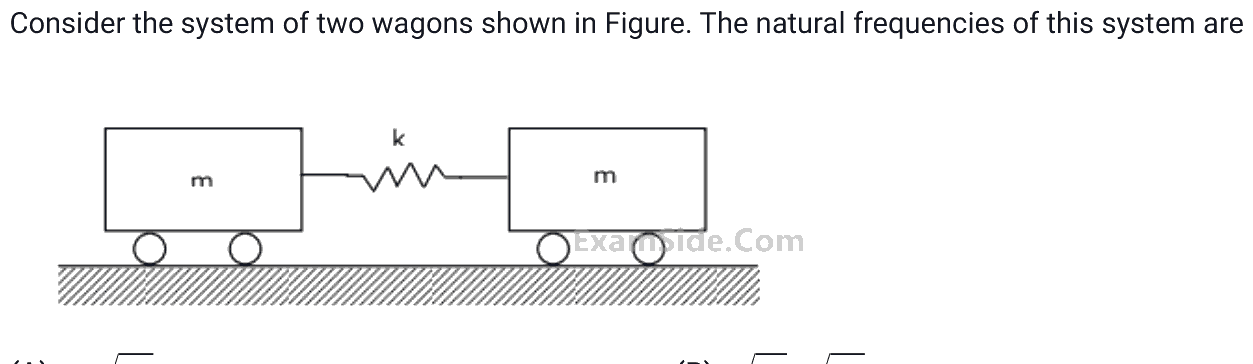
Consider the system of two wagons shown in Figure. The natural frequencies of this system are
Answer: A
GATE ME 1997, Question 72 (5 marks, TEXT)
Theory of Machines - Vibrations
The suspension system of a two-wheeler can be equated to a single spring-mass system with a viscous damper connected in series. Sketch the free body diagram and give the equations of motion. For a mass and a spring with a stiffness of determine what should be the damping coefficient (damping constant) for critical damping. What can be the damping force for a plunger velocity of ?

GATE ME 1996, Question 70 (2 marks, MCQ)
Theory of Machines - Vibrations
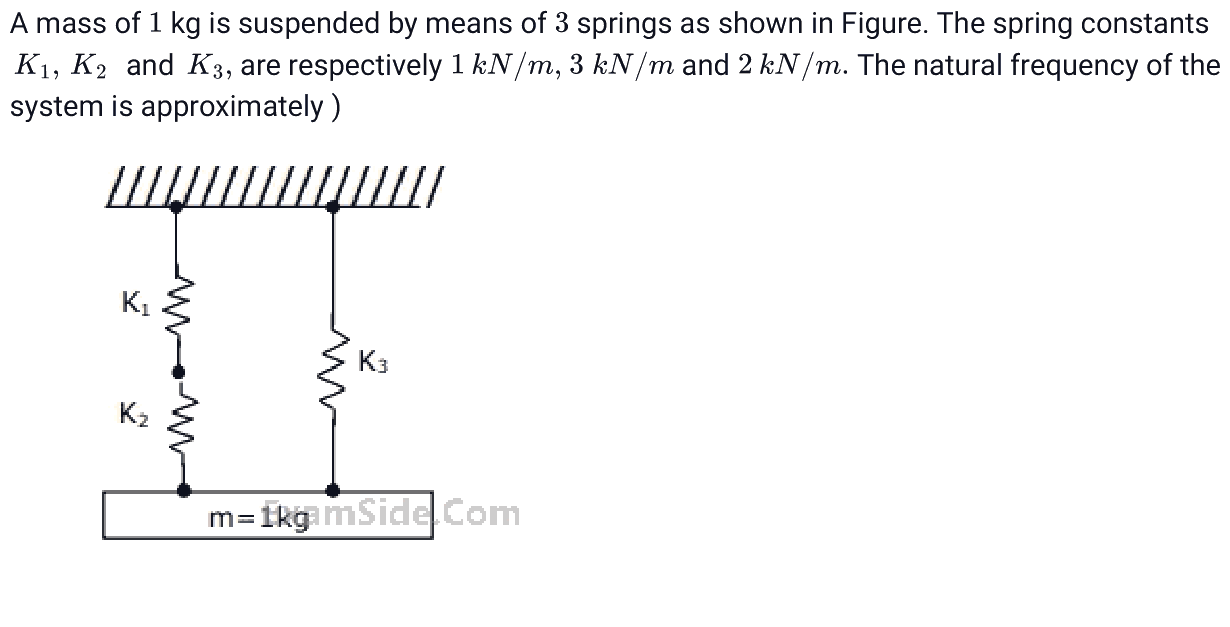
A mass of kg is suspended by means of springs as shown in Figure. The spring constants and are respectively and The natural frequency of the system is approximately )
- rad/sec
- rad/sec
- rad/sec
- rad/sec
Answer: B
GATE ME 1996, Question 73 (5 marks, TEXT)
Theory of Machines - Vibrations
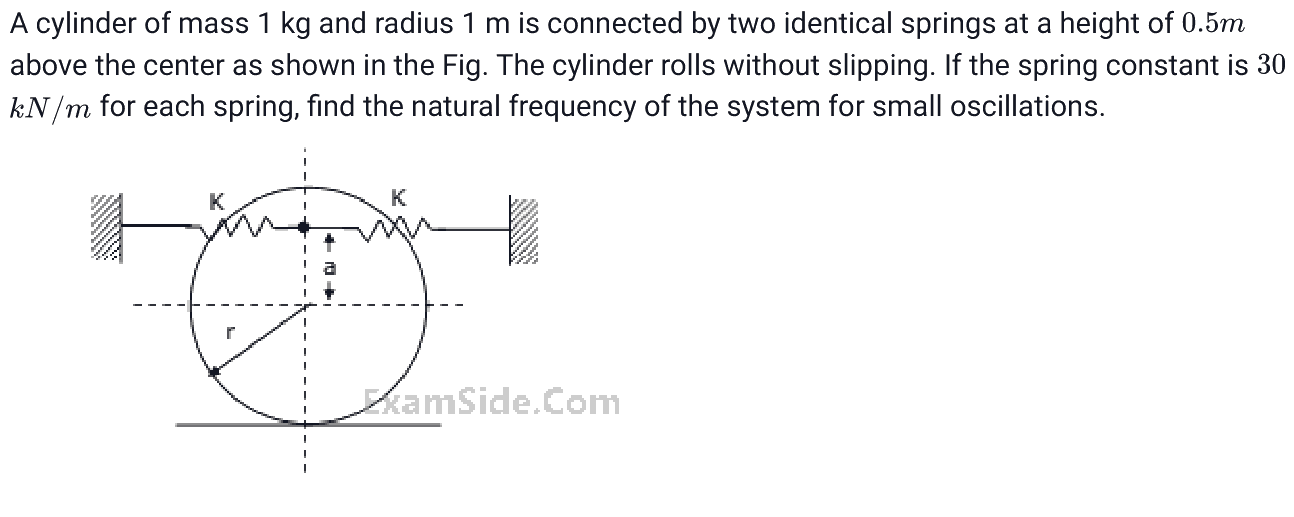
A cylinder of mass 1 kg and radius 1 m is connected by two identical springs at a height of above the center as shown in the Fig. The cylinder rolls without slipping. If the spring constant is for each spring, find the natural frequency of the system for small oscillations.