GATE ME Thin Cylinders: Previous Year Questions
GATE ME (Mechanical Engineering) Thin Cylinders previous year questions from Strength of Materials, with figures and the answer key.
Strength of Materials | All GATE ME papers
GATE ME 2026, Question 52 (2 marks, NAT)
Strength of Materials - Thin Cylinders
A cylindrical pressure vessel made of steel has diameter of 3 m and wall thickness of 15 mm . For steel, Young's modulus and Poisson's ratio are 210 GPa and 0.3 , respectively. The cylinder is designed such that the allowable normal strain at the outer cylindrical surface is equal to 0.00034 . The permissible pressure in the tank is kPa (rounded off to 1 decimal place).

Answer: 840
GATE ME 2024, Question 57 (2 marks, NAT)
Strength of Materials - Thin Cylinders
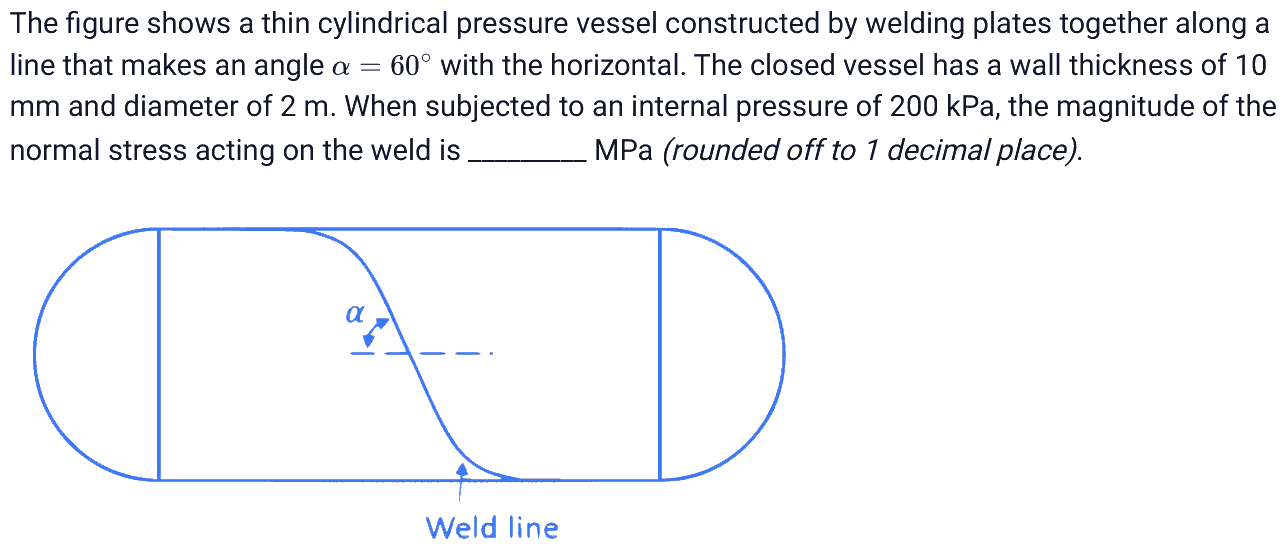
The figure shows a thin cylindrical pressure vessel constructed by welding plates together along a line that makes an angle with the horizontal. The closed vessel has a wall thickness of 10 mm and diameter of 2 m. When subjected to an internal pressure of 200 kPa, the magnitude of the normal stress acting on the weld is _________ MPa (rounded off to 1 decimal place).
Answer: 12.3 to 12.7
GATE ME 2023, Question 40 (2 marks, MCQ)
Strength of Materials - Thin Cylinders
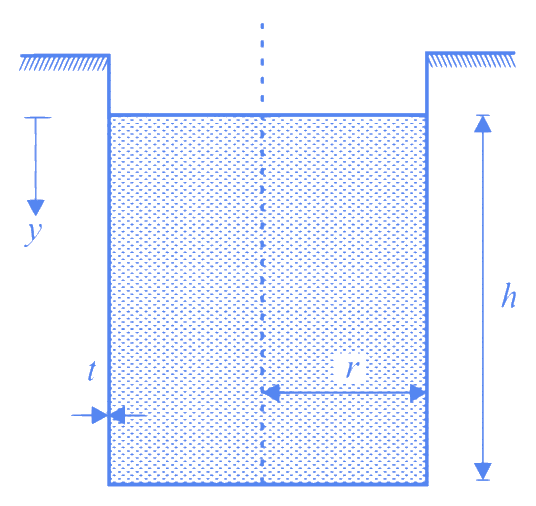
The figure shows a thin-walled open-top cylindrical vessel of radius r and wall thickness t. The vessel is held along the brim and contains a constant-density liquid to height h from the base. Neglect atmospheric pressure, the weight of the vessel and bending stresses in the vessel walls. Which one of the plots depicts qualitatively CORRECT dependence of the magnitudes of axial wall stress (σ$_{1}$) and circumferential wall stress (σ$_{2}$) on y?
Answer: A
GATE ME 2022 Set 1, Question 52 (2 marks, NAT)
Strength of Materials - Thin Cylinders
A thin-walled cylindrical pressure vessel has mean wall thickness of t and nominal radius of r. The Poisson’s ratio of the wall material is 1/3. When it was subjected to some internal pressure, its nominal perimeter in the cylindrical portion increased by 0.1% and the corresponding wall thickness became t̅. The corresponding change in the wall thickness of the cylindrical portion, i.e. 100 × (t̅ − t)/t, is ________% (round off to 3 decimal places).
Answer: -0.062 to -0.058
GATE ME 2020 Set 2, Question 40 (2 marks, MCQ)
Strength of Materials - Thin Cylinders
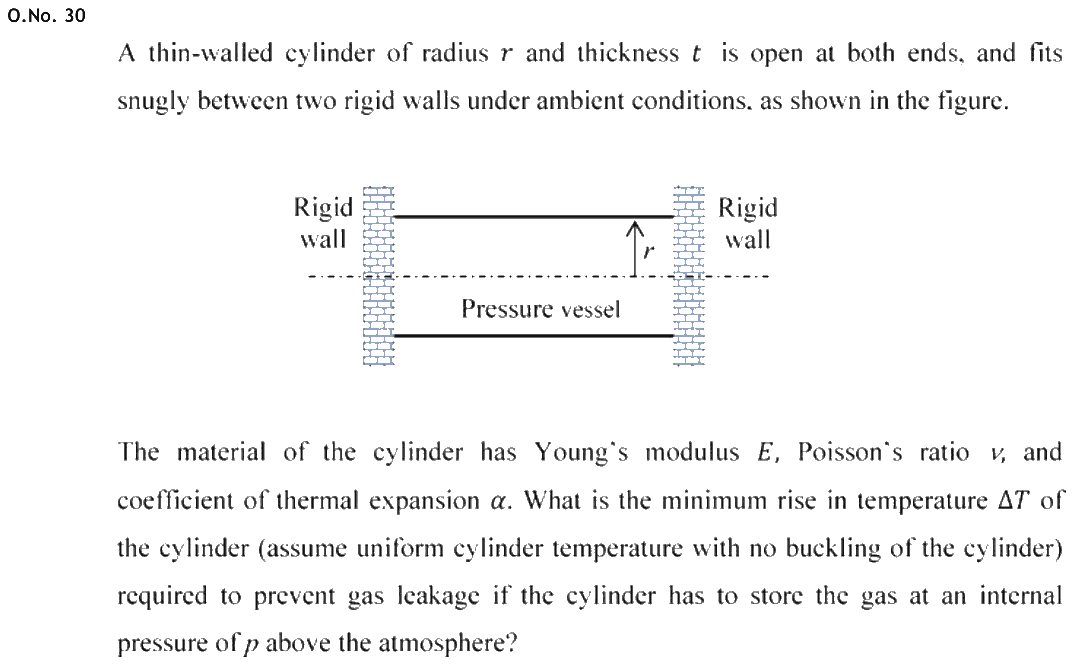
Q.No.30 A thin-walled cylinder ofradiusr and thicknesstis open at both ends,andfits snuglybetweentworigidwallsunderambientconditions,asshowninthefigure. Rigid Rigid wall wall Pressurevessel The material of the cylinder has Young's modulus E,Poisson’s ratio y, and coefficientof thermalexpansionα.WhatistheminimumriseintemperatureTof thecylinder(assumeuniformcylindertemperaturewithnobucklingofthecylinder) requiredtopreventgasleakageif thecylinderhastostore thegasataninternal pressureofpabovetheatmosphere? (A) 3vpr △T= 2atE (B) 1pr AT= 4/atE (C) vpr △T= atE (D) )pr AT= atE
Answer: C
GATE ME 2019 Set 2, Question 40 (2 marks, MCQ)
Strength of Materials - Thin Cylinders
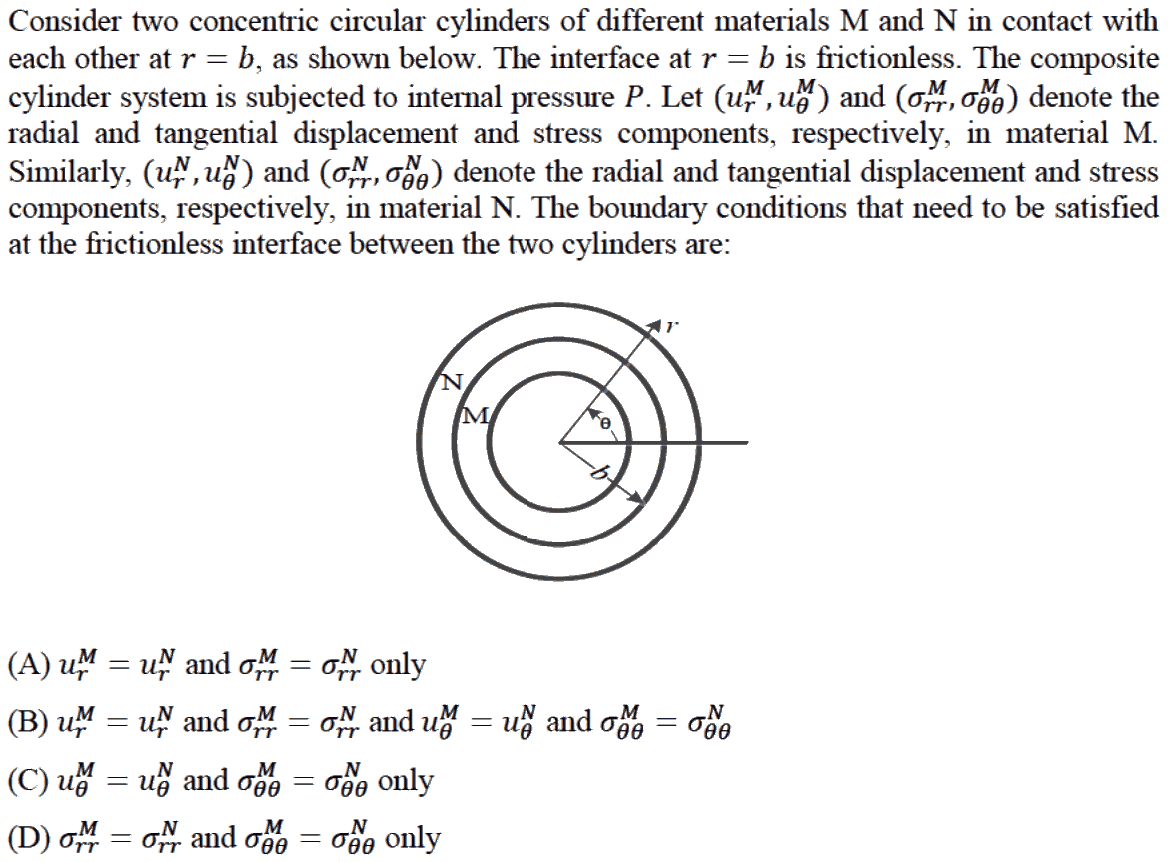
Q.30 each other at r = b, as shown below. The interface at r = b is fictionless. The composite cylinder system is subjected to internal pressure P. Let (u,u) and (oM, o) denote the Similarly, (u,u) and (o, o) denote the radial and tangential displacement and stress components, respectively, in material N. The boundary conditions that need to be satisfied at the frictionless interface between the two cylinders are: (A) uM = u and oM = o only (B) uM = u and oM = o and u = u and o = oe (C) u = u and o = o only (D) oM = o and o = o only
Answer: A
GATE ME 2018 Set 2, Question 47 (2 marks, NAT)
Strength of Materials - Thin Cylinders
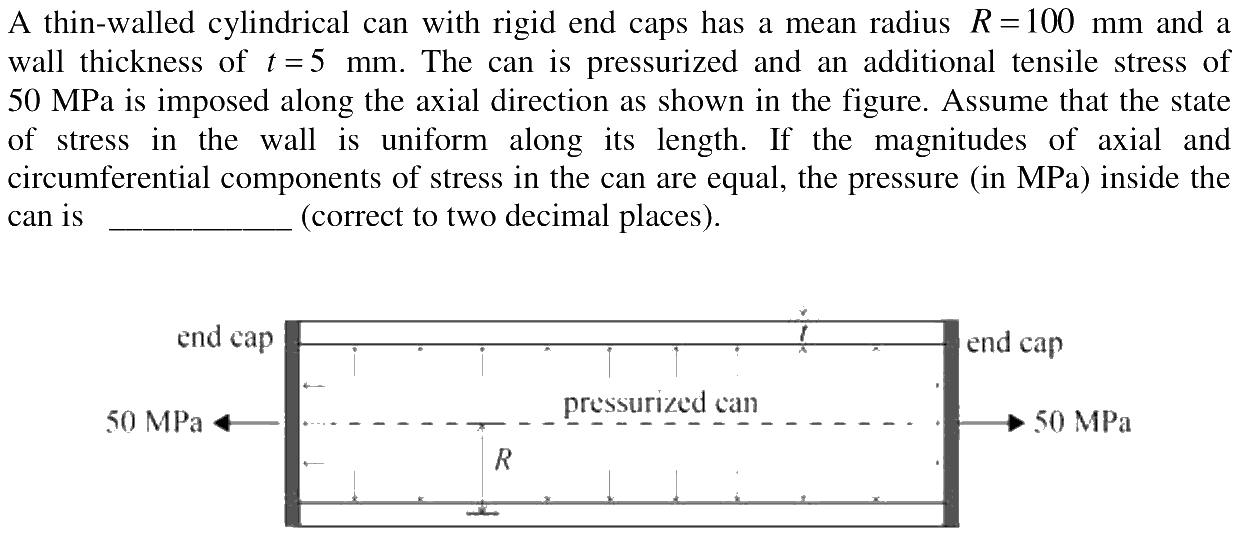
Q.37 A thin-walled cylindrical can with rigid end caps has a mean radius R 100 mm and a wall thickness of t 5 mm. The can is pressurized and an additional tensile stress of 50 MPa is imposed along the axial direction as shown in the figure. Assume that the state of stress in the wall is uniform along its length. If the magnitudes of axial and circumferential components of stress in the can are equal, the pressure (in MPa) inside the can is ___________ (correct to two decimal places).
Answer: 4.8 to 5.2
GATE ME 2016 Set 2, Question 18 (1 mark, MCQ)
Strength of Materials - Thin Cylinders
A thin cylindrical pressure vessel with closed-ends is subjected to internal pressure. The ratio of circumferential (hoop) stress to the longitudinal stress is
- 0.25
- 0.50
- 1.0
- 2.0
Answer: D
GATE ME 2015 Set 2, Question 18 (1 mark, MCQ)
Strength of Materials - Thin Cylinders
A gas is stored in a cylindrical tank of inner radius m and wall thickness mm. The gage pressure of the gas is MPa. The maximum shear stress (in MPa) in the wall is

Answer: C
GATE ME 2015 Set 3, Question 27 (1 mark, NAT)
Strength of Materials - Thin Cylinders
A cylindrical tank with closed ends is filled with compressed air at a pressure of a. The inner radius of the tank is and it has wall thickness of The magnitude of maximum in-plane shear stress (in a) is ________

Answer: 25
GATE ME 2014 Set 4, Question 41 (2 marks, TEXT)
Strength of Materials - Thin Cylinders
A thin gas cylinder with an internal radius of 100 mm is subject to an internal pressure of 10 MPa. The maximum permissible working stress is restricted to 100 MPa. The minimum cylinder wall thickness (in mm) for safe design must be ____________.
Answer: 9.8 to 10.6
GATE ME 2013, Question 21 (1 mark, MCQ)
Strength of Materials - Thin Cylinders
A long thin walled cylindrical shell, closed at both the ends, is subjected to an internal pressure. The ratio of the hoop stress (circumferential stress) to longitudinal stress developed in the shell is
Answer: C
GATE ME 2012, Question 5 (1 mark, MCQ)
Strength of Materials - Thin Cylinders
A thin walled spherical shell is subjected to an internal pressure. If the radius of the shell is increased by 1% and the thickness is reduced by 1%, with the internal pressure remaining the same, the percentage change in the circumferential (hoop) stress is
- 0
- 1
- 1.08
- 2.02
Answer: D
GATE ME 2008, Question 11 (2 marks, MCQ)
Strength of Materials - Thin Cylinders
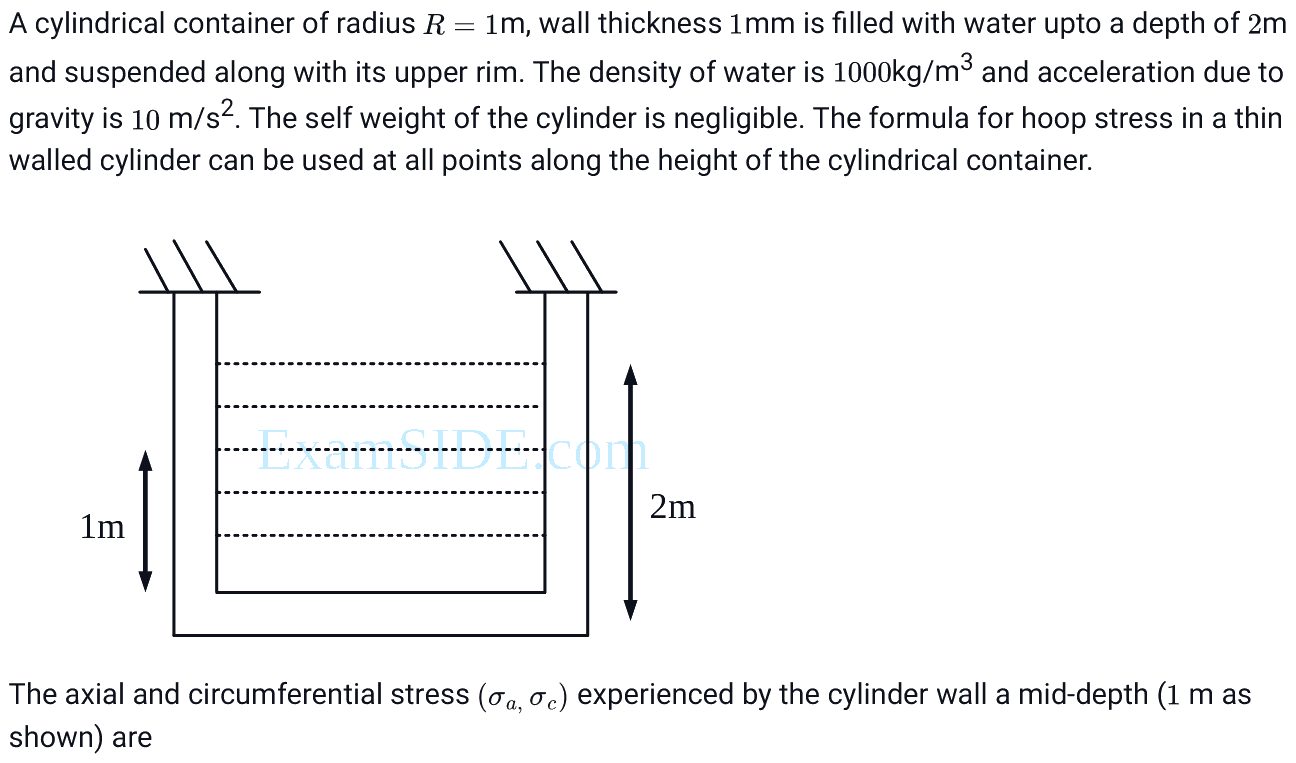
A cylindrical container of radius m, wall thickness mm is filled with water upto a depth of m and suspended along with its upper rim. The density of water is kg/m$^{3}$ and acceleration due to gravity is m/s$^{2}$. The self weight of the cylinder is negligible. The formula for hoop stress in a thin walled cylinder can be used at all points along the height of the cylindrical container. 1m2m The axial and circumferential stress experienced by the cylinder wall a mid-depth ( m as shown) are
- MPa
- MPa
- MPa
- MPa
Answer: A
GATE ME 2008, Question 12 (2 marks, MCQ)
Strength of Materials - Thin Cylinders
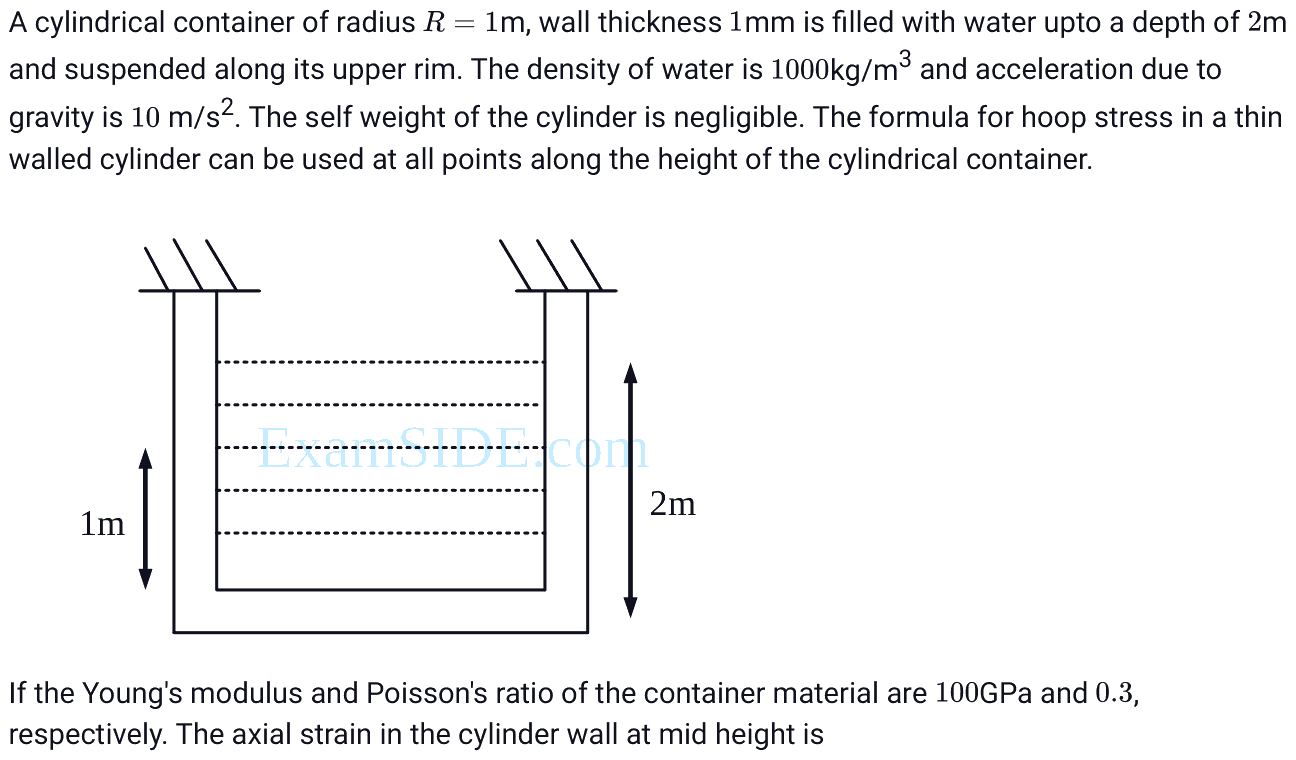
A cylindrical container of radius m, wall thickness mm is filled with water upto a depth of m and suspended along its upper rim. The density of water is kg/m$^{3}$ and acceleration due to gravity is m/s$^{2}$. The self weight of the cylinder is negligible. The formula for hoop stress in a thin walled cylinder can be used at all points along the height of the cylindrical container. 1m2m If the Young's modulus and Poisson's ratio of the container material are GPa and , respectively. The axial strain in the cylinder wall at mid height is
Answer: A
GATE ME 1996, Question 13 (2 marks, TEXT)
Strength of Materials - Thin Cylinders
A thin cylinder of mm internal diameter and mm thickness is subjected to an internal pressure of MPa and a torque of Nm. Calculate the magnitudes of the principal stresses.
