GATE ME 2026, Question 14 (1 mark, MCQ)
Engineering Mathematics - Numerical Methods
Newton-Raphson method for solving algebraic equations is based on
- Power series
- Laurent series
- Taylor series
- Fourier series
Answer: C
GATE ME (Mechanical Engineering) Numerical Methods previous year questions from Engineering Mathematics, with figures and the answer key.
Engineering Mathematics | All GATE ME papers
Engineering Mathematics - Numerical Methods
Newton-Raphson method for solving algebraic equations is based on
Answer: C
Engineering Mathematics - Numerical Methods
The exact solution of is represented as . If represents numerically evaluated value of the above integral using Trapezoidal rule by considering four equal subintervals in the range of , then ( ) is

Answer: A
Engineering Mathematics - Numerical Methods
The values of a function obtained for different values of are shown in the table below. Using Simpson's one-third rule, __________[Rounded off to 2 decimal places]
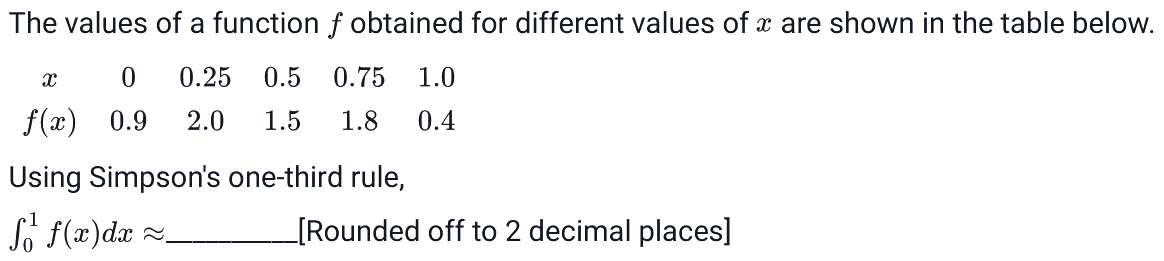
Answer: 1.61 to 1.65
Engineering Mathematics - Numerical Methods
In order to numerically solve the ordinary differential equation dy/dt = -y for t > 0, with an initial condition y(0) = 1, the following scheme is employed: Here, is the time step and for This numerical scheme will yield a solution with non-physical oscillations for The value of h is

Answer: D
Engineering Mathematics - Numerical Methods
The smallest perimeter that a rectangle with area of 4 square units can have is ______ units. (Answer in integer)
Answer: 7.999 to 8.001
Engineering Mathematics - Numerical Methods
The initial value problem is solved numerically using the forward Euler’s method with a constant and positive time step of Δt. Let y$_{n}$ represent the numerical solution obtained after n steps. The condition |y$_{n+1}$| ≤ |y$_{n}$| is satisfied if and only if Δt does not exceed _____________. (Answer in integer)
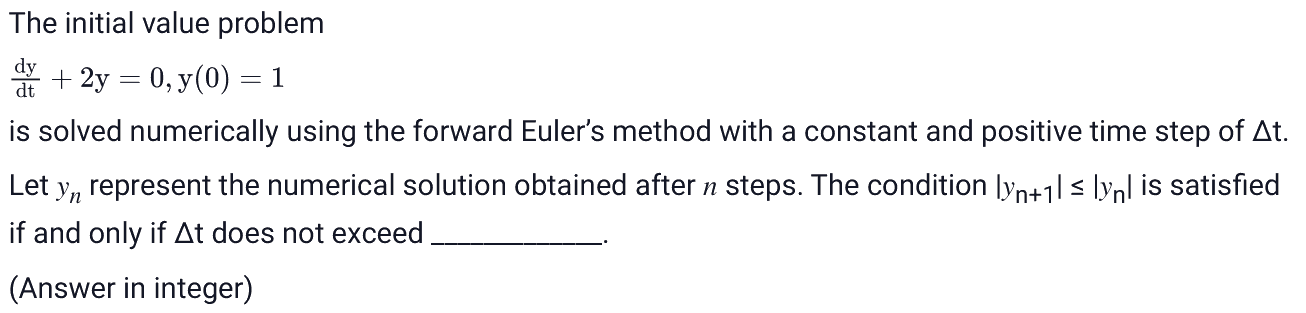
Answer: 0.999 to 1.001
Engineering Mathematics - Numerical Methods
Consider the definite integral Let I$_{e}$ be the exact value of the integral. If the same integral is estimated using Simpson’s rule with 10 equal subintervals, the value is I$_{s}$. The percentage error is defined as e = 100 × (I$_{e}$ - I$_{s}$)/I$_{e}$ The value of e is
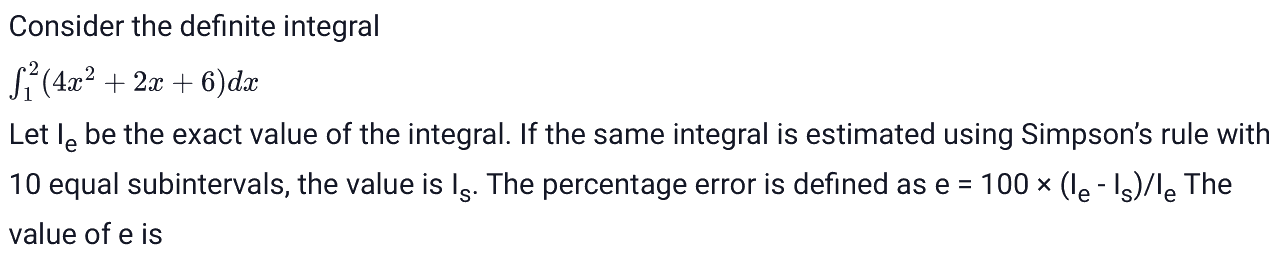
Answer: D
Engineering Mathematics - Numerical Methods
Q.4 dy The ordinary differential equation -Tty subject toaninitial condition p y(0) = 1 is solved numerically using the following scheme: y(tn+1)-y(tn) -πy(tn) h wherehisthe time step,t,=nh,andn=0,1,2,Thisnumerical scheme isstablefor allvaluesofhintheinterval (A) 2 >> π (B) 1>y>0 (C) π >0 2 (D) for all h > 0
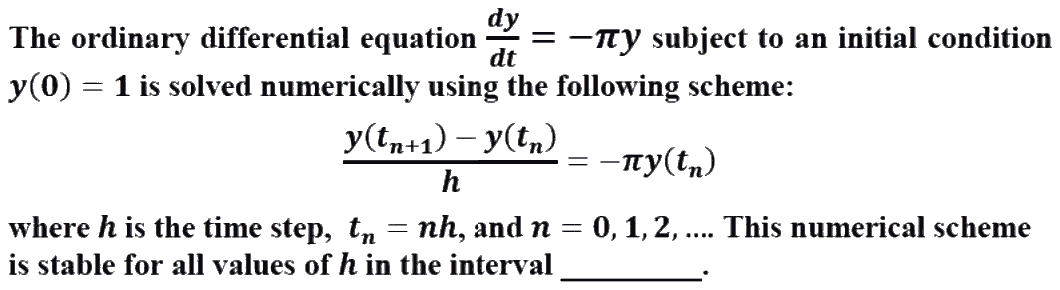
Answer: A
Engineering Mathematics - Numerical Methods
Q.18 5.2 Value of In x dx using Simpson’s one-third rule with interval size 0.3 4 is (A) 1.83 (B) 1.60 (C) 1.51 (D) 1.06

Answer: A
Engineering Mathematics - Numerical Methods
Q.35 Find thepositive real root of x3-x-3=0using Newton-Raphson method. If the starting guess (xo) is 2, the numerical value ofthe root after two iterations (x2) is (round offto two decimal places).

Answer: 1.66 to 1.68
Engineering Mathematics - Numerical Methods
Q.No.26 The evaluation of the definite integral S x x|x|dxbyusingSimpson’s1/3rd(one- third)rulewithstepsizeh=0.6yields (A) 0.914 (B) 1.248 (C) 0.581 (D) 0.592

Answer: D
Engineering Mathematics - Numerical Methods
Q.No.35 For the integral (8+ 4cosx)dx,the absolute percentage errorinnumerical evaluationwith theTrapezoidal rule,usingonly the end points,is (roundofftoonedecimalplace).

Answer: 5.1 to 5.5
Engineering Mathematics - Numerical Methods
Q.18 Evaluation of J x? dx using a 2-equal-segment trapezoidal rule gives a value of

Answer: 63
Engineering Mathematics - Numerical Methods
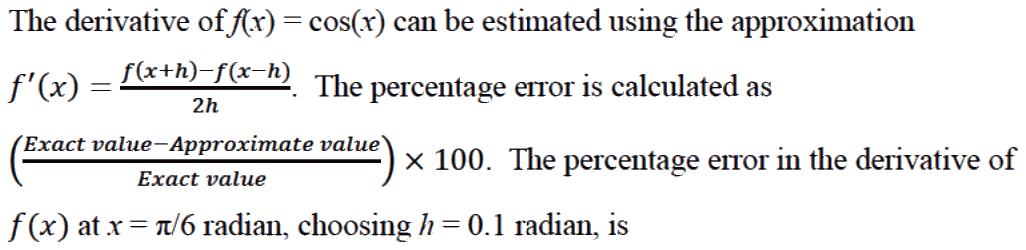
Q.28 2h (Exactvalue-Approximatevalue) X 100. The percentage error in the derivative of Exactvalue f(x) at x = π/6 radian, choosing h = 0.1 radian, is (A)<. 0.1 % (B)> 0.1 % and < 1 % (C)> 1 % and < 5 % (D)> 5%
Answer: B
Engineering Mathematics - Numerical Methods
Q.37 An explicit forward Euler method is used to numerically integrate the differential equation dy dt y using a time step of 0.1. With the initial condition (0) y , the value of (1) 1 y computed by this method is ___________ (correct to two decimal places).

Answer: 2.55 to 2.65
Engineering Mathematics - Numerical Methods
and are three points on the curve defined by Numerical integration is carried out using both Trapezoidal rule and Simpson's rule within limits and for the curve. The difference between the two results will be

Answer: A
Engineering Mathematics - Numerical Methods
Solve the equation using the Newton-Raphson method. The initial guess is The value of the predicted root after the first iteration, up to second decimal, is _____________.

Answer: 1.53 to 1.59
Engineering Mathematics - Numerical Methods
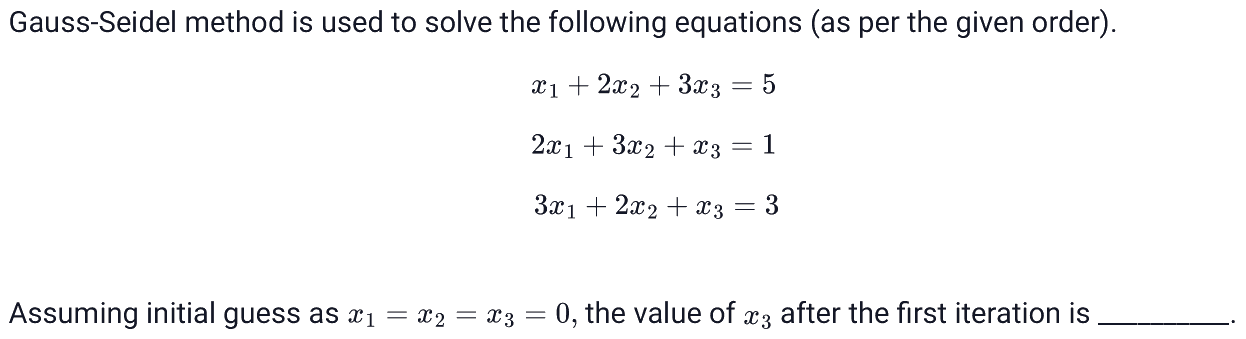
Gauss-Seidel method is used to solve the following equations (as per the given order). Assuming initial guess as the value of after the first iteration is __________.
Answer: -6
Engineering Mathematics - Numerical Methods
Numerical integration using trapezoidal rule gives the best result for a single variable function, which is
Answer: A
Engineering Mathematics - Numerical Methods
The error in numerically computing the integral using the trapezoidal rule with three intervals of equal length between and is _________.

Answer: 0.175 to 0.195
Engineering Mathematics - Numerical Methods
The root of the function obtained after first iteration on application of Newton- Raphson scheme using an initial guess of is

Answer: C
Engineering Mathematics - Numerical Methods
Simpson's rule is used to integrate the function between and using the least number of equal sub-intervals. The value of the integral is __________.

Answer: 2
Engineering Mathematics - Numerical Methods
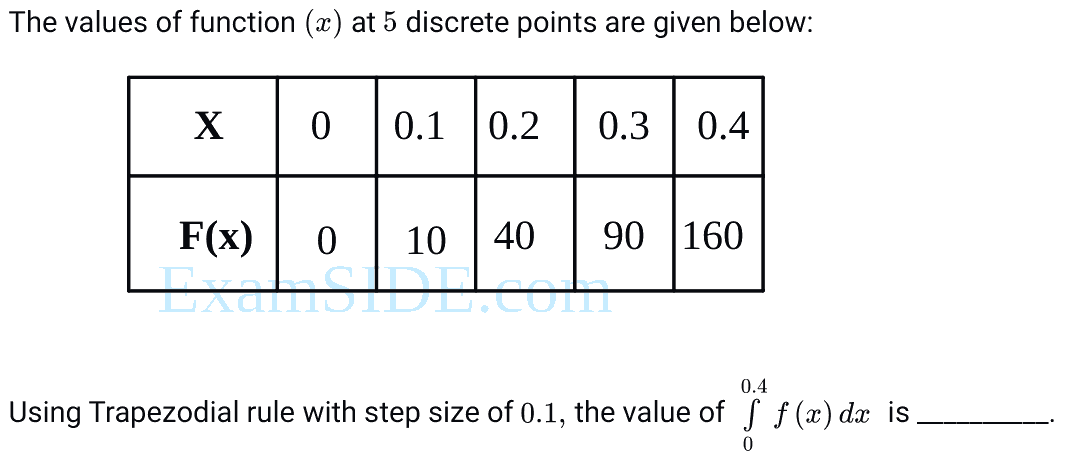
$^{The values of function}$$^{at discrete points are given below:}$ X00.10.20.30.4 F(x)0104090160 ExamSIDE.com $^{Using Trapezodial rule with step size of}$$^{the value of}$$^{is __________.}$
Answer: 21.8 to 22.2
Engineering Mathematics - Numerical Methods
Using a unit step size, the value of integral by trapezoidal rule is ___________.

Answer: 0.68 to 0.7
Engineering Mathematics - Numerical Methods
Newton-Raphson method is used to find the roots of the equation, If the initial guess is then the value of after iteration is ___________.

Answer: 0.29 to 0.31
Engineering Mathematics - Numerical Methods
Using the trapezoidal rule, and dividing the interval of integration into three equal sub-intervals, the definite integral is

Answer: 1.1 to 1.12
Engineering Mathematics - Numerical Methods
The value of calculated using the Trapezoidal rule with five sub-intervals is

Answer: 1.74 to 1.76
Engineering Mathematics - Numerical Methods
The definite integral is evaluated using Trapezoidal rule with a step size of The correct answer is

Answer: 1.1 to 1.2
Engineering Mathematics - Numerical Methods
The real root of the equation (up to two decimal accuracy) is

Answer: 0.53 to 0.56
Engineering Mathematics - Numerical Methods
Consider an ordinary differential equation If at the increment in calculated using Runge-Kutta fourth order multi-step method with a step size of is

Answer: D
Engineering Mathematics - Numerical Methods
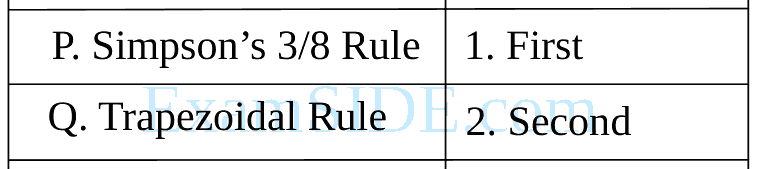
$^{Match the CORRECT pairs.}$ NumericalOrder of Fitting Integration SchemePolynomial R. Simpson’s 1/3 Rule3. Third
Answer: D
Engineering Mathematics - Numerical Methods
The integral when evaluated by using simpson's rule on two equal sub intervals each of length equals to

Answer: C
Engineering Mathematics - Numerical Methods
Starting from one step of Newton - Raphson method in solving the equation gives the next value as

Answer: C
Engineering Mathematics - Numerical Methods
The order of error in the simpson's rule for numerical integration with a step size is

Answer: D
Engineering Mathematics - Numerical Methods
Given the differential equation with initial condition The value of calculated numerically upto the third place of decimal by the order Runge-Kutta method with step size is

Engineering Mathematics - Numerical Methods
Simpson's rule for integration gives exact result when is a polynomial function of degree less than or equal to ________.

Answer: C