GATE ME 2025, Question 20 (1 mark, MCQ)
Production Engineering - Metal Forming
Among the following surface hardening processes, steel is heated to the lowest temperature in
- carburizing
- cyaniding
- nitriding
- carbonitriding
Answer: C
GATE ME (Mechanical Engineering) Metal Forming previous year questions from Production Engineering, with figures and the answer key.
Production Engineering | All GATE ME papers
Production Engineering - Metal Forming
Among the following surface hardening processes, steel is heated to the lowest temperature in
Answer: C
Production Engineering - Metal Forming
Wire drawing operation is performed on a perfectly plastic metal without any strain hardening. Assuming no friction and no redundant work, the maximum possible percentage reduction in area in a single pass is closest to
Answer: B
Production Engineering - Metal Forming
A plate of 30 mm thickness is fed through a rolling mill with two powered rolls. Each roll has a diameter of 500 mm . The plate thickness is to be reduced to 27 mm in a single pass. Assume no change in width. The process feasibility and the maximum draft (in mm ) can be represented, respectively, as Use the coefficient of friction as 0.12
Answer: A
Production Engineering - Metal Forming
A steel sample with 1.5 wt.% carbon (no other alloying elements present) is slowly cooled from 1100 °C to just below the eutectoid temperature (723 °C). A part of the iron-cementite phase diagram is shown in the figure. The ratio of the pro-eutectoid cementite content to the total cementite content in the microstructure that develops just below the eutectoid temperature is ________. (Rounded off to two decimal places)
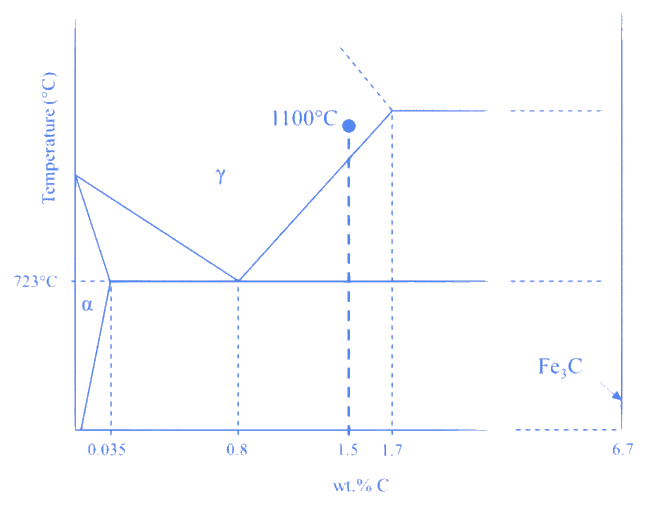
Answer: 0.53 to 0.55
Production Engineering - Metal Forming
A cylindrical billet of 100 mm diameter and 100 mm length is extruded by a direct extrusion process to produce a bar of L-section. The cross sectional dimensions of this L-section bar are shown in the figure. The total extrusion pressure (p) in MPa for the above process is related to extrusion ratio (r) as $^{σ}$ where σ$_{m}$, is the mean flow strength of the billet material in MPa, l is the portion of the billet length remaining to be extruded in mm, d$_{0}$ is the initial diameter of the billet in mm, and K$_{s}$ is the die shape factor. If the mean flow strength of the billet material is 50 MPa and the die shape factor is 1.05, then the maximum force required at the start of extrusion is _______ kN (round off to one decimal place).
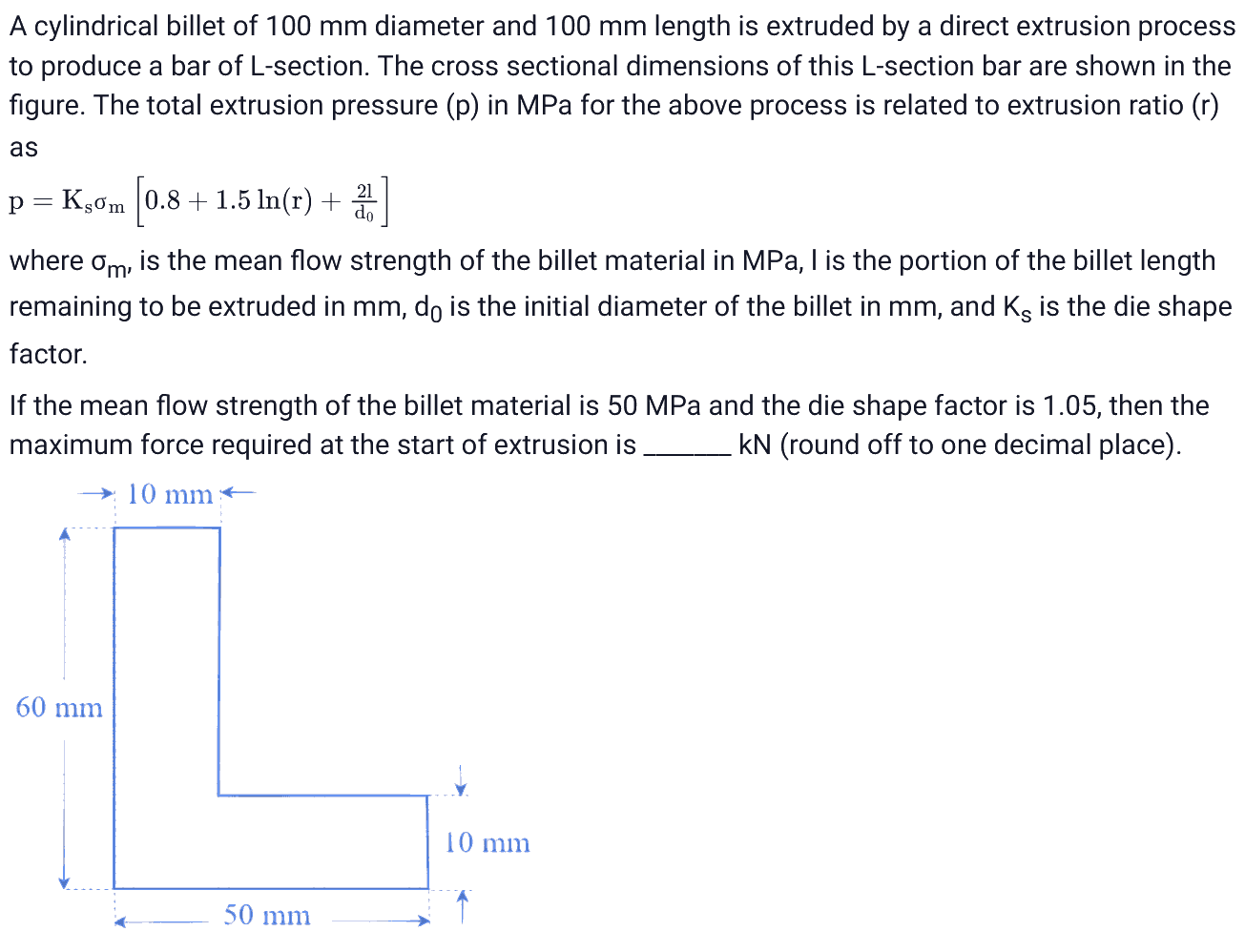
Answer: 2426 to 2432
Production Engineering - Metal Forming
Q.40 A 200 mm wide plate having a thickness of 20 mm is fed through a rolling mill with two rolls. The radius of each roll is 300 mm. The plate thickness is to be reduced to 18 mm in one pass using a roll speed of 50 rpm. The strength coefficient (K) of the work material flow curve is 300 MPa and the strain hardening exponent, n is 0.2. The coefficient of friction between the rolls and the plate is 0.1. If the friction is sufficient to permit the rolling operation then the roll force will be kN (round off to the nearest integer).
Answer: 775 to 784
Production Engineering - Metal Forming
Q.41 The thickness, width and length of a metal slab are 50 mm, 250 mm and 3600 mm, respectively. A rolling operation on this slab reduces the thickness by 10% and increases the width by 3%. The length of the rolled slab is mm (round off to one decimal place).

Answer: 3880 to 3886
Production Engineering - Metal Forming
Q.No.10 The crystal structure ofiron(austenite phase)is (A) BCC (B) FCC (C) HCP (D) BCT

Answer: B
Production Engineering - Metal Forming
Q.No.32 two-highmillhavingrollsofdiameter200mm.Coefficientoffrictionandarc lengthinmm,respectivelyare (A) 0.45and38.84 (B) 0.39and38.84 (C) 0.39and 44.72 (D) 0.45and44.72

Answer: D
Production Engineering - Metal Forming
Q.No.46 The thicknessofasteelplatewithmaterialstrengthcoefficientof210MPa,hasto bereducedfrom20mm to15mmina singlepassina two-highrollingmillwith arollradiusof450mmandrollingvelocityof28m/min.Iftheplatehasawidth of 200mm and its strainhardening exponent,nis 0.25,the rolling forcerequired fortheoperationis kN(roundoffto2decimal places). Note:AverageFlowStress=Material StrengthCoefficient x (True Strain)n (1+n)
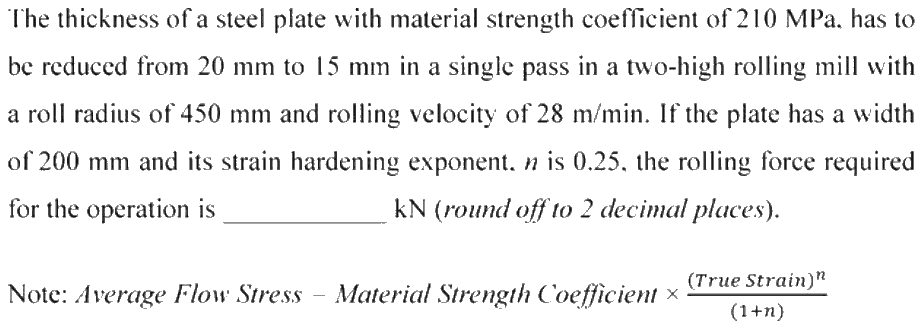
Answer: 1164 to 1168
Production Engineering - Metal Forming
Q.No.22 Aboltheadhastobemadeattheendofarodofdiameterd=12mmbylocalized forging (upsetting) operation. The length of the unsupported portion of the rod is 40mm.To avoid buckling of the rod,a closed forging operation has to be performedwithamaximumdiediameterof mm.

Answer: 18 to 19.5
Production Engineering - Metal Forming
Q.25 in the figure. The metal was loaded in uniaxial tension starting from O. Upon loading, the stress-strain curve passes through initial yield point at P, and then strain hardens to point Q. where the loading was stopped. From point Q, the specimen was unloaded to point R, where the stress is zero. If the same specimen is reloaded in tension from point R, the value of stress at which the material yields again is MPa. 210 180 Stress (MPa) 0 R Strain
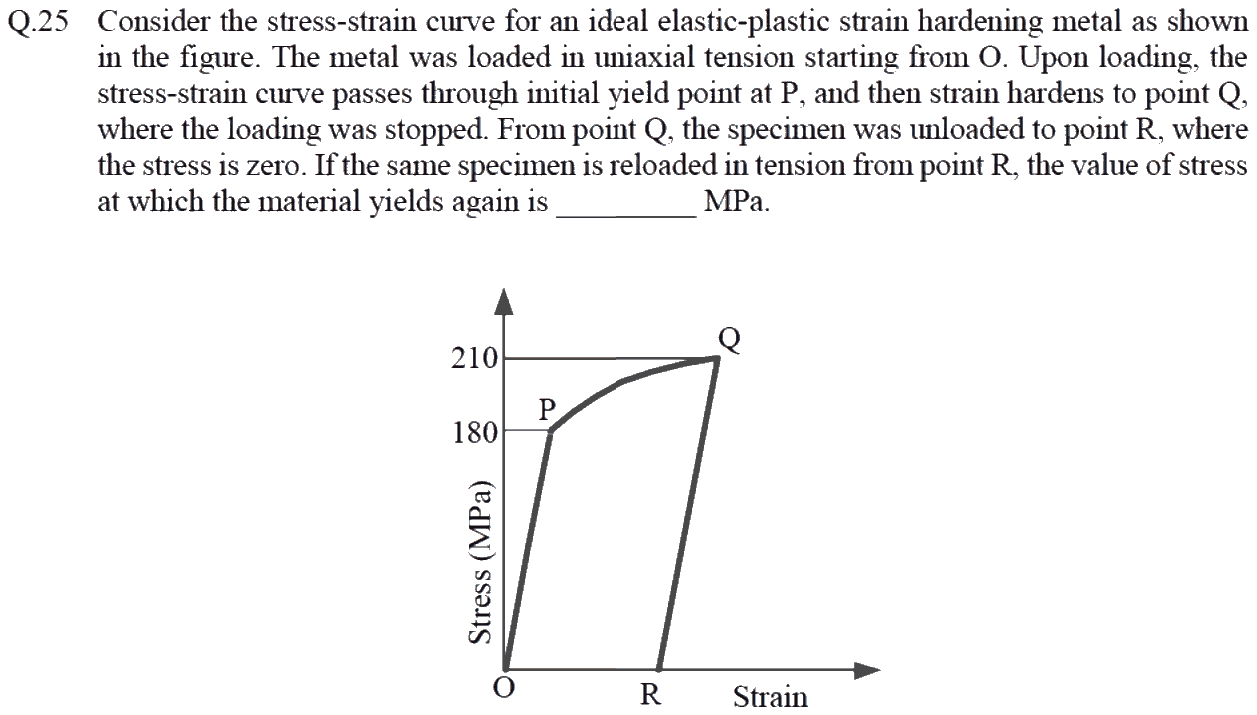
Answer: 210
Production Engineering - Metal Forming
Q.52 The thicknessof a sheetisreduced by rolling(without any change inwidth) using600mm diameter rolls.Neglectelasticdeflectionoftherollsandassumethatthe coefficient of friction at the roll-workpiece interface is 0.o5.The sheet enters the rotating rolls unaided.If the imitial sheet thickness is 2 mm, the minimum possible final thickness that can be produced by this process in a single pass is mm (round off to two decimal places).

Answer: 1.24 to 1.26
Production Engineering - Metal Forming
Q.11 In a linearly hardening plastic material, the true stress beyond initial yielding (A) increases linearly with the true strain (B) decreases linearly with the true strain (C) first increases linearly and then decreases linearly with the true strain (D) remains constant

Answer: A
Production Engineering - Metal Forming
Q.17 The number of atoms per unit cell and the number of slip systems, respectively, for a face- centered cubic (FCC) crystal are (A) 3, 3 (B) 3, 12 (C) 4, 12 (D) 4, 48

Answer: C
Production Engineering - Metal Forming
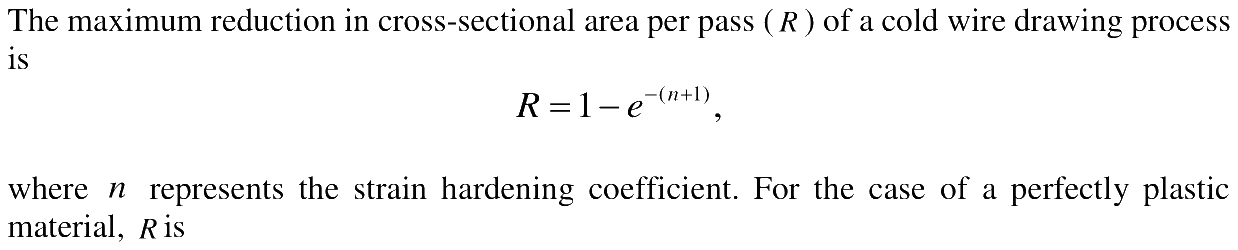
Q.35 The maximum reduction in cross-sectional area per pass ( R ) of a cold wire drawing process is R 1 e ( n 1) , where n represents the strain hardening coefficient. For the case of a perfectly plastic material, R is (A) 0.865 (B) 0.826 (C) 0.777 (D) 0.632
Answer: D
Production Engineering - Metal Forming
Q.50 A bar is compressed to half of its original length. The magnitude of true strain produced in the deformed bar is _________________ (correct to two decimal places).

Answer: 0.69 to 0.7
Production Engineering - Metal Forming
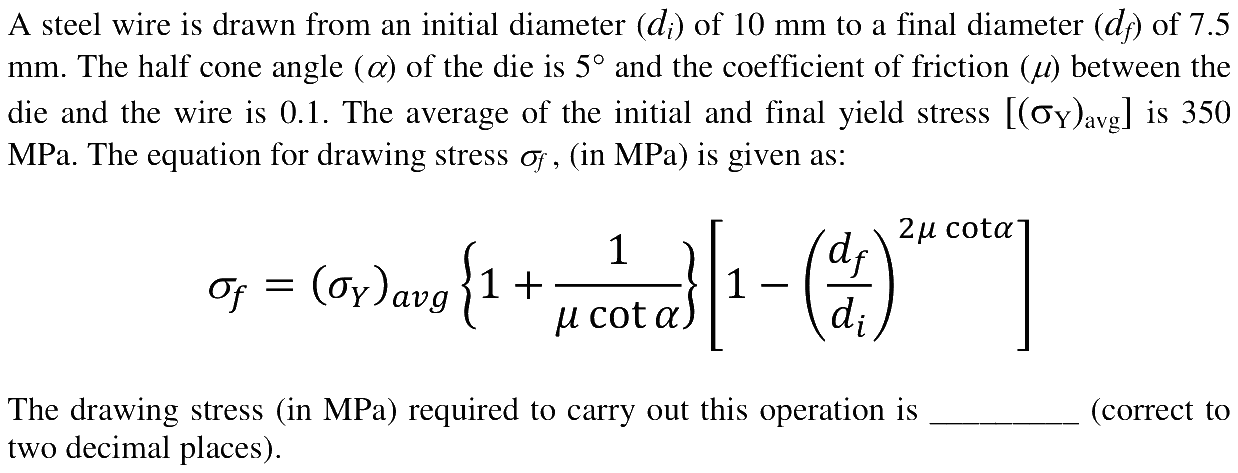
Q.47 A steel wire is drawn from an initial diameter (di) of 10 mm to a final diameter (df) of 7.5 mm. The half cone angle () of the die is 5 and the coefficient of friction () between the die and the wire is 0.1. The average of the initial and final yield stress [(Y)avg] is 350 MPa. The equation for drawing stress f , (in MPa) is given as: 2𝜇 cot𝛼 𝜇cot 𝛼} [1 −(𝑑𝑓 1 𝑓= (𝜎𝑌)𝑎𝑣𝑔{1 + ) ] 𝑑𝑖 The drawing stress (in MPa) required to carry out this operation is _________ (correct to two decimal places).
Answer: 315 to 317
Production Engineering - Metal Forming
In a metal forming operation when the material has just started yielding, the principal stresses are Following Von Mises' criterion, the yield stress is _____________

Answer: 245 to 246
Production Engineering - Metal Forming
The crystalstructureof aluminiumis (A) body-centred cubic (B) face-centred cubic (C) close-packed hexagonal (D) body-centred tetragonal

Answer: B
Production Engineering - Metal Forming
It is desired to make a product having T-shaped cross - section from a rectangular aluminium block. Which one of the following processes is expected to provide the highest strength of the product?
Answer: C
Production Engineering - Metal Forming
A rod of length is stretched to make a rod of length Subsequently, it is compressed to make a rod of final length Consider the longitudinal tensile strain as positive and compressive strain as negative. The total true longitudinal strain in the rod is

Answer: B
Production Engineering - Metal Forming
A strip of width and thickness is rolled between two -diameter rolls to get a strip of width and thickness. The speed of the strip at the exit is There is no front or back tension. Assuming uniform roll pressure of in the roll bite and mechanical efficiency, the minimum total power (in ) required to drive the two rolls is ____________________

Answer: 8.5 to 10
Production Engineering - Metal Forming
A thick slab is being cold rolled using roll of diameter. If the coefficient of friction is the maximum possible reduction (in ) is _______________

Answer: 1.9 to 1.94
Production Engineering - Metal Forming
The value of true strain produced in compressing a cylinder to half its original length is
Answer: B
Production Engineering - Metal Forming
Engineering strain of a mild steel sample is recorded as The true strain is

Answer: C
Production Engineering - Metal Forming
Match the following products with preferred manufacturing process:
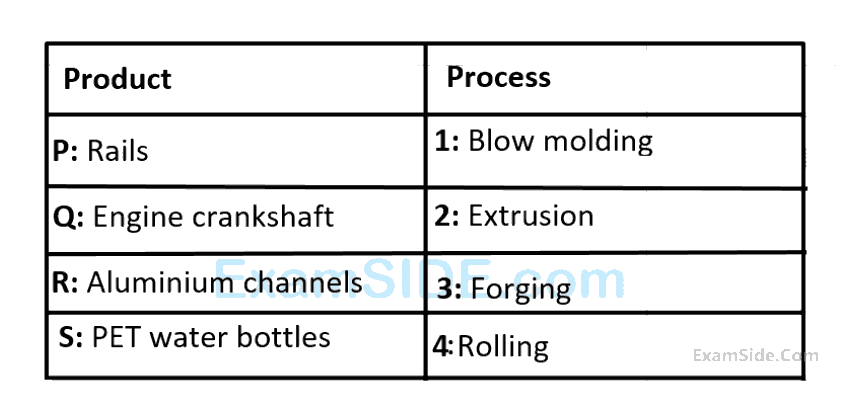
Answer: B
Production Engineering - Metal Forming
In a slab rolling operation, the maximum thickness reduction is given by where is the radius of the roll and is the coefficient of friction between the roll and the sheet. If the maximum angle subtended by the deformation zone at the center of the roll (bit angle in degrees) is ____________

Answer: 5.6 to 5.8
Production Engineering - Metal Forming
he atomic packing factor for a material with body centered cubic structure is

Production Engineering - Metal Forming
In a two stage wire drawing operation, the fractional reduction (ratio of change in cross sectional area to initial cross sectional area ) in the first stage is The fractional reduction in the second stage is The overall fractional reduction is

Answer: B
Production Engineering - Metal Forming
The flowing stress (in ) of a material is given by When is true strain. The Young's modulus of elasticity of the material is A block of thickness made of this material is compressed to thickness and then the load is removed. The final dimension of the block (in ) is ____________

Answer: 95.14 to 95.2
Production Engineering - Metal Forming
In a rolling operation using rolls of diameter if a thick plate cannot be reduced to less than in one pass, the coefficient of friction between the roll and the plate is ____________.

Answer: 0.1 to 0.15
Production Engineering - Metal Forming
A metal rod of initial length is subjected to a drawing process. The length of the rod at any instant is given by the expression, where is the time in minutes. The true strain rate (in ) at the end of one minute is _____________

Answer: 0.9 to 1.1
Production Engineering - Metal Forming
The relationship between true strain and engineering strain in a uniaxial tension test is given as

Answer: C
Production Engineering - Metal Forming
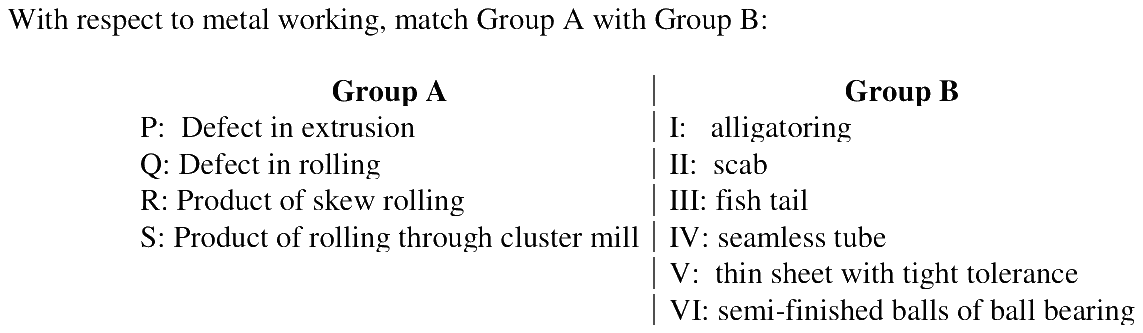
Q.25 With respect to metal working, match Group A with Group B: Group A Group B P: Defect in extrusion I: alligatoring Q: Defect in rolling II: scab R: Product of skew rolling III: fish tail S: Product of rolling through cluster mill IV: seamless tube V: thin sheet with tight tolerance VI: semi-finished balls of ball bearing ME02 (GATE 2014) (A) P-II, Q-III, R-VI, S-V (B) P-III, Q-I, R-VI, S-V (C) P-III, Q-I, R-IV, S-VI (D) P-I, Q-II, R-V, S-VI
Answer: B
Production Engineering - Metal Forming
A mild steel plate has to be rolled in one pass such that the final plate thickness is of the initial thickness, with the entrance speed of and roll diameter of If the plate widens by during rolling, the exit velocity (in ) is ____________

Answer: 14.6 to 14.8
Production Engineering - Metal Forming
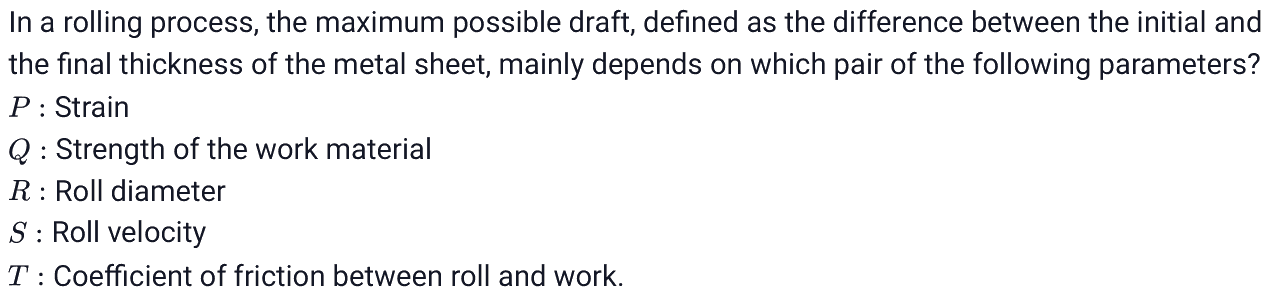
In a rolling process, the maximum possible draft, defined as the difference between the initial and the final thickness of the metal sheet, mainly depends on which pair of the following parameters? Strain Strength of the work material Roll diameter Roll velocity Coefficient of friction between roll and work.
Answer: B
Production Engineering - Metal Forming
In a rolling process, the state of stress of the material undergoing deformation is
Answer: C
Production Engineering - Metal Forming
A solid cylinder of diameter and height is forged between two frictionless flat dies to a height of The percentage change in diameter is

Answer: D
Production Engineering - Metal Forming
In a single pass rolling process using diameter steel rollers, a strip of width and thickness undergoes reduction of thickness. The angle of bite in radians is

Answer: C
Production Engineering - Metal Forming
The maximum possible draft in cold rolling of sheet increases with the
Answer: A
Production Engineering - Metal Forming
In a single pass rolling operation, a thick plate with plate width of , is reduced to thick. The roller radius is and rotational speed is The average flow stress for the plate material is The power required for the rolling operation in is closer to

Answer: A
Production Engineering - Metal Forming
In open die forging, a disc of diameter height is compressed without any barreling effect. The final diameter of the disc is The true strain is

Answer: C
Production Engineering - Metal Forming
The thickness of metallic sheet is reduced from an initial value of to a final value of in one single pass rolling with a pair of cylindrical rollers each of diameter of The bite angle in degrees will be

Answer: D
Production Engineering - Metal Forming
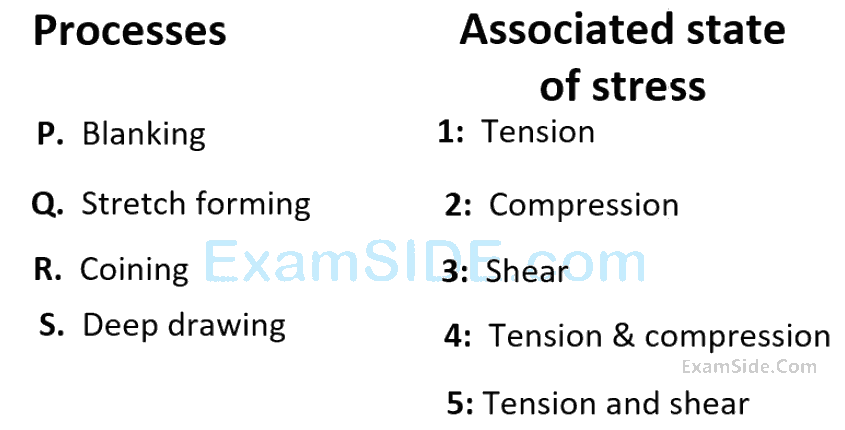
Match the correct combination for following metal working processes.
Answer: D
Production Engineering - Metal Forming
A thick sheet is rolled with diameter rolls to reduce thickness without any change in its width. The friction coefficient at the work-roll interface is The minimum possible thickness of the sheet that can be produced in a single pass is

Answer: C
Production Engineering - Metal Forming
In a wire drawing operation, diameter of a steel wire is reduced from to the mean flow stress of the material is The ideal force required for drawing ignoring friction and redundant work is:

Answer: B
Production Engineering - Metal Forming
In a rolling process, sheet of thickness is rolled to thickness. Roll is of diameter and it rotates at The roll strip contact length will be

Answer: B
Production Engineering - Metal Forming
Cold working of steel is defined as working
Answer: C
Production Engineering - Metal Forming
A brass billet is to be excluded from its initial diameter of to a final diameter of . The working temperature is and the extrusion constant is The force required for extrusion is

Answer: B
Production Engineering - Metal Forming
Hot rolling of mild steel is carried out
Answer: D
Production Engineering - Metal Forming
Ductility of material with work hardening
Answer: B
Production Engineering - Metal Forming
A cylindrical billet of diameter is forged from height to at . The material has constant flow stress of Find the work of deformation. If a drop hamper is used to complete the reduction in one blow. What will be the height of fall.

Production Engineering - Metal Forming
A strip with sectional area is being rolled with reduction of area using diameter rollers. The angle subtended by the deformation zone at the roll center is (in radians)

Answer: D
Production Engineering - Metal Forming
A metal strip is to be rolled from an initial wrought thickness of to a final rolled thickness of in a single pass rolling mill having rolls of diameter. The strip is wide. The average coefficient of friction in the roll gap is . Taking plane strain low stress of for the metal and assuming negligible spreading, the roll separating force is . . . . . . . . .

Production Engineering - Metal Forming
A wire of diameter is drawn from a rod of diameter dies giving reductions of , and are available. For minimum error in the final size, the number of stages and reduction at each stage respectively would be

Answer: B
Production Engineering - Metal Forming
Production Engineering - Metal Forming
A test specimen is stressed slightly beyond the yield point and then unloaded. Its yield strength
Answer: B
Production Engineering - Metal Forming
The process of hot extrusion is used to produce
Answer: B
Production Engineering - Metal Forming
Calculate the bite angle when rolling plates thick using work rolls diameter and reducing the thickness by

Production Engineering - Metal Forming
The true strain for a low carbon steel bar which is doubled in length by forging is
Answer: C
Production Engineering - Metal Forming
A strip of thickness is rolled in a high single pass rolling mill, having roll diameter to a final thickness of If the friction coefficient between the roll and strip is calculate the maximum reduction possible in this operation. Using this relation, for and friction coefficient is calculate the outgoing thickness of the strip. If the inlet velocity is what is the outgoing strip velocity?.

Production Engineering - Metal Forming
For wire drawing operation, the work material should essentially be
Answer: A
Production Engineering - Metal Forming
In forging operation the sticking friction condition occurs near the ...... (Center/ ends) while sliding friction condition occurs near the ...... (Center / ends)
Answer: ends, center