GATE ME Metal Cutting: Previous Year Questions
GATE ME (Mechanical Engineering) Metal Cutting previous year questions from Production Engineering, with figures and the answer key.
Production Engineering | All GATE ME papers
GATE ME 2026, Question 48 (2 marks, NAT)
Production Engineering - Metal Cutting
During orthogonal turning by using a single point cutting tool, feed rate is . The uncut chip thickness is 0.23 mm . The shear angle, tangential force component, and radial force component are , and 150 N , respectively. The value of shear force is N (rounded off to 2 decimal places).

Answer: 571.00 to 574.00
GATE ME 2026, Question 49 (2 marks, NAT)
Production Engineering - Metal Cutting
A drill bit during its lifetime can produce 150 through holes in a plate at a drill-speed of 200 RPM . If the drill-speed increases to 300 RPM , then it can produce 60 through holes in the same plate before the drill bit fails. Assume all other parameters remain constant. The value of the exponent in Taylor's tool life equation is (rounded off to 2 decimal places).

Answer: 0.3067
GATE ME 2024, Question 30 (1 mark, MCQ)
Production Engineering - Metal Cutting
The grinding wheel used to provide the best surface finish is
- A36L5V
- A54L5V
- A60L5V
- A80L5V
Answer: D
GATE ME 2024, Question 60 (2 marks, NAT)
Production Engineering - Metal Cutting
A cutting tool provides a tool life of 60 minutes while machining with the cutting speed of 60 m/min. When the same tool is used for machining the same material, it provides a tool life of 10 minutes for a cutting speed of 100 m/min. If the cutting speed is changed to 80 m/min for the same tool and work material combination, the tool life computed using Taylor’s tool life model is _______ minutes (rounded off to 2 decimal places).
Answer: 21.00 to 22.50
GATE ME 2023, Question 44 (2 marks, MCQ)
Production Engineering - Metal Cutting
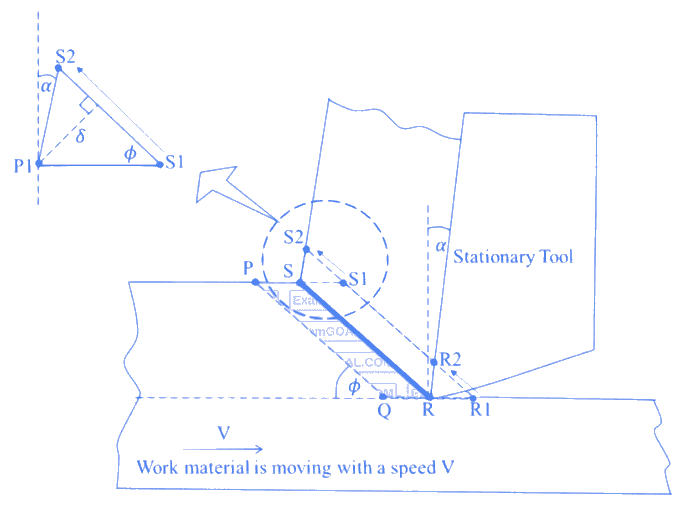
In an ideal orthogonal cutting experiment (see figure), the cutting speed V is 1 m/s, the rake angle of the tool α = 5°, and the shear angle, φ, is known to be 45°. Applying the ideal orthogonal cutting model, consider two shear planes PQ and RS close to each other. As they approach the thin shear zone (shown as a thick line in the figure), plane RS gets sheared with respect to PQ (point R1 shears to R2, and S1 shears to S2). Assuming that the perpendicular distance between PQ and RS is δ = 25 μm, what is the value of shear strain rate (in s$^{-1}$ ) that the material undergoes at the shear zone?
- 1.84 × 10$^{4}$
- 5.20 × 10$^{4}$
- 0.71 × 10$^{4}$
- 1.30 × 10$^{4}$
Answer: B
GATE ME 2023, Question 45 (2 marks, MCQ)
Production Engineering - Metal Cutting
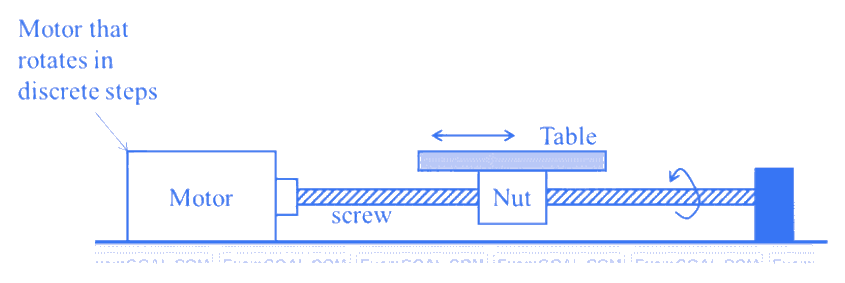
A CNC machine has one of its linear positioning axes as shown in the figure, consisting of a motor rotating a lead screw, which in turn moves a nut horizontally on which a table is mounted. The motor moves in discrete rotational steps of 50 steps per revolution. The pitch of the screw is 5 mm and the total horizontal traverse length of the table is 100 mm. What is the total number of controllable locations at which the table can be positioned on this axis?
- 5000
- 2
- 1000
- 200
Answer: C
GATE ME 2023, Question 51 (2 marks, NAT)
Production Engineering - Metal Cutting
The atomic radius of a hypothetical face-centered cubic (FCC) metal is (√2/10) nm. The atomic weight of the metal is 24.092 g/mol. Taking Avogadro’s number to be 6.023 × 10$^{23}$ atoms/mol, the density of the metal is ____________ kg/m$^{3}$ . (Answer in integer)
Answer: 2499.999 to 2500.001
GATE ME 2022 Set 1, Question 54 (2 marks, NAT)
Production Engineering - Metal Cutting
Under orthogonal cutting condition, a turning operation is carried out on a metallic workpiece at a cutting speed of 4 m/s. The orthogonal rake angle of the cutting tool is 5o. The uncut chip thickness and width of cut are 0.2 mm and 3 mm, respectively. In this turning operation, the resulting friction angle and shear angle are 45o and 25o, respectively. If the dynamic yield shear strength of the workpiece material under this cutting condition is 1000 MPa, then the cutting force is _______ N (round off to one decimal place).
Answer: 2572 to 2574
GATE ME 2022 Set 1, Question 55 (2 marks, NAT)
Production Engineering - Metal Cutting
A 1 mm thick cylindrical tube, 100 mm in diameter, is orthogonally turned such that the entire wall thickness of the tube is cut in a single pass. The axial feed of the tool is 1 m/minute and the specific cutting energy (u) of the tube material is 6 J/mm$^{3}$. Neglect contribution of feed force towards power. The power required to carry out this operation is _________ kW (round off to one decimal place).
Answer: 30 to 32
GATE ME 2022 Set 2, Question 54 (2 marks, NAT)
Production Engineering - Metal Cutting
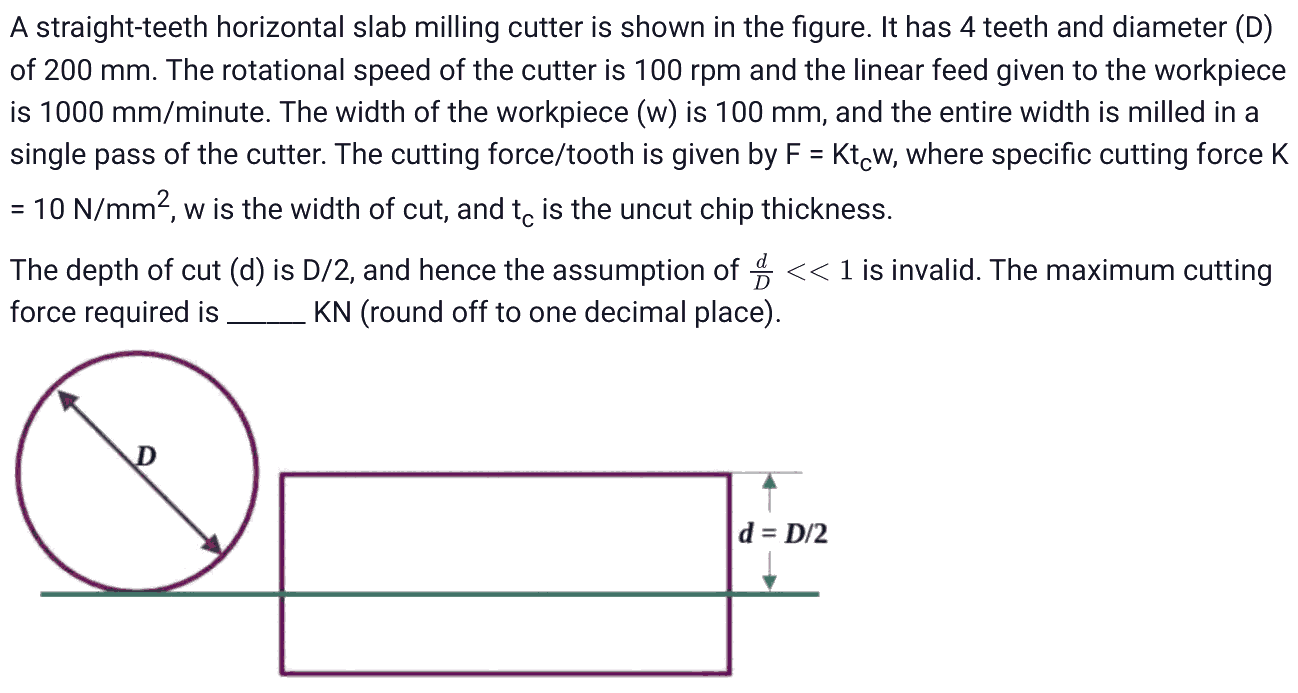
A straight-teeth horizontal slab milling cutter is shown in the figure. It has 4 teeth and diameter (D) of 200 mm. The rotational speed of the cutter is 100 rpm and the linear feed given to the workpiece is 1000 mm/minute. The width of the workpiece (w) is 100 mm, and the entire width is milled in a single pass of the cutter. The cutting force/tooth is given by F = Kt$_{c}$w, where specific cutting force K = 10 N/mm$^{2}$, w is the width of cut, and t$_{c}$ is the uncut chip thickness. The depth of cut (d) is D/2, and hence the assumption of is invalid. The maximum cutting force required is ______ KN (round off to one decimal place).
Answer: 2.4 to 2.6
GATE ME 2022 Set 2, Question 55 (2 marks, NAT)
Production Engineering - Metal Cutting
In an orthogonal machining operation, the cutting and thrust forces are equal in magnitude. The uncut chip thickness is 0.5 mm and the shear angle is 15°. The orthogonal rake angle of the tool is 0° and the width of cut is 2 mm. The workpiece material is perfectly plastic and its yield shear strength is 500 MPa. The cutting force is _______ N (round off to the nearest integer).
Answer: 2700 to 2750
GATE ME 2021 Set 1, Question 48 (2 marks, NAT)
Production Engineering - Metal Cutting
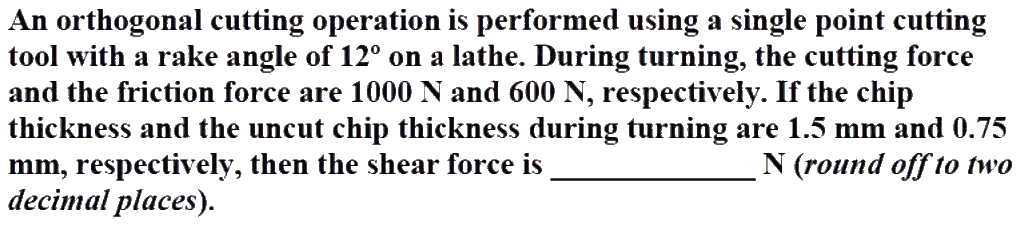
Q.38 An orthogonal cutting operation is performed using a single point cutting toolwith arakeangleof12°onalathe.Duringturning,thecuttingforce and thefrictionforce are1000N and 600N,respectively.Ifthechip thickness and the uncut chip thickness during turning are 1.5 mm and 0.75 mm,respectively,thentheshearforceis N(roundofftotwo decimal places).
Answer: 625 to 750
GATE ME 2021 Set 2, Question 50 (2 marks, NAT)
Production Engineering - Metal Cutting
Q.40 In a pure orthogonal turning by a zero rake angle single point carbide cutting tool, the shear force has been computed to be 40o N. The cutting velocity, V = 100 m/min, depth of cut, t = 2.0 mm, feed, So = 0.1 mm/revolution and chip velocity,V = 20 m/min,the shear strength,Ts of the material will be MPa (round off to two decimal places).

Answer: 388 to 400
GATE ME 2020 Set 1, Question 55 (2 marks, NAT)
Production Engineering - Metal Cutting
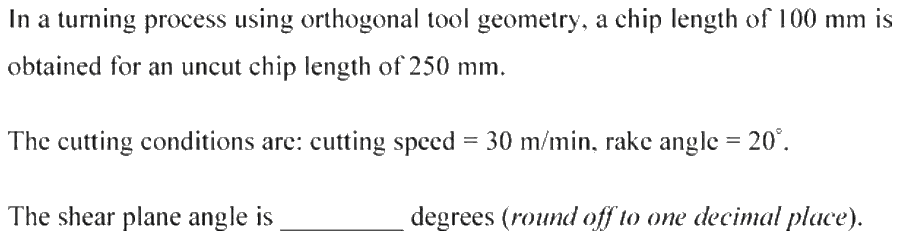
Q.No.45 5Ina turningprocess usingorthogonal toolgeometry,a chiplengthof100mmis obtainedforanuncutchiplengthof250mm. The cutting conditions are: cutting speed = 30 m/min,rake angle = 20°. The shearplane angleis degrees(round offto one decimal place).
Answer: 22 to 25
GATE ME 2020 Set 2, Question 53 (2 marks, NAT)
Production Engineering - Metal Cutting
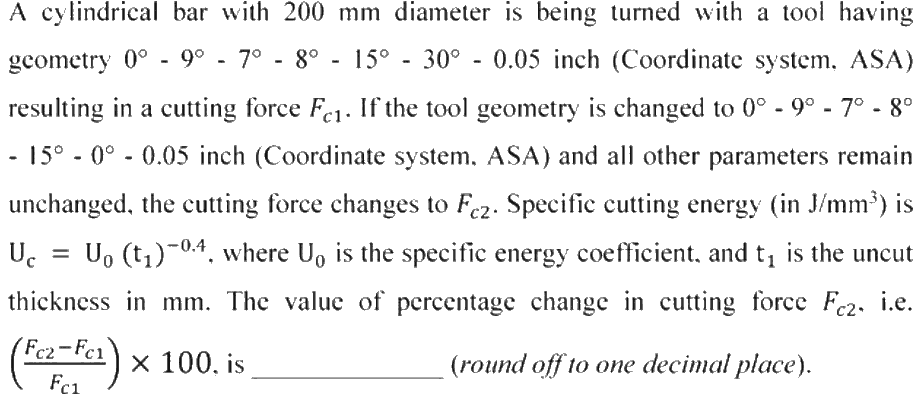
Q.No.43 geometry 0° - 9° - 7°- 8°- 15°- 30° - 0.05 inch (Coordinate system, ASA) resulting in a cutting force Fe1. If the tool geometry is changed to 0° - 9° - 7° - 8° -15°-0°-0.05 inch(Coordinate system,ASA) and all other parameters remain unchanged,the cutting force changes toFc2.Specific cutting energy (in J/mm²) is U=U(t)-0.4,where Uis the specific energy coefficient,and t is the uncut thickness in mm.The value of percentage change in cutting force Fc2,i.e. (Fc2-Fc) × 100, is (roundoff toonedecimalplace). Fc1
Answer: -5.8 to -5.5
GATE ME 2020 Set 2, Question 55 (2 marks, NAT)
Production Engineering - Metal Cutting
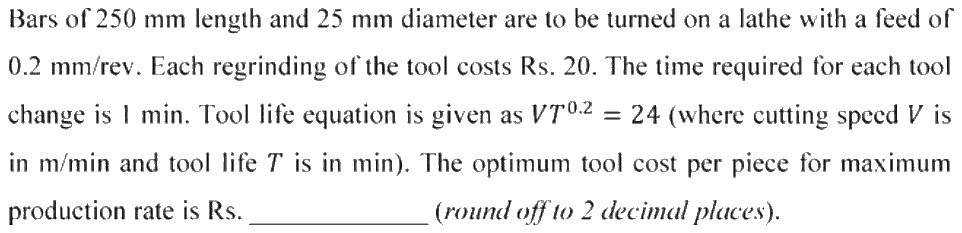
Q.No.45 5Barsof250mmlengthand25mmdiameteraretobeturnedonalathewithafeedof 0.2mm/rev.Ea change is 1 min.Tool life equationisgiven asVT0.2=24(where cutting speedVis in m/min and tool life T is in min).The optimum tool cost per piece for maximum productionrateisRs. (roundoffto2decimalplaces). 6A point‘P’ona CNC controlled XY-stage ismoved to another point‘Q’using
Answer: 26 to 28
GATE ME 2019 Set 1, Question 45 (2 marks, MCQ)
Production Engineering - Metal Cutting
Q.35 In orthogonal turning of a cylindrical tube of wall thickness 5 mm, the axial and the tangential cutting forces were measured as 1259 N and 1601 N, respectively. The measured chip thickness after machining was found to be 0.3 mm. The rake angle was 10° and the axial feed was 100 mm/min. The rotational speed of the spindle was 1000 rpm. Assuming the material to be perfectly plastic and Merchant's first solution, the shear strength of the material is closest to (A) 722 MPa (B) 920 MPa (C) 200 MPa (D) 875 MPa

Answer: A
GATE ME 2019 Set 1, Question 62 (2 marks, NAT)
Production Engineering - Metal Cutting
Q.52 In ASA system,the side cutting and end cutting edge angles ofa sharp turning tool are 45° and 10°, respectively. The feed during cylindrical turning is 0.1 mm/rev. The center line average surfaceroughness(inμm,roundoff toone decimal place)ofthegenerated surface is

Answer: 3.5 to 3.9
GATE ME 2019 Set 1, Question 63 (2 marks, NAT)
Production Engineering - Metal Cutting
Q.53 Taylor’s tool life equation is given by VTn = C, where Vis in m/min and Tis in min. In a tuning operation, two tools X and Y are used. For tool X, n = 0.3 and C = 60 and for tool Y, n = 0.6 and C = 90. Both the tools will have the same tool life for the cutting speed (in m/min, round off to one decimal place) of

Answer: 38 to 42
GATE ME 2019 Set 2, Question 63 (2 marks, NAT)
Production Engineering - Metal Cutting
Q.53 diameter10mm,at afeed of0.25mm/rev and a spindle speed of1200rpm.If thespecific energy required for cutting this material is 0.7 N·m/mm, the power required for drilling is W(roundofftotwodecimalplaces).

Answer: 274 to 276
GATE ME 2019 Set 2, Question 64 (2 marks, NAT)
Production Engineering - Metal Cutting
Q.54 thickness and the chip thickness are 0.125mm and 0.22mm,respectively.UsingMerchant’s firstsolutionfortheconditionofminimumcuttingforce,thecoefficientoffictionatthe chip-tool interface is (round off to two decimal places).

Answer: 0.72 to 0.76
GATE ME 2018 Set 1, Question 23 (1 mark, MCQ)
Production Engineering - Metal Cutting
Q.13 Using the Taylor’s tool life equation with exponent n 0.5, if the cutting speed is reduced by 50%, the ratio of new tool life to original tool life is (A) 4 (B) 2 (C) 1 (D) 0.5

Answer: A
GATE ME 2018 Set 1, Question 59 (2 marks, NAT)
Production Engineering - Metal Cutting
Q.49 An orthogonal cutting operation is being carried out in which uncut thickness is 0.010 mm, cutting speed is 130 m/min, rake angle is 15 and width of cut is 6 mm. It is observed that the chip thickness is 0.015 mm, the cutting force is 60 N and the thrust force is 25 N. The ratio of friction energy to total energy is __________ (correct to two decimal places).

Answer: 0.39 to 0.49
GATE ME 2018 Set 2, Question 58 (2 marks, NAT)
Production Engineering - Metal Cutting
Q.48 Following data correspond to an orthogonal turning of a 100 mm diameter rod on a lathe. Rake angle: 15 o ; Uncut chip thickness: 0.5 mm; nominal chip thickness after the cut: 1.25 mm. The shear angle (in degrees) for this process is _______ (correct to two decimal places).

Answer: 22 to 24
GATE ME 2018 Set 2, Question 59 (2 marks, NAT)
Production Engineering - Metal Cutting
Q.49 Taylor’s tool life equation is used to estimate the life of a batch of identical HSS twist drills by drilling through holes at constant feed in 20 mm thick mild steel plates. In test 1, a drill lasted 300 holes at 150 rpm while in test 2, another drill lasted 200 holes at 300 rpm. The maximum number of holes that can be made by another drill from the above batch at 200 rpm is ______ (correct to two decimal places).

Answer: 252 to 254
GATE ME 2017 Set 1, Question 37 (2 marks, NAT)
Production Engineering - Metal Cutting
Two cutting tools with tool life equations given below are being compared: where is cutting speed in and is tool life in minutes. The breakeven cutting speed beyond which Tool will have a higher tool life is _______________ .

Answer: 105 to 107
GATE ME 2017 Set 2, Question 54 (2 marks, MCQ)
Production Engineering - Metal Cutting
During the turning of a diameter steel bar at a spindle speed of a tool life of minute is obtained. When the same bar is turned at the tool life becomes Assume that Taylor's tool life equation is valid. When the bar is turned at the tool life (in minute) is approximately

Answer: B
GATE ME 2017 Set 2, Question 55 (2 marks, NAT)
Production Engineering - Metal Cutting
In an orthogonal machining with a tool of orthogonal rake angle, the uncut chip thickness is The chip thickness fluctuates between and The ratio of the maximum shear angle to the minimum shear angle during machining is ______________

Answer: 1.45 to 1.53
GATE ME 2016 Set 1, Question 34 (1 mark, NAT)
Production Engineering - Metal Cutting
In an orthogonal cutting process the tool used has rake angle of zero degree. The measured cutting force and thrust force are and respectively. The coefficient of friction between the tool and the chip is ________________

Answer: 0.49 to 0.51
GATE ME 2016 Set 1, Question 60 (2 marks, MCQ)
Production Engineering - Metal Cutting
The too life equation for tool is Constant. The tool life of is obtained using the following cutting conditions If speed feed and depth of cut are increased individually by the tool life (in ) is

Answer: B
GATE ME 2016 Set 2, Question 61 (2 marks, NAT)
Production Engineering - Metal Cutting
For a certain job, the cost of metal cutting is and the cost of tooling is Rs. Where is a constant, is the cutting speed in and is the tool life in minutes. The Taylor's tool life equation is The cutting speed (in ) for the minimum total cost is ___________

Answer: 57.8 to 58
GATE ME 2016 Set 3, Question 59 (2 marks, MCQ)
Production Engineering - Metal Cutting
For an orthogonal cutting operation, tool material is rake angle is chip thickness is speed is and feed is . The shear plane angle (in degrees) is

Answer: B
GATE ME 2016 Set 3, Question 61 (2 marks, NAT)
Production Engineering - Metal Cutting
In a single point turning operation with cemented carbide tool and steel work piece, it is found that the Taylor's exponent is If the cutting speed is reduced by then the tool life changes by ____________ times.

Answer: 14 to 18
GATE ME 2015 Set 1, Question 33 (1 mark, NAT)
Production Engineering - Metal Cutting
Under certain cutting conditions, doubling the cutting speed reduces the tool life to of the original. Taylor’s tool life index for this tool workpiece combination will be ______________

Answer: 0.25
GATE ME 2015 Set 1, Question 45 (2 marks, NAT)
Production Engineering - Metal Cutting
An orthogonal turning operation is carried out under the following conditions; rake angle spindle rotational speed axial feed and radial depth of . The chip thickness, is found to be The shear angle (in degrees) in this turning process is ________________

Answer: 18.5 to 19
GATE ME 2015 Set 2, Question 62 (2 marks, NAT)
Production Engineering - Metal Cutting
A single point cutting tool with rake angle is used in an orthogonal machining process. At a cutting speed of the thrust force is If the coefficient of friction between the tool and the chip is Then the power consumption (in ) for the machining operation is ____________

Answer: 2 to 2.2
GATE ME 2015 Set 3, Question 44 (2 marks, MCQ)
Production Engineering - Metal Cutting
Orthogonal turning of a mild steel tube with a tool of rake angle is carried out at a feed of If the thickness of the chip produced is the values of shear angle and shear strain will be respectively.

- and
- and
- and
- and
Answer: A
GATE ME 2014 Set 1, Question 33 (1 mark, MCQ)
Production Engineering - Metal Cutting
The main cutting force acting on a tool during the turning (orthogonal cutting) operation of a metal is The turning was performed using depth of cut and feed rate. The specific cutting pressure (in is

Answer: B
GATE ME 2014 Set 1, Question 62 (2 marks, NAT)
Production Engineering - Metal Cutting
During pure orthogonal turning operation of a hollow cylindrical pipe, it is found that the thickness of the chip produced is The feed given to the zero degree rake angle tool is The shear strain produced during the operation is ___________

Answer: 2.8 to 3
GATE ME 2014 Set 1, Question 64 (2 marks, NAT)
Production Engineering - Metal Cutting
If the Taylor's tool life exponent is and the tool changing time is then the tool life (in min) for maximum production rate is ____________

Answer: 5.9 to 6.1
GATE ME 2014 Set 3, Question 30 (1 mark, NAT)
Production Engineering - Metal Cutting
A straight turning operation is carried out using a single point cutting tool on an steel rod. The feed is and the depth of cut is The tool has a side cutting edge angle of The uncut chip thickness (in ) is _______________

Answer: 0.08 to 0.12
GATE ME 2014 Set 3, Question 33 (1 mark, MCQ)
Production Engineering - Metal Cutting
Cutting tool is much harder than the work piece. Yet the tool wears out during the tool-work interaction, because
- Extra hardness is imparted to the work piece due to coolant used
- Oxide layers on the work piece surface impart extra hardness to it
- Extra hardness is imparted to the work piece due to severe rate of strain
- Vibration is induced in the machine tool
Answer: C
GATE ME 2014 Set 3, Question 64 (2 marks, MCQ)
Production Engineering - Metal Cutting
Which pair of following statement is correct for orthogonal cutting using a single-point cutting tool? reduction in friction angle increases cutting force Reduction in friction angle decreases cutting force Reduction in friction angle increases chip thickness Reduction in friction angle decreases chip thickness

- and
- and
- and
- and
Answer: D
GATE ME 2014 Set 4, Question 33 (1 mark, MCQ)
Production Engineering - Metal Cutting
Better surface finish is obtained with a large rake angle because
- the area of shear plane decreases resulting in the decrease in shear force and cutting force
- the tool becomes thinner and the cutting force is reduced
- less heat is accumulated in the cutting zone
- the friction between the chip and the tool is less
Answer: A
GATE ME 2014 Set 4, Question 64 (2 marks, NAT)
Production Engineering - Metal Cutting
A cast iron block of length is being shaped in a shaping machine with a depth of cut of feed of and the tool principal cutting edge angle of Number of cutting strokes per minutes is Using specific energy for cutting as the average power consumption (in Watt) is ___________

Answer: 295 to 305
GATE ME 2013, Question 34 (2 marks, MCQ)
Production Engineering - Metal Cutting
Two cutting tools are being compared for a machining operation. The tool life equations are: Where is the cutting speed in and is the tool life in The carbide tool will provide higher tool life if the cutting speed in exceeds

Answer: B
GATE ME 2013, Question 52 (2 marks, MCQ)
Production Engineering - Metal Cutting
In orthogonal turning of a bar of diameter with a feed of depth of cut of and cutting velocity of it is observed that the main (tangential) cutting force is perpendicular to the friction force acting at the chip-tool interface. The main (tangential) cutting force is The orthogonal rake angle of the cutting tool in degrees is

- zero
- zero
Answer: A
GATE ME 2013, Question 53 (2 marks, MCQ)
Production Engineering - Metal Cutting
In orthogonal turning of a bar of diameter with a feed of depth of cut of and cutting velocity of it is observed that the main (tangential) cutting force is prependicular to the friction force acting at the chip-tool interface. The main (tangential) cutting force is The normal force acting at the chip-tool interface in is

Answer: B
GATE ME 2011, Question 49 (2 marks, MCQ)
Production Engineering - Metal Cutting
A single-point cutting tool with rake angle is used to machine a steel work-piece. The depth of cut, uncut thickness is The chip thickness under orthogonal machining condition is The shear angle is approximately

Answer: B
GATE ME 2010, Question 50 (2 marks, MCQ)
Production Engineering - Metal Cutting
For tool Taylor’s tool life exponent is and constant is Similarly for tool and The cutting speed (in ) above which tool will have a higher tool life than tool is

Answer: A
GATE ME 2009, Question 9 (1 mark, MCQ)
Production Engineering - Metal Cutting
Friction at the tool - chip interface can be reduced by
- Decreasing the rake angle
- Increasing the depth of cut
- Decreasing the cutting speed
- Increasing the cutting speed
Answer: D
GATE ME 2009, Question 10 (1 mark, MCQ)
Production Engineering - Metal Cutting
The minimum shear strain in orthogonal turning with a cutting tool of zero rake angle is
Answer: D
GATE ME 2009, Question 51 (2 marks, MCQ)
Production Engineering - Metal Cutting
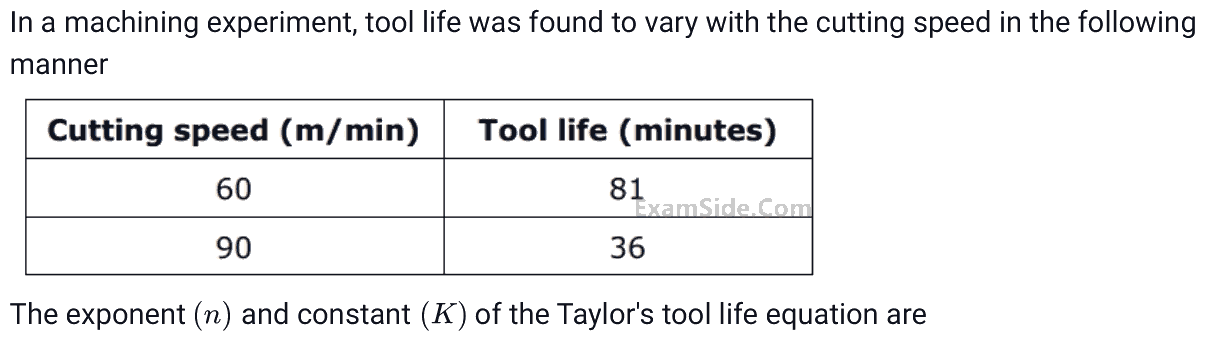
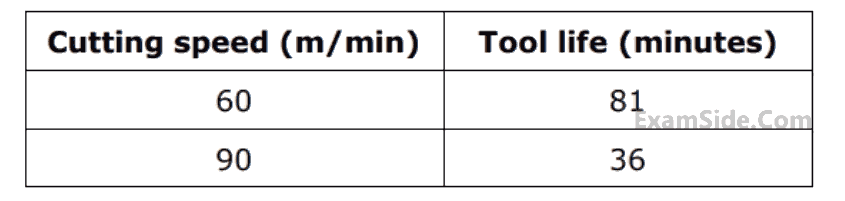
In a machining experiment, tool life was found to vary with the cutting speed in the following manner The exponent and constant of the Taylor's tool life equation are
- and
- and
- and
- and
Answer: A
GATE ME 2009, Question 52 (2 marks, MCQ)
Production Engineering - Metal Cutting
In a machining experiment, tool life was found to vary with the cutting speed in the following manner What is percentage increase in tool life when the cutting speed is halved.
Answer: C
GATE ME 2008, Question 53 (2 marks, MCQ)
Production Engineering - Metal Cutting
In a single point turning tool, the side rake angle and orthogonal rake angle are equal. is the principle cutting edge angle and its range is to The chip flows in the orthogonal plane. The value of is closer to

Answer: D
GATE ME 2008, Question 54 (2 marks, MCQ)
Production Engineering - Metal Cutting
Orthogonal turning is performed on a cylindrical work piece with shear strength of The following conditions are used: cutting velocity is feed is depth of cut is chip thickness ratio is The orthogonal rake angle is Apply Merchants theory for analysis, The shear plane angle (in degrees) and the shear force respectively are

Answer: D
GATE ME 2008, Question 55 (2 marks, MCQ)
Production Engineering - Metal Cutting
Orthogonal turning is performed on a cylindrical work piece with shear strength of The following conditions are used: cutting velocity is feed is depth of cut is chip thickness ratio is The orthogonal rake angle is Apply Merchants theory for analysis, The cutting and frictional forces respectively are

Answer: B
GATE ME 2007, Question 56 (2 marks, MCQ)
Production Engineering - Metal Cutting
A low carbon steel bar of diameter with length of is being turned with uncoated carbide insert. The observed tool lives are and for cutting velocities of and respectively. The feed and depth of cut are and respectively. Use the unmachined diameter to calculate the cutting velocity. When tool life is The cutting velocity in is

Answer: B
GATE ME 2007, Question 57 (2 marks, MCQ)
Production Engineering - Metal Cutting
A low carbon steel bar of diameter with length of is being turned with uncoated carbide insert. The observed tool lives are and for cutting velocities of and respectively. The feed and depth of cut are and respectively. Use the unmachined diameter to calculate the cutting velocity. Neglect over travel or approach of the tool. When tool life is the machining time in for a single pass is
Answer: C
GATE ME 2007, Question 58 (2 marks, MCQ)
Production Engineering - Metal Cutting
In orthogonal turning of a low carbon steel bar of diameter with uncoated carbide tool, the cutting velocity is The feed is and the depth of cut is The chip thickness obtained is If the orthogonal rake angle is zero, and the principle cutting edge angle is the shear angle in degrees is

Answer: B
GATE ME 2007, Question 59 (2 marks, MCQ)
Production Engineering - Metal Cutting
In orthogonal turning of medium carbon steel, the specific machining energy is the cutting velocity, feed and depth of cut are and respectively. The main cutting force is

Answer: D
GATE ME 2007, Question 60 (2 marks, MCQ)
Production Engineering - Metal Cutting
In orthogonal turning of low carbon steel pipe with principal cutting edge angle of the main cutting force is and the feed force is The shear angle is and orthogonal rake angle is zero. Employing Merchants theory, the ratio of friction force to the normal force acting on the cutting tool is

Answer: C
GATE ME 2006, Question 61 (2 marks, MCQ)
Production Engineering - Metal Cutting
In an orthogonal machining operation: Uncut thickness Cutting speed Width of cut Chip thickness Thrust force Cutting force Rake angle Assume Merchant’s theory The values of shear angle and shear strain, respectively are
- and
- and
- and
- and
Answer: C
GATE ME 2006, Question 62 (2 marks, MCQ)
Production Engineering - Metal Cutting
In an orthogonal machining operation: Uncut thickness Cutting speed Width of cut Chip thickness Thrust force Cutting force Rake angle Assume Merchant’s theory The coefficient of friction at the tool chip interface is
Answer: B
GATE ME 2006, Question 63 (2 marks, MCQ)
Production Engineering - Metal Cutting
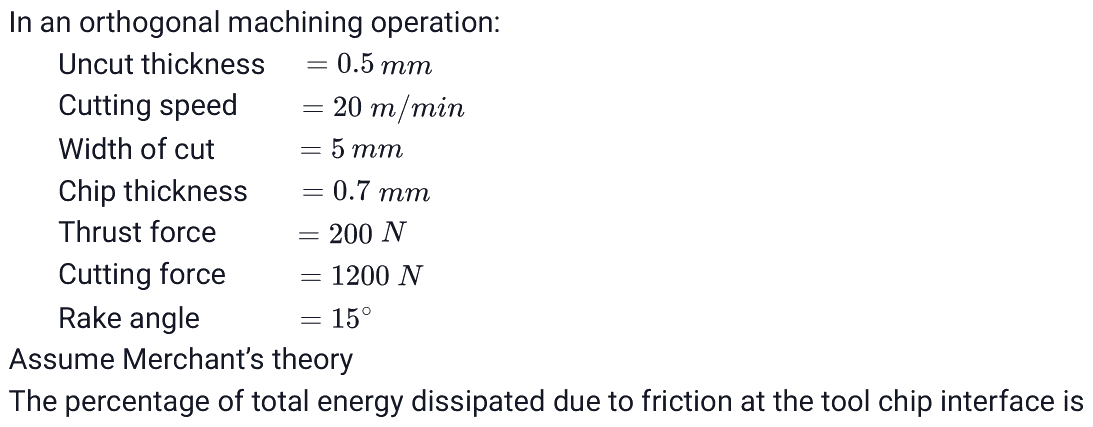
In an orthogonal machining operation: Uncut thickness Cutting speed Width of cut Chip thickness Thrust force Cutting force Rake angle Assume Merchant’s theory The percentage of total energy dissipated due to friction at the tool chip interface is
Answer: A
GATE ME 2005, Question 64 (2 marks, MCQ)
Production Engineering - Metal Cutting
The figure below shows a graph, which qualitatively relates cutting speed and cost per piece produced. The three curves and respectively represent
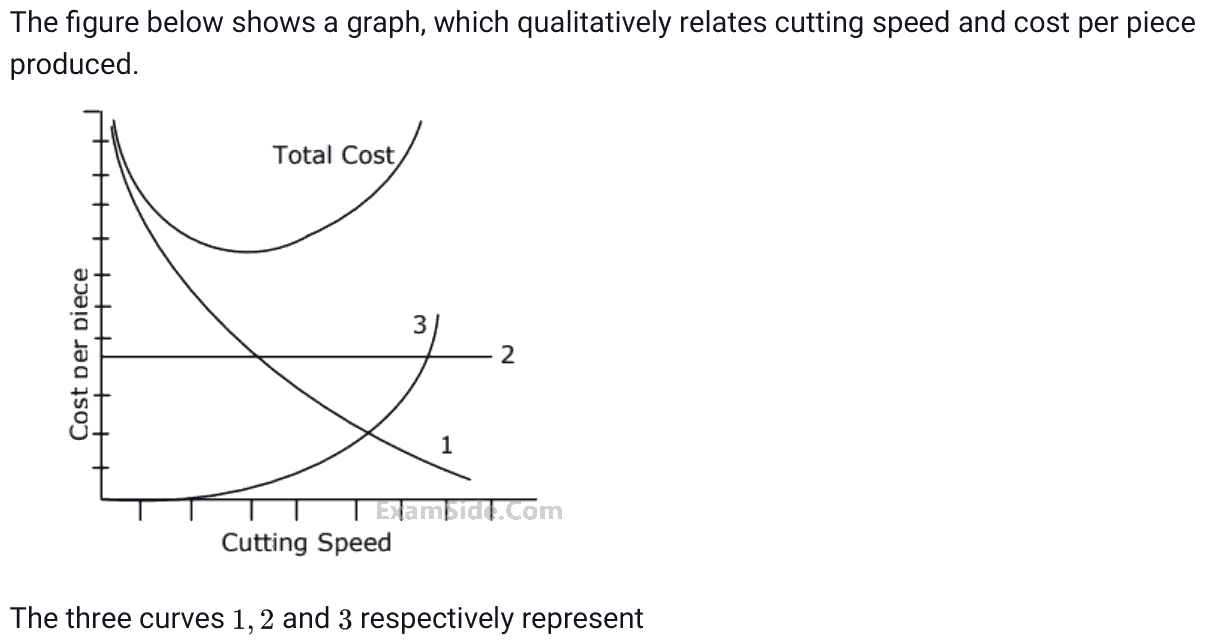
- Machining cost, non-productive cost, tool changing cost
- Non-productive cost, machining cost, tool changing cost
- Tool changing cost, machining cost, non-productive cost
- Tool changing cost, non-productive cost, machining cost
Answer: A
GATE ME 2005, Question 65 (2 marks, MCQ)
Production Engineering - Metal Cutting
Two tools and have signature and (both ) respectively. They are used to turn components under the same machining conditions. If and denote the peak-to-valley height of surfaces produced by the tools and , the ratio will be

Answer: B
GATE ME 2004, Question 66 (2 marks, MCQ)
Production Engineering - Metal Cutting
In a machining operation, doubling the cutting speed reduces the tool life to of the original value. The exponent in Taylor's tool life equation is

Answer: C
GATE ME 2004, Question 77 (5 marks, MCQ)
Production Engineering - Metal Cutting
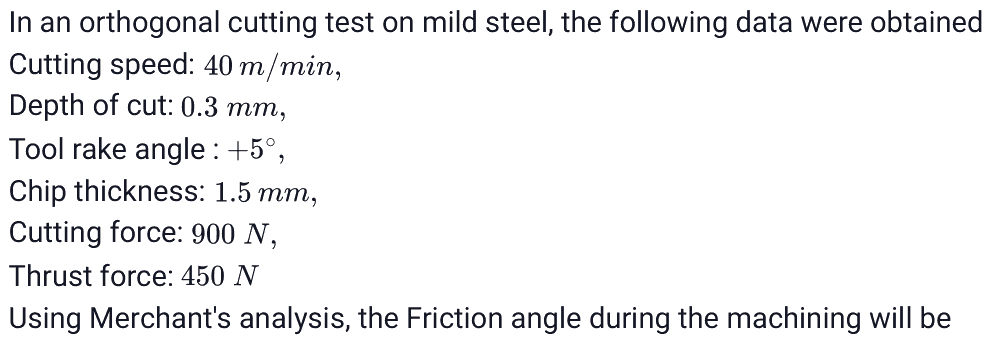
In an orthogonal cutting test on mild steel, the following data were obtained Cutting speed: Depth of cut: Tool rake angle : Chip thickness: Cutting force: Thrust force: Using Merchant's analysis, the Friction angle during the machining will be
Answer: B
GATE ME 2004, Question 78 (5 marks, MCQ)
Production Engineering - Metal Cutting
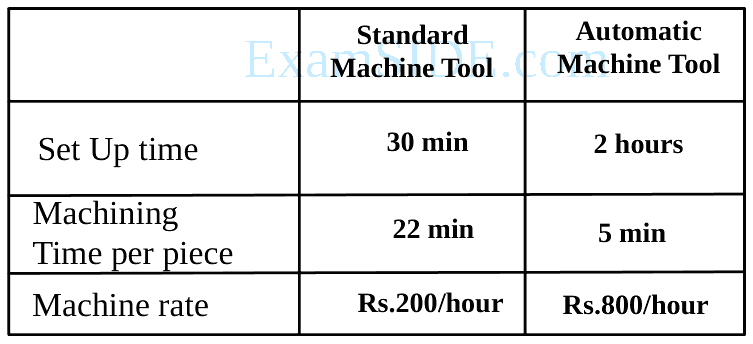
A standard machine tool and an automatic machine tool are being compared for the production of a component. Following data refers to the two machines. The breakeven production batch size above which the automatic machine tool will be economical to use, will be
Answer: D
GATE ME 2003, Question 11 (1 mark, MCQ)
Production Engineering - Metal Cutting
Formation on build-up edge during machining can be avoided by using
- tool with low positive rake angle
- high feed rate
- high cutting speed
- large depth of cut
Answer: C
GATE ME 2003, Question 67 (2 marks, MCQ)
Production Engineering - Metal Cutting
A batch of cutting tools could produce components while working at with a tool feed of and depth of cut of A similar batch of tools of the same specification could produce components while working at with a feed of and depth of cut. How many components can be produced with one cutting tool at ?

Answer: A
GATE ME 2003, Question 79 (5 marks, MCQ)
Production Engineering - Metal Cutting
A cylinder is turned on a lathe with orthogonal machining principle. Spindle rotates at . The axial feed rate is per revolution. Depth of cut is The rake angle is In the analysis it is found that the shear angle is The thickness of the produced chip is

GATE ME 2003, Question 80 (5 marks, MCQ)
Production Engineering - Metal Cutting
A cylinder is turned on a lathe with orthogonal machining principle. Spindle rotates at . The axial feed rate is per revolution. Depth of cut is The rake angle is In the analysis it is found that the shear angle is In the above problem, the coefficient of friction at the chip tool interface obtained using Earnest and Merchant theory is

Answer: D
GATE ME 2002, Question 12 (1 mark, MCQ)
Production Engineering - Metal Cutting
is formed while machining

- Ductile materials at high speed
- Ductile materials at low speed
- Brittle materials at high speed
- Brittle materials at low speed
Answer: B
GATE ME 2002, Question 81 (5 marks, TEXT)
Production Engineering - Metal Cutting
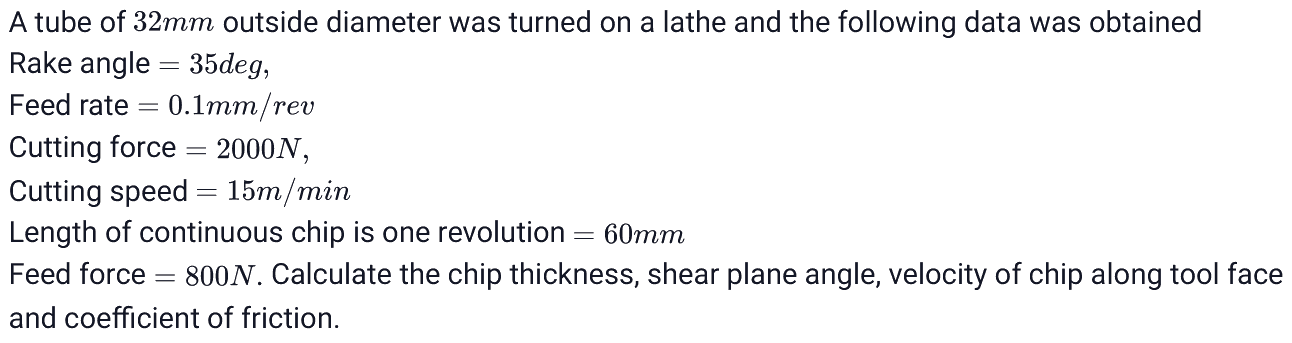
A tube of outside diameter was turned on a lathe and the following data was obtained Rake angle Feed rate Cutting force Cutting speed Length of continuous chip is one revolution Feed force Calculate the chip thickness, shear plane angle, velocity of chip along tool face and coefficient of friction.
GATE ME 2001, Question 68 (2 marks, MCQ)
Production Engineering - Metal Cutting
During orthogonal cutting of mild steel with a degrees rake angle tool the chip thickness ratio was obtained as The shear angle (in degrees) evaluated from this data is

Answer: C
GATE ME 2001, Question 69 (2 marks, MCQ)
Production Engineering - Metal Cutting
For turning alloy steel at cutting speeds of and the respective tool lives are and The tool life for a cutting speed of is

- min
- min
- min
- min
Answer: C
GATE ME 2001, Question 82 (5 marks, MCQ)
Production Engineering - Metal Cutting
Tool life testing on a lathe under dry cutting conditions gave and of Taylor tool life equation as and respectively. When a coolant was used, increased by . The increased tool life with the use of coolant at a cutting speed of is

Answer: A
GATE ME 2001, Question 83 (5 marks, TEXT)
Production Engineering - Metal Cutting
Identical straight turning operation was carried out using two tools : and . For same feed the tool which gives better surface finish is

GATE ME 2000, Question 13 (1 mark, MCQ)
Production Engineering - Metal Cutting
A built up edge is formed while machining
- ductile materials at high speed
- ductile materials at low speed
- brittle materials at high speed
- brittle materials at low speed
Answer: B
GATE ME 2000, Question 70 (2 marks, MCQ)
Production Engineering - Metal Cutting
A conventional lathe and a lathe are under consideration for machining a given part. The relevant data are shown below : The machine preferred for producing pieces is
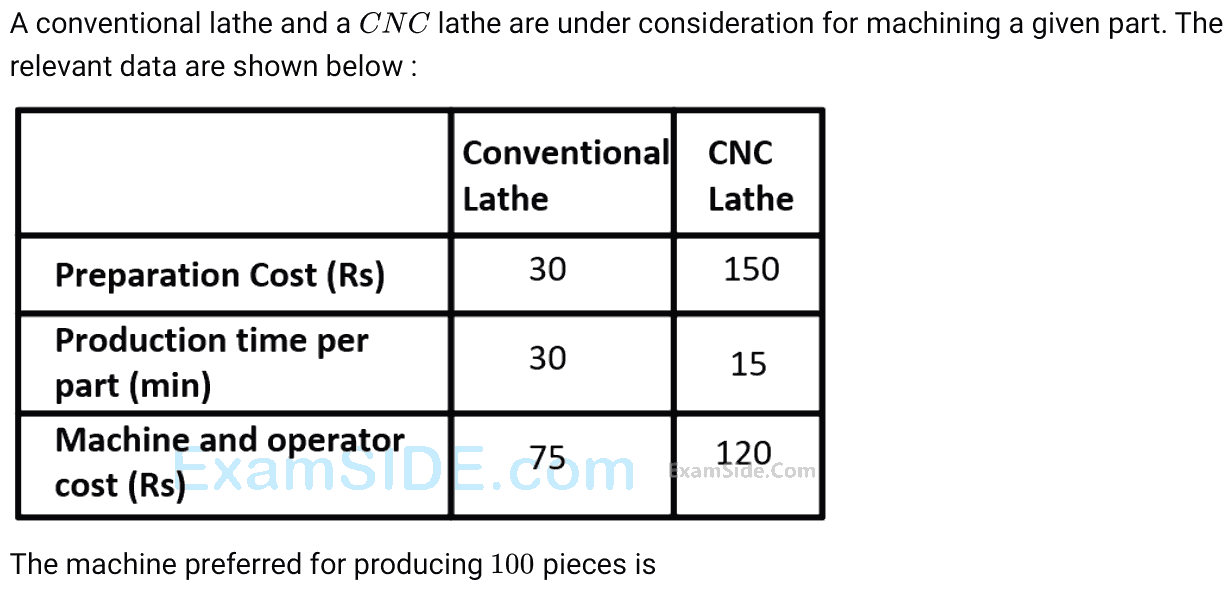
- Conventional lathe
- lathe
- Any of the above
- None
Answer: B
GATE ME 1999, Question 71 (2 marks, MCQ)
Production Engineering - Metal Cutting
What is the approximate change in the life, of the tool with zero rake angle used in orthogonal cutting when its clearance angle, is changed from to deg? (Hint: flank wear rate is proportional to )

- increase
- decrease
- increase
- decrease
Answer: B
GATE ME 1999, Question 84 (5 marks, TEXT)
Production Engineering - Metal Cutting
In an orthogonal cutting experiment with a tool of rake angle , the chip thickness was found to be when the uncut chip thickness was set to find the shear angle and find the friction angle assuming that Merchants's formula holds good.

GATE ME 1999, Question 85 (5 marks, TEXT)
Production Engineering - Metal Cutting
The lives of two tools & , governed by the equation and respectively in certain machining operation where is the cutting velocity in and is the tool life in sec. Find out the speed at which both the tools will have the same life. Also calculate the corresponding tool life. If you have to machine at a cutting speed of , then which one of these tools will you choose in order to have less frequent tool changes?

GATE ME 1998, Question 72 (2 marks, MCQ)
Production Engineering - Metal Cutting
In orthogonal machining operation, the chip thickness and the uncut chip thickness are equal to . If the tool rake angle is deg. The shear plane angle is

Answer: A
GATE ME 1997, Question 73 (2 marks, MCQ)
Production Engineering - Metal Cutting
In a typical metal cutting operation, using a cutting tool of positive rake it was observed that the shear angle was . The friction angle is

Answer: C
GATE ME 1997, Question 74 (2 marks, MCQ)
Production Engineering - Metal Cutting
A cutting tool has a nose radius of . The feed rate for a theoretical surface roughness of microns is

Answer: A
GATE ME 1997, Question 86 (5 marks, TEXT)
Production Engineering - Metal Cutting
In a turning trail using orthogonal tool geometry, a chip length of was obtained for an uncut chip length of The cutting conditions were rake angle cutting tool is Estimate shear plane angle, chip thickness and the shear plane angle for minimum chip strain.

Answer: Shear plane angle
GATE ME 1997, Question 87 (5 marks, TEXT)
Production Engineering - Metal Cutting
A Throwaway carbide insert was used to machine a steel work pieces with a cutting speed of tool life of minutes was observed, when the cutting speed was increased to the tool life decreased to minutes. The cutting speed for maximum productivity, if tool change time is minutes is

GATE ME 1996, Question 88 (5 marks, MCQ)
Production Engineering - Metal Cutting
Tool life of a hours is obtained when cutting with a single point tool at If Taylor's constant tool life on doubling the velocity will be

- hours
- unchanged
Answer: B
GATE ME 1995, Question 14 (1 mark, MCQ)
Production Engineering - Metal Cutting
Cutting power consumption in turning can be signification reduced by
- Increasing rake angle of the tool
- Increasing cutting angle of the tool
- widening the nose radius of the tool
- Increasing the clearance angle
Answer: A
GATE ME 1995, Question 89 (5 marks, TEXT)
Production Engineering - Metal Cutting
A single point turning tool is designated as The values of normal rake and normal clearance of the above mentioned tool .............

GATE ME 1995, Question 90 (5 marks, TEXT)
Production Engineering - Metal Cutting
If under a condition of plain turning the life of the cutting tool decreases by due to increase in the cutting velocity by , then what is the increase in tool life due to reduction in the cutting velocity by from its original value.

GATE ME 1995, Question 91 (5 marks, TEXT)
Production Engineering - Metal Cutting
While turning a steel of diameter at depth of cut and feed of by a tool of geometry the following observations were made. Tangential component of the cutting force axial component of the cutting force chip thickness Determine the dynamic shear strength of the work piece material.

GATE ME 1994, Question 92 (5 marks, TEXT)
Production Engineering - Metal Cutting
A single point cutting tool made of has the value of constant and in the basic tool life equation. If the tool cost per regrind is Rs and the vmachine hour rate is Rs. determine the most economical cutting speed (tool cost includes the cost of time spent on changing.

GATE ME 1994, Question 93 (5 marks, TEXT)
Production Engineering - Metal Cutting
A mild steel block of width is being milled using a straight slab cutter diameter with teeth. If the cutter rotates at and the depth of cut is determine the value of maximum uncut chip thickness when the table feed is

GATE ME 1992, Question 15 (1 mark, MCQ)
Production Engineering - Metal Cutting
The effect of rake angle on the mean friction angle in machining can be explained by
- Sliding model of friction
- Sticking and then sliding friction model
- Sticking friction model
- sliding and then sticking friction model
Answer: A
GATE ME 1992, Question 94 (5 marks, TEXT)
Production Engineering - Metal Cutting
In an orthogonal cutting operation on a work piece of width the uncut chip thickness was and the tool rake angle was (zero) degrees. It was observed that the chip thickness was The cutting force was measured to be and the thrust force was found to be Find the mean shear strength of the work piece material and if the coefficient of friction between the chip and the tool was what is the machining constant.

GATE ME 1991, Question 16 (1 mark, MCQ)
Production Engineering - Metal Cutting
Most of the metal cutting heat goes into the
- Moving chip
- cutting tool
- work material
- machine tool
Answer: A
GATE ME 1991, Question 95 (5 marks, TEXT)
Production Engineering - Metal Cutting
Determine the Merchants constant (shear angle relation) for aluminium from the following orthogonal machining data. Rake angle and an uncut chip thickness the values of and are found to be and respectively. The average chip thickness is also measured and found to be width of cut and cutting velocity

GATE ME 1991, Question 96 (5 marks, TEXT)
Production Engineering - Metal Cutting
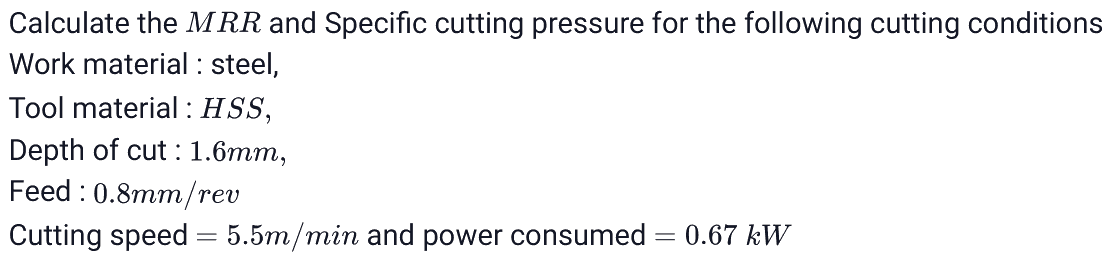
Calculate the and Specific cutting pressure for the following cutting conditions Work material : steel, Tool material : Depth of cut : Feed : Cutting speed and power consumed
GATE ME 1991, Question 97 (5 marks, TEXT)
Production Engineering - Metal Cutting
Find the percentage change in cutting speed required to give a reduction in tool life (that is required tool life is half of the original tool life ) when the value of the tool life exponent or .

GATE ME 1990, Question 17 (1 mark, MCQ)
Production Engineering - Metal Cutting
Most of the metal cutting heat goes into the
- Moving chip
- cutting tool
- Work material
- machine tool
Answer: A
GATE ME 1990, Question 98 (5 marks, TEXT)
Production Engineering - Metal Cutting
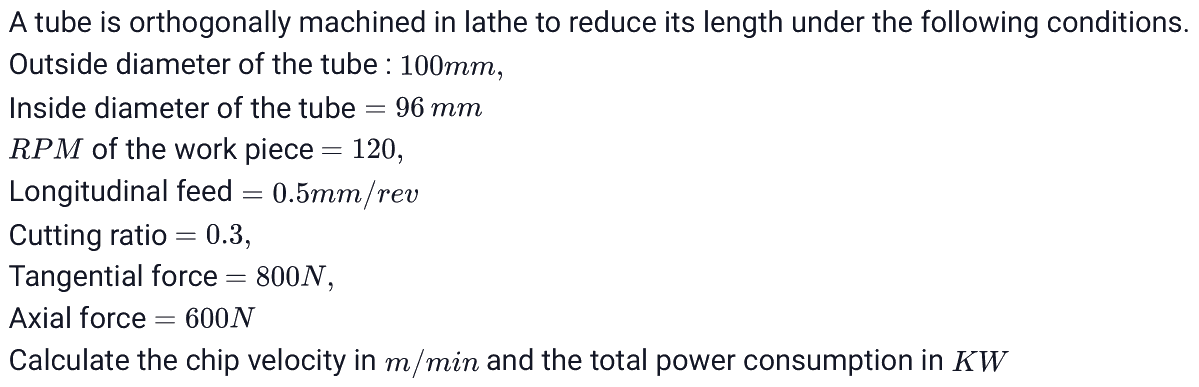
A tube is orthogonally machined in lathe to reduce its length under the following conditions. Outside diameter of the tube : Inside diameter of the tube of the work piece Longitudinal feed Cutting ratio Tangential force Axial force Calculate the chip velocity in and the total power consumption in
GATE ME 1989, Question 18 (1 mark, MCQ)
Production Engineering - Metal Cutting
The size of in metal cutting increases with

- very high speed
- large uncut chip thickness
- use of cutting fluid
- increase in positive rake angle
Answer: B
GATE ME 1989, Question 19 (1 mark, MCQ)
Production Engineering - Metal Cutting
Crater wear always starts at some distance from the tool tip because at that point
- cutting fluid does not penetrate
- chip tool interface temp is maximum
- normal stress on rake face is maximum
- tool strength is minimu8m
Answer: B
GATE ME 1989, Question 75 (2 marks, MCQ)
Production Engineering - Metal Cutting
In turning operation the feed rate could be doubled to increase the metal removal rate To keep the same level of surface finish, the nose radius of the tool has to be
- Doubled
- Halved
- Multiplied by time
- Kept unchanged.
Answer: C
GATE ME 1989, Question 99 (5 marks, TEXT)
Production Engineering - Metal Cutting
In an orthogonal cutting test on the following data were obtained Uncut chip thickness Cutting speed: Tool rake angle: Chip thickness Cutting force : , Thrust force : Calculate the shear angle, total power in making the cut and coefficient of friction between the chip tool interface.

GATE ME 1989, Question 100 (5 marks, TEXT)
Production Engineering - Metal Cutting
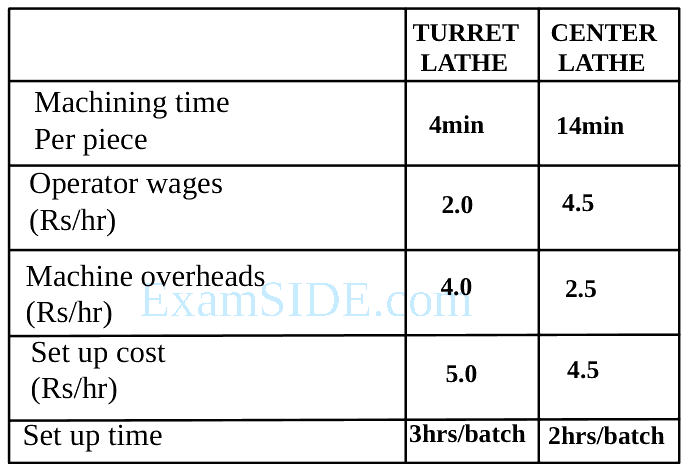
The following data is available for machining a component on a turret or center lathe: find out the total number of components to be machined to justify the use of turret lathe
GATE ME 1989, Question 101 (5 marks, TEXT)
Production Engineering - Metal Cutting
The cutting tool are being tried for an operation. Tailors tool life equation for them are as follows Find out the break even speed above which the carbide tool will be economical.

GATE ME 1988, Question 20 (1 mark, MCQ)
Production Engineering - Metal Cutting
The ideal cutting fluid for low speed machining of metals should be one which
- removes the heat faster from the cutting zone,
- forms a coating on the cutting tool by chemical reaction
- forms a low shear strength film of work material at the tool chip interface
- serves as a dielectric minimizing thereby reactions due to at the interface
Answer: A
GATE ME 1988, Question 76 (2 marks, MCQ)
Production Engineering - Metal Cutting
Pure metal pose machinability problem in turning operations. The reason is the
- Increased length of contact due to the production of continuous chip
- Susceptibility to chemical reactions
- Tendency to form intense adhesion joint with the tool face
- Absence of inclusions which aids chip formation
Answer: A
GATE ME 1987, Question 21 (1 mark, MCQ)
Production Engineering - Metal Cutting
Cutting tools are provided with large positive rake angle mainly for
- Increasing the strength of the cutting edge
- Avoiding rubbing action with the finished surfaces
- Reducing the magnitude of the cutting force
- Better heat dissipation
Answer: C
GATE ME 1987, Question 22 (1 mark, MCQ)
Production Engineering - Metal Cutting
If in a turning operation both the feed rate and the nose radius are doubled the surface finish values will be
- Decreases by
- Increases by
- Increases by
- Remain unaffected
Answer: C
GATE ME 1987, Question 102 (5 marks, TEXT)
Production Engineering - Metal Cutting
During orthogonal turning of a steel rod by zero rake tool at feed and depth of cut the following observations were obtained. Tangential component of cutting force , Axial component of cutting force chip thickness with the help of diagram determine the yield shear strength of work material under the given cutting conditions.

GATE ME 1987, Question 103 (5 marks, TEXT)
Production Engineering - Metal Cutting
In a turning operation the tool life of the carbide tool was found to be and at cutting speeds of and respectively. What will be the tool life of the tool under same condition but at a cutting speed of
