GATE ME Laminar Flow: Previous Year Questions
GATE ME (Mechanical Engineering) Laminar Flow previous year questions from Fluid Mechanics, with figures and the answer key.
Fluid Mechanics | All GATE ME papers
GATE ME 2021 Set 1, Question 32 (1 mark, NAT)
Fluid Mechanics - Laminar Flow
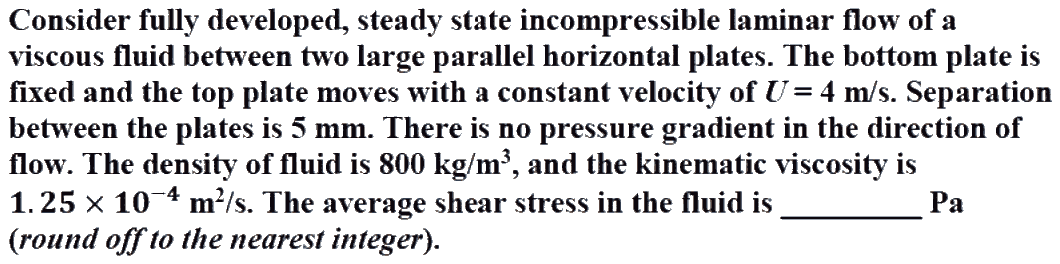
Q.22 Considerfullydeveloped,steadystateincompressiblelaminarflowofa viscousfluid betweentwo large parallel horizontal plates.The bottom plate is fixed and the top plate moves with a constant velocity of U= 4 m/s. Separation between the plates is 5 mm. There is no pressure gradient in the direction of flow.Thedensityoffluidis800kg/m²,andthekinematicviscosityis 1. 25 × 10-4 m2/s. The average shear stress in the fluid is Pa (roundoff tothenearest integer).
Answer: 79 to 81
GATE ME 2020 Set 1, Question 59 (2 marks, NAT)
Fluid Mechanics - Laminar Flow
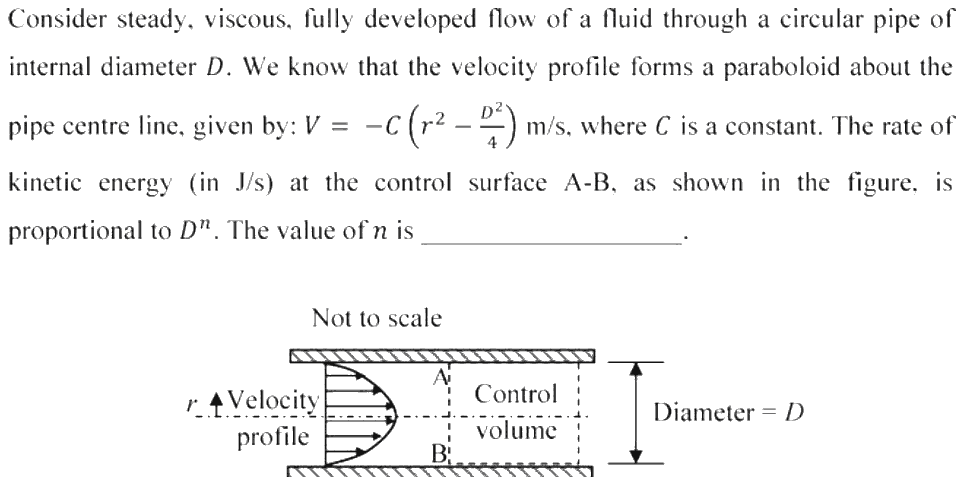
Q.No.49 9Considersteady,viscous,fullydevelopedflowof afluid througha circularpipe of internaldiameterD.Weknowthatthevelocityprofileformsaparaboloidabout the pipe centre line,given by: V =-C(r2-)m/s,where C is a constant.The rate of kinetic energy (in J/s)at the control surface A-B,as shown in the figure,is proportional toDn.Thevalueofnis Not toscale r..Velocity Control Diameter=D profile volume B
Answer: 8
GATE ME 2019 Set 1, Question 55 (2 marks, NAT)
Fluid Mechanics - Laminar Flow
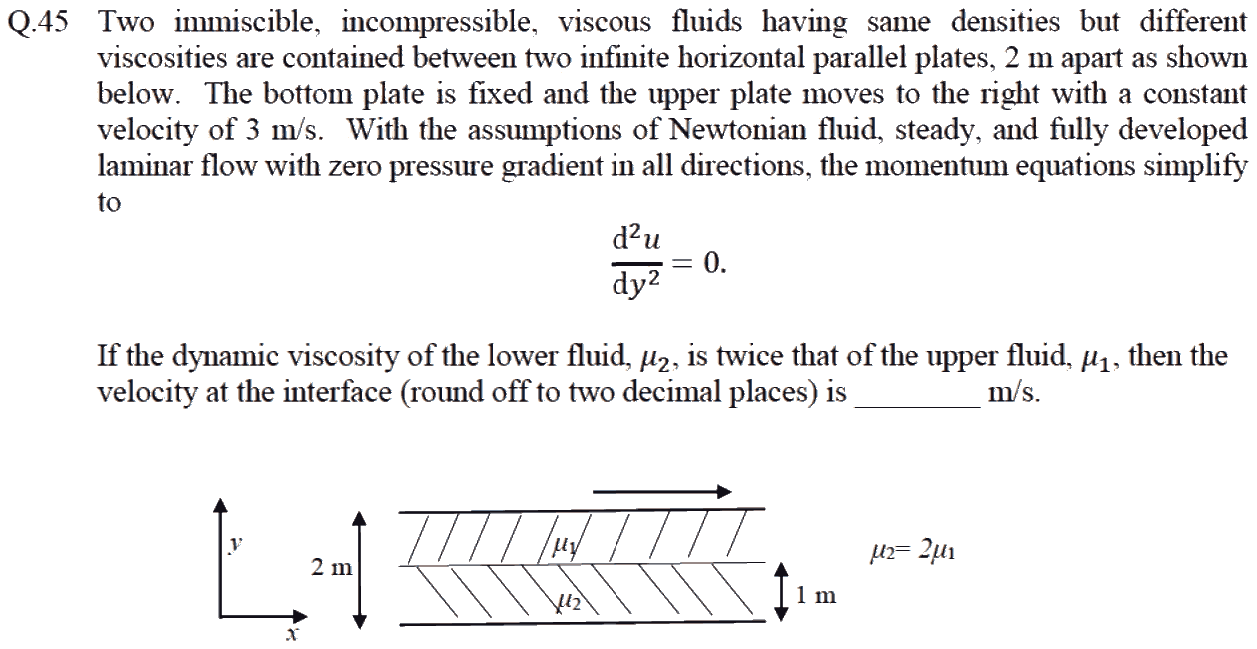
Q.45 viscosities are contained between two infinite horizontal parallel plates, 2 m apart as shown below.The bottom plate is fixed and the upper plate moves to the right with a constant velocity of 3 m/s. With the assumptions of Newtonian fluid, steady, and fully developed laminarflowwithzeropressuregradientinall directions,themomentumequationssimplify to d²u dy2 0 If the dynamic viscosity of the lower fluid, μ2, is twice that of the upper fluid, μ1, then the velocity at the interface (round off to two decimal places) is m/s. μ2= 2μ1 1 m
Answer: 0.98 to 1.02
GATE ME 2019 Set 2, Question 33 (1 mark, NAT)
Fluid Mechanics - Laminar Flow
Q.23 Water enters a circularpipe of length L=5.0m and diameterD=0.20 mwithReynolds numberRep=5oo.Thevelocityprofile at theinletofthepipe isuniform while itisparabolic at the exit.TheReynoldsnumber at the exit of thepipe is

Answer: 500
GATE ME 2019 Set 2, Question 53 (2 marks, NAT)
Fluid Mechanics - Laminar Flow
Q.43 different flow rates. The length of pipe A is 1.0 m and that of pipe B is 2.0 m. The flow in both the pipes is laminar and fully developed. If the frictional head loss across the length of the pipes is same, the ratio of volume flow rates Qs /QA is (round offto two decimal places).

Answer: 0.48 to 0.52
GATE ME 2018 Set 1, Question 32 (1 mark, NAT)
Fluid Mechanics - Laminar Flow
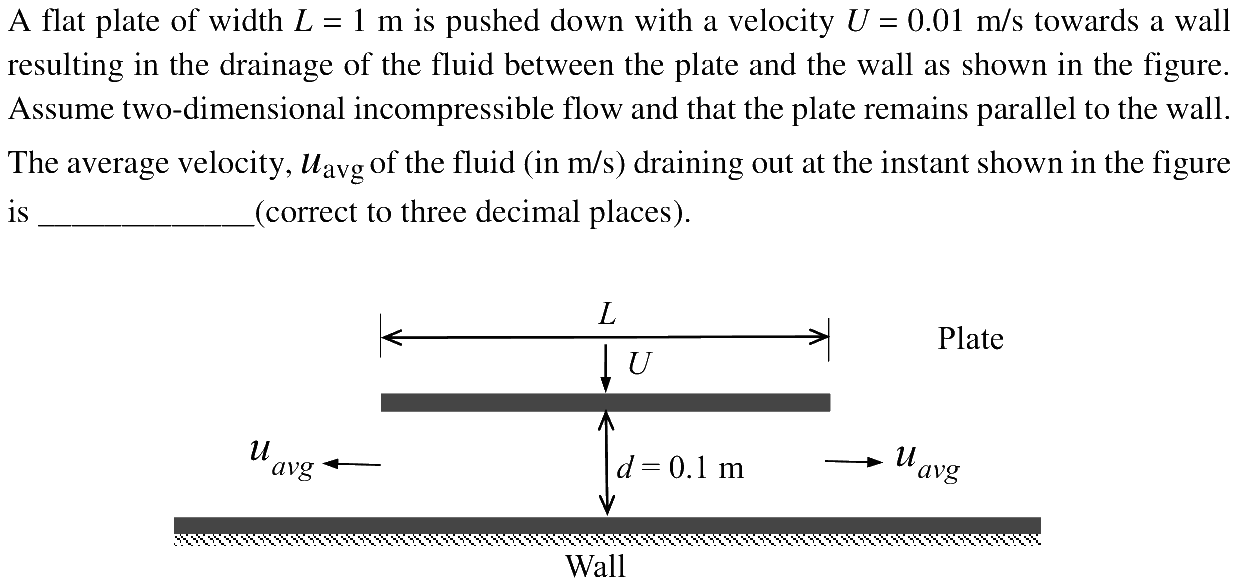
Q.22 A flat plate of width L = 1 m is pushed down with a velocity U = 0.01 m/s towards a wall resulting in the drainage of the fluid between the plate and the wall as shown in the figure. Assume two-dimensional incompressible flow and that the plate remains parallel to the wall. The average velocity, uavg of the fluid (in m/s) draining out at the instant shown in the figure is _____________(correct to three decimal places). L Plate U uavg uavg d = 0.1 m Wall
Answer: 0.045 to 0.055
GATE ME 2017 Set 1, Question 24 (1 mark, MCQ)
Fluid Mechanics - Laminar Flow
For steady flow of a viscous incompressible fluid through a circular pipe of constant diameter, the average velocity in the fully developed region is constant. Which one of the following statements about the average velocity in the developing region is TRUE?
- It increases until the flow is fully developed.
- It is constant and is equal to the average velocity in the fully developed region.
- It decreases until the flow is fully developed.
- It is constant but always lower than the average velocity in the fully developed region.
Answer: B
GATE ME 2017 Set 1, Question 25 (2 marks, MCQ)
Fluid Mechanics - Laminar Flow
Consider steady flow of an incompressible fluid through two long and straight pipes of diameters and arranged in series. Both pipes are of equal length and the flow is turbulent in both pipes. The friction factor for turbulent flow though pipes is of the form, where and are known positive constants and is the Reynolds number. Neglecting minor losses, the ratio of the frictional pressure drop in pipe to that in pipe is given by

Answer: A
GATE ME 2017 Set 2, Question 17 (1 mark, MCQ)
Fluid Mechanics - Laminar Flow
Consider a laminar flow at zero over a flat plate . The shear stress at the wall is denoted by The axial positions and on the plate are measured from the leading edge in the direction of flow. If then

Answer: C
GATE ME 2016 Set 3, Question 49 (2 marks, NAT)
Fluid Mechanics - Laminar Flow
Consider a fully developed steady laminar flow of an incompressible fluid with viscosity through a circular pipe of radius Given that the velocity at a radial location of from the center-line of the pipe is the shear stress at the wall is where is _________________.

Answer: 2.6 to 2.7
GATE ME 2015 Set 1, Question 16 (1 mark, MCQ)
Fluid Mechanics - Laminar Flow
Consider fully developed flow in a circular pipe with negligible entrance length effects. Assuming the mass flow rate, density and friction factor to be constant, if the length of the pipe is doubled and the diameter is halved, the head loss due to friction will increase by a factor of
Answer: D
GATE ME 2015 Set 2, Question 50 (2 marks, MCQ)
Fluid Mechanics - Laminar Flow
The head loss for a laminar incompressible flow through a horizontal circular pipe is . Pipe length and fluid remaining the same, if the average flow velocity doubles and the pipe diameter reduces to half its previous value, the head loss is The ratio is

Answer: C
GATE ME 2015 Set 2, Question 51 (2 marks, NAT)
Fluid Mechanics - Laminar Flow
For a fully developed laminar flow of water (dynamic viscosity -s) through a pipe of radius the axial pressure gradient is . The magnitude of axial velocity (in ) at a radial location of is ____________

Answer: 6.2 to 6.3
GATE ME 2015 Set 3, Question 19 (1 mark, MCQ)
Fluid Mechanics - Laminar Flow
Couette flow is characterized by
- Steady, incompressible, laminar flow through a straight circular pipe
- Fully developed turbulent flow through a straight circular pipe
- Steady, incompressible, laminar flow between two fixed parallel plates
- Steady, incompressible, laminar flow between one fixed plate and the other moving with a constant velocity
Answer: D
GATE ME 2015 Set 3, Question 32 (1 mark, MCQ)
Fluid Mechanics - Laminar Flow
Three parallel pipes connected at the two ends have flow-rates and respectively, and the corresponding frictional head losses are and respectively. The correct expressions for total flow rate and frictional head loss across the two ends are.

Answer: B
GATE ME 2014 Set 1, Question 53 (2 marks, NAT)
Fluid Mechanics - Laminar Flow
Water flows through a pipe having an inner radius of at the rate of at . The viscosity of water at is The Reynolds number of the flow is ____________________

Answer: 635 to 638
GATE ME 2014 Set 1, Question 54 (2 marks, NAT)
Fluid Mechanics - Laminar Flow
For a fully developed flow of water in a pipe having diameter velocity and kinematic viscosity the value of Darcy friction factor is ________________

Answer: 0.06 to 0.07
GATE ME 2014 Set 2, Question 53 (2 marks, NAT)
Fluid Mechanics - Laminar Flow
Water flows through a diameter and long smooth pipe at an average velocity of The density and the viscosity of water are and respectively. Assuming fully-developed flow, the pressure drop (in ) in the pipe is ______________

Answer: 6800 to 6900
GATE ME 2014 Set 2, Question 55 (2 marks, NAT)
Fluid Mechanics - Laminar Flow
Consider laminar flow of water over a flat plate of length If the boundary layer thickness at a distance of from the leading edge of the plate is the boundary layer thickness (in ), at a distance of is __________________

Answer: 13.5 to 14.2
GATE ME 2014 Set 3, Question 55 (2 marks, NAT)
Fluid Mechanics - Laminar Flow
A fluid of dynamic viscosity and density flows with an average velocity of through a long duct of rectangular cross-section. Assuming laminar flow, the pressure drop (in ) in the fully developed region per meter length of the duct is __________________.

Answer: 1.7 to 2
GATE ME 2010, Question 6 (1 mark, MCQ)
Fluid Mechanics - Laminar Flow
Maximum velocity of a one-dimensional incompressible fully developed viscous flow, between two fixed parallel plates, is Then mean velocity (in ) of the flow is

Answer: C
GATE ME 2009, Question 7 (1 mark, MCQ)
Fluid Mechanics - Laminar Flow
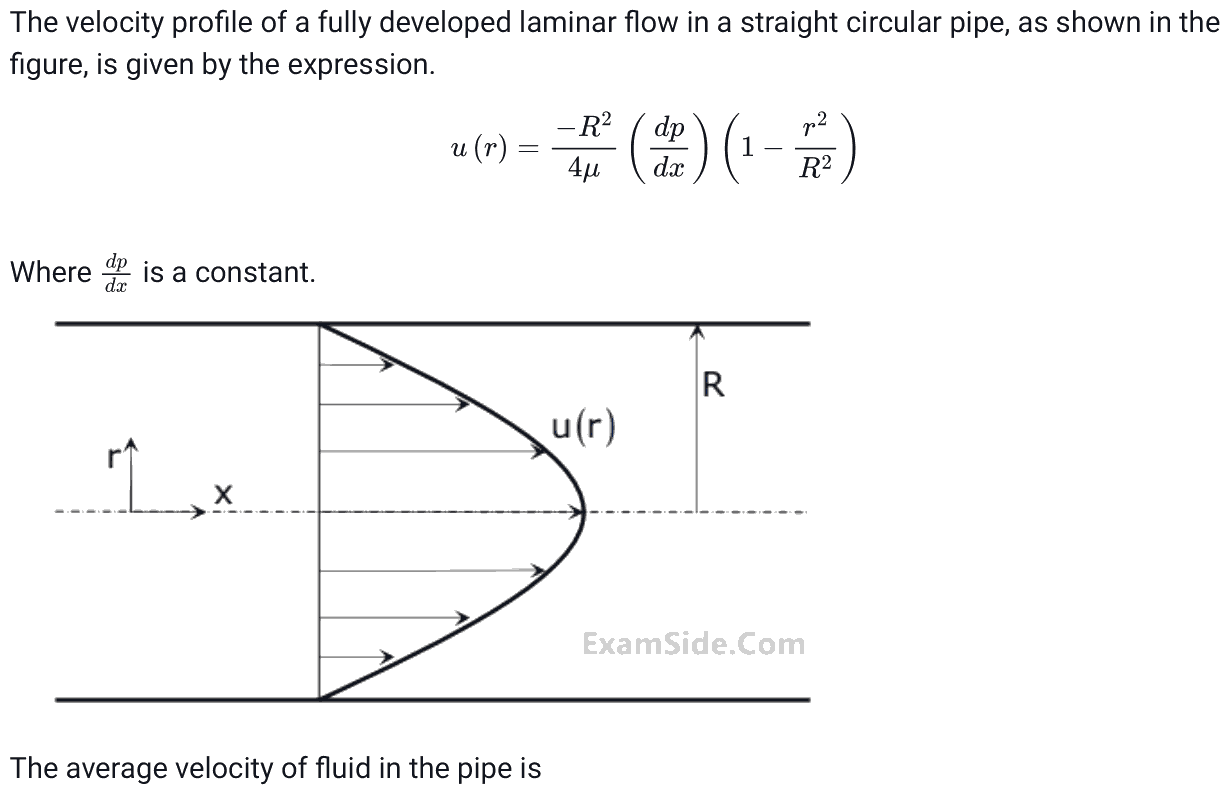
The velocity profile of a fully developed laminar flow in a straight circular pipe, as shown in the figure, is given by the expression. Where is a constant. The average velocity of fluid in the pipe is
Answer: A
GATE ME 2006, Question 19 (2 marks, MCQ)
Fluid Mechanics - Laminar Flow
The velocity profile in fully developed laminar flow in a pipe of diameter is given by where is the radial distance from the center. If the viscosity of the fluid is the pressure drop across a length of the pipe is

Answer: D
GATE ME 1996, Question 20 (2 marks, MCQ)
Fluid Mechanics - Laminar Flow
For laminar flow through a long pipe, the pressure drop per unit length increases.
- in linear proportion to the cross-sectional area
- in proportion to the diameter of the pipe
- in inverse proportion to the cross-sectional area
- in inverse proportion to the square of cross-sectional area
Answer: C
GATE ME 1995, Question 8 (1 mark, TEXT)
Fluid Mechanics - Laminar Flow
In fully developed laminar flow in the circular pipe, the head loss due to friction is directly proportional to ....... (Mean velocity/square of the mean velocity)
GATE ME 1994, Question 9 (1 mark, TEXT)
Fluid Mechanics - Laminar Flow
For a fully developed laminar flow through a pipe, the ratio of the maximum velocity to the average velocity is ___________ (fill in the blank)
Answer: Twice
GATE ME 1988, Question 21 (2 marks, MCQ)
Fluid Mechanics - Laminar Flow
The discharge in for laminar flow through a pipe of diameter having a centre line velocity of is:

Answer: D
GATE ME 1988, Question 22 (5 marks, TEXT)
Fluid Mechanics - Laminar Flow
A diameter pipe long transports oil at a flow rate of Calculate the power required to maintain the flow if the dynamic viscosity and density of oil are - and
