GATE ME Heat Exchangers: Previous Year Questions
GATE ME (Mechanical Engineering) Heat Exchangers previous year questions from Heat Transfer, with figures and the answer key.
Heat Transfer | All GATE ME papers
GATE ME 2026, Question 33 (2 marks, NAT)
Heat Transfer - Heat Exchangers
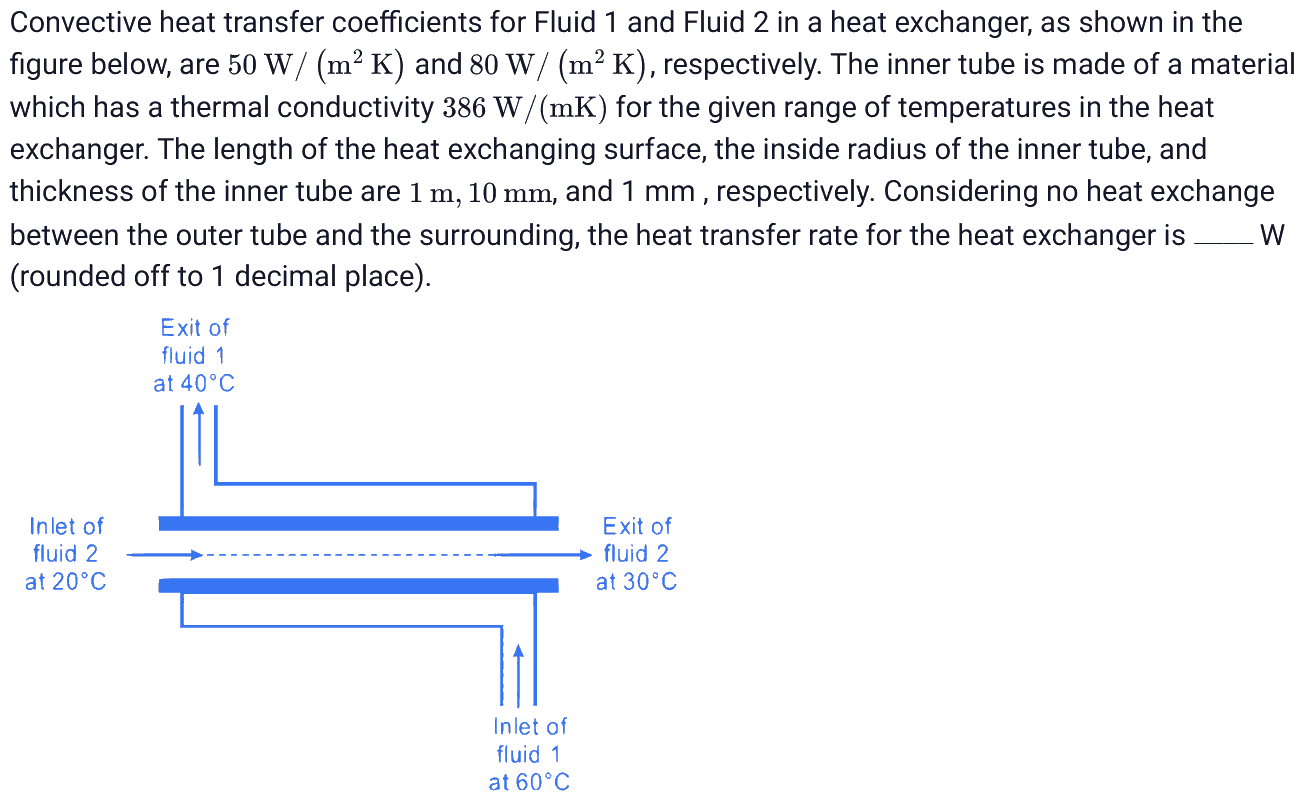
Convective heat transfer coefficients for Fluid 1 and Fluid 2 in a heat exchanger, as shown in the figure below, are and , respectively. The inner tube is made of a material which has a thermal conductivity for the given range of temperatures in the heat exchanger. The length of the heat exchanging surface, the inside radius of the inner tube, and thickness of the inner tube are , and 1 mm , respectively. Considering no heat exchange between the outer tube and the surrounding, the heat transfer rate for the heat exchanger is W (rounded off to 1 decimal place).
Answer: 49.5 to 51.5
GATE ME 2024, Question 49 (2 marks, NAT)
Heat Transfer - Heat Exchangers
A condenser is used as a heat exchanger in a large steam power plant in which steam is condensed to liquid water. The condenser is a shell and tube heat exchanger which consists of 1 shell and 20,000 tubes. Water flows through each of the tubes at a rate of 1 kg/s with an inlet temperature of 30 °C. The steam in the condenser shell condenses at the rate of 430 kg/s at a temperature of 50 °C. If the heat of vaporization is 2.326 MJ/kg and specific heat of water is 4 kJ/(kg.K), the effectiveness of the heat exchanger is _______ (rounded off to 3 decimal places).
Answer: 0.590 to 0.633
GATE ME 2023, Question 35 (1 mark, NAT)
Heat Transfer - Heat Exchangers
Consider a counter-flow heat exchanger with the inlet temperatures of two fluids (1 and 2) being T$_{1,}$ $_{in}$ = 300 K and T$_{2, in}$ = 350 K. The heat capacity rates of the two fluids are C$_{1}$ = 1000 W/K and C$_{2}$ = 400 W/K, and the effectiveness of the heat exchanger is 0.5. The actual heat transfer rate is _____ kW. (Answer in integer)
Answer: 9.999 to 10.001
GATE ME 2022 Set 1, Question 65 (2 marks, NAT)
Heat Transfer - Heat Exchangers
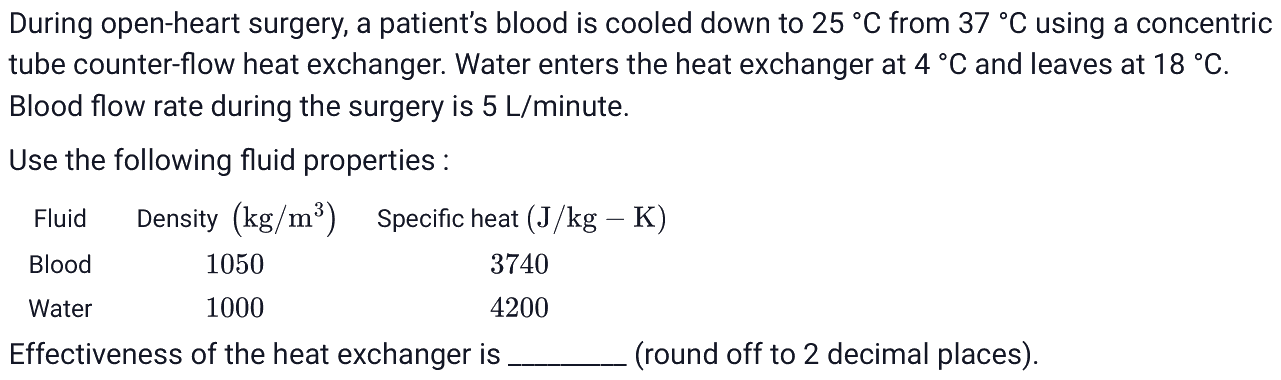
During open-heart surgery, a patient’s blood is cooled down to 25 °C from 37 °C using a concentric tube counter-flow heat exchanger. Water enters the heat exchanger at 4 °C and leaves at 18 °C. Blood flow rate during the surgery is 5 L/minute. Use the following fluid properties : $^{Fluid}$$^{Density}$$^{Specific heat}$ $^{Blood}$ $^{Water}$ Effectiveness of the heat exchanger is _________ (round off to 2 decimal places).
Answer: 0.40 to 0.44
GATE ME 2022 Set 2, Question 64 (2 marks, NAT)
Heat Transfer - Heat Exchangers
Saturated vapor at 200 °C condenses to saturated liquid at the rate of 150 kg/s on the shell side of a heat exchanger (enthalpy of condensation h$_{fg}$ = 2400 kJ/kg). A fluid with C$_{p}$ = 4 kJ-kg$^{-1}$K$^{-1}$. enters at 100 °C on the tube side. If the effectiveness of the heat exchanger is 0.9, then the mass flow rate of the fluid in the tube side is __________ kg/s (in integer).
Answer: 1000
GATE ME 2021 Set 2, Question 54 (2 marks, NAT)
Heat Transfer - Heat Exchangers
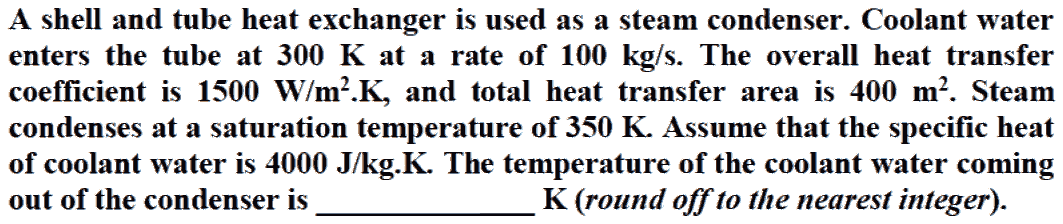
Q.44 A shell and tube heat exchanger is used as a steam condenser. Coolant water enters the tube at 300 K at a rate of 100 kg/s. The overall heat transfer coefficient is 1500 W/m².K, and total heat transfer area is 400 m?. Steam condenses at a saturation temperature of 350 K. Assume that the specific heat of coolant water is 40oo J/kg.K. The temperature of the coolant water coming out of the condenser is K (round off to the nearest integer).
Answer: 337 to 341
GATE ME 2020 Set 1, Question 35 (1 mark, NAT)
Heat Transfer - Heat Exchangers
In a concentric tube counter-flow heat exchange, hot oil enters at 102°C and leaves at 65°C. Cold water enters at 25°C and leaves at 42°C. The log mean temperature difference (LMTD) is ________ °C (Round off to one decimal place).
Answer: 48.8 to 49.8
GATE ME 2019 Set 2, Question 56 (2 marks, NAT)
Heat Transfer - Heat Exchangers
Q.46 = s Cc = 1200 W/K, respectively. If the outlet temperature ofthe cold fluid is 45 °C, the log mean temperature difference (LMTD) of the heat exchanger is K (round off to two decimal places).

Answer: 57 to 58
GATE ME 2018 Set 2, Question 64 (2 marks, NAT)
Heat Transfer - Heat Exchangers
Q.54 Steam in the condenser of a thermal power plant is to be condensed at a temperature of 30C with cooling water which enters the tubes of the condenser at 14C and exits at 22C. The total surface area of the tubes is 50 m2, and the overall heat transfer coefficient is 2000 W/m2 K. The heat transfer (in MW) to the condenser is ______ (correct to two decimal places).

Answer: 1.14 to 1.16
GATE ME 2017 Set 1, Question 29 (1 mark, NAT)
Heat Transfer - Heat Exchangers
Saturated steam at condenses on the outside of a tube. Cold fluid enters the tube at and exits at The value of the Log Mean Temperature Difference is _________

Answer: 63.5 to 64
GATE ME 2017 Set 2, Question 46 (2 marks, MCQ)
Heat Transfer - Heat Exchangers
In a counter-flow heat exchanger, water is heated at the rate of from to by an oil entering at and leaving at . The specific heats of water and oil are and respectively. The overall heat transfer coefficient is The required heat transfer surface are (in ) is

Answer: D
GATE ME 2016 Set 2, Question 52 (2 marks, NAT)
Heat Transfer - Heat Exchangers
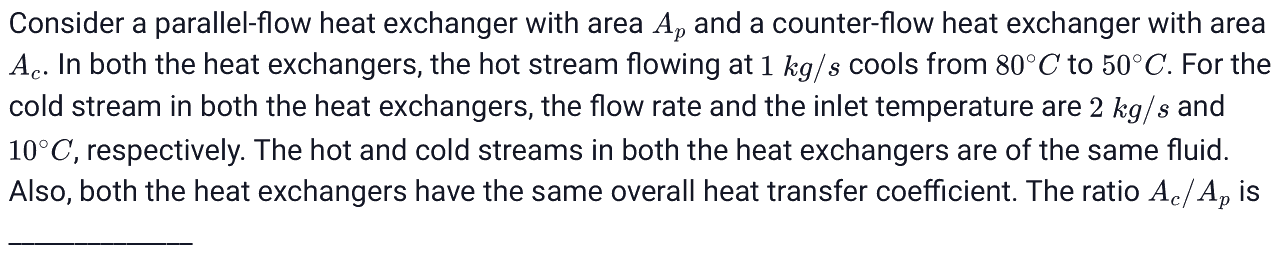
Consider a parallel-flow heat exchanger with area and a counter-flow heat exchanger with area In both the heat exchangers, the hot stream flowing at cools from to . For the cold stream in both the heat exchangers, the flow rate and the inlet temperature are and , respectively. The hot and cold streams in both the heat exchangers are of the same fluid. Also, both the heat exchangers have the same overall heat transfer coefficient. The ratio is ______________
Answer: 0.91 to 0.95
GATE ME 2016 Set 3, Question 28 (1 mark, MCQ)
Heat Transfer - Heat Exchangers
For a heat exchanger, is the maximum temperature difference and is the minimum temperature difference between the two fluids. is the log mean temperature difference. and are the minimum and the maximum heat capacity rates. The maximum possible heat transfer between the two fluids is

Answer: B
GATE ME 2015 Set 2, Question 52 (2 marks, MCQ)
Heat Transfer - Heat Exchangers
A balanced counter-flow heat exchanger has a surface area of and overall heat transfer coefficient of -. Air entering at and is to preheated by the air leaving the system at and The outlet temperature (in ) of the preheated air is

Answer: A
GATE ME 2015 Set 3, Question 22 (1 mark, MCQ)
Heat Transfer - Heat Exchangers
Saturated vapor is condensed to saturated liquid in a condenser. The heat capacity ratio is The effectiveness of the condenser is.

Answer: D
GATE ME 2014 Set 2, Question 26 (1 mark, MCQ)
Heat Transfer - Heat Exchangers
In a heat exchanger, it is observed that where is the temperature difference between the two single phase fluid streams at one end and is the temperature difference at the other end. This heat exchanger is

- a condenser
- an evaporator
- a counter flow heat exchanger
- a parallel flow heat exchanger
Answer: C
GATE ME 2014 Set 2, Question 58 (2 marks, NAT)
Heat Transfer - Heat Exchangers
In a concentric counter flow heat exchanger, water flows through the inner tube at and leaves at . The engine oil enters at and flows in the annular flow passage. The exit temperature of the engine oil is Mass flow rate of water and the engine oil are and respectively. The specific heat of water and oil are and respectively. The effectiveness of this heat exchanger is _________.

Answer: 0.65 to 0.67
GATE ME 2014 Set 3, Question 58 (2 marks, NAT)
Heat Transfer - Heat Exchangers
A double-pipe counter-flow heat exchanger transfers heat between two water streams. Tube side water at liter/s is heated from to . Shell side water at liter/s is entering at . Assume constant properties of water; density is and specific heat is The (in ) is ____________.

Answer: 10.8 to 11.2
GATE ME 2013, Question 50 (2 marks, MCQ)
Heat Transfer - Heat Exchangers
Water (specific heat, ) enters a pipe at a rate of and temperature of The pipe, of diameter and length is subjected to a wall heat flux in If where is and in the direction of flow ( at the inlet), the bulk mean temperature of the water leaving the pipe in is

Answer: B
GATE ME 2013, Question 51 (2 marks, MCQ)
Heat Transfer - Heat Exchangers
Water (specific heat, ) enters a pipe at a rate of and temperature of The pipe, of diameter and length is subjected to a wall heat flux in If and the convection heat transfer coefficient at the pipe outlet is the temperature in at the inner surface of the pipe at the outlet is

Answer: D
GATE ME 2012, Question 21 (2 marks, MCQ)
Heat Transfer - Heat Exchangers
Water at enters a counter flow heat exchanger with a mass flow rate of Air enters at with a mass flow rate If the effectiveness of the heat exchanger is the (in ) is

Answer: C
GATE ME 2011, Question 6 (1 mark, MCQ)
Heat Transfer - Heat Exchangers
In a condenser of a power plant, the steam condenses at a temperature of The cooling water enters at and leaves at The logarithmic mean temperature difference of the condenser is

Answer: B
GATE ME 2009, Question 22 (2 marks, MCQ)
Heat Transfer - Heat Exchangers
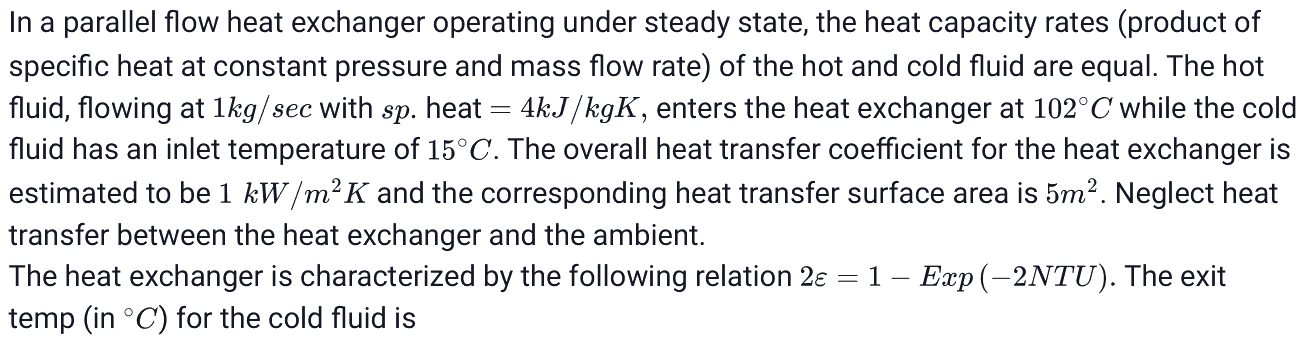
In a parallel flow heat exchanger operating under steady state, the heat capacity rates (product of specific heat at constant pressure and mass flow rate) of the hot and cold fluid are equal. The hot fluid, flowing at with heat enters the heat exchanger at while the cold fluid has an inlet temperature of . The overall heat transfer coefficient for the heat exchanger is estimated to be and the corresponding heat transfer surface area is . Neglect heat transfer between the heat exchanger and the ambient. The heat exchanger is characterized by the following relation The exit temp (in ) for the cold fluid is
Answer: B
GATE ME 2008, Question 23 (2 marks, MCQ)
Heat Transfer - Heat Exchangers
The of a counter flow heat exchanger is . The cold fluid enters at and the hot fluid enters at . Mass flow rate of the cold fluid is twice that of the hot fluid. specific heat at constant pressure of the fluid is twice that of the cold fluid. The exit temperature of the cold fluid is

- can not be determined
Answer: C
GATE ME 2007, Question 24 (2 marks, MCQ)
Heat Transfer - Heat Exchangers
In a counter flow heat exchanger, hot fluid enters at and cold fluid leaves at mass flow rate of the hot fluid is and that of cold fluid is . Specific heat of the hot fluid is and that of cold fluid is The for the heat ecchanger is

Answer: C
GATE ME 2005, Question 25 (2 marks, MCQ)
Heat Transfer - Heat Exchangers
Hot oil is cooled from to in an oil cooler which uses air as the coolant. The air temperature rises from to . the designer uses a value of . the type of heat exchanger is

- parallel flow
- double pipe
- counter flow
- cross flow
Answer: D
GATE ME 2004, Question 26 (2 marks, MCQ)
Heat Transfer - Heat Exchangers
In a condenser, water enters at and flows at the rate The condensing steam is at a temperature of and cooling water leaves the condenser at . Specific heat of water is If the overall heat transfer coefficient is the heat transfer area is

Answer: A
GATE ME 2003, Question 27 (2 marks, MCQ)
Heat Transfer - Heat Exchangers
In a counter flow heat exchanger, for the hot fluid the heat capacity mass flow rate inlet temperature , outlet temperature . For the cold fluid, heat capacity mass flow rate inlet temperature=. Neglecting heat transfer to the surroundings, the outlet temperature of the cold fluid in is

Answer: B
GATE ME 2002, Question 7 (1 mark, MCQ)
Heat Transfer - Heat Exchangers
For the same inlet and outlet temperatures of hot and cold fluids, the Log mean temperature Difference is

- greater for parallel flow heat exchanger than for counter flow heat exchanger.
- greater for counter flow heat exchanger than for parallel flow heat exchanger.
- same for both parallel and counter flow heat exchangers.
- dependent on the properties of the fluids.
Answer: B
GATE ME 2000, Question 28 (2 marks, MCQ)
Heat Transfer - Heat Exchangers
Air enters a counter-flow heat exchanger at and leaves at . Water enters at and leaves at . The in deg is

Answer: B
GATE ME 1999, Question 30 (5 marks, TEXT)
Heat Transfer - Heat Exchangers
Two fluids, and exchange heat in a counter-current heat exchanger. Fluid enters at and has a mass flow rate of Fluid enters at and also has a mass flow rate of Effectiveness of heat exchanger is . Determine the heat transfer rate and exit temperature of fluid (Specific heat of fluid is and that of fluid is ).

GATE ME 1998, Question 31 (5 marks, TEXT)
Heat Transfer - Heat Exchangers
A hot fluid at enters a heat exchanger at a mass flow rate of Its specific heat is - It is to be cooled by another fluid entering at with a mass flow rate and specific heat -. The overall heat transfer coefficient based on outside area of is Find the exit temperature of the hot fluid when the fluids are in parallel flow.

GATE ME 1998, Question 32 (5 marks, TEXT)
Heat Transfer - Heat Exchangers
Hot water flows with a velocity of in a long, diameter pipe. Heat lost from the pipe outer wall is uniform and equal to . If the inlet water temperature is calculate the water temp at the exit. Neglect effect of pipe wall thickness. (water) - and density of water

GATE ME 1997, Question 29 (2 marks, MCQ)
Heat Transfer - Heat Exchangers
In certain both the fluids have identical mass flow rate-specific heat product. The hot fluid enters at and leaves at and the cold fluid entering at leaves at . The effectiveness of the heat exchanger is

Answer: B
GATE ME 1997, Question 33 (5 marks, TEXT)
Heat Transfer - Heat Exchangers
In a certain double pipe heat exchanger hot water flows at a rate of and gets cooled from to . At the same time of cooling water at enters the heat exchanger. The flow conditions are such that the overall heat transfer coefficient remains constant at . Calculate the heat transfer area required, assuming the two streams are in parallel flow, and for both the streams

GATE ME 1995, Question 34 (5 marks, TEXT)
Heat Transfer - Heat Exchangers
A counter flow heat exchanger is to heat air entering at with a flow rate of by the exhaust gas entering at with a flow rate of . The overall heat transfer coefficient is and the outlet temperature of the air is Specific heat at constant pressure for both air and the exhaust gas can be taken as Calculate the heat transfer area needed and the number of transfer units.

GATE ME 1994, Question 8 (1 mark, MCQ)
Heat Transfer - Heat Exchangers
The practice to use steam on the shell side and cooling water on the tube side in condensers of steam power plant is because
- to increase overall heat transfer coefficient water side velocity can be increased if water is on the tube side
- condenser can act as a storage unit for condensed steam
- rate of condensation of steam is invariably smaller than the mass flow rate of cooling water
- it is easier to maintain vacuum on the shell side than on the tube side
Answer: D
GATE ME 1994, Question 35 (5 marks, TEXT)
Heat Transfer - Heat Exchangers
Two streams of fluid of unit constant specific heats and unit mass flow rate exchange thermal energy in an adiabatic heat exchanger. The inlet temps of hot and cold streams are and respectively. Calculate the and effectiveness of the heat exchanger if the hot fluid is cooled to zero entropy condition.

GATE ME 1991, Question 9 (1 mark, MCQ)
Heat Transfer - Heat Exchangers
In shell and tube heat exchanger, baffles are mainly used to
- Increase the mixing of fluid
- Increase the heat transfer area
- deflect the flow in desired direction
- Reduce fouling of the tube surface .
Answer: A
GATE ME 1991, Question 36 (5 marks, TEXT)
Heat Transfer - Heat Exchangers
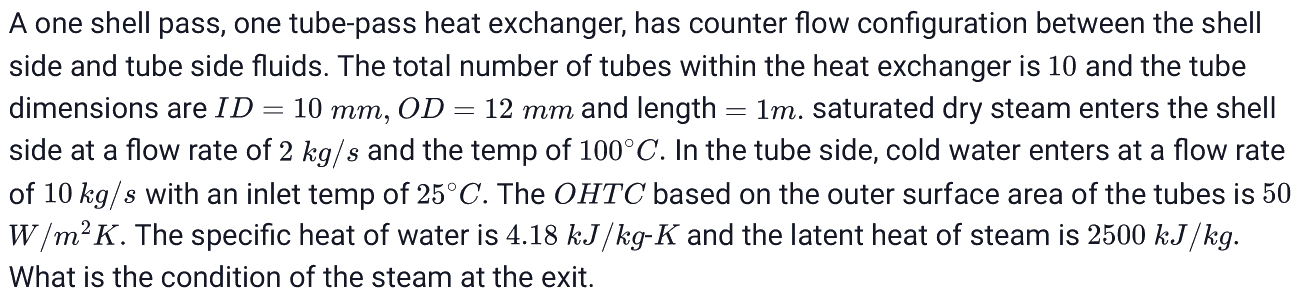
A one shell pass, one tube-pass heat exchanger, has counter flow configuration between the shell side and tube side fluids. The total number of tubes within the heat exchanger is and the tube dimensions are and length saturated dry steam enters the shell side at a flow rate of and the temp of In the tube side, cold water enters at a flow rate of with an inlet temp of The based on the outer surface area of the tubes is The specific heat of water is - and the latent heat of steam is What is the condition of the steam at the exit.
Answer: Little amount of steam condenced
GATE ME 1990, Question 37 (5 marks, TEXT)
Heat Transfer - Heat Exchangers
A double pipe counter flow heat exchanger is to be designed to cool of an oil of specific heat from to by water entering the heat exchanger at and leaving at . If the of heat exchanger is Calculate the and the surface area of the heat exchanger

GATE ME 1988, Question 38 (5 marks, TEXT)
Heat Transfer - Heat Exchangers
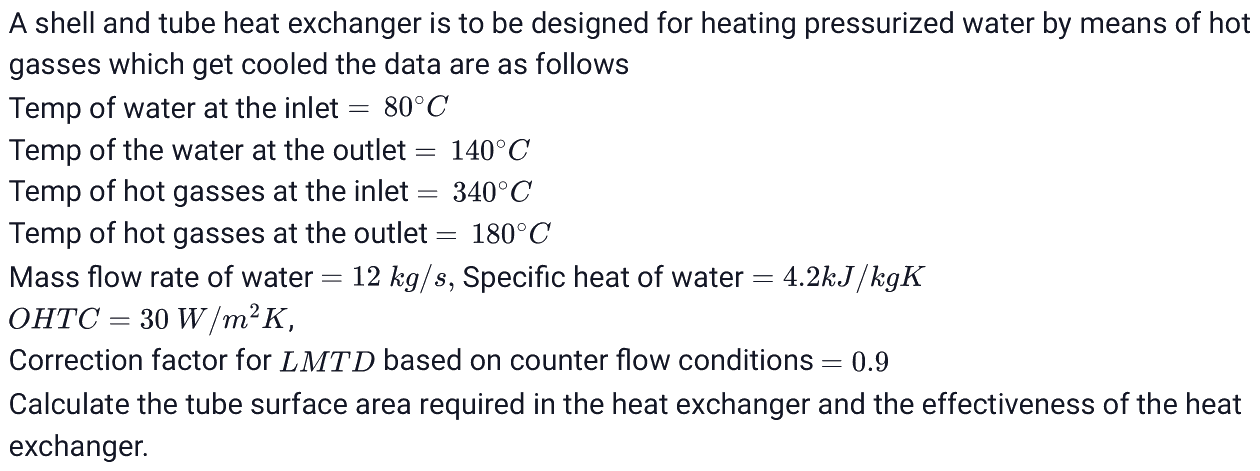
A shell and tube heat exchanger is to be designed for heating pressurized water by means of hot gasses which get cooled the data are as follows Temp of water at the inlet Temp of the water at the outlet Temp of hot gasses at the inlet Temp of hot gasses at the outlet Mass flow rate of water Specific heat of water , Correction factor for based on counter flow conditions Calculate the tube surface area required in the heat exchanger and the effectiveness of the heat exchanger.