GATE ME First Law of Thermodynamics: Previous Year Questions
GATE ME (Mechanical Engineering) First Law of Thermodynamics previous year questions from Thermodynamics, with figures and the answer key.
Thermodynamics | All GATE ME papers
GATE ME 2023, Question 41 (2 marks, MCQ)
Thermodynamics - First Law of Thermodynamics
Which one of the following statements is FALSE?
- For an ideal gas, the enthalpy is independent of pressure.
- For a real gas going through an adiabatic reversible process, the process equation is given by PV$^{γ}$ = constant, where P is the pressure, V is the volume and γ is the ratio of the specific heats of the gas at constant pressure and constant volume.
- For an ideal gas undergoing a reversible polytropic process PV$^{1.5}$ = constant, the equation connecting the pressure, volume and temperature of the gas at any point along the process is , where R is the gas constant and m is the mass of the gas.
- Any real gas behaves as an ideal gas at sufficiently low pressure or sufficiently high temperature.
Answer: B
GATE ME 2023, Question 42 (2 marks, MCQ)
Thermodynamics - First Law of Thermodynamics
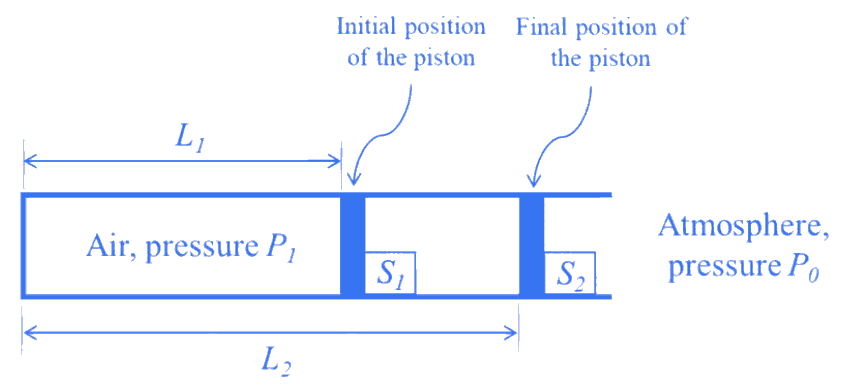
Consider a fully adiabatic piston-cylinder arrangement as shown in the figure. The piston is massless and cross-sectional area of the cylinder is A. The fluid inside the cylinder is air (considered as a perfect gas), with γ being the ratio of the specific heat at constant pressure to the specific heat at constant volume for air. The piston is initially located at a position L1. The initial pressure of the air inside the cylinder is P$_{1}$≫P$_{0}$, where P$_{0}$ is the atmospheric pressure. The stop S$_{1}$ is instantaneously removed and the piston moves to the position L$_{2}$, where the equilibrium pressure of air inside the cylinder is P$_{2}$≫P$_{0}$. What is the work done by the piston on the atmosphere during this process?
- 0
- P$_{0}$A(L$_{2}$ - L$_{1}$)
Answer: B
GATE ME 2022 Set 1, Question 62 (2 marks, NAT)
Thermodynamics - First Law of Thermodynamics
An engine running on an air standard Otto cycle has a displacement volume 250 cm$^{3}$ and a clearance volume 35.7 cm$^{3}$. The pressure and temperature at the beginning of the compression process are 100 kPa and 300 K, respectively. Heat transfer during constant-volume heat addition process is 800 kJ/kg. The specific heat at constant volume is 0.718 kJ/kg.K and the ratio of specific heats at constant pressure and constant volume is 1.4. Assume the specific heats to remain constant during the cycle. The maximum pressure in the cycle is ______ kPa (round off to the nearest integer).
Answer: 4780 to 4825
GATE ME 2022 Set 2, Question 34 (1 mark, NAT)
Thermodynamics - First Law of Thermodynamics
Consider 1 kg of an ideal gas at 1 bar and 300 K contained in a rigid and perfectly insulated container. The specific heat of the gas at constant volume c$_{v}$ is equal to 750 J-kg$^{-1}$K$^{-1}$. A stirrer performs 225 kJ of work on the gas. Assume that the container does not participate in the thermodynamic interaction. The final pressure of the gas will be ______ bar (in integer).
Answer: 2
GATE ME 2022 Set 2, Question 60 (2 marks, NAT)
Thermodynamics - First Law of Thermodynamics
A rigid tank of volume of 8 m$^{3}$ is being filled up with air from a pipeline connected through a valve. Initially the valve is closed and the tank is assumed to be completely evacuated. The air pressure and temperature inside the pipeline are maintained at 600 kPa and 306 K, respectively. The filling of the tank begins by opening the valve and the process ends when the tank pressure is equal to the pipeline pressure. During the filling process, heat loss to the surrounding is 1000 kJ. The specific heats of air at constant pressure and at constant volume are 1.005 kJ/kg.K and 0.718 kJ/kg.K, respectively. Neglect changes in kinetic energy and potential energy. The final temperature of the tank after the completion of the filling process is ________ K (round off to the nearest integer).
Answer: 385 to 405
GATE ME 2021 Set 1, Question 33 (1 mark, NAT)
Thermodynamics - First Law of Thermodynamics
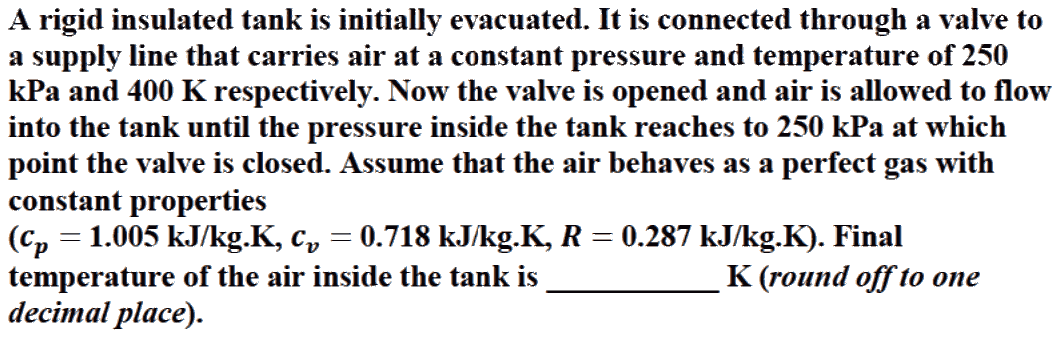
Q.23 Arigidinsulatedtankisinitiallyevacuated.Itisconnectedthroughavalveto asupplylinethatcarries airataconstantpressure and temperatureof250 kPa and 400 K respectively. Now the valve is opened and air is allowed to flow into the tank until the pressure inside the tank reaches to 250 kPa at which point the valve is closed. Assume that the air behaves as a perfect gas with constant properties (Cp = 1.005 kJ/kg.K, C, = 0.718 kJ/kg.K, R = 0.287 kJ/kg.K). Final temperature of the air inside the tank is K (round off to one decimal place).
Answer: 555 to 565
GATE ME 2021 Set 1, Question 59 (2 marks, NAT)
Thermodynamics - First Law of Thermodynamics
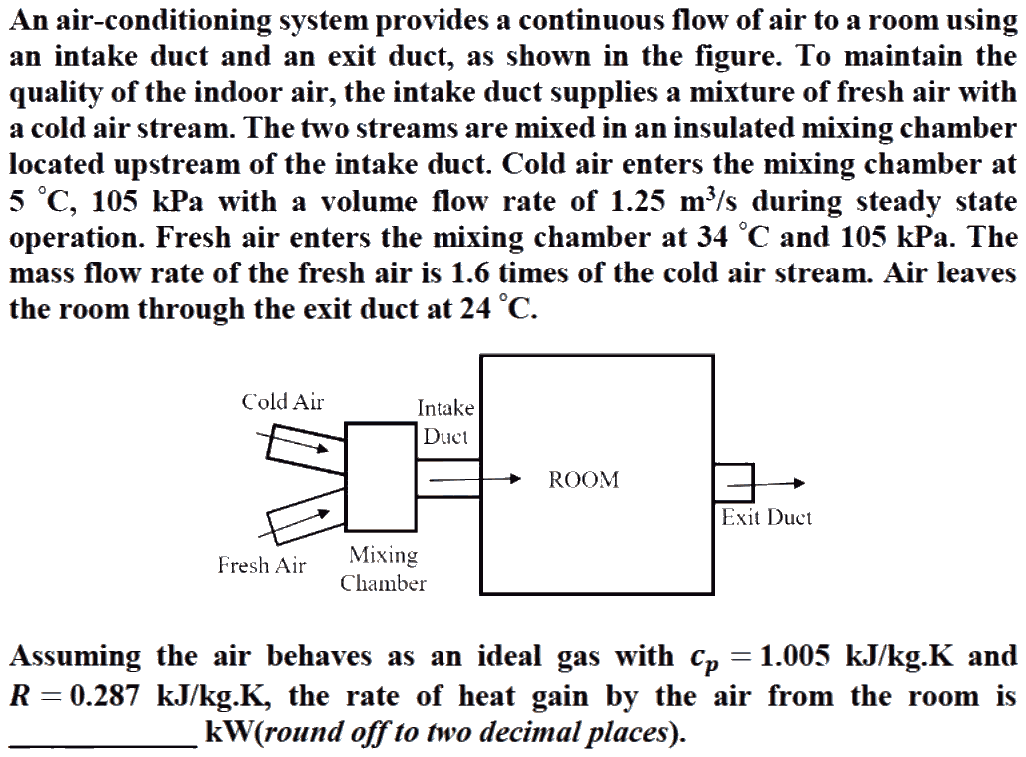
Q.49 An air-conditioningsystemprovides a continuousflow of airto aroom using an intake duct and an exit duct, as shown in the figure. To maintain the quality of the indoor air, the intake duct supplies a mixture of fresh air with acoldairstream.Thetwostreamsaremixedinaninsulatedmixingchamber locatedupstreamof theintakeduct.Cold airentersthemixingchamberat 5 °C, 105 kPa with a volume flow rate of 1.25 m²/s during steady state operation. Fresh air enters the mixing chamber at 34 °C and 105 kPa. The mass flow rate of the fresh air is 1.6 times of the cold air stream. Air leaves the room through the exit duct at 24 °C. Cold Air Intake Duct ROOM ExitDuct Mixing Fresh Air Chamber Assuming the air behaves as an ideal gas with cp = 1.005 kJ/kg.K and R = 0.287 kJ/kg.K, the rate of heat gain by the air from the room is kW(round off to two decimal places).
Answer: 4.9 to 5.1
GATE ME 2021 Set 2, Question 30 (1 mark, NAT)
Thermodynamics - First Law of Thermodynamics
Q.20 Consider adiabatic flow of air through a duct. At a given point in the duct, velocity of air is300m/s,temperature is 330K andpressure is 180kPa. Assume that the air behaves as a perfect gas with constant Cp, =1.005 kJ/kg.K. The stagnation temperature at this point is K (round off to two decimal places).

Answer: 373 to 377
GATE ME 2021 Set 2, Question 33 (1 mark, NAT)
Thermodynamics - First Law of Thermodynamics
Q.23 An object is moving with a Mach number of 0.6 in an ideal gas environment, which is at a temperature of 350 K. The gas constant is 320 J/kg.K and ratio of specific heats is 1.3. The speed of object is m/s (round off to the nearest integer).

Answer: 228 to 230
GATE ME 2021 Set 2, Question 60 (2 marks, NAT)
Thermodynamics - First Law of Thermodynamics
Q.50 An adiabaticvortex tube,shown in the figure given below is suppliedwith 5 kg/s of air (inlet 1) at 500 kPa and 300 K. Two separate streams of air are leavingthe devicefrom outlets2 and 3.Hot airleavesthedevice at a rate of 3kg/sfromoutlet2at100kPaand340K,and2kg/sofcoldairstreamis leaving the device from outlet 3 at 100 kPa and 240 K. Highpressureairinlet Lowpressure hot airoutlet Lowpressurecoldairoutlet Assume constant specific heat of air is 1005 J/kg.K and gas constant is 287J/kg.K.There isnowork transfer across theboundaryof thisdevice.The rate of entropy generation is kW/K(roundoff to one decimal place).
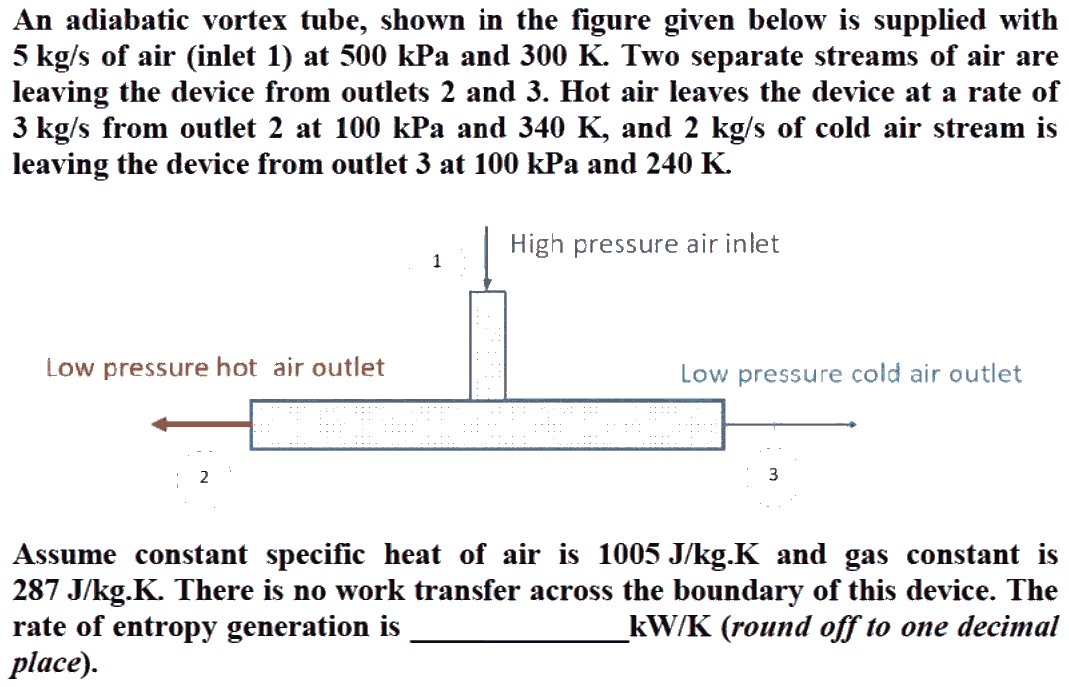
Answer: 2.1 to 2.3
GATE ME 2020 Set 1, Question 61 (2 marks, NAT)
Thermodynamics - First Law of Thermodynamics
Q.No.51 Air(idealgas)enters a perfectlyinsulated compressorat a temperature of310 K.Thepressureratio of the compressoris 6.Specific heat at constant pressure for air is1005J/kg.K and ratioof specificheats atconstant pressure and constantvolumeis1.4.Assume thatspecificheatsof air areconstant.If the isentropic efficiency of the compressor is 85 percent,the difference in enthalpies of airbetween the exit and theinlet of thecompressoris kJ/kg(roundofftonearestinteger).
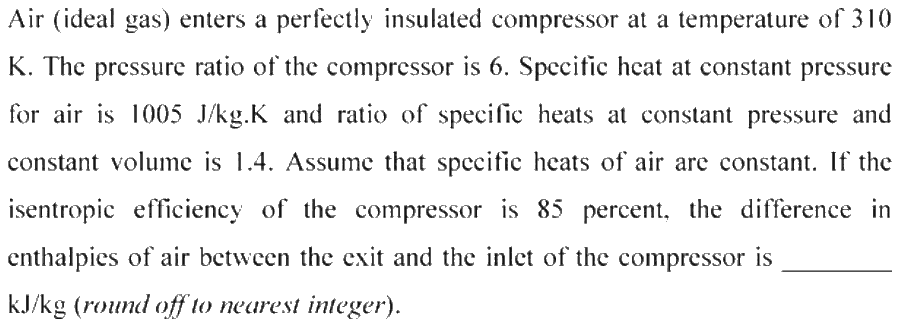
Answer: 244 to 246
GATE ME 2019 Set 1, Question 43 (2 marks, MCQ)
Thermodynamics - First Law of Thermodynamics
Q.33 heating system. The gas enters the heating section of the duct at 100 kPa and 27 °C with a volumeflowrateof15m²/s.Ifheat islostfrom thegasin theduct tothe surroundingsat a rateof51kW,theexit temperatureof thegasis (Assume constant pressure,ideal gas,negligible change in kinetic and potential energies and constant specific heat; Cp = 1 kJ/kg:K; R = 0.5 kJ/kg·K.) (A) 32 ℃ (B)37 ℃ (C) 53 ℃ (D) 76℃
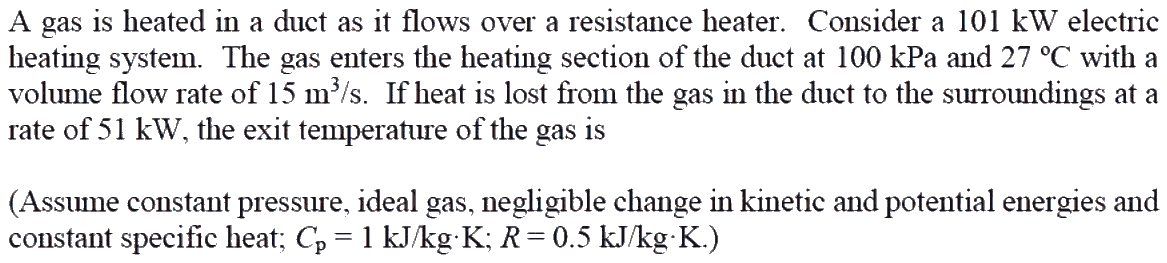
Answer: A
GATE ME 2018 Set 1, Question 55 (2 marks, NAT)
Thermodynamics - First Law of Thermodynamics
Q.45 Steam flows through a nozzle at a mass flow rate of m 1.0 kg/s with a heat loss of 5 kW. The enthalpies at inlet and exit are 2500kJ/kg and 2350 kJ/kg, respectively. Assuming negligible velocity at inlet ( C 1 0 ), the velocity ( C ) of steam (in m/s) at the nozzle exit is 2 __________ (correct to two decimal places).
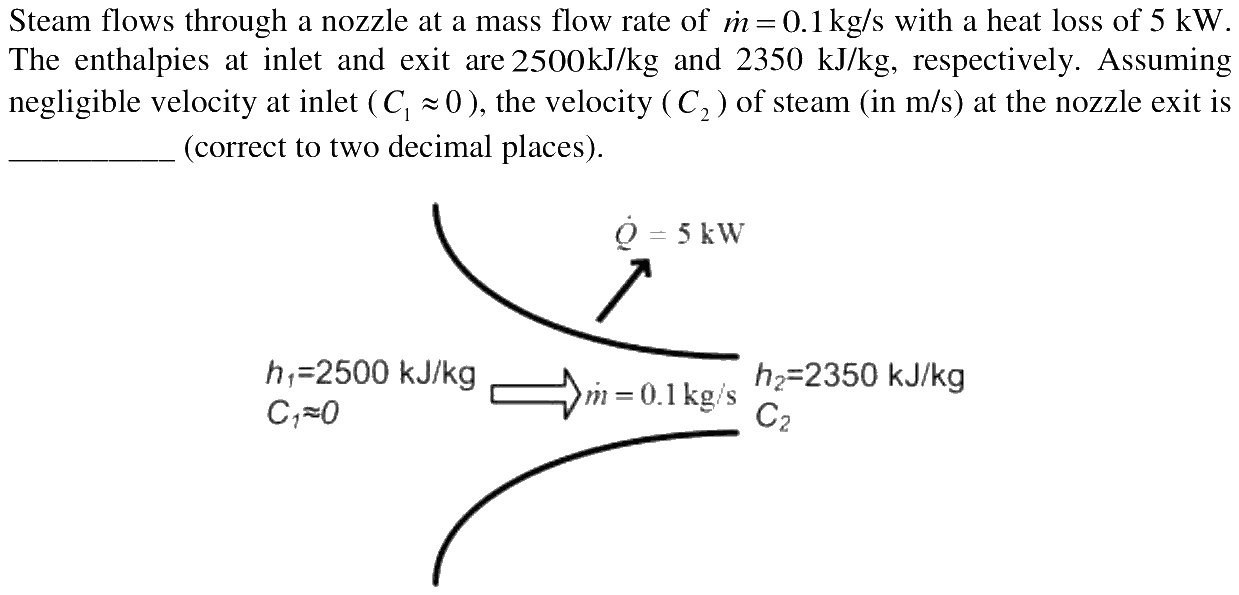
Answer: 445 to 450
GATE ME 2018 Set 2, Question 52 (2 marks, NAT)
Thermodynamics - First Law of Thermodynamics
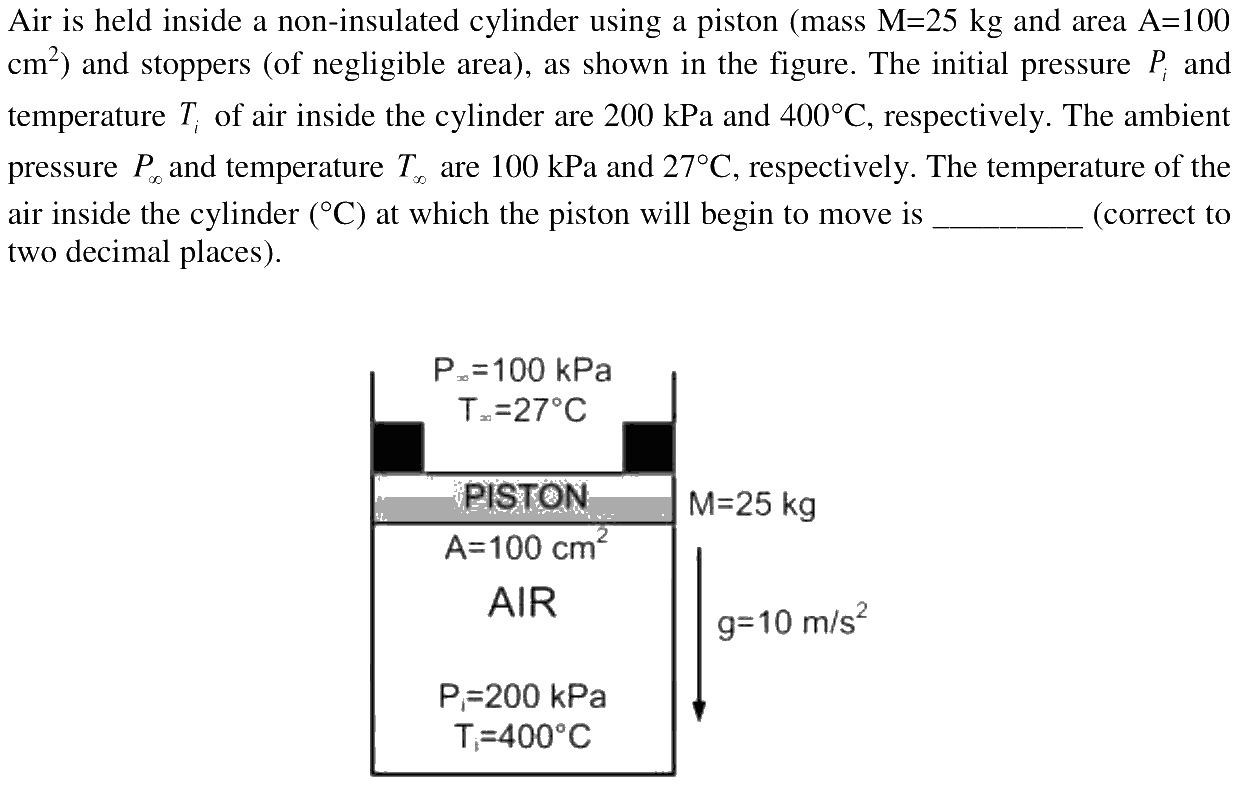
Q.42 Air is held inside a non-insulated cylinder using a piston (mass M=25 kg and area A=100 cm2) and stoppers (of negligible area), as shown in the figure. The initial pressure iP and temperature iT of air inside the cylinder are 200 kPa and 400C, respectively. The ambient pressure P and temperature T are 100 kPa and 27C, respectively. The temperature of the air inside the cylinder (C) at which the piston will begin to move is _________ (correct to two decimal places).
Answer: 145 to 150
GATE ME 2017 Set 1, Question 57 (1 mark, NAT)
Thermodynamics - First Law of Thermodynamics
Water (density ) at ambient temperature flows through a horizontal pipe of uniform cross section at the rate of If the pressure drop across the pipe is the minimum power required to pump the water across the pipe, in watts, is

Answer: 100
GATE ME 2017 Set 1, Question 58 (2 marks, NAT)
Thermodynamics - First Law of Thermodynamics
One of an ideal gas (gas constant, specific heat at constant volume, at bar, and is contained in a sealed rigid cylinder. During an adiabatic process, of work is done on the system by a stirrer. The increase in entropy of the system is _________

Answer: 285 to 289
GATE ME 2017 Set 2, Question 43 (2 marks, MCQ)
Thermodynamics - First Law of Thermodynamics
A calorically perfect gas (specific heat at constant pressure ) enters and leaves a gas turbine with the same velocity. The temperatures of the gas at turbine entry and exit are and respectively. The power produced is and heat escapes at the rate of through the turbine casing. The mass flow rate of the gas (in ) through the turbine is.

Answer: B
GATE ME 2016 Set 1, Question 27 (1 mark, NAT)
Thermodynamics - First Law of Thermodynamics
Q.17 Propane (C3H8) is burned in an oxygen atmosphere with 10% deficit oxygen with respect to the stoichiometric requirement. Assuming no hydrocarbons in the products, the volume percentage of CO in the products is __________

Answer: 13.7 to 14.9
GATE ME 2016 Set 2, Question 54 (2 marks, NAT)
Thermodynamics - First Law of Thermodynamics
A piston-cylinder device initially contains of air (to be treated as an ideal gas) at and The air is now isothermally compressed to 0.1 m3 . The work done during this process is ________ (Take the sign convention such that work done on the system is negative)

Answer: -55.6 to -55.4
GATE ME 2016 Set 3, Question 54 (2 marks, NAT)
Thermodynamics - First Law of Thermodynamics
Steam at an initial enthalpy of and inlet velocity of enters an insulated horizontal nozzle. It leaves the nozzle at The exit enthalpy (in ) is ___________

Answer: 84 to 86
GATE ME 2016 Set 3, Question 56 (2 marks, NAT)
Thermodynamics - First Law of Thermodynamics
Q.46 In a 3-stage air compressor, the inlet pressure is 𝑝1, discharge pressure is 𝑝4 and the intermediate pressures are 𝑝2 and 𝑝3 ( 𝑝2 < 𝑝3). The total pressure ratio of the compressor is 10 and the pressure ratios of the stages are equal. If 𝑝1 = 100 kPa, the value of the pressure 𝑝3 (in kPa) is __________ ME (Set-3) 11/13

Answer: 460 to 470
GATE ME 2015 Set 1, Question 64 (2 marks, NAT)
Thermodynamics - First Law of Thermodynamics
A well insulated rigid container of volume contains of an ideal gas and at a pressure of A stirrer is rotated at constant in the container for rotations and the applied torque is - The final temperature of the gas (in ) is _______________.

Answer: 1283.4 to 1287.4
GATE ME 2015 Set 2, Question 54 (2 marks, NAT)
Thermodynamics - First Law of Thermodynamics
Work is done on an adiabatic system due to which its velocity changes from to elevation increases by and temperature increases by . The mass of the system is and gravitational acceleration is If there is no change in any other component of the energy of the system, the magnitude of total work done (in ) on the system is _______________.

Answer: 4.5
GATE ME 2013, Question 28 (2 marks, MCQ)
Thermodynamics - First Law of Thermodynamics
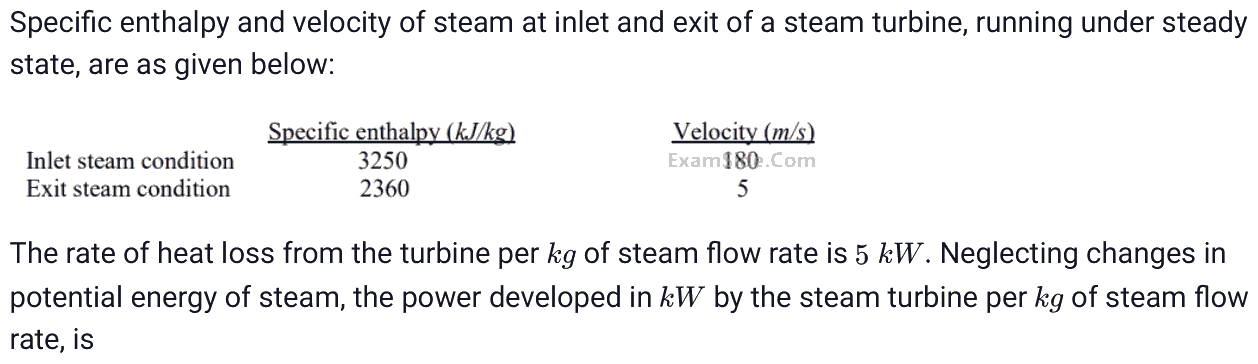
Specific enthalpy and velocity of steam at inlet and exit of a steam turbine, running under steady state, are as given below: The rate of heat loss from the turbine per of steam flow rate is Neglecting changes in potential energy of steam, the power developed in by the steam turbine per of steam flow rate, is
Answer: A
GATE ME 2012, Question 19 (2 marks, MCQ)
Thermodynamics - First Law of Thermodynamics
Steam enters an adiabatic turbine operating at steady state with an enthalpy of and leaves as a saturated mixture at with quality (dryness fraction ) The enthalpies of the saturated liquid and vapour at are and respectively. The mass flow rate of steam is Kinetic and potential energy changes are negligible. The power output of the turbine in is

Answer: B
GATE ME 2012, Question 20 (2 marks, MCQ)
Thermodynamics - First Law of Thermodynamics
Air enters an adiabatic nozzle at with a velocity of It leaves the nozzle at with a velocity of The inlet area is The specific heat of air is The exit temperature of the air is

Answer: C
GATE ME 2012, Question 21 (2 marks, MCQ)
Thermodynamics - First Law of Thermodynamics
Air enters an adiabatic nozzle at with a velocity of It leaves the nozzle at with a velocity of The inlet area is The specific heat of air is The exit area of the nozzle in is

Answer: D
GATE ME 2011, Question 22 (2 marks, MCQ)
Thermodynamics - First Law of Thermodynamics
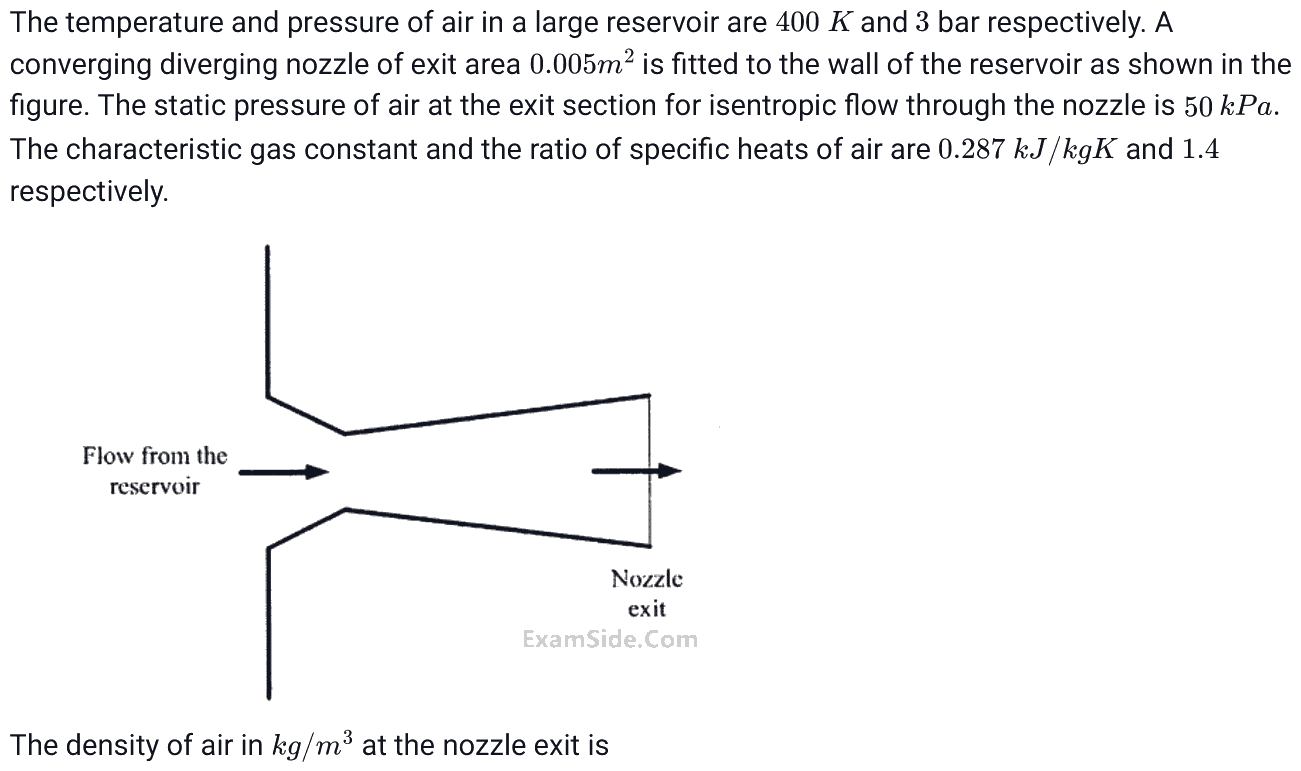
The temperature and pressure of air in a large reservoir are and bar respectively. A converging diverging nozzle of exit area is fitted to the wall of the reservoir as shown in the figure. The static pressure of air at the exit section for isentropic flow through the nozzle is The characteristic gas constant and the ratio of specific heats of air are and respectively. The density of air in at the nozzle exit is
Answer: C
GATE ME 2011, Question 23 (2 marks, MCQ)
Thermodynamics - First Law of Thermodynamics
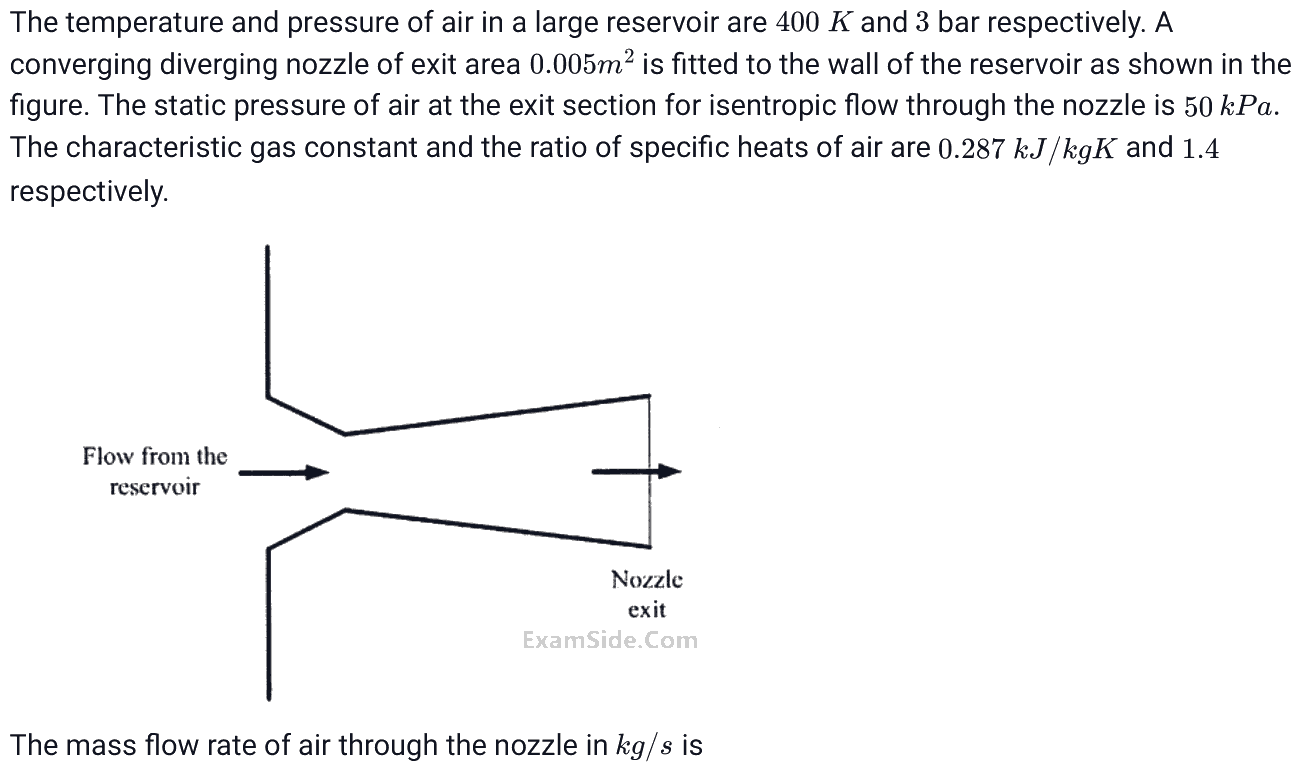
The temperature and pressure of air in a large reservoir are and bar respectively. A converging diverging nozzle of exit area is fitted to the wall of the reservoir as shown in the figure. The static pressure of air at the exit section for isentropic flow through the nozzle is The characteristic gas constant and the ratio of specific heats of air are and respectively. The mass flow rate of air through the nozzle in is
Answer: D
GATE ME 2008, Question 24 (2 marks, MCQ)
Thermodynamics - First Law of Thermodynamics
A balloon containing an ideal gas is initially kept in an evacuated and insulated room. The balloon ruptures and the gas fills up the entire room. Which one of the following statements is TRUE at the end of above process?
- The internal energy of the gas decreases from its initial value, but the enthalpy remains constant
- The internal energy of the gas increases from its initial value, but the enthalpy remains constant
- Both internal energy and enthalpy of the gas remain constant.
- Both internal energy and enthalpy of the gas increase.
Answer: C
GATE ME 2008, Question 25 (2 marks, MCQ)
Thermodynamics - First Law of Thermodynamics
A rigid, insulated tank is initially evacuated. The tank is connected with a supply line through which air ( assumed to be ideal gas with constant specific heats) passes at A valve connected with the supply line is opened and the tank is charged with air until the final pressure inside the tank reaches The final temperature inside the tank. Air Supply Line Valve ExamSIDE.com
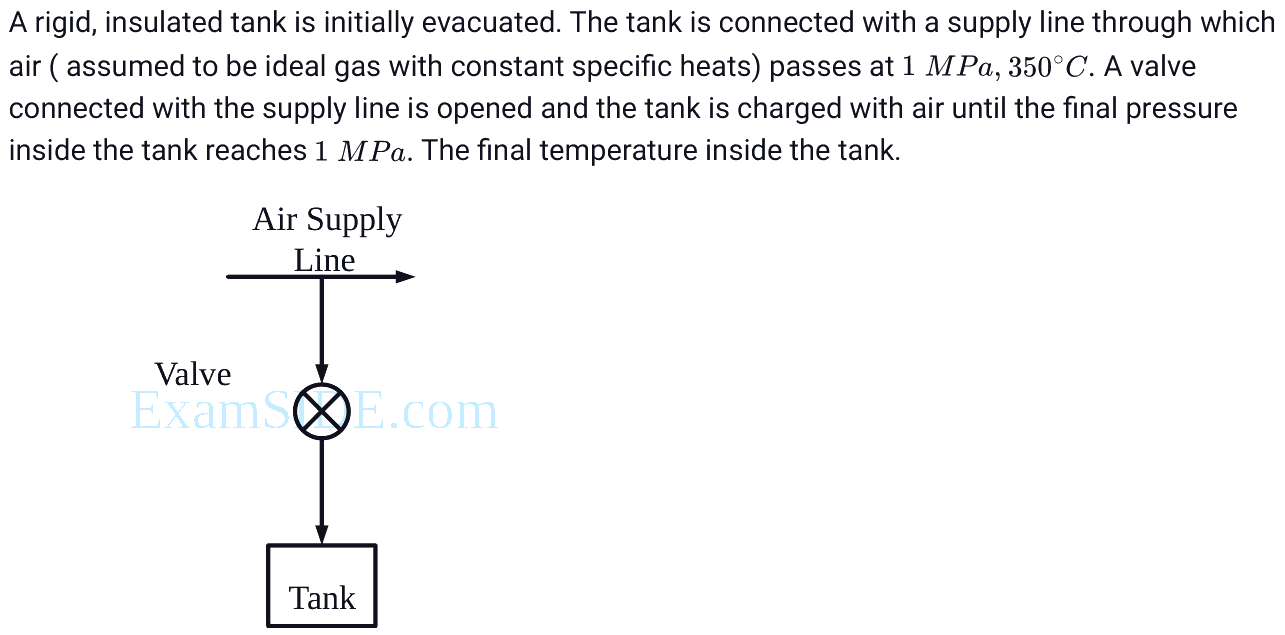
- Is greater than
- Is less than
- Is equal to
- may be greater than less than, or equal to , depending on the volume of the tank.
Answer: A
GATE ME 2004, Question 3 (1 mark, MCQ)
Thermodynamics - First Law of Thermodynamics
A gas contained in a cylinder is compressed, the work required for compression being During the process, heat interaction of causes the surroundings to be heated. The change in internal energy of the gas during the process is

Answer: C
GATE ME 2003, Question 4 (1 mark, MCQ)
Thermodynamics - First Law of Thermodynamics
A liter water heater is switched on for minutes. The heat capacity for water is Assuming all the electrical energy has gone into heating the water, increase of the water temperature in degree centigrade is

Answer: C
GATE ME 2002, Question 26 (2 marks, MCQ)
Thermodynamics - First Law of Thermodynamics
What is the speed of sound in Neon gas at a temperature of (Gas constant of Neon is -)?

Answer: C
GATE ME 2001, Question 27 (2 marks, MCQ)
Thermodynamics - First Law of Thermodynamics
A small steam whistle (perfectly insulated and doing no shaft work) causes a drop of in the enthalpy of steam from entry to exit. If the kinetic energy of the steam at entry is negligible, the velocity of the steam at exit is

Answer: B
GATE ME 2000, Question 5 (1 mark, MCQ)
Thermodynamics - First Law of Thermodynamics
A steam turbine receives steam steadily at with an enthalpy of and discharges at bar with an enthalpy of The work output is The changes in kinetic and potential energies are negligible. The heat transfer from the turbine casing to the surroundings is equal to

Answer: B
GATE ME 2000, Question 28 (2 marks, MSQ)
Thermodynamics - First Law of Thermodynamics
When an ideal gas with constant specific heats is throttled adiabatically, with negligible changes in kinetic and potential energies
Answer: A, D
GATE ME 2000, Question 30 (5 marks, TEXT)
Thermodynamics - First Law of Thermodynamics
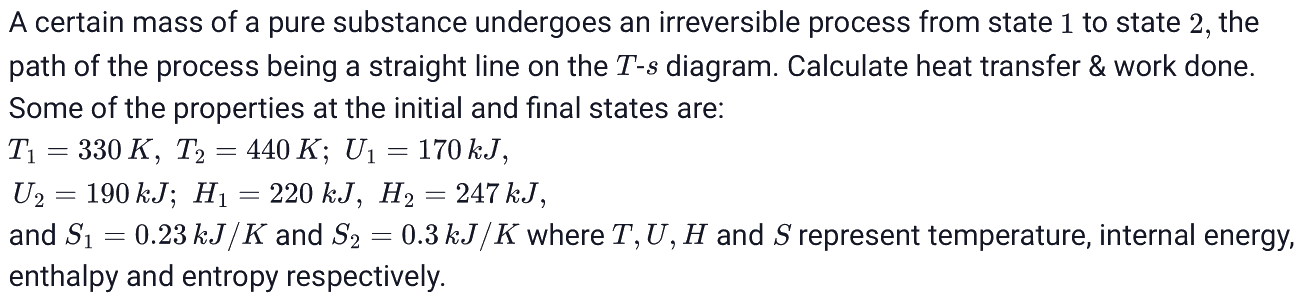
A certain mass of a pure substance undergoes an irreversible process from state to state the path of the process being a straight line on the - diagram. Calculate heat transfer & work done. Some of the properties at the initial and final states are: and and where and represent temperature, internal energy, enthalpy and entropy respectively.
GATE ME 1999, Question 6 (1 mark, MCQ)
Thermodynamics - First Law of Thermodynamics
A steel ball of mass and specific heat is at temperature of It is dropped into water at The final steady state temperature of water is

Answer: A
GATE ME 1997, Question 31 (5 marks, TEXT)
Thermodynamics - First Law of Thermodynamics
Air enters a frictionless adiabatic converging nozzle at bar, with negligible velocity. The nozzle dis-charges to a region at bar. If the exit area of the nozzle is find the flow rate of air through the nozzle. Assume for air, and

GATE ME 1993, Question 7 (1 mark, MCQ)
Thermodynamics - First Law of Thermodynamics
The first law of thermodynamics takes the form when applied to :

- A closed system undergoing a reversible adiabatic process.
- An open system undergoing an adiabatic process with negligible changes in kinetic and potential energies.
- A closed system undergoing a reversible constant volume process.
- A closed system undergoing a reversible constant pressure process.
Answer: B
GATE ME 1993, Question 29 (2 marks, TEXT)
Thermodynamics - First Law of Thermodynamics
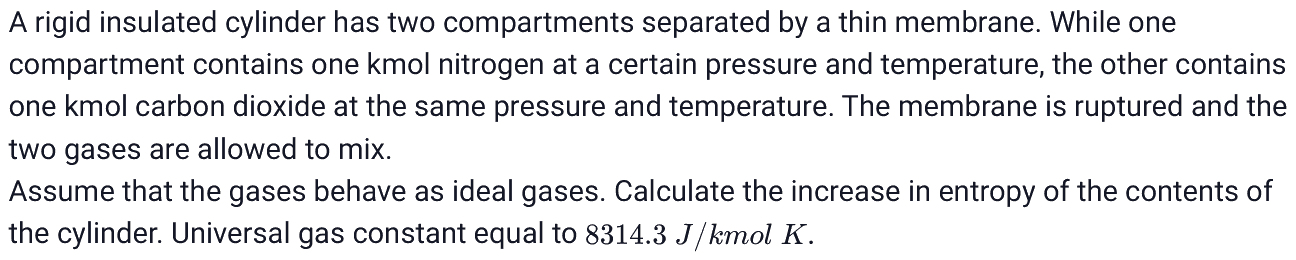
A rigid insulated cylinder has two compartments separated by a thin membrane. While one compartment contains one kmol nitrogen at a certain pressure and temperature, the other contains one kmol carbon dioxide at the same pressure and temperature. The membrane is ruptured and the two gases are allowed to mix. Assume that the gases behave as ideal gases. Calculate the increase in entropy of the contents of the cylinder. Universal gas constant equal to