GATE ME 2026, Question 42 (1 mark, MCQ)
Production Engineering - Casting
In relation to metal casting defects, match the following
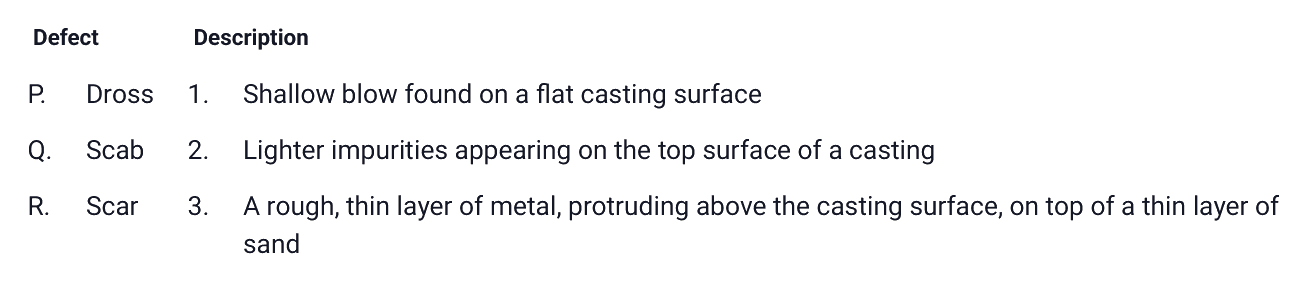
- P-III, Q-I, R-II
- P-II, Q-I, R-III
- P-II, Q-III, R-I
- P-III, Q-II, R-I
Answer: C
GATE ME (Mechanical Engineering) Casting previous year questions from Production Engineering, with figures and the answer key.
Production Engineering | All GATE ME papers
Production Engineering - Casting
In relation to metal casting defects, match the following
Answer: C
Production Engineering - Casting
A metal has FCC crystal structure with of density and of atomic weight. The Avogadro's number is . The atomic radius of the metal is nm (rounded off to 2 decimal places).

Answer: 0.1429
Production Engineering - Casting
A liquid metal is poured in a mold cavity of size . The cooling is uniform in all directions with NO additional compensation for shrinkage. Considering the volumetric shrinkage during solidification and solid contraction as and , respectively, the length of the cube edge after cooling down to the room temperature is ___________ mm (rounded off to 1 decimal place).

Answer: 189.8 to 190
Production Engineering - Casting
Match the mold elements in the casting process with the most suitable function
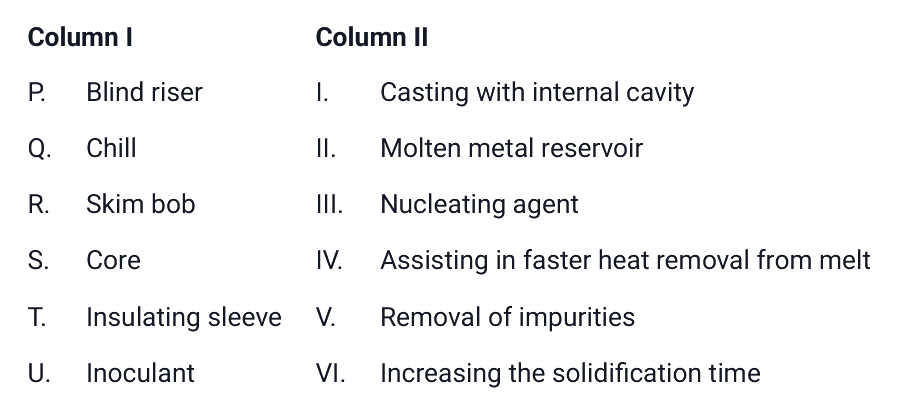
Answer: A
Production Engineering - Casting
Two metal parts (a cylinder and a cube) of same volume are cast under identical conditions. The diameter of the cylinder is equal to its height. The ratio of the solidification time of the cube to that of the cylinder is ___________ (rounded off to 2 decimal places). Assume that solidification time follows Chvorinov's rule with an exponent of 2 .
Answer: 0.83 to 0.87
Production Engineering - Casting
The allowance provided to a pattern for easy withdrawal from a sand mold is
Answer: D
Production Engineering - Casting
Aluminium is casted in a cube-shaped mold having dimensions as 20 mm × 20 mm × 20 mm. Another mold of the same mold material is used to cast a sphere of aluminium having a diameter of 20 mm. The pouring temperature for both cases is the same. The ratio of the solidification times of the cube-shaped mold to the spherical mold is _______ (answer in integer).
Answer: 1
Production Engineering - Casting
In a metal casting process to manufacture parts, both patterns and moulds provide shape by dictating where the material should or should not go. Which of the option(s) given correctly describe(s) the mould and the pattern?
Answer: A, B, D
Production Engineering - Casting
Fluidity of a molten alloy during sand casting depends on its solidification range. The phase diagram of a hypothetical binary alloy of components A and B is shown in the figure with its eutectic composition and temperature. All the lines in this phase diagram, including the solidus and liquidus lines, are straight lines. If this binary alloy with 15 weight % of B is poured into a mould at a pouring temperature of 800 °C, then the solidification range is
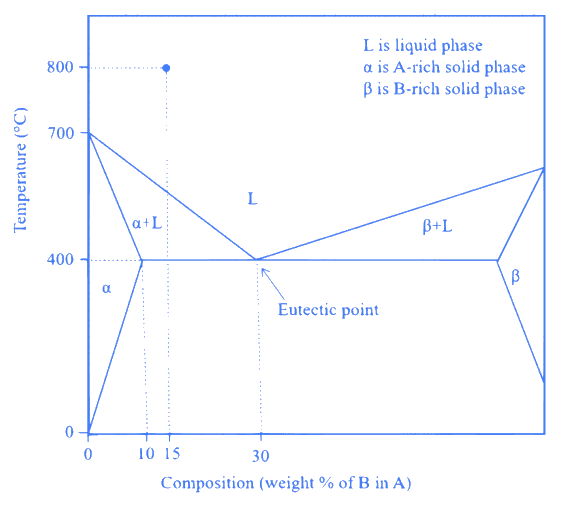
Answer: D
Production Engineering - Casting
Consider sand casting of a cube of edge length a. A cylindrical riser is placed at the top of the casting. Assume solidification time, t$_{s}$∝ V/A, where V is the volume and A is the total surface area dissipating heat. If the top of the riser is insulated, which of the following radius/radii of riser is/are acceptable?
Answer: A, B
Production Engineering - Casting
Which of these processes involve(s) melting in metallic workpieces?
Answer: B, C, D
Production Engineering - Casting
Q.36 A true centrifugal casting operation needs to be performed horizontally to make copper tube sections with outer diameter of 250 mm and inner diameter of 230 mm. The value of acceleration due to gravity, g = 10 m/s2. If a G-factor (ratio of centrifugal force to weight) of 60 is used for casting the tube, the rotational speed required is rpm (round off to the nearest integer).
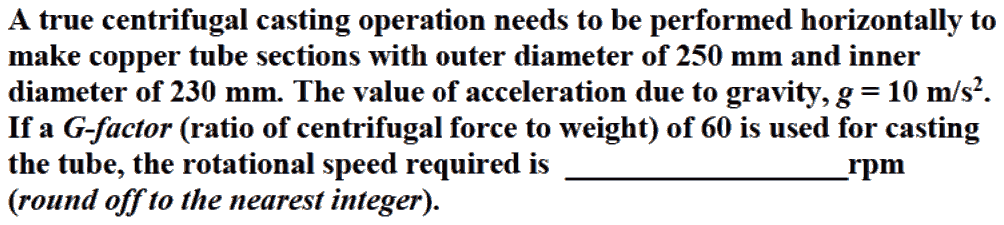
Answer: 660 to 664
Production Engineering - Casting
Q.4 The Cast Iron which possesses all the carbon in the combined form as cementite is known as (A) Grey Cast Iron (B) Spheroidal Cast Iron (C) Malleable Cast Iron (D) White Cast Iron

Answer: D
Production Engineering - Casting
Q.5 The size distribution of the powder particles used in Powder Metallurgy process can be determined by (A) Laser scattering (B) Laser reflection (C) Laser absorption (D) Laser penetration

Answer: A
Production Engineering - Casting
Q.37 Acastproductofaparticularmaterialhasdimensions75mmx125mmx20 mm.Thetotal solidification timeforthecastproduct isfound tobe 2.0 minutesascalculatedusingChvorinov'srulehaving theindex,n=2.Ifunder the identical casting conditions, the cast product shape is changed to a cylinder having diameter = 50 mm and height = 50 mm, the total solidification time will be minutes (round off to two decimal places).
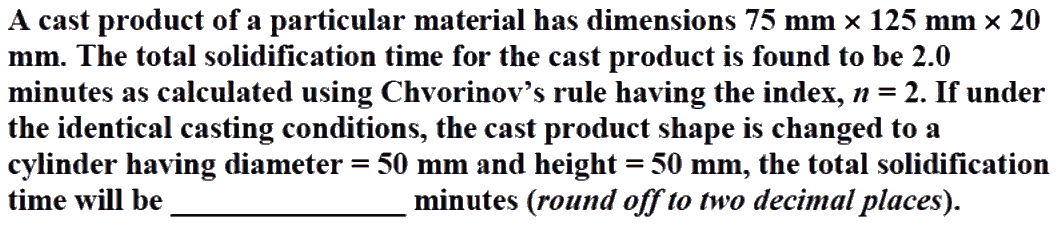
Answer: 2.6 to 3
Production Engineering - Casting
Q.No.11 Match thefollowing. Heat treatmentprocess Effect P:Tempering 1. Strengthening Q:Quenching 2. Toughening R:Annealing 3.Hardening S:Normalizing 4.Softening (A) P-2,Q-3,R-4,S-1 (B) P-1,Q-1,R-3,S-2 (C) P-3,Q-3,R-1,S-3 (D) P-4, Q-3, R-2, S-1 The base of a brass bracket needs rough grinding.For this purpose,the most
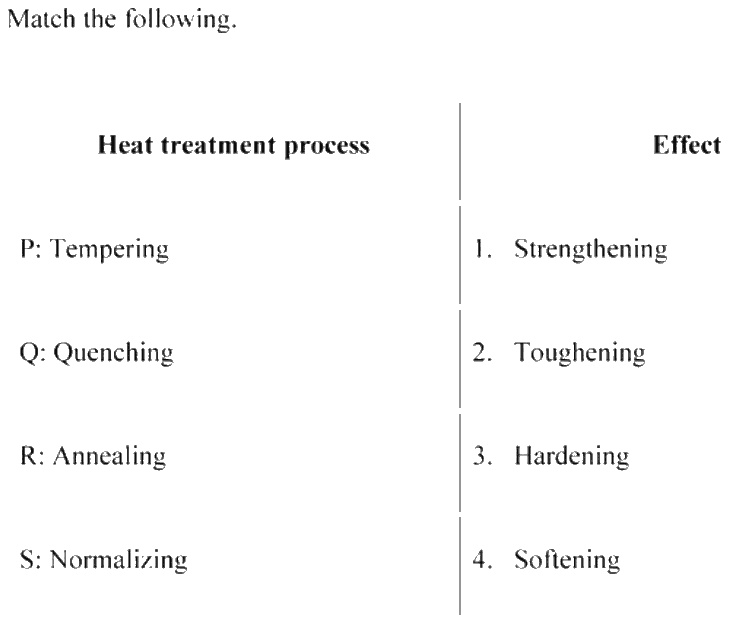
Answer: A
Production Engineering - Casting
Q.No.11 INCORRECT? (A) It indicatesthetemperatureatwhichdifferent phasesstart tomelt (B) Relativeamountofdifferentphasescanbefoundundergivenequillibrium conditions (C) Itgivesinformationontransformationrates (D) Solidsolubilitylimits aredepicted byit

Answer: C
Production Engineering - Casting
Q.No.42 2Amouldcavityof 1200cm²volumehastobefilledthroughasprueof10cm lengthfeedingahorizontalrunner.Cross-sectional areaatthebaseofthesprueis 2 cm2. Consider acceleration due to gravity as 9.81 m/s².Neglectingfrictional losses due tomolten metal flow,the time taken to fill the mould cavity is seconds(roundoffto2decimalplaces). 3Acylindricalbarwith200mmdiameterisbeingturnedwithatoolhaving
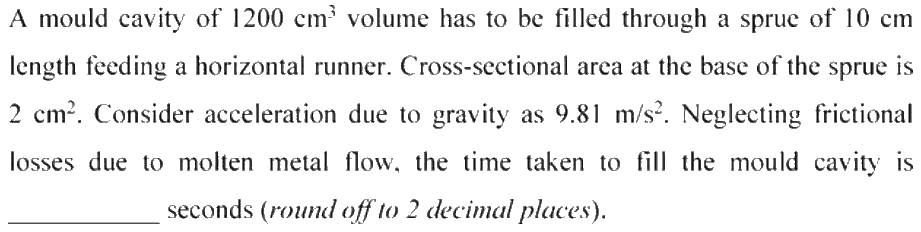
Answer: 4 to 9
Production Engineering - Casting
Q.13 In I a casting g process, a vertical channel through which molten metal flows downward from pouring basin to 1 for reaching the mold cavity runner is called (A) blister (B) sprue (C) riser (D) pin hole

Answer: B
Production Engineering - Casting
Q.37 Match th Defect Cause P Blow hole 1 Poor collapsibility Q Misrun 2 Mold erosion R Hot tearing 3 Poor permeability S Wash 4 Insufficient fluidity (A) P-4, Q-3, R-1, S-2 (B) P-3, Q-4, R-2, S-1 (C) P-2, Q-4, R-1, S-3 (D) P-3, Q-4, R-1, S-2
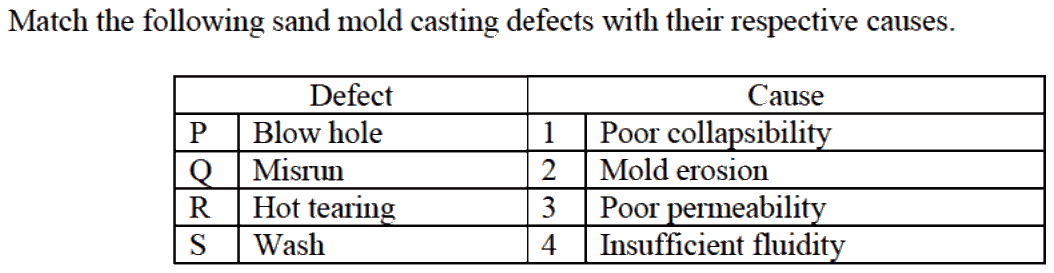
Answer: D
Production Engineering - Casting
Q.14 (A) the ability toharden when it is cold worked (B) the maximum hardness that can be obtained when it is austenitized and then quenched (C) the depth to which required hardening is obtained when it is austenitized and then quenched (D) the ability to retain its hardness when it is heated to elevated temperatures

Answer: C
Production Engineering - Casting
Q.15 The fluidity of molten metal of cast alloys (without any addition of fluxes) increases with imcrease in A viscosity (B) surface tension (C) freezing range (D) degree of : superheat

Answer: D
Production Engineering - Casting
Q.34 The binary phase diagram of metals P and Q is shown in the figure. An alloy X containing 60% P and 40%Q (by weight) is cooled from liquid to solid state.The fractions of solid and liquid (in weight percent) at 1250 °C, respectively, will be 1500 Liquidus Liquid X 1250 Solidus Temperature (° C) Solid 1000 100%P 203240 606880100%Q Concentration of Q (in weight %) (A) 77.8% and 22.2% (B) 22.2% and 77.8% (C) 68.0% and 32.0% (D) 32.0% and 68.0%
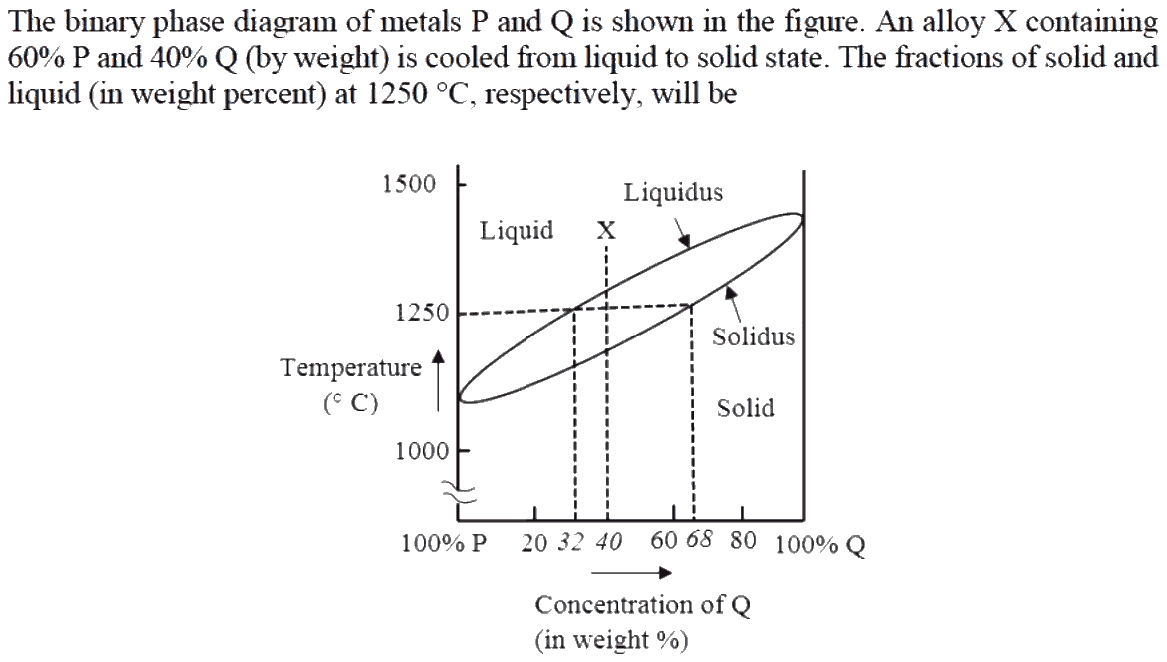
Answer: B
Production Engineering - Casting
Q.50 negligible. The acceleration due to gravity is 9.81 m/s2. The time (in s, round off to two decimal places) to fill up the mold cavity (of size 40 cm x 30 cm x 15 cm) is Atmospheric pressure Filling height 20 cm Diameter 2cm Open to atmosphere 15 cm Volume to be casted (mold cavity) 40 cm
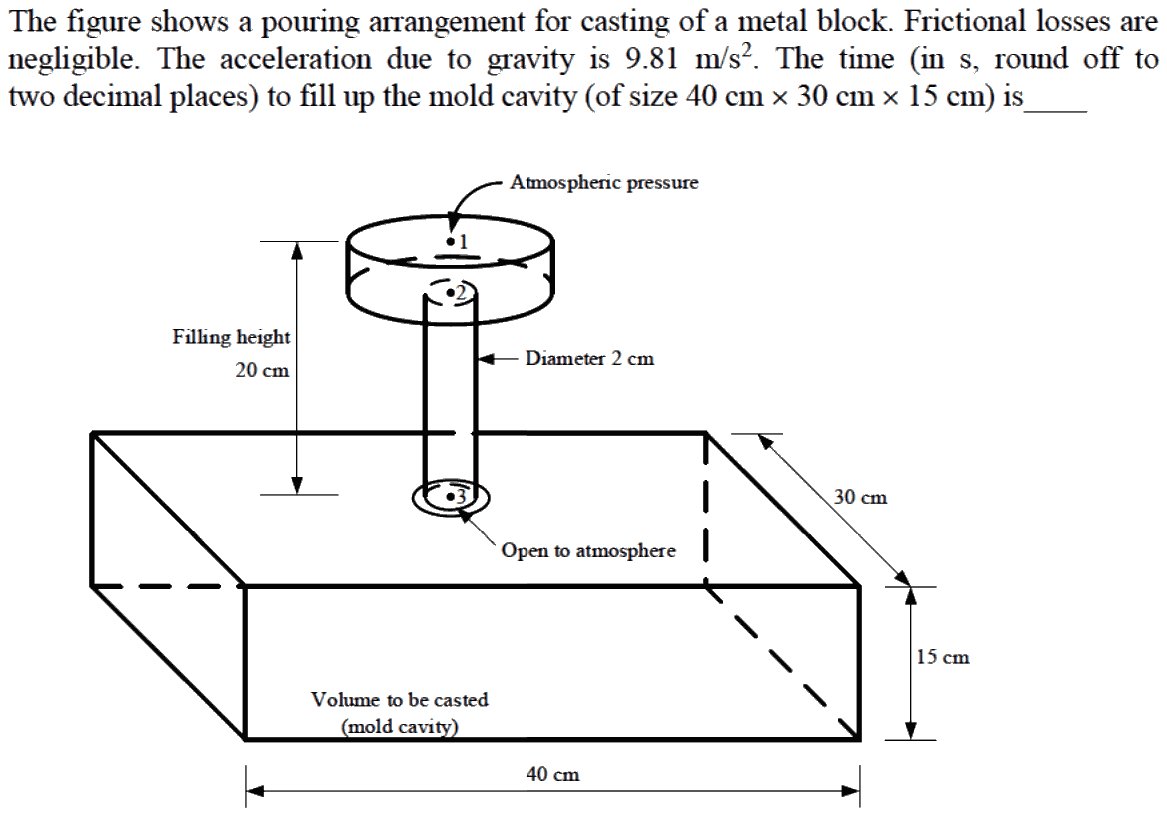
Answer: 28.8 to 29
Production Engineering - Casting
Q.12 Denoting L as liquid and M as solid in a phase-diagram with the subscripts representing different phases, a eutectoid reaction is described by (A) M M M 1 2 3 (B) L M M 1 1 2 (C) L M M 1 1 2 (D) M M M 1 2 3

Answer: A or D (either is accepted)
Production Engineering - Casting
Q.13 During solidification of a pure molten metal, the grains in the casting near the mould wall are (A) coarse and randomly oriented (B) fine and randomly oriented (C) fine and ordered (D) coarse and ordered

Answer: B
Production Engineering - Casting
Q.14 Match the following products with the suitable manufacturing process Product Manufacturing Process P Toothpaste tube 1 Centrifugal casting Q Metallic pipes 2 Blow moulding R Plastic bottles 3 Rolling S Threaded bolts 4 Impact extrusion (A) P-4, Q-3, R-1, S-2 (B) P-2, Q-1, R-3, S-4 (C) P-4, Q-1, R-2, S-3 (D) P-1, Q-3, R-4, S-2
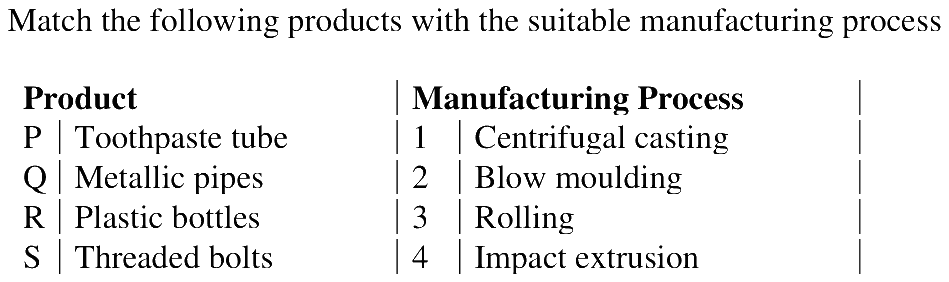
Answer: C
Production Engineering - Casting
Q.50 For sand-casting a steel rectangular plate with dimensions 80 mm × 120 mm × 20 mm, a cylindrical riser has to be designed. The height of the riser is equal to its diameter. The total solidification time for the casting is 2 minutes. In Chvorinov’s law for the estimation of the total solidification time, exponent is to be taken as 2. For a solidification time of 3 minutes in the riser, the diameter (in mm) of the riser is __________ (correct to two decimal places).

Answer: 42 to 52
Production Engineering - Casting
A sprue in a sand mould has a top diameter of and height of The velocity of the molten metal at the entry of the sprue is Assume acceleration due to gravity as and neglect all losses. If the mould is well ventilated, the velocity (upto decimal points accuracy) of the molten metal at the bottom of the sprue is ______________________

Answer: 2.04 to 2.07
Production Engineering - Casting
Given the atomic weight of Fe is 56 and that of C is 12, the weight percentage of carbon in cementite (FeC)is

Answer: 6.3 to 7
Production Engineering - Casting
Q.20 The “Jominy test” is used to find (A) Young’s modulus (B) hardenability (C) yield strength (D) thermal conductivity

Answer: B
Production Engineering - Casting
The part of a gating system which regulates the rate of pouring of molten metal is
Answer: C
Production Engineering - Casting
Heat is removed from a molten metal of mass at a constant rate of till it is completely solidified. The cooling curve is shown in the figure. Assuming uniform temperature throughout the volume of the metal during solidification, the latent heat of fusion of the metal (in ) is ______________
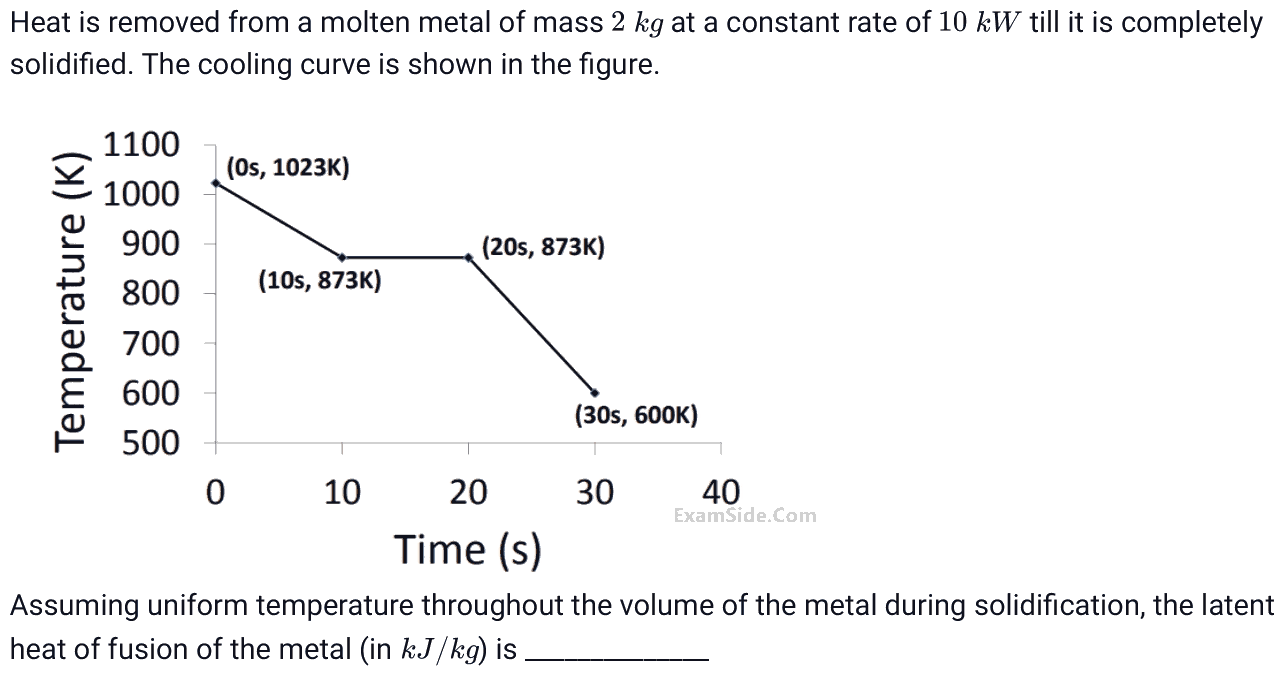
Answer: 49.9 to 50.1
Production Engineering - Casting
A cylindrical job with diameter of and height of is to be cast using modulus method of riser design. Assume that the bottom surface of cylindrical riser does not contribute as cooling surface. If the diameter of the riser is equal to its height, then the height of the riser (in ) is

Answer: A
Production Engineering - Casting
Q.21 In the phase diagram shown in the figure, four samples of the same composition are heated to temperatures marked by a, b, c and d. At which temperature will a sample get solutionized the fastest? (A) a (B) b (C) c (D) d
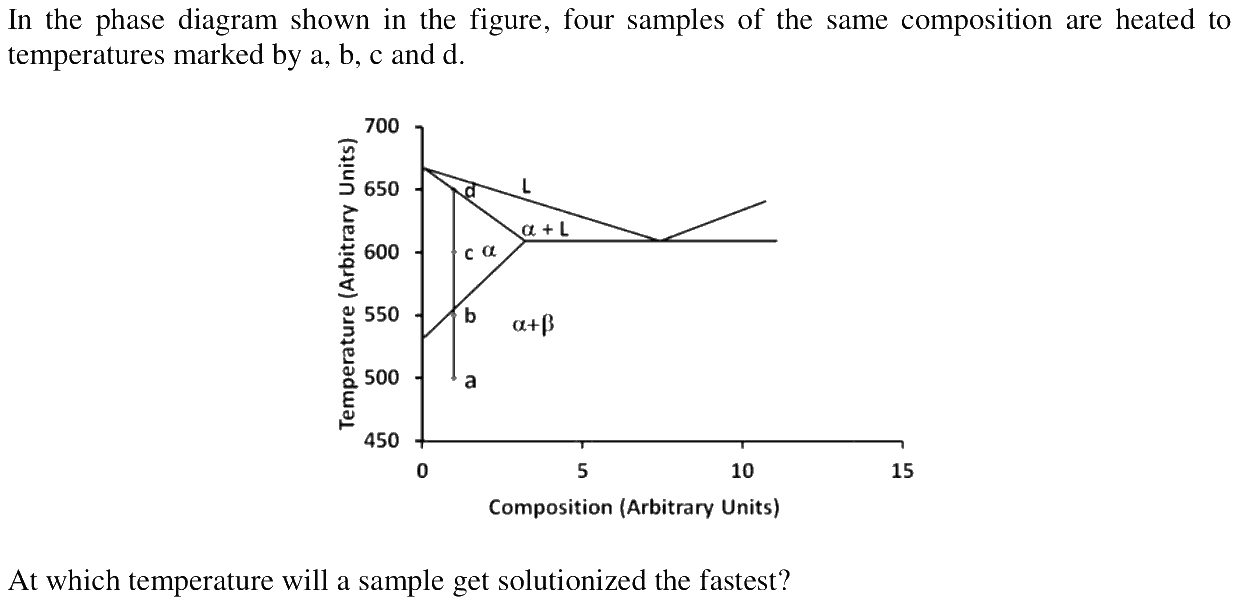
Answer: C
Production Engineering - Casting
The welding process which uses a blanket of fusible granular flux is
Answer: B
Production Engineering - Casting
Q.48 In a binary system of A and B,a liquid of 20%A(80%B)is coexisting with a solid of 70%A (30%B).For an overall compositionhaving 40%A,thefraction of solid is (A)0.40 (B)0.50 (C)0.60 (D) 0.75

Answer: A
Production Engineering - Casting
Gray cast iron blocks of size with a central spherical cavity of diameter mm are sand cast. The shrinkage allowance for the pattern is . The ratio of the volume of the pattern to volume of the casting is ___________________

Answer: 1.08 to 1.1
Production Engineering - Casting
Equal amounts of a liquid metal at the same temperature are poured into three moulds made of steel, copper and aluminum. The shape of the cavity is a cylinder with diameter. The size of the moulds are such that the outside temper-ature of the moulds do not increase appreciably beyond the atmospheric temperature during solidification. The sequence of solidification in the mould from the fastest to slowest is (Thermal conductivities of steel, copper and aluminum are and - respectively. Specific heats of steel, copper and aluminum are and - respectively. Densities of steel, copper and aluminum are and respectively.)
Answer: C
Production Engineering - Casting
The solidification time of a casting is proportional to Where is the volume of the casting and is the total casting surface area losing heat. Two cubes of same material and size are cast using sand casting process. The top face of one of the cubes is completely insulated. The ratio of the solidification time for the cube with top face insulated to that of the other cube is

Answer: B
Production Engineering - Casting
A cube and a sphere made of cast iron (each of volume ) were cast under identical conditions. The time taken for solidifying the cube was The solidification time (in ) for the sphere is _____________________

Answer: 6 to 6.3
Production Engineering - Casting
In full mould (cavity-less) casting process, the Pattern is made of
Answer: A
Production Engineering - Casting
Ratio of solidification time of a cylindrical casting (height radius) to that of a cubic casting of side two times the height of cylindrical casting is ____________

Answer: 0.5 to 0.6
Production Engineering - Casting
The dimensions of a cylindrical side riser (height diameter) for a steel casting are to be determined. For the tabulated shape factor values given below, the diameter of the riser (in ) is _______________

Answer: 10.5 to 10.7
Production Engineering - Casting
Q.24 The process of reheating the martensitic steel to reduce its brittleness without any significant loss in its hardness is (A) normalising (B) annealing (C) quenching (D) tempering

Answer: A
Production Engineering - Casting
An aluminium alloy (density ) casting is to be produced. A cylindrical hole of diameter and length is made in the casting using sand core (density ). The net buoyancy force (in Newton) acting on the core is _____________________

Answer: 7 to 8
Production Engineering - Casting
Match the casting defects (Group A) with the probable causes (Group B):
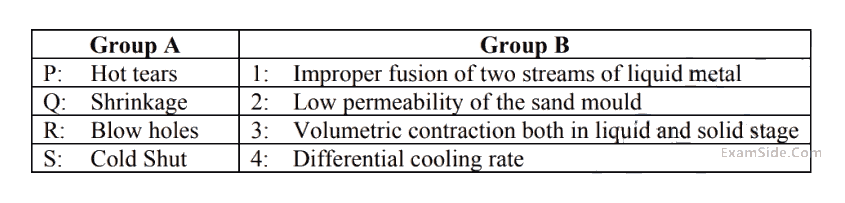
Answer: B
Production Engineering - Casting
The hot tearing in a metal casting is due to
Answer: C
Production Engineering - Casting
A cylindrical blind riser with diameter and height is placed on the top of the mold cavity of a closed type sand mold as shown in the figure. If the riser is of constant volume, then the rate of solidification in the riser is the least when the ratio is
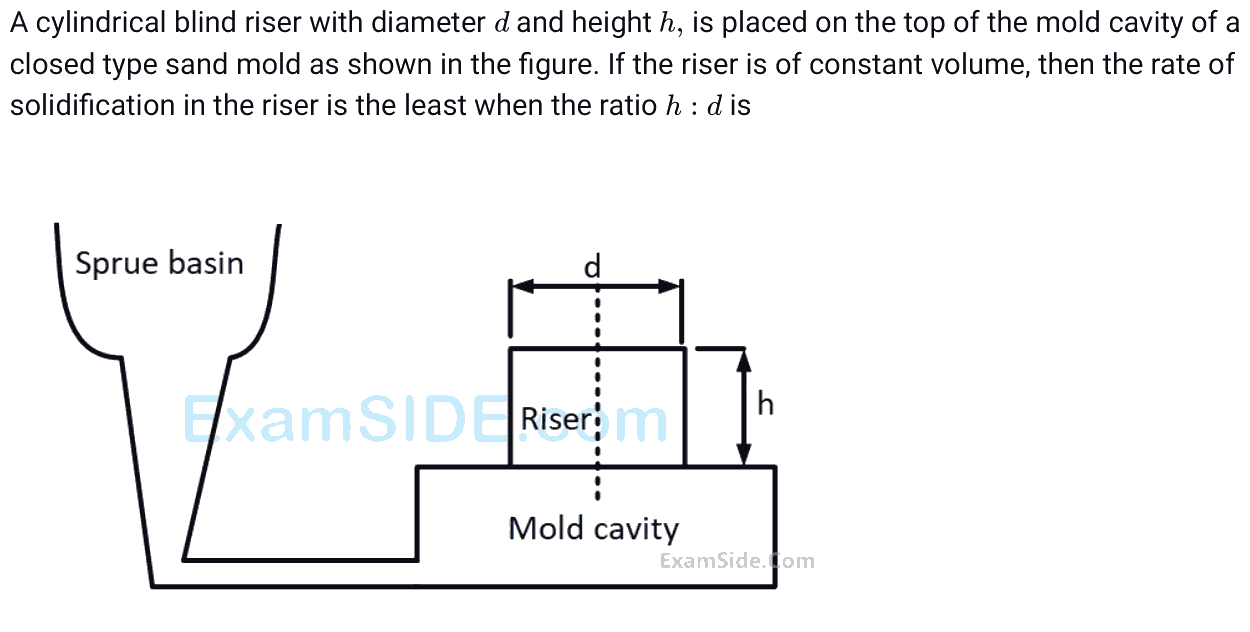
Answer: A
Production Engineering - Casting
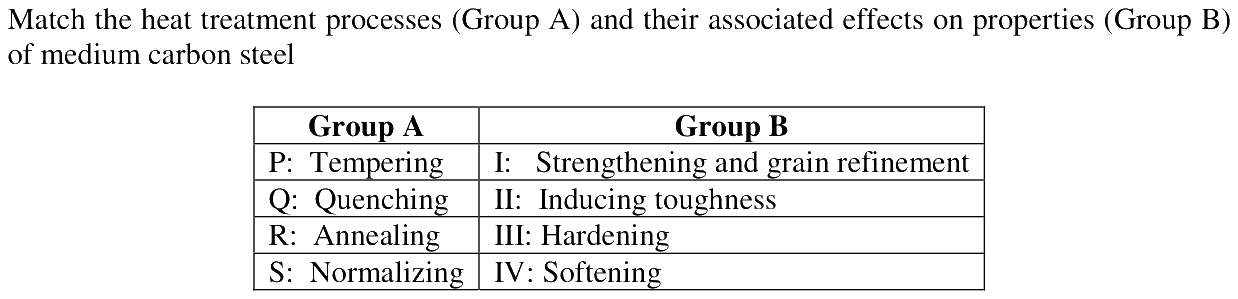
Q.24 Match the heat treatment processes (Group A) and their associated effects on properties (Group B) of medium carbon steel Group A Group B P: Tempering I: Strengthening and grain refinement Q: Quenching II: Inducing toughness R: Annealing III: Hardening S: Normalizing IV: Softening ME04 (GATE 2014) (A) P-III, Q-IV, R-II, S-I (B) P-II, Q-III, R-IV, S-I (C) P-III, Q-II, R-IV, S-I (D) P-II, Q-III, R-I, S-IV
Answer: B
Production Engineering - Casting
A cylindrical riser of diameter and height has to be designed for a sand casting mould for producing a steel rectangular plate casting of dimensions having the total solidification time of minute. The total solidification time (in minute) of the riser is ___________________

Answer: 2.5 to 4.5
Production Engineering - Casting
A cube shaped casting solidifies in min. The solidification time in min for a cube of the same material, which is times heavier than the original casting, will be

Answer: B
Production Engineering - Casting
Green sand mould indicates that
Answer: D
Production Engineering - Casting
A cubic casting of side undergoes volumetric solidification shrinkage and volumetric solid contraction of and respectively. No riser is used. Assume uniform cooling in all directions. The side of cube after solidification and contraction is

Answer: A
Production Engineering - Casting
In a gating system, the ratio represents

Answer: A
Production Engineering - Casting
For the case of molding, it is decided to replace a spherical riser of diameter by a cylindrical riser. Determine size of the cylindrical riser that will have the identical solidification time. Assume blind risering & ratio of height to radius of cylinder is

Answer: A
Production Engineering - Casting
Two streams of liquid metal, which are not hot enough to fuse properly, result into a casting defect known as
Answer: A
Production Engineering - Casting
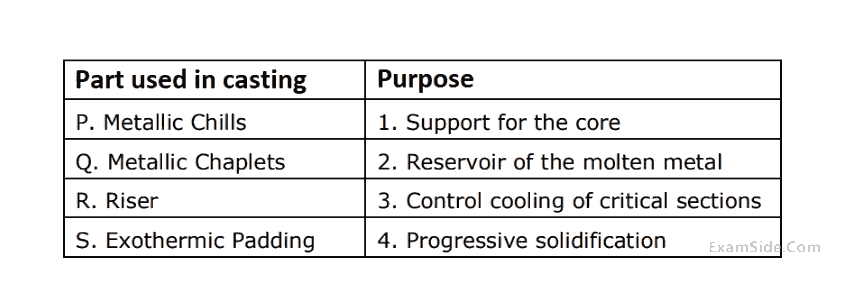
Match the following
Answer: D
Production Engineering - Casting
While cooling, a cubical casting of side undergoes and volume shrinkage during the liquid state, phase transition and solid state respectively. The volume of metal compensated from the riser is

Answer: B
Production Engineering - Casting
Which of the following engineering materials is the most suitable candidate for hot chamber die casting
Answer: D
Production Engineering - Casting
If a particular - alloy contains less than % carbon, it is called

Answer: B
Production Engineering - Casting
Volume of a cube of a side and volume of sphere of radius are equal. Both the cube and the sphere are solid and same material. They are being cast. The ratio of the solidification time of the cube to the same of the sphere is

Answer: D
Production Engineering - Casting
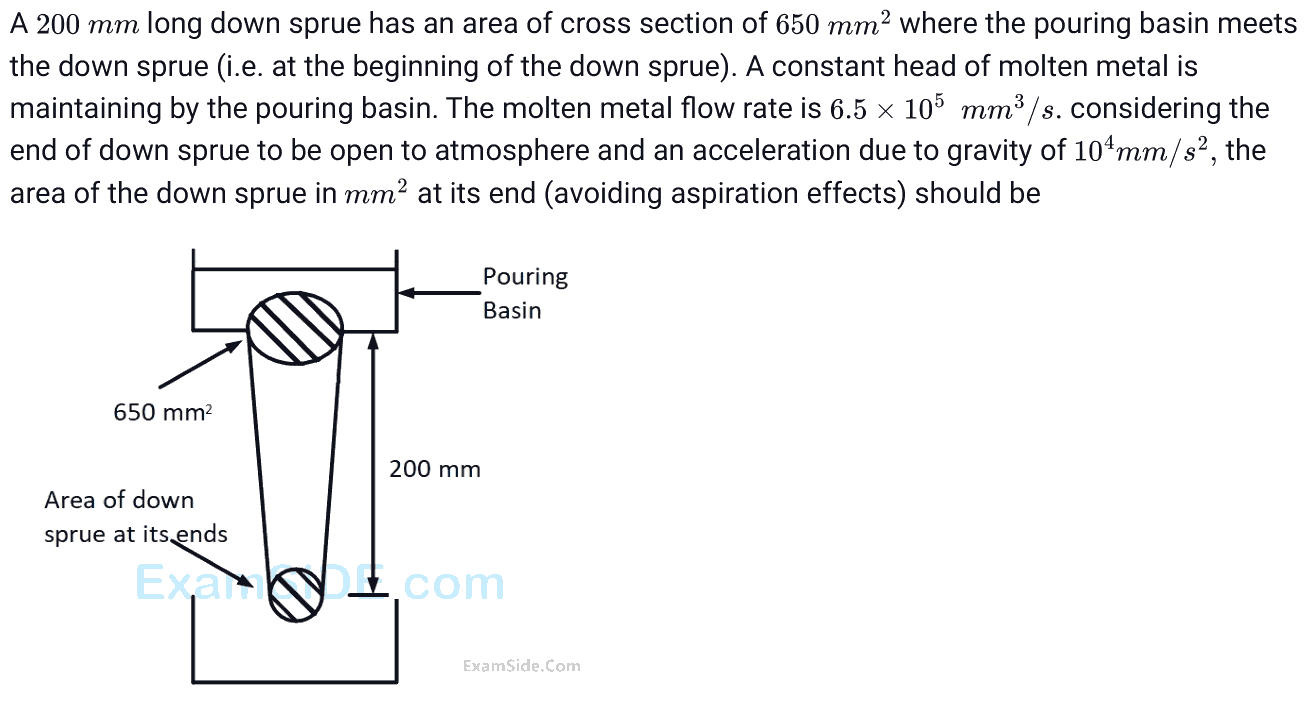
A long down sprue has an area of cross section of where the pouring basin meets the down sprue (i.e. at the beginning of the down sprue). A constant head of molten metal is maintaining by the pouring basin. The molten metal flow rate is considering the end of down sprue to be open to atmosphere and an acceleration due to gravity of the area of the down sprue in at its end (avoiding aspiration effects) should be
Answer: C
Production Engineering - Casting
An expendable pattern is used in
Answer: D
Production Engineering - Casting
In a sand casting operation, the total liquid head is maintained constant such that it is equal to the mould height. The time taken to fill the mould with a top gate is If the same mould is filed with a bottom gate, then the time taken is Ignore the time required to fill the runner and frictional effects. Assume atmospheric pressure at the top molten metal surfaces. The relation between the and is

Answer: B
Production Engineering - Casting
A mould has a downsprue whose length is and the cross sectional area at the base of the down sprue is The down sprue feeds a horizontal runner leading into the mould cavity of volume The time required to fill the mould cavity will be

Answer: B
Production Engineering - Casting
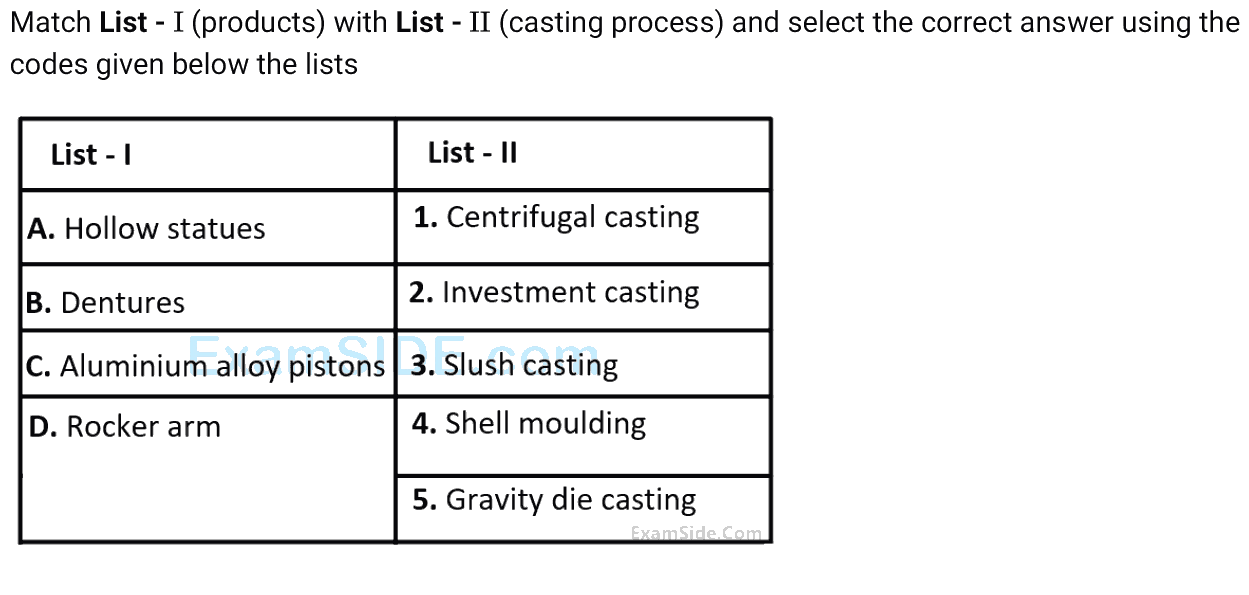
Match List - (products) with List - (casting process) and select the correct answer using the codes given below the lists
Answer: D
Production Engineering - Casting
Misrun is a casting defect which occurs due to
Answer: B
Production Engineering - Casting
Gray cast iron blocks are to be cast in sand moulds. Shrinkage allowance for pattern making is %. The ratio of the volume of pattern to that of the casting will be

Answer: D
Production Engineering - Casting
Hardness of green sand mould increase with
Answer: C
Production Engineering - Casting
With a solidification factor of the solidification time (in seconds) for a spherical casting of diameter is

Answer: B
Production Engineering - Casting
In centrifugal casting, the lighter impurities are
Answer: D
Production Engineering - Casting
The primary purpose of a sprue in a casting mold is to
Answer: C
Production Engineering - Casting
Shrinkage allowance on pattern is provided to compensate for shrinkage when
Answer: C
Production Engineering - Casting
Disposable patterns are made of
Answer: D
Production Engineering - Casting
Two castings, a cube and a slab of the same material solidify under identical conditions. The volumes of the castings are equal but the slab dimensions are in the ratio of , find the ratio of the solidification times of the cube to that of the slab.

Production Engineering - Casting
Which of the following materials requires the largest shrinkage allowance, while making a pattern for casting?
Answer: B
Production Engineering - Casting
In a particular mold design, the down sprue has an area of Cross section of where the pouring basin leads into the sprue. The sprue is long. The required metal flow rate at the top section of the sprue is Determine the pouring height necessary above the sprue top. Also determine the area of of sprue at its bottom to avoid the aspiration of liquid molten metal.

Production Engineering - Casting
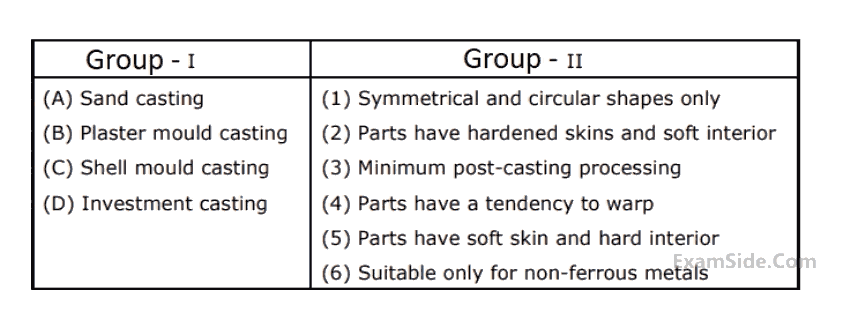
Match the following
Production Engineering - Casting
Two castings of the same metal have the same surface area one casting is in the form of a sphere and the other is a cube. What is the ratio of the solidification time for the sphere to that of cube.
Production Engineering - Casting
Light impurities in the molten metal are prevented from reaching the mold cavity by providing a
Answer: C
Production Engineering - Casting
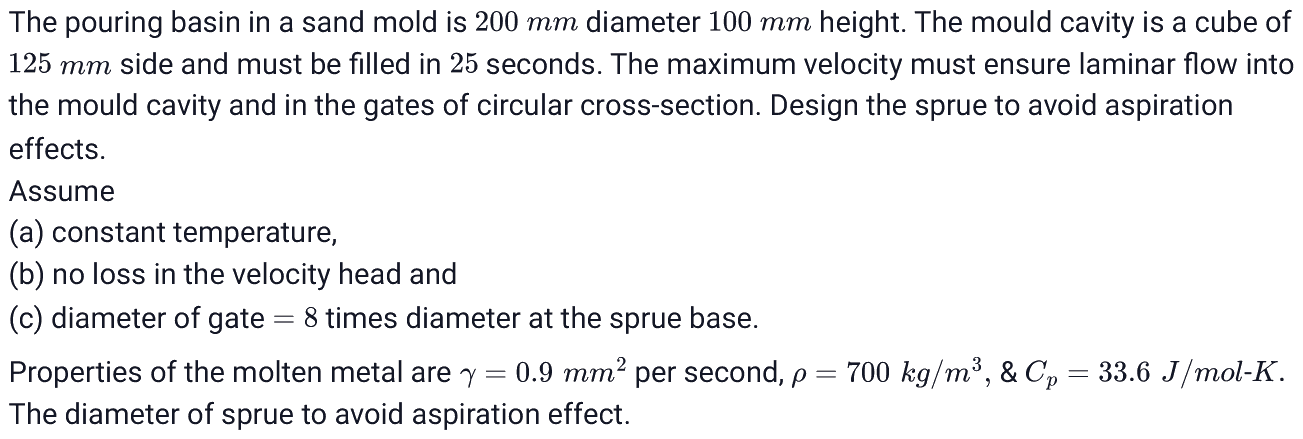
The pouring basin in a sand mold is diameter height. The mould cavity is a cube of side and must be filled in seconds. The maximum velocity must ensure laminar flow into the mould cavity and in the gates of circular cross-section. Design the sprue to avoid aspiration effects. Assume (a) constant temperature, (b) no loss in the velocity head and (c) diameter of gate times diameter at the sprue base. Properties of the molten metal are per second, & - The diameter of sprue to avoid aspiration effect.
Production Engineering - Casting
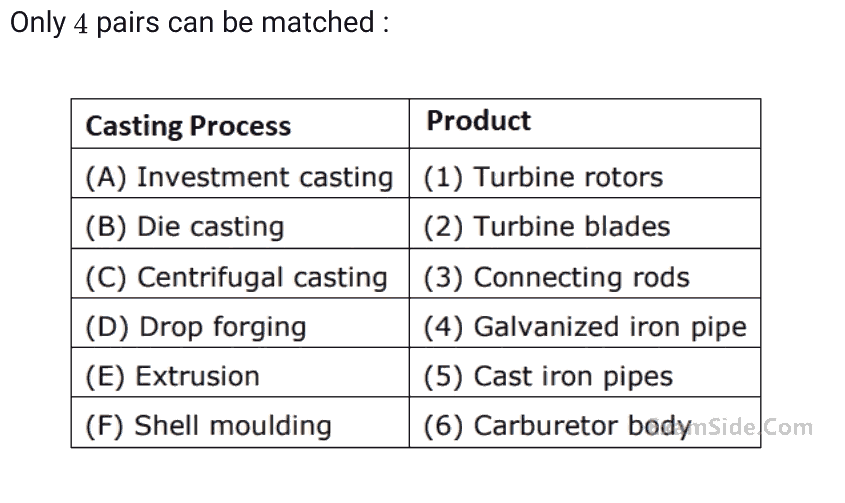
Only pairs can be matched :
Production Engineering - Casting
Centrifugally casted products have
Answer: B, C
Production Engineering - Casting
An aluminium cube of side has to be cast along with a cylindrical riser of height equal to its diameter. The riser is not insulated on any surface. If the volume shrinkage of aluminium during solidification is , calculate shrinkage volume of cube on solidification and minimum size of the riser so that it can provide the shrinkage volume.

Production Engineering - Casting
In a green sand moulding process, uniform ramming leads to
Answer: C
Production Engineering - Casting
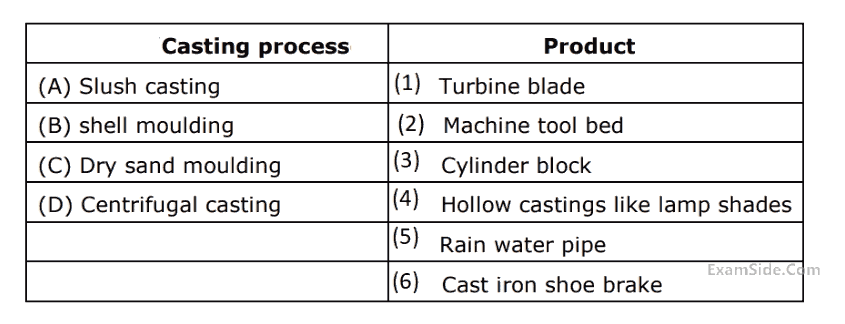
Match the following:
Production Engineering - Casting
Calculate the ratio of the solidification times of two steel cylindrical risers of sizes diameter by in height and diameter by in height subjected to identical conditions of cooling

Production Engineering - Casting
When there is no room temp change, the total shrinkage allowance on a pattern is INDEPENDENT OF
Answer: A
Production Engineering - Casting
Converging passage is used for feeding the liquid molten metal into the mould to
Answer: D
Production Engineering - Casting
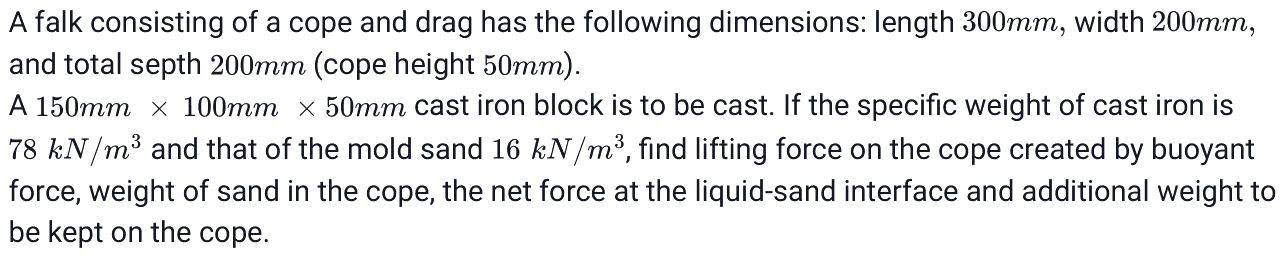
A falk consisting of a cope and drag has the following dimensions: length width and total septh (cope height ). A cast iron block is to be cast. If the specific weight of cast iron is and that of the mold sand , find lifting force on the cope created by buoyant force, weight of sand in the cope, the net force at the liquid-sand interface and additional weight to be kept on the cope.
Production Engineering - Casting
The pressure at the in-gate will be maximum with the gating system
Answer: C
Production Engineering - Casting
Chills are used in molds to
Answer: A
Production Engineering - Casting
Increase in water content in moulding sand causes
Answer: A
Production Engineering - Casting
Two cubical castings of the same metal and sizes of side and side are moulded in green sand. If the smaller casting solidifies in the expected time of solidifications of larger casting will be

Production Engineering - Casting
The contraction allowance provided on the pattern and core boxes compensates for the following type of contraction.
Answer: C
Production Engineering - Casting
Riser is designed so as to
Answer: A, C
Production Engineering - Casting
A down sprue of length has diameter of at its top end. The liquid metal in the pouring cup is main-tained upto height. What should be the theoretical diameter of down sprue at its lowest end to ensure that there is no aspiration effects.
