GATE ME Basic Concepts and Zeroth Law: Previous Year Questions
GATE ME (Mechanical Engineering) Basic Concepts and Zeroth Law previous year questions from Thermodynamics, with figures and the answer key.
Thermodynamics | All GATE ME papers
GATE ME 2023, Question 61 (2 marks, NAT)
Thermodynamics - Basic Concepts and Zeroth Law
Consider a mixture of two ideal gases, X and Y, with molar masses M̅$_{X}$ = 10 kg/kmol and M̅$_{Y}$ = 20 kg/kmol, respectively, in a container. The total pressure in the container is 100 kPa, the total volume of the container is 10 m$^{3}$ and the temperature of the contents of the container is 300 K. If the mass of gas-X in the container is 2 kg, then the mass of gas-Y in the container is ____ kg. (Rounded off to one decimal place) Assume that the universal gas constant is 8314 J kmol$^{-1}$K$^{-1}$.
Answer: 4
GATE ME 2022 Set 2, Question 23 (1 mark, MCQ)
Thermodynamics - Basic Concepts and Zeroth Law
Which one of the following is an intensive property of a thermodynamic system?
- Mass
- Density
- Energy
- Volume
Answer: B
GATE ME 2019 Set 1, Question 58 (2 marks, NAT)
Thermodynamics - Basic Concepts and Zeroth Law
Q.48 temperature is raised from 27 °C to 37 °C, the change in pressure ofthe contained gas (round off to two decimal places), assuming ideal gas behaviour, is Pa. (R=8.314 J/mol·K)

Answer: 82.14 to 84.14
GATE ME 2017 Set 1, Question 56 (1 mark, NAT)
Thermodynamics - Basic Concepts and Zeroth Law
The molar specific heat at constant volume of an ideal gas is equal to times the universal gas constant (). When the temperature increases by , the change in molar specific enthalpy is _______________

Answer: 2908 to 2911
GATE ME 2017 Set 2, Question 45 (2 marks, MCQ)
Thermodynamics - Basic Concepts and Zeroth Law
The volume and temperature of air (assumed to be an ideal gas) in a closed vessel is and respectively. The gauge pressure indicated by a manometer fitted to the wall of the vessel is bar. If the gas constant of air is and the atmospheric pressure is bar, the mass of air (in ) in the vessel is

Answer: C
GATE ME 2016 Set 2, Question 27 (1 mark, MCQ)
Thermodynamics - Basic Concepts and Zeroth Law
The internal energy of an ideal gas is a function of
- temperature and pressure
- volume and pressure
- entropy and pressure
- temperature only
Answer: D
GATE ME 2015 Set 1, Question 61 (2 marks, NAT)
Thermodynamics - Basic Concepts and Zeroth Law
Temperature of nitrogen in a vessel of volume is -tube manometer connected to the vessel shows a reading of of mercury (level higher in the end open to atmosphere). The universal gas constant is - atmospheric pressure is bar, acceleration due to gravity is and density of mercury is The mass of nitrogen (in ) in the vessel is _________

Answer: 4.4 to 4.6
GATE ME 2015 Set 2, Question 28 (1 mark, MCQ)
Thermodynamics - Basic Concepts and Zeroth Law
The Vander-waals equation of state is where is pressure, is specific volume, is temperature and is characteristic gas constant. The unit of a is

- -
Answer: C
GATE ME 2014 Set 3, Question 51 (2 marks, MCQ)
Thermodynamics - Basic Concepts and Zeroth Law
A certain amount of an ideal gas is initially at a pressure and temperature . First, it undergoes a constant pressure process - such that Then, it undergoes a constant volume process - such that The ratio of the final volume to the initial volume of the ideal gas is

Answer: B
GATE ME 2006, Question 13 (2 marks, MCQ)
Thermodynamics - Basic Concepts and Zeroth Law
Match items from groups, and
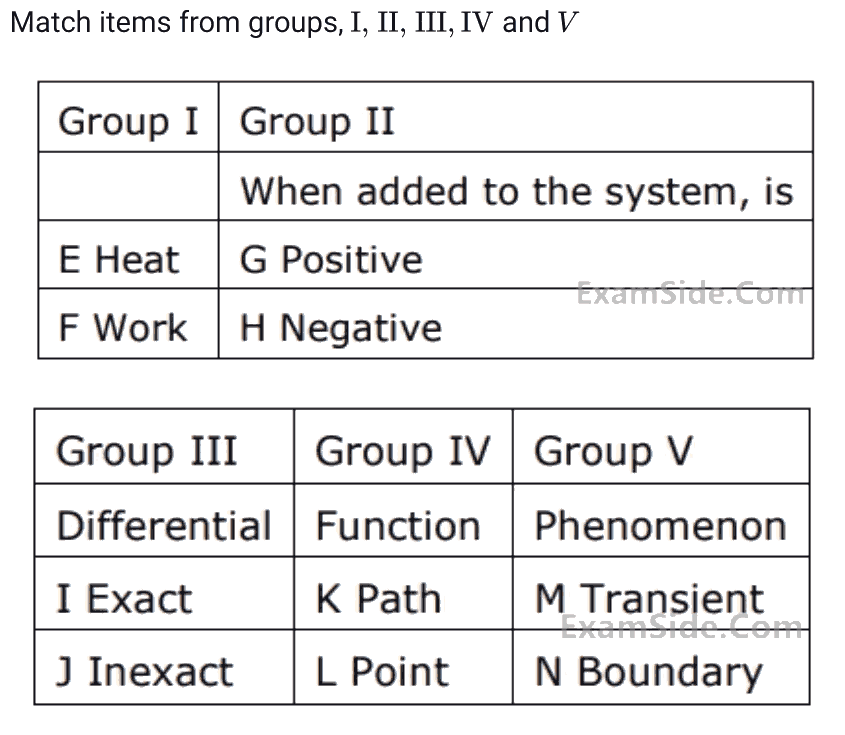
Answer: D
GATE ME 2006, Question 14 (2 marks, MCQ)
Thermodynamics - Basic Concepts and Zeroth Law
A football was inflated to a gauge pressure of bar when the ambient temperature was . When the game started next day, the air temperature at the stadium was . Assume that the volume of the football remains constant at The amount of heat lost by the air in the football and the gauge pressure of air in the football at the stadium respectively equal

- bar
- bar
- , bar
- bar
Answer: D
GATE ME 2006, Question 15 (2 marks, MCQ)
Thermodynamics - Basic Concepts and Zeroth Law
A football was inflated to a gauge pressure of bar when the ambient temperature was . When the game started next day, the air temperature at the stadium was . Assume that the volume of the football remains constant at Gauge pressure of air to which the ball must have been originally inflated so that it would equal bar gauge at the stadium is

- bar
- bar
- bar
- bar
Answer: C
GATE ME 1999, Question 16 (2 marks, MSQ)
Thermodynamics - Basic Concepts and Zeroth Law
An isolated thermodynamic system executes a process. Choose the correct statement from the following:

- No heat is transferred
- No work is done
- No mass flows across the boundary of the system
- No chemical reaction takes place within the system
Answer: A, B, C
GATE ME 1996, Question 5 (1 mark, MCQ)
Thermodynamics - Basic Concepts and Zeroth Law
The specific heats of an ideal gas depend on its
- Temperature
- Pressure
- Volume
- Molecular weight and structure
Answer: D
GATE ME 1996, Question 17 (2 marks, TEXT)
Thermodynamics - Basic Concepts and Zeroth Law
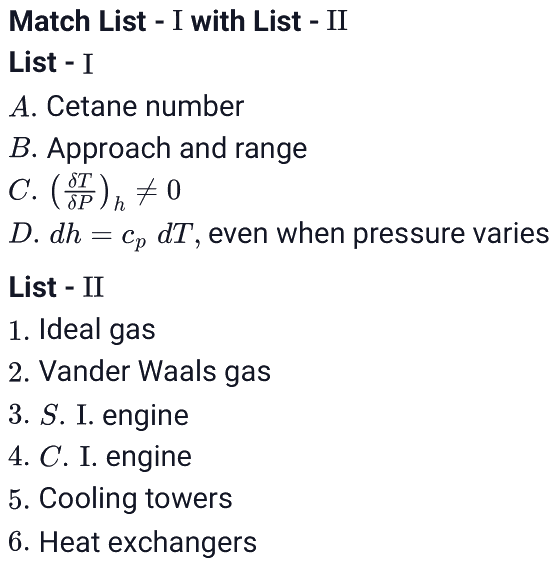
Match List - with List - List - Cetane number Approach and range even when pressure varies List - Ideal gas Vander Waals gas engine engine Cooling towers Heat exchangers
GATE ME 1994, Question 6 (1 mark, MCQ)
Thermodynamics - Basic Concepts and Zeroth Law
The definition of 1 K as per the internationally accepted temperature scale is
- the difference between normal boiling point and normal freezing point of water.
- the normal freezing point of water
- times the difference between the triple point of water and the normal freezing point of water.
- of the triple point of water.
Answer: D
GATE ME 1993, Question 7 (1 mark, MCQ)
Thermodynamics - Basic Concepts and Zeroth Law
A body of weight falls freely a vertical distance of .The atmospheric drag force is For the body, the work interaction is

Answer: D
GATE ME 1993, Question 8 (1 mark, MCQ)
Thermodynamics - Basic Concepts and Zeroth Law
An insulated rigid vessel contains a mixture of fuel and air. The mixture is ignited by a minute spark. The contents of the vessel experience.
- Increase in temperature, pressure and energy
- Decrease in temperature, pressure and energy
- Increase in temperature and pressure but no change in energy
- Increase in temperature and pressure but decreases in energy
Answer: C