GATE AE Viscous Flows & Boundary Layers: Previous Year Questions
GATE AE (Aerospace Engineering) Viscous Flows & Boundary Layers previous year questions from the Aerodynamics section, with figures and the official answer key where available.
All GATE AE papers
GATE AE 2025, Question 17 (1 mark, MCQ)
Aerodynamics - Viscous Flows & Boundary Layers
For a two-dimensional incompressible flow over a flat plate, the laminar boundary layer thickness at a distance $x$ from the leading edge is $\delta$. If $Re_x$ is the Reynolds number defined based on length scale $x$, $\left(\dfrac{\delta}{x}\right)$ is proportional to ______.
- $Re_x^{-1/2}$
- $Re_x^{-1}$
- $Re_x^{-3/2}$
- $Re_x^{-2}$
Official answer: A
GATE AE 2024, Question 42 (2 marks, MCQ)
Aerodynamics - Viscous Flows & Boundary Layers
Consider a flat plate, with a sharp leading edge, placed in a uniform flow of speed $U$. The direction of the free-stream flow is aligned with the plate. Assume that the flow is steady, incompressible and laminar. The thickness of the boundary layer at a fixed stream-wise location $L$ from the leading edge of the plate is $\delta$. Which one of the following correctly describes the variation of $\delta$ with $U$?
- $\delta \propto U$
- $\delta \propto U^{3/2}$
- $\delta \propto U^{1/2}$
- $\delta \propto U^{-1/2}$
Official answer: D
GATE AE 2023, Question 15 (1 mark, MCQ)
Aerodynamics - Viscous Flows & Boundary Layers
Consider the Blasius solution for the incompressible laminar flat plate boundary layer. Among the following options, select the correct relation for the development of the momentum thickness $\theta$ with distance $x$ from the leading edge along the length of the plate.
- $\theta \propto x^{2/3}$
- $\theta \propto x^{1/2}$
- $\theta \propto x^{1/7}$
- $\theta \propto x^{-2/3}$
Official answer: B
GATE AE 2022, Question 17 (1 mark, MCQ)
Aerodynamics - Viscous Flows & Boundary Layers
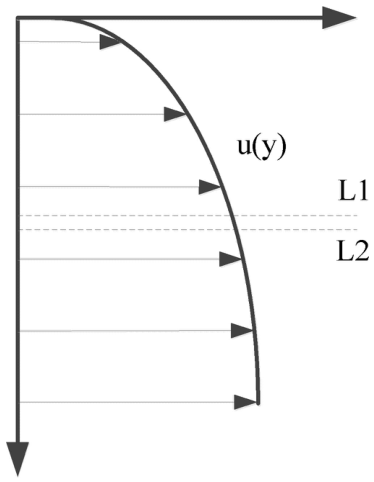
Consider the velocity distribution, $u(y)$ shown in the figure. For two adjacent fluid layers L1 and L2, the viscous force exerted by L1 on L2 is
- to the right
- to the left
- vertically upwards
- vertically downwards
Official answer: B
GATE AE 2022, Question 52 (2 marks, NAT)
Aerodynamics - Viscous Flows & Boundary Layers
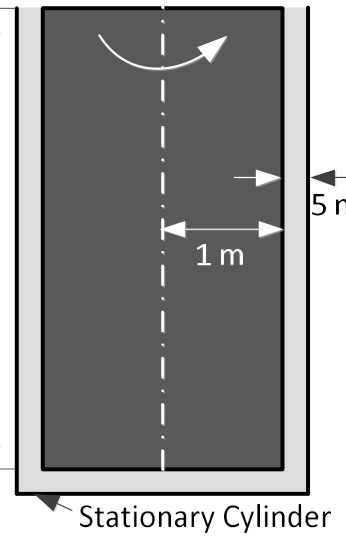
Consider a solid cylinder housed inside another cylinder as shown in the figure. Radius of the inner cylinder is 1 m and its height is 2 m. The gap between the cylinders is 5 mm and is filled with a fluid of viscosity $10^{-4}$ Pa-s. The inner cylinder is rotating at a constant angular speed of 5 rad/s while the outer cylinder is stationary. Friction at the bottom surfaces can be ignored. Velocity profile in the vertical gap between the cylinders can be assumed to be linear. The driving moment required for the rotating motion of the inner cylinder is ____________ Nm (rounded off to two decimal places).
Official answer: 1.24 to 1.28
GATE AE 2018, Question 18 (1 mark, MCQ)
Aerodynamics - Viscous Flows & Boundary Layers
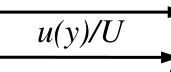
The velocity profile in an incompressible, laminar boundary layer is shown in the figure below. $U$ is the free-stream velocity, $u(y)$ is the stream-wise velocity component. The area of the black shaded region in the figure below represents the
- boundary layer thickness.
- momentum thickness.
- displacement thickness.
- shape factor.
Official answer: C
GATE AE 2018, Question 57 (2 marks, NAT)
Aerodynamics - Viscous Flows & Boundary Layers
The boundary layer thickness at the location of a sensor on a flat plate in an incompressible, laminar flow of air is required to be restricted to 1 mm for an effective measurement. If the flow velocity is 20 m/s with 1 bar pressure, 300 K temperature, and $1.789 \times 10^{-5}$ kg/(m-s) viscosity, the maximum distance (in mm) of the sensor location from the leading edge is ________ (accurate to one decimal place).
Official answer: 47.0 to 55.0
GATE AE 2016, Question 14 (1 mark, MCQ)
Aerodynamics - Viscous Flows & Boundary Layers
For a laminar incompressible flow past a flat plate at zero angle of attack, the variation of skin friction drag coefficient ($C_f$) with Reynolds number based on the chord length ($Re_c$) can be expressed as
- $C_f \propto \sqrt{Re_c}$
- $C_f \propto Re_c$
- $C_f \propto \dfrac{1}{\sqrt{Re_c}}$
- $C_f \propto \dfrac{1}{Re_c}$
Official answer: C
GATE AE 2016, Question 18 (1 mark, MCQ)
Aerodynamics - Viscous Flows & Boundary Layers
Air, with a Prandtl number of 0.7, flows over a flat plate at a high Reynolds number. Which of the following statement is TRUE?
- Thermal boundary layer is thicker than the velocity boundary layer.
- Thermal boundary layer is thinner than the velocity boundary layer.
- Thermal boundary layer is as thick as the velocity boundary layer.
- There is no relationship between the thicknesses of thermal and velocity boundary layers.
Official answer: A