GATE AE Structural Dynamics: Previous Year Questions
GATE AE (Aerospace Engineering) Structural Dynamics previous year questions from the Structures section, with figures and the official answer key where available.
All GATE AE papers
GATE AE 2026, Question 33 (1 mark, NAT)
Structures - Structural Dynamics
The response $x(t)$ of a freely vibrating single degree of freedom underdamped system is given below. In the equation, $A$ and $\phi$ are constants. The damping ratio of the system is ________ (rounded off to 3 decimal places). $$x(t) = A e^{-5t}\sin(10t + \phi)$$
Official answer: 0.440 to 0.450
GATE AE 2026, Question 59 (2 marks, NAT)
Structures - Structural Dynamics
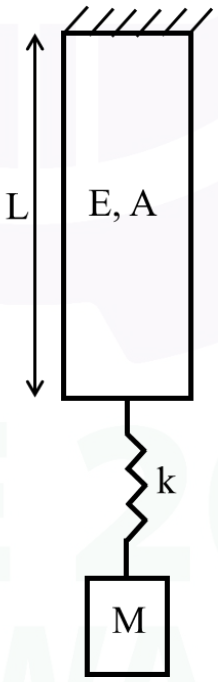
A system comprising a bar, spring and mass is shown in the figure below. The bar, having negligible mass, is made of a material having Young's modulus $E = 200$ GPa, cross-sectional area $A = 100$ mm$^2$, and length $L = 100$ mm. The spring stiffness $k = 200$ kN/mm and the mass $M = 100$ kg. The natural frequency of free vibration of the system is ________ rad/s (rounded off to the nearest integer).
Official answer: 1000
GATE AE 2025, Question 57 (2 marks, NAT)
Structures - Structural Dynamics
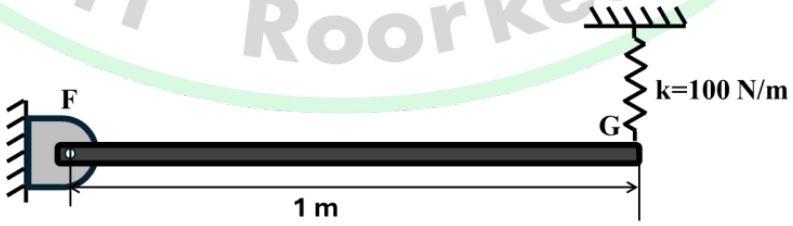
A uniform rigid bar of mass 3 kg is hinged at point F, and supported by a spring of stiffness k = 100 N/m, as shown in the figure. The natural frequency of free vibration of the system is ____ rad/s (answer in integer).
Official answer: 10
GATE AE 2024, Question 14 (1 mark, MCQ)
Structures - Structural Dynamics
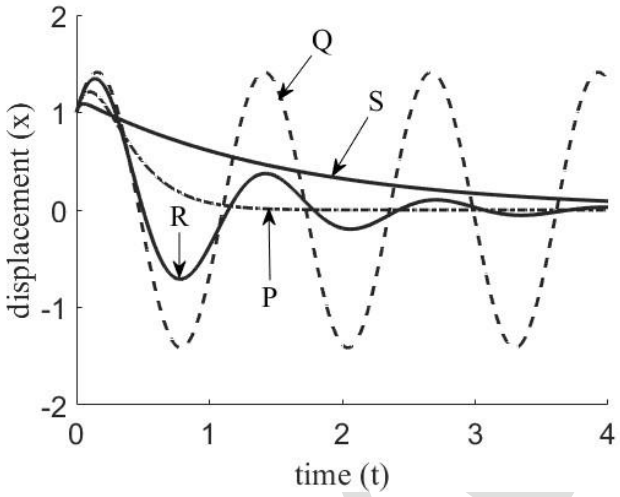
Consider the free vibration responses $P$, $Q$, $R$ and $S$ (shown in the figure) of a single degree of freedom spring-mass-damper system with the same initial conditions. For the different damping cases listed below, which one of the following options is correct? 1. Overdamped 2. Underdamped 3. Critically damped 4. Undamped
- P – 1, Q – 4, R – 2, S – 3
- P – 1, Q – 2, R – 4, S – 3
- P – 3, Q – 4, R – 2, S – 1
- P – 3, Q – 2, R – 4, S – 1
Official answer: C
GATE AE 2024, Question 15 (1 mark, MCQ)
Structures - Structural Dynamics
For a single degree of freedom spring-mass-damper system subjected to harmonic forcing, the part of the motion (response) that decays due to damping is known as:
- transient response
- steady-state response
- harmonic response
- non-transient response
Official answer: A
GATE AE 2024, Question 55 (2 marks, NAT)
Structures - Structural Dynamics
The equations of motion for a two degrees of freedom undamped spring-mass system are: $$m\ddot{x}_1 + 2kx_1 - kx_2 = 0$$ $$m\ddot{x}_2 - kx_1 + 2kx_2 = 0$$ where $m$ and $k$ represent mass and stiffness respectively, in corresponding SI units, and $x_1$ and $x_2$ are the degrees of freedom. The larger of the two natural frequencies is given by: $\omega = \alpha\sqrt{\dfrac{k}{m}}$ rad/s. The value of $\alpha$ is ________ (rounded off to 2 decimal places).
Official answer: 1.72 to 1.74
GATE AE 2023, Question 25 (1 mark, MSQ)
Structures - Structural Dynamics
Which of the following statement(s) is/are true about harmonically excited forced vibration of a single degree-of-freedom linear spring-mass-damper system?
- The total response of the mass is a combination of free vibration transient and steady-state response.
- The free vibration transient dies out with time for each of the three possible conditions of damping (under-damped, critically damped, and over-damped).
- The steady-state periodic response is dependent on the initial conditions at the time of application of external forcing.
- The rate of decay of free vibration transient response depends on the mass, spring stiffness and damping constant.
Official answer: A, B, D
GATE AE 2023, Question 30 (1 mark, NAT)
Structures - Structural Dynamics
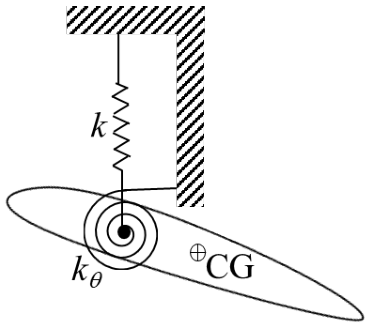
For studying wing vibrations, a wing of mass $M$ and finite dimensions has been idealized by assuming it to be supported using a linear spring of equivalent stiffness $k$ and a torsional spring of equivalent stiffness $k_\theta$ as shown in the figure. The centre of gravity (CG) of the wing idealized as an airfoil is marked in the figure. The number of degree(s) of freedom for this idealized wing vibration model is ________. (Answer in integer)
Official answer: 2
GATE AE 2023, Question 51 (2 marks, NAT)
Structures - Structural Dynamics
A single degree-of-freedom spring-mass-damper system has viscous damping ratio of 0.1. The mass is given an initial displacement of 10 cm without imparting any velocity. After exactly two complete cycles of oscillation (i.e., after time $2T_d$, where $T_d$ is the period of the damped vibration), the amplitude of the displacement is ______ cm. (round off to two decimal place)
Official answer: 2.80 to 2.86
GATE AE 2022, Question 62 (2 marks, NAT)
Structures - Structural Dynamics
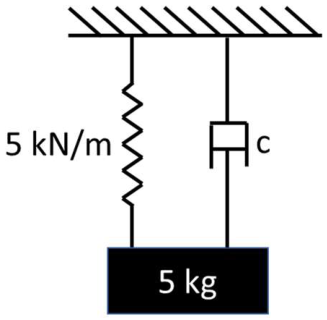
A damper with damping coefficient, $c$, is attached to a mass of 5 kg and spring of stiffness 5 kN/m as shown in figure. The system undergoes under-damped oscillations. If the ratio of the 3$^{\text{rd}}$ amplitude to the 4$^{\text{th}}$ amplitude of oscillations is 1.5, the value of $c$ is ____ Ns/m (rounded off to the nearest integer).
Official answer: 19 to 21
GATE AE 2022, Question 63 (2 marks, NAT)
Structures - Structural Dynamics
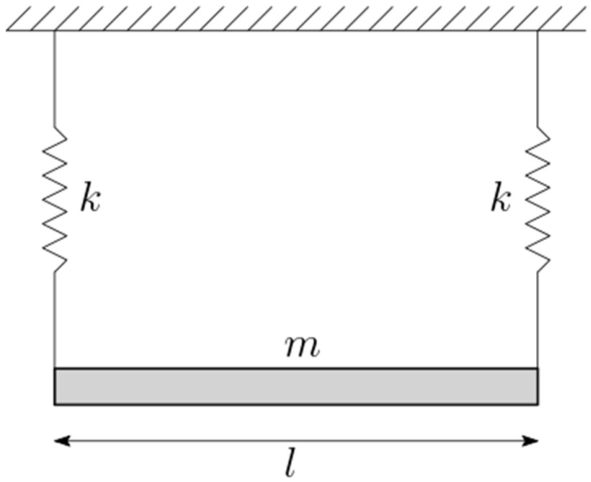
A uniform rigid prismatic bar of total mass $m$ is suspended from a ceiling by two identical springs as shown in figure. Let $\omega_1$ and $\omega_2$ be the natural frequencies of mode I and mode II respectively ($\omega_1 < \omega_2$). The value of $\omega_2/\omega_1$ is _________ (rounded off to one decimal place).
Official answer: 1.7 to 1.8
GATE AE 2018, Question 32 (1 mark, NAT)
Structures - Structural Dynamics
For a damped single degree of freedom system with damping ratio of 0.1, ratio of two successive peak amplitudes of free vibration is ___________ (accurate to two decimal places).
Official answer: 1.75 to 1.95
GATE AE 2018, Question 33 (1 mark, NAT)
Structures - Structural Dynamics
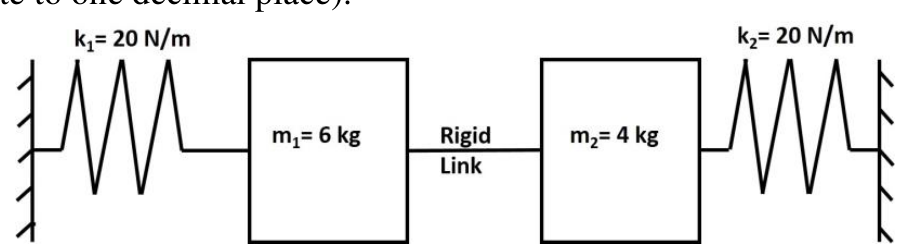
The natural frequency (in rad/s) of the spring-mass system shown in the figure below is _____ (accurate to one decimal place). (Springs $k_1 = k_2 = 20$ N/m; masses $m_1 = 6$ kg and $m_2 = 4$ kg joined by a rigid link.)
Official answer: 2
GATE AE 2018, Question 60 (2 marks, NAT)
Structures - Structural Dynamics
A 1 m long massless cantilever beam oscillates at 2 Hz, while a 60 kg mass is attached at the tip of it. The flexural rigidity of the beam (in kN-m$^2$) is _________________ (accurate to two decimal places).
Official answer: 3.10 to 3.20
GATE AE 2016, Question 24 (1 mark, NAT)
Structures - Structural Dynamics
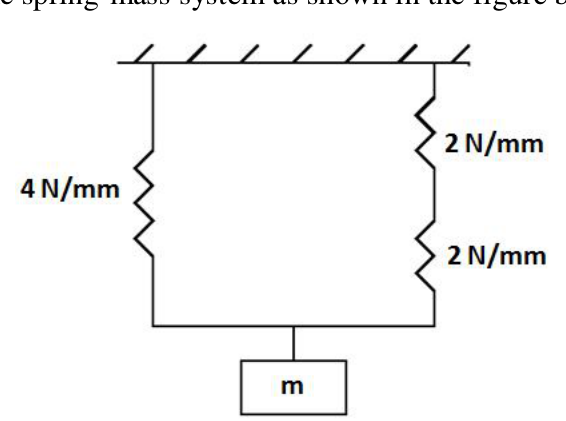
The effective stiffness of the spring-mass system as shown in the figure below is ____ N/mm.
Official answer: 5
GATE AE 2016, Question 51 (2 marks, NAT)
Structures - Structural Dynamics
The governing differential equation of motion of a damped system is given by $m\dfrac{d^2x}{dt^2} + c\dfrac{dx}{dt} + kx = 0$. If $m = 1$ kg, $c = 2$ Ns/m and $k = 2$ N/m then the frequency of the damped oscillation of this system is ____ rad/s.
Official answer: 0.99 to 1.01
GATE AE 2014, Question 24 (1 mark, NAT)
Structures - Structural Dynamics
A damped single degree of freedom system whose undamped natural frequency, $\omega_n = 10$ Hz, is subjected to sinusoidal external force. Power is half of the maximum for the two frequencies of 60.9469 rad/s and 64.7168 rad/s. The damping factor associated with the vibrating system (in %) is _______.
Official answer: 2.95 to 3.05
GATE AE 2014, Question 25 (1 mark, MCQ)
Structures - Structural Dynamics
The boundary conditions for a rod with circular cross-section, under torsional vibration, are changed from fixed-free to fixed-fixed. The fundamental natural frequency of the fixed-fixed rod is $k$ times that of fixed-free rod. The value of $k$ is
- 1.5
- $\pi$
- 2.0
- 0.5
Official answer: C
GATE AE 2014, Question 53 (2 marks, MCQ)
Structures - Structural Dynamics
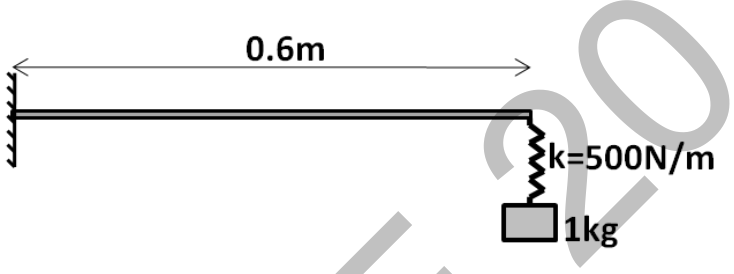
A 1 kg mass is hanging from a spring of stiffness 500 N/m attached to a massless, symmetric beam of length 0.6 m, moment of inertia about the bending axis $I = 8.33 \times 10^{-10}$ m$^4$ and Young's modulus $E = 210$ GPa as shown in the figure. The fundamental natural frequency (in rad/s) of the system is
- 3.24
- 20.36
- 22.36
- 3.56
Official answer: B
GATE AE 2014, Question 54 (2 marks, MCQ)
Structures - Structural Dynamics
A single degree of freedom system is vibrating with initial (first cycle) amplitude of 5 cm. The viscous damping factor associated with the vibrating system is 2%. Vibration amplitude of the fifth cycle (in cm) is
- 1.65
- 4.41
- 2.67
- 3.02
Official answer: D