GATE AE Space Dynamics: Previous Year Questions
GATE AE (Aerospace Engineering) Space Dynamics previous year questions from the Flight Mechanics & Space Dynamics section, with figures and the official answer key where available.
All GATE AE papers
GATE AE 2026, Question 36 (2 marks, MCQ)
Flight Mechanics & Space Dynamics - Space Dynamics
An earth satellite has the instantaneous position vector $\vec{r}$ and velocity vector $\vec{v}$ as given below. Here $\hat{p}$ and $\hat{q}$ denote the unit vectors along the $x$ and $y$ axes of the perifocal frame, respectively. Assume that the value of gravitational parameter is 398600 km$^3$/s$^2$. Which one of the following trajectories does the satellite follow? $$\vec{r} = (8000\hat{p} + 9000\hat{q})\ \text{km and } \vec{v} = (-6\hat{p} + 6\hat{q})\ \text{km/s}$$
- Circle
- Hyperbola
- Parabola
- Straight line
Official answer: B
GATE AE 2026, Question 55 (2 marks, NAT)
Flight Mechanics & Space Dynamics - Space Dynamics
An earth satellite moves in an elliptical orbit with a perigee altitude of 300 km and an apogee altitude of 3000 km. Assume that the radius of the earth is 6378 km. The eccentricity of the orbit is __________ (rounded off to three decimal places).
Official answer: 0.167 to 0.169
GATE AE 2025, Question 53 (2 marks, NAT)
Flight Mechanics & Space Dynamics - Space Dynamics
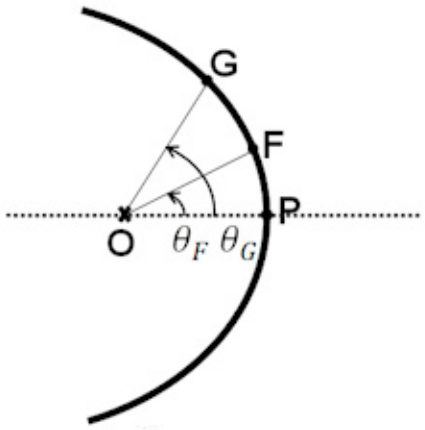
F and G denote two points on a spacecraft's orbit around a planet, as indicated in the figure. O is the center of the planet, P is the periapsis, and the angles are as indicated in the figure. If OF = 8000 km, OG = 10000 km, $\theta_F = 0$ deg, and $\theta_G = 60$ deg, the eccentricity of the spacecraft's orbit is ____ (rounded off to two decimal places).
Official answer: 0.66 to 0.67
GATE AE 2024, Question 26 (1 mark, MSQ)
Flight Mechanics & Space Dynamics - Space Dynamics
Which of the following statements is/are correct about a satellite moving in a geostationary orbit?
- The orbit lies in the equatorial plane
- The orbit is circular about the center of the Earth
- The time period of motion is 90 minutes
- The satellite is visible from all parts of the Earth
Official answer: A, B
GATE AE 2024, Question 39 (2 marks, MCQ)
Flight Mechanics & Space Dynamics - Space Dynamics
At a point in the trajectory of an unpowered space vehicle moving about the Earth, the altitude above the mean sea level is 600 km, and the speed with reference to a coordinate system fixed to the center of mass of the Earth is 9 km/s. Assume that the Earth is a sphere with a radius of 6400 km and $GM_{Earth} = 3.98 \times 10^{14}$ m$^3$/s$^2$, where, $G$ is the universal gravitational constant and $M_{Earth}$ is mass of the Earth. The trajectory is:
- Circular
- Elliptic
- Parabolic
- Hyperbolic
Official answer: B
GATE AE 2024, Question 60 (2 marks, NAT)
Flight Mechanics & Space Dynamics - Space Dynamics
Consider an artificial satellite moving around the Moon in an elliptic orbit. The altitude of the satellite from the Moon’s surface at the perigee is 25 km and that at the apogee is 134 km. Assume the Moon to be spherical with a radius of 1737 km. The trajectory is considered with reference to a coordinate system fixed to the center of mass of the Moon. The ratio of the speed of the satellite at the perigee to that at the apogee is ___________ (rounded off to 2 decimal places).
Official answer: 1.05 to 1.07
GATE AE 2023, Question 24 (1 mark, MCQ)
Flight Mechanics & Space Dynamics - Space Dynamics
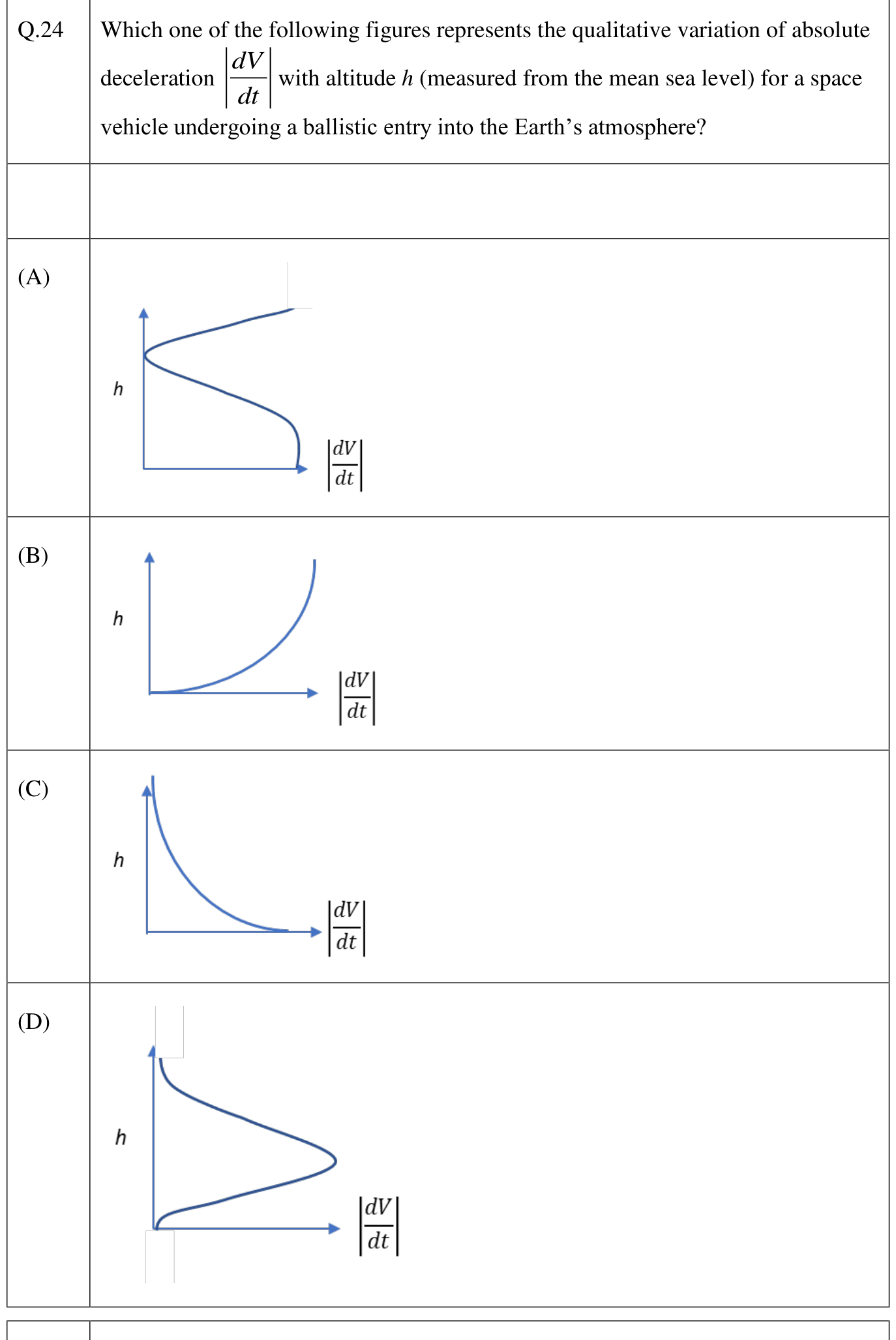
Which one of the following figures represents the qualitative variation of absolute deceleration $\left|\dfrac{dV}{dt}\right|$ with altitude $h$ (measured from the mean sea level) for a space vehicle undergoing a ballistic entry into the Earth's atmosphere?
Official answer: D
GATE AE 2023, Question 62 (2 marks, NAT)
Flight Mechanics & Space Dynamics - Space Dynamics
The universal gravitational constant is $6.67 \times 10^{-11}$ Nm$^2$/kg$^2$. For a planet of mass $6.4169 \times 10^{23}$ kg and radius 3390 km, the escape velocity is _____ km/s. (round off to one decimal place).
Official answer: 4.9 to 5.1
GATE AE 2023, Question 63 (2 marks, NAT)
Flight Mechanics & Space Dynamics - Space Dynamics
A satellite is in a circular orbit around Earth with a time period of 90 minutes. The radius of Earth is 6370 km, mass of Earth is $5.98 \times 10^{24}$ kg and the universal gravitational constant is $6.67 \times 10^{-11}$ Nm$^2$/kg$^2$. The altitude of the satellite above mean sea level is ____ km. (round off to the nearest integer)
Official answer: 260 to 300
GATE AE 2022, Question 46 (2 marks, MSQ)
Flight Mechanics & Space Dynamics - Space Dynamics
Consider a high Earth-orbiting satellite of angular momentum per unit mass $\vec{h}$ and eccentricity $e$. The mass of the Earth is $M$ and $G$ is the universal gravitational constant. The distance between the satellite's center of mass and the Earth's center of mass is $r$, the true anomaly is $\theta$, and the phase angle is zero. Which of the following statements is/are true?
- The trajectory equation is $r = r(\theta) = \dfrac{|\vec{h}|}{GM(1 + e\cos\theta)}$
- The trajectory equation is $r = r(\theta) = \dfrac{|\vec{h}|^2}{GM(1 + e\cos\theta)}$
- $\vec{h}$ is conserved
- The sum of potential energy and kinetic energy of the satellite is conserved
Official answer: B, C, D
GATE AE 2018, Question 19 (1 mark, MCQ)
Flight Mechanics & Space Dynamics - Space Dynamics
The tangential velocity component 'V' of a spacecraft, which is in a circular orbit of radius 'R' around a spherical Earth ($\mu = GM$, gravitational parameter of Earth) is given by the following expression.
- $V = \sqrt{\dfrac{\mu}{2R}}$
- $V = \sqrt{\dfrac{\mu}{R}}$
- $V = \dfrac{2\pi}{\sqrt{\mu}}R^{3/2}$
- $V = \dfrac{2\pi}{\sqrt{\mu}}R^{2/3}$
Official answer: B
GATE AE 2018, Question 20 (1 mark, MCQ)
Flight Mechanics & Space Dynamics - Space Dynamics
Equation of the trajectory of a typical space object around any planet, in polar coordinates $(r, \tau)$ (i.e. a general conic section geometry), is given as follows. ($h$ is angular momentum, $\mu$ is gravitational parameter, $e$ is eccentricity, $r$ is radial distance from the planet center, $\tau$ is angle between vectors $\vec{e}$ and $\vec{r}$.
- $r = \dfrac{h^2/\mu}{1 - e\cos\tau}$
- $r = \dfrac{h^2/\mu}{e - \cos\tau}$
- $r = \dfrac{h^2/\mu}{1 + e\cos\tau}$
- $r = \dfrac{h^2/\mu}{e + \cos\tau}$
Official answer: C
GATE AE 2018, Question 21 (1 mark, MCQ)
Flight Mechanics & Space Dynamics - Space Dynamics
In an elliptic orbit around any planet, the location at which a spacecraft has the maximum angular velocity is
- apoapsis.
- periapsis.
- a point at $+45^\circ$ from periapsis.
- a point at $90^\circ$ from apoapsis.
Official answer: B
GATE AE 2018, Question 54 (2 marks, NAT)
Flight Mechanics & Space Dynamics - Space Dynamics
A spacecraft forms a circular orbit at an altitude of 150 km above the surface of a spherical Earth. Assuming the gravitational parameter, $\mu = 3.986 \times 10^{14}$ m$^3$/s$^2$ and radius of earth, $R_E = 6{,}400$ km, the velocity required for the injection of the spacecraft, parallel to the local horizon, is _______________ (accurate to two decimal places).
GATE AE 2016, Question 65 (2 marks, MCQ)
Flight Mechanics & Space Dynamics - Space Dynamics
A satellite is injected at an altitude of 350 km above the Earth's surface, with a velocity of 8.0 km/s parallel to the local horizon. (Earth radius = 6378 km, $\mu_E$ ($GM$ = Gravitational constant $\times$ Earth mass) = $3.986 \times 10^{14}$ m$^3$s$^{-2}$). The satellite
- forms a circular orbit.
- forms an elliptic orbit.
- escapes from Earth's gravitational field.
- falls back to earth.
Official answer: B
GATE AE 2014, Question 35 (1 mark, NAT)
Flight Mechanics & Space Dynamics - Space Dynamics
Considering $R$ as the radius of the moon, the ratio of the velocities of two spacecraft orbiting moon in circular orbit at altitudes $R$ and $2R$ above the surface of the moon is ________.
Official answer: 1.2 to 1.25