GATE AE Engine Performance: Previous Year Questions
GATE AE (Aerospace Engineering) Engine Performance previous year questions from the Propulsion section, with figures and the official answer key where available.
All GATE AE papers
GATE AE 2026, Question 24 (1 mark, MSQ)
Propulsion - Engine Performance
For a given air-standard power, the propulsive efficiency of a turbofan engine is more than that of a turbojet engine. Which of the following is/are the reason(s) for this?
- The mass flow rate is more for a turbofan engine
- The exit velocity is lower for a turbofan engine
- A turbofan engine operates at a lower altitude
- The fan of a turbofan engine consumes lesser power
Official answer: A, B
GATE AE 2026, Question 38 (2 marks, MCQ)
Propulsion - Engine Performance
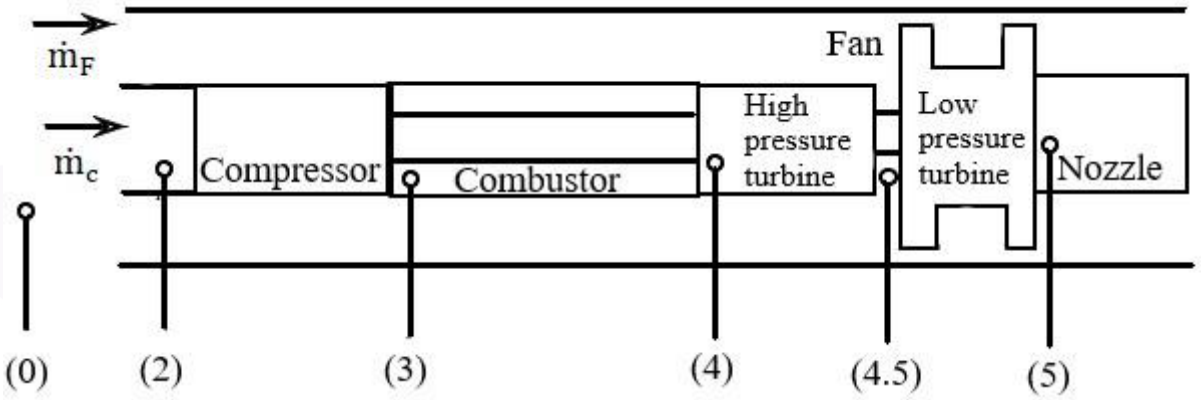
In an ideal turbofan engine shown in the figure below, the compressor is driven by the high pressure turbine, and the fan is driven by the low pressure turbine. The stations 0, 2, 3, 4, 4.5, and 5 refer to free-stream, compressor inlet, compressor outlet, combustor exit, high pressure turbine exit, and low pressure turbine exit, respectively, and the subscript 't' refers to the total condition. Also, $\tau_r = T_{t0}/T_0$, $\tau_c = T_{t3}/T_{t2}$ and $\tau_\lambda = T_{t4}/T_0$. The total temperature ratio of the high pressure turbine ($T_{t4.5}/T_{t4}$) is given by ______.
- $1 - \dfrac{\tau_r}{\tau_\lambda}(\tau_c - 1)$
- $1 + \dfrac{\tau_r}{\tau_\lambda}(\tau_c + 1)$
- $1 - \dfrac{\tau_r}{\tau_\lambda}(\tau_c + 1)$
- $1 + \dfrac{\tau_r}{\tau_\lambda}(\tau_c - 1)$
Official answer: A
GATE AE 2026, Question 44 (2 marks, MSQ)
Propulsion - Engine Performance
Which of the following process(es) is/are involved in the compression of air in an ideal ramjet engine?
- oblique shock
- mechanical compression
- normal shock
- subsonic diffusion
Official answer: A, C, D
GATE AE 2025, Question 61 (2 marks, NAT)
Propulsion - Engine Performance
An ideal turbofan with a bypass ratio of 5 has core mass flow rate, $\dot{m}_{a,c} = 100$ kg/s. The core and the fan exhausts are separate and optimally expanded. The core exhaust speed is 600 m/s and the fan exhaust speed is 120 m/s. If the fuel mass flow rate is negligible in comparison to $\dot{m}_{a,c}$, the static specific thrust ($T/\dot{m}_{a,c}$) developed by the engine is ____ Ns/kg (rounded off to the nearest integer).
Official answer: 1200
GATE AE 2025, Question 64 (2 marks, NAT)
Propulsion - Engine Performance
An ideal ramjet with an optimally expanded exhaust is travelling at Mach 3. The ambient temperature and pressure are 260 K and 60 kPa, respectively. The inlet air mass flow rate is 50 kg/s. Exit temperature of the exhaust gases is 700 K. Fuel mass flow rate is negligible compared to air mass flow rate. Gas constant is R = 287 J/kg/K, and specific heat ratio is $\gamma = 1.4$. The thrust generated by the engine is ___ kN (rounded off to one decimal place).
Official answer: 30.9 to 31.2
GATE AE 2024, Question 34 (1 mark, NAT)
Propulsion - Engine Performance
An aircraft with a turbojet engine is flying with 250 m/s speed at an altitude, where the density of air is 1 kg/m$^3$. The inlet area of the engine is 1 m$^2$. The average velocity of the exhaust gases at the exit of the nozzle, with respect to aircraft, is 550 m/s. Assume the engine exit pressure is equal to the ambient pressure and the fuel-air ratio is negligible. The uninstalled thrust produced by the engine at these conditions is _________ N (rounded off to the nearest integer).
Official answer: 75000
GATE AE 2024, Question 41 (2 marks, MCQ)
Propulsion - Engine Performance
An aircraft with a turbojet engine is flying at 250 m/s. The uninstalled thrust produced by the engine is 60000 N. The heating value of the fuel is $44 \times 10^6$ J/kg. The engine has a thermal efficiency of 35% while burning the fuel at a rate of 3 kg/s. Assume the engine exit pressure to be equal to the ambient pressure. What is the propulsion efficiency of the engine under these conditions (in percentage)?
- 32.5
- 35.0
- 11.4
- 92.4
Official answer: A
GATE AE 2023, Question 22 (1 mark, MCQ)
Propulsion - Engine Performance
An aircraft is cruising with a forward speed $V_a$ and the jet exhaust speed relative to the engine at the exit is $V_j$. If $V_j/V_a = 2$, what is the propulsive efficiency?
- 0.50
- 1.00
- 0.33
- 0.67
Official answer: D
GATE AE 2023, Question 28 (1 mark, MSQ)
Propulsion - Engine Performance
From the options given, select all that are true for turbofan engines with afterburners.
- Turning afterburner ON increases specific fuel consumption.
- Turbofan engines with afterburners have variable area nozzles.
- Turning afterburner ON decreases specific fuel consumption.
- Turning afterburner ON increases stagnation pressure across the engine.
Official answer: A, B
GATE AE 2023, Question 35 (1 mark, NAT)
Propulsion - Engine Performance
A supersonic vehicle powered by a ramjet engine is cruising at a speed of 1000 m/s. The ramjet engine burns hydrogen in a subsonic combustor to produce thrust. The heat of combustion for hydrogen is 120 MJ/kg. The overall efficiency of the engine $\eta_o$, defined as the ratio of propulsive power to the total heat release in the combustor, is 40%. Taking acceleration due to gravity $g_0 = 10$ m/s$^2$, the specific impulse of the engine is _____________ seconds. (round off to the nearest integer).
Official answer: 4800 to 4900
GATE AE 2023, Question 41 (2 marks, MCQ)
Propulsion - Engine Performance
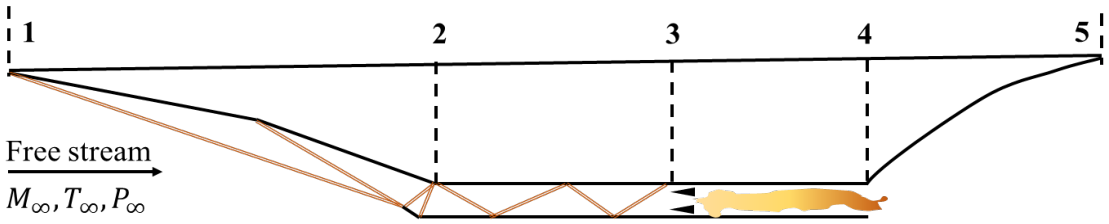
A scramjet engine features an intake, isolator, combustor, and a nozzle, as shown in the schematic. Station 3 indicates the combustor entry point. Assume stagnation enthalpy to be constant between Stations 1 and 3, and air to be a calorically perfect gas with specific heat ratio $\gamma$. Select the correct expression for Mach number $M_3$ at the inlet to the combustor from the options given.
- $M_3 = M_\infty\sqrt{\left(\dfrac{2}{\gamma-1}\right)\left(\dfrac{T_\infty}{T_3} - 1\right)}$
- $M_3 = \sqrt{\left(\dfrac{2}{\gamma-1}\right)\left\{\dfrac{T_\infty}{T_3}\left[1 + \left(\dfrac{\gamma-1}{2}\right)M_\infty^2\right] - 1\right\}}$
- $M_3 = M_\infty\sqrt{\dfrac{T_\infty}{T_3}}$
- $M_3 = \sqrt{\left(\dfrac{\gamma+1}{2}\right)\left(\dfrac{T_\infty}{T_3} - 1\right)M_\infty^2 - 1}$
Official answer: B
GATE AE 2022, Question 34 (1 mark, NAT)
Propulsion - Engine Performance
In a static test, a turbofan engine with bypass ratio of 9 has core hot exhaust speed 1.5 times that of fan exhaust speed. The engine is operated at a fuel to air ratio of $f = 0.03$. Both the fan and the core streams have no pressure thrust. The ratio of fan thrust to thrust from the core engine is _____ (round off to one decimal place).
Official answer: 5.7 to 6.0
GATE AE 2022, Question 64 (2 marks, NAT)
Propulsion - Engine Performance
An ideal ramjet is to operate with exhaust gases optimally expanded to ambient pressure at an altitude where temperature is 220 K. The exhaust speed at the nozzle exit is 1200 m/s at a temperature of 1100 K. Given: $\gamma = 1.4$ at 220 K; $R = 287$ J/(kg-K) for air; $\gamma = 1.33$ at 1100 K; $R = 287$ J/(kg-K) for exhaust gases. The cruise speed of this ramjet is ________ m/s (rounded off to nearest integer).
Official answer: 545 to 555
GATE AE 2018, Question 34 (1 mark, NAT)
Propulsion - Engine Performance
The stagnation pressures at the inlet and exit of a subsonic intake are 100 kPa and 98 kPa, respectively. The pressure recovery of this intake will be ______ (accurate to two decimal places).
Official answer: 0.98
GATE AE 2018, Question 42 (2 marks, MCQ)
Propulsion - Engine Performance
An aircraft with a turbojet engine flies at a velocity of 100 m/s. If the jet exhaust velocity is 300 m/s, the propulsive efficiency of the engine, assuming a negligible fuel-air ratio, is
- 0.33
- 0.50
- 0.67
- 0.80
Official answer: B
GATE AE 2018, Question 43 (2 marks, MCQ)
Propulsion - Engine Performance
An aircraft with a turboprop engine produces a thrust of 500 N and flies at 100 m/s. If the propeller efficiency is 0.5, the shaft power produced by the engine is
- 50 kW
- 100 kW
- 125 kW
- 500 kW
Official answer: B
GATE AE 2016, Question 17 (1 mark, MCQ)
Propulsion - Engine Performance
Which of the following aircraft engines has the highest propulsive efficiency at a cruising Mach number of less than 0.5?
- Turbofan engine
- Turbojet engine
- Turboprop engine
- Ramjet engine
Official answer: C
GATE AE 2016, Question 36 (2 marks, NAT)
Propulsion - Engine Performance
An un-mixed turbofan engine with a bypass ratio of 6.0, flies with a velocity of 200 m/s. The core and the bypass nozzles of the engine, that are both convergent nozzles, operate under choked condition and have exhaust static temperatures of 580 K and 295 K, respectively. The specific gas constant and the ratio of specific heats for both the streams are 287 J/kgK and 1.4, respectively. If the fuel-air ratio is negligible, the thrust per unit mass flow rate generated by the engine is _______ Ns/kg.
GATE AE 2014, Question 26 (1 mark, MCQ)
Propulsion - Engine Performance
Match the appropriate engine (in right column) with the corresponding aircraft (in left column) for most efficient performance of the engine. a. Low speed transport aircraft; b. High subsonic civilian aircraft; c. Supersonic fighter aircraft; d. Hypersonic aircraft. i. Ramjet; ii. Turboprop; iii. Turbojet; iv. Turbofan.
- a - iv, b - iii, c - i, d - ii
- a - ii, b - i, c - iii, d - iv
- a - i, b - ii, c - iv, d - iii
- a - ii, b - iv, c - iii, d - i
Official answer: D
GATE AE 2014, Question 27 (1 mark, MCQ)
Propulsion - Engine Performance
For a given fuel flow rate and thermal efficiency, the take-off thrust for a gas turbine engine burning aviation turbine fuel (considering fuel-air ratio $f \ll 1$) is
- Directly proportional to exhaust velocity
- Inversely proportional to exhaust velocity
- Independent of exhaust velocity
- Directly proportional to the square of the exhaust velocity
Official answer: B
GATE AE 2014, Question 30 (1 mark, MCQ)
Propulsion - Engine Performance
The thrust produced by a turbojet engine
- Increases with increasing compressor pressure ratio
- Decreases with increasing compressor pressure ratio
- Remains constant with increasing compressor pressure ratio
- First increases and then decreases with increasing compressor pressure ratio
Official answer: D
GATE AE 2014, Question 55 (2 marks, NAT)
Propulsion - Engine Performance
A cruise missile with an ideal ramjet engine is flying at Mach 4.0 at an altitude where the ambient temperature is 100 K. Consider ratio of specific heats $\gamma = 1.4$ and specific gas constant $R = 287$ J/kgK. If the stagnation temperature in the combustion chamber is equal to 2310 K, the speed of the exhaust gases (in m/s) is ______________.
Official answer: 1880 to 1881