GATE AE 2026, Question 21 (1 mark, MCQ)
Aerodynamics - Compressible Flows
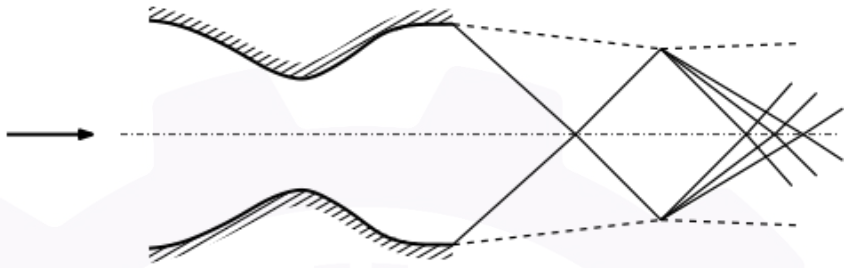
In the figure shown below, the flow at the nozzle exit is ________.
- overexpanded
- underexpanded
- ideally expanded
- subsonic
Official answer: A
GATE AE (Aerospace Engineering) Compressible Flows previous year questions from the Aerodynamics section, with figures and the official answer key where available.
Aerodynamics - Compressible Flows
In the figure shown below, the flow at the nozzle exit is ________.
Official answer: A
Aerodynamics - Compressible Flows
Which of the following statements is/are TRUE regarding critical and drag divergence Mach numbers of a wing?
Official answer: A, B
Aerodynamics - Compressible Flows
A flow is steady, inviscid and one-dimensional, with no shaft work or body forces. Which of the following is/are possible under the given conditions?
Official answer: B, C
Aerodynamics - Compressible Flows
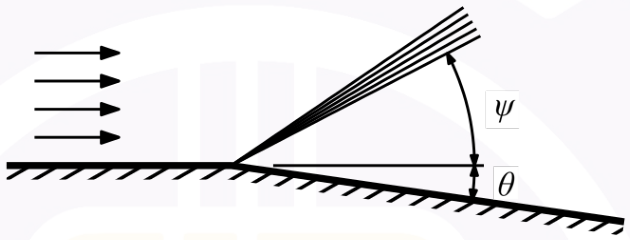
Consider a centered Prandtl-Meyer expansion fan at a $\theta = 4^\circ$ corner in a Mach 1.78 air flow, as shown in the figure below. The angle $\psi$ (see figure) made by the ending wave of the fan with respect to the incoming stream is ________ degrees (rounded off to 1 decimal place). An excerpt from the table of Prandtl-Meyer function for air is provided below. $$\begin{array}{|c|c||c|c||c|c|}\hline M & \nu\,[\deg] & M & \nu\,[\deg] & M & \nu\,[\deg] \\ \hline 1.72 & 18.40 & 1.82 & 21.30 & 1.92 & 24.15 \\ 1.74 & 18.98 & 1.84 & 21.88 & 1.94 & 24.71 \\ 1.76 & 19.56 & 1.86 & 22.45 & 1.96 & 25.27 \\ 1.78 & 20.15 & 1.88 & 23.02 & 1.98 & 25.83 \\ 1.80 & 20.73 & 1.90 & 23.59 & 2.00 & 26.38 \\ \hline\end{array}$$
Official answer: 27.2 to 27.6
Aerodynamics - Compressible Flows
A Mach 1.5 air flow enters a round duct of length 20 cm and diameter 3 cm. If the flow exits with Mach number 1.1, the average Fanning friction factor $f$ of the duct is ________ $\times 10^{-3}$ (rounded off to 1 decimal place). An excerpt from the Fanno flow table for air is given below. $$\begin{array}{|c|c|c|c|c|c|c|}\hline M & 1.1 & 1.2 & 1.3 & 1.4 & 1.5 & 1.6 \\ \hline \dfrac{4fL^*}{D}\times 10^4 & 99.35 & 336.4 & 648.3 & 997.4 & 1361 & 1724 \\ \hline\end{array}$$
Official answer: 4.5 to 5.0
Aerodynamics - Compressible Flows
An aircraft is flying at an altitude of 4500 m above sea level, where the ambient pressure, temperature and density are 57 kPa, 259 K and 0.777 kg/m$^3$, respectively. The speed of the aircraft ($V$) is 230 m/s. Gas constant R = 287 J/kg/K, and specific heat ratio $\gamma = 1.4$. If the stagnation pressure is $p_o$, and static pressure is $p$, the value of $\left[\dfrac{p_o - p}{\frac{1}{2}\rho V^2}\right]$ is ________ (rounded off to two decimal places).
Official answer: 1.08 to 1.14
Aerodynamics - Compressible Flows
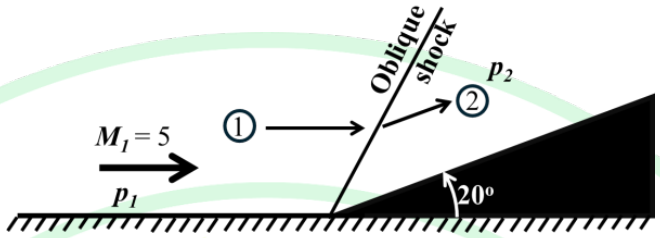
A supersonic stream of an ideal gas at Mach number $M_1 = 5$ is turned by a ramp, as shown in the figure. The ramp angle is $20^\circ$. The pressure ratio is $\dfrac{p_2}{p_1} = 7.125$ and the specific heat ratio is $\gamma = 1.4$. The pressure coefficient on the ramp surface is ________ (rounded off to two decimal places).
Official answer: 0.31 to 0.37
Aerodynamics - Compressible Flows
A perfect gas flows through a frictionless constant-area duct with heat addition. The inlet conditions are as follows: pressure 100 kPa, density 1 kg/m$^3$, and velocity 100 m/s. At a particular downstream location, the gas velocity is 200 m/s. The static pressure at the downstream location is ______ kPa (answer in integer).
Official answer: 90
Aerodynamics - Compressible Flows
The mass flow rate in a supersonic wind tunnel is 2 kg/s when the stagnation pressure and stagnation temperature are 1 MPa and 800 K, respectively. If the stagnation pressure and stagnation temperature are changed to 3 MPa and 200 K, the mass flow rate in the tunnel changes to _______ kg/s (answer in integer).
Official answer: 12
Aerodynamics - Compressible Flows
On Day 1, an aircraft flies with a speed of $V_1$ m/s at an altitude where the temperature is $T_1$ K. On Day 2, the same aircraft flies with a speed of $\sqrt{1.2}\,V_1$ m/s at an altitude where the temperature is $1.2\,T_1$ K. How does the Mach number $M_2$ on Day 2 compare with the Mach number $M_1$ on Day 1? Assume ideal gas behavior for air. Also assume the ratio of specific heats and molecular weight of air to be the same on both the days.
Official answer: B
Aerodynamics - Compressible Flows
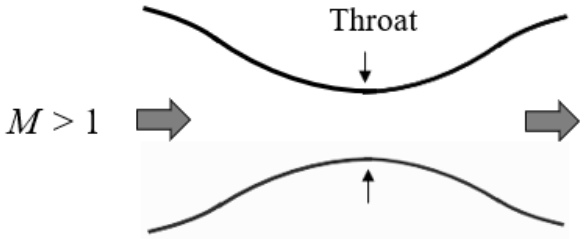
Consider a steady, isentropic, supersonic flow (Mach number $M > 1$) entering a Convergent-Divergent (CD) duct as shown in the figure. Which one of the options correctly describes the flow at the throat?
Official answer: C
Aerodynamics - Compressible Flows
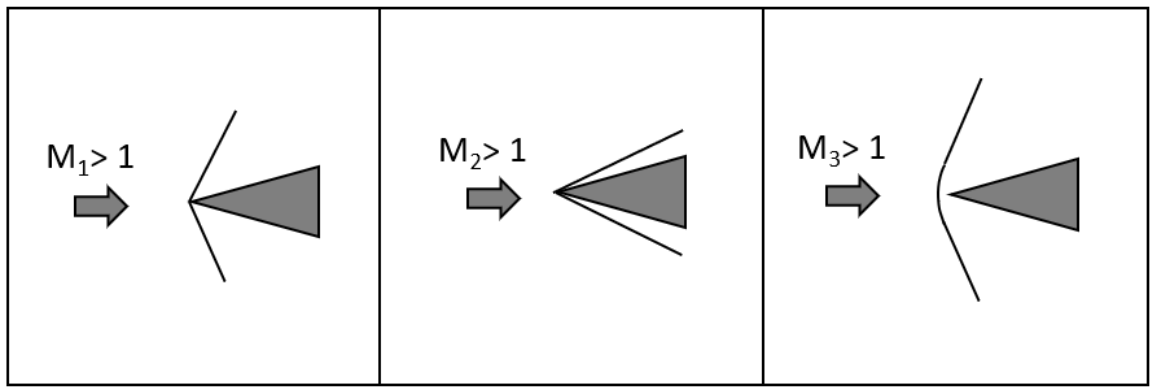
Shock structures for flow at three different Mach numbers over a given wedge are shown in the figure. Assuming that only the weak shock solutions are possible for the attached oblique shocks, which one of the following options is TRUE?
Official answer: D
Aerodynamics - Compressible Flows
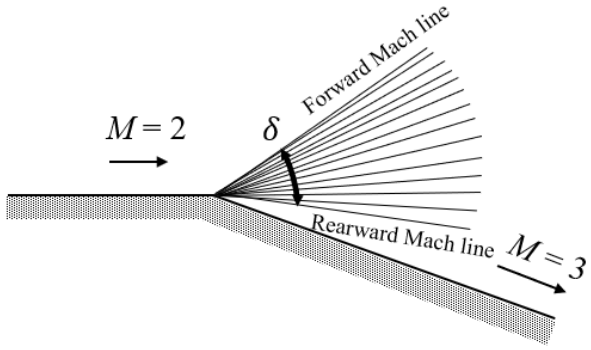
Air flowing at Mach number $M = 2$ from left to right accelerates to $M = 3$ across an expansion corner as shown in the figure. What is the value of $\delta$ (the angle between the Forward and Rearward Mach lines) in degrees? The values of the Prandtl-Meyer functions are $\nu(3) = 49.76^\circ$ and $\nu(2) = 26.38^\circ$.
Official answer: D
Aerodynamics - Compressible Flows
Consider the following Fanno flow problem: Flow enters a constant area duct at a temperature of 273 K and a Mach number 0.2 and eventually reaches sonic condition (Mach number $= 1$) due to friction. Assume $\gamma = 1.4$. The static temperature at the location where sonic condition is reached is _____________ K (rounded off to 2 decimal places).
Official answer: 227.0 to 231.0
Aerodynamics - Compressible Flows
The ratio of the speed of sound in H$_2$ (molecular weight 2 kg/kmol) to that in N$_2$ (molecular weight 28 kg/kmol) at temperature 300 K and pressure 2 bar is ____. (round off to two decimal places)
Official answer: 3.5 to 4.0
Aerodynamics - Compressible Flows
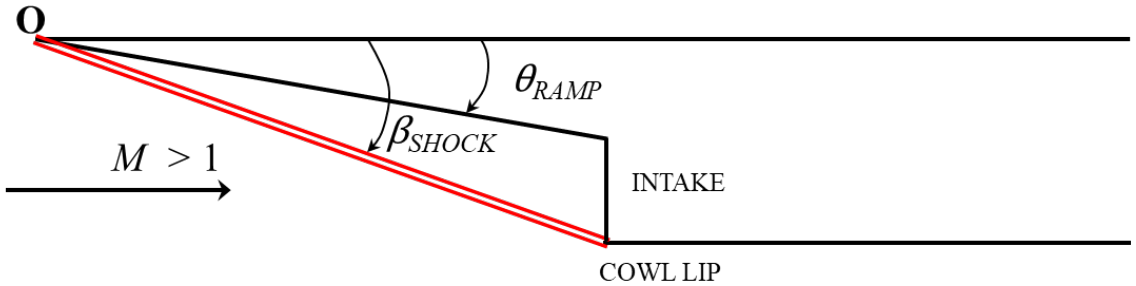
A supersonic aircraft has an air intake ramp that can be rotated about the leading edge $\mathbf{O}$ such that the shock from the leading edge meets the cowl lip as shown in the figure. Select all the correct statement(s) as per oblique shock theory when the flight Mach number $M$ is increased.
Official answer: A
Aerodynamics - Compressible Flows
A perfect gas stored in a large reservoir exhausts into the atmosphere through a convergent duct. The reservoir pressure is $P_0$ and temperature is $T_0$. The jet emerges from the nozzle with average velocity $u$, Mach number $M$, pressure $p$, temperature $T$, and density $\rho$. If the reservoir pressure is increased, then
Official answer: C
Aerodynamics - Compressible Flows
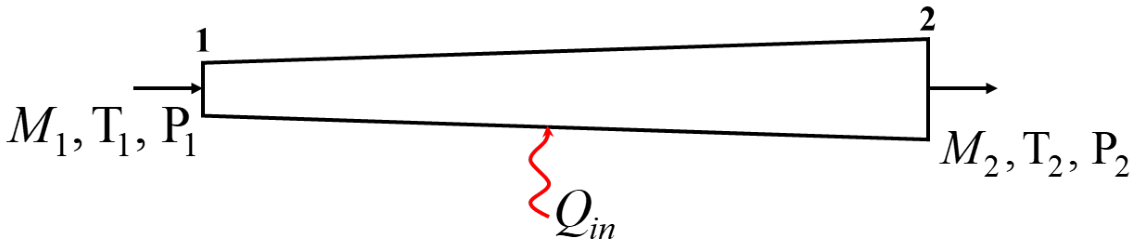
Consider a one-dimensional inviscid supersonic flow in a diverging duct with heat addition ($Q_{in}$) as shown. Which of the following statement(s) is/are always TRUE?
Official answer: B, D
Aerodynamics - Compressible Flows
The point of maximum entropy on a Fanno-curve in a Temperature-Entropy (T-s) diagram represents the
Official answer: C
Aerodynamics - Compressible Flows
Across an oblique shock wave in a calorifically perfect gas,
Official answer: B, D
Aerodynamics - Compressible Flows
A convergent nozzle fed from a constant pressure, constant temperature reservoir, is discharging air to atmosphere at 1 bar (absolute) with choked flow at the exit (marked as $Q$). Flow through the nozzle can be assumed to be isentropic. If the exit area of the nozzle is increased while all the reservoir parameters and ambient conditions remain the same, then at steady state
Official answer: A, C
Aerodynamics - Compressible Flows
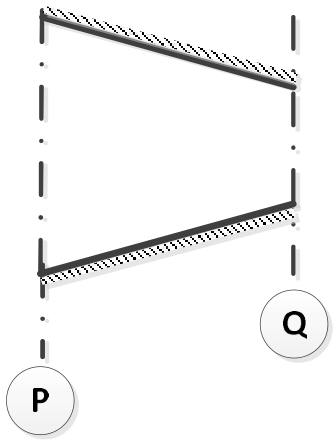
In a converging duct, area and velocity at section P are 1 m$^2$ and 15 m/s, respectively. The temperature of the fluid is 300 K. Air flow through the nozzle can be assumed to be inviscid and isothermal. Characteristic gas constant is 287 J/(kg-K) and ratio of specific heats is 1.4 for air. To ensure that the air flow remains incompressible (Mach number, $M \le 0.3$) in the duct, the minimum area required at section Q is _____ m$^2$ (rounded off to two decimal places).
Official answer: 0.14 to 0.15
Aerodynamics - Compressible Flows
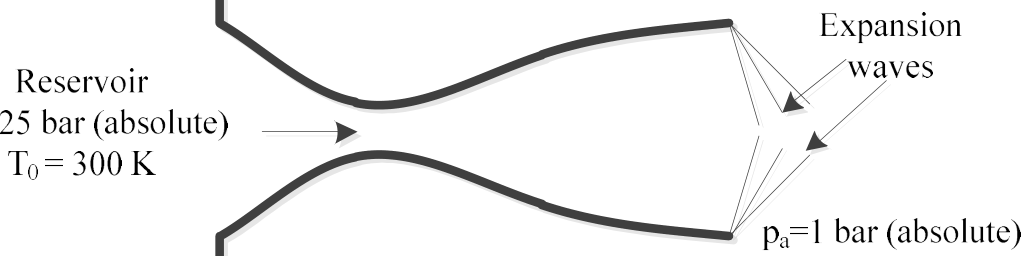
A convergent-divergent nozzle with adiabatic walls is designed for an exit Mach number of 2.3. It is discharging air to atmosphere under the conditions indicated in the figure. Flow through the nozzle is inviscid, the characteristic gas constant for air is 287 J/(kg-K), and $\gamma = 1.4$. When the reservoir pressure is 25 bar (absolute), and temperature is 300 K, Prandtl-Meyer expansion waves appear at the nozzle exit as shown. The minimum percentage change in the reservoir pressure required to eliminate the wave system at the nozzle exit under steady state is _______%.
Aerodynamics - Compressible Flows
A thermocouple, mounted flush in an insulated flat surface in a supersonic laminar flow of air measures the
Official answer: B
Aerodynamics - Compressible Flows
A shock wave is moving into still air in a shock tube. Which one of the following happens to the air?
Official answer: B
Aerodynamics - Compressible Flows
The relation between pressure ($p$) and velocity ($V$) for a steady, isentropic flow at two points along a streamline is, ($c$ is a constant)
Official answer: C
Aerodynamics - Compressible Flows
A thin airfoil is mounted in a low-speed, subsonic wind tunnel, in which the Mach number is 0.1. At a point on the airfoil, the pressure coefficient is measured to be $-1.2$. If the flow velocity is increased such that the free-stream Mach number is 0.6, the pressure coefficient at the same point on the airfoil will approximately be:
Official answer: C
Aerodynamics - Compressible Flows
Air at 50 kPa pressure and 400 K temperature flows in a duct at Mach 3.0. A part of the flow leaks through an opening on the duct wall into the ambient, where the pressure is 30 kPa. The maximum Mach number achieved in the discharge is _______ (accurate to two decimal places). (Ratio of specific heats of air is $\gamma = 1.4$).
Official answer: 3.30 to 3.40
Aerodynamics - Compressible Flows
Consider a $20^\circ$ half-angle wedge in a supersonic flow at Mach 3.0 at standard sea-level conditions. If the shock-wave angle on the wedge is $36^\circ$, the Mach number of the tangential component of the flow post-shock is _______ (accurate to two decimal places).
Official answer: 1.90 to 2.20
Aerodynamics - Compressible Flows
Which of the following statement is NOT TRUE across an oblique shock wave?
Official answer: D
Aerodynamics - Compressible Flows
For a completely subsonic isentropic flow through a convergent nozzle, which of the following statement is TRUE?
Official answer: C
Aerodynamics - Compressible Flows
Consider 1-D, steady, inviscid, compressible flow through a convergent nozzle. The total temperature and total pressure are $T_o$, $P_o$ respectively. The flow through the nozzle is choked with a mass flow rate of $\dot{m}_o$. If the total temperature is increased to $4T_o$, with total pressure remaining unchanged, then the mass flow rate through the nozzle
Official answer: B
Aerodynamics - Compressible Flows
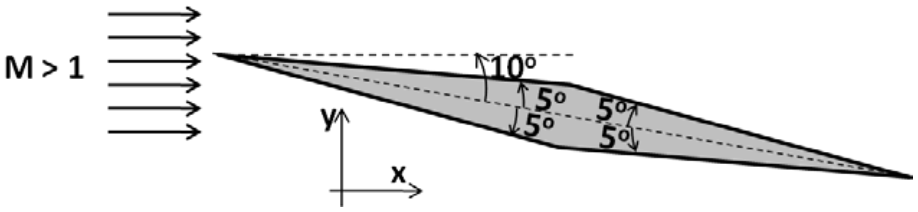
For inviscid, supersonic flow over a diamond shaped airfoil, shown in the figure, which statement is correct among the following?
Official answer: D
Aerodynamics - Compressible Flows
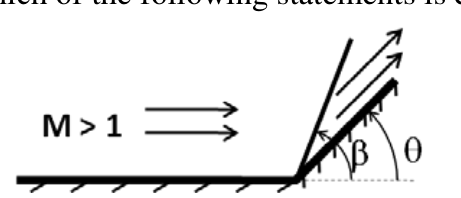
Consider supersonic flow near a corner (at an angle $\theta$ from the horizontal) with an attached oblique shock (at an angle $\beta$ with horizontal) as shown in figure. If Mach number $M$ decreases gradually from a high supersonic value, which of the following statements is correct?
Official answer: B
Aerodynamics - Compressible Flows
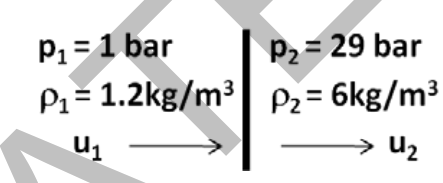
A student needs to find velocity across a stationary normal shock. He measures density and pressure across the shock as shown in the figure below. 1 bar = $10^5$ Pa. (No shock table is needed for the calculations). The value of $u_1$ in m/s is ____. ($p_1 = 1$ bar, $\rho_1 = 1.2$ kg/m$^3$; $p_2 = 29$ bar, $\rho_2 = 6$ kg/m$^3$)
Official answer: 1705 to 1720
Aerodynamics - Compressible Flows
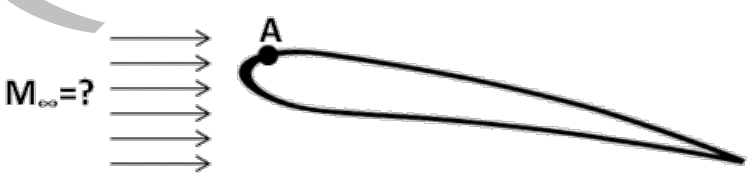
For inviscid, compressible flow past a thin airfoil, shown in the figure, free-stream Mach number and pressure are denoted by $M_\infty$ and $p_\infty$ respectively. Ratio of pressure at point A and $p_\infty$ is 0.8 and specific heat ratio is 1.4. If the Mach number at point A is 1.0 and rest of the flow field is subsonic, the value of $M_\infty$ is
Official answer: B
Aerodynamics - Compressible Flows
An aircraft is flying at Mach 3.0 at an altitude where the ambient pressure and temperature are 50 kPa and 200 K respectively. If the converging-diverging diffuser of the engine (considered isentropic with ratio of specific heats, $\gamma = 1.4$ and specific gas constant $R = 287$ J/kgK) has a throat area of 0.05 m$^2$, the mass flow rate through the engine in kg/s is
Official answer: D