GATE AE Basic Fluid Mechanics: Previous Year Questions
GATE AE (Aerospace Engineering) Basic Fluid Mechanics previous year questions from the Aerodynamics section, with figures and the official answer key where available.
All GATE AE papers
GATE AE 2026, Question 34 (1 mark, NAT)
Aerodynamics - Basic Fluid Mechanics
The vortex shedding frequency behind a landing gear model is found to be 50 Hz when tested in a wind tunnel operating at 5 m/s. If the actual landing gear size is 10 times that of the model, and it is designed to operate at 50 m/s, then the expected vortex shedding frequency behind it is ________ Hz (rounded off to the nearest integer).
Official answer: 50
GATE AE 2026, Question 43 (2 marks, MCQ)
Aerodynamics - Basic Fluid Mechanics
An experimental study is planned to map out the low-Reynolds number incompressible steady two-dimensional aerodynamic characteristics of a promising novel airfoil. The operational parameters of the problem are the speed, density and viscosity of the freestream, the chord of the airfoil and its angle of attack. If the objective is to achieve this with the minimum number of test runs $N_{min}$ while taking 10 equally-spaced test values of each independent parameter of the problem in a suitable range, then $N_{min}$ is ________.
- 10
- 100
- 10,000
- 1,00,000
Official answer: B
GATE AE 2025, Question 21 (1 mark, MCQ)
Aerodynamics - Basic Fluid Mechanics
In a fluid flow, Mach number is an estimate of _____.
- $\sqrt{\dfrac{\text{inertia force}}{\text{viscous force}}}$
- $\sqrt{\dfrac{\text{inertia force}}{\text{elastic force}}}$
- $\sqrt{\dfrac{\text{elastic force}}{\text{viscous force}}}$
- $\sqrt{\dfrac{\text{viscous force}}{\text{inertia force}}}$
Official answer: B
GATE AE 2025, Question 47 (2 marks, NAT)
Aerodynamics - Basic Fluid Mechanics
A rectangular wing of 1.2 m chord length and aspect ratio 5 is tested in a wind tunnel at an air speed of 60 m/s. The density and the dynamic viscosity of air are 1.3 kg/m$^3$ and $1.8 \times 10^{-5}$ kg/m-s, respectively. A second rectangular wing of the same span, but with an aspect ratio of 6, is to be tested in the same tunnel at the same Reynolds number. The air speed at which the second test should be performed is _______ m/s (answer in integer).
Official answer: 72
GATE AE 2025, Question 48 (2 marks, NAT)
Aerodynamics - Basic Fluid Mechanics
In a low-speed airplane, a venturimeter with 1.3:1 area ratio is used for airspeed measurement. The airplane's maximum speed at sea level is 90 m/s. If the density of air at sea level is 1.225 kg/m$^3$, the maximum pressure difference between the inlet and the throat of the venturimeter is ________ kPa (rounded off to two decimal places).
Official answer: 3.20 to 3.45
GATE AE 2024, Question 63 (2 marks, NAT)
Aerodynamics - Basic Fluid Mechanics
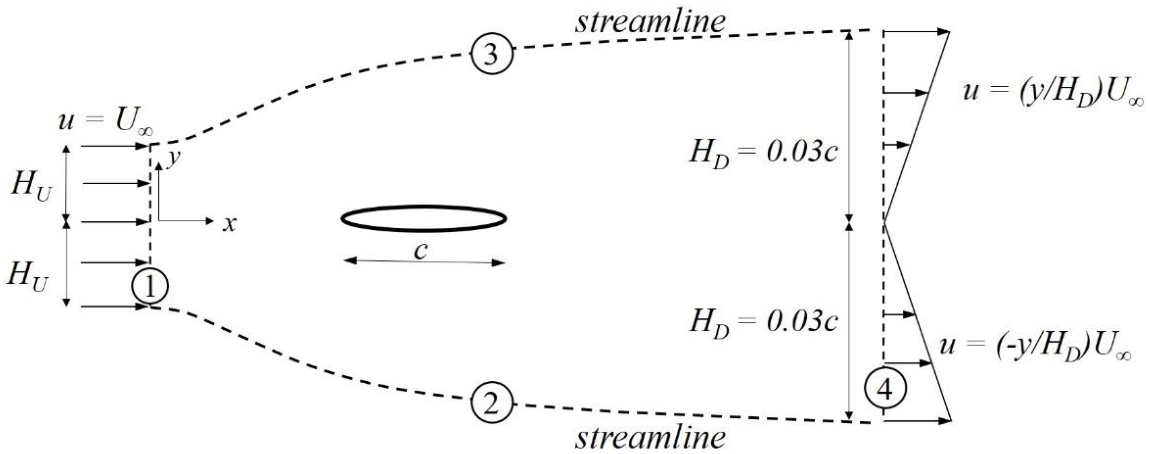
The figure (not to scale) shows a control volume to estimate the forces on the airfoil with elliptic cross-section. Surfaces 2 and 3 are streamlines. Velocity profiles are measured at the upstream end (surface 1) and at the downstream end (surface 4) of the control volume. The drag coefficient for the airfoil is defined as $C_d = \dfrac{D}{\frac{1}{2}\rho U_\infty^2 c}$, where $D$ is the drag force on the airfoil per unit span and $\rho$ is the density of the air. The static pressure, $p_\infty$, is constant over the entire surface of the control volume. Assuming the flow to be incompressible, two-dimensional and steady, the $C_d$ for the airfoil is _________ (rounded off to 3 decimal places).
Official answer: 0.018 to 0.022
GATE AE 2024, Question 65 (2 marks, NAT)
Aerodynamics - Basic Fluid Mechanics
It is desired to estimate the aerodynamic drag, $D$, on a car traveling at a speed of 30 m/s. A one-third scale model of the car is tested in a wind-tunnel following the principles of dynamic similarity. The drag on the scaled model is measured to be $D_m$. The ratio $D/D_m$ is _________ (rounded off to 1 decimal place).
Official answer: 1
GATE AE 2023, Question 58 (2 marks, NAT)
Aerodynamics - Basic Fluid Mechanics
Enstrophy is defined as the square of the magnitude of vorticity. For the three-dimensional velocity field $$\vec{V} = (4x - 1.5y + 2.5z)\hat{i} + (1.5x - 1.5y)\hat{j} + (0.7xy)\hat{k},$$ the enstrophy at location (1, 1, 1) is ________. (round off to two decimal places)
Official answer: 12.61 to 12.81
GATE AE 2022, Question 16 (1 mark, MCQ)
Aerodynamics - Basic Fluid Mechanics
Consider steady, two-dimensional, incompressible flow over a non-porous flat plate as shown in the figure. For the control volume PQRS, the speed, $u_\infty$, at section PQ is uniform and the speed at section RS is given by $u(y) = A_0\left(\dfrac{y}{h}\right)^n$, where $n$ is a positive integer. The value of $A_0$ for which the flow through section PS will vanish is:

- $\dfrac{u_\infty}{n+1}$
- $u_\infty(n+1)$
- $\dfrac{u_\infty}{n-1}$
- $u_\infty(n-1)$
Official answer: B
GATE AE 2022, Question 39 (2 marks, MCQ)
Aerodynamics - Basic Fluid Mechanics
A cylindrical object of diameter 900 mm is designed to move axially in air at 60 m/s. Its drag is estimated on a geometrically half-scaled model in water, assuming flow similarity. Coefficients of dynamic viscosity and densities for air and water are $1.86 \times 10^{-5}$ Pa-s, 1.2 kg/m$^3$ and $1.01 \times 10^{-3}$ Pa-s, 1000 kg/m$^3$ respectively. Drag measured for the model is 2280 N. Drag experienced by the full-scale object is ____ N (rounded off to the nearest integer).
- 322
- 644
- 1288
- 2576
Official answer: B
GATE AE 2022, Question 50 (2 marks, NAT)
Aerodynamics - Basic Fluid Mechanics
A rotational velocity field in an air flow is given as $\vec{V} = ay\hat{i} + bx\hat{j}$, with $a = 10\ \text{s}^{-1}$, $b = 20\ \text{s}^{-1}$. The air density is 1.0 kg/m$^3$ and the pressure at $(x,y) = (0\ \text{m}, 0\ \text{m})$ is 100 kPa. Neglecting gravity, the pressure at $(x,y) = (6\ \text{m}, 8\ \text{m})$ is _____ kPa (rounded off to nearest integer).
Official answer: 88 to 91
GATE AE 2018, Question 49 (2 marks, NAT)
Aerodynamics - Basic Fluid Mechanics
Consider a cubical tank of side 2 m with its top open. It is filled with water up to a height of 1 m. Assuming the density of water to be 1000 kg/m$^3$, $g$ as 9.81 m/s$^2$ and the atmospheric pressure to be 100 kPa, the net hydrostatic force (in kN) on the side face of the tank due to the air and water is ______ (accurate to two decimal places).
Official answer: 9.80 to 9.81
GATE AE 2016, Question 40 (2 marks, NAT)
Aerodynamics - Basic Fluid Mechanics
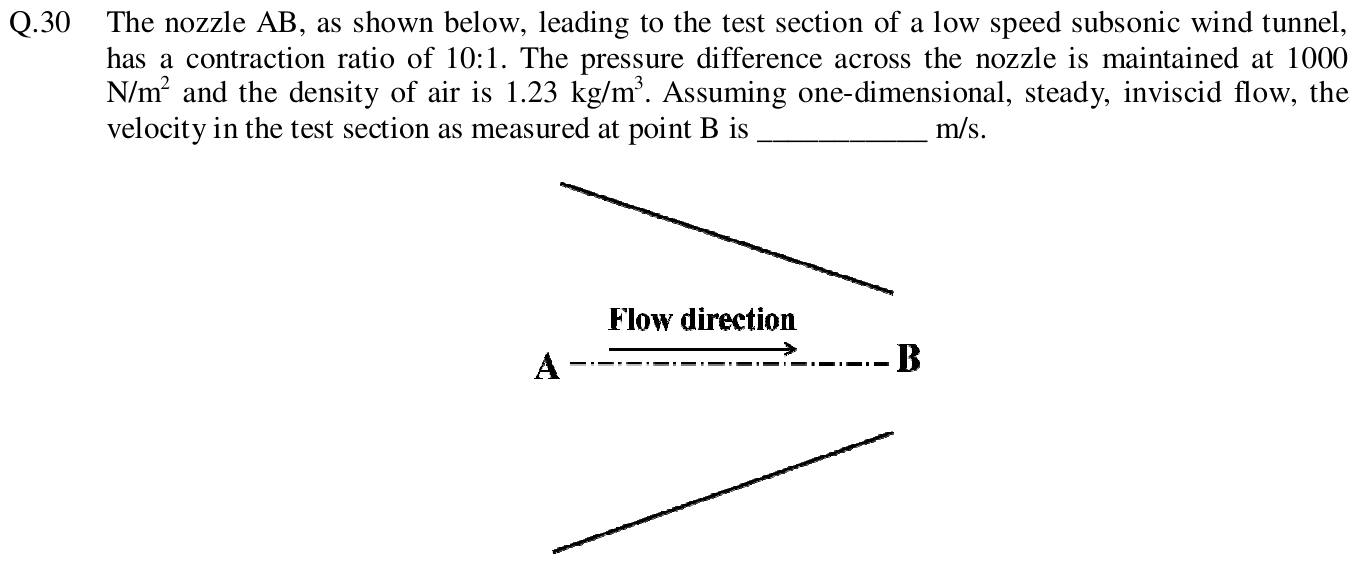
The nozzle AB, as shown below, leading to the test section of a low speed subsonic wind tunnel, has a contraction ratio of 10:1. The pressure difference across the nozzle is maintained at 1000 N/m$^2$ and the density of air is 1.23 kg/m$^3$. Assuming one-dimensional, steady, inviscid flow, the velocity in the test section as measured at point B is ___________ m/s.
Official answer: 40.0 to 41.0
GATE AE 2014, Question 20 (1 mark, MCQ)
Aerodynamics - Basic Fluid Mechanics
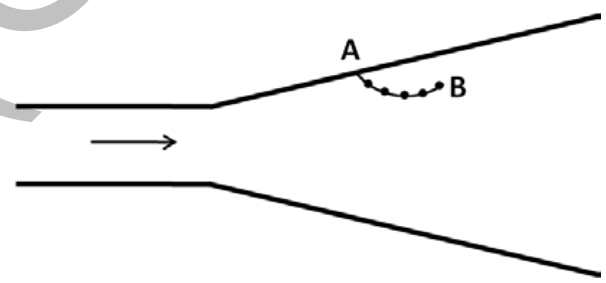
To observe unsteady separated flow in a diverging channel, bubbles are injected at each 10 ms interval at point A as shown in figure. These bubbles act as tracer particles and follow the flow faithfully. The curved line AB shown at any instant represents:
- Streamline, streakline and pathline
- Streamline and pathline
- Only a pathline
- Only a streakline
Official answer: D
GATE AE 2014, Question 41 (2 marks, NAT)
Aerodynamics - Basic Fluid Mechanics
For a steady, incompressible two-dimensional flow, represented in Cartesian co-ordinates $(x, y)$, a student correctly writes the equation of pathline of any arbitrary particle as, $\dfrac{dx}{dt} = ax$ and $\dfrac{dy}{dt} = by$, where $a$ and $b$ are constants having unit of (second)$^{-1}$. If value of $a$ is 5, the value of $b$ is _____.
Official answer: -5.01 to -4.99
GATE AE 2014, Question 42 (2 marks, MCQ)
Aerodynamics - Basic Fluid Mechanics
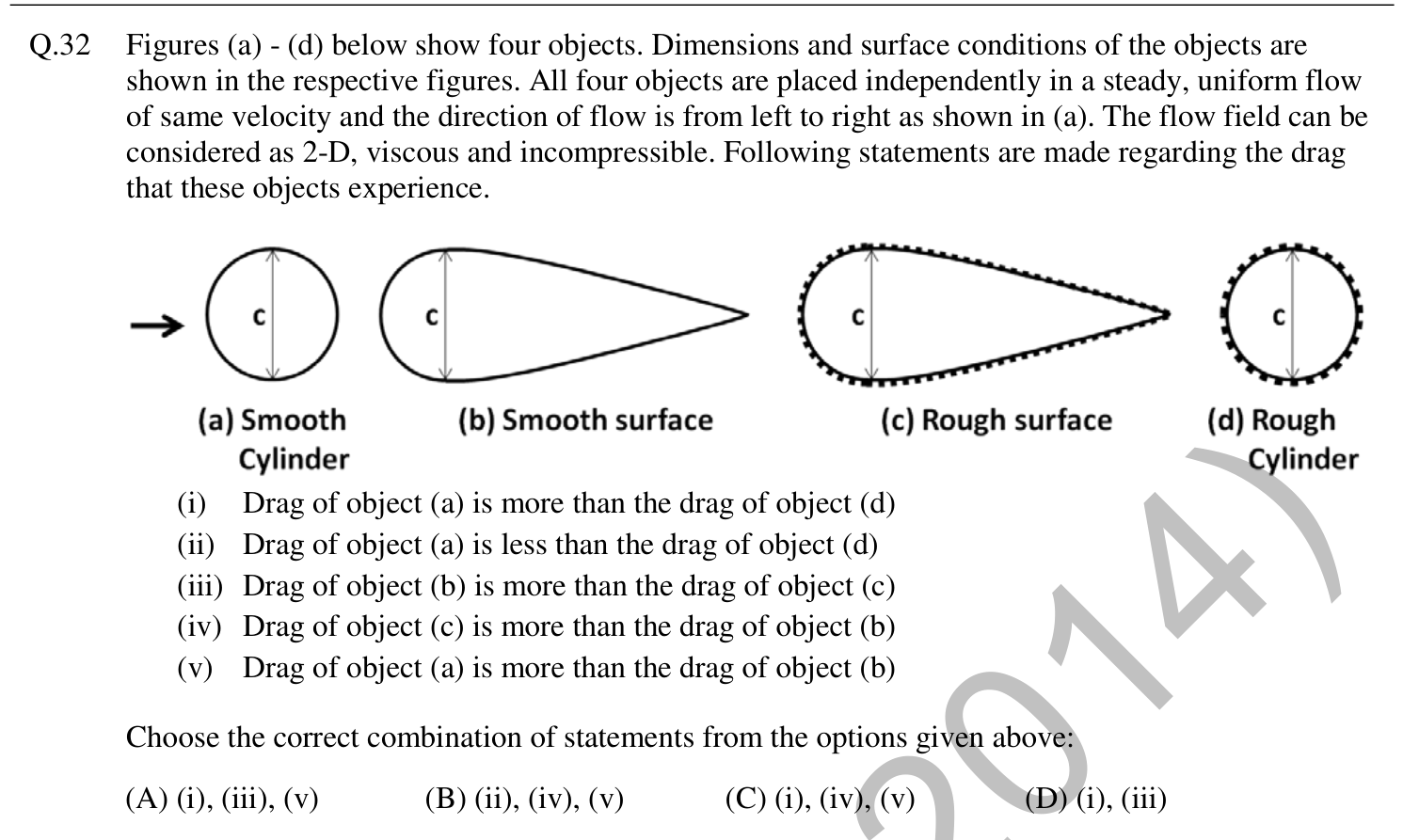
Figures (a) - (d) below show four objects. Dimensions and surface conditions of the objects are shown in the respective figures. All four objects are placed independently in a steady, uniform flow of same velocity and the direction of flow is from left to right as shown in (a). The flow field can be considered as 2-D, viscous and incompressible. Following statements are made regarding the drag that these objects experience. (i) Drag of object (a) is more than the drag of object (d). (ii) Drag of object (a) is less than the drag of object (d). (iii) Drag of object (b) is more than the drag of object (c). (iv) Drag of object (c) is more than the drag of object (b). (v) Drag of object (a) is more than the drag of object (b). Choose the correct combination of statements from the options given above:
- (i), (iii), (v)
- (ii), (iv), (v)
- (i), (iv), (v)
- (i), (iii)
Official answer: C
GATE AE 2014, Question 45 (2 marks, MCQ)
Aerodynamics - Basic Fluid Mechanics
A student can measure free-stream velocity of a low-speed wind tunnel using a: i. Pitot tube alone aligned with the flow direction. ii. Pitot tube aligned with the flow direction with static pressure measurement at an appropriate position on the tunnel wall. iii. Pitot tube aligned with the flow direction along with barometer pressure reading of the outside ambient. iv. Pitot static tube alone aligned with the flow direction. Considering the above statements, which of the following options is correct?
- (i) only
- (i) & (ii)
- (ii) & (iv)
- (i), (iii) & (iv)
Official answer: C
GATE AE 2014, Question 47 (2 marks, NAT)
Aerodynamics - Basic Fluid Mechanics
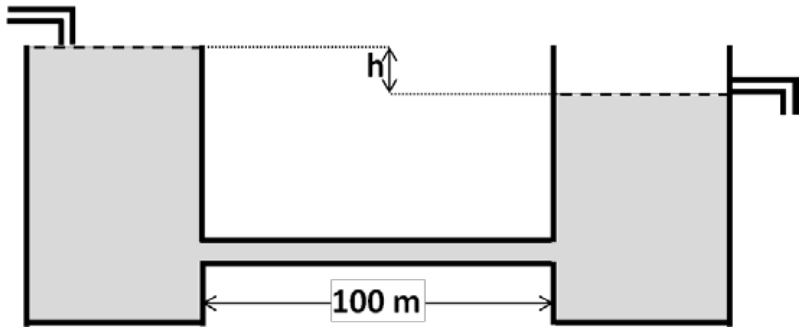
Two overflowing water reservoirs are connected with a 100 m long pipe of circular cross-section (of radius, $R = 0.02$ m), such that height difference $h$ remains constant as shown in the figure below. The centerline velocity in the pipe is 10 m/s. The velocity profile inside the pipe over the entire length is $u = -\dfrac{R^2}{4\mu}\dfrac{dp}{dx}\left[1 - \dfrac{r^2}{R^2}\right]$, where, $\dfrac{dp}{dx}$ is a constant pressure gradient along the pipe length, $x$ is measured from the left end of the pipe along its central axis and $r$ is radial location inside the pipe with respect to its axis. (Given data: Density and kinematic viscosity of water are 1000 kg/m$^3$ and $1 \times 10^{-6}$ m$^2$/s respectively; acceleration due to gravity is 10 m/s$^2$). If all other losses except the frictional losses at the pipe wall are neglected, the value of $h$ in meter is ____.
Official answer: 0.99 to 1.01