GATE AE Airplane Performance: Previous Year Questions
GATE AE (Aerospace Engineering) Airplane Performance previous year questions from the Flight Mechanics & Space Dynamics section, with figures and the official answer key where available.
All GATE AE papers
GATE AE 2026, Question 31 (1 mark, NAT)
Flight Mechanics & Space Dynamics - Airplane Performance
An aircraft starts gliding in power-off condition at an altitude of 4 km. Given that the maximum lift to drag ratio of the aircraft is 15, the maximum glide range that the aircraft can cover, measured along the ground, is ________ km (rounded off to the nearest integer).
Official answer: 60
GATE AE 2026, Question 57 (2 marks, NAT)
Flight Mechanics & Space Dynamics - Airplane Performance
$W_A$ and $W_B$ are the respective maximum take-off weights of an aircraft for two ambient air conditions given below. Condition A: $p = 1$ bar, $T = 50\,^\circ$C; Condition B: $p = 0.66$ bar, $T = -30\,^\circ$C. If all other parameters relevant for take-off are kept the same in these two conditions, the ratio $W_B/W_A$ is ________ (rounded off to 3 decimal places).
Official answer: 0.860 to 0.890
GATE AE 2025, Question 39 (2 marks, MSQ)
Flight Mechanics & Space Dynamics - Airplane Performance
A general aviation airplane is gliding with a speed $V_g$ at minimum glide angle. Which of the following statements is/are true?
- $V_g$ is equal to the speed corresponding to the maximum lift to drag ratio of the airplane.
- $V_g$ increases with decreasing wing loading when all other parameters remain constant.
- $V_g$ increases with decreasing altitude when all other parameters remain constant.
- $V_g$ increases with increasing altitude when all other parameters remain constant.
Official answer: A, D
GATE AE 2025, Question 52 (2 marks, NAT)
Flight Mechanics & Space Dynamics - Airplane Performance
A jet-powered airplane is steadily climbing at a rate of 10 m/s. The air density is 0.8 kg/m$^3$, and the thrust force is aligned with the flight path. Using the information provided in the table below, the airplane's thrust to weight ratio is ______ (rounded off to one decimal place). $$\begin{array}{|l|r|}\hline \text{Airplane speed} & 80\\ \text{m/s} \\ \text{Lift coefficient, } C_L & 0.8 \\ \text{Aspect ratio} & 6 \\ \text{Oswald efficiency factor} & 0.8 \\ \text{Zero-lift drag coefficient} & 0.02 \\ \hline\end{array}$$
Official answer: 0.2
GATE AE 2025, Question 54 (2 marks, NAT)
Flight Mechanics & Space Dynamics - Airplane Performance
While taking off, the net external force acting on an airplane during the ground roll segment can be assumed to be constant. The airplane starts from rest. $S_{LO}$ and $V_{LO}$ are the ground roll distance and the lift-off speed, respectively. $\alpha V_{LO}$ ($\alpha > 0$) denotes the airplane speed at $0.5\,S_{LO}$. Neglecting changes in the airplane mass during the ground roll segment, the value of $\alpha$ is _____ (rounded off to two decimal places).
Official answer: 0.70 to 0.71
GATE AE 2024, Question 20 (1 mark, MCQ)
Flight Mechanics & Space Dynamics - Airplane Performance
Which one of the following figures represents the drag polar of a general aviation aircraft?
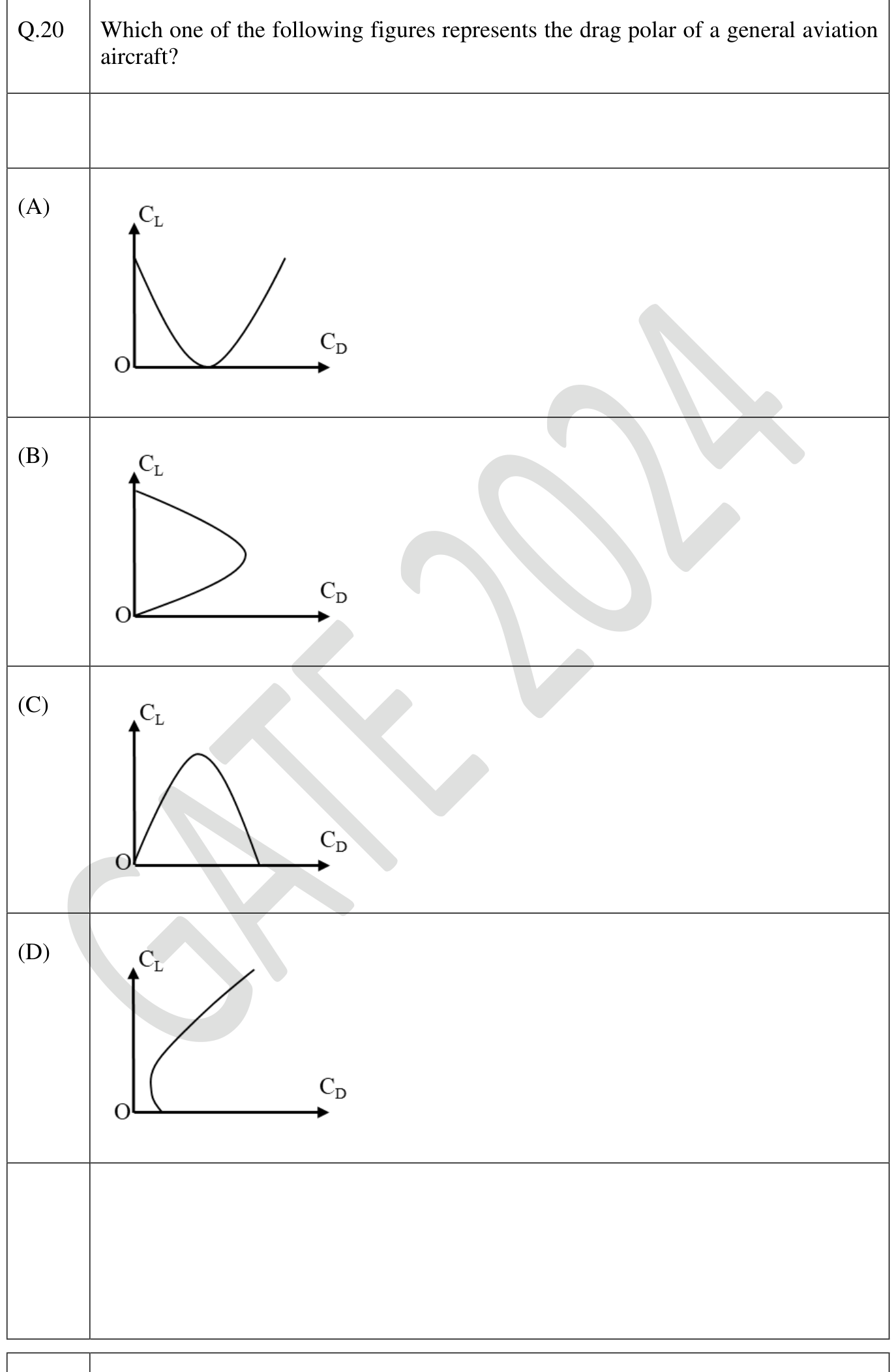
Official answer: D
GATE AE 2024, Question 28 (1 mark, MSQ)
Flight Mechanics & Space Dynamics - Airplane Performance
Which of the following statements about a general aviation aircraft, while operating at point $Q$ in the $V$-$n$ diagram, is/are true?
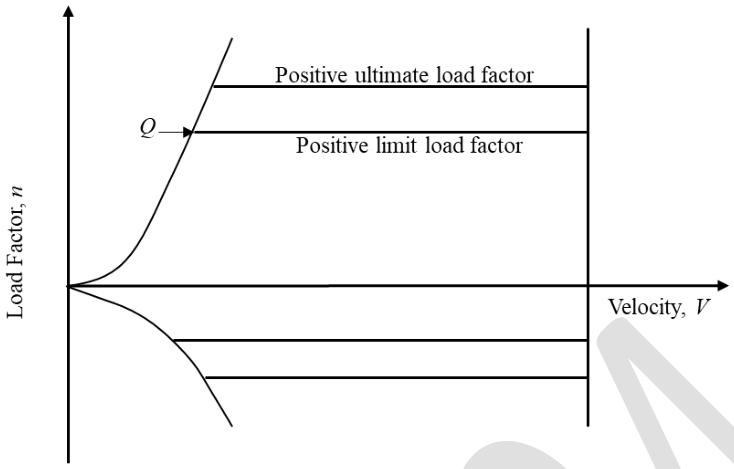
- The aircraft has the highest turn rate
- The aircraft has the smallest turn radius
- The aircraft is flying with minimum drag
- The aircraft is operating at $C_{L,max}$
Official answer: A, B, D
GATE AE 2024, Question 33 (1 mark, NAT)
Flight Mechanics & Space Dynamics - Airplane Performance
An airplane experiences a net vertical ground reaction of 15000 N during landing. The weight of the airplane is 10000 N. The landing vertical load factor, defined as the ratio of inertial load to the weight of the aircraft, is __________ (rounded off to 1 decimal place).
Official answer: 1.5
GATE AE 2024, Question 47 (2 marks, MSQ)
Flight Mechanics & Space Dynamics - Airplane Performance
Which of the following statements about absolute ceiling and service ceiling for a piston-propeller aircraft is/are correct?
- The altitude corresponding to absolute ceiling is higher than that for service ceiling
- At the absolute ceiling, the power required for cruise equals the maximum power available
- The altitude corresponding to absolute ceiling is lower than that for service ceiling
- At the service ceiling, the maximum rate of climb is 50 ft/min
Official answer: A, B
GATE AE 2023, Question 17 (1 mark, MCQ)
Flight Mechanics & Space Dynamics - Airplane Performance
An ideal glider has drag characteristics given by $C_D = C_{D_0} + C_{D_i}$, where $C_{D_i} = KC_L^2$ is the induced drag coefficient, $C_L$ is the lift coefficient, and $K$ is a constant. For maximum range of the glider, the ratio $C_{D_0}/C_{D_i}$ is
- 1
- $\dfrac{1}{3}$
- 3
- $\dfrac{3}{2}$
Official answer: A
GATE AE 2023, Question 32 (1 mark, NAT)
Flight Mechanics & Space Dynamics - Airplane Performance
An airplane weighing 40 kN is landing on a horizontal runway during which it is retarded by an arresting cable mechanism. The tension in the arresting cable at a given instant, as shown in the figure, is 100 kN. Assuming that the thrust from the engine continues to balance airplane drag, the magnitude of horizontal load factor is ________. (round off to one decimal place)
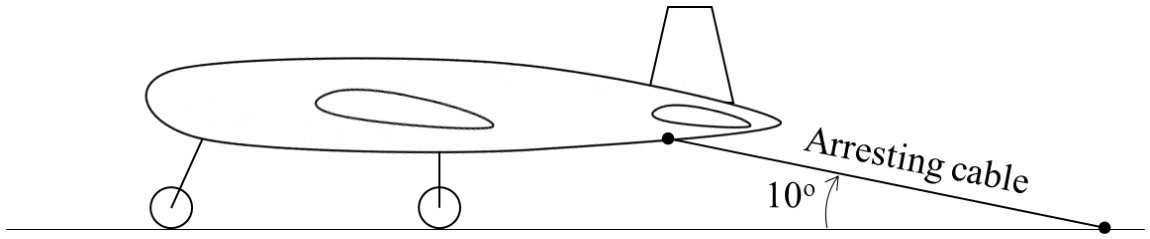
Official answer: 2.4 to 2.6
GATE AE 2023, Question 40 (2 marks, MCQ)
Flight Mechanics & Space Dynamics - Airplane Performance
Consider a general aviation airplane with weight 10 kN and a wing planform area of 15 m$^2$. The drag coefficient of the airplane is given as $C_D = C_{D_0} + KC_L^2$ with $C_{D_0} = 0.025$ and $K = 0.05$. For level flight at an altitude where the density is 0.60 kg/m$^3$ and thrust 1 kN, the maximum cruise speed is (rounded off to the nearest integer)
- 87 m/s
- 30 m/s
- 36 m/s
- 101 m/s
Official answer: A
GATE AE 2023, Question 59 (2 marks, NAT)
Flight Mechanics & Space Dynamics - Airplane Performance
An airplane with wing planform area of 20 m$^2$ and weight 8 kN is flying straight and level with a speed of 100 m/s. The total drag coefficient is 0.026 and the air density is 0.7 kg/m$^3$. The total thrust required to introduce a steady climb angle of 0.1 radians is ____ N. (round off to the nearest integer)
Official answer: 2615 to 2625
GATE AE 2023, Question 60 (2 marks, NAT)
Flight Mechanics & Space Dynamics - Airplane Performance
The maximum permissible load factor and the maximum lift force coefficient for an airplane is 7 and 2, respectively. For a wing loading of 6500 N/m$^2$ and air density 1.23 kg/m$^3$, the speed yielding the highest possible turn rate in the vertical plane is ___________ m/s. (round off to the nearest integer)
Official answer: 190 to 195
GATE AE 2022, Question 18 (1 mark, MCQ)
Flight Mechanics & Space Dynamics - Airplane Performance
The service ceiling of an airplane is the altitude
- at which maximum rate of climb is 100 m/min
- beyond which theoretically the airplane cannot sustain level flight
- at which maximum power is required for flight
- at which maximum rate of climb is 100 ft/min
Official answer: D
GATE AE 2022, Question 32 (1 mark, NAT)
Flight Mechanics & Space Dynamics - Airplane Performance
An unpowered glider is flying at a glide angle of 10 degrees. Its lift-to-drag ratio is ________ (round off to two decimal places).
Official answer: 5.55 to 5.80
GATE AE 2022, Question 56 (2 marks, NAT)
Flight Mechanics & Space Dynamics - Airplane Performance
A conventional airplane of mass 5000 kg is doing a level turn of radius 1000 m at a constant speed of 100 m/s at sea level. Taking the acceleration due to gravity as 10 m/s$^2$, the bank angle of the airplane is ______________ degrees.
Official answer: 44 to 46
GATE AE 2018, Question 14 (1 mark, MCQ)
Flight Mechanics & Space Dynamics - Airplane Performance
A jet aircraft is initially flying steady and level at its maximum endurance condition. For the aircraft to fly steady and level, but faster at the same altitude, the pilot should
- increase thrust alone.
- increase thrust and increase angle of attack.
- increase thrust and reduce angle of attack.
- reduce angle of attack alone.
Official answer: C
GATE AE 2018, Question 17 (1 mark, MCQ)
Flight Mechanics & Space Dynamics - Airplane Performance
An airplane requires a longer ground roll to lift-off on hot summer days because
- the thrust is directly proportional to free-stream density.
- the thrust is directly proportional to weight of the aircraft.
- the lift-off distance is directly proportional to free-stream density.
- the runway friction is high on hot summer days.
Official answer: A
GATE AE 2018, Question 26 (1 mark, MCQ)
Flight Mechanics & Space Dynamics - Airplane Performance
The highest limit load factor experienced by a civil transport aircraft is in the range
- 0.0 – 2.0
- 2.0 – 5.0
- 5.0 – 8.0
- 8.0 – 10.0
Official answer: B
GATE AE 2018, Question 50 (2 marks, NAT)
Flight Mechanics & Space Dynamics - Airplane Performance
An aircraft with mass of 400,000 kg cruises at 240 m/s at an altitude of 10 km. Its lift to drag ratio at cruise is 15. Assuming $g$ as 9.81 m/s$^2$, the power (in MW) needed for it to cruise is _______ (accurate to two decimal places).
Official answer: 62.00 to 63.50
GATE AE 2018, Question 58 (2 marks, NAT)
Flight Mechanics & Space Dynamics - Airplane Performance
Gross weight of an airplane is 7000 N, wing area is 16 m$^2$, and the maximum lift coefficient is 2.0. Assuming density at the altitude as 1.23 kg/m$^3$, the stall speed (in m/s) of the aircraft is _________ (accurate to two decimal places).
Official answer: 18.80 to 18.90
GATE AE 2016, Question 34 (1 mark, MCQ)
Flight Mechanics & Space Dynamics - Airplane Performance
The pitch angle and the angle of attack for a fixed wing aircraft are equal during
- wings level constant altitude flight.
- unaccelerated climb.
- unaccelerated descent.
- landing.
Official answer: A
GATE AE 2016, Question 35 (1 mark, MCQ)
Flight Mechanics & Space Dynamics - Airplane Performance
The load factor of an aircraft turning at a constant altitude is 2. The coefficient of lift required for turning flight as compared to level flight at the same speed will be
- same
- half
- double
- four times
Official answer: C
GATE AE 2016, Question 60 (2 marks, NAT)
Flight Mechanics & Space Dynamics - Airplane Performance
An aircraft weighing 10000 N is flying level at 100 m/s and it is powered by a jet engine. The thrust required for level flight is 1000 N. The maximum possible thrust produced by the jet engine is 5000 N. The minimum time required to climb 1000 m, when flight speed is 100 m/s, is ________ s.
Official answer: 25
GATE AE 2016, Question 63 (2 marks, NAT)
Flight Mechanics & Space Dynamics - Airplane Performance
A glider weighing 3300 N is flying at 1000 m above sea level. The wing area is 14.1 m$^2$ and the air density is 1.23 kg/m$^3$. Under zero wind conditions, the velocity for maximum range is __________ m/s. $$\begin{array}{|c|c|c|c|}\hline \alpha\\ (\deg) & C_L & C_D & C_L/C_D \\ \hline 11 & 1.46 & 0.0865 & 16.9 \\ 9 & 1.36 & 0.0675 & 20.1 \\ 7 & 1.23 & 0.0535 & 22.9 \\ 5 & 1.08 & 0.0440 & 24.5 \\ 3 & 0.90 & 0.0350 & 25.7 \\ 1 & 0.70 & 0.0275 & 25.4 \\ -1 & 0.49 & 0.0220 & 22.2 \\ -3 & 0.25 & 0.0180 & 13.8 \\ \hline \end{array}$$
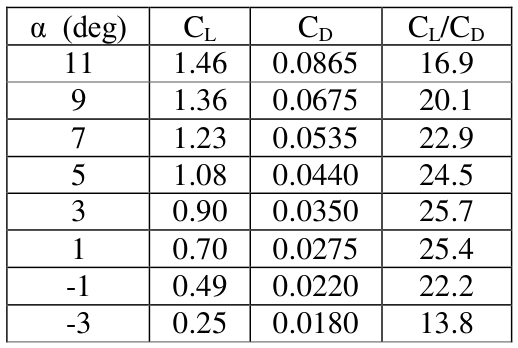
Official answer: 20.0 to 21.0
GATE AE 2014, Question 33 (1 mark, MCQ)
Flight Mechanics & Space Dynamics - Airplane Performance
Under what condition should a glider be operated to ensure minimum sink rate?
- Maximum $C_L/C_D$
- Minimum $C_L/C_D$
- Maximum $C_D/C_L^{3/2}$
- Minimum $C_D/C_L^{3/2}$
Official answer: D
GATE AE 2014, Question 61 (2 marks, MCQ)
Flight Mechanics & Space Dynamics - Airplane Performance
For a given airplane with a given wing loading executing a turn in the vertical plane, under what conditions will the turn radius be minimum and the turn rate be maximum?
- Highest possible $C_L$ and lowest possible load factor
- Lowest possible $C_L$ and lowest possible load factor
- Lowest possible $C_L$ and highest possible load factor
- Highest possible $C_L$ and highest possible load factor
Official answer: D
GATE AE 2014, Question 62 (2 marks, NAT)
Flight Mechanics & Space Dynamics - Airplane Performance
Lift-off distance for a given aircraft of weight $W$ is $S_{LO}$. If the take-off weight is reduced by 10%, then the magnitude of percentage change in the lift-off distance (assume all other parameters to remain constant) is _______.
Official answer: 18 to 20
GATE AE 2014, Question 63 (2 marks, MCQ)
Flight Mechanics & Space Dynamics - Airplane Performance
Which of the following design parameters influence the maximum rate-of-climb for a jet-propelled airplane? P. Wing loading; Q. Maximum thrust-to-weight ratio; R. Zero-lift drag coefficient; S. Aspect ratio.
- P and Q alone
- P, Q, R and S
- P, Q and S alone
- Q, R, and S alone
Official answer: B
GATE AE 2014, Question 65 (2 marks, MCQ)
Flight Mechanics & Space Dynamics - Airplane Performance
Data for a light, single-engine, propeller driven aircraft in steady level flight at sea-level is as follows: velocity $V_\infty = 40$ m/s, weight $W = 13000$ N, lift coefficient $C_L = 0.65$, drag coefficient $C_D = 0.025 + 0.04C_L^2$ and power available $P_{av} = 100{,}000$ J/s. The rate of climb possible for this aircraft under the given conditions (in m/s) is
- 7.20
- 5.11
- 6.32
- 4.23
Official answer: B